




Abstract
Translation studies have demonstrated its dynamic and constantly evolving nature, propelled by various influential factors. This study conducts a bibliometric analysis to explore the evolving landscape of translation studies by seeking to identify annual publication trends, significant publications, affiliations, authors, countries, sources, co-cited references, and research foci. To achieve this objective, 1,948 papers published in the Web of Science (WoS) database were analyzed using Bibliometrix R, Excel, and VOSviewer software. The result of the study shows an annual growth rate of 131% from 2019 to 2022, indicating growing interest and relevance. It identifies China, the USA, and the UK as the top influential countries, reflecting global collaboration and regional disparities. Prominent journals identified were Perspectives, Babel, and Interpreter and Translator Trainer, offering insights for researchers to target reputable platforms. The finding of co-citation analysis reveals that Meta Journal, Perspectives, and Interpreter and Translator Trainer are influential sources. The co-occurrence network analysis highlights six major research themes: the interdisciplinary nature of translation studies, pedagogy and technology, Language and linguistics, complexities and communication analysis, audio-visual translation, and cognitive demand in interpreting to show evolving research interests. This study illuminates and provides valuable guidance for future research directions, enabling researchers to address gaps and emerging trends in translation studies.
Keywords
Introduction
In the contemporary period, the profound impacts of globalization and the ever-increasing interconnections across the globe have undeniably left an indelible imprint on numerous academic disciplines. These influences have significantly shaped the course and nature of these disciplines, driving their growth and evolution (Dash, 2022; Steger, 2020). Translation studies is not different among these disciplines as it has experienced remarkable growth and development (Dong & Chen, 2015). Recent studies within translation studies have demonstrated its dynamic and constantly evolving nature, propelled by a convergence of influential factors. Notably, among these is the interdisciplinary nature of translation studies, drawing insights from diverse fields such as linguistics, cultural studies, sociology, and technology to gain a broader understanding of translation processes and practices (Irshad & Yasmin, 2022; Marais, 2022; Olteanu, 2022; Valdeón, 2022a). Also, technological advancements (Kenny, 2019; Munday et al., 2022; Pym et al., 2016) the richness of linguistic and cultural diversity (Bielsa, 2022; Papadakis et al., 2022; Tursunovich, 2022), critical reflection and theoretical development (Hu, 2020) and advancements in research methodologies (Jacob et al., 2021; Saldanha & O’Brien, 2014) have collectively fueled the field’s expansion. Although translation studies have recently made significant progress for various reasons, these rapid advancements have yet to be comprehensively documented in the current literature. Therefore, researchers are increasingly depending on bibliometric analysis as a feasible approach to capture this dynamic landscape.
Bibliometrics is a quantitative approach utilized in the field of information science and research assessment. Scholars frequently employ bibliographic data to gain valuable insights into evolving trends, pinpoint research gaps, highlight thematic concentrations, analyze publication dynamics and collaborative networks, identify influential scholars, and trace the shifting currents of inquiry within the field (Crosthwaite et al., 2023; Rovira-Esteva et al., 2015). Previous studies (Dong & Chen, 2015; Du & Chen, 2022; Gu & Tipton, 2020; Huang & Liu, 2019; Lei & Liao, 2017; Liang & Xu, 2016; Wang et al., 2019; Zanettin et al., 2015; Zhang et al., 2015) have leveraged bibliometric methods to deepen our understanding of these aspects in translation studies. For instance, Zanettin et al. (2015) used data from 1997 to 2011 retrieved from the Translation Studies Abstracts (TSA) online database with focus authors, keywords, and research interests. Dong and Chen (2015) probe the current research status and themes from 2000 to 2015 journals retrieved from the Web of Science using VOSviewer software to visualize and reflect the current trends in the theoretical translation studies, Translation and interpreting training, and descriptive translation studies. Huang and Liu’s (2019) survey of translation studies using 2014 to 2018 journal papers retrieved from the Scopus database focused on identifying explored research themes, cited articles, publications, and region/country using the Citescore metric as a tool for analysis. Liang and Xu (2016) focus on the developing trends in translation studies through data collection based on eight journals from the Social Sciences Citation Index Published in 2015. Other studies focus on the political discourse in translation studies (Du & Chen, 2022), the mediating role of translators and interpreters (Gu & Tipton, 2020), and Chinese literature, The Journey to the West (Wang et al., 2019).
The exploration of significant developmental trends within translation studies has been the focal point of these investigations, which utilize bibliometric data analysis such as author co-occurrence, publication journals, keywords, authors, and affiliations. However, despite shedding light on pivotal emerging patterns in the domain of translation studies, most studies focus on a specific niche area of translation studies (Du & Chen, 2022). Furthermore, the methods utilized in these studies, such as historical overviews (Zhang et al., 2015), co-citation analysis with VOSviewer (Dong & Chen, 2015), and citation information from Citescores (Huang & Liu, 2019; Liang & Xu, 2016), may not fully provide a comprehensive understanding of translation studies within the broader scholarly landscape. Although these previous studies have added to our understanding of the evolution of translation studies, a bibliometric review of research in this area remains necessary. Such a study would help to delineate developmental trends and predict potential future research themes within Translation studies. Therefore, the core objective of this research is to conduct a comprehensive and holistic investigation into the recent developmental trend in translation studies. Focusing on the period from 2019 to 2022, the study aims to identify any discernible shifts in current trends to answer the following questions:
Which countries or regions have been the most active in publishing research in translation studies from 2019 to 2022? Are there any geographical disparities in research output or collaboration patterns?
Which journals have published the most articles in translation studies from 2019 to 2022? What are the most cited publications in translation studies during this period?
What are the major research trends and themes in translation studies from 2019 to 2022?
Through an in-depth analysis of scholarly literature and critical publications during this timeframe, the research seeks to uncover notable changes, novel approaches, or emergent themes that are expected to provide valuable insights for researchers, practitioners, and policymakers in translation studies, contributing to a deeper understanding of the evolving dynamic landscape of translation studies in the aftermath of the COVID-19 pandemic.
Research Methodology
• The first method involved limiting the data to the most recent 3 years—from 2019 to 2022, thus reducing the number of documents to 115,980.
• The second approach focused only on articles, excluding conference papers, book chapters, reviews, and other documents, lessening the document result to 87,586.
• The third approach limited the data to English articles, reducing our search results to 85,567 documents.
• The fourth approach limited the search scope to translation studies, Language, and Linguistics, reducing the search result to 1,948 documents.
Finally, 1,948 documents comprised the total number of papers used for the study. These downloaded documents for analysis include article titles, authors, abstracts, journal titles, keywords, publishing years, and citations.
Results and Discussion
Research in the domain of translation studies undoubtedly has a massive significance in academia. It offers invaluable insights into the continually changing landscape, enabling a comprehensive understanding of the interdisciplinary and multidisciplinary relationship between translation studies and other disciplines. In this study, the analysis of results is divided into two sections. The first section presents a general bibliometric analysis of translation studies, covering the number of research articles published from 2019 to 2022, annual publication rates, publication sources, and the countries with the highest number of publications. The second section discusses co-citations, including the most cited references, sources, authors, and the co-occurrence of keywords to show the developing and emerging trends in translation studies.
General Bibliometric Analysis
Annual Trends in Publication
The increasing volume of annual publications in translation studies shows a positive and promising trend, which indicates that the field is expanding and attracting numerous interests among researchers. Figure 1 shows the consistent upward trend of publications in translation studies from 390 articles in 2019 to 602 articles in 2022, with an annual growth rate of 131%, as shown in Table 1. Table 1 also revealed that the compilation contains 1,948 documents collected from 436 sources, authored by 2,608 contributors, and cited approximately 68,206 times. The continuous growth in publications is attributed to various factors, such as increasing globalization, the rising importance of cross-cultural communication, and technological advancements (Munday et al., 2022; Valdeón, 2022a), which have led to a collaboration rate of over 15.71% among researchers worldwide.

Annual trends in publication.
Complete Statistical information of Data Retrieved.

Top Influential Publications
Table 2 provides an in-depth analysis of the top 20 influential publications in translation studies, drawing from the 1,948 retrieved articles published in 436 sources. The analysis highlights the dominance of journals within the field, with Perspectives leading with 213 articles, closely followed by Babel with 93, Interpreter and Translator Trainer 87. These journals not only publish a significant number of research papers but also play a crucial role in shaping the discourse within the field of translation studies and with other diverse disciplines such as Pragmatics, Psychology, Linguistics, and Sociolinguistics. The prominence of these journals shows their crucial role in advancing translation studies by providing researchers with reputable platforms to publish their works. The high citation rates of these publications also attest to their influence and the quality of research they attract. The findings of this study align with previous studies, echoing the prominence of Perspectives as observed by Huang and Liu (2019). However, they deviate from the conclusions reported by Du and Chen (2022) and Dong and Chen (2015), who identified the Journal of Pragmatics as a leading publication. These differences highlight the dynamic nature of scholarly discourse in translation studies, characterized by evolving perspectives and shifting academic trends.
Top 20 Sources and Publishers contributing to Translation Studies.

Top Prolific Countries With Highest Publications and Citations
Table 3 provides a comprehensive overview of the top 20 countries contributing to scientific production in translation studies. China, the USA, and Spain have established themselves as the foremost contributing countries in translation studies research, with 1,083, 481, and 452 publications respectively. The dominance of these countries reflects their well-established academic infrastructures and substantial investments in research. Additionally, countries such as the United Kingdom (411), Poland (149), Italy (134), Belgium (131), Germany (124), Australia (199), South Korea (111), and South Africa (108) also make significant contributions, highlighting the diverse global landscape of scholarly endeavors. This corroborates with the earlier findings by Dong and Chen (2015), affirming China, the USA, and the United Kingdom as the leading prolific countries in translation studies. However, it diverges from the conclusions drawn by other scholars, such as Huang and Liu (2019), Du and Chen (2022), and Liang and Xu (2016), highlighting the nuanced dynamics of scholarly discourse and research priorities within the field (Saldanha & O’Brien, 2014).
Top Countries With the Highest Number of Publications.

In contrast, Table 4 reveals an intriguing findings regarding countries with the highest number of citations in translation studies. While China, the USA, and the United Kingdom emerged as the top-cited countries, Spain, despite its significant scientific publication output, ranks lower in total citations (TC). Also, countries like Switzerland and Denmark exhibit lower research citations but boast substantially higher average impact per article, indicative of specific areas of research strength (Dong & Chen, 2015).
Countries With the Highest Citation.

Furthermore, it is essential to recognize that the predominant publishing regions in translation studies are primarily Europe and Asia, while regions such as Africa, the Middle East, and the Americas remain underrepresented. This disparity may result from insufficient funding and a lack of research institutions in these areas. Addressing these disparities is crucial for a more equitable and comprehensive understanding of translation studies on a global scale. The geographical distribution of research outputs shows the international scope of the field, highlighting the potential for cross-cultural and cross-regional collaboration. Therefore, fostering a more inclusive and globally representative discourse in translation studies requires deliberate efforts to bridge these regional gaps.
Top Influential Affiliations
This section focuses on the number of articles published by various universities and their respective countries in translation studies. This information offers scholars and researchers insightful perspectives into the research landscape of translation studies in academic institutions worldwide, thereby providing opportunities for collaboration, research progress, and the sharing of knowledge within the field, ultimately leading to advancements in translation theory and practice.
Table 5 displays the top influential institutions and countries publishing in translation studies. The result, as reflected in Table 5, indicates that researchers affiliated with Universitat Autònoma de Barcelona contributed most to the development of translation studies based on the highest number of articles, which corresponds with the findings of Huang and Liu (2019) and Liang and Xu (2016), followed by Hong Kong Polytechnic University. Researchers affiliated with the University of Free State in South Africa and Hankuk University Foreign Studies in South Korea have substantially contributed to the field. Based on the data presented in Figure 2 and Table 5, these institutions are recognized for their rigorous academic programs and commitment to advancing research in translation studies. The presence of universities from Europe, Asia, and Australia among the top influential contributors shows the global reach and the collaborative nature of the field. This diverse academic involvement is significant in fostering a comprehensive understanding of translation studies and theories across different cultural and linguistic contexts.
Ranking of Top Relevant Affiliations and Country.


Top ranking of relevant affiliations.
Most Influential Authors
A diversified and global number of scholars are responsible for substantial developments and growth in translation studies. These experts, from a wide range of countries and institutions, have all left their mark in the field by providing innovative perspectives and approaches that have enriched its development. Therefore, to identify the most influential authors in translation studies, this study synthesizes several vital metrics such as the total number of publications (NP), total citations (TC), h-index, g-index, and m-index from 2019 to 2022. By examining these metrics, the study gains valuable insights into an author’s productivity, impact, and influence within the field of translation studies, offering a comprehensive evaluation of the author’s scholarly contributions and helping to ascertain their significance and prominence in shaping the discipline.
Table 6 shows that Li, affiliated with Meta AI, has 22 publications and 56 total citations, with an impressive h-index of 4 and a g-index of 5. Li D., affiliated with the University of Macau, closely follows with 16 publications, 41 total citations, and a h-index of 4. Conversely, Valdeon, affiliated with Universidad de Oviedo, has 12 publications, 80 citations, and a high h-index of 5 and g-index of 8. Shadiev from Zhejiang University has considerably influenced translation studies through 10 publications with 99 total citations, resulting in a high h-index of 6 and a g-index of 9. Based on this analysis, it appears that Valdeon (Universidad de Oviedo) and Shadiev (Zhejiang University) are also influential authors in translation studies, along with Li X (Meta AI). However, Valdeon has the highest total citations (80), h-index (5), and g-index (8) among the four leading authors, indicating a substantial impact on the field, which aligns with the findings of Huang and Liu (2019). These scholars have contributed a significant body of work and set benchmarks in the field through their innovative research and academic excellence, making their works essential reading for researchers, translators, and students seeking to understand the current trends and future directions in translation studies.
Most Influential Authors in Translation Studies.

Co-Citation Analysis
Co-citation analysis is a potent method to gain insight into the landscape of knowledge of a specific field of study(Díez-Martín et al., 2021). By examining co-citation trends, this method uncovers substantial information with respect to pivotal works, prominent authors, and significant themes in the field. In this study, co-citation analysis will be employed to identify seminal works that have had a lasting impact on the area, identify influential co-cited authors with a focus on their significant contributions and expertise within the discipline, and uncover clusters of related research to illustrate the interconnectedness of various topics within the field of translation studies.
Therefore, to carry out this analysis, the researcher used VOSviewer software, which utilizes the Visualization of Similarities (VOS) method to help understand and visualize the relationships among research papers, authors, and themes. It’s crucial to emphasize that the association between items is determined by the frequency or number of citations in co-citation analysis (Du & Chen, 2022).
Co-Citation of Cited References
The co-citation analysis of cited references intends to identify the most prominent and influential co-cited research references in translation studies. Using the VOSviewer function, the minimum number of times a co-cited reference was set to 26, and we obtained thirty-one co-cited references from a total of 68,206, with a threshold value of 26. In Table 7, key co-citation of cited references such as Toury’s (1995) Descriptive Translation, Venuti’s (1995) Translator’s Invisibility, and Waddensjo’s (1998) Interpreting Interaction were identified as seminal works with significant influence on subsequent research in translation studies. The appearance of references related to audio-visual translation, such as Cintas (2008), Frederic (2012), and Luis Pérez-González (2014), which was less prominent in previous studies (Dong & Chen, 2015; Du & Chen, 2022; Huang & Liu, 2019; Liang & Xu, 2016), indicates a growing interest in the translation of visual and audio element.
Co-citation of Cited References.

The thirty-one co-cited references in translation studies were grouped into five clusters by VOS viewer. In Figure 3, each node represents a reference with the cited author’s name and year of publication. The bigger the node size implies that the document has more frequent citations by researchers or scholars. The different colors differentiate each cluster in the visualization of the cited references.

Co-citation network of cited references.
Cluster 1 (red cluster) has 10 items containing a wide range of documents: Toury (1995) Descriptive Translation; Venuti (1995) Translator’s Invisibility; Baker (1993) Text and Technology; Catford (1965) Linguistic Theory Translation; Newmark (1988) TXB Translation, Nord, (1997) Translating as a Purposeful Activity, Lefevere (1992) Translation Rewriting, and Bassnett & Lefevere (1990) Translation History and Culture, that cover numerous areas of translation studies such as historical and cultural dimensions, linguistic theories, technological impact, translation procedures, and translators’ roles in the translation process. These documents have contributed substantially to the discourse and development of translation studies as an academic discipline, enabling researchers to refer to these works to establish a solid foundation for their research.
Cluster 2, represented by the green color, includes six documents: Fabio (2003) Triangulating Translation; Gile (2009) Basic Concepts and Model for Interpreters and Translator Training; Hatim (1997) Translator Communication; Kialy (2000) Social Constructivism, and Pöchhacker (2016) Introduction to Interpreting Studies. The documents in this cluster touch on various translation studies topics, such as research methodologies, theoretical foundations, communication in translation, the function of social elements, and interpreting studies.
Cluster 3 (Blue cluster) has five documents: Goffman (1981), Forms Talk, Hale (2007), Community Interpreting (Research and Practice in Applied Linguistics), Perez-Gonzalez (2012), Translator, Sacks (1974), Language, and Waddensjo, (1998), Interpreting Interaction. This cluster focuses on the various aspects of language use, communication, interpreting studies, and research techniques in translation studies. It also sheds light on the interdisciplinary nature of Translation studies, drawing from Sociolinguistics, Communication studies, and Research Methodology to investigate the complexities of translation and language mediation.
Cluster 4 (yellow cluster) entails cited references such as Baker (2006), Translation Conflict; Halliday (1985), Introduction to Functional Grammar, Munday (2012), Evaluation Translation and Bielsa (2009), Translation Global that addresses a broad range of areas in translation studies such as journalistic translation research, conflict in translation, global dimensions of translation and the evaluation of translation thereby providing significant insights into different aspects of theories and practices of translation.
Cluster 5 (purple cluster) has four items: Cintas (2008), Audio-visual Translation: Language Transfer On Screen, Luis Pérez-González (2014), Audio-visual Translation, Jakobson (1959), Translation, and Frederic (2012), Audio-visual Translation, revolving around Audio-visual translation which also highlights the significance of Audio-visual Translation in addressing challenges and investigating how Language, culture, and meaning are transferred when adapting content from one Language and culture to another in audio-visual formats.
The clustering of these co-cited references into distinct groups illustrates the diverse research foci within the field, ranging from theoretical frameworks and methodological approaches to practical applications. These co-cited references will help researchers and translators stay updated with the latest developments, enabling them to adapt to new theories and practices.
Co-Citation of Cited Journals
To find the most cited journal in Translation studies, the study used the VOSviewer function to generate 35,602 co-cited journals. Due to the massive volume of numbers, the study set the minimum number of co-cited journals at 227, with 20 co-cited journals meeting the threshold. Table 8 shows that Meta Journal tops the table with 1,072 citations, while Perspectives and Interpreter and Translator Trainer had 1,056 and 635, respectively. Journal of Pragmatics, Language Learning, Applied Linguistics, and a host of other journals also appeared in the top 20 cited sources, highlighting the interdisciplinary nature of research in Translation studies, drawing from various fields.
Co-citation of Cited Journals.

The study visually depicted the connections between Translation studies and other disciplines using co-citation networks. Figure 4 shows that Cluster One comprises all the journals related to Translation and Interpreting, such as Perspectives, Interpreter and Translator Trainer, Interpreting, Targets, and many others. Cluster 2, on the other hand, consists of journals from Applied Linguistics and Pragmatic aspects, such as the Journal of Pragmatics, Thesis, and Applied Linguistics, showcasing the intricate relationship between Translation and these fields.
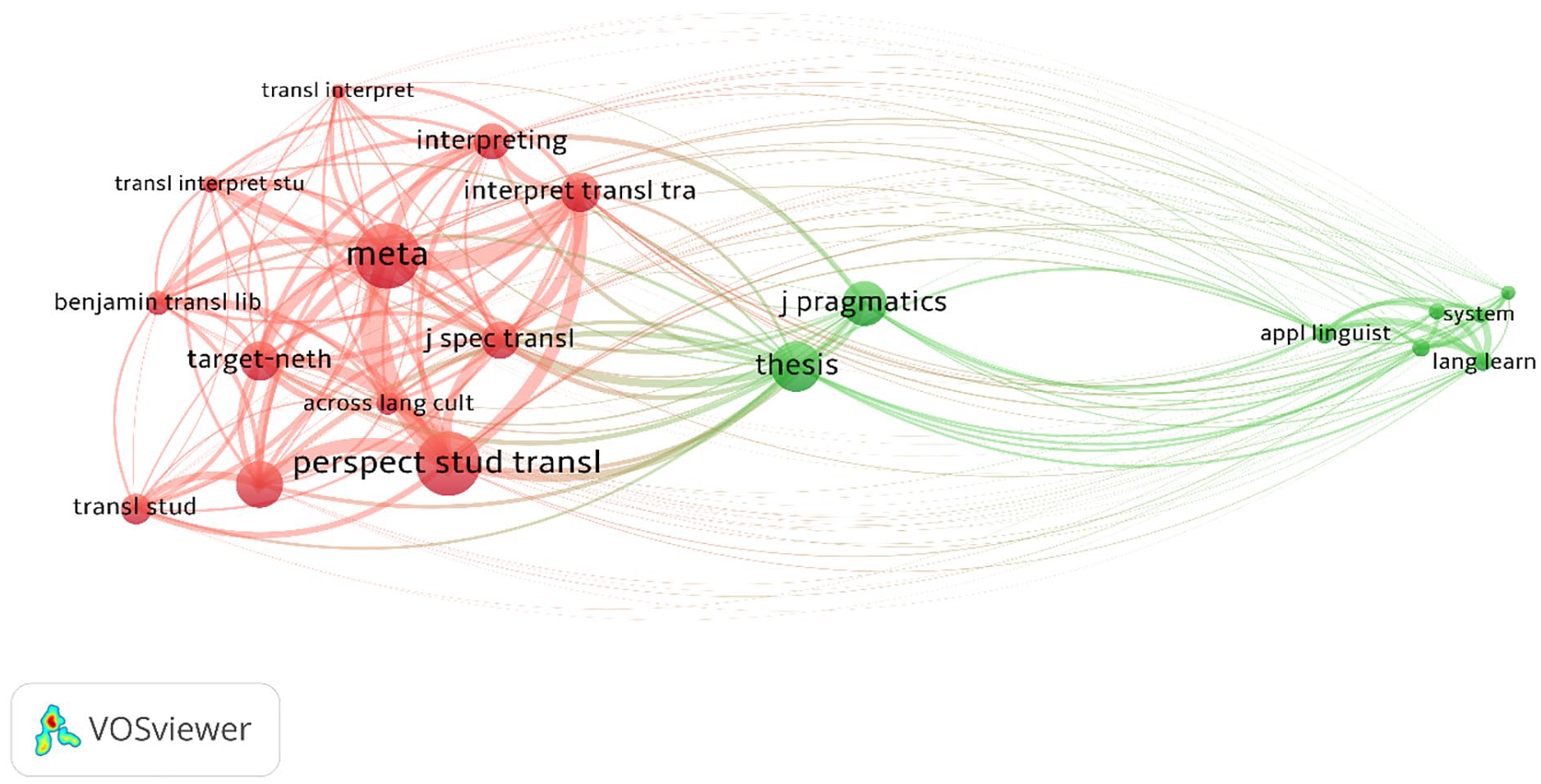
Co-citation network of cited journals.
Co-Citation of Cited Authors
To determine the most frequently cited authors, the study established a minimum threshold of 71 citations for an author. Consequently, 34 authors out of a pool of 39,935 met this criterion. From Figure 5 and Table 9, Mona Baker is the most cited author with 359 citations and 1,145 co-citation links, followed by Pym and Venuti, with 227 and 211 citations, respectively, and 864 and 477 co-citation links. Mona Baker, the most cited author, undoubtedly helped broaden the field of translation studies by fostering a multidimensional comprehension of translation as a social, cultural, political, and linguistic phenomenon through her works such as Text and Technology (1993), Translation Conflict (2006), Critical Readings in Translation Studies (2009) e.t.c Pym, the second most co-cited author, significantly advanced theoretical, methodological, and ethical dimensions within translation studies, which are reflected in his works like Exploring Translation Theories (2010) and On Translator Ethics. Principles for Cross-cultural Communication (2012). Third, Venuti, in his work The Translator’s Invisibility (1995), introduced the concept of foreignization and domestication, highlighted the role of translation in shaping culture and ideology, and emphasized the role of the translator in mediating social and political changes through translation.

Co-citation network of most cited author.
Co-citation of Most Cited Author.

The VOSviewer was used for the network visualization, dividing the thirty-four most cited authors into five clusters. Cluster 1 (red) covers authors’ contributions in areas like sociocultural aspects of translation, audio-visual translation, media accessibility, and translation theory. Cluster 2 (green) consists of authors who have contributed to various parts of translation studies, including interpreting, sociological aspects of translation, community interpreting, ethics, and interactional aspects of translation and interpreting. Cluster 3 (Blue) consists of authors who contributed immensely to corpus linguistics, translation theory, ethics, quality evaluation, and descriptive translation studies. Cluster 4 (yellow) are authors who were instrumental in developing translation theory, translator training, translation technology, ethics, and cognitive aspects of translation. Authors in Cluster 5 (purple) have played a significant part in research areas like intercultural communication, linguistic investigation into translation, translation theory, ethics, and critical approaches to translation.
Co-Occurrence of Keywords
Gaining insights into the widely investigated themes in translation studies proves essential in comprehending the shift and predicting future research trends (Huang & Liu, 2019). The co-occurrence is determined by the frequency with which two keywords appear together in publications (Zurita et al., 2020). Through the analysis of keywords, which reflect the significant research issues discussed in retrieved articles, this study can effectively scrutinize and identify the explored subjects that have received considerable attention in translation studies.
The clustering method in VOSviewer was utilized to co-occur with keywords. At first, the 6,892 keywords were set at the value of five, with 386 meeting the threshold, making up to 10 clusters, making it difficult to understand the research themes. Later, the 6,892 keywords were adjusted to 11 to enhance vividness and comprehensive visualization, with 126 meeting the threshold. The co-occurrence keywords were categorized into six distinct clusters with the aid of VOSviewer, and represented in different colors in Figure 6. Of the six clusters, Cluster 1 had 42 items, Cluster 2 had 27 items, Cluster 3 had 24 items, Cluster 4 had 13 items, Cluster 5 had 11 items, and Cluster 6 had 9 items.

Co-occurrence network of keywords.
The analysis reveals that the literature on translation studies covers many important topics. However, it is clear that “Translation” has the highest centrality among the themes in the literature. In addition to Translation, other terms such as English, Language, machine translation, Audio-visual translation, subtitling, and dubbing appear frequently in the document. This observation emphasizes the interdisciplinary nature of translation studies as an academic discipline, embracing various themes and garnering interest from other fields of study.
Cluster 1—The Interdisciplinary Nature of Translation Studies
Based on the keywords in Cluster 1, it is evident that this cluster predominantly revolves around a wide range of topics related to the domain of translation, from the theoretical aspect to the practical consideration and the role of translation in other disciplines. Cluster 1, comprising 42 keywords, provides valuable insight into the diverse research areas of translation studies. The core keyword is “translation,” a significant research interest for scholars and researchers. Keywords like translation studies, indirect translation, translation strategies, and translation history highlight the theoretical and methodological aspects of research in translation studies, which are visible in the works of Pym Exploring Translation Theories (2010) and Munday Introducing Translation Studies: Theories and Applications (2016). The presence of keywords like Pragmatics, Sociolinguistics, discourse analysis, Semantics, linguistics, corpus linguistics, and Language show the interdisciplinary nature of translation studies, focusing on how language structures and nuances influence the translation process. This finding collaborates with the study of Zhang et al. (2015), which highlighted the intersecting areas between discourse studies and translation, and the study of Du and Chen (2022), which showed the interdisciplinary feature of political discourse in translation studies. Terms relating to culture and identity, such as cultural translation, literary translation culture, identity, ideology, representations, voice, and gender, suggest how translation mediates societal norms, ideologies, and identities. Keywords focusing on the significant role of translation in information dissemination and shaping perspectives through different media platforms are media, journalistic translation, communication, news translation, and perspectives. For instance, Rasul (2019) examines the English-Kurdish translation of written media discourse to identify the recurring translation methods and strategies commonly used in Kurdish renditions of English journalistic materials. Keywords like legal translation, power, discourse, censorship, agency, and mediation reflect power dynamics, relationships, and authority during translation.
In sum, cluster 1 showcases the interdisciplinary nature of translation studies with other disciplines, the influence of translation on communication and power dynamics, and the mediative role of translation in cultural and identity representation. This cluster offers a broader landscape and valuable insight for further research into the diversified field of translation studies.
Cluster 2—Translation/Interpreting Pedagogy and Technology
This cluster covers various translation training, assessments, and technology areas. Keywords such as translation pedagogy, translator education, collaborative transaction, translation training, and translation competence highlight the need to train and develop translators’ skills to enhance translation quality. Keywords like machine translation, translation technology, post-editing, and Google Translate can exemplify the role of technology in improving the efficiency and quality of translation. These tools have boosted translation speed and accuracy, fostered global connections, and highlighted the demand for tech-driven solutions to language barriers (Doherty, 2016). Keywords dominating the area of interpreter training and the assessment of interpretation quality include interpreters, technology, quality, and interpreting. Lastly, keywords like ethics, accuracy, competence, perception, employability, motivation, and stress focus on research in ethical considerations in translation and interpreting, job prospects, perception, and the psychological factors affecting translators and interpreters. This conclusion is supported by the findings of Hubscher-Davidson (2020) and Drugan (2017), which highlighted the significant impact of psychological factors like ethical stress, time pressure, vicarious trauma, and burnout on translators and interpreters during translation and interpreting processes.
Through this comprehensive investigation, the study highlights valuable insights into the importance of ethics, technology, competence, and training of translators and interpreters in enhancing the efficiency and quality of translation and interpreting in the field of translation studies.
Cluster 3—Language and Linguistics Studies
This cluster relates to the area of Language and Linguistic studies, which is evident from the prevailing keywords primarily associated with this field, such as language acquisition (bilingualism, multilingualism, L1, translanguaging, acquisition, and L2), focus on literacy development within educational settings (classroom, children, students, literacy, learners, skills, reading, vocabulary, words, comprehension, strategies, interventions, and instruction), and on language policy. Therefore, this cluster brings to light the significant importance of language acquisition, literacy development in educational settings, and the development of language policies, especially for children and language learners.
Cluster 4—Challenges and Communication Analysis in Translation Studies
Cluster 4, consisting of 13 keywords, relates to the challenges and difficulties translators and interpreters face during communication or translation. Keywords like challenges and terminology highlight the complexities and challenges translators and interpreters face while selecting the appropriate vocabulary to accurately convey the contextual-specific meaning. Keywords related to communication and context in translation studies include conversation analysis, organization, perception, speech, talk, transcription, intersemiotic translation, and turn-taking. This cluster notably showcases the substantial importance of context in understanding cultural and societal intricacies rather than relying only on linguistic equivalence during translation or interpreting. Crucial keywords such as conversation analysis, speech, talk, and turn-taking encapsulate studies examining how interpreters manage spoken interactions during interpreting.
Cluster 5—Audio-Visual Translation
Cluster 5 is primarily characterized by terms that revolve around audio-visual translation, comprising content adaptation across various forms and efforts to ensure accessibility to diverse audiences. The presence of accessibility and adaptation focuses on making translation contents more inclusive and appropriate for different audiences, especially audiences with sensory impairment. Keywords emphasizing the translation of audio-visual content for diversified audiences and methods include audio-visual translation, audio description, subtitling, subtitles, and dubbing. Film history, media accessibility, and reception highlight interest in comprehending how Audio-visual translation has evolved and its impact on audience reception. A recent study by Valdeón (2022b) illustrates this well, showing how Audio-visual translation practices today make content more accessible and usable for people with different disabilities like blindness, deafness, and cognitive impairments.
This cluster thoroughly delves into the significance of audio-visual content for diverse audiences, the varied approaches to translating such content, and how these efforts have influenced the reception and perception over time.
Cluster 6—Cognitive Demand and Interpreting
Cluster 6 consists of nine keywords dominated by keywords from interpreting and cognition. To comprehensively understand the cognitive processes involved during interpreting activities, their impact on performance, and how interpreters identify and process patterns in Spoken Language to enhance efficient and accurate interpretation are evident in keywords like cognitive load, information, pattern, and performance. Keywords like consecutive interpreting, sight translation, and simultaneous interpreting represent the different modes of interpreting and the cognitive processes related to each method. A notable aspect within Cluster 6 is the exploration of eye-tracking methodologies, which offer valuable insights into interpreters’ cognitive processes. Seeber’s (2011) study, in particular, stands out for its use of eye-tracking to analyze how interpreters manage mental effort during simultaneous interpreting. By examining eye movements, the research reveals how different aspects of the source speech influence the cognitive workload of interpreters, shedding light on factors that impact interpretation efficiency and accuracy.
Notably, this cluster sheds light on the complexities of cognitive demands during interpreting and how interpreters use different strategies to enhance their accuracy and performance.
Conclusion
This study focuses on the bibliometric analysis of literature in the domain of translation studies published in the WoS database with the research objectives of identifying the annual publication trends, influential publications, affiliations, authors, countries, sources, and the most co-cited references, authors, and research themes. The study employs Bibliometrix R and VOSviewer tools to generate automatic visualization of network analysis of publication trends, top influential sources, affiliations, and countries, the co-citation analysis of co-cited authors and references, and the co-occurrence of research themes and producing numerous significant findings.
First, the observed annual growth rate of 131% from 2019 to 2022 signifies the expansion of interest in translation studies. This growth suggests that the field is attracting increasing attention and resources, indicating its relevance and potential for future advancements. The analysis showcases the geographical distribution of research efforts by highlighting the countries with the most research outputs. The findings show that China, the USA, and the UK are the top influential countries with the highest number of research outputs in translation studies. China’s prominent position as the country with the highest number of publications and citations and its influential affiliations can be attributed to its rapid economic development (Lei & Liao, 2017). The finding of affiliations and research outputs by countries sheds light on global collaboration trends and potential disparities, raising awareness of regions like Africa, North and South America, and the Middle East that may have limited research activity due to various factors, such as lack of funding or well-ground research institute, contributing to a more holistic understanding of the field’s dynamics
Second, the findings show that the three top journals in translation studies are Perspectives, Babel, and Interpreter and Translator Trainer. However, there is a variation in the co-citation analysis of top-cited sources, with Meta Journal ranking first, Perspectives second, Interpreter and Translator Trainer third in rank. The clustering shows that the research interest was in Translation and Interpreting, Applied Linguistics, and Pragmatics. Identifying top journals and sources is crucial for researchers to target the most reputable publishing platforms (Ellegaard & Wallin, 2015). It aids in understanding the platforms that have the most significant impact in disseminating research in translation studies.
Third, the co-citation analysis demonstrates the interdisciplinary nature of translation studies by providing a descriptive illustration of cited references, grouped into five clusters: (1) theoretical framework of translation studies. (2) The theoretical and methodologies in translation studies; (3) linguistic approach to translation studies. (4) Global dimensions of translation studies; (5) audio-visual translation. The co-cited references and authors show that translation studies have drawn from other disciplines, such as Linguistics, Sociolinguistics, Corpus Linguistics, and many others. The study’s finding on co-citation analysis reveals the diverse range of disciplines that contribute to and draw from translation studies, indicating the field’s relevance beyond its boundaries.
Fourth, the co-occurrence network analysis highlights significant research themes, giving a comprehensive overview of the topics currently receiving the most attention. The findings of the co-occurrence network analysis identify the six major research areas: (1) the interdisciplinary nature of Translation studies with other disciplines. (2) Translator/interpreters pedagogy and technology (3) Language and Linguistics in translation studies (4) Complexities and communication analysis in Translation studies. (5) Audio-visual translation (6) Cognitive demand and interpreting.
In sum, the findings of this study highlight the shift in research interest in translation studies. In the first place, the interdisciplinary nature of translation studies with other different disciplines, such as linguistics, sociology, culture, pragmatics, and technology, has moved the scholarly interest from the traditional aspects of translation to more varied topics like censorship, ideology, identity, representations, voice, and gender which are contemporary issues in the society. Second, the shift in research on the translation process and products to translation subjects focuses on training, quality, ethical consideration, and the psychological state of translators and interpreters (Drugan, 2017; Hubscher-Davidson, 2020). Third, our investigation shows the interrelation of translation with the field of Language and Linguistics. Finally, the other findings were presented to show the complexities and challenges the interpreters face during the interpreting process, the surge in interest in audio-visual translation to make translation products accessible to diverse audiences, and the emerging trends in cognitive demand during interpreting. These findings will guide and enable researchers to identify the gaps and opportunities in translation studies, such as under-researched topics, regions, languages, methods, or perspectives.
It is important to acknowledge several limitations inherent in this study. Firstly, there is a limited view due to the selective database employed as the study solely relied on the Web of Science database, omitting other valuable databases like Scopus, CNKI, Translation Studies Bibliography (TBA), Google Scholar, and Dimension. Secondly, the study also did not consider documents in other languages besides English. Thirdly, the scope of research documents in this study was restricted to articles, excluding books, conference papers, reviews, and other documents. Despite all these limitations, the findings of this study will guide researchers, scholars, and students in their future research directions by identifying gaps, areas of concentration, and emerging trends within translation studies. It will also enable researchers and students to leverage this information to focus on topics that have not received sufficient attention, such as new emerging translation theories, the influence of Artificial Intelligence in translation, the role of emotional intelligence, stress management, and other psychological factors in interpreting performance, the Ethical challenges in translation and interpreting and host of others.
Footnotes
Data Availability Statement
Data sharing not applicable to this article as no datasets were generated or analyzed during the current study.
Declaration of Conflicting Interests
The author(s) declared no potential conflicts of interest with respect to the research, authorship, and/or publication of this article.
Funding
The author(s) received no financial support for the research, authorship, and/or publication of this article.
Ethical Statement
This research does not involve human or any animal participant
