




Abstract
This study investigates citation practices in a specific rhetorical step within the interdisciplinary field of Communication, examining changes from its emerging stage (1980–1981) to its maturing stage (2020–2021). Using a corpus-based approach, the study analyzed citation patterns of research articles (RAs) from four leading Communication research journals. The study reveals diachronic changes in citation practices in Communication research, with shifts in source distribution, citation forms, and comparing stances. These changes reflect the evolution of Communication from an emerging interdisciplinary field reliant on sources of other fields to a mature discipline with greater coherence and independence. The findings offer insights for English for academic purposes (EAP) pedagogy, particularly in teaching critical citation strategies to navigate interdisciplinary research. Finally, this study highlights the need to legitimize interdisciplinary research through institutional support.
Introduction
In research articles (RAs), citations serve as a key scholarly communication mechanism, enabling authors to situate new findings in relation to previous works, and strengthen arguments and claims (Harwood, 2009; Hu & Wang, 2014; Hyland, 1999). For readers, citations function tracing mechanism, allowing them to trace the origins of ideas (Cronin, 1984), and identify the specific disciplinary community to which the work situates (Ahn & Oh, 2024). Beyond their immediate functional roles, citations reflect broader trends in research communities, evolving alongside disciplinary practices and epistemologies.
However, diachronic investigations of citation practices remain limited. Notably, Hyland and Jiang (2019) observed that citation practices in social sciences increasingly mirrored those of the hard sciences, reflecting a broader shift toward scientism. While they did not explicitly frame this shift as interdisciplinarity, this trend aligns with the growing integration of mathematical modeling and statistical tools in social science research (Grimmer, 2015; Lu et al., 2021). Given that citations are a key marker of interdisciplinary engagement, how citation practices have evolved in social science interdisciplinary fields like Communication remains an open question.
To address this gap, this study aims to examine diachronic changes in citation practices in the comparing step of the Discussion section in Communication, focusing on two key periods: the early stage (1980–1981) and the maturing stage (2020–2021). Adopting a functional perspective, it conceptualizes citations as rhetorical units that contribute to the communicative purpose of the Discussion section (Kwan & Chan, 2014, p. 31).
This study contributes to citation research by providing empirical insights into the changing patterns of citation practices, which have valuable implications for English for Academic Purposes (EAP) instruction, particularly in interdisciplinary social sciences. Finally, these shifts in citation patterns reflect ongoing developments in interdisciplinary research, shedding light on disciplinary evolution.
Literature Review
Distribution of Citation
The distribution of citations in RAs is shaped by disciplinary traditions, readership, sectional purpose, and diachronic changes. Previous study found that citation density was generally higher in social sciences than in science disciplines, as social sciences were inherently more interpretive and less empirically grounded (Hyland, 1999). However, Hyland’s corpus was consisted of RAs published in 1997. Subsequent research by Hyland and Jiang (2019) revealed that citation density of RAs published in 2015 in Applied Linguistics and Sociology had surpassed that of Electronic Engineering, reflecting a significant temporal shift.
Readership also plays a critical role in citation practices. For instance, in the field of Information Systems, journals catering primarily to practitioners included fewer citations than those targeting academics (Kwan & Chan, 2014). Sectional variations also influence citation distribution. The Discussion section typically contained more citations than the Method and Results due to its communicative functions, such as comparing findings with previous literature, accounting for results, and highlighting the study’s contributions (Zhang, 2022). Even within the section, citation distribution varies according to specific rhetorical goals. For example, citations aimed at extending the existing territory represent the leading category in the Discussion section (Kwan & Chan, 2014).
Citation Form: Integral and Nonintegral
The study of citation form has widely adopted the categorization of “integral” and “nonintegral,” by J. Swales (1986). Integral form refers to those in which the author’s name appears in the cited sentence (e.g., Bruce (1989) argued that…), and it functions grammatically in a sentence. Nonintegral citations, on the other hand, present the cited author in a bracket (e.g., …. tied to economic theories (Bruce, 1981)), and this form does not play any grammatical role in the sentence.
In science disciplines, such as Biology and Physics, the nonintegral structure was the predominant form, while in Philosophy and some social science disciplines, the integral was preferred (Hyland, 1999). Hyland explained that while the science disciplines used nonintegral citations to present knowledge as objective truths and facts, minimizing human judgment; the humanities and social sciences constructed knowledge interpretively by foregrounding names to engage in a dialogic interaction with significant contributors and integrate their perspectives into academic discourse.
However, recent studies have reported a shift, with the nonintegral form of citation becoming prevalent in the social sciences (Arizavi & Choubsaz, 2021; Hyland & Jiang, 2019; Zhang, 2022). For instance, a study on citation forms in six social science disciplines found that the nonintegral form accounted for nearly 71% of all citations(Zhang, 2022), almost 80% in Applied Linguistics (Arizavi & Choubsaz, 2021) and over 60% in Sociology (Hyland & Jiang, 2019). Accordingly, the nonintegral form has become the preferred style, reflecting a shift toward a more “scientism” writing approach in social science disciplines (Hyland & Jiang, 2019).
Citation and Comparing Step
In the Discussion section, comparing is essential, as it draws on literature to contextualize new knowledge claims, establish a basis for argumentation and highlight points of divergence that contribute to scholarly dialog (Le & Harrington, 2015; Liu & Buckingham, 2018). This step involves referencing prior research to systematically analyze similarities and differences (Moreno & Swales, 2018), with citations serving an evaluative act that reflects the writer’s purpose through the selection of sources and the manner of their presentation (Thompson & Ye, 1991).
This act can be realized through reporting verbs that indicate the writer’s placement of previous works in a certain perspective, usually by means of support or contrast (Thompson & Ye, 1991). In fact, support and contrast are not limited to reporting verbs (Liardét & Black, 2019); they can also be performed by adverbials, such as “while,” and “whereas,” as well as other semantic strategies (Kwan & Chan, 2014).
Communication Studies
According to Biglan (1973), disciplines can be categorized as “hard” or “soft” based on their theoretical structure and approach to knowledge production. Hard disciplines, such as Physics and Chemistry, feature well-developed theories, universal laws, causal propositions, and cumulative, generalizable findings. In contrast, soft disciplines, such as Sociology and Literary studies, often have unclear boundaries, relatively unspecified theoretical frameworks, loosely defined problems, and are more susceptible to trends and fashions.
Communication studies is an interdisciplinary field that draws on a wide range of intellectual traditions, primarily from soft disciplines, including Sociology, Political Science, Linguistics, History, and Literary studies (Lasswell, 1958; Sabine, 1959). Methodologies from hard disciplines, such as laboratory experiments, statistical analysis are also adopted to ensure empirical rigor in research (Calhoun, 2011). What defines Communication studies as a genuinely interdisciplinary field is its theoretical construction mode: dialogical-dialectical coherence (Craig, 1999). This means Communication theory recognizes and engages with the complementarities and tensions among diverse theoretical traditions of discipline, an approach that does not aim to eliminate theoretical diversity but leverages it to deepen the understanding of Communication study (Craig, 1999, 2012). Moreover, unlike other interdisciplinary research, such as Economic History and Neurolinguistics, which are categorized as sub-field of their respective disciplines, Communication has been institutionalized as an independent discipline through college faculty structures, journal articles and research grant classifications(Craig, 2018; Pooley, 2016). Being an independent discipline, Communication is characterized by a body of accumulated specialized knowledge encoded in disciplinary practices of epistemology, ontology, and methodology which are ciphered in discourse (Hyland, 2005).
While previous studies have extensively investigated citation, few have diachronically traced citation changes in an interdisciplinary field or examined the citation function in the comparing step of the Discussion section. This gap leaves an underexplored area in understanding how citations contribute to the construction and dissemination of knowledge in interdisciplinary contexts. Furthermore, while the field of Communication has been institutionalized as an independent discipline and emphasizes theoretical dialogical-dialectical coherence, its citation practices are uniquely shaped by diverse theoretical traditions and disciplinary norms. Examining citation practices in the comparing step of Communication Discussions thus addresses this research gap while offering deeper insights into interdisciplinary scholarly practices. Specifically, this study seeks to address three research questions:
(1) Has the distribution between communication and non-communication sources in comparing step changed over time and to what extent?
(2) Has the form of integral and nonintegral between communication and non-communication citation changed in comparing step over time and to what extent?
(3) Has the comparing act between communication and non-communication citation to Communication study in comparing step changed over time and to what extent?
The three research questions are designed to examine the diachronic changes in citation practices in Communication research, reflecting the dynamism of interdisciplinary research. The first question investigates shifts in the distribution of communication versus non-communication sources in the comparing step over time. The second question builds on this by analyzing changes in citation form over time, exploring how authors engage with these sources. The third question further examines the function of these citations in knowledge construction, assessing whether evolving citation practices reinforce disciplinary boundaries or foster interdisciplinary dialog.
Methodology
The Corpus
This is part of a larger study that examined moves and steps found in the Discussion section of Communication RAs. The data for this study came from corpora comprising four leading journals in the field of Communication, which are Communication Research (CR), Human Communication Research (HCR), Journal of Applied Communication Research (JOACR), and Communication Quarterly (CQ). Based on information from the four journals’ websites, their research focuses on the processes, antecedents, and consequences of Communication in a broad range of societal systems, and offers applications for scholars in other fields, such as Psychology, Sociology, Linguistics, Public Health, and Anthropology. Since this study aimed to examine diachronic changes in citation practice, RAs published during two time segments: 1980 to 1981 and 2020 to 2021, were considered.
RAs selected in this study were limited to those categorized as “research articles” or “original contributions,” while items such as book reviews and letters were excluded, following a previous diachronic study (Wu & Pan, 2023). Table 1 details the composition of the Communication corpus. In total, 177 articles were collected for the 1980 to 1981 period (96 of which contained a separate Discussion section), and 212 were collected for the 2020 to 2021 period (152 of which contained a separate Discussion section). The sample Discussion sections were selected randomly, with five articles chosen from each of the four journals in each year. In cases where there were insufficient articles within the specified time frame, a few articles were taken from the previous or subsequent years, as suggested in other diachronic study (Hyland & Jiang, 2018). Thus, six RAs from JOACR in 1980 were selected to ensure a total of 10 RAs for the 1980–1981 period. In the end, the current study finalized two corpora, each containing 40 RA Discussions, with 26,205 words in the first corpus and 58,153 words in the second.
Composition of the Communication Diachronic Corpus.

The Analytical Framework
This study conceptualizes citations as rhetorical units that contribute to the communicative function of the comparing step in the Discussion section (Kwan & Chan, 2014; Swales, 2004). It specifically examines citations in this step that reference claims from prior research, which are then evaluated against the writer’s own findings (Peritz, 1983). Citations are categorized into communication sources (originating within the discipline) and non-communication sources (from external fields).
Additionally, this study adopts J. Swales (1986) distinction between integral and nonintegral citations, analyzing how authors incorporate citations into their argumentation. Following Thompson and Ye (1991), citations in the comparing step are further classified based on their rhetorical stance as either supportive (aligning with the writer’s findings) or contrastive (highlighting differences).
Analytical Procedure
The analytical procedure of this study consisted of two major processes. For the initial process, the comparing step was coded following the analytical framework of Moreno and Swales (2018). In this framework, a step is considered essential for the progression of the text. They emphasized that it must include at least one verb—whether finite, non-finite, or elliptical—or a nominalization that can be easily reformulated as a verb phrase. The step coding was also assisted by linguistic clues, including certain phraseology (Le & Harrington, 2015), metadiscourse markers (Liu & Buckingham, 2018), and the semantic meaning of the content.
The step “Comparing with previous research” is often characterized by citation and comparative words. As illustrated in Example 1, this step contains the comparative word “confirmed” and citations in parentheses. The verb “confirmed” advances the propositional meaning of the text. The label after each example comprised the acronym of the journal, followed by the year of publication in parentheses, the volume and issue number, and finally the page number(s). 1
Example 1: Results from our systematic examination of all terrorist attacks in the US from 2006 to 2015 CR(2020)Nov-30
It should be noted that there are instances when the linguistic clues are implicit, and comparison is achieved semantically. In such cases, identification relied largely on the semantic meaning of the sentence, requiring careful reading of neighboring sentences to determine whether a comparing meaning exists between them. As illustrated in Example 2, there are no clear comparing linguistic clues indicating comparison; however, the contrastive rhetoric is identifiable through different evaluations found between the writer’s “not associated with” and others’ findings “play a significant role.”
Example 2: It was an unexpected finding that confirmation messages were CQ(2021)69(2)133-151
The second process aimed to investigate the changes in citational distribution, form, and comparing act in the comparing step. The citations of the two periods were categorized into three groups: (1) communication, non-communication and no citation, (2) integral, and nonintegral, and (3) supportive and contrastive relationship between current findings and those of the previous study, referred to as comparing act in this study. This is illustrated in Figure 1:
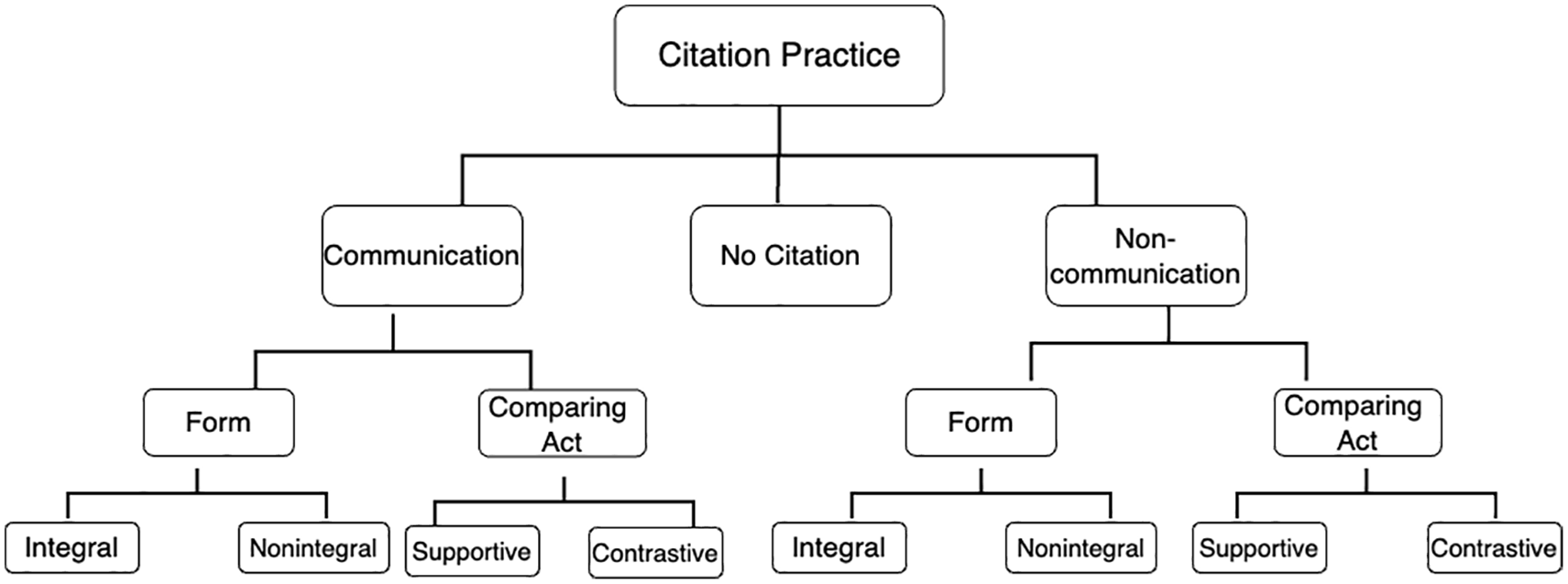
Coding schema of the citation.
The categorization of communication and non-communication sources followed a rigid classification scheme. Specifically, the identification of the two sources was primarily based on the journal name and its aim and scope on the journal website. The criteria for categorizing communication sources involved checking whether the title of the journal contains the word “communication.” For instance, journals like Communication Study, and Political Communication were classified as a communication source. Caution was taken when the journal name contained synonym to the word communication, such as “journalism” and “media,” or when the title was ambiguous. In these cases, the abstract and even the whole article was carefully reviewed to decide the classification.
There were other sources that were not easily categorizable, such as articles published in mega journals PlOS ONE, where its scope covers 200 topics. Additionally, unpublished theses, newspapers, and conference presentations posed challenges. These sources, along with any others with uncertain classification, were carefully studied by reading the abstract or, when necessary, the entire text to determine their classification. Generally, sources excluding the word “communication” were categorized as a non-communication source. This binary categorization method assumes that most journals have certain scope, and journal title is a reliable indication of that scope.
The category “no citation” refers to instances where citations that are either invisible, (e.g., “previous research” without any clear indication of the source in the reference list or notes) or indicated by vague phrases such as “the mainstream press.” Moreover, to eliminate ambiguity, this study used the capitalized term “Communication” to refer specifically to Communication studies, while the lowercase term “communication” to denote the source from communication journals.
One source cited was counted as one citation, while different sources cited in the same place were counted individually. To illustrate, the two citations (Brandy et al., 2015; Merianos et al., 2013) in Example 2 were counted as two separate citations because multiple references in the same bracket could be sources from different areas of study in an interdisciplinary field.
Next, the categorization of integral and nonintegral citation forms was based on the typology defined by J. Swales (1986), guided by previous relevant studies (Hyland & Jiang, 2019; J. M. Swales, 2014). Integral citations are those in which the author’s name is incorporated into the cited sentence and assumes a grammatical role in the sentence, for example: “Rice (2015) argued.…” Nonintegral citations present the cited author in parentheses (as illustrated in Examples 1 and 2), as a superscript (Example 3), or in footnotes, without incorporation of the author’s name into the sentence structure.
Example 3: This result, that dynamism did not behave like the other dimensions of source credibility, tends to support a position taken by McCroskey and Young36. CQ(1980)28(2)19-26
Finally, the comparing act was categorized based on the relational activities involved, whether contrastive or supportive. The identification of these activities was not confined solely to verbs or verb phrases (as illustrated in Examples 1 and 3), but also included other word forms, such as the adverbials like “while” and “whereas;” and nouns like “exception,” as well as semantic meanings (Example 2).
Results
The corpora in this study consisted of 80 Discussion sections from Communication RAs published in 1980 to 1981 and 2020 to 2021. As shown in Table 2, there was a notable increase in the number of RAs containing the comparing step, from 26 to 35. The number of comparing steps in the RAs nearly tripled, increasing from just 48 to 132. Similarly, the number of citations also tripled from 69 to 198, a substantial increase of 187% over the two periods. The significant rise in both comparing steps and citations indicates that the Communication Discussion section not only involves more frequent and intensive comparisons but also increasingly relies on scholarly evidence to either align with or deviate from previous studies. This increase in citations can be attributed to two main factors: the growing body of related research available to authors and the rhetorical goal of emphasizing their own viewpoints to gain recognition from a broader readership. Whether supportive or contrastive, authors use citations to validate their perspectives and highlight the credibility of their findings.
Changes of Citation in the Corpora of Discussion Sections.

Distribution of Different Sources Over Time (RQ 1)
Regarding the distribution change of citations, Table 3 illustrated that the references used for comparison were not evenly distributed among the communication, non-communication and no citation categories. Over the two periods, non-communication sources consistently represented the largest category in the comparing step. However, the 2020–2021 period witnessed a substantial growth in the use of communication sources, indicating a notable shift in source distribution.
The Changes of Distribution Among Sources.

In 1980 to 1981, the majority of citations (62%) were from non-communication sources, with communication sources contributing just 22% of the total. The “No citation” category consistently accounted for the smallest proportion over the two periods, 16% and 4% respectively. The quantitative changes indicate that early Communication studies primarily relied on sources from other fields to compare and validate their findings. Historically, traditional disciplines such as Literature, Linguistics, and Political Science took the lead, occupying a dominant position in interdisciplinary efforts within Communication studies (Lasswell, 1958). This reflects an emerging stage of interdisciplinary research that sought legitimacy through connections to more established academic domains (Gasper, 2010).
Let us consider some examples from the 1980 to 1981 period. Example 4 is sourced from Children’s behavior by Collins, in Example 5, findings are supported from Psychology studies by Mehrabian and Ferris, and Bugental et al., and results in Example 6 are verified using a Sociological theory by Maddox. These examples collectively underscore the reliance on well-established disciplines to enhance the credibility and depth of Communication research. By drawing on frameworks from psychology and sociology, early Communication scholars were able to ground their work in these respected fields, thereby strengthening the legitimacy of their findings. This also highlights the diverse focus of early researchers on various aspects of Communication studies.
Example 4: The interaction found in this study occurs between fifth and sixth grade, whereas CR(1980)7(1)121-135 Example 5: The face-tone-words order of channel weights in the peer condition is consistent with results obtained by Mehrabian and Ferris (1967) and Bugental et al. (1970). CR(1980)7(4)495-509 Example 6: This finding implies that residents’ satisfactions are heavily dependent on the quality of the institutionally selected relationships, supporting Maddox’s (1963) JOACR(1981)9(2)120-130
For the 22% of communication sources, a small fraction of the citations categorized as “communication” in the first period were unpublished academic texts, such as master’s and doctoral theses. For instance, the underlined reference in Example 7 was sourced from an unpublished master’s thesis at the University of Nebraska-Lincoln in 1978. Interestingly, such sources were rarely found in the 2020 to 2021 corpus, at least in the comparing step. This change may lead us to infer that in the earlier period, sources were rather limited for comparing results, whereas in the later period, researchers could rely on a broader range of published sources to validate their findings.
Example 7: The results of the initial study of the effects of cognitive modification on children’s communication … (K. Garrison, 1978; K. Garrison & Brown, 1979). However, the results of the present follow-up study indicate that this treatment effect was not sustained… CQ(1980)28(4)47-56
In the 2020 to 2021 period, the sources from all disciplines significantly expanded, with those from communication showing the most substantial growth of 82%, increasing from 15 citations in 1980 to 1981 to 80 in 2020 to 2021 (Table 3). It is interesting to observe that non-communication sources (56%) still accounted for a larger proportion than the communication source (40%) used to compare findings. The proportional changes in the citation shows that Communication studies increasingly depend on sources within their own field to contextualize their study, reflecting a growing maturity and the consolidation of its status alongside the older established fields (Nordenstreng, 2007). The still high proportion of non-communication sources observed in the recent comparing step further confirmed the unique dialogical-dialectical coherence way of knowledge construction in Communication studies. This highlights how the interdisciplinary origin of Communication research have successfully evolved into a self-sustaining whole, where theories from different origins and types are not in isolation but engaged each other in constant argument (Craig, 1999).
It is noteworthy that some of the communication sources in 2020 to 2021 were also intra-disciplinary. The three Examples 8, 9, and 10 were sourced from Health Communication, Management Communication Quarterly, and Political Communication. These intra-disciplinary sources signal the development of Communication as a more self-sustaining and robust field of study. They also highlight the field’s growing ability to address complex, discipline-specific issues while maintaining its interdisciplinary roots.
Example 8: These findings line up with past research, which has found identification to be positively associated with perceived susceptibility (Frank, Murphy, Chatterjee, Moran, & Baezconde-Garbanati, 2015) CQ(2020)68(2)161-182 Example 9: Thus, this study confirms that OER facilitates an adaptive process with enabling conditions (i.e. competence, efficacy, and communication behaviors for sensemaking and sensegiving) that is important for organizational resilience in a crisis (e.g. Sutcliffe & Vogus, 2003). JOACR(2021)49(5)589-608 Example 10: This finding joins a nascent body of studies that have identified similar patterns on other platforms (Yarchi et al., 2021), suggesting the need to expand current definitions of online polarization to include affective dimensions. CR(2021)Sep-5
The “No citation” category can still be found in recent corpus, with its primary purpose being to discuss or compare concepts that are already wide publicly accepted (Examples 11 and 12), reflecting the practical concerns of Communication research (Craig, 2018).
Example 11: Nonetheless, the results are largely consistent with HCR(2021)47(2)166–191 Example 12: While JOACR(2020)48(6)695-713
Form Changes Between the Two Sources Over Time (RQ2)
Table 4 illustrates the shift in citation forms across two periods. In 1980 to 1981, the integral form predominated in both communication and non-communication sources, whereas in 2020 to 2021, the nonintegral form became the dominant citation style.
The Integral and Nonintegral Form of Citation.

In 1980 to 1981, the proportion of integral forms outnumbered the nonintegral forms (66% and 34%), and the largest composition of integral form coming from non-communication sources. This finding contrasts with the diachronic study of Hyland and Jiang (2019), which reported that the nonintegral form was more prevalent than the integral form in the fields of Applied Linguistics, Sociology, Biology, and Electronic Engineering in the mid-1980s. Nonetheless, the current findings are consistent with another earlier study on Philosophy, where nearly 65% of citations were in the integral form (Hyland, 1999).
It is difficult to simply attribute these opposing results to disciplinary differences, considering the corpus in Hyland and Jiang (2019), whose study was composed of four disciplines, and Communication is a discipline that features works from the social sciences and humanities (Craig, 2018). A possible explanation for the divergence could be that the current study only focused on a single step in the Discussion section while the study by Hyland and Jiang (2019), analyzed the entire RAs. The distinction between partial and entire RAs has also been observed in diachronic changes of stance markers in the Discussion section. The downward trend of authorial features in Applied Linguistic RAs in the study by Hyland and Jiang (2016) was not observed in the Discussion section of the same field (Xie et al., 2024).
The integral form is associated with an emphasis on the person who conducted the research, with the cited author’s name often functioning grammatically in the sentence (J. M. Swales, 2014). When the cited author is foregrounded, an imagined dialog is engaged between the current work and the peers, reflecting a more social science- and humanity-oriented way of knowledge construction (Hyland, 1999) from which Communication studies predominantly originate.
In addition, the larger proportion of integral citation observed in non-communication sources could be a typical feature of the early stages of interdisciplinary research. The interdisciplinary collaboration is a risk-taking research practice that requires an “ontological shift” to transform the blind spots of methodology and topic in the traditional disciplines (McWilliam & Tan, 2010). By employing integral citation, writers are given the option to distance from the cited authors’ arguments to protect themselves from the potential flaws, conflicts, and questions of cited works in other fields, helps avoid direct acknowledgment of potential blindness in previous research and instead rethinking new claims (Zhang, 2022). For readers, integral citations are more likely to invite them to trace the origin of the cited works, allowing them to explore the development of ideas from new perspectives, thus encouraging a more nuanced interpretation of the research and its place within the broader academic discourse.
Examples 13 and 14 demonstrate how writers use cited authors (of other disciplines) as the subject and agent of research thereby highlighting the person behind the findings rather than the cited content. In Example 15, the cited authors as the agent of a noun phrase (NP); in doing so, the human agent (of other fields) behind a proposition is clearly presented, thus endorsing the cited agentive proposition to support the writer’s current points.
Cited author as the subject: Example 13: Barron and Stone (1974) offered this same explanation to account for insignificant effects in studies of organizers. HCR(1981)7(2)147-160 Cited author as an agent: Example 14: The results of this investigation, as well as the work of Moreland et al. (1978), Gaudreau (1977), and Pedhazur and Tetenbaum (1979), provide evidence for the modification of the operational definitions of femininity and masculinity in the BSRI. CQ(1981)29(3)173–186 Cited author in NP: Example 15: The face-tone-words order of channel weights in the peer condition is consistent with results obtained by Mehrabian and Ferris (1967) and Bugental et al. (1970). CR(1980)7(4)495-509
The preferred form of citation in the 2020 to 2021 period is nonintegral, which is consistent with more recent studies in Ecology (Samraj, 2013), Biology (J. M. Swales, 2014), Chemical Engineering (Zaid et al., 2017), and six social science disciplines (Zhang, 2022). In the recent period, the numerical and proportional increase of nonintegral form can be observed in both communication sources (8%–34%) and non-communication sources (26%–46%), resulting in an overall increase from just 34% in 1980 to 1981 to 80% in 2020 to 2021 (Table 4).
When nonintegral citations are used, they often involve assimilation of cited work into their own arguments by interpreting, summarizing, and paraphrasing (Coffin, 2010). As illustrated in Example 16, the writer interprets in what aspect and which idea the previous finding supports, or contrasts with the current finding. In Example 17, the method of “form of censorship” from the previous study is explained to highlight the current argument. Example 18 shows some key relevant points of previous research to underline how it supports and extends the current study. These examples collectively illustrate how the author positions their work as a continuation or refinement of existing scholarship, while inviting readers to evaluate the strengths and limitations of past work in light of the new findings.
Example 16: These findings are consistent with prior research showing that repeatedly working together enhances groups’ capability to learn and adapt to their tasks (Argote & Miron-Spektor, 2011; Leavitt, 1951; Noriega-Campero et al., 2018), but runs counter to the idea that reduced diversity in task experience is detrimental to the WOC (Hong et al., 2020; L. Hong & Page, 2001). CR(2020)May-4 Example 17: Our study reinforces the argument that “psychological firewalls” designed to retard online activism may be superior to “technical firewalls” such as content removal or access restrictions as a form of censorship (Nisbet et al., 2017). CR(2020)Aug-19 Example 18: Other studies have noted several positive outcomes of sports participation on health and social skills (e.g., Danish et al., 1993), and our study extends this research by understanding how communication in sports translates to the workplace CQ(2020)68(5)499-519
Comparing Act Changes Over Time (RQ3)
Table 5 illustrates changes in how comparing acts were related (supportive or contrastive) to communication and non-communication sources. Overall, the prominence of supportive citation used in the comparing step remains unchanged over the two periods. Nonetheless, the proportion of supportive comparison nearly doubled from 59% to 81% over the two periods (Table 5). This finding is consistent with the diachronic study by Hyland and Jiang (2019), which showed an increase in the frequency of positive evaluation in Applied Linguistics, Electronic Engineering, and Sociology from 1985 to 2015.
The Changes of Relation Activities.
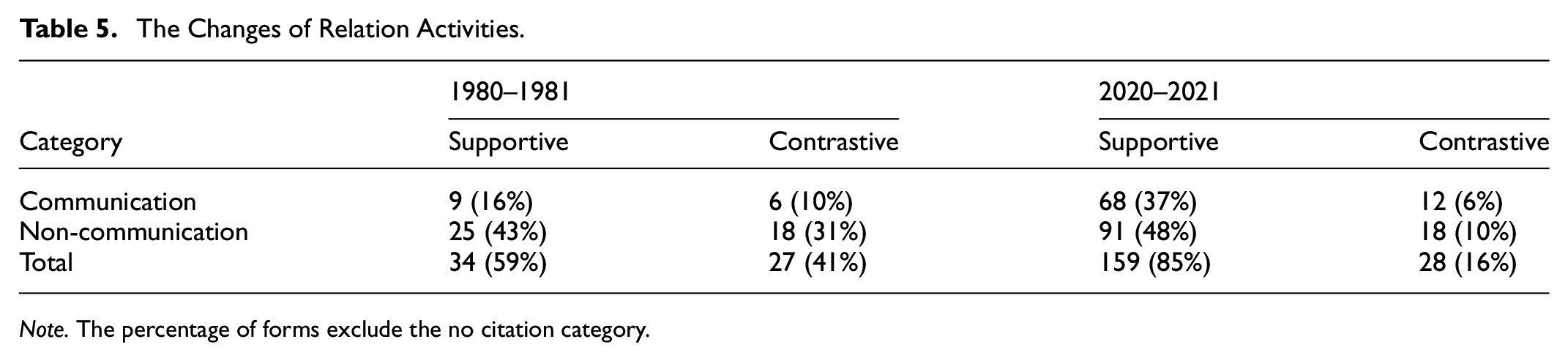
Note. The percentage of forms exclude the no citation category.
Another notable pattern in the corpus is that non-communication sources consistently comprised the largest proportion of contrastive comparing. As indicated in Table 5, it was 31% in 1980 to 1981 and 10% in 2020 to 2021, while the proportion was 6% and 7% in communication sources respectively, across the two periods. However, when comparing the gap between supportive and contrastive non-communication sources in 1980 to 1981 (43% and 31%) and 2020 to 2021 (48% and 10%), we can see that the use of non-communication sources for supportive purposes increased significantly. This may reflect how the relationship between non-communication sources and Communication studies have changed over the past 40 years.
In 1980 to 1981, when confronted with previous findings, non-communication (31%) exhibited more contrastive comparison than communication sources (10%). The higher proportion of contrastive comparison observed in non-communication sources could be due to the propensity of early Communication studies to emphasize their distinction from the established disciplines from which they originated (Sabine, 1959). This reflects an interdisciplinary approach to knowledge construction, characterized by critical evaluation or even opposition to the epistemological and ontological assumptions inherent in specific historical disciplines, with the aim of transcending boundaries (Barry & Born, 2013).
Additionally, the contrastive stance, examined through semantic meanings, was more strongly expressed in 1980 to 1981 than in 2020 to 2021. Table 6 summarizes the realization of contrastive activities by the non-communication sources over the periods. In the earlier period, most contrastive activities were realized through verbs and verb phrases which conveyed a stronger stance compared to noun, adjective, and adverbial forms.
The Grammatical Form of Contrastive Comparing in Non-Communication Sources.

Note. Number in the bracket means the frequency of the word or phrase.
As illustrated in Example 19, contrasting was realized through the verb form “did not find,” signifying a direct opposition between prior and current findings. In Example 20, the opposing relationship between the communication studies and the non-communication source was intensified by the adverb “markedly.” A similar word choice can be found in Example 21, where the adjective “striking” strengthened the opposition between findings and models in other areas. These strong contrastive comparisons may indicate that authors in earlier communication research often emphasized significant departures from or improvements on prior work, highlighting the novelty of their findings, which was crucial for asserting authority in the field.
Example 19: While the literature suggests that individuals deviate from general self-assessments of openness depending on the specific situation (Pearce and Sharp, 1973; Goodstein and Reinecker, 1974; Chelune, 1975), the present study CR(1980)7(4)479-494(1) Example 20: This pattern of results CQ(1981)29(4)263-268 Example 21: The adequacy of four and even three-dimensional solutions in accounting for subjects’ judgments of the passages stands HCR(1981)8(1)26-42
In 2020 to 2021, any strong contrastive stance was barely found, when the contrasting verbs were used, the opposing meaning was organized in a strategic manner. In Example 22, the verb phrase “runs counter to” opposes the “public speculation” and “experimental findings” from non-communication sources. Although the stance exhibited here seems strong, it may be acceptable within the context of Communication research, as a finding that is contrary to public discussion can further highlight the scientism of the current study. Moreover, empirical-based research is a more conventional practice than a laboratory experiment, as Communication focuses on practical problems in society (Craig, 1999, 2012).
In recent periods, the contrastive meaning is often established in a less confrontational manner, by employing nouns, adverbials, and adjectives (Table 6). The positive polarity of citation also observed in social and natural science RAs (Hyland & Jiang, 2019; Zhang, 2022), highlighting consistency rather than differences with previous findings in academic writing. The similarities in findings using different methods or datasets contribute to establishing a common ground in the field which is more likely to gain disciplinary experts’ approval (Guo & Lim, 2024), and deepen the accumulation of specialist knowledge in the discipline (Krishnan, 2009).
Compared to verbs that emphasize action, the nouns tend to show differences, while adverbs such as “whereas” (Example 23) introduced a relationship without emphasizing direct confrontation. The adjective “comparatively weaker” in Example 24 shows the degree of differences. This shift reflects authors framing findings without confrontation, using a strategically balanced approach toward diverse views, while for readers, it signals a more collaborative approach, encouraging deeper engagement with different arguments.
Example 22: This finding CR(2020)Nov-30 Example 23: Also, CQ(2020)68(5)499-519 Example 24: The significant average correlation…explain and predict, with a reasonable level of accuracy. The average correlation is small (Cohen, 1988; Gignac & Szodorai, 2016) and HCR(2020)46(2-3)273-299
Discussion
The present study examined citation practices in the comparing step of Discussion section in Communication RAs over two periods: 1980 to 1981 and 2020 to 2021. The following section discusses the major findings of this study.
Citation Distribution Shifts: From Formation to Expansion
In essence, the changes in the distribution among communication, non-communication, and no citation sources show how citational practice responds to shifts in the discipline. In the 1980 to 1981 period, sources of all categories were relatively scarce, which can be attributed to the emerging stage of the field. This finding is also observed in the emerging period of some disciplines, such as Applied Linguistics in the 1960s, where sources were rather limited (Hyland & Jiang, 2019), and in Zoology in the 1930s, which contained no citations at all (Lin & Luyt, 2012). The notably small proportion of communication sources in the emerging period can also be explained by the field’s interdisciplinary origins, where other fields initially led the Communication study (Lasswell, 1958).
The period 2020 to 2021 saw a general increase in the number of citations, with a particular significant rise in communication sources. This overall increase in citations is largely due to the growth in the number of RAs, highlighting the increasing prominence of interdisciplinary field. Diachronic datasets from interdisciplinary fields such as Chemotaxis (Poole et al., 2019) and Green Supply Chain Management (Fahimnia et al., 2015) also indicated substantial growth in the number of articles and specialized journals, further reinforcing the expanding influence of interdisciplinary research.
Moreover, the communication sources in the comparing step in the recent period exhibit an intradisciplinary tendency. A bibliometric study in Communication studies also confirmed that research topics such as health communication, media psychology, and political communication are prevalent (Chan & Grill, 2022). This suggests that the interdisciplinary origin of Communication study is still valued in modern times, reflecting a continual expansion and synergistic integration of knowledge from various academic domains. Notably, disciplinary expansion is also observed in other fields. For example, Applied Linguistics has increasingly incorporated theories and practices from mathematics and computer science, expanding its research scope (Lei & Liu, 2019). The continuous disciplinary expansion can be understood as niche-seeking behavior, creating spaces that are less constrained by traditional disciplines. This fosters boundary-crossing work and empowering scholars to navigate in competitive academic environments (Barry & Born, 2013).
Citation Form Shifts: From Dependence to Openness
In terms of citation format, the findings indicate that the integral form was preferred during the 1980 to 1981 period, whereas the nonintegral form became the dominant choice in the 2020 to 2021 period. These findings are generally consistent with the diachronic trends reported by Hyland and Jiang (2019), except during the emerging period. This divergence could be attributed to the use of integral citations, particularly in non-communication sources, as a means of positioning emerging research within Communication studies.
Integral citation allow writers distance themselves from cited arguments, avoiding flaws in other fields and sidestepping gaps in prior research. In early Communication studies, this practice enabled scholars to reference established disciplines without direct challenging them. Moreover, this practice served as a tacit mechanism for pioneering Communication researchers to maintain a balance between their emerging discipline and their foundational disciplinary backgrounds. By doing so, they reinforced their identity as Communication researchers while preserving connections to their original fields (Pooley, 2016).
The divergence between interdisciplinary and established fields also observed in other linguistic strategies that shape scholarly communication at different stages of development. For instance, the use of epistemic hedges in the interdisciplinary field of Chemotaxis followed a trend opposite to that reported in Hyland and Jiang’s (2016) corpus, decreasing as the field matures (Poole et al., 2019). While this inconsistency is evident during Chemotaxis’s maturation stage, it illustrates how researchers adjust linguistic strategies to signal confidence and solidify their academic identity.
In the 2020 to 2021 period, nonintegral citation became the dominant form. The preference for nonintegral citation foregrounds the current research, with both categorizations indiscriminately serving the purpose of the present study. As discussed earlier, the preference for nonintegral citation practices has been widely observed across both science and social science disciplines. This trend suggests that the interdisciplinary field, originally rooted in social science, has gradually developed into a mature and established discipline.
However, it should be noted that this disciplinary maturation, at least in terms of citation practices, challenges the traditional notion that disciplines encode specific epistemic discourses and serve to distinguish insiders from outsiders (Trowler, 2012). It also questions the gatekeeping tradition of EAP pedagogy, which assumes that each academic discipline is characterized by distinct linguistic features, conventions, and styles of argumentation that function as markers of expertise (Hyland, 2005, 2015). Instead, the increasingly similar citation patterns, rhetorical structures, and discourse markers observed across both science and social science disciplines (Lu et al., 2021; Rezaei et al., 2021) point toward a scientism style of writing in RAs (Hyland & Jiang, 2018). In this context, the maturation of Communication as an independent field, combined with the increasing interdisciplinarity and dynamism of modern academic environments, calls for greater openness and inclusivity in EAP practices (Kaufhold & McGrath, 2019).
Comparing Shifts: From Agonistic to Coherent Engagement
Over the two periods, supportive comparing acts consistently outnumbered contrastive ones, a finding that aligns with the literature (Hyland & Jiang, 2019). In the earlier period, the proportion and stance of contrastive citations were higher in non-communication sources. Since no studies have compared the function of citations in diachronic interdisciplinary corpora within the comparing step, it remains unclear whether earlier scholars tended to adopt a strongly critical stance toward previous studies.
However, in the case of earlier Communication studies, the observed citation patterns may align with the “agonistic-antagonistic” mode of knowledge construction in interdisciplinary fields (Barry & Born, 2013, p. 12). In this mode, scholars critically engage with existing knowledge, challenge assumptions and boundaries, and position their work either in opposition to or in dialog with prior research. This perspective provides a possible explanation for the higher proportion of contrastive citations in non-communication sources, where scholars not only referenced but actively contested prior research. The stronger stance in contrastive citations likely reflects efforts to assert disciplinary legitimacy, negotiate theoretical boundaries, and distinguish Communication from its source disciplines.
In more recent periods, supportive comparisons are found in high proportions across both sources, while contrastive comparisons often employ a softened tone to signal differences between present and past studies. As discussed earlier, the preference for supportive comparisons is evident across disciplines. Citation study based on more recent dataset also observed that critical citations are infrequent, and when they are used, they tend to adopt a softened tone rather than outright criticism of prior research (Bordignon, 2022).
This shift can be attributed to broader linguistic trends toward positivity in academic writing as negative expressions have significantly decreased over time (Cao et al., 2021; Wen & Lei, 2022). Supportive comparisons are more likely to foster peer recognition and strengthen the cohesion of the field’s foundation (Zhang, 2022). Over time, these shifts in citation practices reflect how tensions and complementarities have shaped the dialogical coherence of Communication studies, contributing to its distinctive intellectual identity (Craig, 1999).
Conclusion
Based on a self-built diachronic corpus, this study investigated the changing patterns of citation practices in the Discussion sections of Communication RAs over the two periods. The findings suggest that, in the earlier period (1980–1981), citations favored non-communication sources, integral forms, and stronger contrastive stance of comparison This reflected the formative stage of Communication studies, characterized by dependency on other fields and an antagonistic mode of knowledge construction. In contrast, the recent period (2020–2021) shows a preference for communication sources, nonintegral forms, and supportive comparison, signifying disciplinary maturity, independence, and an emphasis on integration and cohesion rather than criticism.
Notably, these changes illustrate a broader disciplinary evolution, challenging traditional notions of distinct disciplinary identities and questioning the “gatekeeping” practices within EAP pedagogy. The interdisciplinarity and dynamism of contemporary academic environments highlight the importance of explicitly teaching contrastive citation practices, enabling students to critically engage with existing literature, articulate original arguments and demonstrate intellectual rigor across disciplinary boundaries. Empirical evidence also shows negative citation often target high-quality research, leading to critiques and further scientific dialog (Catalini et al., 2015). Thus, the critical citation patterns observed in the 2020 to 2021 corpus can be used as valuable teaching materials for EAP instructions, guiding students to explore and developing acceptable critical citation strategies.
Furthermore, the evolution of Communication studies underscores both the potential and the persistent challenges of interdisciplinary research. Although the field has successfully established its identity, barriers such as discipline-based publication standards and institutional structures continue to pose difficulties for interdisciplinary scholars (Purvis et al., 2023). This study aims to contribute to ongoing debates on how to overcome the constraints of the traditional disciplinary categorization, decentralize disciplinary boundaries, and establish mechanisms to legitimize interdisciplinary research.
This study presents certain limitations that point toward potential avenues for future research. Firstly, our study’s findings are based on a specific rhetorical step of Communication Discussion section, which may not be fully generalizable to other sections or disciplines with distinct citation norms and practices. Future research could explore diachronic changes in citation practices across other sections, particularly examining how the comparing act is deployed to establish research niche in the Introduction and Literature Review section. Secondly, this study employed a rigid classification scheme in categorization of communication and non-communication sources based on journal names and aim scope. While this method may have led to some interdisciplinary research as non-communication sources particularly in the 2020 to 2021 period, it offers the advantage of clearly identifying communication sources and ensuring a more focused analysis of changes in comparing acts in Communication Discussion section. Finally, given the interdisciplinary nature of Communication studies, an interview-based qualitative study could provide deeper insights into the nuanced perspectives and experiences of practitioners. Such a qualitative approach, similar to the methods employed by Harwood (2009), could enrich our understanding of citation practices and modes of knowledge construction within interdisciplinary research.
Footnotes
Acknowledgements
1. I would like to express my sincere gratitude to my supervisor Dr. Daron Benjamin Loo, for his invaluable suggestions, comments, and support throughout the preparation of this article.
2. I am grateful to the four anonymous reviewers, the editor, and the copy editor for their constructive and insightful feedback, which has significantly enhanced the quality of this study.

Funding
The author(s) received no financial support for the research, authorship, and/or publication of this article.
Conflicting Interests
The author(s) declared no potential conflicts of interest with respect to the research, authorship, and/or publication of this article.
Data Availability
The data that support the findings of this study are available from the corresponding author upon request.