




Abstract
This study documents the dynamic evolution of Chinese English Scholarship spanning 40 years from its birth to the present. In an attempt to investigate the current status (synchronically) and developmental trajectory (diachronically) of Chinese English scholarship in 1980 to 2020, this study surveyed the bibliographical, theoretical, methodological, and thematic state of Chinese English literature manifested in an analytical framework of six parameters (geographic distribution, publication outlets, citations, research approaches, research methods and research strands) by adopting a thorough bibliometric analysis subsequent to careful and meticulous coding in terms of the six parameters of Chinese English scholarship. The results showed that Chinese English scholarship has displayed distinctive distribution patterns and chronological trends in the bibliographical, theoretical, methodological, and thematic dimensions of literature, based on which, the study sketched a few directions for advancement of future research agendas such as a more globalized researcher profile, a wider range of hosting disciplines, greater heterogeneity of theoretical approaches, stronger methodological rigor and a much balanced scenario of research strands. The study is useful in portraying an overarching disciplinary landscape for Chinese English research and providing the basic reference statistics for possible comparisons to be conducted across regionalized varieties and for more general conclusions to be made about the state of scholarship on world Englishes.
Introduction
Within the fertile research paradigm of World Englishes, localized Englishes scholarship in various regional contexts has flourished in the past 50 years (Bolton, 2003; Deterding, 2007; Kachru, 1983; Mesthrie & Bhatt, 2008; Schneider, 2007; Setter et al., 2010; Tan, 2013). The realm of Chinese English has also developed its academic trajectory (Bolton, 2003; Cheng, 1982; He & Li, 2009; Jiang, 1995; Kirkpatrick & Zhichang, 2002; Qin & Gao, 2020, 2022; Qin, 2023; Xu, 2010; Xu, He, & Deterding, 2017), for which only scarce survey is now available, which includes one “overview of ‘China English’ studies” investigating its definition and linguistic features (Yajun, 2002, p. 4), one review critiquing the syntactic analysis of Chinese English (Mahboob & Liang, 2014) and one study outlining the body of research published in Chinese mainland by Chinese scholars (Xu, 2017). Up until present, there has not been a systematic synthesis depicting the comprehensive landscape of Chinese English scholarship within the World Englishes territory. This study aims to represent the initial effort to comprehensively present and systematically analyze the bibliographical, theoretical, methodological, and thematic parameters of Chinese English literature (1980–2020) in the hope of charting the state of field, identifying knowledge gaps and determining fruitful research agendas for scholars interested in Chinese English and dedicated to the diverse issues of English in the Chinese context.
Earlier Relevant Reviews
To the author’s knowledge, Yajun’s (2002) overview was the earliest attempt of profiling China English research at the turn of the 21st century found in the international academic platform. Mahboob and Liang (2014) critiqued research methods adopted in literature documenting syntactic features of China English. While both reviews provide a useful survey of a large array of Chinese English publications, the focus of the former is on definition and linguistic features of China English (particularly on the levels of phonology, lexis and discourse) and the latter is on identifying methodological issues which undermine the validity and usability of syntactic descriptions of Chinese English. In terms of methodology, neither of the reviews provides explicit information on procedures of literature search, sampling and analyzing.
Xu (2017) has examined 100 Chinese-language articles published in 1980 to 2013 and identified 14 major themes from the selected corpus. Two methodological problems are worth mentioning here. First, Xu’s study, entitled “A Meta-analysis of Chinese Scholarship on Chinese English,” is not a “meta-analysis” in the accurate sense. Meta-analysis refers to the statistical synthesis of results from a series of studies. None of the critical elements of a meta-analysis (such as the effect size for each study, the weight assigned to each effect size, the estimate of the summary effect etc., see Borenstein et al., 2021) is present in Xu’s review. Second, the identified themes are either too specific to be counted as common themes or not well demarcated (or at least the coding principles of similar themes are not elucidated). For example, themes such as “whether Chinese English exists,”“naming the variety,”“defining Chinese English” and “the China English debate” are inherently inseparable. If taking a closer look, “the China English debate” theme actually “centers around the naming, the definitions of China English” (Xu, 2017, p. 247) and whether it exists. As a result, the same publications (such as Wang, 1991) occurred repeatedly under all these themes. Other themes are equally confusingly overlapping such as the following two adjacent pair themes: (1) “awareness of and attitudes toward Chinese English” and “acceptability of Chinese English,” (2) “reviews of Chinese English research” and “stages of researching Chinese English,” in each of which, the former theme is inclusive of the latter and the latter is embedded in the former.
While each of the three reviews has surveyed the field with a particular focus, within a particular time period and in a particular context, none of them has provided a statistical profile portraying the various dimensions of Chinese English scholarship in its totality (approximate totality, of course). In other words, an overarching systematic synthesis of Chinese English literature from its very genesis in the 1980s till the present 2020, using a scientific set of literature searching, selecting and analyzing procedures, is apparently lacking.
Rationale of Reviewing Parameters
The reviewing taxonomy of the present study is adapted from the framework of Veletsianos and Shepherdson (2016) in their efforts of synthesizing the empirical MOOC literature in 2013 to 2015. The original framework consists of five parameters which form the bases of scientometrics: geographic distribution, publication outlets, citations, data collection and analysis methods and research strands. For the purposes of the present study, two adaptions were made. First, a new parameter “research approaches” was added to investigate the range of theoretical stances adopted by the current scholarship. Second, the fourth parameter “data collection and analysis methods” was replaced by “research methods” for the reason that the original framework was utilized to map only empirical MOOC literature (for which data collection and data analysis are particularly relevant) while the present study attempts at a preliminary overall glimpse at Chinese English literature, in which circumstance, “research methods” is a suitable parameter for assessing its methodological status.
Therefore, the reviewing taxonomy in the present study consists of six parameters: geographic distribution, publication outlets, citations, research approaches, research methods and research strands, by the combination of which, it is hoped to produce a comprehensive and systematic synthesis of the Chinese English scholarship in 1980 to 2020.
To address the research gaps identified in section 2, the following research questions are formulated in light of the six reviewing parameters proposed in this section:
RQ1: What is the current status of Chinese English literature?
RQ1a: How is the Chinese English literature geographically distributed?
RQ1b: What are the publication outlets of Chinese English literature?
RQ1c: Which Chinese English studies are cited the most?
RQ1d: What research approaches are adopted in the Chinese English studies?
RQ1e: What research methods are used in the Chinese English scholarship?
RQ1f: What research strands have appeared in the Chinese English literature?
RQ2: What are the diachronic trends of Chinese English literature in the past 40 years?
Research Methods
This study adopts the systematic literature review as the research design. The systematic literature review uses systematic, explicit and reproducible methodology to identify, evaluate and synthesize the body of completed works produced by researchers (Okoli & Schabram, 2010; Petticrew & Roberts, 2006). Compared with other review designs such as narrative review (mainly theoretical and qualitative), the rigorous methodology of a systematic review is able to address specific quantitative research questions, prevent possible procedural bias, allow replicability of data and enhance reliability and validity of the review (Xiao & Watson, 2019).
Data Collection
Literature Search
The results of the literature search and article selection are outlined in Figure 1, based on the PRISMA flow diagram (Moher et al., 2009). The Preferred Reporting Items for Systematic Reviews and Meta-Analyses Statement (PRISMA) is an appropriate method to include relevant literature with adequate accuracy and is widely used in the medical, health-care fields and many other disciplines in order to enhance the completeness of the reporting of systematic reviews (Higgins & Wells, 2011; O’Flaherty & Phillips, 2015). The search process consisted of three stages. First, databases of Web of Science (WoS) and Scopus were consulted at the beginning of 2021 by using search parameters of “China English,”“Chinese English” and “Chinese Englishes” (k = 3081). A time period restriction (1970–2020) was set to find records after 1970, an ample margin since the concept of indigenized Chinese English appeared in the scientific literature in the 1980s (Cheng, 1982; Ge, 1980). Second, Google Scholar was manually screened with the same search terms to locate any other primary sources (k = 74). Third, references of the known reviews (see section 2) and two bibliographies (Adamson et al., 2002; Bolton et al., 2015) were manually checked, and additional records not covered by the previous two stages were included (k = 9). Finally, the literature search yielded 3,164 retrieved records in total.
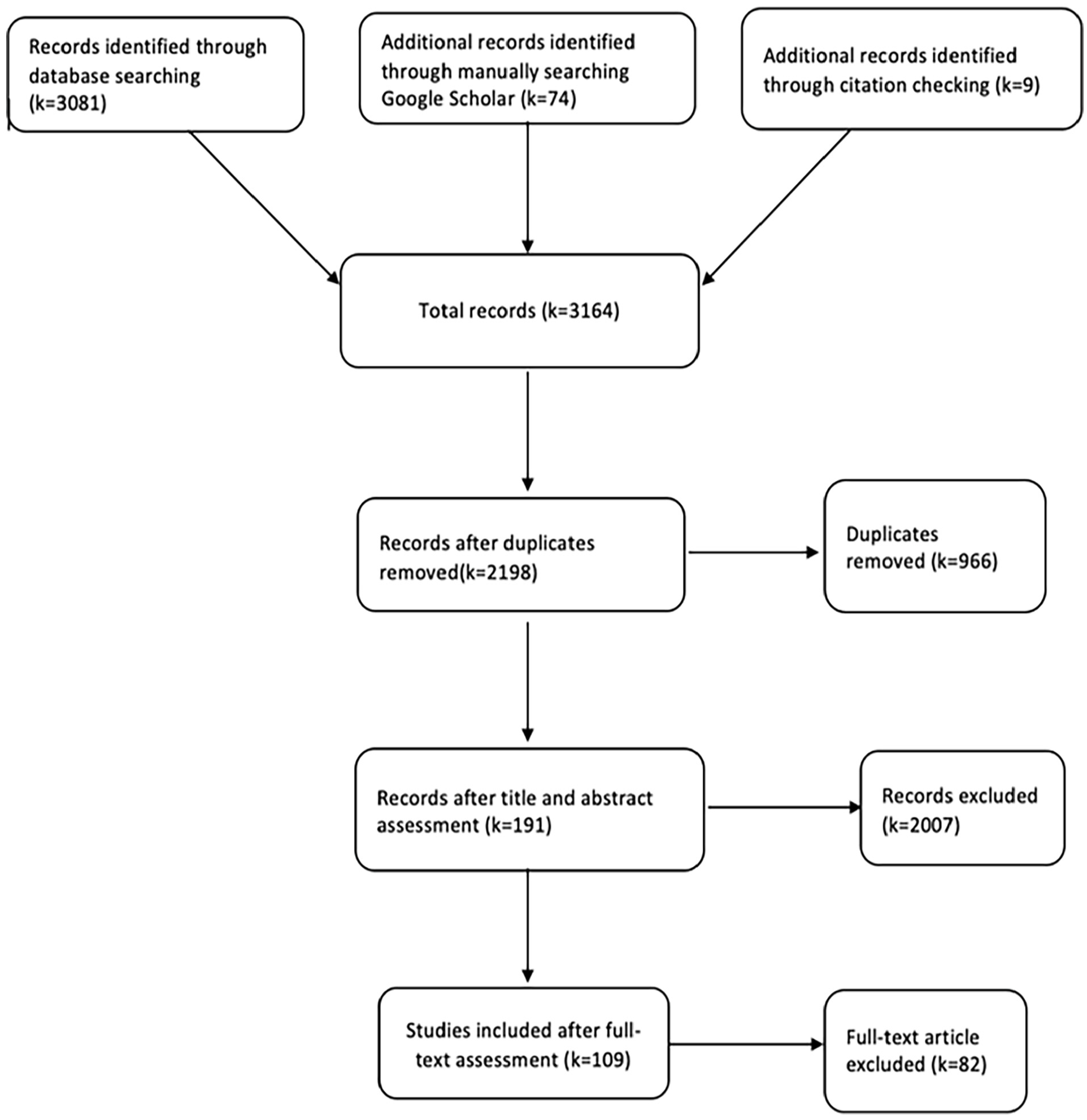
Flow diagram of literature search and selection.
Study Selection
The study selection comprised three stages (Figure 1). First, 966 duplicates were removed from the original dataset. Second, titles and abstracts of the 2,198 records were examined and 2007 articles were excluded as their topics are apparently irrelevant (such as “Study on International Standard Multilingual Nomenclature of Chinese Medicine”). To establish reliability of the screening process, every record was independently screened by two evaluators (the author and a graduate student). Disagreements were resolved by repeated discussion. Third, the full texts of the remaining 191 articles were assessed for eligibility by applying six inclusion and exclusion criteria developed for as comprehensive as possible an identification of primary evidence (Table 1). In terms of screening consistence and reliability, the author independently analyzed the whole texts of 191 articles and invited an experienced researcher to evaluate 17 disputed cases. A consensus was reached after thorough discussion. By the end of the screening process, 109 articles were included in the final dataset. Notably, although the time period of 1970 to 2020 was set for the literature search, none of the sampled records were dated before 1980. The literature search and selection were completed over 1 month.
Selection and Inclusion Criteria.

Data Analysis
Qualitative Analysis
The final dataset consists of 109 articles, each of which forms the basic unit of analysis. The author independently coded all the items for parameters 1 to 6 and invited the experienced researcher (the one who was consulted previously in the full-text screening) to settle uncertain cases for parameters 4 to 6. The coding of parameters 4 to 6 involved whole-text analysis, which turned out to be the most time-consuming yet most rewarding stage of the research process (the author has always regarded literature reading as one of the most fascinating research activities because of the whole spectrum of interesting perspectives revealed). For the present analysis, the author has closely read and meticulously coded all 109 articles in 4 months’ period and consulted the experienced researcher for challenging items. The coding framework is summarized in Table 2. Coding procedures for each parameter are reported as follows.
Coding Framework for the Six Reviewing Parameters of Chinese English Literature.

To determine the geographical distribution of the Chinese English literature, affiliations of authors (n = 165) were coded in two ways: (1) by the country in which their institution or organization was located (or, if unaffiliated, by the country in which the author was located), and (2) by the associated region.
The publication outlets of the 109 articles were coded by the name of each outlet and the results were classified according to whether it was published in a journal or a conference proceeding.
The citations of each article were determined by identifying each item in Google Scholar and noting its citation counts accordingly (by 22 April 2021).
The coding of research approaches is essentially of an open nature, though Bolton’s seminal taxonomy of approaches to the World Englishes paradigm (proposed in 2003 and updated subsequently in 2005, 2006, and 2018 respectively) was employed as the basic reference framework. Its latest version in Bolton (2018, p. 201) was adopted in the present study. As it is not uncommon to find one study define and highlight different aspects of its topic from two or more approaches, only the explicitly stated or the predominating approach was designated as the theoretical approach for each article. In actual coding, each item was evaluated and filtered through Bolton’s taxonomy of 13 categories to locate the label that best describes its research approach. If no existing label in the 13 basic codes fits the feature, a new code was developed and assigned to the item. This process was repeated until all the items were scrutinized and assigned a code. In terms of coding reliability, 19 out of the 109 articles required external evaluation for handling uncertainties and reaching consensus.
However, Bolton’s (2005) classification, theoretical in orientation, has presented two major challenges in mapping the academic discourses of Chinese Englishes. The first challenge arises from the “significant overlaps” (p. 69) inherent in the “intersecting and overlapping” approaches (Bolton, 2003, p. 36). The following coding principles are designed for four particularly highly inter-related categories.
(1) “English corpus linguistics”: As the corpus-based approach (whether using self-constructed dataset or established standard corpus) to world English studies has gradually become the major means or toolbox of empirically examining various localized phenomena (Davies & Fuchs, 2015; Lange & Leuckert, 2020; Nelson & Ozón, 2018) in tandem with “the second wave of world Englishes research” (Fuchs, 2020, p. 395), the category of “English corpus linguistics” (the means) is used to explore a large array of research approaches (the ends), most commonly seen in “features-based approaches” and “ELF.” For this reason, only articles where corpus was not used as a method but as the predominating agenda (such as Chinese English corpus design and compilation) are assigned with “English corpus linguistics” in the present study.
(2) “Features-based approaches”: Linguistic features are identifiable through multiple perspectives such as structural linguistics, lexicography and systemic functional linguistics. In this study, only articles adopting a structural approach are assigned with this code.
(3) “Kachruvian studies”: Kachruvian terminology (e.g., Inner Circle, Outer Circle and Expanding Circle) underpins almost all articles as the default conception, in which case, this category cuts across almost all approaches. The present study assigns this code exclusively to articles with an explicitly-stated Kachruvian research agenda such as bilingual creativity.
(4) “Applied linguistics”: Most research tend to respond to language learning and teaching issues as the majority of researchers are meanwhile educators. In the present study, this label is only assigned to studies that utilize a predominating pedagogical approach.
The second challenge arises from the hierarchical structure of Bolton’s (2018, p. 201) taxonomy. “Features-based approaches,”“the sociology of language,”“Kachruvian studies,”“Pidgin and creole studies,” these four labels are placed in alignment with other nine approaches but are subsumed within the “sociolinguistic approach” (in the 2018 version, the upper heading “sociolinguistic approach” disappeared from the taxonomy tabulation). This has caused particular difficulty for the coding of newly emerged sociolinguistic themes (such as “attitudinal” and “language landscape”), for which, obviously, “sociolinguistic approach” is not a suitable label because it is not on the same plane with other four existing sociolinguistic categories. To maintain consistence, the “sociolinguistic approach” is not used in the present coding (following the 2018 taxonomy). In other words, each newly appeared approach that falls within the sociolinguistic scope is not coded as the “sociolinguistic approach” but as the specific sub-theme it represents. In the results part, a numerical summary of all studies within the sociolinguistic line will be reported.
The identification of research methods adopted a four-item coding scheme: non-empirical, qualitative, quantitative and mixed methods. In the present study, “non-empirical” includes (1) conceptual and introspective research (e.g., position paper, general overview); (2) loosely empirical research which has yielded an impressionistic description by resorting to sporadic graphical or textual data without being explicitly either based on a specified set of data or accountable to a systematic procedure of data analysis. In terms of coding reliability, 13 out of the 109 articles invited additional assessment for disagreement reconciliation.
To determine the research strands in the dataset, each article was designated with a code describing its study focus. No pre-determined limits were set on the number of emerging codes. In terms of coding reliability, 15 out of the 109 articles were further discussed with the experienced researcher to resolve disputes. The open coding yielded 29 codes, upon which, the two researchers together identified 16 categories describing these codes.
Quantitative Analysis
The bibliometric analysis is generally used to reveal, on the basis of quantitative indicators, significant parameters of scientometrics as represented in the present reviewing framework. The frequencies and percentages for the values of the six parameters in the coding framework are calculated and compared both synchronically and diachronically, providing a numerical profile of the state of Chinese English scholarship in 1980 to 2020. The statistical analyses of the information were conducted using MS Excel and the figures visualizing the data have been produced by MS Excel and VOSviewer.
Results
RQ1: What Is the Current Status of Chinese English Literature?
RQ1a: How Is the Chinese English Literature Geographically Distributed?
Table 3 shows that studies of Chinese English were dispersed in four regions but heavily concentrated in Asia (71.8%). The rest of the research was conducted in North America (14.6%), Oceania (7.0%), and Europe (6.7%). Table 4 displays that authors of Chinese English scholarship were distributed in 17 locations, the majority of whom (57.5%) were affiliated with institutions from China Mainland (43.9%) and China Hong Kong (13.6%). One third (31.5%) of authors came from five countries: United States (12.1%), Australia (6.1%), Singapore (5.5%), United Kingdom (4.2%), and Brunei (3.6%). The rest 10.9% represented 10 locations that had four or fewer authors each.
Frequency (%) of Each Region Among Author Affiliations.
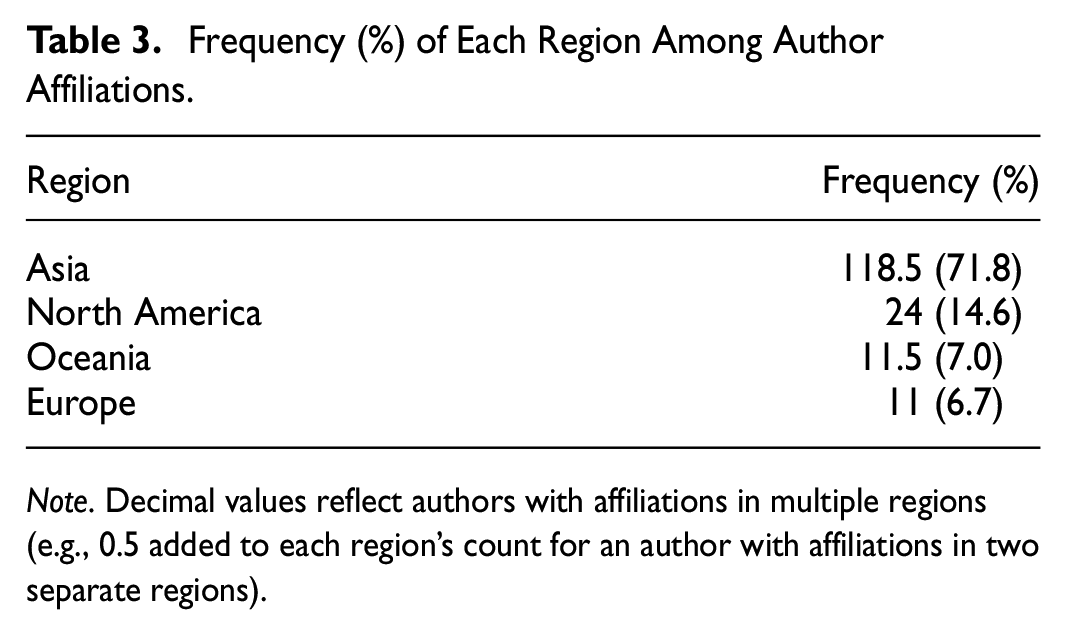
Note. Decimal values reflect authors with affiliations in multiple regions (e.g., 0.5 added to each region’s count for an author with affiliations in two separate regions).
Frequency (%) of Each Location Among Author Affiliations.

Note. Decimal values reflect authors with affiliations in multiple locations (e.g., 0.5 added to each location’s count for an author with affiliations in two separate locations).
RQ1b: What Are the Publication Outlets of Chinese English Literature?
Of the 109 articles identified, 101 were published in peer-reviewed journals and eight in conference proceedings. The 101 articles were located in 33 peer-reviewed journals. According to Table 5, the highest percentage of Chinese English studies (60.4%) were published in three prominent journals dedicated to the discipline of World Englishes: English Today (27.7%), World Englishes (23.8%) and Asian Englishes (8.9%). However, only two articles were published in English World-Wide (2.0%). The other 29 journals represented in the dataset published either one (20 journals) or two articles (9 journals) and covered a wide spectrum of linguistic, educational and humanistic topic areas such as applied linguistics, bilingualism, multilingualism, translation, literature and sociology. In terms of abstracting and indexing, the majority of journals (24, 72.7%) were indexed in both Web of Science (WoS) and Scopus, and the remaining journals were either indexed only in Scopus (3, 9.1%), Web of Science (1, 3.0%), or Google Scholar (5, 15.2%).
Journals Publishing the Chinese English Literature.

RQ1c: Which Chinese English Studies Are Cited the Most?
By 22 April 2021, the 109 articles identified were cited from 0 to 321 times in Google Scholar. Figure 2 displays the distribution of articles for each citation count and Figure 3 the distribution of articles in each citation range. Additionally, there are 41 (37.6%) articles cited 10 or below 10 times. If incorporating the parameter of publication outlets here, it is found among the eight conference proceedings studies, four were cited 0 times and the other four were cited 1, 3, 18, 40 times, respectively. Table 6 shows the articles cited most frequently (over 100 citations in Google Scholar). For comparative purposes, column four was added to show the number of citations 22 months after the data collection retrieved in Google Scholar and Scopus respectively (WoS was not consulted as the time frame for SSCI collection accessible through the author’s institution was from 2007 to present, which means a substantial number of papers before 2007 were not included.). The 16 most cited papers represented six journals (English Today 7/43.8%, World Englishes 5/31.3%, English World-Wide 1/6.3%, TESOL Quarterly 1/6.3%, American Speech 1/6.3%, Journal of English as a Lingua Franca 1/6.3%) dispersed in five publishers (Cambridge University Press 7/43.8%, Wiley-Blackwell 6/37.5%, John Benjamins 1/6.3%, Duke University Press 1/6.3%, De Gruyter 1/6.3%). Last but not the least notable, the 16 most cited papers were contributed by 21 authors, among whom, only three are female researchers.

Distribution of articles for each citation count.

Distribution of articles in each citation range.
The Most-Frequently Cited Literature (Over 100 Citations by 22 April 2021).

RQ1d: What Research Approaches Are Adopted in the Chinese English Studies?
The semi-open coding process has identified 18 research approaches (Table 7). Six categories in Bolton (2018, p. 201) taxonomy, “English studies,”“Pidgin and creole studies,”“Popularisers,”“Critical linguistics,”“Linguistic futurology,” and “English as an international language (EIL),” were not found to be corresponding to any item in the dataset while 11 new codes (in bold in Table 7) were developed to represent the various emerging research orientations in the domain of Chinese Englishes.
Research Approaches of the Chinese English literature.
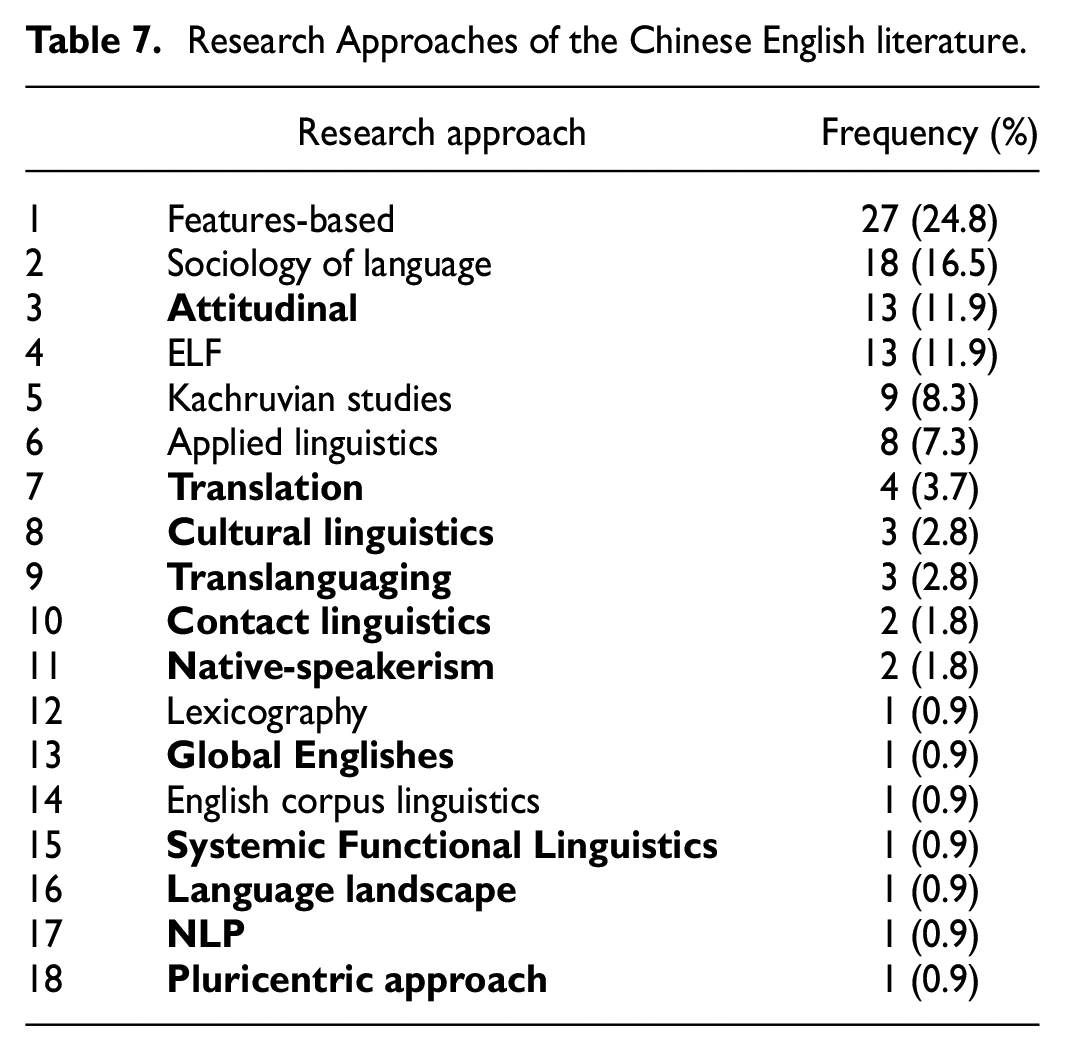
Among the 18 identified research approaches, six categories stood out: features-based (24.8%), sociology of language (16.5%), attitudinal (11.9%), ELF (11.9%), Kachruvian studies (8.3%), and applied linguistics (7.3%). The rest have 3.7% (1 approach), 2.8% (2 approaches), 1.8% (2 approaches), and 0.9% (7 approaches) of the articles respectively. Responding to the second challenge in the coding of research approaches (section 4.2.1), the sociolinguistic approach, which encompasses the sociology of language (16.5%), features-based (24.8%), Kachruvian studies (8.3%), attitudinal (11.9%) and language landscape (0.9%), accounted for 62.4% of all the articles.
RQ1e: What Research Methods Are Used in the Chinese English Scholarship?
According to Table 8, around one-third of the articles (39, 35.8%) are non-empirical while the rest two-thirds (70, 64.2%) are empirical. The empirical studies used quantitative (14, 12.8%), qualitative (32, 29.4%) and mixed methods (24, 22.0%). While descriptive statistics were reported in all quantitative and mixed methods papers (14 + 24 = 38), they were used as the sole method of quantitative analysis in 21 papers (21/38 = 55.26%). If incorporating the parameter of publication outlets, 60 among the 70 empirical studies (85.7%) were published by WoS-Scopus indexed journals.
Research Methods of Chinese English Literature.

RQ1f: What Research Strands Have Emerged in the Chinese English Literature?
The open coding yielded 29 codes designating the focus of each study and 18 categories emerged describing these codes. According to Table 9, six major research strands for Chinese English literature are linguistic features (34, 31.2%), attitudes (20, 18.3%), status overview (16, 14.7%), education (7, 6.4%), language ideology (5, 4.6%), and identity (5, 4.6%). The rest 12 strands occurred much less frequently from 3.7% to 0.9%. A more refined picture is provided by looking at the specific codes in each major research strand. In the 34 studies aiming at linguistic features, the codes of lexis, phonology, syntax, discourse, pragmatics appeared 14, 11, 6, 4, 2 times, respectively (Table 9). In the 20 studies investigating attitudes toward status, features and function of Chinese English, learner attitudes appeared 16 times, teacher attitudes eight times, and attitudes of speakers of other varieties one time.
Research Strands Present in the Chinese English Literature.

The thematic focuses of the Chinese English scholarship could be echoed and reinforced by the network of relations between key items occurring in the titles, abstract and list of keywords of the 73 papers indexed in the Web of Science and Scopus. The titles, abstracts and the keywords have been selected to form the basis of the analyses as these sections play a crucial role in defining/reflecting the themes and contents of the research. There are many nodes (central notions) in Figure 4, whose elements are related to one another as well. Two of these central notions are China English and Chinese English to which other nodes connect, pointing to various principal topical strands identified earlier such as linguistic features (feature, pronunciation, accent, syntactic feature, loan translation), education (learner, speaker, student, ELT, English phonetics instruction), bilingual creativity (rhetorical norm, Ha Jin), cultural conceptualization (Chinese culture), and user perspective (intelligibility). This network of relations, created on the basis of the key items, may function as a mind map, reflecting the contents of the bulk of Chinese English scholarship.
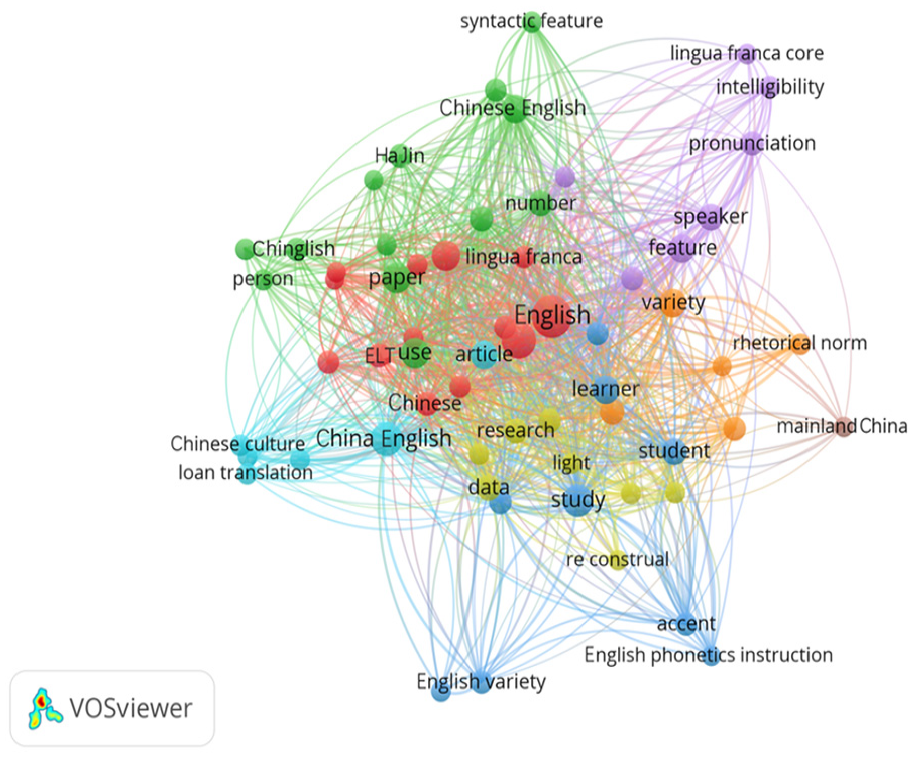
Network of relations between key themes.
RQ2: What Are the Diachronic Tendencies of Chinese English Literature in the Past Forty Years?
This section reports the quantitative results of the diachronic tendencies of Chinese English literature in four time periods (period I–IV: 1980–1989, 1990–1999, 2000–2009, and 2010–2020). As the correlation between citation and time is self-evident, the parameter of citation was not examined diachronically. Instead, the number of publications in each time period was calculated and compared. Therefore, diachronic trends of six parameters of publication number, author affiliation, publication outlets, research approaches, research methods and research strands are reported respectively below.
Figures 5 to 7 illustrate the chronological division of number of publications, author affiliations and publication outlets respectively. According to Figure 5, the number of publications is on steep rise with 2 (1.8%), 3 (2.8%), 24 (22.0%), and 80 (73.4%) articles published respectively in periods I to IV. According to Figure 6, the percentage of authors affiliated with China mainland is on slight decrease (66.7%, 50.0%, 44.8%, 43.0%). Figure 7 shows 1, 2, 6, and 33 journals hosted Chinese English articles respectively in the four periods. Additionally, the eight conference proceeding articles all appeared in the 2010 to 2020 period.

Number of publications in each period.

Percentage of China mainland authors in each period.

Number of journals hosting Chinese English articles in each period.
Figures 8 to 10 illustrate respectively the graphical presentation of diverse research approaches, research methods and research strands for each time period. According to Figure 8, the two articles in period I were all “features-based”; the three articles in period II were evenly divided among “applied linguistics,”“features-based” and “sociology of language”; the 24 articles in period III saw three additional approaches emerging: “attitudinal,”“Kachruvian studies,” and “native speakerism”; in period IV, the 80 articles were dispersed among 18 approaches.

Research approaches of Chinese English literature in four time periods.

Research methods of Chinese English literature in four time periods.

Research strands of Chinese English literature in four time periods.
According to Figure 9, the two articles in period I were evenly divided between “mixed methods” and “non-empirical”; in period II, all three articles were “non-empirical”; in period III, 37.5% of the articles were “non-empirical” while 62.5% were “empirical” (25.0% “qualitative,” 12.5% “quantitative,” and 25.0% “mixed methods”); in period IV, 32.5% were “non-empirical” and 67.5% were “empirical” (32.5% “qualitative,” 13.8% “quantitative,” and 21.3% “mixed methods”).
According to Figure 10, in phase I, the two studies were all about “linguistic features.” In phase II, the three studies were evenly distributed in “education,”“linguistic features” and “status overview.” In phase III, division of research strands were “attitudes” (7, 29.2%), “linguistic features” (7, 29.2%), “status overview” (6, 25.0%), “bilingual activity” (2, 8.3%), “education” (1, 4.2%), and “user perspective” (1, 4.2%). In phase IV, distribution of the 18 strands were “linguistic features” (24, 30.0%), “attitudes” (13, 16.3%), “status overview” (9, 11.3%), “education” (5, 6.3%), “identity” (5, 6.3%), “language ideology” (5, 6.3%), “cultural conceptualization” (3, 3.8%), and the rest 11 strands either have one or two articles for each.
Discussion
The Current Status of Chinese English Scholarship
The Geographical Status of Chinese English Scholarship
Distributed in four regions and 17 locations, Chinese English literature was heavily concentrated in Asia (71.8%) with most authors originating from China Mainland (43.9%) and China Hong Kong (13.6%) though North America (14.6%) and United States (12.1%) also contributed a significant portion. The statistics of geographical spread of other regional Englishes scholarship are not available. Hillman et al. (2021) did touch upon geographical division of research on MENA (The Middle East and North African) Englishes, but they looked at what specific country in the MENA region was examined in each article instead of the author affiliations. However, statistics are available in other disciplines such as the MOOC technology. In Veletsianos and Shepherdson (2016), the 183 MOOC articles in 2013 to 2015 were authored by researchers originating from 38 countries. Though situated in two different disciplines, the comparison at least indicates that Chinese English is still a highly regional research enterprise (consider 17 countries in the time span of 40 years vs. 38 countries in the time span of 3 years).
It would be too abrupt to generalize the findings here to reflect the geographical contribution to academic output for other Expanding Circle or even Outer Circle varieties. However, a more generalized and recognized observation is that: if authors from select geographical regions dominate the direction and focus of the research, the development of scholarly understanding of localized Englishes might be limited in scope. On the contrary, the participation of a broader geographical area may provide more diverse perspectives through which to make sense of the indigenized Englishes phenomena. In other words, studies of localized Englishes need globalized scholarship.
The Publication Outlets of Chinese English Scholarship
The choice of publication outlets varies significantly across disciplines. Of the 109 articles identified, 101 are published in peer-reviewed journals. By comparison, Hillman et al. (2021, p. 4) “chose to include only peer-reviewed empirical and theoretical journal articles in respectable journals” to ensure quality assessment. A very different picture is presented by Veletsianos and Shepherdson (2016) in which 53.6% of MOOC-related studies were published in journals and 46.4% in conference proceedings. The findings in the present study and the exclusion of other types of publication outlets in Hillman et al. (2021) could be combined to suggest the status of peer reviewed journals as the predominating communicative forum in world Englishes studies (as compared with conference proceedings). Furthermore, the abstracting and indexing status of the journals (over two-thirds are WoS-Scopus indexed) might also indicate, to a certain degree, the general high standard of the output quality of Chinese English research disseminated as journal articles.
A closer look revealed three journals dedicated to the world Englishes paradigm featuring prominently, English Today (including 27.7% of the articles), World Englishes (23.8%) and Asian Englishes (8.9%). A notable exception is English World-Wide, hosting only two articles (2.0%). The result, again, was triangulated by Hillman et al. (2021) in which only one study was published in English World-Wide. Apart from these four journals, 29 other journals have published articles in the present study and 23 other journals in Hillman et al. (2021), each of the “other journals” hosting only one or two articles. The findings here indicate that while the three traditional journals for world Englishes still prevail, studies of regional varieties have spanned across and gained interest from a wide spectrum of disciplines as represented by the wide array of journal outlets.
Citations of Chinese English Scholarship
As there are no available statistics calculating the citation counts of other regional Englishes in parallel time periods, it is hard to compare the reach and impact of Chinese English literature with other Expanding Circle or Outer Circle Englishes. However, the citation analyses of the present study (1) showed a significant portion (37%) were cited from 0 to 10 times; (2) revealed that papers in conference proceedings were generally not frequently cited; (3) identified papers that, for one reason or another, are popular; (4) revealed the two most prolific publishers, Cambridge University Press and Wiley-Blackwell, the latter has been one of the top five publishers for social sciences and humanities since the mid-1990s (Larivière et al., 2015); (5) added evidence to the unbalanced gender representation in scientific productivity and impact in soft sciences when abundant statistics have already accumulated for gender inequality in hard sciences (Beaudry & Larivière, 2016; Prpić, 2002).
Research Approaches of Chinese English Scholarship
The Chinese English phenomena have been approached from a plethora of theoretical perspectives though not in a well-balanced manner. While traditional approaches to the Chinese English phenomena enjoyed a predominance (features-based 24.8%, the sociology of language 16.5%, attitudinal 11.9%, Kachruvian studies 8.3%, applied linguistics 7.3%, totaling 68.8%), a large variety of new approaches have emerged among which ELF accounted for a significant 11.9% while the remaining 19.3% was divided amongst other 12 approaches. By comparison, Hillman et al. (2021) has identified the most common five approaches as sociology of language (31%), applied linguistics (20%), Kachruvian studies (17%), ELF (17%) and Schneider’s dynamic model studies (12%). While similar theoretical concerns shared by the two studies (the sociology of language, Kachruvian studies, applied linguistics, ELF) might suggest universal themes across various contexts of regional Englishes, notable differences include (1) Schneider’s dynamic model did not appear in the present study, understandable as this model originated from and theorizes specifically for postcolonial Englishes and its applicability to the Expanding Circle varieties such as Chinese English remains unresolved (Schneider, 2014); (2) the first-place features-based came at the sixth place in Hillman et al. (2021), which could be attributed to different sociopolitical, historical and ideological dynamics surrounding these two variety complexes. However, due to the arbitrariness and subjectivity of the coding procedures (e.g., attitudinal studies did not appear in research approaches in Hillman et al., 2021 but was the second most common research area in the same study) and the fact that Hillman et al. (2021) has not explicitly explained the coding principles for certain overlapping approaches, the comparison here should be interpreted with great caution.
Methodological Status of Chinese English Literature
Slightly over one-third (39, 35.8%) of the 109 articles are non-empirical. The empirical studies (70, 64.2%) consist of 32 (29.4%) qualitative studies, 24 (22.0%) mixed-method studies and 14 (12.8%) quantitative studies, suggesting that researchers have favored a qualitative approach to the conduct of Chinese English research. Looking closer, more than half of the 14 quantitative and 24 mixed-methods studies used descriptive analysis as the sole method of quantitative analysis. The analysis suggests that scientifically designed research, especially robust empirical research with a mixed-method design using inferential statistics, is still lacking. Whether this is particular for Chinese English studies or representative of Expanding Circle Englishes is hard to determine because of scarcity of relevant publicly-accessible statistics. Additionally, that the overwhelming majority of the empirical studies (85.7%) were published by WoS-Scopus indexed journals might indicate, to some extent, the correlation of empiricism and journal ranking, which needs further validation and refinement by evidence from more fields and disciplines.
Research Strands of Chinese English Literature
According to Ma and Xu (2017), world Englishes research on varieties in Kachru’s three concentric circles has a different agenda. The Inner Circle varieties are primarily about variation and change; the Outer Circle varieties have been largely researched regarding their developmental stages for the purpose of legitimization; the Expanding Circle varieties mainly focus on the naming and defining of such varieties and the extent to which these varieties exist. The present study reveals that variety naming and defining only constitute the primary concern of the initial phase of Chinese English research. The results here have shown a diverse range of scholarly concerns (29 codes, 18 categories) for the Chinese English publications though they have received diverse amount of scholarly attention.
The articles are heavily concentrated in four strands: linguistic features (34, 31.2%), attitudes (20, 18.3%), status overview (16, 14.7%) and education (7, 6.4%). Other 14 strands have one to five articles. By comparison, Hillman et al. (2021) has identified the most common sub-areas in MENA Englishes: sociology of language (23.7%), language attitudes (18.6%), areal studies (15.2%), features-based (15.2%), language education (11.9%), contact linguistics (11.9%), and critical linguistics (10.2%). While these two studies have presented some common popular themes, to what extent the slight differences in the percentages of these areas reflect different scholarly concerns in the two Englishes or arise from subjective coding in the two studies is not clear.
Besides, the scholarly attention within each research strand is not well balanced. In the 34 linguistic features studies, “lexis” and “phonology” were the most examined dimensions while other linguistic levels such as syntax, discourse and pragmatics received much less attention. In the 20 attitudinal studies, learner attitudes were investigated twice as many times as teacher attitudes and attitudes of speakers of other varieties emerged only once.
Diachronic Trends of Chinese English Literature
Berns’s (2005) quantitative analysis of numbers of articles with an Expanding Circle country focus published over 1998 to 2001 in journals of World Englishes and English Today suggests “a critical mass of studies of the Expanding Circle and its Englishes is in the early stages of formation” (p. 90). Judging from the number of publications in Phase I to IV (2, 3, 24, 80) in the present study, it would be reasonable to characterize phase III (2000–2010) as a formative period and therefore characterize developmental stages of Chinese English literature as dormant (phase I and II), formative (phase III), and blossoming (phase IV). Throughout its evolutionary course, parameters of the state of Chinese English literature have displayed distinctive diachronic trends.
In the formative and the blossoming periods, parameters of publication outlets, research approaches and research strands are on the rise steadily in the former and sharply in the latter which witnessed prodigious growth in the disciplines the publication outlets represented, theoretical approaches adopted and topic areas examined. In terms of author affiliation, the percentage of Chinese mainland-based authors is on slight decrease, which means Chinese English research is contributed by authors from an increasingly broader geographic area.
The trends of research methods are somewhat complex in these two periods. The percentage of empirical research has increased, but only slightly (from 63% to 68%); qualitative research is on the rise (from 25% to 33%); mixed-methods research is on the decrease (from 25% to 21%); quantitative research is approximately stable (from 13% to 14%). The results suggest that (1) the methodological status of the Chinese English literature has not changed substantially, at least not as substantially as other three parameters explained in the previous paragraph and (2) evidenced-based studies, especially rigorously designed mixed methods studies using inferential statistics, are still lacking.
Conclusion
This study has presented a comprehensive and systematic bibliometric analysis of the current status and developmental trajectory of the Chinese English scholarship (1980–2020) in dimensions of geographical distribution, publication outlets, citation counts, research approaches, research methods, and research strands. Analytical results demonstrate that research in Chinese English has kept abreast of the progress of world Englishes scholarship and has developed rapidly in both quantity and quality in 1980 to 2020, especially in the past decade 2010 to 2020. The body of literature has attracted researchers from a wider geographical area who are situated in a broader range of disciplines, accumulated higher impact, achieved growing heterogeneity in theoretical approaches and topical areas and adopted an increasingly evidence-based methodology.
However, this mapping of Chinese English research suggests plenty of room for future research endeavors. In terms of geographical distribution, a more globalized profile of researchers is needed; in terms of research approaches, the newly emerged approaches with very limited research reported are a rich area for future studies; in terms of research methods, an expansion of the methodological approaches and a sounder methodological toolkit are urgently needed; in terms of research strands, underexplored topic areas (such as discoursal, pragmatic, collocational and rhetorical features, instructor attitudes, corpus building) are deserving more attention. This study provides only a segment of the landscape of world Englishes scholarship. Future empirical studies about the status and history of other Expanding Circle varieties and Outer Circle varieties are needed in order to reach more general and firm conclusions regarding uniform patterns and divergent facets in world Englishes research and more importantly the intra-linguistic and extra-linguistic factors responsible for the broad range of variability and commonalities.
There are many possibilities for future systematic reviews which may focus on synthesizing knowledge on particular areas of interest (e.g., linguistic features) or analyzing exclusively empirical research by examining the data collection and data analysis methods. Furthermore, future research could compare how papers published after 2020 fit into the picture described herein and engage in further categorization and cross-tabulation of the literature on the basis of the reference statistics provided herein. Finally, it is hoped that the findings here might encourage a critical reflection on the part of researchers as to the history, present and future of Chinese English research as well as contribute to the development of sustainable future research directions through the World Englishes lens.
Footnotes
Declaration of Conflicting Interests
The author(s) declared no potential conflicts of interest with respect to the research, authorship, and/or publication of this article.
Funding
The author(s) disclosed receipt of the following financial support for the research, authorship, and/or publication of this article: National Philosophy and Social Sciences Foundation (Grant 23BYY008), The Interdisciplinary Research Project for Young Teachers of USTB (Grant FRF-IDRY-21-003), and Quality Education Core Course Construction of USTB (Grant KC2022TS04)

Data Availability Statement
Data sharing not applicable to this article as no datasets were generated or analyzed during the current study.