




Abstract
Tourism has become an essential activity for the economies of developing island destinations. Few studies have focused on the influence of community attachment and personal benefits on residents’ perceptions of impacts and support for tourism in these areas. Moreover, many previous studies have yielded ambivalent results on the role of community attachment. In the present study, based on social exchange theory, we tested a theoretical model that analyses these aspects in a socio-economic context such as the Cape Verde archipelago with a strong impact of emigration, where community attachment or the personal benefits produced by tourism can help explain the level of residents’ support. Quantitative research was carried out through a survey of residents and 518 valid responses were obtained. The model was tested using structural equations with PLS. The results suggest that personal benefits influence both directly and indirectly, through perceptions of tourism impacts, and residents’ support for tourism. It is also found that community attachment influences residents’ perceptions of tourism impacts. Theoretical and practical implications of the results obtained are also discussed.
Plain Language Summary
Purpose: The purpose of this study is to understand how community attachment and personal benefits influence residents’ support for tourism activities in emerging island destinations, using Cape Verde as a case study. Methods: The researchers conducted quantitative research through a survey of residents in Cape Verde. They obtained 518 valid responses and tested a theoretical model based on social exchange theory. The model analyzed the causal effects of community attachment and personal benefits on residents’ perceptions of tourism impacts and their support for tourism. Conclusions: The study found that both community attachment and personal benefits play a significant role in influencing residents’ perceptions of tourism impacts and their support for tourism development. Personal benefits had direct and indirect effects on support, while community attachment influenced residents’ perceptions of tourism impacts. Implications: The findings suggest that to promote sustainable and conflict-free tourism development, destination managers should create opportunities for local residents to benefit from tourism activities directly or indirectly. Additionally, reinforcing feelings of belonging and community attachment could help mitigate migratory stress faced by emerging tourism destinations in developing countries like Cape Verde. Limitations: The study has several limitations. Firstly, it focused solely on Cape Verde as a single developing island destination, so the results may not be generalizable to other locations with different cultural contexts. Secondly, the sample was unbalanced, and the tourism impacts might vary on different islands, potentially introducing some bias.
Keywords
Introduction
The support of residents for tourism activity is a fundamental aspect for sustainability, harmonious and conflict-free development, and the success of tourist destinations (Crotts et al., 2022), especially for developing island destinations where the sector’s contribution to the economy is highly relevant (Eusébio et al., 2018; S. Wang & Chen, 2015). In this research field, many studies have identified some intrinsic exogenous factors that have the potential to influence residents’ support for tourism activity (Gursoy et al., 2019). In this context, community attachment in emerging island destinations with strong migratory tension due to economic motivations, such as Cape Verde, can play a relevant and distinctive role in explaining support for tourism compared to other places. Similarly, in developing island destinations, it is common for residents to be excluded from participation in the process and not receive personal economic benefits (S. Wang & Chen, 2015), which means this intrinsic variable can also have differential effects on residents’ support.
However, despite the importance these exogenous factors can have in this type of destination, few studies have addressed these relationships in the literature (Nunkoo & Ramkissoon, 2010).
To address these literature gaps, the present study proposes the testing of a structural model of direct and/or indirect causal effects of community attachment and personal benefit on residents’ perceptions of the positive and negative impacts of tourism and their support for tourism development in a developing island tourist destination, such as Cape Verde.
Since the 1970s numerous studies have attempted to analyse residents’ attitudes toward tourism development, giving rise to a relevant field of research (Gursoy et al., 2019). Of the various theories from which residents’ support for tourism activity has been studied, Social Exchange Theory (SET) (e.g., Ap, 1992; J. S. Chen & Hsu, 2001; Getz, 1994; Gursoy et al., 2010; Jurowski & Gursoy, 2004) has made the most significant theoretical contributions (Fredline & Faulkner, 2000; Gursoy et al., 2009).
However, the vast majority of these previous studies have been conducted in developed countries (Sirakaya et al., 2002). Moreover, although tourism is considered by governments and development actors as one of the most important economic activities to promote sustainable development in developing countries, attention to this phenomenon has been rather limited (Eusébio et al., 2018). In this sense, it may be that the factors influencing residents’ perceptions of tourism impacts, as well as their nature and extent, may be different in developed and developing regions (Sirakaya et al., 2002). In addition, small island economies are lagging behind in the analysis of their residents’ attitudes toward the tourism sector, and it is questionable whether, due to their special characteristics, existing models and results on resident attitudes are valid (Gursoy & Rutherford, 2004; Nunkoo & Ramkissoon, 2010; Rasoolimanesh et al., 2015).
It is recognized that island tourist destinations have unique and differential characteristics in their tourism development (Jafari, 1982; Nunkoo & Ramkissoon, 2010), with significant contributions to Gross Domestic Product, ranging from 74% in the case of the Caribbean islands (Weaver, 1991) to 44.8% in the Balearic Islands (EXCELTUR, 2022), 35% in the Canary Islands (Exceltur, 2022) or 25% in the case of Cape Verde (The World Bank, 2022).
Developing island destinations often face economic and social constraints that impede integrated progress, with residents often excluded from tourism decision-making and planning processes (Dyer et al., 2007; S. Wang & Chen, 2015). In fact, the existence of possible differences in island developing economies in relation to residents’ perception of impacts and support for tourism has been raised (Eusébio et al., 2018; Nunkoo & Ramkissoon, 2010).
Furthermore, there are a limited number of studies, often with ambiguous results, on the direct and indirect effects of community attachment, a potentially important variable in a developing country context (see Gursoy et al., 2002; Gursoy & Rutherford, 2004; McCool & Martin, 1994; McGehee & Andereck, 2004). Therefore, there is a need to investigate residents’ attitudes toward tourism development in developing regions, considering some intrinsic exogenous factors, which may provide considerably different results from those obtained in developed countries (Eusébio et al., 2018).
This paper is structured as follows. The subsequent section provides an exposition of the theoretical framework, accompanied by the hypotheses formulated for empirical investigation, pertaining to the characterization and determinants of residents’ support for tourism activity within a developing island tourist destination. Following this, a detailed explication of the measurement model is presented, which is succeeded by an elaborate account of the selected sample and the methodological approach employed. The empirical results are subsequently meticulously delineated. Lastly, the paper culminates by concisely outlining the primary contributions and engaging in a comprehensive discourse regarding the implications of this study for future research
Theoretical Framework and Hypotheses
Conceptual Framework
Theory
Social Exchange Theory (SET) was applied by Ap (1992) to tourism assuming that there is an exchange of resources and value between different stakeholders in the destination. According to this theory, residents will support tourism development if they perceive a positive balance in their relationship with tourists (Allen et al., 1993), assuming that the more positive the potential impacts of tourism are perceived to be, the more willing residents will be to support tourism development (Gursoy et al., 2010; Stylidis & Terzidou, 2014).
This relationship has been corroborated by a multitude of studies (e.g., Garau-Vadell et al., 2014; Gursoy & Rutherford, 2004; Jurowski et al., 1997; Nunkoo & Ramkissoon, 2012). According to this theory, it is key to understand the dimensions of impacts and how the benefits and costs of the activity are perceived (Gursoy et al., 2019; Han et al., 2022; Woosnam & Ribeiro, 2022).
Residents’ Perceptions of the Impact of Tourism
In most studies on residents’ support for tourism activity, it is generally accepted that residents’ perceptions are usually related to broad groups of impacts including economic, cultural, social and environmental impacts, with numerous contributions relating to impacts located in each of these dimensions (e.g., Andereck & Vogt, 2000; Gursoy et al., 2002; Gursoy & Kendall, 2006; Gursoy & Rutherford, 2004; Gutiérrez-Taño, 2010; Stylidis & Terzidou, 2014). These impacts have been structured in theoretical models in various ways, with this study following one of the alternatives by classifying impacts from a two-dimensional perspective, grouping them into benefits and costs (Boley et al., 2014; Gursoy et al., 2002; Gursoy & Kendall, 2006; Latkova & Vogt, 2012; Nunkoo & Ramkissoon, 2011; S. Wang & Chen, 2015), both being valid predictors of residents’ support for tourism development. Each of these two dimensions is operationalized into items that consider the four types of impacts mentioned above, thus using an integrative approach to investigate the specific influences of each of them (economic, social, cultural, and environmental).
Exogenous Factors
Numerous studies have attempted to analyse residents’ attitudes toward tourism development, giving rise to a relevant field of research (Gursoy et al., 2019) with the aim of identifying the factors that can influence perceptions of the impacts generated by tourism activity, differentiating between those of an intrinsic nature and those known as extrinsic (Rasoolimanesh & Seyfi, 2021). Intrinsic variables relate to residents’ personal circumstances and characteristics (economic, dependence on tourism employment, community attachment, spatial factors, host-guest interaction, personal values, environmental awareness and demographic variables such as age, gender and education). Extrinsic variables refer to the socio-economic environment of the community, such as the level of tourism development, including the type of tourism and tourism markets, seasonality, dependence on the tourism industry and national stage of development (Faulkner & Tideswell, 1997).
Literature Review
Positive Perceived Impacts
Among the positive impacts generated by tourism, most studies have focused on economic impacts and a large proportion of them have found that residents tend to have positive perceptions of the economic impacts of tourism development (e.g., Andereck & Vogt, 2000; Andereck et al., 2005; Gursoy et al., 2002). Tourism is an activity that increases investment and employment (Dyer et al., 2007; T. J. Lee et al., 2007), improves living standards, increases community income (Byrd et al., 2009; Gursoy & Rutherford, 2004) and contributes to infrastructure development (Andriotis & Vaughan, 2003; Terzidou et al., 2008).
However, positive impacts are not only limited to the economy, tourism also has impacts on the socio-cultural context. In the social dimension, some studies have highlighted, for example, that investment in tourism facilities increases recreational resources for local residents (Belisle & Hoy, 1980; Dyer et al., 2007; J. C. Liu & Var, 1986), improves the quality of life of residents in general (Andereck & Nyaupane, 2011; Milman & Pizam, 1988; Tovar & Lockwood, 2008) and improves local amenities (Kuvan & Akan, 2005).
In the cultural sphere, results have also found perceptions of positive impacts, for example on improving intercultural understanding (Gilbert & Clark, 1997; Kuvan & Akan, 2005), increasing shopping and leisure opportunities in the destination (Byrd et al., 2009; McDowall & Choi, 2010). Fostering emotional solidarity between residents and tourists (Woosnam & Norman, 2011), contributing to the preservation of local culture (McDowall & Choi, 2010; McGehee & Andereck, 2004) and enhancing the community and cultural identity of local residents are relevant positive effects, too (Stronza & Gordillo, 2008).
Although in the environmental dimension, studies have identified more perceptions of negative impacts by residents, there are also studies that have found some positive aspects of tourism activity toward the environment. For example, in certain areas of ecological decline, residents expressed agreement with statements suggesting that tourism had improved the appearance of their village and surroundings (Perdue et al., 1987) or enabled the reclamation of recreational space (McCool & Martin, 1994; Perdue et al., 1990) or increased investment in environmental infrastructure (Var and Kim, 1990).
Negative Perceived Impacts
Previous research has also found that residents of a destination may perceive negative impacts, with environmental aspects being the costliest as residents perceive that tourism causes negative effects on the environment, such as environmental pollution, destruction of natural resources, degradation of vegetation and depletion of wildlife (Andereck, 1995; Var and Kim, 1990). Tourism is often linked to pollution, crowding and noise (Brunt & Courtney, 1999; Byrd et al., 2009; Dyer et al., 2007; Johnson et al., 1994; Nunkoo & Ramkissoon, 2010; Terzidou et al., 2008). Indeed, certain extensive tourism endeavors have been declined by local inhabitants due to their perceived negative impact on the fragile ecosystems and natural environment (Andriotis, 2008).
In relation to the cultural dimension, some studies have identified negative impacts such as those related to the loss of traditions, acculturation and trivialization of cultural heritage (Bestard & Nadal, 2007; Dyer et al., 2007; Ko & Stewart, 2002; Nunkoo & Gursoy, 2012; Tosun, 2002). Whereas, negative social impacts include traffic congestion problems or an increase in general social problems (J. C. Liu & Var, 1986; Long, Perdue and Allen, 1990; Tovar & Lockwood, 2008), such as crime, alcoholism and prostitution (Nunkoo & Ramkissoon, 2010).
Although in the economic dimension, residents usually recognize the positive economic impact, economic costs have also been identified, such as the generation of seasonal and unstable low-wage jobs, the increase in the cost of living due to the higher demand for goods and services (Kwan & McCartney, 2005; J. C. Liu & Var, 1986; Perdue et al, 1990). There is also the fact that tourism activity does not always incorporate local labor, and that businesses may be in the hands of foreign companies that do not reinvest their profits in the territory (Sharpley, 2014; Tosun, 2002) as well as the increase in real estate prices (Belisle & Hoy, 1980; Bestard & Nadal, 2007; Cui & Ryan, 2011; Lorde et al., 2011).
Community Attachment
Attachment is understood as residents’ feeling of solidarity with the local community (Gursoy et al. 2019) manifesting itself in a positive or negative relationship that a person has with a specific place (Eusébio et al. 2018; T. H. Lee, 2013; Scannell & Gifford, 2010). It is the result of people’s accumulated experiences of the physical and social dimensions of an environment leading to emotional attachment to that place (Low & Altman, 1992; Tuan, 1974).
The community attachment theory of place-based residents (Vargas-Sánchez, et al., 2011, 2015) has often been used to enhance the explanatory power of SET-based models, and many previous studies have found that it can influence perceptions of tourism impacts (Andereck & Vogt, 2000; Gursoy et al., 2019). This approach considers that the nature and strength of community attachment can influence how residents perceive the potential impacts of tourism development (McCool & Martin, 1994; Sheldon & Var, 1984; Um & Crompton, 1987).
Much previous research has concluded that residents’ level of emotional attachment to their community affects how they evaluate tourism impacts, although its effect on residents’ support for tourism is ambivalent (see Gursoy & Rutherford, 2004; Gursoy et al., 2002; McCool & Martin, 1994; McGehee & Andereck, 2004). Some findings suggest that residents’ attachment to their community is negatively related to their perceptions of tourism’s positive impacts of (e.g., Draper et al., 2011; Haralambopoulos & Pizam, 1996; Lankford & Howard, 1994; Madrigal, 1993; Snaith & Haley, 1999). Both Haralambopoulos and Pizam (1996) and Snaith and Haley (1999) concluded that the shorter the period of residence, interpreted as less attachment, the more positive the residents’ perception of tourism impacts. Likewise, Um and Crompton (1987) validate an adverse correlation between community attachment and the perceived repercussions of tourism. On the other hand, Gursoy et al. (2002) were unable to establish a distinct connection between community attachment and perceptions of tourism impacts.
However, other research suggests a positive relationship between attachment and perceptions of positive impacts (e.g., Davis, Allen & Cosenza, 1988; Deccio & Baloglu, 2002; Gursoy & Rutherford, 2004; Gursoy et al., 2002; Jurowski et al., 1997). Notable in this group of research are the results of Gursoy and Rutherford (2004), who found that more attached residents tend to perceive tourism impacts more positively than less attached ones. Furthermore, Ramkissoon and Nunkoo (2011) documented a favorable association between the image residents hold of their locality and their perspectives on the advantages of tourism. Similarly, Schroeder (1996) observed that residents possessing more positive impressions exhibited an increased inclination to support tourism development and promotion through state funding. Davis et al. (1988) additionally contend that community attachment stands as a substantial predictor of residents’ favorable reactions to tourism expansion. Jurowski et al. (1997) go on to contribute that residents with stronger attachments tend to view the economic and social repercussions of tourism more optimistically. Nevertheless, McCool and Martin (1994), along with Choi and Murray (2010), propose that sentiments of local community attachment elevate the perception of both positive and negative consequences. Contrarily, Lankford and Howard (1994) discovered an absence of a distinct relationship between attachment and perceptions of impact.
These contradictions in findings regarding the relationship between community attachment and perceptions of tourism impacts can potentially be attributed to the different approaches adopted in their measurement (Stylidis, 2018). Community attachment has often been measured as length of stay and/or being born or raised in a community (Davis et al., 1988; Jurowski et al., 1997; Lankford & Howard, 1994; McCool & Martin, 1994; McGehee & Andereck, 2004). However, many authors consider that attachment should rather be measured by the feeling toward and participation in the community (Jurowski & Brown, 2001). In this sense, it is noteworthy that the research referred to above has been carried out in environments with very different socio-economic situations and models of tourism development.
Despite the existence of verified evidence supporting the link between community attachment and perceptions of impacts, this construct has not been routinely analyzed as a determinant of residents’ perceptions toward tourism development (Gu & Ryan, 2008). There has only been limited empirical research addressing this relationship and with mixed results (McGehee & Andereck, 2004; Ramkissoon & Nunkoo, 2011; Stylidis, 2016).
Personal Benefits of Tourism
Personal benefits from tourism for residents refer to the positive outcomes or advantages that local inhabitants of a region or tourist destination experience as a result of tourism activities in their area. These benefits are specific to the residents and can be either direct or indirect (increased income, employment opportunities, …) (Gursoy et al., 2019; McGehee & Andereck, 2004).
Research into local residents’ attitudes toward tourism development has highlighted that one of the intrinsic exogenous antecedents that most influences perceptions of tourism impacts are the direct or indirect personal benefits generated by the activity (Gursoy et al., 2019; Y. Wang & Pfister, 2008). Indeed, the personal benefits generated by tourism have been considered the most prominent motivation for local residents to engage in and support tourism development in their community (Pizam, 1978)
Hypotheses Development
Relationships of Community Attachment
There does, however, seem to be a consensus in the literature on the use of community attachment as a factor that is commonly present in people’s lives (Lewicka, 2008; Williams & McIntyre, 2001) and is an antecedent of psychological equilibrium (Rowles, 1990). Thus, greater attachment would imply greater emotional attachment to the place (Low & Altman, 1992; Tuan, 1974) and would therefore imply greater resistance to abandoning it under any circumstances. This fact suggests that in unfavorable economic situations that encourage emigration, residents would appreciate and value more positively the positive impacts of tourist activity as it would be an alternative to emigrating from a place to which they feel emotionally attached.
According to some previously reported studies, such as Jurowski et al. (1997), Gursoy and Rutherford (2004) and Choi and Murray (2010), for an environment with high outbound-migration due to economic reasons such as the one depicted here, the following hypotheses can be put forward regarding the relationship between residents’ community attachment and the perceived impacts of tourism activity:
H1: There is a positive relationship between residents’ community attachment and their perceptions of the positive impacts of tourism in that location.
H2: There is a negative relationship between residents’ community attachment and their perceptions of the negative impacts of tourism at that location.
Relationships of Tourist Personal Benefit
Most previous studies have shown that residents who are dependent on the tourism industry or who perceive a higher level of economic benefit tend to have more positive perceptions of the economic impact of tourism than other residents and have a more favorable attitude toward further development of tourism activity (Deccio & Baloglu, 2002; Haralambopoulos & Pizam, 1996; Jurowski, Uysal & Williams, 1997; Lankford & Howard, 1994; Lindberg & Johnson, 1997; J. C. Liu et al., 1987; Madrigal, 1993; McGehee & Andereck, 2004; Sirakaya et al., 2002; Sinclair-Maragh et al., 2015; Perdue et al., 1990).
For instance, in the study by Haralambopoulos and Pizam (1996), the group of residents who were directly dependent on tourism perceived the industry more positively in terms of employment opportunities, personal income and standard of living than residents who did not depend on tourism. In 1997, Lindberg and Johnson similarly discovered that individuals who valued economic progress held more favorable viewpoints regarding tourism. Nonetheless, there exists supporting evidence indicating that individuals who perceive the advantages of tourism also possess an awareness of its potential negative repercussions (King et al., 1993; Snepenger et al., 2001).
It is worth noting the important implications that this aspect has on perceptions of positive impacts. It has been proposed that destination managers should focus on demonstrating and highlighting the benefits that individuals receive from tourism in their communities to strengthen residents’ positive attitudes and support for the activity (McGehee & Andereck, 2004). In different socio-economic environments, this fact may have different relevance, and it is to be expected that in developing destinations, the employment opportunities and wealth that tourism activity can represent are valued, and consequently favor the settlement of the population in the territory. Bearing all this in mind, the following hypotheses are put forward:
H3: There is a positive relationship between the personal benefits residents can receive due to tourism and their perceptions of tourism’s positive impacts.
H4: There is a negative relationship between the personal benefits residents may receive from tourism and their perceptions of tourism’s negative impacts.
H5: There is a positive relationship between the personal benefits residents may receive from tourism and support for the activity.
Relationships of Perceived Impacts
Several previous studies have proposed theoretical models for tourism support, incorporating perceived impacts of tourism and their underlying factors based on the Social Exchange Theory (SET) (Gursoy et al, 2019; Stylidis & Terzidou, 2014). In this study, the research classifies studies that employed the SET as the theoretical framework into two-dimensional models (benefits and costs model. The two-dimensional approach, which categorizes perceived impacts into benefits and costs, has been predominantly used in previous research (Boley et al., 2014; Gursoy & Kendall, 2006; Gursoy et al., 2002; Latkova & Vogt, 2012; Nunkoo & Ramkissoon, 2011; S. Wang & Chen, 2015). These studies have demonstrated that both benefits and costs serve as valid predictors for residents’ support for tourism development.
In general, studies based on the Social Exchange Theory (SET) have concluded that perceived positive effects of tourism have a significant and positive relationship with residents’ support, whereas perceived negative impacts have a negative relationship (Gursoy et al., 2019). It is common for research to examine both the positive and negative effects of tourism as influencing factors in models. Eusébio et al. (2018), Ouyang et al. (2017), Ribeiro et al. (2017), and Stylidis and Terzidou (2014) have found significant and positive relationships between perceived positive effects of tourism and support for tourism, while they have demonstrated negative relationships between perceived negative effects of tourism and support from residents.
Therefore, in accordance with previous results from the literature, the following hypothesis is put forward:
H6: There is a positive relationship between residents’ perceptions of the positive impacts of tourism and support for the activity
H7: There is a negative relationship between residents’ perceptions of the negative impacts of tourism and support for the activity.
Proposed Theoretical Model
Based on the literature review and drawing on SET and community attachment theory, the theoretical model proposed to explain residents’ support for tourism activity is presented in Figure 1. The model suggests that, on the one hand, residents’ support for tourism depends on their evaluation of the perceived benefits and costs of tourism activity, that is, it is proposed that perceived positive impacts directly and positively affect support and that perceived negative impacts directly and negatively affect support. On the other hand, it is also proposed in the model that the personal benefits generated by tourism activity positively affect perceptions of positive impacts, negatively affect negative impacts, and positively affect support. Finally, the model proposes that a greater attachment to the community will produce a greater perception of positive impacts and consequently a lower perception of negative impacts.

Proposed theoretical model.
Research methodology
Sample
To achieve the proposed objectives, a self-administered online survey was conducted among the population over 18 years of age in Cape Verde. Structured self-administered questionnaires were favored due to their ability to achieve a higher response rate and minimize researcher interference (Oppenheim, 1992). A specialized market research company sent out email invitations containing links to the online questionnaire to a selected group of residents. Many previous studies have shown that the representativeness of Internet data is comparable to data from probability samples of the general population (e.g., H. Liu et al., 2010).
The responses obtained were subjected to a three-level quality control: the responses that took less than five minutes to complete the questionnaire have been discarded, as well as those who answered the control questions incorrectly (Control question: to assess your level of attention, please answer ‘completely disagree’ here). Additionally, responses from straightliners, meaning those who consistently chose the same Likert scale level for all the questions in the block, have also been excluded. Data collection took place between May and July 2022 and a valid sample of 518 eligible respondents completed the questionnaire.
Table 1 shows the profile of the respondents. Of the respondents, 0.2% were from the island of Santo Antão, 3.7% from São Vicente, 0.2% from São Nicolau, 6.0% from Sal, 1.9% from Boavista, 2.1% from Maio, 85.1% from Santiago and 0.8% from the island of Fogo. In terms of gender, 48.6% are female and 51.4% were male, and in terms of age, 8.5% were between 18 and 24 years old, 45.6% were between 25 and 34 years old, 25.1% were between 35 and 44 years old and 20.8% were over 44 years old.
Structure of the Resulting Sample.
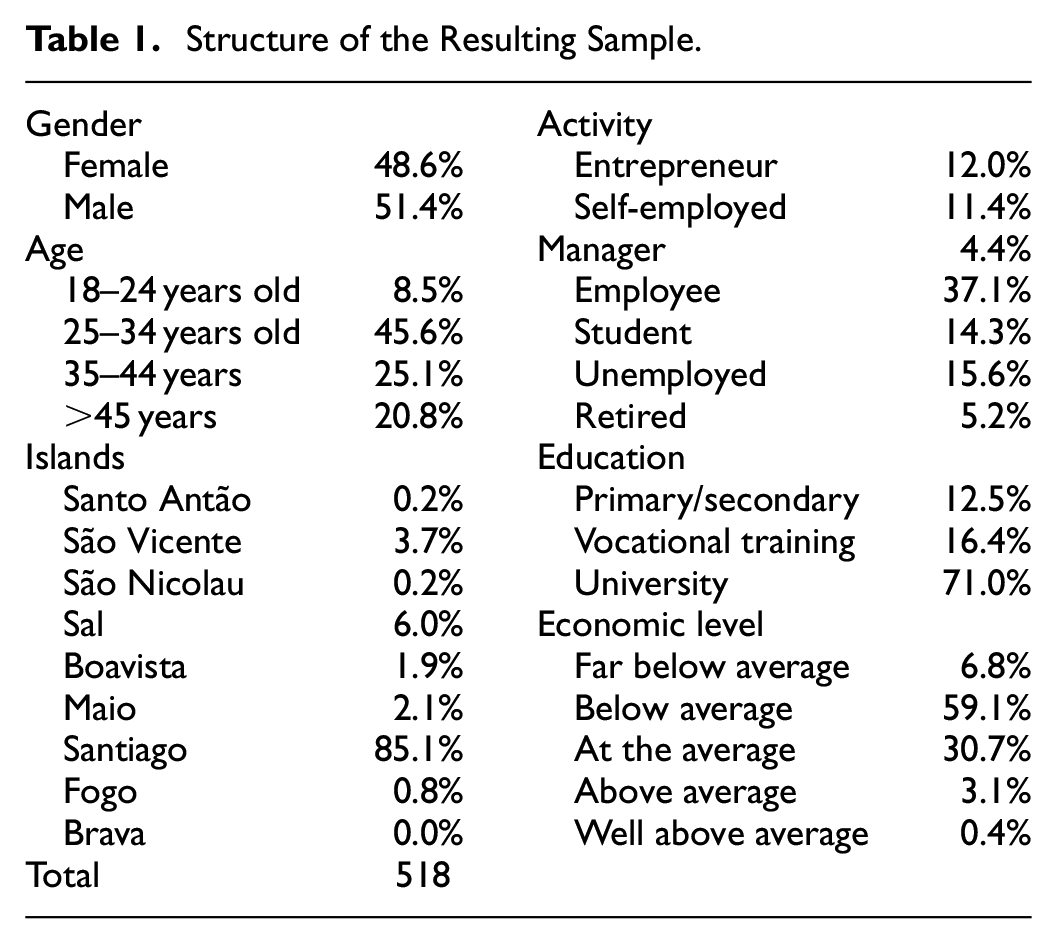
According to occupation, 12.0% were entrepreneurs, 11.4% were self-employed, 4.4% were managers, 37.1% were employed, 14.3% were students, 15.6% were unemployed and 5.2% were retired. Respondents with primary-secondary education accounted for 12.5% of the sample, 16.4% with vocational training and 71.0% with university education. Finally, by economic level according to self-classification, data indicate that 6.8% of the sample was well below the average, 59.1% below the average, 30.7% at the average, 3.1% above the average and 0.4% well above the average.
In order to confirm the adequacy of the sample size for conducting the analyses, was employed G*Power (Faul et al., 2009). According to the software’s recommendation, a minimum sample of 138 individuals is needed to achieve a statistical power of 0.95 for testing the proposed model consisting of five constructs. Based on this, it can be confidently concluded that the utilized sample size of 518 is more than adequate for the specific requirements of this study.
Measurement
Community attachment was measured as a reflective construct using three items adapted from several commonly used scales and is in line with the notion of attachment as a reflection of rootedness and sense of belonging to the community. It collected (a) satisfaction with the community (item 1: I am happy to live on the islands, Gursoy & Rutherford, 2004; Kasarda & Janowitz, 1974); (b) sense of belonging (item 2: I am comfortable with the way of life on the islands, Gursoy & Rutherford, 2004; McCool & Martin, 1994); (c) the affective and identification dimension (item 3: I am proud of the way the people of the islands are, Kasarda & Janowitz, 1974; Gutiérrez-Taño, 2010).
The personal benefit of tourism activity, also reflective, has been measured by adapting the scale previously used in several studies (e.g., Gutiérrez-Taño, 2010; Harrill, 2004, Ko & Stewart, 2002, McGehee & Andereck, 2004, Perdue et al., 1990, Vargas-Sánchez et al., 2015), which has been divided into three items: direct personal benefit, indirect benefit to families and relatives, and personal economic benefit.
Both the perceived positive and negative impacts of tourism activity have been configured as formative constructs and measured through four items, each representing economic, social, cultural, and environmental dimensions. Previously used scales have been adapted that consider impacts in two dimensions, positive and negative (e.g., Gursoy et al., 2002; Nunkoo & Gursoy, 2012; Nunkoo & Smith, 2013; Rasoolimanesh et al., 2015; Vargas-Sánchez et al., 2015; S. Wang & Xu, 2015).
Residents’ support for tourism has also been measured using previous scales configured as reflective (Garau-Vadell et al., 2019; Gursoy et al., 2002; Nunkoo & Gursoy, 2012; Perdue et al, 1990) and three items were used to capture aspects of support (a) Tourism development on the islands has been very beneficial for the island and its inhabitants; (b) Tourism should continue to be promoted as one of the main driving forces of the islands’ economy; (c) Tourism activity on the islands is beneficial for my daily life.
Research participants could rate all items of the different constructs on a seven-point Likert scale ranging from 1 “Strongly Disagree” to 7 “Strongly Agree.”
Data Analysis
To analyse the proposed theoretical model and test the hypotheses, the Partial Least Squares (PLS-SEM) technique was used with the Smart PLS software Version 4.0.8.3 (Ringle et al., 2022). A primer model has been proposed where reflective (mode A) and formative (mode B) constructs coexist simultaneously, which supports the use of this PLS technique as being suitable for the analysis (Chin, 2010; Sarstedt et al., 2016).
The assessment of the overall model was checked by analyzing the SRMR indicator, verifying that there is no multicollinearity between the constructs and examining that there is no common method bias (CMB). The assessment of the measurement model has been carried out for mode A constructs by means of reliability and validity of the constructs and for mode B constructs by analyzing the VIF of the items and the contribution and significance of the items to the construct. The structural model is analyzed through R2, path coefficients, confidence intervals and standardized root mean square residual (SRMR) values as a measure of approximate model fit for PLS-SEM (Henseler et al., 2016).
The Cape Verde Context
Located in the North Atlantic Ocean, 570 km off the coast of Africa, Cape Verde is an African country which, together with the Azores, Madeira and the Canary Islands, makes up the group known as Macaronesia. Cape Verde consists of ten islands and eight islets of volcanic origin, only nine of which are inhabited. They are divided between the Windward group to the north, with Santo Antão, São Vicente, Santa Luzia, São Nicolau, Sal and Boavista and the Leeward group of islands to the south, where the islands of Santiago, Maio, Fogo and Brava are located. The archipelago has 483,628 resident inhabitants (250,262 men and 247,801 women), who are mainly concentrated in the municipality of Praia, on the island of Santiago, which accounts for 29.4% of the resident population.
Cape Verde’s economy is largely sustained by tourism, which accounts for 25% of GDP and drives around 40% of economic activity. Between 2016 and 2019, economic growth was 4.7% (3.2% in per capita terms), leading to a decrease in poverty from 35% in 2015 to 28% in 2019. This positive economic performance was interrupted by the COVID-19 pandemic in 2020, generating a 14.8% drop in GDP in 2020. However, GDP is estimated to increase by 7% in 2021, with a gradual recovery of the tourism sector (The World Bank, 2022).
Despite being a country, whose economy depends mainly on the tourism sector, in 2019, hotel establishments employed only 9,050 people according to data from the National Institute of Statistics (INE, 2019). Sal Island is the main tourist enclave in the archipelago, with 53% of workers in the sector (INE, 2019), followed by the islands of Boa Vista with 24.7% and Santiago Island with 9.1%. The hotel sector is the clear majority, employing 85.2% of tourism workers, followed at a great distance by hostels with 5.3% and tourist and residential villas, both with 4%.
In relation to tourist inflows, in the first quarter of 2022, the hotel industry registered slightly more than 141,000 guests (INE, 2022). The United Kingdom again became the main country of origin of tourists with 31.8%, followed by Portugal with 13.2%, Germany with 11.5%, the Netherlands and France, accounting for 9.7% and 5.8%, respectively. In terms of overnight stays, the United Kingdom now occupies first place with 38.8% of the total, followed by Germany with 12.6%, Portugal with 11.3%, the Netherlands with 9.8% and France with 4.6%, respectively, with the island of Sal being the most visited, accounting for nearly 47.9% of the stays in hotel establishments (INE, 2022).
Like several small island states, Cape Verde faces situations of remoteness and dependence, which hinder its economic development. Since 1993, tourism has been gaining weight in the economy, thanks to the opening up of the Cape Verdean economy and foreign investment in the sector. Since then, successive plans have been developed for the development of tourism in the country, based on an almost exclusive offer of sun and beach tourism and all-inclusive services. This is clearly reflected in the INE data (2022) with hotels being the most demanded establishments, representing 92.3% of total bookings. This is followed by residential establishments with 3.2%, and hostels with 2.2%. In terms of overnight stays, hotels represent 97%, compared to only 1.2% in residential units and 0.7% in guesthouses.
Historically, Cape Verde has been a country strongly marked by emigration, with its population forced to seek alternatives abroad, given the scarcity of natural resources and cyclical droughts. The migratory phenomenon has acquired increasing importance and has become a socio-economic and cultural component of great relevance in Cape Verdean daily life. Thus, after political independence, the country’s economy became highly dependent on external economic flows, with remittances from emigrants in the diaspora being the main resource, together with public development aid. According to figures from a report of the Bank of Cape Verde (BCV, 2022), from January to June 2022, remittances sent by Cape Verdean immigrants amounted to almost 17.622 billion escudos (160.11 thousand euros)/(157.20 thousand US dollars). This is 40% more compared to the same period of the previous year.
Results
Descriptive Analysis
Table 2 shows the results of the descriptive analysis (mean and standard deviation) of the items of the constructs of the model proposed. On a scale of 1 to 7, the items of the construct support for tourism obtains values above or very close to the midpoint, although the item expressing the benefit for daily life (3.81) is slightly below the midpoint.
Descriptive Analysis and Assessment Results of the Measurement Model.

Note. ns = non-significant. Bold = construct.
p < .05. **p < .01. ***p < .001.
The personal benefit provided by tourism activity to residents is below the mid-point, although the item relating to the benefit to people close to them is slightly above (4.46). Community attachment items are also above or close to the midpoint of the scale. In relation to the items of positive impacts, economic (5.85) and cultural (4.99) benefits stand out, but residents perceive hardly any environmental (3.22) and social (3.26) benefits. On the other hand, the perception of negative impacts is very low. Environmental costs (4.84) and economic costs (4.31) stand out, but social (2.95) and cultural (2.15) costs are perceived as very low.
Assessment of the Overall Model
The findings indicated that the SRMR model fit yielded values of 0.074. A value below 0.08 is deemed suitable for PLS-SEM, as noted by Henseler et al. (2016). Furthermore, no signs of multicollinearity among the precursor variables for each of the endogenous constructs were detected, as evidenced by VIF (Variance Inflation Factor) scores all below 3.
Additionally, common method bias (CMB) was examined with Harman’s single factor approach (Podsakoff & Organ, 1986). An unrotated factor analysis using an eigenvalue greater than one criterion revealed five different factors accounting for 61.8% of the variance. The initial factor accounted for 26.7% of the variability present in the dataset. Given the absence of a predominant single factor and the relatively low proportion of variance explained by the first factor, it seems that CMB is not likely to pose a significant concern.
Assessment of the Measurement Model
Reflective Mode A Constructs
The reliability of individual indicators within the formulated reflective Mode A constructs was evaluated by analyzing the loadings (λ) of these indicators with their corresponding constructs. As indicated in Table 2, all item loadings in the measurement model exceed .707 (Carmines & Zeller, 1979).
In Table 2, the construct reliability was analyzed, and it is observed that all composite reliability values (Dijkstra & Henseler, 2015) are above the minimum cut-off point of 0.70 (Fornell & Larcker, 1981). All latent variables manage to achieve convergent validity as their AVE measures exceed the level of 0.5 (Fornell & Larcker, 1981).
The findings presented in Table 3 indicate that the assessed constructs fulfill the criteria for discriminant validity, as they successfully satisfy the heterotrait-monotrait (HTMT) requirement for correlations (with values below 0.85, as per Kline, 2011). As a result, the measurement model was deemed acceptable, providing substantial evidence of reliability, convergent validity, and discriminant validity.
Discriminant Validity.
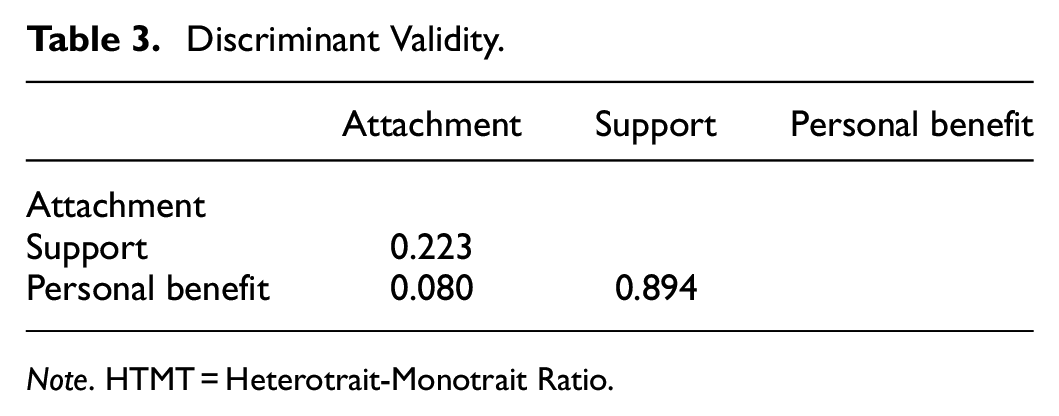
Note. HTMT = Heterotrait-Monotrait Ratio.
Formative Mode B Constructs
Regarding the formative mode B constructs, Table 2 shows that all the VIFs of the construct items are less than 3.3 (Diamantopoulos & Siguaw, 2006) and therefore it can be guaranteed that there is no multicollinearity between the indicators. Table 2 also shows the contribution and significance of the items to the constructs, all items except cultural costs contribute positively and significantly to the negative impacts construct.
The contributions to the positive impacts of all dimensions are very relevant, highlighting the social benefits (0.470). This indicates the perceived social improvements due to tourism activity (in health, education, basic services, . . .). On the other hand, the most relevant contributions to the negative impacts are the economic (0.510) and social costs (0.470).
Assessment of the Structural Model
Assessment of relationships of the structural model was performed by bootstrapping (Hair et al., 2011) analyzing the significance of the path coefficients. Since the hypotheses specify the direction of the relationship of the variables, a 1-tailed Student’s t-distribution with n − 1 degrees of freedom was used as the number of subsamples. A total of 10,000 samples were run (Hair et al., 2021) with the number of cases equal to the number of observations in the original sample. For the assessment of the significance of the relationships, in addition to bootstrapping, confidence intervals were analyzed (Henseler et al., 2009).
As can be seen in Table 4 and Figure 2, all the relationships proposed in the model are significant. Community attachment has a positive and significant influence on perceptions of positive impacts (H1: β = .183, p < .001, f2 = 0.044) and a negative influence on negative impacts (H2: β=−.149, p < .001, f2 = .024). Similarly, personal benefit shows a large positive and significant influence on the perceptions of positive impacts (H3: β = .466, p < .001, f2 = 0.287) and negatively on negative impacts (H4: β = −.208, p < .001, f2 = 0.046).
Results of Hypothesis Testing, Variance Decomposition, Redundancy Q2 and Effect Size f2.

Note. n = 10,000 subsamples: *p < .05; **p < .01; ***p < .001; ns: non-significant (one-tailed t Student). Bold = construct.
t(0.05; 4999) = 1,645; t(0.01; 4999) = 2,327; t(0.001; 4999) = 3,092.
Confident Intervals [5% to 95%].
Effect sizes f2: <0.005 small; <0.01 moderate; ≥0.025 large (Kenny, 2018).
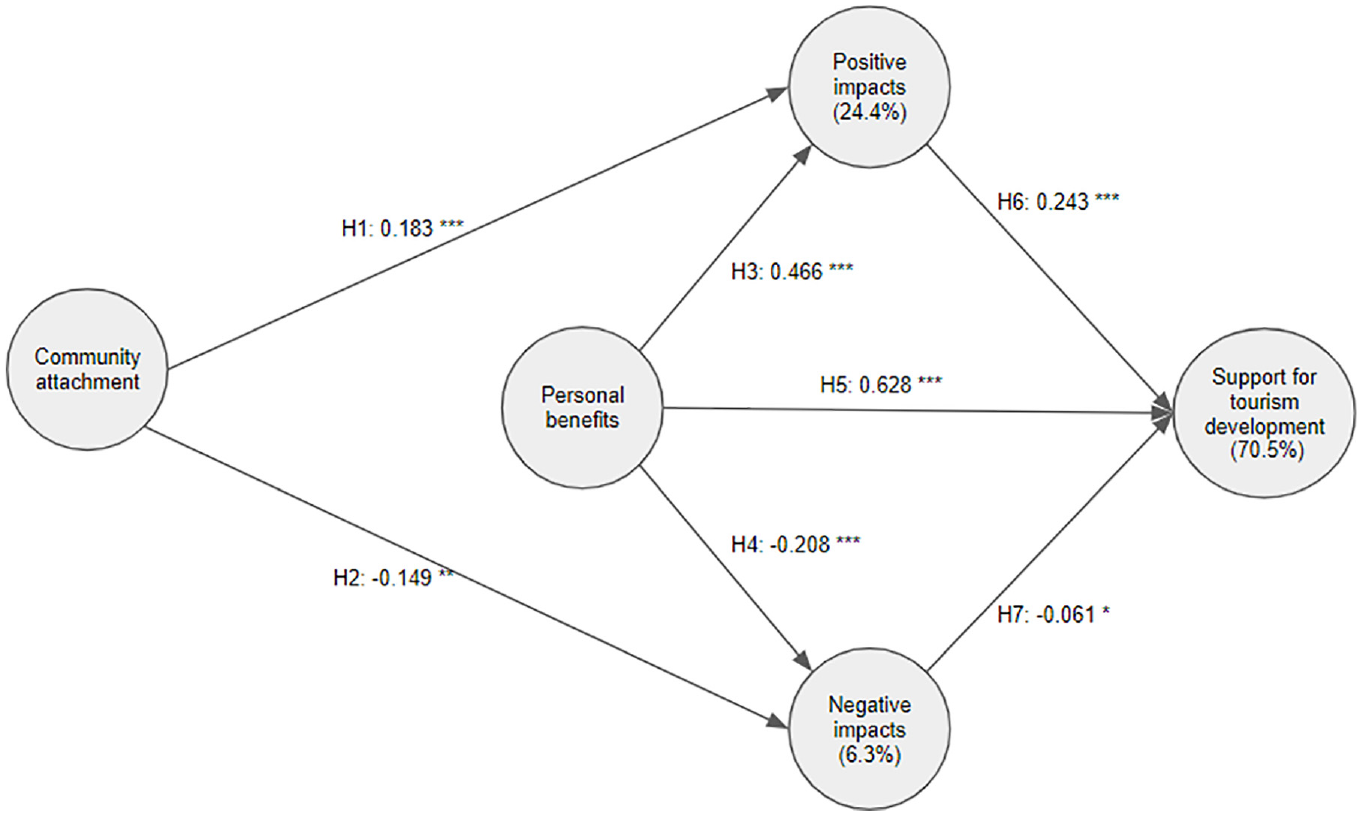
Results of the analysis.
With respect to the antecedents of support for tourism, a positive and significant influence of personal benefit (H5: β = .680, p < .001, f2=1.241) and positive impacts (H6: β = .243, p < .001, f2 = 0.141) is observed. A negative influence of negative impacts on support is also observed, although with a small size effect (H7: β = −.061, p < .05, f2 = 0.011).
As can be seen, there is sufficient evidence to accept all the research hypotheses.
The coefficient of determination (R2) represents a measure of predictive power that indicates the amount of variance of a construct that is explained by the predictor variables of that endogenous construct in the model. The proposed model explains 70.5% of residents’ support for tourism development, which is considered a substantial value (Chin, 1998) (Table 4). Moreover, as a criterion to measure the predictive relevance of the constructs, the Stone-Geisser test (Geisser, 1975; Stone, 1974) has been used, observing in Table 4 that the Q2 value is greater than zero, which indicates that the model has predictive potential.
Discussion and Implications
Contrast with Prior Research
The results of the study show that community attachment and personal benefit are two intrinsic exogenous variables that influence residents’ support for tourism development in an emerging island tourism destination such as the one analyzed.
Specifically, the present study found a direct and positive relationship between community attachment and residents’ perceptions of positive impacts. As previously indicated, this relationship has had contradictory results in previous studies. The results of the present study differ from those of Draper et al., (2011), Haralambopoulos and Pizam (1996), Lankford and Howard (1994), Madrigal (1993), Snaith and Haley (1999), who pointed to a negative relationship between residents’ attachment to their community and perceptions of positive tourism impacts. One of the explanations for these contradictory results has to do with the operationalization of the attachment construct, as these authors relied on length of stay or having been born or raised in a community as items reflecting the construct. However, in the present research, we have chosen to measure attachment through feelings toward and participation in the community (Jurowski & Brown, 2001).
Therefore, the results of the present study reinforce the fact that greater attachment implies greater emotional attachment to the place, as argued by Low and Altman (1992) and Tuan (1974) and, therefore, implies greater resistance to leaving it under any circumstances. In this sense, we agree with previous studies such as Jurowski et al. (1997), Gursoy and Rutherford (2004) and Choi and Murray (2010), who consider that for an environment of high emigration due to economic reasons, such as a developing country like the one analyzed, greater attachment to the community is positively related to residents’ perceptions of the positive impacts of tourism.
Moreover, the results of this paper are consistent with those of research conducted by other authors, such as Jurowski et al. (1997), Gursoy and Rutherford (2004), Davis et al. (1988), Deccio and Baloglu (2002) and Gursoy et al. (2002). In this regard, we concur with the perspective of Davis et al. (1988), who argue that community attachment is a significant predictor of residents’ positive responses to tourism development and also with Jurowski et al. (1997), who note that more attached residents perceive tourism impacts more positively.
On the other hand, the results of this study have found a direct and negative relationship between attachment and the negative impacts of tourism activity perceived by residents, which means that people with more attachment to the community tend to underestimate the negative impacts relative to people with less attachment. Some previous studies failed to test this relationship, such as Gursoy et al. (2002) or Lankford and Howard (1994) and even, contrary to the results of the present study, McCool and Martin (1994) and Choi and Murray (2010) suggested that feelings of attachment to the local community increase perceptions of negative impacts.
In relation to the influence of personal benefit on perceptions of tourism impacts and support, it has been highlighted by the literature that it is one of the most influential intrinsic exogenous antecedents (Gursoy et al., 2019; Y. Wang & Pfister, 2008). Our results confirm that residents who perceive a higher level of economic benefit tend to overestimate positive impacts and underestimate negative impacts and, consequently, are more supportive of tourism development. These results are consistent with the majority of previous studies (Deccio & Baloglu, 2002; Haralambopoulos & Pizam, 1996; Jurowski et al., 1997; Lankford & Howard, 1994; Lindberg & Johnson, 1997; J. C. Liu et al., 1987; Madrigal, 1993; McGehee & Andereck, 2004; Perdue et al., 1990; Sinclair-Maragh et al., 2015; Sirakaya et al., 2002).
Consequently, residents who are dependent on the tourism industry or who perceive higher levels of economic benefit tend to have more positive perceptions of the impact of tourism and are more supportive of the activity. A high percentage of employment directly or indirectly involved in the tourism sector will therefore favor its support by residents.
Additionally, the results of the study confirm the findings of social exchange theory in the sense that the greater the perceived positive impacts, the greater the support, and the greater the negative impacts, the lower the residents’ support for tourism activity. This relationship has been corroborated by a multitude of studies (e.g., Gursoy & Rutherford, 2004; Garau-Vadell et al. 2014; Jurowski et al., 1997; Nunkoo & Ramkissoon, 2012).
Practical Implications
The results obtained from this study have several practical implications for the sector. One of the benefits that our study offers to destination managers and tourism professionals is the examination of two key variables for interpreting residents’ support for tourism activity in a developing country with an emerging tourism destination.
Firstly, it can be highlighted that the significant effects of community attachment on perceptions of impacts and indirectly on support suggest that destination managers and tourism project promoters should design communication and resident participation actions that reinforce feelings of belonging to the community. This is especially important in this type of emerging tourism destination, which usually has high levels of openness to the outside world and penetration of foreign investment in tourism projects, and which usually tend to neglect this aspect of integrating the resident population. Secondly, destination managers and tour operators should create explicit and verifiable opportunities for local people to benefit economically directly or indirectly from tourism activity and make them aware of this fact. Both aspects, and according to the results obtained in this study, would favor and improve the tourism performance and resilience of residents through support for the activity, so important, as we have seen, in these emerging tourist destinations.
Conclusions and Limitations
The purpose of this study is to contribute to the theoretical understanding of residents’ support for tourism in a scenario of emerging island destinations in developing countries, subject to strong migratory pressures for economic reasons. Drawing on social exchange theory and the tourism literature on residents’ support and attitudes toward tourism and its impacts, a structural theoretical model of tourism support was proposed. This model is supported by previous studies that posited the causal effects of intrinsic exogenous variables such as community attachment and personal benefit on residents’ perceptions of the positive and negative impacts of tourism and their support for tourism development in a developing island tourism destination such as Cape Verde.
This study demonstrates that community attachment and personal benefit are factors affecting perceptions of the positive and negative impacts of tourism conceptualized in its four economic, social, cultural, and environmental dimensions, and how these perceptions and personal benefits affect residents’ support for tourism. The model tested advances the theoretical understanding of local residents’ reactions and attitudes toward tourism development by validating previously developed models based on social exchange theory.
This study also provides clarification of the role of community attachment in influencing support that had previously yielded contradictory results, proposing a measure of the construct as a reflection of rootedness and sense of belonging to the community. This represents a new contribution that helps to differentiate between “community attachment,” made up of elements such as the subjective identification that individuals experience with respect to a community, and “place attachment” measured by variables such as length of residence that do not capture the essence of the feeling of belonging.
Overall, the results of this study confirm that like any other form of development, tourism activity has both positive and negative impacts on communities and according to the theory of impact perception, each individual’s evaluation varies according to intrinsic variables. To support and improve the tourism performance and resilience of communities, destination managers should create opportunities for local people to benefit directly or indirectly from tourism activity and reinforce feelings of belonging. This could also mitigate the migratory stress faced by territories with emerging tourism destinations in developing countries, such as Cape Verde.
Limitations of the Study
This paper has some limitations that could lead to future research. Firstly, the study is limited to analyzing residents’ support for tourism activity in a single developing island destination such as Cape Verde, and further research exploring residents’ attitudes in other developing locations and areas would be warranted to determine whether patterns and outcomes are replicated or dependent on factors such as culture or other influences. Secondly, this study has been carried out on an unbalanced island sample, and it is therefore possible that there is some bias due to different tourism weights on each island. Finally, this work has been based on social exchange theory and further research that considers other theoretical approaches would be desirable.
Footnotes
Declaration of Conflicting Interests
The author(s) declared no potential conflicts of interest with respect to the research, authorship, and/or publication of this article.
Funding
The author(s) received no financial support for the research, authorship, and/or publication of this article.

Data Availability Statement
Data sharing not applicable to this article as no datasets were generated or analyzed during the current study.