




Abstract
This study investigated the relationships between maternal, paternal, teacher, and peer social support, behavioral engagement, and school burnout among Finnish lower secondary student athletes (n = 209) and regular students (n = 156) using cross-sectional questionnaire data collected in Grade 7. Structural equation modeling revealed positive associations between social support and student behavioral engagement, and negative connections between social support and behavioral engagement and school burnout. Behavioral engagement mediated the association between maternal and peer support and school burnout, and teacher support was the strongest direct predictor of school burnout. Student athletes displayed stronger associations between behavioral engagement and school burnout in comparison to regular students. The results contribute to our understanding of the interplay between individual and environmental resources in shaping student athletes’ and regular students’ well-being in lower secondary school.
Plain Language Summary
The present study adds to the existing literature by examining the influence of student engagement and social support on school burnout among Finnish student athletes and regular students using cross-sectional questionnaire data collected in Grade 7. The central results of this study provide promising insights about the role of social support and behavioral engagement in predicting students’ school burnout at an early stage of lower secondary school. Our findings underscore the importance of teacher and peer social support to adolescents’ school adjustment, as teachers hold the potential to recognize harmful cross-domain patterns of faltering engagement in sports or school. Schools should concentrate on indoctrinating teachers in finding ways to support student athletes in meeting the constantly growing dual demands of sports and school, and incorporating teaching of prosocial values and skills into the curriculum. The data used in this study was cross-sectional and provided some new insights into the relationships between school burnout and behavioral engagement, and thus, there is still a need for further research on the reciprocal relations between these two constructs.
School burnout has been associated with many negative outcomes, including declining school success, truancy, and dropout, and a subsequent risk of depression and marginalization in society (Fiorilli et al., 2017; Madigan & Curran, 2021; Virtanen, Lerkkanen, et al., 2018). Lower secondary school is a period of strenuous pressure due to a mismatch between adolescents’ resources and increasing study demands and pressure to plan future educational paths (Eccles & Roeser, 2011). Although occasional school stress is common among students, certain subgroups of students might be more inclined to experience prolonged strain leading to school burnout than others (Parviainen et al., 2021; Salmela-Aro et al., 2017). Student athletes constitute one prominent group whose members face expectations of pursuing a dual career (DC) by engaging in school and sports (Lupo et al., 2017), which might dispose them to school and/or sport burnout (Sorkkila et al., 2020).
The ability to plan, organize, and participate in learning activities (e.g., school engagement) and social support from significant others are recognized as important personal and external resources that facilitate students’ academic success and well-being and protect against negative outcomes (Fernández Lasarte et al., 2020; Roorda et al., 2021; Virtanen et al., 2019; Wang et al., 2019). Moreover, parents, teachers, and peers constitute independent sources of social support that display fluctuating associations with students’ school burnout (De Laet et al., 2015; Engels et al., 2016; C. S. Lee & Goldstein, 2016), whereas school engagement has been shown to manifest flexibly and individually in response to the social support adolescents receive in the school context (Salmela-Aro & Upadyaya, 2020; Wang & Hofkens, 2020). To date, school has been acknowledged as an important developmental context during the specializing years (ages 13–15 years) of an athlete’s DC (Stambulova et al., 2020), but there is a lack of research on factors affecting adolescent burnout in lower secondary school. Despite the potential taxing nature of DC, it has been suggested that sports participation aids values and skills that are beneficial for academic functioning and provides extended opportunities to form social ties with significant others (Knight et al., 2018; Ryba et al., 2017). Therefore, the present study aims to add to the existing literature by examining the influence of student behavioral school engagement and social support on school burnout among student athletes and regular students in Grade 7.
School Burnout
Burnout can occur in the school context at various levels (Salmela-Aro et al., 2017) and across divergent school contexts (Madigan & Curran, 2021). Students engage in academic activities by attending classes, preparing assignments, and taking tests (Noh et al., 2013). Academic demands and psychological factors can cause students to respond in three key dimensions: feeling exhausted due to study demands, having a cynical attitude toward school, and feeling inadequate toward school (Salmela-Aro et al., 2009). School burnout encompasses a variety of symptoms of varying severity that range from minor school stress to major school burnout (Mäkikangas & Kinnunen, 2016). Empirical research generally indicates that exhaustion is the initial burnout component (Parker & Salmela-Aro, 2011), but students’ perceived cynicism and inefficacy also increase during lower secondary school (J. Lee et al., 2013).
Previous research suggested that student athletes who engage in school and sports are likely to develop symptoms of burnout in these contexts separately or in parallel (Sorkkila et al., 2018, 2020). However, burnout seems to be a context-specific phenomenon, with school exhaustion recognized as the initial component of burnout that might subsequently spill over to sports exhaustion. Concerning the incidence of school burnout, roughly 10% to 15% of regular upper secondary school students (Salmela-Aro & Näätänen, 2005) as well as student athletes (Sorkkila et al., 2017) report school burnout symptoms of varying severity. This nonexistent group-level difference in school burnout among older students is intriguing given that it becomes increasingly difficult to engage in sports and school during the specializing years (ages 13–15 years) in sports (Knight et al., 2018; Sum et al., 2017).
Student Engagement and Social Support
Student engagement encompasses students’ attraction to and investment in learning and school life (Salmela-Aro et al., 2021; E. Skinner et al., 2008). The topic has been studied at the individual level in terms of engagement in the classroom and after-school activities, as well as more broadly at the school level or in education in general (Lawson & Lawson, 2013). Students’ engagement in classroom activities is typically recognized as a metaconstruct encompassing behavioral, cognitive, and affective dimensions (Fredricks et al., 2004). Behavioral engagement includes students’ tangible exertion, persistence, and positive attendance in classroom activities (Appleton et al., 2006; Fredricks et al., 2004), whereas cognitive engagement includes internal processes and strategies for learning (Wang et al., 2019). The definitions and measures of these two engagement dimensions differ across studies (Salmela-Aro et al., 2021). For instance, effort is traditionally linked to behavioral engagement but sometimes also conceptualized as part of the cognitive engagement construct (Fredricks et al., 2016). For conceptual clarity, and given the key role of behavioral engagement (Lei et al., 2018), the present study focused on behavioral engagement as a personal resource that is crucial for adolescents’ school adjustment.
Affective engagement comprise belonging and valuing school and classroom learning as well as attachment to significant others in school (Allen et al., 2018). The distinction between facilitators (e.g., positive feelings about relationships with significant others at school) and indicators (e.g., feelings of belonging and valuing school and classroom learning) of engagement is an area under discussion (Salmela-Aro et al., 2021). These two components are sometimes misleadingly packed together to represent the affective dimension of engagement. The multidimensional concept of social support, including students’ perceptions of belonging to a supportive social environment and receiving support from significant others (C. S. Lee & Goldstein, 2016), is a broader construct that resembles affective engagement (E. A. Skinner & Pitzer, 2012; Virtanen et al., 2019). Although adolescents’ subsequent behavior has been associated with previous affective engagement (Li & Lerner, 2011), students’ perceptions of social support from significant others are generally accepted as external resources (i.e., facilitators) associated with higher engagement and lower burnout (Fredricks et al., 2019; Kim et al., 2018; Romano et al., 2021; Roorda et al., 2021; Virtanen et al., 2019). Following this view, in the present study, social support was conceptualized as an external resource with the potential to facilitate school adjustment.
Social Support, Behavioral Engagement, and School Burnout Within the Social Exchange Theory
Social exchange theory provides a theoretical framework for understanding the interactions between the environment and an individual’s behavior (Cropanzano & Mitchell, 2005). Although social exchange theory encompasses a family of different conceptual models, the different views agree that a series of transactions between two or more parties generates positive or negative behavior and responses depending on the quality of the initiating interaction (Cook & Rice, 2006). In reaction to positive interactions, individuals usually engage more intensively in a given activity and show fewer negative responses (Cropanzano & Mitchell, 2005). Prior research has established that social support provided by teachers (De Laet et al., 2015; Kim et al., 2018), parents (Bryce et al., 2019; Virtanen et al., 2019), and peers (Engels et al., 2016; Kim et al., 2018; Pietarinen et al., 2014) facilitates student behavioral engagement and protects against feelings of inadequacy, cynicism, and exhaustion. Consistent with social exchange theory (Cook & Rice, 2006), teachers, parents, and peers constitute different influential sources and play independent roles in adolescents’ academic adjustment through emotional (e.g., nurturing), tangible (e.g., tutoring), and informational (e.g., advicing) forms of support (Fernández et al., 2018; Liu et al., 2016).
Another central feature of social exchange theory (Cook & Rice, 2006) is that social exchange results in tangible or intangible rewards or costs (i.e., outcomes). Individuals tend to act in ways that benefit them by engaging in actions that boost benefits and decrease costs (Cropanzano et al., 2017). Behavior provoking a positive response generally continues and is likely to be repeated in similar contexts; however, a central concern of utilizing social exchange theory relates to difficulties in psychometrically disentangling the relationships between constructs. Previous research suggested that school burnout and engagement are two separate processes that are strongly and negatively correlated (Parker & Salmela-Aro, 2011; Salmela-Aro et al., 2009). However, the direction of the relationships between these two has yet to be determined, as recent evidence suggested that students can show different combinations that include high engagement and burnout simultaneously (Salmela-Aro & Upadyaya, 2020; Virtanen, Lerkkanen, et al., 2018). Furthermore, it is important to separate disengagement, passive engagement, and active engagement, as each comes with conceptual implications and unique contributions to academic outcomes (Fredricks et al., 2019; Nguyen et al., 2018). Given that active behavioral engagement has been shown to predict lower levels of cynicism, exhaustion, and inadequacy (Akbasli et al., 2019; Virtanen et al., 2021) and other positive schooling outcomes (Bryce et al., 2019), we define school burnout as an outcome of active behavioral engagement rather than the opposite.
Finally, the reciprocal multidimensional engagement model suggests that academic functioning and social functioning within the school context contribute mutually to prolonged engagement that precedes academic well-being (Wang & Hofkens, 2020). Social support is an external resource that protects adolescents directly from school burnout (Romano et al., 2021; Salmela-Aro et al., 2017); however, students’ involvement in school activities and social interactions becomes less integrated in lower secondary school (Wang & Hofkens, 2020). A growing number of educational studies recognize that adolescents’ active engagement in schoolwork is a prerequisite for attaining positive educational outcomes (E. A. Skinner & Pitzer, 2012; Virtanen et al., 2021). In essence, students’ experiences of social support from significant others have the potential to facilitate positive educational outcomes through direct mechanisms but also indirectly through strengthening behavioral engagement (Bryce et al., 2019; Eccles & Roeser, 2011; Wang et al., 2019). Therefore, in addition to a personal resource, we define behavioral engagement as a mediational construct that links social support with school burnout.
The Effects of Behavioral Engagement and Social Support on Regular Students and Student Athletes’ School Burnout
Students’ ability to adjust to increasing study demands and cope with stress during lower secondary school varies among student subgroups (Salmela-Aro & Upadyaya, 2020; Virtanen, Lerkkanen, et al., 2018). As school and sports are two critical developmental contexts for adolescents in which they spend most of their waking hours (Eccles & Roeser, 2011; Stambulova et al., 2020), their dual engagement might produce beneficial transfer effects across the contexts (Cook & Rice, 2006; Van Boekel et al., 2016). In particular, it may well be that the values and skills learned through sports training are consistent with educational values and thus facilitate school engagement (Meier et al., 2018; Ronkainen et al., 2021). However, other evidence suggests that increasing demands in sports and school might force adolescents to diminish their involvement in either school or sports as an alternative response to developing burnout symptoms (Ryba et al., 2017; Sum et al., 2017). Consequently, the literature confirms that adolescents’ experiences and developmental outcomes differ largely depending on the context and the sports program’s design (Meier et al., 2018).
Regular students’ efforts and involvement in classroom work and discussions (i.e., behavioral engagement) peak at the age of 11 years, thereafter declining steadily over the course of each school year until the end of lower secondary school (Zhu et al., 2019). Although there is no exact information regarding student athletes’ involvement in classroom activities, the vast majority of student athletes show a dual identity characterized by equal importance attributed to both contexts (Moazami-Goodarzi et al., 2020). This is consistent with the Nordic DC philosophy, accentuating the high importance of school and sports (Ryba et al., 2017).
Social support within the school context is critical to students’ school adjustment, but the contribution of different support providers on adolescents’ school burnout and behavioral engagement differs across the general student body (Kim et al., 2018; Liu et al., 2016; Pietarinen et al., 2014). It is essential to consider the source of support (e.g., specific support) to understand its importance and mechanisms with regard to times of intense social change in early adolescence (Nguyen et al., 2018; Romano et al., 2021; Roorda et al., 2021). Social support has been established as a necessity for student athletes’ DC (Storm et al., 2021), and students enrolled in sports programs have extended opportunities to form valuable social ties by being part of the school and sports contexts (Martinez et al., 2016; Meier et al., 2018; Van Boekel et al., 2016). However, parents, peers, and teachers must also distribute their support between school and sports (Knight et al., 2018).
Although parents are key support providers for adolescents’ DC (Tessitore et al., 2021), there is limited research on the parental role in student athletes’ school adjustment. Parental success expectations toward school can protect student athletes against school burnout (Sorkkila et al., 2017), which might reflect an authoritative parenting style characterized by a combination of high parental success expectations for schooling outcomes and an elevated level of social support and caring (Tessitore et al., 2021). Among regular students, parental support has been established as a strong and direct predictor of behavioral engagement and school burnout (Virtanen, Lerkkanen, et al., 2018) but also as an indirect promoter of academic well-being by strengthening behavioral engagement (Bryce et al., 2019). Distinguishing between paternal and maternal social support is important, as parents’ different socialization styles contribute uniquely to adolescents’ school adjustment (Fernández et al., 2018). This might be relevant specifically for student athletes, as fathers tend to focus more on adolescents’ tangible needs and support their skill development in sports, and mothers constitute a more stable source of general emotional support (Tessitore et al., 2021).
Peers constitute another recognizable source of social support because students can choose their peers and share an equal relation with them (Kim et al., 2018). Student athletes learn the essence of daily engagement and competition in sports as part of a group of like-minded individuals, which might transfer to a desire to engage in school (Cropanzano et al., 2017), but high ambition in sports and school might also alter student athletes’ experiences of school burnout (Sorkkila et al., 2018, 2020). Similarly, peer groups with prosocial values positively predict behavioral engagement (school compliance), and having friends with antisocial values has a negative effect on behavioral engagement (Wang & Eccles, 2012). Although Virtanen et al. (2014) found a positive zero-order correlation between behavioral engagement and peer support, peers are commonly recognized as the most influential source of support for regular student school connectedness in lower secondary school (Bradley et al., 2021).
Teachers are key to regular students’ school adjustment, as teacher support is directly associated with school exhaustion (Romano et al., 2021) and behavioral engagement (Bryce et al., 2019). Teachers can assist student athletes by expressing interest and understanding sports-related demands, monitoring fatigue and stress, helping them to set short- and long-term academic goals, and by providing flexible solutions to compensate for sports-related missed classroom time (O’Neill et al., 2017). The association between teacher social support and academic adjustment varies from teacher to teacher (Roorda et al., 2019), as teachers might focus and provide support that is more extensive for some groups of students than for others (Roorda et al., 2021).
The Present Study
The present study aimed to examine the role of social support from significant others and student behavioral engagement in student athletes’ and regular students’ school burnout in Grade 7. Using cross-sectional data collected over a period of 6 months at two time points, the study aimed to answer the following research questions: (1) How is social support associated with school burnout and behavioral engagement among lower secondary students? Based on the social exchange theory and previous research (De Laet et al., 2015; Kim et al., 2018; Wang & Eccles, 2012), we hypothesized that social support (e.g., teacher, paternal, maternal, and peer) negatively predicts school burnout (Hypothesis 1) and positively predicts student behavioral engagement (Hypothesis 2). (2) How is behavioral engagement related to school burnout among lower secondary students? Based on previous findings (Akbasli et al., 2019; Virtanen et al., 2021), we hypothesized that higher level of behavioral engagement is associated with lower level of school burnout (Hypothesis 3). (3) To what extent does behavioral engagement mediate the association between social support and school burnout for students? Conceptualizing behavioral engagement as a mediational construct that link environmental resources to outcomes (Bryce et al., 2019; Eccles & Roeser, 2011; Wang et al., 2019), we expected that social support would lead to higher levels of behavioral engagement, which in turn would decrease feelings of school burnout (Hypothesis 4). (4) Are there differences in the relationships between social support, behavioral engagement, and school burnout between student athletes and regular students? Based on research that assessed the influence of sports participation on school functioning (Meier et al., 2018; Ronkainen et al., 2021), we hypothesized there are differences in the strength of the pathways from social support and behavioral engagement to school burnout between student athletes and regular students (Hypothesis 5). We decomposed school burnout into three indicators (exhaustion, cynicism, and inadequacy) to assess whether they were differently associated with social support and behavioral engagement. The hypothesized direct and indirect paths from social support and behavioral engagement to school burnout are presented in Figure 1.

Conceptual model of behavioral engagement as a mediator between social support from significant others and school burnout.
Because school engagement and burnout may be affected by preexisting variations in students’ backgrounds, we added gender (Parviainen et al., 2021; Salmela-Aro & Upadyaya, 2020; Virtanen et al., 2014), parental socioeconomic status (SES; Meier et al., 2018; Virtanen et al., 2021), and grade point average (GPA; Bryce et al., 2019; Virtanen et al., 2014) as covariates in the analysis. Findings from these studies suggested that girls might display higher levels of school engagement but also more school burnout than boys, and students with higher GPA and parental SES are more behaviorally engaged in school and report less school burnout than students with lower GPA and parental SES.
Method
The Finnish Dual Career (DC) Context
The Finnish DC system is club-based, meaning that student athletes compete for their club teams while studying at separate educational institutions. Special arrangements between sports and schools are necessary to allow student athletes the opportunity to practice sports during school hours (Stambulova et al., 2020). Currently, 30 upper secondary sports schools (vocational and general) and some elite athlete-friendly universities provide student athletes a flexible curriculum that supports development in academic studies and high performance sports. There are no official lower secondary sports schools, but as a part of the national DC development project, 19 public lower secondary schools participated in a 3-year pilot project (urheiluyläkoulukokeilu in Finnish) during the 2017 to 2020 academic years. The project aimed to promote young adolescent athletes’ opportunities to pursue academic and athletic careers simultaneously by strengthening the collaboration between the participating lower secondary schools and local sports clubs.
All schools participating in the pilot project have targeted sports programs with ancillary curricula, but focused mainly on general education in accordance with the national core curriculum for basic education. All other students study in general education classrooms, except for one classroom of student athletes per grade level. Student athletes are subject to the same learning goals as the rest of the student body, but are allowed up to 10 hr of sports training during school hours. The schools are typically medium- to large-sized urban public schools with 400 to 900 students. Finnish schools characteristically have heterogeneous grouping, which implies that all students, regardless of their academic abilities or socioeconomic backgrounds, receive instruction together in the same classroom (Salmela-Aro et al., 2017). This approach is often identified as the cause of the low disparity in school-level wellbeing and academic achievement between the highest- and lowest-ranking Finnish schools, the difference assessed being less than 10%, according to the Program for International Assessment (Schleicher, 2019).
Participants and Procedure
Parallel to the 3-year pilot project, a longitudinal mixed-methods research project was initiated to examine student athletes’ academic and athletic development throughout lower secondary school. Ethical approval was obtained from the ethics committee of (Abo Akademi University) prior to recruiting participants. Participation in the study was voluntary, and written informed consent was collected from the students’ parents. As part of the research project, student athletes and regular students filled out questionnaires at four measurement points: at the beginning of Grade 7 (T1), at the end of Grade 7 (T2), at the end of Grade 8 (T3), and at end of Grade 9 (T4). The present study is based on cross-sectional questionnaire data collected at T1 and T2, and is the first publication utilizing any part of the data set. Students completed the first Internet-based questionnaire in November and December of 2017 and the second questionnaire in April and May of 2018 during class hours. The first questionnaire (T1) included the covariates and measures of social support and behavioral engagement, and the second questionnaire (T2) included measures of school burnout.
The sample consisted of 209 (45% girls) student athletes (M = 13.5 years; SD = 0.3), and 156 (54.5% girls) regular students (M = 13.6 years; SD = 0.3) in Grade 7 from 16 of the 19 schools participating in the pilot project. Within each school, principals assigned one classroom of regular students using a random drawing, whereas the second classroom was purposively selected because it contained all student athletes participating in the pilot program. The student athletes’ mean GPA (possible range 4–10) was 8.61 (SD = 0.75), and the regular students’ GPA was 8.53 (SD = 0.82). Of the student athletes and regular students mothers, 43% and 50% were upper white-collar, 42% and 37% lower white-collar, and 15% and 13% blue-collar or in an unsalaried position, respectively. The corresponding socioeconomic status of student athletes’ and regular students’ fathers was 50% and 47% upper white-collar, 32% and 31% lower white-collar, and 18% and 22% blue-collar or in an unsalaried position, respectively. There were no statistically significant demographic differences between the groups.
Measures
Perceived Social Support
We assessed students’ perceptions of school-related support using perceived teacher support (e.g., “Overall, my teachers are open and honest with me”) and peer support (e.g., “Students at my school are there for me when I need them”) subscales of the brief version of the Student Engagement Instrument (Appleton et al., 2006; Virtanen, Moreira, et al., 2018). Moreover, items measuring students’ perceived paternal and maternal support (e.g., “When I have problems at school, my mum/dad is willing to help me”) were derived from the Finnish 2010 Health Behavior in School-Aged Children Questionnaire (Kämppi et al., 2012). We modified the original scale by splitting parental support into two parallel-worded scales to measure paternal and maternal support separately. All scales consisted of three items and were rated on a 5-point Likert scale ranging from 1 (strongly agree) to 5 (strongly disagree). The items were reverse-coded so that higher scores indicated a higher level of perceived support.
Behavioral Engagement
The middle school student version of the Research Assessment Package for Schools (RAPS; Wellborn & Connell, 1987) was used to measure behavioral engagement. The scale consisted of five items that assessed the extent to which a student exerted effort on schoolwork, paid attention in class, prepared for classes, and believed that doing well in school was personally important (e.g., “I work very hard on my schoolwork”). The items were rated on a 4-point Likert scale ranging from 1 (strongly agree) to 4 (strongly disagree). The items were reverse-coded so that higher scores indicated a higher level of engagement.
School Burnout
School burnout was measured using the School Burnout Inventory (SBI; Salmela-Aro et al., 2009). This inventory consisted of nine items measuring exhaustion at school (four items; e.g., “I feel overwhelmed by my schoolwork”), cynicism toward the meaning of school (three items; e.g., “I feel that I am losing interest in my schoolwork”), and feelings of inadequacy as a student (two items; e.g., “I often have feelings of inadequacy toward my schoolwork”). All items were rated on a 6-point Likert scale ranging from 1 (completely disagree) to 6 (strongly agree). Higher scores indicated a higher level of burnout.
Background Characteristics
We entered gender (1 = boy) into the analysis as a self-reported dummy-coded variable. Moreover, participants were asked to list their mothers’ and fathers’ professions and describe their current occupation. The answers were then coded according to the classification of socioeconomic groups that Statistics Finland (n.d.) issued. Maternal and paternal SES were broken into four levels: 1 (unsalaried position), 2 (blue-collar), 3 (lower white-collar), and 4 (upper white-collar). Both mother’s and father’s SES were considered with the highest of the two used to indicate parental SES. Adolescents’ self-reported most recent grades in Finnish language and literature, mathematics, and English were coded on a 7-point scale (4–10) and averaged to create self-reported GPAs. Self-reported grades have consistently been shown to correlate highly with actual grades in academic subjects (Sticca et al., 2017).
Data Analysis Strategy
We conducted the statistical analyses with Mplus version 8.2, using the maximum likelihood estimation with non-normality robust standard errors (Muthén & Muthén, 2017) due to a slight nonnormality in the measures. The number of missing values was small, varying between 0% and 2.5%, thus we replaced the missing values by using the expectation maximization (EM) algorithm (Dempster et al., 1977).
As a first step, we assessed the measures’ equivalence (i.e., measurement invariance) across student athletes and regular students in a three-step process using multiple-group CFA. During this process, a model with no constraints on its parameters (i.e., configural, invariance) was defined for both groups and compared against two nested hierarchical models (i.e., metric and scalar) with increasingly restrictive constraints on the model parameters (Rudnev et al., 2018). Invariant measures imply that student athletes and regular students have interpreted the constructs in a conceptually similar way and is a prerequisite to compare relations between constructs by groups (Vandenberg & Lance, 2000). In the second step, we defined a series of multigroup structural equation models for the data to examine the relations between them, from social support and behavioral engagement to school burnout. The covariates were added in the models as manifest variables. In all analyses, chi-square (χ2), the comparative fit index (CFI), the Tucker–Lewis index (TLI), and the root mean square error of approximation (RMSEA) were used as indicators of model fit.
The following cutoff values were considered to indicate acceptable fit: χ2 = (p > .05), CFI > 0.95, TLI > 0.95, and RMSEA < 0.05 (Hu & Bentler, 1999). When comparing nested models, Chen (2007) suggested that changes of less than 0.01 in CFI and 0.015 in RMSEA values supported accepting a more parsimonious model. To test the indirect effect of social support on school burnout via behavioral engagement, we adopted the CINTERVAL (bcbootstrap) function with 1,000 iterations to produce bias-corrected bootstrap 95% confidence intervals, providing an accurate estimate of the indirect effects (Lau & Cheung, 2012). The indirect effect is statistically significant if the CI does not include zero. Finally, to compare the two groups for significant differences in the direct and indirect relationships among the latent factors, we applied the model test command in Mplus.
Measurement Invariance
We started the modeling by fitting a baseline model, imposing no invariance constraints on the factor loadings and indicator intercepts for student athletes and regular students. In both groups, one item (“I often come to class unprepared”) measuring behavioral engagement was removed due to low factor loading (<0.3) and cross-loadings (MI = 56.56) on the same-scale item (“I don’t work very hard in school”). Additionally, similarly worded paternal and maternal social support scale item residuals were allowed to covariate. The revised baseline model matched the data well (χ2(490) = 688.43, p < .001, CFI = 0.948, TLI = 0.936, RMSEA = 0.047 (90% CI [0.039, 0.055])). Next, factor loadings were constrained to equality (metric invariance) between the two groups, which did not alter the model fit (χ2(506) = 698.654, p < .001, CFI = 0.949, TLI = 0.940, RMSEA = 0.046 (90% CI [0.037, 0.054]); ΔCFI = 0.001, ΔRMSEA = 0.001). Lastly, we compared the metric invariance model against a fully invariant model (scalar invariance), with both factor loadings and indicator intercepts constrained to equality across groups. The fully invariant model supported measurement invariance (χ2(523) = 719.835, p < .001, CFI = 0.948, TLI = 0.941, RMSEA = 0.045 (90% CI [0.037, 0.053]); ΔCFI = 0.001, ΔRMSEA = 0.001).
Results
Descriptive Statistics
Correlations and reliability measures (Cronbach’s alphas) of the eight latent factors for student athletes and regular students are presented in Table 1. The social support constructs were positively correlated with behavioral engagement and negatively correlated with the three dimensions of burnout in general. Cronbach’s alpha varied between .62 and .87.
Correlations and Internal Consistencies of the Latent Study Variables.

Note. Correlation coefficients to the left side of the diagonal refer to student athletes and the right side to regular students.
p < .05.
Direct Paths Between Social Support, Behavioral Engagement, and School Burnout
To examine the dynamics among social support, behavioral engagement, and school burnout, we utilized the four-step procedure Baron and Kenny (1986) recommended. The first three steps enabled us to estimate direct paths between social support, behavioral engagement, and school burnout (Hypotheses 1–3), and the fourth step allowed us to assess to what extent the effect of social support on school burnout is transmitted through behavioral engagement (Hypothesis 4). Due to a relatively large number of latent factors and estimated parameters, we tested Hypotheses 1 to 4 using the whole sample, including student athletes and regular students. The effects of demographic variables on the latent constructs were controlled for in all path models. Table 2 presents the results for Hypotheses 1 to 3.
Direct Pathways Between Social Support, Behavioral Engagement, and School Burnout for the Whole Sample (N = 365).

Note. GPA = grade point average; gender (1 = boy); parental SES (1 = unsalaried position–4 = upper-white collar).
p < .001. **p < .01. *p < .05. ns >.05.
The first step in Baron and Kenny’s (1986) procedure involved establishing a significant relation between the predictor and the outcome. To test the first hypothesis, we estimated the direct paths from social support to school burnout. All other paths were fixed to zero. The results indicated that the model fit the data adequately (χ2(220) = 379.17, p < .001, RMSEA = 0.045 [0.037–0.052], CFI = 0.95, TLI = 0.94). Teacher social support had a moderate negative association with exhaustion (β = −.32, p < .001), cynicism (β = −.32, p < .001), and inadequacy (β = −.20, p < .01). Furthermore, maternal support negatively predicted cynicism (β = −.17, p < .01), whereas peer social support had a weak and negative connection to inadequacy (β = −.17, p < .01).
The second step in Baron and Kenny’s (1986) procedure was establishing a significant relation between the predictor and the hypothesized mediator. To test the second hypothesis, the direct paths from social support to behavioral engagement were estimated. Again, all other paths were constrained to zero. This model showed sufficient fit to the data (χ2(136) = 205.17, p < .001, RMSEA = 0.037 [0.026–0.047], CFI = 0.97, TLI = 0.96). The results indicated that maternal (β = .24, p < .001), peer (β = .28, p < .001), and teacher (β = .26, p < .05) social support positively predicted behavioral engagement.
The third step in Baron and Kenny’s (1986) procedure included demonstrating that the mediator variable was significantly associated with the outcome. To test the third hypothesis, we estimated direct paths from behavioral engagement to school burnout while constraining all other paths to zero. The model provided an adequate fit to the data (χ2(90) = 228.23, p < .001, RMSEA = 0.059 [0.048–0.070], CFI = 0.92, TLI = 0.90). The results suggested that behavioral engagement negatively predicted all three dimensions of school burnout. Behavioral engagement had a strong effect on cynicism (β = −.59, p < .001), a moderate effect on inadequacy (β = −.27, p < .001), and a weak effect on exhaustion (β = −.14, p < .05.
Student Behavioral Engagement as a Mediator of the Effects of Social Support on School Burnout
The direct path models provided support for testing the fourth hypothesis, namely, whether behavioral engagement mediates the relationship between social support and school burnout. According to the fourth and last step in Baron and Kenny’s (1986) procedure, mediation occur if the direct relationship between the predictor and the outcome cease to exist or is reduced after the mediator is introduced. Thus, we specified a model with direct paths between social support (maternal, peer, and teacher), behavioral engagement, and school burnout, as well as indirect paths from social support to school burnout through behavioral engagement using the whole sample. Paternal social support could not be included in the mediational analyses because it was not associated with the mediator or outcomes. After including prior GPA and gender as covariates, the model resulted in chi-square value of 465.06 (df = 243, p < .001), RMSEA = 0.050 [0.043–0.057], CFI = 0.93, TLI = 0.92). Figure 2 illustrates significant standardized path coefficients.

Significant standardized associations between social support (maternal, paternal, teacher, and peer), behavioral engagement and school burnout (exhaustion, inadequacy, cynicism).
As shown in Figure 2, the direct paths from peer, maternal, and teacher social support to behavioral engagement remained significant and positive after the indirect paths were included. In addition, the direct paths from behavioral engagement to cynicism and inadequacy continued to be significant and negative, whereas the direct path from behavioral engagement to exhaustion became nonsignificant. Regarding the covariates, boys displayed lower levels of exhaustion (β = −.36, p < .001), inadequacy (β = −.29, p < .001), cynicism (β = −.12, p < .05), and behavioral engagement (β = −.19, p < .001) than girls. Moreover, GPA positively predicted behavioral engagement (β = .28, p < .001) and negatively inadequacy (β = −.17, p < .001). The model accounted for 35% of the variance in behavioral engagement, 29% of the variance in exhaustion, 23% of the variance in inadequacy, and 42% of the variance in cynicism.
Table 3 presents the results of the mediation analysis, with significant values marked in boldface. The results indicated that behavioral engagement fully mediated the paths from maternal (β = −.11, p < .01) and peer (β = −.14, p < .01) social support to cynicism. This pattern of findings is consistent with the indication that maternal and peer social support diminishes students’ feelings of cynicism toward school through their effect on behavioral engagement. Furthermore, the relationship between teacher support and school burnout was not mediated by behavioral engagement, as teacher support predicted cynicism (β = −.24, p < .001), exhaustion (β = −.33, p < .001), and inadequacy (β = −.17, p < .001) directly. The total effect of teacher direct support on all three dimensions of school burnout was significant, as well as the indirect effect of maternal support on cynicism via behavioral engagement.
Direct, Indirect, and Total Effects of Maternal, Peer, and Teacher Social Support on School Burnout (Exhaustion, Cynicism, and Inadequacy; N = 365).
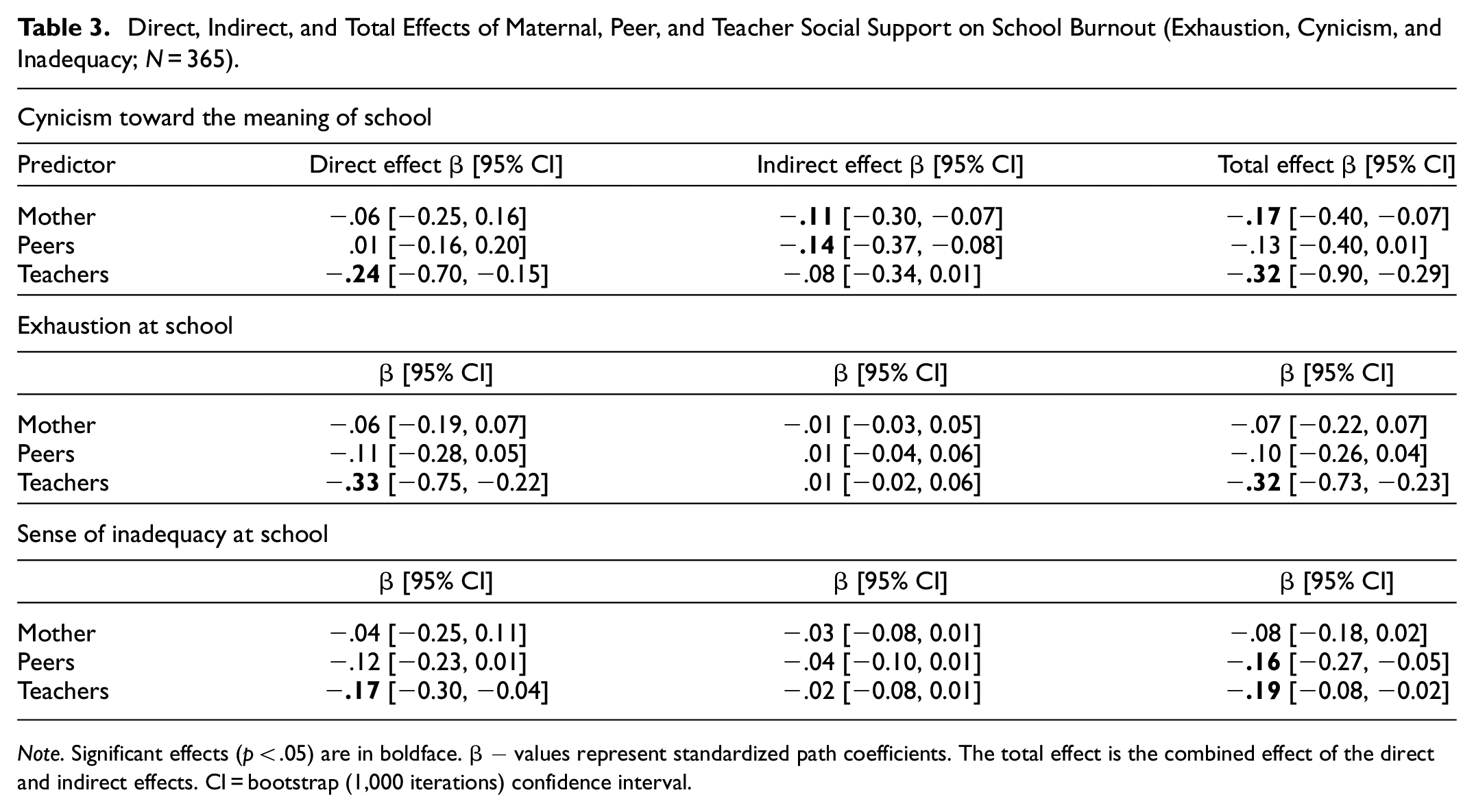
Note. Significant effects (p < .05) are in boldface.
Differences in Pathways Between Student Athletes and Regular Students
To test Hypothesis 5, we calculated whether the relationships between the latent constructs differed between student athletes and regular students.
We tested each of the statistically significant indirect (two) and direct (eight) pathways between social support and behavioral engagement separately using Wald’s test in Mplus (see Figure 2 and Table 3). This decision was informed by a relative complex overall model (i.e., the number of estimated parameters) in combination with a small sample size (n = 156) for regular students (Fan & Sivo, 2007). The results revealed that the direct path from behavioral engagement (β = −.41 vs. −.11, z = 10.03, p < .001) to inadequacy was significantly stronger for student athletes than for regular students. This pattern suggests that behavioral engagement is key in reducing student athletes’ sense of inadequacy regarding school.
Discussion
This study aimed to examine the role of social support from significant others and student behavioral engagement in student athletes’ and regular students’ school burnout in Grade 7. We extended previous knowledge by providing novel insights on direct and indirect links from social support and behavioral engagement to school burnout for two distinct subgroups of students. Congruent with social exchange theory (Cropanzano & Mitchell, 2005), the present results imply that in response to social support, individuals engage more intensively in classwork and homework and show fewer negative responses.
The results supported Hypotheses 1 and 2. In general, social support showed the expected direct positive and negative associations with behavioral engagement and school burnout, respectively. However, the relationships between the constructs varied according to the source of social support. Reflecting the findings of a meta-analysis (Kim et al., 2018), we found that teacher social support displayed the strongest relationship to adolescents school burnout. Direct teacher social support had a statistically significant negative total effect on exhaustion, as well as on student feelings of cynicism and inadequacy. These findings are important since school burnout often starts with feelings of exhaustion, which later transmits to cynicism and inadequacy (Parker & Salmela-Aro, 2011). Moreover, teacher social support had the third largest direct positive effect on behavioral engagement, which also replicates previous findings (Bryce et al., 2019). It has been suggested that teachers might not be able to support all students equally (Roorda et al., 2021); however; the results of the present study revealed no differences in the role of teacher support in student athletes and regular students’ school adjustment. In fact, this result may accurately mirror a relevant feature of the educational system, namely, that highly educated Finnish teachers’ seem to find ways to support students’ different needs (Schleicher, 2019). This result also suggests that teachers seem to have a keen interest in and understanding of DC demands and the capability to monitor student athlete fatigue and stress in school (O’Neill et al., 2017).
In contrast to previous findings (Kim et al., 2018), we found no direct associations from parental support to adolescents’ school burnout. On the contrary, and in line with earlier findings (Bryce et al., 2019; Virtanen, Lerkkanen, et al., 2018), the results indicated that maternal social support was the second-largest positive predictor of behavioral engagement. Another interesting finding was the absence of direct paths from paternal support to behavioral engagement and school burnout. Given societal expectations related to parental support in different contexts it is possible that fathers will find it more natural to support student athlete development in sports (Tessitore et al., 2021), whereas adolescents often find it easier to communicate with and more natural to share worries related to school with their mothers than with their fathers (Levin et al., 2012). Although student athletes and regular students did not differ in the strength of the pathways from paternal and maternal support to behavioral engagement and school burnout, the results highlight the unique contributions of paternal and maternal support to adolescents’ school adjustment (Fernández et al., 2018).
Regarding peer social support, the present results are similar to those of Bradley et al. (2021) demonstrating that peers hold the most important role in promoting student behavioral engagement. This finding underlines the importance and value of choosing a group of like-minded peers with prosocial values promoting a desire to engage in school (Cropanzano et al., 2017; Kim et al., 2018; Wang & Eccles, 2012). Corresponding to earlier research (Kim et al., 2018; Pietarinen et al., 2014), the results also showed small negative relationships between peer support and feelings of inadequacy toward school. The importance of peer support in school adjustment did not differ between student athletes and regular students, which partially conflicts with previous evidence suggesting that peers play a limited role in student athletes’ DC adjustment (Knight et al., 2018). However, research embedded in the school context noted that students who are actively enrolled in sports tend to cluster in academically oriented peer groups that boost participation in school activities (Fredricks & Eccles, 2008). Supporting the latter proposition, the findings generally suggest that peers constitute an important source of support and that establishing close relationships with them is important for all students.
Regarding the direct relationships between behavioral engagement and school burnout, the results partially supported Hypothesis 3. In line with previous studies (Akbasli et al., 2019; Salmela-Aro et al., 2009), the results showed negative paths from behavioral engagement to cynicism and inadequacy. The nonexistent paths from behavioral engagement to exhaustion, in turn, fit well with literature on school burnout in older students, suggesting that students’ perceived exhaustion increases with constantly growing academic demands from primary school to upper secondary education (Parviainen et al., 2021). As suggested by social exchange theory, students appear to act in ways that benefit them by maintaining engagement in actions that decrease costs (Cropanzano et al., 2017). Supporting previous evidence (Virtanen et al., 2021), behavioral engagement showed a particularly strong and negative correlation with cynicism. In conclusion, the direct associations between behavioral engagement and the three dimensions of school burnout supplement prior research, implying that, with the exception of social support, active student behavioral engagement in school activities is a necessity for gaining positive schooling outcomes (E. A. Skinner & Pitzer, 2012; Virtanen et al., 2021).
The present results also revealed that behavioral engagement functioned as a mediational construct that transmitted the effect of social support to school burnout, supporting Hypothesis 4. This finding complements previous engagement research that have assessed the role of behavioral engagement as a mediator between the context and different student learning and achievement outcomes (Wang & Hofkens, 2020). In line with previous research showing an indirect mechanism between parental support and students’ reading and math achievement (Bryce et al., 2019) and truancy (Virtanen et al., 2014) through behavioral engagement, the present results revealed the existence of a similar negative indirect effect from maternal support to cynicism via behavioral engagement. Moreover, the second significant indirect effect of peer support to cynicism through behavioral engagement might reflect that adolescents tend to adapt their behavioral engagement to match the level of the peer group (Wang et al., 2018). It appears as interactions with peers and mothers expose adolescents to norms and values that encourage engagement in daily school work, which in turn functions as a protective factor against students’ cynicism toward school (Virtanen et al., 2019).
In support of Hypothesis 5, the results indicated one significant difference between student athletes and regular students. The direct path from behavioral engagement to inadequacy was statistically stronger for student athletes than regular students. Student athletes learn to work persistently in everyday sports training to acquire long-term benefits. This work ethic may spill over to the school context, shielding student athletes from minor setbacks that lead to feelings of inadequacy (Ronkainen et al., 2021). Lastly, consistent with prior findings (Salmela-Aro & Tynkkynen, 2012; Salmela-Aro & Upadyaya, 2020), girls expressed higher levels of school burnout and behavioral engagement than did boys. Girls reported high levels of exhaustion, possibly transmitting the gender-typical ambition of academic success among girls (Ryba et al., 2016). According to expectations, higher GPA predicted higher levels of behavioral engagement and less feelings of inadequacy (Bryce et al., 2019; Virtanen, Lerkkanen et al., 2018).
Practical Implications
This study generated practical insights applicable to lower secondary schools aiming to integrate sports classes and regular classes into their core activities. In particular, we argue that these institutions could benefit from recognizing the presence of student subgroups, each having distinct requirements for environmental support to effectively adjust to the demands of school. European student athletes usually have less structural support for their DCs than their North American counterparts (Stambulova et al., 2020), which should be considered when planning interventions appropriate for the culturally different European setting. Our results underscore the importance of teacher social support to student athletes’ school burnout, as teachers have the potential to recognize harmful cross-domain patterns of faltering engagement in sports or school. Therefore, schools should concentrate on indoctrinating teachers in finding ways to support student athletes in meeting the constantly growing dual demands of sports and school. Teacher flexibility in delivering curricula and teaching time-management skills are examples of such compensatory teacher reactions that can help student athletes’ school adjustment (O’Neill et al., 2017). Similarly, the important role of peers in facilitating school adjustment, suggest that it might be beneficial for schools to incorporate exploring prosocial values and skills into the curriculum (Wang & Eccles, 2012). Finally, the results highlight the importance of making fathers more aware of their role in supporting adolescents’ school adjustment, since having two supportive parents is optimal for adolescents’ development and wellbeing (Fernández et al., 2018).
Limitations and Future Directions
Our study has at least the following limitations. First, the study variables were based on students’ self-reported social support, behavioral engagement, and school burnout. For instance, data derived from teachers’ lesson notes or researchers’ field observations could have provided a more accurate measure of student behavioral engagement. An objective measurement of school burnout or social support, on the contrary, is more difficult to obtain, as those are an individual’s intangible experiences. Second, the data used in the study was cross-sectional and provided some new insight into the relationships between school burnout and behavioral engagement, and thus, there is still a need for further research on the reciprocal relations between these two constructs. Third, the data was collected from the same schools for student athletes and regular students; however, to reduce the possibility of method invariance, data for the two groups could have been collected from different schools. Fourth, our study lacked measures of students’ depressive symptoms that would have been interesting to interpret more closely, considering that extended feelings of exhaustion may cause later depressive symptoms (Salmela-Aro et al., 2017).
Future studies should examine the prevalence and incidence of school burnout in student athletes. More precisely, cross-sectional and longitudinal studies are needed at different stages of lower secondary school. A person-centered profile analysis offers one promising approach to examine student athletes’ school burnout: Given that students cannot be grouped into one homogenous group, some particular students might be more inclined to school burnout than others (Sorkkila et al., 2018). Furthermore, longitudinal analyses are needed to examine the evolution of school burnout among student athletes during lower secondary school. Cross-cultural research would accumulate evidence on the extent to which school burnout, behavioral engagement, and social support is context specific.
Conclusion
This study contributes to our understanding of the role of social support and behavioral engagement in student athletes and regular students’ school burnout in lower secondary school. The distinction between facilitators (i.e., sources of social support) and indicators of classroom engagement (i.e., behavioral engagement), and students’ school burnout allowed studying the relationships between the constructs with a cross-sectional design. Importantly, student behavioral engagement could be distinguished from school burnout, opposed to treating it as the negative pole of engagement (i.e., disengagement). Even though facilitators of engagement are important for students’ school adjustment, they should be studied in unison with indicators of tangible classroom engagement to assess the impact of external and individual factors on students’ school burnout.
The results of this study offer initial support for treating social support and behavioral engagement as distinct individual and environmental resources associated with students’ school burnout, and encourage future studies to include especially measures of affective and cognitive engagement along with behavioral engagement to elucidate further the role of school engagement on students’ school burnout. In particular, students’ affective engagement (e.g., liking of school) can perhaps be included as a predictor of school burnout or as a mediational construct linking social support to educational outcomes (Li & Lerner, 2011; E. A. Skinner & Pitzer, 2012). Taken together, this study’s central results support the findings from earlier studies about the role of social support and behavioral engagement in predicting students’ school burnout at an early stage of lower secondary school. However, to our best knowledge, this is the first study to examine these associations among student athletes and regular students. Based on the findings and as suggested by the social exchange theory (Cropanzano & Mitchell, 2005), we conclude that social support and behavioral engagement could serve as protective factors for student athletes and regular students, potentially mitigating the rise of school burnout (Noh et al., 2013) through distinct direct and indirect mechanisms.
Footnotes
Declaration of Conflicting Interests
The author(s) declared no potential conflicts of interest with respect to the research, authorship, and/or publication of this article.
Funding
The author(s) disclosed receipt of the following financial support for the research, authorship, and/or publication of this article: The first author received funding from Högskolestiftelsen i Österbotten for the research, authorship, and publication of this article.

Data Availability Statement
The datasets generated during and/or analyzed during the current study are available from the corresponding author on reasonable request.