




Abstract
The present study examined corporate entrepreneurship (CE) influence upon business performance following the mediation of employee engagement. In all, 201 middle managers from big 5 banks in Pakistan were sampled for the present study. Through applying structural equation modeling to test statistical relationship, the results revealed significant positive relationship between CE and business performance. Accordingly, the results also indicated mediation of employee engagement in this relationship thus, supporting both the hypothesized relationships. The study is first of its kind, addressing critical gap concerning employee engagement in the domain of CE and business performance. The study presents critical explanations and potential implications through which CE prospects could help employees to feel obliged to respond back with higher engagement and business performance. Toward the end, the chapter also discusses future research directions and scope for further study.
Keywords
Introduction
The current market environment is evolving, requiring businesses to innovate and bring constant improvements for competitive outcomes (Salanova & Schaufeli, 2008). Corporate entrepreneurship (CE) is an evolving concept that talks about nurturing and an environment that supports and motivates people to work with initiative mind-set, indulging in creativity and innovation within the organization thus, resulting for higher business performance prospects. Notably, empirical literatures have underscored employee engagement to be highly significant in enhancing performance perspectives (Kompaso & Sridevi, 2010; Saks, 2006). Hence, by blending the empirical and theoretical understandings, the present paper attempted to test how CE can enhance business performance within an organization. Importantly, the paper has also empirically outlined the pivotal role of employee engagement in the mediating capacity to enrich this relationship.
Literature on social exchange theory (SET) explains that employees get engaged and/or disengaged due to economic, social, emotional, and physical resource exchange (refer for example Kahn, 1990; Maslach et al., 2001). Moreover, from their perspective employees feel indebted for involving themselves for the support and resources they receive from the management hence turning to be basis for their work wellbeing. Therefore, we assume that employee engagement could and will successfully translate an environment based upon support that would further performance. Thus, under the shadow of SET, this paper has forwarded research findings addressing paucity of research along with mature significance for fostering business performance at the workplace.
Literature Review
CE
CE is a concept that highlights individuals and/or groups striving to initiate, create, and innovate within an organization (Sharma & Chrisman, 2007). CE has gained much prominence over the past four decades as it caters to behavior of an organization toward entrepreneurship and entrepreneurial activities. Popular literature on the topic has underlined significance of CE on harnessing growth and business prosperity (Chen et al., 2015; Kühn et al., 2016; Kuratko & Audretsch, 2009; Zahra, 1993). Studies have also outlined that the idea of CE provides resources and platform for employees to think out of the box and bring creativity in action to innovate for effective individual and organizational outcomes (Morris et al., 2009; Nayager & Van Vuuren, 2005). For this, several models have been highlighted whereby, major scholars have indicated that there are five organizational internal prospects that can help facilitate entrepreneurial environment and thus can be categorized as dimensions of CE (Hornsby et al., 1999, 2002; Kuratko et al., 2005; Wood et al., 2008). These are management support, work discretion, rewards reinforcement, time availability, and organizational boundaries. Though, it is not necessary that all the CE prospects may offer anticipated results in all circumstances, depending upon the nature, and business context (Welter & Smallbone, 2011) yet still; they are generally found responsive in fostering entrepreneurial culture resulting in significant organizational outcomes (Goodale et al., 2011). Hornsby et al. (2002) have suggested that higher the degree the perceptions of individuals on the responsive availability of management support, flexible organizational horizons, resources for innovation, and work discretion would result in maximizing innovation and creativity at work.
Management support refers to motivation and facilitation of entrepreneurial actions by the organization whereby, work discretion denotes to individual perception about autonomy to make decisions and responsibilities (Kuratko et al., 2014). Accordingly, rewards and reinforcement caters to responsive availability of rewards and resource provision for encouragement and time availability denotes to availability to considerable extra time for individuals to pursuer innovation and creativity at work. Finally, organizational boundaries denotes recognition of the organization in terms of its established boundaries as to how they induce, direct, and encourage actions and behaviors (Kuratko et al., 2014). According to Hornsby et al. (2002), management support is essential to nurturing CE in the business with performance prospects (Hisrich, 1990). Similarly, work discretion enables employees to fine-tune their work, improve on mistakes, enhance focus on creativity, and bring in innovative ideas and work dynamics in place (Kuratko et al., 2014). Likewise, rewards and reinforcement spark enthusiasm in employees to strive with full energy for better organizational outcomes like innovation (Alpkan et al., 2010; Kuratko et al., 2005) and the same goes to time availability whereby, free time could help employees to perform better in assigned tasks and consider focusing on entrepreneurial activities (Alpkan et al., 2010; Darini et al., 2011). Similarly, Kuratko et al. (1990) suggests that organizations should have standard operating procedures for all major parts of jobs and the dependency on jobs to ensure the effective use of the resources which induces innovation. Based on the empirical evidences, the internal corporate entrepreneurial factors discussed herein could potentially influence employees to act innovatively and result in higher organizational outcomes.
CE and Business Performance
Business (firm) performance denotes to organizational effectiveness in creating and delivering value for its internal and external customers (Antony & Bhattacharyya, 2010). The concept has been quoted with interchangeable terms like firm performance and organizational performance (Barrett et al., 2012). Notably, business performance is also categorized as financial and non-financial (Combs et al., 2005). In addition, business or firm performance has been discussed in the management literature as a multidimensional construct, which is based on financial and non-financial measures (Kaplan & Norton, 1996; Martz, 2013; Umrani et al., 2016). Measuring organizational performance has been the center of attention for management researchers, serving as a critical construct for organizational success. In addition to this, it is imperative to understand that non-financial measures are important indicators for financial measures, as organizations always focus on the assessment of financial perspective of it, hence assessment of performance against non-financial indicators helps organizations to refocus their resources in enhancing long-term performance (Banker et al., 2000; Ittner & Larcker, 1998; Snow & Hrebiniak, 1980).
Scholars have argued that how a business performs in terms of non-financial prospects is an important arena for consideration (Atkinson & Brander-Brown, 2001; Sauaia, 2014). This is because it can lead toward employee motivation, task refinement, harnessing positive work culture, and inspiring employees to attain organizational objectives effectively. Notable studies have supported the notion of focusing on non-financial business performance (Atkinson & Brander-Brown, 2001; Kaplan & Norton, 2001) and keeping this in view, the present study has focused on non-financial business performance.
In parallel, studies have outlined that firms with higher CE posture are more effective compared to others which indicates their performance prospects (Umrani et al., 2018; Zahra & Covin, 1995). Likewise, scholars have also landed direct support toward this notion, highlighting the acute significance and association between the two (Wiklund & Shepherd, 2005). Though, Maçães et al. (2007) have indicated the need for further investigation in the relationship in response to which, recent empirical evidence could be traced highlighting the notable role of CE toward fostering overall financial as well as non-financial performance (Bierwerth et al., 2015; Heavey & Simsek, 2013). Henceforth, the present study formulated the following hypothesis:
CE and employee engagement
Employee engagement relates to positive work state that bring energy, immersion and passion in work (Schaufeli et al., 2002). Engaged employees express more sense of responsibility and willingness to achieve organizational goals. Such employees tend to be more energetic and involved with the sense of personal fulfillment from the work achievement (Maslach & Leiter, 2008). They work with their hands, heads and hearts together thus, proving to be better performers than the rest (Hakanen et al., 2019; Rich et al., 2010).
Since engagement is a relatively new concept (Kahn, 1990) yet still, scholarly evidence can be traced outlining its predictors. Based on the explanations of SET, scholars have underlined the significance of diverse job characteristics in this regard (see further., Saks, 2006; Van Wingerden et al., 2017).
However, a link between CE and employee engagement is a very recent realization thus, resulting in scarcity of empirical evidence (Ahmed et al., 2018). Prominently, a study by Kassa and Raju (2015) is worthy of mentioning. The study tested and reported the employee view of the five internal CE factors (CEAI), though varied, but in positive relationship with employee engagement. The study also indicated toward the paucity of research and recommended further studies for better understanding of this relationship. Accordingly, similar views have forwarded by Ayadurai (2011) and Lockwood (2007). Hence, based on these theoretical and empirical assertions, the present study attempted to test the following:
Employee engagement and business performance
Scholars in the area of employee wellbeing can be traced attempting to understand the link between employee engagement and various performance prospects (see further., Gupta & Sharma, 2016). Typically engaged employees have been reported to outperform disengaged employees by snatching 10% higher in customer ratings; giving 22% more profitability through expressing 21% higher productivity (Sorenson, 2013). Hence, it indicates the typical value of employees engaged for a business. In parallel, empirical evidence by Ahmed, Khalid, et al. (2017) can also be taken into consideration that indicated toward the critical role of employee engagement toward harnessing business performance in a mediating model.
Accordingly, a meta-analysis report also outlined overall improvement in the business performance index due to employee engagement (Harter et al., 2002). More recently, prominent organizational scientists have testified that engaged employees bring better for performance outcomes for any business since they express active involvement and immersion in the work (Reijseger et al., 2017). Henceforth, the present study tested the following:
Mediation of Employee Engagement
Employee engagement is defined as a positive work based individual psychological state that enables an individual to work with energy and enthusiasm (Schaufeli et al., 2002). Since its first conception by Kahn (1990), multifold of studies have surfaced, outlining its acute significance toward harnessing individual and organizational outcomes in numerous domains (Ahmed, Umrani, et al., 2017; Bakker & Bal, 2010; Saks, 2006). More and more recent studies have indicated the significant association between employee engagement and business performance (Bailey et al., 2017; Menguc et al., 2017; Van Wingerden et al., 2017; Saks & Gruman, 2017). In addition, studies have also outlined that employees who are engaged with work tend to express joy and contentment with the work (Schaufeli et al., 2002) and express enthusiasm, pride, and passion toward their work. Since, CE has been concluded in a significant direct relationship with employee engagement (Kassa & Raju, 2015); the present study asserted it play the mediating role between CE and Business performance. Pertaining to the mediation of employee engagement, scholars have also empirically confirmed its intervening role (Crawford et al., 2010; Karatepe, 2013) whereby, Umrani et al. (2016) have indicated toward its mediating potential in the relationship between CR and business performance in a conceptual study. Accordingly, under the explanations of SET whereby, Cropanzano and Mitchell (2005) states “social exchange evolve when businesses take care of employees which thereby engenders beneficial consequences” (p. 882). Accordingly, it appears that when a business takes care of an employee through providing management level support, allocates extra time, allows to work at own discretion, provides clear organizational boundaries, and practices rewards for creativity and innovation then the employees are likely to engage in their work, leading to enhanced business performance. In simple, employees receiving healthy CE culture are likely to feel responsible to repay the business with engagement and in-turn, showcase effective business performance (Saks, 2006). Thus, following these evidences and theoretical support followed by the research gap, the present study tested the following hypothesis:
Methodology
Population and Sampling Technique
Middle managers from big five commercial banks in Pakistan were selected for this study. The selection was particularly important as they represent management decision making after top managers; this choice was also important since, they are direct contact point with employees, they direct, interact, measure employees work performance on regular basis. Banks in particular, chosen as unit of study, have made this study more interesting, as there has been a dearth of research in the banking industry in relation to employee engagement and non-financial performance. These contextual factors make our sample more interesting.
Through stratified random sampling 201 responses were collected from a population of 1,385 middle managers using Krejcie and Morgan’s (1970) criteria. The self-administration method of data collection was used. This was necessary as the managers in banks are extremely busy, they don’t use personal internet connections at workplace, hence, a direct contact with our data collection team made it possible to collect timely data and in more effective way. From the sampling frame of 1,385 middle managers, 245 responses were collected out of which 201 were used in the analysis, the rest of the questionnaires were discarded due to outliers. We used Mahanalobis (D2) test in detecting the outliers. The extent of missing values was less than 5%, and the pattern of missing values was random, hence we used mean-replacement to deal with missing values (Hair, Sarstedt, et al., 2014, 2016).
Measures
For testing CE, the present study deployed 48-item CEAI scale (Hornsby et al., 1992) the same scale has been validated in the banking sector of Pakistan in an earlier study (Umrani & Mahmood, 2015). . For business performance 4-items were adopted from Deshpandé et al. (1993) and 3-items from Jaworski and Kohli (1993) whereby, 6-item scale by Saks (2006) was considered to examine employee engagement. All the constructs were assessed on 5 point Likert-type scale whereby, 5 referred to strongly agree and 1 denoted as strongly disagree.
Findings
We tested our proposed conceptual model through variance-based structural equation modeling, popularly known as partial least squares (PLS-SEM) drawing upon recommendation of Reinartz et al. (2009). This choice was made due to following reasons. First of all, the purpose of this study is to predict the dependent variable (Hair et al., 2011). Next, in our study, we used latent variables scores in the subsequent analysis to estimate indirect effects in the proposed mediation model (Hayes, 2013; Suárez et al., 2014). Therefore, we employed SmartPLS 3.2.8 software (Ringle et al., 2015). After detecting and deleting multivariate outliers the sample size used for analysis purpose was 201. Before ascertaining the reliability and validity of the model, we employed Harman’s single-factor test to ensure the common method variance (CMV) issue (Podsakoff & Organ, 1986). By performing principal component factor analysis, we found that the CMV was not a problem as our results witnessed that no general factor was evident in the un-rotated factor structure.
Reliability and Validity of Measures
The assessment of measurement model shall be based up ascertaining and establishing indicator reliability, internal consistency reliability, convergent validity, and discriminant validity when the constructs of a study are reflective in nature (Henseler et al., 2009). Since all the constructs in this study were reflective in nature therefore for the individual item reliability we retained factor loadings that were up to .50 and/or above (Hair, Hult, et al., 2014). To establish internal consistency reliability, the composite reliability (CR) scores were examined. The CR scores of all the latent variables in the present study were up to .70 or above (Bagozzi & Yi, 1988). We next examined convergent validity by considering average variance extracted (AVE) scores; as Table 1 indicates that the AVE scores of all the latent variables were up to .50 (Chin, 1998). Hence, we conclude that indicator reliability, internal consistency reliability, and convergent validity has been successfully demonstrated in the present study.
Measurement Model.

Note. AVE = average variance extracted; CR = composite reliability
Finally, we assessed empirical evidence for discriminant validity. For this reason, we employed Fornell and Larcker’s (1981) criterion. Table 2 indicates that the square root of the AVE of every latent variable is larger than its correlations with any other latent variable in the model. Hence, discriminant validity was also established in the present study. In addition, we evaluated discriminant validity through heterotrait–monotrait ratio of correlations (HTMT) method (Gold et al., 2001; Henseler et al., 2009; Kline, 2011); our results indicated that all the HTMT values were lower than 0.85. Hence, current study demonstrates discriminant validity as per HTMT rule as well.
Discriminant Validity.

Note. Entries shown in bold face represent the square root of the average variance extracted.
Structural Model
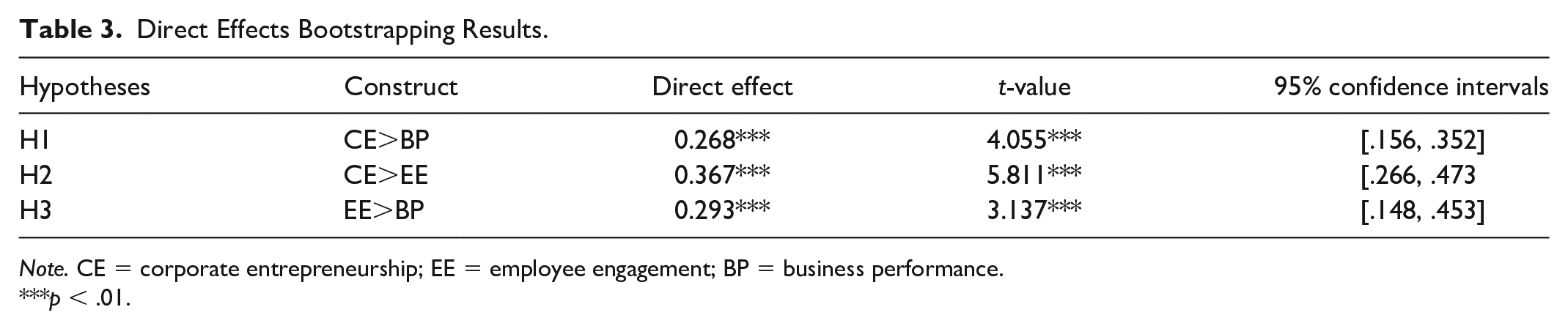
We tested our direct and indirect hypotheses using bootstrapping approach with 5,000 resamples estimate and confidence intervals (Hair et al., 2016). Table 3 presents path coefficients of the current study.
Direct Effects Bootstrapping Results.
Note. CE = corporate entrepreneurship; EE = employee engagement; BP = business performance.
p < .01.
Referring Table 3 and Figure 1, we can infer that our results are consistent with Hypotheses 1, as the relationship between CE and business performance was found to be significant and was considerably different from zero (β = .268, t = 4.055, p < .01, [.156; .352]). Thus, H1 was supported. Similarly, the results indicate that the paths from CE to employee engagement were also supported (β = .367, t =5.811, p < .01, [.266; .473]). Hence, H2 was also supported. Our analysis also suggests empirical support for H3 where we hypothesized the direct positive relationship employee engagement and business performance (β = .293, t = 3.137, p < .01, [.148; .453]).

Structure model results.
We next evaluated predictive relevance of the model. For this reason, we first report the s-squared values of the model. Our empirical outcome revealed the total variance of 0.153 and 0.136% in business performance and employee engagement respectively. Although the acceptable r-squared value depends on research context; however, according to Falk and Miller (1992) a minimum of 10% variance is acceptable in social sciences. Moreover, the obtained variance in the current study is considered significant according to Hair et al. (2016). Next, we examined the predictive capability of the model through blindfolding procedure. As per this test, the results were also acceptable that suggest Q2 score of the model is above than zero (Q2 = .065 for business performance and 0.069 for employee engagement; Henseler et al., 2009).
Mediation analysis: we followed criterion suggested by Preacher and Hayes (2004) through bootstrapping procedure. Our results indicated that employee engagement mediates the relationship between CE and business performance (β = .108, t = 2.898, p < .01). In addition to this, the Preacher and Hayes (2004) have suggested that a zero should not straddle in between the confidence intervals of the indirect effects [.054; .177]). Thus, we conclude that H4 was supported.
Indirect Effect of CE on BP Through EE.

Note. CE = corporate entrepreneurship; BP = business performance; EE = employee engagement.
p < .01.
Discussion
CE and employee engagement on individual basis have received much scholarly attention over the recent years; however, research combining these two in relation with business performance is very scarce. Establishing upon this gap, the main objective of this study was to explore, understand, and thereby statistically test the mediation of employee engagement in the relationship between CE and business performance. At first, the study tested the relationship between CE and business performance whereby, a significant positive relationship was found thus supporting Hypothesis 1. The findings are in line with Kassa et al. (2015), outlining that healthy CE culture whereby, employees are provided with management support; allocated with extra time; allowed to work with personal discretion; offered clear organizational boundaries and rewarded for creativity and innovation they then result in enhancing business performance. Accordingly, the study has empirically highlighted that presence of CE fosters synergy in the workplace wherein, employees feel obligation to respond to business through showcasing employee engagement. In particular, significant positive results of the Hypothesis 2 have confirmed the mediation of employee engagement in the relationship between CE and business performance. Under the explanations of SET, the study has empirically informed that employees receiving healthy CE culture are likely to feel responsible to repay the business organization with engagement and in-turn showcase effective business performance (Saks, 2006). Thus, the results of the present study are not only in line with the limited evidence in the relevant literature (Crawford et al., 2010; Karatepe, 2013), but also in agreement with the explanations of SET (Cropanzano & Mitchell, 2005).
According to entrepreneurship perspectives, CE should motivate employees to demonstrate wellbeing at work (Kassa et al., 2015). The present study has landed further empirical support for this argument. As a positive work based psychological state (Schaufeli et al., 2002), employee engagement played a mediating role between CE and business performance.
Management Implications
Few considerable implications are delineated by the present study. Employee engagement is a long-term and on-going process (Saks, 2006); thus, organizations need to understand the significance of social exchange and how it can help foster performance-based outcomes. In line with this, the study implies to provide employees with corporate entrepreneurial environment whereby they receive ample amount of management support, time, work independence, clear organizational boundaries and rewards so that they feel energized and obliged to the company via higher employee engagement and business performance. Specifically, banks should provide CE prospects to make employees engaged who would strive to help foster business performance. Employee engagement is a highly desired feature as such individuals are better performers (Sorenson, 2013).
The social exchange theory provides clear explanation pertaining to employee engagement, in this regard Kahn (1990) and Maslach et al. (2001) have provided that organizations should provide employees economic, social, and emotional resources so that they fell obligated in paying the organization back by involving themselves in work. Therefore, it is recommended that bank managers may attempt to provide economic, social, and emotional support in particular to their employees to enhance engagement. This claim of Kahn (1990) and Maslach et al. (2001) also supports that CE is equally essential for managers and organizations hence they should extend their support in terms of improved management support, balanced and well organized time frame, independence in the work, clear organizational boundaries, and rewards alongside positive reinforcements.
Limitation and Suggestion for Further Studies
The present study was conducted through cross sectional means hence, future studies may be carried out assess how employee engagement mediates over a longer period of time. Accordingly, the study only accounted for non-financial business performance hence, considering CE and its impact on financial business performance could be another interesting arena for future scholars. Literature widely recognizes engagement as positive antitheses of burnout (Maslach et al., 2001); the present study after successfully assessing work discretion, rewards, and recognition, forwards that future researchers may instill a further assessment of mediating role of employee engagement particularly for workload, community, and social support, perceived fairness, and values (Maslach et al., 2001). We also suggest future researchers to incorporate control variables, as the control variables could rule out alternative explanations to the research results (Schmitt et al., 1991). Next, our data collection was based upon self-reporting measures and literature points out that with the use of these measures there are always hazard of social desirability (Podsakoff, 2003; Dodaj, 2012). Although in the current study we have attempted to reduce desirability issues through maintaining anonymity and by improvising scale items (Podsakoff et al., 2012) but still there might be chances of these problems. Therefore, future researchers may adopt other methods for assessing CE, employee engagement and business performance. We also recommend future researchers to include other banks or managers from other industries, particularly other financial sectors, in the sample to generalize the findings. Our results found 13% variance in the endogenous constructs. This indicates that other variables could further potentially explain business performance particularly researchers may follow Kahn (1990) and Maslach et al. (2001) and include psychological conditions and antecedents for engagement to elaborate CE and business performance relationship in the light of social exchange theory. Finally, replication of present study on other occupational settings and business sectors would facilitate in strengthening our understanding pertaining to CE and its consequences.
Conclusion
In today`s competitive environment, businesses need to strive for accelerating entrepreneurial activities to harness employee work wellbeing and business performance. The present study has attempted to provide empirical evidence pertaining to the availability of CE leading toward business performance and the mediation of employee engagement in this relationship. The present study has extended our knowledge and understanding on how CE can be of value toward business performance enhancement via employee engagement.
Footnotes
Declaration of Conflicting Interests
The author(s) declared no potential conflicts of interest with respect to the research, authorship, and/or publication of this article.
Funding
The author(s) received no financial support for the research, authorship, and/or publication of this article.
