




Abstract
While a multitude of opinion mining studies have examined the impact of attribute performance on customer satisfaction, they have offered limited insights into the role performance of service employees by investigating tourists’ experiences. Focusing on the hotel industry, this study investigated tourists’ evaluations of service personnel by scrutinizing 68,439 hotel reviews and explored the asymmetric effects of employee performance on customer satisfaction according to service employee functions and traveler types. The results indicate that different travelers have distinct expectations of different kinds of services, thereby moderating the asymmetric impact of role performance on tourist satisfaction. Manager employee, in particular, constitutes an excitement factor for family, solo, and couple travelers. The findings have implications for the formulation of operation strategies to promote tourists’ satisfaction rather than frustration. This study contributes to the literature by offering a novel understanding of the asymmetric effect of customer–personnel interactions on tourist satisfaction.
Keywords
Introduction
The increasing popularity of online shopping has resulted in a massive amount of user-generated content (UGC) related to product evaluations. UGC is generated by customers who voluntarily share their personal experiences with specific products. Recorded as a bundle of subjective descriptions of product attributes, customers’ opinions can offer useful information on customers’ perceived importance and performance of product attributes. Thus, analyzing customer opinions can provide useful insights to help managers improve product quality and customer satisfaction (CS).
The need to understand customers’ experiences manifested in online reviews has led to the development of opinion mining. Based on UGC, hospitality studies have extensively investigated the impact of attribute performance on CS. However, there are still several limitations in existing literature. First, the opinion mining research school has focused on investigating customers’ evaluations of tangible product attributes, whereas intangible service attributes, such as interactions between customers and service personnel, have seldom been considered (Galati & Galati, 2019; D. Kim et al., 2020). Moreover, previous studies have rarely employed opinion mining to examine customers’ opinions on the role performance of service personnel by investigating tourists’ experiences. Managers need to understand travelers’ evaluations of service employees to measure and monitor role behaviors provided by frontline employees and enhance their service quality, as well as to enable servicers to focus on the aspects that matter in terms of improving CS and optimizing resource allocation.
Furthermore, several studies have opined on the heterogeneity within the travel market (e.g., Ahn et al., 2017; Saarinen, 2004; Xu, 2018), and this holds particularly true in an increasingly service-based hospitality market. Previous literature has reported that people traveling for different purposes may have distinct expectations (Xu, 2018). S. Liu et al. (2013) demonstrated that travelers with similar backgrounds can manifest contrasting expectations concerning the attributes of hotel products and services when examining different traveler groups. Xu (2018) reaffirmed this notion by elucidating that travelers in different travel group compositions exhibit divergent perceptions pertaining to the quality of products and services. This variation in perceptions is attributed to the disparate needs and expectations inherent in different traveler groups. Marketing strategies should meet travelers’ diverse requirements. To achieve this objective, it is crucial to differentiate travelers’ preferences regarding customer-personnel interactions based on their specific traveler types.
To scientifically prioritize the improvement of customer–personnel interactions, this study attempted to address three research questions to guide further empirical studies: (a) How do customer–personnel interactions influence CS? (b) Do different types of tourists evaluate hospitality employees in distinct ways? (c) How can service quality be improved? Using the hospitality industry as an example, in this study, an empirical analysis was conducted to examine how tourist evaluations of service employees’ role performance vary across traveler types and to provide insights that can benefit hotels’ service optimizing and human resource management across market segments.
The paper is structured as follows: Section 2 presents a comprehensive review of pertinent literature. Section 3 presents our research design, data collection, opinion mining process, and revised attribute satisfaction model. The empirical findings are reported in Section 4. Section 5 delves into the theoretical and practical implications of our research findings. The subsequent section offers recommendations for further exploration in this field, ensuring continuity of investigation.
Literature Review
Service Encounters and Role Script
Service encounters are commonly recognized as pivotal junctures that play a significant role in evaluating service quality (Stewart, 2003). Such encounters entail the involvement of staff, physical facilities, and technological capabilities that facilitate consumer engagement (Bitner, 1990; Larivière et al., 2017). However, it is crucial to note that these encounters are fundamentally social in nature. Therefore, service firms must establish clear roles for their frontline staff members to effectively administer the interpersonal interactions between employees and customers, thereby ensuring the delivery of expected levels of service quality. This is especially pertinent within the hotel industry, as the interactions between customers and personnel exert a significant impact on the provision of services (B. Kim et al., 2016).
The comprehension of service encounters across various situations has been extensively explored in previous research through the lens of role theory (Broderick, 1999), which elucidates how individuals are assigned and typically adhere to specific roles in different situations. Within the context of service encounters, this theory suggests that these encounters entail social interactions characterized by well-defined roles and prescribed scripts (Solomon et al., 1985). The adoption of suitable roles by participants facilitates the adherence to role scripts within service encounters, thereby contributing to the cultivation of positive experiences. Role scripts encompass the anticipated role behaviors and actions exhibited by all actors engaged in a social interaction. Therefore, when considering the perspective of role theory in a service-oriented environment like a hotel, the efficacy of customer-personnel interactions is contingent upon service employees’ comprehension of their assigned roles, their ability to embody the corresponding role behaviors, and their capacity to execute these actions accordingly.
The hotel industry allows for a thorough exploration of various service employee roles as different employees fulfill distinct role functions, including customer service (Engen & Magnusson, 2015). Within hotel establishments, specialized teams are entrusted with the provision of lodging, food and beverage offerings, and ancillary services. This study concentrates on hotel employees who directly engage with customers, as they play a critical role in satisfying customer demands and fulfilling service expectations. We employ text mining techniques on UGC to uncover customers’ perspectives regarding these role classifications, along with the importance ascribed to these roles and the employees’ performance in exhibiting the associated role behaviors.
Assessing Hospitality Services by Mining Online User-Generated Content
Unlike earlier survey-based techniques, which mostly relied on relatively small samples, UGC provides a valuable avenue for extracting and examining information from extensive user populations, such as users of an online platform, providing finer granularity, and unbiased and enriched empirical insights. UGC contains customers’ preferences for and perceptions of particular product or service attributes. The frequency of mentioning an attribute indicates customers’ preferences (Jia, 2020; Stringam & Gerdes, 2010), while subjective expressions regarding this attribute indicate its perceived performance (Mehraliyev et al., 2022). Online UGC can therefore help managers understand customers’ evaluations of products or services. However, the vast amount of UGC has made it difficult for managers to extract useful information from customers’ comments.
Recent advancements in text mining and sentiment analysis present a promising avenue for accessing the “big data” of UGC. Text mining examines concepts mentioned in UGC, while sentiment analysis evaluates customers’ subjectivity (emotion polarity) in UGC. By employing both techniques, opinion mining can reveal not only customer subjectivity but also the objects of customer sentiment. Application of opinion mining enables the extraction and comprehension of customers’ experiential narratives and assessments pertaining to the attributes of products or services, through the utilization of computationally-driven algorithms. Table 1 presents a brief overview of the recent opinion mining literature on hospitality attributes, including the hospitality attributes mentioned and the aim and analytical methods of each study.
Overview of the Recent Opinion Mining Literature on Hospitality Attributes.

The text mining literature has mainly focused on tourists’ opinions on service attributes, such as destination attributes (e.g., Jiang et al., 2021; Marine-Roig & Huertas, 2020), hotel attributes (e.g., Bi et al., 2019; Ou et al., 2018; Wang et al., 2020), and attractions (e.g., Y. Luo et al., 2021; Sun et al., 2017), ignoring the richer information than can be obtained from tourists’ evaluations of service employees’ role performance. In experience-based industries, most tangible product attributes and intangible service encounters are intertwined (Kara et al., 2005), and frontline service employees play a key role in product/service delivery and customer–personnel interactions. Thus, it is necessary to expand the investigation to the role performance of service employees. This holds especially true for tourism industries, such as the hospitality industry, in which tourist–personnel interactions strongly influence CS and word-of-mouth advertising (e.g., Bitner, 1990; Ostrom et al., 2015; Stockdale, 2007).
The impact of role-specific employee performance on service evaluations and CS is widely acknowledged in the scholarly literature. In order to effectively address customer demands, frontline employees are required to tailor their performance to the specific requirements associated with each instance of service encounter. However, the literature is lacking in thorough investigations into the role performance of service employees, indicating a significant gap in current research regarding the prioritization of improving service employees according to their functions based on UGC opinion mining. There is a need to explore tourist evaluations of the role performance of service personnel in different user scenarios and examine the potential of UGC to offer detailed insights into the effects of employees’ roles to enable more comprehensive assessments of tourist–personnel interactions.
Asymmetric Effects of Service Performance on CS
The asymmetrical impact of service performance on CS is widely reported in previous studies. The idea that independent factors impact satisfaction in different ways (three-factor theory) introduced by Kano et al. (1984) suggests that CS is not a unidimensional concept: The opposite side of satisfaction does not always imply dissatisfaction and vice versa (Kano et al., 1984). The three-factor theory provides a framework for classifying product attributes into three categories: excitement factors (satisfiers), basic factors (dissatisfiers), and performance factors (hybrids) (reference available upon request) (Sirakaya et al., 2004). As depicted in Figure 1 (left), the impact of an excitement factor on CS is observed to be greater at higher levels of performance as compared to lower levels of performance, while a basic factor operates in the opposite direction. In terms of performance factors, the association between attribute performance and CS manifests symmetry. This theoretical framework has been widely employed to explore the asymmetric nature of the relationship between hospitality attributes and CS.

Three-factor model and Vavra’s Importance Grid.
To identify an asymmetrical association between service attributes and CS, it is necessary to examine the differential influences of attribute performance on CS. Vavra’s (1997) Importance Grid (IG) is a popular technique used for this purpose (Figure 1, right). Vavra (1997) argued that the perceived importance of an attribute may differ significantly depending on what is being measured—namely, explicit weight (customers’ ratings of attribute importance) or implicit weight (impact of attribute performance on CS). Accordingly, he proposed an IG to compare the explicit and implicit importance of product attributes (Matzler & Sauerwein, 2002). This grid divides service attributes into three factors (Figure 1, right): (a) basic factors, (b) performance factors, and (c) excitement factors. Basic factors exhibit high explicit and low implicit importance. Despite their explicit importance, they do not significantly influence CS. Performance factors may possess either high or low levels of explicit and implicit importance. In cases where both levels are high, good work should be kept up. If not, service providers can pay less attention to them. Excitement factors exhibit low explicit but high implicit importance. Although they are not explicit important, they have a significant effect on CS.
The IG has been widely used in the marketing literature to identify determinant product attributes of CS and evaluate the relationship between attribute performance and CS. However, the IG is a classifying tool and does not provide significant strategy insights because it does not indicate which attributes need to be improved. To gain practical insights into service prioritization, this study developed a revised IG model based on opinion mining. Explicit importance (attribute frequency), attribute performance (sentiment performance), and implicit importance (regression coefficient on CS) were integrated into a single model to gain comprehensive insights.
Methodology
This study aimed to identify service prioritization strategies by mining tourists’ evaluations of service personnel’s role performance from online UGC—specifically, hotel reviews written by international tourists staying at Chinese luxury hotels. The research framework employed in this study (Figure 2) included three main procedures: (a) Data collection: A web crawler program was employed to collect hotel reviews from TripAdvisor. (b) Opinion mining: Terms describing hotel personnel were detected by part of speech (POS) tagging and then filtered and combined manually. Subsequently, tourists’ subjectivity regarding the mentioned service employees was evaluated, and the impact of their role performance on CS was statistically analyzed. (c) Effect assessment: A revised model considering the performance (sentiment score) and explicit (mention frequency) and implicit importance (standardized regression coefficients of service ratings) of hotel personnel was used.
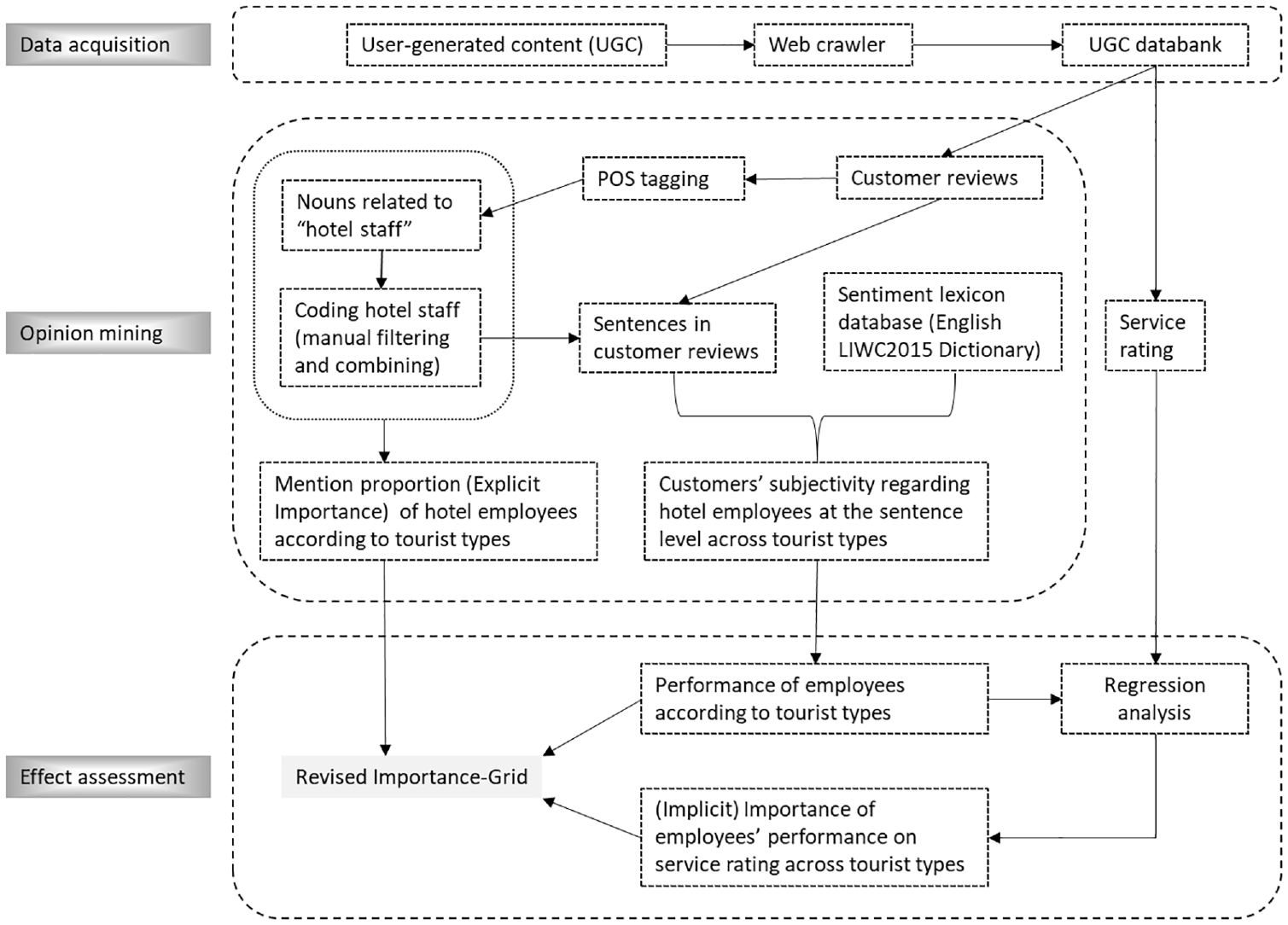
Research framework.
Data Collection
Travelers’ reviews of luxury (five-star) hotels in China were collected from TripAdvisor in June 2021. To eliminate the possible impact of the COVID-19 pandemic on service evaluations (Hu et al., 2021), reviews were conducted for 5 years (2015–2019) before the pandemic. From each review, the content, hotel service rating, and traveler type were extracted. Reviews with missing service ratings and traveler types were excluded from the analysis. The language detection of the reviews was accomplished by employing MySQL software in conjunction with the textcat package in Python. The final sample included 68,439 English-language reviews of 383 luxury hotels in four popular tourist destinations: Beijing (n = 18,957), Shanghai (n = 24,974), Guangzhou (n = 6,604), and Shenzhen (n = 5,420). To gain managerial insights, the reviews were further classified into five groups according to the types of travelers: business, couple, family, friends, and solo (Table 2).
Distribution of Hotel Reviews According to Traveler Types and Service Ratings.

Identifying Types of Service Personnel and Their Explicit Importance
The original textual data were entered into KH Coder, an automated tool for quantitative textual analysis, in order to perform text mining. After preprocessing, a noun list of tourist reviews was obtained. The term-extracting module in the KH Coder was also employed to identify noteworthy noun phrases (N-grams) (Nakagawa, 2000). The obtained noun (e.g., “doorman,”“concierge,” and “housekeeper”) and noun phrase (e.g., “bell boy,”“cleaning staff,” and “reception staff”) lists were manually checked by three researchers to identify candidate terms that described hotel personnel. Finally, 39 terms with more than 50 mentions each were used in the analysis.
A review of the hospitality literature and websites yielded different classifications of hotel employees. This study aimed to examine hotel employees from the tourist’s perspective. Specifically, it focused on employees who came into direct contact with tourists to examine whether they fulfilled their expectations. Based on previous studies (e.g., Baum & Odgers, 2001; Lupu & Marin-Pantelescu, 2009) and the service functions of hotel personnel as described in UGC, five hotel personnel groups were identified (Appendix A): (a) Concierge, (b) Front-desk, (c) Housekeeper, (d) Catering-staff, and (e) Manager. After defining codes for each group (Appendix A), the mention proportion of hotel service personnel is employed to indicate the explicit importance of service personnel in tourists’ minds.
Evaluating the Sentiment Performance and Implicit Importance of Service Personnel
Sentiment analysis was performed at the sentence level using a dictionary-based approach. As shown in Figure 3, the reviews were broken down into sentences. The subjectivity (tourist sentiment) of each sentence was evaluated based on an emotion lexicon database (English LIWC2015 Dictionary). The sentiment score assigned to each sentence was utilized as a measure of the performance exhibited by hotel personnel. For instance, a sentence such as “I was really astonished by a concierge’s rudeness at a five-star hotel” was assigned a negative subjectivity score, indicating that the concierge performed poorly. Finally, the mean sentiment score of each type of personnel in the entire sample was calculated to indicate its perceived performance.

Opinion mining workflow.
The IG classifies product attributes based on a comparison of their explicit and implicit importance. Implicit importance scores are often calculated by regressing multiple product attributes on CS to derive standardized regression coefficients. Conforming to the existing literature, a multiple regression analysis was conducted to examine how service employees’ performance affected tourists’ service ratings. The standardized regression coefficients were utilized as the impact weight of implicit importance.
Revised Importance Grid Model
As previously mentioned, Vavra’s IG (1997) has both merits and limitations. Its main disadvantage is that it cannot determine whether an attribute needs to be improved and how to improve. Therefore, this study proposes a revised IG model. As shown in Figure 4, the proposed model considers attribute performance (high or low). Unlike the traditional IG, the revised model classifies attributes into eight strategy categories (C1–C8) according to their performance and explicit and implicit importance.

Revised Importance Grid.
C1. Possibly keep up: “Basic factors” with high performance should be maintained only when a firm’s resources are sufficient because high performance does not create satisfaction, and slightly lower performance does not result in dissatisfaction.
C2. Slightly improve: “Basic factors” with low performance should be slightly improved to eliminate dissatisfaction.
C3. Keep up the good work: To maintain high customer ratings, performance factors with high performance should be maintained.
C4. Constantly improve: To increase customer ratings, performance factors with low performance should be constantly improved.
C5. Possible overkill: Since such performance factors are considered to be of low priority (low explicit and implicit importance), factors with high performance should be slightly weakened to free up firm resources if they are insufficient.
C6. Low priority: Since such performance factors are considered to be of low priority (low explicit and implicit importance), factors with low performance do not need to be addressed.
C7. Satisfiers: To maintain CS, excitement factors with high performance should be maintained.
C8. Significantly improve: To increase CS, excitement factors with low performance should be significantly improved.
Findings
Explicit Importance of Service Personnel
Appendix B presents the mention frequency and proportion of each type of hotel personnel by traveler types. The chi-square tests show significant differences in the proportion of mentions for concierge (x2 = 462.317, p < .01), front-desk (x2 = 124.012, p < .01), housekeeper (x2 = 81.427, p < .01), catering-staff (x2 = 27.233, p < .01), and manager (x2 = 63.764, p < .01) between the different traveler segments. Figure 5 visualizes the explicit importance (the mention proportion of hotel service personnel) of the five employee types according to traveler types. Generally, concierge was the most frequently mentioned, followed by front-desk, manager, housekeeper, and lastly, catering-staff. This suggests that travelers lodging in luxury hotels considered concierge service to be a core offering. Moreover, the findings indicate different travelers have distinct expectations for various types of service employees. For instance, business and solo travelers were more interested in front-desk and housekeeping services, whereas family and couple travelers seemed to be more concerned about concierge. Moreover, solo travelers were the least interested in manager, suggesting that they had a lower intention to interact with them.

Explicit importance of hotel personnel types by traveler type.
Performance of Service Personnel
Appendix C lists the perceived sentiment performance of each type of hotel personnel by traveler type. The sentiment scores were obtained directly from the sentiment analysis software, while the performance level was assessed based on a comparison between a sentiment score and the mean sentiment score of its service category (see Appendix C). Figure 6 illustrates the performance of each type of hotel personnel by traveler type. The perceived performance (traveler subjectivity) of each type of hotel personnel differed between traveler types. For instance, business travelers had the least favorable perceptions of concierge service, while couple and friend travelers were more dissatisfied with the services provided by front-desk and housekeeper, respectively. All travelers had similar perceptions of catering-staff and manager.

Performance of hotel personnel types by traveler type.
Implicit Importance Weight of Service Personnel
Appendix D presents the regression results for the performance of each type of hotel personnel according to service ratings by traveler type. The standardized regression coefficients shown in Figure 7 visualize the implicit impact of hotel personnel on tourists’ service ratings. The service quality of luxury hotels mainly depended on the service of concierge, front-desk, and manager, while housekeeper and catering-staff contributed less to service satisfaction. The implicit importance—that is, the contribution to satisfaction—of each type of hotel personnel varied widely across traveler types. For instance, concierge had a stronger impact on family and couple travelers’ satisfaction, while manager had a stronger effect on friend travelers’ satisfaction. Interestingly, concierge and manager had a weaker effect on the satisfaction of solo travelers than on that of other types of travelers.
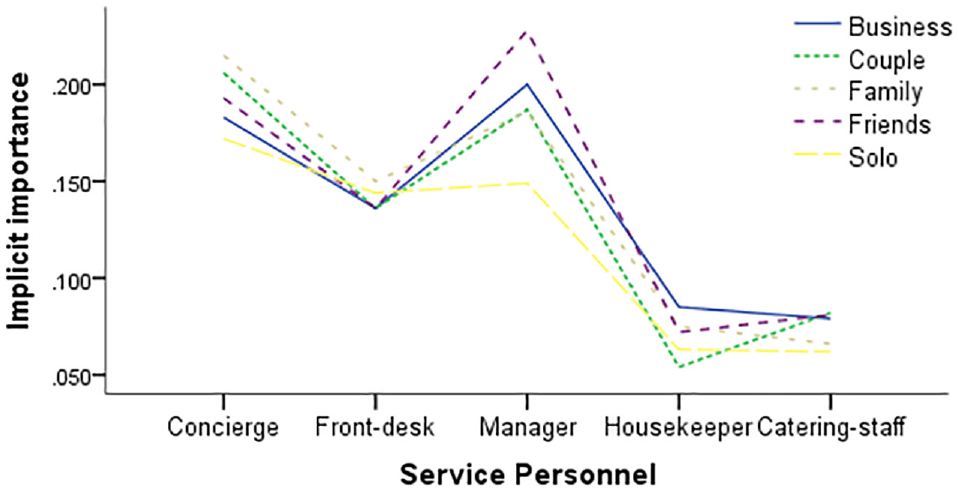
Implicit importance of hotel personnel by traveler type.
Mapping the Empirical Findings Using the Revised Importance Grid
The findings on the performance and explicit and implicit importance of each type of hotel personnel according to traveler types (Sections 4.1–4.3) were visualized using the revised Importance Grid Model (Figure 8), the implicit importance of hotel personnel was positioned on the horizontal axis, indicating the impact of personnel performance on service satisfaction, while the explicit importance of hotel personnel was positioned on the vertical axis, indicating the weight of tourists’ expectations. Perceived sentiment indicated the performance of hotel personnel at high (circles) and low (triangles) levels, suggesting whether it needed to be improved. As shown in Figure 8, travelers’ perceptions of front-desk and concierge were mostly distributed in the second quadrant, while perceptions of catering-staff and housekeeper appeared close together in the third quadrant. These types of personnel belonged to performance factors, whereas manager mostly constituted an excitement factor.
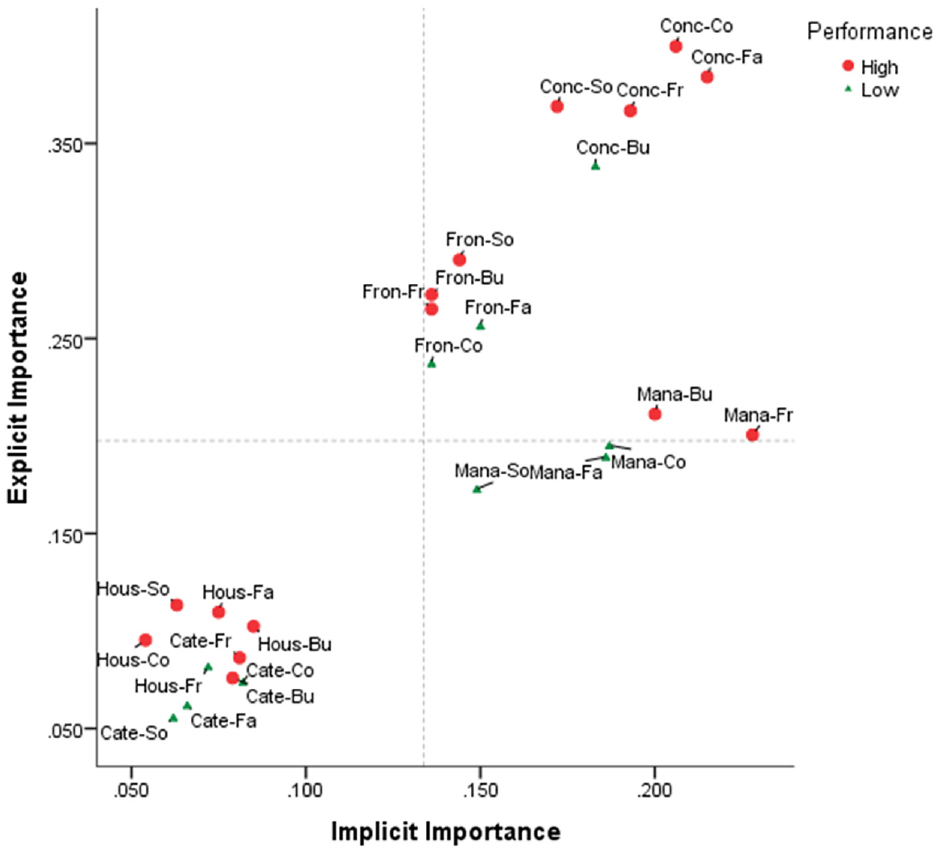
Implications drawn from the revised Importance Grid.
In terms of strategy categories (Section 3.4, Figure 4), C3 is recommended for Conc-Co, Conc-Fa, Conc-Fr, Conc-So, Fron-So, Fron-Bu, Fron-Fr, Mana-Bu, and Mana-Fr to maintain high customer ratings, while C4 (Conc-Bu, Fron-Fa, and Fron-Co) should be constantly improved to increase customer ratings. C5 (Hous-So, Hous-Fa, Hous-Bu, Hous-Co, Cate-Co, and Cate-Bu) should be slightly weakened if firm resources are insufficient. Items belonging to C6 (Cate-So, Cate-Fa, Cate-Co, and Hous-Fr) do not need to be addressed, whereas items in C8 (Mana-So, Mana-Fa, and Mana-Co) should be significantly improved to increase CS.
Discussion and Conclusions
Conclusions
This study combined opinion mining, traditional statistical methods, and an attribute satisfaction model to gain insights into how personnel services can be improved. Using opinion mining, service employees frequently mentioned in UGC were identified, and customers’ perceptions of their performance were then evaluated. A regression analysis was also performed to assess the asymmetric effects of hotel personnel on service quality. Finally, a revised attribute satisfaction model was used to draw substantive conclusions according to the functions of service employees and the types of travelers.
The outcomes of this study reveal the potential utility of utilizing UGC for the evaluation of CS in relation to the performance of service personnel. In practice, employing the three-factor theory can assist practitioners in scrutinizing the influence of customer-personnel interactions on CS. For instance, concierge, front-desk, housekeeper, and catering-staff are distributed in the second and third quadrants (symmetric attributes), indicating that hoteliers should improve them consistently to provide enhanced customer experiences. Manager constitute an excitement factor for family, solo, and couple travelers and have a greater impact on these types of tourists at a higher level of performance compared to a lower level. Among the five types of hotel personnel, service quality, and thus CS, mainly depend on the performance of concierge, front-desk, and manager.
The results also indicate that different types of travelers have distinct expectations of the various types of service personnel. In line with Wang et al.’s (2020) findings, this suggests that service improvement should be differentially prioritized according to traveler types. For example, business travelers report low performance levels for concierge, family travelers report low performance levels for front-desk, and solo travelers report low performance levels for manager and catering-staff. Therefore, this study recommends eight service improvement strategy categories according to the types of service personnel and travelers.
Theoretical Implications
The results of this study have several theoretical implications. Firstly, this research is a preliminary study aimed at exploring the asymmetric effects of role performance on CS based on the functions of service employees, illustrating how customer–personnel interactions impact CS. Although role theory is commonly employed to analyze customer-personnel interactions in service encounters, limited attention has been given to exploring service roles and role scripts from the customer’s point of view in existing literature. This research presents a valuable contribution to the field of service encounter studies by utilizing role theory to assess employees’ scripts and their performance in fulfilling their roles through text mining UGC. Additionally, our study illustrates how opinion mining can serve as a novel approach to improve service personnel performance based on role settings. By integrating text mining techniques with conventional statistical analyses and leveraging the conceptual underpinnings of role theory, this investigation brings forth a fresh perspective for future investigations on customer experiences within service environments.
Second, this study provides a valuable contribution to the existing body of literature on traveler behavior and satisfaction. Our findings confirm that the market of travelers exhibits significant heterogeneity (e.g., Ahn et al., 2017; Saarinen, 2004; Xu, 2018). Therefore, travelers’ preferences for intangible services should be distinguished according to traveler types. For instance, business travelers pay more attention to hotel functioning (e.g., front-desk and housekeeper), whereas leisure travelers (e.g., couple and family travelers) emphasize comfort (e.g., concierge) (Rohani et al., 2017). Furthermore, our findings reveal multiple asymmetries associated with service personnel across traveler types. Interestingly, manager seem to be considered satisfiers at luxury hotels, especially by family, couple, and solo travelers. Thus, this study expands the marketing literature by investigating traveler preferences for customer–personnel interactions from a perspective of market segmentation.
Finally, this study introduces a novel research framework for prioritizing service employee improvements. The proposed model (Figure 4) provides novel insights into four aspects: (a) the hospitality services that are important for tourists, (b) the actual performance of these services, (c) how their performance affects CS, and (d) the ways to optimize these services. Extending the existing body of literature, our study not only underscores the significance of customer–personnel interactions for CS (Bahadur et al., 2018) but also introduces a conceptual framework that evaluates the asymmetric effect of role performance on customer satisfaction and prioritizing service improvements according to traveler and personnel types.
Practical Implications
Unlike previous studies merely using the importance and/or performance of service attributes to gain practical insights, this study focused on prioritizing service employee improvements using a revised attribute satisfaction model to classify hotel personnel into eight strategy categories according to the weights of their performance and explicit and implicit importance. Thus, this study provides novel insights that can assist in hotel service optimization according to the various types of travelers.
Hoteliers should deploy resources to serve different market segments in a reasonable manner. For instance, concierge should pay more attention to family and couple travelers, while front-desk should be mindful of the needs of business and solo travelers. This study also investigated the perceived performance of luxury hotel employees according to traveler types. Our findings suggest that different travelers have distinct criteria for assessing service personnel. For instance, business travelers seem to be strict with concierge, while couple travelers commonly expect more efficient front-desk service. Therefore, concierge and front-desk should offer the respective types of travelers better or higher efficiency services. In summary, hoteliers should provide differentiated services to distinct traveler types to enhance customer service experiences and satisfaction.
Overall, our findings help hoteliers prioritize service employee improvements to meet customers’ expectations and increase CS. They can also prove instrumental in aiding hotel managers in enhancing employee deployment, personnel selection, and training curricula. Hotels can improve their operational performance and the perceived importance of each factor according to the types of travelers and the functions of service personnel.
Limitations and Future Research
This study examined travelers’ evaluations of different types of service employees based on 68,439 English-language reviews (international travelers) according to traveler types and uncovered the asymmetric relationships between service employee performance and CS. Other aspects, such as hotel types (Hu & Trivedi, 2020), can be considered in future research. In future research endeavors, scholars may consider employing the same methodology as employed in this study to examine customer preferences pertaining to service encounters within alternative service contexts, including but not limited to restaurants and airports. Furthermore, future studies could evaluate the differences in travelers’ expectations of hotel personnel’s performance according to their cultural backgrounds (Dolnicar & Grün, 2007; Zhang et al., 2015). Finally, our research investigated customers’ evaluations of service employees, ignoring service encounters themselves. Future studies could employ content analysis for in-depth customer–personnel interaction profiling (Hu et al., 2022), which can help to prioritize service encounter improvements systematically.
Footnotes
Appendix
The Standardized Regression Coefficients of Service-personnel Performance on Service Ratings Across Traveler Types.

| Attributes | Business | Couple | Family | Friends | Solo | |||||
|---|---|---|---|---|---|---|---|---|---|---|
| Coef | p-Value | Coef | p-Value | Coef | p-Value | Coef | p-Value | Coef | p-Value | |
| Concierge | 0.183 | .000 *** | 0.206 | .000 *** | 0.215 | .000 *** | 0.193 | .000 *** | 0.172 | .000 *** |
| Front-desk | 0.136 | .000 *** | 0.136 | .000 *** | 0.150 | .000 *** | 0.136 | .000 *** | 0.144 | .000 *** |
| Housekeeper | 0.085 | .000 *** | 0.054 | .000 *** | 0.075 | .000 *** | 0.072 | .002 ** | 0.063 | .016 * |
| Catering-staff | 0.079 | .000 *** | 0.082 | .000 *** | 0.066 | .000 *** | 0.081 | .001 ** | 0.062 | .017 * |
| Manager | 0.200 | .000 *** | 0.187 | .000 *** | 0.186 | .000 *** | 0.228 | .000 *** | 0.149 | .000 *** |
***p < .001; **p < .01; *p < .05.
Declaration of Conflicting Interests
The author(s) declared no potential conflicts of interest with respect to the research, authorship, and/or publication of this article.
Funding
The author(s) disclosed receipt of the following financial support for the research, authorship, and/or publication of this article: This research is supported in part by Science Foundation of Ministry of Education, PR China (Grant No. 21YJA630031) and The general project of Art Science of National Social Science Foundation of Chin (23BH149).
Ethical Standards
This article does not contain any studies with animals performed by any of the authors.

Data Availability Statement
Data sharing not applicable to this article as no datasets were generated or analyzed during the current study.