




Abstract
Social media posts made by ordinary people are in most cases only viewed by a small number of friends and contacts. But some posts get thousands of likes, comments, and shares, a phenomenon often dubbed as going viral. This paper provides a content analysis of viral Facebook posts published by common people in Norway, and of the news coverage they received. The social media posts that go viral in Norway deal with a variety of topics, like health care, elderly care, bullying, traffic safety, unemployment, animal welfare, school, and education. Some of the viral posts were open job applications, and some were creative expressions. Many of the posts address political issues, and becomes part of the public debate. The posts are personal in their mode of address, often with an emotional appeal for civic engagement. They resemble the letters to the editor, though they bypass the editor and go directly to online self-publication, and in this way, moving parts of the public debate from the newspapers to social media. Most of the viral posts got news coverage, which in most cases focused more on the popularity cues and the virality of the post, and less on the topic the post addressed.
Keywords
Introduction
Posts made by common people on social media are usually viewed by a few friends and contacts, but sometimes the posts go viral. Why do some social media posts go viral while most do not? This paper will look into the characteristics of the social media updates made by ordinary people in Norway that go viral; what are their main characteristics, and whether they can be seen as a modern version of the newspaper tradition of letters to the editor in the way they become part of the public debate? The viral social media posts resemble letters to the editor in the way they often address a current topic in a personal way. Letters to the editor is a long-standing tradition for common people to take part in the public debate (Dahlgren, 2009; Ihlebæk & Krumsvik, 2015). They used to be quite popular among newsreaders in Norway, with their focus on personal experience and observation related to a current topic, though a gatekeeping process in the newspapers kept most people from getting their letters published (Elvestad, 1999). Later, the comment sections in online newspapers emerged as a place for debate, but only a small proportion of the readers participated here (Almgren & Olsson, 2016; Bergström & Wadbring, 2015). These debates have moved to social media, and a different agenda-setting power has emerged; the one of virality and public engagement on social media. Shares, likes, and comments on social media become part of collective intelligence in a participatory culture (Levy, 2021). The way people are passing along and reframing media texts is changing the media landscape (Jenkins et al., 2013). Though the main motives for using social media are socializing and self-expression (Nielsen & Schrøder, 2014), these activities sometimes become intertwined in public debate in ways that are not always predictable for the individual participant. This also relates to the click economy, as popularity cues on social media often lead to coverage in editor-controlled news media.
This paper gives a thematic analysis of social media posts from common people that go viral in Norway, and a quantitative content analysis of the newspaper articles covering the posts, a discussion on virality as part of the public debate. The thematic analysis focuses on the topics of the posts, style of address, and visual material. The quantitative content analysis of the newspaper articles focuses on the use of sources, use of pictures, and references to popularity cues in prominent places, such as headline and lead paragraph.
Common people, or ordinary people, are in this paper understood as individuals who do not have a public role, and are neither part of a media profession nor hold any specific merit or position where public visibility is expected (Eronen, 2015; Turner, 2010). Facebook is the social media of choice in this study because it is the most popular social media in Norway; 82% of the general population in Norway are using Facebook regularly, and while the younger generations often are more eager users of social media, Facebook is also popular among the older age groups; 75% of over 60 have a Facebook profile (Ipsos, 2017).
Literature Review
Letters to the Editor
News organizations are not new to audience interaction. Letters to the editor is a long-standing tradition for the papers to let their readers express their opinions, and have served as an arena for public debate (Dahlgren, 2009; Elvestad, 1999; Ihlebæk & Krumsvik, 2015). Letters to the editor are written by the readers and printed in the newspapers in a letter format (Elvestad, 1999). This definition excludes limericks, op-eds, regular columnists, and letters to specialized columns, like ask the doctor, ask the lawyer, etc. (Elvestad, 1999). Letters to the editor were quite popular in Norway in the days of paper distribution, particularly in the local and regional newspapers (Elvestad, 1999; Høst & Roppen, 1994), but there is no current research to suggest its popularity in recent years.
According to a study of the published letters in Norway in the late nineties, typical topics were health care, kindergartens and schools, taxes and public fees, immigration and racism, and topics related to traffic (Elvestad, 1999). The letters were usually based on a personal experience or observation. Letters that addressed a specific issue in the local community got the most attention; they got more reply letters from other readers and were also followed up in news articles and editorials in the same newspaper (Elvestad, 1999).
Newspapers received more letters than they had room for, and the public had little influence over the newspaper’s gatekeeping process to select which letters to publish (Elvestad, 1999; Ihlebæk & Krumsvik, 2015; Nielsen, 2010). Earlier studies have found that the published letters were mainly written by conservative people from the white middle class (Forsythe, 1950, as referred to in Jönsson & Örnebring, 2011), and by people with above-average income and education (Pasternack, 1988). Gatekeepers also favor experts, who have dominated the letters to the editor columns in Norwegian newspapers (Elvestad, 1999). Studies in the period 1959 to 1989, when most newspapers in Norway had a clear leaning toward either the political left or right, showed that most of the published letters to the editor were in line with the newspaper’s political ideology (Elvestad & Fogt, 2010).
Comments Section
Letters to the editor still exist in the traditional form, but online media opened up a variety of opportunities for people to express their opinions, like discussion boards, blogs, and social media, where there is no shortage of space. Online newspapers have tried to direct the online debate to the comments section under the news articles, but several studies suggest that only a minority of the readers have participated here (Almgren & Olsson, 2016; Bergström & Wadbring, 2015; Ihlebæk & Krumsvik, 2015). For instance, surveys in Sweden show that most readers have never posted anything in the comments section. The comments section attracted younger readers, frequent online news users, and more men than women (Bergström, 2008; Bergström & Wadbring, 2012). The people who posted the most comments were male and middle-aged, well educated, and interested in politics and technology (Almgren & Olsson, 2016). There would be few comments on lightweight news, and more on news about changes in the local community, politics, and welfare issues (Almgren & Olsson, 2016). News related to immigration and/or religion is often among the most commented on news articles in Norway (Wold, 2020).
Comments sections have often had a bad reputation for generating unreasonable and hostile arguments. Newspapers have tried various strategies to curate the debate in the comments section, like pre-moderation, or not having a comments section under articles covering controversial topics, and several newspapers have stopped having a comments section (Almgren & Olsson, 2016; Ihlebæk & Krumsvik, 2015). The largest national tabloid, VG, received between 7,000 and 9,000 contributions daily and found that pre-moderation would take too long and that it would lose one of the benefits of online debate; the immediate publication (Skogerbø & Krumsvik, 2015). Journalists rarely participate in the comments section, although they are generally active social media users, both for private reasons and while at work (Hedman, 2016). In short, many seem to prefer social media to express their opinions.
Social Interaction Becomes a Public Debate
Social media have become a popular arena for social interaction and for expressing one’s opinions, among other things, and has become a platform for (parts of the) public debate (Conroy et al., 2012; Ekdale et al., 2010; Gustafsson, 2012; Ihlebæk & Krumsvik, 2015; Moe & Larsson, 2013). Compares to the letters to the editor and the moderated comments section, social media allows for more immediate outbursts and publishing directly without being at the mercy of the gatekeepers in the newspapers, or the delay of the moderators in the comments section. It is also plausible that many people are more comfortable with publishing on a platform that feels more familiar because it is a place where they connect with friends and acquaintances.
Socializing and self-expression are the most common motives for using social media (Ekdale et al., 2010; Nielsen & Schrøder, 2014). Social media is also the third most important news source in Norway, behind TV and online newspapers (Moe & Bjørgan, 2019). This involves both incidental and deliberate encounters with information, news, and discussions.
Earlier studies have shown how news consumption and sharing of information is part of a social experience (Hagen, 1994), and this is important for online media consumers as well (Hermida et al., 2012). Conversations about the news are an important gratification of news consumption, and this reflects in the way people share, like, and comment on information and news stories on social media (Choi & Lee, 2015). Social media is a mixture of traditional news, non-traditional news, and content published by the users themselves (Wadbring & Ödmark, 2016). In this mixture of everything, the users choose to share some of the vast amounts of available content. Socialization and self-presentation can be a motive for sharing content that will reflect positively on you, as a way of acting out a public persona, but there can also be altruistic motives to share content that can be useful or entertaining for others (Berger & Milkman, 2012; Brandtzaeg et al., 2011; Kalsnes & Larsson, 2017; Kümpel et al., 2015; Weeks & Holbert, 2013).
There are great variations in how people use social media. Some are lurkers, who rarely contribute content or interact, some use the platforms mainly for socializing, some are eager debaters, and others use them for a wide variety of purposes (Brandtzaeg, 2012). Social media is also a means for journalists to come in contact with ordinary people and vice versa. Content published by ordinary people is usually viewed by a few friends and other people in their existing network, but sometimes becomes part of the public debate. This particularly happens when a social media post gets an unexpected amount of views, shares, likes, and comments from other social media users, and goes viral.
Virality
Virality can be defined in different ways. To spread widely and rapidly is at the core of the definitions (Al-Rawi, 2019). Viral news, for example, is news that disseminates faster and wider than other news, mostly through social media (Al-Rawi, 2019; Kalsnes & Larsson, 2017). The word viral refers to the way a virus spreads quickly from person to person and the way content disseminates in social media from user to user. Some scholars compare it to word-of-mouth, or word-of-mouse (Al-Rawi, 2019; Mills, 2012).
Liking, commenting, and sharing other peoples’ updates on social media increases the visibility of the content. Sharing in this respect refers not to the general act of posting content, but to the redistribution of content that was originally posted by someone else (Larsson, 2016). To “like” a post on social media is a less-demanding mode of participating than to comment and share, and far exceeds comments (Kalsnes & Larsson, 2017). The “like” functionality on Facebook was redesigned into a series of reactions, but it remains an easy, one-click mode of interaction (Larsson, 2017; Stinson, 2016).
In this information age, one can benefit from collective intelligence, where people help each other to find important and useful information (Levy, 2021; Sampson, 2012). Collective intelligence is the cognitive capacities of a collection of individuals and emerges for instance in the new digital environment, where sharing, liking, and commenting on social media become part of the creative conversations which accumulate, manage, and filter information (Levy, 2021).
The concept of collective intelligence is similar to Jenkins’s ideas about spreadable media (Jenkins et al., 2013). People are passing along media text in participatory ways, and this is changing the media landscape. A mix of top-down and bottom-up forces determine which content is shared and how it is reframed (Jenkins et al., 2013). Activities like liking, recommending, and passing along texts have often been narrowly defined as less active, but Jenkins argues that the shift from distribution to circulation marks a shift toward a more participatory culture wherein people use media and distribution to serve their collective interests (Jenkins et al., 2013).
There is a concern that news reading and public debate on social media may increase polarization if people are mainly exposed to news and information matching their personal beliefs (Levy, 2021). And indeed, Levy (2021) presents findings suggesting that Facebook’s algorithm may increase polarization by giving people a biased news feed, with news and information matching their existing knowledge and attitudes. On the other hand, the findings also suggest that social media may decrease polarization because social media provide a platform where people can engage with counter-attitudinal news and information, and studies also show that people are willing to do so (Levy, 2021).
Facebook users can choose to let only their confirmed contacts see what they post, and is in that sense semi-public, but wider diffusion through likes, commenting, and sharing posts means that some of the content can reach a far bigger audience than they expected (Karlsen, 2015; Larsson, 2016). Some studies find that positive content goes viral more often than negative content (Berger & Milkman, 2012; Kümpel et al., 2015). However, positive/negative is not the only axis. Berger and Milkman (2012) suggest that material that causes high arousal emotions, either positive or negative, tends to go viral more often. They argue that some types of negative emotions, like anger and anxiety, triggers mobilization. Other types of negative emotions, like sadness, are characterized by low arousal, and deactivation or inaction (Berger & Milkman, 2012).
Studies from various countries indicate that content is more likely to go viral if it has a perceived social value, if it is humorous or if it can dynamically involve users, if it can trigger debate, or if it is practically useful, interesting, or surprising (Al-Rawi, 2019; Berger & Milkman, 2012; Mills, 2012; Wadbring & Ödmark, 2016). Studies in Norway find that Norwegians are likely to share information with engaging, provocative, and sometimes humorous content (Kalsnes & Larsson, 2017). These are also stories that make people feel angry and indignant. This overlaps both with the emotional stories noted by Berger and Milkman (2012), and the controversial stories identified in Swedish research (Wadbring & Ödmark, 2016).
It is also evident that content with photos more often goes viral than content without, but is rarely the main medium; written material is more often than photos the primary medium (Baresch et al., 2011; Mäenpää, 2014).
Virality as News Criteria
Ordinary people have often been used in news media to illustrate a current trend or as witnesses of a major event, but also in stories about everyday life, and often journalists now find these stories via social media, and user-generated content is used more often than before (Eronen, 2015; Hermida et al., 2012; Karlsson et al., 2015; Mäenpää, 2014; Paulussen & Harder, 2014; Schmieder, 2015; Turner, 2010). How do news workers decide which social media posts to turn into news stories?
Traditional news criteria suggest that an incident is more likely to become a news story if it is close in time, space, and culture, and if it can be linked to a political, economic, cultural, or athletic elite (Wadbring & Ödmark, 2016). Negative, unexpected, and odd events are also more likely to become news stories than positive incidents, but online newspapers in the Nordic countries have had an increase in positive news (Wadbring & Ödmark, 2016). Several new viral sites focus on uplifting and spreadable stories, and this has had an impact on the traditional news organizations when it comes to finding positive stories (Wadbring & Ödmark, 2016).
Likes, shares, and comments on social media functions as an indication of interest: If so many people are interacting with a certain social media post, perhaps they would also like to read a news story about it. Bruns (2016) refers to this function as gate-watching within social media. Updates on Facebook and Twitter that are liked or shared by many other users have greater visibility, which at least increases the chances of being noticed by a news organization, in a kind of collaborative action by the crowd as gate-watchers (Al-Rawi, 2019; Bruns, 2016; Larsson, 2016).
This is related to the click economy which has impacted journalism in several ways, for instance in a devaluation of information and a rise of fake news (Romero-Rodríguez et al., 2022). A survey among Norwegian journalists showed that they put great emphasis on the click potential of a story, and look for stories that are quick and easy to publish online (Allern, 2015; Dahlstrøm & Hognestad, 2016). This is not particular for Norway; the same development is evident in several countries (Al-Rawi, 2019; Welbers et al., 2016).The huge amount of information available, combined with the rapidness of online news and the pressure for rating and clicks has led to infoxication and pseudo-information, or in other words; journalism without information (Aguaded, 2014; Romero-Rodríguez et al., 2022).
To investigate some of these elements in an exploratory study, two research questions and one hypothesis have been set up:
RQ1: Which topics are covered in the user-generated posts that go viral on Facebook, and what main characteristics are there with regards to pictures, videos, and tone of voice in the written text?
RQ2: How are the viral social media posts covered by news media, with regards to interviews, additional sources, and use of images and other material from the social media post?
H1: The news coverage will focus on the popularity cues (likes, shares, and comments) of the social media post.
Method
The data material consists of viral Facebook posts published by common people in Norway. All posts were published on open user profiles or in open groups. Facebook was chosen because 82% of the population in Norway uses Facebook regularly and it covers all age groups (Ipsos, 2017).
Research on social media is increasing, but there are few definitive hypotheses. Hence, a qualitative, exploratory study of the social media posts is a reasonable choice, as described by Patton (2002), combined with a quantitative content analysis of the newspaper articles. Criterion sampling was used as it is recommended to ensure information-rich cases (Kvale & Brinkman, 2009; Patton, 2002). The logic of criterion collection is to set up predefined criteria to collect information-rich cases for in-depth, qualitative analysis (Corbin & Strauss, 2008; Patton, 2002). The following criteria were used:
The posts had to be made by common people.
Only Norwegian posts were selected.
Sharing was chosen as a measurement of virality. Sharing might have different significance for different people, so it is contested whether it is useful for scientific analyses of social media (Kümpel et al., 2015). Liking and commenting are also easy actions that increase the visibility of the content (Singer, 2014), but when users share something on Facebook, it is reasonable to assume that they do so to make the content more visible to people in their network (Larsson, 2016, 2017; Singer, 2014).
Posts had to be shared at least 1,000 times to be included. It is relative what counts as a lot of attention on social media. Posts from celebrities can be shared many thousand times. For common people, a few hundred can be overwhelming. To set the limit to 1,000 might seem arbitrary, but after a consideration of the available material, this served to limit the material without being too exclusive.
Data Collection Process
Automatic searches on social media have been used by several researchers, but in this case, such search methods were not successful in finding cases matching the criteria. Most viral cases on social media are ephemeral, with very little regard for what happened last month, and one has to be present to observe events as they unfold. Cases were collected manually by monitoring social media daily and by targeted searches on social media for posts with high visibility. This process yielded 55 cases of Norwegian Facebook postings going viral. Five from 2014, 10 from 2015, 17 from 2016, and 29 from the first 6 months of 2017. The period of three and a half years is unusual. The number of Norwegians on Facebook has not changed much in this period (Ipsos, 2017), but the use of social media is never a fixed system, and the study does not adjust for how the use of Facebook might have changed in this period. However, the collected data is still the result of active engagement with social media content by users.
Thematic Analysis of the Social Media Posts
The unit of analysis was the social media post: what topics they cover, what visual material they contain, and the mode of address. The social media posts were analyzed using inductive thematic analysis with open coding. Thematic analysis was chosen because it is a theory-flexible approach, and useful for analyzing patterns in qualitative material, starting with relatively broad themes to develop thematic networks (Braun & Clarke, 2006; Corbin & Strauss, 2008; Patton, 2002). The analysis was done with open coding in a way that resembles inductive content analysis, where the data categories emerge out of the data and not from an existing theoretical framework (Corbin & Strauss, 2008; Patton, 2002). Initial coding was done for each case immediately after it was collected. The coding was then refined in several steps while developing themes and sub-themes, with the writing process functioning as the last step of the analysis. The main themes were health care, school and education, job applications, traffic safety, bullying, animal welfare, manners, and creative expressions.
Quantitative Content Analysis of News Articles
Almost all the posts in this material got media coverage. The media coverage was analyzed through quantitative content analysis, using the first news article to cover the social media post, and focused on the headline, lead paragraph, caption, use of sources, and pictures. The quantitative coding was done by the author of this paper, using a coding key developed for this purpose.
All 55 news articles were also coded by a student assistant, using a limited coding key, focusing on the topic, visual material, use of multiple sources, and references to virality in headlines and lead paragraphs. We used Holsti’s method to evaluate the intercoder reliability, according to how it is described by Messner and Distaso (2008). The coding similarity was 96% for topic, 100% for use of visual material, 91% for use of multiple sources, and 96% for references to virality. This is considered good intercoder reliability. The reliability might be exaggerated, though, as a certain coding similarity would in any case have arisen by chance. This is a known weakness with this method. Still, the method is considered as a good measure of intercoder reliability for this study because there were only two coders involved, and, to avoid any shared preconceived ideas of how the material should be interpreted, the second coder was not involved in the development of the coding key.
Results
RQ1 asks which topics are covered in the user-generated posts that go viral on Facebook, and what the main characteristics are concerning pictures, videos, and tone of voice. For the first part of RQ1, the main topic categories were health care (elderly care, food in nursing homes, emergency care in rural areas, and children’s health), school and education (netiquette, gender roles, school curriculum, and bullying), job applications, traffic safety, bullying, animal welfare, and creative expression (musical or athletic performances, nature photography, and humor; Table 1).
Main Topic and Secondary Topic of the Posts.

Note. A total of 55 cases in the table.
Russ refers to the graduation students at high school
Health Care
The posts in the health care category addressed elderly care, food in nursing homes, emergency care in rural areas, and children’s health. Only one of the posts addressed politicians and came up with suggestions for political action. The other posts were general expressions of civic engagement, for instance addressing the bureaucracy of health care or giving praise to the health workers as everyday heroes (Figure 1).

Does this make you hungry? This is how we serve food to demented elders living at home in Oslo. Isn’t it strange that so many elderly are malnourished? This dish goes directly from the door mat to the microwave. Delicious? Today this food have been sitting on the door mat for at least 3 hours. Oslo municipality wants to save money by letting old and sick people stay at home. I have called the local department of the municipality and voiced my worries about this person. Do you think they were pleased when this neighbor bitch called? I have also submitted a message of concern. Now it’s been a week, do you think they have answered? Within a few years it might be my turn. And yours. Pleas share.
This post is a good example of civic engagement from a personal angle. A woman writes that her elderly neighbor suffers from dementia and that the municipal home care left a dinner tray on the neighbor’s doormat, where it remained untouched for over 3 hours. She called the city social care to voice her worries, but to no avail. She argues that this is why so many elderly people suffer from malnutrition. Over 5,000 users shared the post, and it got coverage in a national newspaper, where the municipality promised they would improve their routines for food serving. The media focused primarily on the numbers of shares and likes, not on the importance of appetizing and nutritious food in elderly care.
School and Education
The school and education category includes topics like netiquette, gender roles, school curriculum, and bullying. The netiquette topic consisted of two posts: One where a teacher held up a sign with a request to share it, to demonstrate to the pupils how fast pictures can travel online, and one where a concerned parent warns against strangers trying to contact her adolescent daughter online. Two of the posts were comments about what children should learn in school.
A post from a small construction company addressed education differently. They congratulated one of their young employees on achieving a certificate of apprenticeship. The person had nearly dropped out of school during adolescence, but the company decided to give him a chance to get an education through practical learning and apprenticeship. The media coverage of the post focused on the number of shares and likes.
Job Applications
Job applications are a good example of people turning to social media when they need help. The job seekers in this material told about a difficult job market, particularly when they have been unemployed for some time. Several of them also told about a handicap or a condition that made employers less willing to give them a chance. The posts are written in a positive, optimistic tone, stressing a desire to work. The posts included portrait pictures of the applicants, and they asked people to help them by sharing the post, directly involving the other users. These posts got from 3,000 to over 30,000 shares on Facebook, and the job seekers have gotten job interviews, temporary positions, or permanent jobs.
Traffic Safety
The posts in this category dealt with the reckless, inconsiderate, or annoying behavior of others, like reckless driving, illegal parking in handicap spaces, or cyclists on the road. The posts expressed irritation and anger. Two of the posts included videos, filmed from a motor vehicle, of cyclists in front of them on the road. In both videos, they express irritation over the cyclist. In a more positive post, a dad praises his teenage daughter for using a bicycle helmet (Figure 2).

Children these days stop using bicycle helmet when they start at junior high school. They don’t think helmets are cool, they’re afraid to mess up their hair, and think helmets are ugly, and so on. I have three kids, and they have all been through the same. The two eldest stopped bicycling when they got a driver’s licence. The youngest girl still rides a bike, and I had pretty much given up nagging about helmet use. Last week a 15 year old girl was in a bicycle accident, and landed on her head. She wore a helmet, and it probably saved her life. I sent the news article to my daughter. The day after she sent me a text message: “I’m wearing my helmet today, and it feels a lot safer.”
The father writes that teenagers do not use bicycle helmets because it is not cool. He refers to a bicycle accident where a 15-year-old girl was severely injured but survived because of the helmet. This accident made his daughter decide to wear a helmet, and he praises her for being tough enough to be different from the others. He encourages other parents to share the post and to get their children to use helmets.
Bullying
The posts in this category are typically someone telling about how they have been subjected to mental and physical bullying. Some posts also tried to make suggestions on how bullying could be prevented. In the following example, a father gave his children a specific task when schools were starting up again after the summer vacation: “make contact with one who seems to be alone. Send him or her a nice text message. Ask him or her to join you for an after-school activity.” (Figure 3)
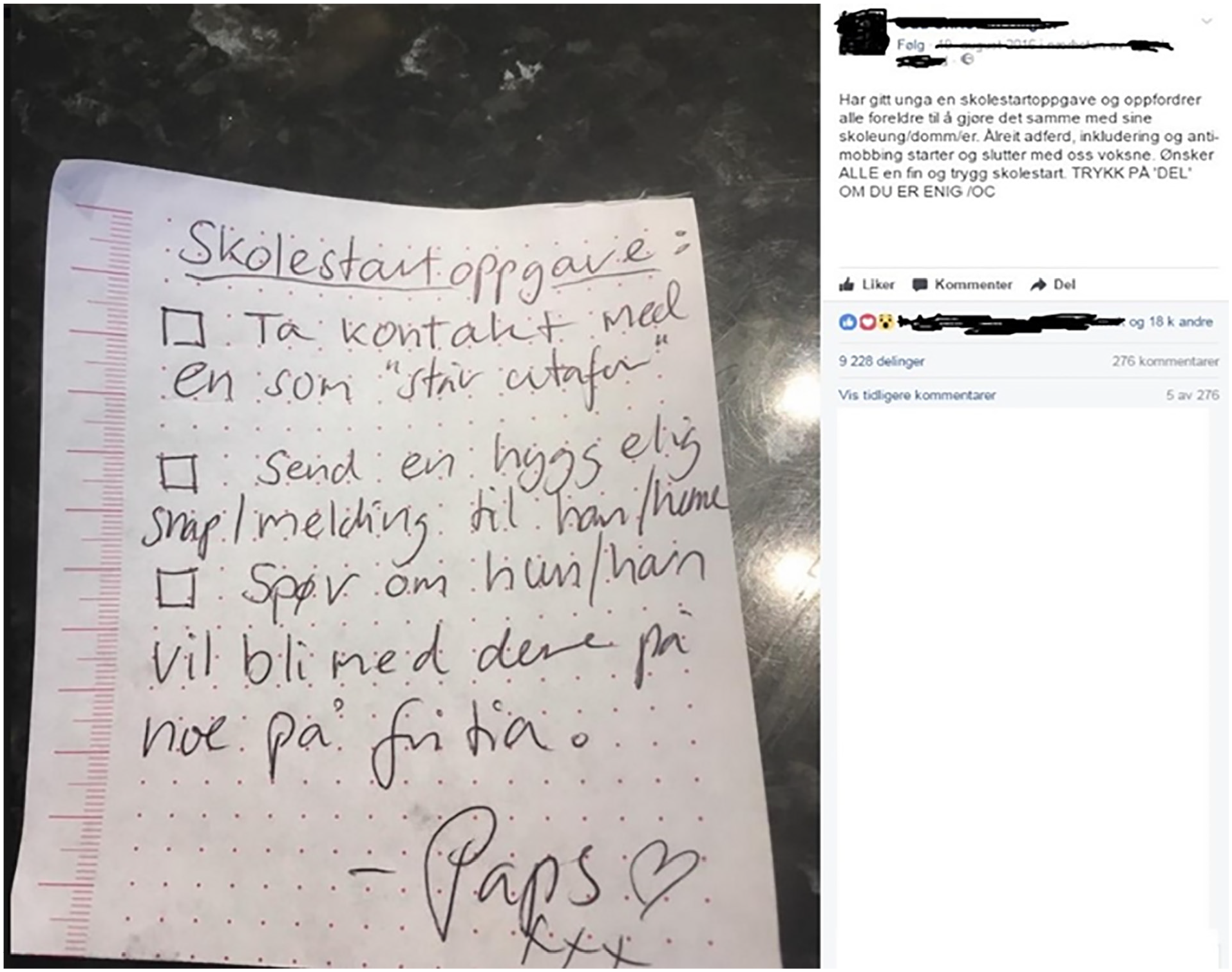
I gave my kids an assignment for school start-up, and I encourage other parents to do the same. Nice behavior and anti-bullying starts and end with us adults. I wish EVERYONE a nice and safe school start-up. CLICK “SHARE” IF YOU AGREE.
The post consists of a photo of the hand-written message he gave to his children, and a text saying it is the adult’s responsibility to teach their children good behavior, and that anti-bullying starts with social inclusion. He encourages everyone to share the post. Over 9,000 have, and more than 18,000 have given a positive reaction. The post was covered by several of the largest online newspapers in Norway and Sweden and on national television. Some of the media coverage focused less on virality, and more on bullying and the importance of social inclusion.
Animal Welfare
Cute animals are all over the internet, but the posts in the animal welfare category dealt with more serious issues (Figure 4).

It is devastating to see that some people just don’t care, or don’t understand, what kind of injuries fireworks can cause to animals. Please hear my prayer… Let the fireworks be until New Year’s Eve…Please….
In Norway, New Year’s Eve is the only opportunity for private citizens to use fireworks. This gives animal owners a chance to prepare and keep their animals safe. A horse owner tells that several days before New Year’s Eve, someone sent up fireworks, causing the horse to panic and run into the road, where it was hit by a car. The horse suffered severe injuries and had to be put to sleep. The pictures show the injuries, and the owner appeals for everyone to wait with the fireworks until New Year’s Eve.
Creative Expression
This category includes music, athletic display, nature photography, and the biggest sub-category; humorous expressions. One of the humorous posts was a satirical meme with a fictitious suggestion from a political party, which some seemed to believe was true. There were also training and advertising parodies, and funny customer complaints (Figure 5).

Hi there!
An IKEA customer complained that his testicles were stuck in the holes of a stool while he was showering. It is a long story, with lots of colorful expressions, and the customer service gives a humorous reply. The post was shared more than 13,000 times, with 32,000 reactions, and 6,500 comments. National news media in Norway and several other countries picked up the story. And a country musician performed a song based on the story on the Jimmy Kimmel Show in the USA.
Main Characteristics
The second part of RQ1 asks what the main characteristics of the viral posts are, particularly when it comes to images and the general tone of voice. A 29% of the posts contained text only, while 67% of the posts included a photo or video, usually in a combination with text. A 4% contained drawings.
In most cases, the picture was the person who published the post. There were only nine cases where the visual material was the main content of the post, with no or very little text. Seven of these were humorous videos, one was a humorous drawing, and one was nature photography. The remaining posts were a combination of pictures and texts, with the text providing the bulk of the information, and the pictures serving as illustrations. We cannot tell for sure if it was the text or the photos that made people want to share the post. Nevertheless, this strengthens hypothesis 1; the majority of the viral social media posts contain pictures, but the main information lies in the written texts.
Many of the posts were expressions of civic engagement, sometimes to give praise to an important group in society but more commonly addressing a current topic. They often addressed matters of political concern, but rarely mentioned any politician or political party. The posts that dealt with negative issues, such as unemployment, bullying, mistreatment of animals, and poor elderly care, had a general tone that something needs to be done paired with optimism that something can be done. The majority of the posts were rooted in a recent personal experience or observation.
News Coverage
RQ2 concerns the news coverage of the viral posts, and RH1 stipulates that the coverage will focus on popularity cues. A 91% of the 55 social media posts got news coverage after going viral. The news coverage was swift, focused on the number of likes and shares, and used private pictures. The topic for the posts usually got second priority. There were only a few cases where the social media posts sparked off a more thorough news coverage of the given topic.
The majority of the news articles can be categorized as soft news and follow an episodic format. The most typical format of the news stories was to have an interview, usually by phone, with the person who published the post. This interview would, together with content from the social media post, provide the main material for the news story. In a few cases, the source was just the social media post alone, with no interview.
The news stories often reproduced the social media post in its entirety, either by quoting the text or by screenshot. A 45% of the news articles had only one source. In articles with more than one source, the social media post and the user were still the main sources in 84% of the articles. Additional sources were either common people, private companies, or public offices. Private companies were usually contacted to answer customer complaints on social media, and public offices were typically asked to answer complaints made about public services, like elderly care.
The person who posted the content on social media, and hence became the main source in the news stories, was fairly evenly distributed among men and women. Most news articles did not state the age of the sources. When their age was stated, it was fairly evenly distributed along the scale, but with a slightly larger representation of people in their twenties. The youngest person in the material was 15. The oldest was 62. They were given generic titles, like the 22-year-old, the man, the house-owner, the wheel-chair user, the pupil. In a few cases, they were referred to by their profession.
Most news stories used a private picture of the person, often taken from social media, or a picture or screenshot from the post. Only three articles used pictures taken by a professional newspaper photographer.
The news coverage always referred to the virality of the social media post. Half of the news stories had a headline referring to the virality of the post, like how many times a post has been shared or a video has been seen, or with more vague concepts, like “going viral” or “takes the internet by storm.” The other half of news stories referred to virality in other prominent places, like lead paragraph and caption. The virality itself seems to be an important news criterion.
National newspapers seemed more eager to cover a social media story than the regional or local newspapers. When a regional or local newspaper reported about a social media post from a person in their district, it was in most cases after it had already been covered by a national newspaper.
The media attention was short-lived. Even for the cases that got coverage in several newspapers, it only lasted for 1 day, sometimes two. Only 24% of the cases got follow-up articles.
The news coverage usually did not make any significant contribution to the spin of the original Facebook post. Almost all news articles stated the number of shares that the post in question had received so far, and in most cases, the social media post only got a few more shares after that. It is possible that when a Facebook post becomes subject to news coverage, most people do not find it necessary to look up the original post itself. The virality in the material was usually short-lived.
This supports hypothesis 1: That the news coverage will focus on popularity cues of the social media post.
Discussion
RQ1 asks which topics are covered in the user-generated viral posts on Facebook, and what the main characteristics of the posts are. The findings indicate that they cover a wide variety of topics, like elderly care, unemployment, traffic safety, education, bullying, creative expressions, and humor. In news terms, most of them would be labeled as soft news and human relations. Almost all of the viral posts contained pictures, often a selfie, and a few contained videos, but the main information is in the written text. The minor importance of visual material was a bit unexpected in such a visual culture. It can be that the picture-dominated communication is more personal, and takes place on more personal platforms, like Snapchat and Messenger. It can also be that self-exposure and artistic expression through pictures are better suited through platforms like Instagram, where several daily updates are more common than on Facebook.
From a perspective of social media as a sort of un-edited news and information platform, it is less surprising that people prefer a combination of pictures and text, with text providing the bulk of the information. It resembles the way news traditionally has been constructed, with images centrally placed to anchor the case and/or to get the audience’s attention, but where the information mainly lies in the written text for newspapers or the spoken word for TV news (Allern, 2015; Gynnild, 2009). It is also likely that the pictures were important for the visibility of the posts, as nearly none of the viral posts were written text only.
The majority of the posts address a current topic using personal experiences or observations. They resemble letters to the editor. Typical topics for letters to the editor in Norway are health care, kindergartens and schools, taxes and public fees, immigration and racism, and traffic, and the letters are based on something that happened to the writer, to someone they know, or that they criticize something in the local community (Elvestad, 1999). This is comparable to the social media posts in this study; the topics are in the soft news and human interest categories, and they are based on personal experiences and observations. Another similarity is that letters to the editor sometimes are developed into news stories by the newspaper (Elvestad, 1999). They are personal expressions on social media that become a part of the public debate.
H1 stipulates that the news articles will focus on popularity cues. H1 is strengthened. Nearly all the viral social media posts served as material for news stories. The news articles were episodic in form and focused more on individual relevance than on societal issues. Most of the articles in this material refer to the clicks, likes, and reactions of the social media posts, and bring very little new information to the table, in line with the notion of information devaluation (Romero-Rodríguez et al., 2022). There was little journalistic processing, such as additional research, use of other sources, professionally taken photographs, or follow-up stories. The newspapers did not use a lot of resources on these stories. The economy of news production has changed after the online revolution, demanding less work in the field, more standardized news, and amateur material (Dahlstrøm & Hognestad, 2016). User-generated content from social media, with shares and likes as a new criterion, is one way of adapting to the new economic circumstances in news production.
Traditional news criteria give priority to stories that are close in time, space, and culture (Wadbring & Ödmark, 2016), and the majority of the cases in the current study satisfy these three criteria. Traditional news criteria also favor negative, unexpected, and odd events, but online news tends to have a larger proportion of positive news (Wadbring & Ödmark, 2016). In the present study, there are only a few cases that can be described as negative events. There were some unexpected and odd events, but the majority of the cases dealt with mundane, day-to-day topics. This is consistent with earlier research showing that newspaper articles featuring user-generated content consist mainly of personal and everyday life-oriented stories, rather than news or information (Jönsson & Örnebring, 2011). Similar to the “photo of the day”-section, many news publications now have a section for tweet of the day or other routinized ways of integrating social media content from the audience in their news publications. Most of the cases do not contain material that would qualify as breaking news according to traditional news criteria.
It seems as the virality itself was the main news criteria for many of these cases. A high number of shares and reactions on social media increases the chance that a news worker will notice the post, and the number of interactions will be taken as an indication of relevance (Bruns, 2016). This also provides newspapers access to stories with an affirmed closeness to their readers.
Online sources may be chosen by journalists because they “may bring to the story a passion not found in everyday interviews” (Shaw et al., 1997, p. 233).
The social media posts in the present study certainly represent more immediate outbursts than the traditional opinion pieces. This relates to the immediacy effect. Immediacy has a time and space dimension; events feel more important when they are geographically close, and if they are happening right now, or at least fairly recent. It is also about the perceived cultural and social closeness between the public and the events. Immediacy is perceived presence, for instance in the way that the communication appears like a personal conversation, with a direct address. A lot of this is present in social media posts. They are mostly personal in their address, are culturally close, and written by a peer. This is often interesting material for news stories and goes together with a more general trend for mass media to show interest in the stories of common people. However, there are some missed journalistic opportunities here. For instance, a social media post about a school dropout who got a practical education at a construction company reflects some important ideas on how young people who struggle in a theory-ridden school can find a different path in life, but the media coverage focused on the number of shares and likes. It is also a call for the social responsibility of the news media to commit to quality journalism and public communication (Romero-Rodríguez et al., 2022).
A big difference between social media posts and letters to the editor is that not all letters get published. A Danish study showed that the largest newspapers could receive 10 to 50 times more letters than they had room for (Nielsen, 2010). There’s a selection process where the editors are gatekeepers, and their decisions have a great impact on what’s on the agenda in the letters to the editor section (Elvestad, 1999).
The main reason for writing letters to the editor is to express personal matters and opinions, and sometimes to start a debate (Karlsson et al., 2015). This might also be the motivation for sharing something on social media, but most of the time, socializing is a more important motivation here. However, this socializing sometimes becomes part of the public debate. Several scholars have pointed out that blogs and social media have become platforms for public debate, and to a much larger degree than the comments section in online newspapers (Almgren & Olsson, 2016; Bergström & Wadbring, 2015; Bruns, 2016; Conroy et al., 2012; Ekdale et al., 2010; Gustafsson, 2012; Ihlebæk & Krumsvik, 2015; Moe & Larsson, 2013).
Social media can enable a more diverse group outside of the elite to do reporting by sharing unexpected events with their social media networks, and in the next step, influences the news agenda (Bruns, 2016). Social media becomes the place to go when you have something to say about something, without the delay of editor-controlled media. People are not merely consumers of media content. They are also sharing and reframing the content, and although the mass media still holds a privileged voice, these acts of circulation do leverage attention, particularly on social media (Jenkins et al., 2013).
Conversations at the dinner table at home and by the water cooler at work have been an important part of the social fabric of modern societies (Kalsnes & Larsson, 2017). Previous studies suggest that discussing the news serves as a way of presenting oneself as a socially engaged citizen (Weeks & Holbert, 2013). Studies from the pre-online era showed that Norwegians perceive it as a moral and democratic duty to be up-to-date on the latest news (Hagen, 1994). These cultural and social norms concerning media use apply to online media platforms as well. This has to do with the democratic ideals of the well-informed citizen, and how we see ourselves and wish to present ourselves (Hagen, 1994). The sharing of information on social media can function as a part of these processes. There can also be altruistic motives to share content that one thinks will be useful or entertaining to others (Mills, 2012; Weeks & Holbert, 2013).
It is uncertain what it means that parts of the public debate now take place on commercial platforms. Popularity cues on social media can function as a form of collective gate-watching, but can also be manipulated, either by automation or by organized campaigns, which is something news workers must be aware of.
Further Research
This study does not answer why people share other users’ posts on social media, but it is clear that such sharing sometimes becomes part of the public debate, whether that was the intention or not. We must research how social media affects the debate, and the public’s opportunity to participate in it. One could also research the news-sharing practices of individual users. Do they for instance see it as a moral duty to be up-to-date on social media and to share news and information with their network? It could also be interesting to study why most people do not share content.
Media production studies are also interesting here. How do journalists use social media as a research and distribution tool? Field research in newsrooms and interviews with journalists can shed some light on how they monitor social media, how they decide which user-generated material to turn into a news story, and in what way.
Limitations
Research involving material from social media will face issues concerning reliability, validity, and generalizability. A manual data collection poses limitations to the study which must be considered when drawing conclusions from the results. There can be relevant cases that have gone undiscovered using these search methods. This study does not take into account how algorithms and personalization of social media affect the visibility of the various posts. A possible bias in the data collection is that many of the viral posts that had gotten attention in news media, and the news articles often got a second round of attention on social media. So one must consider how the attention from news media might have an effect on the attention on social media as well. It is also a limitation that the data does not say anything about external drivers of attention. Weekday or time of day may affect the visibility of a post, or if it coincides with other events or current debates. Some of the posts were posted on the FB page of a business, like IKEA. Businesses often use Facebook and other social media to build customer relationships (Ali Qalati et al., 2021; Dwivedi et al., 2021; Lee & Kim, 2020; Sung, 2020), and when the letter got an open reply from IKEAs customer service, it probably increased the visibility of the post. The data presented are from 2014 to 2017. Social media platforms have a constant release of new functions (Dwivedi et al., 2021), and there is no guarantee that the processes of virality studied are applicable today. It is, however, good reason to argue that the material contains sufficient cases matching the criteria to provide for a discussion of social media as an interactive version of letters to the editor, and as part of the public debate.
Ethical Considerations
Elgesem (2015) discusses how it is difficult to formulate general rules for when consent is necessary for social media research, and that the researcher must assess on a case-by-case basis. All the information presented here is publicly available. Personal information is not included in the material. Consent from the participants was not necessary to summarize the information. The cases used as illustrative examples are easy to identify because of the coverage in news media. Informed consent is necessary here because a research presentation is in a very different context than the social media context (Elgesem, 2015). I have attained consent from the people who published the posts. They have also seen the result before publishing, and have given their approval.
Footnotes
Declaration of Conflicting Interests
The author declared no potential conflicts of interest with respect to the research, authorship, and/or publication of this article.
Funding
The author disclosed receipt of the following financial support for the research, authorship, and/or publication of this article: This research was part of the ViSmedia project, funded by the Norwegian Research Council, grant number 247721.
