




Abstract
China’s cultural policy has shifted from a government-driven direction to a model centered on marketization development model. The economic value of culture has come to be seen as the main engine of growth for national development; moreover, cultural and creative industries (CCIs) have been strategically fostered. Here, in place of a unilateral top-down method imposed by the government, a marketization development model has been promoted to actively accommodate the policy discourse presented by cultural creators/consumers. China’s CCI policy discourse may indicate the policy direction necessary to develop itself into a cultural powerhouse. In this study, policy discourse is collected and analyzed for keywords of China’s CCIs from 2006 to 2020. Text mining and network analysis were performed, and the main results are as follows. First, it was found that China’s CCI policy discourse has been gaining traction; its centers appear to be found within large cities with rich cultural infrastructure, where major cultural projects are discovered and promoted, and Chinese culture is being globalized. Second, the items/contents of the Chinese CCIs are diversifying and developing into a human-friendly Chinese-style cultural and creative industry model that values experience. This should be noted to help guide the future direction of China’s cultural policy. Finally, it is necessary to adjust industrial concentrations and regional development imbalances because of the acceleration of industrial clusters in CCIs.
Keywords
Introduction
Policy discourse presents general values and goals for society with the aim of overcoming conflict through a policy’s social diffusion (Flink & Kaldewey, 2018). Policies that promote a country’s sustainable development must not only lead to social consensus that goes beyond a government’s explicit deliberation but also have a positive effect on social, market, and business development. Indeed, not all policy discourses has a positive effect on society. Nonetheless, if we expect private-led rather than government-led development, policy discourse should be pivotal in inducing the active participation and openness of the private sector (Barrett et al., 1995). Culture is a field of state affairs wherein private-led policy discourse is reflected in important policy decisions and execution (Grodach, 2013). This is because cultural policies reflect the macroscopic identity of a country. However, in the current global era, a revitalization of cultural fields with the addition of the economic concept of creativity and industrialization is indispensable for strengthening national competitiveness.
Since the 2000s, countries all over the world have been defining culture as a vital industry area (Shan, 2014). They have endeavored to discover creative private competencies with national policy support. A representative country among these is China. From a macro perspective, the changes that have taken place in Chinese cultural policies are in line with economic development policies, which seek cooperative development between the government and the market by breaking away from the government’s top-down policy promotion (White & Xu, 2012). Following Mao Zedong’s ideas, the cultural field in the early days of the founding of Communist China had an important strategic position, closely related to the stable and sustainable development of the country together with its politics and economy (Keane, 2009; Tong, 1994; White & Xu, 2012). During this time, policies were focused on government-led propaganda that emphasized social and public value. However, after joining the World Trade Organization, China began to pay close attention to the globalization and economic feasibility of culture and devoted itself to fostering cultural and creative industries (CCIs). China’s current cultural policy has developed into a new policy concept called CCIs wherein industrialization and creativity are added to the basic idea of culture.
It is important to note that China’s CCI policy emphasizes the role of the private sector in expanding diversity in terms of cultural development by strengthening creative capacities. In other words, the promotion of this policy does not follow China’s usual tendency of being strongly driven from the top-down in the past. However, government policy establishes macroscopic guidelines wherein policy discourse is actively formed, allowing the private sector to develop autonomous and voluntary CCIs. Specifically, the accelerated cultural globalization due to the spread of information and communications technology (ICT) and the emphasis on soft power related to culture has promoted discourse formation and cultural diversity in CCI policies. Therefore, although the most suitable approach to analyze the major influencing factors and actors in this area is through a policy discourse analysis of China’s CCIs, most studies related to Chinese cultural policies have focused on institutional studies and economic effect analysis. This is because many cultural fields in China are under the direct control of the state (Fung, 2016; Gao, 2015).
However, the industrialization of culture and the emphasis on soft power is becoming an undeniable trend, catalyzing active discussion of CCIs. The autonomous generation and development of discourse can be converted into the outcomes of various CCIs. The analysis of policy discourse to identify the critical keywords (actors) that are actually leading China’s CCI policies has produced significant research value for understanding the context of China’s cultural policy and suggesting future development strategies. Specifically, analyzing the goals being pursued by the government’s CCI policies in China, the social policy discourse present in the media, and the main keywords can help us understand China’s method in pursuing top-down policies from a new perspective. As a research method, this study applies network analysis performed on data gathered through text mining. Text mining can be used to derive main keywords by examining them in a discursive context, such as those occurring around the social spread of CCI policies. Network analysis is suitable for analyzing the patterns and roles in which the main keywords (actors) are found in discourses and how they may lead the discourses (Zhang et al., 2019).
This study is organized as follows. The next section investigates prior work on Chinese cultural policy through a literature review that examines various frames for the study of Chinese cultural policy as well as enhances the understanding of the universality and specificity of Chinese cultural policy. Then, the data and analytical methodology are described. Subsequently, the results of the empirical analysis and interpretations are presented, and finally, the research results are discussed, followed by the conclusions.
Literature Review
A CCI policy describes a national development strategy (Hartley, 2004) that creates economic benefits through the expansion of pure culture and the art field while simultaneously enhancing the existing industrial structure. Creativity has been at the core of globalization and new economic growth engines since the late 1990s, and the UK’s slogan of “creative industry” (Hesmondhalgh & Pratt, 2005) has helped lead industrialization policy in the cultural field (Garnham, 2005; Oakley, 2004; Pratt, 2005). As globalization accelerated, the industrialization of the cultural field and the grafting of the creative concept spread quickly across Europe and Asia, and this development became the basis of the current CCIs (Lee, 2004; O’Connor & Gu, 2006).
Several studies have focused on CCIs, but they have approached it based on innovation (Li, 2020; Messeni Petruzzelli & Savino, 2015) and emphasized the role that cultural and creative knowledge have in solving social problems and creating economic benefits (Kong, 2014; Throsby, 2008; Tschmuck, 2003). Additionally, studies on the system and role of the CCIs in the production of creative outcomes (Chapain et al., 2010; Cooke & De Propris, 2011; Messeni Petruzzelli & Savino, 2015; Müller et al., 2009) have seen widespread development. It should be noted here that the CCIs proceed based on innovation, with a result that requires a combination of various ideas and high-quality creative content so that uncertainty in the market and consumer choices cannot be avoided (Savino et al., 2017). To reduce this uncertainty, the CCI policy has two options. The first relates to the government’s intensive investment in areas that can generate economic benefits (cultural infrastructure, cultural education, etc.), and the other is creating a production–distribution–consumption ecosystem that develops around choices made by markets and consumers (Kong, 2014; Oakley, 2009). The former route is generally chosen by countries seeking to promote a centralized and robust top-down policy strategy, and the latter relates to a method that is oriented to the market or customer and emphasizes a bottom-up establishment of policy. European and North American countries, where the values of freedom and democracy developed early, have been seeking to build autonomous and market-oriented cultural ecosystems.
In China, CCIs have developed in response to a shift in awareness regarding the strategic importance of culture that has occurred in the 21st century (Shan, 2014). In response to the emphasis in the early cultural fields on the ideological character and policy tools regarding propaganda and agitation, a change of perception occurred that emphasized material values, which gradually strengthened commercial and economic concepts (Keane, 2009; Pang, 2012; Throsby, 2010; Towse, 2020); this is in line with China’s policy of economic development through industry reforms and openness (White & Xu, 2012). In other words, following the period of reform and opening up, the Chinese economy has continued to discover/nurture sustainable growth engines. Among them are the industrialization of culture and the fostering of soft power, which have attracted greater attention as growth engines.
In the 2000s, under the slogan of “Cultural Powerhouse,” the Chinese government attempted a bold transition from a quantitative conception of growth to a qualitative one in the cultural field. Deng Xiaoping’s liberalization measures in 1978 acted as a catalyst for the modernization of cultural policies along with rapid political, economic, and social changes (Yi et al., 2021). As the esthetic/entertainment value of art has become more important, culture has emerged as a new field for economic development. Accordingly, at the 14th Congress of the Chinese Communist Party in 1992, the wave of so-called “marketization” was strongly projected on the cultural field, and the concept of cultural industry began to emerge in the context of economic reforms and socialist market construction at this time (Shan, 2009). At the beginning of the 21st century, China’s cultural industry worked seamlessly with Britain’s creative industry, and the “Culture and Related Industry Classification” and “Culture Industry statistical indicators” were enacted, leading to an accurate conceptualization (Kang, 2012). Simultaneously, CCIs went through an early nascent period, centered on Shanghai and Beijing (White & Xu, 2012).
From a policy perspective, at the 16th National Congress of the Chinese Communist Party in 2002, the country’s leaders emphasized a new fusion of culture with politics and the economy, which was to emerge as a substantial approach to competitiveness in terms of national power. The following year, Hu Jintao presented the report The View of Cultural Development based on the scientific outlook of development. The 11th Five-Year Plan (FYP) (2006–2010) promoted policies for active investment in China’s CCIs to foster markets and strengthen industry competitiveness. In 2011, the State Council stated that promoting CCIs should be a major development axis for China’s national economy. In 2014, efforts were made to enact the <Cultural Industry Promotion Law>. In 2018, this law was used to promote not only quantitative development but also the qualitative advancement of the Chinese cultural industry to increase the global influence of the Chinese cultural industry. The CCIs no longer seek justification for development but have emerged as the locus for developing scale-up (Shan, 2014).
The changes in China’s CCI policies constitute flexible responses to the increase in China’s political and economic status on the international stage. Evidently, the criticism could be made that culture is becoming merely instrumental, appearing only in its economic value of culture (Throsby, 2010); however, China has considered its CCI policy to be an important part of the transition process to modernization and advancement through the economization of cultural policies (Pang, 2012; Shan, 2014).
Notably, although China’s CCI policies were developed in response to the times and the strategic needs that appear inside and outside of China, it did not establish an artificial development process from the top-down like previous policies. In other words, China’s CCIs were developed to cultivate self-sustainability, which must overcome market uncertainty on its own by combining creative concepts with the cultural industry. This policy direction emphasizes the macroscopic guidelines of policy and the private sector, which develops its own basis and competencies, and in this process, policy discourse is an important issue and entrepreneurial spirit. As per Throsby (2010), some stubborn policymakers are concerned with the dysfunction of public support in the cultural field; however, modern CCIs are a future-oriented policy agenda that innovate society through the integration of art, information, and knowledge economy. This proves that China’s macroscopic CCI policy support and guideline formation are making important contributions to enhancing the self-sufficiency of cultural creativity in the private sector. In this dimension, it is important to study the policy discourse of China’s CCIs and their social diffusion.
There have been many studies on the concept and system of China’s cultural field (e.g., Hu, 2010; O’Connor & Gu, 2014; Shan, 2009; Zhang & Dai, 2021) but few have focused on the role of the private sector, which is emphasized by China’s cultural policy, especially in terms of CCI policy. Therefore, there is a need to analyze policy discourse regarding CCIs to examine the social spread and role of primary policy keywords and investigate the practical capacity of cultural creativity in the private sector and in the market in relation to this. This study uses textual data to identify policy discourse and categorizes it with regard to certain periods in order to examine social changes in policy discourse in CCIs. Additionally, the main policy keywords are derived for each period by applying network analysis and analyzing the roles that these keywords play. Thus, we can summarize the following two research questions:
RQ 1: What kind of time series changes do China’s “CCI policy discourse keywords” show?
RQ 2: What are the characteristics and roles of “CCI policy discourse keywords” in China?
Data and Methodology
Data
In this study, we collected text data related to China’s CCIs by using the Python algorithm. Text data matching the theme of CCIs were collected from Baidu (including news, webpage, and academic page), which is China’s largest social media portal site, and Sina Blog, where individual opinions and discourses are expressed and exchanged. These channels account for more than 80% of the Chinese internet portal community (Zhang et al., 2019). The collection period extended from January 2006 to December 2020, a period when CCIs were being discussed in earnest in China, and data were extracted for each year. To analyze changes in the policy discourse of the CCIs in China, three data sets were constructed accordingly in relation to the 5-year development plan. By period, 3,465 cases were collected for the 11th FYP, 5,125 articles for the 12th FYP, and 8,272 articles for the 13th FYP.
Next, duplicate documents were deleted, the data were refined, and the texts were organized by part of speech (POS). Keywords that were not related to the subject word of this study or were not analyzed because of POS forms (e.g., prepositions and verbs), alphabets, numbers, singular/plural, symbols, and spaces were removed. To efficiently perform this behavioral analysis, we utilized the R package (www.github.com/NamyounKim/NLP4kec). This morphological analysis technique is a process of segmenting words or sentences, which are language units that are larger than morphemes, into morphemes, which are the smallest units of meaning. After dividing the document into tokens (small semantic units), POS tagging is performed, and the unstructured data is processed as structured data and converted for mathematical analysis. After acquiring a total of 10,307 words (11th FYP: 1,463 words, 12th FYP: 2,731 words, 13th FYP: 6,113 words), we performed text mining and build a word co-occurrence matrix using these words.
Methodology
Text mining can efficiently analyze comprehensive information on policy discourse for CCIs by examining various issues discussed in reality—thus determining the various sub-policy keywords related to the subject words—and conducting a richer analysis and interpretation of the research topic (McDonald & Kelly, 2012). Network analysis is an appropriate methodology for exploring a society’s micro/macro characteristics comprising networks. When data derived from text mining are applied to network analysis, various patterns and structures appearing in the text network can be identified and used to analyze policy discourse (Zhang et al., 2019). In this study, we examined the text sets gathered from websites using text mining techniques to determine which words appear and spread socially within different periods. Next, through network analysis, we examined which policy keywords played leading roles in the discourse amid changes in crucial discourse issues related to China’s CCIs. The overall procedure of analysis is presented in Figure 1.

Analysis procedure.
Text Mining
In this study, we used text mining by adopting the term frequency–inverse document frequency (TF–IDF) measure and the degree of centrality value. The top 30 words, as indicated by these values, were taken as the analysis targets because words with higher rankings in these measures show stronger relationships to subject word and have a crucial explanatory power (Gabaix, 2016). TF–IDF is an indicator of the degree of importance that a word has in a document.
TF denotes the frequency that a specific word occupies across the entire document, and the value for IDF is obtained by dividing the number of documents in which a specific word appears by the total number of documents in the set and taking the log. The value for TF–IDF is derived from a multiplication of TF and IDF, indicating the importance of words in a document in part through their frequency (Aizawa, 2003; Salton & Buckley, 1988). The value is derived from formula (1).

where
Centrality is a measure of how centrally a specific node is in the network and how much influence it exerts on neighboring nodes. Each node is a refined keyword, and the link between nodes indicates the correlation of co-occurrence frequency of the corpus within window size 5. Centrality is measured differently according to the relationship characteristics of nodes and is used for data mining, and degree/between/proximity/eigenvectors are mainly used (Borgatti et al., 2002; Park et al., 2019; Zhang et al., 2019). In this study, centrality was quantified by measuring the number of other nodes directly connected to a specific node. As it is located at the center of the network and has many relationships with other nodes, the influence increases, and the value of connection centrality increases in proportion to it (Iezzi, 2012). Here, centrality is expressed as the following equation (2).

where
Network Analysis
Semantic network analysis, which is useful for discourse analysis, is a research technique that brings words to a network node and determines whether specific words coexist (Jung & Park, 2015). Additionally, among semantic network analysis, CONCOR analysis provides information that can be structurally understood to explain how certain words are arranged in a specific policy discourse (Park et al., 2019; Wang et al., 2020). Network analysis through CONCOR analysis can visualize the semantics and patterns of the policy discourse process by extracting structured information from unstructured data, which analyzes correlation metrics of words mainly derived from text mining, network type, density, and hub node and information about cluster groups. This is useful for classifying issues between groups and interpreting their relationships because they are grouped by determining similar structural positions of nodes. Words in a cluster can help form a specific topic by creating common ground within the said topic. This is beneficial for investigating policy discourse because it can characterize words in a derived cluster unit (Zhang et al., 2019). The equations that constitute the correlation matrix used in this analysis are combined in the following formula (Kwahk, 2014; Wang et al., 2020; Zhang et al., 2019):
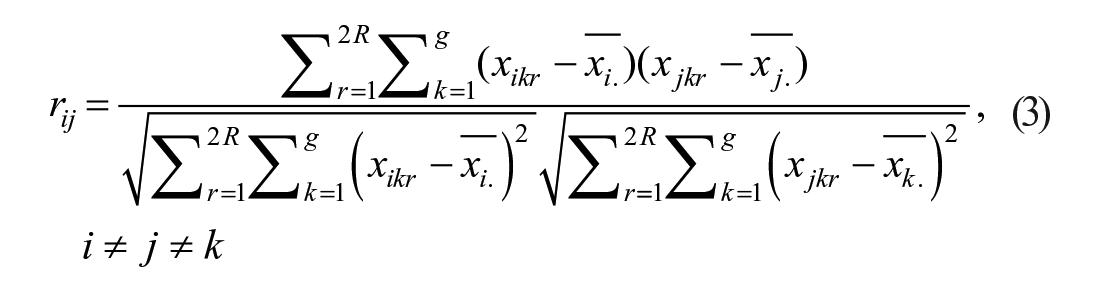
where
Empirical Analysis Results
Text Mining
In this study, text mining was conducted to analyze policy discourse regarding China’s CCIs. In all, 10,307 meaningful words were extracted from a total of 16,862 discourses on policy regarding CCIs and used for analysis. In relation to the frequency of co-occurrence of words, TF–IDF/centrality was calculated and sorted by ranking, and the top 30 words were extracted and used for text mining analysis. The primary analysis results are presented in Table 1.
Text Mining Results.
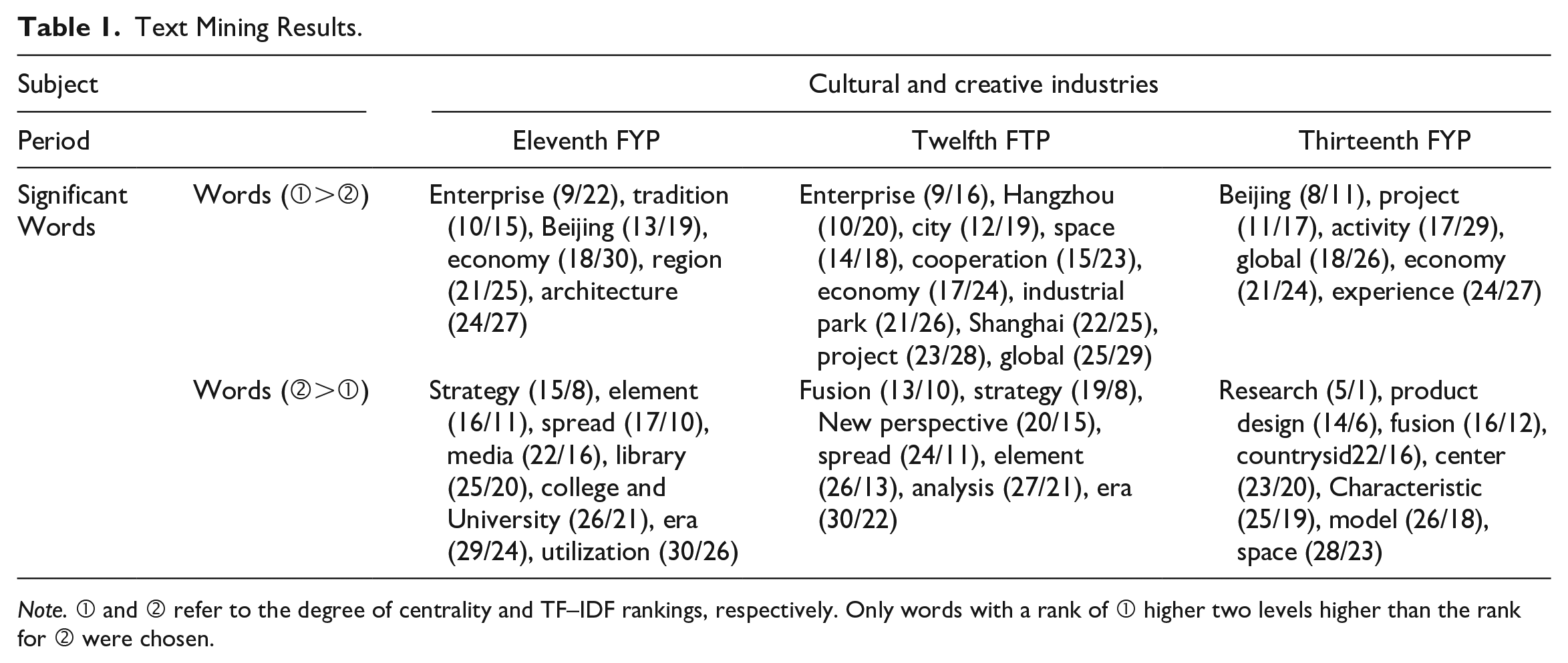
Note. ① and ② refer to the degree of centrality and TF–IDF rankings, respectively. Only words with a rank of ① higher two levels higher than the rank for ② were chosen.
After being analyzed by period, during the 11th FYP period, six words (enterprise, tradition, Beijing, economy, region, and architecture) were identified that emphasized the centrality of a strong connection between words rather than the importance of frequency. These words are termed essential keywords, and they exert a strong influence on discourse (Zhang et al., 2019). During this period, the discourse was characterized by an emphasis on tradition and regional characteristics, development centered on Beijing, and economic development, together with the role of companies in this.
Next, during the 12th FYP period, enterprise, Hangzhou, city, space, cooperation, economy, industrial parks, Shanghai, projects, and global perspectives were found in terms of centrality rankings that were three or more levels above TF–IDF. During this period, CCIs still emphasized the economic aspect and the role of companies. Notably, more practical words appeared in during period than in the previous one. Thus, it can be seen that incubation in CCIs, centered on industrial parks, was being actively discussed and that related projects were also activated. Additionally, various cultural and creative facilities that lead to changes in terms of space and the city increased. Following Beijing, during this period, Hangzhou and Shanghai emerged as significant regions leading CCIs. Other two notable words for this period were cooperation and global. This means that a discourse was formed where China’s CCI needs required bidirectional and multidirectional collaboration beyond the earlier one-way development style, and they were sharing the recognition of a global strategy for China.
During the 13th FYP, we identified six words with strong centrality (Beijing, project, activity, global, economy, and experience). Specifically, Beijing, project, global, and economy had been mentioned as important discourse keywords in a previous period; however, activities and experiences emerged as important words during this period. Similarly, during this period, as digital technology quickly spread throughout society, various online or virtual cultural contents received attention from people. Nevertheless, in terms of purely cultural and CCI spread throughout society, policy discourse saw cultural experience as having more effectiveness in policy diffusion.
China’s CCI policy discourse primarily spread across large cities with rich cultural infrastructure, such as Beijing, Shanghai, and Hangzhou. In particular, as the economic aspects of culture emerged, the modernization of tradition, incubation of the cultural industry as an industrial park, discovery and promotion of cultural projects, and globalization of Chinese culture were revealed as essential aspects of overall discourse.
Network Analysis
Network analysis was conducted for the top 30 words based on centrality value. We constructed a correlation matrix of the top 30 words extracted for each period and conducted a CONCOR analysis. The analysis results are presented in Table 2.
CONCOR Analysis Results.
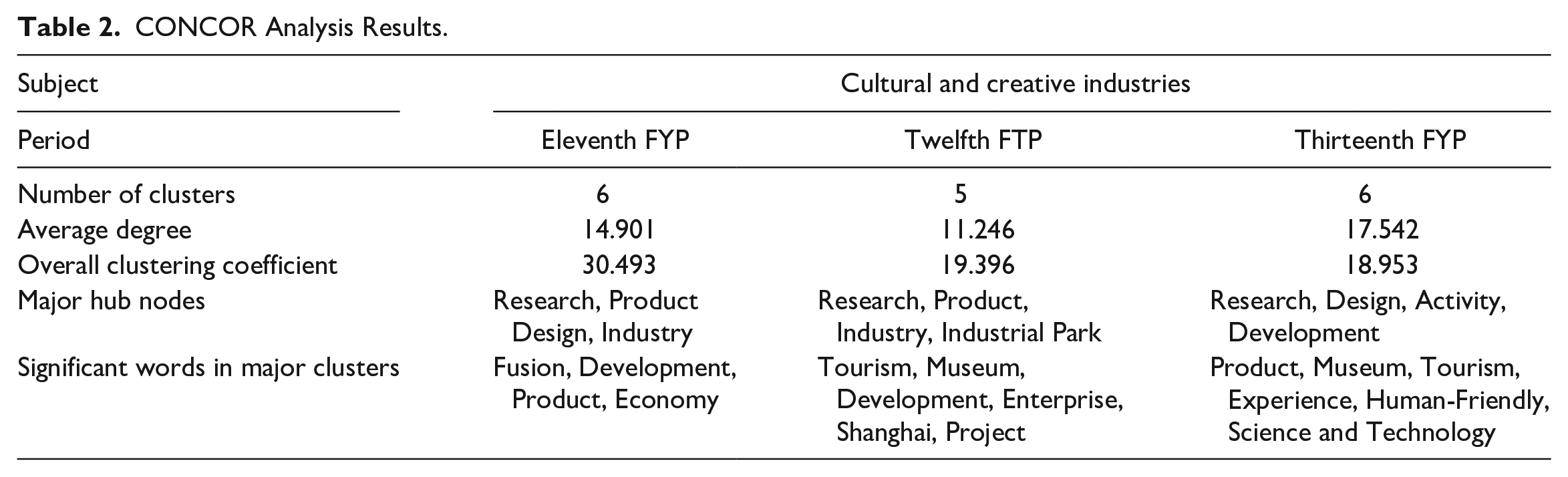
First, there were six, five, and six clusters of policy discourse for each period, with an average degree of 14.901, 11.246, and 17.542 for each period, respectively. Here, the average degree indicated the power of network nodes (individual words), which described the advantageous structural position. High values of this indicator had a more substantial influence on the discourse, making it an object of attention (Hanneman & Riddle, 2003). In other words, at the beginning of implementation, China’s CCI policy was the subject of a great deal of attention thanks to the policy of building a cultural powerhouse and the policy to foster soft power. In the 12th FYP period, the influence somewhat decreased, but during the 13th FYP period, a robust policy discourse was formed again owing to the influence of digital cultural contents and globalizing trends. Additionally, clustering coefficients for the periods were 30.493, 19.396, and 18.953, respectively, showing a gentle decline. A clustering coefficient indicates the degree of clustering of the entire network, and the fact that the clustering coefficient decreased for each period implied that the discourses from several strong clusters formed a single diversified cluster. This indicates the presence of a policy discourse that emphasized diversified cultural contents and products because of the expansion of private sectors in CCIs.
The network analysis results for the 11th FYP showed two large clusters and one medium-sized cluster. In each cluster, words with large node sizes (research, product design, and industry) served as hubs connecting each cluster, and noteworthy keywords were fusion, development, product, and economy. This shows the early stages of the practical promotion of CCI policy; moreover, it appears that a significant discourse was formed here regarding the use and mass production of the economic value of culture as an industry. Additionally, CCIs were set as the primary goal; for this, the convergence of various cultural and creative items was pursued (see Appendix A).
Next, five clusters were formed during the 12th FYP period. The hub words were research, product, industry, and industrial park; tourism, museum, development, enterprise, Shanghai, and project were selected as the primary keywords exerting influence on each cluster. China’s CCIs during this period went beyond the initial stage of planning and strategy establishment and into the stage of actual execution and diffusion. Therefore, industrial park appeared as a novel central hub, and museum and tourism emerged as specific items of CCIs. Additionally, a CCI park was established in the global city of Shanghai, which rapidly supported incubation and related projects for companies that create various cultural and creative industry items. During this period, of course, only a small cluster was formed; however, it seems clear that the discourse on internationalization and global cooperation increased. As China’s economy grows and its international influence remains strong, it can be seen that the Chinese CCIs are forming a policy discourse that accelerates the globalization of Chinese culture (see Appendix B).
Finally, during the 13th FYP period, four clusters were found that led the policy discourse—research, design, activity, and development appeared as hub words for each cluster. Furthermore, product, museum, tourism, experience, human-friendly, and science and technology were extracted as relatively influential words in these clusters. During this period, the policy discourse regarding CCIs in China indicated an active discussion, centering on more realistic and diversified cultural and creative contents and items. Specifically, during this period, discourse was actively discussed in the private sector, creating intangible values for the development of true CCIs. The CCIs were developed thanks to experience; the rapid growth of eco-friendly cultural contents took place, and cultural creative items with Chinese characteristics were recognized as brands. Additionally, because of the advent of the Fourth Industrial Revolution and the development of ICTs, it was found that existing industries and companies as well as science and technology played an important role in the economic growth of CCIs (see Appendix C).
In summary, it can be seen that the policy discourse in China’s CCIs began with research work to discover various cultural contents and items for each period and develop economic value. Furthermore, such researches have been linked to creating products related to the CCIs of Chinese tradition and Chinese characteristics. The policy discourses were linked to reality and supported the development of companies that produced diverse cultural and creative products or contents, where the government also built CCI infrastructure to support the voluntary development of this private capacity, providing financial/policy support. China’s CCIs promoted globalization and industrialization at the same time, thanks to the autonomous development of the private sector, such as in this discourse. Recent developments indicate that science, technology, and ICT should be actively utilized to develop creativity and the industrialization of culture. Notably, policy discourse has diversified and substantiated the value of culture, and this was done in a human-oriented way despite the trend. Of course, the industrialization of culture and the enhancement of economic value can lead to a quantitative increase of CCIs, but to achieve qualitative development, human knowledge and experience—and through this, human-friendly CCIs—must be formed.
Discussion and Conclusion
In China’s CCIs, the power of culture goes beyond social cohesion and stability, prioritizing economic value and promoting the self-sustaining development of culture through the private sector. Although the government provides guidelines for the macroscopic direction of cultural and creative industry policies, methods of detailed development and implementation come under the so-called government-led marketization development model, which empowers the private sector. This marks an open and inclusive policy that supports development in all fields except those contraindicated in the government’s policy guidelines. Generally, this development model centers on the role of the private sector, and the formation of the related policy discourse is an essential driving force for diversifying CCIs.
This study investigated policy discourses related to China’s CCIs by using text mining and network analysis on discourses data from after 2006, when the CCI policy began to be implemented in earnest. The main words found relevant to the policy discourse related to CCIs were economic, corporate, regional names (Beijing, Shanghai, and Hangzhou), industrial park, global, and activities. Overlapping words were found between periods, and significant keyword changes were observed in the time-series data on policy discourse wherein the Chinese CCIs were confirmed. Additionally, in the results, it was found that policy discourse received the most attention and exerted the greatest influence during the 13th FYP. Moreover, the discourse that was developed during the same period showed a lower clustering coefficient than during the previous period, which may mean that the topics forming the discourse were adequately diversified. In other words, the diversified items and contents of CCIs were topics of active discussion as cultural policy issues. In detail, during the 12th FYP, practical actions related to CCIs were undertaken in the market, and this was found to have contributed to enhancing the global influence of culture in relation to China’s economic development. Finally, the current policy discourse related to CCIs actively discussed the issue of utilizing digital technology and soft power (culture-related human resources). Particularly noteworthy was the coexistence of the emphasis on the industrial and economic value of culture as well as the recognition that culture remains human-friendly and should be developed in relation to various experiences.
These results lead us to the following implications. First, the discourse on China’s CCI policy seems to have developed in the direction of emphasizing industrialization and global capabilities through actors in the government, economy, and education within the macroscopic framework of national development. As China’s economic development continues to pursue its policy of gradual openness with a more profoundly open policy, path-dependent characteristics of development appear from a government-led to a dually complementary form of the government and the market. In the 11th FYP, the modernization of traditional elements was promoted, which centered on regions, companies, and educational institutions under the government’s initiative, and during the 12th FYP, more regions and companies participated to build industrial clusters and carry out cultural projects that are more oriented toward the market and demand. Moreover, in the 13th FYP, discourse played a role as a market maker leading the Chinese CCIs, and it can be seen that diversified items and contents promoted industrialization, marketization, and globalization without losing the essence of culture. Additionally, we found that policy is spreading in a way that does not go against the spirit of reform and openness in China. This is because of the successful policy direction that the country has been pursuing wherein market order is led by market discourse. In other words, with the exception of the contraindicated areas, China is entrusting the enhancement of cultural diversity and creativity to the power of the market as well as the capabilities of the private sector. Through this means, policy implementation is in progress to prepare a healthy development ecosystem for the growth of CCIs.
Second, the direction of the discourse was aligned with the expansion of the emerging CCIs and the establishment of a Chinese-style development model. The traditional culture industry in China appeared in the fields of literature, publishing, and film, while museums and libraries were the main sources of cultural services. However, as shown in the discourse, CCIs in China have been commercialized and industrialized with creative and consumer-oriented cultural items and contents within the macroscopic guidelines of the government. Specifically, in combination with incubation and strong start-up support policies, synergy effects have been incorporated to create rapid cultural makers. Furthermore, the rapid spread of digital technology and ICT, called the Fourth Industrial Revolution, served as the catalyst to rapidly expand the extension of emerging CCIs (electronic publishing, network games, VR cultural experiences, etc.). This brought both quantitative increase and qualitative improvement to China’s cultural industry, and the museums and libraries that once provided cultural services are now sites that form an important cultural bond to enjoy digital cultural experiences and cultural activities. In other words, the innovative development of digital content platforms (e.g., TikTok and Tencent) and the integration of culture and tourism are rapidly progressing in China. These emerging CCIs have been creating a consensus that can establish a Chinese-style development model. This will enable the goal of reinterpreting the culture of the past in a contemporary way, thus preserving its regional characteristics and developing a human-oriented cultural industry through experience based on the foundation of the Chinese humanities and humanistic ideology. As Keane (2013) indicated, this can be seen as the result of continuous efforts for change by the public officials who put the people first. They took risks, changed their management style, and emphasized on innovative technology and a human-friendly ideology, which is why various Chinese digital/emotional contents are gradually leading in terms of being widespread socially.
Third, it is necessary to adjust industrial concentrations and regional development imbalances owing to the acceleration of the industrial cluster of CCIs. As China develops into a cultural powerhouse, cultural industries and services have been upgraded considerably relative to the past. However, it should not be overlooked that the regional imbalances in culture are as large as the regional imbalance in the economic aspect. China’s major policy initiatives show a pattern of taking longer implementation periods for full-scale polices, selecting appropriate areas according to the target of the policy, and slowly moving them to the surrounding areas after a sufficient period of verification. Although CCIs have induced discourse led by the private sector, local governments collectively respond to the government’s macroscopic direction suggestion, leading to unnecessary competition and promotion of show-style policies. For culture to encompass all regions and generations, it must be expanded to the fields of industries and services, and appropriate cultural infrastructure must be established in order for everyone to enjoy culture. As the study results show, the policy discourse of CCIs is strongly formed in economically developed metropolitan cities, and the cultural infrastructure and financial support system are well established in such areas. The goal of this policy is the creative industrialization of culture; however, we must be wary that excessive cultural industrialization by capital can lead to the loss of the identity of Chinese culture. This is described in Throsby (2008), Holden (2004), and McCarthy et al. (2004) and can be viewed in the same context as the need for a balance between the instrumental role of culture and the intrinsic cultural purpose. Additionally, although China’s CCIs increased its global influence because of rapid development to secure competitiveness and compete with the cultural items and contents of advanced countries, it is necessary to strengthen one’s own competitiveness through a market competition system in the cultural field. To this end, it will be necessary to increase the concentration of industry through the quantitative and qualitative expansion of private cultural enterprises and actively support measures from the financial sector to promising cultural start-ups.
In sum, examination of the policy discourse on China’s CCIs indicates that it is actively supplied to cultural consumers through a process of rapid marketization, while simultaneously, cultural globalization is promoted. Additionally, the items and contents of the Chinese CCIs that appear in the discourse are established as a human-friendly Chinese-style CCI model that values diversity and experience. This should be noted in relation to the presentation of the direction of China’s future cultural policies. Furthermore, this paper has the following limitations. Most textual data displayed on the Chinese web are not free from the surveillance of the Chinese government, which may have prevented obtaining more specific and critical text data. Additionally, as China’s CCIs have different names and development patterns for each region, the need for future regional subdivisions of discourse from a microscopic should be accounted for in future studies.
Footnotes
Appendix
Declaration of Conflicting Interests
The author declared no potential conflicts of interest with respect to the research, authorship, and/or publication of this article.
Funding
The author disclosed receipt of the following financial support for the research, authorship, and/or publication of this article: This paper was supported by Konkuk University in 2019.
