



Abstract
This research aims to explore the influencing mechanism of fashion brand cultural content marketing on consumers’ willingness to buy. The concept of content marketing for fashion brand culture was analyzed from the four dimensions of functional content, entertainment content, emotional content, and interactive content according to content marketing theory, and the influencing mechanism was studied based on the information adoption theory. Furthermore, it is verified for the mediating role of information content quality perception, information utility quality perception, information expression quality perception, information carrier quality perception, information adoption, and the moderating role of information involvement and brand trust. The structural equation model was developed and empirically tested the hypothesis. The results show that fashion brand culture content marketing can promote consumers’ willingness to buy. Consumers generate purchase intention by perceiving information content quality, information utility quality, information expression quality, information carrier quality, and information adoption. It was found that consumers with high involvement degrees are more likely to perceive information. Moreover, consumers with high brand trust will promote the effect of information adoption on consumers’ purchase intention. This research provides new ideas and references for the content marketing of fashion brand culture. It provides quantitative scientific data for fashion enterprises to grasp the direction of fashion brand culture content marketing and implement brand culture shaping and communication strategies.
Plain language summary
This paper puts forward the concept of content marketing for fashion brand culture by analysis from the four dimensions of functional content, entertainment content, emotional content, and interactive content. The mechanism of fashion brand cultural content marketing on consumers’ willingness to buy is analyzed based on the information adoption theory, and on this basis, the mediating role of information content quality perception, information utility quality perception, information expression quality perception, information carrier quality perception and information adoption, and the moderating role of information involvement and brand trust are verified. The structural equation model empirically tested the hypothesis. The results show fashion brand culture content marketing can promote consumers; willingness to buy. Consumers generate the purchase intention by perceiving information content quality, information utility quality, information expression quality, information carrier quality and information adoption. It was found that consumers with high involvement degrees are more likely to perceive information. Moreover, the consumers with high brand trust will promote the effect of information adoption on consumers’ purchase intention.
Keywords
Introduction
With the upgrading of consumption, consumers’ demand for fashion has been changed from the material demand of fashion itself to the taste symbolized by fashion brands culture, and they pay more attention to whether fashion can bring their own cultural identity and emotional sustenance to their hearts (Mrad et al., 2020; Na’amneh, 2021). Consumers’ perception of brand culture has become an important factor for purchasing and a basis for choosing a brand (Liao et al., 2008). However, the homogenization of the image of fashion brands’ culture has made consumers aesthetic fatigue (Entwistle & Wissinger, 2021). To date, enterprises ignore brand characteristics, blindly positioning brand culture so that consumers have a false impression and, thus, their recognition is not high (Bandyopadhyay & Ray, 2020). Moreover, enterprises lack crisis perception in brand culture construction and management (Lu et al., 2021). In addition, enterprises neither adapt to the dynamic market situation nor extend the brand according to the brand characteristics, which leads to consumers misinterpreting the cultural connotation, weakening consumers’ cognition, and ultimately leading to enterprises losing consumers’ trust in the brand (Atulkar, 2020; Bergkvist & Eisend, 2021; Chang & Wong, 2010; McLean et al., 2020). Brand culture is not concentrated in each communication link, resulting in a lack of integrity and consistency of the image of fashion brand culture, affecting the marketing performance.
In addition, with the rapid development of social media, traditional advertising communication has been unable to meet consumers’ needs, being unable to adapt to the preferences of consumers (M. L. Cheung et al., 2019; Nisar & Whitehead, 2016; Tajvidi et al., 2020). Consumers begin to pay more attention to information interaction and actively search for information, thus reducing information asymmetry with enterprises. Therefore, content marketing, in which enterprises convey brand or product information and share valuable content, is favored by consumers (Lieb, 2012; Rose & Pulizzi, 2011; X. Z. Zhao & Zhang, 2019). Content marketing has become a vital enterprise marketing strategy in practical businesses and is a hot issue in academic research.
Previous research on fashion brand cultural content marketing focused on concept definition and dimensional division, but it was limited to how to deliver brand culture and promote interactivity with consumers to increase their willingness to buy through content marketing. In order to promote consumers to receive information from brands, perceive the brand culture behind that information, and make purchase decisions, fashion brand cultural content marketing should consider the quality of the brand information and the source’s credibility, which decide whether to adopt a piece of information for consumers. The information adoption model is consistent with the mechanism of consumer-perceived information of fashion brand cultural content marketing. Therefore, this paper explores the intrinsic influencing mechanisms of how fashion brand cultural content marketing affects consumers’ purchase intentions based on information adoption theory and content marketing theory to provide quantitative scientific data for fashion enterprises to grasp the direction of fashion brand culture content marketing and implement brand culture shaping and communication strategies. The following research questions are aimed to explore in this study.
What is the impact of the content marketing of fashion brand culture on the perception of information content quality, information utility quality, information expression quality, and information carrier quality?
What effect does the functional, entertainment, emotional, and interactive content marketing of fashion brand culture have on consumer purchase intentions?
What role does information adoption play in the perceived information content quality and consumer purchase intentions?
What role does the information involvement play in influencing content marketing of fashion brand culture on the perceived information content quality?
What role does brand trust play in influencing information adoption and consumer purchase intentions?
This study would benefit fashion marketers in improving consumers’ perception of fashion brand culture through content marketing and optimizing the communication effect of fashion brand culture. Also, it would be helpful for academia to understand its influence more deeply.
This introduction has shown that from the point of view of fashion brand culture, increasing fashion brand culture content marketing is preferable while identifying which factors and how to affect fashion brand culture content marketing is also necessary. In the next parts, taking consumer perceived information content quality and information adoption as intermediary variables, a theoretical model is constructed, and the perceived information content quality and information adoption of consumer purchasing intentions in the face of fashion brand content marketing is deeply analyzed to provide a reference for fashion enterprises to carry out content marketing activities in the future provide a theoretical basis.
Literature Review and Hypothesis Deduction
Fashion Brand Culture Content Marketing and Consumers’ Purchase Intention
Functional, entertainment, emotional, and interactive content play a significant role in content marketing for fashion brand culture, affecting consumers’ purchase intention. Functional content refers to content marketing that provides consumers with useful information and directly hits consumers’ pain points, which can arouse consumers’ perception of information and thus encourage consumers to have purchase intention. Hwang et al. (2003) pointed out that the fun of content would affect consumers’ perception and acceptance of content, thus generating purchase motivation. Q. Chen et al. (2008) believe that interesting content can help a brand establish a positive image and arouse consumers’ attention and interest, thus generating purchase intention. Rose and Pulizzi (2011) proposed that the value and entertainment of content greatly influence consumers’ behavioral intentions. According to the three-stage theory of customer behavior (Hess et al., 2011), brand communication content will affect consumers’ emotions, and consumers are more sensitive to emotional content to generate purchase intention. Y. K. Kim and Sullivan (2019) believe that emotional content can make consumers have brand preferences and trigger purchases. Ridings et al. (2006) pointed out that people’s interaction with others can better perceive content, thus promoting the generation of purchase intention. Scholars believe that enterprises improve consumers’ perception of brand information through content marketing, thus affecting consumers’ behavioral intention to brand. Hence, this hypothesis can be proposed:
Fashion Brand Culture Content Marketing and Information Quality Perception
Content marketing for fashion brand culture influences information content quality, information utility quality, information expression quality, and information carrier quality. Information content quality refers to the extent to which information content is consistent with objective reality, including authenticity, accuracy, timeliness, and completeness. Previous studies have shown that brand or product content marketing can affect consumers’ perception of information content quality. In the study of brand content marketing, Tajvidi et al. (2020) believe that consumers’ perception of the quality of information content would be improved by participating in brand-building activities such as providing brand advice and spreading brand information. Santos-Roldán et al. (2020) believe that the functional product information provided by enterprises to users could affect consumers’ perception of products. Nisar and Whitehead (2016) believe that when enterprises release functional brand content through social media accounts, they can create a positive image, promote consumers’ association, and improve their cognition of the brand. S. Chen and Chaiken (1999) believe that the interaction between consumers and brands in content marketing can help consumers perceive and judge information content more clearly. Ducoffe (1996) showed that the advertising content of content marketing could provide consumers with the latest information in a relatively short time, thus improving the perception of the timeliness of the content. Y. Zhang et al. (2017) believed that the more detailed the green product comment information published by consumers on the platform, the more valuable it would be for consumers and the deeper the cognition and feelings of other consumers on green products. It is also believed that fashion brands’ green perceived value would enhance the purchase intention due to the perceived quality of green innovation (L. Chen et al., 2021). Lieb (2012) pointed out that content marketing will affect consumers’ attitudes and perceptions toward products. Therefore, if marketing content is related to brands, consumers will perceive and associate with brand content. Thus, scholars believe that enterprises can influence consumers’ perception of information content quality through content marketing, thus affecting consumers’ behavioral intentions. Therefore, we propose the hypothesis:
Information utility quality refers to the extent to which the information conveyed by a brand can help consumers make effective purchasing decisions, including usefulness, applicability, and timeliness. Therefore, the more useful information content marketing provides to consumers, the higher consumers’ perception of information utility and quality. Y. Zhang et al. (2017) pointed out that the usefulness of online review information can affect consumers’ perception of information utility. X. Z. Zhao and Zhang (2019) believe that enterprises or brands deliver valuable product information through content marketing, making consumers’ cognition of information consistent with their need to accept information more quickly. Halligan and Shah (2009) believe that content marketing adopts the strategy of pull marketing to provide consumers with useful content or educational content to help consumers improve their perception of information utility and generate brand preference to search brands actively. M. L. Cheung et al. (2020) believed that by disseminating emotional content, enterprises could make consumers have a brand association and have a good cognition of the brand in their hearts, thus arousing consumers’ emotional demand. Then consumers will actively search for brand information to evaluate the brand and promote purchase positively. H. Zhang and Yang (2004) found in their study of teenagers’ attitudes toward advertising that enterprises should first understand consumers’ needs and then spread valuable content according to consumers’ needs to improve consumers’ knowledge of information effectively. Cao et al. (2005) pointed out that disseminating useful and consumer-related content can meet customer needs and improve consumers’ perception of the quality of information utility. Hence, scholars mainly study the influence of content marketing on consumers’ perceived information, pointing out that enterprises can improve consumers’ perception of the quality of brand information utility through content marketing and meet consumers’ needs. Thus, it might be hypothesized:
The quality of information expression refers to whether the information can present the content it wants to convey, including clarity, simplicity, ease of understanding, and comprehensiveness. Coelho et al. (2018) show that consumers can influence their attitude toward brand information in interaction with brands because they can better understand the expression of information and thus improve their perception of the quality of information expression. Ducoffe (1996) believes that content marketing advertisements can express product information clearly and concisely in terms of expression and are easier to understand and accept by consumers. H. Kim and Niehm (2009) believe that entertainment content can make consumers happier and more relaxed to understand the information conveyed by the brand more quickly and search for information more actively. Gupta et al. (2021) found that more emotional expression is easier for consumers to understand, and the perception of the quality of information expression is obvious compared with rational expression. Three-stage theory, based on the content marketing interaction content marketing uses a kind of emotional expression (Smith et al., 2006). Brand marketing using content to consumers can cause emotional content, establish a good relationship between customers, improve consumer perception of information, thus improving consumer perception of quality information expression. Furthermore, positive content is more likely to evoke emotional resonance than negative content. Hwang et al. (2003) point out that fun content is more likely to elicit a customer’s perception of the message. Woodside et al. (2008) found that by telling stories to consumers, an enterprise’s story background, culture, and products are conveyed to shorten the distance with consumers, making enterprises more approachable and consumers more likely to trust enterprises emotionally and understand information conveyed by brands. Moreover, it improves consumers’ perception of the quality of brand information expression and makes the enterprise produce better word of mouth. According to the literature on the influence of content marketing for fashion brand culture on the perception of quality of information expression, scholars believe that enterprises can improve consumers’ perception of quality of brand information expression by using content marketing. Hence, we may propose this hypothesis:
The quality of information carrier refers to the ability of information communication media to accurately, timely, safely, and reliably complete information transmission tasks, including security, operability, integration, and system functions. Yayli and Bayram (2012) believe that network communication carriers for content marketing are convenient and maneuverable, allowing users to access the internet anytime and anywhere to obtain information, which improves users’ perception of the quality of information carriers. S. Zhou et al. (2021) believe that brands can convey brand perception through content marketing and communicate with consumers through text, audio, video, and other forms of brand content through different media. Content marketing can improve consumers’ perception of information carriers compared to traditional marketing. Wachtman and Johnson (2009) proposed that in content marketing, attention should be paid to creating high-quality content and the carriers or media that communicate with users and actively encourage users to participate in interactive communication. The interaction between enterprises and users will improve consumers’ perception of the system function, operability, and integration of the carrier, thus improving consumers’ perception of the quality of the information carrier and user engagement. M. L. Cheung et al. (2019) found that online interaction and communication between enterprises and consumers through media can positively affect consumers’ perception of information media to attract consumers to participate in brand building and promote purchases. According to the literature on the influence of content marketing for fashion brand culture on the perception of quality of information carriers, scholars believe that enterprises can enhance consumers’ perception of the quality of information carriers through content marketing, attract consumers to participate in interactive communication, and improve user stickiness. Therefore, this paper proposes the hypothesis:
Information Quality Perception and Information Adoption
Technology Adoption Theory first proposed the word “Adoption” in information technology, which refers to acceptance and adoption, especially after selection or approval (Davis, 1989). The theory of information adoption holds that information adoption is the behavior of people using information with a purpose and is a process in which consumers make judgments and decisions based on their understanding and cognition (Delgosha & Hajiheydari, 2020). In online shopping, information adoption refers to consumers’ behavior to accept or not accept information after judging the information quality. The more trustworthy and reliable the information content is, the higher the quality of the information is, the fewer mistakes are made based on the perception of information quality, and the more likely consumers are to adopt the information. Yang (2013) believes that consumers’ perception of high-quality information content can, to a certain extent, show some feelings and experiences of consumers in the process of consumption, which is highly persuasive and can help consumers judge whether to adopt the information. Filieri (2015) believes that consumers’ perception of information content quality in e-commerce platforms will affect the adoption of online review information. Gregg and Walczak (2010) believe that if users perceive high-quality information, they will pay for products based on this information. C. M. Cheung et al. (2008) point out that consumers are more inclined to adopt richer and more comprehensive online evaluation than traditional marketing evaluation information. Pöyry et al. (2019) have found that the relevance and authenticity of information content greatly impact information adoption. Hence this hypothesis may be proposed,
In the theoretical information adoption model, Sussman and Siegel believe that consumers adopt information because of useful content. Consumers’ perception of information quality affects information adoption through their perception of information usefulness. The adoption of spontaneous group-buying information in virtual communities that the information’s usefulness and sensuality would affect consumers’ adoption (Trabelsi-Zoghlami & Touzani, 2019). Moreover, the stronger the perceived usefulness of food word-of-mouth information, the more willing consumers are to adopt the word-of-mouth information (Lee & Workman, 2021). Through empirical research, Peng et al. (2020) pointed out that the perceived usefulness of information positively impacted social media users’ crisis information adoption intentions. In their research on social media, Liao et al. (2008) found that the stronger consumers’ perceived usefulness of product recommendation information, the more likely they are to adopt it. Benlian et al. (2012) believe that consumers’ perceived usefulness of product content improves consumers’ willingness to adopt online reviews. H. Zhou and Li (2018) believed that online reviews’ information credibility and usefulness positively affected consumers’ attitudes toward information adoption. Peng et al. (2020) believe that information perceived usefulness greatly influences consumers’ information adoption. Therefore, this paper proposes the hypothesis:
In addition to the influence of quality perception of information content and utility on information adoption, information expression quality also affects consumers’ information adoption. P. F. Wu and Yan (2015) show that the comprehensiveness of information expression impacts consumers’ adoption of online comment information. C. M. Cheung et al. (2008) believes that consumers’ comprehensiveness and explicit knowledge in online comments will affect their attitude toward adopting comments, thus affecting purchase decisions. Consumers’ perception of information expression quality, such as comprehensiveness, clarity, and conciseness, will affect consumers’ attitude toward information adoption. Therefore, this paper proposes the hypothesis:
The refined processing possibility theory model (ELM) believes that when the information receiver processes information in the edge path, the credibility of the information source is a very important clue, which can directly affect the acceptance attitude of the information receiver. P. F. Wu and Yan (2015) showed that the credibility and professionalism of information carriers directly impact consumers’ adoption of comment information. Wang et al. (1995) believe that in online shopping, consumers judge the quality of goods by evaluating the quality of information carriers, thus influencing consumers’ behavior of adopting information. Khwaja and Zaman (2020) believe that the reliability and professionalism of comment information publishers are also important factors affecting consumers’ adoption of comment information. Empirical studies by DeLone and McLean (1992) found that consumers affect user satisfaction through their perception of information system quality, thus affecting consumers’ behavior of adopting information. Empirical findings show that improving the platform’s information technology ability can improve consumers’ willingness to adopt online evaluation information. Consumers’ perception of the quality of information carriers, such as the security of information media and system functions, will affect their final behavior of information adoption. Therefore, this paper proposes the hypothesis:
Information Adoption and Consumers’ Purchase Intention
In consumers’ purchase intention, information collection, identification, and evaluation must be carried out, and some internal and external factors, such as information processing, information stimulation, information input, environment, and other factors, will also be affected. In the actual consumption process, due to information asymmetry, consumers rely on the information conveyed by the brand and judge whether to adopt the information according to some clues to make purchase decisions. According to the Expectation Confirmation Theory (ECT), the expectation of consumers before and after the adoption of product or service satisfaction is compared. The smaller the gap is, the more positive the adoption attitude will be and the more positive the intention to buy again (Duanmu et al., 2018; X. M. Fu et al., 2018). In information dissemination, consumers need to perceive the information conveyed by the brand before making a purchase decision, judge, and screen whether the information is used to decide whether to adopt or not, and then generate the subsequent purchase intention. The consumers need to screen information indicators and evaluate them to decide whether to accept the information. Therefore, it can be seen from this model that there is a stage of information adoption in the process, from consumers receiving information to making purchase decisions.
Economic management experts believe that “information is the effective data to provide decision-making,” and many applied psychology and business researchers have paid attention to the direct relationship between information and decision-making quality (Mandl et al., 2011). The process of consumers’ purchase intention and purchase decision is influenced by many factors, among which high-quality information is a key factor. The perception of decision quality refers to how consumers perceive information as consistent with their interests and hobbies, deciding whether to adopt information. In contrast, consumers’ behavior of adopting information directly affects consumers’ purchase intention. In the study of online reviews on e-commerce platforms, Yang (2013) found that consumers make purchase decisions more based on online reviews and whether consumers adopt online review information can directly affect consumers’ purchase intention. Y. Zhao, Wang, et al. (2020) believe that consumers’ adoption of online reviews on e-commerce platforms can effectively improve green product purchase decisions. Pickett-Baker and Ozaki (2008) found through research that when consumers receive marketing information, it will promote consumers’ purchase intention to environment-friendly products. C. Wu and Shaffer (1987) found that information adoption is how consumers make purchase decisions based on word of mouth. From this point of view, the stronger the willingness of consumers to adopt information, the higher the degree of influence on consumers’ purchasing intention. Therefore, this paper proposes the hypothesis:
Moderating Effect of Information Involvement
Krugman first applied the degree of involvement to marketing, where the degree of involvement refers to the relevance of a product or thing generated by consumers depending on their values, preferences, and needs (Zaichkowsky, 1985). Involvement is an important factor affecting consumers’ information processing methods (Zaichkowsky, 1986). There is a strong correlation between involvement and information processing. The higher the level of involvement, the more willing consumers are to take the initiative to understand information and think about its meaning. According to the refined processing possibility model (ELM), consumers’ perception of information processing is influenced by information involvement, which moderates information quality and source credibility. Since consumers need to collect and process information before making purchase decisions. Information involvement refers to how consumers attract attention, interest, understanding and fine processing the obtained marketing information when choosing products or services (W. Liu, 2012).
McClure and Seock (2020) found that when consumers have a high degree of involvement, they have a relatively clear cognition of information quality, affecting consumers’ attitudes toward products. Consumers cannot perceive the information content well when they have low involvement. Ki and Kim (2019) believe that consumers’ involvement will affect their collection of product information, thus affecting their perception of product quality and performance judgment, thus affecting their brand choice.Yin and Yu (2008) found that product involvement plays a moderating role in the influence of brand image, consumers’ perception of extended product quality, and purchase intention. Petty et al. (1993) found that the degree of information involvement would affect consumers’ choice of path in information processing, and information involvement could change their judgment by influencing consumers’ inner activities. Lu and Bai (2021) found that product involvement has a moderating effect on perceived review content quality usefulness. The consumers will process brand content through two information processing paths due to different product involvement (J. R. Fu et al., 2020). Consumers with high participation spend more time processing information and more energy seeking inner satisfaction, while consumers with low involvement do not (J. R. Fu et al., 2020). The enterprises can use product involvement to improve consumers’ perception of product information (Y. Zhou et al., 2012). Hutter and et al. (2013) believe that consumers will spend more time understanding the products and judging them through brand information for products with high consumer involvement, thus increasing their purchase intention. The customers with high product involvement pay more attention to products and think more deeply about information content than those with low product involvement (Yu et al., 2020). The product involvement has a moderating effect on the impact of review information on customers’ purchasing behavior when studying the contradictory follow-up review of fashion products (Y. Zhao, Wen, et al., 2020).
Therefore, it is found that most of the detailed research is analyzed from the perspective of product factors, while a few scholars start from the perspective of individual factors of consumers. The degree of consumer involvement depends more on consumers’ attitudes toward products, so it is more reasonable to measure consumer involvement from consumer behavior. Therefore, from the perspective of consumer behavior, this paper introduces the degree of information involvement, which plays a moderating role in the influence process of content marketing for fashion brand culture and perception of quality of information expression, perception of quality of information content, perception of quality of information carrier and perception of quality of information utility. Therefore, this paper proposes the hypothesis:
Moderating Role of Brand Trust
Information is an important reference index for purchase intention in a consumer market that has not fully developed a credit system. After consumers have a sense of trust in branded goods and products, they can reduce the perceived risk of their purchase behavior. Pourfakhimi et al. (2020) showed that consumers’ trust in electronic word-of-mouth information plays an important role in consumers’ purchasing decision-making process. Matook et al. (2015) found that in social networks if consumers trust the recommendation of others, they are willing to carry out behaviors based on the recommendation. The acceptance model of knowledge recommendation services on e-commerce websites is that when consumers adopt information, the higher their trust is, the more they will promote their purchase intention (Dabbous et al., 2020). Chang and Wong (2010) believe that the role of trust in an information system is mainly reflected in the adjustment. Atulkar (2020) believes that consumers’ brand trust affects consumers’ attitudes toward brands. Taking word-of-mouth communication as an example, consumers’ trust in brands can effectively promote their intention of word-of-mouth communication after receiving word-of-mouth information. The consumers’ trust in their attitudes is more likely to stimulate positive purchase intentions (McLean et al., 2020). Brand trust is an important factor that affects information adoption and consumers’ purchase intention. This paper takes brand trust as a moderating variable between information adoption and consumers’ purchase intention from moderating variables. When consumers adopt the information conveyed by the brand, brand trust has a moderating effect on consumers’ purchase intention. Therefore, this paper proposes the hypothesis:
Theoretical Model Establishment
Based on the information adoption theory and combined with the above research assumptions, this paper considers content marketing for fashion brand culture (functional, entertainment, emotional, and interactive) as independent variables and consumers’ purchase intention as dependent variables. Information quality perception (quality, utility, expression, carrier) and information adoption as an intervening variable, information involvement, and brand trust as control variables lead to purchase intention. Altogether, construct the theoretical model of content marketing for fashion brand culture to consumers’ purchase intention. Enterprise or brand, through three forms of content marketing (story, dialogue, customer participation) of fashion brand culture, is converted into information to consumers. Consumers in the process of perception of information quality are affected by the degree of information involved, which affects the consumer information adoption behavior, will affect consumer purchase intention. The theoretical research model is shown in Figure 1.
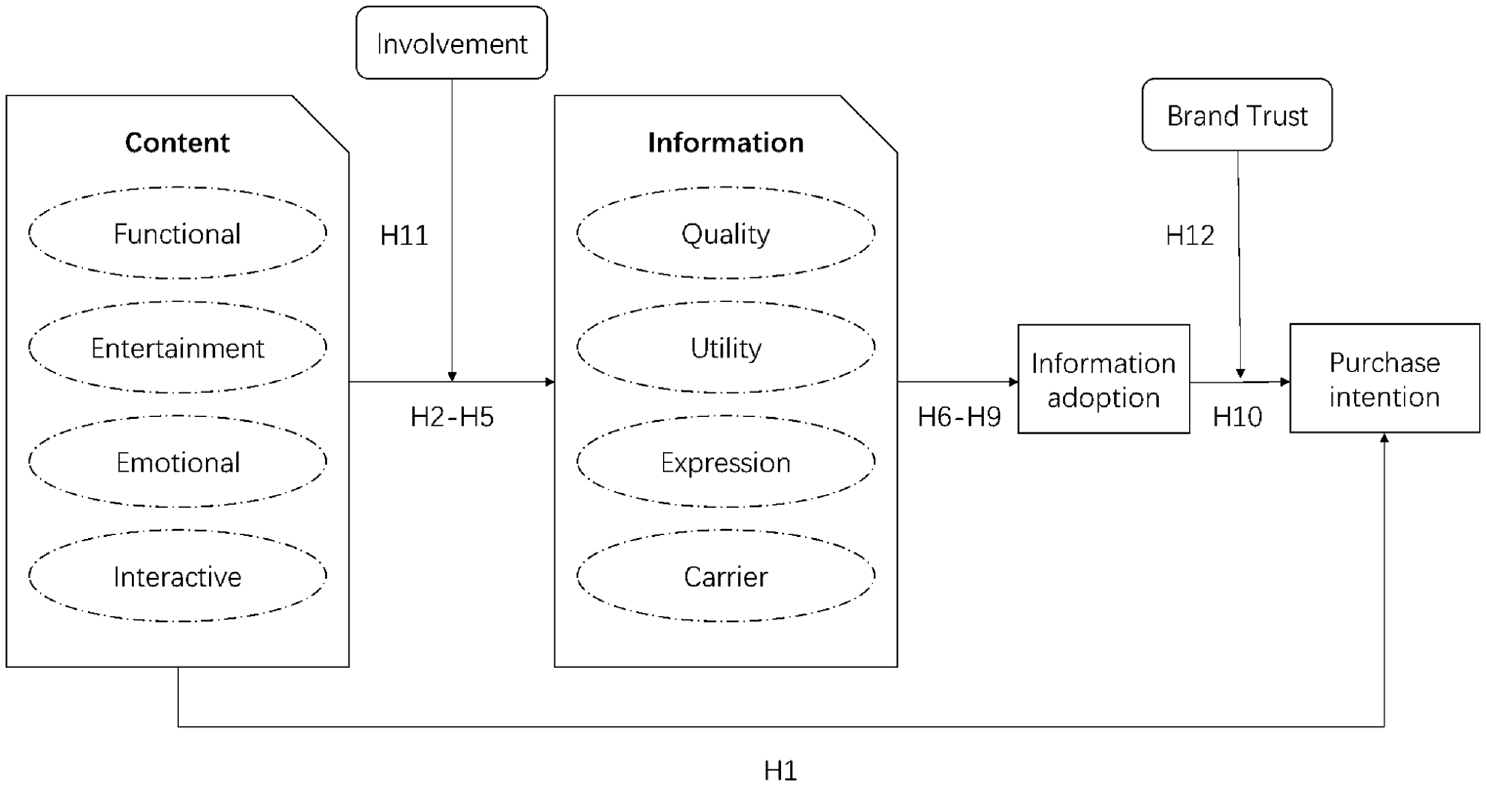
Theoretical model.
Empirical Testing and Data Analysis
Design of Measurement Items
This study adopts the case analysis method to conduct an in-depth analysis of typical content marketing cases of fashion brand culture and to explore the expression forms and marketing methods of fashion brand culture. Then, the content analysis method is adopted, and ROST content mining software is used to mine consumers’ perception characteristics of content marketing for fashion brand culture. Then, correlation analysis is conducted through social networks and semantic networks to establish categories. Finally, the content marketing for fashion brand culture dimension is extracted to construct an index system of content marketing for fashion brand culture. Based on this, referring to the classical measurement scale of content marketing proposed by predecessors, the scale of content marketing of fashion brand culture is developed, presented in Table 1. In addition, the perceived information content quality is mainly based on the scale of Matook et al. (2015) and Wang and Strong (1996). The perceived information utility quality is mainly based on the scale of Maltz (2000) and Bovee (2004). The perceived information express quality is mainly based on the scale of Nelson et al. (2005). The perceived information carrier quality is mainly based on the scale of Salisbury et al. (2001) and Aladwani and Palvia (2002). Information adoption is mainly based on the measurement scale of Hussain et al. (2017) and Venkatesh et al. (2003). Information involvement is mainly based on the scale of Zaichkowsky (1986) and Petty et al. (1993). Brand trust is mainly based on the scale of Komiak and Benbasat (2006). Customer purchase intention is mainly based on the scale of Dodds et al. (1991). In the following article, FBCCM represents fashion brand culture content marketing, FC represents functional content, AC represents entertainment content, EC represents emotional content, IC represents interactive content, ICQ represents information content quality perception, IUQ indicates information utility quality perception, IEQ represents information expression quality perception, IMQ represents information carrier quality perception, IA represents information adoption, INI indicates information involvement, BT indicates brand trust, and PUI indicates consumer purchase intention.
Design of Evaluation Scale of Content Marketing for Fashion Brand Culture.

Data Collection
The questionnaire survey was used to collect data. The survey samples selected people who had experience in online and offline fashion consumption in shops and distributed offline questionnaires and online questionnaires to investigate consumers thoroughly. The offline questionnaires were distributed in the brand agglomeration area in Shanghai. Online questionnaires were distributed through the “Questionnaire Star” software. As a principal target to investigate the perceptions of content marketing of fashion brand culture by diverse types of consumers, all consumers who were asked to have a good understanding of fashion brand culture content marketing. For the purpose of matching the subjects’ characteristics, we asked consumers to experience brand culture content marketing through images, text, animations, etc., which were extracted from content marketing cases of fashion brands to help respondents become familiar with each measurement item of fashion brand culture content marketing before they filled the questionnaires. During the survey period, there were 169 offline questionnaires and 144 valid questionnaires, with an effective rate of 85.2%. Moreover, there are 437 online questionnaires and 373 valid questionnaires, with an effective rate of 85.3%. A total of 606 questionnaires were collected from online and offline questionnaires, of which 517 were valid, with an effective recovery rate of 85.3%. This study conducted a pre-survey before the formal survey and partially modified the scale based on the survey results to ensure the rationality of the questionnaire. The collected basic sample information is shown in Table 2. It can be seen from the table that all ages, occupations, education, regions, and monthly incomes were involved in the survey, indicating that the selection of survey groups was reasonable.
Basic Information of Survey Samples.

Reliability and Validity Test of Questionnaire
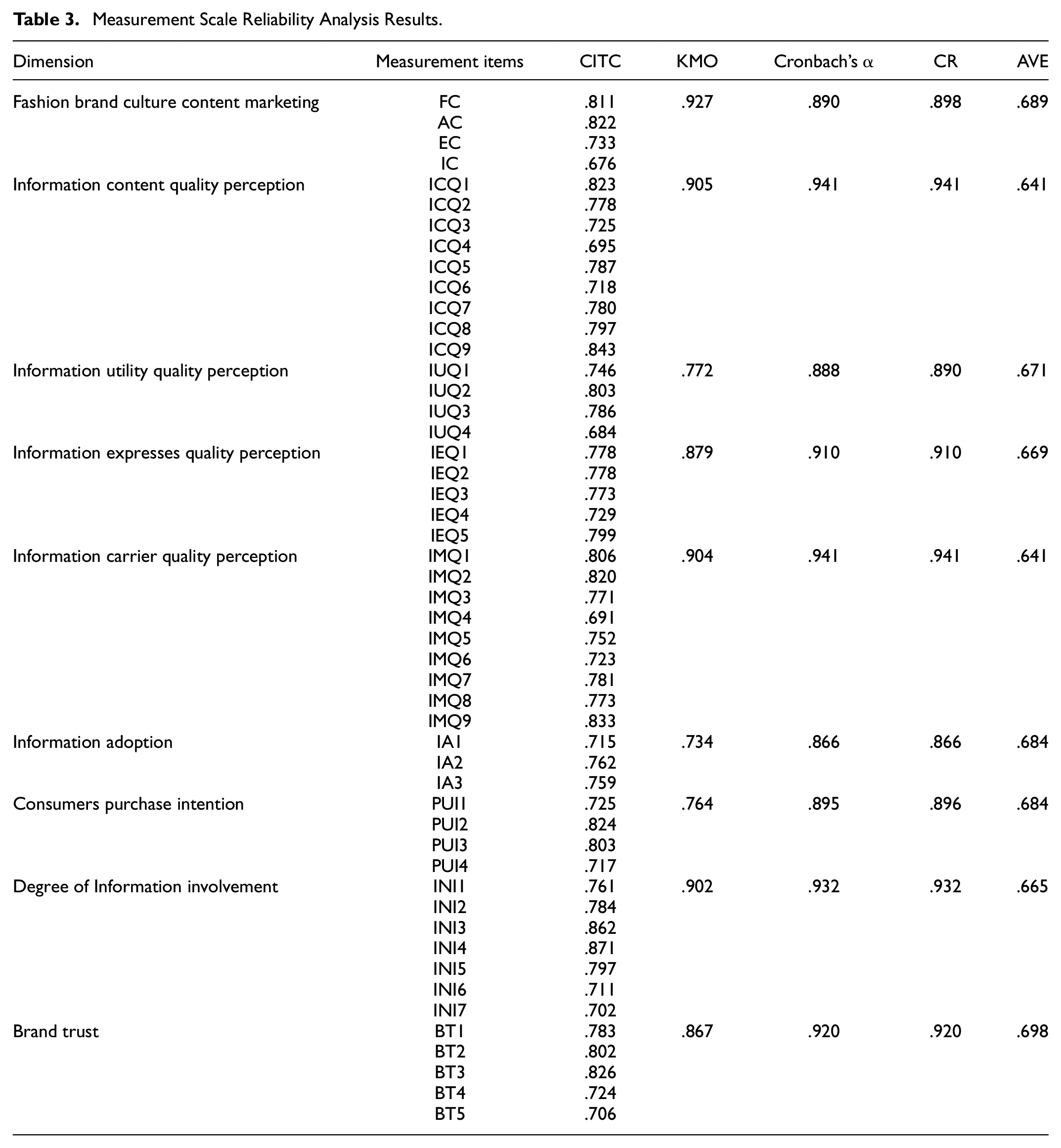
SPSS25.0 software was used for exploratory factor analysis. A first-order confirmatory factor analysis was conducted on the data using AMOS 24.0 software to assess the convergent validity and discriminant validity of the measurement scales. Exploratory factor analysis showed that the overall factor KMO value was 0.927, Bartlett’s sphericity test significance was 0.000, and the cumulative variance percentage was 73.609%. It can be considered that the scale contains the basic factors that can explain this variable. The load values of each factor were between 0.678 and 0.962, which been all greater than the standard value of 0.5, indicating that the scale had good discriminant validity. The overall Cronbach’s α coefficient of the questionnaire was .981, much higher than the critical value of .7. The Cronbach’s α coefficient of each scale dimension was between .80 and .95, which reached the minimum acceptance standard and had a high-reliability level. The reliability and validity of the model are good. In addition, the combination reliability and mean-variance extraction values of all measurement variables were within the acceptable range, and the confirmatory factor analysis results were good, as shown in Table 3.
Measurement Scale Reliability Analysis Results.
Goodness of Fit Test of Model
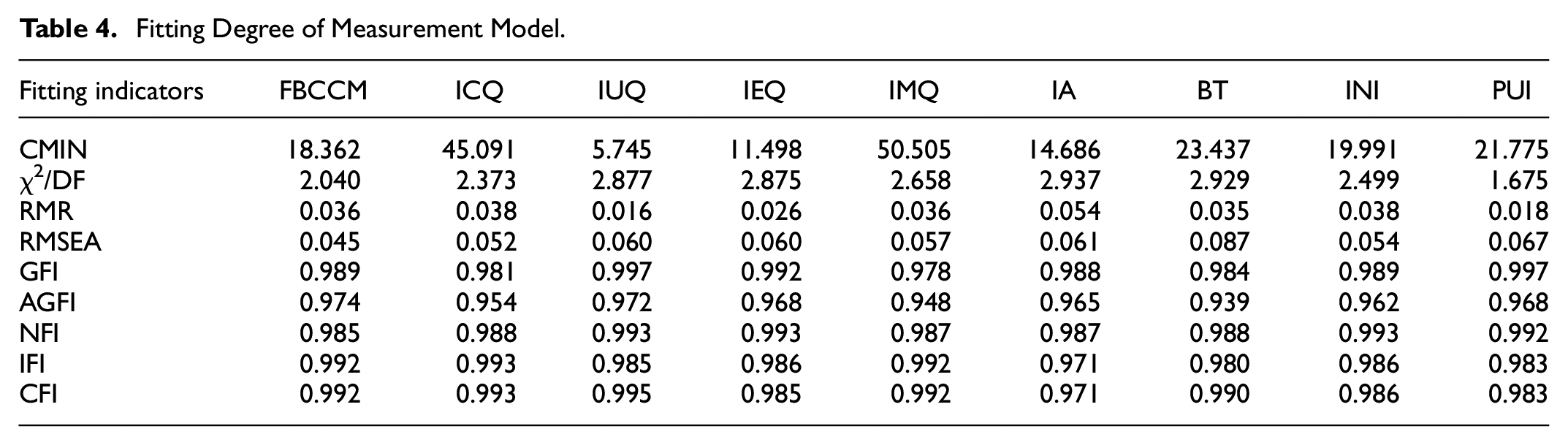
AMOS24.0 software was used to test the model’s goodness of fit, and the results of the model fit index of each measurement dimension are shown in Table 4. According to the data in the table, RMSEA of content marketing for fashion brand culture, perception of quality of information expression, perception of quality of information content, perception of quality of information carrier, perception of quality of information utility, information adoption, information involvement, consumers’ purchase intention and brand trust is less than 0.08, GFI, NFI, and CFI are greater than 0.9. Other fitting degree of measurement model reached the judgment standard of 0.9, which met the minimum acceptable standard, indicating that the model had a good fit.
Fitting Degree of Measurement Model.
Hypothesis Test
In this study, AMOS 24.0 software was used for the data analysis and the research hypothesis was tested using a maximum likelihood estimation model. The hypothesis of direct effect was tested first, and the p values of all the hypotheses were less than .05, so all the hypotheses of direct effect were valid. See Table 5.
Hypothesis Model Test Results.
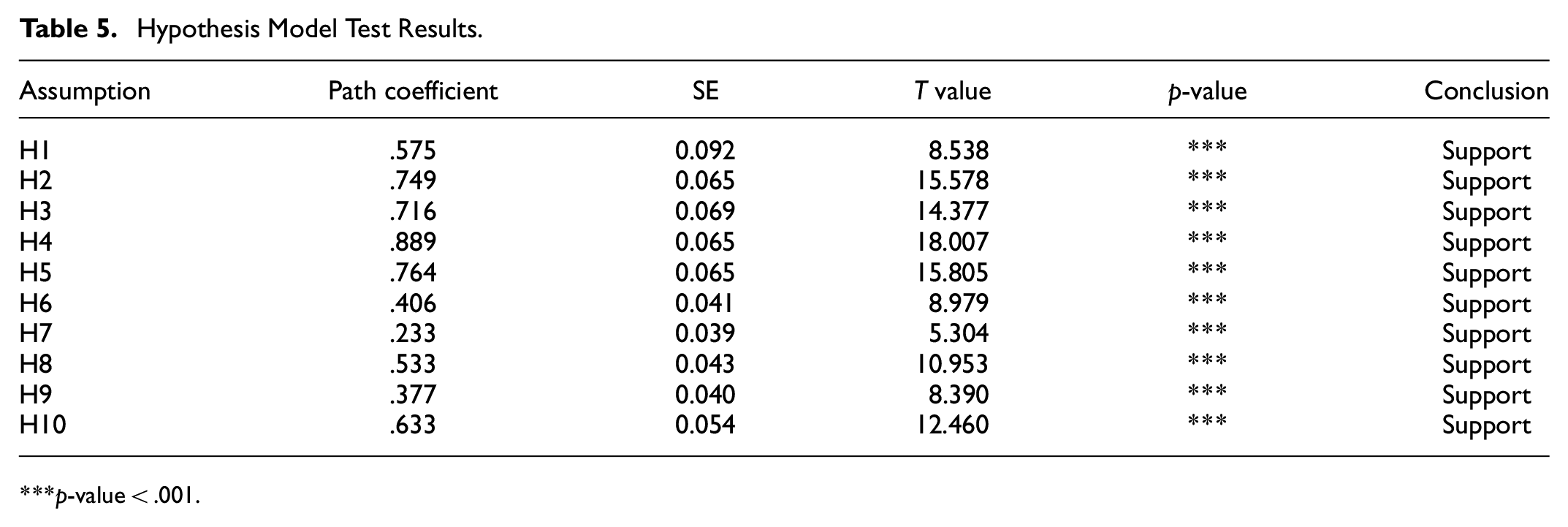
p-value < .001.
Mediating Effect Test
Model6 in SPSS25.0 macro is used to test the compound multiple mediation effect under controlling gender, education background, occupation, age, income, and residence. The upper and lower bounds of the bootstrap 95% confidence interval of the direct effect of content marketing for fashion brand culture on consumers’ purchase intention and the mediating effect of the four mediating variables on consumers’ purchase intention do not contain 0. The proportion of mediating effect is in the following order: perception of information expression quality > perception of information content quality > perception of information carrier quality > perception of information utility quality. Through content marketing to transfer brand information to enhance consumers’ perception of fashion brand culture, emotional resonance with the consumers, thus improve the purchase intention, among them; the information through purchase intention is of the highest quality perception, through the carrier information content quality perception and quality perception of purchase intention, The purchase intention generated by the perception of information utility quality is the lowest, refer Table 6.
Intermediate Effect Model Test Results.

Moderating Effect Test
This paper uses a hierarchical regression model to test the moderating effect by introducing the cross-product term of content marketing for fashion brand culture and information involvement and information adoption and brand trust. The information content quality perception and consumer purchase intention as the dependent variable, in control of income, place of residence, age, gender, educational background, professional a few demographic factors, the introduction of content marketing for fashion brand culture and information involved in the degree of cross-product items, information involvement degree, and brand trust through the cross product of regression analysis (Table 7). shows the analysis results of the moderating effect of information involvement on the influence of content marketing for fashion brand culture on the perception of information content quality. Table 8 shows the analysis results of the moderating effect of brand trust on the influence of information adoption on consumers’ purchase intention. The adjusted R2 increases gradually with interaction terms, indicating that the model has a better fit. The interaction terms of content marketing for fashion brand culture and information involvement significantly impact the perception of information content quality (β = −.228, t = −8.596, p = .000 < .001). This indicates that the degree of information involvement significantly moderates the influence of content marketing for fashion brand culture on the perception of information content quality. The interaction terms of information adoption and brand trust significantly impact consumers’ purchase intention (β = −.147, t = −6.606, p = .000 < .001), indicating that brand trust plays a significant moderating role relationship between information adoption and consumers’ purchase intention.
Regulatory Effect Test Results.

Significant at .01 level.
Regulatory Effect Test Result 5.

Significant at .01 level.
Discussion
The empirical results suggest that consumers’ perception of the qualities of information content, information utility, information expression, and information carriers will affect their behavior of adopting information, thus affecting consumers’ purchase intentions. The SEM model was developed to establish the relationships among variables, as shown in Figure 2. The results reveal the “black box” for content marketing of fashion brand culture and consumer purchasing intentions from information adoption theory. It obtains the following research conclusions.

The graphical representation of the SEM model.
Assuming the establishment of H1 indicates that designing content marketing of fashion brand culture will directly affect consumer purchasing intentions. When enterprises carry out content marketing activities, consumers’ perception degree of each dimension of content marketing for fashion brand culture from large to small is as follows, that is, entertainment (0.825), emotional (0.814), functional (0.803), and interactive content (0.762). Moreover, it is assumed that H2, H3, H4, and H5 are established, indicating that content marketing for fashion brand culture positively affects the perception of information quality. When enterprises carry out content marketing activities, consumers’ perception of each information quality is as follows, that is, information content quality (0.749), information utility quality (0.716), information expression quality (0.889), and information carrier quality (0.764). Entertaining content is humorous and can make consumers feel relaxed and happy and promote consumers’ interest in the brand. Therefore, consumers’ perception of it is the highest. Secondly, emotional content and functional content have higher perception degrees. The upgrade in consumer demand leads consumers to pay more attention to the brand’s spiritual connotation and cultural concept. Emotional content can move consumers, generate emotional resonance with consumers, and bring consumers more satisfaction. Functional content can directly hit the pain points of consumers and provide effective information to consumers. Finally, interactive content, which is relatively low in consumer perception, is more about maintaining the connection between the brand and consumers. Therefore, enterprises should be able to bring more effective communication and communication to consumers to have a sense of trust and identity effective interactions, to improve consumer perception.
It is assumed that H6, H7, H8, H9, and H10 are established, indicating that consumers promote the information adoption behavior mainly through the perception of information content quality, information utility quality, information expression quality and information carrier quality, and then generate purchase intention. Among them, the perception of information expression quality has the highest influence on information adoption, followed by the perception of information content quality and information carrier quality, with the perception of information utility quality being the lowest. The proportion of mediating effect is also in the following order: perception of information expression quality > perception of information content quality > perception of information carrier quality > perception of information utility quality. It shows that delivering brand information to consumers through content marketing can enhance consumers’ perception of fashion brand culture, generate emotional resonance with consumers, and thus improve purchase intention. Among them, the purchase intention generated by the perception of information expression quality is the highest, followed by information content quality and carrier quality, and the purchase intention generated by the perception of information utility quality is the lowest. This shows that the clearer, more concise, and easier to understand the information conveyed by the enterprise, the more consumers will think that the enterprise can reduce consumers’ time and improve efficiency, and they will be more willing to pay for it. However, in the case of information overload, it is difficult for consumers to obtain useful information, so consumers have the lowest purchase intention through the perception of information utility quality. Therefore, enterprises should accurately understand consumer needs and deliver targeted and useful information when delivering information.
The establishment of H11 indicates that consumers with a high degree of information involvement are likelier to perceive the information conveyed by fashion brands and understand the connotation of brands’ culture, thus improving consumers’ purchase intention. This indicates that when the degree of information involvement is high, people will spend more time thinking about and understanding the information, and vice versa. The establishment of H12 indicates that consumers with higher brand trust are more likely to identify with information, which will promote the effect of information adoption on purchase intention. However, consumers with low brand trust will think about information more rationally and objectively, inhibiting its effect to some extent.
Conclusion
This paper constructs and empirically tests the theoretical model of content marketing for fashion brand culture and consumer purchase intention based on the information adoption theory, clarifying the influencing mechanism of content marketing of fashion brand culture to consumers’ purchase willingness, and expands the anterior dependent variables and outcome variables, exploring the application of information adoption theory model on content marketing area. The four dimensions of content marketing of fashion brand culture are entertainment, emotional, functional, and interactive content. The four dimensions of information quality in the model of information adoption theory, the perception of (information content, utility, expression, carrier) quality and information adoption were used as mediating variables, and information involvement and brand trust were used as moderating variables to clarify the mechanism of content marketing for fashion brand culture. It will provide a theoretical basis and guidance for enterprises to implement fashion brand cultural content marketing strategy.
The use of information adoption theory reveals the mechanism of content marketing information dissemination and consumer purchase willingness, which is helpful to understand the essential law of enterprises to carry out fashion brand culture content marketing to create brand uniqueness so that consumers can generate brand preferences and purchase intentions. According to the information adoption theory model, this paper opens the black box of fashion brand cultural content marketing influencing consumers’ willingness to buy and confirms the mediating role of information quality perception (information content quality perception, information utility quality perception, information expression quality perception, information carrier quality perception) and information adoption through structural equation testing.
Marketing Enlightenment
This paper conducts an exploratory attempt to study the content marketing of fashion brand culture based on information adoption theory and has obtained some valuable conclusions, and the research has certain practical significance. Based on the empirical test results, enterprises may focus on developing content marketing elements of fashion brand culture through in-depth content development to meet consumers’ needs and obtain consumers’ long-term relationship investment. Firstly, enterprises can create useful content, emphasize the usefulness and reliability of content, help consumers solve problems or increase insights, and improve consumer trust with professional content, to develop functional content marketing. Secondly, the in-depth excavation of entertainment-based content can start from the fun and novelty, create mysterious content, and leave consumers to indulge in it with unlimited imagination space, which can bring consumers a pleasant and relaxed feeling. Thirdly, when developing emotional content, enterprises can dig deeper into emotional content through the resonance and sincerity of the content, communicate emotionally and establish good relations with consumers to meet their emotional needs. Finally, interactive content should be appropriately increased to provide consumers with more opportunities for participation. It is necessary to be able to attach importance to consumer participation and actively encourage the interaction between brands and consumers so that consumers can personally experience the concept of a “people-oriented” of the brand in interactive participation so as to cause consumer value co-creation behavior to enhance consumers’ sense of belonging to the brand.
After excavating the elements of fashion brand cultural content marketing and creating valuable content, enterprises should choose the operation mode of fashion brand cultural content marketing to create brand uniqueness. Enterprises can create story situations to shape design cultural image, cultivate corporate culture atmosphere and communicate good corporate image through innovative content presentation, achieve brand personality difference by passing on the spiritual and cultural core, realize the silent dialogue with consumers through tore design, convey service culture to consumers by inviting them to interact and participate. Furthermore, Enterprises can accurately grasp consumer needs through user portrait profiles. For consumers with high involvement, it’s better to customize content related to the brand to attract consumers according accurately grasp and position of the content that consumers are interested in. For consumers with low involvement, they can encourage consumers to actively participate in brand building, improve consumers’ brand experience, and gain a sense of belonging to the brand in interaction, to improve consumers’ information involvement.
Enterprises can enhance consumers’ perception of brand information by breaking the asymmetry of brand information. Firstly, enterprises may restrain the information publisher not to release some false, vague, and speculative information and also strengthen the review of information content to avoid basic errors, such as scientific and intellectual errors, to mislead consumers. Secondly, enterprises should be concise, clear, and comprehensive in the information expression to help consumers obtain the information they require, improving decision efficiency and cultivating brand trust. Thirdly, to improve the quality perception of information carriers, enterprises may first strengthen the security construction of information dissemination media, screen and manage advertisements on the media, control the number of advertisements and ensure the personal privacy and safety of consumers. In addition, enterprises may choose the right media to ensure that the media tone and user portrait are consistent with the marketing goals.
Limitation and Future Research
This research aimed to explore the impact of content marketing of fashion brand culture on consumer information quality perception and purchase intentions. There are two limitations to this research. Firstly, the dimensions of content marketing of fashion brand culture in this research were defined in terms of marketing, design, service, enterprise, store, and spirituality culture, and research samples from fashion brand consumers, which is not applicable for other industries to analyze further and verify. Secondly, this research has not considered consumer engagement behavior and experience value perception. We believe that a detailed study might be conducted to explore those research objectives in the future.
Due to the limitations of objective conditions, the research still has shortcomings, and it is hoped that they will be further overcome in the follow-up study. Firstly, the questionnaire survey method used in this paper to collect sample data may affect the degree of consumers’ perception of specific problems and the accuracy of the description of behavioral processes and may lead to errors due to consumer attitude problems. Therefore, the experimental method is encouraged in future research, the content marketing experiment is carried out by grouping, and the variables are strictly controlled for comparative analysis to minimize the error caused by the sample data collection. Secondly, most of the samples participating in the survey are young people in the workplace, and the number and scope of samples can be expanded in the later stage of the study, and more professional groups to conduct research to make the results more convincing.
Footnotes
Acknowledgements
The authors would like to extend our sincere thanks to anonymous reviewers for providing helpful comments and suggestions on earlier manuscript drafts.
Declaration of Conflicting Interests
The author(s) declared no potential conflicts of interest with respect to the research, authorship, and/or publication of this article.
Funding
The author(s) disclosed receipt of the following financial support for the research, authorship, and/or publication of this article: The research was supported by the General Project of Shanghai Philosophy and Social Science Planning (2022BCK002); Key Project of International Chinese Language Education Research Project (22YH53B); Research Fund for International Scientists (RFIS-52150410416) by National Natural Science Foundation of China; the Fundamental Research Funds for the Central Universities (22D128603) and the Fundamental Research Funds for the Central Universities (2232023G-08).
Institutional Review Board Statement
Not applicable.

Data Availability Statement
The corresponding author can provide the data on request.