




Abstract
The organic food market is speedily growing in the current era; organizations in this industry, therefore, need to understand consumer motivations, perceptions, attitudes, and behavioral intentions of purchasing organic food. Based on a survey of 268 respondents, we investigated the relationships between individuals’ food safety concerns and health consciousness with their purchase intentions of organic food. The findings of our study reveal that individuals’ health consciousness and food safety concerns are positively related to their intentions of purchasing organic food products through consumer involvement. In addition, consumers’ ecological motive has been found as a boundary condition on the direct and indirect relationships described above such that the associations are stronger at the higher levels of ecological motive.
Keywords
Introduction
Consumers are now ever more concerned about the quality, safety, and environmental-friendliness of food. The growing need for a healthier diet caused a rapid increase in organic food consumption worldwide (Al-Swidi et al., 2014; Kushwah et al., 2019; Waqas & Hong, 2019). The industry of organic or natural food has nurtured exponentially in recent years with a growth rate of approximately 10% to 30% (Rana & Paul, 2017). Organic food is referred to as the food products that are grown with no synthetic chemicals such as pesticides and artificial fertilizers (Gennaro & Quaglia, 2003). Organic food products promote the health of the ecosystem, land, and humans (Tzoulas et al., 2007).
Owing to the benefits, consumers are now more inclined toward natural, healthy, pure, and less injuring to the environment food (Mondelaers et al., 2009; Rimal & Moon, 2006); thus, the demand for this food (organic) has been widely grown in the past few years (Van Huy et al., 2019). The increasing demand for organic food is associated with the reasons that it is considered more healthy and safer than conventional foods (Hamm & Gronefeld, 2004; Hughner et al., 2007; Schleenbecker & Hamm, 2013; Yiridoe et al., 2005). Extant research in the field of organic food consumption has highlighted various factors that motivate consumer behavior (Rana & Paul, 2017). For instance, previous studies have found customer interest in shaping their attitude and behavior toward food products (Campbell & DiPietro, 2014; Prebensen et al., 2013).
Although consumption motives (e.g., health consciousness and food safety concern) positively shape attitude toward organic products (Teng & Lu, 2016), researchers have highlighted the significance of customer involvement in organic food purchase decision (e.g., Aertsens et al., 2009; Isaacson et al., 2018; Teng & Lu, 2016). According to Hamzaoui Essoussi and Zahaf (2009), customers do not only look into the mentioned label that the product is safe but also pay good attention to its ingredients, artificial coloring, artificial flavoring, and more than that whether it is a chemical- and pesticide-free product. To this end, customer involvement plays a key role in developing their attitudes and buying intentions; thus, it should establish a linkage between consumption motives and purchase intentions (Teng & Lu, 2016). For instance, consumers having a positive attitude toward organic products may not buy if their involvement is too low (Thøgersen & Ölander, 2006). Therefore, it is extremely important to examine the intervening role of involvement in the association between consumption motives (e.g., health consciousness and food safety concern) and purchase intention to enhance our understanding of organic food consumption behavior (e.g., Teng & Lu, 2016).
Our research aimed at answering the important research question that whether and how consumption motives (in the form of food safety concern and health consciousness) are associated with intentions to purchase natural food. We further argue that there are also some external factors (such as ecological motives) that act as a stimulator in purchase intentions (Dodds et al., 1991). Therefore, this study further explores the moderating role of consumer ecological motives in organic food purchase. Ecological motive can be described as a person’s motivation to buy products that cause no pain to animals, which are environmental-friendly, and which are produced without disturbing nature (Honkanen et al., 2006; Lindeman & Väänänen, 2000). We assume that the association between consumer food safety concern and health consciousness with purchase intentions toward buying organic food through consumer involvement will be stronger for the people having high ecological motives.
In contrast to the previous studies, our study makes several contributions regarding organic food consumption by examining a theoretical model on the associations between food safety concerns and health consciousness with the customers’ involvement that leads to their purchase intentions. Past research studies on organic food consumption behavior focused on developed regions such as Europe and America (Hasselbach & Roosen, 2015a; Heerwagen et al., 2015; Lockie et al., 2002; Załęcka et al., 2014). Although the consumption of organic food largely belongs to advanced countries, nonetheless, people in developing countries have started prioritizing organic foods over conventional foods (Al-Swidi et al., 2014). According to an estimate, the organic food industry, in Asia Pacific countries, is predicted to have an exponential growth accounting for more than 12% of international revenue till 2025. Likewise, the size of the organic food market in South Asia has increased a lot in recent years. This provides a piece of evidence that people living in a developing country are also concerned about the quality and safety of the food despite their low affordability (Husnain et al., 2017). Therefore, investigating consumer behavior for organic food in developing and emerging markets is an important area of research.
Notably, Pakistan is well known to have the great potential and market for organic foods due to its substantial agricultural contributions. The agriculture sector plays a crucial role in Pakistan’s economy accounting for 20% contribution to the overall gross domestic product (GDP). Moreover, from a total cultivated area of 22.68 million hectares, 45,299 hectares belong to the organic farming in Pakistan (Akbar et al., 2019). Although traditional farming methods are mostly performed in Pakistan, including the use of destructive chemicals that can potentially affect human health (Asif et al., 2017), the recent past has witnessed the growing awareness and interests among Pakistani consumers toward consuming the organic food because it offers chemical-free food products. With growing organic food demands, the organic agricultural land has also grown from 6,005 hectares in 2017 to 51,304 hectares in 2019 (Willer & Lernoud 2017). To this end, this study offers an insightful contribution by examining the factors that can predict consumers’ buying behavior of organic food in Pakistan. Moreover, scholars believe that the context of culture is important in social sciences research (Harré & Bernardo, 2019; Johns, 2006; Moon et al., 2016). However, organic food consumption is comparatively a new phenomenon in the context of developing countries. Hence, it is worth examining the factors affecting consumer intentions to purchase natural food products in a developing country context, that is, Pakistan. This could generate the compelling field results to compare and contrast the cultural or regional similarities and differences. In this vein, this study attempts to fill the theoretical as well as the contextual gap by using Pakistan as the sample because the country is well known as an agricultural producer and striving toward becoming an organic food market.
This article is organized as follows. First, the “Introduction” section presents the rational and objectives of this study. Next section discusses the background theoretical approaches and variables under investigation, followed by the development of research model and hypothesis. After that, research methods and measures are discussed in the “Method” section. Next, the “Analysis and Results” section presents the analysis and results of the hypothesis testing. Afterwards, we discuss the findings of this study and highlight the implications for theory and practice. Finally, this article ends by providing an overall conclusion in the last part.
Theory and Hypothesis Development
This study investigates consumer involvement as a mediator in our model. This highlights the underlying reason for the association between food safety concern, health consciousness, and intentions to purchase natural food. Therefore, we do not only establish a link to these variables but also provide the reason (the mediating mechanism) underlying these links. Third, the investigation of ecological motives as a moderator on the theorized relationships will enhance our understanding of the conditions that when these relationships are stronger. Figure 1 shows our model.

Theoretical model.
Based on the rational choice models (e.g., Ajzen, 1991), different studies in the area of organic food consumption have elaborated an attitude–intention relationship (e.g., Rana & Paul, 2017; Saleki et al., 2019; Zhang et al., 2020). Among those, the theory of planned behavior (TPB) is a parsimonious and well-grounded theory that has been largely useful to investigate and predict consumer purchase intentions. TPB (Ajzen, 1991) describes that the consequences of the buying behavior are connected with the buying intentions. This theory implicit one’s buying intentions for his or her interest in a product or a service (Zhang et al., 2020). Empirical research has shown that customer purchase intentions are recognized by their purchase behavior (De Cannière et al., 2010; Kim et al., 2016).
The intention reflects an individual’s commitment, plan, or the decision to behave in a certain way. Although an intention to perform a behavior (e.g., to buy organic food) is generally regarded as the primary determinant of its future behaviors, besides, previous research has also highlighted that consumer purchase intentions can be explained or influenced by several factors (Dodds et al., 1991). For instance, TPB suggests that the attitude (i.e., favorable or unfavorable) is the key predictor of purchase intentions (Pham et al., 2018). To this end, recent research has shown the significance of investigating the variables that are associated with the purchase of organic foods (e.g., Gkargkavouzi et al., 2019; Rana & Paul, 2017; Teng & Lu, 2016). In line with the extant literature, this study explores the factors which are deemed to contribute to consumer’s organic food purchase intentions, such as concern for food safety, health consciousness, and consumer’s ecological motives from the theoretical lens of TPB. In addition, the underlying role of consumer involvement in an attitude–intention relationship has also been investigated in this study.
The following section is organized as follows. First, two main organic food consumption motives (i.e., health consciousness and food safety concerns) are discussed with regard to their relationship with purchase intentions. Next, the mediating role of consumer involvement has been discussed followed by the discussion regarding the moderating role of ecological motives in organic food consumption.
Health Consciousness, Food Safety Concerns, and Purchase Intentions
Customers are being more concerned about their health, thus, always try to get food that provides them mental satisfaction and physical nourishment to abstain from experiences that may have damaging and harmful effects on their health (Glanz et al., 1998). Individuals, who wish to preserve their quality of life, are often involved in certain health-conscious behaviors and take protective measures to manage their health and wellbeing (Michaelidou & Hassan, 2010). In this vein, health consciousness is described as the degree to which people are involved in managing and participating in health actions (Moorman & Matulich, 1993).
Recent studies have indicated that consumers are gradually becoming more conscious about their health and they often prefer to purchase natural and healthy food products (Hasselbach & Roosen, 2015a, 2015b). In this regard, organic foods are generally considered healthier than conventional foods (Raza et al., 2019). The notion that health-conscious consumers frequently prefer organic food is because, besides being safe and healthy, it is deemed to be chemical-free, free of additives, and eco-friendly (Hill & Lynchehaun, 2002); moreover, it contains fewer pesticides and more nutrition. Health consciousness is therefore considered an important determinant for the consumption of organic foods (Kushwah et al., 2019). Therefore, we hypothesize the following:
Frequent food safety incidents make consumers more concerned regarding food safety issues (Hsu et al., 2019). Therefore, consumers are being involved in knowing the level and extent of food additives, pesticides, insecticide residues, artificial flavoring as well as the process through which the food is processed (Rao & Annadana, 2017; Ureña et al., 2008). Food safety concern reflects the extent to which consumers are anxious about food ingredients, production methods, and agricultural practices (Michaelidou & Hassan, 2008). The consumers who are more concerned about food safety will seek safe, pure, and natural foods to avoid eating the harmful substances (Teng & Lu, 2016).
Food buyers are now more involved in knowing its quality and ingredients (Aguilera-Morales et al., 2005; Winter & Davis, 2006), however, organic food is generally considered as being entirely safe for consumption by the consumers (Hsu et al., 2019). In this regard, consumer’s concern for food safety leads them to have a positive attitude for organic food purchases (Cabuk et al., 2014). Moreover, there is some empirical evidence showing the correlation between food safety concerns and consumer’s purchasing intentions concerning organic food (Bartholomew et al., 2011). Based on this discussion, we hypothesize the following:
The Mediating Role of Consumer Involvement
Besides the direct effect of food safety concern and health consciousness on buying behavior, consumer’s level of involvement with the organic food also influences the purchase decision (e.g., Bravo et al., 2013). Theorizing on the assumptions of the elaboration likelihood model (ELM; Petty & Cacioppo, 1986; Petty et al., 1983), researchers believe that consumer involvement plays a significant role in determining how a customer gathers and processes information in purchase decision-making (Tan et al., 2003).
Consumer involvement is described as an individual’s interest in acquiring, consuming, and disposing of a good (Hynes & Lo, 2006). It has been recognized as a key factor in facilitating consumers in making their purchase decisions (Isaacson et al., 2018). For instance, when customers are fully involved in some product, they are more likely to make purchase decisions. In line with this, prior literature suggests that individuals’ high involvement with a product will eventually influence their intention to buy (e.g., Teng & Lu, 2016). Likewise, scholars in food research believe that involvement is a key determinant in their buying behavior toward food products, that is, whether a customer is willing to buy or not (Lipper et al., 2014).
Given that involvement reflects a person’s perceived relevance of the object based on inherent needs, values, and interests, consumer’s level of involvement will be higher when their consumption motives are strongly related to their inherent values. For instance, health-conscious people would be more involved in purchasing natural food due to its potential outcomes associated with good health. Similarly, the safety benefit of organic food would enhance the level of involvement of consumers who concern about food safety. This discussion leads us to assume that organic food consumer’s consumption motives (i.e., health consciousness and food safety concern) would enhance their level of involvement with organic products, and consequently, strengthen consumer’s intentions for organic food purchases. This means that consumer health consciousness and food safety concerns are positively associated with their involvement which subsequently leads to purchase intentions. Concluding the discussion, we assume that customer involvement plays an important underlying role in the associations between food safety concerns, health consciousness, and customer intentions to purchase organic food. Therefore, we hypothesize the following:
The Moderating Role of Ecological Motives
The notion of environmental destruction makes customers worried about their health and safety (Kristanti & Jokom, 2017). Therefore, customers’ preference for organic products is not only for the welfare of their health and safety but also for keeping the environment safe and pure for future generations. This environmental-friendly attitude is termed as ecological motives that reflect concern for environment protection and the welfare of animals (Honkanen et al., 2006). This can be described as the motivation of an individual to purchase only those products which do not cause any pain to animals and are particularly produced by giving no harm to nature (Honkanen et al., 2006; Lindeman & Väänänen, 2000).
Consumers with ecological motives (aka ethical consumers) tend to prefer environmental-friendly products and respect environmental and animal rights (Roos & Hahn, 2019). Organic food as being natural and healthy food is considered environmental-friendly food (Yun et al., 2018). Previous studies have highlighted that the ecological motive of a customer is another important factor that can play a role in the organic food purchase decision (Gkargkavouzi et al., 2019). According to Lockie et al. (2002), the welfare of animals and the protection of the environment is being considered important by the organic consumers more than nonorganic consumers. Hence, people with higher ecological motives will be more involved with organic food products (Teng & Lu, 2016). This discussion on customers’ ecological motives and their intentions toward buying organic food leads us to assume that an individual’s ecological motives may moderate the relationship between customer food safety concern, health consciousness, and customer involvement in organic food. Here, we hypothesize the following:
To this point, we explained the relationships between the independent variables, that is, customers’ health consciousness, and food safety concerns, with the dependent variable that is customers’ purchase intentions through the mediating role of customers’ involvement. We also explained the moderating role of ecological motives in the relationship between customers’ health consciousness and food safety concerns and customers’ involvement. Our theorization further suggests a moderated mediation model. For instance, in the food business area, previous researchers believe that customers having ecological motives want to purchase environmental-friendly food (Dipeolu et al., 2009) and are willing to pay more for natural and environmental-friendly products (Bryła, 2016; Tobler et al., 2011). Moreover, environmental concerns about the protection and safety of the environment are different among different customers (He & Liu, 2018). In line with this, Mostafa (2007) argued that there is a great impact of different ecological information on the purchase intention of food buyers. He believes that highly educated and mature customers are willing to pay even higher for healthy and environmental-friendly food. Therefore, we postulate the moderated mediation relationship, that is, ecological motives will also mediate indirect relationships between the independent variables (i.e., health consciousness and food safety concerns) and the dependent variable (i.e., purchase intentions) through customer involvement. Therefore, we hypothesize the following:
Method
Participants and Procedure
We employed a convenience sampling technique as a part of the nonprobability sampling approach to collect data for this study. Researchers believe that nonprobability sampling is a better approach in the absence of a sampling frame (Saunders & Lewis, 2012). An online survey link was created and distributed among general people in Pakistan mainly through social media and emails. Because our study was designed to investigate factors related to general consumers’ attitude and intentions regarding organic food, it was important to survey the general people of Pakistan. We, therefore, decided and collected data from the general people, the consumers of organic food in Pakistan. From July 2018 to September 2018, during 3 months, we generated 268 valid responses for our study. We believe that our sample size of 268 respondents is sufficient for this research as different past studies in the relevant social science disciplines have used a sample size of 268 or less (Rasheed, Jamad, et al., 2020; Zhang et al., 2019). Moreover, researchers for instance Hair et al. (2010) recommend that collecting five responses against each item in your questionnaire is sufficient in the case of social science research utilizing the nonprobability sampling technique. We have 21 items in our survey instruments; therefore, a sample of 268 is more than the minimum required 21*5 = 105 responses. In line with the previous studies (Podsakoff et al., 2012; Rasheed, Malik, et al., 2020), we informed all the participants about the purpose of this research and ensured them the confidentiality of the information they provided as suggested by previous researchers. Participants were informed that they are not required to reveal their identity as well as about the confidentiality of information. In response, participants were provided with the results of the survey. Of the 268 respondents, 61.1% were males, 41% were having a college education, 55.6% were employees, and 45.9% were having an income between Rs. 30,000 and Rs. 50,000 a month.
Measures
Health consciousness
We measured our respondents’ health consciousness behavior through a 5-point Likert-type scale adapted from Kutnohorska and Tomšík (2013). The items selected to measure consumers’ health consciousness were designed on a 5-point scale (5 = strongly agree to 1 = strongly disagree). Question items are, for example, “I am alert to changes in my health,” and “I take responsibility for the state of my health.” Alpha reliability measured for this scale in our study was .83.
Food safety concern
Our participants’ concern for food safety was measured with a 4-item scale taken from past studies (Khan et al., 2018; Teng & Lu, 2016). The items selected to measure food safety concern were designed on a 5-point scale (5 = strongly agree to 1 = strongly disagree). A question item is, for example, “the quality and safety of food nowadays concern me.” Alpha reliability measured for this scale in our study was .72.
Consumer involvement
Consumer involvement was measured through a 4-item scale adapted from previous research studies (Broderick & Mueller, 1999; Lee et al., 2015). The items selected to measure consumer involvement were designed on a 5-point scale (5 = strongly agree to 1 = strongly disagree). A question item is, for example, “I’m highly involved in searching and reading information about good quality food, like organic food.” Alpha reliability measured for this scale in our study was .77.
Purchase intentions
The purchase intentions of our respondents were measured with a 4-item scale from Tarkiainen and Sundqvist (2005). The items selected to measure purchase intention were designed on a 5-point scale (5 = strongly agree to 1 = strongly disagree). A question item is, for example, “I am glad to purchase organic food items.” Alpha reliability measured for this scale in our study was .86.
Ecological motives
Ecological motives were measured with the help of a 4-item scale adapted from Thøgersen and Ölander (2006). The items selected to measure consumers’ ecological motives were designed on a 5-point scale (5 = strongly agree to 1 = strongly disagree). A question item is, for example, “It’s very important that the food items have been prepared in an environmentally friendly way.” Alpha reliability measured for this scale in our study was .79.
All measurement scales have been provided in Appendix
Analysis and Results
For hypothesis testing, the SPSS PROCESS macro was utilized in this study (Hayes, 2012; Preacher et al., 2007). We applied PROCESS Model 8 for estimating the mediation and moderated mediation models and conducted a bootstrapping analysis for assessing the significance of indirect relationships (Shrout & Bolger, 2002). As compared with the causal step analysis suggested by Baron and Kenny (1986), recent researchers, for example, Hayes and Preacher (2013), have recommended that bootstrapping is a more reliable technique to measure and calculate the indirect effects.
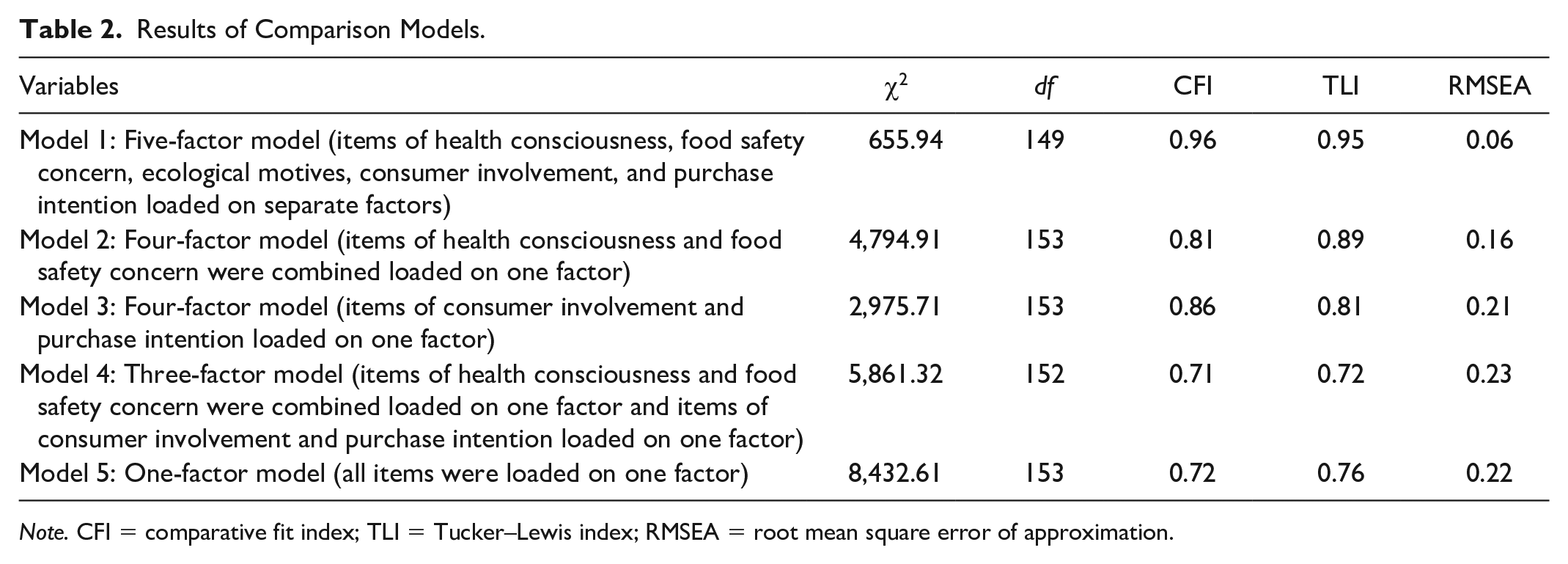
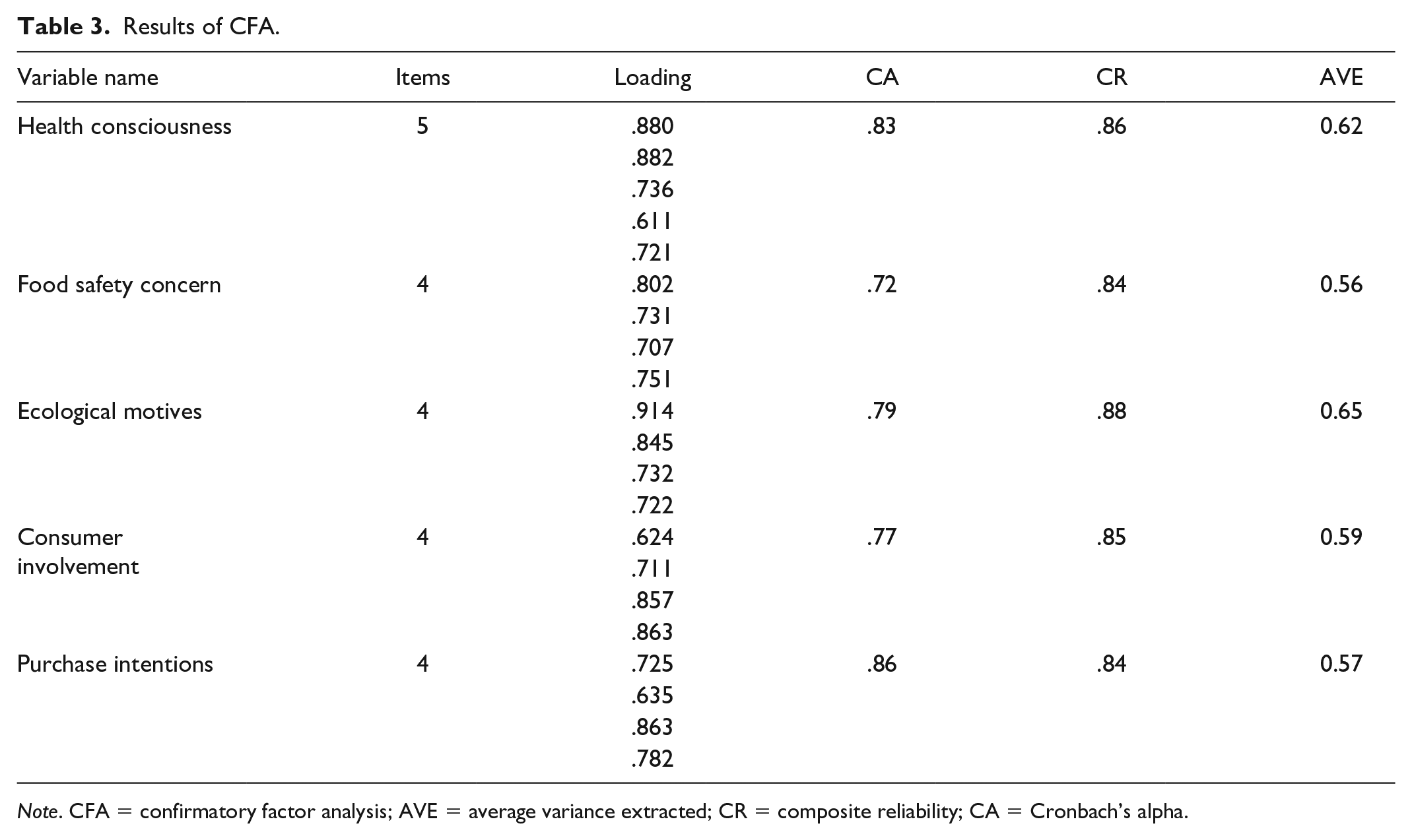
We conducted the Kolmogorov–Smirnov (K-S) and Shapiro–Wilk statistics (Shapiro & Wilk, 1965) for each construct. The results in Table 1 show that all our constructs were significant. The significant values violate the assumptions of normality; however, we argue that this significance of K-S test in data is due to the large sample size as discussed by Pallant and Tennant (2007). Field (2009) argued that the significance of K-S test for large sample size cannot be considered as the deviation of data from a normal distribution. We then conducted confirmatory factor analyses (CFAs). Results of CFAs revealed that standardized factor loadings for health consciousness were ranging from .61 to .88; for food safety concerns, .70 to .80; for ecological motives, .72 to .91; for consumer involvement, .62 to .86; and for purchase intentions, .64 to .86. The hypothesized five-factor model fits the data satisfactorily—χ2 (199) = 655.94, comparative fit index (CFI) = 0.96. All factor loadings, Tucker–Lewis index (TLI) = 0.95, root mean square error of approximation (RMSEA) = 0.06, were statistically significant (p < .001). Following the recommendation of Byrne (2016), we measured the fit indices such as CMIN/df, CFI, RMSEA, and TLI resulting in the acceptable levels of these fit indices (i.e., CMIN/df = 1.41, CFI = 0.90, RMSEA = 0.06, TLI = 0.91). Results of the comparison models are presented in Table 2.
K-S Test of Normality.

Note. K-S = Kolmogorov–Smirnov, HC = health conciousness, FSC = food safety concern, EM = Ecological motives, CI = consumer involvement, PI = purchase intentions.
Lilliefors significance correction.
Results of Comparison Models.
Note. CFI = comparative fit index; TLI = Tucker–Lewis index; RMSEA = root mean square error of approximation.
For calculating the reliability, discriminant validity, and convergent validity of our constructs, we followed the procedures as recommended by researchers, for instance, Hair et al. (2010) and Gefen and Straub (2005). They argue that for establishing a convergent validity, the average variance extracted (AVE) values should be greater than the threshold value of 0.50. Table 3 reports that AVE values for all our constructs are greater than 0.50; therefore, there is a good convergent validity of the constructs used in our research. It is further argued that for establishing discriminant validity, the square root values of AVEs of the constructs used in the research should be greater than the correlations between constructs. Our Table 4 reports that the square root of the AVE values of our constructs is higher than the correlation values; therefore, there is a good discriminant validity of our constructs. In addition, it is suggested that the composite reliability (CR) values should be greater than .70 for establishing the reliability of the constructs. Table 3 reports that the CR values of the constructs used in our research are greater than .70. Moreover, Cronbach’s alpha values greater than .70 also indicate good reliability of the constructs.
Results of CFA.
Note. CFA = confirmatory factor analysis; AVE = average variance extracted; CR = composite reliability; CA = Cronbach’s alpha.
M, SD, and Intercorrelations.

Note. N = 268; figures in bold and italic are square root of AVEs. AVE = average variance extracted.
Significance level: *p < .05 (two-tailed) and **p < .01 (two-tailed).
Descriptive Statistics
Table 4 provides the results of descriptive statistics such as mean, standard deviation, and correlation among all the variables. Health consciousness (r = .474, p = .01) and food safety concern (r = .551, p = .01) are positively associated with consumer involvement. Similarly, health consciousness (r = .442, p = .01) and food safety concern (r = .483, p = .01) are positively associated with purchase intentions. In addition, consumer involvement is positively associated with purchase intentions (r = .596, p = .01). The demographic variables were not found related to any of the study variables; therefore, we excluded them from any further analysis.
Hypothesis Testing
The results of our hypothesis testing are presented in Tables 5 and 6. The results were found consistent with the preliminary analysis as health consciousness (B = 0.15, t = 2.75, p = .01, Table 5) and food safety concern (B = 2.28, t = 0.17, p = .01, Table 6) show positive association with consumer purchase intentions, which supports our Hypotheses 1 and 2. Next, we computed the indirect effects of health consciousness and food safety concern on purchase intention through consumer involvement. The results provided the support for the underlying mediating role of consumer involvement in the indirect relationships between health consciousness and purchase intention (effect = −0.006, 95% confidence interval [CI] = [−0.06, −0.03], Table 5) and food safety concern and purchase intention (effect = 0.008, 95% CI = [0.03, 0.05], Table 6). The results of these mediation analyses provide evidence to support our Hypotheses 3a and 3b.
Moderated Mediation.

Significance level: *p < .05. **p < .01. ***p < .001.
Moderated Mediation.

Significance level: *p < .05. **p < .01. ***p < .001.
We also calculated the conditional direct effects of food safety concern and health consciousness on consumers’ intentions to purchase across the levels (at −1SD and +1SD) of the moderator (i.e., ecological motives). Table 5 reports that the direct effects of health consciousness on purchase intentions are strong (effect = −0.20, 95% CI = [0.08, 0.31]) when ecological motives are high (+1SD) than when ecological motives are low at −1SD (effect = −0.11, 95% CI = [−0.03, 0.25]). Likewise, Table 6 reports that conditional direct effects of food safety concern on purchase intentions are strong (effect = 0.20, 95% CI = [0.05, 0.35]) when ecological motives are high (+1SD) than when ecological motives are low at −1SD (effect = 0.09, 95% CI = [−0.04, 0.03]). These findings are supporting the moderating Hypotheses 4a and 4b.
For the moderated mediation analysis, we analyzed the indirect effects of food safety concern and health consciousness on consumer intentions to buy through consumer involvement across levels (at −1SD and +1SD) of ecological motives. As reported in Table 5, we found that the conditional indirect effects of health consciousness on purchase intentions through consumer involvement are strong (effect = 0.10, 95% CI = [0.05, 0.17]) when ecological motives are high (+1SD) than when ecological motives are low at −1SD (effect = 0.09, 95% CI = [0.04, 0.17]). The indirect effects of food safety concern on purchase intentions through consumer involvement are strong (effect = 0.12, 95% CI = [0.05, 0.22]) when ecological motives are high (+1SD) than when ecological motives are low at −1SD (effect = 0.11, 95% CI = [0.05, 0.21]). These results are supporting our moderated mediation Hypotheses 4a and 4b.
Discussion
This study aimed at investigating the determinants of consumer purchase intentions for organic food in a developing country context (i.e., Pakistan). The findings of this study revealed that consumer attitude such as health consciousness and food safety concern is positively related to consumer involvement which in turn is positively associated with consumer purchase intentions for organic food. In addition, we found that ecological motives play a moderating role in the direct relationships between consumer health consciousness and their involvement in buying organic food and consumer food safety concerns and their involvement in buying organic food. Consumer ecological motives were also found as a moderating variable on the mediated relationships between consumer health consciousness and purchase intentions through their involvement in buying organic food and consumer food safety concerns and purchase intentions.
The findings of this study extend the literature in the area of consumer purchase intentions toward organic and healthy food by developing and testing a comprehensive moderated mediation model. This study provides the basic knowledge and supportive information about the identified factors of consumer intentions to purchase healthy and natural food. The results are in line with the past research which has found positive relationships between consumer health consciousness and purchase intentions (Khoiriyah & Toro, 2013), consumer safety concerns and purchase intentions (Michaelidou & Hassan, 2008), and consumer involvement and purchase intentions (Park & Lee, 2008) in other contexts. This study, thus, contributes to the literature by exploring these factors in the emerging industry of organic food.
Theoretical Implications
Our study not only tests the associations between consumer health consciousness and purchase intentions and consumer food safety concerns and purchase intentions but also explores the underlying psychological mechanism in these relationships, that is, consumer involvement. Exploring consumer involvement as a mediating mechanism in the stated relationships, we answer the question of how consumer health consciousness and food safety concern is associated with their purchase intentions toward organic food. Previous research has found that the high level of involvement of customers regarding some products highly tends toward their purchase intentions (Bravo et al., 2013). Our results confirm past studies that have found consumer involvement as a mediating variable in the relationships between similar factors (Aertsens et al., 2009; Thøgersen et al., 2012). Based on our results, one can explain that when consumers have high health consciousness and concerns for the safety of the food, they are more likely to be involved in buying healthy and organic food and will subsequently show purchase intentions toward such quality food. Previous research, for example, Lockie et al. (2002), has also found that consumers who have food safety concerns such as the natural quality of food, food free of artificial ingredients, and food free of chemicals are more involved in buying healthy and organic food. Similarly, Bezençon and Blili (2010) found that customers who are more conscious about their health are more involved in showing intentions to buy healthy organic food.
Moreover, our study found ecological motive as an important moderating variable on the relationships between consumer health consciousness, purchase intentions, and food safety concerns such that the associations are strong when ecological motives are high. A potential explanation for our finding is that the relationship between consumer health consciousness and purchase intentions and consumer food safety concerns and purchase intentions toward organic food is stronger for the consumers who have high ecological motives. Organic, healthy, and environmental-friendly food involves food that does not affect the environment in any negative way. It may include fruits, vegetables, as well as meat that are obtained by considering the preservation of the environment. Past studies have found that consumers who have more environmental concerns or who have high ecological motives are more inclined toward buying organic food (Hjelmar, 2011; Zagata, 2012; Zagata & Lostak, 2012; Żakowska-Biemans, 2011). Our study confirms this past research conducted in another context by exploring the moderating role of ecological motives in strengthening the relationships between consumer health consciousness, food safety concerns, consumers’ involvement, and consumer intentions toward buying organic food.
Practical Implications
Our research carries important managerial implications for organizations and managers in the business of organic food. For instance, our study found a positive relationship between consumer health consciousness and their involvement in showing their intentions to buy organic food; therefore, the sales managers and the organizations in the business of organic food can particularly target this segment of customers. Similarly, our research suggests that consumers having high food safety concerns can be targeted for selling organic and healthy food products. Moreover, companies and managers should be giving more value to their environmental-friendly policies in their marketing campaigns of organic food as consumers’ ecological motives are an important moderating variable reported in the findings of this study. Overall, the factors identified in our research that contribute to consumers’ purchase intentions of healthy and organic food have a great value for the organizations and managers to modify their marketing campaigns and enhance their sales. For instance, our research points out the positive relationship between consumer involvement and purchase intentions, marketing managers and companies can, therefore, do more specific efforts in getting more involvement of their customers for enhancing their sale of organic and healthy food products.
Limitations and Directions for Future Research
Despite its strengths, this research also carries some limitations. For example, the study has taken a sample from a single country. Future research should consider investigating our model with a diverse sample from other countries and cultures. Second, we collected cross-sectional data which may cause common method variance (CMV). We ensured the anonymity of respondents and kept the confidentiality of their information which provided us some procedural remedy. Future research should still consider longitudinal or experimental designs to cover this limitation of the possible threat of CMV. Third, we explored one mediating mechanism, that is, consumer involvement, but we believe that alternative explanations exist in linking consumer health consciousness and food safety concerns with their purchase intentions which future researchers can intend to explore. Future researchers might also want to explore a boundary condition at the second stage of our model which could be a substantial contribution in knowing high consumer involvement but still less intention to buy natural food.
Conclusion
The organic food market is rapidly growing and so is the number of companies involved in this business. This research helps the scholars and managers who are associated with healthy and organic food products in knowing the factors that contribute to consumer purchase intention of buying organic food. A comprehensive research model outlines factors such as consumer health consciousness, food safety concerns, consumer involvement, and ecological motives to understand their relationships with consumer intentions toward buying healthy and organic food.
Footnotes
Appendix
Declaration of Conflicting Interests
The author(s) declared no potential conflicts of interest with respect to the research, authorship, and/or publication of this article.
Funding
The author(s) received no financial support for the research and/or authorship of this article.
