




Abstract
This study examines mobile commerce continuance intention based on integrating expectation-confirmation and task-technology models and incorporating flow experience and user adaptation perspectives in an emerging context of Vietnam. The dataset (n = 519) of face-to-face responses from mobile commerce consumers utilizing convenience and snowball sampling techniques was examined employing the partial least squares structural equation modeling SmartPLS4.0. The findings confirm that confirmation, perceived usefulness, and satisfaction are all positively related to continuance intention. Additionally, the findings show that while task-technology fit affects perceived usefulness and user adaptation, it does not directly predict satisfaction. Furthermore, the study indicates that flow and task-technology fit impact continuance intention. Remarkably, this study is the first to unveil the significant moderating effect of flow on the relationship between adaptation and continuation intention. The study offers insightful implications for firms to retain customers effectively by boosting the factors forming continuance intention.
Plain language summary
Purpose: This study examines mobile commerce continuance intention based on integrating expectation-confirmation and task-technology models and incorporating flow experience and user adaptation perspectives in an emerging context of Vietnam.
Keywords
Introduction
This study focuses on consumers’ post-adoption mobile commerce (m-commerce) behavior that promotes the success of firms in transcending traditional commerce channels and the heated competition among other m-commerce platforms. Despite the advantages of m-commerce services, consumers are reluctant to utilize innovative means of commerce (Gao et al., 2015; Khaw et al., 2022; Silva et al., 2022). Statista (2023) reports that m-commerce, which denotes that the browsing, purchasing, and payment of goods or services using smartphones, only contributed to 7% of retail sales in Vietnam in 2021, despite increasing steadily over consecutive years. By the end of 2023, Vietnam’s m-commerce is expected to be valued at $10.2 billion, where half of the country’s population (49 million) of m-shoppers purchase via mobile devices (Minh-Ngoc, 2023).
For m-commerce firms, getting new customers and inspiring initial purchases are only the beginning of the road. Additionally, firms need to keep their existing buyers and facilitate their continued purchasing (Mou et al., 2020; Shaikh & Karjaluoto, 2015). Researchers have observed that acquiring a new customer costs five times as much as keeping a current one (Abbasi et al., 2022). Furthermore, the competition in the m-commerce sector is becoming fiercer and customers are being increasingly aggressively attracted by multiple m-commerce platforms that operate across the boundaries (Pop et al., 2023; Salimon et al., 2023; Vicedo et al., 2020). Managers and scholars have focused a great deal of attention on the amazing potential and persistent challenges of the m-commerce sector (G.-D. Nguyen & M.-T. Ha, 2021; Purnomo et al., 2022). Topics such as m-commerce acceptance and repurchase have been explored widely by a host of scholars (Andronie et al., 2021; Yan et al., 2021; see, e.g., Ertz et al., 2022).
Extant studies concentrate on user continuance intention (CI) employing either the (purposeful) planned behavior-related or habitual (automatic) perspectives (Bhattacherjee & Lin, 2015; De Guinea & Markus, 2009). The former involves pre- and post-adoptive behavioral models such as the technology acceptance model (TAM) (Davis et al., 1989) and the theory of planned behavior (TPB) (Ajzen, 1991). The latter incorporates information technology (IT) continuance models that have been augmented with habitual and relevant factors. It is worth noting that an emerging research stream on IT adaptation-continuance looks at IT continuation regarding the user adaption process (Bala & Venkatesh, 2016; Bhattacherjee et al., 2018; D. G. Nguyen & M.-T. Ha, 2022). Furthermore, Ha et al. (2022) postulate that “IT continuance is likely to be impacted by the adaptation factor, which are the behaviors that users proactively perform to harmonize between each other in order to improve job performance and the IT service system” (p. 44). However, few studies concentrate on the relationship between the fitness of m-customers’ shopping preferences (i.e., purchasing task) and m-commerce app functionalities (i.e., technology) and their adaptation behavior (AD) that enables consumers to undertake the appropriate shopping and make the correct repurchasing decisions (Franque et al., 2020; Nabavi et al., 2016). Goodhue and Thompson (1995) named the fitness between users’ tasks and the technology they use to accomplish the tasks, to be the task-technology fit (TTF). Likewise, while researchers have regarded the flow experience (FW) as a state during which customers are captivated in their purchasing activity which likely affected their repurchase intention, yet practically ignored in studies pertaining to user adaptation (Yan et al., 2021). Thus, the aim of this study is to explore the effects of factors such as TTF, AD, and FW on CI of m-shoppers in order to fill the aforementioned theoretical gaps and assist firms in gaining a competitive edge by retaining and facilitating customers to continue purchasing m-commerce apps. The study attempts to answer the following three research questions: (1) What are the factors affecting CI in the use of m-commerce? (2) How do these factors affect CI? (3) What is the moderating role of flow on the relationship between AD and CI?
Our study makes several contributions to m-commerce literature: First, distinct from most earlier studies which overemphasize about the original expectation-confirmation model (ECM) and combine either planned behavior models or habitual perspectives, this study reviews the continuance intention of m-commerce shopping by integrating ECM with IT adaptation perspective, TTF, and flow theory. Second, the study sheds light on the understanding post-purchase determinants of CI with a moderating role of flow experience that no other research has explored before. Third, the study reveals empirical evidence that shows the strength of flow as a direct influencer of both adaptation and CI, and a moderator of the effect of AD on CI in relations to m-commerce. Finally, the study provides m-commerce businesses with practical implications for conducting marketing strategy and improving customer relationship programs for retaining customers.
The remainder of this paper is arranged as follows: the literature review and hypotheses development are presented in Section 2. Next, the methodology applied for conducting of the study is outlined in Section 3. Section 4 presents the results, followed by the insightful discussions. The implications and the conclusion are given in Section 5.
Literature Review and Hypotheses Development
IT Continuance
Researchers have argued that users often hesitate to use extensions of IT-enabled service systems, resulting in underutilized and unsuccessful services (Shaikh & Karjaluoto, 2015). Once entering IT continuance, users make the decision to stay with the IT by using it extensively, and then utilize it in the most appropriate manner (Bhattacherjee et al., 2018; DeLone & McLean, 2016). Researchers have regarded “IT continuance” as user behavioral intention and the usage of an IT in the post-adoption stage, following the acceptance, initial adoption, or first use (Ha et al., 2022; Nabavi et al., 2016; Yan et al., 2021). Across IT-enabled systems or services, the definitions of IT continuation vary slightly. According to W. T. Wang et al. (2019), continuance intention refers to a consumer’s decision to use a specific mobile service over a lengthy period. Furthermore, Franque et al. (2020) posited that continuance intention is related to the contributing factors to a long time success of the IT service system. In this study, we define continuation intention as the customer’s decision to remain connected with the m-commerce app and to continue shopping on it.
Expectation-Confirmation Model
Relying on the expectation-disconfirmation theory (EDT) (Oliver, 1980), Bhattacherjee (2001) introduces the ECM which applies to the information system (IS) continuance setting. Given that both theories focus on the user post-adoptive stage (i.e., after pre-adoptive use or first purchase), Oliver’s EDT theory aims to inspect the users’ satisfaction (SA) and its influence on the decision to repurchase a product, primarily in marketing; the original Bhattacherjee’s ECM examines users’ (1) SA with the experience of the adopted IT, (2) confirmation of expectations (CON), and (3) perceived usefulness (PU) and their impacts on users’ continuance intention (CI) in various settings (Bhattacherjee & Lin, 2015; G.-D. Nguyen & M.-T. Ha, 2021). Researchers have widely adopted the original ECM and have incorporated various theoretical frameworks to develop variations of extended ECM for investigating users’ post-adoptive behavior in different contexts (Franque et al., 2020; Nabavi et al., 2016; Yan et al., 2021).
Continuance in M-Commerce
Extended ECMs inform user continuance intention by incorporating new variables in numerous m-application contexts, including e-learning, online tourism, ride-hailing, and m-banking services (Joia & Altieri, 2018; Shaikh & Karjaluoto, 2015; Susanto et al., 2016; Tam et al., 2022; Yan et al., 2021; X. Zhang, 2020). Furthermore, for a highly interactive IT mobile platform context (such as m-commerce) (Breidbach & Brodie, 2017), studies on continuance behavior have broadly integrated ECM with various psychological and behavioral models such as TAM, TPB, and UTAUT (unified theory of acceptance and use of technology) (see e.g., Joia & Altieri, 2018; Marinković & Kalinić, 2020; Vinerean et al., 2022), the TTF model (Yuan et al., 2016), the information system success (ISS) model (Gao et al., 2015), and flow theory (Sarkar & Khare, 2019) and multiple perspectives (Faber & de Reuver, 2019) . Particularly, researchers have also attempted to predict user behavioral changes by refining a combination of selected foundational theories relevant to the emerging context of digitalization (Gao et al., 2015; Ha et al., 2022; Yuan et al., 2016). Accordingly, grounded on ECM, our research has been shaped by its four factors—confirmation, PU, SA, and CI, as well as its five general hypotheses (Ha et al., 2022). Thus, the study suggests the following five hypotheses:
H1. User satisfaction positively affects CI to use m-commerce.
H2. User perceived usefulness positively affects CI to use m-commerce.
H3. User perceived usefulness affects SA with m-commerce.
H4. User confirmation positively affects PU of m-commerce.
H5. User confirmation positively affects SA with m-commerce.
Task-Technology Fit
By utilizing ISS (DeLone & McLean, 2016), cognitive fit theory (Vessey et al., 2006), and TAM (Davis et al., 1989), the study by Goodhue and Thompson (1995) develops the task-technology model to illuminate how users’ performance (e.g., outcome impact; utilization) is influenced by task-technology fit (TTF) and their experience of IT. TTF refers to the capacity of IT to help a user accomplish a job by matching the technological functionalities to the task requirements. Goodhue and Thompson (1995) have termed the construct of TTF as referring to “correspondence between task requirements, individual abilities, and the functionality of the technology” (p. 218). Based on the original TTF model, the TTF theory has emerged, claiming that technologies significantly impact the user performance once their functions are “utilized and matched” to the user task. In this m-commerce context, TTF is defined as the extent to which an m-commerce app matches customers’ m-shopping patterns and how it facilitates their purchases (Y.-S. Chen & Huang, 2017). According to Barki et al. (2007) consumers who use an IT application (e.g., m-commerce) do more than interact with it to carry out tasks (e.g., shopping); they also appropriate the features of the m-commerce app and change themselves (e.g., learning), within the task-technology-individuals triangle frame, to fit the app. Additionally, previous studies also posited that TTF is a driving factor of IT behavioral usage (i.e., adaptation) in the form of adjusting, appropriating, and enhancing the IT (DeLone & McLean, 2016; Jasperson et al., 2005; Tam & Oliveira, 2016).
Prior studies utilize TTF incorporating with various theoretical frameworks to predict CI. B. Wu and Chen (2017) and apply TTF and TAM to investigate e-learning and blockchain banking, respectively. Franque et al. (2022) and Gu et al. (2021) utilized UTAUT and TTF to predict user acceptance m-payment and e-health services. Scholars have claimed that, once the fit of task-technology characteristics are established, this will boost the utilization of m-commerce, while the opposite (unfit) leads to discontinuance usage (Zhao & Bacao, 2020). The TTF theory argues that m-shoppers are reasonable and will use the m-app to purchase products or services if their shopping manner and the m-app fit. In other words, when customers perceive the fit between the m-commerce application (i.e., technology) and the purchase (i.e., shopping task), they are likely to continue shopping (Groß, 2016; G.-D. Nguyen & M.-T. Ha, 2021). While empirical research in specific settings has examined the direct links between TTF and actual usage (Franque et al., 2022; Tam & Oliveira, 2016), CI (Yuan et al., 2016), confirmation, SA, and PU (Yuan et al., 2016), there is a need for an evidence for the association between TTF and behavioral adaptation (Barki et al., 2007; Ha et al., 2022). Therefore, we propose the following hypotheses:
H6. TTF has a positive effect on user satisfaction.
H7. TTF has a positive effect on perceived usefulness.
H8. TTF has positive effect on behavioral adaptation.
User Adaptation
User adaptation has been identified as a stage of an IT diffusion process by both diffusion of innovation theory (DIT) (Rogers, 1983) and IT implementation (Ha et al., 2022; Jasperson et al., 2005). Adaptive structuration theory for individuals (ATSI) (Schmitz et al., 2016) decomposes the adaptation mechanism into a multiple “structuration episode,” while IT users explore and exploit their tasks and IT functions to achieve better performance and other preferential decision outcomes. Both the coping model for user adaptation (CMUA) (Beaudry & Pinsonneault, 2005) and the information system use-related activity model (ISURA) (Barki et al., 2007) postulated that (individual) adaptation is a user’s effort to perform on the IT (technology), the work (task), and oneself (capability). Unambiguously, as Barki et al. (2007) described, IT adaptation is operationalized as a collective user behavior variable including IT interaction, task-technology adaptation, and self-adaptation that is inspired from a task-technology fit model (Goodhue & Thompson, 1995). As such, according to both Goodhue & Thompson’s (1995) TTF and Barki’s et al. (2007) models, the fitness of task and technology has a significant role on user utilization (IT adaptation), and leads to a better performance or a decisive positive outcome (continuance usage) and whether one makes use of the IT (G.-D. Nguyen & M.-T. Ha, 2021; Rubel et al., 2020). In the context of m-commerce and based on earlier studies, we define behavioral adaptation as “the actions performed by users to adjust the m-commerce app and practice to fit their preferences, needs, and situations” (G.-D. Nguyen & M.-T. Ha, 2021). Therefore, the fitness between task and technology may bring about satisfaction, drive users adapting with m-commerce, and then lead them to the post-adoptive stage of extended use and making the decision for continuance use. This is because the more users perceive the system to be useful and suitable, the more they adapt to it and the more likely it will be that they continue to use it (DeLone & McLean, 2016; D. G. Nguyen & M.-T. Ha, 2022). Despite the fact that user adaptation is crucial to the long-term success of IT-enabled services, user adaptation research is scarce. As a consequence, incorporating the adaptation viewpoint and TTF model into ECM may fill a gap in the m-commerce literature. Thus, rooted on the original ECM and referring to recent empirical studies, our research model proposes relationships between behavioral adaptation to PU, SA, and CI through the following hypotheses:
H9. User perceived usefulness positively affects behavioral adaptation with m-commerce.
H10. Behavioral adaptation positively affects satisfaction with m-commerce.
H11. Behavioral adaptation positively affects CI to use m-commerce.
Flow Theory
The state of flow represents the holistic experience that an individual feels when acting with total involvement, no matter what action is being performed (Csikszentmihalyi, 1975). Flow was initially regarded as “the holistic sensation that people feel when they act with total involvement” (Csikszentmihalyi, 1975, p. 4). Nakamura and Csikszentmihalyi (2014) have argued that “the flow state is one of dynamic equilibrium” and it “depends on establishing a balance between perceived action capacities and perceived action opportunities of a user” (p. 90). When one is in the flow state, they become enthralled in their motion: their perception is captivated by the activity itself, and they are unable to find self-consciousness. Furthermore, once one’s skills and challenges exceed the threshold values, they enter a flow state, and the flow reflects a balance between the users’ skills and challenges (Gao & Bai, 2014).
Flow
Researchers argued that flow (FW) is an elusive concept; it refers to multi-dimensional aspects in terms of its drivers (e.g., enjoyment, concentration, and perceived control), and outcomes (e.g., satisfaction, continuance usage, and loyalty) (Almunawar et al., 2021). More recently, flow has also been studied in multiple contexts (Gao et al., 2015), such as m-commerce (Y.-M. Chen et al., 2018), e-learning (M.-H. Zhang et al., 2020), sport websites (O’Cass & Carlson, 2010), and online tourism (Gao et al., 2017). Researchers argued that customers need to balance both skills (e.g., using mobile internet) and challenges (e.g., online payment) to obtain flow, and when users experience a flow that is a positive involvement, they may feel great enjoyment and perceive fulfillment and then make a decision to continue using the service (Gao & Bai, 2014). While there have been several empirical studies that have investigated the direct and mediating effects of flow on user acceptance and behavioral usage intention (Gao et al., 2015; M.-H. Zhang et al., 2020), surprisingly very little research has explored its critical role as a moderator, and concurrently with its direct effects on CI and user usage (see, e.g., Franque et al., 2020; Yan et al., 2021). Whereas L. Wang et al. (2020) have investigated the role of flow on the relationships between users’ perceptions (i.e., privacy and reward) and their intention in social media usage, Chang et al. (2014) have found the moderating role of flow on the links of CI and both personal expectations (i.e., utilitarian and hedonic) in online game setting. In the context of m-commerce, customers may likely be enticed by the innovative, challenging features of mobile shopping apps and absorbed in the purchase process (action, timeliness) in a flow manner of IT-enabled service system settings (McLean et al., 2018; Wasiq et al., 2022). Thus, m-shoppers should rely on involvement and control in purchasing activities. In other words, flow became a critical factor to keep their customers surfing the app and to entice them into continuing with the purchase (Gao et al., 2015; Zhou, 2012). Thus, the deeper state of the flow, the more intention customers have to stay in the shopping site and the more activities they perform on the m-commerce application.
As such, we propose the following hypotheses:
H12: Flow positively affects CI to use m-commerce.
H13: Flow positively moderates the relationship between behavioral adaptation with CI to use m-commerce.
H14: Flow positively affects behavioral adaptation with m-commerce.
We suggest a research model based on the aforementioned review of the theoretical frameworks, the empirical studies published, and our arguments in the context of m-commerce, as indicated in Figure 1 below.
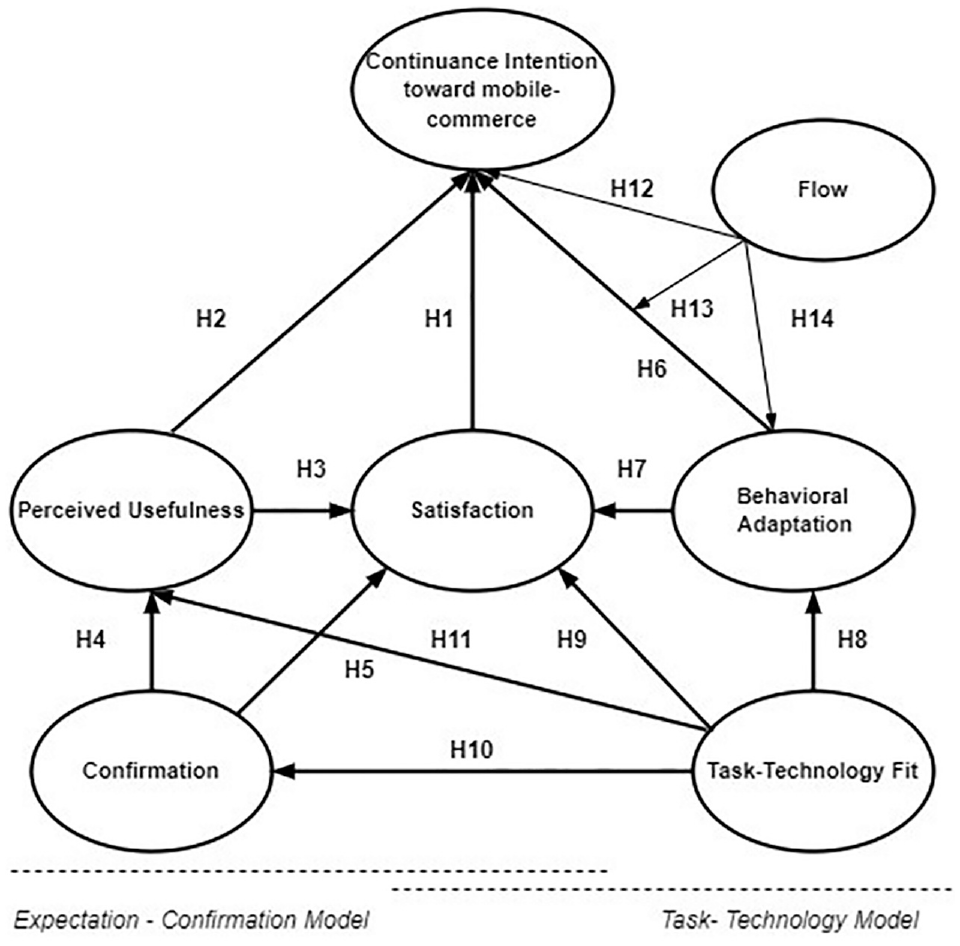
Research model.
Methodology
Participants and Data Collection
During the 3-month period from October 2022 to January 2023, the authors of this study intended to collect 700 responses using the convenience and snowball sampling methods that were considered as proper approaches given the context of m-commerce (Sarstedt et al., 2018). The targeted respondents were m-app users of at least one the largest m-commerce platforms in Vietnam (e.g., Shopee, Lazada, Tiki, Sendo, Grab, and Gojek) (Vietnam Plus, 2022) and those who made at least two online purchases or transactions during the three prior months. Face-to-face interviews were used in the investigations (Minh-Tri, 2022) and 519 out of the 700 distributed questionnaires (74.15%) yielded valid responses. Several respondents had assumed that they may answer later using different methods of online media on the day of the interview. The direct and online media surveys provided a total of 67.4% and 32.6% of the replies, respectively. Before beginning the interview and at any point throughout it, respondents were asked to check the consent box indicating that they understood that the survey was voluntary, and their answers would be treated confidentially. To reduce response bias, a group of selected final-year business management students were trained to conduct the survey. The questionnaire was first developed in English and then translated into Vietnamese and verified by four lecturers of English and e-commerce. A pretest was also performed by face-to-face interviews with a representative sample of 15 m-shoppers and m-commerce professionals to ensure the questionnaire’s construct validity.
Forty-seven percent of the respondents in the sample are male and 53% are female. All respondents were between 18 and 65; 52% of the sample were between the ages of 24 and 55; and 3-year or 4-year college students accounted for 48% of the respondents at the educational level of high school or below. Graduate school or higher accounted for 29% and 23%, respectively. Most shopping mobile app users have a monthly income from $350 to $800, followed by a higher income, from $800 to $1250, which accounted for 41% and 24%, respectively.
For m-commerce channels, Shopee’s users is the largest among the respondents, with 122 people and accounting for 24%. Gojek has only 27 respondents using it, accounting for only 5%. Tiki, Lazada, and Grab also have many users.
As shown in Figure 1, our study model includes four distinct pathways (from PU, SA, AD, and FW) that connect to CI, and the sample size of 519 completely complies with the PLS-SEM minimum size criteria, which states that the sample size should be 10 times the maximum number of structural paths that may be directed at a particular latent structure in the model (Hair Jr et al., 2017; Hair et al., 2019).
Measurement of Constructs
This survey’s measuring items were tailored from scales that have been verified in relevant research. All of these items were graded on a 7-point Likert scale, with 1 being strongly disagree and 7 being strongly agree. The items for CI were adapted from Bhattacherjee and Lin (2015) and Gao et al. (2015). The SA was measured using scales from Bhattacherjee (2001) and Tam et al. (2020). The PU was derived from Chong (2013) and Franque et al. (2021). Confirmation was measured using items derived from Bhattacherjee (2001), and H. Lin and Hwang (2014). The AD items were adapted from G.-D. Nguyen and M.-T. Ha (2021) and Y. Wu et al. (2017). We adopted the TTF scale by H.-F. Lin (2011) and Tam and Oliveira (2016). Finally, the items of FW were taken from I.-L. Wu et al. (2022) and Gao et al. (2015).
Data Analysis and Results
Common Method Bias
Several methods have been recommended to test the common method bias that is an issue of using the same measurement instrument (Podsakoff et al., 2003; Tehseen et al., 2017). This study adopts the suggestions of Bagozzi et al. (1991) who state that large correlations are evidence for common method bias. An assessment of our correlation confirms that there is no correlation between two variables surpassing the cut-off value of 0.9. Additionally, using SmartPLS to analyze the data, common method bias (CMB) is detected through a full collinearity assessment approach. The data analysis shows that no VIF value is higher than the recommended threshold of 3. We conclude that the general problem of process bias does not appear in our model (Kock et al., 2021).
Assessing Measurement Models
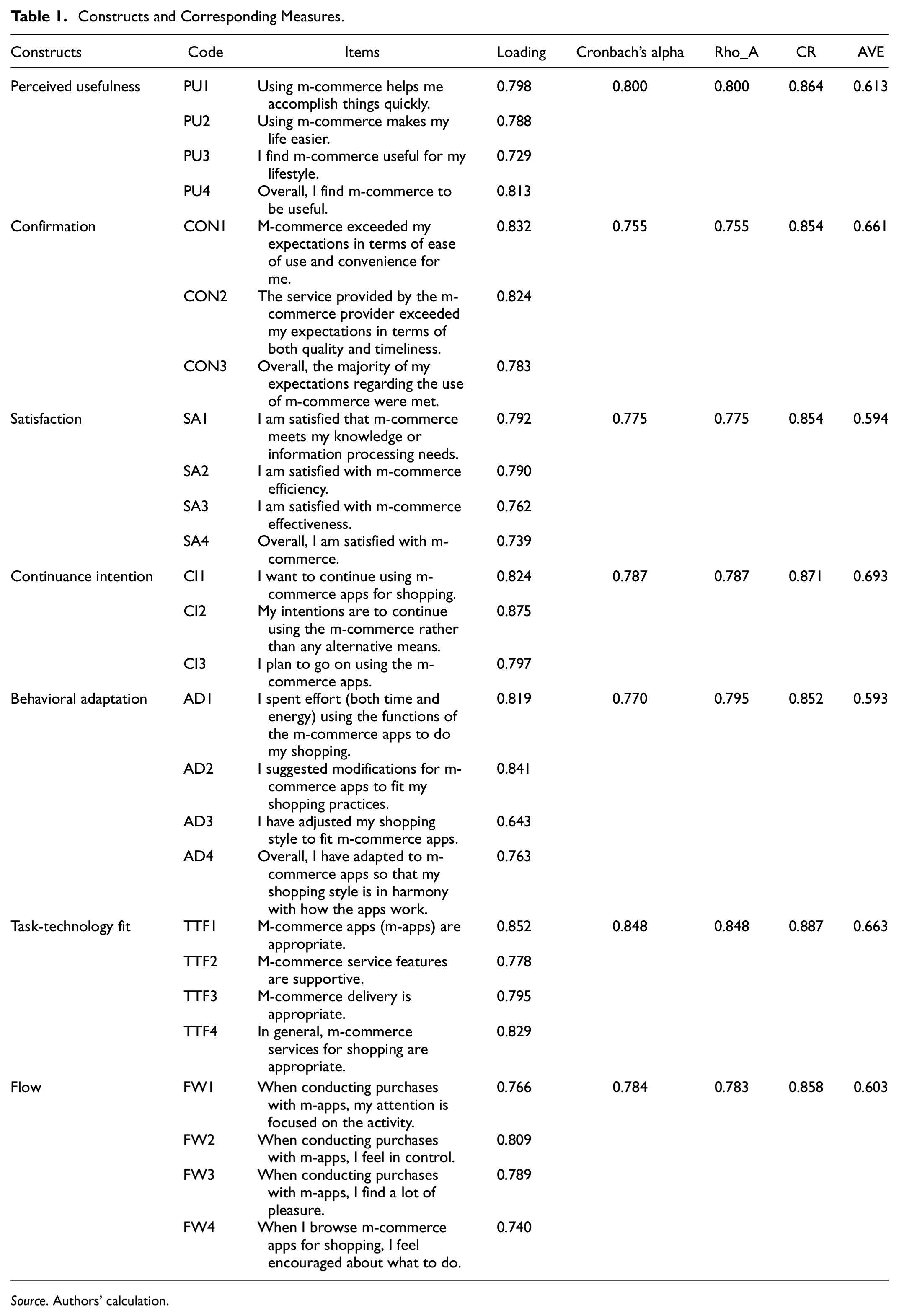
Table 1 summarizes the results of the measurement models evaluation, including outer loading, Cronbach’s alpha, composite reliability (CR), rho_A, rho_C, and the average extracted variance (AVE). In terms of examining the indicator loadings, except for AD3, all metrics exceed 0.708 which indicates an acceptable item reliability, as recommended by (Hair et al., 2019). The item AD3 is retained in the external structural model because the AD3 loading (0.640) is higher than 0.5 (Sandhya & Sulphey, 2021), behavioral adaptation composite reliability is above 0.70, and AVE value is more than 0.50 (Hulland et al., 2017). In assessing the internal consistency reliability, the results reveal that all CR values vary from 0.755 (CON) to 0.848 (TTF), ranging from satisfactory to good (Hair et al., 2019). Moreover, all AVE values range from 0.593 (AD) to 0.693 (CI), addressing the convergent validity of each construct measure.
Constructs and Corresponding Measures.
Source. Authors’ calculation.
As seen in Table 2, all the heterotrait-monotrait (HTMT) ratios, a well-known measure of discriminatory value, are less than 0.611 and have achieved the threshold of 0.85 (Henseler et al., 2016). Thus, it is shown that discriminant validity has been reached. Therefore, it is possible to conclude that the construct is empirically distinct from other constructs in the structural model.
Results of Discriminant Validity Using HTMT.

Source: Authors’ calculation.
Evaluation of Inner Model
Before evaluating the structural model, the variance inflation factor (VIF) or collinearity was tested to confirm that it does not bias the regression results, and all of the VIF values were below 1.400, ensuring the multicollinearity problem of the inner model (Sarstedt & Mooi, 2019). Next, we examine the internal model to confirm the hypothesized relationships between the constructs in the proposed model by using the 5,000 bootstrap subsamples method. Path analysis findings are presented in Table 3.
Bootstrapping Results.

Source. Authors’ calculation.
We then examine the squared multiple correlations (R-square) to determine the significance of the structural model (Hair et al., 2019). As shown in Figure 2, the corresponding path coefficients have the projected sign and are significant; that is, the R2 values were moderate for continuance intention (0.358), meaning that 35.8% in CI was explained by its determinants.

SmartPLS results.
The data analysis revealed that 11 of the 12 hypotheses were confirmed. Except for the direct relationship between TTF and SA (H9), all connections are supported statistically from the p values (.000, .001).
Table 3 shows the effect size (f2) to assess how much an explanatory variable contributes to the R2 of the dependent variables. All f2 values range from 0.024 to 0.195, indicating that the contributions of exogenous variables are moderate and weak (Cohen, 1988).
The calculation of predictive performance was conducted with the holdout sample-based and cross-validation coefficient k = 10. Additionally, the Q-square predict values of PU, SA, AD, and CI were all greater than zero, so that the model offers better predictive performance (Hair et al., 2019; Ringle et al., 2022).
Evaluation Moderating Effects
The proposed model examines the flow’s moderating role on the relationships between AD-CI (H14). The result has found a statistically significant effect of FW (β = .171, ρ = .000) on CI. Accordingly, as shown in Table 3, the fact that the H13 is supported shows that the effect of FW on CI is contingent upon AD. Figure 3 depicts the moderating effect of FW on the relationship between AD and CI through the slopes of the two linear lines. The slope of the line is greater for a higher FW than for a lower FW. Consequently, for higher FW, the relationship between AD and CI is stronger and vice versa. This result presents solid empirical evidence that confirms the moderating effect of FW on the association of AD and CI.

Moderating effects of flow.
Discussions and Implications
Discussions
This paper examines the influences of behavioral adaptation, task-technology fit, and flow in determining continuance intention. Specially, we confirm the three impacts of flow experience: direct effects on both AD and CI, and the moderating effect on the AD-CI relationship.
The study provides compelling empirical support for the set of linkages put forward in the research model for the m-commerce setting. Our findings support all of the hypothesized associations except for H9, the link TTF-SA. Notably, this study approves the comprehensive viewpoint that the connections between the original ECM’s (i.e., PU, CON, and SA), the TTF’s (TTF), the flow theory’s (FW) factors, and the user adaption variables, as well as the ultimate outcome of CI are distinctive and extensible.
First, our research is a pioneer in the integration of behavioral adaptation and TTF, as adaptation process constructs and flow perspective to predict continuance intention using m-commerce (Cheng, 2021; Schmitz et al., 2016; Yan et al., 2021). The research has extended the original Bhattacherjee’s 2001 ECM capacity by including two users’ adaptation variables (TTF and AD) and their flow experience with mobile shopping applications. By providing empirical evidence using data collected from m-commerce users, the current model has shed new light in novel tendency of IT adaptation-continuance research, different from two traditional streams of purposeful and habitual continuance (Bhattacherjee & Lin, 2015; Ha et al., 2022; G.-D. Nguyen & M.-T. Ha, 2021).
Second, this study finds FW to have imperative roles, including direct effects on AD and CI (H12 and H14 supported) and a moderating effect on the relationship between AD and CI (H13 significant). The former aligns with earlier works (e.g., Hyun et al., 2022), which considered flow experience to be a determinant of user acceptance and actual usage (i.e., behavioral adaptation). While Hyun et al. (2022) and I.-L. Wu et al. (2020) have found the relationships of users’ flow and their e-commerce shopping behavior, our study findings reveal a significant association between FW and adaptation behavior in m-commerce. In addition, this study demonstrates that FW positively affects CI (H12 significant). While that significant link of FW-CI underlines the results of a majority of previous works (e.g., Cheng, 2021; Gao et al., 2017), it is dissimilar from the findings of several studies (see e.g., Ozkara et al., 2017). The latter shows that flow experience moderates the association between AD and CI, while the moderator FW affecting CI is comparable to previous research (e.g., Chang et al., 2014; Thakur, 2019), it unveils a noteworthy effect of the flow moderating on the AD-CI link that has not yet been empirically confirmed previously in the m-commerce settings. Although there are some studies on the moderating effects of flow experiences in various contexts, these studies are quite limited (Faber & de Reuver, 2019). So far, that flow has been validated as a moderator stops short at the relationships between IT continuance and users’ satisfaction, expectations (i.e., hedonic, utilitarian), and trust (see e.g., Chang et al., 2014; Cheng, 2021). This study has elucidated the importance of flow experience concerning users’ adaptation and decision-making processes to repurchase in m-commerce.
Third, in addition to that, the original ECM’s relationships (e.g., SA-CI, PU-CI) were reaffirmed and in line with previous studies (e.g., Bhattacherjee, 2001; Susanto et al., 2016), and AD has been found to be a significant driver of CI. The positive link, AD-CI, is supported by those findings and arguments of recently published works (DeLone & McLean, 2016; G.-D. Nguyen & M.-T. Ha, 2021), which assert that initial usage (i.e., behavioral adaptation) is an influencer of CI. In the m-commerce setting, as customers spend more effort in adapting to m-commerce applications, such as modifying the smartphone’s screen interface and adjusting the security settings, they have more intention to stay with the m-commerce app for re-purchasing.
Finally, the findings indicate that TTF has positive influences on AD (H8) and PU (H11). Our study reinforces the findings of the research by Franque et al. (2022), Larsen et al. (2009), and Tam and Oliveira (2016), whose results found that TTF positively impacts continuance usage intention, and PU. Accordingly, our results are aligned with previous research, which found TTF-PU and TTF-usage links significant (Cheng, 2021; Franque et al., 2022; Sheppard & Vibert, 2019). Contrary to our anticipation, TTF had a statistically insignificant effect on satisfaction. While the unexpected output is not backed by the majority of previous works (e.g., W.-S. Lin, 2012; Wan et al., 2020), it is in line with the findings of Yuan et al. (2016) and Huang et al. (2017) who found that the link TTF-SA is insignificant. The possible explanation is that customers may be satisfied with the actual shopping with m-commerce and, interestingly, once becoming adapted with and gaining experiencing of the m-commerce app, they apprehend their satisfaction. In other words, adaptation behaviors help customers become satisfied with the m-commerce app (AD-SA or H7 significant).
Theoretical Implications
Our study makes the following contributions to m-commerce continuance and adaptation literature: first, this study is among the first to have attempted to explore the influences of user adaptation on user CI for m-commerce shopping. As aforementioned, while earlier studies have overemphasized about the planned behavior and the habitual factors to predict CI, this study focuses on user adaptation and fit as two determinants of continuance intention of m-commerce shopping. In this regard, the paper contributes to the IT continuance and adaptation literature by giving new insights into the customers’ adaptation process and its outcome of CI toward m-commerce.
Second, recognizing that previous studies have largely ignored the importance of flow experience on user repurchase in m-commerce, this study investigates and exposes empirical evidence supporting the importance of flow as a determinant of adaptation and a moderator of the relationship between adaptation and CI. This discovery sheds new light on the role of flow experience, which has not been explored in previous research.
Third, the study finds that user adaptation is strongly correlated with key factors such as TTF and flow experience. However, there is a lack of research on the factors that contribute to user adaptation, especially in relation to TTF and flow experience, which are crucial for continuance usage. In particular, the finding contributes to our understanding of the detrimental impact of TTF on user satisfaction in m-commerce. The study results broaden the TTF theory’s application into m-commerce, an innovative IT-enabled service setting.
Managerial Implications
The study addressees several ongoing issues which are relevant to m-commerce managers and policy makers. First, our results highlight that both users’ behavioral adaptation and their satisfaction with their initial purchase of m-commerce are crucial factors in forming their continuance intention to repurchase via the m-commerce platform. This recommends that managers should support customers in trying to familiarize themselves with the mobile app, and ensure that they enjoy first-time shopping and their adaptation to m-shopping. The more adaptation actions customers perform (such as modifying m-app functions), the more likely it is that they will become skillful and committed to continue using the m-commerce app. Second, managers need to understand that, for consumers to embrace and to utilize m-commerce fully, they must adapt to the chosen m-application, purchasing processes, and shopping styles. As a manager, it is important to provide personalized and dedicated service to a diverse group of m-shoppers in order to enhance their flow experience. This will increase the likelihood of m-shoppers continuing to make purchases.
Conclusions and Limitations
This study extends the original ECM model with TTF, flow theory, and adaptation perspective and provides strong evidence on the influencing factors that form user CI to use m-commerce. This was considered to be the most competitive and fast-changing platform economy model. The results confirm that ECM is a robust base model in IT continuance and that, confirmation, perceived usefulness, and satisfaction are all positively related to continuance intention to utilize m-commerce. Additionally, the study highlights the significant influence of users’ adaptation on CI. More importantly, the findings also disclose the significant impacts of TTF and flow experience on user adaptation, and how flow moderates the link of adaptation and CI. Especially, the study findings exhibits that while task-technology fit affects perceived usefulness and user adaptation, it does not directly predict satisfaction. The study offers insightful implications for firms to retain customers effectively by promoting the factors forming continuance intention.
The study recommends that m-commerce managers and policy makers in Vietnam, as well as other emerging economies, find ways how to retain m-shoppers and boost m-commerce growth. Based on research findings, stakeholders develop m-commerce-specific marketing strategies, such as platform technological attributes, mobile shopper assistance, to facilitate the transition to m-commerce.
This study has some unavoidable shortcomings, which are suggestions for future research. First, the study utilizes the convenience and snowball samplings which may cause uncertainty about the generalizability. Upcoming research should consider different sampling techniques to reconfirm the findings’ generalizability. Second, this research required for this study gathered cross-sectional and self-reported survey data to predict consumer behaviors on m-commerce. Future studies may apply longitudinal and objective measurements (e.g., computer-recorded) to judge the actual usage consumer behavior over time.
Footnotes
Declaration of Conflicting Interests
The author(s) declared no potential conflicts of interest with respect to the research, authorship, and/or publication of this article.
Funding
The author(s) received no financial support for the research, authorship, and/or publication of this article.
Ethical Approval
Ethical approval for this type of study is not required by our institute as this study does not contain any sensitive or private information. Ethical approval was therefore not provided.
Informed Consent
The participants were informed during the recruitment process that their participation was voluntary and that all information was treated with confidentiality. The participants were also informed that they had the right to withdraw from the study and were asked to tick the consent box before proceeding with the survey completion.

Data Availability Statement
Data sharing not applicable to this article as no datasets were generated or analyzed during the current study.