




Abstract
The trend in technological development is to utilize AI-based methods to optimize workflows and swiftly achieve desired objectives. Despite extensive exploration into the principles, acceptance, and application modes of new technologies, the research on the compatibility of artificial intelligence with work tasks remains limited. This study integrates the Stimulus-Organism-Response (SOR) model as a framework, combining Task Technology Fit (TTF), and Technology Acceptance Model (TAM), employing a mixed research approach that combines qualitative and quantitative methods to analyze data from 226 designers. Structural equation modeling is utilized to validate research hypotheses. The findings reveal that perceived usefulness and perceived security significantly influence designers’ behavioral intention to use Artificial Intelligence Generated Content (AIGC). Moreover, Technology Characteristics significantly impact technological compatibility and perceived ease of use, while technological compatibility significantly affects perceived usefulness. This study extends the application scope of the SOR theory, enriches the research on technological compatibility of AIGC in the creative design industry, explores the application process of human-machine collaborative innovation, provides valuable theoretical validation for the study of designers’ behavior in using AIGC, and discusses the key factors in transforming AIGC into Artificial Intelligence Generated Design (AIGD).
Plain language summary
From a creative design perspective, this study explores the technological congruence from AIGC to AIGD, providing empirical research to broaden the application scope of AIGC and enhance the intelligent design of the creative design industry. Framed within the SOR (Stimulus-Organism-Response Model) theory, this research incorporates Task-Technology Fit (TTF), the Technology Acceptance Model, and self-efficacy theory as foundational elements. Employing a mixed-method approach combining qualitative and quantitative analyses, data from 226 designers are examined, and the study’s hypotheses are validated using structural equation modeling. The findings reveal that perceived usefulness and perceived security significantly influence designers’ behavioral intention to use AIGC (Artificial Intelligence Generated Content). Additionally, Technology Characteristics significantly impact technological congruence and perceived ease of use, while technological congruence significantly affects perceived usefulness.
Introduction
On November 30, 2022, OpenAI released the text generator ChatGPT and the image generator DALL-E2. Within 60 days, the user base of ChatGPT surpassed 100 million (Harrison, 2023), making it one of the fastest-growing human-computer interaction applications in history. It has been widely applied in various aspects of life, driving educational reform (Zhou & Dai, 2019), improving corporate profitability (Shukla, 2023), and enriching social entertainment activities (Doshi & Hauser, 2023; Parra Pennefather, 2023). Undoubtedly, productivity tools enhance societal productivity, and artificial intelligence, as a revolutionary technological upgrade, is bound to impact all aspects of life, especially in repetitive and regular work. However, the creative design industry is characterized by originality, differentiation, and personalization, which differ significantly from traditional product features. While Artificial Intelligence relies on past databases as the starting point for machine thinking, the creative design industry starts from future needs. Their thinking paths and evaluation criteria are fundamentally different, so Artificial Intelligence cannot fully replace the work content in the creative design field. Therefore, it is crucial to explore the acceptance and responsiveness of design professionals to AI design tools. Indeed, artificial intelligence is rapidly shaping our lives like never before.
While artificial intelligence serves as an exceptional assistant in our work, it still cannot replace human thought; it requires human guidance and correction. AI can help simplify work tasks, but it can also result in a lack of creativity and personalization (Labajová, 2023). Additionally, concerns regarding the intellectual property and legal risks of Artificial Intelligence Generated Content (AIGC) remain a focal point of discussion (Burlacu, 2023). On one hand, AIGC enhances societal productivity and work efficiency; on the other hand, it also lowers employment barriers across various industries.
Artificial intelligence has altered workflows and methodologies in different sectors, particularly in the manufacturing industry, which is characterized by routinized and regular processes. However, for service industries emphasizing creativity and personalization, there is a need to validate the compatibility between AIGC and work content (Doshi & Hauser, 2023; Parra Pennefather, 2023). This study focuses on the creative design industry, utilizing the Stimulus-Organism-Response Model (SOR) theoretical framework and integrating Task Technology Fit (TTF) to explore the compatibility of AIGC with creative design processes. The findings of this study significantly contribute to expanding the application scope of AIGC and enhancing the intelligence of creative design processes. It optimizes the work patterns in the design innovation industry and explores the impact of artificial intelligence on traditional workflows and methodologies.
In the creative design industry, transitioning from AIGC to Artificial Intelligence Generated Design (AIGD) will be a trend. Future designers must possess the ability to create with AI (Lyu et al., 2023) to face fierce competition from technology and peers. This study focuses on practitioners in the creative design industry and students majoring in design, exploring their acceptance of AIGC and analyzing the technological compatibility of AIGC with the creative industry.
The purpose of this study is to explore whether the technological features of AIGC meet the requirements of the creative design industry and whether designers are willing to accept changes in their work methods brought about by AIGC, understanding designers’ inner thoughts through interviews. Throughout the research process, the differences between traditional design processes and AIGD processes are compared to understand the role of AIGC in the creative design field.
This study contributes to understanding designers’ attitudes toward new technologies from the perspective of job tasks, exploring the compatibility of AIGC with the creative design industry. It provides empirical data and interview materials to expand the universality of AIGC, promote designers’ attitude change toward applying new technologies, and optimize workflow in the design field. Ultimately, following the trend of technological development, transitioning from AIGC to AIGD will enhance the efficiency of the creative design industry.
In conclusion, as artificial intelligence technology evolves, AIGC will also generate artistic or design values and assist designers in better understanding and meeting market demands. Integrating AIGC into the creative design process can be summarized as follows: firstly, artificial intelligence is better suited to assist designers in research and user studies in the early stages of design, ultimately leading to objective, quantifiable, and visual design positioning. Secondly, with designers clearly identifying market pain points and user needs, image-based AI tools like Mid-journey can rapidly generate numerous design concepts. Lastly, in the design decision-making phase, designers still need to select the final solutions based on their work experience and current market changes. This stage is more subjective and intuitive, requiring human experience and intuition to make decisions. Future research should focus on user refinement and expand the categories of artificial intelligence design tools. It is evident that studying the compatibility between AIGC’s technological features and the task characteristics in the creative design industry holds significant importance and an urgent need.
Literature Review
In the backdrop of artificial intelligence continuously reshaping social structures, work content, and methodologies, every industry is striving to enhance productivity by integrating AIGC. The technological advantages of artificial intelligence are widely acknowledged, particularly in repetitive, routinized, and regular tasks. However, do tasks requiring strong autonomy and innovation, such as product definition and creative design, possess the same technological advantages (Hunt, 2023)? This study, based on the trend of technological development, applies Task Technology Fit and Technology Acceptance Mode to explore the adaptability of artificial intelligence technology in the creative design field through empirical research and case interviews.
AIGC breaks down barriers across different industries and lowers the entry barriers for various professions. In the creative design field, applications like Mid-journey, Stable Diffusion, and AI Picasso allow easy creation of high-quality renderings. This technology enables individuals without prior training in painting, modeling, or rendering to undertake the role of junior designers. In other words, as designers, instead of idolizing or avoiding the changes brought by new technology, we should learn to coexist harmoniously with AIGC. This study examines how designers can leverage the advantages of AIGC to enhance creative productivity in the era of artificial intelligence.
The application of AIGC in the creative design industry has been extensively researched empirically. Academia often focuses on comparing the differences between machine-generated and human-created content to understand its superiority. Current research can be categorized into three types of discussions: (1) before the start of a project, exploring the encoding differences between designers and artificial intelligence in collaborative creation, as well as the decoding differences in perceiving text-to-image output (Lyu et al., 2022); (2) during the project, continuously training the understanding of artificial intelligence through different text inputs to achieve human-machine collaboration (Fang, 2023); (3) after the project, comparing the works of designers and AIGC output, analyzing their respective strengths and weaknesses, and incorporating them into the next task (Wang et al., 2023). Technological progress has reshaped industry forms, workflows, work content, and organizational methods. The creative design industry urgently needs new talents capable of solving cross-disciplinary, diversified, and comprehensive problems. Mastery of AIGC usage skills will be a basic requirement. In conclusion, the transition from AIGC to AIGD is a long process of coordination, mutual understanding, and collaborative innovation. Figure 1 illustrates the differences between traditional design processes and AIGC collaborative innovation in the creative design industry.

Differences in design processes between traditional and AI era backgrounds.
Stimulus-Organism-Response Model
This study applies the well-established Stimulus-Organism-Response (SOR) Model theoretical framework to elucidate changes in individual behavior and explores the psychological change process through interviews. The SOR model effectively explains changes in user behavior, asserting that external stimuli do not directly lead to changes in user behavior but must be mediated through the organism. The early theoretical basis of this model originated from Pavlov’s classical Stimulus-Response (S-R) theory, which solely discussed the relationship between stimuli and responses without considering the internal feelings and organismic experiences (O) of users. Therefore, Woodworth expanded on this theory in 1929, proposing the SOR model (Woodworth, 1929). The Stimulus-Organism-Response Model posits that external environmental stimuli (S) can influence users’ organismic experiences (O), which in turn affect their behavioral responses (R).
The Stimulus-Organism-Response Model, as a user behavior research model, possesses universal characteristics. It is widely applied in studies of human behavior change, particularly in measuring behavior change and technology acceptance (T. Huang, 2023). In the field of e-commerce, it explains the influence of the online sales environment on consumer information processing and purchasing behavior (Kim, 2019). In the realm of social media, it elucidates the positive impact of interactive design on users’ visit intentions (Li, 2019). In cognitive psychology, it explains the effect of conflicting online comments on consumer decision-making (Bigne et al., 2020). In research education, it explains the factors influencing users’ intent to read using mobile devices (Ye & Liu, 2021). In summary, the SOR model has been proven to be a theoretically robust framework for explaining user behavior change, applicable for understanding and predicting user behavior and intentions in various scenarios. Building on this research foundation, this study aims to explore the key factors influencing the compatibility between AIGC and the creative design industry.
Task Technology Fit Model
In 1995, scholars Goodhue and Thompson proposed the Task Technology Fit (TTF) model (Goodhue & Thompson, 1995), which comprehensively explains the critical factors influencing individuals’ adoption of new technology and establishes a research model for the good alignment of job content and new technology. Task-Technology Fit (TTF) explores the alignment between technology features and task requirements and effectively explains the compatibility of new technology with specific industries. The model comprises four key factors: task characteristics, technology characteristics, task-technology fit, and usage behavior or behavioral intention. It is applicable for explaining the support capabilities of new technology for specific tasks. The TTF model posits that new technology is only suitable for use in a field when it can support specific job content.
Although the TTF model has been proven applicable in various work domains, such as in the field of virtual reality, where it explains how human-computer interaction can enhance the efficiency of virtual product work (Maruping & Agarwal, 2004); in the hotel management field, where it explains how employees improve self-efficacy and enhance work attitudes through the application of information technology (Lam et al., 2007); in the financial services field, where it explains how users increase acceptance of mobile banking through information technology (Khan et al., 2018); in the educational research field, where it explains how augmented reality technology can enhance students’ learning motivation (Faqih & Jaradat, 2021); however, in the era of AIGC, the applicability of TTF to the creative design industry has not yet been fully researched and discussed. Building on this research foundation, this study proposes the following hypotheses:
H1: Task characteristics positively influence task technology fit.
H2: Technology characteristics positively influence task technology fit.
H3: Technology characteristics positively influence perceived ease of use.
Technology Acceptance Model
Furthermore, the study adopts the Technology Acceptance Model (TAM) to understand designers’ acceptance of new technology. TAM theory is a model used to measure users’ acceptance of new technology, proposed by scholar Fred Davis in 1989. It fully explains individuals’ behaviors regarding the acceptance and degree of acceptance of information technology. The model’s assumption is that perceived usefulness and perceived ease of use influence individuals’ behavioral intentions, which in turn affect their actual use of new technology (Davis, 1989). It mainly comprises the following three measurement dimensions: (1) Perceived Usefulness. This measures users’ perceptions of the practicality of new technology. When users believe that new technology can improve work efficiency and quality, they are more likely to accept it; (2) Perceived Ease of Use. This measures users’ perceptions of the learning costs and ease of use of new technology. When users believe that new technology is easy to master and apply, they are more likely to accept it; (3) Behavioral Intention. This measures users’ willingness or plans to adopt new technology. When users have a higher intention to adopt new technology, they are more likely to actually apply it; and (4) Actual System Use. This measures users’ actual use of new technology. Since there is a correlation between behavioral intention and actual use, it is necessary to explore users’ actual usage.
TAM has the advantage of universality and is widely used in predicting user acceptance of new technology research (Bagozzi, 2007). For example, in the higher education field, it explains ways in which new technology can improve teaching quality (Al-Azawei & Lundqvist, 2015); in the financial services field, it explains how mobile payments effectively enhance the quality of financial services (Rafdinal & Senalasari, 2021); in the online entertainment field, it explains how online videos can effectively enhance users’ experiences (Fang, 2023). However, there is limited research on how AI technology affects industrial design workflows.
In the application process, TAM has been theoretically extended to adapt to user behavior analysis in different fields. For instance, TAM has been combined with the Theory of Planned Behavior (TPB) to measure medical personnel’s acceptance of new equipment (Yi et al., 2006). Additionally, TAM has been integrated with the Technology Readiness Index (TRI) model to form the TRAM model, facilitating the measurement of the influence of user background on technology acceptance (Lin et al., 2007). Moreover, TAM has been extended to electronic learning through the Generalized Technology Acceptance Model for E-Learning (GETAMEL), enabling the analysis of external factors influencing perceived usefulness and perceived ease of use (Abdullah & Ward, 2016). Furthermore, the combination of TAM and Task-Technology Fit (TTF) models has been utilized to measure students’ continued intention to use MOOCs (Wu & Chen, 2017). In summary, by extending TAM, it can be adapted to various application scenarios and provide comprehensive explanations of user behavior. Building on this research foundation, this study proposes the following hypotheses:
H4: Task technology fit positively influences perceived usefulness.
H5: Task technology fit positively influences behavioral intention.
H6: Perceived usefulness positively influences behavioral intention.
H7: Perceived ease of use positively influences behavioral intention.
The uncertainty surrounding new technologies universally affects practitioners in different industries, especially as artificial intelligence technology has the potential to replace many traditional job roles. Among these, Perceived Security and Perceived Privacy have the most significant impact, deeply influencing users’ adoption of new technologies (Breward, 2007). For example, in the healthcare sector, Perceived Security reduces the acceptance of wearable medical technology among older adults (Talukder et al., 2020); in higher education, Perceived Security decreases students’ acceptance of virtual learning environments (R.-T. Huang et al., 2022); in public services, Perceived Privacy affects perceived ease of use, subsequently reducing the public’s intention to use new technologies (Gelbrich & Sattler, 2014); and in the healthcare domain, Perceived Privacy lowers patients’ trust and acceptance of mobile health technologies (Meng et al., 2022). In summary, these studies all highlight technology anxiety as a key factor in understanding the adoption of new technologies by different users. Building on this research foundation, this study proposes the following hypotheses:
H8: Perceived security positively influences behavioral intention.
H9: Perceived privacy positively influences behavioral intention.
Within the SOR theoretical framework, this study integrates the aforementioned academic models and proposes the conceptual model depicted in Figure 2, which has mature applications in e-commerce (Baabdullah et al., 2019) and education fields (Lim & Lee, 2021). The model comprises eight independent variables and nine research hypotheses. The original model for this study is derived from assessments of new technologies in higher education (Bere, 2018). This study expands upon the model by transforming important variables from the technology acceptance model and task-technology fit theory into relevant stimuli and organic states for designers’ use of AIGC, ultimately driving designers’ intention to use AIGC.

Conceptual mode.
Research Methods
Research Object
The study targets working designers and university students with a background in design. Researchers employed random sampling to recruit participants, ensuring that participants were informed of the study’s purpose and procedures. After completing the questionnaire, researchers obtained participants’ consent to fill out a paper-based questionnaire to further explore their psychological state changes. In total, 265 survey responses were received. After excluding 39 invalid responses, 226 valid responses were retained, resulting in an effective rate of 85.3%. Specific demographic information of the participants is presented in Table 1. Among them, there were 89 males, accounting for 38.9%, and 137 females, accounting for 61.1%. Design major undergraduate students numbered 123, comprising 54.4%, while 96 participants, accounting for 42.4%, were working in enterprises or design companies. All participants reported having experience with AIGC use. Additionally, 18 participants engaged in semi-structured interviews after completing the questionnaire survey.
Basic Information of Interviewee (N = 226).

Research Method
This study utilizes a mixed-method approach combining questionnaire surveys and semi-structured interviews to gather data on designers’ drivers for using AIGC. The data collection process involves semi-structured interviews. The interview items in the questionnaire survey are adapted from established scales. For instance, the measurement items for Perceived Usefulness, Perceived Ease of Use, and Behavioral Intention are derived from Davis (1989) and Venkatesh et al. (2003). Measurement items for Self-Norms are based on Ajzen and Fishbein (1975). Measurement items for Perceived Security, Perceived Privacy, Task Characteristics, Technology Characteristics, and Task Technology Fit are drawn from Goodhue and Thompson (1995) and Tam and Oliveira (2016). The specific scale is shown in Table 2. Additionally, personal information about designers, such as gender, age range, work experience, and experience using AIGC, is collected. To optimize the measurement items, we conducted small-scale testing before the experiment and semi-structured interviews after the experiment. Respondents voluntarily and actively answered the following three questions: (1) What challenges have you encountered in using AIGC? (2) Do you have any expectations or requirements for AIGC? and (3) What motivated you to use AIGC last time?
Question and Loading.

Research Process
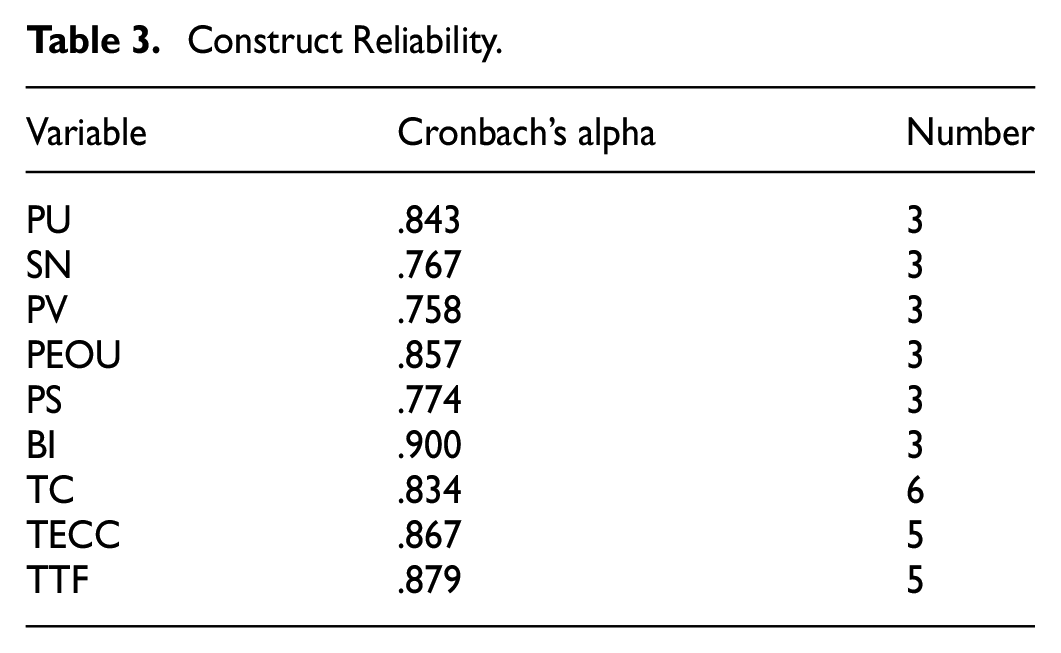
The reliability and validity of the data were analyzed using SPSS 25.0 in this study, including descriptive statistics, internal consistency, reliability, and validity. The main factors were measured using scales. Firstly, internal consistency was analyzed using Cronbach’s alpha coefficient method to assess the reliability of each dimension. The Cronbach’s alpha coefficients for each item ranged from 0 to 1. In this analysis, the reliability coefficients for each secondary dimension in the scale ranged from .75 to 1, as shown in Table 3. Additionally, the validity analysis indicated a Kaiser–Meyer–Olkin (KMO) measure of .86, significantly higher than the minimum requirement of .05, indicating its suitability for exploratory analysis. Thus, it can be concluded that the scales used in this study exhibit good internal consistency and reliability.
Construct Reliability.
Structural Equation Model Fitness Test
The results of the model fit test in Table 4 reveal that the CMIN/DF (Chi-square degrees of freedom ratio) is 1.677, falling within the acceptable range of 1 to 3. Additionally, the root mean square error of approximation (RMSEA) is .069, which falls below the recommended threshold of <.08. Furthermore, the test results for ITI, TL, and CF1 all exceed the acceptable level of .9. Therefore, based on the comprehensive analysis, it can be concluded that the CFA model for this scale demonstrates good fit.
Fit Indices of the Structural Equation Model.

The study targets working designers and university students with a background in design. Researchers employed random sampling to recruit participants, ensuring that participants were informed of the study’s purpose and procedures. After completing the questionnaire, researchers obtained participants’ consent to fill out a paper-based questionnaire to further explore their psychological state changes. In total, 265 survey responses were received. After excluding 39 invalid responses, 226 valid responses were retained, resulting in an effective rate of 85.3%. Specific demographic information of the participants is presented in Table 1. Among them, there were 89 males, accounting for 38.9%, and 137 females, accounting for 61.1%. Design major undergraduate students numbered 123, comprising 54.4%, while 96 participants, accounting for 42.4%, were working in enterprises or design companies. All participants reported having experience with AIGC use. Additionally, 18 participants engaged in semi-structured interviews after completing the questionnaire survey.
Research Result
The study employed the Bootstrapping method to verify the significance of the equation model, as illustrated in Figure 3. Out of the nine research hypotheses proposed in this study, seven were supported, while two were not validated. A detailed analysis is provided below:

Results of model analysis. It explored the effects of task technology fit and technology acceptance mode on designers intention to use AIGC.
The decisive factors influencing designers’ adoption of AIGC include Perceived Usefulness and Perceived Security. Given that AIGC is still an emerging technology, more profound experiences like Perceived Ease of Use and Perceived Privacy are not currently impacting adoption intention. However, with increased usage frequency, it is believed that these factors will also influence designers’ intention and user experience in the future. Furthermore, due to the more efficient working mode of AIGC compared to traditional technologies, which is common knowledge, Technology Characteristics significantly affect Task Technology Fit and Perceived Usefulness. The reason why Task Characteristics do not significantly affect Task Technology Fit is due to usage patterns. While Task Technology Fit significantly influences Perceived Usefulness, it does not directly affect Behavioral Intention because designers have a low frequency of AIGC usage and have not yet established trust or clear needs. It is evident that the features of AIGC are highly compatible with the workflow of the creative industry, and proficiency in applying AIGC has become a fundamental skill for future design. The results of the research hypothesis are shown in Figure 3.
The experimental results indicate that the driving factors influencing designers’ use of AIGC are mostly common-sense factors. As designers’ usage frequency, methods, and requirements increase, the future factors influencing designers’ use of AIGC will become more diverse. With this speculation in mind, we conducted semi-structured interviews after the quantitative study to gain deeper insights into users’ thoughts. The results of the research hypotheses are shown in Table 5.
Hypothesis Test Results.
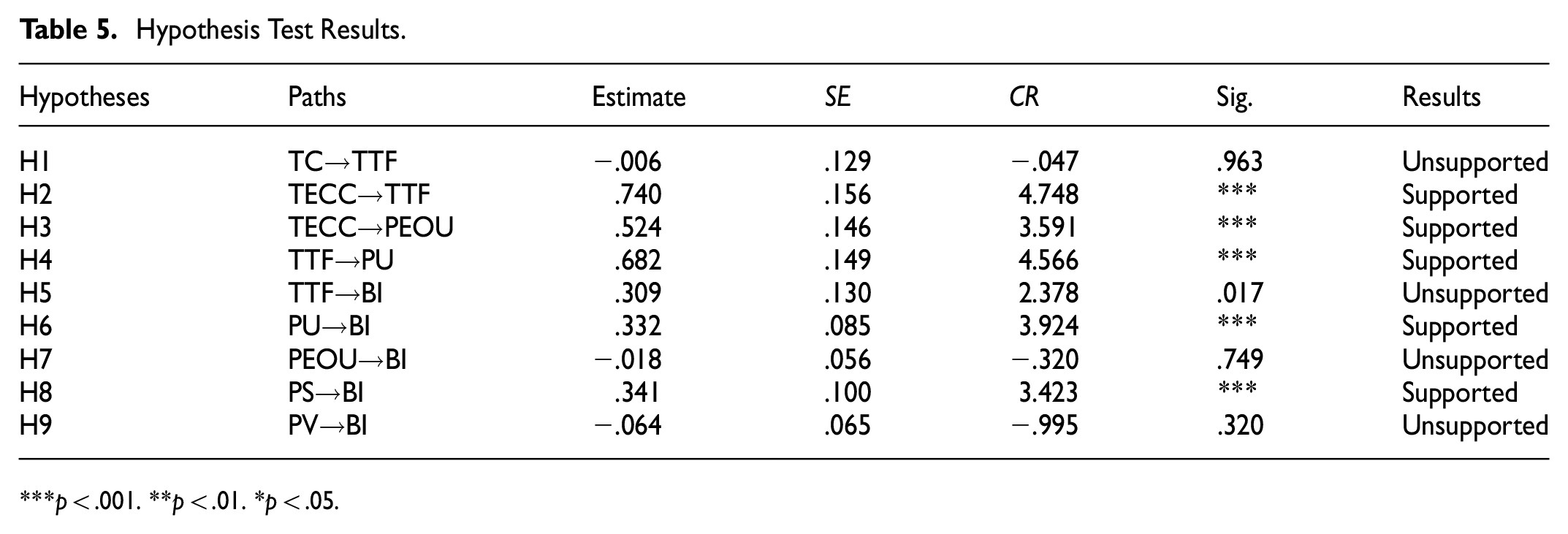
p < .001. **p < .01. *p < .05.
Further insights into respondents’ attitudes and needs regarding AIGC were gathered through post-experiment semi-structured questionnaires. The findings are as follows: (1) Designers who support AIGC tend to be more optimistic and proactive, displaying a willingness to learn new technologies and embrace novelty. They believe that AIGC enhances work efficiency, reduces repetitive tasks, and allows them to focus more on improving their design skills and managerial expertise. (2) Designers with negative attitudes toward AIGC are often influenced by ethical standards and concerns about intellectual property. They perceive AIGC as introducing more uncertainty and higher learning costs, leading to professional insecurity. Table 6 presents more personalized responses.
Main Responses of Semi-Structured Interviews.

Discussion and Conclusions
Discussion
From the perspective of creative design, exploring the technological compatibility from AIGC to AIGD provides empirical research to expand the application scope of AIGC and enhance the intelligent design of the creative design industry. This study constructs a model of designer acceptance of AIGC by integrating Task-Technology Fit and Technology Acceptance Model, and conducts empirical analysis through structural equation modeling. The study indicates that new users supporting AIGC often focus on perceived usefulness, perceived security, and technological features. In contrast, existing users supporting AIGC, due to their mature usage experience, tend to prioritize perceived ease of use, perceived privacy, task requirements, and technological compatibility. Users who refuse to use AIGC are predominantly driven by anxiety and misunderstanding of new technology. These negative factors include high learning costs, uncertain output results, intellectual property risks, and societal ethical constraints.
Based on questionnaire surveys and in-depth interviews, the study identifies trends in the application of AIGC in the creative design industry: (1) AIGC complements designers well. It assists designers in completing tedious design tasks and helps them discover more design elements and potential creative sources through big data analysis and image recognition, ultimately providing more creative inspiration and ideas. (2) Combining AIGC with designers’ intelligence can achieve more efficient and precise design. Designers can utilize AI technology to analyze and process large amounts of data, extract key information and trends, and better understand user needs and market changes. (3) AI technology can assist designers in automated design, design optimization, and rapid prototyping, reducing the workload of designers, and improving design efficiency and quality. (4) Designers need to establish clear task requirements and detailed workflows for AIGC to leverage its advantages. Designers excel in defining goals and requirements, while AIGC excels in reducing repetitive work and providing more design materials and inspiration. (5) When using AIGC, designers must adhere to principles of ethics, law, and autonomous thinking. Designers should not solely rely on AI technology to complete designs but should always maintain their creativity and imagination. Although AI technology can provide more design materials and inspiration, the final design still requires the judgment and decision-making of designers themselves.
Conclusions
The study’s limitations lie in the homogenization of the research sample, failing to differentiate and categorize the needs of design managers, design executors, design assistants, and production manufacturers. Industrial design involves systemic industry-specific processes, involving decision-makers such as product managers, designers, engineers, and marketing personnel. The application of AI design tools can change their collaborative work methods and the resulting work content, ultimately reflecting in improved work efficiency and showcased outcomes. Therefore, the research methodology should incorporate more expert interviews and non-structured questionnaires, as feedback and acceptance of new technologies are more closely related to users’ inner sensory and psychological changes. Additionally, ethical constraints and legal risks of AIGC remain key factors limiting its rapid marketization.
For future research, the following suggestions can optimize the study phase: (1) Expand the scope of research by enriching industry diversity through extending the research subjects. Because the creative design industry can be further subdivided into different sectors such as visual communication design, industrial design, digital media arts, environmental art design, and decorative arts, designers in different sectors may vary in their reliance on and usage of AIGC. (2) Subdivide the research subjects by considering differences in designer backgrounds, such as usage duration, learning backgrounds, proficiency levels, and specific task requirements, all of which are worthy variables for consideration. (3) Enrich the research methods by adding expert interviews and grounded theory in qualitative research to delve deeper into the driving factors behind designer behavior changes.
In summary, AIGC exhibits good technological compatibility in the creative design industry, enabling human-machine collaborative innovation. However, future development should address user concerns regarding security, privacy, legal risks, and social morality. From Artificial Intelligence Generated Content (AIGC) to Artificial Intelligence Generated Design (AIGD), there is still a long technological path and user research journey ahead. Artificial intelligence is a double-edged sword for designers, serving as both an accelerator of work efficiency and an aid in generating larger design sketches. However, all of this hinges on the subjective guidance of designers. Therefore, designers are required to possess more foundational knowledge and macro design strategies to scientifically manage different design tools and workflows.
Supplemental Material
sj-pdf-1-sgo-10.1177_21582440251344044 – Supplemental material for Exploring Drivers of AIGC-Designer Collaborative Innovation
Supplemental material, sj-pdf-1-sgo-10.1177_21582440251344044 for Exploring Drivers of AIGC-Designer Collaborative Innovation by Shao-Feng Wang and Chun-Ching Chen in SAGE Open
Footnotes

Funding
This research is supported by the 2025 Fujian Provincial Social Science Foundation (Grant No. FJ2025B213) for the project "Digital Preservation and Innovative Design of Fuzhou Bodiless Lacquerware Based on AIGD.
Declaration of Conflicting Interests
The author(s) declared no potential conflicts of interest with respect to the research, authorship, and/or publication of this article.
Data Availability Statement
All data generated or analyzed in the course of this study are included in this published article and its supplementary file.
Supplemental Material
Supplemental material for this article is available online.
References
Supplementary Material
Please find the following supplemental material available below.
For Open Access articles published under a Creative Commons License, all supplemental material carries the same license as the article it is associated with.
For non-Open Access articles published, all supplemental material carries a non-exclusive license, and permission requests for re-use of supplemental material or any part of supplemental material shall be sent directly to the copyright owner as specified in the copyright notice associated with the article.
