




Abstract
This study investigates the relationship between belief structures (perceived compatibility, self-efficacy, and subjective norm), behavioral adaptation, satisfaction, and continuance intention of a platform-based ride-hailing service called “Grab” in Vietnam. After applying a questionnaire-based survey method and convenience sampling for data collection, the study collected 439 responses from the current users of Grab. A structural equation modeling procedure was used to verify the hypotheses. The results revealed that, except for the relationship between perceived compatibility and behavioral adaptation, all belief structures positively affect behavioral adaptation and satisfaction. Furthermore, both satisfaction and behavioral adaptation positively affect the continuance intention. Our study also demonstrated the partial and full mediating role of behavioral adaptation between self-efficacy and continuance intention, and between subjective norm and continuance intention, respectively. Our study broadens the current understanding of the relationship mechanism between belief structures, behavioral adaptation, and continuance intention. Theoretically, this study is the first research into the relationships between belief structure, behavioral adaptation and continuance intention, and it also identifies the mediating effects of behavioral adaptation on continuance intention in the platform-based context. Additionally, our study offers insightful implications for firm managers to retain users effectively by boosting the factors contributing to continuance intention.
Introduction
Many of the world’s largest companies are currently doing business on internet platforms, information technology (IT) or digital platforms (DP). Firms such as Alphabet (Google’s mother company), Facebook, Uber, Airbnb (or Alibaba), and many others are all platform-based and have each been given valuations of billions of dollars (Cusumano et al., 2020). DP is often seen as a web-based technology that “allows stakeholders to interact and share experiences” (Ramaswamy & Gouillart, 2010, p. 5). Ride-hailing digital platform (RHDP) refers to innovative mobile applications that facilitate rider-driver interactions for transportation services via internet-enabled mobile devices or smartphones (Joia & Altieri, 2018). In general, a rider sends a request to the nearest drivers via an RHDP, based on which the best rider-to-driver match is established for the trip to be made. A ride-hailing service is also known as ride-sourcing, on-demand ride services, ride-booking, among other names (Tirachini, 2020). This study employs the term “ride-hailing service” and refers to it as prearranged transportation services on a commercial basis using an IT-enabled application (or RHDP) to connect riders with drivers using a personal vehicle (ITF, 2016). Compared to traditional transportation (e.g., street-hailing), ride-hailing services offer a distinctive set of advantages for both riders and drivers such as convenience, transparency (e.g., price matching), localization, ubiquity, resource efficiency (e.g., time, fuel) and accountability (ITF, 2016). The global ride-hailing market is projected to soar from $42 billion in 2020 to surpass $108 billion in 2025 (Businesswire, 2021). The three largest ride-hailing markets are in the USA, China, and Europe with major RHDP players such as Uber and Lyft in the US market, Uber and Cabify in Europe, and Didi Chungxi in China (Joia & Altieri, 2018; Sánchez-Torres et al., 2021). According to Forbes, the world’s two largest platforms, Uber and Didi, were valued at more than $60 billion each by early 2021 (David, 2021).
For the Southeast Asian (ASEAN) region, ride-hailing services, which are the second best performing industry in the internet economy of the region, have exploded to five times their previous total turnover over the past 5 years, reaching $13 billion in 2019 and expected to exceed $40 billion by 2025 (Hoppe & Baijal, 2019). According to Bloomberg, the region’s two major ride-hailing platform providers, platform-based firms such as Gojek and Grab, two key platform providers, are each expanding their services to a full range of offerings (e.g., food delivery and financial services) in order to remain competitive in the ASEAN region (Lee & Alpeyev, 2020). According to Google, Temasek and Bain, the ride-hailing service in Vietnam has the leading growth rate of Southeast Asia, which is at 30% annually, reaching a value of $1.6 billion in 2020 (Hoppe & Baijal, 2019). While the ride-hailing service has the potential for growth, coupled with the competitive challenges from many international (e.g., Grab; Gojek) and domestic (e.g., AhaMove; Be) players, the service is still in its infancy. In addition, because of the novelty of the ride-hailing service, its adoption and dissemination by users are challenged by various issues such as the RHDP’s compatibility with users’ travel practices or the way in which users get used to the RHDP’s features (Joia & Altieri, 2018). Moreover, for platform drivers, other factors such as ride-hailing regulations, contracts with platform firms and customer pressure also affect their usage of RHDP (Fielbaum & Tirachini, 2021; Sánchez-Torres et al., 2021). In addition, ride-hailing firms, including major multinational players such as Uber, have struggled to avoid losses, consolidate their market share, and sustain growth (ABIResearch, 2019). Along with motivating users to adopt and initially use the services, establishing a long-term relationship with users to maintain their continuance intention (CI) to use the RHDP is a key for success in the marketplace (Hsiao et al., 2016; Tam, Santos et al., 2020). Although prior research has provided rich insights into user’s continuance usage of digital platforms (e.g., Liu et al., 2020; Poromatikul et al., 2019; Tam, Santos et al., 2020), only a few studies take into account the user’s adaptation perspective (e.g., Jasperson et al., 2005). Despite the importance of user adaptation and how its driving impact on the decision to continue using IT has been regarded (Bala & Venkatesh, 2016; Bhattacherjee & Harris, 2009; Karahanna et al., 1999), there remains a paucity of empirical evidence on the relationship of the adaptation with the user intention for continued use (Franque et al., 2020; Nabavi et al., 2016). Additionally, the adaptation process of RHDP is indispensable, and some adaptive behavior is unavoidable because a platform will never fit effortlessly into a user situation (Leonard-Barton, 1988; Rubel et al., 2020; Schmitz et al., 2016). Therefore, behavioral adaptation research is fundamentally required to explain how it drives users to post-adoptive continuing use, substantive IT use (Bhattacherjee & Barfar, 2011; Bhattacherjee & Harris, 2009; Jasperson et al., 2005), and ultimately, retaining the firm’s users.
Furthermore, while IT diffusion and usage literature have acknowledged the importance of user beliefs such as perception compatibility and subjective norm on behavioral intention and usage (Ajzen, 1991; Bhattacherjee & Lin, 2015; Joia & Altieri, 2018; Karahanna et al., 2006; Taylor & Todd, 1995), there is currently a paucity of empirical studies investigating the influences of these potential factors on user adaptation and the ultimate outcome of continuance usage in an integrated model. Therefore, this study sets out to fill this gap by examining the effect of users’ adaptation to their continuing usage in the context of a platform-based ride-hailing service. More specifically, this study attempts to answer the following three research questions: (1) What are the determinants of CI? (2) How do these determinants influence each other and CI? (3) What is the mediating role of behavioral adaptation between user belief (i.e., perceived compatibility, subjective norm and self-efficacy) and CI?
To answer these research questions, the proposed research model is based on the underlying theories and model of (1) IT adaptation and its extension, that is, the adaptive structuration theory (AST) (DeSanctis & Poole, 1994) and AST for the individual (Schmitz et al., 2016), (2) the theory of planned behavior (TPB) (Ajzen, 1991) and its extension, namely Decomposed TPB (Taylor & Todd, 1995) and (3) the empirically validated model of IT continuance (ITCM) (Bhattacherjee, 2001). On the one hand, adaptation literature provides solid justification for interpreting user adaptation in IT implementation for firms and individuals. This is essential to explain the IT user’s adaptation process, its antecedents, and more importantly, its likely consequences such as changes in user’s decisions, performance, or behaviors. On the other hand, TPB and its extension DTPB have determined how users’ behavioral intentions and uses are affected by their belief structures (i.e., their attitudes, subjective norms and perceived behavioral controls). After the initial adoption, the user adapts to IT and may generate the intention to continue using the IT. The IT continuance intention is the outcome variable of ITCM, based on which this study expects to investigate the users’ CI to use a ride-hailing platform.
This study makes the following contributions: first, by applying DTPB (Taylor & Todd, 1995) and ITCM (Bhattacherjee, 2001) with the inclusion of users’ adaptation constructs, the study sheds light on the understanding of CI and its determinants with a mediating role of behavioral adaptation that no other research has conducted before. The second contribution is that it investigates the user’s adaptation in the context of a ride-hailing service, so this study enriches the body of literature on adaptation that has not yet addressed the digital platform. This is crucial because, while prior IT research mostly targets “IT adoption,” this study aims to explain how users interact, adapt to a platform and develop the CI of using that platform. This is valuable for firms in realizing the determinants of users’ sustainability, especially in an extraordinarily competitive platform-based business market. In addition, the study results provide practical guidelines for carrying out marketing and user retention strategies for users by promoting the adaptation process to the digital platform.
Literature Review
IT Adaptation
The adaptation concept has been studied in various fields, from psychology to organizational behavior and IT (e.g., Ashford, 1986; Tyre & Orlikowski, 1994). Ashford (1986) claimed that “individuals adapt by tailoring their behavior to fit the demands of their particular environment” (p. 465). Pulakos et al. (2000) reasoned that adaptation was used “to comply with the job-related performance” (p. 613). IT implementation literature (e.g., Jasperson et al., 2005) identified adaptation as one part of the successive six-stage process of organizational IT implementation. Adaptation would lead to the IT routinization and infusion in which implemented IT and work processes were adjusted in order to use the IT “in a comprehensive and integrated manner” and obtain the organizational effectiveness. Leonard-Barton (1988) also argued that implementation is a “mutual adaptation” between technology and the user environment as one which “tries to enhance the productivity” (p. 251).
The diffusion of innovation theory (Rogers, 2003) considered adaptation as “re-invention,” which is where “an innovation is changed or modified by a user in the process of its adoption and implementation” (p. 175). The concept of reinvention of innovative technology (e.g., RHDP) is similar to the IT implementation concepts of “extension of invention” (Leonard-Barton, 1988), “incorporation,” “routinization” (Cooper & Zmud, 1990), and “technology adaptation” (Tyre & Orlikowski, 1994). According to DIT, whenever RHDP is adapted, the diffusion enters the “confirmation” stage, so that the users can continue using the RHDP. In other words, continuing to use RHDP follows users’ early acceptance and may be decided by their adaptation to the IT. DIT also posited that there are five attributes of an innovation affecting its diffusion (e.g., compatibility, etc.).
Adaptive structuration theory or AST (DeSanctis & Poole, 1994) and adaptive structuration theory for individuals or ASTI (Schmitz et al., 2016) have been considered to be strong theoretical lenses for investigating the adaptation process. While AST is often applied to study adaptation at group and organizational levels, ASTI is applied at the individual level. These two theories view the adaptation as a “structuration” process, which is the mutual interaction of IT (i.e., IT functions) and the working environment of the users (i.e., work procedures). In the adaptation process, users acquire, adapt, employ, and modify available structures to fit their individual situations. According to ASTI, the three input “structures” for the adaptation process are technology artifacts, environment or work, and individual characteristics (Schmitz et al., 2016). The outputs of the adaptation process are changes in structures, which involve users’ decision outcomes, better performance (i.e., benefits) and emerging structures in IT implementation for both firms and users (DeSanctis & Poole, 1994; Schmitz et al., 2016). Despite significant contributions to adaptation literature, ASTI only explained how the adaptation mechanism mediates the impact of just a couple personal factors (i.e., innovativeness; self-efficacy) on a particular dependent variable (i.e., performance) as the outcome. Other potential antecedents of IT adaptation (e.g., technology, social influence attributes) and their associate linkages with post-adaptive outcomes remain open for future studies (see Schmitz et al., 2016, p. 683).
The individual adaptation of an IT model (ITA for short) (Bhattacherjee & Harris, 2009) defined adaptation behavior as the extent to which users modify both the IT and their work processes to fit users’ needs and situations (Bhattacherjee & Harris, 2009, pp. 39–40). Following AST and in combination with an acceptance technology model (TAM) (Davis et al., 1989), the ITA model has been developed to examine the adaptation process (determined by AST) with its input factors (as determined by TAM). According to ITA, TAM-based attributes (i.e., perceived adaptation usefulness, IT adaptability, and ease of adaptation) were significant determinants of IT individual adaptation. However, the comprehensive account still leaves potential antecedents (e.g., social factors) and the outcome variables (e.g., performance, continuance) for future research (Bhattacherjee & Harris, 2009, p. 39).
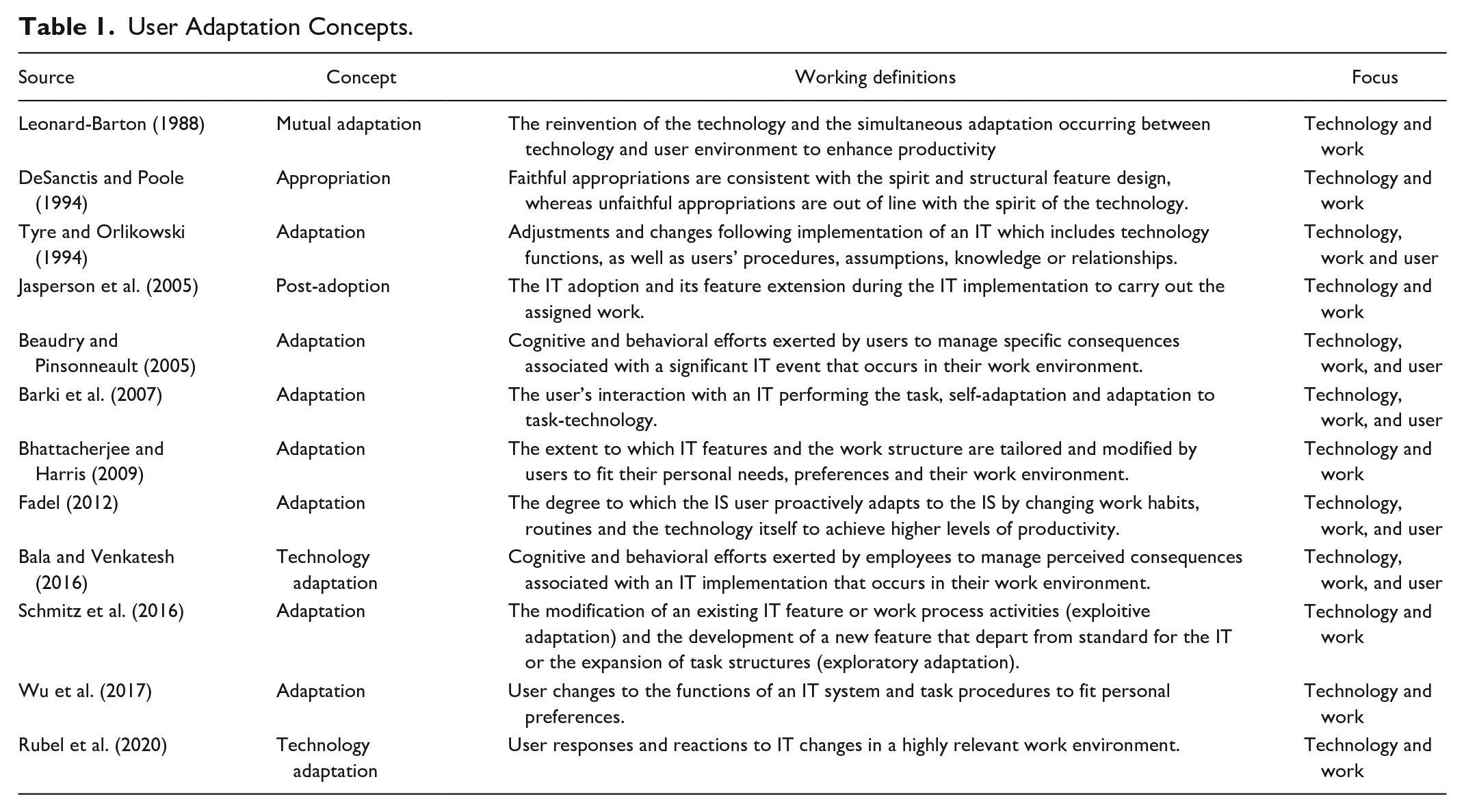
The coping model of user adaptation, or CMUA (Beaudry & Pinsonneault, 2005) defined adaptation behaviors as “efforts exerted by users to manage specific consequences associated with a significant IT event that occurs in their work environment” (p. 496). Thus, the CMUA relates IT adaptation to how individual user behaviors perform on the IT (i.e., IT features), the work (i.e., work procedures) and the users themselves. Similarly, the information system use-related activity (or ISURA) framework (Barki et al., 2007) conceptualized IT behavioral adaptation, or ISURA, as a combined construct of three components involving technology interaction, task-technology and self-adaptation. While CMUA is based on the coping theory which relates to an individual user’s adaptation acts and coping efforts in response to occurrences in his/her environment (Folkman & Lazarus, 1984, pp. 494–495), ISURA relies on the framework of a task-technology fit (TTF) (Goodhue & Thompson, 1995) and interaction behaviors in IT (Doll & Torkzadeh, 1998). According to ISURA, users’ activities (adaptation behaviors) performing on IT (i.e., interaction, task-technology and the specific user’s self-adaptation) affects the outcome achievement. For both CMUA and ISURA models, adaptation behaviors lead to better performance, satisfaction and whether users stay or exit the IT (Barki et al., 2007; Beaudry & Pinsonneault, 2005). Table 1 summarizes empirical research in IS fields that has studied behavioral adaptation. Based on multiple conceptualizations of the individual adaptation of IT, for the context of IT-enabled ride-hailing service (RHDP), this study defines it as the extent to which individual users adjust, modify the RHDP features, work procedures, and themselves to accommodate the platform, and also to fit their needs and situations. User adaptation to RHDP can influence user satisfaction with the platform, post-adoptive extended use and the decision to stay with the service platform (Bala & Venkatesh, 2016; Barki et al., 2007; Bhattacherjee & Harris, 2009).
User Adaptation Concepts.
IT Continuance
IT users’ continuance in information systems (IS) literature is similar to retention and repurchase by customers from in-marketing and customer behavior literature (Bhattacherjee, 2001). While the early adoption of IT is a primary phase, the sustainable success of IT depends on repeated usage by the users rather than the initial use (Bhattacherjee, 2001; Venkatesh et al., 2011). Drawing on the Expectation-Disconfirmation theory (EDT for short) (Oliver, 1980) and integrating it with TAM, Bhattacherjee (2001) proposed ITCM, which claimed that IT continuance intention depends on the users’ satisfaction with the IT, expectations from prior IT use (confirmation) and post–adoption (perceived usefulness). IT continuance is extensively studied in IS literature as post-acceptance stages, in which users first experience the IT and then continuously use it.
Although the term IT continuance intention is often expressed in different ways, all references mean the intention or decision to continue using the IT. Agarwal and Prasad (1997) defined “future use intentions” as “intentions to use the innovation in the future,” or as an influencer of “current use” (p. 568). Bhattacherjee (2001) asserted that “users’ decisions to continue using IT in the long run are in contrast to IT acceptance, which focuses on the users’ initial or first-time decisions to use the IT” (pp. 351–352). The study by Tulu et al. (2006) illustrated that the “intent to continue using” is a resolution for “loyal use,” and “consistent, ongoing, routine behaviour” (p. 642). Limayem et al. (2007) defined continuance intention as “a series of individual decisions to continue using a particular IS” and “the decisions to continue to use an IS following an initial adoption decision” (p. 707). While comparing CI to the intention to repurchase in marketing, Lu (2014) defined CI as “a mental state reflecting an individual’s decision to repeat his or her current behaviour” (p. 138). Motohashi et al. (2012) argued that the “intention to subscribe” and the “intention to re-use” IT service (i.e., an interactive internet television) are outcome variables of the IT diffusion process (p. 315). Furthermore, DeLone and McLean (2016) argue that the “intention to reuse” is a key measure of IS use in the early days of Web 2.0 and e-commerce (p. 57). Regardless of the variations in the definition, researchers see IT continuance as routinizing IT usage and ongoing activity (Lee & Kwon, 2011). Based on earlier conceptualizations, this study defines the IT continuance intention to be the users’ intention to continue using the IT.
Research on IT continuance has applied various theories and models (Nabavi et al., 2016) such as TAM (Davis et al., 1989), the theory of reasoned action (TRA) (Fishbein & Ajzen, 1975), TPB (Ajzen, 1991), decomposed TPB (Taylor & Todd, 1995), unified theory of acceptance and use technology (UTAUT) (Venkatesh et al., 2003), and the IS success model (DeLone & McLean, 2003, 2016). Besides this, a plethora of factors influencing IT continuance have been investigated such as, for example, user perceived value by Chen and Fu (2018) in the context of image-based social platform, trust by Zhang (2020) in the online tourism context, network externality by Gao and Bai (2014) in social networking services, and risk by Cheng et al. (2019) for a bicycle-sharing service. A multiple perspective is also applied by IT continuance research such as Bhattacherjee and Lin (2015), which investigated how IT continuance is influenced by three drivers, namely, reasoned action, experiential, and habitual response. Despite intensive studies being made on IT continuance intention with the application of diverse theories and research models for multiple contexts to date (Franque et al., 2020; Nabavi et al., 2016), no empirical evidence has been reported on the relationship between CI and user adaptation, which is a potential factor affecting continuance usage (Bhattacherjee & Barfar, 2011).
Theory of Planned Behavior (TPB) and Decomposed TPB (DTPB)
Both TPB and DTPB are widely used to explain the linkages between users’ belief structures (i.e., attitude, subjective norm and perceived behavioral control) with behavioral intention and usage. While TPB addresses the belief structures as combined and unidimensional constructs, DTPB decomposes these same belief sets into multi-dimensional constructs (Taylor & Todd, 1995, p. 150). Decomposed TPB brings more advantages over TPB such as introducing multiple determinants of belief sets across settings and emphasizing the influencing factors for intention and usage. According to DTPB, (1) behavioral beliefs are split into three components of complexity, relative advantage and compatibility; (2) subjective norm is derived from normative beliefs; (3) efficacy and facilitating conditions are decomposed from control beliefs. Researchers have largely applied TPB and DTPB to investigate user adoption and continuance usage of IT- enabled services and systems. While Hsu and Chiu (2004) examined users’ CI by using electronic services (web-based tax) with DTPB constructs and satisfaction as a mediator of their relationships, Ajjan et al. (2014) investigated planned behavior factors for users’ continuous usage of enterprise instant messaging applications and their knowledge outcome activities in the organization. Another approach was derived by Merikivi and Mantymaki (2009), who investigated the continuance use of virtual social networks by integrating DTPB concepts with critical mass and the quality of rivals. Regarding the digital platform context, while Khoi et al. (2018) explored the strong effects of planned behaviors factors (e.g., attitude, subjective norm and perceived behavioral control) on mobile commerce adoption, Joia and Altieri (2018) observed the significances of DTPB user beliefs (e.g., subjective norm, compatibility) on satisfaction and continuance in ride-hailing service platform context. Thus, the DTPB approach and its factors can explain the behavioral intention and usage in the ride-hailing service context. These factors (i.e., user belief structures) are contextually selected and may become potential influencers of users’ adaptation to the digital platform and their continued use (Bhattacherjee & Barfar, 2011; Bhattacherjee & Harris, 2009; Joia & Altieri, 2018; Taylor & Todd, 1995).
Research Model and Hypothesis Developments
Based on the above literature review, we propose the research model to investigate the continuance intention toward RHDP and how it is influenced by users’ behavioral adaptation. This is an extension of the continuance model which was drawn from the IT continuance model (Bhattacherjee, 2001), adaptive structuration theory for individual (Schmitz et al., 2016) and the decomposed theory of planned behavior (Taylor & Todd, 1995). As mentioned earlier, while IT usage has been studied intensively, the literature has ignored the adaptation, its causes and effects in IT implementation. So far, no empirical work has explicitly explained the linkage of IT adaptation and IT continuance. For the IT platform usage setting, adaptation behaviors may take place via modifications to the technology, yet in others, users choose to adapt their individual task process in their workplace. In either circumstance, adaptation behavior will improve the fit between each individual’s task and technology, making users satisfied with using technology and prompt them to use the tailored technology and to go on using it. For RHDP, once the platform is downloaded and installed on their smartphone, registered users can begin the initial usage process, and gradually adapt to the platform through activities such as adjusting its features (e.g., location sharing), learning how to use new service functions (e.g., trip planner), changing work and travel schedules, and requesting the helpdesk. Thus, post-adoptive usage behaviors performed by users with RHDP will likely lead to the fitness between users and the platform that motivate the user to continue using the adapted platform.
Continuance Intention (CI) and Satisfaction (SA)
The concept of CI in an IS context is similar to customer’s retention and repurchase from marketing and customer behavior literature (Bhattacherjee, 2001; Venkatesh et al., 2011). Continuance usage is studied in digital platform literature as post-acceptance and post-adoptive stages, in which users continuously use the mobile apps within various services (Poromatikul et al., 2019; Tam, Santos et al., 2020). For EDT, satisfaction (SA) is determined by prior experience with the product and, in turn, influences their intentions to reuse that product (Oliver, 1980). EDT argues that consumers decide to repurchase a product or continue using a service based on their satisfaction of prior use of that product or service. In the IS context, satisfaction is conceptualized as the “affective attitude toward a computer application” (Doll & Torkzadeh, 1988, p. 261), and as a result of users’ interactions with that IS. According to the IS success model, the interrelationship between users’ usage and their satisfaction is reasonably established; a positive experience with the adaptation/usage of IS likely results in more satisfaction with that IS. Only satisfied IS users will continue to use the existing IS while those who are dissatisfied will likely drop that IS for a new system (Deng et al., 2010; Susanto et al., 2016). The direct influence of satisfaction on continuance intention has been studied in a multitude of contexts (Franque et al., 2020; Nabavi et al., 2016) such as in online tourism (Liu et al., 2020), mobile commerce (Gao et al., 2015), e-learning (Joo et al., 2017), health applications (Alsyouf & Ishak, 2018), and e-government (Veeramootoo et al., 2018). In the context of a digital platform, the significant relationship between satisfaction and continuance intention was also examined by authors such as Cheng et al. (2019) in bike-sharing, Alalwan (2020) in food-delivering and Poromatikul et al. (2019) in mobile banking, to name a few.
According to the IS success model, the interrelationship between users’ usage and their satisfaction is reasonably established, and positive experience with the adaptation/usage of IS is likely to result in more satisfaction with that IS (Bala & Venkatesh, 2016; DeLone & McLean, 2003). While user adaptation has been considered as a post-adoptive behavior promoting extended use, continued use and satisfaction (Bala & Venkatesh, 2016; Bhattacherjee & Barfar, 2011), little research has been conducted to date on the relationship between usage-satisfaction (e.g., Aldholay et al., 2018; Isaac et al., 2017, 2019). Furthermore, although the relationships between behavioral adaptation, user satisfaction and continuance intention have also been proposed (Barki et al., 2007; Bhattacherjee & Barfar, 2011), prior studies on digital platform service systems have rarely investigated the interrelationships between adaptation, CI and satisfaction (Faber & de Reuver, 2019; Franque et al., 2020; Nguyen & Ha, 2021), these links between the three constructs are yet to be confirmed in the ride-hailing service settings. In a RHDP context, the more users perform the adaptation process (i.e., learning how to use platform services or adjusting the platform features accordingly on a smartphone, etc.), the more likely they are to have already adapted to the platform, and to make the platform a better fit for themselves, so they will be satisfied with the platform and continue to use it (Bala & Venkatesh, 2016; Barki et al., 2007; Beaudry & Pinsonneault, 2005). Drawing on the previous literature, we expected the positive links between SA with CI and between BA with SA and CI. Thus, we propose the following hypotheses:
H1: Users’ SA with RHDP is positively associated with CI.
H2: Users’ BA with RHDP is positively associated with SA.
H3: Users’ BA with RHDP is positively associated with CI.
Perceived Compatibility (PC)
Compatibility is defined by Rogers (2003) as a user’s perception of how an innovative technology, such as a ride-hailing service, matches or fits in with his or her current values, prior experiences and needs. In this study, PC is defined as the perception of users about the fitness of the digital platform to handle tasks and situations in their workplace. Compatibility is a technology attribute that is expectedly associated with adoption and may drive potential users to use the platform (Marinković et al., 2020; Su et al., 2018). In practice, the digital platform that is perceived by users as having more compatibility (given that other technological attributes are unaffected) will be used and adapted more promptly than others. Prior empirical research findings recognized a positive correlation between users’ perceived compatibility and their adoption of IT (Agarwal & Prasad, 1997; Isaac et al., 2019; Peña-García et al., 2020). Additionally, in the digital platform context, prior studies demonstrated that the higher the perceived compatibility of a platform is, the more confidence users have when adapting it or performing activities with that platform (Chau et al., 2020; Joia & Altieri, 2018; Karahanna et al., 2006); furthermore, users will be more satisfied by their experience with the compatibility of that platform (Isaac et al., 2019; Islam & Azad, 2015; Joia & Altieri, 2018). Accordingly, we hypothesize the following:
H4a: User’s PC of RHDP is positively associated with BA.
H4b: User’s PC of RHDP is positively associated with SA.
Self-Efficacy (SE)
Bandura (2010) defined “perceived self-efficacy as people’s beliefs about their capabilities to produce effects” and claimed that “self-efficacy beliefs determine how people feel, think, motivate themselves and behave” (p. 1). Ajzen (1991) also argued that facilitating conditions and self-efficacy, which were decomposed from a structure of control belief, will affect both user’s behavioral intention and actual behavior. Compeau and Higgins (1995) introduced computer self-efficacy, in an early computing technology setting, as a user’s ability and skill to perform a behavior. Prior empirical research by Bhattacherjee and Harris (2009), Compeau and Higgins (1995) and Sharif and Raza (2017) studied IT self-efficacy and investigated its positive relationship with behavioral intention. For the context of the IT platform, while Kang and Lee (2015) argued that self-efficacy is a significant predictor of continuance intention toward online instant services, (Thakur, 2018) demonstrated that self-efficacy is positively associated with continuance intention toward the mobile shopping platform and Aldholay et al. (2018) noted that self-efficacy (SE) affects users’ behavioral usage activities (i.e., behavioral adaptation) in online learning applications. In line with these findings, we hypothesize the following:
H5a: Self-efficacy is positively associated with CI.
H5b: Self-efficacy is positively associated with BA.
Subjective Norm (SN)
DTPB conceptualizes subjective norm as a crucial social attribute directly influencing behavioral intention. Subjective norm is the perceived social pressures (e.g., pressure from important people) whether or not to carry out certain actions (Ajzen, 1991; Mathieson, 1991). In this study, subjective norm is considered as opinions, advice, or suggestions from important referents (i.e., friends, family, and colleagues) for users to use or to adapt to the platform (Marinkovic & Kalinic, 2017; Moore & Benbasat, 1996; Wang et al., 2014). The significance of the relationship between subjective norm and satisfaction, behavioral intention and the usage of a platform have been endorsed by previous studies such as Liébana-Cabanillas et al. (2015) in mobile payment, Lin (2007) in online shopping and Si et al. (2020) in bike-sharing platform. The more the users are encouraged, the more likely they are to adapt to the platform with confidence and assertion. Fu and Juan (2017) revealed that subjective norm affects both users’ satisfaction and their continuance intention in the public transport context. Zhao and Bacao (2020) noted the considerable effect of subjective norm on user satisfaction continuance intention in the food-delivery platform. Hence, it is postulated as follows:
H6a: Subjective norm is positively associated with BA.
H6b: Subjective norm is positively associated with SA.
Methodology
Data Collection and Sample
To examine users’ adaptation to digital platforms, a ride-hailing service platform is selected due to its high level of interaction between multiple actors/users and between the users and the platform itself (Breidbach & Brodie, 2017). The company named Grab occupies the largest market share among ride-hailing service platforms in Vietnam, with more than 73% of the market, five times as much as the second highest, Go-Viet (currently Gojek, www.gojek.com). According to the research of ride-hailing services in the Asia Pacific region (ABIResearch, 2019), after acquiring Uber’s operations in Southeast Asia in spring 2018, Grab was almost “alone in a market” in the regional market. Grab Vietnam currently runs a super-platform multiservice business which dominates ride-hailing as well as other on-demand services (e.g., food delivery, package express and financial payments). For this research, the survey respondents are drivers (named by Grab Vietnam as driver-partners) who are using the Grab platform for their individual benefits. Participants were selected based on the following two criteria: (1) having the Grab platform downloaded and operating on their smartphones, and (2) wearing Grab’s requested uniform. Before data collection, the questionnaire was pretested on a small, representative group of respondents (n = 30) using face-to-face interviews. The interviewees for the pre-test were platform-based firms’ managers, scholars in management information system fields, mobile application specialists and ride-hailing service drivers. The objective of this pre-test was to assess whether any questions were too difficult to answer due to sentence length, wording or special terminology (Colton & Covert, 2007, p. 140), thus ensuring the construct validity of the questionnaire (Shadish et al., 2002). The questionnaires were translated into Vietnamese and then back into the original English to ensure the accuracy of the translated version (Parameswaran & Yaprak, 1987), with support from three independent translators and English language lecturers). Finally, the questionnaire was developed in two parts following a screening question and a brief introduction to engage the respondents’ interests. The first and main part contained 21 items of theoretical constructs of the study and the second part collected the respondents’ demographic details.
This study used data based on 439 face-to-face, paper-based interviews over 5 months, from September 2019 to February 2020, using the convenience sampling method. The total of 600 respondents who are Grab drivers were asked across the country, including the three biggest metropolitans (i.e., Ho Chi Minh city, Hanoi, and Danang) and three less developed provinces, randomly selected from the remaining provinces. These provinces were Dong Nai in the Southeast region, Long An in the Mekong Delta and Quang Ninh, a coastal border province in the Northern region. Prior to field data collection, selected interviewers who are senior business management students or ride-hailing service staff members (i.e., part-time clerical collaborator from Grab’s offices) received training on interview skills (e.g., sticking to the original order of the questions, not paraphrasing and shortening questions, and not suggesting answers) to ensure a high response rate and prevent response bias.
Interviews for the data collection were conducted in selected provinces and cities and are described next. Trained interviewers, who were randomly assigned to each area of the town, carried out the personal (face-to-face) and paper-based surveys of drivers at convenient places such as corner street cafés, parking areas of shopping centers and petrol stations. The proper time to reach a potential driver for the interview was during off-peak hours when the driver is not driving and is waiting for passengers. Once they had completed the survey form by answering every question, the drivers each received a gift worth about $1 or 75 English pence (such as a mobile recharge card or a drink) from the interviewer. On the day of the interview, some respondents who suggested that they could complete the questionnaires later via email or other media received a link to the questionnaire from the interviewers with a two-week deadline to respond. Of the 600 invited respondents, 439 completed the questionnaire, which accounted for 73.2%, and none of the items contained missing data.
All respondents were aged between 18 and 45 years old. Males accounted for 95.2% of the respondents and females only 4.8%. In terms of the educational levels, the sample respondents with a high school education and college or higher degree accounted for 40% and 18%, respectively. Students studying at universities and colleges accounted for 36% of the respondents, and the remaining 6% had less than 12 years of schooling. Regarding the occupational patterns, 46% were full-time drivers, and the remaining 54% were part-timers to earn extra income, including 39.2% who were university students and 14.8% were employees. As the majority of respondents (92%) have already worked with (i.e., they had downloaded and tried) at least one ride-hailing platform (e.g., Be, Gojek, AhaMove), only a very few (8%) have just entered the ride-hailing service with the Grab platform.
Measurement
This paper employed a 5-point Likert scale in which “1” indicates “strongly disagree” and “5” indicates “strongly agree.” Satisfaction was measured using four items from Bhattacherjee (2001) and Fang et al. (2011). Continuance intention was measured using three items from Bhattacherjee (2001). Subjective norm was measured using three items from Mathieson (1991). Perceived compatibility was measured using three items from Moore and Benbasat (1996) and Taylor and Todd (1995). Self-efficacy was measured using four items from Bhattacherjee et al. (2008) and Venkatesh et al. (2003). Finally, behavioral adaptation was measured using four items from Barki et al. (2007) and Wu et al. (2017).
Data Analysis
The Anderson and Gerbing (1988) approach involves two steps and was employed in this study, using an IBM SPSS AMOS 24. First, a measurement model was established and tested for reliability, convergent validity and discriminant validity following the confirmatory factor analysis (CFA) procedure. Next, a structural model was established in order to check the significance of paths. A reliability test was conducted using composite reliability (Bagozzi & Yi, 1988) which should exceed a threshold of 0.60. Convergent validity, based on Anderson and Gerbing (1988), was checked for the significance of the standardized factor loading for each measurement item; the average variance extracted (AVE) used the 0.50 level for every construct (Fornell & Larcker, 1981). Fornell and Larcker’s (1981) criterion for discriminant validity was also checked to ensure that the AVE for every single construct should exceed the squared correlation of that construct with any of the other constructs.
For both the measurement and the structural model, essential fit indices were checked, including χ2 (df), p and others. The cut-off threshold of 0.90 was applied for GFI (goodness of fit), NFI (normed fit) and CFI (comparative fit) (Anderson & Gerbing, 1988). The RMSEA (root mean square error of approximation) should be lower than 0.08 and the SRMR (standardized root mean square residual) should be 0.08 or less (Hair et al., 2018).
Findings
Measurement Model Evaluation
Initially, there are two key assumptions to be handled. This means that there should be no outliers in the dataset and also that the data are normally distributed (Byrne, 2016; Kline, 2015). Data screening detected no outliers. In terms of normality, there is no concern about the departure from multivariate normality in the data if the ratio of respondents per measured variable reaches 15 (Hair et al., 2018). Since the ratio found in this study is close to 21:1, it can be concluded that there is no violation of multivariate normality.
During the CFA process, a refinement was made by removing four items (i.e., PC1, SE2, BA1, and BA3) because of their levels of covariance between the error terms (Arbuckle, 2006, 2012). For the measurement model with remaining indicators, all relevant fit measures, such as standardized factor loading (SFL), the CR and the AVE are presented in Table 2. The factor loadings (ranging from 0.559 to 0.794) are all acceptable and statistically significant at the 0.001 level (Anderson & Gerbing, 1988). The CRs range between 0.675 (perceived compatibility) and 0.828 (satisfaction) which are well above the threshold values (Bagozzi & Yi, 1988). Additionally, all AVEs range between 0.501 (CI) and 0.546 (satisfaction), which are satisfactorily accepted at the 0.50 level, implying that the convergent criteria were met. The Cronbach’s alpha values range from between 0.679 (perceived compatibility) and 0.827 (satisfaction), suggesting that the constructs are internally consistent with the proposed threshold of 0.60 (Hair et al., 2018; Nunnally & Bernstein, 1978). As shown in Table 1, the model fit indicators proved the excellent fitness of the measurement model by the empirical data. More specifically, chi-square χ2 was 201.867 (df = 104, p = .000), CMIN/df was 1.941, SRMR was .043, RMSEA was .046, GFI = .948, TLI was .943 and CFI was .957 (Anderson & Gerbing, 1988; Bollen, 1989; Hair et al., 2018).
CFA Analysis With Reliability and Validity.

Note. ***denotes significant at p < .001; (d) denotes items ignored during the validity and reliability test.
Model fits: ***p < .001; χ2 = 201.867; CMIN/df = 1.941(<3); RMSEA = .046(<.08).
CFI = .957(>.9); AGFI = .94825 (>.8); TLI = .9435 (>.9); GoF = .94825 (>.8).
Furthermore, the discriminant validity was also achieved since none of the squared correlations surpassed the AVEs. Table 3 shows the correlations and the discriminant validity.
Correlation and Discriminant Validity.

Note. The diagonal line of the table presents values of square roots of AVEs.
Structural Model Evaluation
The next part is to continue with the path analysis and the structural model. A maximum likelihood estimation is applied to validate the hypothesized paths as outlined in Figure 1. Model fit statistics revealed that χ2 was 203.828, p = .000 with 107 degrees of freedom (df). The χ2/df (1.905) was between 1 and 3, suggesting parsimony of model. The RMSEA was .045, SRMR was 0.043, while CFI and TLI were .957 and .945, respectively. The results revealed that the model yields both absolute and incremental goodness of fit as stated by Hair et al. (2018) and Hu and Bentler (1999). This is except for the hypotheses H2 and H4a, where all associations were significant with p < .05. The model fit indices were adequate, that is, Chi-square statistic=1.920 (<3); AGFI = 0.925 (>.8); TLI = 0.944 (>.90); CFI = 0.957 (>.90); RMSEA = 0.046 (<.08). Table 4 indicates that seven out of nine hypothesized paths were empirically supported. The results of all analyses are presented in Figure 2.

Theoretical model.
Results of Hypothesis Testing.

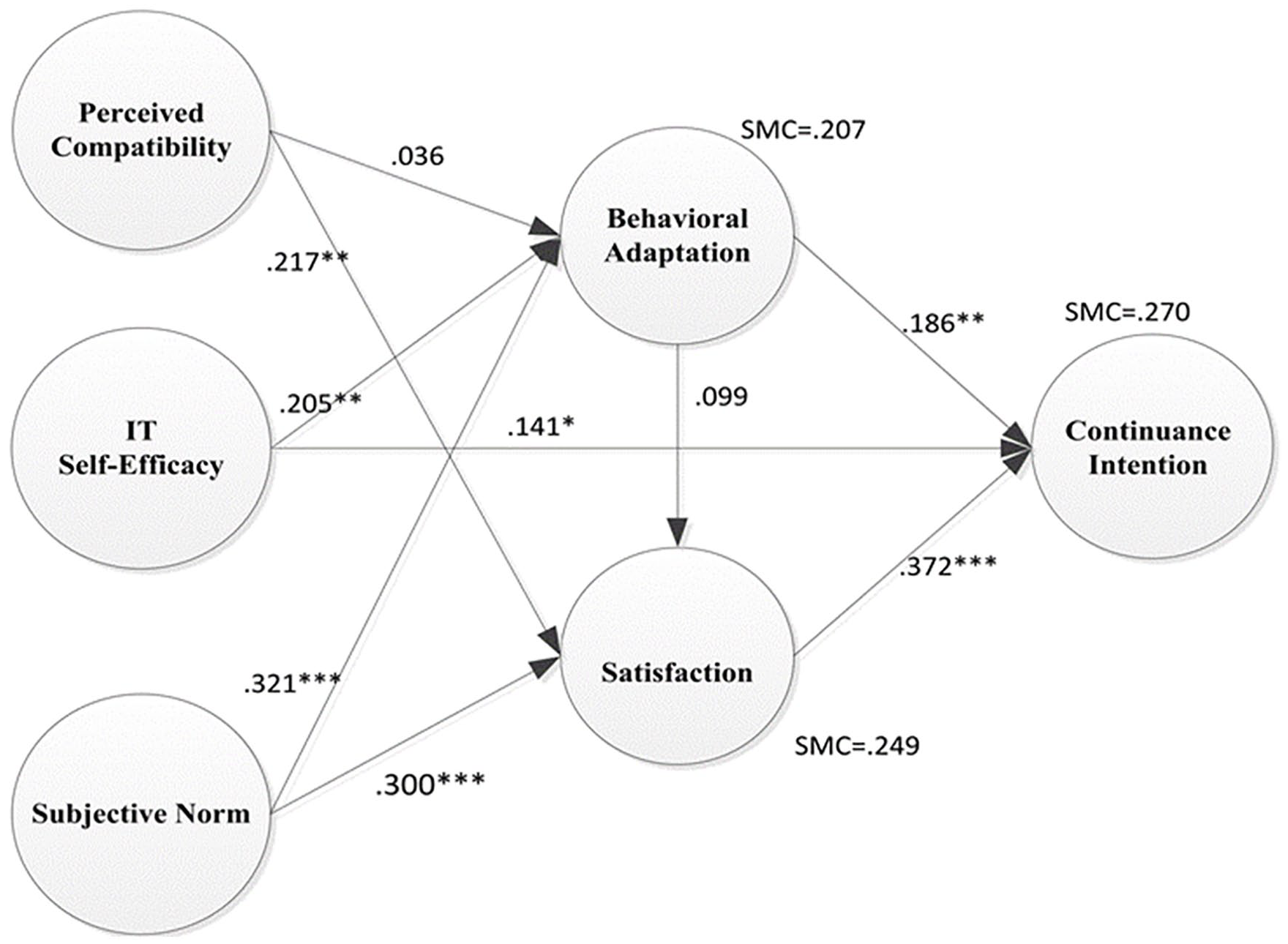
Results of structural model.
Squared multiple correlations (SMCs) in the structural model indicate the strength of the structural relationships (Hair et al., 2018). In our structural model, perceived compatibility, subjective norms, and self-efficacy jointly account for 20.7% variance of behavioral adaptation. Among them, perceived compatibility had no relationship with users’ adaptation (PC-BA or H4a was insignificant), whereas subjective norm and behavioral adaptation (SN-BA) had the most positive linkage (β = .321, p < .001). Similarly, subjective norm, perceived compatibility, and behavioral adaptation jointly account for 24.9% variance of satisfaction. Conspicuously, the empirical finding showed insignificant association between satisfaction and behavioral adaptation (BA-SA or H2 was unsupported), while subjective norm and self-efficacy upheld the strong association (β = .300, p < .001). When it came to their turn, satisfaction, behavioral adaptation and self-efficacy jointly accounted for the 27% variance of CI, with the weakest linkage being SE-CI (β = .141, p < .05) and H5a continued to be supported, while the most positive association was SA-CI (β = .372, p < .001), and H1 was most significant hypothesis in this study. Finally, and most impressively, our novel hypothesized positive relation between behavioral adaptation and CI was satisfactorily confirmed by the empirical result (β = .186 with p < .01).
Evaluation of Mediating Effect of Behavioral Adaptation
Furthermore, a mediation analysis using the bootstrapping method was performed to understand the relationship between the belief structures, BA and CI, fully (Preacher & Hayes, 2008). A 95% level of bias-corrected confidence interval was set, and the analysis performed 5,000 bootstrap samples. Our findings indicated that PC does not significantly affect BA, although BA significantly affects CI. Additionally, our study also revealed a partial mediation of BA in the positive association between SE and CI. Furthermore, the relationship between SN and CI was fully mediated by BA. Table 5 exhibits the mediation analysis results.
Test for Mediation Using Bootstrap Analysis with a 95% Confidence Interval.

Note. ** p < .01; (ns) non-significant at p < .05. Bootstrap sample = 5,000 with replacement.
Discussion and Implications
Discussion
Interestingly, little attention has previously been paid to consider systematically how BA may both theoretically and empirically form a relationship between CI and the belief structures. To fill this research gap, our study proposes a model delineating how different belief structures enable BA and satisfaction, which then influences CI. By demonstrating that BA mediates between PC, SE and SN, and CI, the empirical findings largely support our hypothesized model. Simultaneously, our findings underline the importance of BA as both a primary benefit of belief structures and a major driving force of CI.
Our study examined the relationship between continuance intention and its determinants in a ride-hailing context in Vietnam. The most interesting finding of this study is that behavioral adaptation statistically impacts on continuance intention. This finding is in line with the argument of DeLone and McLean (2016, p. 57), who asserted that “intention to reuse” is contextually aligned to the purpose of the IS usage and the measure of the IS success outcome. In our ride-hailing context, this means that, as users spend more time and effort adapting (to) the Grab platform, they have more intention to continue using, thus leading to the success of the adapted Grab platform.
Our results also indicate that the relationships which IT self-efficacy has with both behavioral adaptation and continuance intention are positive. These results are in alignment with prior studies, including Bhattacherjee et al. (2008), Taylor and Todd (1995), and Thakur (2018) across the contexts from public service and collegial computer support systems to mobile commerce application, respectively. The findings also show that IT self-efficacy encourages users to undertake the adaptation to the Grab platform, that is, a mobile application, with their own effort, by customizing or modifying the platform functions. Thus, after adapting to the platform, users are motivated to continue using the platform.
Additionally, our findings have shown that the relationships of subjective norm with both behavioral adaptation and continuance intention are positive. These findings support the results of several previous works in the same field (e.g., Marinkovic & Kalinic, 2017; Moore & Benbasat, 1996), indicating that users’ adaptation behavior and their satisfaction are intensively affected by the subjective norm. In our platform-based context, Grab platform users follow their colleagues, classmates or family members to use and adapt to the Grab platform for gaining individual benefits.
Moreover, the results also showed that perceived compatibility holds a significant association with satisfaction and supports the results of previous studies (e.g., Islam & Azad, 2015). The users’ perceptions of the compatibility of the Grab platform, together with a significant person’s influence, certainly affects user satisfaction, leading to one’s continuance intention to use the platform.
In line with the findings of previous studies (e.g., Gao et al., 2015; Joia & Altieri, 2018), satisfaction is statistically associated with CI. This indicates that satisfaction with the adapted digital platform is a strong factor leading to a user’s continuance intention. In other words, Grab platform users could continue to use the platform after they have spent time and effort using and are satisfied with the application. This will make the platform more compatible with their jobs.
Contrary to expectations, our work finds an insignificant relationship between perceived compatibility and behavioral adaptation. There are three possible explanations for this insignificance. First, as Grab drivers perceive the fitness of the platform, they do not go beyond the embedded functions of the IT platform, yet simply use those appropriate functions “as given” for accomplishing specific individual tasks (see, e.g., Barki et al., 2007; Doll & Torkzadeh, 1998). It is also possible that, with its experience in platform design and implementation, Grab seems to provide a ride-hailing platform that is considered to be compatible with most ordinary smartphone users in Vietnam after being successful in several Southeast Asian countries (ABIResearch, 2019; Hoppe & Baijal, 2019). Second, in this period of rapidly evolving mobile application technology, users are more confident with the updates and modifications of the mobile apps. In the case that Grab has upgraded its platform with new updates or included new services and, if the modifications are not much different from the existing version and features, users will use them without needing adjustment or adaptation. Third, the insignificance may be due to cultural influencers such as individualism and uncertainty avoidance of the country of study (Muñoz-Leiva et al., 2018; Qi Dong, 2009). While Vietnam has a low uncertainty avoidance score of 30, platform users can be comfortable with innovations different from their experiences. The score of 20 for individualism indicates that the country has a collectivist culture (Hofstede, 2011). The Vietnamese users in a collectivist culture are interdependent and are prone to belonging to “in groups” or tight communities that take care of each other in exchange for membership. Individual actions are consensual and comply with the guidance of firms. Consequently, Vietnamese drivers are more inclined to follow what is being said (i.e., compliance) than to find ways of adapting to what is being said to fit their individual circumstances (i.e., adaptation).
Furthermore, we unexpectedly find that no significant relationship exists between behavioral adaptation and satisfaction. This is not in line with several previous works (e.g., Baroudi et al., 1986; DeLone & McLean, 2003). This may be explained by the finding that, although Grab users spend effort in using and adapting the platform by modifying its functions or adjusting their own work routines, it is possible that they do not find much satisfaction in the process of adapting. Another explanation is that the more users perform adaptive behaviors with the platform, the more they see that its functions need to continue to improve to go on satisfying users. In addition, as the system is used more, it is found to become less effective, and this may in turn, and even in some other cases, reduce user satisfaction (Bokhari, 2005). In other words, a higher degree of users participating in a change of work procedures or modification of a platform does not necessarily lead to positive outcomes, such as user satisfaction (Chen & Chen, 2017). Interestingly, this insignificant relationship possibly occurs in the proportion of the “weak” relationship of “Use–User Satisfaction,” as reported in Petter and McLean (2009, p. 163).
Theoretical Implications
The relationships between the belief structures (i.e., perceived compatibility, subjective norm, and self-efficacy) and continuance intention have been discussed in many previous studies. However, the mediating role that behavioral adaptation may play in such a relationship has not yet been studied. This study is theoretically important because it bridges the gap between belief structures and CI. By developing the model with a sound theoretical base, this study is able to explain the interrelationship between the belief structures, BA and CI.
This study is also important since it is the first to investigate the relationship between the belief structures, BA and CI. Theoretically, this is a pioneering study that adopted AST, ITCM, TPB, and DTPB into the relationship between the belief structures, BA and CI. Theoretically, this extends our understanding of the important mediating role of BA, and thus enriches the body of literature on IS adaptation that none of the earlier studies has ever conducted. By adopting our model, SE and SN could contribute to CI through BA.
Practical Implications
This paper addresses more than a few issues of potential applicability to managers in platform-based businesses and those who make every effort to foster users’ continuance behavior with their core platforms. First, the study supports the findings that both users’ behavioral adaptation and their satisfaction with the adaptation are key factors resulting in continuance intention to use the platform. This suggests that the managers really should train their platform users (drivers/partners of the firm) on how to use and adapt the platform, and make sure that users are enjoying the adaptation. The more they perform behavioral adaptation, the more likely they are to be committed to continuing to use the platform. Firms’ managers should invest more in enhancing the internal system for users’ feedback and suggestions for the platform that they are adapting. It is said that no feedback is useless, not even negative feedback, although positive and creative suggestions based on experiencing the adaptation are the best channels to adjust and change, thus improving the IT platform. Moreover, firms’ managers should realize that the ultimate outcomes of platform adaptation are only completely achieved when users conduct the adaptation in both the targeted platform and their own working procedures. Managers must accommodate and encourage such practices for the success of the platform usage and the satisfaction with the workplace.
Second, self-efficacy was found to influence behavioral adaptation directly. It is recommended that firms’ efforts in boosting users’ confidence enables users to interact with the platform, to learn how to use it actively and to adapt it to fit their workstyle. The optimal method for a firm to encourage the process of adaptation includes assisting active learning via online instructions, a support desk or internal IT backing staff members. After an initial training session on platform regulations and directions, online guidance documents and online help desks with professional IT personnel must be user-friendly and accessible around the clock for non-professional users in the case of need. When users see themselves as self-confident, they actively adapt the platform and then feel satisfied. The pleasure in performing the adaptation of the platform will lead to their continuance intention to use that platform. Regularly evaluating users’ satisfaction in their experiences of the platform and introducing consistent procedures to assure users’ satisfaction are also wise ways to retain the managers in the firms.
Third, our model suggests that perceived compatibility impacts users’ satisfaction, causing their continuance intention. The key issues for platform managers are investing in the compatible platform for drivers and partners, deciding how to communicate this compatibility to the platform users, and also promoting the platform with a plethora of technological attributes that fit with them and their situations. Such communication is unquestionably a vital strategy for a platform-based firm to compete in the marketplace.
Fourth, subjective norm in our study is positively associated with the two antecedents of continuance intention: satisfaction and behavioral adaptation. This implies that opinions and advice from important individuals are very crucial for users to choose to adapt the platform. Long-term fair treatment and good care for partners, employees and their families go together to form the best policy and sustainable strategy for all firms. Social benefits and income levels, along with training and support programs will enhance firm reputation and generate pleasant advice for users about the firm’s platform, making them confident to adapt and be satisfied with the adaptation to the platform.
Finally, Grab and other ride-hailing firms alike, have grown throughout the region of Southeast Asia, and their expansion to new markets could be a strategic marketing decision. In Grab’s case, the expansion into new markets, including the western market, can be facilitated by its two advantages: (1) experience in market expansion from the successful takeover of Uber Vietnam’s business in 2018 and (2) the prospect of negotiations to merge with a Silicon Valley-based company, Altimeter, (Anshuman & Aradhana, 2021; Lee, 2021). It seems that a likely starting point for Grab to think about their next expansion would be in global ride-hailing service markets.
Limitations and Future Research
This research has several shortcomings which leave gaps for further research. First, our research employed convenience sampling which prevents generalizability. Future research should use probability sampling which enables the generalizability of the findings. Second, while there are many differences between countries and regions in using IT-enabled services such as ride-hailing, this study collected samples from only Vietnam, an emerging economy, which is limited to cross-cultural generalizability. It should be improved by upcoming studies which employ a cross-cultural approach to investigate user behaviors in the context of a digital platform. Third, this study employed a cross-sectional design, and data were collected from a single point in time. This prevents us from observing any change that CI and its determinants may have. Future research should use a longitudinal design which allows the researchers to capture the change of CI and its determinants over time. It could be useful for managers to have appropriate strategies designed to improve BA which would lead to improvements in CI. Fourth, our study used only perceived compatibility (technological attribute), self-efficacy (individual attribute), and subjective norm (social attribute) as key determinants of users’ behavioral adaptation while precluding others, and so future studies should include other antecedents, such as habits and management support as well as their cross effects to gain better insights into CI.
Conclusions
Platform-based firms are more dependent on sustaining users to compete in the digital marketplace. However, firm managers are struggling to find ways of keeping their platform users to maintain or improve their market share. To this end, our study suggested and confirmed an adaptation-continuance model that explained the roles of perceived compatibility, users’ self-efficacy and subjective norm and CI with the mediating roles of BA and satisfaction. The significant relationship between adaptation behaviors and users’ intention to continue using that platform provides a better understanding of individual IT adaptation and a deeper insight for firms’ managers in doing platform-based businesses. Thanks to this comprehensive view of factors determining behavioral adaption with the platform and its consequent outcomes, managers are equipped with the knowledge to leverage a firm’s capability to facilitate the users’ adaptation process, which in turn results in achieving the purpose of retaining users who have adapted to the platform. This study fills a gap in the IT adaptation literature and contributes to the understanding of continuance intention of using a ride-hailing platform, which has emerged as one of the top performers in a fast-changing internet economy. The findings from this study would certainly help the online firms in the country and would also gain practical insights into implementing digital platforms and sustaining customers with these firms in the competitive online market in Southeast Asia.
Footnotes
Acknowledgements
The authors sincerely thank all survey respondents and interviewers for their commitment, time, and input.
Declaration of Conflicting Interests
The author(s) declared no potential conflicts of interest with respect to the research, authorship, and/or publication of this article.
Funding
The author(s) received no financial support for the research, authorship, and/or publication of this article.
