




Abstract
The digital economy is integral in driving economic growth, particularly of high-quality standards. Against the backdrop of the “Double Carbon” project, exploring the impact of the digital economy on green agricultural development bears tremendous practical significance. Thus, this study aims to investigate how the digital economy affects agricultural green total factor productivity (GTFP). The entropy-TOPSIS method and SBM-GML index are used to measure core variables quantitatively. In addition, two-way fixed effects panel data models, Tobit, and intermediary effect models are implemented. Three research findings emerge. First, China’s agricultural GTFP level generally experiences an upward trend, and the development of the digital economy has a significant positive effect on increasing agricultural GTFP. Second, the digital economy mainly promotes agricultural technology innovation that boosts agricultural GTFP. Third, Western China experiences a more significant positive effect of the digital economy on agricultural GTFP than Central and Eastern China. Finally, based on the findings, this paper proposes relevant policy recommendations to promote green and sustainable agriculture development.
Keywords
Introduction
China is a major agricultural country globally, and its agricultural economy is an essential pillar of the national economy. Since the country’s reform and opening-up, the agricultural GDP has increased by an average of 4.6% annually. The scale of the agricultural economy has been expanding, but there is still a need to address the efficiency issue. Behind the economic growth brought by the crude agricultural development model are the severe waste of natural resources and the continuous deterioration of the ecological environment. The total amount of CO2 produced in China’s agricultural production accounts for 17% of the country’s total CO2 emissions, while China’s agricultural output per capita is less than 20 times that of the United States. China’s agricultural development has thus fallen into a dual dilemma of low efficiency and environmental pollution.
According to the No.1 Central Document of 2022, the Chinese government aims to promote green development in agriculture and rural areas and achieve rural ecological revitalization with the new pattern of “green agriculture.” The digital economy has penetrated all industrial sectors and is critical to quality economic transformation. After the United States, China has become the world’s second-largest digital economy. In recent years, digital industrialization has grown steadily, industrial digitization has deepened, and digital governance has improved significantly. The 50th Statistical Report on the Development of China’s Internet by the China Internet Network Information Center (CNNIC) showed that as of June 2022, the number of Chinese Internet users was 1.051 billion, and the Internet penetration rate reached 74.4%. Among them, the number of rural internet users was 293 million, and the internet penetration rate in rural areas was 58.8%. China’s rural internet infrastructure is continuously advancing, and digital technologies are widely used in rural production, creating favorable conditions for developing the rural digital economy and promoting the modernization of agriculture. The evolution of green agriculture is inseparable from the support of the digital economy. By optimizing the allocation and circulation of agricultural production elements, the digital economy improves the efficiency of agricultural production (Z. Jiang et al., 2021). The digital economy can also effectively contribute to the innovation of agricultural production methods and the integration of rural industries (Q. Jiang et al., 2022). It breaks down traditional spatial and temporal boundaries of resources and markets and energizes agriculture’s green and sustainable development. Furthermore, the booming digital economy boosts the quality and effectiveness of China’s digital inclusive financial services in the countryside. As a financial tool embedded in digital technology, digital inclusive finance has the advantages of reducing service costs, widening service boundaries, and improving service quality, which can effectively alleviate financial exclusion in rural areas and promote the green development of the agricultural economy (Hong et al., 2022). Integrating the digital economy and green agriculture is an inevitable trend for the high-quality growth of modern agriculture in China.
GTFP (Green Total Factor Productivity) is a new economic concept emphasizing eco-friendly production methods and considering non-desired output factors such as pollutant emissions. This aligns with the core principle of modern green development (Xia & Xu, 2020). Previous literature on agricultural GTFP has focused on methods for measuring it and analyzing the factors that influence it. Regarding measurement, Zhang et al. (2016) used the Malmquist-Luenberger productivity index to assess total factor productivity. However, the radial DEA model did not take into account slack variables. As a result, in subsequent studies, scholars added slack input and output variables to the model to improve its accuracy. For example, Xu and Deng (2022) used the SBM-DDF-ML index, based on data envelopment analysis (DEA), to measure agricultural GTFP in Chinese cities. However, despite its usefulness, the traditional SBM model could not meet the assumption of production frontier consistency across regions. To address this limitation, Choi et al. (2015) employed the meta-frontier Malmquist-Luenberger (MML) index model to comprehensively measure environmentally sensitive productivity and explore its decompositions on China’s regional productivity growth.
Previous studies have examined how climate change, environmental regulations, agricultural insurance, and other factors impact agricultural GTFP (Fang et al., 2021; Feng et al., 2020; C. Liu et al., 2022). However, there are still gaps in our understanding of how the progress of the digital economy affects agricultural GTFP. The advancement of the digital economy will create a green business model that encompasses both the platform and sharing economies, thus contributing to the green development of the regional economy (Bukht & Heeks, 2017). Furthermore, evidence shows that the digital economy significantly promotes high-quality economic development and improves GTFP (Deng et al., 2022).
However, studies on the specific impact mechanisms of the digital economy on GTFP remain divided. Among positive views, C. Liu et al. (2022) believe that by upgrading the industrial structure, the digital economy can promote green economic growth and environmental protection. On the other hand, Hao et al. (2023) found that the digital economy can significantly improve the manufacturing GTFP of China and that innovation, talent aggregation, and financial scale play critical moderating roles in the influencing process. Moreover, Meng and Zhao (2022) confirmed that the digital economy has a single threshold effect on improving GTFP when viewed from the global value chain perspective. The boosting is likely to become stronger with further development of the digital economy.
Opposing views center on the argument that the digital economy is still in its infancy in rural China. The lag in e-commerce and financial services makes the digital economy’s impact on rural revitalization insignificant (Xing, 2021). The debate on both sides centers around the heterogeneity of factors such as region, industry, and resource endowment, which may result in different implications for the relationship between the digital economy and green productivity and the underlying mechanisms of action.
Existing studies have mainly focused on the impact of the digital economy on green production indicators, with a lack of research on the evolutionary process and empirical analysis of green agricultural production. In addition, economic and ecological benefits have yet to be integrated into a comprehensive study. This paper utilizes the SBM-GML model, including undesired output, to measure agricultural GTFP based on panel data from 30 provinces in China between 2011 and 2020. The paper empirically analyzes the impact of the digital economy on agricultural GTFP. It tests its mechanism of action using two-way fixed effects panel data models and intermediary effect models.
Theoretical Analysis and Research Hypothesis
Direct Impact of the Digital Economy on Agricultural Green Total Factor Productivity
The direct impact of the digital economy on agricultural Green Total Factor Productivity (GTFP) is mainly reflected in the advancement of agricultural production efficiency, the improvement of the agricultural ecological environment, and the integrated development of rural industries. The first area of impact is the advancement of agricultural production efficiency. Traditional agriculture in China has weaknesses such as small-scale production, fragmented operation, and poor information sharing. It is difficult to achieve effective synergy among the various actors involved in the agricultural industry chain, which seriously hinders the improvement of agricultural production efficiency (Guo, He, et al., 2020). The digital economy can promote the deep integration of digital technology with agricultural operations, reducing redundancy costs at every stage by systematically integrating the production processes of the agricultural industry chain, thereby improving agricultural production efficiency (Rotz et al., 2019).
In agriculture, the digital economy promotes the transformation of production toward intelligent, intensified, and eco-friendly processes. Through the Internet, data becomes a production factor that can break boundaries of space and time, minimizing information asymmetry and creating optimal global resource allocation. Consequently, agricultural output efficiency steadily increases. Additionally, the digital economy can improve the agricultural ecological environment due to its advantages of low marginal costs, high added value, and fast factor turnover. One way the digital economy promotes eco-friendly agricultural production is by facilitating fast information interaction, efficient operation and management, and advanced business concepts, making it possible to achieve clean agricultural production. This helps to transform traditional agricultural production through standardized product processing and green management of agricultural industry chain processes (Shin & Choi, 2015).
On the other hand, the digital economy has improved environmental governance in rural areas (Green et al., 2021). China’s digital infrastructure and agricultural big data platforms are increasingly well-established in these regions. Digital technologies like the Internet of Things, blockchain, and cloud computing can connect offline production and operation activities with online big data platforms. With traceability management systems, government supervision departments can directly monitor and manage agricultural pollutant emissions in a precise and timely manner. In addition, digital agriculture introduces intelligent pollution monitoring systems and advanced pollution prevention and treatment tools that can be applied to green and ecological agriculture. This promotes high-quality agricultural development and rural ecological revitalization.
Thirdly, the digital economy has broken traditional industries’ boundaries and significantly affected substitution, penetration, and synergy. It expands the perspective and space of the original industrial development model and plays an essential role in transforming agricultural modernization and integrating rural industries (Hosan et al., 2022). The organic integration of agriculture with the secondary and tertiary industries promotes complementary functions and value-added effects of new industries and modern agricultural production, forming innovative development models for diverse rural industries such as eco-tourism, rural e-commerce, and intelligent agriculture. Integrating rural industries under the digital economy’s leadership has economic and ecological value and effectively extends the depth and breadth of the traditional agricultural industry chain (Leng & Tong, 2022).
Based on the above analysis, this paper proposes the following hypothesis:
Hypothesis 1: The digital economy promotes improving agricultural green total factor productivity.
Indirect Impact of the Digital Economy on Agricultural Green Total Factor Productivity
Agricultural technology innovation requires adequate financial support, advanced infrastructure, and a favorable innovative economic environment. The digital economy focuses on three aspects to improve agricultural technology innovation: optimizing digital inclusive financial services, enhancing digital village construction, and promoting industrial structure upgrading. The detailed mechanistic evolution process can be found in Figure 1.

The effect mechanism of the digital economy on agricultural green total factor productivity.
Firstly, as an essential part of the digital economy, inclusive digital finance can rely on big data-sharing platforms and the construction of digital financial services to continuously improve financial efficiency. It can increase the availability of information to agricultural operators for productive technological innovation in their investment and financing activities and reduce the problem of innovation exclusion caused by information asymmetry (Cao et al., 2021).
In addition, as the modernization transformation of agriculture requires substantial capital investment for technological innovation, equipment renovation, and product development, inclusive digital finance can take advantage of digital, multi-channel, and low-cost financing to efficiently gather capital into the agricultural technology innovation sector. The increased supply of agricultural finance will effectively alleviate financing constraints and strengthen the positive externalities of the digital economy on agricultural technology innovation (Zhong et al., 2022).
Secondly, the digital economy continues to narrow the digital divide between urban and rural development by improving the countryside’s digital infrastructure and digital governance capacity. This is conducive to intelligent agriculture development and digital countryside construction in China. Agricultural technology innovation is an essential part of digital countryside construction, and the digital economy guides the transformation of the traditional agricultural economy into an intelligent, digital, and green one (Y. Zhao & Li, 2022). This process of change in the agricultural economy toward high-quality development is an innovation process in agricultural technology.
Thirdly, the digital economy has broken traditional boundaries between agriculture and other industries, promoting optimizing and upgrading industrial structures through integrated innovation and resource integration among different sectors (Hong et al., 2022). This restructuring of rural industries presents an opportunity to improve agricultural technological innovation and invigorate the rural economy. By improving the efficiency of agricultural resource utilization and strengthening farmers’ eco-awareness, technological innovation can lead to high-quality green agriculture.
On the one hand, agricultural technology innovation can significantly reduce energy input and pollution emissions per unit output by upgrading production and processing technology, mechanizing agriculture, and developing carbon cycle technologies (Aldieri et al., 2021). This leads to improvements in agricultural green total factor productivity (GTFP). On the other hand, technological innovation can promote eco-friendly behavior among farmers by raising awareness of the negative impact of environmental pollution and resource waste on agricultural production and the benefits of participating in technological innovation (Wang et al., 2021). This behavior, in turn, benefits the sustainable development of green agriculture and further improves agricultural GTFP.
Thus, based on the above analysis, this paper proposes the following hypothesis:
Hypotheses 2: The digital economy enhances agricultural green total factor productivity by reinforcing agricultural technology innovation.
Regional Heterogeneity of the Impact of the Digital Economy on Agricultural Green Total Factor Productivity
Due to significant disparities in economic development, geographical conditions, and policy orientation in different regions of China, the development of the digital economy and the level of agricultural GTFP in each region show noticeable geographical differences. The distribution is characterized by “strong east and weak west, strong south and weak north.” However, the digital economy has a good catch-up effect and offers new opportunities for lagging regions to achieve catch-up (Han & Li, 2022).
First, the less developed western regions can take advantage of their increasing marginal rewards in the early stages of digital economy development and have a more substantial impact on the quality development of agriculture. At the same time, the cost of various agricultural production factors in the western region is low, and the digital economy has a broader development space, strengthening the positive effect of the digital economy on agricultural GTFP.
Second, China’s digital economy support policies have been tilted toward the Western region in recent years. The Western region is intensely promoting an innovation-driven development strategy led by big data and intelligence, and the digital economy is deeply integrated with the real economy. This is conducive to better and faster development of the Western region’s digital economy to lead the agricultural economy’s green and innovative development.
Third, the digital economy has a crowding-out effect on the real economy in the eastern region of China (S. Jiang & Sun, 2020). In other words, the higher level of the digital economy in the central and eastern regions may inhibit the efficiency of green production in agriculture to a certain extent.
Based on the above analysis, this paper proposes the following hypothesis:
Hypothesis 3: The positive impact of the digital economy on agricultural green total factor productivity has regional heterogeneity, which is more significant in Western China than in Central and Eastern China.
Materials and Methods
Sample and Data Sources
This paper analyzes data from 30 provinces in China (excluding Hong Kong, Macao, Taiwan, and Tibet) between 2011 and 2020. Our data is derived from the Digital Finance Research Centre of Peking University’s digital inclusive financial index (Guo, Wang, et al., 2020). In addition, provincial statistics are sourced from publications, including “The Statistical Yearbook” of China’s provinces, the “China Statistical Yearbook,” the “China Rural Statistical Yearbook,” the “China Environmental Statistical Yearbook,” as well as the “Information Industry Yearbook.”
This paper employs panel data techniques for our analysis, using statistical sources for the 30 provinces mentioned above spanning 10 years. In addition, some missing data were filled in via interpolation methods.
Definition of Variables
Dependent Variable
This study’s dependent variable is agricultural green total factor productivity (GTFP). While most existing studies use the SBM model and ML index method to measure agricultural GTFP, these methods cannot effectively address variable slackness and intertemporal comparability issues. To improve upon these limitations, this paper utilizes the SBM-GML index model to measure agricultural GTFP in China’s provinces (K. Zhao et al., 2021). The specific model settings are as follows:


Equations 1 and 2 feature the efficiency value, ρ, of the decision-making unit, along with several other variables. Specifically,
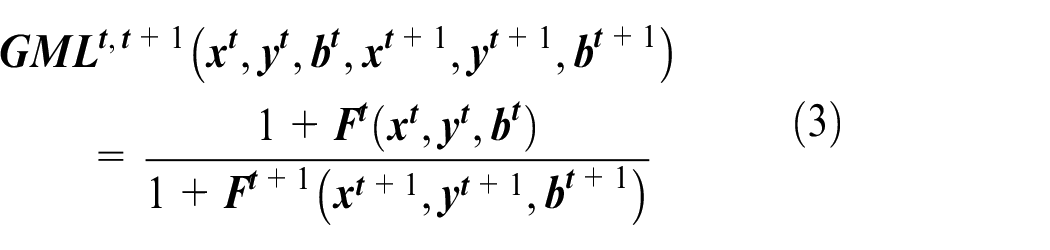
In Equation 3,
Referring to Hu et al. (2018), this paper constructs an input-output index system. Please see Table 1 for details. The input indexes include human input (HI), which is calculated by multiplying the total number of employees in agricultural, forestry, animal husbandry, and sideline fishery industries by the proportion of the total agricultural output value in these industries; land input (LI), which is expressed as the total sown area of crops; machinery input (MI), which is expressed as the total power of agricultural machinery; fertilizer input (FI), which is the number of agricultural fertilizers (including nitrogen fertilizer, phosphate fertilizer, potash fertilizer, and compound fertilizer) applied in agricultural production; water input (WI), which is the agricultural irrigated area; agricultural film input (AFI), which is the area covered by the agricultural film; and pesticide input (PI), which is the amount of pesticide used. The unexpected output index is agricultural carbon emissions (ACE), measured by the sum of carbon emissions from fertilizers, pesticides, agricultural film, diesel, and irrigation. Finally, the expected output indexes include gross agricultural output value (GAOV).
GML Index Measurement System.

This paper measures the agricultural GTFP of 30 provinces in China from 2011 to 2020. To reflect the dynamic evolution pattern of the overall agricultural GTFP in China, this paper refers to Wu and Song’s research on the average geometric processing method to compute the annual values for each province in China (Wu & Song, 2018). Figure 2 shows that the overall level of agricultural GTFP demonstrates an upward trend, with an accelerated rate of increase in recent years. This trend is due to China’s unwavering commitment to promoting the construction of ecological civilization and adhering to the concept of green development since the 18th National Congress of the Communist Party of China. Furthermore, under the guidance of national macro policies, the agricultural industry is striving toward the goal of “green and low-carbon,” constantly expanding and innovating the development space of agriculture. As a result, efficient and green growth of agriculture is leading to revitalizing rural ecology.

Trends in agricultural GTFP in China from 2011 to 2020.
Explanatory Variables
This paper employs the entropy-TOPSIS method to synthesize a composite indicator that proxies for China’s digital economy (T. Zhao et al., 2020). The level of development of China’s digital economy is measured from two aspects: internet development and digital financial development. Internet development is assessed in four dimensions: Internet penetration, internet-related employees, internet-related output, and Internet users. Internet penetration is calculated by the number of Internet users per 100 people. Internet-related employees are represented by the proportion of employees working in computer and software industries in the unit employees. Internet-related output is measured using the number of telecommunication services per capita, while the number of mobile phones per 100 people is used to calculate the number of Internet users. Finally, digital financial development is evaluated using the digital inclusive financial index compiled by the Digital Finance Research Centre of Peking University. Table 2 shows the specific indicators and corresponding weights used in this study.
Digital Economy Index Measurement System.

This paper utilizes the entropy-TOPSIS method to measure the digital economy index. Firstly, the data is standardized, followed by the determination of the ratio of each sub-indicator under each scheme. Next, we calculate the information entropy value of each sub-indicator to ascertain their corresponding weights. Finally, we compute the overall score of the digital economy. Figure 3 illustrates the spatial distribution of the average digital economy level across China’s provinces. Notably, the eastern coastal areas exhibit a greater level of the digital economy than their counterparts in the central and western regions.

Spatial distribution of the digital economy level in China’s provinces.
Mediating Variable
The existing literature mainly utilizes two indices to measure agricultural technology innovation: R&D investment and the patent number. However, according to J. F. Zhao and Zhang (2020), the number of patents is a more convincing direct index to evaluate the level of regional innovation. Therefore, following the methodology of Liu, Ji, et al. (2021), this paper uses the natural logarithm of the total number of agricultural invention patents to measure the level of agricultural technology innovation (ATI). In addition, relevant data are obtained from the CNKI patent database.
Control Variables
To eliminate the influence of factors other than the digital economy, this paper sets control variables by referring to relevant literature (Liu, Zhu, & Wang, 2021; Ma et al., 2022). The control variables are as follows:
(1) Level of urbanization (LOU), characterized by the proportion of the non-agricultural population to the total population. (2) Degree of industrialization (DOI), measured by the proportion of industrial added value to the gross regional product. (3) Foreign direct investment (FDI), measured by the actual amount of foreign investment utilized in each province each year. (4) Degree of natural disasters (DOND), measured by the proportion of crop disaster area to crop sown area. (5) Agricultural human capital (AHC), expressed by the average years of education of the rural population. (6) Income structure (IS), using the urban-to-rural per capita disposable income ratio. Descriptive statistics for each variable are detailed in Table 3.
Descriptive Statistics.

Model setting
To explore the relationship between the digital economy and agricultural GTFP, the following panel regression model is established:

Where i represents the province and t represents the time.
Empirical Results
Benchmark Regression Analysis
Table 4 presents the results of the panel benchmark regression. Models (1) and (3) only consider explanatory variables, while Models (2) and (4) incorporate control variables. Models (1) and (2) do not control for fixed effects, whereas Models (3) and (4) control for both time and personal effects. According to the benchmark regression results in Table 4, the coefficients affiliated with the digital economy (DE) are significantly positive, whether control variables are added or fixed effects are considered. This confirms that the development of the digital economy has a positive effect on agricultural GTFP. After controlling for time and individual fixed effects and adding control variables, the coefficient of the digital economy is 3.251, which implies that augmenting the digital economy by one unit can improve the agricultural GTFP by 3.251 units.
Benchmark Regression Results.

Note. Standard errors in parenthesis. ***, **, and *Indicate significant at the 1%, 5%, and 10% levels respectively.
Furthermore, the coefficients of LOU and AHC are also significantly positive, whereas the FDI coefficient is significantly negative. This indicates that, like the digital economy, the urbanization and education of rural communities predominantly contribute to the increase in agricultural GTFP. The reason is that high urbanization and education assist in integrating rural industries and improving the efficiency of agricultural production, thus facilitating sustainable and high-quality agricultural development. In contrast, foreign direct investment hampers the growth of agricultural GTFP. This may be due to that the pursuit of profit by capital causes foreign investors to primarily invest in secondary and tertiary industries, which can hurt agriculture by generating pollution that may harm green agricultural development. Thus, Hypothesis 1 is proven.
Robustness Analysis
In order to ensure the validity and reliability of the estimation results, the Tobit model is utilized for testing purposes in this study. Furthermore, by utilizing a semi-parametric estimation method, it becomes unnecessary to assume a specific form for the residuals, thus yielding consistent estimates even when individual heteroskedasticity is present. Consequently, this method is employed for the analysis in this section, with the regression results presented in Table 5. Our findings reveal that the digital economy significantly impacts agricultural GTFP, with or without consideration of the control variables. This highlights the robustness of the conclusions drawn from this research paper.
Robustness Test.

Note. Standard errors in parenthesis. ***, ** and *Indicate significant at the 1%, 5%, and 10% levels respectively.
Heterogeneity Analysis
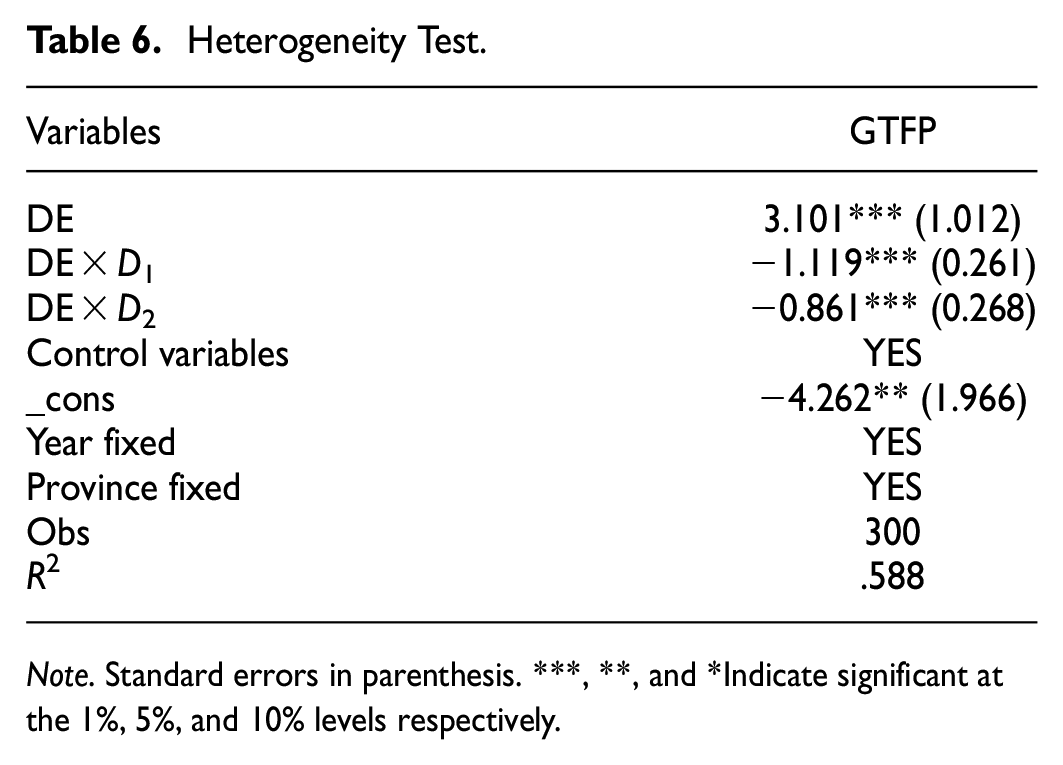
Due to various objective factors such as differing resource endowments, levels of economic development, and transportation convenience in China’s different provinces, the impact of the digital economy on agricultural GTFP exhibits heterogeneity across regions. This paper divides China’s 30 provinces into three regions: the Eastern, Central, and Western regions. The paper specifically explores how the digital economy affects agricultural GTFP heterogeneity across these regions. To avoid the problem of selectivity bias caused by grouped regressions, we introduce regional dummy variables (D1 and D2). This study sets up interaction terms between the main explanatory variables and the dummy variables for regression analysis. If the sample is from the Eastern region, then D1 = 1, D2 = 0; if the sample is from the Central region, then D1 = 0, D2 = 1; if the sample is from the Western region, then D1 = 0, D2 = 0. Table 6 shows that the coefficient of the digital economy is significantly positive, but the coefficients of the interaction terms DE × D1 and DE × D2 are both significantly negative. This finding indicates that compared with the Eastern and Central regions, the digital economy has a more significant positive effect on agricultural GTFP in the Western region. The coefficient of DE × D1 is −1.119, while the coefficient of DE × D2 is −0.861. This means that for every unit of improvement in the digital economy compared to the Eastern region, the agricultural GTFP of the Western region increases by 1.119 more units. Compared to the Central region, for each unit of improvement in the digital economy, the agricultural GTFP of the Western region increases by 0.861 more units. Therefore, Hypothesis 3 can be verified.
Heterogeneity Test.
Note. Standard errors in parenthesis. ***, **, and *Indicate significant at the 1%, 5%, and 10% levels respectively.
Mechanism Analysis
This paper uses the Bootstrap sampling method to test the intermediary effect of agricultural technology innovation on the relationship between the digital economy and agricultural GTFP. It standardizes the values of each variable to ensure consistency in the data, resulting in a distribution of [0,1] (Frölich & Huber, 2017).
Table 7 displays the Bootstrap test results, indicating a significant mediating effect of agricultural technology innovation on the digital economy and agricultural GTFP at the 1% level. The indirect effect value is 0.650, and the 95% confidence interval is [0.344, 0.956]. These findings support hypothesis 2, which argues that the digital economy promotes agricultural GTFP progress by strengthening agricultural technology innovation.
Bootstrap Test of the Mediating Effect of Agricultural Technology Innovation.

Note. Confidence interval at the 95% level in parenthesis. ***, **, and *Indicate significant at the 1%, 5%, and 10% levels respectively.
Endogeneity Analysis
Given that the transmission path of “DE→ATI→GTFP” may have a reverse causality, regions with higher agricultural green production efficiency tend to have better agricultural scale and specialization. Thus, local agricultural industry development emphasizes technological innovation and depends more on the digital economy. This may encourage the development of green technology innovation and the digital economy from the opposite direction, leading to endogenous problems. Therefore, this paper utilizes the two-stage least squares instrumental variable method to conduct endogenous testing.
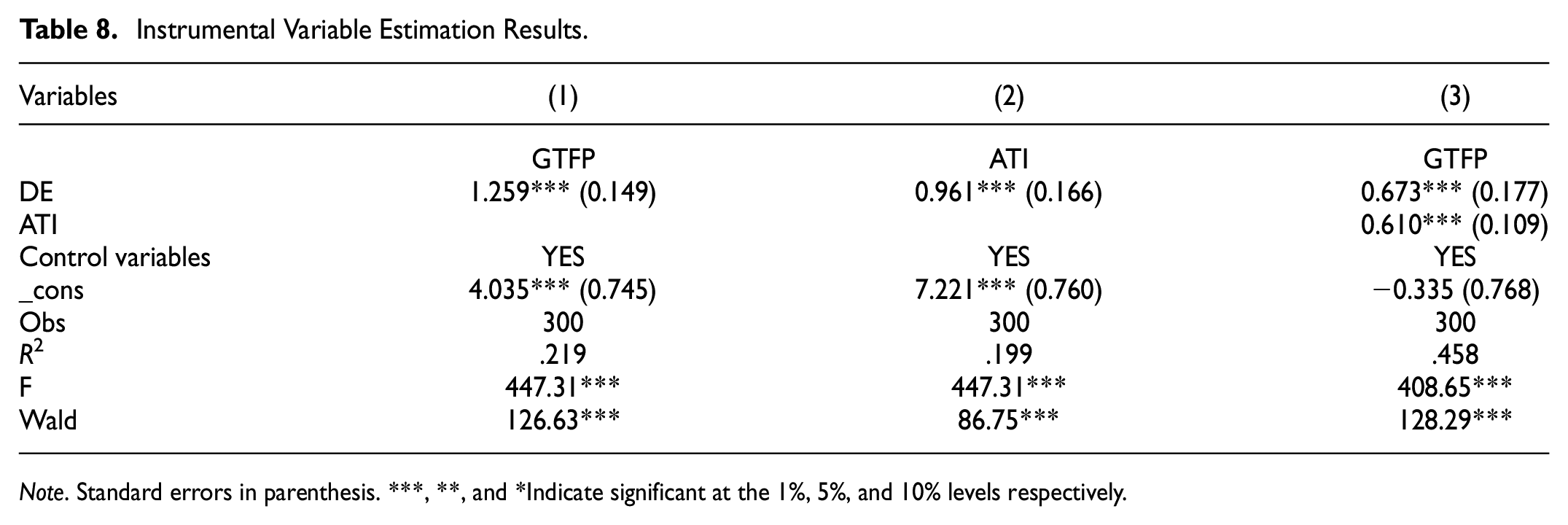
Considering that the selection principle of instrumental variables should meet the requirements of both being related to the core explanatory variable and being exogenous with the dependent variable, this paper uses the level of digital financial development, measured by the Peking University Digital Inclusive Finance Index (DIF), as an instrumental variable. Table 8 presents the second-stage regression results for the three independent two-stage regression models. The estimation results of the first-stage regression in models (1) to (3) reveal that the coefficients of DIF are significantly positive at a 1% significance level, and the F-values are 447.31, 447.31, and 408.65, respectively. This indicates that there is no weak instrumental variable problem, and the instrumental variable selection in this study is valid.
Instrumental Variable Estimation Results.
Note. Standard errors in parenthesis. ***, **, and *Indicate significant at the 1%, 5%, and 10% levels respectively.
It can be observed from Table 8 that based on considering the endogenous bias:
(1) The digital economy development promotes agricultural GTFP. (2) The digital economy development stimulates agricultural technology innovation. (3) When the digital economy and agricultural technology innovation are simultaneously included in the model, both the digital economy and agricultural technology innovation have a significant positive impact on agricultural GTFP.
That is, agricultural technology innovation plays a supportive role in the process of digital economy development, driving agricultural GTFP improvement. Therefore, the estimation results of instrumental variables are consistent with the original conclusions, and hypotheses 1 and 2 are further validated.
Conclusions and Policy Suggestions
Conclusions and Implications
Based on Chinese provincial panel data from 2011 to 2020, this paper empirically tests the impact mechanism of the digital economy on agricultural GTFP from the perspectives of linear effect, mediating effect, and spatial heterogeneity. The main findings are as follows: First, China’s agricultural GTFP has steadily increased, and advances in the digital economy can significantly increase GTFP. Second, the digital economy promotes agricultural green production efficiency through agricultural technological innovation. Third, compared with the central and eastern regions, the positive effect of the digital economy on agricultural GTFP in the western region of China is more significant. This is because the Chinese government attaches great importance to developing the digital economy in the agricultural sector and continues to strengthen agricultural technology innovation and upgrade the agricultural development model. Relying on digital technology to promote high-quality agricultural development is a route that China has long adhered to. The digital transformation of the agricultural economy is a crucial direction for the future development of Chinese-style agriculture. Moreover, the government’s policy support for the Western region has become more robust, aiming to integrate development and reduce the problem of inter-regional imbalance. The findings of this paper have both theoretical and practical implications.
Theoretically, this paper enriches the existing literature on the relationship between the digital economy and green agricultural development. It places the digital economy, agricultural technology innovation, and agricultural GTFP in a unified research framework and reveals their intrinsic linkages and impact mechanisms. This will also provide a particular theoretical foundation for other scholars in the field of the digital economy as well as green agriculture areas to study related content in the future.
From a practical perspective, in the era of great global attention to the development of the digital economy and green transformation of agriculture, the findings on the digital economy and agricultural GTFP can facilitate the utility of the digital economy for green agricultural development. Furthermore, the conclusion can provide a theoretical basis for relevant government departments to formulate and optimize specific policies to serve high-quality economic development and ecological construction better.
Policy Suggestions
Based on the above conclusions, this paper puts forward the following policy suggestions: Firstly, the government should strengthen the construction of rural information infrastructure, build an extensive data system for agriculture and rural areas, develop a new rural digital economy, and improve rural public information services to promote the development of China’s digital countryside. The agricultural sector should accelerate technological innovation and the application of agricultural digital technologies to increase the penetration of the digital agricultural economy. Through research and development of intelligent agricultural equipment, information terminals, and mobile internet applications adapted to the characteristics of agriculture, more digital technologies will be promoted to be integrated into all aspects of agricultural production, processing, marketing, and logistics.
Secondly, the digital economy should strengthen the path of dependence on technological innovation in the process of high-quality agricultural development. On the one hand, the government should set up incentive policies to guide digital economy resources to invest in green agricultural technology innovation and accelerate the construction of a production-side science and technology innovation system to serve green agricultural development. On the other hand, socialized agricultural services should be actively carried out around agricultural technology innovation, with green production as the guide to enhance agricultural science and technology innovation capacity and continuously improve agricultural green production efficiency.
Finally, according to the local digital economy development model and the actual situation of agricultural industry development, each region’s government should comprehensively consider spatial heterogeneity, natural resource endowment, and regional industrial characteristics. Then, the local government can precisely and steadily promote the synergistic and integrated development of the digital economy and green agriculture. Furthermore, governments of developing countries should strengthen the construction of digital hardware facilities in underdeveloped rural areas to create favorable conditions for the digital economy to help the development of green agriculture in these areas.
Footnotes
Authors Contribution
All authors made equal contribution toward this paper.
Declaration of Conflicting Interests
The author(s) declared no potential conflicts of interest with respect to the research, authorship, and/or publication of this article.
Funding
The author(s) disclosed receipt of the following financial support for the research, authorship, and/or publication of this article: Major Project of Philosophy and Social Sciences Research in Universities of Jiangsu Province, 2023, Project No. 2023SJZD064.

Data Availability Statement
The authors confirm that the data supporting of this study are available from the corresponding author (Dr. Yifeng Zhang) on request.