




Abstract
Civic engagement is crucial in order to uphold democratic societies, however there is growing concern about a progressive decrease in youth sociopolitical participation and the existence of socioeconomic and gender inequalities, and therefore, an unequal distribution of political power. This study analyzes the influence of family socioeconomic level—both directly and indirectly through social concerns—on the adolescents’ expected sociopolitical participation as adults, from a gender perspective. The sample included 4,448 adolescents 13 to 18 year old, selected through random multistage sampling stratified by conglomerates. Results showed family material affluence to have a limited direct influence on expected sociopolitical participation, however a significant indirect impact through their concerns about social issues. Adolescents with a low socioeconomic level were more concerned about social issues, and therefore had higher expectations of socio-political participation than adolescents with a high socioeconomic level. In addition, these effects were similar for both boys and girls. Understanding how family socioeconomic status influences adolescent civic engagement and how these inequalities are reproduced among boys and girls will aid in designing interventions that promote knowledge and opportunities for participation—especially among the more disadvantaged groups—, which can reduce gender and socioeconomic gaps.
Plain Language Summary
There is growing concern about a progressive decrease in youth sociopolitical participation and the existence of socioeconomic and gender inequalities. The purpose of this study was to analyze the influence of family socioeconomic level—both directly and indirectly through social concerns—on the adolescents’ expected sociopolitical participation as adults, from a gender perspective. The sample included 4,448 adolescents 13 to 18 year old, selected through random multistage sampling stratified by conglomerates. Results showed family material affluence to have a limited direct influence on expected sociopolitical participation, however a significant indirect impact through their concerns about social issues. Adolescents with a low socioeconomic level were more concerned about social issues, and therefore had higher expectations of socio-political participation than adolescents with a high socioeconomic level. In addition, these effects were similar for both boys and girls. Understanding how family socioeconomic status influences adolescent civic engagement and how these inequalities are reproduced among boys and girls will aid in designing interventions that promote knowledge and opportunities for participation—especially among the more disadvantaged groups—, which can reduce gender and socioeconomic gaps.
Keywords
Introduction
Civic engagement is the basis of democratic societies (Van Deth, 2016). Moreover, youth’s concerns about social issues and expected sociopolitical participation as adults are essential and associated indicators of civic engagement in adolescents (Schulz et al., 2010). Adolescents establish bonds with whom they identify (family, friends, classmates, etc.), prompting them to develop beliefs and concerns for others, which simultaneously promotes more involvement in social and political action in benefit to the community (Lerner et al., 2014).
Inter-generational differences in indicators of implication and activism, and the lack of consensus regarding how measure them (Malin et al., 2017; Sherrod & Lauckhardt, 2009; Youniss et al., 2002), makes it challenging to determine if adolescents today are more- or less-committed to society compared to previous generations. However, research has detected an alarming decrease in youth civic awareness and knowledge of political issues (e.g., political leaders or foreign policy), and in civic behaviors (e.g., the intention to vote) (Dudley & Gitelson, 2002; Putnam, 2000). Moreover, Oosterhoff et al. (2020) found a decrease from 2000 to 2015 in US adolescents’ concerns about social issues.
Furthermore, socioeconomic inequalities in civic engagement are also concerning. There is consistent evidence of cross-generational political inequality related to socioeconomic disparities, resulting in an unequal distribution of power and participation (Schlozman et al., 2012). Thus, social stratification is reinforced by higher socioeconomic classes having more participation and political authority. As Weber (1946, reviewed by Brady et al., 2015) highlighted, inequalities in political participation affect not only individuals but also the stratification system of social classes.
In fact, previous research reported a decline in civic engagement only in the more disadvantaged groups, thus increasing inequalities in civic engagement. For example, Putnam et al. (2012) discovered that the most advantaged adolescents presented higher engagement in extracurricular activities, volunteering, social trust, and being active in community life, whereas adolescents from a lower socioeconomic status showed lower levels of these behaviors, which remained stable or even decreased. Gaby (2017) found inequalities in youth volunteering in the US—increasing from 1976 to 2009—due to different levels of parental education. In line with these findings, higher levels of income inequality at a national level have demonstrated to increase the political gap by negatively affecting political participation in less-affluent youth (Solt, 2008).
Furthermore, the social concerns of adolescents might play an important role in how inequalities in youth political participation are reproduced. Godfrey and Cherng (2016) found that lower material affluence and unequal contexts might act as catalysts for the adolescents’ understanding of the prejudicial effect of inequalities (due to their own experiences). However, their critical awareness (Watts et al., 2011) may in turn promote civic engagement (Diemer et al., 2006; Gimpel et al., 2003; Godfrey & Grayman, 2014; Sandell & Plutzer, 2005; Verba et al., 2003).
Given these evidences of the importance of adolescent civic engagement in democratic societies, its possible deterioration, and the persistence of inequalities that contribute to reproducing the cycle of disadvantages, further research is needed to identify indicators of adolescent civic engagement and how socioeconomic inequalities affect them.
Research with adults has demonstrated that higher socioeconomic status correlates to higher rates of political participation. For example, Wray-Lake and Hart (2012) found that people with the highest educational levels had a greater likelihood of voting, and employed people demonstrated more political participation. Verba et al. (2003) found differences in young adults’ political participation related to their family’s socioeconomic background and political participation. These differences were caused directly by parental education, and indirectly by family income and political environment. Thus, both family socioeconomic status and political participation are transmitted generation to generation. Moreover, this relationship is reinforced because adults whose parents had higher levels of education and socioeconomic status are more likely to complete higher levels of education themselves, and through these effects, have more political participation (C. Flanagan et al., 2009; Zaff et al., 2009). Similarly, adolescents from more affluent families relate more to people with higher educational and socioeconomic levels, and thus, have greater access to valuable sources of social capital with more social, economic, and cultural resources (Flap & Völker, 2008), increasing the adolescents’ opportunities to participate in social and political issues.
Research on socioeconomic inequalities in adolescent civic participation has mainly treated parental education as a dimension of socioeconomic status. Along these lines, research has found association between high parental education and higher civic engagement and more concern with social issues in adolescents. For example, higher levels of parental education have been associated with adolescents’ perception of the importance of involvement in social movements and civic efficacy—feeling more efficacious about their own political knowledge, their ability to participate in political actions, and to contribute helping their own communities—(Metzger et al., 2020), or with the likelihood of being civic leaders or being classified in different groups of civic typology compared to an “unengaged” group (Wray-Lake & Shubert, 2019).
Regarding social concerns, Oosterhoff et al. (2020) also found that adolescents whose parents had high levels of education showed more concern about race relations, hunger, poverty, and socioeconomic problems compared to adolescents whose parents had lower educational levels. However, research examining other socioeconomic dimensions such as material capital, beyond focusing on cultural capital, are scarce. Amongst the few existing studies, research conducted by Lenzi et al. (2012) using data from the 2006 Health Behavior in School-aged (HBSC) study, stands out. Exploration of five countries showed that family material affluence and attending school with more affluent peers (on average) has an impact on adolescent involvement in community civic organizations; those from more affluent families presented higher levels of civic engagement in all countries, except in Italy where no significant differences were found. Parents with a higher socioeconomic status and education level are more likely to employ democratic educational styles (Anton et al., 2015; Bluestone & Tamis-LeMonda, 1999; Pinderhughes et al., 2000). Likewise, inequalities affect adolescent sociopolitical participation through the family’s access to literacy resources or how their children are educated in civic competence (Benson et al., 2006; Damon, 2004; Larson, 2000).
However, socioeconomic difficulties might also promote more sociopolitical participation. For example, previous research conducted by Roy et al. (2019) found that adolescents from neighborhoods with more income inequality and greater exposure to violence are more engaged in critical-action behaviors such as participating in a political campaign or group fighting for social justice. It is reasonable to assume that adolescents with less exposure are less concerned about these issues compared to adolescents who are directly affected, and it is possible that adolescents with a higher socioeconomic status also have more ties with other members of their communities, who are less in need (Godfrey & Cherng, 2016).
From a gender perspective, parents socialize their sons and daughters differently regarding trust and reinforcement of participation. Thus, parents tend to foster caregiving values and concern for others to a higher degree in girls than in boys (Wray-Lake et al., 2012). This causes girls to have more social concerns, help others, and participate in activities such as volunteering (Gaby, 2017), or have future expectation of participating in social issues (Salado et al., 2022), whereas boys’ interests are more related to political issues such as the intention of voting in the future or following news on different media platforms (Wray-Lake et al., 2020). Moreover, gender differences have also been found in adolescents’ concerns with social issues, with girls showing more concerns for issues like racism, hunger, poverty, and crime and violence compared to their male peers (Oosterhoff et al., 2020).
Not only could overall family influence vary according to gender, but socioeconomic inequalities may also have a differential effect in boys than in girls. Along these lines, recent research conducted by Wray-Lake et al. (2020) found a differential impact of parental education on young men and women’s political participation. Specifically, authors found that young women benefit more from having parents with a higher educational level, reinforcing their participation in community services, and therefore, reducing the gender gap in political voice.
Regarding gender differences in the influence of socioeconomic factors on the adolescents’ expected sociopolitical participation, results are scarce and tend to show a limited effect as research by Manganelli et al. (2014) has shown. This might be because the gender gap in inequalities in civic engagement are still not manifest during adolescence (Hooghe & Stolle, 2004).
Ultimately, given the relevance of family socioeconomic level in the development of adolescent civic engagement and the need to incorporate a gender perspective in order to better understand the different processes of socio-emotional development throughout life, the main objective of this study is to analyze the influence of family socioeconomic level on the expected future sociopolitical participation of Spanish adolescents and the mediator role of the youths’ concerns for social inequalities. Secondly, this paper examines possible gender differences in the influence of socioeconomic level on expected sociopolitical participation, directly and indirectly through social and political concerns.
Method
This study was conducted by a research team at the University of Seville (Spain) in the framework of the Opinion Barometer of Childhood and Adolescence (Barómetro de Opinión de la Infancia y Adolescencia) project, in collaboration with UNICEF. Using a transversal design, the study evaluates the adolescents’ opinions and concerns, knowledge about sociopolitical issues, and their civic engagement.
Data comes from a representative sample of 4,448 youth (52.4% girls and 47.6% boys) between 13 and 18 year old, selected using random multistage sampling stratified by conglomerates. The age groups were distributed as follows: 52.1% 13 to 14 year old; 38.8% 15 to 16 year old; and 9.1% 17 to 18 year old.
Data was collected through an online questionnaire, answered anonymously by the adolescents themselves at school. The questionnaire’s online administration optimized material and human resources, avoided paper use, controlled for possible errors in manual data entry, and ensured confidentiality and anonymity. Participating schools were provided with an informative dossier in order to aid their students in completing the questionnaire. In addition, the research team’s technical personnel were available to resolve issues and monitor participation.
The questionnaire was approved by the Bioethical Committee of the Regional Government of Andalusia (Comité de Bioética de la Junta de Andalucía), and respected the youth’s dignity, beliefs, and privacy. Participants were informed beforehand about the objectives and ethical aspects of the study, and both parents/legal guardians and the School Committees consented.
Instruments
The instrument used was the Opinion Barometer of Childhood and Adolescence (Barómetro de Opinión de la Infancia y Adolescencia) (Moreno et al., 2017). In addition to the sociodemographic variables sex and age, the following variables were selected from the questionnaire:
- Family socioeconomic level was evaluated through the latest version of the six-item instrument Family Affluence Scale (FAS-III) (Torsheim et al., 2016). Some of these items were: “Does your family own a car, van or truck?,”“How many computers does your family own (including laptops and tablets, not including game consoles and smartphones)?,” and “How many times did you and your family travel out of [insert country here] for a holiday/vacation last year?.” The Cronbach alpha was .48 in this study, similar to other research that found only moderate internal reliability ranging between .32 and .62 (Schnohr et al., 2008). However, the scale’s construct validity has been proven in several studies, showing correlations with other SES indicators informed by the adolescents themselves (Cho & Khang, 2010; Svedberg et al., 2016) or by their parents (Corell et al., 2021; Torsheim et al., 2016). It has also demonstrated external criterion validity in 35 countries with macro level indicators such as Gross Domestic Product (GDP) (Boyce et al., 2006).
- Civic engagement was evaluated using the seven-item scale Expected sociopolitical participation (ESPP) inspired in Schulz et al. (2010). This instrument evaluated the likelihood of the adolescent’s future participation in: (1) forms of social engagement with community issues (e.g., volunteering); (2) political participation (e.g., interest in collaborating with a political party); (3) unconventional forms of participation (e.g., participating in protests); and (4) collaborating with special interest groups (e.g., animal protection associations). Responses options were coded on a Likert scale with values between 1 (not at all likely) and 5 (extremely likely). The Cronbach alpha of the original sub-scales ranged between .72 and .80 (C. A. Flanagan et al., 2007). The internal consistency of the full scale was .76. Analysis of the unidimensional latent structure showed adequate data fit (CFI: .95; RMSEA = .08; SRMR = .05).
- Concern with social issues (CSI) was evaluated using a five-item scale adapted from research by the Center of Sociological Research in Spain (Centro de Investigaciones Sociológicas—CIS, 2019). Participants were asked about their degree of concern about the following issues: “The way that the general population treat immigrants,”“Racism,”“The lack of respect for sexual diversity,”“Lack of respect for other religions,” and “Hunger and extreme poverty in the world.” Response options ranged from 1 (I’m not concerned at all) to 4 (I’m very concerned). The Cronbach alpha was .81. Analysis of the unidimensional latent structure showed adequate data fit (CFI: .98; RMSEA = .06; SRMR = .02).
Data Analysis
Firstly, descriptive statistics were examined (mean, standard deviation, and minimum and maximum values). Secondly, Student-t test was conducted to examine mean differences between the independent samples of boys and girls, as well as Cohen’s d (Cohen, 1992) to determine the effect size. Following the recommendations for the behavioral sciences (Tabachnick & Fidell, 2012), the levels considered were: 0.00 to 0.19 negligible; 0.20 to 0.49 low; 0.50 to 0.79 medium; and 0.80 high.
Pearson’s coefficient correlation was used to examine association between variables in the global sample (low correlation ≥.10; moderate correlation .30 to .49; and high correlation ≥.50) (P. Cohen et al., 1983). Likewise, Pearson’s coefficients between variables were calculated for each sample segregated by sex. The differences between correlations and the effect size of the differences between samples were estimated using the Fisher’s z test and Cohen’s Q. The reference values for effect size were: <0.1 negligible effect; 0.1 to 0.3 small effect; 0.3 to 0.5 medium or moderate effect; and >0.5 high effect (Cohen, 1992). IBM SPSS Statistics 26.0 software was used to analyze descriptive statistics as well correlations, with a 95% minimum confidence level.
A structural equation model was performed—considering each indicator as a latent factor created through Confirmatory Factorial Analysis (CFA)—using Maximum Likelihood (ML) estimation to analyze the relationship between family socioeconomic level and (1) expectations of future sociopolitical participation, (2) concerns about social inequality, and (3) the indirect influence of socioeconomic level on expected sociopolitical participation through social concerns. Chi-squared (χ2) was employed to assess model fit to the data, indicating good fit to the model when the value is not significant. However, given its sensitivity to sample size (Cheung & Rensvold, 2002), the following indices were also considered: Comparative Fit Index (CFI), with values above .90 considered acceptable, and above .95 considered excellent; Root Mean Square Error of Approximation (RMSEA) and Standardized Root Mean Squared Residual (SRMR). For these indexes, values near or below .08 and .05, respectively, are considered acceptable model fit. Effect size was calculated using standardized coefficients to examine the strengths of both direct and indirect effects. To test this effect size—following Peterson and Brown (2005)—the standardized β coefficients were transformed into r, and this indicator in eta-square (η2) following Dunlap’s (1994) procedure. Values ≤0.059 were interpreted as a small effect, moderate effect for values .06 to .13, and strong effect for values ≥0.14 (Cohen, 1988).
Lastly, multi-sample confirmatory factorial analysis was conducted to evaluate the model’s progressive factorial invariance for the separate samples of boys and girls. A structural model was applied to the two samples prior to analysis using the aforementioned values for good model fit. Analysis was performed employing parameter constrain in each step for the different degrees of invariance. Given the Chi-squared statistic’s sensitivity to sample size, an increase in CFI higher than 0.01 was considered to be a significant change in the model by sex (Cheung & Rensvold, 2002). The program EQS 6.3 was employed for the structural model and to calculate invariance.
Results
Firstly, descriptive characteristics of the studied dimensions—expected sociopolitical participation (ESPP), concern with social issues (CSI), and family affluence scale (FAS)—will be presented, including means comparison and effect size test to analyze differences according to sex. Secondly, correlations between variables for both the global and segmented samples are presented, reporting differences in the correlations of the segmented samples and their effect size. Lastly, the fit indices of both the global and segmented models are presented, analyzing model invariance by sex.
Descriptive statistics and analysis of the correlations between family socioeconomic level, concern with social issues and expected sociopolitical participation.
Table 1 shows the descriptive statistics—including minimum and maximum values, means, and standard deviation—for the continuous variables.
Descriptive Characteristics of the Sample in All Analyzed Variables (n = 4,448 Adolescents 13–18 Year Old).
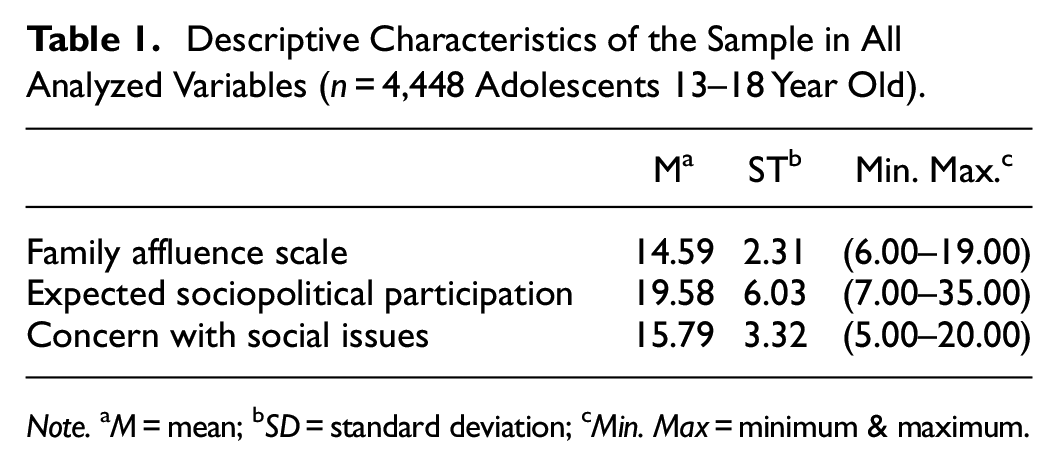
Note. aM = mean; bSD = standard deviation; cMin. Max = minimum & maximum.
Analysis of the differences between boys and girls in each of the studied dimensions (Table 2) resulted in no significant differences in FAS (p = .028, d = 0.07). However, statistically significant differences, with a small effect size, were found in ESPP and CSI, with girls scoring higher than boys.
Mean Comparisons Between Girls and Boys and Measure of Effect Size.

Note.
Regarding the global sample, Pearson’s correlation coefficient values indicate a significant, positive, and moderate correlation between ESPP and CSI (r = .37; p < .001). Analysis of the association between ESPP and CSI in data segmented by sex (r = .38; p < .001 for boys; r = .40; p < .001 for girls) produced similar results. In addition, the differences between correlations for boys and girls were not significant (p = .216; Z = −0.78; Q = 0.02).
FAS showed a negative association with ESPP, which was not statistically significant for either the global sample (p = .194) or for boys (p = .166). However, the association was positive but not significant in the sample of girls, with a negligible effect size. Moreover, the differences in the correlations between FAS and ESPP in the segmented samples were significant with a moderate effect size (p < .001; Z = −10.33; Q = 0.31), showing a stronger relationship in girls.
Lastly, the association between FAS and CSI in the global sample was negative and significant, however the correlation value showed a weak relationship (r = −.07; p < .001). Similar results were found in both of the segmented groups (r = − .08; p < .001) when analyzed separately. Therefore, the differences between the correlations of the two sub-samples was not significant (p = .369; Z = 0.33; Q = 0.01).
Mediation Model of the Influence of Family Socioeconomic Level on Expected Sociopolitical Participation Through Concern for Social Inequalities
Table 3 presents the absolute (Chi-squared), as well as approximate (CFI, RMSEA and SRMR), goodness-of-fit indices for the estimated model on the influence of FAS on ESPP both directly, and indirectly through CSI. Despite sample size in inflating the Chi-squared value (χ2 = 1951.60; p < .001), all the other indices showed adequate goodness-of-fit for the hypothesized model (CFI = .91; RMSEA = .06; SRMR = .04).
Goodness-of-Fit Indices for the Hypothesized Model.

Note. aχ2 = chi squared; bdf = degree of freedom; cCFI = comparative fit index; dRMSA = root mean squared error; eCI = confidence interval; fSRMR = standardized room mean squared residual;
*p < .001; significant value.
Lastly, Figure 1 presents the analyzed model which includes the standardized coefficients for the direct relationship between FAS and ESPP, and the indirect relationship through CSI.
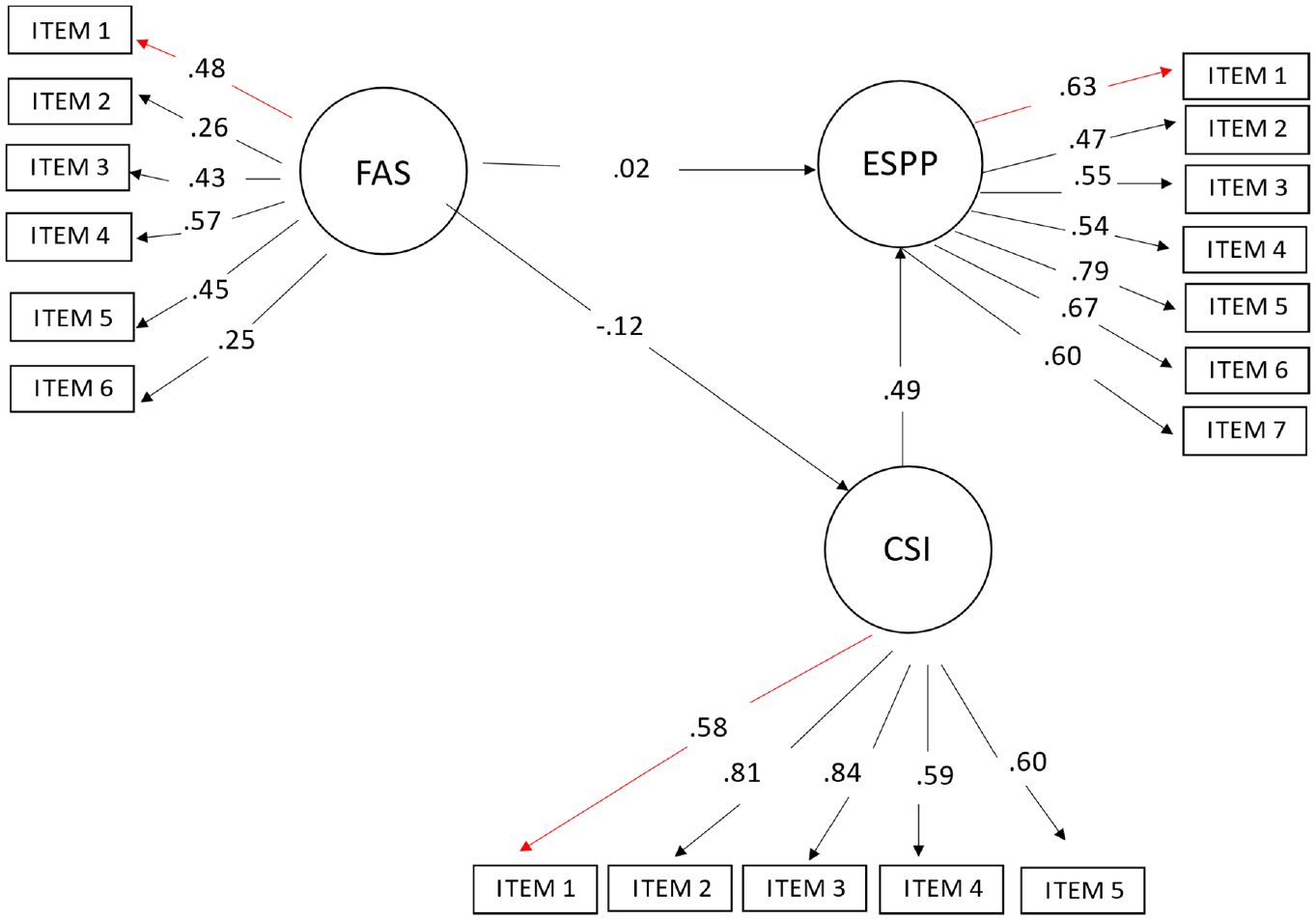
Representation of the standardized estimates of the path coefficients model.
The explained variance of ESPP by FAS was 24.2%, through a partial mediation relationship. The direct relationship between FAS and ESPP was significant and positive but showed a neglectable effect size (β = .02, p < .001; η2 = 0.005). However, the indirect relationship between FAS and ESPP through CSI was negative, significant, and with a small effect size (β = −.06, p < .001; η2 = 0.01). In addition, the explained variance of CSI by FAS was 14%, with a negative and significant relationship and a small effect size (β = − .12, p < .001; η2 = 0.03). Finally, the direct relationship between CSI and ESPP was positive, significant, and with a strong effect (β = .49, p < .001; η2 = 0.29).
Analysis of Invariance by Sex in the Mediation Model
In addition to the aforementioned, analysis was conducted to determine if the data fit to the model was similar for boys and girls, examining the goodness-of-fit indices for the segmented samples separately. As can be observed in Table 4, the model structure shows a good fit for both samples.
Goodness-of-Fit Indices for the Global Sample and Sample Segmented by Sex.
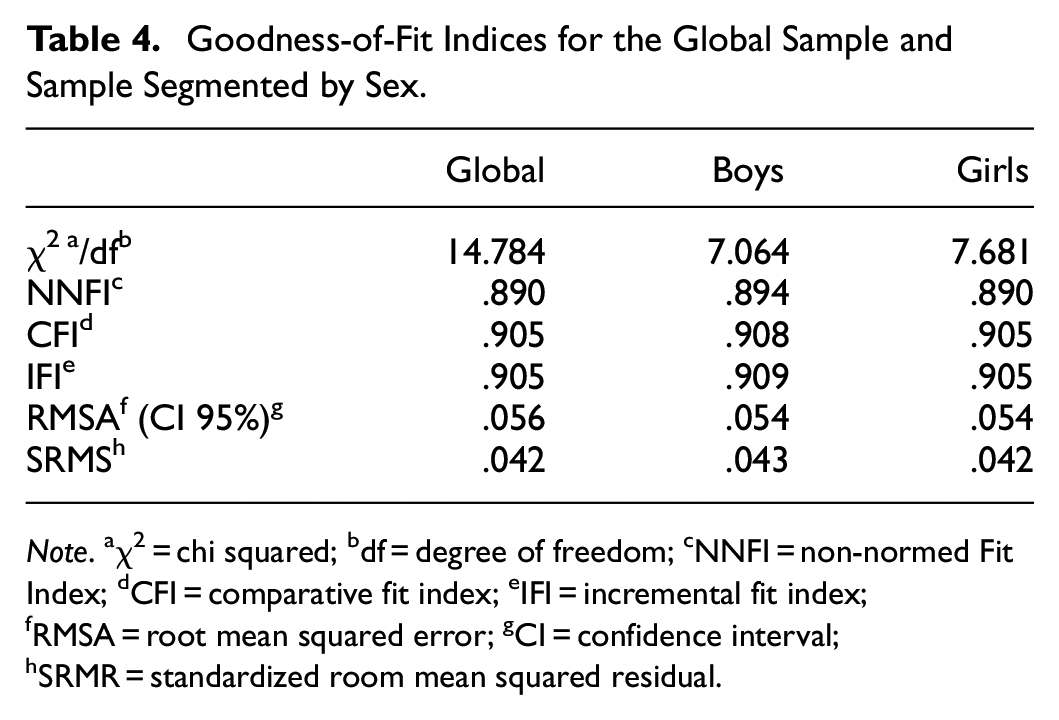
Note. aχ2 = chi squared; bdf = degree of freedom; cNNFI = non-normed Fit Index; dCFI = comparative fit index; eIFI = incremental fit index; fRMSA = root mean squared error; gCI = confidence interval; hSRMR = standardized room mean squared residual.
Figure 2 presents the standardized coefficients from the proposed models for the segmented samples. As in the global sample, partial mediation is observed, with a direct relationship between FAS and ESPP and an indirect relationship through CSI.
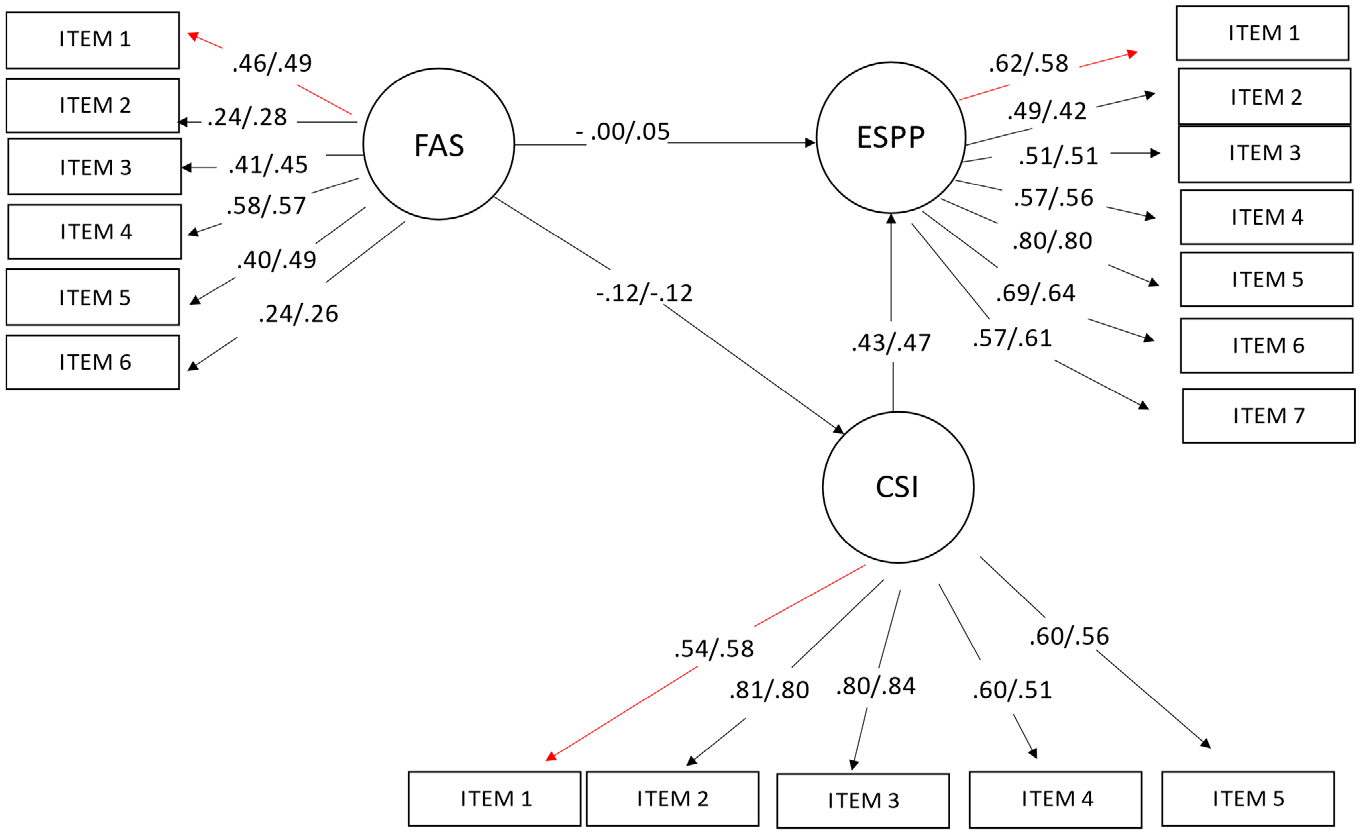
Coefficients for the model of boys are presented first, followed by that of girls, separated by the symbol “/.”
In both samples, the standardized coefficient values were irrelevant in the direct relationship of FAS with ESPP, and negative and significant for the indirect relationship through CSI. However, there were slight differences among boys and girls in the standardized coefficients of the direct relationship between CSI and ESPP, being significant and positive in both samples.
It should be noted that in the sample of boys, the explained variance of ESPP by the partial mediation model was 18.5%. The direct relationship between FAS and ESPP was irrelevant (β = −.00, p < .001; η2<0.01), whereas the indirect relationship between FAS and ESPP through CSI was negative with a small effect size (β = −.05, p < .001; η2 = 0.01).
In the case of girls, the explained variance of ESPP by the partial mediation model was 22%. The direct relationship between FAS and ESPP was positive with a small effect size (β = .05, p < .001; η2 = 0.01). Conversely, the indirect relationship between FAS and ESPP through CSI was negative and with a small effect size (β = −.05, p < .001; η2 = 0.01).
Regarding CSI in the sample of boys, the explained variance by FAS was 1.4%, with a significant and negative relationship (β = − .12, p < .001; η2 = 0.03). Similarly, in the sample of girls, the explained variance of CSI by FAS was 1.3%, establishing a significant negative relationship with a small effect size (β = −.12, p < .001; η2 = 0.03). In addition, the direct effect of CSI on ESPP was positive and with a strong effect for both boys (β = .43, p < .001; η2 = 0.23) and girls (β = .47, p < .001; η2 = 0.27).
Finally, Table 5 shows the step-by-step results of the factorial invariance process. Firstly, the configural invariance or factorial equivalent of the scale establishes a starting point for considering the degree of adjustment resulting from applying the same structure to both samples. Data showed good fit to the model on this first level. Afterward, in the metric or weak invariance, the factorial loads were constrained for both boys and girls, evaluating the weight equivalence of each item with respect to the factor. Table 5 displays the results, indicating a good model fit when these restrictions were applied, with small variations in some indicators. In addition, the increase in CFI was lower than .01, therefore indicating measurement invariance of the model for both boys and girls.
Goodness-of-Fit Indices For the Different Steps of the Factorial Invariance Analysis.

Note. aχ2 = chi squared; bdf = degree of freedom; cNNFI = non-normed fit index; dCFI = comparative fit index; eΔCFI = increase in CFI; fIFI = incremental fit index; gRMSA = root mean squared error; hSRMR = standardized room mean squared residual.
Discussion
A democratic society is based on the equal participation of all its members, and thus requires social and political participation. Recent researches has called attention to a decline in civic engagement among recent generations of adolescents (Malin et al., 2017; Silke et al., 2020). In addition, there is evidence of socioeconomic and gender inequalities in youth civic engagement (Gaby, 2017; Metzger et al., 2020; Stefani et al., 2021). Studies have shown that children from families with a lower socioeconomic status are more likely as adults to have a low socioeconomic status as well as lower sociopolitical participation compared to people raised in families with a higher socioeconomic status, indicating an intergenerational transmission of inequalities (Ballard et al., 2019). In addition, the transmission of these inequalities early in life, strongly promoted in their family’s context, are usually stabilized during adulthood (Buchmann & Steinhoff, 2017; Jennings & Stoker, 2004).
This study set out to analyze socioeconomic inequalities in the expected political participation of adolescents and their concerns with social issues, both of which are considered to be indicators of civic engagement (Schulz et al., 2010). This research contributes to understanding the importance of socioeconomic level in youth’s future sociopolitical participation, both directly and indirectly through their concerns with social issues. Furthermore, this study includes analyses segmented by sex and model invariance in both samples to evaluate if boys and girls perceive a differential impact of socioeconomic inequalities on their expected sociopolitical participation.
Results suggested a limited relationship between family material affluence and expected sociopolitical participation when analyzed directly, however it increased when considering the mediating influence of concern with social issues. Moreover, this research found that adolescents with a higher socioeconomic status showed lower concerns with social issues, and therefore, a lower expected sociopolitical participation in the future compared with those from a lower socioeconomic level, who presented higher levels of concern with social issues, and hence, a higher expectation of engage in sociopolitical activities in the future. These results are congruent with a previous study conducted by Godfrey and Cherng (2016) which showed that adolescents with a lower socioeconomic status gave more importance to helping others due to their own experiences and their concern with inequalities. Our study found that adolescents with a lower socioeconomic status have a higher expectation of participating in sociopolitical issues in the future. Although families with less socioeconomic resources may have fewer competences to foster youth civic interest (Flanagan et al., 2009; Zaff et al., 2009), other factors such as interaction with peers from different socioeconomic levels (e.g., at school), might promote a higher participation of adolescents from a lower socioeconomic level. That is, youth may see beyond income inequalities and create strong ties with their peers which in turn foster their intentions to help their communities (Godfrey & Cherng, 2016).
However, previous research conducted by Lenzi et al. (2012) with HBSC data found that high family socioeconomic status can foster relationships between family members, offering more opportunities for the adolescent’s participation than families with a lower socioeconomic level. In our study, although socioeconomic level showed a limited direct influence, results highlighted the importance of concern for others as a key factor in adolescent civic engagement. Adolescence is when youth form beliefs about which social problems are relevant, concerning, and motivating for civic action (Metz et al., 2003).
Regarding sex, our study also showed differences in expected sociopolitical participation and concern with social issues (higher in girls than in boys), in-line with previous findings (Eisenberg & Morris, 2004; Oosterhoff et al., 2020). This could be due to differences in parental socialization, which tends to promote caregiving and concern for others in girls to a greater extent than in boys (Wray-Lake et al., 2012).
However, our results showed that the relationships between socioeconomic level and expected socio-political participation through concern for social issues were similar for both sexes. Despite certain differences regarding the direction of the associations, our results are congruent with Manganelli et al. (2014), showing a similar association between family material affluence and expected future sociopolitical participation for both boys and girls. That is, socioeconomic resources did not determine youth civic awareness, but rather other family characteristics such as communication, trust, or social responsibility seem to promote civic commitment to a greater extent. As suggested by Eisenberg and Morris (2004), parental educational styles may affect gender differences more than material wealth. Furthermore, in-line with Hooghe and Stolle (2004), our results may indicate that the impact of the intergenerational gender-gap—produced in adult civic engagement due to differences in economic resources—is not yet noticeable in adolescents.
Certain limitation should be mentioned. Firstly, cause-effect relationships between variables were difficult to establish due to the transversal design. In addition, data could not be crossed with other socioeconomic indicators reported by the families, such as income level, education level, or employment status which could complement the information from the adolescents. Lastly, data from the 17 to 18-year-olds cannot be considered representative given that school is not mandatory at this age, and therefore our data is only representative of those youth within the formal education system.
As strengths, it should be noted that our study used an exhaustive and systematic data filter, and the large sample size added significance to our study. In addition, a diversity of measures—trusted and validated by behavioral sciences—were used, adding to the methodological thoroughness. Furthermore, the complex and diverse data analyzes provide robustness to the results. As commented in the limitations, relationship causality could not be established in the mediation analyses due to the cross-sectional nature of the data. However, the direction of the relationships tested in the model is based on prior theoretical evidence and therefore a strength of the mediation analyses conducted is that it allows us to infer the measured relationships between variables which at first did not show a direct association, thus offering a more complete view.
From another perspective, it should be mentioned that the research topic is related to issues recently addressed in social sciences, advocating for a new working model with regards to adolescent civic engagement. Current research in this area neglects to analyze how socioeconomic inequalities caused by other socioeconomic factors—beyond than parental education—might contribute to inequalities in adolescent sociopolitical participation. However, given the persistence of political inequalities, better understanding how a families’ socioeconomic circumstances influences adolescent sociopolitical participation is paramount. Therefore, the present research examines socioeconomic inequalities in youth civic engagement—more specifically on their expected sociopolitical participation—through their concern with social issues. In addition, investigating how inequalities specifically affect boys and girls furthers our understanding about sex differences in adolescent civic engagement and how inequalities are reproduced.
Future research should conduct longitudinal studies that examine the relationship between family material affluence and possible changes in concerns and expectations of social and political participation throughout life, as well as to what degree these inequalities manifest in actions benefiting the community during adulthood, both in girls and boys. In addition, other indicators of civic engagement should be further researched—such as thoughts regarding community intervention, civic engagement through debates and seeking out sociopolitical information, participation both in and out of school and/or family related to collective commitment, etc. (Schulz et al., 2010)—, which could help foster adaptive relationships between the youth and their community (Lerner et al., 2014).
Conclusions
In this study, family socioeconomic level was associated with youth sociopolitical participation, mediated by their concerns about social issues. Specifically, this study shows that adolescents from a lower socioeconomic status are more concerned with social issues, and therefore, have higher expectations of future sociopolitical participation. Therefore, concerns about social issues in adolescence are associated with their expectations of future participation in activities that benefit their community or those related to politics, in addition to being a vector through which inequalities exert an effect. Regarding practical implications, interventions aimed at raising adolescents’ awareness about social issues such as discrimination or gender-based violence could increase sociopolitical participation and reduce socioeconomic inequalities.
In addition, this study shows no sex differences during adolescence in the association between socioeconomic status and sociopolitical participation mediated by social concerns, however it may that inequalities in these factors have yet to manifest. Although the relationship model is similar for both boys and girls—reinforcing concerns and social and political participation in those of low socioeconomic status—, analyzes show that girls have higher levels of expected participation and concern for social issues. Differential socialization from an early age—more social in girls and more political in boys—could influence the type of participation.
Lastly, it is imperative to consider the influence of other socializing contexts beyond the family—such as school or friends—in order to instill and reinforce civic behaviors in youth. This could foster the adolescents’ positive develop which will in turn contribute to achieving common goals which is essential for the development and maintenance of a democratic and egalitarian society.
Footnotes
Author Contributions
All authors were involved in the design of the study, created the database, conducted data analysis and had primary responsibility for methodological issues. Besides, all authors written the first draft of the manuscript and participated in writing and editing the manuscript. In addition, they assisted with the interpretation of results, made critical revisions of the manuscript, and all authors read and approved the final manuscript.
Declaration of Conflicting Interests
The author(s) declared no potential conflicts of interest with respect to the research, authorship, and/or publication of this article.
Funding
The author(s) disclosed receipt of the following financial support for the research, authorship, and/or publication of this article: This research was developed in the framework of the project entitle “Barometer of Children and Adolescents’s Opinion” developed through collaboration between the Spanish UNICEF Committee and the Universidad de Seville. The methodological development of the study and the questionnaire itself were proposed by the same research team during the year 2017, thanks to a competitive research funding by UNICEF, ref.3122/0294 obtained by the funded research team. The continuity of the project was possible thanks to a 68/83 contract (ref.3592/0991) with UNICEF for systematizing and implementing the barometer at a national level in 2019 (first edition) and again in 2020 (second edition), on both the regional level (thanks to a FEDER project) and national level (another 68/83 contract with UNICEF), as well as its longitudinal follow-up granted by the Ministry of Economy, Knowledge, Business, and Universities (Consejería de Economía, Conocimiento, Empresas y Universidad) (project FEDER, ref.US-1266024).
In addition, this work was supported by the Ministry of Science, Innovation and Universities (Ministerio de Ciencia, Innovación y Universidades) through a grant received by one of the authors in the University Professor Training Program (Programa de Formación de Profesorado Universitario) (ref. FPU19/00023) and by the VI Plan Propio de Investigación de la Universidad de Sevilla 2018, under the action “II.5B Access contract to the Spanish System of Science, Technology and Innovation for the Development of the Own R & D & I Program of the University of Seville” through a grant awarded to another author.
Code Availability
“Not applicable”
Ethics Approval
The study conforms to the ethical principles of the Declaration of Helsinki and was authorized by the Ethical Research Committee of the University of Seville
Informed Consent
Participation was voluntary and informed consent was sought from school administrators, mothers/fathers/legal guardians, and children.

Data Availability Statement
All authors has full access to all the data in the study and had final responsibility for the decision to submit for publication.