




Abstract
Repeat adolescent pregnancy is a public health problem worldwide. Different interventions aimed at increasing the use of contraception and preventing repeat pregnancies have been implemented and their effectiveness has been evaluated. This systematic review evaluates the results of the efficacy of diverse interventions for contraceptive use and prevention of repeat pregnancies in adolescents. A search was conducted for articles published from 1985 to 2018 in the PubMed, Scopus, EBSCOhost, Web of Science, and ProQuest databases, including interventions with adolescents 15 to 19 years of age who were pregnant, postpartum or had a history of pregnancy. Significant results were found for an increase in contraceptive use and prevention of repeat adolescent pregnancy, leading to the conclusion that there are reports of high methodological quality multicomponent interventions for the prevention of repeat adolescent pregnancy that could be tested in other socio-economic and cultural contexts.
Keywords
Pregnancy in adolescence is one of the main public health problems worldwide. The total global fertility rate worldwide is 44 births per thousand women between the ages of 15 and 19 (World Health Organization [WHO], 2018). Adolescent pregnancy increases the risk of hypertensive disorders, anemia, preterm birth, birth injuries for the mother, and maternal death. It can also cause adverse perinatal outcomes such as perinatal death, prematurity, and low birth weight (Noguera & Alvarado, 2012; Salinas et al., 2014). In addition, after the first pregnancy, adolescent mothers may be more vulnerable due to the adoption of traditional gender roles, thereby suffering gender discrimination, fewer opportunities for school reinsertion and achievement, and precarious incorporation into the job market, that contribute to an intergenerational reproduction cycle of poverty (Frieden et al., 2013; Maravilla et al., 2017; Rodriguez, 2017). However, it should be recognized that adolescent pregnancy is more likely to have complications for both mother and child, and these complications represent a greater risk in a repeat pregnancy, which is defined as the presence of two or more pregnancies occurring up to 24 months after the first one (Whitaker et al., 2016).
In the United States, approximately one third of pregnancies reported by adolescent girls are repeat pregnancies (Reese & Halpern, 2017) and 30% became pregnant again in their first year postpartum (Mosher et al., 2012). WHO (2011) has established guidelines on early pregnancy prevention that include the promotion of contraceptives to increase their use.
Interventions have been developed aimed at addressing this urgent public health problem, involving cognitive, behavioral, environmental, and/or psychosocial variables, which contribute to improved outcomes for a given population (Gitlin & Czaja, 2016). There is evidence that the implementation of interventions aimed at increasing contraceptive use reduces maternal and infant mortality and that the selection of a contraceptive method immediately after pregnancy decreases the likelihood of a repeat pregnancy (Damle et al., 2015; United Nations Organization, 2015). However, although the implementation of these interventions has been reported in the literature, this information has not been synthesized to determine which is the most effective. Therefore, the purpose of this paper is to conduct a systematic review to evaluate the results of the efficacy of the interventions in increasing contraceptive use and prevention of repeat pregnancies in adolescents aged 15 to 19 years.
According to Cooper, systematic reviews can have several distinctions; in the case of the present review, an approach with future application to practice has been selected. The main objective is to integrate the available information on interventions to prevent repeat or subsequent pregnancies, with exhaustive coverage and selective citation, and with a neutral perspective. The present review includes diverse groups of adolescent mothers from different contexts due to the primary research limited in a single context. However, this literature review provides a starting point for future development of adaptations of interventions to different contexts and thus the advance of the implementation science. Knowing the characteristics of the effective interventions in other contexts would lead to effectiveness.
Method
This systematic review was based on the Preferred Reporting Items for Systematic Review and Meta-Analyses (PRISMA). Given the complexity of the topic of adolescent pregnancy and in order to analyze the studies in different settings, the inclusion criteria for the selected studies were experimental and quasi-experimental studies with either a comparison group or pre and post evaluation; evaluated the use of contraceptives and the prevention of repeat pregnancies within their primary outcomes; published from 1985 to 2018 in English, Portuguese or Spanish; in female adolescent population, of 15 to 19 years, currently in gestation, postpartum or with a history of pregnancy. Studies that did not specify the reproductive status of adolescent girls were excluded.
The PubMed, EBSCOhost, Web of Science, Scopus, and ProQuest databases were consulted using a search strategy with MeSH descriptors, related terms, and synonyms in English, as well as Boolean operators AND, OR, and NOT, as shown in Table 1. The search was carried out during the month of August 2018. The process of identification, revision and selection of articles was carried out through a bibliographic reference’s administrator. Duplicates were removed and a review was conducted, first by titles, then by title and summary, and finally the full text was reviewed for selection.
Search Strategy for PubMed.

Note. PIO = It is a search strategy on the format population (P), intervention (I), and outcome (O).
Analysis of the selected studies and data extraction were performed using the Critical Reading Forms platform (FLC 2.0). The form was used for clinical trials that consider the following criteria to evaluate the quality of the studies: research problem, method, results, and conclusions. As the information was captured, a summary was obtained for each item with a Likert-type scale rating of good, regular, bad or not applicable, and the evaluation of the quality of the studies was determined through a cross-table between the rating of the methods versus the remaining criteria to define it as low, medium, high, or unclassifiable quality (López de Argumendo et al., 2017).
Subsequently, a general description of the studies was prepared, including author, year, origin, objective, sample size, intervention, and results on contraceptive use and repeat pregnancy, in order to identify the main characteristics and the effect of the variables of interest of the studies as shown in Table 2. The studies were also evaluated individually with the Cochrane Collaboration tool to assess the risk of bias (Higgins & Green, 2011) considering the domains of sequence generation, allocation concealment, blinding, incomplete outcome data, selective reporting of the results, and other sources of bias, giving a ranking as high risk, low risk, or unclear risk of bias for each one. A summary was made as shown in Table 3.
Description of Studies Promoting the Use of Contraceptives to Prevent Repeat Adolescent Pregnancy.
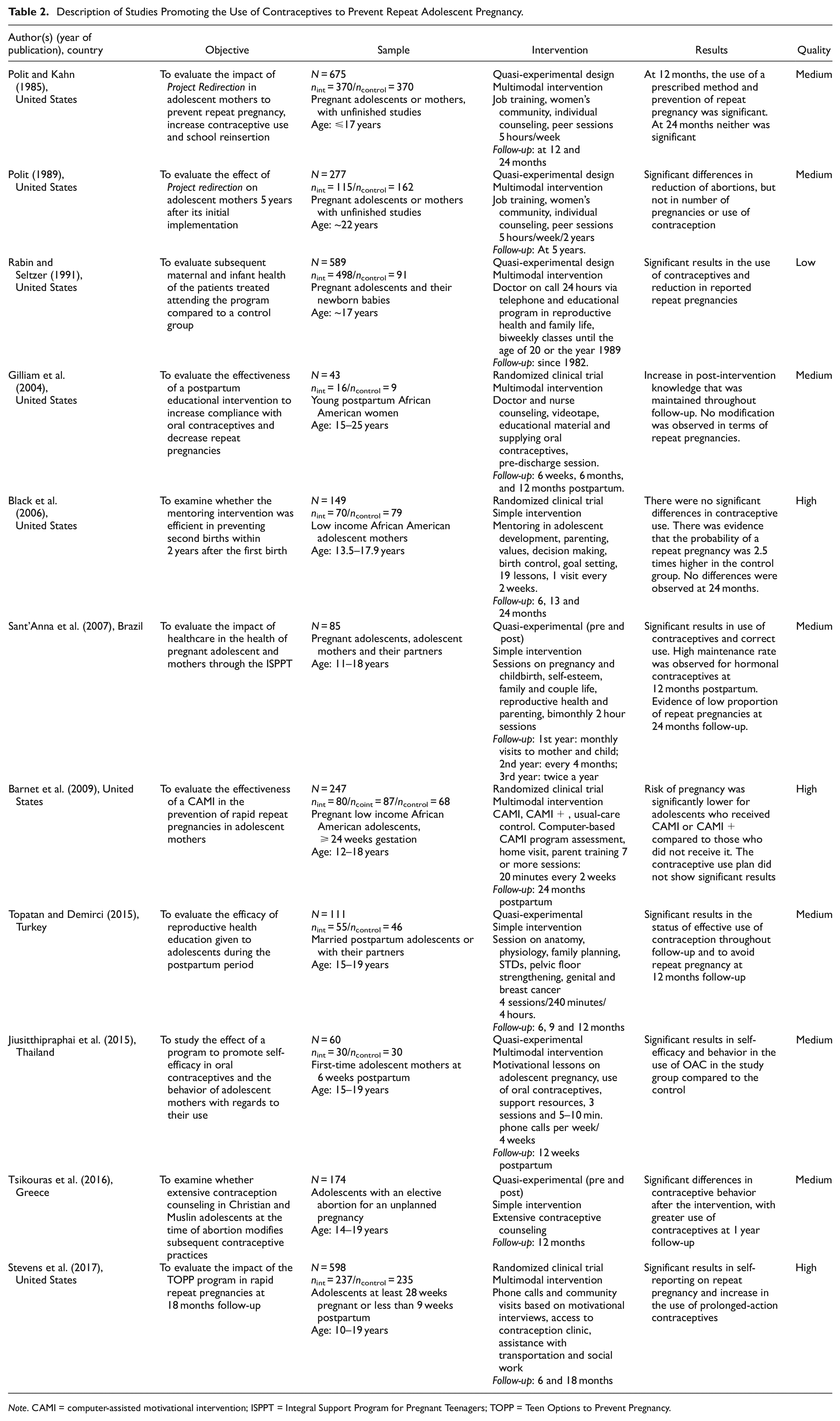
Note. CAMI = computer-assisted motivational intervention; ISPPT = Integral Support Program for Pregnant Teenagers; TOPP = Teen Options to Prevent Pregnancy.
Assessing Risk of Bias.

Note.
Results
The search yielded a total of 5,092 documents and 2 additional documents were added through a manual search. After the elimination of duplicates, a total of 3,424 documents were obtained. Of these, 3,226 were discarded according to their title, as they did not meet the inclusion criteria; subsequently, 133 more were discarded through the review of their summary and 5 more because they were not available in full text. A total of 65 articles were examined in full text, of which 54 were excluded because they did not meet the inclusion criteria or did not match the purpose of the review, leaving a final 11 articles for analysis (see Figure 1).

PRISMA flow diagram.
Of the eleven studies selected, four are randomized, controlled trials, five with a comparison group, and two with pre- and post-evaluations. Three studies had follow-up periods less than or equal to 24 months and were evaluated with high methodological quality (Barnet et al., 2009; Black et al., 2006; Gilliam et al., 2004; Stevens et al., 2017). One showed statistical significance in contraceptive use (Stevens et al., 2017) and one medium-quality study had losses during the follow-up period that affected the comparison of intervention efficacy (Gilliam et al., 2004). Other studies showed an absence of randomization and allocation that could have affected the results.
Since most of the studies were quasi-experimental, as previously described, the risk assessment of bias was not evaluated in the sequence generation and allocation concealment domains. Only one study had the complete information. In the other studies, the information found was insufficient to allow a high or low risk assessment of all domains, as shown in Table 2.
Altogether, the information of 3,008 adolescents who participated in the studies was integrated, their ages ranged between 11 and 19 years, and the studies were carried out in different countries and regions as follows: seven in the United States, two in Europe, one in Thailand, and one in Brazil. Table 3 shows the main characteristics of the studies included in this review. Only one of the studies included considered adolescents in a range between 15 and 25 years of age (Gilliam et al., 2004), since it included the age group of interest and other characteristics defined in the inclusion criteria. In four studies they included adolescents with 24 or more weeks of gestation, three studies considered adolescents in the postpartum period, one included adolescents pregnant or postpartum and two conducted the study in adolescents after an induced abortion.
The reported interventions with rigorous design that integrated a theoretical approach, as shown in Table 4, evidenced the efficacy in reducing repeat adolescent pregnancy as a primary outcome; however, in evaluating the increase in the use of contraceptive methods, they did not show statistically significant results, which was attributed by the authors to loss to follow-up or lack of emphasis on the component associated with this result (Barnet et al., 2009; Black et al., 2006). The information was synthesized according to the characteristics of the intervention, such as study population, delivery modality, scenario, format of delivery, and content.
Description of the Characteristics of Interventions.
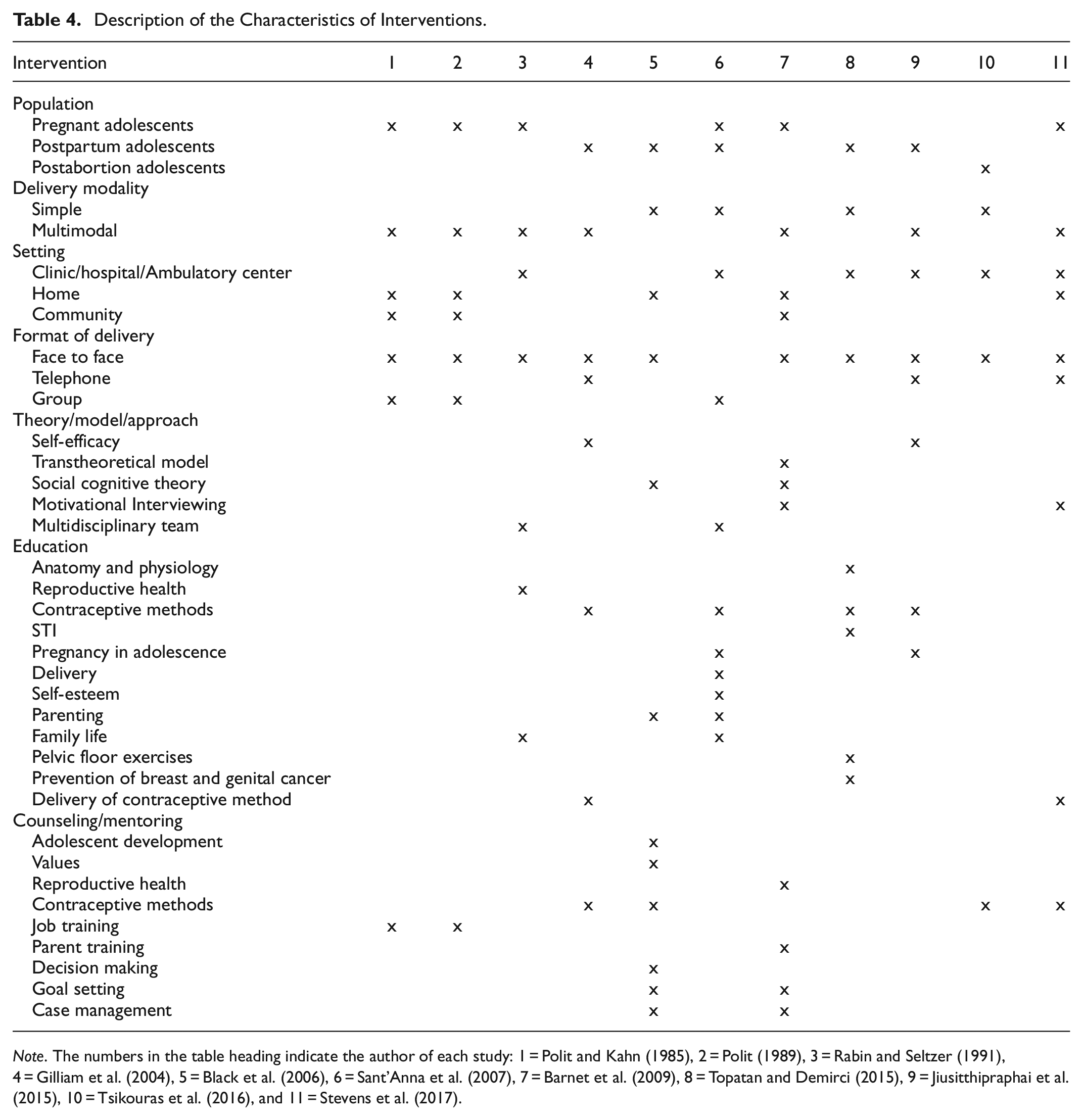
Note. The numbers in the table heading indicate the author of each study: 1 = Polit and Kahn (1985), 2 = Polit (1989), 3 = Rabin and Seltzer (1991), 4 = Gilliam et al. (2004), 5 = Black et al. (2006), 6 = Sant’Anna et al. (2007), 7 = Barnet et al. (2009), 8 = Topatan and Demirci (2015), 9 = Jiusitthipraphai et al. (2015), 10 = Tsikouras et al. (2016), and 11 = Stevens et al. (2017).
Contraceptive Use
Contraceptive use was reported heterogeneously, as a one-dimensional “use” variable by Rabin and Seltzer (1991), Sant’Anna et al. (2007), and Tsikouras et al. (2016) or by adding adjectives that could modify the meaning and measurement of the variable as effective (Topatan & Demirci, 2015), correct (Jiusitthipraphai et al., 2015), and continued (Gilliam et al., 2004), limiting the interpretation of the effectiveness of interventions globally. Seven of the studies presented significant results for variable “contraceptive use,” two of these were characterized by applying multimodal interventions, included mentoring and education focus on life protect (job training, family life) with weekly follow-up and obtaining the increase upon completion of the 12-month follow-up period (Polit & Kahn, 1985; Rabin & Seltzer, 1991); another reported the same characteristics of the previous studies, but the follow-up period was only 3 months (Jiusitthipraphai et al., 2015). One implemented a multimodal intervention, included in addition to contraception counseling by phone, delivery of contraceptive method with significant results in follow-up midway through the intervention and at 18 months (Stevens et al., 2017) and three studies based their interventions on contraceptive education and the time of delivery was at the moment of hospital discharge (Gilliam et al., 2004; Topatan & Demirci, 2015; Tsikouras et al., 2016).
Repeat Adolescent Pregnancy
The measurement of prevention in repeat pregnancy was compared through mean differences in the number of pregnancies, abortions, and live births in two study (Polit, 1989; Tsikouras et al., 2016), six studies reported the percentage of repeat pregnancies (Black et al. 2006; Gilliam et al., 2004; Polit & Kahn, 1985; Rabin & Seltzer, 1991; Sant’Anna et al., 2007; Stevens et al., 2017), one the risk ratio (Barnet et al., 2009). Out of the nine studies, six presented significant results in prevention of repeat pregnancies. Three of these (Barnet et al., 2009; Polit & Kahn, 1985; Sant’Anna et al., 2007) included, in addition to contraception, a motivational interview, at-home counseling on adolescent development, values, decision making, parenting, goal setting, and/or home visits; obtaining results after 12 months of follow-up. Black et al. (2006) showed that, after this same follow-up period, adolescents in the control group were 2.5 times more likely to be pregnant. Rabin and Seltzer (1991) also included reproductive health orientation and biweekly classes. Stevens et al. (2017), with a multimodal intervention, obtained the same result at 18 months follow-up.
Discussion
This systematic review identified and analyzed studies that evaluated the effect of different interventions promoting the use of contraceptives for the prevention of repeated pregnancy in adolescents 15 to 19 years of age with a previous pregnancy. The diversity of the studies included limits the homologation of the results, given the differences in study populations. As reported by Tsikouras et al. (2016), contraceptive behavior in adolescents is affected by social, cultural, educational, and religious factors. For example, four studies were developed with African American adolescents under conditions of vulnerability and a comparative study was carried out between Christian and Muslim adolescents, involving differences in the structure of the interventions, the operationalization, and the evaluation of the study variables.
The structure of the interventions differed with regards to their content, format of delivery and team; the only similarity found was in the content of two simple interventions that focused exclusively on education about contraceptive methods (Gilliam et al., 2004; Tsikouras et al., 2016). However, they were inconsistent in their results as Gilliam et al. (2004) reported changes in the continued use of contraceptives in young African American women, but without significant differences due to limitations on account of losses during follow-up. Tsikouras et al. (2016) reported significant changes in contraceptive behavior in Christian and Muslim adolescents, the greatest one being contraceptive use at 1-year follow-up. Similar results were presented for those interventions that clearly reported the content of the interventions (Jiusitthipraphai et al., 2015; Rabin & Seltzer, 1991; Sant’Anna et al., 2007); this could suggest that despite the context or characteristics of the population, contraceptive education is relevant to the increase in their use.
In terms of reducing the number of repeat pregnancies, the interventions that had the greatest positive effect were those that integrated the motivational interview, at-home counseling and home visits with peers; the positive effect of these interventions could be related to the multiple tasks performed by a teenage mother during the day and their limitations to access the intervention in another scenario (Barnet et al., 2009; Black et al., 2006; Polit & Kahn, 1985; Sant’Anna et al., 2007).
In developed countries, components that have been reported as successful in the implementation of interventions for contraceptive use in adolescent mothers, as in this systematic review, include peer mentoring, motivational interviewing, self-efficacy, and training for parents (Lewis et al., 2012). However, in the research on development of interventions in different contexts such as Latin America, it is a challenge to adapt and integrate these components, in order to establish their generalizability in population groups with other socio-economic and cultural characteristics.
Limitations
Only 11 studies were included in the analysis. The main limitation in this analysis corresponds to insufficient reporting in the studies analyzed, regarding the design, interventions, measurement, and analysis of the variables, to allow for the synthesis and evaluation of their quality, as well as restricted applicability due to differences in the origins of the studies, their populations of interest, and the characteristics defined in some of them. Only four of the studies analyzed reported an appropriate randomization and allocation, so an overvaluation of the analyzed results could have taken place. The heterogeneity in the results of contraceptive use, the diversity in their measurement methods and insufficient information about their content, validity, and reliability could have generated a bias in their homologation and their respective interpretation. Results are also difficult to generalize due to the age, culture, and religious factors. (Studies were carried out in the United States, Greece, Turkey, Brazil, and Thailand. They would not necessarily have the same results if carried out in other populations.). It is important to mention that the conclusions are limited because only studies written in English, Portuguese, and Spanish were included.
Conclusions
In this systematic review, the studies were characterized by having been carried out in greater proportion in African American adolescents, with intervention designs that included multiple components in addition to contraception. Overall, a positive effect was observed on the reduction of repeat pregnancies and the use of contraceptives.
The interventions that had an impact on the increase in contraceptive use included information about contraceptive methods, other educational topics, counseling and self-efficacy approaches, delivered prior to hospital discharge, and through outpatient clinics. These topics may have generated greater interest and adherence to the intervention due to the emerging needs of adolescent mothers, such as the prevention of repeat pregnancy, parenting guidelines, and optimization of resources.
Based on all the above, it can be concluded that the multicomponent interventions proposed by Black et al. (2006), Barnet et al. (2009), and Stevens et al. (2017) proved to have the highest methodological quality, to be effective in reducing repeat pregnancies and, in the latter study, also in increasing the use of contraceptives. However, it is important to consider that, given the complexity of its implementation, the inclusion of components such as home visits or the use of strategies to access health services could affect the viability of its replication in different socio-economic contexts.
The main contribution of this review is offering a synthesis to support decision-making in the design, adaptation or implementation of interventions for contraceptive use, based on the best available evidence, to generate a greater impact on the prevention of repeat pregnancies in adolescent mothers.
Footnotes
Acknowledgements
We appreciate the contribution of the Center for Research and Development in Health Sciences (CIDICS) for the resources required, the School of Nursing of the Universidad Autónoma de Nuevo León for its support and advice in the development of this review, and Sergio Lozano Rodríguez and Cecilia Siañez González for style corrections.
Authors’ Note
Natalia Isabel Manjarres-Posada, Universidad de Guadalajara, Departamento de Salud Pública, Centro Universitario de Ciencias de la Salud, Gudalajara, Jalisco, México; Raquel A. Benavides-Torres, Universidad Autonoma de Nuevo Leon, Facultad de Enfermería, CIDICS, Nuevo León, México; Guadalupe Fabiola Pérez Baleón, Universidad Nacional Autónoma de México, Escuela Nacional de Trabajo Social, Ciudad de México, México; María Teresa Urrutia Soto, Universidad Andrés Bello, Facultad de Enfermería, Santiago, Chile; Dora Julia Onofre Rodríguez, Universidad Autonoma de Nuevo Leon, Facultad de Enfermería, CIDICS, Nuevo León, México; Rosalva del Carmen Barbosa-Martínez, Universidad Autonoma de Nuevo Leon, Facultad de Enfermería, CIDICS, Nuevo León, México; María Aracely Márquez-Vega, Universidad Autonoma de Nuevo Leon, Facultad de Enfermería, CIDICS, Nuevo León, México.
Declaration of Conflicting Interests
The author(s) declared no potential conflicts of interest with respect to the research, authorship, and/or publication of this article.
Funding
The author(s) disclosed receipt of the following financial support for the research, authorship, and/or publication of this article: This work was supported by the Consejo Nacional de Ciencia y Tecnología (CONACyT, 626549) and UANL’S Scientific and Technologial Research Support Program (PAICYT, SSA933-19).
