




Abstract
Early life experiences are important precursors for developing leadership skills and acquiring formal leader roles later in life. The antecedents of leadership emergence in childhood have, however, not been subject to much empirical research—nor their links to actual leader role occupancy in adulthood. This study examines leadership emergence in a life-course perspective based on a large cohort of boys and girls, including survey and register data from the early 1960s to the late 2000s. We found a strong association between informal leadership emergence in childhood and formal leader role occupancy in adulthood. Social class was a significant predictor of both, mainly mediated through cognitive capacity and educational attainment in adulthood. Overall, the same factors predicted leadership emergence for both men and women. However, women received significantly more nominations for informal leader roles in childhood compared to men—accounting for a relatively larger share of the indirect effect of social class on holding a managerial position in adulthood. In contrast, the likelihood that a male held a managerial position in adulthood was relatively higher if he had been active in his spare time in childhood and had become a parent. Our findings thereby confirm the “parenthood advantage” for men vis-à-vis leadership role occupancy. With its prospective design and richness of data, the study shows how individual, structural, and behavioral factors interact in how leaders emerge across the life course, in general and among men and women respectively.
Plain Language Summary
Early life experiences play an important role for taking on leadership roles later in life. However, not much research has looked at what leads children to become leaders or how these early experiences are connected to leadership in adulthood. Past studies on leadership have mostly focused on personal qualities, rather than social background or life circumstances. In this study, we followed a large group of boys and girls from the early 1960s to the late 2000s, using both surveys and official records. We wanted to understand how people become leaders over the course of their lives. We found a strong link between informal leadership in childhood—like being seen as a leader by classmates—and formal leadership roles in adulthood, such as managing others at work. Social class made a big difference in who became a leader, both in childhood and adulthood. For the most part, this was because children from higher social classes often had stronger thinking skills and achieved higher levels of education, which increased their chances of becoming leaders later on. We also found that the same general factors influenced leadership for both men and women. Children who were seen as leaders by their peers in childhood were more likely to become managers as adults. Interestingly, girls were more often seen as informal leaders in childhood than boys. For women, being seen as a leader in childhood played a bigger part in how social class shaped their chances of becoming managers later on. For men, other factors stood out. Boys who were active in their free time and later became fathers were more likely to hold leadership roles as adults. This supports the idea of a “parenthood advantage” for men when it comes to becoming leaders at work. Thanks to the long time span and rich data of this study, we were able to show how personal abilities, social background, and life experiences all come together to shape who becomes a leader over the course of life, both for men and women.
Keywords
Introduction
Paint a picture of the clever, hard-working, good girl—and then add some extra color. That was what I was like! A big sister, member of the student council, project leader, class party organizer, chair of the student union, head of communications—before becoming politically active. First in my spare time, and then more and more extensively; the Moderate Youth League, ministries, municipality, region, parliament, the European Parliament.
Summer in P1 is an immensely popular program on Swedish Public Radio. It is broadcasted daily during summer and features persons from various parts of society who are invited to speak about their personal stories and matters that are close to their heart, accompanied by music of their own choice. The list of hosts in 2021 included the former leader of the Swedish Conservative Party, Anna Kinberg Batra. She was forced to step down as party leader after less than 2 years and her program naturally came to circle around her ascent to—and descent from—the higher echelons of political leadership.
Leadership is one of the most primary forms of association which arises wherever there are interactions of individuals or of groups (Guillen, 2010). Our fascination with formal and informal leaders is reflected in widespread attention in radio programs as well as other media, but also in the “leadership industry.” Most attempts at defining leadership circle around an influencing process between one or several leaders and one or several followers, how this process is shaped by leader traits and behaviors, follower perceptions and attributions, and the context in which this process occurs (Antonakis & Day, 2018). Although scholars are continuously debating if and how leaders and leadership affect organizational success, organizational investments aimed at identifying, recruiting, and training leaders are massive (Badura et al., 2022).
One of the core issues within leadership research is how some people come to occupy positions in which they may exert power over others. Are some individuals simply born to lead or is this a question of opportunity and context? Leadership scholars have offered different perspectives on this essential question. Over the years psychologists and organizational theorists came to dominate the field, focusing on individual traits and management issues. Sociological approaches, including the interplay between e.g., socioeconomic, individual, and contextual factors, gradually become less fashionable (Martin et al., 2017). Some of this void was filled with the upsurge in gender-oriented studies of access to power positions in organizations and society. Metaphors such as “the glass ceiling” and “the glass cliff” became part of our everyday vocabulary (Bruckmüller et al., 2014). From there leadership emergence and diversity attracted greater interest from leadership scholars (Guillen, 2010; Teigen et al., 2022), as well as early life experiences as potential drivers of leader role occupancy in adolescence and adulthood (Murphy & Johnson, 2011; Zaccaro et al., 2018).
In Kinberg Batra’s radio broadcast for Summer in P1 she provided a condensed narrative of her rise to higher political leadership positions. This account included familiar ingredients from leadership research, such as family socioeconomic status, birth order, engagement in extracurricular activities, educational attainment—and gender. As the first female leader of the Conservative Party, she found that her physical appearance and family life were brought to the fore in a way that male politicians seldom are exposed to. She also implicitly highlighted the importance of understanding leader emergence in a life-course perspective and how some individuals come to occupy leadership roles at an early age. A person’s self-view as a leader and taking on leader roles easily reinforce each other (Emery et al., 2010). At the same time leader-identity and access to leadership training opportunities vary substantially. Socioeconomic background is for example likely to have an impact on access to such opportunities, thereby modifying or reinforcing gender differences. The “glass ceiling” may, then, emanate from unequal access to informal leader roles at an early age.
In their model of leader emergence in a life-course perspective Murphy and Johnson (2011) productively unite individual traits and behaviors with structural and contextual factors, including family characteristics and development of leader identity in early life through for example engagement in extracurricular activities. Still, the model has several shortcomings. First, it does not include cognitive capacity, identified as one of the main dispositional precursors of leader emergence (Zaccaro et al., 2018). Second, it does not include structural attributes such as sibling status and social class. Although still widely debated, first-borns are thought to be overrepresented in formal leader positions. Possible explanations are greater attention and expectations from parents, as well as power struggles between the first-born and subsequent siblings (Eckstein et al., 2010). Younger siblings may then compensate power deficiencies by improving prosocial skills (Salmon et al., 2016). The omittance of social class is, however, more problematic. In the early days of leadership research, the socioeconomic bias among those who occupied formal leadership roles in society was emphasized (Stogdill, 1948). But socioeconomic and other structural circumstances came to be largely overlooked or taken for granted. The association between e.g., parental support, educational attainment, cognitive capacity, and leader emergence are clearly related to socioeconomic circumstances (Barling et al., 2023).
The point of departure in this article is the unexploited connection between leader emergence in childhood and in adulthood, where the long-term impact of socioeconomic status may be a bridge between the two (Barling et al., 2023; Breen & Jonsson, 2005). Based on a modified version of the framework presented by Murphy and Johnson (2011)—see Figure 1—our overarching aim is to prospectively and from a gender perspective examine the impact of family socioeconomic background on informal and formal leader role occupancy across the life course. Our specific research questions are: (1) What role does family socioeconomic status play for informal and formal leader emergence among men and women when controlling for other structural and individual characteristics? (2) Is informal leader emergence in childhood associated with formal leader role occupancy in adulthood for men and women alike? (3) If so, is family socioeconomic status mediated through informal leader roles and other general and gender-specific antecedents to leader emergence?

A model for leader emergence from childhood to adulthood, adapted from Murphy and Johnson (2011).
Informal and Formal Leader Emergence Over the Life-Course
A basic tenet in leadership research is that there is no leadership without followership. In childhood and pre-adolescence such relationships are mainly informal, but no less real. Still, children and childhood are relatively alien concepts in traditional leadership research (Gottfried & Gottfried, 2012), while scholars in childhood studies tend to avoid the concept “leadership” (Chen, 2023). Expectations of rationality and behavioral patterns are different when it comes to children, and leadership in childhood and adolescence is also a much more ambiguous phenomenon (Dodge et al., 2006).
In childhood and youth studies, “peer status” is a far more familiar concept. Peer/sociometric status is essential for understanding group dynamics, antisociality and deviance, interactional patterns—and their association with later educational, health, social, and occupational outcomes (Almquist, 2009; Smångs, 2010). Peer status may be measured in various ways. As children grow older observational data are gradually substituted or supplemented with interviews and sociometric measurement techniques. Since the early 1980s asking children to name three classroom peers whom they like the most (acceptance) or like least (rejection) became a standard procedure for measuring peer status (Coie et al., 1982). This technique has also been used to examine perceptions of task-specific and relational capabilities. Children may for instance be asked to name peers whom they would like to work with, to play with, or have as their best friend (Tassi & Schneider, 1997). Task-related peer nominations and friendship are not necessarily as strongly related as one might intuitively expect (Hollander & Webb, 1955), analogous to the dichotomy between task- and relations-oriented leadership in mainstream leadership research (Behrendt et al., 2017). Peer nominations have also been used to study academic achievements in middle childhood (Rotheram-Fuller et al., 2022).
Peer nominations have, then, been used to assess actual or perceived leadership capacity among children and adolescents as well as adults in organizational settings (Andrews, 2020; Hollander, 1957; Petzel et al., 1990).
Peer Status and Socioeconomic Status
One of the founding fathers of modern leadership research noted already some 80 years ago that leadership positions tend to be populated by persons with higher socioeconomic status and that “leaders are persons who tend to rate higher than average in popularity” (Stogdill, 1948, p. 59). Popularity is often seen as a shallow reflection of “true” qualities but does tell us something about how a person is seen by others (Bukowski, 2011). Popularity is, then, basically a question of social status and thereby involves a potential to influence others. The antecedents of popularity, its measurement significance in social relations is therefore worth examining. Popularity is, for example, strongly related to socioeconomic status, and gender (Bukowski, 2011; Petzel et al., 1990).
Although it is generally accepted that peer status is closely related to socioeconomic status, peer status and peer relations are rarely approached from a socioeconomic status or inequality perspective (Bukowski et al., 2020). Schools and school classes are, nonetheless, entrenched in a larger social environment. Even in a relatively uniform school environment, social stratification may be highly tangible for pupils who spend most of their wake hours in it (Parsons, 1959). Leader emergence must therefore be understood within a wider historical, cultural and/or sociological context.
Leader Emergence Across the Life-Course
A life-course perspective on leader emergence means a shift in focus from informal to formal leader roles, where power resources are gradually supplemented with organizational powers associated with the occupancy of certain roles. In this process leadership tends to be conflated with “its more tangible cousin management” (Alvehus, 2021, p. 121). While leadership is often romanticized as a process involving unique individuals bringing about change based on visionary ideas, management is often described as the fulfillment of organizational objectives (Simonet & Tett, 2013).
The socio-demographic distribution of formal leader (managerial) roles has been a topic of great interest among several scholarly fields, not least those focusing on structural and cultural barriers toward greater gender equality in occupation of formal leadership roles (Badura et al., 2018). In a life-course perspective it has been noted how girls are less likely to see themselves as potential leaders and to be encouraged or labeled as leaders by peers, parents, teachers, or coaches (Nathan et al., 2021). During child-bearing years these tendencies are likely to be enhanced by gendered expectations about employment, career, and parenthood (Frear et al., 2019; Jongbloed et al., 2024; Morgenroth et al., 2021). Bearing in mind that socioeconomic background may play out differently for men and women (Li et al., 2011), there is also reason to examine the underlying mechanisms of leadership role occupancy for men and women respectively. The authors conclude that future studies should adopt longitudinal designs for this purpose. Our study is an attempt to heed that call.
Method
Sample and Material
The sample and data in this study originate from the Project Metropolitan, initiated as a collaboration among Nordic capital cities in the 1960s. Its main aim was to study social mobility, conformity, and deviance in a life-course perspective. The Swedish Project Metropolitan covered all children who were born in 1953 and who were residing in the Stockholm Metropolitan area in 1963 (7,398 girls and 7,719 boys). Data were collected from the cohort members themselves, their parents/guardians and from registries. One of the sub-studies in the project—the School Study—consisted of a written survey which was distributed among the children when they were in the sixth grade (in 1966). They responded to the questionnaire individually, in the classroom. It included questions about future aspirations, hobbies and participation in extracurricular activities, relationship to friends and parents, attitudes to homework and school, as well tests of cognitive capacity. 1 These data have been used in studies on criminality, risk for premature death and suicide, educational attainment, income, and so forth (Stenberg, 2018).
Survey and register data were collected until 1986, after which the data were deidentified. In 2018/2019 the data set was successfully matched with another anonymized longitudinal data set—Relink53—consisting of all persons born in 1953 and residing in Sweden in 1960, 1965 and/or 1968. Of the original 15,117 cohort members 14,608 could be positively matched and thus included in what came to be the Stockholm Birth Cohort Multigenerational Study (SBC Multigen) (Almquist et al., 2019). This has broadened the scope for research based on the original Metropolitan study, both in terms of follow-up period, inclusion of siblings and offspring, as well as type of outcomes that may be analyzed. Recently, SBC data have for example successfully been used for the study of leadership emergence in a longitudinal perspective—albeit hitherto only among men (Reitan & Stenberg, 2019, 2024, 2025).
An overview of the variables included in our analyses, the sources of information, the year the variables refer to, and non-response rates is presented in Table 1. The gross sample in this study comprises 11,256 individuals who participated in the School Study, who were in the sixth grade in 1966, and where information about which school class they attended is available. Moreover, it excludes individuals who died before or were not residing in Sweden in 2009 (at the age of 55). Following listwise deletion of individuals with missing data on at least one variable, we constructed 2 analytical samples consisting of 10,219 individuals (5,201 females, 5,018 males) regarding inform leader emergence (in childhood) and 8,852 individuals (4,657 females and 4,195 males) concerning formal leader emergence (in adulthood).
Overview of Variables, Data Sources, Year(s) Information Refers to and Age of Cohort Members at the Time, and Non-Response Rates.
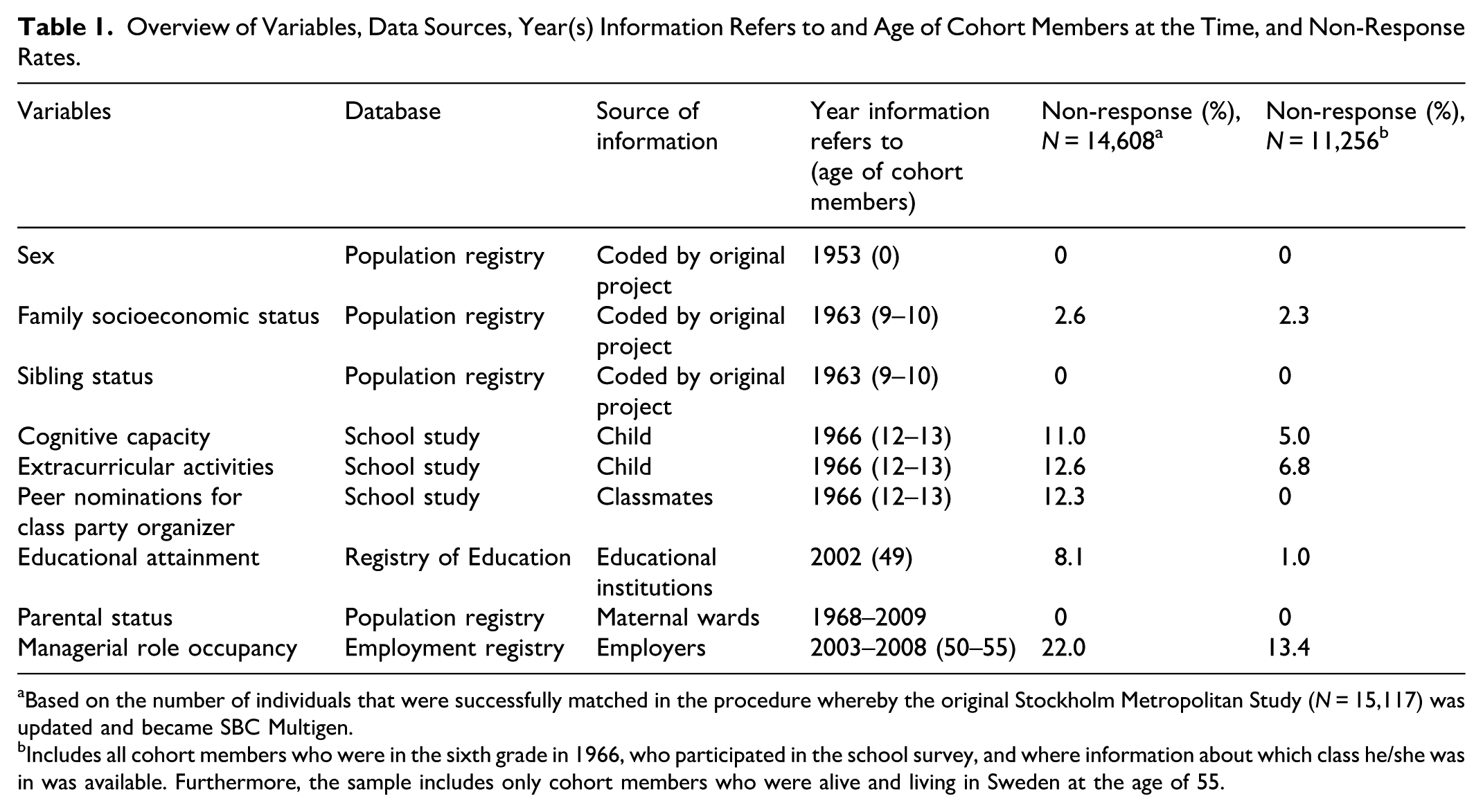
Based on the number of individuals that were successfully matched in the procedure whereby the original Stockholm Metropolitan Study (N = 15,117) was updated and became SBC Multigen.
Includes all cohort members who were in the sixth grade in 1966, who participated in the school survey, and where information about which class he/she was in was available. Furthermore, the sample includes only cohort members who were alive and living in Sweden at the age of 55.
The research was carried out in accordance with the Swedish Ethical Review Act and approved by the Regional Ethical Review Board in Stockholm (reference number 2017/1340-31) and the Swedish Ethical Review Authority (reference number 2020-03835). The data set on which this study is based is in practice a register study including a large number of individuals. After data were deidentified and matched with another anonymized data set (see above), it is no longer possible to link data with identifiable individuals. Requirements for informed consent were therefore waived by the Ethical Review Board. For the same reason there was no direct contact between researchers and participants in this study. Additionally, many of the cohort members are no longer alive and none of the variables included in this study are defined as sensitive according to the General Data Protection Regulation (GDPR) or the Swedish Ethical Review Act. Consequently, the risk of harm to any individual is negligible.
Variables
In the following each variable is presented in further detail. A description of the sample across variable categories is presented in Supplemental Table 1 and is based on the analytical sample for managerial role occupancy in adulthood.
Gender is measured as male or female sex, according to coding in register data.
Family socioeconomic status is defined as that of the family of origin. Information on parents’ (mainly the father’s) occupation in 1963 was collected from population register data and originally coded into five categories: (1) Upper and upper middle class, (2) lower middle class, officials, and non-agricultural employees, (3) lower middle class or entrepreneurs, (4) working class (skilled workers), and (5) working class (unskilled workers).
Sibling status was based on the status in 1963 and coded in four categories—only child (no siblings), oldest child (only younger siblings), middle child (both older and younger siblings), and youngest child (only older siblings).
Cognitive capacity was assessed by use of a verbal, a spatial, and a numerical test as part of the School Survey. Each test rendered a possible score of 0 to 40 points, totaling a maximum score of 120 points. 2
Extracurricular activity is based on a question in the School Survey about how often the cohort member took part in organized activities (sports clubs, scouts, religious groups, etc.). The variable was coded into three categories (weekly, sometimes, never).
Peer Nominations
In the school survey children were asked to nominate a maximum of three pupils in the same class whom they would like to see as organizers of a class party. Nominations were given anonymously and none of the pupils were aware of how many nominations they received or from whom. The number of nominations varied between 0 and 31. The average number of nominations was 2.5 among boys and 3.1 among the girls. However, the distribution of nominations was highly skewed: Almost 30% of the boys and 24% of the girls received no nominations, and around 20% among both genders received one nomination.
Educational attainment is defined as the highest level of education by the age of 49. The original variable, consisting of seven categories, 3 was recoded into three categories: (1) compulsory school or 2 years of vocational school, (2) upper secondary school, and (3) university level.
Parental status is defined as a dichotomous variable measuring whether the cohort member had at least one registered offspring when he/she was 50 years old.
Managerial Role Occupancy
When the original Project Metropolitan data were updated within the Relink project, access was provided to occupational data from Statistics Sweden. The occupational registry is based on information from employers and follows international classifications. 4 In our analyses managers were registered as occupying a formal managerial position at least once between the age of 50 and 55. Individuals who had died before the age of 55 or who were not living in Sweden at that time were excluded.
Procedure
We used regression analyses to examine the association between background factors and leader emergence in childhood (peer nominations) and in adulthood (managerial role occupancy). 5 In the first case we employed a negative binomial regression which is particularly appropriate when we are dealing with an over-dispersed count variable where each participant has the same length of observation time, as in the case of peer nominations.
In the second case we performed a logistic regression appropriate for this dichotomous measure (manager vs. non-manager). To ease interpretation cognitive capacity was standardized. The result of the negative binomial regression analysis was presented as incidence rate ratios (IRR), representing the ratio of certain events for categorical variables. That is, the number of events (peer nominations) per unit of time (school lesson), divided by the groups we are studying. The interpretation of IRR resembles that of odds ratios (OR) in the logistic regression analysis. Using the margins command, we estimated the predicted number of events (peer nominations) and the probability of holding a managerial role in adulthood.
The first model includes family socioeconomic status, sibling status, cognitive capacity, and frequency of extracurricular activities, with peer nominations for class party organizer as the dependent variable. The second model includes all the above-mentioned variables in addition to educational attainment and parental status, with managerial role occupancy as the dependent variable. Because peer nominations were made within separate school classes, they were not independent of each other, and standard errors are probably not unbiased. Therefore, we calculated clustered standard errors by the number of school classes. Both models are presented with only main effects, as well as with interaction effects between gender and other independent variables (Table 3).
While the overall response rate was high (see Table 1) data was missing to a higher degree for some variables, particularly managerial role occupancy. We therefore performed multiple imputations on all models (see Supplemental Table 2).
The next step was to decompose the effect of family socioeconomic status on managerial role occupancy in adulthood using nominations for class party organizer, cognitive capacity, and educational attainment as mediators while controlling for sibling status, extracurricular activities, and parental status. This analysis was based on the Karlson-Holm-Breen (KHB) method (Kohler et al., 2011). This method has been especially developed to compare the estimated coefficients of nested nonlinear probability models, thereby enabling the identification of a direct effect of family socioeconomic status on managerial role occupancy, and an indirect effect, that is, mediated by other variables preceding managerial role occupancy. Finally, we calculated the shares of the total effect of family socioeconomic status on managerial role occupancy that were mediated by peer nominations, cognitive capacity, and educational attainment respectively. Both KHB analyses were conducted for males and females separately.
Results
In this study we examine leadership emergence in a life-course perspective. This means that the basic tenet of leadership research, stressing leadership as a truly relational and dynamic phenomenon, is even more relevant. As pointed out by the few scholars in this area, leadership in childhood and pre-adolescence mainly manifests itself informally—and is therefore harder to observe with traditional approaches that equate leadership to the occupation of formal leadership positions (Chen, 2023; Gottfried & Gottfried, 2012). Hence, it is necessary to incorporate informal leadership roles (in childhood) into traditional models of leadership emergence in adulthood. In doing so network-oriented approaches focusing on peer status and sociometric positions are of great avail (Smångs, 2010). In Table 2 we therefore include both “traditional” antecedents to leader role occupancy in adulthood, well-known in leadership studies (see e.g. Barling et al., 2023; Eckstein et al., 2010; Salmon et al., 2016; Zaccaro et al., 2018), as well as perspectives from social network theory and research on peer status (see e.g. Bukowski, 2011; Coie et al., 1982; Tassi & Schneider, 1997). We present the distribution of managerial role occupancy and non-occupancy in relation to all other variables, including peer nominations as class party organizer (as a measure of informal leadership roles). As could be expected the share of managers was markedly higher among male cohort members compared to female ditto—around 20% and 10% respectively. The gender gap in leader role occupancy has, as we have seen, been noted in many previous studies (Bruckmüller et al., 2014; Nathan et al., 2021). It is, furthermore, worth noting that the percentage of managers increases progressively with each social class—from around 9% among unskilled workers to some 19% among children with an upper and upper middle-class background. The relationship between socioeconomic status (either one’s own or the family of origin) is yet another factor which has regained some of its previous standing in leadership studies (see e.g. Martin et al., 2017). As for sibling categories the likelihood of becoming a manager was highest among first-born, and lowest for the middle child. This finding is also comparable with many studies on leadership role occupancy, in which first-borns are thought to be overrepresented (Eckstein et al., 2010). The average score on the intelligence test in the sixth grade was 75.6 among those managerial role occupants compared to 69.4 among non-managers. Again, this finding is as expected given previous research on the link between cognitive capacity and formal leadership role occupancy (Zaccaro et al., 2018). Children who were not active in their spare time had the lowest rate of managers in adulthood, while those who were active on a weekly basis showed the highest rate. The importance of engagement in extracurricular activities vis-à-vis leadership emergence and development of leadership skills has been shown in several recent longitudinal studies (Liu et al., 2023; Reitan & Stenberg, 2019). As expected in relation to previous research on leadership emergence, level of education was progressively higher among managers (Zaccaro et al, 2018). Cohort members who were parents were approximately twice as likely to be managers at age 50 to 55 compared to those who did not have children. This result is particularly interesting in relation to the possible “parenthood advantage” noted by Morgenroth et al., 2021).
Managerial Role Occupancy by Explanatory Variables. Percentage/Means (Standard Deviations Within Parentheses). N = 8,852. a

Based on observations with valid information on all included variables.
However, the most noteworthy result from Table 2 is the significance of informal leader emergence in childhood; children who later became managers received on average one more nomination as class party organizer compared to non-managers.
In order to examine the association between background factors and leader emergence in childhood (peer nominations) and in adulthood (managerial role occupancy we performed regression analyses. The results are shown in Table 3 and in Supplemental Table 2. Overall, there were small differences between results of listwise deletion and the imputed values, so the following presentation is based on the former.
Leader Roles in Childhood and Adulthood. Negative Binomial Regression/Logistic Regression, Listwise Deletion With and Without Interactions. Clustered Standard Errors by Number of School-Classes. a

Six hundred eighteen classes in the first model, 617 in the second.
Peer nominations for class party organizer: Incidence rate ratios [95% confidence interval], managerial role occupancy: odds ratios [95% confidence interval].
Reference category: females.
Reference category: unskilled workers.
Reference category: youngest sibling.
Reference category: never.
Reference category: compulsory education or 2 years vocational school.
Reference category: not parent.
The first model includes only childhood variables with peer nominations as the dependent variable. Using the margins command and, we calculated the predicted number of nominations for different categories. On average the boys received 2.4 nominations as class party organizer compared to 3.2 among girls. With regards to family socioeconomic status the main distinction was between workers and non-workers. The three highest classes on average received approximately 3 nominations, as compared to 2.5 nominations for children from the two lowest SES categories. When it comes to sibling status the youngest child received on average three nominations, compared to approximately 2.7 nominations for all other sibling categories. Regarding cognitive capacity the average number of nominations varied between 2.1 at −1 standard error and 3.6 at 1 standard error. Lastly, children who were active on a weekly basis received on average 3.2 nominations compared to 2.4 for non-active children.
The only interactions between gender and other independent variables that showed any statistically significant relationship were between middle children (there was no interaction effect between gender and sibling status overall), and cognitive capacity. In the former case the difference was approximately one extra nomination for girls vis-à-vis boys. In the latter case the average number of nominations for boys compared to girls varied between 1.9 and 2.3 at −1 standard error, and between 3 and 4.1 at 1 standard error.
The second model includes variables from both childhood and adulthood, analyzing the probability of holding a managerial role at age 50 to 55. To start out, the likelihood of holding such a position was 0.09 for women and 0.20 for males. When it comes to family SES there was a significant difference between the highest class vis-à-vis all other classes. However, the probability of holding a managerial position was 0.15 for the highest class and 0.11 for the lowest class. Sibling status and frequency of extracurricular activities showed no significant differences in relation to their respective comparison groups. For cognitive capacity the likelihood of holding a managerial position varied between 0.12 and 0.16 at −1 and 1 standard errors. As for peer nominations the likelihood of holding a managerial position was on average approximately 0.13 for those who received 0 to 2 nominations, increasing to 0.18 at 10 nominations and 0.21 at 15 nominations. In this model we also include educational attainment, showing significant differences between categories. The likelihood of holding a managerial position increased from 0.10 in the lowest to 0.19 in the highest educational level. Lastly, we found significant differences depending on parental status. The likelihood of holding a managerial position was 0.16 for parents compared to 0.08 for non-parents.
Two interactions between gender and other independent variables showed significant differences: First, the likelihood of holding a managerial position was 0.09 for women and 0.17 for men who were non-active in their spare time in childhood. The likelihood of holding a managerial position was basically unchanged for women (0.10) with a high level of extracurricular activity but increased to 0.22 for high-activity males. Second, among those who did not have children the likelihood of holding a managerial position was 0.07 for women and 0.10 for men. In contrast, the corresponding figures for parents were 0.10 and 0.22 respectively.
Mediation (KHB Analysis)
Capitalizing on the longitudinal character of our data set, we subsequently examined whether the effect of family socioeconomic status on managerial role occupancy is mediated through informal leader emergence in childhood for women and men respectively. Because cognitive capacity and educational attainment are closely associated with family SES, we also included them as potential mediators vis-à-vis leader emergence in adulthood. 6
Using the KHB method (see above), we were able to decompose the total effect of family SES on leader emergence in adulthood into its direct and indirect effects. In Supplemental Table 3 the coefficients for the total, direct, and indirect effects of family SES are presented, for the total study population as well as by gender. The indirect effects are, in turn, presented separately for peer nominations, cognitive capacity, and educational attainment with sibling status, extracurricular activity, and parental status as concomitants. In Table 4 we present the indirect effects’ percentages of the total effects for each social class, as well as the respective mediating variables’ shares of these indirect effects. As can be derived from Supplemental Table 3 some of these percentages refer to total and/or indirect effects that are not significant, which means that Table 4 must be interpreted with that in mind.
Distribution of Indirect Effects on Total Effect of Family Socioeconomic Status on Managerial Role Occupancy in Adulthood. Percent.

Reference category: Unskilled workers.
Reference category: Compulsory education or 2 years vocational school.
The total effect of family SES on managerial role occupancy is, as shown in Supplemental Table 3 overall strong, and is primarily mediated through cognitive capacity and educational attainment. While these mechanisms are not so surprising, it is more remarkable that the effect of family SES on formal leader role occupancy is—except for among skilled workers group—also significantly mediated through informal leader emergence in childhood. We also note that this effect is evident for both sexes and even somewhat stronger for women.
In Table 4 the indirect effect’s share of the total effect is presented for each social class and by gender, as well as the relative distribution between its components (peer nominations, cognitive capacity, and educational attainment). We see that, in comparison to unskilled workers, a notable part of the total effect of family SES is mediated in all classes apart from skilled workers. Moreover, the indirect effects of both educational attainment and cognitive capacity were substantial—apart from children from families of skilled workers. More interestingly though, peer nominations for class party organizer in the sixth grade accounted for a significant share of the total indirect effect of family SES on the likelihood of managerial role occupancy in adulthood. This effect was also notable in all classes except among skilled workers.
The indirect effects accounted for a varying share of the total effect among men and women in different classes. Over 60% of the total effect of family SES was mediated for men in the highest social class. Furthermore, educational attainment and cognitive capacity accounted for the largest shares of the indirect effects for both women and men, albeit somewhat more so for men. In contrast, informal leader emergence in the form of peer nominations accounted for a relatively larger share of the indirect effects among women.
Discussion
Leadership is a fundamental part of human interaction involving the distribution and exertion of power resources. As leadership is closely related to a core sociological issue—who, when, and how do (groups of) individuals emerge as leaders, formally or informally?
Empirical analyses of leader emergence, however, seldom go beyond retrospectively or cross-sectionally concluding that males and people from higher social classes are overrepresented in formal leadership positions. Study populations typically include small samples of persons who already occupy such positions or are on their way into these roles, e.g., business school students (Fitzsimmons et al., 2014). Consequently, generalizability is hampered by selection bias.
Based on a large data set and a prospective design, this study has been able to show how the socioeconomic status of the family of origin affects the likelihood of holding a formal leadership position many decades later. Family SES was mainly mediated through differences in cognitive capacity and educational attainment in adulthood, both well-known antecedents of leader role occupancy. Still, a noteworthy share of the effect of family SES was mediated through nominations for an informal leader role in childhood. These mechanisms turned out to be basically the same for men and women. Contrary to findings by Li et al. (2011), we saw a strong effect of family SES on formal leader role occupancy among women.
Awareness and understanding of social class differences start at an early stage in life and status cues tend to spill over on judgments of e.g., intelligence, motivation, or responsible behavior (Shutts et al., 2016). Overall, the girls in this cohort were more likely to be found suitable for the task as class party organizers. The number of nominations also increased significantly stronger with higher cognitive capacity among girls compared to boys.
Peer nominations as class party organizer could of course be interpreted as a simple measure of popularity (Gardner, 1956). However, the school class is a condensed microsystem where leaders emerge and disappear depending on an intricate interplay between ascribed and achieved characteristics of the child, the group, and situational factors. Socioeconomic status may therefore be an “underexamined socially defining attribute” in the classroom context (Régner & Monteil, 2007, p. 96). It is also important to emphasize that nominations were made anonymously and therefore less susceptible to popularity or friendship relations.
Four decades after the cohort nominated each other for an informal leader role, male cohort members were over twice as likely to hold a managerial position compared to their female peers. Moreover, the likelihood of holding a managerial position was relatively higher among men who had a high level of extracurricular activity in childhood, and who had become parents. These findings support previous studies on the importance of (physical) activity vis-à-vis managerial positions (Fitzsimmons et al., 2014; Johansson et al., 2017) and the parenthood advantage, especially for men (Morgenroth et al., 2021). Still, what really stands out is the significance of informal leader emergence in childhood on formal leadership role occupancy in adulthood—for men and women alike. In this way, focusing on both social and academic involvement in the elementary years is not only important vis-à-vis student performance—as suggested by Rotheram-Fuller et al. (2022)—but also in relation to future roles in organizational life.
Limitations
Our study has several limitations that deserve mentioning. Firstly, our analyses may have been subject to possible weaknesses related to selection bias and reliability issues which could not wholly be assessed through multiple imputations. Second, there are obviously a whole range of factors that we have not been able to control for. For example, temperament or personality are among the most studied precursors to leader emergence, along with for example genetic predispositions and facial appearance (Little, 2014; van Vugt & von Rueden, 2020). Third, although we were able to corroborate the well-established association between level of education and later managerial role occupancy our data were lacking in specificity concerning educational paths. For example, business studies are generally seen as particularly conducive to managerial positions in work-life (Wilton, 2008). Fourth, relevance and generalizability of our results may easily be questioned. The use of secondary and historical data is extra demanding as survey questions and responses must be contextualized within the social context they were collected. The Stockholm metropolitan area was, and is, different from other parts of Sweden and the demographic composition of this cohort is very different from today’s Swedish society. Having said that, placing individual traits and behaviors into a wider structural and political context is just as relevant today (Borgen, 2024).
In closing, we are also well advised to remind ourselves that we are dealing with probabilities, not determinism. Lack of peer nominations in childhood, low educational attainment, or being a male without children does not imply that a managerial—or other leadership—position is out of reach later in life. Similarly, being ousted from high leadership positions does not necessarily imply that such positions are no (longer) obtainable. After her exit as party leader, Anna Kinberg Batra was active in various boards and conducted a public inquiry before being appointed governor of Stockholm County in 2023. However, in September 2024 she was once again forced to resign prematurely—this time after severe criticism following several questionable recruitments. Leadership is, in other words, a precarious phenomenon and highly related to follower perceptions of leadership capacity and suitability in a specific context.
Conclusion
Leadership is an inter-personal phenomenon, a dynamic relationship between (perceived) leaders and (potential) followers. This dynamic starts out at an early age and is related to the task at hand, individual behaviors and characteristics, as well as the context in which leaders and followers operate. Studies on leader emergence in a life-course perspective often depart from retrospective accounts from smaller samples of persons who are already in formal leadership roles, focusing on the leaders’ individual traits. In contrast, this study was based on a large cohort of both males and females including survey and register data measuring both contextual, individual, and relational aspects across five decades. Through a prospective design we were, then, able to show how early life experiences and circumstances influence both informal leadership emergence in childhood as well as formal leader role occupancy in adulthood.
One of our main findings was that the socioeconomic status of the family of origin is a is a powerful predictor of both informal and formal leadership role occupancy. Children from non-working-class families received significantly more nominations for the task-related leader role of organizing a class party compared to working-class children. Cognitive capacity and a high level of extracurricular activity were also significantly related to informal leader emergence in childhood. In adulthood, the effect of family socioeconomic status was still strong but mainly mediated through cognitive capacity and later educational attainment.
With our longitudinal design we were, furthermore, able to show how informal leader emergence in childhood was a strong foundation for formal leadership role occupancy in late adulthood. Nominations for leadership positions in the sixth grade accounted for a significant share of the total indirect effect of family socioeconomic status on the likelihood of holding a managerial position in adulthood.
Because of the size and richness of the data set we were also able to analyze gender differences in leadership emergence over the life-course, producing several noteworthy findings: Overall, the same factors predicted informal and formal leadership emergence among both men and women. However, girls were significantly more likely to emerge as informal leaders in the sixth grade in terms of peer nominations as class party organizer. For women, this informal leadership emergence accounted for a relatively larger share of the indirect effect of social class on holding a managerial position in adulthood. In contrast, the likelihood that a male held a managerial position in adulthood was relatively higher if he had been active in his spare time in childhood—and had become a parent. In this way our study confirms previous discoveries of a parenthood advantage for men in relation to leadership role occupancy.
The classroom is an arena where foundations are made for future positions in organizational life, not only academically but also in terms of access to formal leadership roles. Recognizing and examining informal leadership roles and their impact on leadership identity, motivation to lead and later outcomes—as well as follower characteristics and behaviors—is a timely topic for future researchers and practitioners. At the same time leader role occupancy should be approached more dispassionately and not as an unambiguously positive outcome—neither for the leaders themselves nor for their followers. We also need to recognize the volatility and contextual aspects of leadership and leadership emergence and to welcome more longitudinal studies incorporating both informal and formal leader roles.
Supplemental Material
sj-docx-1-sgo-10.1177_21582440251383044 – Supplemental material for Class in the Classroom. A Cohort Study of Leader Role Occupancy Across the Life Course
Supplemental material, sj-docx-1-sgo-10.1177_21582440251383044 for Class in the Classroom. A Cohort Study of Leader Role Occupancy Across the Life Course by Therese Reitan and Sten-Åke Stenberg in SAGE Open
Supplemental Material
sj-docx-2-sgo-10.1177_21582440251383044 – Supplemental material for Class in the Classroom. A Cohort Study of Leader Role Occupancy Across the Life Course
Supplemental material, sj-docx-2-sgo-10.1177_21582440251383044 for Class in the Classroom. A Cohort Study of Leader Role Occupancy Across the Life Course by Therese Reitan and Sten-Åke Stenberg in SAGE Open
Supplemental Material
sj-docx-3-sgo-10.1177_21582440251383044 – Supplemental material for Class in the Classroom. A Cohort Study of Leader Role Occupancy Across the Life Course
Supplemental material, sj-docx-3-sgo-10.1177_21582440251383044 for Class in the Classroom. A Cohort Study of Leader Role Occupancy Across the Life Course by Therese Reitan and Sten-Åke Stenberg in SAGE Open
Footnotes
Ethical Considerations
The study has been approved by the Swedish Ethical Review Authority (registration number 2017/1340-31 and 2020-03835). Requirements for informed consent were waived, mainly because the data set was anonymized in 1986 and can no longer be linked to identifiable persons.
Author Contributions
Both authors were equally responsible for conceptualization, creation of models and interpretation of data and results. Stenberg took main responsibility for data curation and formal analysis. Reitan prepared the original draft while both authors were equally responsible for revisions and comments to reviewers.
Funding
The authors disclosed receipt of the following financial support for the research, authorship, and/or publication of this article: This study was supported by the Swedish Research Council for Health, Working Life and Welfare (Forte), grant number 2020-00153.
Declaration of Conflicting Interests
The authors declared no potential conflicts of interest with respect to the research, authorship, and/or publication of this article.
Data Availability Statement
The data underlying this article cannot be shared publicly due to restrictions from Swedish ethical review authorities. Data can, however, be accessed by researchers under certain preconditions. More information about the data set, access to it, and the preconditions set by Swedish authorities can be retained from the RELINK research program at the Department of Public Health Sciences at Stockholm University,  .
.
This statement has not been included in the submitted main manuscript file due to risk of jeopardizing author anonymity.
Supplemental Material
Supplemental material for this article is available online.
Notes
References
Supplementary Material
Please find the following supplemental material available below.
For Open Access articles published under a Creative Commons License, all supplemental material carries the same license as the article it is associated with.
For non-Open Access articles published, all supplemental material carries a non-exclusive license, and permission requests for re-use of supplemental material or any part of supplemental material shall be sent directly to the copyright owner as specified in the copyright notice associated with the article.
