




Abstract
This study aims to investigate the effectiveness of explicit information (EI) in the context of Processing Instruction (PI) as an alternative to traditional teaching methods. PI encompasses explicit information and structured input activity (SI). However, the effectiveness of EI has been a subject of debate. To address this question, grade-7 students were divided into three groups: the complete Processing Instruction group, the explicit information only group, and the structured input activity only group. Following pre-tests and the implementation of different teaching instructions on English passive voice, the scores of the participants were analyzed for the immediate post-test and delayed post-test. The results suggested that although EI did not accelerate the acquisition of the form-meaning connection of English passive voice, it was beneficial for final performance similar to SI. The complete Processing Instruction, however, proved to be the most effective. This study suggests a possible association between the effectiveness of EI and the relative difficulty of the target item for language learners.
Plain language summary
This study aims to investigate the effectiveness of explicit information (EI) in the context of Processing Instruction (PI) as an alternative to traditional teaching methods. PI encompasses explicit information and structured input activity (SI). However, the effectiveness of EI has been a subject of debate. To address this question, grade-7 students were divided into three groups: the complete Processing Instruction group, the explicit information only group, and the structured input activity only group. Following pre-tests and the implementation of different teaching instructions on English passive voice, the scores of the participants were analyzed for the immediate post-test and delayed post-test. The results suggested that although EI did not accelerate the acquisition of the form-meaning connection of English passive voice, it was beneficial for final performance similar to SI. The complete Processing Instruction, however, proved to be the most effective. This study suggests a possible association between the effectiveness of EI and the relative difficulty of the target item for language learners. The limitations of the study include the potential impact of uncontrollable classroom distractions, the grouping of participants according to classes without accounting for variations in learning abilities, English proficiency levels, and the potential influence of self-directed learning outside the classroom.
Introduction
The role of grammar and its integration within the foreign language classroom is a central focus of ESL (English as a Second Language) and EFL (English as a Foreign Language) learning and teaching contexts (Ellis, 2001). Undoubtedly, grammar instruction plays a vital role in EFL teaching and learning. However, it is also one of the most controversial issues in the field of foreign language research with numerous scholars continuously seeking improved approaches than the overwhelming traditional instruction, which is largely based on Swain’s (1985) Output Hypothesis, attaching greater importance to the production of the target linguistic structure than the input. It involves three stages. Initially, teachers provide an explanation of the target language structure. Subsequently, students are required to practice the same structure in a mechanical manner to reinforce their understanding of its form. Finally, students are encouraged to produce the target linguistic structure in a meaningful and communicative manner to facilitate the acquisition of its meaning. The traditional instruction is so popular that it is “still used around the world in a number of foreign language contexts and a good deal of practitioners believe passionately in the use of drills and mechanically-oriented activities” (VanPatten & Wong, 2004), and its prominence is particularly evident in China’s English education (Ellis, 2010).
Despite its prominence, the traditional instruction has faced criticism for yielding unsatisfactory results and exhibiting a disconnection between form and meaning, as these aspects are often addressed separately in different stages. In response to these concerns, various alternative approaches have emerged, one of which is Processing Instruction (PI) proposed by VanPatten and Cardierno (1993a, 1993b). The concept of PI draws inspiration from Krashen’s Input Hypothesis (Krashen, 1985) and VanPatten’s Input Processing Theory (VanPatten, 1993).
However, language learners can only absorb a certain amount of input, referred to as intake. Building on this notion, Input Processing Theory focuses on the conversion of intake into input. This theory suggests that learners have limited capacity to allocate their attentional resources. As a result, they employ strategies and mechanisms during comprehension to filter and revise the input, transforming it into a new entity called intake. This process, referred to as input processing, plays a crucial role in establishing the form-meaning connection. Intake is defined as the portion of input that is actually absorbed into learners’ interlanguage system. It serves as an essential catalyst for facilitating second language acquisition.
In the acquisition process, three fundamental stages are involved, as depicted in Figure 1 (VanPatten, 2003). The first process concerns the conversion of input into intake, where learners establish the form-meaning connection. The second stage focuses on the development of the learner’s internal system based on the intake. Finally, the third stage involves the adaptation of the developing system to produce output and manipulate language use.

Process in second language acquisition (VanPatten, 2003).
Moreover, this theory comprises two major principles, the Primacy of Meaning Principle and the First Noun Principle. The former states that learners process input for meaning before they process it for form, while the latter proposes that learners tend to process the first nouns or pronouns they come across in a sentence as the subject/agent of the sentence (VanPatten, 2004).
Processing instruction, derived from the aforementioned theories, comprises two main components: explicit information (EI) and structured input activity (SI). Explicit information involves providing learners with explicit details about a linguistic structure or form, as well as explanations regarding their non-optimal processing strategies. For example, when teaching English passive voice, teachers not only inform students about the structured pattern (“subject + be/get + past participle + optional by phrase”), but also caution them against incorrectly considering the first noun as the agent, as it usually represents the patient of the sentence. This aspect of Processing Instruction resembles Traditional Instruction, as both require explicit explanations of the linguistic structure.
Structured input activity encompasses two types. The first is referential activity, which presents language structures containing the target form with right or wrong answers, such as multiple choice questions. This type of activity evaluates students’ comprehension of the grammatical form and meaning of the target linguistic structure. Affective activities, on the contrary, aim to elicit learners’ attitudes, beliefs, or emotional responses while engaging with information related to real-world contexts (Wong & VanPatten, 2003). These activities do not have definitive right or wrong answers; instead, learners are encouraged to immerse themselves in realistic contexts where they can connect language to personal experiences. For example, when learning English passive voices, students are provided with a scene described by passive sentences and asked to express their feelings about the scene as to whether they like it or not. This approach exposes students to an environment that facilitates engagement with the target linguistic item. Structured input activity differs fundamentally from explicit information and Traditional Instruction in that teachers do not explicitly instruct the target linguistic structure. Instead, students are presented with numerous opportunities to be motivated by their own emotions and experiences, rather than being guided by predetermined objective questions with set answers.
While Traditional Instruction focuses on the output, the production of the target linguistic structure, and is applied by mechanical and repetitive drills, Processing Instruction focuses on the process by which input is transferred into intake, and is implemented by flexible teaching activities as structured input activity. Traditional Instruction aims to ensure that learners produce the target structure correctly, whereas Processing Instruction recognizes the importance of comprehension and intake, aiming for a deeper understanding of the target structure.
Most researchers agreed that Processing Instruction was better than the traditional instruction (Benati, 2001, 2005; Benati & VanPatten, 2004; Russell, 2012; VanPatten & Wong, 2004; Wong & Ito, 2018; but see DeKeyser & Sokalski, 1996). However, there is inconsistency in their explanations for why it is superior, particularly regarding the effectiveness of explicit information (EI). Some studies have concluded that explicit information is ineffective (Benati & VanPatten, 2004; VanPatten & Oikkenon, 1996; Sanz, 2004; Sanz & Morgan-Short, 2004), while others have discovered some benefits of it. The benefits of explicit information can be viewed from two perspectives. Firstly, although structured input activity is useful, its effectiveness does not match that of complete Processing Instruction (Farley, 2004). Secondly, explicit information has been found to accelerate the acquisition of the target linguistic structure (Fernández, 2008; Henry et al., 2009, 2017; Russell, 2012; VanPatten & Borst, 2012; VanPatten et al., 2013). However, it is important to note that the accelerating effect is not consistently observed. Fernández (2008), Henry et al. (2009), VanPatten et al. (2013), and Russell (2012) suggest that the effectiveness of explicit information depends on the specific target linguistic structures. For instance, in a study conducted by VanPatten and Oikkenon (1996) on Spanish object pronouns and word order, English participants were divided into three groups: one received complete Processing Instruction (explicit information plus structured input activity), one received structured input activity only (without explicit information), and one received explicit information only (without structured input activity). The results indicated significant improvement in both the full Processing Instruction and structured input activity groups, while the explicit information only group showed no gains. This suggests that explicit information did not play a significant role in Processing Instruction.
However, in Farley’s (2004) study, it was observed that both the complete Processing Instruction group and the structured input activity only group demonstrated significant improvement. The complete Processing Instruction group exhibited superior performance compared to the structured input activity only group, indicating that structured input activity alone has the potential to develop learners’ meaning-form mapping. However, the benefits of structured input activity were found to be less pronounced than those of the full Processing Instruction treatment, suggesting that explicit information does have some relevance in Processing Instruction. Furthermore, Fernández (2008) discovered that the groups receiving explicit information began processing significantly earlier than the other group, requiring fewer trials to reach the criterion. This finding indicates that explicit information can accelerate the learning process and facilitate quicker acquisition of the target linguistic structure in Processing Instruction.
Given the inconsistent findings regarding the effectiveness of explicit information in Processing Instruction, it is important to conduct further investigations to determine whether explicit information indeed accelerates the learning of grammar rules. In the context of English as a foreign language instruction in China, Processing Instruction is a relatively new pedagogical approach, and previous research primarily focuses on college students, with limited studies involving Chinese school-age students (although see Benati, 2005; Qin, 2008). Therefore, this study aims to examine the effectiveness of Processing Instruction and the necessity of explicit information specifically in the context of English language learning in China. Additionally, most previous studies have predominantly used college students as participants, who possess strong self-discipline, self-learning abilities, information manipulation skills, and a solid foundation in the target language. However, the learning situation may differ for middle and high school students, as they tend to rely more on explicit information and the guidance of teachers. Therefore, in this study, participants from a middle school were divided into three groups: the complete Processing Instruction group, the structured input activity only group, and the explicit information only group. By including students from a younger age group, we can better understand the effectiveness of explicit information and its role in Processing Instruction in the specific context of middle school English language learning in China.
In conclusion, taking into account the potential benefits of explicit information in accelerating the acquisition of the target linguistic structure and the relatively limited effectiveness of structured input activity alone compared to complete Processing Instruction, the research questions for this study are as follows:
Possible different results indicate different roles of Explicit Information:
(1) If the result is that PI equals to SI, and that EI does not work, it means that SI itself is effective and EI is useless.
(2) If the result is that PI is better than SI and EI, and that both EI and SI work, it means that both SI and EI are effective and neither of them is dispensable.
English passive voice was chosen as the target structure because (a) existing research focused on other linguistic structure such as OVS-type sentences with third person clitic pronouns in French, Spanish and German (Fernández, 2008; Henry et al., 2009, 2017; Vanpatten, 1996; Vanpatten et al, 2013) and it is needed to expand the range of the linguistic structures that Processing Instruction can be applied to, (b) passive sentences present a contrast to the First Noun Principle, which indicates that language learners tend to process the first noun or pronoun they come across as the subject/agent.
Methodology
Participants
The participants were three grade-seven classes (class A, class B, and class C; they were three classes without any reshuffle) from a middle school in Chongqing, China, with a total number of 109 students. This grade was chosen because they were not supposed to have learned English passive voice. However, to minimize the effect of extracurricular influence, the participants must meet the following requirements.
The participants must score less than 60% of the maximum score in the pretest about English passive voice, indicating a limited understanding of the target structure.
The participants must only be able to encounter English passive voice in the classroom during the whole experimental process. Therefore, homework about the target structure would not be assigned.
The participants must go through the whole experimental stages.
Therefore, only 94 students’ data were included for analysis. The demographic information is presented in Table 1. Class A was the structured input activity only group, class B was the Processing Instruction group, and class C the explicit information only group.
The Demographic Information of Three Group.
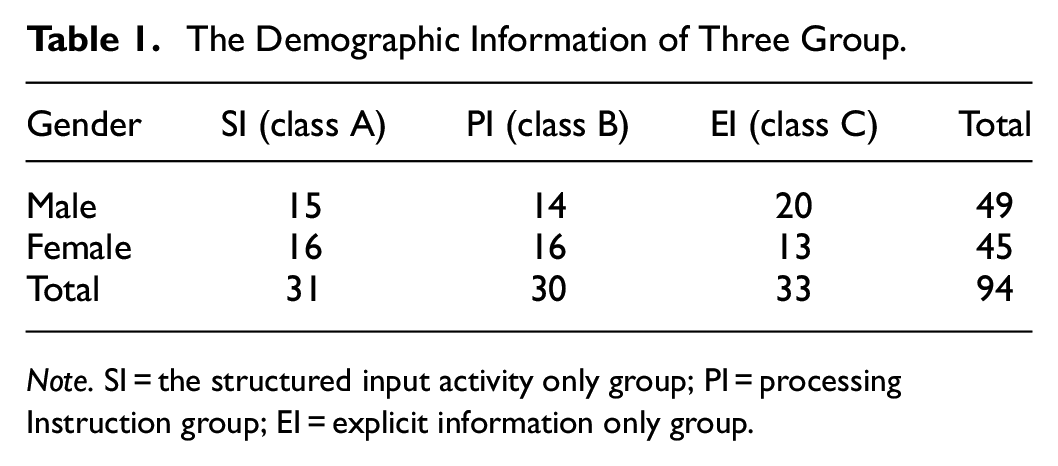
Note. SI = the structured input activity only group; PI = processing Instruction group; EI = explicit information only group.
Materials
All the materials were chosen from an authentic grammar book and related to previous studies.
Target Structure
The target linguistic pattern was English passive voice for its contrast with the First Noun Principle, where the subject of a sentence is typically perceived as the initiator of the action. In English passive voice, however, the subject is the receiver of the action.
Teaching Instruction
The three groups received three instructions. To ensure effective communication and comprehension, all oral instructions provided to the students during the study were delivered in Chinese, considering their English proficiency level. For instance, during the structured input activity, while the questions were presented in English, the teacher used Chinese to provide instructions and guidance to the students, ensuring that they fully understood the tasks and objectives.
Class C received only the explicit information about the English passive voice, including what English passive voice is, what its form is, how it should be used, and the regular and irregular transformations of the past participles, and the explicit information about the processing strategy that learners are likely to adapt and would lead to mistakes when processing input. For example, they were instructed to avoid regarding the first nouns of the passive sentence as the agent. Detailed implementation of EI delivered included:
(a) What present and past passive sentences are and how they are structured.
(b) How past participles are transformed from original forms, including regular and irregular forms.
(c) What the difference between a active sentence and a passive sentence is, such as the difference of structure and that of thematic role (without mentioning the term).
(d) How the auxiliariy “can” is used in passive sentences.
(e) Subjects should not be regarded as the agent, but usually the patient, or the recipient.
Class A was taught by only the structured input activity. The referential activity was in the form of picture-meaning matching at the sentence level. Each trial presented a picture along with a set of sentences, and the students were required to choose the sentence that correctly matched the picture. The design of the activity ensured that there was only one correct answer for each trial, encouraging learners to rely on their understanding of the passive structure to comprehend the meaning conveyed. There were 20 exercises in total, with one distractor following three target structures. Examples of the referential activity are presented in Figure 2. The participants were asked to choose the right sentence matching the picture. In the affective activity, participants needed to present their affective feelings or viewpoint about the sentence containing the target structure by circling either YES or NO based all on their understanding and previous experience. It is important to note that there were no right or wrong answers. Learners just gave the answer based on their understanding and feelings. Some examples are provided in (1). If the learners liked the scene that the sentence described, they were supposed to circle “Yes”, or “No” if not.

Examples of questions in the referential activity.
(1) A thief is caught by the police. □ Yes □ No
A mother is kissed by her daughter. □ Yes □ No
A cat is hurt by a naughty boy. □ Yes □ No
Many trees are planted. □ Yes □ No
Phone is invented by people. □ Yes □ No
And class B was instructed by both the explicit information delivered to class C and the structured input activity delivered to class A.
Assessment
To evaluate the impact of explicit information and structured input activities in processing instruction, two types of assessment tasks were used: comprehension tasks and production tasks at the sentence level. In all the three tests, each test included a production task and a comprehension task. However, questions included were different so that (a) the students would not meet the same question twice, and (b) the scores of different tests could be compared. The pretest was conducted to assess the initial proficiency level of all participants and identify those who met the required standard based on the test results. The immediate post-test and delayed post-test were designed to examine and compare the effects of the instruction. These tests maintained consistency in terms of task type, number of exercises, overall length, and time limit, with a duration of 35 min.
In the comprehension task, the participants were required to underlie either the agent or the patient of the passive sentence. The task consisted of 10 trials, with 5 trials focusing on identifying the agent and 5 trials focusing on identifying the patient.
As for the production task, the participants were asked to complete the sentence by using the correct voice of the given verb with the help of the provided pictures and cue words. The task also consisted of 10 sentences. The following are the examples of the materials used in the two tasks, (2) for comprehension task and Figure 3 for production task.
(2) Comprehension task:
I. Underline the doer of the action of the following sentences.
1. Mike is invited by Mary to her birthday party.
2. A woman is stopped by a policeman.
…
II. Underline the recipient of the action of the following sentences.
1. The boy is bitten by his cat.
2. The teacher is told something by his students about fruits.
…

The example for the production task.
Procedures
Before the main experiment, a pilot study was conducted with a total of 24 grade seven students who had similar levels of language proficiency. There were eight students assigned to each instruction group. Based on the feedback received and discussions with the participants, adjustments were made to the materials to address any difficulties that were unrelated to the English passive voice. These adjustments were made to ensure that the materials effectively targeted the intended linguistic structure and minimized any confounding factors that could affect the results of the main experiment.
The experimental timeline spanned from September to November in 2021, following a pretest-treatment-immediate posttest-delayed posttest design. The treatment occurred during students’ regular classes over a period of five consecutive days, with explicit information, structured input activity, and full Processing Instruction delivered to the respective groups for 20, 20, and 40 min each day. The immediate post-test was administered on the final day of the treatment, followed by a delayed post-test 1 month later. Vocabulary acquisition was not the primary focus, and students were allowed to inquire about unfamiliar words during the study.
Analysis
Data from two resources was collected for analysis. The first was from the participants’ answer sheet of the referential activity in the processing instruction group and the structured input activity only group. This included information on the trials to criterion, which indicated the stage at which the participants answered four items in a row correctly, signifying accurate processing of passive voice (Fernández, 2008). The trials to criterion represented the number of items attempted before reaching the criterion. A lower number of trials to criterion indicated a faster construction of the form-meaning connection. For example, if a participant answered correctly four items in a row from item 3 to item 6, then the trials to criterion were 2. The second was from the assessments conducted. Every sentence in the comprehension task and the production task was counted 1 if the answer was correct and 0 if it was incorrect. All the data was analyzed in SPSS 26.0.
Results
Pretest
The descriptive analysis of the pretest scores is presented in Table 2. The scores of the SI group were slightly higher than the other two groups. To further investigate if there were any statistical differences among the groups, one-way ANOVA tests were conducted for the total score, the comprehension task score, and the production task score, as shown in Table 3. The results were F(2, 91) = .935, p = .396 > .05 for the total score, F(2, 91) = 1.962, p = .146 > .05 for the comprehension task, and F(2, 91) = .951, p = .390 > .05 for the production task. The results indicated that there were no significant differences among the groups in the pre-test scores, as shown in Table 3.
The Score for the Comprehension Task, the Production Task, and the Total Score.

Note. SI = the structured input activity only group; PI = Processing Instruction group; EI = explicit information only group.
One-Way ANOVA of the Pre-Test for the Three Groups.

Note. CT = comprehension task; PT = production task; TS = total score.
Form and Meaning Connection
To answer whether EI helps to increase the speed of learners to construct form-meaning connection, independent-samples t test was conducted with PI and SI being the independent variables and the trials to criterion being the dependent variable. As shown in Table 4, there was no significant difference between PI and SI for trials to criterion, suggesting that the two groups were at the same pace to construct from-and-meaning construction.
The Results of Trials to Criterion Between SI and PI.

Immediate Post-Test and Delayed Post-Test
To determine the effectiveness of the different instructional approaches in acquiring English passive voice, the results of the two post-tests were analyzed.
What deserves mentioning is that due to the deviation from normal distribution of some data, some analyses took T-tests while others Wilcoxon’s sign rank test and Mann–Whiteney U test, with the same test of different groups, or different tests of the same group as the independent variable and the score as the dependent variable.
Here some small questions need to be answered. The first question is whether all the methods were effective or only some them were.
Figures 4 to 6 show that all the three groups’ performance increased for both tasks in the immediate post-test and then decreased in the delayed post-test. To ensure that the instructions were useful, Wilcoxon’s sign rank test and paired-samples T test were applied to compare the performance of the pre-test and the immediate post-test, shown in Table 5. The results indicated that all the three groups were significantly influenced by the teaching instructions.

The mean score for production task in pre-test, immediate post-test and delayed post-test.

The mean score for the total score in pre-test, immediate post-test and delayed post-test.

The mean score for comprehension task in pre-test, immediate post-test and delayed post-test.
The Comparison Between the Pre-Test and the Immediate Post-Test for the Three Groups.

Note. CT = comprehension task; PT = production task; TS = total score.
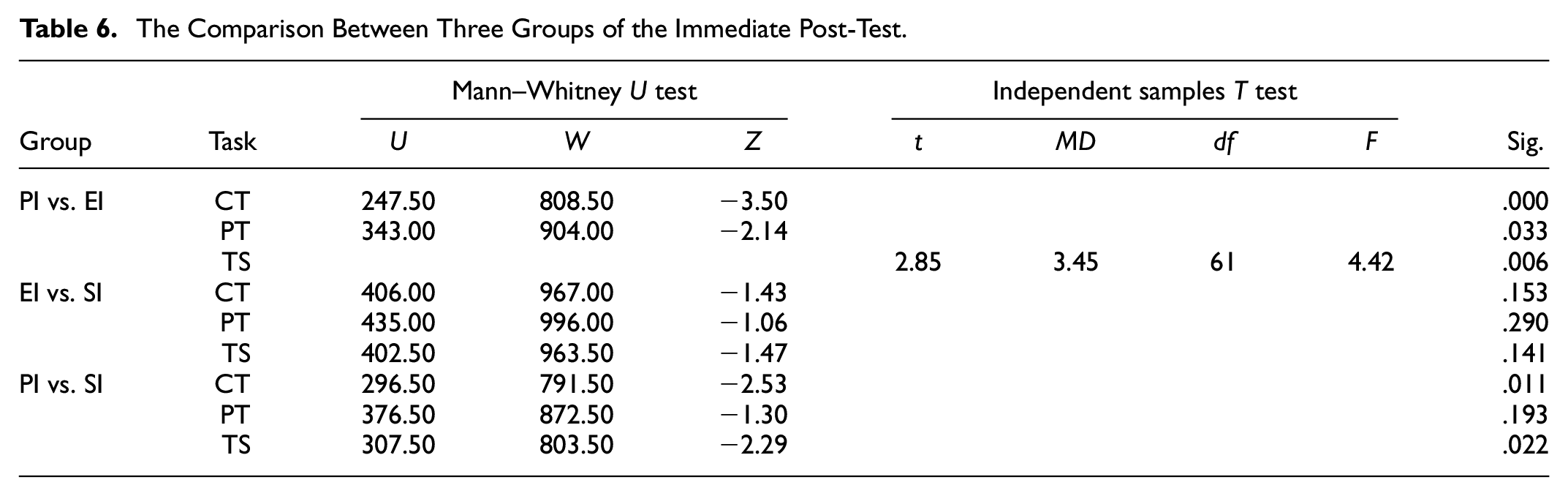
Since all the methods were effective, the next question is which of them was the most effective. To answer this question, Mann–Whitney U test and independent-samples T test were conducted in the immediate post-test among the three groups. As illustrated in Table 6, there was significant difference between PI and EI and no such difference between EI and SI for both tasks and the total score. However, when it comes to the difference between PI and SI, no significant difference was detected for the production task. It seems that the complete Processing Instruction was the most effective method.
The Comparison Between Three Groups of the Immediate Post-Test.
After that, the next question is about the delayed post-test. Since Figure 4 has illustrated declining trends for every delayed test, it is necessary to know whether the participants’ performance in the delayed post-test has regressed to the level prior to the teaching. Paired-samples t-test and Wilcoxon’s sign rank test were conducted to compare the pre-test and delayed post-test scores. As shown in Table 7, the results indicated that the performance in the delayed post-test for all three groups was significantly different from the pre-test. This suggests that the participants retained some level of knowledge and skills even after a month-long delay.
The Comparison Between Pre-Test and Delayed Test.

Now that it is certain that the performance of the delayed test, although illustrating a declining tendency, was still statistically better than that of the pre-test, it is necessary to know which of the three groups outperformed the others. To understand this question, independent samples T test and Mann–Whitney U test were applied, as demonstrated in Table 8. It can be concluded that there was a significant difference between PI and SI for all the tasks and no difference between EI and SI. However, when it comes to the comparison between PI and EI, no difference was found for the production task.
The Comparison Between Three Groups of the Delayed Test.

Discussion
Research Question 1
The results of the comparison of the trials to criterion indicate that Processing Instruction and structured input activity are of same effectiveness as to the speed of the connection between form and meaning, and that explicit information does not help to accelerate the learning process. This seems to conform with the study of VanPatten et al. (2013) in that they concluded that the accelerating effect of explicit information can vary depending on the target item. When the target item violated one-to-one mapping principle, explicit information did not work for speed. However, this cannot be applied in the current study because English passive voice does not violate the principle. Therefore, a comparison with others’ work provides a different perspective for explanation.
The current experiment was different from VanPatten and Borst’s (2012) in that VanPatten and Borst completed their study in a lab, while this study was designed in a real classroom teaching, with the whole process of teaching lasting for five consecutive days. It is possible that the participants were originally different in terms of the trials to criterion but the difference diminished for the last 4 days. The same situation happened for Henry et al. (2017). Although Henry et al. (2017) used classroom setting, Processing Instruction treatment and the post-test were in the same scheduled class period for 50 min.
Therefore, it is reasonable to conclude that the duration of explicit information may play a role in its accelerating effect. Initially, explicit information aids in the establishment of form-meaning connections. However, as observed in the comparison between the current study and previous research, after a certain period of time (possibly a few days), the structured input activity group catches up, resulting in the diminishing of the accelerating effect.
Research Question 2
Despite the lack of evidence for the acceleration of form-meaning connection through explicit information, it is noteworthy that explicit information did contribute to improved results when comparing the pre-test with the two post-tests. Furthermore, the comparison between different groups suggests that complete Processing Instruction yielded the most effective outcomes, while explicit information and structured input activity showed similar performance. These findings contradict studies that dismiss the effectiveness of explicit information but align well with the findings of Farley (2004), although some differences still exist.
Farley (2004) suggested that the effectiveness of explicit information may be attributed to the difficulty of the target linguistic structure. In his study, the Spanish subjunctive was considered challenging and explicit instruction was found to be beneficial. However, in the current study, the target structure, English passive voice, is relatively easier compared to the subjunctive. While the compositional rule of subjunctive can be complex, the English passive voice is comparatively simpler. To explain the discrepancy in results, it is important to consider the characteristics of the participants in the two experiments. In Farley’s study, the participants were college students in their fourth semester of Spanish, and the subjunctive remained challenging for them. In contrast, the participants in the current study were middle school students with limited English knowledge, making English passive voice difficult for them. Therefore, although English passive voice is generally considered easier for most individuals, it posed a challenge for the participants in this study, much like the subjunctive did for college learners. Based on this, it is reasonable to revise Farley’s proposition and hypothesize that the effectiveness of explicit information is not solely determined by the difficulty of the target linguistic structure, but rather by its relative difficulty for the learners.
Hence, it can be inferred that the effectiveness of instructional approaches is not solely determined by the learner’s existing language knowledge or the complexity of the target structure, but rather by the gap between the two. When the gap is moderate, learners are able to observe and deduce patterns or rules independently, making explicit information less necessary. Conversely, when the gap is significant, learners may struggle to acquire the patterns without explicit instruction and therefore benefit from explicit information to facilitate their learning process. Therefore, the relative gap between the learner’s existing knowledge and the complexity of the target structure plays a crucial role in determining the effectiveness of explicit information in language acquisition.
This hypothesis can be supported by previous studies. For example, VanPatten and Oikkenon (1996) recruited university students as the participants, which means that they had enough language knowledge. And the target structure was the placement of pronouns and word order, which is fundamentally important for understanding who did what to whom, without the concept of which nothing can be comprehended. Therefore, the gap, the knowledge required to grasp the target linguistic structure, was small. Therefore, in their study, explicit information was not necessary.
Moreover, the results might be partially attributed to the exposure time of the participants to the target structure. Specifically, the participants in the complete Processing Instruction group received a total of 40 min of instruction, whereas the other two groups received only 20 min of either explicit information or structured input activity. This doubled exposure time in the Processing Instruction group could have had some influence on the learners’ understanding and processing of the target structure.
The findings of this study suggest that Processing Instruction, with its explicit information and structured input activity components, holds promise for application in China’s English teaching context, particularly in middle schools. These results not only support the positive effects of Processing Instruction but also align with the characteristics of China’s educational system.
In China, various teaching methods, theories, and models have been proposed, such as intercultural communicative language teaching, task-based language teaching, and teaching with humorous videos. While these approaches have demonstrated effectiveness in improving language learning outcomes (Bui & Tai, 2022; Do et al., 2021; Tran & Duong, 2018), they may not always be suitable for Chinese English teaching due to specific considerations. In many cases, the primary goal for Chinese learners is to achieve high scores in exams rather than focusing on practical language usage. Additionally, the demanding curriculum and time constraints necessitate a more direct and efficient imparting of knowledge from teachers to students.
In this context, Processing Instruction offers a compatible approach. The explicit information component enables students to acquire knowledge directly and efficiently, aligning with the objective of achieving high scores in exams. Furthermore, the structured input activity can be seamlessly integrated into the teaching syllabus or assigned as homework without disrupting the principles of current English teaching practices. It is important to note that this does not imply the futility of other teaching methods or approaches. Different instructional techniques have their merits and can be effective in various contexts. However, the compatibility of Processing Instruction with China’s English teaching system highlights its potential as a valuable tool for English language instruction in middle schools.
Moreover, with reference to the previous studies concerning that Processing Instruction is better than Traditional Instruction (Benati, 2001, 2005; Benati & VanPatten, 2005; Russell, 2012; VanPatten & Wong, 2004; Wong & Ito, 2018), it is even possible to replace Traditional Instruction with Processing Instruction. Unlike Traditional Instruction, which takes advantage of repetitive and burdensome drills, Processing Instruction provides students with more opportunities to be immersed into the environment where language is not only a teaching object, but a tool by which they see through the world and discover their own feelings about the society, as affective activity does.
Another question that needs to be addressed is that in the delayed test, a decling tendency occurred, and that the scores were still statistically different from the pretest. However, considering the fact the teaching is fundamentally for higher scores, although Processing Instruction is still effective in the long run, a better option is to have students review the target linguistic structure, since the missing of a single score would come with a different future.
To conclude, the current study favors that both explicit information and structured input activity are indispensable components of Processing Instruction. And it can be applied in China’s English teaching since it is in line with the teaching situation.
Non-Dichotomous Perspective
The current study contributes to the ongoing debate surrounding the validity of explicit information in language instruction. It highlights the need to consider the complexity of this issue, suggesting that the effectiveness of explicit information may not be a dichotomous problem but rather a gradable one influenced by various factors. Since it is possible that the effectiveness of explicit information is affected by the relative difficulty of the target structure to language learners, the effectiveness may largely be determined by the age of language learners or different linguistic structures. Also, other factors may be taken into consideration.
The factors, other than the relative difficulty mentioned above, may include cognitive ability, macro learning context and expectations, and micro learning condition. As Benati and Angelovska (2015) have distributed the outperformance of the adult learners to their cognitive processing load, it is reasonable that a young learner with high cognitive processing load tends to gain more from Processing Instruction compared with the peers with low cognitive competence. Moreover, learning context and expectations may also influence the effectiveness of explicit information, as Haghani and Rashtchi (2023) have referred to (see also Bakhshandeh & Jafari, 2018; Nazari, 2013; Rashtchi & MohammadYousefi, 2016). They stated that the positive effect of explicit information in their experiment might be due to the fact that they were accustomed to direct teaching and instruction. The same situation probably applies for China’s education system. Considering the amount of knowledge Chinese students have to master and the limited time they possess, little room is left for self-discovery or observation-based learning. Besides, Wong (2004) also mentioned the variable effectiveness of explicit information, proposing that learning conditions may influence it. The purpose of Processing Instruction is to construct form-meaning connection, the weight of which is naturally put more on structured input activity because the feedback of incorrect answers forces learners to do it. Therefore, In cases where structured input activities effectively facilitate form-meaning connections and provide corrective feedback, the role of explicit information may be less prominent. However, in teaching environments where the connection between form and meaning is not easily grasped, explicit information may play a more crucial role in bridging the gap.
However, not all factors appear to have a significant impact. For instance, Haghani and Rashtchi (2023) investigated the influence of learning styles on the effectiveness of Processing Instruction. They categorized participants into ectenic and synoptic learners based on a questionnaire but found no discernible difference between the two groups regarding Processing Instruction or its components.
In conclusion, it is plausible to consider the effectiveness of explicit information as a gradable variable rather than a dichotomous one in future studies. This implies that the impact of explicit information may be determined by the relative difficulty of the target structure and influenced by other variables such as cognitive ability, macro and micro learning environments, and so on. Exploring these factors can provide valuable insights into understanding the nuanced nature of explicit information in language learning and identifying the specific conditions under which it can be most beneficial.
Limitation
The study’s use of a classroom setting offers the advantage of providing insights into the outcomes of different teaching instructions in a realistic educational environment. However, there are certain disadvantages associated with this setting. One limitation is that the classroom environment is susceptible to various distractions, such as outdoor noises, gossip, or students’ occasional absent-mindedness. These factors, which are common among grade 7 students, are uncontrollable in a classroom setting but can be controlled in a laboratory setting, potentially affecting the overall effectiveness of the teaching instructions.
Additionally, grouping the participants based on their classes introduces the possibility of variations in learning ability and English proficiency among the groups. Although the pretest ensured that none of the students had prior knowledge of English passive sentences, it did not account for potential differences in their meta-linguistic learning abilities. Consequently, some classes may have shown better learning outcomes compared to others due to inherent differences in their learning abilities.
Moreover, although no specific homework assignments were given regarding English passive voice, it is plausible that some curious students may have independently sought out and studied the linguistic structure on their own outside of the classroom. This self-directed learning, which is challenging to control, could potentially impact the results of the study.
Conclusion
The findings suggest that both Processing Instruction and structured input activity yielded similar results in terms of trials to criterion for constructing the form-meaning connection of English passive voice. This indicates that explicit information may not significantly contribute to the speed of acquiring this linguistic structure. However, explicit information was still valuable in terms of improving the final performance, comparable to the benefits provided by structured input activity. The complete Processing Instruction, which combined explicit information and structured input activity, emerged as the most effective approach.
The current study was theoretically and pedagogically inspiring since (a) it reveals a possibility that the effectiveness of explicit information is not simply determined by the difficulty of the linguistic structure but by the relative difficulty of the linguistic knowledge to learners and (b) it shows that teachers should still provide explicit information at least for Chinese young students.
However, it is important to acknowledge the limitations of the current research. The limitations of the study include the potential impact of uncontrollable classroom distractions, the grouping of participants according to classes without accounting for variations in learning abilities, English proficiency levels, and the potential influence of self-directed learning outside the classroom on the results. Future research should address these limitations to further enhance our understanding of the role and optimal implementation of explicit instruction in language learning contexts.
Footnotes
Declaration of Conflicting Interest
The author(s) declared the following potential conflicts of interest with respect to the research, authorship, and/or publication of this article: Author Tao Zeng declares that she has no conflict of interest. Author Peng Xu declares that he has no conflict of interest. Author Xi Gao declares that she has no conflict of interest.
Funding
The author(s) received no financial support for the research, authorship, and/or publication of this article.
Ethical Approval and Informed Consent
This study was approved by Foreign Studies College Research Ethical Review Board of Hunan University. The participants were middle school students who were informed the consent before they participated in the experiment. Letter of Information and Consent Form include the following important information: the research purposes and procedures, what tasks or activities the subjects will be doing, benefits, risks, the opportunity to withdraw without penalty, the opportunity to ask questions, the amount of time required, and how confidentiality will be maintained, and the outcome of the study.

Data Availability Statement
Data sharing not applicable to this article as no datasets were generated or analyzed during the current study.