




Abstract
In this study, we investigated the effectiveness of processing instruction (PI) as opposed to traditional deductive exercise-based intervention (TI) in teaching English derivational affixes. There was also a comparison non-intervention (NI) group, and the groups were posttested. To teach the target affixes via PI, new structured input tasks were developed. In all, 101 adult male and female lower-intermediate participants initially took part in the study, but this was later reduced to 71 as a result of the pretest, and so on. The results were analyzed through MANOVA and paired t test. In recognition, PI and TI outperformed non-intervention, while PI and TI did not outperform one another. In production, TI outperformed the other groups, while the other groups did not outperform one another. More studies must be carried out before drawing any conclusions about the transferability of PI to output activities for teaching derivational affixes. The students were also interviewed to survey their attitudes. Affectively, PI created self-confidence and an enjoyable atmosphere among the learners. Also cognitively, PI was the only group that satisfied the participants in their ability to recognize and produce derivational affixes. We found PI a highly effective and positive approach for teaching recognizing derivational affixes. We also believe it to possess a high potential for teaching their production, as it gave the participants a good sense of self-confidence for the production of the affixes.
Keywords
Introduction
Processing instruction (PI) is an approach to teach the form of language based on learners’ input-processing strategies (VanPatten & Cadierno, 1993). It is composed of an explicit part based on a default input-processing problem and an inductive, implicit task-based part in the form of structured input tasks. VanPatten and other researchers have shown the effectiveness of this intervention type in various studies with respect to teaching the structure and grammatical morphology of language (e.g., Farley, 2005; VanPatten, 1996; VanPatten & Uludag, 2011). But its effectiveness concerning other language forms has not been sufficiently established yet as VanPatten and Uludag (2011) have put it themselves.
The main focus of this study was to investigate the utility and effectiveness of PI (VanPatten, 1993), which is mainly implemented through structured input tasks as opposed to traditional exercise-/item-based intervention, but this time in teaching English derivational affixes. There are both a qualitative and a quantitative part to this study. The students were interviewed to survey their attitudes toward learning under any of the instruction types investigated in this study. They were also pretested, there was a comparison group, and the groups were posttested under controlled conditions.
Background
Different aspects of PI have been investigated and discussed in various contexts and by various researchers (e.g., Benati & Lee, 2008; DeKeyser & Sokalski, 1996; Henry, Culmn, & VanPatten, 2009; Lee, Leeser, & Wong, 2011; Sanz & Morgan-Short, 2004; Uludag & VanPatten, 2012; VanPatten, 2004a; VanPatten & Borst, 2012; VanPatten, Farmer, & Clardy, 2009; VanPatten, Inclezan, Salazar, & Farley, 2009; VanPatten & Sanz, 1995; Wong, 2005), but the present study was mainly inspired by VanPatten and Uludag’s (2011) research on the transferability of training via PI to output tasks. In their study, they worked on the passive structure to see whether input practice via PI, which is “an input oriented approach to grammar intervention” (p. 44), is transferable to limited output conditions. They carried out a detailed statistical analysis of the data to interpret the results and proved the transferability of instruction via PI to output activities.
The sufficiency of input for grammatical acquisition has been supported by many (Benati, 2005; Benati & Lee, 2008; Fernández, 2008; Truscott & Sharwood Smith, 2004; VanPatten, 2002a), while others emphasize the pivotal role of output in learning (Izumi, 2002; Swain, 1998). One of the classical studies supporting the sufficiency of input is VanPatten and Cadierno’s (1993) experimental work on PI in which the group receiving PI outperformed the group receiving no instruction and the one working on controlled to free communicative activities. However, there have been some studies that have denied this effectiveness for PI (DeKeyser, Salaberry, Robinson, & Harrington, 2002; Keating & Farley, 2008; Qin, 2008). Many studies have compared input processing with production-based intervention and proven either the superiority of the latter or the equality of the effectiveness of both (Collentine, 1998; DeKeyser & Sokalski, 1996; Kim, 2001; Salaberry, 1997).
This study was supposed to investigate the effectiveness of VanPatten’s (1993) PI with regard to teaching English morphemes, and more specifically its derivational morphemes. As mentioned above, many studies have shown the effectiveness of this intervention type with respect to teaching the structure and grammatical morphology of language (e.g., Benati, 2001), but its effectiveness concerning other language forms has not been sufficiently established yet as VanPatten and Uludag (2011) have put it themselves: PI has been researched in English, Spanish, German, French, Italian, and Russian to date. Within these languages, researchers have examined both syntactic issues (word order and the role of nouns in sentences, including case marking, and causative structures), verbal morphology (e.g., past, present, future, mood, aspect, person-number), nominally oriented morphology (e.g., agreement between nouns, adjectives, and participles), and other surface forms of language. (p. 52)
As can be understood from the excerpt and a review of the literature, there have been no efforts to examine the effectiveness of this intervention with content words or derivational affixes (unlike inflectional affixes, which are functional rather than lexical). Nor have there been any claims about this effectiveness. Maybe this is due to the principles of input processing proposed by VanPatten (2002b) such as the one that reads “[l]earners prefer processing ‘more meaningful’ morphology before ‘less’ or ‘nonmeaningful’ morphology” (p. 758, in the table). PI, therefore, tries to help learners overcome their processing problems (i.e., their less-than-optimal processing strategies) and process the ignored items more readily.
A processing problem refers to a mistake students “make when trying to comprehend a particular kind of sentence and then [they] are given examples to show why their ‘default’ processing strategies may not work” (VanPatten & Uludag, 2011, p. 45). Actually during this explicit part of the instruction, learners are provided with information on why they process a structure/item incorrectly as a result of a default way of processing sentences and are taught how to overcome this problem. The processing problem discerned with regard to derivational affixes among elementary, lower-intermediate, and intermediate learners is that unless they are made aware of the existence of a specific derivational affix in a new word, particularly the less frequent derivational affixes, they do not tend to notice it (Nation, 2001). In other words, learners generally tend to perceive words holistically, unless they are sensitized to derivational affixes during the later stages of their learning lives through different noticing activities. This is based on VanPatten’s (2004b) most basic input-processing principle, that is, Principle 1, which reads “[l]earners process input for meaning before they process it for form” (p. 7, emphasis in original). In this regard, the first, second, and fifth subprinciples are of particular importance. They read as follows:
Learners generally tend to rely on the contextual clues and the lexical items available to process meaning.
Structured input activities “contain input manipulated in particular ways to push learners away from less-than-optimal processing strategies” (VanPatten & Uludag, 2011, p. 45, emphasis in original). They are asked to interpret sentences containing the target structure/item and this leads to altering their default processing strategies. More has been explained about structured input under the treatments section.
What was probed to be done in this study was to investigate this rather untouched aspect of PI. The question was whether PI could be effective in teaching the derivational affixes in language or it would lose ground to other traditional, time-honored approaches (VanPatten, 1993, 1996, 2002b; VanPatten & Uludag, 2011).
Besides this comparison, the present research was destined to develop a specific structured input task catering to the instruction of English derivational affixes. As the majority of the studies carried out on PI so far have examined grammar intervention, most of the structured input tasks designed cater to teaching the structure of language and there are almost no well-developed tasks focusing on derivational affixes, at least to the present researchers’ best knowledge. Therefore, an effective task of our own was needed to be designed for the specific purpose of this study.
Based on the problems and purposes stated for this research work, the following four categories of questions emerged:
Intervention Versus Non-Intervention
PI Versus TI
PI
Qualitative Investigations
Method
This study was planned to compare the differing effects of three instruction types on students’ acquisition and use patterns of English derivational affixes both quantitatively and qualitatively. The purpose of the qualitative analysis was to gain more information than the mere numerical information on various instructions would provide.
Participants and Categories
The participants were chosen from among adult foreign language learners of both genders with age ranging from 18 to 25, with just a limited number of exceptions of age about 30 and 40. All the participants were BA/BS students of business, management, physics, mathematics, education, and the like at the Shahre Rey Branch of Islamic Azad University in Tehran. All the students were attending their General English course and one of the present researchers was their instructor. As all the participants were students of majors other than the English Language (Literature, Translation, or Teaching English as a foreign language [TEFL]), all of them were supposed to be lower-intermediate learners, and this was confirmed through devising the reading section of the paper version of Test of English as a Foreign Language (TOEFL)®.
Three instruction types for teaching English derivational affixes were examined. Two of these were the treatment groups including a PI intervention based on VanPatten’s (1993) PI theory and a deductive item-based intervention (hereafter the TI group [traditional intervention]), and the other one was an inductive, holistic non-intervention (hereafter the NI group [non-intervention]), which served as the comparison group. Due to the common limitations at universities, the three classes chosen were intact, but the three instruction types were assigned randomly to each of the three classes. The groups initially consisted of 38, 29, and 34 participants, in the PI, TI, and NI groups, respectively. However, for reasons that have been explained in what follows, these numbers were later reduced to 23, 23, and 25, respectively.
Morphemes
Rather than inflectional affixes, this study chose to examine the effectiveness of PI with teaching derivational morphemes, which have more to do with the meanings of words. Based on the definition proposed for derivational morphemes in Nation (2001) and in Hudson (2000), they are bound morphemes (i.e., affixes, either prefixes or suffixes) that change either the meaning of a word or its part of speech. For example, the affix un- in unhappy is a derivational prefix that changes word meanings and the affix -ness in happiness is a derivational suffix that transforms an adjective into a noun. A sample of all types of derivational affixes was selected in this study. The selection was founded on a categorization and sequencing of English derivational affixes for instruction based on the difficulty criterion by Nation. He has listed the affixes under five stages from the easiest ones to the most difficult (see Table 1).
A Sequenced List of Derivational Affixes for Learners of English.

Source. Adopted from Nation (2001).
As it shows, the third stage which stands in the middle and suits intermediate learners includes the longest list. This list seemed to give the greater number of items to choose from, but as some of the learners in the present study might have been familiar with some of them, it was wiser to pick the affixes in the last two stages to make sure that they were unfamiliar. Nevertheless, any final claims about the familiarity of the learners with the selected items had to be based on the pretesting results. There were 28 affixes in the last two stages, and to round the number of the affixes for our treatments and tests, we added two other rather infrequent affixes from the third stage: -en (adjective- and verb-maker) and semi-. Besides, two of the affixes selected (ex- and pro-) were actually two affixes each that had the same form but different meanings and functions. We did so to have more example words for them at our disposal.
Pretesting
For each of the affixes, a recognition multiple-choice item was designed. The stem presented a sentence including an underlined word containing the affix. The options represented different meaning alternatives for the word and they were similar to each other except for the part related to the affix. Below, the reader is provided with two example items—one for testing a derivational suffix and one for a derivational prefix:
Example:
The
making something deep
how deep something is
someone who makes things deep
A
a pilot in the past
an amateur pilot
someone who helps the pilot
In the end, all the items were collected into a whole test and validated.
As the cut-off point, it was decided that, to account for the guessing scores, the students who gained any score amounting to more than 25% of the total score (to be on the safe side) be excluded. Accordingly, as a whole, 15 of the participants who had gained 8 and more were excluded and, quite by chance 5 in each group. In addition, a number of the participants who were present on the pretest were absent either during the treatments or on the posttest. Therefore, 15 more pretest scores were excluded: 10 in PI, 1 in TI, and 4 in NI. Thus, 71 participants were left for the final posttest: 23, 23, and 25 in PI, TI, and NI, respectively.
Any item with an item facility index of more than 0.25 (more than 17 correct answers) was omitted, because the affixes tested by such items would be conceived of as too familiar for the learners. Four of the items were consequently deleted: Item 1 testing the affix -able with 33 correct answers, Item 2 testing -ee with 24, Item 10 testing -y with 27, and Item 11 testing pre- with 22. So, the total score of the pretest was changed to 26 from 30. These affixes were also deleted from the treatments and posttest.
A one-way ANOVA showed no significant difference among the groups in their prior knowledge of the target morphemes: F(2, 68) = 0.12, p > .891.
Treatments
Three 30-min treatment sessions were allocated to each group. All the sessions were taught by one of the researchers, and they were all held in L2.
In NI, the students read passages including the affixes silently. The texts were about miscellaneous topics, including sports, navy, and science. Afterward, they were asked some general and specific comprehension questions by the teacher and, next, they had reading aloud accompanied by the clarification of the vocabulary and difficult sentences. All the new words were defined and further sentential examples were provided by the teacher to show their uses in sentences. In the end, they worked on a vocabulary activity in which they received a list of words to complete sentences including a blank. There was no indication to affixes during any of the phases of their instruction (see Appendix A for the NI sample material).
In TI, in each session the students were given explicit morphological explanations on the target affixes, followed by traditional exercises which the students answered in pairs. From the second session on, before presenting the rest of the target affixes, the teacher answered the students’ problems with the previous ones and they reviewed them together. There were two kinds of exercises in this group. In the first one, the students added an affix to a stem/word to form a complete word based on the part of speech and a definition in front of each word. In the second exercise, they were presented with sentences including a blank and a word which was provided in the end of each sentence in parentheses. The students added an appropriate affix to the word to fill in the blank (see Appendix B for the TI sample material).
In PI, in the first session, the students received explicit instruction with examples on the target affixes and a processing problem accompanied by structured input activities. In the structured input activities, they were not asked to produce the target affixes and did not receive any further explicit explanation (VanPatten & Uludag, 2011). During the next sessions, the students only worked on more structured input activities.
In this study, the PI learners were presented with a version of structured input activities which was specifically designed for the presentation of derivational affixes, because there has been no structured input task with such an aim developed in the literature, at least to the present researchers’ best knowledge. The tasks included 15, 30, and 30 items for the three sessions, respectively, to cover the 30 min of instruction in each session. Each item presented them with a L1 sentence or a picture for which there were two English sentences to choose between (VanPatten & Cadierno, 1993; Wong, 2004). In two thirds of the items in each activity, the sentences including the affixes were the correct answers and in the rest of the items the sentences not including them (see Appendix C for the PI sample material).
Posttest and Analyses
Immediately after the treatments were over, the posttest was given to the participants on the last session of the instructions. There was a 3-week gap between the pretest and the posttest, which would neutralize almost any practice effect. The posttest included two sections: a recognition test and a production test. The recognition posttest was of the same format as that of the pretest, but new items were developed.
The production test included completion items in which the participants were presented with a cue word in the end of each sentence in parentheses. The students were supposed to add an appropriate affix to the cue word to fill in the blank. Below, the reader is provided with an example item:
Example:
The two students ------ to answer the questions. (operate)
In the end, all the items were collected into a whole test and validated.
There were one independent variable and two dependent variables in the study. The independent variable was instruction type with the three levels of PI, TI, and NI. The two dependent variables investigated in this study were the participants’ recognition and production scores.
The data in this design were analyzed using one-way MANOVA to find out whether there was a significant overall difference and Tukey’s post hoc test to compare each two means on each dependent variable. Also, separate t tests were run between the pretest and the recognition posttest results of each of the three groups to check for the amount of gain in their recognition of the target affixes.
Qualitative Investigations
The qualitative part of this study contributed to the quantitative part by collecting non-numerical data on the participants’ attitudes toward the effectiveness of different instruction types for the acquisition of English derivational affixes. Scrutinizing this effectiveness does not necessarily need to be done merely through experimenting with those instructions. The participants’ attitudes can be valid sources of information on the effectiveness of the instructions they undergo.
What was interesting for the researchers to find out was to detect whether studying derivational affixes under PI gave the learners a cognitively and affectively more positive experience than did studying under other more traditional interventions. To this aim, a structured interview was developed that tapped their views toward various aspects of their classrooms. A complete version of the structured interview is presented in Table 2 below.
Structured Interview About Participants’ Attitudes Toward Different Instruction Types for Derivational Affixes.

The interviews were carried out in the learners’ L1 to ensure maximum understanding and feedback. The interview was piloted with intermediate adult learners prior to the study, and it was made sure that it would elicit the information we were looking for, hence the validity of the items.
Results and Discussion
A one-way MANOVA was run for the posttest, and a significant difference was found in the results: F(4, 134) = 5.81, p < .0005. This shows that different instruction types did have an effect on the learners’ recognition and/or production of the target affixes. However, a partial η2 of .15 suggests that only 15% of the difference found was due to the independent variable, that is, the instruction types, and the remaining 85% was due to other intervening variables. Also, the tests of between-subjects effects show that this difference has been significant in both recognition and production: Frecognition(2, 68) = 6.2, p < .003, partial η2 = .15, and Fproduction(2,68) = 5.76, p < .005, partial η2 = .15. Afterward, a Tukey’s post hoc test was run to compare each two means on each dependent variable (see Table 3).
Tukey’s Post Hoc Test Results.

Note. PI = processing instruction; TI = traditional deductive exercise-based intervention; NI = non-intervention.
is significant at p < .05
The results of Tukey’s post hoc test illustrate that both treatment groups, that is, PI and TI, significantly outperformed the comparison group, that is, NI on the recognition posttest, while no significant difference was found between PI and TI on this test. This can mean that intervention, as opposed to non-intervention, can make a positive difference for teaching recognizing derivational affixes, but there is no considerable difference between the traditional deductive item-based approach and more modern task-based approaches. Thus, teaching derivational affixes, regardless of the approach taken, leads to higher amounts of learning than does not teaching them. In other words, we can feel safe that if teachers spend time on teaching the affixes through more direct instructional procedures, they will not be wasting that time to gain nothing considerable in return. If teachers do not probe to teach derivational affixes directly, their learners will most probably gain much less than when they do so directly. However, all these should be taken with caution.
In terms of production, TI significantly outperformed the other two groups, while neither PI nor NI proved any better than one another. This may signify that as PI is an input-based approach, it cannot bear any better results than not teaching using derivational affixes in speaking and writing at all (i.e., non-intervention). It seems that the more traditional deductive practice-based approaches work better for teaching the production of derivational affixes. This actually connotes the lack of transferability of PI to output activities at least in terms of derivational affixes. Of course, there have been many studies that have supported the transferability of PI to output tasks (Benati, 2005; Benati & Lee, 2008; Fernández, 2008), and this study does not deny this transferability for other aspects of SLA. Even with respect to teaching derivational affixes, we believe that as this was one of the first times that PI was devised for the instruction of derivational affixes, there must have been definitely many shortages and deficiencies in the proper implementation and actualization of PI based on the principles established for it in the literature. These may have included factors such as the length of instruction and the development of well-targeted material.
However, one highly important point should not be overlooked. Not leading to any better results than the non-intervention instruction in the production of derivational affixes may connote, but does not necessarily denote, the lack of transferability of PI to output activities. Besides, the observation that PI was significantly less effective than TI in teaching the production of derivational affixes does not mean that PI itself has not been significantly effective in teaching the production of derivational affixes. In sum, to make sure whether PI is after all transferable to output activities or not, a production pretest–posttest design needs to be put up, which has, to our great regret, been one of the limitations of this study.
In addition, the significant impact of PI on the recognition of derivational affixes should not be forgotten. After all, this was one of the first times PI was devised for their instruction and it turned out to be considerably successful and even a bit more so than the traditional deductive item-based approach. This can be deeply promising for the advocates of PI. PI has been successful in a domain for which it has never made big claims—that is, the instruction of derivational affixes.
As mentioned above, in this study, we also drew a recognition within-groups pretest–posttest comparison. The aim was to find out which group(s) had significantly improved from the pretest to the posttest. Separate t tests were run between the pretest and the recognition posttest results of each of the three groups. The results of these analyses plus the descriptive statistics of the groups on all their tests have been tabulated in Table 4 below.
Within-Group t Test Results and Groups’ Descriptive Statistics.

Note. PI = processing instruction; TI = traditional deductive exercise-based intervention; NI = non-intervention.
is significant at p < .05
According to Table 4, all the three groups significantly improved since their pretest. This means that all the instruction types were effective for teaching recognizing the derivational affixes. Even the comparison group, which had not received any instruction on the target affixes, managed to make significant progress. This may seem disappointing for the results obtained by PI on the recognition posttest, but before jumping into any conclusion we should take a second look at Table 3. Based on Table 3, PI significantly outperformed NI on the recognition posttest and this means that it has been better enough to be considered as an alternative for non-intervention in teaching derivational affixes. The same is true for TI. Although PI was slightly better than TI on the recognition posttest, it did not succeed to cause a significant difference. Again this can be attributed to the use of PI for teaching derivational affixes for almost the first time in this study. Deductive item-based instruction of derivational affixes has been devised for many years in schools and institutes, but it has always received students’ frowns because of the lack of attractiveness of its procedure. Maybe it is time to substitute this rather dull approach with more attractive activities that have proved effective in this respect, especially PI, which is more likely to be welcomed by students due to its use of illustrations, as you will read in the following section.
So far, the first six research questions have been discussed. As for the seventh question about the structured input tasks created for instructing derivational affixes in this study, we cannot have an outright answer. We do not exactly know whether the learning brought about by PI in recognition was due to the initial explicit part or the subsequent structured input tasks. What is undeniable, however, is their attractiveness and novelty for the participants as described in the following section. Therefore, even not to mention their direct role, they can at least indirectly have a positive effect on students’ learning. As you will read in the qualitative part, the students were deeply interested in the illustrations and the general format of the activities in PI and invested more energy and attention in their instruction. Nevertheless, to have a better picture of how the structured input tasks influence the acquisition of derivational affixes more studies need to be done focusing on this specific aspect of PI.
Surveying the Participants’ Attitudes
As mentioned above, a structured interview was developed which tapped the participants’ views toward various aspects of their classrooms. A complete version of the structured interview is presented in Table 2. Each interview lasted for about 5 min. To answer our eighth research question, the interviews were analyzed almost based on Lynch’s (1992) model of analysis of “the effects matrix” through “general patterns,” “specific difference patterns,” and “specific similarity patterns.” This method of analysis mixes both qualitative and quantitative forms of data. The data are summarized in a table in the form of a matrix and then evaluated both qualitatively and numerically. We transcribed the learners’ answers to the questions in the interview and summarized them in Table 5 below.
Effects matrix of participants’ interviews about attitudes towards different instruction types for derivational affixes.
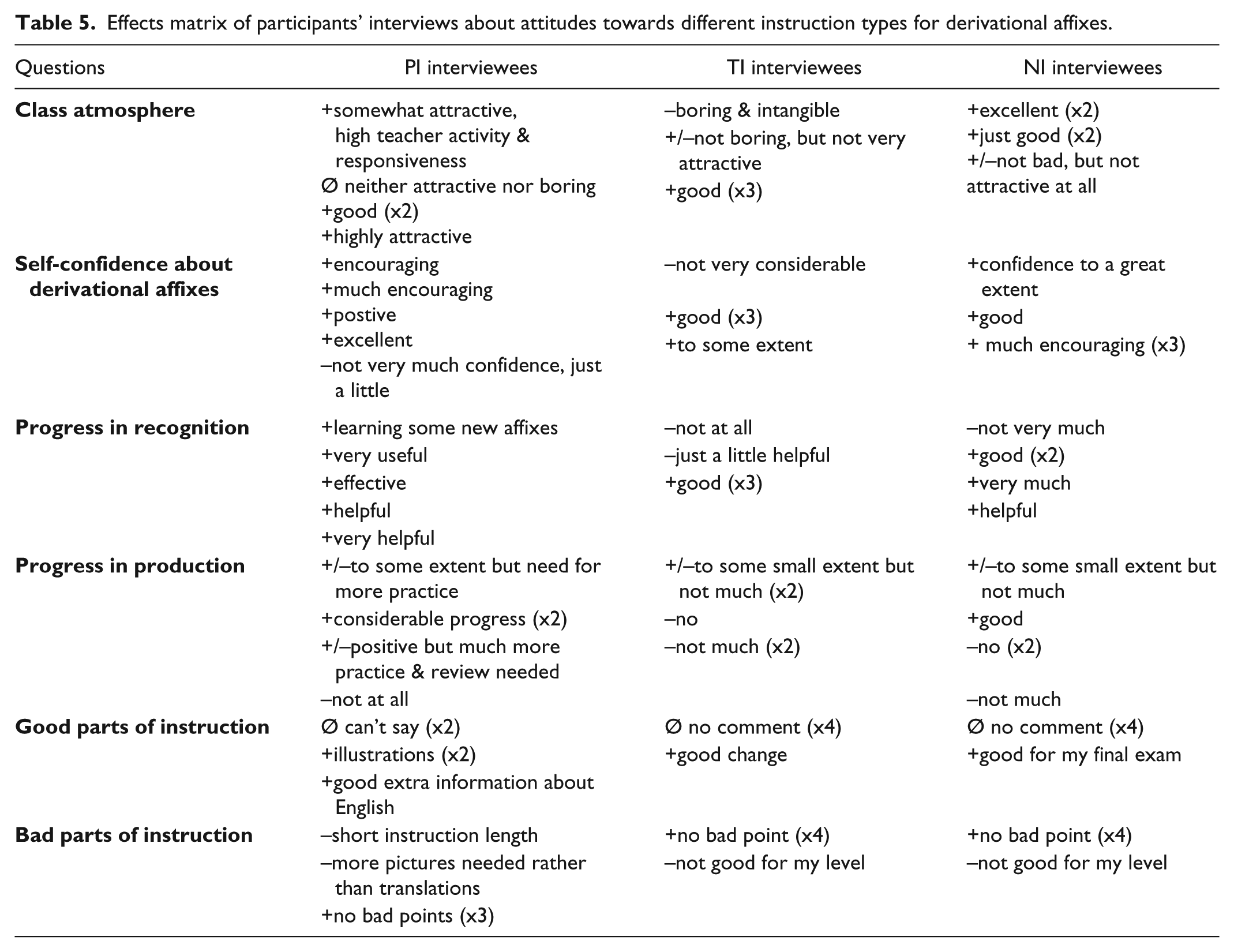
In each group, five of the participants were randomly chosen for the interview. All the three aspects mentioned above have been discussed in what follows.
General Patterns
A general comparison among the three groups of the interviewees’ answers to the questions shows that the PI group received 23 pluses, the TI group 18, and the NI group 23. However, PI received 6 minuses, TI 11, and NI 7. This general comparison favors the PI and NI groups as opposed to the TI group. Generally, the learners in the traditional deductive item-based approach were not as positive about both the affective and cognitive aspects of the instruction of derivational affixes as those in PI and NI.
Specific Difference Patterns
Regarding the class atmosphere, the participants in PI had a rather highly positive attitude toward their instruction. The important point is that there was no negative attitude at all. Only one of the interviewees gave a neutral response. The TI interviewees were a bit negative. On average, their attitude was not terrible, but TI was not very welcomed either. In NI, the participants seemed to like their instruction in general, but three of the interviewees did not sound that enthusiastic.
It was very interesting that the learners who had not received any instruction in terms of the affixes claimed to have gained the highest amount of self-confidence, and all of them agreed in that respect. In the PI group, all the learners but one enjoyed a high level of confidence in understanding and using the affixes. The TI interviewees seemed to be at a bit lower confidence level in comparison with the other two groups.
Recognition turned out to be PI’s strongest aspect. All the PI interviewees agreed on having improved considerably in recognizing the affixes in texts. TI’s average in this respect was a bit low, and NI, though better than TI, was not as positive as PI.
To our great surprise, TI had the lowest average in production, too. Most of the TI interviewees were negative about their ability to use the affixes for producing words including them. The NI participants were just a little better. The PI interviewees were largely positive about their production abilities, and two of them thought that in case of more practice and review at home they would gain more fruitful results in future.
For two of the PI participants, the pictures were the sweet part of the instruction and one of them felt that he had gained more information about the English language. Only one of the interviewees in TI liked the change, and one in NI found the information useful for her final exam at the university.
One interviewee in each of the TI and NI groups thought that the instructions were over their heads, while two interviewees in the PI group asked for more instruction and pictures—a criticism that is only negative on the surface.
Specific Similarity Patterns
There were some similarities among the three groups in each of the questions, but here, we focus on just some of the most important aspects. In terms of the affective aspects, both PI and NI enjoyed warm receptions from the interviewees, but PI won the ground with regard to the cognitive aspect from the other groups. All the three groups had gained considerable amounts of self-confidence about learning and using derivational affixes after the instructions were over, and this shows that generally language learners welcome instruction of derivational affixes. Also, no parts of any of the instruction types turned out to have severely bothered the learners.
Summary
Generally speaking, PI seemed to be the most popular of the three instruction types with the participants. Affectively, the learners enjoyed their experience with the procedure and gained high levels of self-confidence. Particularly, they were very positive about the illustrations. Actually, NI, too, was successful in this respect but not as successful. This partial accomplishment, we speculate, is because of the inductive nature of NI, which does not make learners overly tired. TI, due to its deductive, tedious procedure, looked a bit boring to the learners.
Also cognitively, although this was TI that had gained the best results on the recognition and production posttests as a whole, PI was the only group that accomplished to satisfy the participants in terms of their ability to recognize and produce derivational affixes. They felt that they had become much better after the instruction. This was not the case with either TI or NI. Therefore, we think that PI can be deeply promising for teaching derivational affixes. It is an approach highly welcomed by learners because of its novelty, and this popularity among its recipients is a point that not many instruction types have enjoyed.
Conclusion
In this study, we tried to investigate the utility and effectiveness of PI (VanPatten, 1993), which is mainly implemented through structured input tasks in teaching English derivational affixes as opposed to traditional deductive exercise-based intervention.
Statistically, PI proved quite effective for the recognition of derivational affixes, but for any claim about the transferability of PI to output activities for teaching derivational affixes, more meticulous studies must be carried out.
Considering the participants’ attitudes, PI, and with a lower caliber NI, managed to create an enjoyable atmosphere in the class and positive attitudes of self-confidence among the learners.
Based on the results of both sections of the study, we find PI a highly effective and positive approach for teaching the recognition of derivational affixes. We also believe it to possess a high potential for teaching their production, as it gave the participants a good sense of self-confidence for the production of the affixes.
Dull traditional deductive practice-based approaches have been exhausted for the instruction of derivational affixes, and we believe that it is time for the substitution of this approach with more popular and effective approaches, including PI, with all their novelties and attractions. This was what we actually probed to try in this study.
Footnotes
Appendix A
Appendix B
Appendix C
Declaration of Conflicting Interests
The author(s) declared no potential conflicts of interest with respect to the research, authorship, and/or publication of this article.
Funding
The author(s) received no financial support for the research and/or authorship of this article.