



Abstract
The present article provides an integrative review of available evidence on dual emotional systems, guided by the distinction between “explicit” and “implicit” emotions. Extrapolating on a wide array of research, the conceptualization of the proposed framework demonstrates two sequential processes at the three levels of analysis, implying that several mechanisms lead to the elicitation of implicit and explicit emotions, and thereby outline the interplay of the dual dimensions. Moreover, in reconciliation with the literature of political judgment and behavior, the current research posits the role of political sophistication and attitudes on the elicitation of implicit and explicit emotions. In addition, it discusses the moderating influence on partisan loyalties on the relationship between implicit and explicit emotions. Furthermore, the current study forwards an operational measure of the two blocks of emotional experience.
Keywords
In anger, your blood pressure rises, your heart speeds up, your face broadcasts anger, you have the urge to yell or hit. However, does this occur in response to political stimuli (i.e., a political event, figure, policy, or speech that elicits an emotional response)? Is it reflective of the political emotional episode? How? It is believed that in the realm of political emotions, reflex-like indicators are only one side of the coin rather than the crystallizations of emotional episodes. The rule is duality of emotions. Emotional processing is thought to take place at two sequential levels, namely, conscious and unconscious. To understand this duality of political emotions’ processing requires a conceptual framework that anticipates the elicitation of emotional responses and that supports the differences between each emotional process and manifestations.
It is noteworthy that scholars identified three major approaches for the study of political emotions, namely, approach-avoidance theories, appraisal theories, and neural process theories (Brader & Marcus, 2013). That said, among each of the aforementioned theories there are many different accounts. Approach-avoidance theories entail that affect (i.e., the assignment of a valence [e.g., good vs. bad] of an encounter stimulus) is central for the resolution of the issue of approach and avoidance (see Russell, 2003). Scholars’ criticism of this approach lays in its level of description, namely, the limitation of a single valence to capture the affective subjective experience (Larsen & McGraw, 2011; Marcus, 2003). Compared with accounts of avoidance-approach theorists, a finer distinction among emotions is provided by appraisal theorists. Appraisal, understood as the personal perception of the significance of a given event for the achievement of one’s goals, is central to the understanding of the situation and mechanism through which the process, at the conscious and unconscious levels, triggers certain emotions (see Arnold, 1960; Lazarus, 1991; K. R. Scherer, 2001; R. P. Scherer, Sjunneskog, Iverson, & Hooyer, 2004). In the political domain, a number of studies adopted the theories in question to describe the correlation between political emotions and behavioral consequences (e.g., Huddy, Feldman, & Cassese, 2007; Valentino, Brader, Groenendyk, Gregorowicz, & Hutchings, 2011). That said, it is noteworthy that, to date, the adoption of appraisal theories in the political field has not advanced the concept of appraisal, but rather appropriated them into the researched phenomena (Brader & Marcus, 2013). Last but not least, neural process theories study emotion on the basis of the neural system that is associated with the emergence of distinctive emotions (Adolphs & Spezio, 2006; Gray, 1987, 1990; LeDoux, 1993, 2000; Panksepp, 1998; Rolls, 1999). Early endeavors of this approach emphasized the critical value of affective appraisal (i.e., a positive dimension that ranges from moribund to enthusiastic and a negative dimension that ranges from calm to anxious and fearful), which in turn is associated with certain neural processes that correlate with cognitive and behavioral systems (see Adolphs & Spezio, 2006; LeDoux, 1993, 2000; Panksepp, 1998). A critical account that evolves around the premises of this approach in the field of political psychology is the theory of affective intelligence (Marcus & MacKuen, 1993; Petersen, Fox, Posner, Mintun, & Raichle, 1988). This theory encompasses three appraisals, namely, enthusiasm, anxiety, and aversion/anger.
To that effect, it is noteworthy that the notion that emotions are significantly influential in shaping political behavior is still modern (Bruce & Wilcox, 2000; Marcus, 2002). For a long time, scholars favored reasoning and deliberation over such states (Aldrich, 1993; Foster, 1984; Rabinowitz & MacDonald, 1989). Thus, literature along that vein considered the study of emotions as less valuable, and ultimately undesirable in understanding political behavior (Marcus, 2002; Marcus, Neuman, & MacKuen, 2000). However, recent advancement in the political domain has contradicted previous considerations. To that end, emotion is posited to be a critical and desirable element of political attitude and behavior.
As such, scholars posit a central impact of emotions on public policy attitude (Huddy, Feldman, Taber, & Lahav, 2005; Pagano & Huo, 2007), perception of officeholders’ performance (Conover & Feldman, 1986), attitude toward candidates (Abelson, Kinder, Peters, & Fiske, 1982; Ottati, Steenbergen, & Riggle, 1992), and electoral behavior (Miller, 2011). In addition, evidence has unveiled the role played by emotions in the enhancement of political learning and rational deliberative decisions (Dolan & Holbrook, 2001; Marcus & MacKuen, 1993; Marcus et al., 2000).
However, notwithstanding these insights, there is still room to improve our understanding of political emotions. We now realize, based on recent research, that emotion can be elicited and processed on associative and propositional levels. To that effect, the premises of this study are built on the assumption that considers emotion as a cognitive function under the condition that equates information processing with cognition (Lane, Nadel, Allen, & Kaszniak, 2000). Moreover, extrapolating on conceptual act (Barrett, 2006), core effect (Russell, 2003), affective intelligence (Marcus & MacKuen, 1993; Petersen et al., 1988), and emotional citizen appraisal (Miller, 2011) theories, political emotions are defined in terms of socio-cultural constructions of acquired conceptual knowledge that manifest in experienced implicit and explicit states and reactions, eliciting action urgency.
Moreover, in inherently complex societal settings, where encountered and projected problems and questions do not confide in a sole field, the urgency to explore and resolve issues of concern combined with technological advances increasingly stimulates multidisciplinary efforts (Committee on Facilitating Interdisciplinary Research, 2005). In this study, the researcher endeavors to contribute to one of the most promising interdisciplinary endeavors focusing on the study of political judgment and behavior, namely, the fields of psychology and political science (for review, see Druckman, Kuklinski, & Sigelman, 2009; Kinder, 1998; McGraw, 2006). As such, theories, perspectives, methods, techniques, and data from a wide array of research are integrated to advance the fundamental understanding in an eclectic sense. In reconciliation with Committee on Facilitating Interdisciplinary Research (2005) and Sherif and Sherif’s (1969) assessments, this article is not limited to appropriating ideas from the literature of psychology or political science. Instead, it pursues the amalgamation of a number of unconnected elements (e.g., political sophistication, implicit and explicit emotions (EEs), and political behavior). To that end, it is noteworthy to mention that an inclusive interdisciplinary exploratory effort goes beyond the scope of one study. The scope of conceptualizations is relatively narrowed to draw attention to political emotion causation. To that effect, this study provides an integrative, exhaustive review of the available evidence regarding implicit and explicit emotional elicitations and their interactions. With that stated, the appropriate point of departure is provided by reviewing implicit and explicit political emotion processing at the functional, algorithmic, and implementational levels, prior to positing the influence of a number of potent factors (political sophistication, attitudes, and partisanship) and proposing measures of the dual construct of political emotions.
Implicit Emotion (IE)
Emotional automaticity can be exemplified in terms of memory’s associative network; that is, the first functioning element and the basis of unconscious information processing. The automatic nature of this process is manifested through activated memory associations. Zajonc’s (1980) affect experiment is an early example of unconscious information processing that occurs without conscious appraisal influence on later responses. Zajonc’s findings portray evidence supporting an automatic process in which an encountered object (i.e., person, image, animal, etc.) is tagged into positive or negative classes. It is worthwhile to mention that the mechanism in which these tags operate lines up with both Anderson and Parrish’s (1981) information integration theory and Anderson’s (1983) architecture of cognition. In that vein, memory is considered as a network of nodes (neurons; concepts, ideas) connected through sets of associations. When a concept, person, or an idea is affectively tagged in long-term memory, it becomes primary. Furthermore, memory’s associative networks are linked through “spreading activation” (Barsalou, 1992; Lodge & Taber, 2000, 2005). As such, the subliminal exposure to a stimulus, in a scale of milliseconds, elicits a spread of activation along associative networks, which in turn transforms primaries into the working memory. Then, without the agent’s awareness, and in fractions of a second, infuses affective reactions that may have subsequent influence on later conscious thoughts and behavior (Lodge, Taber, & Verhulst, 2011).
For instance, based on Tamietto and De Gelder’s (2010) assessment, the subliminal exposure to a visual stimulus (e.g., Obama’s image), through transmitted signals from the eye’s retina, activates associative networks in the region (superior colliculus; Schiller & Malpeli, 1977) implicated in automatic responses to emotional stimuli (e.g., Williams, Das, et al., 2006). In addition, the retina’s signals and spread of activation in the superior colliculus elicit nodes of the region (pulvinar) involved in automatic attentional mechanism (e.g., Lyon, Nassi, & Callaway, 2010). It is worthwhile to mention that the spread of activation along the superior colliculus also stimulates nodes in an area (periaqeductal gray) associated with automatic somatic responses (Mobbs et al., 2007). The amygdala’s nodes, one of the most critical regions associated with processing of emotional stimuli, are thought to be activated through cortical (e.g., visual cortex) and subcortical (e.g., pulvinar) associative pathways (Phelps & LeDoux, 2005). Charged nodes in that region, through its extensive, reciprocal associative pathways with subcortical regions, olfactory systems, hippocampal formation, and neocortical regions (Freese & Amaral, 2009), in turn activate nodes in structures that are commonly implicated in consumptive behavior (hypothalamus), processing of less arousing stimuli (Kensinger & Corkin, 2004), and the contextual evaluation of such stimuli (hippocampus; Morris, Ohman, & Dolan, 1998).
Moreover, initially activated associative networks of the superior colliculus via the pulvinar mediated pathway elicit a spread of activation along the region (nucleus accumbens or ventral striatum) implicated in automatic motor responses (Adolphs, 2002; Calder, Lawrence, & Young, 2001; for example, bodily responses that portray anger) and processing of rewards (McHaffie, Stanford, Stein, Coizet, & Redgrave, 2005). Evidently, charged nodes of another area (locus coeruleus) involved in automatic somatic responses modulate the activation of the amygdala, pulvinar, and superior colliculus’ associative networks, in response to emotionally salient stimuli (Liddell et al., 2005). In addition, the amygdala’s active nodes may stimulate associative networks in cortical regions involved in cognitive functions (orbitofrontal cortex; Öngür & Price, 2000) and affective functions (anterior cingulate cortex; Bush, Luu, & Posner, 2000).
The spread of activation along the aforementioned structures, through the extensive associative pathways, is believed to trigger implicit emotional responses (IERs; for example, facial expressions of anger); it is noteworthy to mention that agents are thought to be unaware of such reactions. As such, this unconscious process does not encompass the assignment of truth value (Gawronski & Bodenhausen, 2006). Hence, it takes place regardless of whether an agent considers it to be accurate (Bassili & Brown, 2005). However, activation of the amygdala, orbitofrontal, and anterior cingulate cortex’s associative networks are observed in conscious emotional evaluation (Whalen & Phelps, 2009), which may indicate a convergence of unconscious and conscious emotional information processing.
Furthermore, findings from the domain of social cognition imply that the elicitation of IE could be the result of either incremental changes in associative networks or changes in the patterns of activation along pre-existing networks (Gawronski & Bodenhausen, 2006). Evidence that supports the first cause of IE elicitation can be located in the literature of fear conditioning; that is to say, a prototypical instance of automatic elicitation of IERs (e.g., Squire & Knowlton, 2000). The occurrence of such phenomenon follows the spread of activation in subcortical regions and does not require the activation of nodes of the structures implicated in high cognitive functions (i.e., sensory cortex; Fanselow & Poulos, 2005). In line with research on evaluative conditioning, it is argued that IERs could be the manifestation of incremental changes in the associative network of a number of neurological structures. A wide array of research reported that IEs’ elicitation can be obtained from the interception of positive (negative) unconditional stimuli (USs) with neutrally conditioned stimuli (CSs) at both the associative (Kamin, 1969; Petty, Tormala, Brinol, & Jarvis, 2006) and functional levels (Domjan, 2005).
For instance, repeating the presentation of neutral faces (CSs) paired with negative electrocutaneous stimulation (USs) elicits changes in IE (i.e., fear). These findings were supported by Hermans and colleagues (2005), who replaced CSs to food stimuli and USs with pleasant versus unpleasant scents. Building on Knight, Nguyen, and Bandettini’s (2005) assessments, repeating the interception of novel US (e.g., bursts of complex sounds, whistles, or tone sweeps) with CS (e.g., the image of Donald Trump) may cause incremental changes in the associative networks, which in turn elicits negative IERs (e.g., fear). Moreover, fear conditioning is believed to result in new associations between nodes along the amygdala, right cerebellum, right insula, and precentral and left middle frontal gyri. Among the aforementioned structures, the spread of activation in the amygdala has the strongest correlation with the expression of IERs. In this sense, activation of the amygdala’s nodes elicits agents’ unconscious monitoring of the contingencies between USs and CSs, which in turn manifest in IERs (Gläscher & Büchel, 2005). However, lesion studies unveiled that damage to the amygdala only undermines IERs, but later awareness of US-CS contingencies is believed to remain intact, unless an agent’s hippocampus is damaged as well (Öhman, 2009).
The occurrence of the second cause of IE elicitation is determined merely by the context cues. That is, the activation of particular patterns of pre-existing associations that follows encountering an emotionally relevant stimulus. The literature of emotion regulation implies that the activation of different pattern associations along pre-existing networks in the memory leads to changes in IE, without forming any new association (i.e., non-incremental change). Emotion regulation is a process that takes place unconsciously and is evoked by encountering a relevant stimulus. It is believed that emotion regulation commonly reduces negative IERs. Scholars identified a number of regulatory processes that agents maintain in the absence of conscious awareness (for review, see Gyurak, Gross, & Etkin, 2011). For matters of clarity and parsimony, the researcher exemplifies only two mechanisms; namely, conflict adaptation regulatory and emotion regulatory beliefs, values, and goals.
Emotional conflict adaptation is an automatic, associative process, wherein an agent encounters emotionally relevant stimulus paired with incongruent information (Egner, Etkin, Gale, & Hirsch, 2008; Etkin, Egner, Peraza, Kandel, & Hirsch, 2006 Dissociable neural systems resolve conflict from emotional versus non-emotional distracters 2008). Agents who maintain such control, at the unconscious level, practice careful investigation, effortlessly, with no recollection of key elements involved in the process (Etkin, Prater, Hoeft, Menon, & Schatzberg, 2010). This regulatory process is expected to slow down IERs due to agents’ experience of emotional conflict. Extrapolating on the findings of Egner et al. (2008), in reconciliation with Nevid and McClelland’s (2010) experiment, a Democratic agent’s exposure to an image of Barak Obama paired with the word “Foreigner” might, at the unconscious level, create an emotional conflict and elicits her to probe and negate the incongruent effect of encountering such a stimulus. In particular, it may activate pre-existing nodes along structures implicated in emotional regulation; namely, prefrontal and anterior cingulate cortices (Etkin et al., 2006; Etkin et al., 2010). Moreover, increased spreading of activation in the ventral anterior cingulate cortex elicits a reduction in the strength of initially activated networks along the amygdala, which in turn reduces the negativity of IERs.
In addition, agents’ beliefs, values, and goals maintain another IE regulatory process that takes place unconsciously; however, when any of these factors are articulated, the agent becomes aware of the regulation (Gyurak et al., 2011). Agents are believed to automatize such regulation to compensate for their beliefs, values, and/or goals. For instance, encountering emotionally threatening information about one’s party candidate triggers activation in pre-existing associative networks of the amygdala (Westen, Blagov, Harenski, Kilts, & Hamann, 2006). Then, the threatening nature of that stimulus, without an agent’s awareness, can elicit the automatized process to regulate and reduce negative emotions toward the candidate. This regulatory process is manifested through increased activation of pre-existing nodes along areas of the medial prefrontal cortex, such as the region (ventromedial) implicated in emotional influence on reasoning and the affective process (Davidson, 2002). In addition, a boost of activation of pre-existing networks in the anterior cingulate cortex subdivisions, associated with cognitive functions (rostral region) and affective functions (ventral regions), is experienced (Bush et al., 2000). These activations, specifically, along the medial prefrontal cortex are thought to decrease activations of associative networks in the amygdala and, therefore, lower negative IERs.
Taken altogether, encountering a political stimulus triggers a spread of activations along a group of brain structures, which in turn might elicit IERs. Such reactions are the manifestation of unconscious information processing that may encompass a number of implicit regulations. As mentioned earlier, such elicitation follows incremental changes in associative networks, or changes in the patterns of activation along pre-existing networks. Extrapolating on the integrative review, IE is posited to reflect the first block of political emotion experience. In this sense, the political emotional episode starts with unconscious processing of a stimulus combined with IERs. IE implications are argued to provide a base of later explicit emotional responses. However, agents might not realize their IE or negate its propositional implications (see the next section for a thorough review). Now, the researcher turns to the second system and the bases of EEs.
Explicit Emotion (EE)
The propositional process reflects conscious evaluative tendencies that agents tend to undertake to assign emotional meaning and value (either discrete or valence emotions) to an encountered emotional stimulus (Barrett, 2005; Cunningham, Johnson, Gatenby, Gore, & Banaji, 2003; Nielsen & Kaszniak, 2007). It is commonly obtained through deliberative self-endorsement and tapped into by measures like questionnaires and interviews. Such evaluative tendencies are the result of syllogistic inferences that are derived from contextually related propositional information (Gawronski & Bodenhausen, 2006). These inferences take place in a reflective system that is superordinate to an associative store (Strack & Deutsch, 2004). The reflective system throughout this process transforms associative inputs into propositional output. The propositional reasoning allows agents to label their emotion explicitly through expressing or reporting either current or past states (Albarracín & Wyer, 2001; Gilbert, 1991).
Moreover, developmental psychology (Trevarthen & Aitken, 2001) and self-report studies (Barrett, Gross, Christensen, & Benvenuto, 2001; Davitz, 1969; Stein & Levine, 1999) support three domains of propositional mechanism, namely, evaluating stimulus emotionality (e.g., Hariri, Bookheimer, & Mazziotta, 2000; Narumoto et al., 2000), one’s emotion (e.g., Gusnard et al., 2001; Hutcherson et al., 2005), and others’ emotion. It is important to note that all three types of propositional emotional evaluation share a common associative mechanism. Extrapolating on Lee and Siegle’s (2012) meta-analytic findings, emotions’ propositional evaluations are a result of the common spread of activation along the amygdala and associative networks of regions implicated in cognitive control, selective attention (e.g., Bedwell et al., 2005), memory retrieval (e.g., Bunge, Burrows, & Wagner, 2004; lateral prefrontal cortex), conscious value-based evaluation (e.g., Cunningham, Raye, & Johnson, 2004), and later emotional regulation (e.g., Banks, Eddy, Angstadt, Nathan, & Phan, 2007; Cunningham et al., 2004; dorsomedial prefrontal cortex).
Notwithstanding that the three emotions’ propositional evaluations share a common spread of activation along a number of structures, each evaluative tendency still recruits the activation of additional distinct regions (Lee & Siegle, 2012). For example, the evaluation of a stimulus’s salient emotionality may depend on its meaning and physical features (Arnold, 1960; Roseman, 1984; for example, Obama, African American, Democrat, presidential candidate) and pre-existing propositions (Leventhal & Scherer, 1987; C. A. Smith & Kirby, 2001; for example, his stands on fixing the economy threatens my financial security). Along with the common activated structures, the propositional evaluation of an emotionally salient stimulus elicits a spread of activation in the regions associated with the enhancement of agents’ vigilance (right ventrolateral prefrontal cortex; Andrews & Thompson, 2009; Monk et al., 2006) and sensory cortices (e.g., visual cortex).
Furthermore, the evaluation of one’s emotion is subjected to her inferences of inner states (somatic experience), propositional appraisal about past and current experiences, and conscious action tendencies (Lambie & Marcel, 2002; Lane, 2000; Lee & Siegle, 2012). Such evaluative tendencies, in addition to the common activated structures, are manifested through the spread of activation along regions involved in explicit emotional experience (rostral anterior cingulate; Barrett, Mesquita, Ochsner, & Gross, 2007; Lane, 2000), subjective awareness (Craig, 2002, 2004), and introspection (Critchley, Wiens, Rotshtein, Ohman, & Dolan, 2004) of inner states (insula). Finally, the propositional evaluation of others’ emotions is associated with agents’ aptitude to understand the psychological properties of others. This phenomenon can be exemplified in terms of agent’s tendencies to put herself in “others’” shoes (simulation theory; Goldman & Sripada, 2005) or her cognitive capacity to attribute desires, intentions, and beliefs of others (theory of mind; Baron-Cohen et al., 2000; Fine, Lumsden, & Blair, 2001) to infer propositions of their emotional states. At the associative level, the distinct spread of activation takes place along regions implicated in processing the intentionality (superior temporal sulcus; Frith & Frith, 1999; Gallagher & Frith, 2003) and semantic rationalization of the mental state of others (temporo-parietal junction; Blakemore, Winston, & Frith, 2004; Saxe, 2006).
Moreover, agents may recruit self-perception (awareness of one’s self), person inference (awareness of others’ judgment of the self), and knowledge of social norms (awareness of the social norms or rules that determine what is right and wrong) as a propositional basis for regulating EEs (Beer, 2007). The utilization of self-perception as a regulatory process may unfold in terms of self-reference encoding (using the self in comparison with others as a point of encoding; for example, Gillihan & Farah, 2005; Ochsner et al., 2005; Symons & Johnson, 1997), self-reflection (one’s identity evaluation), and self-monitoring (the assessment of one’s behavior; Beer, John, Scabini, & Knight, 2006; Beer, Shimamura, & Knight, 2004; Luria & Homskaya, 1970). Building on these studies’ findings, self-perception propositional regulation is superordinate to a spread of activation along the frontal lobes, anterior and posterior cingulate cortices. Person inference is another propositional regulatory process in which agents consider others’ selves and emotional states before deliberation over their own emotional states. Last, but not least, the agents’ knowledge of societal rules, which they and others utilize in judging behavior, recruits a propositional regulatory process. This propositional regulation shares the common spread of activation of the three explicit evaluative tendencies. It also elicits activations in the insular and sensory cortices (Adolphs, 1999; Stuss & Benson, 1984).
In light of the previous review, and extrapolating on Gawronski and Bodenhausen’s (2006) ideas, the elicitation of EE could be a result of changes in IE, the set of relevant propositions that are considered when making an evaluative judgment, and the mechanism utilized to overcome propositions’ inconsistency. It is worthwhile to mention that the automatic amygdala’s spread of activation (LeDoux, 1998; Tamietto & De Gelder, 2010) hints to its involvement in initial propositional evaluations of emotions. This may make the elicitation of IEs—as follow incremental changes in the associative network or temporal changes through particular, activated patterns along pre-existing associative networks—the basis of later propositional evaluations. As discussed earlier, the continuous interception of positive (negative) USs with neutral CSs could lead to associative incremental change, which, then, agents might become aware of consciously (Öhman, 2009). Such awareness is argued to be manifested in oppositional format; therefore, the elicitation of EE could be mediated by incremental changes in associative networks. Moreover, the literature of emotional regulation provides evidences of IE’s—which undergoes unconscious appraisal or suppression—propositional implications, which enter the conscious awareness at later stages (Gyurak et al., 2011). For instance, an agent’s beliefs, values, and/or goals automatically reduce negative IEs of partisan agents (Westen et al., 2006) after encountering a threatening stimulus about her own party’s candidate. Correspondingly, this elicitation follows a spread of activations along structures that contain tagged nodes associated with the stimulus. As such, changes of patterns of activations along pre-existing networks may mediate the elicitation of EE.
The second cause of EE elicitation is a result of changes in the set of considered propositions undertaken in an emotional evaluation attempt. Before discussing this phenomenon, it is worthwhile to outline cognitive elaboration, that is, the level of active thoughts devoted to endorse EEs (Greenwald, 1968; Petty, Ostrom, & Brock, 1981). This process is crucial in suppressing negative IEs (Fazio & Olson, 2003) and retrieving a desired EE based on agents’ self-perception, personal inference, and knowledge of social norms. Therefore, one can argue that the relationship between negative IEs and EEs is strong when individuals are not engaged in propositional validation (low in their needs for cognition; Cacioppo et al., 1996; Hofmann, Gawronski, Gschwendner, Le, & Schmitt, 2005). In contrast, greater cognitive elaboration increases the complexity of propositional reasoning through adding more relevant propositions, which an agent validates prior to the endorsement of EE (Albarracín & Wyer, 2000; Kruglanski & Thompson, 1999). Such complexity may lead an agent to suppress her IEs (Florack, Scarabis, & Bless, 2001; Shiv & Nowlis, 2004). This is only true when the set of processed propositions disconfirmed one’s IEs (Judd & Lusk, 1984).
Moreover, this type of elicitation depends on agents’ consideration of (a) additional propositions of a familiar stimulus (Judd & Lusk, 1984) or (b) the attainment of new propositional beliefs of the world (Gawronski & Bodenhausen, 2006). Building on findings from introspection (Wilson, Dunn, Kraft, & Lisle, 1989) and mere thoughts fields, the elicitation of EE could follow the inclusion of additional propositions. This is expected to take place when either mere thoughts add new proposition(s) that disconfirm pre-existing proposition(s) (not when they confirm them) or the agent is introspective about reasons (Wilson et al., 1989). The second scenario maybe best exemplified through literature on persuasion (Chen & Chaiken, 1999; Petty & Wegener, 1999). In that vein, exposing agents to strong or weak argument combined with peripheral or heuristic cues (i.e., the source likeability, credibility, consensus’s data, etc.) may elicit a change in EE. Under the condition of high (low) cognitive elaboration, EE is likely to be affected by the argument’s strength and credibility (peripheral or heuristic cues; Kruglanski & Thompson, 1999). As argument statements, heuristic cues, or peripherals are propositional in nature, change in EE may occur due to added propositions, albeit exposure to a persuasive message, that disconfirm pre-existing proposition.
The third cause of EE’s elicitation is changes in the utilized strategy to achieve consistency. This type of elicitation can be exemplified through the research on cognitive dissonance (e.g., Festinger, 1957; Gawronski & Strack, 2004; Gawronski, Strack, & Bodenhausen, 2009; Kruglanski, 1989). Literature on cognitive dissonance posits that two cognitions that follow (or do not follow) from opposite of each other are considered dissonant (or consistent; Festinger, 1957). In that sense, two propositions are consistent with each other when one does not invalidate the other; and they are inconsistent when both are perceived to be true, yet each follows from the opposite of the other. Such aspect (consistency vs. inconsistency) is determined throughout truth value assignment. Before an agent endorses her EE, she may resolve the inconsistency between propositions through either finding an additional proposition or changing the truth value of one proposition (Gawronski et al., 2009). For instance, as exemplified earlier, an agent may reject the forwarded proposition from her negative IEs toward a stimulus when it is inconsistent with other proposition, or she could find additional proposition(s) that resolves such inconsistency. While the first scenario to resolve inconsistency is considered hierarchal inhibition (Bodenhausen & Macrae, 1998), suppression (Wegner, 1994), or negation (Gilbert, 1991), the second is explained as justification (Crandall & Eshleman, 2003; Dovidio & Gaertner, 2004) or rationalization (Festinger, 1957). Furthermore, deriving from the semantic aspect of such cognitions, the assignment of truth value is crucial in determining the nature of the relationships between cognitions (consistent vs. dissonant; Gawronski & Strack, 2004). The elicitation of EE, in this sense, occurs when agents reject propositions forwarded by their IEs (Festinger & Carlsmith, 1959; Olson & Stone, 2005).
The author, based on a wide array of research, reviewed three cases of EE’s elicitation. The propositional process reflects the conscious factor where agents explicitly label their emotion based on a truth value assignment. This system is superordinate to the spreading of activation along a group of brain structures. The amygdala’s spread of activation during automatic, propositional, and initial propositional evaluations hints at its involvement in the transmission of the propositional implications of IEs. In other words, IEs could serve as the basis of later, explicit emotional evaluations. To that end, EEs might be overridden by IEs. For instance, when agents are low in cognitive elaboration (Chow & Luk, 2006), responding to an emotional stimulus in a state of high cognitive load, or when they are less informed (Shiv & Fedorikhin, 1999), their endorsed EE to a political stimulus could be overridden by IEs. In the next section, the researcher outlines the three levels of analysis of the proposed theory and the similarities and differences in comparison with a number of emotional causation theories.
Discussion
Levels of Theory’s Analyses
Guided by the assumption that emotion is a cognitive function, and therefore equates information processing with cognition, the researcher conceptualized a framework through providing an integrative review of available evidence, as regards conscious and unconscious information processing, in the study of both implicit and explicit political emotions. In particular, based on Marr’s (1982) and Moors’s (2009) ideas, the processes of political emotion causation were described at three different levels of analysis. First, at the functional level (see Figure 1), politically informed agents’ exposure to a political stimulus (e.g., Obama’s picture) may elicit unconscious information processing, which in turn manifests in IERs (e.g., anger). As discussed earlier, under certain conditions, later EE could be overridden by IEs. Therefore, the political stimulus might be considered an input and IE as an output. Nonetheless, agents may become vigilant of the implications of their IEs. That makes IEs a possible input to later propositional information processing. In that sense, agents could utilize propositional processing to compensate for their IEs. Nevertheless, an agent might reject the propositional implications of IEs. As a result, that agent could consider the political stimulus as an input that goes through further propositional processing, making it more predictive of endorsed EEs (output).

The computational model of political emotion causation.
Second, at the algorithmic level (see Figure 2), political emotions’ elicitation is a result of two cognitive functions, namely, associative and propositional. The spread of activation along associative networks—that encompasses nodes—is the basis of automatic activation; this process could manifests in IEs. The elicitation of IEs takes place due to incremental associative and/or activated pathways of pre-existing networks’ changes. While the former follows evaluative conditioning, the latter is a regulatory process. It is worthwhile to mention that conditioning could create or reinforce IERs (e.g., fear) and regulatory processes are believed to reduce negative IEs. Under certain conditions, an agent might become consciously vigilant of US-CS contingencies and utilized implicit regulatory process(es) and, consequently, aware of her IEs propositional implications. Moreover, propositional information processing of political stimulus emotionality is the second cognitive function that is superordinate to the spread of activations along associative networks. In that sense, the attainment of political information and levels of cognitive elaboration and load could be predictive of the complexity of propositional reasoning of IEs’ forwarded implications. Particularly, additional propositions of a familiar stimulus, newly attained propositional beliefs of the world, and/or propositional strategy to achieve consistency based on self-perception, person inference, and knowledge of social norms might determine the level of consistency between IEs and EEs. As such, agents’ hierarchal inhibition, suppression, or negation may result in endorsing EEs that are independent of IEs. The occurrence of this phenomenon is believed to follow introspection about reasons, mere thoughts, high cognitive elaboration, and/or hierarchal inhibition, suppression, or negation.

The algorithmic model of political emotion causation.
As such, based on the hypothesized model, it is argued that politically informed agents are more emotionally responsive to political stimuli. For instance, these agents’ exposure to a political stimulus (e.g., John McCain) is thought to trigger richer and deeper spread of activation, along memory networks, compared with less informed agents. With the attained information and the newly processed political data—the subject of motivated exposure—highly informed agents are believed to form more links between retained nodes in long-term memory. Extrapolating on Miller’s (2011) emotional citizen theory, McCainGroup’s Fairy Tales advertisement—which might condition fear of Barak Obama’s, the Democratic candidate of 2008 presidential election, supposed lack of foreign and counter-terrorism policies experience with a displayed danger and his propagated “childish” stance regarding war on terror—is an attack advertisement. In addition, it intended to associate the Republican candidate, John McCain, with readiness, competence, experience, and leadership. According to premises of the hypothesized model, it is believed that agents’ reliable dissection of that message requires certain levels of political knowledge. Furthermore, highly informed agents might attain nodes about John McCain’s experiences, such as his service and imprisonment in Vietnam (Alexander, 2002), Iraq War troop surge of 2007 (Giroux, 2007), the maverick (Welch, 2007), tax cuts, social policies (Barone, Cohen, & Ujifusa, 2007), and so forth. This type of agents’ encounter of that advertisement might trigger spread of activation, resulting incremental changes in associative networks and, thereby, fear IERs. Nevertheless, changes of the activation of different associative patterns along pre-existing networks, in terms of emotion regulation (e.g., conflict adaptation), might mediate the relationship between unconscious processing of political stimuli and IEs. Emotion regulation could, in turn, reduce fear IERs.
In addition, agents could become consciously aware, under certain conditions, of forwarded proposition of IE, making it the basis of later endorsed EE. However, agents might not become vigilant of IE and/or its propositional implications. Nevertheless, highly informed agents are likely to consider additional propositions about the two candidates, newly attained propositional beliefs about that election, and/or certain propositional strategy to achieve consistency based on self-perception, person inference, and knowledge of social norms. It is worthwhile to mention that such propositional processing is thought to determine the level of consistency between implicit and EEs. As such, agents’ hierarchal inhibition, suppression, or negation may result in an EE that is independent of IE. To that end, highly informed agents’ manifested realization, among other factors, might scare them into voting for John McCain. In contrast, politically uninformed agents are less likely to comprehend and consciously process the advertisement; therefore, IE could override EE.
Finally, at the implementational level (see Figures 3 and 4), the exposure to a visual political stimulus (e.g., Obama’s image) could activate nodes (neuron) in the superior colliculus, pulvinar, periaqeductal gray, visual cortex, amygdala, hypothalamus, hippocampus, nucleus accumbens or ventral striatum, locus coeruleus, orbitofrontal cortex, and anterior cingulate cortex. As discussed earlier, these regions are implicated in a number of functions and the spread of activation along them reflects the unconscious information processing of emotional stimulus, which in turn might elicit IEs. Particularly, extrapolating on a wide array of neurological and social cognition studies, the elicitations of political IE follows either incremental changes in associative networks, or changes in patterns of activations along pre-existing networks. While the former might be the outcome of evaluative conditioning (e.g., fear conditioning), the latter could be the result of emotional regulation. For instance, at the neural level, the elicitation of implicit fear is thought to be the manifestation of newly associated nodes along the amygdala, right cerebellum, right insula, and precentral and left middle frontal gyri. Emotional regulation, however, is posited to elicit IEs (i.e., the reduction of negative IERs) through changes of patterns of activations along a number of structures, such as prefrontal and anterior cingulate cortices; the spread of activation along these regions might reduce the level of activation of the amygdala nodes and, as a result, lower negative IERs.
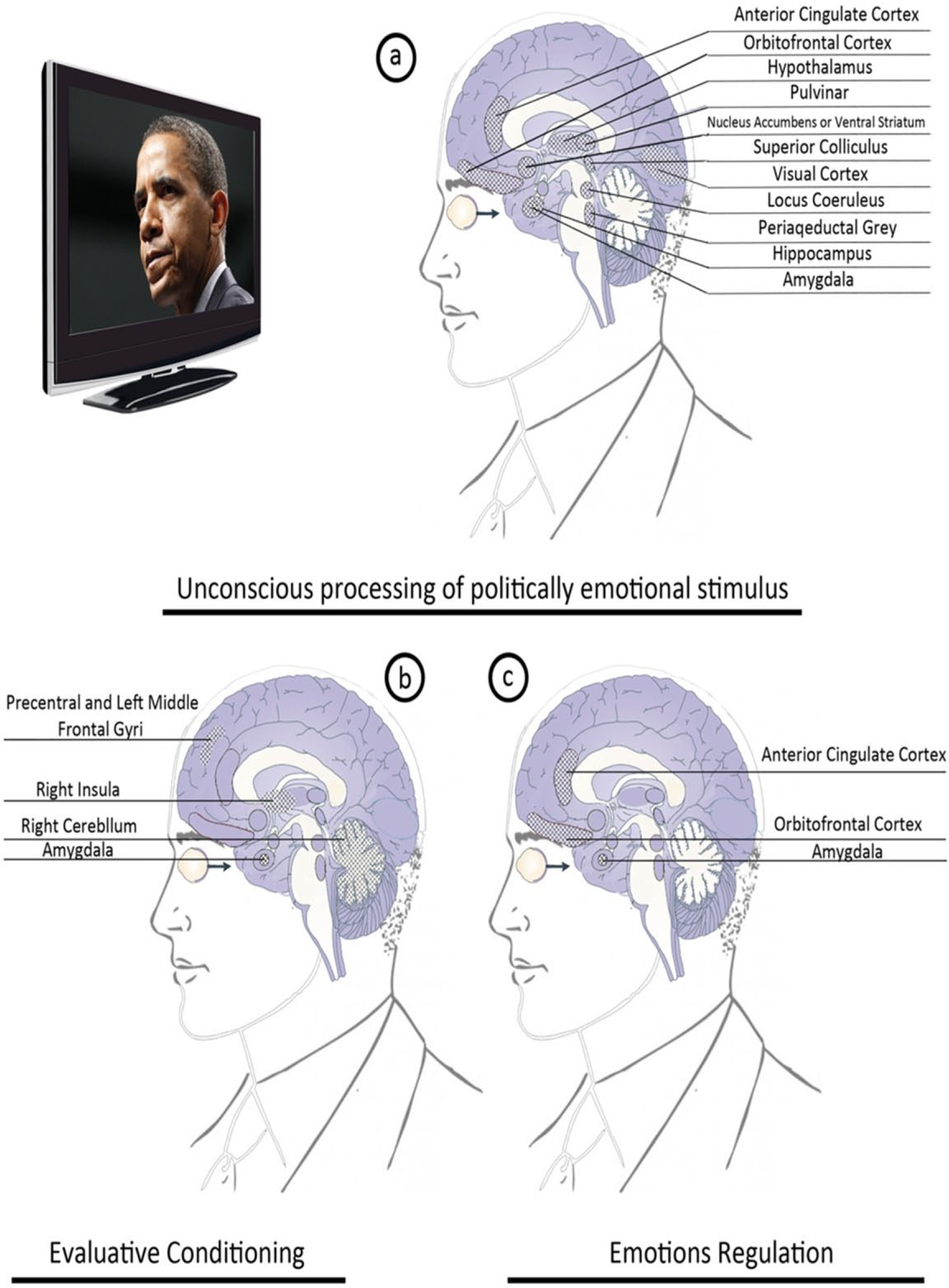
The implementational model of implicit emotion causation.
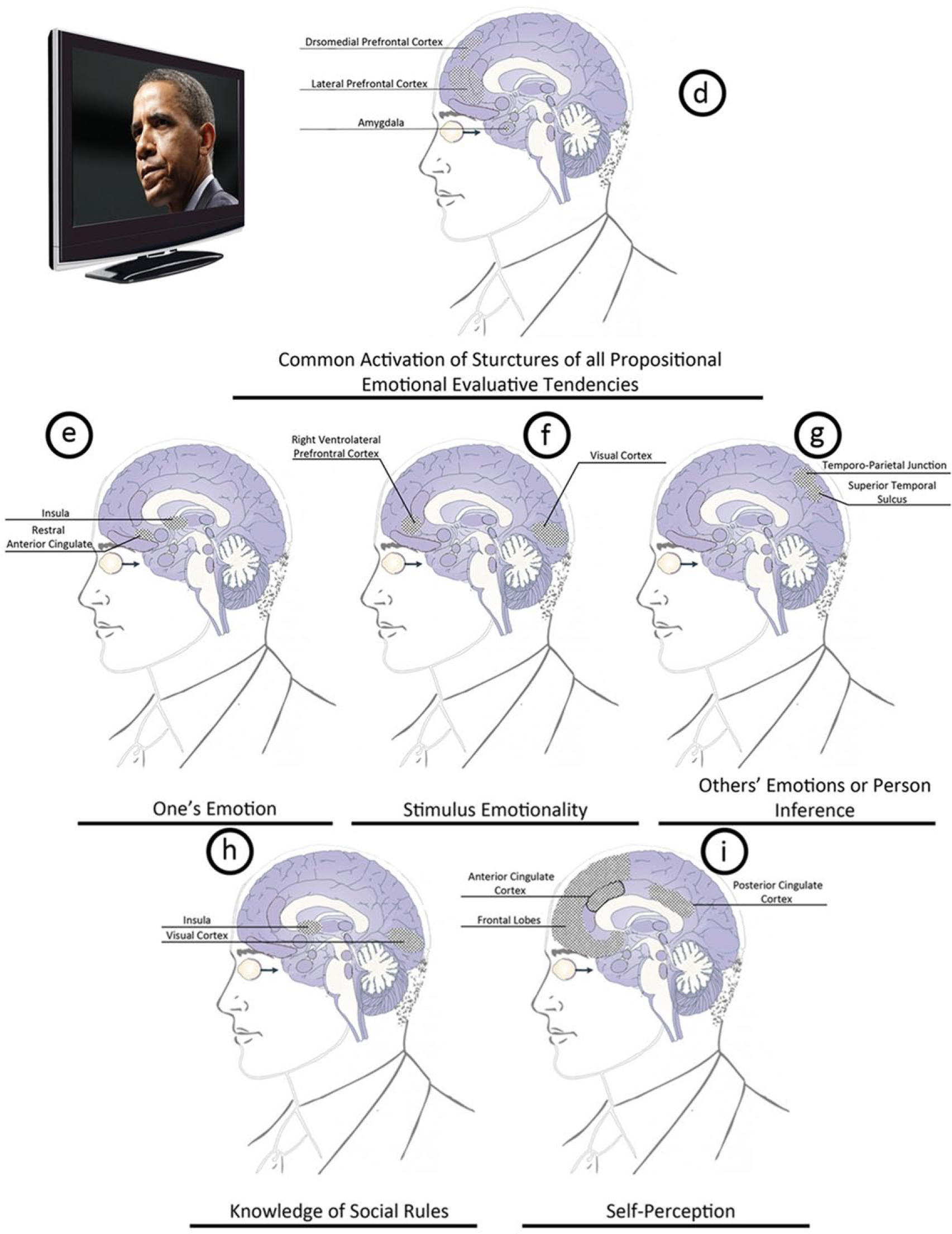
The implementational model of explicit emotion causation.
However, the spread of activation of the amygdala, orbitofrontal, and anterior cingulate cortex’s nodes is noted in propositional evaluation of political stimulus, which could hint to the convergence of automatic and propositional processing of emotional stimuli. The literature on social cognition provides evidence of both such convergence and cases in which propositional implications override that of propositional conscious judgments. As discussed earlier, the levels of attained political knowledge, cognitive elaboration, and load may determine the extent to which each factor of the dual emotional system is predictive of endorsed EEs. As such, neurological studies unveiled that agents may become vigilant of US-CS contingencies and a number of emotionally implicit regulatory processes. Therefore, the propositional implications of unconscious information processing of emotions may serve as the basis of later propositional judgments. In that sense, the elicitation of IEs might stimulate changes in EEs.
Moreover, findings from developmental psychology and self-reported literature confide three propositional processes, namely, stimulus emotionality, one’s own emotions, and the emotions of others. Lee and Siegle’s (2012) meta-analytic assessment uncovered the common spread of activation of these processes. Activations of the amygdala, lateral and dorsomedial prefrontal cortices’ associative networks are believed to be recruited in all forms of propositional evaluative tendencies. Moreover, propositional processing of political stimulus emotionality requires the activation of additional regions; specifically, right ventrolateral prefrontal and sensory cortices. It is worthwhile to mention that propositional processing of political stimulus emotionality might be affected by one’s emotion and/or others’ emotion. As a result, activations across the rostral anterior cingulate and insula, and/or superior temporal structure and temporo-parietal junction, could be recruited. Due to the semantic nature of propositional processing of political stimulus emotionality, agents may utilize self-perception, personal inference, and knowledge of social norms in regulating their EEs. For instance, self-perception regulation of political EEs is thought to be resulted from forwarded propositional implications of the frontal lobes, anterior and posterior cingulate’s spread of activations. However, notwithstanding that the propositional implications of IEs may elicit or serve as the basis of later propositional judgments, agents could employ the aforementioned mechanism in inhibiting, suppressing, negating, justifying, or rationalizing the propositional implication of IEs. From a social cognition perspective, the propositional process might manifest in the elicitation of EEs based on the set of relevant propositions that are considered when making an evaluative judgment, and/or the mechanism utilized to overcome a proposition’s inconsistency.
Taken altogether, the hypothesized political emotion causation posited through the current theory, to some extent, is in line with the ones of Barrett’s (2006) conceptual act theory, affect program theory (e.g., Ekman, 1992, 2007; Izard, 1977; Panksepp, 1998, 2000; Tomkins, 1962), and appraisal (e.g., Arnold, 1960; K. R. Scherer, 2001; R. P. Scherer et al., 2004), network (e.g., Baeyens, Eelen, & Van den Bergh, 1990), and philosophical perceptual theories (e.g., de Sousa, 1987) and differs from Schachter’s (1962) theory and philosophical cognitivism theories (Lyons, 1980; Nussbaum, 1990; Solomon, 1976). As such, it is extrapolated on the assumption that emotional automaticity depends on the conditions under which an agent processes a stimulus (Bargh, 1989; Moors, & De Houwer, 2006a, 2006b). To that end, each system is demonstrated through a specific format of representation, namely, associative and propositional. As outlined earlier, associative networks are mental contents that agents, at the unconscious level, entertain without ascribing truth values to them (Charland, 1997). Whereas agents, at the conscious level, utilize propositional representations—that is, superordinate to associative store—based on the assignment of truth value (Fodor, 1980). In that sense, the current theory is illuminated through two different representations. However, notwithstanding that the propositional implications of IEs for later propositional judgments, agents could employ the aforementioned mechanism in inhibiting, suppressing, negating, justifying or rationalising them—including Barrett’s (2006) theory—in terms of input-output assignment. As discussed earlier, the input of the crucial process could be the stimulus or IEs, and output might be of EEs or IEs. In addition, while IE and EE could be independent from each other, IE is suggested to interact with EE, and overrides it under certain conditions.
To that effect, it is argued that notwithstanding that the proposed theory extrapolates on the theory of affective intelligence (MacKuen, Wolak, Keele, & Marcus, 2010; Marcus, 2002; Marcus et al., 2000) and emotional citizen appraisal (Miller, 2011), the dual processing, the causes of its elicitation, and its consequences differentiate it from the two accounts. For instance, the political geography of affective intelligence posits that enthusiasm functions as an affective appraisal, often unconsciously, when relying on identification and convictions (e.g., partisanship). It is explained in the section discussing the role of partisanship that such a process is merely regulatory to compensate for such conviction and that occupies a moderating influence on the relationship between implicit and EE. In addition, the theory of affective intelligence posits that anxiety is the trigger of more thoughtful reasoning (Brader, 2006; MacKuen, Marcus, Neuman, & Keele, 2007; Marcus & MacKuen, 1993). The proposed theory suggests that a propositional process, which follows the associative one, is central for such conscious reasoning. In that sense, it considers anxiety as an external force that might alter the propositional process. The affective intelligence theory also argues that aversion/anger is an appraisal that regulates agents’ reaction to protect the extent of their identifications and convictions (Huddy et al., 2007; MacKuen et al., 2010). The exemplified regulatory process, namely, conflict adaptation, which occurs prior to propositional reasoning, is behind the compensation for such affinities (for more, see the section on partisanship).
In addition, it is noteworthy that the proposed theory advances the premises Miller (2011) theory (see the section on sophistication). Though, it is important to stress that while Miller explored the effect of sophistication on EE, this article argues, in a following section, that political sophistication maintains an influence on both implicit and EE. In addition, grounded on the classical literature of electoral behavior and partisanship and building on Cacciatore, Binder, Scheufele, and Shaw’s (2012) ideas of the moderating influence of partisanship, the researcher extended the relatedness of the two constructs in reconciliation with partisan identifications.
Theories of Political Behavior and Judgment
Motivated by the elusive pursuit of predicting voting behavior and the massive expenditure utilized to attract voters, the American presidential election phenomenon is discussed in exemplifying the elicitation of IEs and EEs. In this section, theories and ideas from the three dominant schools of electoral behavior and judgment are reviewed to advance the knowledge on political emotion elicitation.
First, Columbia model posits that agents’ electoral behavior and judgment is predicted in terms of ideological cleavages rather than immediate attitudinal factors (Berelson et al., 1954; Katz & Lazarsfeld, 1955). That is to say, electoral division of voter blocs on the bases of ethnicity, religion, area of residency, and socio-economic status, among other sociological forces, is predictive of voting behavior and judgment. However, notwithstanding the sociological approach predictability of political behavior in the long term, it failed to clarify the variations of electoral behavior for different elections and among members of a group. Regardless of the scholarly endeavors to overcome those issues, empirical research suggest an unavoidable and strong influence of the media, attitude toward economic policies and structure, and partisanship on electoral behavior and judgment (Curtice, 2002; Glasgow & Alvarez, 2005; Johnson, Shively, & Stein, 2002; Van der Eijk, 2002; Van der Eijk, Franklin, & Oppenhuis, 1996; Wright, 1977). Therefore, research of mass politics increasingly shifted attention to psychological-based factors in clarifying the mechanisms that govern electoral behavior and judgment (Dalton, 1984; Dogan, 1995; Franklin, 1985).
Second, Michigan model development came as a response to the shortcoming of the one of Columbia (Campbell & Kahn, 1952; Campbell, Gurin, & Miller, 1954; Campbell, 1980). The main thesis of that endeavor is that agents, commonly, compensate immediate environment to existing political information in designating their allegiances to serve as the bases for their behavior and judgment. In addition, it is argued that the Michigan model had, unpremeditatedly, instigated philosophers, scholars of mass politics, and practitioners to oppose such conceptualizations (Munger, 2011). In response, scholars offered alternative models for the study of electoral behavior. For instance, Sniderman, Piazza, Tetlock, and Kendrick (1991) rejected the Michigan model and, instead, promoted Simon’s (1985) assessment of heuristics and bounded rationality. The concept of “low information rationality,” offered by Popkin (1991), emerged as an alternative approach to the Michigan model. Interestingly, revisionists of the Michigan model and their critics’ interest in the impact of attitude toward political issues on electoral behavior stimulated the adoption of utility maximization hypothesis that manifested in the emergence of Rational Choice paradigm (Bartels, 2012). Accordingly, political scientists utilized the rational choice (or alternatively ignorance) paradigm in conceptualizing and investigating electoral behavior under the assumption that collecting, retaining, and employing political information is costly in terms of the resource required for the aforementioned processes (Hinich & Munger, 1994; Lupia & McCubbins, 1998; Popkin, 1991). In addition, scholars from the economic vein researched the phenomena of asymmetric and incomplete information (Akerlof, 1970; Alchian & Demsetz, 1972; Arrow, 1996; Stigler, 1961). However, notwithstanding the observed abandonment of the psychological model, various studies have presented evidence that contradict the wisdom implying a decline of partisanship loyalty (for review, see Bartels, 2000).
Third, alternatively, Downs (1957) proposed the rational choice theory. It set forth a rule of rational-based political behavior that is analogous to the one that governs producers and consumers’ exchanges. Downs’s thesis is that the assumption of rationality is effective in reading the market; therefore, it can clarify electoral behavior. Notwithstanding that studies that adopted the rational choice theory yielded ground breaking contributions, they also raised a number of questions on that conceptualization of voting behavior and judgment (Blais, 2000; Green & Shapiro, 1994) It is noteworthy that a wide range of research introduced new concepts to the rational choice literature to deal with such criticism (e.g., Lupia, McCubbins, & Popkin, 2000; Popkin, 1991).
The brief review of electoral behavior aimed to shed some light on the influential role of partisanship, sophistication, and attitudes. In addition, it demonstrated the differences and nexus between the three explanatory models. Rational choice studies suggest that individuals’ evaluation of a number of political, economic, and social issues is the basis of their political judgment and behavior. The sociological approach posits that historical and social factors that manifest through groups’ collective goals determine electoral judgment and behavior. The Michigan model conquers mediating and moderating roles between the sociological (distal factors) and rational choice (proximal factors) approaches. To that end, an appropriate point of departure is presented through advancing the conceptual integration of the proposed theory.
Political Sophistication as a Function of Emotional Elicitation
The previous discussion informs our understanding about political emotion elicitation at the different levels of analysis description. The theory suggests that politically informed agents are more emotionally responsive to political stimuli. In line with that assumption and based on Miller’s (2011) assessment, it is argued that politically sophisticated agents, defined as those with high level of political knowledge and interest, are more emotional in response to relevant stimuli. In this sense, high sophisticates are not only knowledgeable but also motivated to consume political information. Therefore, their exposure to a political stimulus (e.g., Hilary Clinton) is thought to trigger richer and deeper spread of activation, along memory networks, compared with less sophisticated agents. With the attained information and the newly processed political data—the subject of motivated exposure—high sophisticates are believed, at the algorithmic level, to form more links between retained nodes in long-term memory. Therefore, the engagement with new political information is posited to enhance agents’ capabilities in dissecting complex political subjects, making more representative decisions and taking decisive political actions.
Moreover, this endeavor, in reconciliation with findings from the domain of social cognition (for review, see Gawronski & Bodenhausen, 2006), exemplified political emotion elicitation, at the unconscious levels, in terms of memory associative networks. In this sense, it is argued that the elicitation of IEs is the result of either incremental changes in associative networks or changes in the patterns of activation along pre-existing networks. Retrieving from earlier review, agents react, unconsciously, to political stimuli in light of the aforementioned associative changes. For instance, Hilary Clinton’s foreign policy speech—which might condition fear of Donald Trump, the Republican presumptive nominee of the 2016 presidential election, supposed lack of foreign policy experience. According to Russell’s (2003) definition of emotion (social artifacts), agents’ reliable dissection of that speech requires certain levels of political knowledge. Furthermore, high sophisticates might attain nodes about Clinton’s experiences. This type of agents’ encounter of that speech might trigger spread of activation, resulting in incremental changes in associative networks and, thereby, negative IEs. Nevertheless, changes of the activation of different associative patterns along pre-existing networks, in terms of emotion regulation (e.g., conflict adaptation), might mediate the relationship between unconscious processing of political stimuli and IEs. Emotion regulation could, in turn, reduce negative IEs toward Trump.
In addition, agents could become consciously aware, under certain conditions, of forwarded proposition of IEs, making it the basis of later endorsed EEs. However, agents might not become vigilant of negative IEs and/or its propositional implications. Nevertheless, high sophisticates are likely to consider additional propositions about the two candidates, newly attained propositional beliefs about that election, and/or certain propositional strategy to achieve consistency based on self-perception, person inference, and knowledge of social norms. It is worthwhile to mention that such propositional processing is thought to determine the level of consistency between implicit and EEs. As such, agents’ hierarchal inhibition, suppression, or negation may result in EE that is independent of IE. In contrast, extrapolating on previous research (see Heath, Brandt, & Nairn, 2006; Spence & Townsend, 2006), politically uninformed agents are less likely to comprehend and consciously process the speech; therefore, IE could override explicit brand emotion. In addition, they might not realize and react to the fear connotation of such a speech.
Political Attitudes as a Function of Emotional Elicitation
A perusal of the American electoral landscape uncovers many political attitudinal constructs with direct and indirect implications on political judgment and behavior. Political emotions are likely an amalgamation of agents’ attitudes (e.g., cynicism and efficacy) toward a political stimulus socio-political connotations and denotations. In an endeavor to entertain the aforementioned propositions, it is important to maintain conceptual and empirical distinctions between political attitudes and emotions because each variable might be associated with certain behavioral inclinations.
It is noteworthy that a number of scholars acknowledged the ambiguity of attitude and pointed that its utilization, to some level, lacks conclusive consensus at conceptual and empirical grounds (see Bohner & Dickel, 2011; Lodge et al., 2011). A general definition of attitude is exemplified in terms of the evaluation of an object of thought (call it attitude object; for example, tangible objects, ideas, people, brands, etc.). Under the veil of social cognition literature, more elaborated conceptualizations provoked a heated debate regarding whether attitudes are temporal evaluations formed on the spot or stable enduring constructs that are stored in the memory (Gawronski, 2007).
Eagly and Chaiken (2007) and Cunningham, Zelazo, Packer, and Van Bavel (2007) posited a dual perspective in exemplifying attitudinal responses. In that sense, attitude is understood in terms of the psychological tendencies to evaluate objects, based on stored and currently formed evaluative summaries, as favored or disfavored. It is worthwhile to mention that, empirically, single perspectives (stable vs. constructed on the spot) portray a number of strength and weaknesses, making dual conceptualizations, relatively, more comprehensive in capturing all aspects of evaluative tendencies (for review, see Bohner & Dickel, 2011). However, notwithstanding the importance of shedding some light on the single and dual conceptualization of attitude, determining its nature goes beyond the scope of the current study. Therefore, the researcher refrains from the scholarly debate on the nature of such construct and adopts the Eagly and Chaiken (2007) and Cunningham et al. (2007) dual conceptualization.
Retrieving from previous discussion, in reconciliation with Gawronski and Bodenhausen’s (2006) assessment, emotions are believed to be social artifacts with clear connection to personal goals, experiences, values, beliefs, conflict adaptation, self-perception, person inference, and knowledge of social norms. As specified earlier, the aforementioned factors operate at the two levels of cognitive processing (i.e., conscious and unconscious). In this sense, political emotions are fundamental functions that are governed by all memory-based and conditioned evaluative tendencies of an attitude object (politicians, parties, policies, etc.). As such, in opposition to Plato’s view of affective reactions (i.e., “foolish counselors”) and Descartes’s understanding of emotions (i.e., afflictions that obscure and bias reasoning and choices; for review, see Bargh & Williams, 2007) and in line with Darwin’s (1872) conceptualization, this endeavor considered emotion as necessary states that allow individuals to detect political threats and opportunity in their pursuit of political goals’ achievement and, thereby, take action to minimize political costs and maximize benefits.
Furthermore, emotion theorists posit the critical role of active emotions (i.e., fear, anger, etc.) in eliciting actions (Arnold, 1960; Frijda, 1986; Plutchik, 1980; Seitz, Lord, & Taylor, 2007). Under that veil, those theorists noted that the inclusion of emotions, as moderator variable of attitude–behavior relationship, is likely to enhance attitude predictability of behavior. In that sense, the consistency of agents’ attitude–behavior relationship is greater when their valenced attitude matches the ones of emotions (Chaiken & Baldwin, 1981; Huskinson & Haddock, 2004; Millar & Tesser, 1986; Rosenberg, 1968).
Specifically, scholars argued that emotions might be described as action tendencies (Arnold, 1960; Bradley & Lang, 2000; Frijda, 1986). The experience of emotion can be understood in terms of the state of action readiness (Frijda, 1986) and action preparations (Plutchik, 1980). Extrapolating on the assumption that individuals are likely to act upon their attitudes, emotions are believed to strengthen attitude predictability of behavior. For instance, Seitz et al.’s (2007) findings (Experiments 1 and 2), in the context of individuals attitude–behavior consistency toward gay people, supports the moderating role of emotions. However, notwithstanding the cognitive and behavioral aspects of attitude, it is worthwhile to mention that the construct encompasses an affective dimension (Breckler, 1984; Eagly & Chaiken, 1993; McGuire, 1985; Rosenberg & Hovland, 1960). Interestingly, affect is believed to be implicated in emotion individuals experience due to the exposure to an attitude object (Eagly & Chaiken, 1993). To that effect, scholars noted the independence of the affective dimension (e.g., Breckler, 1984).
Moreover, under the veil of social cognition, hot cognition is essential for unconscious and conscious information processing (Burdein, Lodge, & Taber, 2006; Lodge & Taber, 2005). This account implies that when an agent gets exposed to a political stimulus, all relevant and previous evaluation of that stimulus become hot (active; Bargh, 1994; Laird, 1974; Lodge & Stroh, 1993; Taber, Lodge, & Glather, 2001). It is worthwhile to mention that hot hypothesis is built on the premises that all retained concepts are affect laden (i.e., tagged into positive or negative classes (for review, Bargh, 1994; Fazio & Williams, 1986; Fiske, Kenny, & Taylor, 1982; Lodge & Stroh, 1993; McGraw, Lodge, & Stroh, 1990; Zajonc, 1980). Among scholars of hot cognition, it is believed that semantic associations connect nodes in the long-term memory based on their ascribed meanings (Clore & Schnall, 2005). For example, the node representing the president of the United States of America, Barak Obama, would presumably have links to his ethnicity, other personal characteristics, political affiliation, and/or policies that an individual assigns to attain direct or indirect relationship with the president. In that sense, links that are commonly brought up when talking about that stimulus (Obama) are believed to have strong associative power. For example, ObamaCare (aka The Patient Protection and Affordable Care Act or PPACA) may hold a stronger connection to a potential beneficiary than leading from behind (i.e., a phrase first used by Ryan Lizza, CNN contributor and the Washington correspondent for The New Yorker magazine, to describe President Barack Obama’s policy in Libya in 2011). However irrelevant at the personal level it might be, it is suggested that semantically separated nodes are likely to be linked through a spread of activation (e.g., Barsalou, 1992; Burdein et al., 2006; Lodge & Taber, 2000, 2005). When a node is activated, albeit the exposure to a political stimulus, all nodes connected to it, semantically, move closer to their threshold and, thereby, get transformed to the working memory (or alternatively get hot). Nevertheless, nodes of ascribed irrelevance, at the personal level, could suffer disassociation. To that effect, the nature of the valence of associative networks (i.e., pleasant or unpleasant) is thought to infuse IERs.
In line with Gyurak et al.’s (2011) assessment, Lodge and Taber’s (2005) experiment unveiled a slow affective reaction in response to encountering affectively incongruent concepts (e.g., Hitler—rainbow). Interestingly, the aforementioned findings are, specially, supported among politically sophisticated participants and those of strong prior political attitudes. That implies stored strong political attitudes might allow individuals, at the unconscious level, to practice careful investigation, effortlessly, with no recollection of key elements involved in the process (Etkin et al., 2010). As mentioned earlier, this regulatory process is expected to slow down IEs’ assignment due to agents’ experience of emotional conflict (Egner et al., 2008; Etkin et al., 2006; Etkin et al., 2010). It is noteworthy that such automatic process is believed to reduce agents’ negative IEs. Hence, it allows agents to compensate for their stored positive attitudes toward a political stimulus.
In addition, Gawronski and Bodenhausen (2006, Case 4; see also, Gawronski & Bodenhausen, 2011) conceptualized the interplay between associative and propositional processing. Extrapolating on that view, an explicit political attitude might infuse IEs as a result of the influence of propositional evaluation on associative processing. This implies that initial elicitation of IEs is mediated by explicit attitudes. In reconciliation with the premises of the proposed theory, the occurrence of such phenomenon should emerge when (a) a given attitudinal construct gets elicited by a given factor, albeit resulted from provided additional propositions as the basis of explicit attitude change (e.g., when an individual encounters persuasive arguments that reinforce or weaken a political attitude) and (b) these explicit evaluative tendencies lead to incremental or pre-existing associative network changes. In situations where strong enduring and stable attitudes serve as a regulatory emotional process, the relationship between attitudes and emotions might be observed. Regardless of the nature of valenced attitudes (i.e., positive or negative), their subsequent impacts are likely to cause regulation or reinforcement of emotions. To that end, it is worthwhile to mention that attitudes triggering positive emotions are thought to result in more positive behaviors than the ones that elicit negative emotions (Breckler, 1984). For example, a number of studies indicate that positive emotions, such as happiness, are elicited by stereotypical attitudes (for review, see Bless et al., 1996; Clore & Schnall, 2005).
An instance of political attitudes is cynicism, which can be explained in terms of the attitudinal manifestations of the appraisal of key factors, such as values, action, and motives of an agent (Bedeian, 2007). Political cynicism refers to tendency that crystallizes in lack of trust and confidence in the people running a government (Kaid & Tedesco, 2000; Pinkleton, Austin, & Fortman, 1998). In political lingo, the term is synonymous with distrusting, showing contempt, doubting, and disappointment in public officials. In line with this definition, Miller’s (2011) emotional citizen appraisal theory, Dean, Brandes, and Dharwadkar’s (1998) assessment, and in reconciliation with the premises of the proposed theory, cynicism reflects an evaluative state that maintains a facilitating role in discerning a political stimulus. In addition, it is expected to elicit negative emotional reactions. For instance, one of the major issues facing the presumptive Democratic nominee is voiced through a lack of trust by many Republican and Democratic agents.
News published on her email scandals are arguably assessed by potential voters, many of which might tarnish her credibility. In accordance with the premises of the proposed theory and Gawronski and Bodenhausen’s (2006) assessment, cynics’ exposure to negative materials creates new nodes about Clinton, linking it to a network of previously stored information about the candidate. Such exposure might induce distrust and reinforce explicit cynical attitude, albeit encountering a negative advertisement that adds a new proposition, causing negative IEs. Additional negative propositions and the respective propositional implication of IEs could trigger explicit negative emotions.
Building on Cottrell and Neuberg’s (2005) ideas, political cynicism could provoke agents’ experience of anger toward a presidential candidate thought to be involved in public injurious policies. In addition, individuals might experience disgust toward a candidate thought to promote social policies (e.g., marriage equality) opposing their values because of strong attitude toward such policies. From this perspective, agents’ cynical attitudes toward a presidential candidate’s might elicit implicit and EEs, which in turn motivate them to behave in order for them to counter ostensible threats and maximize political benefits.
Partisanship as a Regulatory Process
Partisanship is clarified in terms of agents’ enduring affinities toward a political party (Campbell, 1980). Extrapolating on non-emotional research (Cacciatore, Binder, Scheufele, & Shaw, 2012; Fazio & Williams, 1986; lyengar & Kinder, 1987; McLeod, Becker, & Byrnes, 1974; Weise, 1996) and constrained by Etkin et al. (2010), it is argued that partisanship mitigates agents’ implicit and EEs; a phenomenon that could be explained in terms of accessible partisan investigative-based considerations that accompany prior political beliefs, stimulating emotion regulation processes and, thereby, stronger, or weaker, IEs-EEs relationships. As mentioned earlier, this regulatory process is expected to slow down IEs’ assignment due to agents’ experience of emotional conflict (Egner et al., 2008; Etkin et al., 2006; Etkin et al., 2010) when exposed to negative information about their party’s candidate. It is noteworthy that such automatic process is believed to reduce agents’ negative IEs. Hence, it allows agents to compensate for their stored beliefs guided by their partisan’s loyalty.
In addition, Gawronski and Bodenhausen (2006, Case 4; see also, Gawronski & Bodenhausen, 2011) conceptualized the interplay between associative and propositional processing. Extrapolating on that view, partisanship might infuse IEs as a result of the influence of propositional evaluation (e.g., partisan’s considerations) on associative processing. This implies that initial elicitation of IEs is moderated by agent’s partisan affiliation. To that end, it is worthwhile to mention that group-based loyalties triggering positive emotions are thought to result in more positive IEs-EEs relationship than the ones that elicit negative emotions. Therefore, in reconciliation with Campbell (1980), the premises of the proposed theory, and extrapolating on Cacciatore et al.’s (2012) findings, the researcher posits a moderating effect of partisanship as regards the relationship between IEs and EEs.
Measuring IEs and EE
In operationalizing political emotion, in reconciliation with the premises of the proposed theory and assessment from a wide array of research, namely, social, cognitive, political, and marketing psychology (e.g., Fiske et al., 1982; Horcajo, Briñol, & Petty, 2010; Lodge & Taber, 2000, 2005; Nevid & McClelland, 2010; Zajonc, 1980), two distinct measures are employed. As such, two distinct measures are employed. In the interest of reconciliation, to some extent, with dimensional variables (Davidson, 1999; Lang, Bradley, & Cuthbert, 1997; Russell & Barrett, 1999; Schneirla, 1959; Watson, Wiese, Vaidya, & Tellegen, 1999), EEs (e.g., fear, anger, pride, and hope) are defined as the salient manifestation of arousal (i.e., contrast the states of excitement with quietness), valence (i.e., captures the states of displeasure and pleasure), and approach-avoidance (i.e., captures the tendencies to approach and avoid the encountered stimuli; for review, see Keltner & Haidt, 1999). Based on the premises of the proposed theory, the aforementioned aspects are guided by several determinants such as agent’s self-perception, personal inference, and/or knowledge of social norms. For instance, the endorsement of anger, in response to a statement by Donald Trump, is understood in terms of high arousal, negative valence, and high motivational approach. Such explicit categorizations could be the manifestation of an agent’s ascribed ideological beliefs, values and partisanship, anticipated reactions to a displayed emotional response by the groups with which the agent affiliates, and the inferred righteous and socially acceptable judgment. It is worthwhile to mention that in accordance with core affect (Russell, 2003, 2009) and Barrett’s (2006) theories, the reconciled explicit political emotions are considered as socio-cultural constructions (i.e., artifacts), rather than evolutionary categories given in nature (i.e., natural kinds).
Second, Affect Misattribution Procedure (AMP; Payne, Cheng, Govorun, & Stewart, 2005) is used to tap IEs. That is, a procedure developed specifically to explore unconscious automatic reactions (i.e., attitude, IEs, and values). Briefly, AMP flashes a picture of a stimulus on a screen for a fraction of a second, then, a picture of a Chinese character (word) is flashed for a longer fraction of a second. It is forwarded that participants should be asked to rate their emotional reactions (e.g., anger-calmness) toward the ambiguous Chinese character instead of the stimulus (e.g., Donald Trump). Notwithstanding that the participants are instructed to ignore the stimulus, they are believed to rely on their IEs of the stimulus due the persistence of its affect. As such, AMP is used to measure IEs toward a stimulus. It is noteworthy to indicate that AMP possesses two advantages relative to other measures (De Houwer & Houwer, 2006; Lebel & Paunonen, 2011); first, it is highly reliable in terms of internal consistency; second, it is parsimonious regarding its construction and administration. As discussed, EEs are the manifestation of the spread of activation. It is worthwhile to mention that, extrapolating on Payne et al.’s (2005) assessment, the AMP is designed to capture indirectly implicit reactions. In line with the premises of the proposed theory, AMP is posited to be a parsimonious tool to capture and discriminate between implicit emotional episodes (Figure 5 depicts an instance of IEs and EEs measurement based on the premises of the proposed theory).

Measurement of political emotions: Anger—Calmness.
Conclusion
Drawing on the notion that emotions are cognitive functions, so long as information processing is equated with cognition, duality of emotional processing, distinctive activation of brain structures, and the two levels of representations, implicit and explicit emotional processing and their interactions were hypothesized at the three different levels of analyses. Moreover, based on a wide array of research on political judgment and behavior, political sophistication and attitudes are posited to be a function of political emotions’ elicitation. In addition, this article also posited the moderating influence of partisan loyalties on IEs-EEs relationship. To that effect, the proposed theory implies several new predictions that might stimulate further research and, thus, may improve our understanding of the underlying dynamics within implicit and explicit political emotions. Future research on political emotions may benefit from prior considerations regarding the nature and elicitation of implicit and EEs. For instance, the thorough investigation of variables which elicit incremental and pre-existing patterns of associative and/or propositional changes could shed more light on the processes that govern political emotion causation. The specification of variables that stimulate a particular process and its respective patterns of implicit and EEs’ elicitation are believed to be important to consider.
Footnotes
Declaration of Conflicting Interests
The author(s) declared no potential conflicts of interest with respect to the research, authorship, and/or publication of this article.
Funding
The author(s) received no financial support for the research and/or authorship of this article.