




Abstract
This research investigated the impact of processing instruction (PI) on the acquisition of the English third-person singular present tense by Chinese English-as-a-foreign-language (EFL) learners and whether this effect would extend to the acquisition of other language components. This study featured the pretest-immediate-posttest design and participants were required to participate in all tests (pretest, immediate posttest, delayed posttest). Two classes were assigned to receive PI and Traditional Instruction (TI) respectively, while another class served as the control group. A language background check was conducted 2 weeks before the main experiment. And after three consecutive class hours, there is an immediate posttest and a delayed posttest in 2 weeks. By comparing the results of the three tests, the study measured and compared the primary effects, secondary transfer-of-training (TOT) effects, and cumulative TOT effects of PI and TI. The findings showed that both PI and TI had significant effects, although they differed in the extent and duration of improvement in acquisition effectiveness. PI was found to be superior to TI, which could be reflected in primary and two TOT effects except the interpretation tasks related to passive voice. This study suggests that PI can be utilized in grammar teaching due to its efficacy in teaching specific linguistic structures and its transfer-of-training effects on other grammar rules.
Plain Language Summary
This study investigated whether teaching English learners in China using processing instruction (PI) could help them learn the third-person singular present tense and transfer to other linguistic items. The present study has two experimental classes: one that got PI and another that got Traditional Instruction (TI). A third class was the control group. The experiment lasted three class hours and included pre-tests, immediate post-tests, and delayed post-tests. The present study compared the results and found that both methods worked, but PI was better. PI could help teach specific grammar rules and transfer knowledge to other grammar rules as evidenced by the cumulative TOT effects observed in this study. Basically, the study only had 106 students, which is not a lot compared to other studies. This might be because the school is linked to a university and is smaller in size. Also, the teaching time for both PI and TI was only 2 hours, which might not have been long enough for students to really learn the grammar well. To get better results in future studies, more students and more teaching time should be considered.
Keywords
Introduction
In the field of second language acquisition (SLA), two intriguing questions persist. The first question revolves around the optimal approach for teaching grammar. The second question pertains to the transfer effect within the target language. The teaching of grammar has long been a subject of debate in SLA. Ellis (2006) emphasized the significance of incorporating grammar instruction in SLA, prompting researchers to explore various instructional strategies aimed at helping students develop a cognitive model of second language (L2) grammar. While Traditional Instruction (TI) has been widely employed in SLA classrooms and may appear to be a viable solution, its effectiveness has been called into question. Critics argue that TI is inefficient and fails to establish a meaningful connection between form and meaning, as it often encourages students to engage in rote practice before being able to generate meaningful sentences for communication. In the search for more effective instructional approaches, Processing Instruction (PI) has emerged as a popular technique for teaching grammar. PI is rooted in VanPatten’s (2015a) input processing (IP) model, which focuses on the process of deriving meaning from a significant amount of input. With the aim of transforming students’ subpar methods of processing input and fostering a connection between form and meaning during the learning process, PI strives to help students grasp grammatical concepts (Henry, 2022; Lee & Doherty, 2020; VanPatten & Cadierno, 1993; Wong & Ito, 2018). However, the effectiveness of PI remains a topic of contention (Zhang, 2015). Even VanPatten (1996) himself has expressed doubts about the long-term impact of PI.
Transfer-of-training (TOT) effects refer to the situation where a language learner applies a processing strategy they have acquired for one linguistic item to another item that they have not encountered previously. Despite numerous studies demonstrating the effectiveness of processing instruction (PI), there is a scarcity of studies that compare the effects of PI with other instructional methods or explore its application in different contexts (Henshaw, 2012; Kasprowicz & Marsden, 2018; Rice et al., 2015). This study aims to address this gap by comparing how two different teaching methods, PI and Traditional Instruction (TI), influence the learning outcomes of EFL learners in relation to the acquisition of the third-person singular simple present tense and simple past tense. This will be achieved by analyzing the scores obtained in interpretation tasks and production tasks in both the immediate and delayed posttests. The results also show that PI had more significant primary effects, the secondary TOT effects, and the cumulative TOT effects than TI, which was also the most distinct result among those relative studies on PI. Moreover, those effects could retain for a longer time in the delayed posttest. Therefore, compared with TI, PI was a more practical instruction method of grammar by supporting optimal strategies to link the form with the meaning of the grammar point when learners process grammar.
The significance of this study can be divided into two aspects: theoretical and practical. Firstly, there is limited research on the effects of PI in non-Roman languages like Chinese, particularly on the transfer-of-training (TOT) effects of PI. This study aims to explore whether PI can help learners change nonoptimal strategies when learning grammar points, transfer the effects to another unlearned item and fill the gap in research on PI in grammar instruction at home for participants at the beginning level of English. Secondly, the research may shed light on the implication of the primary and TOT effects of PI in teaching and help learners develop a habit of using optimal strategies to process input, stimulate the linkage between form and meaning, and transform these strategies when acquiring other grammar items.
Literature Review
Input Processing
In light of Ellis (1994, 2006) emphasis on the importance of grammar teaching in second language acquisition, researchers have recognized the benefits of incorporating grammar instruction. VanPatten (1996) argued that certain grammatical structures become more salient than others, leading to an acceleration in language comprehension. Traditional instructional methods, which are widely utilized, typically prioritize form, aiming to develop learners’ explicit knowledge of the target grammar by directing their attention to forms and structures (VanPatten, 2002). Two common traditional approaches to grammar teaching are the Grammar-Translation Method (GTM) and the “Presentation, Practice, Production” (3P) Model, both falling under the category of Traditional Instruction (TI). The GTM requires instructors to initially introduce complex grammar rules deductively, often involving translation into learners’ native languages. The 3P Model consists of three stages: first, presenting targeted grammar patterns with occasional examples; second, engaging in mechanical drills to manipulate or substitute grammatical forms; and finally, providing learners with multiple opportunities to apply what they have learned. While the 3P Model is more systematic and specific compared to the GTM, enabling learners to engage in more varied and stimulating grammar activities instead of mere rote memorization, neither method addresses the development of optimal cognitive processing strategies (VanPatten, 1996). VanPatten explored a more effective approach to grammar instruction.
Input processing theory, based on which Processing Instruction was first proposed by VanPatten (1996). The input absorbed into learners’ interlanguage system is called intake. Compared with other hypotheses, such as the input or output hypotheses, IP focuses on how learners initially recognize and comprehend linguistic data from what they hear or read. It also encompasses the psycho-linguistic strategies and mechanisms that learners may adopt to convert input into intake (VanPatten, 1996). VanPatten (2004b) modified the IP model to Figure 1, which divides SLA into four phases, attempting to illustrate how learners establish initial form-meaning correlations and parse sentences to achieve accurate comprehension (VanPatten, 2004a, p. 32).

A sketch of basic acquisition processing by VanPatten (2004b).
An effective approach to focus on form is one which ties together form and meaning and moves from input to output practice (Benati, 2021). To answer how learners relate form to meaning, VanPatten (2014) outlines several principles used by language learners when processing input. Table 1 presents two main principles and their subprinciples in the latest form (VanPatten, 2014).
Principles of Input Processing (VanPatten, 2014).

Note. P1 and P2 are the main principles of PI; P1(a-f) & P2(a-c) are subprinciples of two main principles.
The first principle posits that when learners comprehend a sentence or utterance, they prioritize understanding lexical items over grammatical items (VanPatten, 2002, 2015a, 2015b). For instance, in the sentence “I walked to Central Park yesterday,” learners are more likely to focus on the meaning of the word “yesterday” rather than the grammatical marker “-ed” attached to the verb “walk.” The same applies to the marker “-s” in the third-person singular present tense. In other words, learners tend to process items with higher communicative value first.
As for Principle 2, language learners have a tendency to assign the role of the agent to the first noun or noun phrase in a sentence or utterance (VanPatten, 2002, 2015a, 2015b). For example, when encountering the sentence “John was cheated by Mary,” learners are inclined to interpret “John” as the one who performed the action of cheating. Since “John” appears first in the sentence, they assume that he is the agent. This principle addresses issues from a formal standpoint.
Processing Instruction and Transfer-of-Training Effects
Theoretical Bases and Components of Processing Instruction
Processing instruction (PI) is a grammar teaching method that focuses on input-based instruction and aims to help learners establish connections between form and meaning by utilizing psycho-linguistic strategies and mechanisms involved in converting input into intake (VanPatten, 1996, 2004a). PI consists of three main components: (1) the provision of explicit information about a specific linguistic structure or form, (2) the explanation of learners’ non-optimal strategies, and (3) structured input activities (SI) (VanPatten, 2004b, pp. 33–62). The first two components, explicit information (EI), are similar to traditional teaching methods where instructors explain the definition and basic rules of the target linguistic item. The structured input practice includes two types of activities: referential activities and affective activities. Referential activities emphasize the form to make sense of the meaning. These activities have clear right or wrong answers to ensure that learners establish the connection between form and meaning. On the other hand, affective activities do not have right or wrong answers. Instead, learners are encouraged to express their genuine feelings or viewpoints about various information related to the target linguistic structures in their daily lives, which promotes their engagement with the item (Benati, 2022b; Marsden & Chen, 2011).
Application of Processing Instruction
Since its introduction in 1996, the effectiveness of Processing Instruction (PI) in grammar teaching has been a widely debated topic. Several studies have indicated that PI can contribute to improved grammatical proficiency in specific areas (Benati, 2019; Lee & Benati, 2013; VanPatten, 2015b). However, there are contrasting viewpoints suggesting that PI is not highly effective and does not facilitate learners’ skill development. The initial study by VanPatten and Cadierno (1993) served as a catalyst for subsequent discussions on PI, becoming the most frequently cited study and inspiring numerous replication experiments.
Subsequent research endeavors have focused on investigating the effectiveness of PI in teaching various grammatical structures across different languages. Henry (2022), for instance, found that the group receiving PI exhibited significantly greater improvement in interpretation tests compared to other groups, although both the PI and TI groups showed significant improvement in production test scores, which were also similar to each other. These findings have been replicated in other studies exploring different grammatical structures. Some studies got the same results that the effects of PI were better than TI overall, such as on Spanish accusative case object pronouns (e.g., White, 2015), French causative constructions (e.g., Wong & Ito, 2018), German accusative/nominative case definite articles (e.g., White, DeMil, & Rice, 2015), Japanese (e.g., Hikima, 2011), and English (e.g., H. Y. Li, 2021; Y. F. Li & Zhang, 2015; Uludag & VanPatten, 2012).
However, there have been doubts raised regarding the effectiveness of PI based on research investigating various grammatical structures. And whether PI is an effective teaching method or not also needs to be confirmed by comparing it extensively with other teaching methods.
Argues on Processing Instruction
Inconsistent results were found in language items such as French causative with faire, Spanish object pronouns, and subjunctive in adjectival clauses. In some studies, there were no significant differences observed between the PI and TI groups, and in certain cases, the control group even outperformed them (e.g., Allen, 2000). These inconsistent results may be attributed to variations in instructional methods, assessment materials, and research subjects across different trials (Aghaei Aghdam et al., 2022; Haghani & Rashtchi, 2023; VanPatten, 2002).
Then, researchers gradually devotedly compared the impact of PI to other types of instruction. Benati (2005) asserted that only in interpretation tasks did learners from the PI group make progress significantly more than students from the MOI group. Nevertheless, in respect of production tasks, there was no gap. Qin (2008) probed into the effects of PI and dictogloss (DG) tasks on acquiring the English passive voice. He found that the PI group performed significantly better than the DG group concerning comprehension. However, this superiority disappeared 1 month later. For the production section, both groups improved significantly, and the effects lasted 1 month. Similar results were also illustrated by Uludag and VanPatten (2012). From these studies, it is impossible to assert that the effects of PI are better than other teaching methods or techniques such as MOI and DG for primary effects and long-term effects. Moreover, the long-term effects of SI were also concentrated recently (Benati & Batziou, 2019), as well as the long-term effects of PI (VanPatten & Fernández, 2004).
Based on the above analyses, PI is not the only effective teaching method for grammar instruction, and the PI is not the optimal instruction method for all grammar items. Therefore, it is still necessary to explore the effects of PI in different participants toward different grammar structures.
Transfer-of-Training Effects of Processing Instruction
The transfer-of-training (TOT) effects of PI have been subject of debate. These effects can be classified into secondary TOT effects and cumulative TOT effects. Secondary TOT effects refer to the transfer of processing strategies from one linguistic item to another that share similar processing principles, while cumulative TOT effects occur when linguistic items involve different processing principles. The examination of TOT effects in PI was not conclusive until Benati and Lee (2008) conducted three studies. These studies investigated the TOT effects of Italian noun-adjective agreement to Italian future tense morphology, English past tense to English third-person singular present tense, and French imperfect to subjunctive and causative constructions. The PI group demonstrated significant TOT effects in both secondary and cumulative effects, while the TI group showed some TOT effects and the control group exhibited none. Leeser and DeMil (2013) used 92 American college students as subjects, examined the effect of input processing instruction on Spanish object pronouns interventions on the transfer effects of Spanish conjugated pronouns, and also purposed that of the two approaches, only PI is effective in prompting learners to alter the way they process primary linguistic data in the input.
All of these being said, TI is still the most popular teaching strategy employed in compulsory education despite its dissatisfactory results on grammar learning. As a result, attempting a new teaching strategy seems unnecessary and few studies in China have concerned the comparison and contrast between PI and TI, and secondary TOT effects and cumulative TOT effects. Therefore, the present research combines two of them with a complete design to compare two different TOT effects simultaneously.
Limitations of Previous Research
As a novelty teaching method for grammar structures, the school for the research on PI is relatively more minor than those mainstream research hotspots such as the Communicative Approach and TBLT, and there are very few researchers in the field. It seems to be even worse in China as most of the studies on the primary and the TOT effects of PI focus on the Roman languages and the Indo-European languages in western countries. And it is still controversial whether PI has TOT effects and whether its TOT effects are better than TI or other teaching methods’. As it is known, the results of previous studies don’t reach a consensus among those questions, so it needs to be further studied.
Research Questions
Considering these, the current study intends to fill the aforementioned gaps in the literature and to investigate the primary and two kinds of TOT effects of PI after participants acquire English third-person singular present tense so that three research questions should be figured out below. Also, the findings of these questions could be possible to provide a more effective method for grammar teaching and better analyze the transfer between two similar grammatical structures.
What are the different primary effects of PI and TI on English third-person singular present tense?
What are the secondary TOT effects of PI and TI from the acquisition of English third-person singular present tense to the simple past tense?
What are the cumulative TOT effects of PI and TI from the acquisition of English third-person singular present tense to the passive voice?
Research Methodology
Overall Design
This study featured the pretest-immediate-posttest design, with 106 EFL learners from three classes. Two of the classes were randomly assigned to one of two experimental conditions: Processing Instruction (PI) and Traditional Instruction (TI). And the remaining one is the control group. All participants were required to participate in all tests (pretest, immediate posttest, delayed posttest) and treatment for 2 hr, which were divided into three lessons.
Participants
Before selecting participants, a set of criteria of participants needed to be followed:
They have spent none or no more than 3 months in English-speaking countries.
They were all beginning-level English learners.
They had not been taught or previously exposed to the linguistic items applied in the experiment.
Moreover, only participants who scored less than 70% of the maximum score instead of 60% in common on the pretests (both the interpretation and production tasks) were included in the final data pool because the target linguistic item (third-person singular present tense) is much easier compared with other items in previous studies.
The original participants were from Grade 7 at a junior high school affiliated with Hunan University in Changsha. All 114 participants were Chinese native speakers who had been studying English since Grade 1 in their primary schools.
After filtering by the criteria, in the final data pool, eight participants were filtered out from three groups, some of whom had lived in British commonwealth countries for more than 3 years, and others got high scores than the criteria. Three instructional methods were used in three groups randomly: the PI group (N = 36), the TI group (N = 35), and the control group (N = 35). As for gender distribution and the average age, those two factors in the three groups were nearly the same. As shown from Table 2, there were 23 males and 13 females in the PI group and 21 men and 14 females in the TI and control groups. The average age of each group’s EFL learners is around 12 years old.
Descriptive Statistics About Participants.

Note. PI = processing instruction; TI = traditional instruction; Con = the control group.
Target Linguistic Items
The three target linguistic items were English third-person singular present tense, simple past tense, and passive voice. The present study selected these three structures for a variety of reasons, including the fact that the EFL learners had no prior knowledge of them, and the fact that they could accept them based on their prior knowledge from their 7-year schooling.
Furthermore, those students had just entered Grade 7, and they had not learned those grammar points in the system. But in the other aspect, those were within the zone of proximal development (ZPD), students can acquire them with the help of the instructor.
In order to measure the primary and secondary transfer-of-training effects, English third person singular present tense-s and the simple past tense-ed were selected. Both verbal morphemes are affected by the Lexical Preference Principle (P1b) because learners will tend to rely on lexical items than grammar forms. Moreover, another processing principle named Preference for Nonredundance Principle (P1c) could also be at play here.
The passive tense was selected to measure the primary and cumulative transfer-of-training effects. It was affected by the Lexical Semantics Principle (P2a). Thus, those pair (from English third-person singular present tense-s to the passive tense) were under different PI principles.
Moreover, there were restrictions in the target linguistic items actually used in tests. Considering the vast amount of irregular forms of past tense, only regular forms were included in the experiment. Also, since passive voice is difficult for students from grade 7, the structure was limited to be-passive and get-passive was excluded.
All teaching materials of English third person singular present tense were referred to Longman Understanding and Using English Grammar published by Foreign Language Teaching and Research Press and An Advanced English Grammar edited by Bo Bing, which were two of the most authoritative books in China. Because there were few studies on two kinds of TOT effects or passive voice, many examples which could be used in teaching materials or tests could be chosen from some exams of previous final exams or senior high school entrance examinations locally. All items in tests were referenced to those two authoritative grammar dictionaries and exam questions of previous final exams or senior high school entrance examinations for the whole city. The reliability and validity of those tests had been verified in the pilot study, as well as the difficulty of those tests.
Treatment
Target Items
All teaching materials on the English third-person singular present tense were adopted from Longman Understanding and Using English Grammar published by Foreign Language Teaching and Research Press, and Advanced English Grammar edited by Bo Bing. These books were chosen to ensure that the teaching materials were accurate and reliable. However, considering the current proficiency level of the participants, some examples of teaching materials or tests were selected from previous final exams or senior high school entrance examinations for local schools. To ensure that all three experimental groups would receive equal and appropriately challenging instructional activities, each lesson would contain six tokens with similar themes. The control group, on the other hand, would not receive any formal instruction but will only be given some reading tasks.
TI Treatment
There were three periods in TI treatment. As shown in Figure 2, teachers illustrated the definition and structures of the target linguistic item (third-person singular present tense), then followed mechanical drills, meaningful exercises, and communicative practices for the output, such as “Find and Change errors” and “Draw and Introduce.” For the “Find and Change errors,” students were asked to do some error-correcting exercises, like “She are not a good student” and “Kitty and Lily goes to school by bus.” As for “Draw and Introduce,” students were required to draw a sketch of their class best friend on the paper and write three sentences to describe him/her. In each period, the teaching objectives and tokens’ numbers were the same.

The teaching procedure of TI.
PI Treatment
There were also three periods (40 min for each lesson) in PI treatment to teach English third person singular present tense. The first period was to introduce the definition and the structure of the simple present tense. The second aimed to teach children how to change verbs’ forms according to the third-person singular rules. Finally, the negative sentences and the interrogative sentences with the third-person singular form were taught. Students were led to build the connection between the form and the meaning in every period when they process sentences. A more detailed description of the periods are presented in Table 3.
The Teaching Procedure of PI.

There were many types of referential tasks. For instance, students were asked to finish a task called “Choose Subjects,” they were given some short sentences without subjects like: “Does _______ always swim very fast?,” they needed to choose a right answer from the three given answers: “Helen, the Helens and Not sure.” Besides, “Multiple Choice” also belonged to referential tasks, which required students to choose an answer after reading a question. As for the affective tasks, for example, there was a task called “Judge whether it is the same with you,” which means they were provided with a short article like: “I’m John. I’m a tidy boy. In my room, the books are often on the desk. My computer game is often there, too. My baseballs are often under the bed. My school bag is often on the sofa. I’m tidy, but Cookie, my dog, is not.” After reading this, students were required to finish related questions: “Draw a picture of John’s room,”“Do you like John’s room?” and “How about your room?” And in another activity, students were asked to describe a favorite cartoon character and share it with the class.
Control Group
The control group in this study did not receive any explicit instruction on the target linguistic item. However, they were exposed to various texts, some of which contained sentences incorporating the target linguistic item. For instance, students were given articles to read and asked to determine the accuracy of sentences provided in the questions. The teaching material was modified to highlight the target linguistic structures with underlines. While listening to radio broadcasts of these texts, learners followed along with these markings. After listening and reading, learners were required to complete writing tasks and answer comprehension questions related to these passages. The total number of linguistic items presented in the control group was equivalent to that in the PI and TI groups.
Assessment Tasks
Every participant was required to finish three tests, each test containing all the three linguistic items, pretest, immediate posttest, and delayed posttest, for third person singular simple present, simple past, and be-passives, each of which included multiple-choices questions and “True or False” questions at sentence level as the interpretation tasks, and cloze questions at discourse level as the production task.
The multiple-choice questions were derived from the referential activity used in PI group. It included 10 questions, among which five were distractors. Therefore, the maximum score was five points. Also, in the “True or False” questions included five target questions and five distractors, resulting a total score of 5. The cloze questions, which was derived from the an activity in TI group, included only five target questions. However, in the production task for passive voice, it is possible for the participant to get 0.5 score if he produced only copular verbs or only main verbs right since both were compulsory in a be-passive sentence.
All items in tests were adopted form those two authoritative grammar dictionaries and exam questions of previous final exams or senior high school entrance examinations for the whole city. The reliability and validity of those tests had been verified in the pilot study, as well as the difficulty of those tests.
Procedure
A language background questionnaire was completed 2 weeks before the research to filter out those participants who did not meet the criteria for the current investigation. Pretests for the primary target linguistic item (the third person singular of the simple present tense), secondary transfer target linguistic item (simple past tense), and cumulative transfer target linguistic item (passive voice) were completed concurrently in roughly 40 min. The instructor did not explain or check the answers to these tests.
In the second research session, a random draw was conducted to determine which group corresponded to which therapy. The PI group followed the original research, and the English third-person singular present tense was taught in three phases during each period. After completing the entire teaching method, students underwent three immediate post-tests on the primary target language item and the two transfer-of-training linguistic items. Two weeks later, delayed post-tests were administered, which focused on the same three linguistic items.
Although different teaching methods have a collorary of different teaching materials more or less, the difficulty of the teaching materials, the duration of the treatment time, the number of instructional activities, and the time allotted for examinations were all kept as consistent as possible. All the teaching procedures were presented in Figure 3, which was shown in a bird’s-eye view.
The research procedures of the Three Groups.
Research Method and Instruments
The most common research methods used in the research were taken advantage of in previous ones, included the documentation method and test method. The documentation method involved using literature resources to support the present study. The test method was used to assess the subjects’ abilities in statistics. Additionally, the study was a quasi-experiment and highlights the use of hardware (teaching props, electronic whiteboard, video and radio cassette recorder) and software (Excel and SPSS 26.0) to facilitate the instruction and statistical analyses.
Data Analysis
Monthly examination grades, pretests, and two types of posttests were computed using SPSS 26.0.
The one-way ANOVA not only testified that students in three groups had nearly the same English proficiency before the beginning of the study but also investigated whether the scores of interpretation tasks and the production task in pretests for the three groups had any disparities. Based on the results of one-way ANOVA, it was necessary to guarantee the three groups have no gap in terms of the basic knowledge about those three target linguist items before the treatments.
Repeated ANOVA was used to explore whether there were any significant effects between the three kinds of instructions and time in the immediate posttest, and whether there was a significant interaction between instruction and time in the delayed posttests was also investigated by repeated ANOVA.
Then, a post hoc test was established where statistical differences between three groups and three tests if effects were found. In other words, a post hoc test was used to explore the differences between every two groups of three.
Results
Primary Effect
In the one-way ANOVA, the teaching effect of PI was better than TI. Moreover, the trend of the scores’ changes could also be observed. In the premise of normal distributions and the homogeneity test of variances, the raw scores of pretests for the third-person singular present tense were submitted to the one-way ANOVA. Those data revealed scores of the three groups were neck and neck in terms of not only interpretation tasks (F2,103 = 0.10, p = .90 > .05) but also the production task (F2,103 = 0.13, p = .88 > .05), which meant that the extents of acquisition for the third-person singular present tense in the pretest phase were nearly the same in these three groups, and any gains in the scores of immediate posttests and delayed posttests would be attributed to the different instructions instead their background knowledge.
Then repeated ANOVA was used to explore different effects of several factors between these groups statistically in much greater detail. The analyses yielded a significant main effect for time (F2,103 = 134.00, p =.00, η2 p = .56 in interpretation tasks, F2,103 = 75.17, p = .00, η2 p = .42 in production tasks) and instruction (F2,103 = 61.49, p = .00, η2 p = .54 in interpretation tasks, F2,103 = 18.54, p = .00, η2 p = .27 in production task). However, the effect size of the primary effects of instruction was too low (η2 p = .27 < .03) to be convinced in production. That is to say, the teaching effects of those instructions did not have significant differences. There is as well as a significant interaction effect between time and instruction (F2,103 = 44.78, p = .00, η2 p = .40 in interpretation tasks, F2,103 = 32.05, p = .00, η2 p = .38) with relatively low effect size. Therefore, those results indicated that there were significant discrepancies in both within groups (time) and between groups (instruction).
In the case of the multiple comparisons (third-person singular present tense) on the time, the results showed the following contrasts in Table 4. First, both the PI group’s scores and the TI group’s scores were significantly higher (p = .00 < .05) from the pretest to the immediate posttest. Second, during the process of two kinds of posttests, there were also significant changes in scores of PI and TI (p = .02/.01<.05). And third, for the multiple comparisons of the time on the two tasks, there were still distinct differences between the delayed posttest and the pretest (p = .00 < .05). It was not hard to find that not only did the PI and TI gain satisfactory teaching effects, but also maintain them for at least 2 weeks when learning third person singular present tense.
Multiple Comparisons (Third Person Singular Present Tense) for Instructions Interpretation Tasks/Production Tasks.

Note. PI = processing instruction; TI = traditional instruction.
p < .05.
In conclusion, EFL learners from the PI group made greater progress in terms of interpretation tasks (shown as PI>TI>Control) and nearly had the same advance in the aspect of the production task compared with the TI group’s students (shown as (PI equals TI) >Control), therefore, the instructional effects of PI were superior to TI. In other words, both PI and TI had primary effects on English third-person singular present tense regarding both interpretation tasks and the production task, but the effects of PI were more significant.
Secondary TOT Effect
The second research question concerned the secondary TOT effects of PI and TI from English third-person singular present tense teaching to the acquisition of the simple past tense.
Results of the repeated ANOVA showed significant primary effects for time (F2,103 = 85.846, p = .00 < .05, η2 p = .46 in interpretation task, F2,103 = 17.50, p = .00 < .05, η2 p = .15 in production task) and for instruction (F2,103 = 47.93, p = .00 < .05, η2 p = .48 in interpretation task, F2,103 = 5.87, p = .00 < .05, η2 p = .10 in production task) as well as a significant interaction between time and instruction (F2,103 = 27.40, p = .00 < .05, η2 p = .35 in interpretation task, F2,103 = 4.72, p = .00 < .05, η2 p = .08 in production task).
The post hoc analyses were included in Table 4 to ensure the precise differences between those principal effects. Table 5 showed that the performance of the PI group had improved significantly more than that of the control group in both the interpretation task and production task (p = .000/.005, both lower than 0.05). However, the TI group only showed a significant secondary TOT effect on the interpretation task (p = .00 < .05) and a marginal significant TOT effect on the production task (p = .06). Coupled with the fact that the results of the delayed posttest are still significantly higher than those in the pretest, it can be assumed that PI>TI>Control might be used to indicate the secondary TOT effects of various instructions in the third-person singular present tense.
Multiple Comparisons (Simple Past Tense) for Instructions Interpretation Tasks/ Production Tasks.

Note. PI = processing instruction; TI = traditional instruction.
p < .05.
According to a review of the data analyses about the secondary TOT effects of PI and TI, both instructions had some secondary TOT impacts, although PI’s secondary TOT effects were superior to TI’s in terms of both production and interpretation tasks. Moreover, PI’s secondary TOT effects could last longer than TI’s.
Cumulative TOT Effect
The final study issue, which concerns the cumulative TOT effects of PI and TI from obtaining instruction in English in the third-person singular present tense to the acquisition of the passive voice, could be illustrated by the following description. The data for the interpretation task showed substantial time primary effects (F2,103 = 19.02, p = .00 < .05, η2 p = .16), and instruction (F2,103 = 17.16, p = .00 < .05, η2 p = .25) as well as the interaction between time and instruction (F2,103 = 5.00, p = .001 < .05, η2 p = .09), which also arose issues with the relatively modest effect size. The cause was that students’ scores did not significantly improve. While for the production task, it was revealed that there was no main effect from either time (F2,103 = 0.923, p = .40 > .05, η2 p = .01), or instruction (F2,103 = 0.39, p = .68 > .05, η2 p = .01), let alone the interaction between the time and the instruction (F2,103 = 0.17, p = .95 > .05, η2 p = .00). These outcomes showed that three instructions rarely produced cumulative TOT effects.
To compare the concrete effects of the interpretation task, post hoc tests were essential. On the one hand, Table 6 showed that the scores of both experimental groups improved prominently compared with the control group (p = .00 < .05). However, scores between the PI group and the TI group had no significant difference (p = .40 > .05). To sum up, in terms of interpretation tasks, the cumulative TOT effects of the three kinds of instructions from third person singular present tense to passive voice might be stated as the formula: the effect of the PI group and that of TI group are better than that of the Control group but PI and TI do not differ significantly from each other.
Multiple Comparisons (Passive Voice) for Instructions on Interpretation Tasks.

Note. PI = processing instruction; TI = traditional instruction.
p < .05.
According to Table 7, this study primarily discovered the primary, secondary, and cumulative TOT effects of the two teaching techniques, PI and TI. The most notable finding among those comparison research on PI was that PI had more substantial primary, secondary, and cumulative TOT effects than TI. Additionally, in the delayed posttest, such effects could last longer. Because it offered the best methods for connecting the form with the meaning of the grammar point when learners processed grammar, PI was a more useful grammar instruction approach than TI.
The Conclusion of the Research Result.
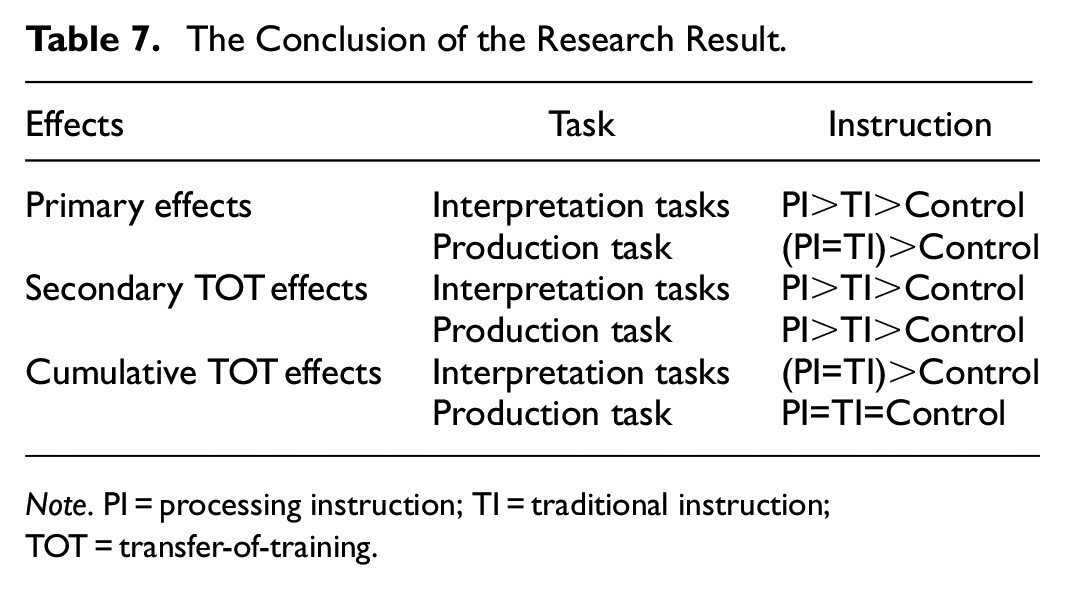
Note. PI = processing instruction; TI = traditional instruction; TOT = transfer-of-training.
Discussion
Before delving into the findings, it is evident that the results of this research align with VanPatten’s input processing (IP) model (VanPatten, 2002, 2014) and previous studies on PI (Benati, 2022a; Chiuchiù & Benati, 2020; Issa & Morgan-Short, 2019; Wong & Ito, 2018), demonstrating that PI assists learners in developing form-meaning connections as well as identifying, attending to, and processing cues in the input. The primary objectives of this study were to examine the effects of processing instruction (PI) and traditional instruction (TI) in terms of primary, secondary transfer-of-training (TOT), and cumulative TOT effects. As these three terms suggested that the primary effects on a linguistic form were those that result directly from instruction on that linguistic form. In contrast, the TOT effects were those that result indirectly from instruction on another form. The target language in this investigation was English, as acquired by EFL learners in China. In order to accomplish this, two out of the three classes received PI and TI interventions, totaling 2 hr of instruction, specifically focusing on the English third-person singular present tense as the primary target linguistic item. The secondary TOT target linguistic item was the simple past tense, and the cumulative TOT target linguistic item was the passive voice. The following mainly discusses how different teaching instruction affected primary, secondary TOT, and cumulative TOT effects.
Primary Effects of Processing Instruction
In terms of primary effects, this study compares two instructional approaches: PI and TI. The findings indicate that PI outperforms TI in the interpretation task and demonstrates a significant teaching effect compared to the control group. Learners tend to prioritize the meaning of temporal adverbials, leading to a weak connection between the third-person singular and the verb suffixes -s or -es. Through exposure to PI input, learners are encouraged to develop a strategy for establishing the link between form and meaning, enabling them to focus more on the verb suffix when encountering phrases in the general present tense, rather than the adverb of time. The TI group in this study shows significant improvement, contrary to some previous studies that reported only the PI group exhibiting a primary effect (Cheng, 1995; VanPatten & Cadierno, 1993). This could be attributed to Benati’s (2005) research that minimized the use of mechanical tasks in TI, the flexibility of TI drills proposed by VanPatten (2014), the suitability of multiple-choice and judgment questions for Grade 7 junior high school students, and the recognition of the target linguistic item. The acquisition by TI learners can be categorized as incidental, which may explain their increased scores following standard instruction. Although Chan’s (2018) study mainly focused on the English simple past tense, the grammar structure proved challenging for the participants as they were in Grade 2 of primary school. As for secondary TOT effects, the results were similar to those of primary effects.
Secondary Transfer-of-Training Effects of Processing Instruction
This study places emphasis on examining the secondary and cumulative transfer-of-training (TOT) effects of both processing instruction (PI) and traditional instruction (TI). Drawing from the input processing theory, learners who received PI treatment for the third-person singular present tense demonstrated the development of effective learning strategies that connect meaning with form. This proficiency in connecting form and meaning could be transferred to the acquisition of the simple past tense, as both tenses are influenced by the Primacy of Meaning Principle (P1). These findings align with previous research conducted by Benati and Lee (2008), VanPatten and Uludag (2011), and Ma (2017). Benati and Lee (2008) found that PI yielded greater secondary TOT effects than TI for interpretation and production tasks involving the transfer from the past tense to the third-person singular present tense. Ma (2017) observed significantly greater secondary TOT effects in the PI group compared to the control group for test tasks related to present participle to simple past tense conversion. VanPatten and Uludag (2011) also reported secondary TOT effects of PI in their study conducted in Turkey, indicating significant gains in all measures for the PI group compared to the control group.
Based on the current study, it can be inferred that PI generates significant secondary TOT effects for grammar points that are influenced by the same principle, such as the third-person singular present tense and the simple past tense. Through PI, EFL learners develop optimal processing strategies and internalize the connection between form and meaning, enabling them to recognize the simple past tense with its suffixes. The gains made by the PI group are maintained in the delayed posttest, indicating the long-lasting secondary TOT effects achieved by overcoming non-optimal strategies.
However, the secondary transfer-of-training (TOT) effects of both processing instruction (PI) and traditional instruction (TI) have received less attention in the existing literature, and the findings are not as consistent as those for the primary effects. Two possible explanations for this inconsistency could be the limited number of participants or insufficient time allocated for structured input activities. Benati and Lee (2008) discovered that both PI and TI exhibited secondary TOT effects in their study, specifically for interpretation and production tasks. Similarly, in the present study, both PI and TI demonstrated effects on the secondary TOT. These results may be attributed to the relatively small sample size (N = 30) in their study, which could have influenced the overall outcomes. Additionally, the limited inclusion of mechanical drills in the TI approach allowed learners to transfer the rules more flexibly, contributing to their observed effects. Besides, the cumulative TOT effects showed different results.
Cumulative Transfer-of-Training Effects of Processing Instruction
Regarding the cumulative transfer-of-training (TOT) effects, both processing instruction (PI) and traditional instruction (TI) demonstrated effects on comprehension in this study, with PI showing stronger effects compared to TI. However, when it came to production, detecting cumulative TOT effects was more challenging, particularly for the passive voice. The absence of obvious cumulative TOT impacts on production may be attributed to the inherent difficulty in producing passive voice structures. Additionally, the main target linguistic item (P1) and the cumulative TOT item (passive voice) might have influenced the production results of PI. Since passive voice was introduced in the Grade 9 textbook, students were not expected to have a deep understanding of it.
Similar to the secondary TOT effects, there were limited studies specifically focusing on cumulative TOT effects, and the findings varied across different research studies. For example, Benati and Lee (2008) investigated the cumulative TOT effects of Italian noun-adjective agreement to future tense and found that PI had cumulative TOT effects on both interpretation and production tasks, while TI had cumulative TOT effects only on production. However, when the groups switched to the production task for passive voice, they did not engage in any significant process. The time constraints in the study might have made it challenging to observe cumulative TOT effects on the production of passive voice. Another important factor to consider is the inclusion of the cumulative TOT effect test in the production task, which was not implemented in certain studies, such as White and DeMil’s (2013) investigation of cumulative TOT effects of PI from Spanish accusative to dative clitics, where the difficult grammar structure prevented the inclusion of a production task.
The Effectiveness of Processing Instruction
Even though the factors that may intrinsically affect the cumulative TOT effect are varied, such as the relationship between the two target language items and the learners’ ability to recognize and process them, Benati and Lee (2008) proposed that PI operates across various domains by transforming the way language learners process both input and output data. It guides learners in making connections between theory and practice in a different manner. In this study, PI was employed to introduce students to the definition and structure of words, enabling them to develop a deeper understanding of these lexical items. The teacher then taught the students the rules governing verb phrase changes and the final form, followed by integrating the words or phrases into sentences for students to establish connections. Through PI, students’ internal linguistic processes began to reorganize, which was reflected in their accurate use of verb forms. These findings indicate that PI plays a significant role in primary effects and secondary transfer-of-training (TOT) effects in second language acquisition (Benati, 2019).
Furthermore, the results support Benati and Lee’s (2008) Strengthening Hypothesis, which suggests that second language learners who receive various PI treatments targeting the same processing principle gradually reinforce their use of more effective processing strategies. However, in the case of traditional instruction (TI), simply presenting words to students is superficial, and students may struggle to comprehend the internal structural changes of words, thereby limiting its effectiveness compared to PI.
The presence of diverse participants, variations in sample sizes, and the complexity of transferring knowledge between grammatical structures can sometimes result in a lack of secondary transfer-of-training (TOT) effects in processing instruction (PI), although they are generally observed and make PI more effective than traditional instruction (TI) and control conditions. The presence of secondary TOT effects depends on factors such as the difficulty of the target linguistic structures, duration of treatment, and the cumulative nature of the goal structure. Therefore, this research does not provide a definitive conclusion regarding the cumulative TOT effect. While input processing theory provides valuable guidance for empirical research on PI, further investigation is necessary due to the various factors involved in the observed TOT effects of PI.
Conclusion
The aim of this study was to examine the primary and transfer-of-training (TOT) effects of processing instruction (PI) on English third-person singular present tense among Chinese junior high school students. Three research questions were formulated to thoroughly investigate the two TOT effects, resulting in the identification of three phenomena: (1) Both PI and TI demonstrated significant primary effects on the acquisition of the third-person present tense; (2) Both PI and TI exhibited secondary TOT effects, with PI demonstrating more pronounced effects in transferring knowledge from the third-person present tense to the simple present tense; (3) PI and TI showed limited cumulative TOT effects on the interpretation tasks related to passive voice, while cumulative TOT effects were observed from the third-person present tense to passive voice.
The experimental study conducted on the primary effects and transfer-of-training (TOT) effects (secondary and cumulative) of processing instruction (PI) and traditional instruction (TI) in grammar teaching has several pedagogical implications. PI, which aims to establish a connection between the form and meaning of the target grammar item by internalizing the processing program, may be an attractive approach for teachers when teaching grammatical structures. Furthermore, PI has the potential to facilitate Chinese EFL learners’ comprehension of different grammar points beyond what they have previously acquired, as evidenced by the cumulative TOT effects observed in this study.
Limitations
However, some limitations should be considered when interpreting the findings of this study. First, the sample size of 106 students was small compared to other studies, due to the small scale of the school being an affiliate of a university. If the volume of the sample is around at least 150 learners, the data analyses would be more evident in the aspect of statistics. Second, the instruction time of 2 hr for PI and TI respectively was short. Repeated practice and reinforcement are needed for the acquisition of grammar items from comprehension to production. Longer PI and TI instruction time could lead to better cumulative effects of PI or TI, with longer structured input activities of PI strengthening form and meaning linkage of grammar structure. Finally, due to objective factors, this study almost only focuses on the period from immediate posttest to delayed posttest and does not pay attention to the long-term primary effects and TOT effects of PI and TI, which are also seldom studied by scholars. Therefore, future studies could increase class size and instruction time. Besides, some qualitative elements such as interviews and questionnaires could be added to those quantitative studies. All in all, studies on the effects and the secondary and cumulative TOT effects of PI and TI have so many creative standpoints, and those assumptions could be verified in the future.
Pedagogical Implications
The present study has several pedagogical implications for grammar instruction. For instance, PI could be used in teaching grammar to help Chinese EFL learners master the target grammar structure firmly and profoundly. Teachers may be tempted to use PI in teaching grammar structures because PI aims to link the form and meaning of the target grammar item by internalizing the processing program. Furthermore, this study has found that PI has more significant secondary and cumulative TOT effects than TI. Based on this finding, PI is more beneficial for transferring between two similar grammar structures. Regarding cumulative TOT effects, PI could also help Chinese EFL learners comprehend different grammar points from what they have acquired.
In conclusion, further research should explore the effects and secondary and cumulative TOT effects of PI and TI from diverse perspectives. The assumptions and creative viewpoints presented in this study can serve as a basis for future investigations, which may help validate and expand our understanding of these instructional approaches in grammar instruction.
Footnotes
Declaration of Conflicting Interests
The author(s) declared no potential conflicts of interest with respect to the research, authorship, and/or publication of this article.
Funding
The author(s) received no financial support for the research, authorship, and/or publication of this article.
Ethical Approval and Informed Consent
This study was approved by Foreign Studies College Research Ethical Review Board of Hunan University. The participants were middle school students who were informed the consent before they participated in the experiment. Letter of Information and Consent Form include the following important information: the research purposes and procedures, what tasks or activities the subjects will be doing, benefits, risks, the opportunity to withdraw without penalty, the opportunity to ask questions, the amount of time required, and how confidentiality will be maintained, and the outcome of the study.

Data Availability Statement
The data that support the findings of this study are available from the corresponding author upon reasonable request.