




Abstract
Industry 4.0 is growing, and the strong economy is often accompanied by an integrated financial system. Now China is striving for the “double carbon” target and high-quality development so digital economy and green finance have become important strategies. Thus, this paper tries to construct a theoretical framework among them and uses various spatial measures and panel threshold techniques to analyze their relationship. The results demonstrate that: (1) Spatial correlation is an important and indispensable factor testified by the digital economy and green finance in the process of high-quality development. (2) The effect of digital economy differs from that of green finance on high-quality development. Moreover, the former outweighs the latter in China. The synergy between the two attributes more to economic development, indicating that the digital economy is beneficial for green finance. (3) The test of threshold effect shows that there is a threshold between digital economy and green finance, and only when the two match each other and develop coordinately can the effect on high-quality development be achieved better.
Plain language summary
This study explores the relationship among digital economy and green finance policies and China’s high-quality development. A multi-dimensional model is used to establish proxy indicators of the three variables, and SDM is used to test the correlation among them. In addition, we also use the threshold regression model to confirm the relationship between digital economy and green finance on economic development, and the significance of each stage of the threshold. The empirical results show that in China, digital economy is more positively associated with high-quality development than green finance. In the initial stage of developing green finance, the positive relationship between digital economy and high-quality development is not significant. With the increase of green finance index, especially when the development reaches a certain threshold, the positive relationship between digital economy and high-quality development becomes more and more significant, thus confirming the main-auxiliary relationship between the two for high-quality development. Also, through the test of direct and indirect effects, we find that the concentration effect of digital economy and green finance is relatively significant, and the spillover effect of policies needs to be further strengthened for the characteristics of China’s provinces and regions.
Keywords
Introduction
After global large-scale industrialization, the natural ecology deteriorates rapidly, and the climate change caused by it has aroused people’s serious concern repeatedly. According to the Statistical Yearbook of World Energy (70th edition) released by BP, in 2020, the carbon emissions in China will reach 9.899 billion tons, which will continue to be the peak in the world. The impact on the ecological environment brings great pressure to the Chinese government. At the 28th APEC Economic Leaders’ Meeting in November 2021 Chinese leaders emphasized that “China strives to achieve carbon peak before 2030 and become carbon neutral by 2060” (Guo, 2022, F. Shi et al., 2022). Therefore, China now faces two major challenges: rapid economic development and “double carbon” achievement.
With the rapid innovation of the Internet, Blockchain, AI and other technologies, digital economy is considered by many countries as the inevitable choice to promote economic growth and improve economic structure at present. Undoubtedly, digital economy has grown fastest in the world’s economy (Frolov & Lavrentyeva, 2019; X. Li, 2019). The digital age is rapidly emerging. During the construction of a modernized economic system, Chinese government attaches great importance to the digital economy which is considered as a new opportunity and a new approach. The 14th Five-Year Plan for the Development of Digital Economy issued by The State Council of China in January 2022 clearly points out that during this period, China’s digital economy will shift to a new level of deepening application, standardized development and universal benefit sharing. Despite the attempt to move towards green and high-quality development, China, as an emerging country, still faces the dilemma of insufficient capital supply and inefficient capital allocation. Therefore, the role of financial system construction should be treated essentially and seriously in the economy (Goldsmith, 1969; McKinnon, 1973; Shaw, 1973). In 2016, the People’s Bank of China as well as seven ministries and commissions released the “Guidance on Building a Green Financial System” where financial services are stated for project financing and operation & risk management in environmental fields including protection, energy conservation, green transportation and building. The Chinese government hopes to promote green finance construction because it has been a new driving force for the transformation of industrial structure and the guarantee of high-quality economy (D. M. Shi & Shi, 2022).
Since its introduction, the term “digital economy” has become the focal point of global attention (Song, 2019). However, the definition of digital economy in relevant studies is relatively scattered (C. Li, 2017). Currently, information and communication technology (ICT) has gradually penetrated into various fields of economy and society, it will soon become a strong driving force for the transforming and upgrading of industry, further optimizing the economic structure and accelerating the efficiency of economic operation (Mugabe et al., 2022). As the development in economy and society has changed significantly, ICT has become an emerging form and triggered a boom in the academic and practical circles (M. Xu et al., 2023). Generally, “green finance” is to guide financial institutions, enterprises and investors to jointly promote sustainable development and improve the ecological system through financial mechanisms (Fang, 2022), because the operational concept of “green finance” is that the financial industry should take environmental sustainability into consideration when conducting financing or issuing financial commodities, rather than just considering economic and financial industry growth factors. In other words, the factors such as potential external rewards, risks and costs related to the environment are all taken into consideration in decision-making (Y. Zhang, 2022).
In theory, the policies that promote digital economy and green finance seem to be conducive to high-quality development, but in reality, there are still obstacles such as the difference of the “digital gap” (Antonelli, 2003) and the ineffective effect of green finance (Gholipour et al., 2022). Especially, China is a large emerging economy, and the promotion of green technologies and environmental protection policies, ensuring their effectiveness, and promoting them across the country seems to be complex and difficult. In addition, when these policies are implemented in detail, there will be contradictions between ecological maintenance and economic development. Therefore, after the implementation of the policy, the development trend, as well as the relationship and role of each other will become interesting and worthy for further discussion.
Literature Review
This paper reviews the previous literature on digital economy, green finance and high-quality development from the following perspectives. At the beginning, from the perspective of digital economy and high-quality development, digital economy is regarded as the new and powerful driving force for contemporary economy. Therefore, the issues that whether it affects high-quality development and how does it drive the economy into high-quality route have become a hot topic for scholars, and there have been some studies on these issues from different perspectives. First it is related with the concept of New Development. Wan and Wang (2022) proposed that digital economy plays its leading role in “innovation, coordination, green, opening up, and sharing.” And then, for the perspective of macro and micro level, Jing and Sun (2019), Ding (2020), Ren (2020), T. Zhang et al. (2021), Y. Wang and Li (2023), and other scholars pointed out at the micro layer, digital economy can reduce the production costs and transaction costs of companies and achieve economies of scale and scope. At the mesoscopic level, digital technology promotes the balance between digital industrialization and industrial digitization through innovation, diffusion and development, and forms new models and new business forms. At the macro part, digital economy enhances high-quality economy through deepening capital, improving allocative efficiency and raising productivity. Furthermore, from the perspective of supply system, Goldfarb and Tucker (2019) and Song (2020) believed that digital economy benefits the reducing of costs and risks, maintaining stable economic operation and improving economic resource allocation. Finally, from the perspective of industry, Kuang and Peng (2020), B. Shi (2020), S. Li and Huang (2022), and other scholars proposed that digital economy realizes industrial expansion through digital industrialization, and enables real economy to foster high-quality economy through industrial digitalization. Y. Bai and Song (2021) and J. Chen (2023) discussed the impact of digital economy on high-quality economy from the aspects of production, distribution, exchange and consumption from the view of political economy.
In terms of empirical testing, most scholars start from a broad perspective, construct an index system for high-quality economy, and test the impact of digital economy on high-quality economy. Ning (2020) believed that digital economy promotes the power, efficiency and quality, and improves productivity. Thus, they conducted a study about the high-quality development in China’s provincial economy. Research shows that 1% increasing of digital economy can make high-quality development increase by 0.182%. T. Zhao et al. (2020) expanded the research sample to the city level, and the results indicate that digital economy also plays a significant role in urban economY. T. Zhang et al. (2021) conducted an empirical test of 30 provinces and cities in China by choosing economic structure and market system, total factor productivity and operational efficiency as variables, finding that digital economy can enhance high-quality development, whereas it will bring the unstability and unsustainability during the economic growth. In addition, Y. Zhang (2021) built a spatial econometric model and found that digital economy can significantly improve high-quality development not only in the local areas but also in the neighboring areas with positive spatial spillover. Some scholars have verified that technological innovation in digital economy can enable high-quality development by expanding the scale of technology market (W. Bai et al., 2022) and optimizing industrial structure (Liu & Wang, 2022). Scholars have also proposed that digital economy can not only boost the efficiency of the production end, but also stimulate the consumption expansion of the demand end, thus enhancing high-quality development (Yang, 2022).
Then, it is for the mechanism of digital economy on high-quality development, Ren (2020) points out that it is manifested in “Three major changes”: (1) to realize efficiency change by improving innovation ability; (2) to bring about dynamic change by creating new industries and empowering traditional ones; (3) to achieve quality change to guarantee the products and services. Around this framework, scholars have explored it from different perspectives. The main viewpoints include the following: First, innovation-driven. Min and Xu (2022) pointed out that digital economy mainly relies on product innovation, production method innovation, market innovation and organizational innovation to drive high-quality development. Song (2020) et al also assumed that digital economy will improve the economic development by stimulating regional technological innovation. Second, upgrading the industrial configuration. Y. Zhang et al. (2021) and X. Xu (2022) found that digital economy can foster the development of new industries, new business forms and new models during the upgrading of industrial structure and the realization of high-quality development. Third, productive factor allocation. Z. Li and Yang (2021) proposed that digital economy can drive high-quality development by improving the efficiency of factor matching. Fourth, degree of entrepreneurial activity. According to T. Zhao et al. (2020), digital economy is conducive to cultivating more entrepreneurial opportunities, enriching entrepreneurial resources, and stimulating entrepreneurial activity, thus exerting a positive impact on high-quality development.
Finally, as for the correlation between green finance and high-quality development, Ewa and Johannes (2021) believed that it should be considered from a broad global perspective, while most scholars believe that it starts from the study of financial influence on economic changes. In particular, a modern financial system is essential for economic growth (Goldsmith, 1969; McKinnon, 1973; Shaw, 1973). Scholtens and Dam (2007), Peng et al. (2019), and H. Li and Liu (2019) indicate that green finance is beneficial for environmental pollution and greenhouse effect, and thus promote the economic, social and environmental development in a sustainable way. Gantman and Dabos (2012) and Qiu (2017) demonstrated how green finance may boost green investment for environmental protection, encourage scientific and technological innovation, and thereby enhance regional environmental quality. Omri et al. (2015) and F. Wang et al. (2021) pointed out clearly that regional environmental quality is significantly influenced by green financing, and that environmental quality is inversely correlated with financial development. Therefore, Salazar (1998) and Madjid and Samsudin (2021) assumed that green finance is the conjunction between green industry and financial industry in the highly-dependent resource areas.
Additionally, many academics think that green financing can stimulate economic growth. Beck and Levine (2004), Aghion et al. (2005), J. Zhang and Jin (2005), and Feng et al. (2017) show that green finance can optimize the supply of production factors and have an impact on economic development in the region. Z. Chen et al. (2018) indicated that industrial structure upgrading due to green finance can achieve high-quality development in western China. Zhou et al. (2020) shows that different levels of economic development will have different effects of green finance on environmental quality, but green finance has the potential to significantly enhance this relationship and produce a situation where both the environment and economic development benefit. Z. Wang and Wang (2020) believed that green finance can serve as a roadmap for improving industrial structure, fostering coordinated regional economic and environmental growth, and serving as a crucial means of directing high-quality development. In terms of empirical research, P. Yu and Zhang (2021) calculated the correlation between green finance and high-quality development, and believed that green finance has a threshold effect on high-quality development, beyond which green finance could significantly promote economic development. Dong and Fu (2018) analyzed the highly coordinated and coupled state of green finance and green economy by employing the coupling degree model, and compared the spatial regional differences. G. Chen and Long (2018) empirically analyzed the correlation between provincial green finance and industrial structure upgrading in China by using gray relation analysis model, as well as suggestions on provincial industrial structure adjustment. Some scholars also conducted empirical tests on the basis of analyzing the influence mechanism. An (2021) showed the existing problems of China’s green finance system from the aspect of carbon neutrality, and discussed the innovation path of the green finance system in combination with the actual situation. F. Zhang et al. (2020) pointed out that financial institutions optimize resource allocation by controlling the delivery of green financial products through the intermediary effect and moderate effect model, which has an important impact on promoting high-quality development.
However, there are also some different arguments in the process of industrialization of digital economy, such as the economic differentiation caused by the development of regional or global “digital gap” (Antonelli, 2003), as well as the problems of wealth inequality and information insecurity caused by the monopoly of digital platforms (Burguet et al., 2015; Y. M. Chen, 2020). Green finance has become an important factor affecting the environment, and it is generally believed that it is positively correlated with environmental quality (Omri et al., 2015). In the empirical study it is found that green finance only reduces the amount of environmental pollutants to mitigate the impact of climate change without realizing all the expected effects (Gholipour et al., 2022; L. Jiang et al., 2020; X. Zhao et al., 2022). In addition, numerous findings have been reported by academics on digital economy, green finance and high-quality development, but few of them have been about unified analytical framework among digital economy, green finance and high-quality development. Furthermore, the synergistic impact and intrinsic correlation between digital economy and green finance on high-quality development have not been explored, and the consensus regarding the environmental and economic effects of green finance have not been formed. Hence, this paper tries to seek out in the following four aspects: (1) To enhance the literature on digital finance and green finance by identifying conceptually the mechanism of the digital economy, green finance, and their synergistic effects on high-quality development. (2) To investigate specifically how the synergistic effects of the digital economy and green finance affect the high-quality development of the region in the context of the current situation where the Chinese government strongly supports green finance and to add to the body of knowledge on the subject. (3) To construct the index system of high-quality development, digital economy, green finance and other development levels of Chinese provinces (municipalities) by comprehensive evaluation method and entropy method and other multidimensional weighting methods. (4) To examine the spillover effects of digital economy and green finance on high-quality development in 31 provinces and cities in China. (5) To examine the interaction between digital economy and green finance when they are the threshold of each other.
The above research serves as a foundation for government departments to formulate green finance policies that are appropriate to digital economy. The research of this paper is organized as follows: the theoretical mechanism and research hypotheses are presented in Section “Theoretical Mechanism and Research Hypotheses.” Followed by it, it is the methodology and empirical analysis in Section “Methodology” and in Section “Empirical Demonstration of Spatial Econometric Model” respectively, and finally, Section “Conclusions and Policy Implications” is the conclusions and policy implication.
Theoretical Mechanism and Research Hypotheses
The Impact of Digital Economy on High-Quality Development Efficiency
The connotation of high-quality development is fruitful and highly consistent with China’s five new development concepts—innovations, coordination, green development, opening up, and sharing (Ren, 2020). The digital economy contributes to the realization of the five concepts in the following aspects: (1) improve innovation to promote economic development. The industrial chain created by digital economy needs the highly proficient knowledge with strong innovation attributes. Besides, the transformation and the high permeability of digital technology on traditional industries is reflected in the application of new technologies, and new products, thus enhancing total factor productivity (Wen et al., 2019); (2) strengthen coordination to help regional development. Digital economy can contribute to social employment through making the industrial pie bigger. Meanwhile, digital technology can reduce transaction costs, increase the effectiveness of resource allocation and fully utilize each region’s comparative advantages to stimulate the long-term development in less developed regions and to achieve the common development; (3) promote ecological protection and consolidate green development. Due to the digital economy, on the one hand, the space of traditional high-pollution industries is squeezed, reducing environmental pressure; on the other hand, the efficiency of resource utilization is enhanced through digital technology to reduce waste and pollution, thus improving the ecological environment (H. Jiang & Jiang, 2022); (4) reduce time and space barriers to promote opening-up. As an important carrier for digital economy, e-commerce platform promotes cross-border business transactions of digital technology and equipment in-depth. It can also strengthen economic, trade and cultural exchanges among countries and become a new and powerful driver of opening-up and communication; (5) promote linking and sharing to achieve common prosperity. Through platform communication and point-to-point linking, digital economy greatly improves the supply efficiency and demand matching in global economies. In addition to the expansion of effective demand, digital economy also actively guarantees sufficient and diverse supply. Moreover, the increasingly powerful searching and matching technology will effectively expand the economic scope and efficiency, meet the needs of all types of consumer groups, and is also a powerful tool to solve the contradiction between supply and demand (Xia & Liu, 2021). Therefore, related with the findings of Ning (2020), T. Zhao et al. (2020), and T. Zhang et al. (2021), Hypothesis 1 of this paper is proposed.
Hypothesis 1: Digital economy is positively correlated with high-quality development.
The Impact of Green Finance on High-Quality Development Efficiency
Green finance is derived from the traditional financial theory to solve the problems such as environmental constraints in the face of economic development (Salazar, 1998). As for the connotation scope of green finance, there is no definite definition in the academic circle. The main ideas fall into three categories: (1) A preferential policies in the financial realm to green environmental preservation projects in the financing process (Gao, 1998); (2) A financial operation strategy that guides the direction of social resources through the operation of financial business for environmental protection and sustainable economic development (Q. He, 2021); (3) A process of applying the results to financial resource allocation and financial activity evaluation by measuring environmental or economic value (X. Li et al., 2007). In August 2016, the definition of green finance is put forward for the first time in the “Guiding Opinions on Building a Green Financial System” released by the People’s Bank of China, the Ministry of Finance, the Ministry of Environmental Protection and other seven ministries and commissions. “Green finance refers to the financial services provided for project financing, project operation and risk management in the fields of environmental protection, energy conservation, clean energy, green transportation and green building in order to support economic activities of environmental improvement, climate change response and efficient use of resources.” Therefore, green finance in China is to serve financial institutions, enterprises and investors jointly on the purpose of sustainable economic and social development through financial mechanisms. The People’s Bank of China has committed to accelerating the construction of a sustainable financial ecosystem and listed green finance as one of its priorities. China needs a lot of investment in the process of achieving carbon neutrality, which will support green investment and financing activities through financial marketization. In addition, China is also working with the European Union to promote international standards for green classification and improve China’s green finance standard system. Specific measures have been introduced to encourage financial institutions for carbon emission reduction such as the establishment of pilot banks in all financial institutions, the establishment of a comprehensive mandatory information disclosure system, the announcement of the flow of green credit-related funds, preferential interest rates and special green re-loans.
Based on the above literature and the findings of Zhou et al. (2020), P. Yu and Zhang (2021), and An (2021), Hypothesis 2 of this paper is as followed.
Hypothesis 2: Strengthening green finance can significantly promote high-quality development
Digital Economy, Green Finance, and High-Quality Development Efficiency
In recent years, the digital economy with the high-quality development has shifted the traditional economy to modern economy. Digital economy with high technology, high integration and high potential plays a core role in improving environmental development (X. Wang et al., 2022). Therefore, the digital economy not only fully fosters the economy but also makes the coordinated development of economic and environmental development possible. Given the relevant data of “Greening China’s Financial System” from 2015 to 2020, China will contribute 17.4 trillion yuan to the growth of green finance, about 2.9 trillion yuan per year on average, which also shows that the amount of funds invested in green finance accounts for over 14% of national fiscal revenue. The Chinese government hopes to lead the flow of capital through a series of green finance policies for high-quality development, and improve the ecological environment by perfecting financial institutions and enterprises. The development of green finance and digital economy also requires all-round coordination and cooperation of all regions, which promotes the connotation, inclusiveness and sharing necessary for high-quality development, Hence, Hypothesis 3 is presented below.
Hypothesis 3: The synergistic effect of digital economy and green finance can significantly promote high-quality development.
Methodology
Variable Measurement and Description
Explained Variables
Combining with the theoretical connotation of high-quality development and the existing research findings (Ma et al., 2019; Tang et al., 2020), this study constructs an evaluation index system of high-quality development from five dimensions: economic operation, development efficiency, coordinated development, social sharing service, and opening up, with a total of 24 indicators (see Table 1).
Evaluation System of High-Quality Development in China.

Explanatory Variables
There are two explanatory variables, that is, digital economy and green finance. For digital economy, the index selection of existing literature is mainly adopted (W. Zhong & Zheng, 2021). Relevant digital economy indexes issued by authoritative institutions such as the National Bureau of Statistics and the China Academy of Information and Communication Technology are adopted. Eleven indicators were selected from the three dimensions of digital infrastructure, digital industry development and digital technology upgrade to evaluate the development level of digital economy (see Table 2). After the standardization of index data, the entropy method is used to weight and count the data of digital economy (DE).
Evaluation System of Digital Economy in China.

Green finance mainly includes four dimensions: Green Bonds, Green Securities, Green Insurance, and Green investment (B. Yu & Fan, 2022), among which green credit is currently the most crucial component. Due to the short periods of green finance in China, immature rules and regulations, and scattered or missing data related to Green Bonds and Green Funds, the available statistical data period is short, so it is limited to obtain multi-dimensional indicators to accurately calculate the green finance development index. This paper refers to the research design of Zeng et al. (2014) and L. He et al. (2019). At the same time, considering the availability and validity of data, the weight is determined by combining subjective and objective methods, and the designed dimensions and index system are shown in Table 3.
Evaluation System of Green Finance in China.
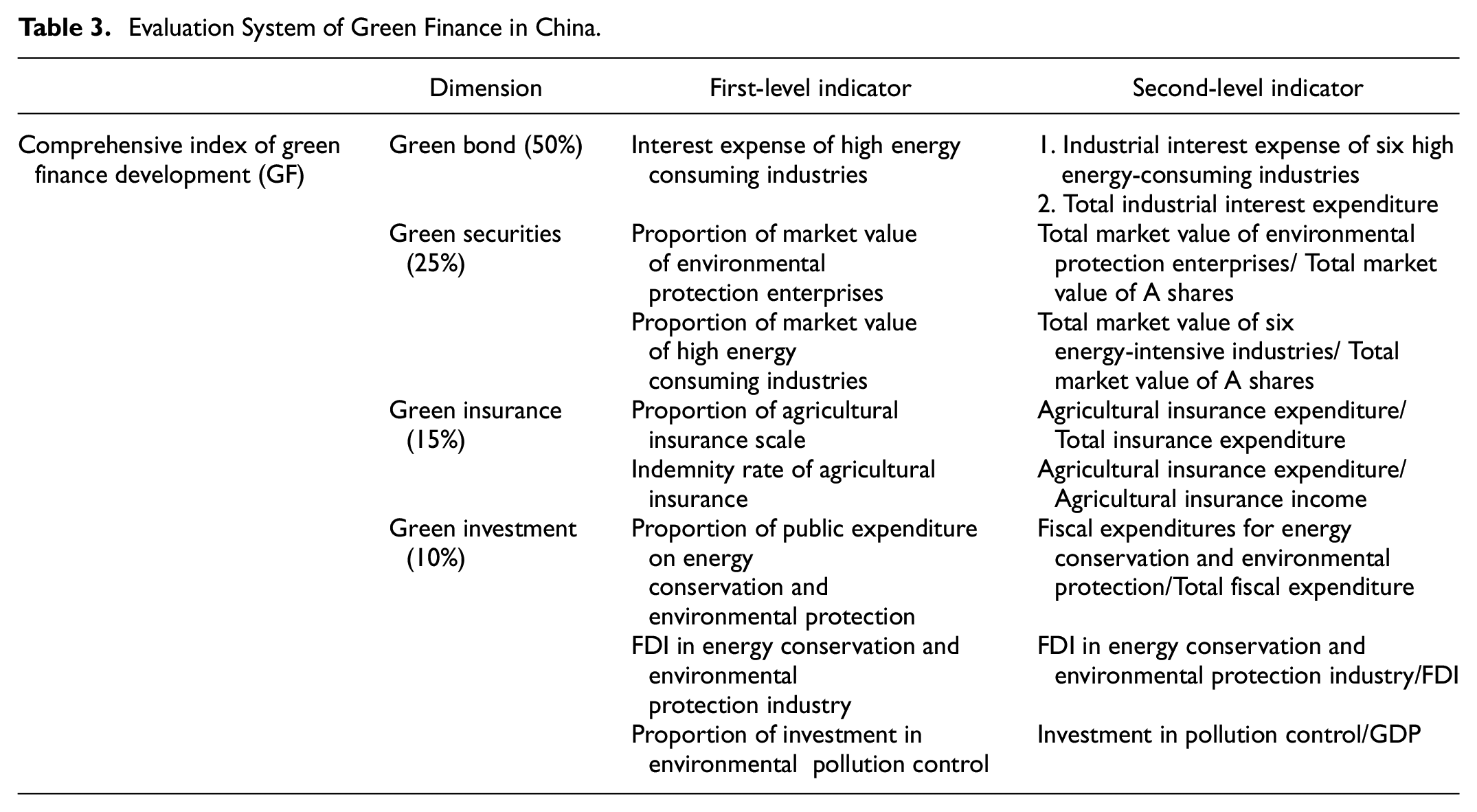
Each first-level indicator is equal to the arithmetic average of its corresponding second-level indicator, and then the data of green finance (GF) is calculated according to the weights of each component.
Control Variables
Referring to control variables in existing studies (T. Zhao et al., 2020; W. Zhong et al., 2022), this paper chooses the following control variables. Regional economic development level (ED) is measured by regional GDP per capita; The level of human capital (HC) is measured by the per capita years of education in each region; Urbanization level (LU) is measured by the percentage of urban population in the total population; The degree of openness to the outside world (FDI) is expressed by the percentage of foreign direct investment in GDP.
Data Source and Description
The research sample is from 31 municipalities and autonomous regions in total in China (except Taiwan, Hong Kong and Macao). The panel data comes from China Statistical Yearbook, EPS Global Database, China Economic Network Database, and Wind Database from 2009 to 2020.
Construction of Spatial Econometric Model
Selection and Setting of Spatial Econometric Model
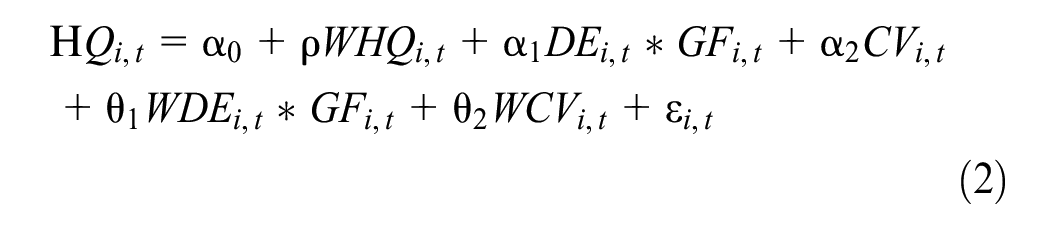
The spatial Durbin model (SDM) further extends the spatial autoregressive model (SAR) and spatial error model (SEM) by considering the spatial impact of random shocks (Lesage & Pace, 2009). Therefore, on the basis of the SDM model, this paper constructs a model to investigate the independent and synergistic effects of digital economy and green finance on high-quality development.

Panel Threshold Model Setting
Digital economy affects green finance, vice versa, and the effect of the two on high-quality development may have a “threshold” effect due to the mismatch. In this paper, digital economy and green finance are used as threshold variables to further establish a panel threshold model, and the equation is as follows:


Empirical Demonstration of Spatial Econometric Model
Spatial Correlation Analysis
Moran’s I is used to investigate the spatial correlation among variables. During the sample period, most of the Moran’s I values of core variables are significantly positive, indicating that there is a non-negligible spatial correlation among digital economy, green finance and high-quality development of provinces and regions in China, and it also proves that the spatial econometric analysis method is appropriate.
Independent Effect Analysis of Digital Economy and Green Finance
This paper estimates the three spatial panel models, including SAR, SEM and SDM, to verify whether they have robust empirical results. Then, according to the judgment of Wald test and R2 value, it is found that SDM model is the best from the aspect of fitting effect, so the subsequent synergistic effect is mainly analyzed by SDM model.
Table 4 shows the positive effects of digital economy and green finance on high-quality development under the two weight matrices, and the effect of digital economy is significantly higher than that of green finance. It shows that digital economy is the strong driving force for high-quality development and potential room for green finance. The coefficient of the spatial lag term is significantly positive in the three models, and the coefficient in the economic distance matrix is greater than that in the geographical distance matrix, indicating that the similarity of economic development level can promote the interaction between regional economic developments, and then realize spatial agglomeration. Thus Hypotheses 1 and 2 are verified. In terms of control variables, both the level of economic development and the level of human capital are positively correlated with high-quality development, but they are not significant, indicating that economic development and human capital training cannot effectively promote high-quality development. The level of urbanization and the degree of opening to the outside world are negatively correlated with high-quality development, but not significantly. The reason may be that the growth of foreign investment forms a certain technological dependence, which hinders the improvement of local innovation capacity.
Test Results of the Independent Effect of Digital Economy and Green Finance.

Source. The authors.
**, and * denote that the t-statistics are statistically significant at 1%, 5%, and 10% respectively.
Analysis of the Synergistic Effect of Digital Economy and Green Finance
The interaction term of digital economy and green finance is served as the synergistic effect of the two on high-quality development. According to the Hausman and Wald tests, it is suitable to adopt the fixed effect form of SDM model (see Table 5 for regression results).
Test Results of the Synergistic Effect of Digital Economy and Green Finance.

Source. The authors.
**, and * denote that the t-statistics are statistically significant at 1%, 5%, and 10% respectively.
From the synergistic effect test, the synergistic effect is significantly higher than the independent effect under the three different spatial econometric models test. It further shows that there is a benign cooperative relationship between digital economy and green finance, and the effect of digital economy or green finance on high-quality development is not as great as the synergistic effect of the two. This also verifies Hypothesis 3.
Robust Test
The empirical robustness is tested in the following four ways. (1) Replace digital economy variables. Referring to Ge and Wu (2021) and X. Li et al. (2022), this paper uses entropy weight TOPSIS method to measure the digital economy from development environment, industrial digitalization, digital industrialization and digital governance, and carries out regression again. (2) Replace the green finance variable. Since China’s green finance was formally proposed in the Guidance on Building a Green Finance System in 2016, this paper adjusted the research interval to 2016–2020 for regression. (3) Replace the explained variable. The mechanism test of this paper shows that the collaborative operation of digital economy and green finance can enhance high-quality development, but it takes time for the spatial diffusion and the generation of benefits of both, so the generation of effects may have a certain time lag. This paper adopts the model of high-quality development variables ahead of one period, and conducts the regression again. (4) Endogeneity considerations. Considering the possible endogeneity problems in the regression model, this paper adopts the conventional practice of empirical research and uses the one-period lag of the dependent variable as the instrumental variable to run the regression again (see Table 6 for regression results).
Regression Results of Robust Test.

Source. The authors.
**, and * denote that the t-statistics are statistically significant at 1%, 5%, and 10% respectively.
It can be seen from Table 6 that except for the differences in coefficient size and significance degree, the relationships among variables and their influence trends are generally the same.
Spatial Correlation Decomposition Test of Independent Effect and Synergistic Effect
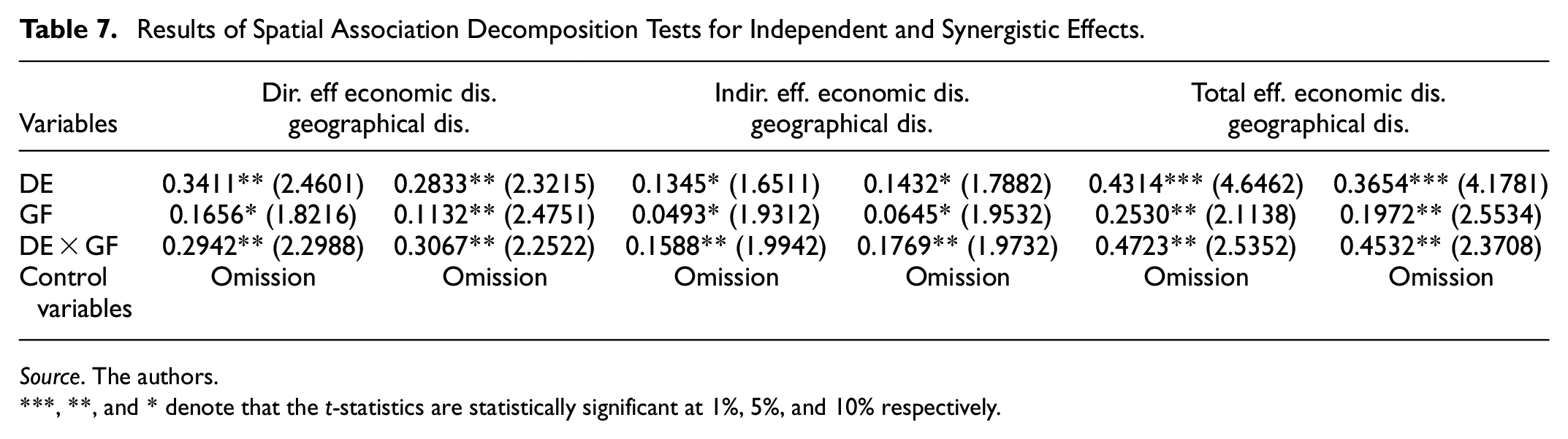
Based on the SDM model, this paper disaggregates the total spatial effect into direct effect and indirect effect, in which the direct effect is viewed as the influence of explanatory variables on the local area, the indirect effect is the influence on other areas, and the total effect is consisted of direct effect and indirect effect. Measuring the average impact of variables across all regions (see Table 7), the regression results show that, regarding independent effects, the three spatial effects of digital economy and green finance are significantly positive, and the direct effects were greater than the indirect effects. The impact of the digital economy is far greater than that of green financing, demonstrating that it has a larger influence on the high-quality development. Meanwhile, the spilt effect needs to be improved owing to the concentration of digital economy and green finance on the local area. For synergistic effect, the three spatial effects were greatly improved, significantly greater than the influence of independent effect, and the influence under the economic distance matrix accounted for the main part. These findings reveal that the synergy of digital economy and green finance is a more effective path for high-quality development in the future.
Results of Spatial Association Decomposition Tests for Independent and Synergistic Effects.
Source. The authors.
**, and * denote that the t-statistics are statistically significant at 1%, 5%, and 10% respectively.
Empirical Analysis of the Panel Threshold Model
To further explore the interaction between digital economy and green finance on high-quality development, this paper takes digital economy and green finance as threshold variables by the panel threshold model (see Table 8).
Results of Threshold Effect Tests.

Source: The authors.
and * denote that the t-statistics are statistically significant 5%, 10%, and 10% respectively.
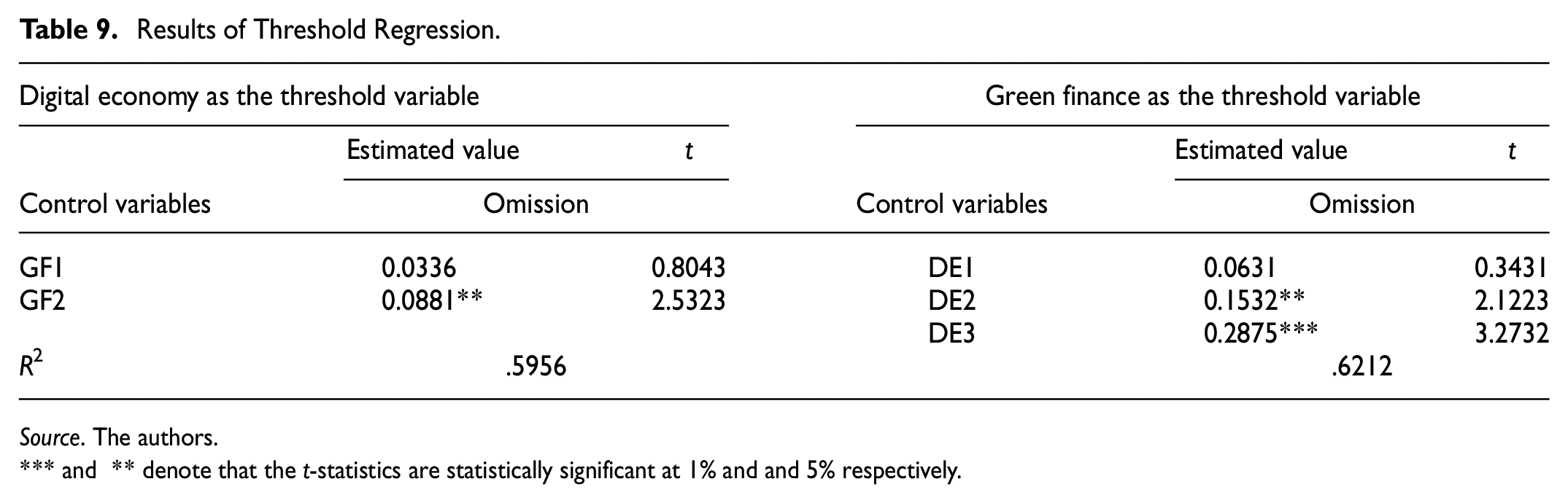
The results show that when green finance is the threshold variable, the digital economy has a double threshold effect with the threshold values 0.7673 and 1.5388 respectively. When taking digital economy as the threshold variable, green finance has a single threshold effect with threshold value 0.6143.
Except the threshold effect test, this paper continues the regression analysis. The threshold regression results of digital economy are presented below (see Table 9). Green finance has contributed significantly to the high-quality growth of the economy with the continuous development of digital economy, which shows that digital economy is an essential factor to release the dividend of green finance. The threshold regression results of green finance show that when green finance is less than 0.7673, the impact of digital economy on high-quality development is positive, but not significant, because this stage is the most initial innovation or imitation. When innovation is in the second stage (between 0.7673 and 1.5388), the effect of digital economy on high-quality development is significantly positive. When green finance continues to improve (greater than 1.5388), it represents the stage when green finance becomes the main financial instruments of enterprises, with the characteristics of maximum creativity and highest economic benefits, and digital economy has a significant role in promoting high-quality development.
Results of Threshold Regression.
Source. The authors.
and ** denote that the t-statistics are statistically significant at 1% and and 5% respectively.
The threshold regression demonstrates that two variables are mutually conditional. Only by accelerating digital economy can green finance better promote high-quality development. On the contrary, digital economy needs the support of green finance to become a new driving force for high-quality development.
Conclusions and Policy Implications
Conclusion
This study explores the relationship among digital economy and green finance policies and high-quality development. As China’s economic development needs the expansion of energy, it increases CO2 emissions, which seriously damages its ecological environment. The Chinese government and leaders not only stimulate the innovation of digital technology and the diffusion of digital economic benefits to achieve the two-carbon goal but also promote green finance policies to help the expansion of the digital economy. But with China’s large population and vast territory, there exists Digital Gap. Moreover, the promotion of green finance policies and the performance of practical results are not ideal without obstacles.
In this study, a multi-dimensional model is used to establish proxy indicators of the three variables, and SDM is used to test the correlation among them. In addition, we also use the threshold regression model to confirm the relationship between digital economy and green finance on economic development, and the significance of each stage of the threshold. The empirical results show that in China, digital economy is more positively associated with high-quality development than green finance. In the initial stage of developing green finance, the positive relationship between digital economy and high-quality development is not significant. With the increase of green finance index, especially when the development reaches a certain threshold, the positive relationship between digital economy and high-quality development becomes more and more significant, thus confirming the main-auxiliary relationship between the two for high-quality development. Also, through the test of direct and indirect effects, we find that the concentration effect of digital economy and green finance is relatively significant, and the spillover effect of policies needs to be further strengthened for the characteristics of China’s provinces and regions.
Policy Implication
The study shows that even though the digital economy is an important channel for China to move towards high-quality development, yet green finance is also indispensable. The current findings have important implications for large, developing countries such as China. As these countries actively pursue economic development, most of them are under pressure from high energy consumption and high environmental costs. The Chinese government and leaders are aware of the threat posed by industrialization to the environment, so we recommend that the government should more actively support and commit to innovation related to renewable energy technologies and encouragement of private companies and households through financial incentives to adopt renewable energy technologies as soon as possible. Green finance policies should also be strengthened to support these innovations. In addition, China’s current high-quality development shows a phenomenon of “concentration,” especially in the promotion of digital economy and green finance. This may be due to China’s simultaneous “urbanization” policy. Therefore, the effects of “spillover” and diffusion of policy are still expected. On one hand, the government should vigorously promote the application of financial technology, so that remote areas can also enjoy financial inclusion. On the other hand, the government should be more open to accept financial innovation and spread green benefits across the country more quickly by supporting the development of green finance, which will contribute to China’s high-quality development.
Limitations and Future Research Directions
The scope of this study is limited to the impact of digital economy and green finance on China’s high-quality development. However, it has been observed that too many regulations are not conducive to the spread of financial benefits. In China, green finance needs some important changes of economic structure to play a more effective role in the digital economy. In addition, a more comprehensive approach is needed to study the dynamic development of green finance in large developing countries. The proxy indicator system and the linkage among variables in this study can be used as a reference for empirical testing of other countries and regions, which will extend our findings.
Footnotes
Declaration of Conflicting Interests
The author(s) declared no potential conflicts of interest with respect to the research, authorship, and/or publication of this article.
Funding
The author(s) received no financial support for the research, authorship, and/or publication of this article.

Data Availability Statement
The data that support the findings of this study are available from the corresponding author upon reasonable request.