



Abstract
The influential roles of supervisor’s leadership in the context of a small store are not studied and it is unclear how it affects the attitudinal and behavioral outcomes of frontline service employees. Drawing on the social exchange theory, the purpose of this study is three folds. First, this study aims to examine the role of supervisors’ authentic leadership and supervisor ostracism on frontline service employees’ perceived supervisor trust. Second, this study investigates the effects of frontline service employees’ perceived supervisor trust on commitment to customer services and store affective commitment. Finally, the positive role of store affective commitment on frontline service employees’ commitment to customer services is examined. A survey-based was used to collect 203 responses from frontline service employees of coffee shops in Korea. Covariance-based structural equation modeling (CB-SEM) was conducted to test the hypotheses. The results indicated that a supervisor’s authentic leadership is positively whereas supervisor ostracism is negatively associated with supervisor trust. Similarly, supervisor trust has a significant positive effect on the frontline service employee’s commitment to customer services and store affective commitment. Finally, frontline service employees’ store affective commitment has a significant positive effect on the commitment to customer services. This research offers practical implications for managers of frontline service employees, particularly in the selection, training, promotion, and socialization process of supervisors of small stores in general and in coffee shops in particular. Practitioners interested to increase frontline service employees’ commitment to customer services and store affective commitment can leverage the findings of this study.
Keywords
Introduction
The researchers and practitioners have recognized the significance of frontline service employees in performing a diverse range of core service activities in the service industry (Chien et al., 2021; Huang & Lin, 2020; Potdar et al., 2021; Subramony et al., 2021; van Esch et al., 2020). As a result, a rapidly growing body of research has looked into the roles of different organizational, contextual, and individual factors that both directly and indirectly impact the attitudes and behaviors of front-line service employees (Alexandrov et al., 2007; Chiang et al., 2014; Karatepe & Karadas, 2015). Supervisors are key social resources in the working places who influence the job-related outcomes of employees. In the extant literature, there are two main streams of the body of studies on the roles of supervisors. First, studies have shown that supervisors positively influence frontline employees’ job outcomes (Afzal et al., 2019; Boukis et al., 2020; Van Jaarsveld et al., 2021). The second body of knowledge discusses the negative roles of supervisor leadership on the behavioral outcomes of employees (Al-Hawari et al., 2020; Jawahar & Schreurs, 2018; Taylor et al., 2012). However, a close evaluation of these previous studies has shown that researchers have extensively discussed the role of the supervisor from the perspective of larger and high-end companies (5-star Hotels) and overlooked examining the roles of the supervisor in the context of small stores.
Since small and medium enterprises are becoming backbones of the all modern economies. Rowinski (2022) states that small businesses are contributing a lot to driving the American economy and these businesses make up 99.9% of all the businesses in the United States of America. Rowinski (2022) further argued that small businesses create more jobs (62% of total jobs from 1995 to 2000) than larger enterprises. Similarly, in Korea too, these small and medium enterprises are major contributors to the Korean economy. The latest report from the Korean Ministry of SMEs and Startups (2024) showed that small businesses accounted for 99% of total enterprises, 81% of employment creation, and 39% of exports. In particular, small stores accounted for 25% of small and medium enterprises and places Korea at number 6 on the list of Organisation for Economic Co-operation and Development (OECD) countries. Especially, in Korea, the proportion of small stores in the service industry such as restaurants and cafes, is substantially high. According to the Act of small Enterprises of Korea, a small store is a store that employs less than 10 people (Basic Act on Small Enterprises, 2021). Specifically, small stores have a relatively smaller number of people employed at the same time (1–9), and the relationship between leaders and subordinate play important role in the success of the business (Balwant et al., 2020; Putra & Cho, 2019). However, there is limited understanding of the supervisor’s leadership roles in the job-related outcomes of frontline service employees of small stores. Therefore, a study is needed to examine the supervisor’s leadership for frontline employees in small stores. Specifically, it is pertinent to look at how supervisors’ leadership affects the attitudinal and behavioral outcomes of frontline service employees of small stores.
Authentic leadership is one of the most crucial forms of leadership that determines the attitude, intention, and behavior of the employees in the best possible ways. Previously, authentic leadership is extensively studied and researchers found a positive effect on work engagement (Wei et al., 2018), affective commitment (Ribeiro et al., 2018), and employee performance (Nasab & Afshari, 2019). However, the mainstream body of literature on authentic leadership is silent about the role of a supervisor’s authentic leadership on the attitudinal outcomes such as perceived supervisor trust of frontline service employees of small stores.
Likewise, in same way, the negative way of supervisor leadership such as supervisor ostracism is also not being examined in the context of frontline service employees of small stores. As important sources of social influence, supervisors not only provide important emotional and instrumental support to reduce the work-related stresses of subordinates but also become stressors that increase negative work-related outcomes (Potipiroon & Ford, 2019). Prior literature has examined the role of supervisor ostracism on employees’ performance (Choi, 2020), employees’ job embeddedness (Lyu & Zhu, 2019), organization perception, and turnover intention (Howard et al., 2020). However, a study to investigate the role of supervisor ostracism on frontline service employees’ attitudes and behavior in general and frontline employees of small stores, in particular, was not discussed to date. Therefore, there is a need for a study that investigates the effect of supervisor ostracism on frontline service employees’ attitudinal and behavioral outcomes.
Prior literature has extensively discussed the role of perceived supervisor trust on positive outcomes such as job engagement (Basit, 2017), job embeddedness (Afsar et al., 2018), innovative work behavior (Bak, 2020), performance (Neves & Caetano, 2006), and commitment to supervisor (2018). In line with these aforementioned studies, this study investigates the effects of supervisor trust on the frontline service employees’ store affective commitment and commitment to customer services. Despite the theoretical and managerial significance, the concept of frontline service employees’ commitment to customer service has not received substantial attention as a behavioral outcome. Jeon (2016) has argued that “frontline service employees’ commitment to customer service ‘makes or breaks’ service businesses in the contemporary environment of fierce competition” (Jeon, 2016, p. 351). Therefore, this study will advance the understanding of the frontline service employees’ commitment to customer services by examining the roles of frontline service employees’ perceived supervisor trust and store affective commitment.
The present study examines the positive and negative influences of supervisor leadership on frontline service employees of small stores and offers three theoretical contributions to the literature. First, this research extends the literature on supervisor authentic leadership by examining its role in building supervisor trust of frontline service employees in small stores. Second, this study investigates the role of supervisor ostracism on the perceived supervisor trust of frontline service employees of small stores. Third, this study advances the literature by investigating the role of perceived supervisor trust on store commitment and frontline service employees’ commitment to customer service. Managerially, the results of the study offer crucial information for practitioners to comprehend the significance of supervisors’ leadership in the trust building of frontline service employees of small stores which will assist in the selection, training, promotion, and socialization process of supervisors in the service industry in general and small stores in particular.
The study is organized as follows. Section 2 offers a comprehensive literature review of the major constructs of the study. Section 3 discusses the hypotheses development. Section 4 is about the method of the study. Section 5 discusses the results of the study. Finally, section 6 is about the comprehensive discussion on the theoretical, managerial implications, and limitations of the study.
Literature Review
Social Exchange Theory
Social exchange theory is a highly influential perspective in organizational research that suggests that interpersonal interactions are guided by the norm of reciprocity. This theory was proposed by Blau in 1964. Specifically, the reciprocity norm refers that when the supervisor or managers treat their subordinates favorably then subordinates reciprocate with favorable treatment (Cropanzano & Mitchell, 2005). In other words, social exchange theory argues that individuals will typically respond positively to positive actions, and negatively to negative actions. Based on the types of interpersonal social exchange, the prior literature is categorized into two main streams.
First, the researchers have adapted social exchange theory to explain the reciprocity norm in the context of positive interpersonal exchanges (Jawahar & Schreurs, 2018; Qiu et al., 2019). Second, few researchers have discussed negative social exchanges or negative reciprocity. The later studies focused that when subordinates perceive negative unfavorable treatment from supervisors and coworkers then they reciprocate negatively (Khalid et al., 2018; Shaffakat et al., 2022; Taylor et al., 2012). For example, based on the negative reciprocity, Khalid et al. (2018) have argued that when employees perceive that their supervisor is mistreating them with incivility then they do knowledge hiding which has a negative outcome for the organization. In line with the positive and negative reciprocity in interpersonal social exchange, this study will explore the significance of a supervisor’s authentic leadership and supervisor’s ostracism for frontline employees’ perceived supervisor trust of small stores.
Supervisor Authentic Leadership
Over the past several years, researchers have extensively explored the intersection of leadership, ethics, and positive organizational behaviors (Avolio et al., 2004; Walumbwa et al., 2008). Authentic leadership exemplifies the best convergence of leadership, ethics, and positive organizational behavior and has attracted substantial interest from researchers and practitioners (Avolio et al., 2018; Avolio & Gardner, 2005; Shamir & Eilam, 2018). Walumbwa et al. (2008) defined authentic leadership as “a pattern of leader behavior that draws upon and promotes both positive psychological capacities and a positive ethical climate, to foster greater self-awareness, an internalized moral perspective, balanced processing of information, and relational transparency on the part of leaders working with followers, fostering positive self-development” (p. 94). Specifically, authentic leaders are “persons who have achieved high levels of authenticity in that they know who they are what they believe and value and they act upon those values and beliefs while transparently interacting with others” (Avolio et al., 2004).
According to the conceptualization of Walumbwa et al. (2008), authentic leadership is a higher-order construct that comprises self-awareness, relational transparency, internalized moral perspective, and balanced processing. Self-awareness refers to the degree to which a person makes sense of the world and is aware of his or her strengths as well as weaknesses (Kernis, 2003; Rego et al., 2012; Walumbwa et al., 2008). According to Rego et al. (2012), relational transparency is “the degree to which the leader presents his/her authentic self (as opposed to a false or distorted self) to others, open shares information, and expresses his/her true thoughts and feelings, reinforcing a level openness with others that provides them with an opportunity to be forthcoming with their ideas, challenges, and opinions” (p. 430). Internalized moral perspective refers “to the degree to which the leader sets a high standard for moral and ethical conduct, guides actions by internal moral standards and values (versus group, organizational, and societal pressures), and expresses decision making and behaviors that are consistent with such internalized values” (Rego et al., 2012, p. 430). Finally, balanced processing is defined as “the degree to which the leaders shows that (s)he objectively analyzes the relevant data before coming to a decision and solicits views that challenge deeply held positions” (Rego et al., 2012, p. 430).
In the prior literature, a plethora of studies have demonstrated the significance of authentic leadership on subordinates’ positive outcomes such as trust-in-leader (Qiu et al., 2019), work engagement (Wei et al., 2018), affective commitment (Kalay, 2018; Ribeiro et al., 2018), and employees performance (Nasab & Afshari, 2019) in relatively large companies and there is need of study to discuss the significance of supervisor’s authentic leadership on the job-related outcomes of frontline employees of small stores.
Supervisor Ostracism
Ostracism is a social phenomenon that affects the way people treat and are treated by others (Williams 2002, 2007). According to Ferris et al. (2008), workplace ostracism is defined as “the extent to which an individual perceives that he or she is ignored or excluded by others at work” (p. 1348). Specifically, supervisor ostracism refers to “the extent to which the employees feel ignored or rejected by their supervisor such that the supervisor ignores their views, avoids eye contact with them, or does not involve them in work activities” (Wan et al., 2016, p. 748). In the literature, workplace ostracism is considered as a low-intensity form of experienced mistreatment which is a violation of organizational norms (Howard et al., 2020).
In the extant literature, scholars have extensively investigated ostracism in workplaces. Recently, Howard et al. (2020) have conducted a comprehensive meta-analysis of ostracism. They found that ostracism negatively affects the outcomes such as lower employee performance, satisfaction, identification, and engagement. Similarly, workplace ostracism leads to employee emotional exhaustion (Jahanzeb et al., 2018), negligence behavior (Aliza et al., 2022) and turnover intention (Liu et al., 2022). These studies have discussed ostracism relatively in larger companies and overlooked examining the effects of supervisors’ ostracism on the frontline employees of small stores.
Supervisor Trust
Trust plays a pivotal role in the effectiveness of the organization as well as the individuals (Searle et al., 2011). In the prior literature, various definitions of trust have been proposed. Rousseau et al. (1998) defined trust as “a psychological state comprising the intention to accept vulnerability based upon positive expectations of the intentions or behavior of another” (p. 395). Specifically, supervisor trust refers to “subordinates’ willingness to be vulnerable to their supervisor based on expectations that the intention, words, or actions of their supervisor can be relied upon” (Poon et al., 2006, p. 520).
A significant number of studies have shown that trust in the leaders or supervisors produces positive outcomes such as job engagement (Basit, 2017), job embeddedness (Afsar et al., 2018), innovative work behavior (Bak, 2020), greater exchange of knowledge and idea (Renzl, 2008), high performance (Neves & Caetano, 2009), and commitment to supervisor (Akram et al., 2018).
Store Affective Commitment
Organizational commitment plays a pivotal role in positive employees performance. In the prior literature, organizational commitment is extensively studied as three components such as affective commitment, continuous commitment, and normative commitment (Meyer & Allen, 1991). Affective commitment refers to employees’ positive emotional attachment and identification with their organization (Allen & Meyer, 1990)—which has more desirable outcomes for organizations (DiPietro et al., 2020; Meyer et al., 2002). The prior literature has documented the positive outcomes of employees’ affective commitment such as work performance (Raineri, 2017), job satisfaction (DiPietro et al., 2020), and organizational citizenship behavior (Yang, 2012).
Conversely, in previous studies, researchers have also explored store-related outcomes from consumers’ perspectives in the context of coffee shops. For instance, Jang et al. (2015) have investigated the positive effects of store green practices on the green store attachment. Similarly, Alan et al. (2016) have examined the positive role of store-related cognitions on store loyalty which is mediated by positive emotions. However, existing studies have focused on affective commitment or loyalty from the perspective of consumers. Therefore, employee perspectives need to be studied. In this study, we focus on the affective commitment of frontline service employees of the small stores.
Commitment to Customer Services
In the era of drastic changes in business dynamics and customer preferences, frontline service employees’ commitment to customer services are instrumental to sustaining the competitive advantages of the firms. Specifically, Peccei and Rosenthal (1997) defined commitment to customers’ services as “a relative propensity of an individual to engage in continuous improvement and to exert effort on the job for the benefits of customers” (p. 69). In previous studies, researchers have argued that service quality depends on the empowerment and involvement of all the members of the organization. However, the approach that quality scholars have adopted are generally expressed the predisposition of total quality management (TQM) which reflects the systems rather than individual employees (Peccei & Rosenthal, 1997). Researchers in the prior literature have argued that customer perception of the quality of services they are getting from the organization is significantly affected by the interaction which occurs in the moment of truth (Bowen et al., 1989; Jeon, 2016; Peccei & Rosenthal, 1997). In other words, high-quality interaction and superior service delivery from frontline staff enhance the overall service quality of the organization.
Theoretical Framework and Hypotheses Development
Supervisor Authentic Leadership and Supervisor Trust
In the prior literature, researchers have extensively discussed the effect of authentic leadership on employees’ positive attitudinal and behavioral outcomes. Generally, the argument that authentic leadership of the leader fosters subordinates’ trust in the leader is in line with the fundamental tenets of social exchange theory (Blau 1964; Cropanzano & Mitchell, 2005). Social exchange theory argues that in the social exchange of leaders and subordinates, the exchange partners maintain the reciprocity norm and feel obligated to give back to the partners such as leaders or the organization in terms of positive attitudes and behaviors (Hsieh & Wang, 2015).
Based on the social exchange theory, studies documented that when leaders demonstrate authentic leadership the followers reciprocate it with more respect, a positive effect, and a high level of trust toward the leaders (Hirst et al., 2016). For instance, Qiu et al. (2019) found that authentic leadership leads to trust-in-leader in the context of Chinese five-star hotels. Similarly, Wei et al. (2018) explored and found a positive relationship between authentic leadership and the work engagement of employees. Ribeiro et al. (2018) found the positive effect of authentic leadership on the store affective commitment of the employees. Based on the findings of these studies, we infer and propose that supervisor authentic leadership is likely to increase the frontline supervisor trust in supervisors. This is because authentic leadership of the supervisor will provide a chance for open communication and trustworthiness that leads to frontline service employee supervisor trust. Hence, the present study hypothesizes that;
Supervisor Ostracism and Supervisor Trust
As far as supervisor trust is concerned, few studies have investigated the relationship between supervisor ostracism and supervisor trust in general and frontline service employees in particular. According to social exchange theory, in the social exchange of leaders and subordinates, the exchange partners maintain the reciprocity norm and feel obligated to give back to the partners either positively or negatively based on the way they are being treated. Specifically, if the employees feel that they are being treated negatively then the employees react with negative behaviors or decrease the positive behavior.
Studies also documented the negative influence of supervisory behaviors on the positive outcomes of employees (Al-Hawari et al., 2020; Jawahar & Schreurs, 2018; Shaffakat et al., 2022; Taylor et al., 2012). For example, Jawahar and Schreurs (2018) found that supervisor incivility increases the negative work engagement of the employees. Since past studies have demonstrated that social ostracism is similar to other workplace mistreatments such as social exclusion and social rejection (Peng & Zeng, 2017). Hence, based on the reciprocity norm, it is likely that if a supervisor ostracizes the frontline employees then the frontline employee reciprocates it by loss of trust in the supervisors. Thus, we hypothesize that:
Supervisor Trust and Store Affective Commitment
Researchers have shown that trust in the supervisor influences the positive job outcomes of employees such as job embeddedness (Afsar et al., 2018) and commitment to the supervisor (Akram et al., 2018). A positive evaluation of the supervisors by employees can increase their emotional ties with the organization which thus increases their store affective commitment (Stinglhamber & Vandenberghe, 2003). Similarly, Ahmad et al. (2020) have argued and found that trust led to organizational affective commitment. Poon et al. (2006) argued that “it is unlikely that employees would feel a sense of attachment, identification, and involvement toward their organization if the most salient representative of their organization – their supervisor – were believed to be untrustworthy” (p.39), and the finding of the study demonstrated that the supervisor trust predicted employees’ organization store affective commitment positively. Cho and Park (2011) studied the relationship between different types of trust including supervisor trust and employees of the federal aviation administration and found that employees’ trust in their supervisors ultimately increases their organizational commitment. Based on the findings of these studies, we infer that supervisors are an important part of the small store workplace and they have an influence on frontline services employees particularly frontline employees’ store affective commitment. Thus, we hypothesize that:
Supervisor Trust and Commitment to Customer Service
Trust and commitment are some of the major researched areas in different contexts. Researchers have investigated and empirically validated the significant relationship between trust and different types of commitments (i.e., employee commitment, organizational commitment, and affective commitment) in the context of employees and organizations. Specifically, extant literature showed that supervisor trust leads to more positive outcomes for frontline employees such as job embeddedness (Afsar et al., 2018). Akram et al. (2018) studied the relationship between supervisor trust and the commitment to supervisor based on the social exchange theory. The researcher also discussed the significance of employee supervisor trust on work-related behaviors. For example, Bak (2020) found that employees who have supervisor trust have highly innovative work behavior. Peccei and Rosenthal (1997) argued that trust in top management may have a positive effect on the employees’ commitment to customer services. Based on the aforementioned findings, the current study infers that frontline employees’ supervisor trust leads to commitment to customer service. Hence, the present study hypothesizes:
Store Affective Commitment and Commitment to Customer Service
Prior literature has discussed the effects of store affective commitment on the desired and positive outcomes of employees. For instance, Yang (2012) has demonstrated that higher effective commitment of the employees predicts organizational citizenship behavior which is one of the desired positive outcomes of the employees. Similarly, researchers have discussed job satisfaction and found that affective commitment played a role of an antecedent to the job satisfaction of the employees (DiPietro et al., 2020). Babakus et al. (2003) argued and found that individuals who have a higher effective commitment to their organization will have a positive effect on their service recovery performance. Based on the findings of these studies, we propose that the store affective commitment of the frontline employees leads to their commitment to customer services (Figure 1).

Research model.
Method
Sample and Data Collection
To test the proposed hypotheses of the study, we applied a personally administrated survey by using a quantitative research method. The data for the study were collected from the frontline employees of coffee shops in Korea. The coffee shop business is booming in Korea and outperforming the other food industries. According to the latest report, in a short span of 4 years, the number of coffee shops in Korea doubled to 100,000, and coffee imports exceeded USD 1 Billion (Pulse, 2023). This exponential growth of coffee shops has created employment opportunities and a substantial number of people are associated with this industry. Statista (2022) compiled a comprehensive report on the number of employees at different coffee shops in Korea for the year 2019. According to this report, coffee shops have created 28,6000 regular jobs and 16,8000 temporary jobs only in Seoul. Thus, study on the frontline employees and the influential roles of their supervisors offers an interesting avenue to study. We collected data from four main cities in Korea which have a population of more than one million: Seoul, Busan, Daejeon, and Changwon. These cities have the largest number of coffee shops and relatively more people are working as full-time or temporary jobs. Frontline employees were reached with a questionnaire. Since this study was conducted in South Korea, therefore, the survey was translated into Korean language from English. We employed a back-translation approach to overcome the discrepancies in translation (Brislin, 1970). The survey was translated into Korean and then from Korean to English to evaluate the equivalence. The translated version of the survey was cross-checked with one of the bilingual authors who can work in both languages professionally.
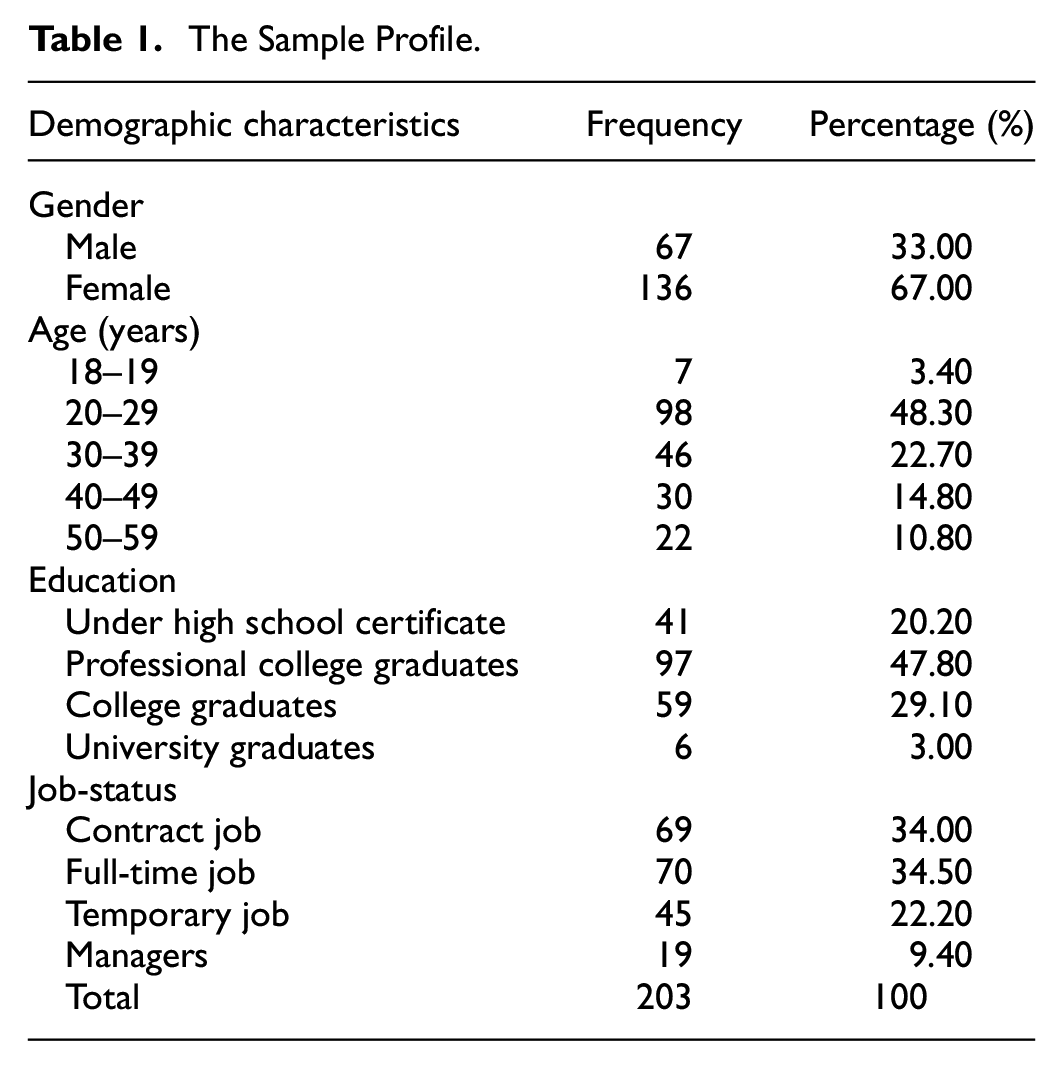
After eliminating outliers and missing data, a total of 203 questionnaires were finally used to test the proposed hypotheses of the study. Based on gender, the sample was distributed as 67% of the samples were females whereas 33% were males. Similarly, 47.8% of the samples were high school graduates and 29.1% of the samples were college graduates. Table 1 shows the sample profile.
The Sample Profile.
Measurements
The measure instruments of the study were taken from previous literature. The researchers used a 5-point scale in which 1 stands for strongly disagree and 5 stands for strongly agree to measure the constructs. Authentic leadership is a multidimensional construct comprised of four sub-constructs such as self-awareness, relational transparency, internalized moral perspective, and balanced processing. All the sub-constructs were measured by three items each taken and adapted from the authentic leadership scale of Walumbwa et al. (2008). Supervisor ostracism was measured by the scale of Wan et al. (2016) using four items. Five items were used to measure supervisor trust from the study of Yilmaz and Hunt (2001). Store affective commitment of frontline service employees was measured by three items taken from the study of Allen and Meyer (1990). Finally, the commitment to customer service is measured by five items borrowed from the study of Peccei and Rosenthal (1997). Table 2 shows the measurement items of the variables.
Measurements.

Assessment of Common Method Bias
The current study used a cross-sectional self-reported questionnaire to collect data for both the independent and dependent variables which potentially increases the chances of common method bias. To minimize the common method error in the study, we used procedural and statistical remedies (Podsakoff et al., 2003). Procedural remedies were applied from the stage of designing the questionnaire. For instance, the respondents were ensured that their responses are only used for research purposes and that their identity will remain anonymous. Moreover, the respondents were asked to respond to the question honestly since there are no right or wrong answers.
Statistically, we examine the common method bias by using Harmon’s single-factor procedure (Podsakoff et al., 2003). We conducted Harmon’s single-factor test in SPSS by loading all the indicators of the constructs to a single factor with an un-rotated solution. The results showed that a single factor explained 46% of the variance which is under the cutoff value of 50% negates the presence of common method bias. In order to further validate the absence of common method bias in this study, we used the confirmatory factor analysis of a common latent variable. All the items of the constructs are loaded on a single latent variable and the confirmatory factor analysis is conducted. Malhotra et al. (2006) suggested that “method biases are assumed to be substantial if the hypothesized model fits the data” (p.1867). However, the results showed that a common latent variable has a poor fit to the model (χ2 = 2,661.69, df = 377, p < .01, χ2/df = 6.80, CFI = 0.58, TLI = 0.54, IFI = 0.58, RMR = 0.06, RMSEA = 0.17) which further validate the absence of common method bias.
Data Analysis
This study employed a covariance-based structural equation modeling (CB-SEM) technique using AMOS 21.0 (Arbuckle, 2011) to examine the proposed hypotheses of the study. SEM is relatively a well-established multivariate analysis technique (Bollen & Long, 1993; Malhotra & Ackfeldt, 2016) that simultaneously estimates more complex and interrelated relationships (Fornell & Larcker, 1981; Hair et al., 1998; Malhotra & Ackfeldt, 2016). Generally, researchers have recommended a two-step approach to conducting SEM (Anderson & Gerbing, 1988). In the first step, the psychometric property such as the reliability and validity of the measurement model is analyzed, and subsequently, in the second step, the structural model is tested. Based on the recommendation of Anderson and Gerbing (1988), we conducted the SEM in two steps.
Results
Reliability and Validity
The results of the confirmatory factor analysis (CFA) showed an acceptable fit of the model such as: χ2 = 595.93, df = 349, p < .01, χ2/df = 1.71, CFI = 0.95, TLI = 0.94, IFI = 0.95, RMR = 0.02, RMSEA = 0.06). The reliability and validity of the measurement model are assessed before the assessments of the measurement model. The standard loadings of the items were examined to know about the reliability of the items of variables. All the standard factor loadings were higher than the threshold value of 0.70 and significant, indicating convergent validity at the item level (Fornell & Larcker, 1981). The convergent validity of the constructs was evaluated and confirmed by the values of average variance extracted (AVE), which was greater than .50 (Fornell & Larcker, 1981). Similarly, the construct reliability was assessed by examining the values of Cronbach’s alpha and composite reliability which were greater than the cutoff value of .70 (Nunnally, 1978) confirmed the reliability of the measurement items. Table 3 shows the results of CFA in detail.
Results of Confirmatory Factor Analysis.
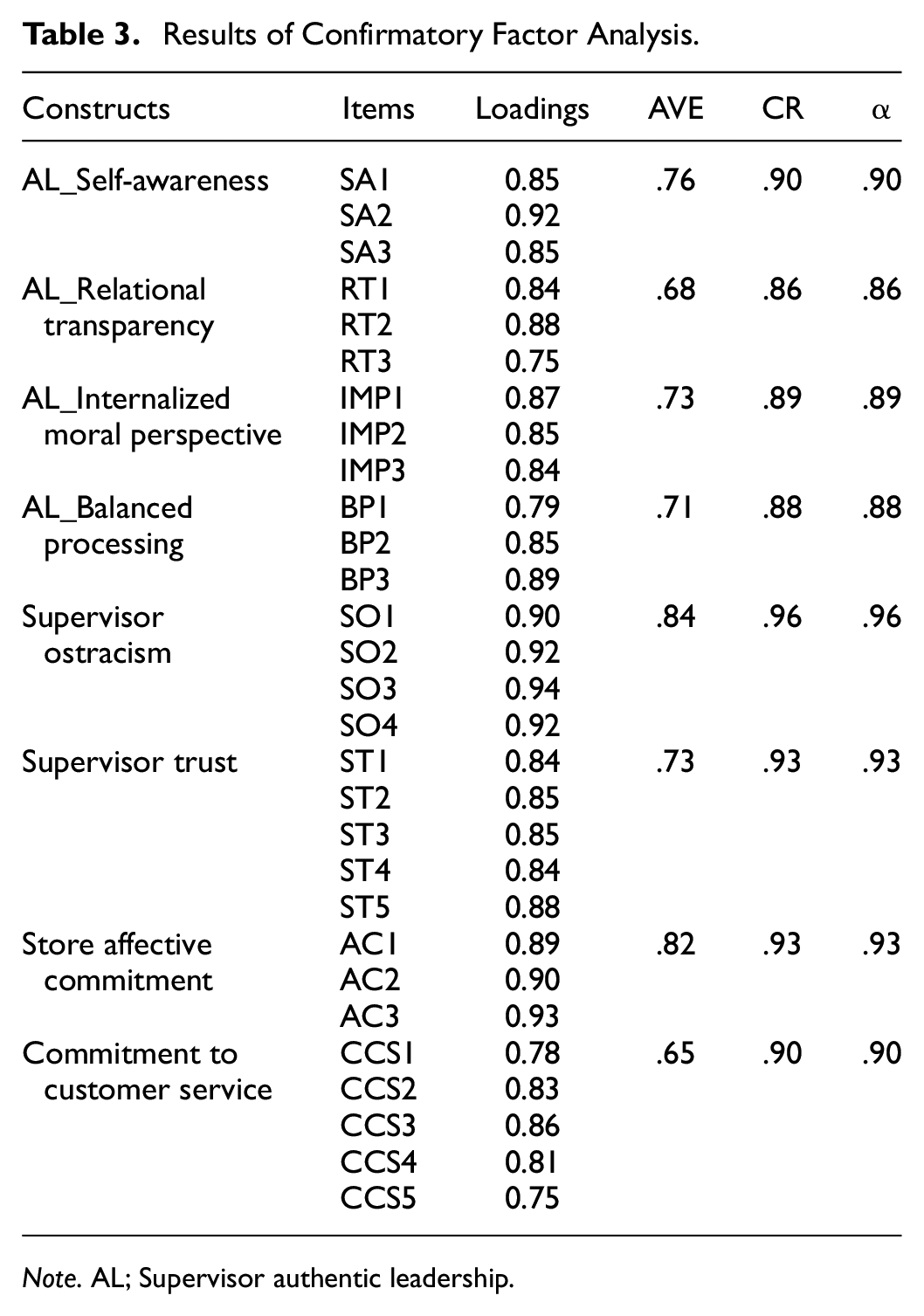
Note. AL; Supervisor authentic leadership.
Similarly, the discriminant validity of the constructs was assessed by using Fornell-Larcker’s criterion. Accordingly, the AVE square root of each construct was higher than the absolute value of the correlation among constructs. Table 4 shows the results of the correlation coefficients and the squared roots of AVE in diagonal in detail. This study has a second-order construct which is supervisor authentic leadership. Therefore, we conducted the confirmatory factor analysis for the second-order construct separately.
Correlation Matrix and Square Roots of AVE in Diagonal (in bold).
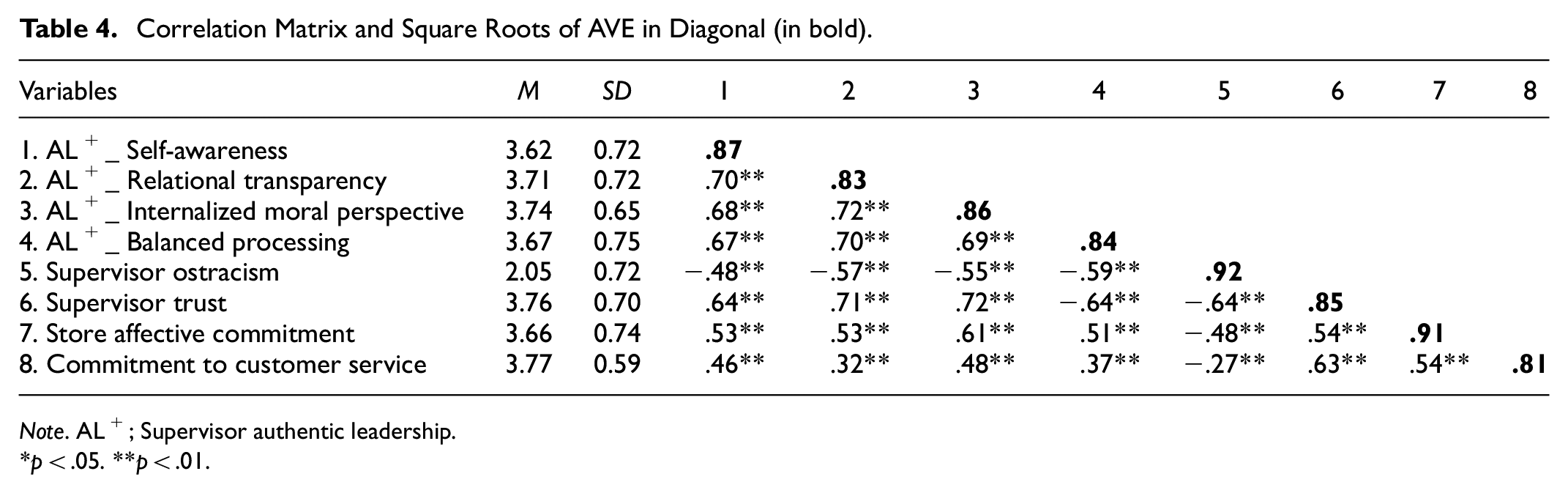
Note. AL+; Supervisor authentic leadership.
p < .05. **p < .01.
Table 5 indicates the results of the confirmatory factor analysis of the second-order constructs. The model fits the data well such as χ2 = 98.01, df = 50, p < .01, χ2/df = 1.96, CFI = 0.97, TLI = 0.96, IFI = 0.97, RMR = 0.02, RMSEA = 0.07.
Confirmatory Factor Analysis of Second-order Construct.

Hypotheses Testing
Table 6 of the study shows the results of the structural equation modeling. The findings demonstrated that the fit indices of the statistical model are satisfactory. Specifically, the results showed that; χ2 = 360.73, df = 183, p < 0.01, χ2/df = 1.97, CFI = 0.95, TLI = 0.95, IFI = 0.95, RMR = 0.03, RMSEA = 0.07). All the fitness indices were satisfactory as that the CFI, TLI, and IFI were above 0.90 of the satisfactory cutoff. The χ2/df is under the threshold of 3 which depicted the good fitness of the model.
Results of a Structural Equation Modeling.

p < .05. **p < .01.
The results showed that supervisor authentic leadership significantly affected the supervisor trust (β = .77, p < .01), thus the H1 of the study is supported. Supervisor ostracism predicted the supervisor trust negatively (β = −.14, p < .05) which supported the H2 of the study. Supervisor trust has a significant positive effect on store affective commitment (β = .65, p < .01), hence the H3 of the study is supported. The results also showed that supervisor trust led to a commitment to customer service (β = .21, p < .05) which supported the H4 of the study. Finally, the result showed that store affective commitment predicted the commitment to customer service positively (β = .40, p < .01), thus the H5 of the study was supported.
Discussion
Theoretical Implications
Theoretically, the present study has the following contributions. First, the current study has contributed to the theory of supervisor trust and supervisor authentic leadership in the context of frontline service employees of small stores. As the prior literature showed that authentic leadership has been extensively discussed in different settings (Nasab & Afshari, 2019; Ribeiro et al., 2018; Wei et al., 2018), and there is a very limited understanding of the role of supervisor authentic leadership on perceived supervisor trust of small store frontline service employee. Hence, the current study has addressed the knowledge gap by exploring the relationship between supervisors’ authentic leadership and their perceived supervisor trust in the context of small stores.
Second, the present study has contributed to the literature on supervisor ostracism such as this study has explored the relationship between supervisor ostracism on the frontline service employee supervisor trust. Although previous literature has documented the effects of ostracism on employees’ performance (Choi, 2020), employees’ job embeddedness (Lyu & Zhu, 2019), and turnover intention (Howard et al., 2020). Therefore, the present study contributes to the literature by examining the relationship between supervisor ostracism on the employees’ supervisor trust.
Third, the current study has contributed to the literature on a commitment to customer services. In the prior literature, the commitment to customer services is studied from the perspective of HRM practices and the influence of supervisor roles was not explored. Hence, this study offered a new study that validated the positive relationship between supervisor trust and frontline service employees’ commitment to customer services.
Finally, the findings of this study contributed to the literature of organizational affective commitment and frontline service employees’ commitment to customer services. Specifically, the findings showed that the store affective commitment to the store led to the commitment to customer services.
Managerial Implications
This research offers insight to practitioners to learn more about the frontline service employees’ tendency to perceive supervisor trust in general and small stores in particular. The study has specifically focused on the antecedents such as supervisor authentic leadership and supervisor ostracism that increase and decrease perceived supervisor trust respectively. Relying on the findings of this research, we have the following suggestions for the managers or owners of small stores in general and coffee shops in particular. Generally, the owners perform the roles of managers in small stores. However, some stores hire supervisors to oversee the operations independently. Hence, based on the findings following managerial implications are suggested.
First, managers (owners) of small stores should emphasize the supervisor’s authentic leadership in the workplace both explicitly and implicitly. In particular, managers (owners) can introduce various training programs and development actions that are aimed to increase the authentic leadership of supervisors. Moreover, during the recruitment and promotion activities of human resource practices, the manager (owners) should evaluate applicants based on credentials of authentic leadership so that the right person is promoted or hired.
Second, supervisor ostracism reduces the perception of supervisor trust which in turn affects the service employees’ commitment to customer services and the store’s affective commitment. To be very specific, supervisor ostracism deteriorates the perceived supervisor trust of frontline service employees. Therefore, managers (owners) of small stores should introduce policies in the workplace to effectively deal with supervisor ostracism. To do this, managers (owners) can implement the following solutions. The managers of small stores should highlight the counterproductive outcomes of supervisors’ intentional and unintentional ostracism to frontline service employees in terms of the deterioration of perceived supervisor trust. Similarly, the managers (owners) might also offer specialized professional training and counseling programs for supervisors who are regularly accused of engaging in ostracism. The managers (owners) should ensure smooth and open communication practices in the store (Yang & Treadway, 2018) so that the frontline service employees report such incidents that will be helpful in the prevention of supervisors’ ostracism. Lastly, the managers (owners) might also codify a pragmatic code of conduct with a concrete penalty against the offenders.
Third, the research found that frontline service employees’ perceived supervisor trust leads to commitment to customer services and store affective commitment. Therefore, store managers (owners) should make ensure a conducive and congenial working environment where the frontline service employees can trust their supervisors and their organization. There can be several ways to offer such a service environment however in light of the findings of this study, the supervisor’s authentic leadership is an important antecedent to frontline service employees’ perceived supervisor trust. Therefore, special attention should be given to the process of hiring, selection, promotion, and socialization of the supervisors.
Limitations and Future Research Directions
Although the present study offers insights about the role of the supervisor authentic leadership and ostracism on supervisor trust and organizational commitment which in turn predict frontline service employees’ commitment to customer service, it has a few limitations which provide avenues for future research. For instance, for the current study, the data were collected in a single point in time and from a single source, therefore, a longitudinal study with multiple data sources can enhance the validity of the study. Similarly, the hypotheses of the study were tested in the context of frontline service employees of coffee shops in Korea. Therefore, replicating the framework to other service settings can offer the generalizability of the findings.
Footnotes
Declaration of Conflicting Interests
The author(s) declared no potential conflicts of interest with respect to the research, authorship, and/or publication of this article.
Funding
The author(s) received no financial support for the research, authorship, and/or publication of this article.

Data Availability Statement
Data sharing not applicable to this article as no datasets were generated or analyzed during the current study.