




Abstract
Supervisor ostracism is commonplace in work settings. Previous studies have mainly focused on the influence of supervisor ostracism on employees’ work behavior and performance, while the impact of supervisor ostracism on employees’ family harmony has garnered less attention. Based on the affective events theory, we analyzed data collected from 3 time points and 343 employees in the Chinese context. We found that supervisor ostracism significantly undermines employee-family harmony, which is mediated by workplace anger. In addition, our study demonstrated that high emotional regulation alleviates the relationship between workplace anger and family undermining, reducing the destructive consequences for the family. Our results indicated that individual differences in emotional regulation are responsible for moderating the mediating effects of workplace ange between supervisor ostracism and family undermining, shedding light on future research directions and providing practical implications for solving work-family conflict.
Keywords
Introduction
In the increasingly competitive modern society, supervisor ostracism, as a violation of workplace norms, has become an increasingly prominent issue for individuals regarding their social environments and livelihoods. According to a Chinese research survey, 70% of employees attempt to evade negative treatments like ostracism in the workplace (People’s Daily, 2013). From the perspective of social psychology, employees often desire to establish and maintain a safe and positive social group identity (Baumeister & Tice, 1990). However, once individuals are excluded from important social groups and stakeholders, they experience anxiety and other negative (Eisenberger et al., 2003). Previous studies commonly conceptualized different sources of exclusion in the workplace as workplace ostracism, but rarely differentiated between sources of exclusion based on how they impact the employees’ behaviors (Zadro & Gonsalkorale, 2014). Supervisor ostracism has a more profound and far-reaching impact on employees than colleague ostracism (Chen & Tu, 2017). It is precisely because supervisor ostracism and colleague ostracism will have different degrees of impact on employees (Jiang et al., 2011; Ye et al., 2015). Considering that the high-power distance is common in many regions (especially in Asian countries), this study focuses on supervisor ostracism, which leads to prolonged pain for individuals (Nezlek et al., 2012; Zhao et al., 2019), and can cause negative results, such as workplace silence (Jahanzeb et al., 2018), reduction of organizational citizenship behavior (Han & Hwang, 2021), and turnover intentions (Wang et al., 2021).
Although researchers have increasingly noticed that supervisor ostracism has a considerable impact on employee behavior, there is an existing research gap concerning this issue (Chen & Tu, 2017). Most existing studies only focus on the workplace results, and few have considered the impact on employees’ family lives. Some researchers suggested that the source of ostracism can also come from the family and proposed that family ostracism may affect workplace performance (Babalola et al., 2021). Therefore, the mechanism mentioned by Babalola et al. (2021) may be bidirectional rather than unidirectional. When being rejected by leaders in the workplace, employees may also react by excluding their family members (e.g., family undermining, a typical manifestation of family exclusion). Additionally, some studies focus on long-term outcomes while ignoring short-term outcomes such as negative emotions (Wu et al., 2012). However, ostracism may cause various emotional experiences (Chow et al., 2008), which require further research on how supervisor ostracism influences employees’ emotional outcomes.
The affective events theory (AET) provides a useful perspective to explore the impact of supervisor ostracism on employees outside the workplace, especially the emotional reactions that lead to the predicted behavior (Perry, 2014; Vaillant et al., 1986). According to this theory, there is a relationship between employees’ internal influences such as emotion, and their reactions to those workplace incidents during their workday (Weiss & Cropanzano, 1996). In other words, the employee may display affect-driven behavior according to their mood or emotion caused by their workday affective experience (there are two ways affective response affects employee behavior, one of which is behaviors that are directly driven by emotional responses called emotion-driven behaviors). Previous research has confirmed through AET that workplace incidents lead to employee workplace outcomes, including impacts on job performance and job satisfaction (Todorova et al., 2014; Weiss & Cropanzano, 1996). However, not enough studies focus on the influence of supervisor ostracism on outcomes outside the workplace. Therefore, this study aims to address the research gap in this field by constructing an accidents-emotion-behavior framework model. To explain the emotion-driven behavior spillover from the workplace to the family realm, this study draws attention to Perry’s (2014) study which suggests that when facing emotional conflict or internal and external stressors, individuals may adopt various automatic psychological mechanisms, including displacement, to regulate their behavior, which is also referred to as self-defense mechanism. Furthermore, individuals may unconsciously transfer emotion and stress from a higher-level threatening object to another object that is usually less threatening (Di Giuseppe & Perry, 2021). An example is that the victims of ostracism are more likely to take revenge on their innocent group members (Gaertner et al., 2008; Warburton et al., 2006). It is reasonable to infer that this revenge may even be associated with their family members. We infer that individual will feel emotional fluctuations and pressure upon facing rejection from their leaders at the workplace and may unconsciously vent this emotional pressure onto people that pose less of a threat. As the closest relations to the individual, family members may become the victims of this emotional catharsis. Destructive emotions such as anger (Matsumoto et al., 2016), which is possibly a result of ostracism (Howard et al., 2020), may act as a medium for emotional transmission from the workplace to the family. As employees are unable to vent their anger at work (Semmer et al., 2010), they are likely to project it onto family life (Hoobler & Brass, 2006). Thus, workplace anger can turn into a threat to family harmony.
Considering that the expression of anger in the workplace is emotional, the ability to control emotions may affect this self-defense mechanism. When individuals maintain strong emotional regulation, they can alleviate their negative emotions, and reduce their levels of stress, anxiety, and depression (Martins et al., 2010); they do not feel the need to shift blame from the leaders to their family members. However, individuals with low emotional regulation may respond to their emotions through dysfunctional strategies and even show antisocial behavior (Petrides et al., 2004). Therefore, this study proposes that individuals’ emotional regulation might determine the level of impact of supervisor ostracism on family undermining.
This study examined the influence of supervisor ostracism on employee behavior from the perspective of the source of ostracism (Zadro & Gonsalkorale, 2014). Supervisor ostracism mostly occurs in the workplace, while colleague ostracism often occurs outside (Jiang et al., 2011). Chen and Tu (2017) called for an in-depth study of supervisor ostracism to explore the impact of work conflict (supervisor ostracism) on families. Previous studies have mainly focused on the performance of individuals in the workplace, but research on the impact of supervisor ostracism outside the workplace has largely been ignored. Our study investigated whether supervisor ostracism could affect employee family harmony and whether individual differences in emotional regulation moderate the mediating effect of workplace anger between supervisor ostracism and family undermining.
This study aims to make several contributions, the first of which is to deepen the theoretical depth of the work-family spillover effect. Previous research merely discusses the relationship between supervisor ostracism and employees’ outcomes in the workplace, but there is an inadequate exploration of the result outside the workplace. This study focuses on the spillover effect of supervisor ostracism to address the issue above. Additionally, following Perry (2014), Di Giuseppe’s and Perry’s (2021) conclusion, aggressive emotional feelings could be shifted from a high-level threat (e.g., a supervisor in the workplace) to a low-level threat target (e.g., family members outside the workplace), which mean that employee may react through a self-defense mechanism in such a situation. Finally, this study also extends the research field of AET, constructing an incident-emotion-behavior framework to explain the negative influence of supervisor ostracism on employees’ family harmony.
Supervisor Ostracism, Workplace Anger, and Family Undermining
Ferris et al. (2008) and Hitlan and Noel (2009) defined supervisor ostracism as exclusion or neglect from direct superiors, that was perceived by employees in their workplace. In the context of Chinese workplaces, supervisor ostracism is often perceived by subordinates as a negative interpersonal approach. It can take the form of intentional or unintentional neglect, indifference, and rejection from direct leaders. These actions can be either obvious or covert in nature, as explained by Chen and Tu (2017). It exists in various organizations across cultures and regions (Leung et al., 2011). Some studies have confirmed that ostracism negatively affects individual’s emotion, cognition, and mental health (Williams, 2007) and increases individual aggression (Zhang et al., 2019). However, relevant studies have not discussed the impact of different sources of ostracism. As leadership entails strong authority and power, we believe that the impact of supervisor ostracism on employees is likely to be significantly different from other types of ostracism (Kong & Li, 2019; Zhao et al., 2019).
According to AET, supervisor ostracism is an unpleasant incident that causes employee stress. During this process, employees will cognitively judge events and generate corresponding emotional responses (Weiss & Cropanzano, 1996). Since supervisor ostracism is a kind of aggressive and oppressive behavior, it is reasonable to speculate that it also elicits antagonistic emotions, the most typical of which is anger. Some studies have mentioned that anger may be an emotional result of ostracism. Ma et al. (2022) believe that individuals assess the threat of workplace exclusion, which may cause negative emotions including anger (Chow et al., 2008). This conclusion has also been confirmed in another study (Wang et al., 2021; Zhu & Zhang, 2021). However, studies have not elaborated on whether and how anger is transferred when ostracism occurs. We inferred that the ostracism encountered by leaders could also cause individual workplace anger. However, due to the unequal status between superiors and subordinates and the power held by leaders (such as control over promotion and resource allocation), even if subordinates are angry with the leaders, they have to consider the cost and refrain from confrontation (Zhou et al., 2021). This forbearance does not mean the end of anger, because feeling anger does not necessitate its direct expression (Gibson & Callister, 2010). On the contrary, some unpleasant experiences may vent from the workplace to the family realm. Plutchik et al. (1979) concluded that people may regard defense as a derivative of basic emotion, and anger easily triggers displacement behavior. Thus, anger is transferred to people whom individuals perceive as less threatening (Di Giuseppe & Perry, 2021). Studies have confirmed that ostracism can cause individuals to behave aggressively toward innocent targets (DeWall et al., 2009). We suggest that this emotion may be brought into the family from work, leading to family conflicts (Grzywacz & Marks, 2000).
Family undermining is a negative behavioral pattern that prevents family members or spouses from establishing or maintaining positive interpersonal relationships (Westman & Vinokur, 1998), sometimes related to work conflict (Luo et al., 2007). It can involve destructive behaviors in the family, such as quarreling, losing their temper, and deliberately finding fault (Zhang et al., 2022). The anger felt by individuals at work can lead directly to destructive behavior, that may affect family life (Hoobler & Brass, 2006; Westman & Vinokur, 1998). We infer that supervisor ostracism will make individuals feel anger, and this anger will shift from higher threat objects (e.g., leaders) to lower threat objects (e.g., close family members) according to the self-defense mechanism (Perry, 2014; Vaillant et al., 1986). This shift may manifest as family undermining and complete the identity transformation from a victim of supervisor ostracism to a perpetrator of family undermining. Finally, supervisor ostracism spills over into the family realm through anger. The process of anger replacement is also called the emotion-driven stage in AET.
The Moderating Effect of Emotional Regulation
According to the AET, emotion is the key variable that connects workplace incidents and emotion-driven behavior. However, individual differences should also be considered. The self-defense mechanism (SDM) indicates that when facing pressure and anxiety caused by internal and external conflicts, individuals will take a series of defensive steps to protect themselves. Individuals with a high level of emotional intelligence may adopt mature defense mechanisms including humor and altruism. However, when emotional intelligence is immature or neurotic, it is easy to use common defense mechanisms such as displacement (Vaillant et al., 1986). Individuals differ in their ability to deal with emotions, and this determines whether they will displace their anger.
Emotional regulation, which refers to the ability of individuals to manage their emotions, is the main dimension of emotional intelligence. Individuals with high emotional regulation can control their emotions better, rarely lose patience, or display emotional outbursts (Davies et al., 1998). They can recover quickly if they make a psychological gaffe (Law et al., 2004). In contrast, individuals with low emotional regulation vent their emotions through dysfunction (Petrides, 2011) and even show aggressive behavior (Roberton et al., 2012). Huang et al. (2017) found that individuals with high emotional intelligence were better at controlling their negative emotions, could reduce the negative impact of bad leadership, and improve family satisfaction.
We believe that individual differences in emotional regulation determine whether individuals will vent their workplace anger to family members. Individuals with low emotional regulation find it difficult to ease their anger, even when they leave work and return to their families (Hoobler & Brass, 2006; Westman & Vinokur, 1998), which is more likely to lead to family undermining. Conversely, individuals with high emotional regulation may feel anger after rejection but can quickly adjust their emotions and return to normal.
The Moderated Mediation Model
In the workplace, even if the employees are angry due to exclusion, they rarely engage in confrontation as they fear conflict with their leaders for losing chances. This is maybe why supervisor ostracism in the workplace can lead to family undermining. AET indicates that an individual would respond emotionally to such an unpleasant experience. However, emotional-driven behavior varies from person to person. Vaillant et al. (1986) distinguished four different defense levels according to emotional maturity. Displacement behavior, which is a manifestation of relative emotional immaturity (Level 3 maturity), has short-term advantages in coping with stress; long-term use is likely to cause problems in interpersonal relations, work, and life. Therefore, individuals with low emotional regulation are more likely to show displacement behavior, strengthen the path of projecting anger caused by supervisor ostracism onto family members, and strengthen the negative results of family undermining. Conversely, individuals with high emotional regulation may adopt more mature defense mechanisms (such as sublimation and altruistic behavior) and weaken the mechanism of anger displacement, which means that they are less likely to cause family undermining due to supervisor ostracism.
The theoretical model is shown in Figure 1.

Theoretical model based on AET.
Materials and Methods
Participants and Procedures
A sample of 475 employees was recruited from four internet companies in Guangdong province, China. APA ethical guidelines were followed, and data were collected at three different times. With the help of the human resources departments, surveys were conducted using paper questionnaires. Interviewees participated voluntarily and were informed that all data would be kept confidential. At Time 1, we asked respondents to provide basic demographic information and assess supervisor ostracism. A total of 475 complete responses were collected. One month later, at Time 2, we again distributed questionnaires to employees to assess workplace anger and emotional regulation, and received 408 complete replies. One month later, at Time 3, questionnaires including the dependent variable were distributed to employees. Finally, 362 surveys were collected, and 343 were valid. In the final sample, 50% of the participants were men. The average age was 32.52 years (SD = 5.98), the average work experience was 9.04 years (SD = 6.22), and the average education was 16.06 years (SD = 1.35).
Measures
As the research was conducted in the context of China, all scales were derived from the existing Chinese maturity scale that had been validated by research (Jiang et al., 2011; Law et al., 2004; Liu et al., 2015; Zhang et al., 2022). We instructed the employees to score the degree of agreement of each item from 1 (strongly disagree) to 5 (strongly agree) according to a 5-point Likert scale.
Supervisor Ostracism
A 10-item scale, developed by Jiang et al. (2011), was completed by employees to assess supervisor ostracism (α = .95). An example item included “When I ask my superiors for help when I am in trouble, they ignore me or refuse to answer me.”
Workplace Anger
We used a 4-item scale developed by Liu et al. (2015) to measure workplace anger. After evaluating supervisor ostracism, the employees were instructed to rate their anger (α = .95). An example item included “I was angry at the tasks my superiors had assigned to me.”
Emotional Regulation
A 4-item Emotional Regulation Scale developed by Law et al. (2004) was used (α = .94). An example item stated, “I am a person who can encourage myself.”
Family Undermining
The measurement of family undermining was derived from a 3-item Family Undermining Scale developed by Westman and Vinokur (1998), which was translated into Chinese by Zhang et al. (2022) (α = .91). An example item included “I treat my family or spouse unpleasantly or angrily.”
Results
Descriptive Statistics and Correlations
The descriptive statistical analysis results are shown in Table 1. There was a significant positive correlation between supervisor ostracism and anger (r = .74, p < .001), as well as supervisor ostracism and family undermining (r = .58, p < .001). There was also a significant positive correlation between anger and family undermining (r = .65, p < .001). Interestingly, our results also indicated that emotional regulation is negatively correlated not only with anger (r = −.60, p < .001) but also with supervision ostracism (r = −.53, p < .001) and family undermining (r = −.67, p < .001). It shows that individuals with high emotional regulation can avoid being rejected by leaders and handle the conflicts between work and family well.
Means, Standard Deviations, and Correlations Between the Study Variables.

Note. N = 343. Internal consistency reliabilities are in parentheses.
p < .05. ***p < .001.
Measurement Model
Confirmatory factor analysis via AMOS software was used to test the convergent validity and discriminant validity of relevant variables. The results in Table 2 reflected that the range of factor loading was between 0.68 to 0.93, and the average variance extracted (AVE) of the four variables was higher than 0.50 (supervisor ostracism: AVE = 0.64; workplace anger: AVE = 0.78; emotional regulation: AVE = 0.83; family undermining: AVE = 0.81), with the conclusion that convergent validity is adequate for the measurement model. The results in Table 3 show that the hypothesis of the four-factor model had the best overall fitting validity (χ2/df = 1.98; CFI = 0.98; TLI = 0.97; SRMR = 0.03; RMSEA = 0.05). To test the homology error problem, we loaded all self-reported items to a potential common method factor in a separate model for testing. The results confirmed that the model with the common method factor did not significantly improve the fitting degree of the model, indicating that the homology error problem was minimal.
Factor Loadings and Convergent Validity of CFA.

Note. AVE = average variance extracted.
Discriminant Validity Test of CFA.

Note. N = 343. CFI = comparative fit index; TLI = Tucker-Lewis index; SRMR = standardized root mean square residual; RMSEA = root mean square error of approximation.
This model merged the items of workplace anger and emotional regulation into a common factor.
This model merged the items of supervision ostracism, workplace anger, and emotional regulation into a common factor.
p < .01.
Hypothesis Testing
After standardizing the sample data, the study used hierarchical regression analysis to test the hypotheses. The hierarchical regression results testing the mediating effect of the model are shown in Table 4. After controlling for gender and other variables (model 1 and model 3), the results of models 2 and 4 showed a significant positive correlation between supervisor ostracism and employees’ workplace anger (r = .68, p < .001), and a significant positive relationship between supervisor ostracism and employees’ family undermining (r = .47, p < .001), indicating that supervisor ostracism can positively affect employees’ workplace anger and family undermining. In addition, to confirm the mediating effect of anger between supervisor ostracism and family undermining, supervisor ostracism (independent variable) and employees’ workplace anger (mediating variable) were put into model 5 for testing. The results showed that anger has a significant positive impact on family undermining (r = .35, p < .001). Compared to model 4, although the relationship between supervisor ostracism and anger is still significant, the corresponding regression coefficient decreased (r = .20, p < .001). Therefore, anger has a partial intermediary role between supervisor ostracism and employees’ family undermining. Hypothesis 1 was verified.
Hierarchical Regression of Mediating and Moderating Effects.

Note. N = 343.
p < .05. **p < .01. ***p < .001.
To verify the moderating effect of emotional regulation, the regression of Model 6 and Model 7 was continued based on previous models. The results showed that the interaction between anger and emotional regulation had a significant negative effect on family undermining (r = −.08, p < .01), indicating that employees’ emotional regulation could negatively affect the relationship between anger and family undermining. We also conducted a simple slope analysis (see Figure 2), that showed that the moderating effect between anger and family undermining was weaker for individuals high in emotional regulation (+1SD) than for those low in emotional regulation (-1SD). Hypothesis 2 was verified.

Moderating effect of emotional regulation between workplace anger and family undermining.
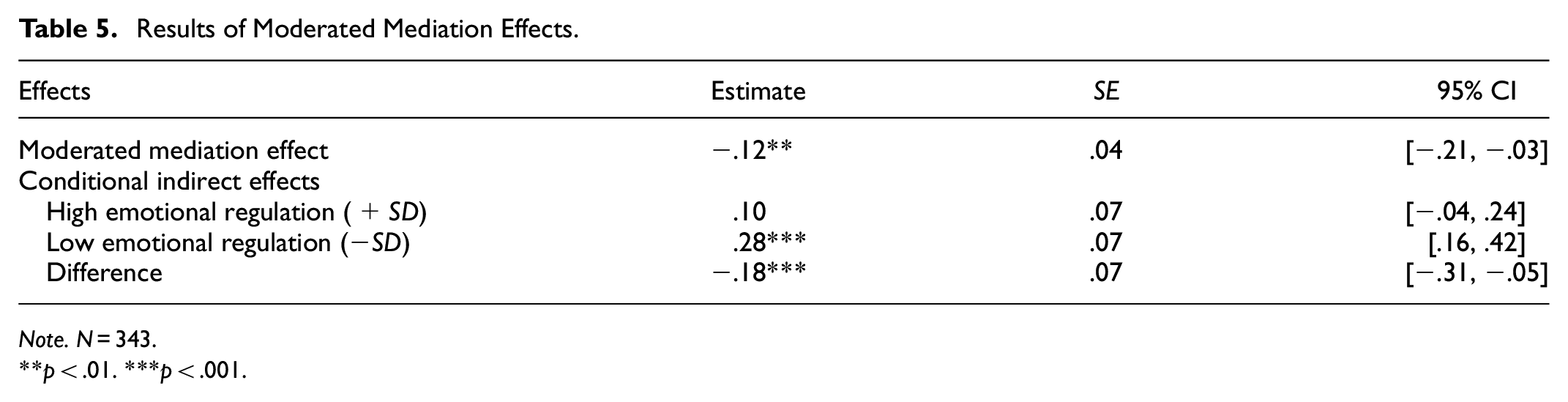
Furthermore, bootstrapping with 5,000 replications via PROCESS Marco of SPSS software was used to test the moderated mediating effects. As Table 5 shows, the index of the moderated mediation effect is −0.12, and the 95% confidence interval is excluded from 0, indicating that the moderated mediation effect is significant. Specifically, individuals with low emotional regulation (M − SD) are more likely to vent their anger from their supervisor to their family (conditional indirect effects remain significant with the 95% confidence interval excluding 0). However, individuals with high emotional regulation (M + SD) are unlikely to displace their anger, since the conditional indirect effect is no longer significant (95% confidence interval includes 0). Hypothesis 3 was supported. In addition, we conducted a Johnson-Neyman test (in Figure 3). The results indicated that when emotional regulation is smaller than 3.34 (on a 5-point scale), the indirect effect is significant, indicating that the effect of supervisor ostracism on employee’s family undermining via anger is significant and negatively moderated by emotional regulation.
Results of Moderated Mediation Effects.
Note. N = 343.
p < .01. ***p < .001.
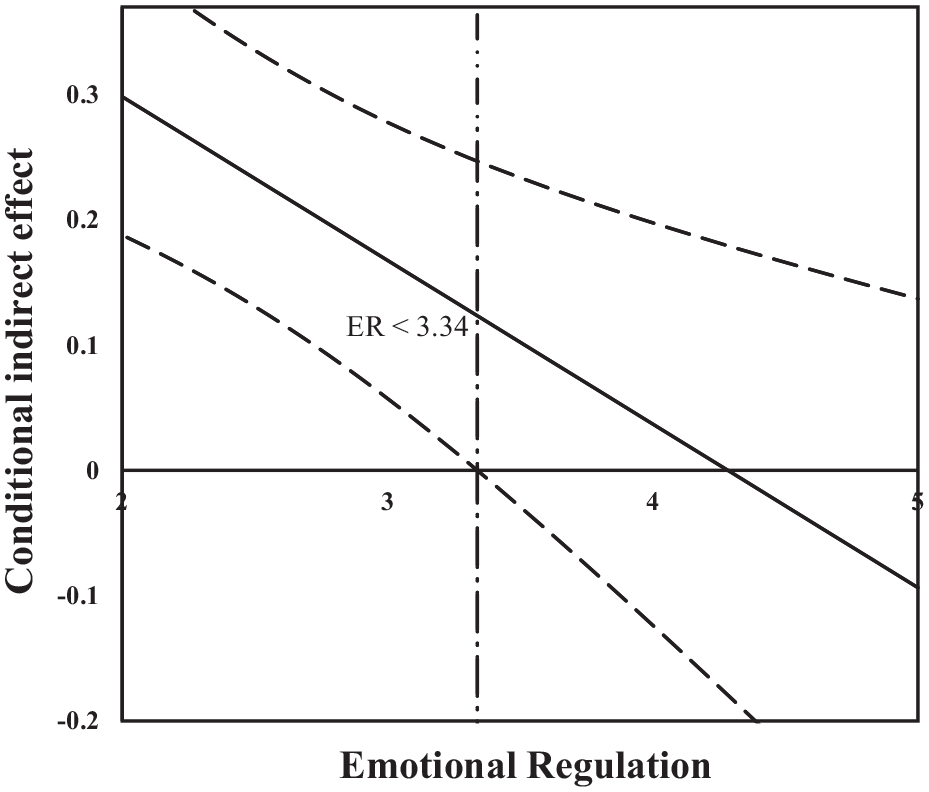
Johnson-Neyman test for moderated mediation model.
Discussion
According to the results above, family undermining can be driven by anger that stems from supervisor ostracism in the workplace. As AET shows, supervisor ostracism is an unpleasant event that stresses employees, driving them to evaluate and respond emotionally (also known as the cognitive judge stage in AET). The results show that supervisor ostracism has a strong relationship with employees’ workplace anger. However, the anger could shift from their workplace to their family realm. A reasonable explanation is that individuals may express their aggressive emotion to a low-threaten target instead of a high-threaten target (the leader represents power for promotion etc.), which is also called a self-defense mechanism in psychology. Thus, some employees who experienced supervisor ostracism may “bully the soft and fear the hard,” and respond with family undermining behavior toward their family members. In other words, family-undermining behavior seems to offer these angered employees a way to release the unpleasant experience their supervisor has given, even though these actions are harmful to their family harmony. Furthermore, individual emotional regulation can significantly affect this process, which means that anger replacement may mainly happen to those with low emotional regulation ability.
Theoretical Implications
First, there are significant differences in the impact of different exclusion sources on individuals (Jiang et al., 2011; Ye et al., 2015). The impact of supervisor ostracism needs further exploration (Chen & Tu, 2017). Our study examines the influence of supervisor ostracism on employees’ outgroup members, which enriches the inadequate research on this issue (Kerr et al., 2009; Mao et al., 2018).
Second, previous studies have indicated that workplace exclusion can lead to adverse consequences by threatening individual psychological needs (Ma et al., 2022). Our research points out the important intermediary role of workplace anger, rather than other emotions, between supervisor ostracism and family undermining. Consistent with the SDM, we found that anger due to supervisor ostracism could be displaced from its cause to its expression. Thus, as a destructive emotion, anger often leads to a decline in control and promotes aggressive behavior (Yang, 2003).
According to the SDM, the use of displacement reveals emotional immaturity, and individuals with higher emotional maturity are more likely to adopt mature defense mechanisms (Vaillant et al., 1986). Our findings support evidence that emotional regulation can help alleviate anger (Szasz et al., 2011).
Finally, our research revealed that anger generated by leaders’ misconduct is often vented upon other individuals (Zhou et al., 2021). This may be due to the hierarchical nature of power dynamics. Employees often choose to swallow their anger when facing leaders, but release their negative emotions on the family or other surroundings (S. Zhang et al., 2022). Therefore, family members can become an outlet for employees’ negative emotions. The results mentioned above bring a new contribution to the research field of AET, since we have successfully shown that the “event-emotion-behavior” structure, and the emotional-driven behavior could happen outside the workplace, which means that there is an emotional spillover effect from the workplace to the family realm.
Practical Implications
This study provided some practical implications. First, organizations should take measures to reduce the occurrence of supervisor ostracism by promoting a friendly and harmonious atmosphere (Williams, 2001; Wu et al., 2012), encouraging honest and open communication, and establishing more communication channels between leaders and subordinates to improve working relationships and reduce unnecessary misunderstandings or conflicts.
In addition, leaders need to recognize the seriously negative results of exclusion behavior (Mawritz et al., 2012), improve managers’ interpersonal communication by regularly providing interpersonal communication-related training, and promote leaders’ care for subordinates. High-quality and friendly leadership will lead to a high-level work-family enrichment (Wu et al., 2020).
Besides, in terms of emotional regulation, organizations should offer training courses to their employees. This would ensure that they have the opportunity to receive further education and improve their cognitive abilities in emotional regulation (Wang & Zhao, 2015). Additionally, employees can manage their emotional stress through deep breathing, mindfulness, and meditation. If they encounter ostracism, they should find appropriate solutions to communicate with their supervisors (Bao et al., 2014).
Finally, as our conclusion revealed, anger can transform individuals from victims of supervisor ostracism to perpetrators of family undermining. Organizations should provide room for employees to release emotions and psychological pressure and reduce anger at work caused by supervisor ostracism by paying timely attention to the emotional state of employees. Organizations should set up counseling rooms and regularly arrange psychological counseling and training for employees. Quality development activities for employees should be implemented regularly, and lounges or gyms within the organization should be set up. What is more, employees who are ostracized could adopt some appropriate strategies, including ingratiation and forgiveness seeking (Williams & Zadro, 2005; Wu et al., 2012), to reduce anger emotion and avoid family-undermining behavior.
Limitations and Avenues for Future Research
This research has some limitations. First, the sources of workplace exclusion are diverse. Some people may experience more than one kind of workplace ostracism (from supervisors and colleagues as well as customers). As the length of the questionnaire constrained us, ostracism from colleagues and other sources was not considered. Comparison studies could explore the impact of different sources of workplace exclusion on employees’ behavior.
Second, this study investigated supervisor ostracism at Time 1, but the concept of supervisor ostracism emphasizes the continuity of exclusion behavior. Follow-up research should implement a multi-time-point measurement of supervisor ostracism to observe the variable causality and dynamic change process. Furthermore, it is more reasonable for a spouse or family members to evaluate family undermining.
Third, the process of supervisor ostracism may be dynamic. Some studies indicate that excluded people may be more apt to be aggressive, which may result in a higher possibility of being ostracized (Warburton et al., 2006). Hence, for employees with family-undermining behavior after being ostracized by their supervisor, family inharmony may finally turn into a bad performance in their workplace (Babalola et al., 2021), which may cause another ostracism experience. Further studies should pay more attention to the dynamic perspective of supervisor ostracism instead of a static view (Mao et al., 2018).
Finally, cultural factors should be considered in future research (Over & Uskul, 2016). Our study used Chinese employees as samples, however, owing to the high power distance in Eastern societies (Lin et al., 2013), employees may demonstrate stronger obedience and bear their anger toward their supervisor (Mao et al., 2018). Thus, further research should focus on cross-cultural samples, which would help to distinguish the differences between Eastern and Western societies in research on supervisor ostracism.
Footnotes
Author Contributions
QZ substantially contributed to the conception, data analysis and preparation of the draft; ZD contributed to the data collection and analysis; BZ contributed to the data analysis. WY critically reviewed and contributed important intellectual input.
Declaration of Conflicting Interests
The author(s) declared no potential conflicts of interest with respect to the research, authorship, and/or publication of this article.
Funding
The author(s) disclosed receipt of the following financial support for the research, authorship, and/or publication of this article: This research was supported by Renmin University of China: the special developing and guiding fund for building world-class universities/disciplines (Grant No. 2022033) awarded to Dr. Qi Zeng.

Data Availability
The data that support the findings of this study are available on request from the corresponding author upon reasonable request.