




Abstract
Motivating customers to proactively engage in service with frontline employees (FLEs) is essential for contemporary hospitality organizations. Existing literature has well documented that customer service engagement is associated with a wide range of desirable outcomes. However, there is limited knowledge about the interpersonal-related antecedents of customer service engagement. Drawing on social exchange theory, this research develops an interpersonal-based model to explore why, how, and when FLE humor facilitate customer service engagement. This research employed a scenario-based experiment and a multi-source field survey, sampling 294 participants via a Chinese online survey platform and 611 FLE-customer dyads in two Chinese scenic spots, respectively. Results reveal that FLE humor has a positive impact on customer service engagement, and customer relational energy mediates this relationship. In addition, customers with stronger sensitivity to interpersonal treatment will generate more relational energy. Our multi-method research extends customer engagement literature by explicitly examining one critical interpersonal-based antecedent and the corresponding reciprocal process.
Plain Language Summary
In hotels, restaurants, and other hospitality settings, getting customers actively involved in their own service experience leads to better outcomes for everyone. While we know this customer participation is valuable, we know less about the simple, human interactions that can encourage it. We investigated whether humor used by frontline staff—like receptionists or waiters—could be a key ingredient in boosting customer engagement. To answer this question, we conducted two studies: one where participants responded to a controlled service scenario and another real-world survey involving 611 employee-customer pairs. Our findings consistently showed that when employees use humor, customers are more likely to actively participate in the service process. The reason this happens is that humor boosts the customer’s relational energy—the positive feeling of connection and vitality they get from the interaction. This positive energy, in turn, makes them want to engage more. Furthermore, this effect was even stronger for customers who are particularly sensitive to the quality of their social interactions. For these individuals, a touch of humor from an employee has an especially powerful impact on creating positive energy. Our work highlights that humor is more than just a way to be friendly. It is a powerful, low-cost tool that managers can encourage to build a positive dynamic between staff and customers, leading to a more engaging and successful service experience for all.
Keywords
Introduction
Contemporary high-quality hospitality goes beyond transactional goals, meaning that frontline employees (FLEs) need to not only successfully deliver the service, but also create enjoyable social experiences for customers (Harmeling et al., 2017; Lin et al., 2020). Accordingly, there are increasing callings to transform unilateral FLE-customer relationship into a bilateral type by motivating customers to engage in service delivery (Naumann et al., 2020; Roy et al., 2018). Customer service engagement, defined as customers’ active resource investment during the service, typically exemplifies bilateral high-quality hospitality (Liang et al., 2020; Rather & Hollebeek, 2021). Given the dynamic nature of today’s hospitality/service environment, customer service engagement has become increasingly important for understanding how service relationships are developed, maintained and enhanced (Chandler & Lusch, 2015; Hollebeek et al., 2021; Qi et al., 2023).
Existing research has well documented the benefits of customer service engagement (Jaakkola & Alexander, 2014; Lim et al., 2022; So et al., 2020 for review). Accordingly, scholars have shown growing interest in exploring its antecedents and identified several promising drivers, including involvement (Naumann et al., 2020), satisfaction (Pansari & Kumar, 2017), and service quality (Islam et al., 2019). Despite these advances, research on the antecedents of customer service engagement remains limited, in part because the interpersonal perspective has been underexplored. In fact, investigating the interpersonal-based antecedents of customer service engagement is vital and timely, as contemporary hospitality context increasingly entails high-contact and highly customized services (Bhattacharjee et al., 2025; Liang et al., 2020; Rather & Hollebeek, 2021). Moreover, given that cultural context shapes many hospitality phenomena (Bakir et al., 2017; Radojevic et al., 2019), we advance a culturally grounded perspective on the antecedents of customer service engagement. Specifically, interpersonal-related antecedents warrant particular attention in Eastern cultures, where individuals tend to construct self-views that are interdependent with relationship partners (Cross et al., 2011). Indeed, affected by thousands of years of Confucianism, Chinese people place a premium on interpersonal harmony, elevating the role of humor in social interactions (Yang & Yeh, 2023; Yue, 2010).
Accordingly, the present study adopts social exchange theory as the theoretical foundation to investigate how and when the humor usage of FLE facilitates customer service engagement. Social exchange theory suggests that interpersonal interactions are governed by the norm of reciprocity, that is, when actors confer benefits on targets, they elicit a felt obligation to reciprocate (Cropanzano et al., 2017; Cropanzano & Mitchell, 2005). We conceptualize FLE humor as a typical type of goodwill delivered by FLEs (actors). As a common social skill, the proper usage of humor not only decrease depression, anxiety, and stress for both actors and targets, but also enhances their mood, immunity to illness, and life satisfaction (Morgan et al., 2019; Zhao et al., 2025). Indeed, the usage of humor has been found to exert substantial influence in hospitality context. For example, FLE humor can increase customers’ trust (Lussier et al., 2017), expectation of continuity (Iqbal & Hassan, 2018), and service recovery (Shams et al., 2024).
From the social exchange perspective, by demonstrating humor to customers, FLEs can launch favorable social interactions that further trigger customers’ repayment, featuring a reciprocal process (Cropanzano et al., 2017; Cropanzano & Mitchell, 2005). Accordingly, we argue that customers are inclined to engage in the service as a form of reciprocity toward FLEs, because such engagement can reduce FLEs’ workload, enhance their sense of occupational achievement, and clarify the service demands, etc. Because customer service engagement requires resource investment, we further explore its psychological driver. The energy literature indicates that individuals’ positive experiences generate a collective force and provide the energy needed to propel actions (Baker, 2019; Cayla & Auriacombe, 2025). In particular, relational energy captures individuals’ heightened level of psychological resourcefulness that motivates a range of behaviors (Owens et al., 2016). We therefore integrate the energy literature and posit relational energy as the mediating mechanism linking FLE humor to customer service engagement.
Furthermore, we argue that the amount of relational energy customers derive from interactions with humorous FLEs depends on their sensitivity to interpersonal treatment (SIT). SIT captures one’s cognitive and affective responsiveness to friendly interpersonal encounters (Bunk & Magley, 2011). Those high in SIT exhibit heightened interpersonal awareness and tend to react more strongly to interpersonal treatment (Peng et al., 2020). Introducing SIT as a moderator aligns with social exchange theory, which suggests that dispositional differences shape reciprocal responding (Cropanzano et al., 2017). For example, Panaccio et al. (2015) found that, in exchanges with servant leaders, highly extroverted subordinates generate less psychological contract fulfillment than their less extraverted counterparts. Accordingly, we frame SIT as a boundary condition of reciprocal responses.
To ensure the robustness and reliability of the findings, we employ a scenario-based experiment (Study 1) and a multi-source field survey (Study 2) to test the proposed model. The article proceeds as follows: Introduction, Literature review and hypotheses development, Overview of the present research, Study 1, Study 2, General discussion, and Conclusion. The theoretical contributions made by this research are threefold. First, we explicitly examine FLE humor as an interpersonal-based antecedent of customer service engagement, which adds important knowledge to research on service engagement. This research draws on social exchange theory to articulate a reciprocal process between FLEs and customers, featuring that FLEs exhibit humor to customers as initiating action and customers choose to reciprocate this treatment with service engagement (Cropanzano et al., 2017). Second, by integrating the energy literature and theorizing relational energy as the mediating mechanism, we illuminate an energizing pathway through which FLE humor translates into customer service engagement. Third, we examine an individual difference as a boundary condition in the reciprocal process, clarifying which customers are more likely to reciprocate via service engagement and thereby enriching the customer engagement literature. Figure 1 depicts the proposed research model.

The proposed model of the current research.
Literature Review and Hypotheses Development
A Social Exchange Perspective on the Antecedent of Customer Service Engagement
Customer engagement is a broad construct that manifests in multiple forms, including online behavioral engagement (Perez-Vega et al., 2021), brand engagement (Leckie et al., 2018), and firm-focused engagement (Jaakkola & Alexander, 2014). This research focuses on customer service engagement within hospitality context (Liang et al., 2020; Rather & Hollebeek, 2021). Prior literature has conceptualized customer service engagement from either a psychological or a behavioral perspective. Specifically, from a psychological perspective, it is a state that arises from interactive customer experiences with FLEs in service relationships (Brodie et al., 2011). From a behavioral perspective, it extends beyond transactions to encompass customers’ observable manifestations during service encounters (van Doorn et al., 2010). As Lim et al. (2022) note, the core feature of both psychological and behavioral customer engagement involves “the same end goal of persuading desired customer behavior” (p. 439).
Guided by our research question, this research adopts a behavioral view and define customer service engagement as behaviors whereby customers voluntarily contribute resources to the service beyond what is fundamental to the transaction (Harmeling et al., 2017; Liang et al., 2020; Van Doorn et al., 2010). To date, scholars have mainly drawn on stimuli-organism-response theory (Perez-Vega et al., 2021) and engagement marketing lens (Harmeling et al., 2017) to investigate the antecedents of customer service engagement. Although these theoretical perspectives offer valuable insights, they have rarely foregrounded interpersonal antecedents. Yet interpersonal dynamics are central in face-to-face hospitality contexts (Bhattacharjee et al., 2025; Hwang & Mattila 2020; Kutaula et al., 2022; Tu et al., 2020). Drawing on social exchange theory (Cropanzano et al., 2017; Cropanzano & Mitchell, 2005), this research frames customer service engagement as a repayment to the goodwill showed by FLEs in the face-to-face interactions (Qi et al., 2023). The core principle underlying social exchange theory is reciprocity, which emphasizes interdependent exchanges (Cropanzano & Mitchell, 2005). Typical social exchanges are bidirectional, that is, something is given and something is returned (Cropanzano et al., 2017). Accordingly, this research considers FLE humor as a catalyst for interpersonal goodwill. FLE humor is a trait-like individual tendency to use or display behaviors, attitudes, and abilities related to amusement during social interactions (Mesmer-Magnus et al., 2012; Yam et al., 2018).
We posit that customers’ service engagement constitutes a reciprocal response to FLE humor for three reasons. First, by engaging in the service, customers assume part of FLEs’ tasks, thereby reducing FLEs’ workload (van Doorn et al., 2010). Second, customers’ engagement in the service signals that interactions are favorable and gratifying, fostering FLEs’ service confidence, satisfaction, and pride (Pansari & Kumar, 2017). These feelings then increase FLEs’ work achievement and occupational well-being, functioning as meaningful reciprocity from customers. Third, contemporary service contexts are dynamic and complex due to various factors such as the growing digital technology (Law et al., 2024). Proactive customer engagement helps narrow the gap between desired and delivered service (Liang et al., 2020). In short, customers are motivated by FLE humor to respond in a way that follows the norms of reciprocity in interpersonal interactions. We hypothesize the following:
Relational Energy as a Mediator
Relational energy refers to “a heightened level of psychological resourcefulness generated from interpersonal interactions that enhances one’s capacity to do work” (Owens et al., 2016, p. 37). It captures one’s positive-activating emotions of vitality, vigor, and stamina derived from interpersonal interactions with specific others (Baker, 2019). As suggested by social exchange theory, interpersonal exchanges involve the transfer of socioemotional resources, which can elicit energized psychological states that enable reciprocal action (Cropanzano et al., 2017; Cropanzano & Mitchell, 2005). Accordingly, we expect a positive association between FLE humor and customers’ relational energy. FLE humor can be interpreted as nonmaterial forms of goodwill that conveys interpersonal resources to recipients (Lussier et al., 2017). Such humor should facilitate the transfer of energy from FLEs to customers, thereby elevating customers’ relational energy (Baker, 2019).
More specifically, the significant relationship of FLE humor and customer energy can be explained from three aspects. First, humor creates an amusing, pleasant, and relaxing interactional climate, increasing customers’ sense of participation in a social exchange (Cayla & Auriacombe, 2025; Lussier et al., 2017). Such participation allows customers to experience an interesting and meaningful service, causing them to feel energized. Second, by reducing status differences and fostering rapport, humor use is usually associated with trust (Neves & Karagonlar, 2020). When feeling trusted by FLEs, customers experience a more positive state and interpersonal liking, which results in enhanced relational energy (Fan et al., 2021). Third, in Eastern cultures, guanxi considerations (i.e., securing favors through personal connections; M. Li et al., 2016) motivate customers to maintain or replenish interpersonal resources through interactions with likable others (Yang et al., 2019). Taken together, these arguments lead us to anticipate a positive association between FLE humor and customer relational energy. Therefore, we hypothesize the following:
Furthermore, relational energy motivates individuals to treat interaction partners well through various actions (Baker, 2019). For example, relational energy between workplace friends has been shown to facilitate interpersonal citizenship behavior (Xiao et al., 2020). In service encounters, energized customers are likely to seek information about service opinions, possibilities, and combinations, and to search for better solutions. In other words, energized customers have a stronger willingness to explore service-related information. Not only that, customers high in relational energy also tend to be more collaborative interactors (Liang et al., 2020). That is, they are more proactive in disclosing personal preferences and making service-related decisions (Islam et al., 2019). Taken together, energized customers more thoroughly explore service information and actively coordinate the service process, behaviors that manifest as greater customer service engagement. We hypothesize the following:
Moderating Role of Customer SIT
Social exchange theory further suggests that the extent to which the reciprocity process can be initiated and successfully achieved depends on actors’ awareness and endorsement of the norm of reciprocity (Cropanzano & Mitchell, 2005). Following this logic, we propose that the strength of the relationship between FLE humor and customer relational energy is contingent upon customer SIT. Interpersonal sensitivity describes a tendency to feel self-conscious around others and the ability to observe, interpret, and appropriately respond to interpersonal cues (Molinsky & Margolis, 2005). More specifically, customer SIT denotes the strength of a customer’s cognitive and affective responsiveness in interpersonal encounters (Bunk & Magley, 2011).
Customers high in SIT are more attuned to signals of social acceptance and thus experience stronger feelings of friendliness and rapport (Peng et al., 2020). In addition, they have even greater expectations for receiving friendly interpersonal treatment during the service (Molinsky & Margolis, 2005). As such, they are more likely to interpret FLE humor as benevolent and kind and to derive greater relational energy from these interactions. By contrast, customers low in SIT generate relatively lower relational energy with FLEs since these customers are less sensitive to FLEs’ humor. Customers with low SIT are less responsive to employee humor and thus less effective in stimulating relational energy (Mesmer-Magnus et al., 2012). In sum, customers with different levels of SIT shapes their awareness of interpersonal cues and, in turn, their relational energy with others. Thus, we hypothesize the following:
A Moderated Mediation Model
The hypotheses above delineate how FLE humor impacts customer service engagement and when this association is stronger or weaker. Specifically, we argue that FLEs demonstrating humor to customers are likely to provoke customers’ relational energy. This positive psychological state subsequently motivates customers to reciprocate FLEs by engaging in the service. Moreover, customers with high SIT are likely to generate more energy during their interactions with humorous FLEs. To examine this mechanism, the present study specifies a moderated mediation model which suggests that customer SIT will moderate the mediating effect of relational energy on the association between FLEs humor and customer service engagement. Therefore, we hypothesize the following:
Overview of the Present Study
To enhance the robustness of the findings, we tested the proposed hypotheses across two studies using different samples and contexts. Specifically, Study 1 employed a scenario-based experiment as an initial investigation of the relationship between FLE humor and customer service engagement via relational energy. However, because Study 1 only examined participants’ reactions to a hypothetical person, its external validity was limited. Moreover, Study 1 did not test the moderation hypothesis. To remedy these limitations, we further conducted a multi-source field survey (Study 2) to test the results of Study 1 and examined the moderating influence. The data in Study 2 were collected in actual service scenes at 4 five-star hotels, where customers were invited to fill out the questionnaire immediately after a service encounter.
Study 1: A Scenario-Based Experiment
Participants and Procedures
We recruited 320 students from a hospitality management college located in western China to participate in our scenario-based experiment. We solicited their voluntary participation by assuring confidentiality and anonymity and offering a course credit reward. The scenario-based experiment was conducted during class break time. Participants were instructed to read a scenario and imagine that they were enjoying a massage service at a resort during their vacation (please see Appendix). Three trained research assistants assigned and collected the questionnaires. We excluded 16 questionnaires because there are a lot of blank options or the demographics were obviously wrong, such as ratings on age were above 50. In addition, 10 questionnaires were excluded due to their failure at the attention check question (i.e., Which service does the scenario you just read related to? A. Job interview; B. Massage; C. Car selling). The final sample of Study 1 consisted of 294 participants. Most of them were female (80.272%). The average age of participants was 19.534 (SD = 1.233).
Measures
We followed a translation-back-translation procedure to generate a Chinese version of measures. Participants provide their responses on a 7-point Likert scale ranging from 1 (strongly disagree) to 7 (strongly agree).
FLE Humor Manipulation
Drawing on previous studies (Treger et al., 2013; Zhang et al., 2021), we manipulated FLE humor by presenting two different scenarios. In the humorous condition, the service employee projects a friendly and cooperative image and uses puns and euphony to crack customers up. In the non-humorous condition, the service employee speaks to the customer with a blunt tone, keeps a straight face, and does not use any puns and euphony. After reading the assigned scenario, participants were asked to rate FLE humor using Yam et al.’s (2018) seven-item scale. A sample item was “During the service I just received, the service employee said things in such a way as to make me laugh.” The Cronbach’s alpha was .972.
Relational Energy
Relational energy was measured by Owens et al.’s (2016) five-item scale. A sample item was “I feel invigorated when I interact with the service employee just now.” The Cronbach’s alpha was .974.
Customer Service Engagement
We measured customer service engagement with the seven-item scale developed by Liang et al. (2020). A sample item was “During the service I just received, I provide service-related information to the service employee without being asked.” The Cronbach’s alpha was .862.
Control Variables
Consistent with previous studies (Islam et al., 2019; Liang et al., 2020), we included gender, age, and education as control variables to account for the potential influence of demographics.
Study 1 Results
Manipulation Check
To ensure the content validity of our scenario, we communicated with two professors and several customers about the scenario content. We also examined participants’ evaluations of scenario content by asking “To what extent can you image that you are Tianran Wang in the scenario” and “To what extent the scenario you have just read could happen in the real world.” Participants reported a high score of these two questions (M = 6.316, SD = 0.421; M = 6.054, SD = 0.997, respectively). Participants in the humorous condition reported a higher manipulation check score (M = 5.401, SD = 0.932) than their counterparts in the non-humorous condition (M = 1.614, SD = 0.822; t(292) = 36.960, p < .001). Moreover, results from an analysis of variance (ANOVA) also indicated successful manipulation (F(1, 292) = 1,366.045, p < .001).
Confirmatory Factor Analysis
We examined the discriminant validity of the substantive variables of Study 1 using confirmatory factor analysis (CFAs) in Mplus 7.4 (Muthén & Muthén, 2017). The results showed that the hypothesized three-factor model displays a good fit to the data (χ2 = 402.014, df = 147, χ2/df = 2.735, RMSEA = 0.077, CFI = 0.962, TLI = 0.956, SRMR = 0.050) and outperformed any alternative models. Hence, the discriminant validity of the three variables was confirmed.
Hypothesis Tests
Table 1 presented the results of the path analytic model with the full relationships. As depicted in Table 1, FLE humor has a significant positive effect on customer service engagement (γ = .347, SE = 0.033, p < .001), supporting Hypothesis 1. Results in Table 1 showed that FLE humor was positively related to customer relational energy (γ = .788, SE = 0.031, p < .001), and customer relational energy was positively related to customer service engagement (γ = .313, SE = 0.059, p < .001). These results provided support for Hypothesis 2 and Hypothesis 3. Moreover, the indirect effect of FLE humor on customer service engagement via customer relational energy was significant (indirect effect = 0.247, SE = 0.048, 95% CI = [0.156, 0.341]). Hence, Hypothesis 4 was supported.
Mplus Analysis Results of Study 1.

Note. N = 294. Parameter estimates are unstandardized. Values in parentheses are standard error estimates.
p < .05. ***p < .001.
Study 2: A Multi-Source Field Survey
Method
Participants and Procedures
Survey data were collected at 4 five-star hotels. They were located at two national AAAAA-level scenic spots (i.e., highest-level scenic spot assessed by the China National Tourism Administration) in southwestern China. These hotels provided customers with a wealth of services, including accommodation, catering, haircuts, fitness, massages, etc. The features of these hotels highlighted the appropriateness of the samples. To ensure the timely recall of the service, questionnaires were distributed to FLEs and customers as soon as their service were completed. After filling out the questionnaire, we thanked each participant by offering a packet of chocolate. Eight trained research assistants, evenly divided into four teams, administered and collected the questionnaires from FLEs and customers.
We conducted an a priori power analysis using G*Power to determine the minimum sample size needed to address our research questions (Faul et al., 2009). The analysis indicated that, to detect a medium effect with 99% power at a significance level of α = .001, a minimum of 325 observations was required. To reduce common method variance, we collected multi-source data. Specifically, customers were asked to rate on FLE humor, relational energy, and SIT, and FLEs were asked to rate on customer service engagement. It took about 3 weeks to complete the data collection. According to our observations, the average length of FLE-customer interaction was 5 min, ensuring that customers can clearly perceive and understand FLEs’ humor. We solicited customers’ voluntary participation by promising anonymity and confidentiality. In total, we asked more than 900 customers to fill out the questionnaire, and 688 of them agreed to participate. After excluding invalid questionnaires and collating valid questionnaires, the final sample consisted of 611 customers who had received services from 109 FLEs. In other words, one FLE averagely served 5.606 customers in our data. More than half were female (57.938%) and had a bachelor diploma or above (61.374%). The average age of respondents was 32.887 years old (SD = 10.972).
Measures
In Study 2, we measured FLE humor, relational energy, and customer service engagement using the same scales in Study 1. The Cronbach’s alphas were .923, .873, and .869, respectively. Notably, customer service engagement was rated by FLEs, ensuring that its measurement was consistent with our behavioral perspective. Moreover, we used Bunk and Magley’s (2011) eight-item to measure customer SIT. A sample item was “I would remember when FLEs treats me with respect.” The Cronbach’s alpha was .888.
Control Variables
As suggested by Palmatier et al. (2006), the level of customers’ general understanding of the service (i.e., customer service knowledge) affects how the customers can contribute to the service. Furthermore, relationship duration and contact frequency may also impact customers’ service engagement and contributions to service encounters (Liang et al., 2020). Relationship duration represents how long the relationship has existed between customers and service employees, and contact frequency means how often customers and service employees interact during the service, which can be captured by the concept of interpersonal familiarity (Palmatier et al., 2006). We followed Liang et al.’s (2020) study to measure customer service knowledge and interpersonal familiarity. The Cronbach’s alpha was .799 and .825, respectively. In addition, since Study 2 was conducted at actual hospitality context, we controlled for customer demographics, including gender, age, and education.
Analytic Strategy
As we collected nested data (i.e., several customers were served by one FLE), the assumption of independent observation is violated. To this end, we used Mplus 7.4 to test the measurement model and the hypotheses by employing the syntax of “cluster = team ID”“type = complex” (Muthén & Muthén, 1998–2017). The core feature of this method is that all hypotheses are analyzed at the customer level, while considering the possible effect from the FLE level (Deng et al., 2018). Given the nested nature of our data, we reported ICC(1), ICC(2), and Rwj to justify the use of multilevel modeling. Specifically, for FLE humor, ICC(1) = 0.215, ICC(2) = 0.605, Rwj = 0.800; for relational energy, ICC(1) = 0.206, ICC(2) = 0.593, Rwj = 0.776. To test the mediation effect, we inserted the estimates obtained from the regression analysis into the Monte Carlo simulation (with 20,000 repetitions) to derive the confidence intervals (CIs) at 95% significance level. The Monte Carlo simulation was an online interactive tool developed by Selig and Preacher (2008), which is superior to methods that rely on a single sample of data (Sobel test; Preacher & Selig, 2012).
Study 2 Results
Preliminary Analysis
Prior to hypothesis testing, we conducted a series of confirmatory factor analyses to ensure the distinctiveness of the four key variables. As shown in the results, the hypothesized four-factor model yielded good fit (χ2 = 671.986, df = 318, χ2/df = 2.113, RMSEA = 0.043, CFI = 0.960, TLI = 0.956, SRMR = 0.033) and demonstrated superior fit than all the alternative models. Hence, the discriminant validity of the four variables was confirmed.
Table 2 reported the means, SDs, intercorrelations, and internal consistencies of all the variables.
Descriptive Statistics and Correlations of Study 2.
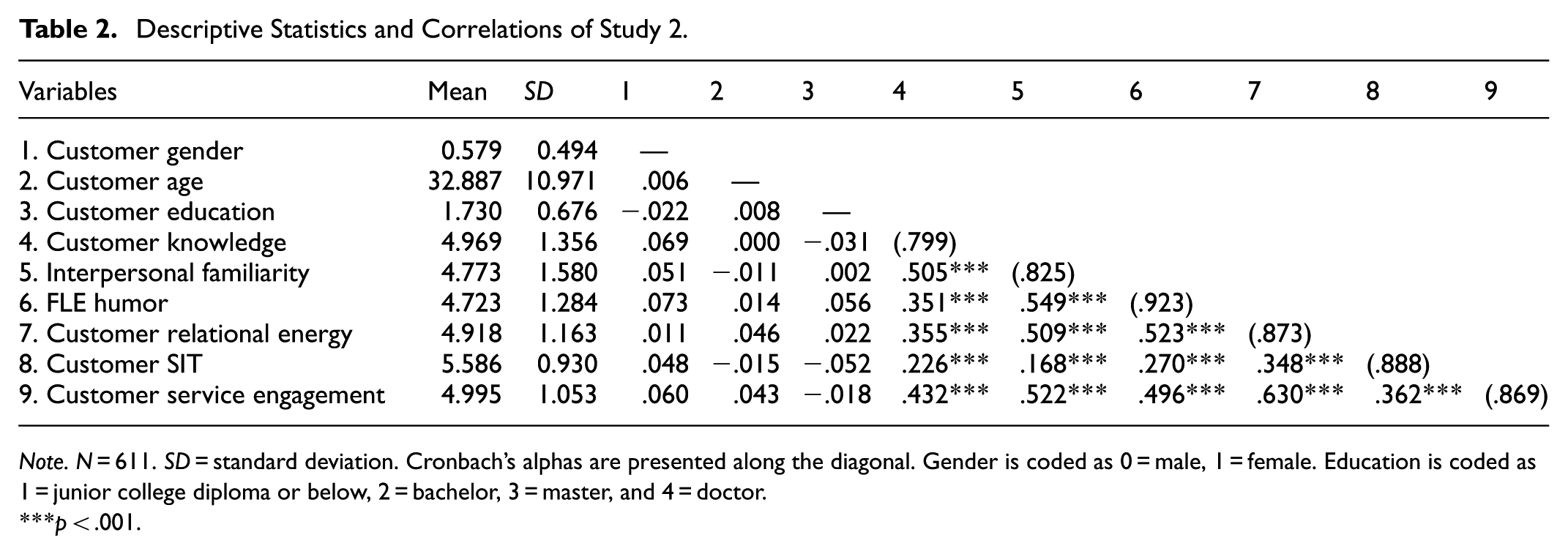
Note. N = 611. SD = standard deviation. Cronbach’s alphas are presented along the diagonal. Gender is coded as 0 = male, 1 = female. Education is coded as 1 = junior college diploma or below, 2 = bachelor, 3 = master, and 4 = doctor.
p < .001.
Hypothesis Tests
As shown in Table 3, FLE humor was significantly related to customer service engagement (γ = .228, SE = 0.032, p < .001), supporting Hypothesis 1. The results in Table 3 also showed a positive relationship between FLE humor and customer relational energy (γ = .304, SE = 0.036, p < .001), which provided support for Hypothesis 2. In addition, customer relational energy and service engagement was significantly related (γ = .384, SE = 0.033, p < .001). Hypothesis 3 was supported. We examined the significance of the indirect effect using the Monte Carlo simulation procedure with 20,000 replications. Results from Mplus showed that the indirect effect was significant (indirect effect = 0.117, SE = 0.017, 95% CI = [0.083, 0.150]). These findings revealed an indirect relationship between FLE humor and customer service engagement via relational energy. Taken together, Hypothesis 4 was supported.
Mplus Analysis Results of Study 2.
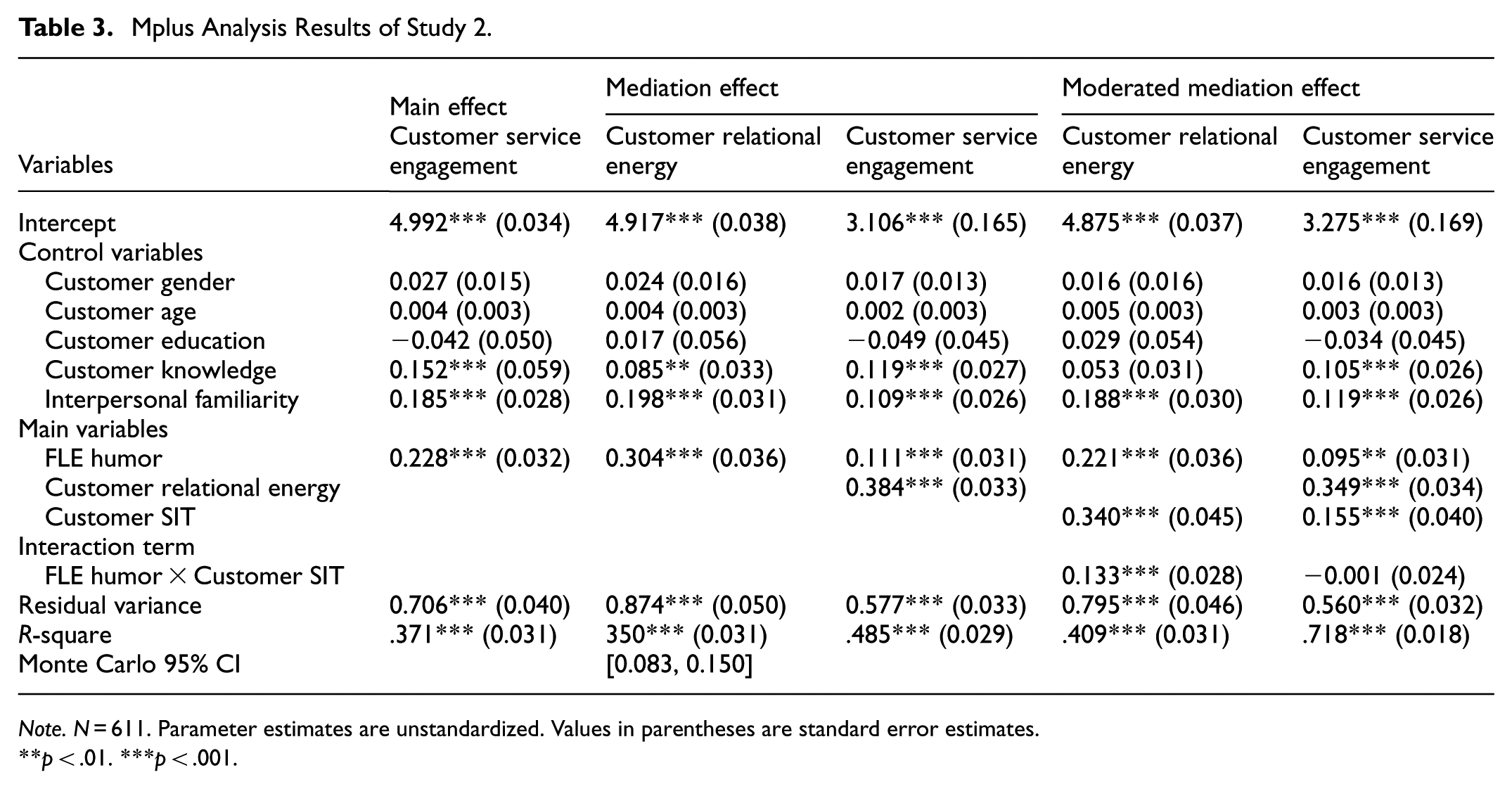
Note. N = 611. Parameter estimates are unstandardized. Values in parentheses are standard error estimates.
p < .01. ***p < .001.
Further, Table 3 revealed that the interactive effect of FLE humor and customer SIT on customer relational energy was significant (γ = .133, SE = 0.028, p < .001). A simple slope test revealed that FLE humor had a stronger positive effect on customer relational energy when customer SIT was high (simple slope coefficient estimate = 0.345, SE = 0.039, p < .001) than when it was low (simple slope coefficient estimate = 0.097, SE = 0.049, p < .05; difference in coefficient estimate = 0.248, SE = 0.052, p < .001). These results supported Hypothesis 5. We plotted the interaction effect in Figure 2.

The interactive effect of FLE humor and customer SIT on customer relational energy.
As shown in Table 4, the conditional indirect effect of FLE humor on customer service engagement via relational energy was more significant for customers with high SIT (indirect effect coefficient estimate = 0.121, SE = 0.018, p < .001, Monte Carlo 95% CI = [0.085, 0.156]) than those with low SIT (indirect effect coefficient estimate = 0.034, SE = 0.017, p < .05, Monte Carlo 95% CI = [0.001, 0.068]; difference in coefficient estimate = 0.087, SE = 0.020, p < .001, Monte Carlo 95% CI = [0.047, 0.126]). These results supported Hypothesis 6.
First-Stage, Second-Stage, and Conditional Indirect Effect Results of Study 2.

Note. SD = standard deviation. Pmx = path from FLE humor to customer relational energy; Pym = path from customer relational energy to customer service engagement.
p < .05. ***p < .001.
To ensure that the control variables did not affect the significance, we retested all the hypotheses without control variables (Bernerth & Aguinis, 2016). Results showed a similar significant pattern when control variables were excluded.
General Discussion
Although the use of artificial intelligence (AI) seems to spawn revolutionary transformational effects on hospitality organizations, the role of face-to-face FLE-customer interaction remains irreplaceable (Bhattacharjee et al., 2025; Kutaula et al., 2022). In particular, with the notion “shifting doing business to customers to doing business with customers” spreads in hospitality organizations (Verhoef et al., 2010), research on customer engagement is flourishing in recent years (Lim et al., 2022; Perez-Vega et al., 2021). Drawing on social exchange theory, we developed a moderated mediation model to examine how and when FLEs’ humor facilitates customer service engagement and its underlying mechanisms. We conducted a scenario-based experiment (Study 1) and a multi-source field survey (Study 2) to examine the theoretical model. Our multi-method approach ensured the internal and external validity of the theoretical model. In sum, the interpersonal-based model with multi-method design provided both theoretical and practical implications.
Theoretical Contributions
The present study offers several theoretical implications. First, adopting a social exchange perspective, we frame FLE humor as an interpersonally related antecedent of customer service engagement and articulate a reciprocity-based mechanism in hospitality contexts. In fact, there are increasing calls that employees should make effort to go beyond the necessary service requirements in contemporary hospitality context, such as establishing psychological contract (Kutaula et al., 2022) and showing kind understanding (Ngo et al., 2020). Accordingly, understanding FLE-customer social interactions is essential. We introduce an interpersonal lens to explain how FLE humor facilitates customers service engagement, thereby enriching the hospitality literature. Moreover, existing literature has mainly focused on the unidirectional effect of humor through frameworks such as conservation of resources theory (Lin et al., 2022) and affective events theory (Tu et al., 2020). In contrast, our social exchange perspective foregrounds reciprocity, offering a complementary account of how FLE humor operates in the hospitality domain.
Second, we elucidate a psychological mechanism linking FLE humor and customer service engagement by adopting an energy perspective and theorizing relational energy as the mediator. This mechanism captures a heightened, positively activating psychological state elicited by interpersonal contact (Owens et al., 2016). This examination is closely tied to research on customers’ well-being. Previous research reveals that intentional activities, such as striving for personal goals, are a key route to enhanced personal well-being (Tang et al., 2024). Customer service engagement constitutes such intentional activity, undertaken to achieve pre-set goal, such as enjoyable dining experiences (Brodie et al., 2011; Hollebeek et al., 2011). Accordingly, our research contributes to the customer well-being literature. In addition, we articulate that resources are exchanged between FLEs and customers as FLEs take initiation action in the way of humor usage and customers choose to reciprocate this treatment with service engagement. Within this reciprocity process, psychological resources are transferred and amplified, increasing customers’ willingness to enact engagement behaviors (Fan et al., 2021; Yang et al., 2019).
Third, this research identifies customer SIT as a boundary condition in the process of relational energy generation, clarifying how interpersonal characteristics can strengthen or weaken the reciprocal process. To date, the effect of SIT has been examined in some contexts. For example, Y. Li et al. (2016) found that SIT strengthens the effect of sexual harassment on job engagement. However, research incorporating SIT into reciprocal processes remains underexplored. Investigating the effect of customer SIT in hospitality settings is important because SIT predicts customers’ awareness and reaction to favorable or negative treatment in interpersonal contact (Bunk & Magley, 2011).
Practical Implications
Face-to-face interaction with FLEs is an important and extremely common part of the service scenario. Our findings provide three main practical implications. First, because the findings of this research reveal that FLE humor has a significant impact on customer service engagement, hospitality organizations should explicitly encourage appropriate humor usage in service interactions by implementing a series of policies. For example, hospitality organizations can establish a humor-related reward system (Zhao et al., 2025). In Chinese organizations, by utilizing WeChat mini-programs (i.e., an extremely popular software in China with more than 1 billion registered users), hospitality organizations can develop an online service evaluation platform to assess humor usage and reward high-scoring FLEs. Moreover, we advise hospitality organizations to improve the staff training system. Hospitality organizations should train the FLEs to equip them with humor skills. Although individuals’ sense of humor is partly derived from their innate traits, it can also be nurtured (Mesmer-Magnus et al., 2012). For example, hospitality organizations can design a humor-related training topic by inviting communication or marketing experts to teach how to cultivate a sense of humor and to appropriately use humor.
Second, we recommend that managers should optimize their staff recruitment and placement. Specifically, Hospitality organizations can consider applicants’ sense of humor as a selection criterion, using validated personality assessments, structured interviews, or work samples to identify humor-competent candidates. By doing so, organizations can build a workforce with a high sense of humor, which in turn increases customer relational energy and subsequent service engagement. Moreover, it is beneficial for front-line sectors to place more humorous employees. Hospitality organizations can identify humorous employees through personality assessment. As such, managers can allocate employees with a strong sense of humor at the front lines where they need to interact with customers. Moreover, department leaders can organize FLEs to share their successful experiences of social interactions with customers. In sum, treating humor as a core interpersonal skill, supported by incentives, training, and talent management, can help organizations cultivate more favorable service experiences.
Limitations and Future Research Directions
Although this research is at the forefront of understanding the interpersonal-based antecedent of customer service engagement, it comes with several limitations that offer opportunities for future research. First, this research mainly focuses on affiliative humor, neglecting the examination of aggressive humor. Since hospitality contexts involve many face-to-face verbal interactions, it is worth investigating the effect of aggressive humor in the FLE-customer relationship (Bhattacharjee et al., 2025). Second, given the nature of humor and relational energy, we used 7-point Likert scales to capture their nuanced judgments and broader variability. However, scales beyond 6-point scales may challenge human’s basic ability to make fine-grained distinctions (Simms et al., 2019). In addition, all the sampled hotels in the field survey are five-star hotels, located at two national AAAAA-level scenic spot. Such sample fail to illustrate the variations across service types, such as luxury versus budget hotels. Finally, our field survey was conducted in the Chinese context. Existing literature suggests that humor is culturally nuanced, with variations in its perception, usage, and implications across cultures (see Lu, 2023 for systematic review). For example, in Taoist-influenced Chinese cultures, humor is often framed as a means to achieve witty, peaceful, and harmonious interactions with others and with nature (Yue, 2010), while in Western contexts humor is frequently associated with charisma and perceived competence because humor helps them stand out from others. Thus, we encourage future research to incorporate broader samples from different cultural contexts to further validate our findings.
Conclusion
Drawing upon social exchange theory, this research develops a moderated mediation model to examine the relationship between FLE humor and customer service engagement, along with the underlying mechanisms. We find that FLE humor can facilitate customer service engagement by fostering relational energy between FLEs and customers. In addition, the strengthen of the path is contingent on sensitivity to interpersonal treatment. Despite advances in artificial intelligence in hospitality, social interactions are expected to play an increasingly important role in delivering favorable service. We hope our findings stimulate further scholarship on social interactions in the hospitality domain.
Footnotes
Appendix

Ethical Considerations
All procedures performed in studies involving human participants were in accordance with the ethical standards of the institutional and national research committee and with the 1964 Helsinki declaration and its later amendments.
Consent to Participate
Informed consent was obtained from all the participants in the studies.
Funding
The authors disclosed receipt of the following financial support for the research, authorship, and/or publication of this article: This study was funded by Chengdu Philosophy and Social Sciences Project, Grant Number: 2025CS091 (awarded to Jincen Xiao); Chengdu Science and Technology Bureau, Grant Number: WZ20250139 (awarded to Xiuwen Zhao); and Department of Science and Technology of Sichuan Province, Grant Number: SCJJ25RKX088 (awarded to Xiuwen Zhao).
Declaration of Conflicting Interests
The authors declared no potential conflicts of interest with respect to the research, authorship, and/or publication of this article.
Data Availability Statement
The processed data that support the findings of this study are available on request from the corresponding author. The raw data are not publicly available due to privacy or ethical restrictions imposed by the companies included in the study.