




Abstract
Recently, there is a growing interest in the concept of spiritual leadership. However, there are conceptual and research dilemmas regarding distinctions between the concept of spiritual leadership and other leadership approaches, especially positive leadership theories. Thus, there is a need to distinguish between the semantic relation construct of spiritual leadership and other related concepts in the field of management. Therefore, the current study provides a systematic literature review and bibliometric analyses of the 422 publications on spiritual leadership that were published between 1980 and 2021. The VOSviewer software with network visualization map was used. This paper contributes to understanding related aspects of spiritual leadership with other leadership approaches, provides a framework for integrating existing theories of leadership and leads to the identification of questions for future research. The study includes concepts based only on moral and ethical issues.
Introduction
The phenomenon of leadership has been investigated in the field of management for nearly 100 years (Samul, 2020a). Over the years, many approaches, theories, and definitions of leadership have emerged. One of the recently recognized concepts is spiritual leadership. The first studies on the spiritual leadership concept began in the 1990s. However, the most developed model was proposed by Fry (2003), who claimed that spiritual leadership is “the value, attitudes, and behaviors that are necessary to intrinsically motivate oneself and others so that they have a sense of spiritual survival through calling and membership” (p. 711). Spiritual leadership is treated as a springboard for a new leadership paradigm (Fry et al., 2005) based on ethical and moral values that provide many benefits from an individual, team and organizational point of view (Samul, 2020b).
Over the last decade, there is a noticeable increase in interest in spiritual leadership among management researchers and practitioners. Many researchers have noted the similarities between recently developed concepts of leadership based on positive aspects, known as value-based leadership theories (Sendjaya et al., 2008) or positive leadership theories (Alvesson & Einola, 2019), which focus more on ethics and moral issues (Burns, 2005). For example, Avolio and Gardner (2005) compared authentic leadership components with transformational, charismatic, servant, and spiritual leadership components, and claimed that there was a very high degree of similarities. Brown and Treviño (2006) compared the construct of ethical leadership with related concepts like spiritual, authentic, and transformational leadership and identified common values such as integrity, altruism, role modelling, and empowerment. Eva et al. (2019) provided a theoretical transparency of servant leadership with other value-based leadership approaches and indicated that there is still a question of the conceptual and empirical overlap between various leadership approaches. Anderson and Sun (2017) have also identified the extensive overlaps among various leadership approaches, such as ideological, pragmatic, authentic, ethical, spiritual, distributed, and servant leadership, and claimed that a major reorientation of leadership research is necessary. Alvesson and Einola (2019) critically examined authentic leadership, and they claimed that much of the criticism can also be applicable to other positive leadership theories. However, there is very little research on the links between spiritual leadership and other similar concepts.
Moreover, the overlapping of multiple leadership approaches is highly problematic and causes “construct proliferation” (DeRue et al., 2011). Suddaby emphasized the need for constructs to be transparent in management sciences and the need to clearly distinguish between different concepts as well as present their relations with other constructs (Suddaby, 2010, p. 347). In a recent meta-analysis, Banks et al. (2018) questioned the justification for the proliferation of leadership theory due to the lack of evidence that each theory is theoretically and empirically different from those that preceded it. “It is almost a point of cynicism that leadership theories seem to be cyclical and return either rebranded or coming back into favor unaltered, rarely feeling entirely complete” (Hudson, 2020, p. 43). Leadership and its definitions are based on a continual evolution, which frequently amounts to nothing more than substituting one outdated characteristic for more progressive examples, without fully explaining the transition (Hudson, 2020). Uslu (2019) has claimed that new leadership theories are a form of self-replication of old theories. In the context of such observations, it is important to place the construct of spiritual leadership against the background of other theories.
The aim of the research is to clarify the meaning of the concept of spiritual leadership in comparison to other concepts of leadership, and to indicate the semantic relations in the conceptual context between them. This provides a theory of the phenomenon of spiritual leadership by identifying the major constructs of the concepts and their relations. Specifically, the study addresses three research questions:
RQ1: How does spiritual leadership relate to existing leadership concepts?
RQ2: Which leadership concepts are closely related to spiritual leadership?
RQ3: What are the semantic relations between spiritual leadership and related concepts?
The current study provides the conceptual connections between spiritual leadership and other concepts of leadership, which have not been explored so far. The study makes an attempt to determine the similarities of the concept of spiritual leadership with the other concepts. A better understanding of spiritual leadership compared to other leadership theories is necessary if the concept of spiritual leadership is to move toward a paradigm status of value to organizations (Crossman, 2010). It might provide insights to scholars and practitioners. It also contributes a significant advancement in the understanding and development of a holistic framework for leadership.
The article consists of the following sections. The first section shortly describes spiritual leadership concept because it is well recognized in the literature. The second section provides a description of the used methods and research questions. The next section presents the results of a bibliometric analysis to verify the connection between spiritual leadership and the other concepts, and the results of the literature review of similarities in theoretical constructs between the related leadership approaches. The final sections conclude the results and limitations, and suggest future directions for spiritual leadership research.
Spiritual Leadership as a Concept of Leadership
One of the first models of spiritual leadership was proposed by Fry (2003, p. 695) who indicated three dimensions: (1) leader values, attitudes, and behaviors, (2) followers’ needs for spiritual survival, and (3) organizational outcomes. The author defined spiritual leadership as qualities like vision, hope/faith, and altruistic love that have a sense of employee spiritual survival through calling and membership so they become more organizationally committed and productive. Among leader values, the author mentioned such qualities as vision, hope/faith, and altruistic love that meet the needs of both leaders and employees. A vision is a future direction of the organization. A spiritual leader is able to inspire others with confidence in the vision (Chen & Yang, 2012). Creating a vision is one of the most important leadership skills over the years (Berson et al., 2016; Ghasabeh et al., 2015; Stam et al., 2014). It has long been recognized that leaders who are able to articulate a vision are critical to the management and success of their organizations (Osman-Gani & Hassan, 2018). Fairholm (1996) claimed that an inspiring vision and mission create a culture of trust, commitment to a team, and organizational effectiveness. Hope and faith with altruistic love create a spiritual environment that helps employees to thrive and achieve the organization’s vision (Ferguson & Milliman, 2008; Fry, 2003; Reave, 2005). Altruistic love refers to a sense of wholeness, harmony, love, trust, loyalty, tolerance, gratitude, acceptance, honesty, integrity, courage, patience, kindness, and humility (Fry, 2003; Fry et al., 2005). Altruistic love is the care that leaders have for their employees, and the concern for fostering a friendly workplace, which increases the intrinsic motivation of employees. Furthermore, altruistic love positively influences employees’ faith (Fry et al., 2005), while, hope nurtures the vision.
The second dimension of the spiritual leadership model is the fundamental need for spiritual well-being shared by both leaders and followers, as expressed through calling/meaning and membership (Fry et al., 2010). Spiritual leadership encourages employees to find a deeper meaning in their work and life, integrating their spiritual identity with professional work (Fairholm & Gronau, 2015). A spiritual leader should take care as regards the meaning and purpose of work and should cause the employees to feel appreciated, understood, and respected in their social interactions. A sense of purpose becomes more significant than simply making money (Ferguson & Milliam, 2008). In recent years, it has been observed that current leadership has returned to the more traditional knowledge about leadership, seeing the meaning of life insight. For example, Alvesson and Einola (2019) emphasized purposefulness, while van Knippenberg (2019) proposed a model of meaning-based leadership that notes the motivating potential of purpose that gives meaning to the work. The second element of spiritual well-being is membership understood as being a part of a community and being connected to others at work. Spiritual leadership focuses on meeting the needs of both leaders and followers in the workplace (Biberman & Tischler, 2008), which is important for every leader. Recent concepts of leadership have claimed that leadership has both individual and collective qualities. Ospina and Foldy (2016) used the phrase “collective dimensions of leadership” and stated that leadership is more of a phenomenon that involves all members of a group than a single “heroic” leader. This observation was also confirmed by the analysis of trends in the leadership literature conducted by Samul (2020a), who concluded that a leader is not one who is a “great man” but rather a person who has “ordinary human” traits and behavior. The spiritual leadership concept emphasizes certain positive values based on ethical and moral aspects. Spiritual leadership has been described as values and behaviors that guarantee the maintenance of moral existence (Karadağ et al., 2020). Reave (2005) pointed out that spiritual leadership is demonstrated in the ethical, compassionate, and respectful treatment of other people. Giacalone and Jurkiewicz (2003) indicated that spiritual leaders not only lead to job satisfaction or commitment but also reduce absenteeism and turnover. Several studies on spiritual leadership have emphasized that showing concern for spiritual well-being in the workplace contributes positively to personal and organizational outcomes (Eisler & Montouori, 2003; Fry, 2003).
The last dimension of spiritual leadership is individual and organizational outcomes—the results of influencing spiritual leadership on spiritual well-being in a work environment. The purpose of having a spiritual leader is to raise the level of organizational commitment and employee productivity (Chen & Li, 2013). Leadership has been widely recognized as a process whereby a person influences a group of people to achieve a common goal (e.g., Bratton, 2020; Griffith et al., 2018; Northouse, 2010; Yukl, 2006).
This review of the spiritual leadership concept presents some roots of spiritual aspects in the overall meaning of leadership. Spiritual leadership as one of the leadership concepts, is a composition of the motivation-based perspective, the religious-based perspective, the ethics-based perspective and the value-based perspective, like many other leadership approaches (Chen & Yang, 2012). It can be summarized using this old sentence: “leadership is the art of dealing with human nature” (Copeland, 1942).
Materials and Methods
A systematic literature review and bibliometric analysis were applied to explore the background of the links between spiritual leadership and other leadership concepts in the existing literature. Literature review plays a crucial role in research to gather existing knowledge and examine the state-of-the-art (Kunisch et al., 2018). This methodology approach allows identifying and describing new concepts, categories, and relations, especially when the existing theory is not sufficient (Graebner et al., 2012). A systematic literature review allows researchers to retain methodological rigor (Moher et al., 2009; Tranfield et al., 2003) through the replication of the review process and receive the same list of publications (Linnenluecke et al., 2020). Bibliometric analyses make the results possible to visualize.
The Scopus database was selected for the bibliometric analysis. Scopus has the largest abstract and citation database of academic text (Khiste & Paithankar, 2017, p. 81) and can be easily used with VOSviewer tool to present visual results. With over 22,000 journals from 5,000 international publishers, Scopus delivers the most comprehensive overview in the field of management science and is widely used for bibliometric analysis (e.g., Bellucci et al., 2022; Salam & Senin, 2022).
In this study, the selection of the literature had three steps: (1) searching the keyword “spiritual leadership” in Scopus database; (2) searching the topic in the field of management; (3) setting the criteria of publications for analysis. For the first step, the keyword “spiritual leadership” was searched in the article titles, abstracts and keywords, according to theme-centric orientation (Webster & Watson, 2002). Other synonymous terms such as “spiritual leader” were omitted because the topic of this research is the concept of spiritual leadership and the aim was to gather publications that were closely related to the concept rather than those that were loosely related to the topic. Most likely, using a keyword like “spiritual leader” would return a large number of articles covering a wide range of topics like performance or well-being. The study sought to establish links with other similar concepts or theories. A total of 1,532 items matched the criteria. To address the research questions in the field of management science, the category of ‘Business, Management and Accounting’ was used in the second step, giving 457 publications. In the last step, the following selection criteria were established: the selection of full-text, peer-reviewed articles in journals, book chapters, books, and conference papers. This resulted in the elimination of reviews. As a result, 422 publications from the year 1980 (when the first article was recorded in Scopus database) to the year 2021 were identified and were included for further investigation and the final bibliometric analysis. The search was conducted in December 2021. Table 1 presents the search procedure and results.
Steps and Criteria of Bibliometric Analysis.

Next, the VOSviewer software was chosen with bibliometric maps to visualize the results that allow one to observe the connections between the concepts (Cobo et al., 2011; Zupic & Čater, 2015). VOSviewer is a method for quantitative analysis of textual data and for constructing and viewing bibliometric maps (Van Eck et al., 2010). To present the bibliometric maps, all keywords co-occurrence analysis was conducted to identify the relations in the topic studied by scholars in the field of spiritual leadership. Keyword co-occurrence network is used in theoretical and empirical studies to explore research trends and their relations in various fields (e.g., An & Wu, 2011; Ding et al., 2001). The number of co-occurrences of two keywords is the number of publications in which both keywords occur together in the title, abstract, or keyword list (Van Eck et al., 2010). The output of the words frequently co-occur analysis is a network of themes and their relations that represent the conceptual space of a field (Zupic & Čater, 2015, p. 435). VOSviewer is a very useful tool to analyze a large variety of bibliometric networks. Scopus data (title, abstract, keywords) was saved in csv. format, which was then uploaded into VOSviewer that automatically provided a bibliometric map that presented the conceptual structure of a research field. There was no need to set any additional criteria.
Analysis and Results
Profile of the Publications on Spiritual Leadership
A total of 422 scientific publications, indexed in Scopus from the last 4 decades (1980–2021) was analyzed. Figure 1 shows the publications by year. It is worth to notice an increase in the number of publications in each decade. The first 10 years produced two publications on spiritual leadership, while in the last 10 years, 305 publications have been written. The largest part of the selected publications are articles (309), book chapters (76), books (20), and conference papers (17).

Number of publications in the 4 decades of 1980–2021.
Table 2 shows publications by country, journal, and author in four decades. In the table, the most common countries, source titles, and authors in the field of spiritual leadership were presented. The first publication on spiritual leadership came from the United States. Thus, it can be considered the country of origin of this topic. In the second decade, the number of publications in the United States increased and the first studies from other countries like India or Australia appeared. In the third decade, existing research has been extended also to European countries. The fourth decade has been dominated by the United States and Asian countries; the research also expanded to other European countries. This indicates that the concept of spiritual leadership has become a common concept of leadership all over the world. However, the countries with the highest overall percentage of publications on spiritual leadership are: United States (39%), India (11%), and United Kingdom (9%). A total of 422 scientific publications, indexed in Scopus from the last 4 decades (1980–2021) were analyzed. Figure 1 shows the publications by year. It is important to take note of an increase in the number of publications as we move from 1 decade to the next. The first 10 years produced 2 publications on spiritual leadership, while in the last 10 years, 305 write-ups have been published. The selected publications include articles (309), book chapters (76), books (20), and conference papers (17).
Publications by Country, Source Title, and Author.

Table 2 shows publications by country, journal, and author in 4 decades. In the table, the most common countries, source titles, and authors in the field of spiritual leadership are presented. The first publication on spiritual leadership came from the United States. Thus, the United States can be considered the country of origin of this topic. In the second decade, the number of publications in the United States increased and the first studies from other countries like India or Australia appeared. In the third decade, existing research has been extended also to European countries. The fourth decade has been dominated by the United States and Asian countries; the research also expanded to other European countries. This indicates that over time, the concept of spiritual leadership has become a common concept of leadership all over the world. However, the countries with the highest overall percentage of publications on spiritual leadership are the United States (39%), India (11%), and the United Kingdom (9%).
An analysis of the publications by the journal indicates that the concept of spiritual leadership was initially explored in the context of human management and human values (Human System Management, Journal of Human Values), it then moved more to the field of leadership (Leadership Quarterly, Leadership Organization Development Journal), and finally, it was published by different journals in the field of management. The journals with the highest overall number of articles on spiritual leadership are: Journal of Management Spirituality and Religion (40), Journal of Business Ethics (22), and Leadership Quarterly (18).
An analysis of publications by authors presents the researchers who have embarked on the adventure of spiritual leadership, those who have continued in it for a long time, and many researchers who have few publications on the concept. The most recognized authors names with the highest overall number of publications are: Fry (14), Delbecq (8), Dhiman (7), Zsolnai (7), Hunsaker (6), and Karakas (6).
Network Between Spiritual Leadership and Other Leadership Concepts
A bibliometric map presents the link between the concept of spiritual leadership and other leadership concepts. Although it can be observed that many topics are related to spiritual leadership, the current study focuses only on the leadership concepts (marked in dashed circle). The highest total link strength of “spiritual leadership” is with: “leadership” in general (142), and concepts such as “servant leadership” (33), “transformational leadership” (20), “ethical leadership” (18), and “authentic leadership” (11). The network visualization map is shown in Figure 2.

The network visualization map of spiritual leadership and other leadership concepts.
Moreover, the map presents the connections in a time interval. It can be noticed that earlier studies on the connections between leadership concepts started around the 2010s and were related to searching for a link between transformational leadership and spiritual leadership (dark violet). Next, ethical and servant leadership juxtaposes with spiritual leadership around the 2015s (dark green), and then—authentic leadership (bright green). Therefore, the studies about the relations between the positive leadership concepts cover the last decade.
The bibliometric map of the network of leadership concepts confirms the recent studies that pay attention to the relations between transformational, servant, ethical, authentic, and spiritual leadership as a development trend of positive forms of leadership (Alvesson & Einola, 2019; Avolio & Gardner, 2005), also called “newer genre” leadership theories (Hannah et al., 2014), “moral approaches” (Lemoine et al., 2019) or “leadership with higher purpose” (Jackson & Parry, 2011). These approaches focus mainly on determining what causes employees to go beyond managers’ performance expectations, show a high level of effort, make prosocial contributions to the group, and contribute to group maintenance and well-being (Hannah et al., 2014). These concepts are similar but have distinct characteristics that make them a standalone “construct” (Lemoine et al., 2019; Walumbwa et al., 2008).
Semantic Relationships Spiritual Leadership with Positive Leadership Concepts
In the following sections, a brief review of studies about the comparisons between spiritual leadership and related theories based on definitions and constructs are presented.
Spiritual and Servant Leadership
Servant leadership is considered as a holistic leadership approach that engages followers in multiple dimensions: relational, ethical, emotional, and spiritual (Eva et al., 2019). Likewise, spiritual leadership is perceived by Fry (2003) as a holistic approach that includes: body (physical factor of human), mind (logical/rational thought), heart (emotions, feelings), and spirit. Akuchie (1993) tried to find the biblical roots of servant leadership that are common with the spiritual leadership concept, where spirituality often associates with religion (e.g., Benefiel et al., 2014; Karakas, 2010). Spiritual development as a domain of spiritual leadership results in self-awareness and hope that facilitate servant leadership. A calling to serve that is born out of spiritual growth strengthens and increases the efforts to serve others (Greenleaf, 1970; Patterson, 2010). Servant leadership relies on spiritual insights and humility as its source of influence (Graham, 1991; Greenleaf, 1970).
The next common characteristic of the servant and spiritual leadership is serving others. According to the most common definition proposed by Greenleaf (1970, p. 4) servant leadership ensure that others’“highest priority needs are served first.” Servant leadership focus on the natural feeling of serving and puts employees first (Eva et al., 2019; Hale & Fields, 2007). Also, spiritual leaders rather show concern for others than themselves (Chalofsky & Krishna, 2009). It can be said that both concepts of servant and spiritual leadership go beyond yourself. Moreover, servant leadership encourages followers to contribute to society (Reed et al., 2011; Stone et al., 2004), so also, spiritual leadership focuses on the social goals of the organization (Wang et al., 2019).
Furthermore, serving others pays attention to promoting their well-being (Hoch et al., 2018; Roberts, 2021). Servant leadership involves caring for employees’ well-being by creating a positive work environment (Black, 2010; Greenleaf, 2002; Hoch et al., 2018). When followers’ well-being, growth, cohesiveness, and collaboration are prioritized, they are more engaged, and this, in turn, leads to increased prosocial and altruistic behavior that improves organizational performance (Ebener & O’Connell, 2010; Hu & Liden, 2011; Walumbwa et al., 2010). The significant role of the spiritual leader is to create a culture that promotes the spiritual well-being of employees. Spiritual leadership taps into satisfying the needs of spiritual well-being through calling and membership (Fry et al., 2011).
Servant leaders take care of employees’ personal and professional development (Greenleaf, 1997; Matteson & Irving, 2006) for their own good, as an end, in and of itself, not only for reaching the organizational goals (Ehrhart, 2004). It seeks first and foremost to develop employees on the basis of leaders’ altruistic and ethical preferences (Greenleaf, 1977). Just as servant leadership strives to enable employees to become better and more developed (Graham, 1991; Greenleaf, 1977), spiritual leadership also strives to help them grow and develop (Ferguson & Milliman, 2008). Moreover, caring for others seems to come from the same foundations—agape in servant leadership and altruistic love in spiritual leadership. These are oriented toward transcendental values such as agape or unconditional love which means “unselfish delight in the well-being of others, and to volitionally engage in acts of care and service without expecting anything in return” (Beauregard et al., 2009, p. 94).
The original source of the servant-follower relation is a sense of connection with others (Chandler et al., 1992; Helminiak, 1987). This connection to others allows leaders to develop self-awareness that they are only part of a larger whole, which encourages humility (Bragger et al., 2021). A servant leader with empathy, compassion, and altruistic calling builds a healthy workforce by inculcating a sense of cohesiveness and collaboration (Jit et al., 2017). Sanders et al. (2003) defined spiritual leadership as the organization level of encouraging and providing a sense of significance and interconnection among collaborators.
Common values are noticeable when we compare both concepts. Spiritual leadership engenders integrity, humility, trust, engagement, altruistic love, and vision (Sendjaya & Pekerti, 2010; Sousa & van Dierendonck, 2017) so also, the servant leadership includes integrity, humility, trust (Errol & Winston, 2005; Marquardt, 2000; Patterson, 2003; Russell & Stone, 2002; Wong & Page, 2003); love and caring for others, and developing others (Banutu-Gomez, 2004; Greenleaf, 1977; Wong & Page, 2003); and vision and purpose (Farling et al., 1999; Whetstone, 2002; Wong & Page, 2003). Both servant and spiritual leadership involve taking care of others in the organizations based on "intrinsically virtuous approaches that set out to cultivate a sense of love, hope, faith, holism, integrity, meaning, purpose, and interconnectedness in the workplace” (Crossman, 2010, p. 603).
Spiritual and Transformational Leadership
Transformational leadership as a following concept of a value-based approach is described as a moral leadership that relies on inspiring followers to look beyond self-interest and work together for a collective purpose (Burns, 1978). Only this definition shows several common elements with spiritual leadership. Transformational and spiritual leaders care about others and pay attention to the community. Transformational leader “attends to the needs of each follower (…) and listens to the concerns and needs of the follower” (Judge et al., 2004, p. 755). The transformational leader encourages self-transcendent behaviors among followers such as going beyond self-interest for the benefit of the collective (Burns, 2003), which is one of the aspects of altruistic love. The spiritual leader also pays attention to the needs and interests of employees and care for their well-being (Abdizadeh & Khiabani, 2014). Spiritual leaders feel love for others and value them, and build relationships by creating common values.
Sparks and Schenk (2001) explored the components of transformational leadership theory and concluded that transformational leadership “transforms” followers by encouraging them to see higher purposes in their work. Meanwhile, spiritual leaders focus on inspiring employees by providing the meaning of work and a sense of belonging, which means meeting the needs of spiritual well-being (Fry, 2003). The empirical study confirms that spiritual well-being can predict the behavior of transformational leadership (Mehdinezhad & Nauri, 2016). Thus, fostering group cohesiveness and a sense of belonging or “membership” to a collective is a common part of transformational and spiritual leadership (Jung & Sosik, 2002; Walumbwa & Lawler, 2003).
Similarly, spiritual and transformational leaders are thought to be visionary. One of the dimensions of transformational leadership is inspirational motivation, described as “the degree to which the leader articulates a vision that is appealing and inspiring to followers and ‘challenge followers with high standards, communicates optimism about a future goal achievement and provides meaning for the task at hand’” (Judge et al., 2004, p. 755). Transformational leaders focus on activating others to attain their vision (Bragger et al., 2021). Mack et al. (2014) through a literature review and analysis demonstrated that transformational leadership has the ability to lead followers toward meaning, purpose, and interconnectedness with the organization’s goals and values. Meanwhile, one of the main aims of a spiritual leader is the inspiration of others by intrinsic motivation to achieve the vision of the organization.
Spiritual and Ethical Leadership
The next positive concept is ethical leadership, which is defined as a model of ethical conduct that “becomes targets of identification and emulation for followers by engaging in behaviors that are: normatively appropriate (open and honest); motivated by altruism (treating people fairly and considerately); and communicate ethics-related messages” (Brown et al., 2005, p. 120). Mayer et al. (2012, p. 151) analyzed that definition and indicated three main characteristics: “being an ethical example, treating people fairly and actively managing morality.” A role model is a leader who can be seen as a plausible example because he/she practices what he/she preaches (Brown et al., 2005; Mayer et al., 2009). Spiritual leadership is also considered as a “living example” with respect to the treatment of others (Reave, 2005), as well as an ethics-based approach to leadership (Fry, 2003). In the literature, we can find such studied values as honesty, altruism, trust, integrity, and humility (Dede & Ayranci, 2014; Reave, 2005; Fry, 2003) that causes a spiritual leader to portray himself as the example of someone who can be trusted, relied upon, and admired.
Spirituality is related to employees’ ethical behavior, greater commitment, and less likelihood to worry (Eisler & Montouori, 2003). Brown et al. (2005) compared ethical leadership with related concepts about common moral dimensions and claimed that ethical leaders should be perceived as open, honest, and motivated by altruism. The emphasis of spiritual leadership on integrity and altruism is consistent with conceptualizations of the ethical dimension of leadership. Ethical leadership is the behavior of a leader based on building interpersonal relationships, inspiring, and promoting such behaviors among employees to achieve leadership goals (Brown et al., 2005). Respect for employees is considered the standard of moral values. Spiritual leaders try to meet the needs of employees according to their moods and give them common values based on ethical understanding and principles (Fairholm, 1996). Ethics and spiritual leadership are the drivers of positive interrelations with followers (Reave, 2005).
Brown and Treviño (2006) conducted a comparison of ethical leadership with spiritual leadership and pointed out key similarities between them: concern for others (altruism), integrity, and role modelling. An ethical leader is a person who shows concern for people and the whole society. Spiritual leadership also demonstrates social behavior through taking care of others and society and refers to finding a balance between one’s own interests, the interest of employees, the interest of the organization, and the interest of society (Samul, 2020b). Ethical leadership achieves moral good, based on integrity, trust, and moral rectitude (Sama & Shoaf, 2008). Spiritual leadership is based on goodness and ethics as a principle of life (Fairholm, 1996). According to Reave (2005), ethical leadership may explain the effectiveness of spiritual leadership in certain environment. Spiritual leadership and ethical leadership are related to each other. On the one hand, moral character and an ethical environment are required for spiritual leadership. In order for spirituality to exist, spiritual leadership must include ethical characteristics such as honesty and faith. On the other hand, spiritual motives may encourage someone to become an ethical leader in the first place. There is a great deal of overlap between the two theoretical models (Osman-Gani & Hassan, 2018).
Spiritual and Authentic Leadership
Authentic leadership includes other positive leadership approaches such as transformational, charismatic, servant, and spiritual leadership (Avolio & Gardner, 2005; Lemoine et al., 2019), also called the “root construct” for the others (Luthans & Avolio, 2003, p. 4). The emergence of the authentic leadership concept was a consequence of a loss of faith in previous leadership approaches (May et al., 2003, p. 247). Citing the definition of authentic leadership, some parallels with spiritual leadership can be observed. Authentic leadership is derived from the word “authentic.” In Greek philosophy, this means “know the self,” in the West, it is used interchangeably with “genuineness,”“reality,” and “truth” (Grayson & Martinec, 2004). An authentic leader as a role model fosters the development of authenticity in followers that contributes to their well-being (Avolio & Gardner, 2005). The concept of spirituality aims to promote authenticity in leadership (Benefiel, 2005; Cavanagh et al., 2003).
The concept of authentic leadership was originally described by Gardner et al. (2005) as leading by example, communicating high moral values, and being a positive role model. Authentic leadership is “a pattern of leader behavior” that promotes positive self-development (Walumbwa et al., 2008, p. 94). Meanwhile, spiritual leadership is also a model of shaping an individual’s behavior (Karakas, 2010).
An authentic leader is an individual who is deeply aware of how he thinks and behaves, knows who he is, and what he believes (Avolio et al., 2004, p. 4). Similarly, spirituality focuses on our sense of who we are, and our beliefs about why we are here (Astin, 2004, p. 4).
Avolio and Gardner (2005) analyzed the related leadership theories, including authentic and spiritual leadership and indicated the overlapping areas: focus on integrity, trust, courage, hope, and perseverance. Authentic leaders have attributes such as hope, confidence, self-awareness, openness, optimism, resilience, transparency, and consistency (Avolio et al., 2004; Gardner et al., 2011), which are parts of the altruistic love of the construct of spiritual leadership (Delbecq, 1999). Likewise, concern for others (over self) is essential to authentic leadership (Brown & Treviño, 2006) and spiritual leadership (Chalofsky & Krishna, 2009). Michie and Gooty (2005) studied the influence of values and emotions on leader authenticity and claimed that universal values such as honesty, and positive emotions such as appreciation and concern for others play a fundamental role in the development of authentic leadership. Both authentic and spiritual leaders are guided by qualities of the heart, passion and compassion (Avolio et al., 2004; van Saane, 2019).
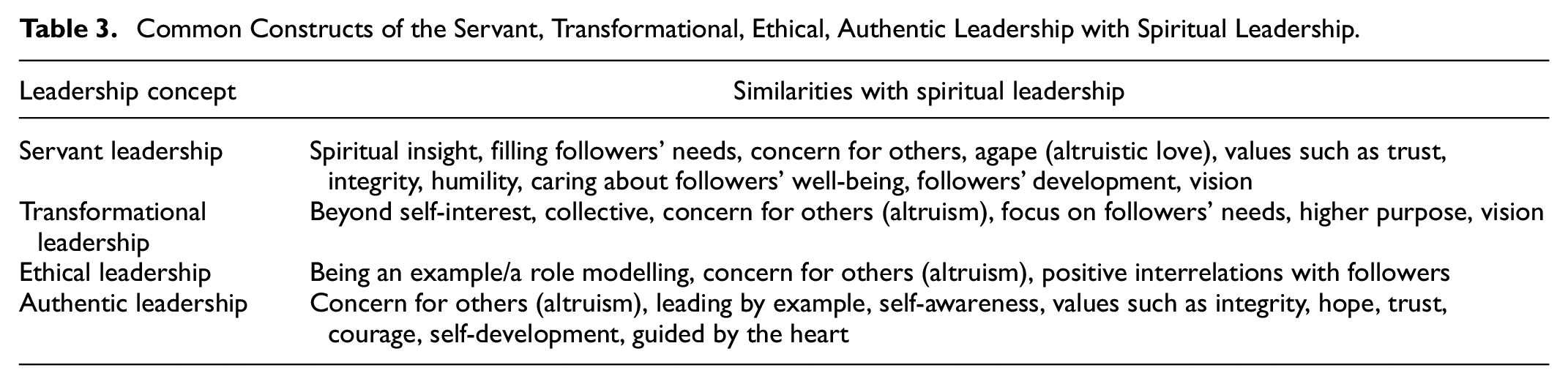
To summarize the above literature review, Table 3 presents the similarities between spiritual leadership and servant, transformational, ethical, and authentic leadership. It can be noticed that similarities are overlapped. All positive leadership theories share common main elements: concern for others and leading by example. These characteristics are the essence of, it can be said, leadership in general. Due to all these similarities, there is a need for further research to provide evidence that these concepts are independent. One of the critical caveats suggests that spiritual leadership is privileged because it is reserved for naturally unselfish super-leaders (Northouse, 2018).
Common Constructs of the Servant, Transformational, Ethical, Authentic Leadership with Spiritual Leadership.
Conclusions
Research on spiritual leadership has been developing since the 1980s and is gaining more and more attention. In the last decade, there has been a lot of research in this area, along with the opinion that it is a new paradigm in the field of leadership. This study showed the relations of spiritual leadership not only with the general leadership theory but also with the other leadership concepts, especially positive ones, which are based on ethical and moral values.
The analysis of the literature review shows that spiritual values scroll through the current leadership approaches, especially in the last decade. Spiritual, moral and ethical values, attitudes and behaviors of leaders expressed by spreading a vision, giving hope for its realization, expressing trust in its achievement, loving approach to others, caring for well-being to achieve individual and organizational outcomes are the common constructs of positive leadership theories. It can be said that the concept of spiritual leadership is a combination of motivation-based perspectives from transformational leadership; religious-based perspective focusing on values such as giving care and love to others from servant leadership; an ethics-based perspective from ethical leadership; and a value-based perspective, fostering employees’ meaning of work and interpersonal relations with various leadership approaches. It might confirm Hudson’s (2020) words about leadership that there are “no new stories.” However, the statement that the concept of spiritual leadership is nothing new is not a critical voice, but rather a positive one. It confirms the importance of this concept. If many aspects of spiritual leadership appear in different theories and concepts, then this theory must be true and valid. The similarities between these concepts only confirm the significance of such common elements as caring about employees, leading by example, following the heart, authenticity, honesty, morality, and ethics that contribute to effective leadership. This concept seems to revisit previous definitions of leadership and to remind us again of what is the crux of leadership, parallel to the addition of value in current new contexts.
Spiritual leadership might be considered as a root of leadership. Howard (2002) treated the interest in spirituality as a new dimension of management and claimed that it is “probably the most significant trend in management since the 1950s” (p. 230). First of all, related leadership concepts only touch (indirectly) spiritual values, meanwhile, spiritual leadership focuses directly and comprehensively on spirituality. Spiritual leadership comprehensively combines spirituality with the daily work life of every leader, not only the outstanding leaders. Second, although spiritual leadership is based on well-recognized positive values, it is tailored toward the current times and challenges in leadership. Spiritual leadership can be said to be the continuous updating of previous leadership theories. However, it takes into account recent achievements in the field of management, leadership, or psychology related to employee motivation theories, care for their well-being or development of a positive workplace. It also includes the constant human desire to have a role model and seek greater meaning in what we do on the earth, in our life, and in work. Third, the concept of spiritual leadership allows us to better understand the core of leadership. It does not mean that spiritual leadership is the only and the most appropriate approach to leadership; however, it pays attention to the spiritual side of employees which has not been taken into account so far by previous theories and the existence of which we cannot deny. One of the integrated definitions of leadership pointed out that leadership affects followers to enthusiastically expend spiritual, emotional, and physical energy to achieve the organizational vision and objectives (Winston & Patterson, 2006). The current study confirms that we should follow this definition of leadership.
Limitations and Agenda for Future Research
The current study has certain limitations. First, not all leadership theories and concepts were included in the above analysis. This study included only the concepts, which are related to spiritual leadership based on bibliometric analysis. This may change in the next decade depending on research trends. Moreover, it is rather impossible because it is estimated that since 2000 till date, about 66 separate leadership theories have appeared in the published literature (Dinh et al., 2014). The next limitation of the study is the use of Scopus database. However, most of the publications from Scopus are repeated on the Web of Science, which is also often used for bibliometric analyzes. Most likely the results would be the same. Also, the choice of using only one keyword, “spiritual leadership,” may have limited the obtained results. Using more keywords could indicate a relation with other topics as well. Next, perhaps a little space has been devoted to the approaches. However, this study does not claim to be exhaustive; rather, it is a starting point for further reflexive in-depth research on this topic. Separate articles could be devoted to each pair of concepts compared. Furthermore, this research includes a comparison of only the theoretical construct of definitions and concepts. On this basis, the similarities were identified.
In this paper, a research agenda for further investigations was developed. The conducted bibliometric analysis as well as the literature review clearly indicate the existence of connections between the above-mentioned concepts of leadership. This raises further questions that researchers should seek answers to: Do empirical research findings also confirm the links between these concepts? What are the differences (conceptual and research) between these theories that allow them to be treated as independent of each other? Do these connections require the integration of positive leadership theories?
This study was focused on identifying the connections resulting from the way of defining particular concepts and their theoretical constructs. Therefore, research on the empirical context of spiritual leadership and other theories should be conducted. This can be done in two ways. First, a systematic literature review can be conducted to present antecedents, mediators, moderators, and outcomes from various positive leadership concepts. The second way is the examination of the convergence between the questionnaire on spiritual leadership and questionnaires on other concepts. For example, Rowold and Heinitz (2007) compared the measures of transformational and charismatic leadership questionnaires. Empirical studies on spiritual leadership have not compared the concept of spiritual leadership with other leadership approaches, so it is unknown whether spiritual leadership adds new knowledge above and beyond the other styles. It would be interesting and would also confirm the links between the empirical concept of spiritual leadership and the others.
To answer the second question, it is necessary to analyze the differences between spiritual leadership and other concepts. This analysis should be conducted through a conceptual and research context lens. It can be noticed that this study focuses only on similarities, however not every component is common. For example, Avolio and Gardner (2005) claimed that authentic behavior differs from authentic leadership and from spiritual leadership. It would be useful to present the differences that result from the conceptual constructs of the concepts. Likewise, a comparison of the research findings from the studies on this topic would shed light on the independence of these concepts. A holistic framework including both similarities and differences could help to explain the complex interrelations.
These findings also highlight the need to consider a combination of a “full-range” leadership approach. The overlapping of many concepts makes it worth considering whether it is time to develop one holistic approach to leadership, instead of looking for the next best new-old leadership concept. Leadership theory needs to be developed in a comprehensive way, integrating all previous knowledge about effective leadership. A similar opinion has led Anderson and Sun (2017) to state that we should pay attention to the need to integrate different approaches into a new “full range” style of leadership that will allow future investigations to better combine leadership research, rather than replications. However proud the words “there is not much to learn about how one human can lead others” (Hudson, 2020, p. 44) sound, they seem to be true today. It seems that the need for integrating that knowledge is more significant now than ever before.
Footnotes
Author Contributions
The author contributed to the whole study.
Declaration of Conflicting Interests
The author declared no potential conflicts of interest with respect to the research, authorship, and/or publication of this article.
Funding
The author received no financial support for the research, authorship, and/or publication of this article.

Data Availability Statement
Data sharing not applicable to this article as no datasets were generated or analyzed during the current study.