




Abstract
The aim of this study is to review the body of literature on the contribution of family businesses to economic growth. The Scopus database was used to conduct the bibliometric analysis of the topic under discussion. The sample procedure was completed using PRISMA. VOSviewer software was used to go through 598 publications. This way, the network’s growth, the most active contributing agents, the intellectual structure’s background, the most popular topic, and the research gap for further study were all exposed. We noticed that the Scopus database began to include publications of family business research in 1998. The terms “family businesses,”“entrepreneurship,” sustainable development, and “economic growth” have been used often. The density map displays recent themes such as family businesses, entrepreneurship, sustainable development, and economic growth. Also, it was found that the Sustainability (Switzerland) journal had the most articles overall. However, the Journal of Financial Economics was the top source, receiving more citations overall. Furthermore, the five top-ranked contributing nations in family businesses are the USA, the UK, China, Spain, and Italy. Therefore, research gaps have been presented. Researchers will learn from the findings regarding the implications for the past, present, and future. There are several restrictions on this study pertinent to the bibliometric methods’ shortcomings. One of the limitations was that the synonyms used in the search query were not exhaustive, so it excluded other documents that could be used in this research.
“Global Perspective and Trend of the Knowledge Base Regarding the Contribution of Family Businesses to Economic Growth”
Introduction
Family businesses are the predominant type of business organizations in every economy in the world (Aparicio et al., 2021; Lepore et al., 2019). They also play a significant role in creating employment in the private sector and boosting GDP (Aparicio et al., 2021; D’Angelo et al., 2016).
Family businesses play a crucial role in the economy, constituting a substantial presence in the economic landscapes of numerous countries worldwide, irrespective of the diversity of their economic strategies and global economic positioning (Sabaa, 2021). In these instances, family enterprises comprise the predominant share of the overall businesses active within the national economies of these nations (Sabaa, 2021).
Family business research adopts a range of theoretical perspectives that illuminate the intricate dynamics between family and business systems. These perspectives encompass Family Systems Theory, Agency Theory, Resource-Based View, Stewardship Theory, and the Socioemotional Wealth Framework, among others (Gabriel & Bitsch, 2018; Suman, 2020). These lenses offer insights into understanding the challenges, advantages, and unique characteristics of family-owned enterprises within a diverse and evolving theoretical landscape (Gabriel & Bitsch, 2018; Suman, 2020).
There has been a significant rise in the number of studies published recently to better understand the behavior of family businesses (Araya-Castillo et al., 2022; Hernandez-Perlines, 2018). This rise is contributed mostly by three factors: family businesses are the most typical type of business globally (Fan et al., 2011; Gedajlovic et al., 2012; Hiebl et al., 2018); family businesses play a significant role in the economic development and well-being of many nations (Mirjana et al., 2018); and family businesses are the type of businesses that generate the most jobs (Fan et al., 2011). Nevertheless, there is a claim that, to date, there hasn’t been much progress made in the field of family businesses (Gedajlovic et al., 2012).
In this case, there was a need for bibliometric research to solve the doubt. This research found that the first article to appear in the Scopus database for “business,”“business and finance,”“economics,” and “management” was “Dependency or self-reliance? The contradictory case of work in UK small business families,” written by Wheelock J. and Baines S. and published in the “Journal of Family and Economic Issues” in 1998. The sample consists of 598 articles published between 1998 and 2023. Despite the rising tendency, there were noticeable fluctuations in growth, like drops in 2014, 2017, and 2020. All of the articles in the sample were written by a total of 595 authors.
For a number of reasons, it is vital to review the publications that have significantly increased the family business literature. Researchers frequently stress the value of categorizing the literature of a study field according to the dominant disciplinary trends in order to enhance scientific knowledge (Aparicio et al., 2021; Bjork et al., 2014). A literature review is a starting point for knowledge advancement because it engages academics and practitioners by offering a transparent audit trail for validating the arrangement and flow of articles and by igniting discussion of the field’s potential future directions.
Numerous literature reviews have been conducted in order to ascertain the existing knowledge within the field of family business research (Gedajlovic et al., 2012; Rovelli et al., 2022; Xi et al., 2015). These evaluations have demonstrated that family business research is a topic that is always changing, and new strategies are required to comprehend the industry’s past, present, and future. By using a bibliometric approach and broadening the coverage of the analyzed journals, the current effort attempts to delve into the evolution of the subject to supplement the previous work of Rovelli et al. (2022).
Bibliometric analysis has proven to be a useful tool for quantitatively analyzing academic publications in order to assess research trends in various fields of study (Priyan et al., 2023a, 2023b). Bibliometrics is described as “the application of mathematics and statistical approaches to books, book chapters, conference proceedings, articles, reports, and other media of communication” (Durieux & Gevenois, 2010). This study’s objective is to give a thorough overview of the family business research field, covering the following areas: (1) the family business research growth trend; (2) the most popular family business themes and the research gap; (3) the major contributing agents: authors, articles, sources, and nations; and (4) the intellectual structure of family business research. This study illustrates the research hotspots and priorities of family business research, allowing readers to comprehend the trends, significant theoretical and practical contributions, and family business’s upcoming issues contributing to economic growth.
Different online bibliographic databases exist at the moment; however, they do not all cover the scientific subject equally (Cobo et al., 2012). The Web of Science and Scopus are the main databases. In fact, 84% of Web of Science publications are in Scopus (Singh et al., 2021), which was chosen for this study since it includes a wider range of journals (Mongeon & Paul-Hus, 2016).
This bibliometric review aims to provide academics with a better understanding of historical, contemporary, and upcoming trends as well as to recommend prospective future research subjects (Priyan et al., 2023a, 2023b). Different from what others have done, we use PRISMA (Preferred Reporting Items for Systematic Reviews and Meta-Analyses), which accounts for bias and encourages transparency; we use data from all Scopus journals for the whole period of Scopus publication in the family business domain, not just some journals (Rovelli et al., 2022).
Li et al. (2023) limited their study to the years 2004 to 2021 to explore sustainability disclosures in family firms with “corporate social responsibility” as a main term in their search query, contrary to this study, which covers the whole period from the first appearance of family business documents on the Scopus database (1998) to 2023 to widen the scope. Furthermore, this study is a general bibliometric review of the impact of family businesses on economic development, using economic development as a main term in the search query. Furthermore, this study used the VOSviewer software to do bibliometric analysis, contrary to the literature (Li et al., 2023) that uses the Biblioshiny and other software to do bibliometric analysis. However, the context of the research differs from this study due to the fact that it is a general bibliometric review paper with different research questions than those used in this study.
Furthermore, most of the research was done in a short period of time, like Ho et al. (2022), whose study was from 2008 to 2020 with a limited scope (only Vietnam) using Tableau, contrary to this study, which included worldwide documents published on Scopus in all the periods from the first appearance of family business documents on the Scopus database (1998) to 2023, using VOSviewer software to widen the scope. Not only that, but also Ho et al. (2022) used the SSHPA database in data sampling and collection, contrary to this study, which used the Scopus database due to its benefits stipulated in the methodology section of the literature. Therefore, subject to the above differences, this study is innovative and new.
Therefore, using a science mapping methodology, we conducted a bibliometric analysis of family business studies, focusing on the following research questions:
RQ1: What is the current growth trend in the field of family business research?
RQ2: What are the most popular family business themes, and what is the research gap?
RQ3: Who are the major contributing agents: authors, articles, sources, and nations; to the understanding of family businesses?
RQ4: What is the setting of the literature on family businesses’ intellectual structure?
In order to create a useful knowledge base, this review of the literature examines the corpus of family business research (specifically the literature on the contribution of family business to economic growth) using bibliometric analysis, which is the most useful method for assessing the conceptual framework of the research issue (Kumar et al., 2020).
Bibliometric analysis is a statistical examination of published documents (book chapters, scientific articles, and published books, among others), which is an efficient technique to quantify the influence of publication in the scientific community (De Moya-Anegón et al., 2007). It is a scientific computer-assisted review technique that looks at all of the publications on a particular topic or field and seeks to discover the major item relationships (Han et al., 2020).
Research Methods
Cisneros et al. (2018), Kumar et al. (2020), Priyan et al. (2023a), and Priyan et al. (2023b) used methods like co-occurrence analysis, citation analysis, co-authorship analysis, and co-citation analysis in their bibliometric assessments of the literature. VOSviewer software is used to do bibliometric analysis of the literature (van Eck & Waltman, 2010). We chose VOSviewer software because of its adaptability. Contrary to other tools, VOSviewer can offer a thorough graphical depiction of bibliometric maps (van Eck & Waltman, 2010). We began reviewing the family business literature on August 17th, 2023, in order to get a current image of the subject field and compile a list of the terms that are most frequently used.
Before beginning the process of collecting data, we established our inclusion criteria in accordance with the PRISMA protocol (Moher et al., 2009). PRISMA is an evidence-based item that is intended to assist authors when reporting a wide variety of systematic reviews and meta-analyses, which are primarily used to evaluate healthcare interventions. PRISMA focuses on methods authors can take to make sure their research is conducted in a transparent environment and fully disclosed (Gough et al., 2012).
Identifying Sources for the Review
Scopus was chosen as the source of information for researching and getting papers because empirical studies have demonstrated that it offers more thorough coverage of publications than Web of Science sources for the social sciences (Mongeon & Paul-Hus, 2016). The authors maintain that this is a field-specific claim that has to be empirically validated (Hallinger & Kovačević, 2019). It’s possible to argue that the Web of Science contains a database of higher-quality sources because of its more limited coverage (Martín-Martín et al., 2019; Orduna-Malea et al., 2015). However, Archambault et al. (2009) found a significant correlation between publications and citations in Scopus and Web of Science.
Search Delimiting Criteria
The “Scopus” database was initially searched on August 17, 2023, using the predefined search string. The operator “TITLE-ABS-KEY,” which conducts full-text searches on titles, abstracts, and authors’ keywords, was used to conduct the query in the Scopus Database. We were able to gather all of the double-blind peer review research contents by restricting the search to documents published in English in the “final papers” category and released up to August 17th, 2023. Our result was filtered using a set of exclusion and inclusion criteria (Figure 1).

The PRISMA flow diagram explaining steps in the identification and screening of data (Moher et al., 2009).
The PRISMA technique served as the basis for the document search (Moher et al., 2009). For accurate results, parentheses customize the output. The search terms are specified using the question mark “?” and the asterisk (“*”) for inclusion, as well as the Boolean operators (OR, AND) to widen and narrow the search, respectively (Priyan et al., 2023a, 2023b). A Scopus database was searched using the terms (contribution) AND (“family business*” OR “family firm*”) AND (“economic growth” OR “economic development”). In this search, 4,088 documents were discovered. 3,490 documents were eliminated after screening and eligibility verification because they contained undesired specifications or were not eligible to meet inclusion criteria (Figure 1).
Results
For data analysis, the 598 papers’ bibliographic details, including citations, titles, authors, abstracts, and keywords, were exported. The comprehensive bibliometric research included “visualization of similarities,” keyword co-occurrence analysis, author co-citation analysis, and citation analysis (van Eck & Waltman, 2017; White & McCain, 1998). In the bibliometric research, VOSviewer analysis utilized analytical tools from Excel and Scopus (van Eck & Waltman, 2017). The results of the bibliometric analysis of the knowledge base on family businesses are presented in this section, which answers the four research questions as follows: RQ1, the rising global trend in scientific production for family business research, was analyzed (see Figure 2), RQ2, the most popular family business themes, and the research gap were analyzed (see Table 1 and Figure 5), RQ3, the major contributing agents: authors, articles, sources, and nations; to the understanding of family Businesses were analyzed (see Tables 2 to 4 and Figures 3 and 4), and RQ4, the setting of the literature on family businesses’ intellectual structure was analyzed (see Figure 6).
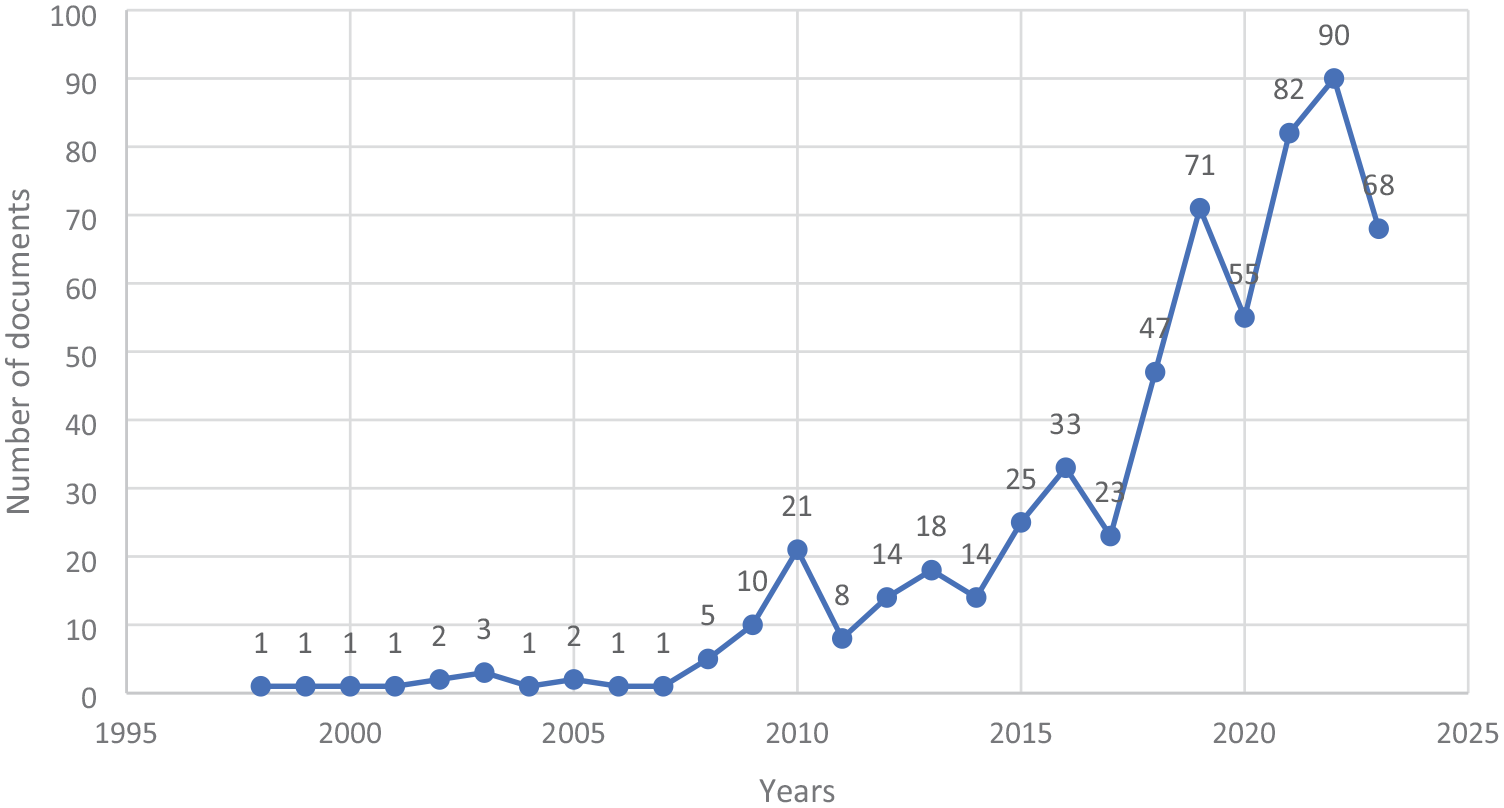
Longitudinal evolution of the family business, 1998 to 2023 (n = 598).
The Keywords Growth Trend in Family Businesses Knowledge Base.

Source. Author.
Rank Order of the Most Contributing Journals in Terms of Productivity and Citations.

Source. Author.
Rank Order of the Most Influential Authors in Family Businesses Knowledge Base.

Source. Author.
Rank Order of the Most Influential Documents in Family Businesses Knowledge Base.

Source. Author.

Worldwide distribution of family business documents, 1998 to 2023 (n = 598).

Ten top most prolific nations in family business research (n = 20,204).
Evolution of Family Businesses and Their Growth Trend
The sample, which consists of 598 articles, was published between 1998 and 2023. Figure 2 demonstrates the rising global trend in scientific production for family business research. Despite the rising tendency, there were noticeable fluctuations in growth, like drops in 2014, 2017, and 2020. The 2020 decline happens right after the number of publications reaches its highest point in 2019. Consequently, the COVID crisis may be to blame for the reduction, and it is most likely an isolated occurrence. All of the articles in the sample were written by a total of 595 authors. It is clear that an emergent issue exists because about 60% of the total has been published in the last 5 years (Figure 2).
By considering the keyword trajectories, the chronological evolution has been investigated, and the frequencies have been standardized by the overall number of keywords in each sub-period (Agramunt et al., 2020). Table 1 displays how the keywords changed over the course of the entire period and its three sub-periods. The first sub-period, which spans from 1998 to 2009, is regarded as the initial phase. During this period, only two publications were released annually on average. Family businesses, enterprise sustainability, small business, economic growth, and private ownership were the five keywords that appeared together most frequently over this time period, making up more than 16% of all occurrences.
The second sub-period, which runs from 2010 to 2017, is referred to as the “take-off phase” because this is when the volume of articles started to progressively rise. About 19 papers were published annually on average. The five most frequent terms throughout the sub-period (family businesses, entrepreneurship, sustainable development, economic growth, and performance management) accounted for more than 10% of all occurrences.
The third sub-period, which runs from 2018 to 2023, is the present phase. Around 62 papers are published in this sub-period annually on average, and the significant growth began during this phase. Its primary themes are family businesses, entrepreneurship, sustainable development, economic growth, and performance management. One way to conceptualize family businesses is as a concentrated term that is the most often used keyword across all sub-periods. The phrases that appear most frequently across all sub-periods include “family businesses” and “economic growth” (1998–2023).
The Growth Trend of the Top Five Individual Research Topics With the Highest Occurrence
In the first sub-period, research on family businesses began, with an annual growth rate of 41.9%. Its growth rate declined to 24.8% of occurrences in the second sub-period. In the third sub-period, it decreased to 14.4% of occurrences. The average growth rate for family businesses, which made up 16.9% of all occurrences, was the highest (Table 1). The third keyword with the fastest growth rate, “entrepreneurship,” accounted for about 10% of all occurrences (Table 1). In this case, since the primary theme of “family businesses” is still not popular among the articles available in the Scopus database, there hasn’t been much research done in this area yet (1998–2023). This is due to the fact that it appears to be growing slowly for each of the sub-periods, which indicates that there is a lack of interest in the field among researchers, leading to a gap in knowledge.
The second keyword with the fastest growth rate, “entrepreneurship,” accounted for 8.3% of all occurrences (Table 1). In the second sub-period, research on entrepreneurship began, with an annual growth rate of 6.1%. Its growth rate increased to 7.7% of occurrences in the third sub-period.
The term “sustainable development” for articles in the Scopus database is new, as its research started in the last sub-period (2018–2023). It grew at a pace of 6.6% during its initial occurrence. The average growth rate for sustainable development, which made up 6.4% of overall occurrences, was the third highest (Table 1). As a result, there is a research gap in the knowledge base regarding the contribution of family businesses to sustainable development and similar topics.
The third sub-period saw the emergence of the phrases “entrepreneurial culture,”“tourism,” and “business management.” These are the contentious issues and the focus of family business research. “Entrepreneurial culture” grew at a pace of about 3% during its initial occurrence. However, the term didn’t manage to enter the top 10 most-occurring keywords. “Tourism” grew at a pace of 2.7% during its initial occurrence. The average growth rate for tourism, which made up about 2.4% of all occurrences, was the ninth highest (Table 1). “Business management” grew at a pace of 2.2% during its initial occurrence. The average growth rate for tourism, which made up about 2.1% of all occurrences, was the 10th highest (Table 1). As long as a subject is being discussed for the first time, most stakeholders are unaware of it.
In order to discover where scholarly interest in family business research has been concentrated, the geographic locations of the writers were looked into. This body of work was created in 90 different nations, indicating a narrow-spread interest in the topic (Figure 3). However, as seen in Figure 4, researchers mostly focused on developed and emerging nations. Academics with ties to the following 10 countries contributed more than 75% of the knowledge base gathered about family businesses for this review: the United States, the United Kingdom, China, Spain, Italy, Germany, Australia, France, Canada, and India. With 98, 93, 67, 67, and 62 published articles, respectively, it is clear that the five top-ranked nations are the USA, the UK, China, Spain, and Italy, meaning that more than 40% of family business articles were written by authors from only these five nations. As a result, as long as developing countries contribute significantly to the global economy, there is a need for research in these areas.
Therefore, the 10 most prolific nations percentagewise in family business research are as seen in Figure 4.
The Scope of the Most Contributing Agents in the Family Business Knowledge Base
Understanding the main thinkers and works on the subject of family businesses can shed light on the current level of knowledge as well as suggest possible directions for future study. Additionally, it can help scholars understand which nations, journals, authors, and papers are crucial and ought to be checked for more thorough information.
Analysis of the Most Fruitful Publication Sources
This report offers a thorough review of the most well-known journals in the subject of family businesses, assisting researchers and practitioners in staying up-to-date with new findings and in identifying the journals most likely to publish their work. The 598 publications on family businesses were dispersed throughout 254 journals. The top 15 sources (shown in Table 2) made up more than half of the total corpus, despite the fact that only 32% of sources had multiple publications. The Sustainability (Switzerland) journal had the most articles (97), although there were 254 sources in all, accounting for 20,204 citations. Twenty-seven sources out of the total had no citations (the list is not attached), while the top fifteen sources received more than 60% of all citations (Table 2). The Journal of Financial Economics was the top source, receiving 2,634 citations across 3 family business research documents. Table 2 lists the specifics of the other top sources.
The Most Influential Authors in the Family Business Knowledge Base
Understanding the role of researchers and their contributions to the field is made easier by this analysis. The most influential scholars in the literature on family business are shown in Table 3, along with their significant author citation effects. The Scopus h-index, however, takes into account each author’s whole corpus of scholarly work, which goes outside the family business discipline (Durieux & Gevenois, 2010); hence, we have not taken that into account. As a result, only references from each author’s works on family businesses are used in Table 3’s citations.
The Most Prolific Documents in the Family Business Knowledge Base
Table 4 exhibits the most prolific documents that can be explained in this section.
Block (2012) adds to the debate over whether family- and founder-owned enterprises are more entrepreneurially oriented than other business types. According to the author, when a firm shifts from a single founder to a family firm, it appears that some of its entrepreneurial orientation is lost. The knowledge of this matter was so interesting in such a way that researchers were stimulated to find the reasons for and differences between proprietorship businesses and family-owned businesses (Block, 2012).
The author also adds to the debate over whether founder-owned and family-owned businesses are more long-term-focused than non-family businesses. Finally, Block (2012) adds to the topic of how to best define the characteristics of a family firm by demonstrating that family firms and lone-founder enterprises may be two separate sorts of firms. The author offers useful recommendations for family businesses and businesses with a single founder. The author advised family businesses and their management teams to be aware of these ramifications and take the necessary action. Block (2012) seems to embrace the irrelevant dividend motive by advising the use of money given as a dividend to invest in more productive projects. The interesting idea is that the author advises firms to involve founders in the monitoring of the firm’s operations, even when they are no longer active in the management of the firm.
Stewart and Hitt (2012) examine the differences between family and nonfamily businesses and their implications for performance. It proposes six ideal types of family firms based on their modes of professionalization and contexts. It suggests that family firms can benefit from different degrees and forms of professionalization depending on their goals, resources, and environments. The paper challenges the common view that family firms should professionalize and become more like nonfamily firms. It calls for further research that is attentive to the variation and contingency of family business phenomena.
Anderson et al. (2009) examine how the ownership of a company by its founder or heir affects corporate opacity and firm value in the U.S. The authors develop an opacity index that measures the relative transparency of the 2,000 largest industrial firms and find that both founder and heir firms are significantly more opaque than diffuse shareholder firms. They also find that as opacity increases, founder and heir ownership has a negative impact on firm performance, suggesting that these controlling shareholders exploit opacity to extract private benefits at the expense of minority investors. The article also explores the role of other mechanisms that enhance founder or heir control, such as dual-class shares, board representation, and CEO type, and how they interact with opacity to affect firm value.
According to Gedajlovic et al. (2012), future progress in the field would require important contributions from both family business “specialists” and “generalists” from traditional disciplines in the organizational sciences. According to the authors, the primary challenge for family business specialists would be determining how to broaden their focuses in order to address questions that go beyond the narrow confines of the field as it is currently defined (Gedajlovic et al., 2012). They added that, for those scholars who frame their research domains in more generalist terms, more frequent incorporation of the ubiquitous family firm into their theoretical frameworks and research designs would strengthen the validity and generalizability of their findings. The authors singled out potential research opportunities related to the dual goals and mixed motives of owner–managers as having much potential, but there were many other opportunities as well. They believed that it was past time for family firm research to enter the mainstream of organizational sciences, where they anticipated that it would continue to attract increasing attention and provide researchers with new opportunities for many years to come.
Kellermanns et al. (2012) explore how family influence and innovativeness affect family firm performance. It uses a multidimensional view of family influence and considers three aspects: family management involvement, generational ownership dispersion, and family member reciprocity. The article finds that family influence can have both positive and negative effects on performance and that innovativeness is more beneficial for family firms with concentrated generational ownership. The article contributes to the literature on family firms, entrepreneurship, and innovation by providing a more nuanced understanding of the role of the family in firm outcomes.
Topical Concentrations and Intellectual Structure of the Family Business Knowledge Base
Topical Concentrations of the Family Business Knowledge Base
Finding the pertinent research gaps for further studies requires an understanding of the thematic focuses of family businesses. The themes covered in the family business literature were investigated using keyword analysis. First, we used the Scopus analytic tool to determine the most widely used words (Figure 5).
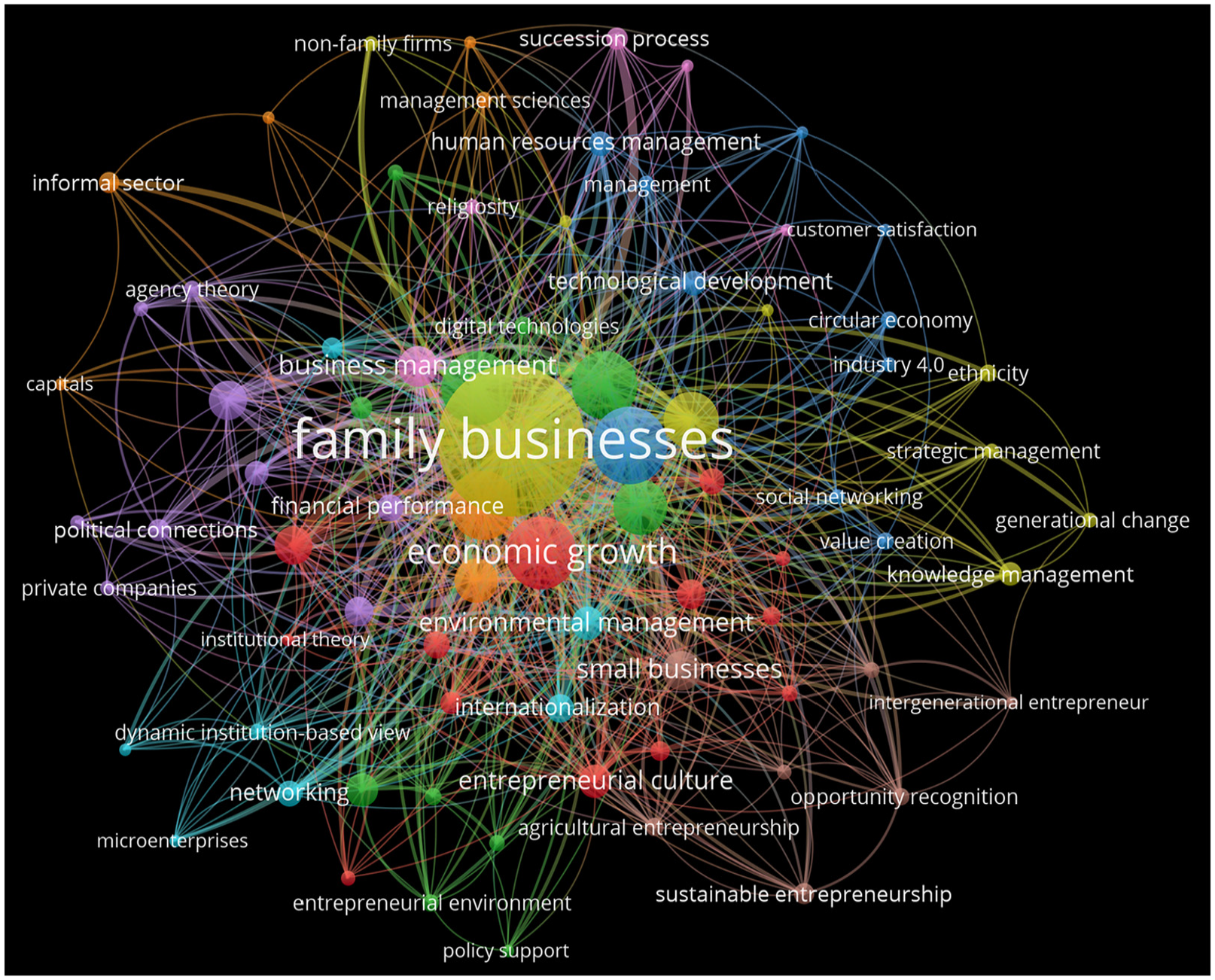
Author keywords co-occurrence network with 5 minimum occurrences.
In VOSviewer, a “chronological keyword map” was created with a cutoff of at least five co-occurrences (Figure 5). The chronological co-word analysis looks at how keywords are distributed through time based on when the content was published.
Additionally, to determine the focus of the study in the area of family businesses, we employed author keyword analysis. An author keyword network was created using VOSviewer software after the author keywords were first extracted from our database of 598 pertinent articles. We set a requirement of five minimum co-occurrences of terms in order to collect analytical data. An author’s keyword co-occurrence network was clear for any keywords that appeared more than five times together in the collection of 598 papers. Out of 506 key words, 98 met our criteria. “Family businesses” was found to be the keyword that occurred the most, 254 times.
Intellectual Structure of the Family Business Knowledge Base
By examining the intellectual structure, researchers can identify the areas of family businesses that have received the most research and those that have received the least. Researchers looked into the “intellectual structure” of several academic subjects using scientific mapping review methods (Nerur et al., 2008). The primary theoretical and empirical lines of research, or “schools of thought,” that define a field of study are referred to as an “intellectual structure.” We used author co-citation analysis to generate a network map in VOSviewer that shows how the knowledge base on family businesses is conceptually organized.
According to researchers who use co-citation analysis (Hallinger & Kovačević, 2019), authors that are often co-cited by other authors have similar scholarly philosophies. Additionally, VOSviewer software may create a network map that “visualizes commonalities” among the authors cited in the family business domain by examining the frequency of “author co-citations” (van Eck & Waltman, 2017).
VOSviewer’s co-citation map showed 169 academics because the minimum was set at 50 co-citations from 54,845 authors (Figure 6). The larger bubbles in Figure 6 signify significant researchers based on the frequency of co-citations. Based on co-citation links, the colorful clusters group researchers into several study fields. However, there were mainly three clusters represented by green, red, and blue, as shown in Figure 6.
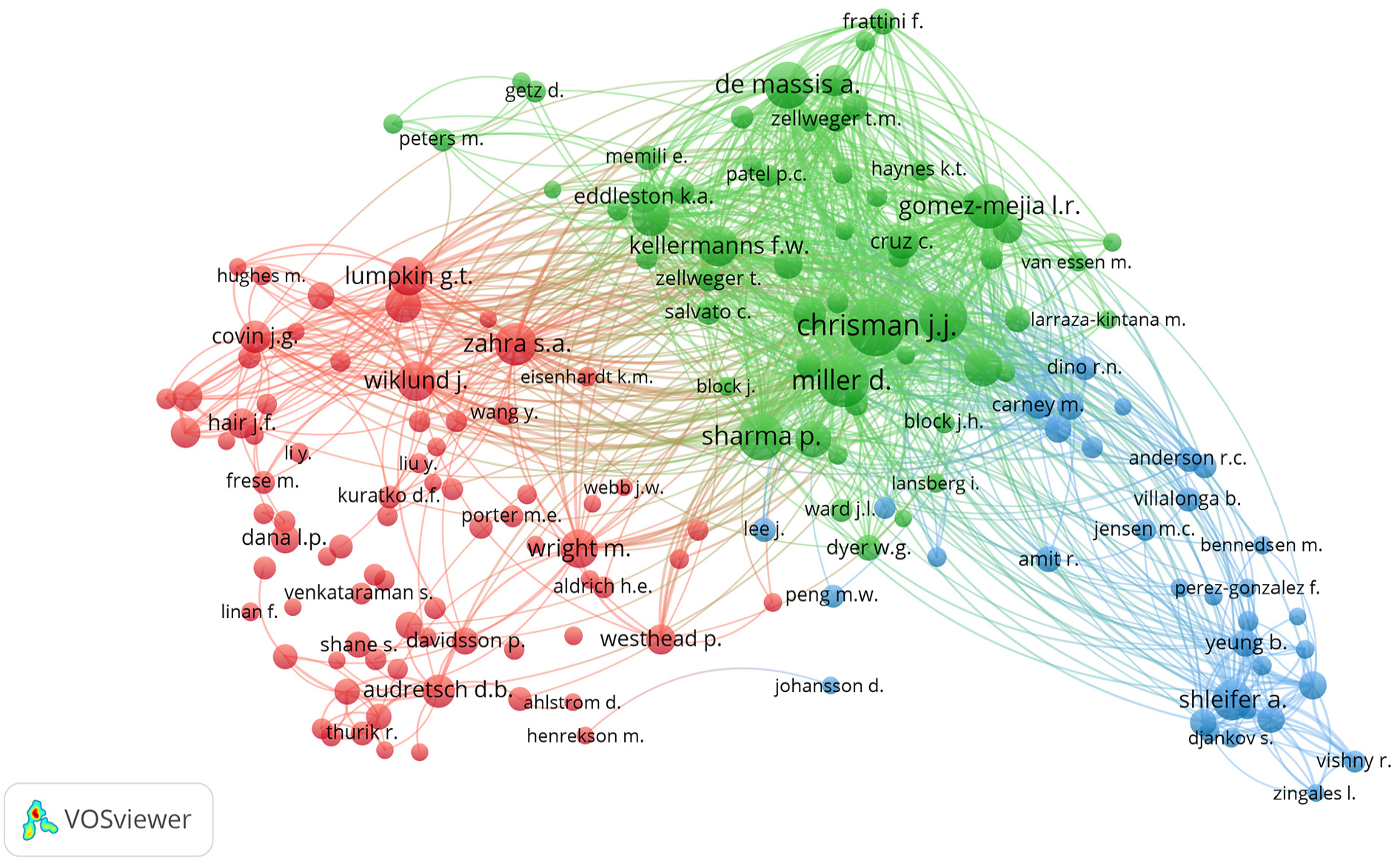
Co-citation to author network map generated in the VOSviewer.
Discussion of Findings
The goal of this study was to evaluate the literature on the contribution of family businesses to economic growth as a foundation for future research. From the perspective of keywords and the quantity of publications discovered, we looked at the temporal evolution of the theme. Also examined were the most productive writers and publications, international scientific distribution, and growth trends.
A sample of 598 papers published between 1998 and 2023 was collected using the Scopus database. Although we were able to confirm that the earliest article on this topic was published in 1998, scientific research on this topic only really took off after 2009. Less than 5% of all articles published can be attributed to the years 1998 to 2009, which highlights the growth in popularity after this period.
The primary topic area is family businesses, followed by entrepreneurship, sustainable development, and economic growth, which makes sense given that these broad study groups are where family business research is framed. Apart from appearing in most of the sub-periods, they have had tremendous growth, which piques the researchers’ interest.
The most influential authors are Allen F., Qian J., and Qian M., with 2,244 citations. They are from the Wharton School in Philadelphia, Pennsylvania, followed by Daneke, G. A., Hall, J. K., and Lenox, M. J., with 708 citations (Table 3). The most influential documents are available in Table 4, monopolized by the USA, which has more than 50% of the documents among the 15 most influential documents (Table 4). The United States, the United Kingdom, China, Spain, and Italy are the five nations with the highest levels of productivity in that order.
The 598 publications on family businesses were dispersed throughout 254 journals. The top 15 sources (shown in Table 2) made up more than half of the total corpus, despite the fact that only 32% of sources had multiple publications. Sustainability (Switzerland) had the most articles (97), although there were 254 sources in all, accounting for 20,204 citations. Twenty-seven sources out of the total had no citations (the list is not attached), while the top fifteen sources received more than 60% of all citations (Table 2). The Journal of Financial Economics was the top source, receiving 2,634 citations across three family business research documents.
The ability to visualize the condition of scientific production and, more importantly, to identify potential future research directions through the evolution of keywords is one way that this work advances research on family businesses. In this regard, we came to the conclusion that family businesses, entrepreneurship, sustainable development, economic growth, and performance management were the five most significant issues covered in the recent literature.
However, Table 1 enabled us to recognize four new themes introduced in the last sub-period (sustainable development, entrepreneurial culture, tourism, and business management). The time frame examined was split into three sub-periods for the thorough keyword investigation. The engine term with the greatest average co-occurrence that appears in all sub-periods is family businesses.
Conclusion, Research Gaps, and Limitations
Conclusion
The research represents a first attempt to organize and make sense of the body of existing knowledge on family businesses. This has been made possible by a number of quantitative bibliometric analyses that rely on software and computer methods that let users participate in the process of knowledge creation as it flows across time. By doing this, we were able to offer a detailed evaluation of the body of knowledge on family businesses, identify some potential research directions, and offer an analytical framework that takes into account the field’s continuous progress. The analysis thus highlights the knowledge map and the information gap.
While there have been previous attempts to perform a thorough and organized review of academic family business research, this work adds a bibliometric perspective to the field by organizing and synthesizing the body of knowledge already available in this research domain. As a result, this article offers a wide perspective on the study in this area and makes an effort to add to the growing body of literature on family businesses. By doing this, it makes the work of scholars, sociologists, academics, consultants, and family firms’ owners easier. The information provided in this study supplements and adds value to a prior bibliographic knowledge base, notwithstanding the limitations of the study. Also, only the Scopus database was used to compile the dataset. As a result, information from additional sources such as the Web of Science, Google Scholar, etc. was excluded.
Research Gaps
First, in the top ten keywords for the most recent sub-period (2018–2023), three terms made their debut. These are the terms: “family businesses,”“entrepreneurship,” and “sustainable development.” The terms require additional research because they are still hot (Table 1).
Second, family businesses experienced the fastest growth, making up more than 15% of all instances (Table 1). Since a larger portion of the world’s population still does not know about it, the topic is still popular enough for scholars to continue exploring.
Third, the words “sustainable development,”“entrepreneurial culture,” and “tourism” are new and emerged in the third sub-period (2018–2023). These are the contentious issues that have drawn the attention of family business researchers. They have an average growth rate of more than 10% for all occurrences (Table 1). As long as a subject is being discussed for the first time, most stakeholders are unaware of it.
Fourth, family business research is dominated geographically by rich and emerging economies, casting a shadow over developing economies (Figure 4). For instance, it is difficult to practice family businesses in particular because most underdeveloped countries lack adequate knowledge about them. The influence of these topics may therefore be different in emerging and developed nations than in developing economies. In this instance, it is still unclear how family businesses affect the economic development of developing nations.
Limitations
There are several restrictions on this study pertinent to the bibliometric methods’ shortcomings. Despite the potential use of materials like conference proceedings, national journals, and editorial content in family businesses’ research, this search methodology does not include them (Casado-Belmonte et al., 2021). In addition, our study employed co-occurrence, co-citation, and key word analyses, similarly to Tiberius et al. (2020). The application of various bibliometric methods, such as bibliographic coupling, may be beneficial to our findings.
The study made use of the Scopus database. Even though Scopus contains the majority of the articles in the Web of Science database, it would be interesting to conduct this analysis using the Web of Science to ensure that the outcomes are consistent.
One of the limitations was that the synonyms used in the search query were not exhaustive, so it excluded other documents that could be used in this research.
On the other hand, Google Scholar is getting better, making it worthwhile to conduct research there. Academic works that can significantly advance the subject of study are not included in Google Scholar, which is restricted to publications in scientific journals (Durieux & Gevenois, 2010). Therefore, the aforementioned limitations provide suggestions for strengthening or enhancing bibliometric research in the future. Future studies might also concentrate on corporate governance (hardly studied), innovation, and sustainable development, which are solely concerned with family business services.
Footnotes
Declaration of Conflicting Interests
The author declared no potential conflicts of interest with respect to the research, authorship, and/or publication of this article.
Funding
The author received no financial support for the research, authorship, and/or publication of this article.

Data Availability Statement
Data sharing not applicable to this article as no datasets were generated or analyzed during the current study.