



Abstract
This study analyzed the 100 most-cited servant leadership publications in the Scopus database from 1991 to 2021 by using bibliometric analysis. The analysis includes visualization, bibliographic coupling, co-occurrence, and co-authorship analysis. Country contributions were examined, with the United States emerging as the dominant contributor, followed by the Netherlands, Australia, China, and Canada. van Dierendonck and Liden being the most influential contributors. Their work has focused on areas related to servant leadership scales, organizational behavior, and the conceptual development of servant leadership. The analysis of top keywords revealed a diverse range of research interests, underscoring the breadth and complexity of servant leadership as a concept. The study highlights the importance of international collaborations in advancing servant leadership research and emphasizes the need for increased research engagement from non-dominant countries to address the existing knowledge imbalance. The findings shed light on research trends, country contributions, influential authors, and important research themes, helping researchers identify gaps and future directions in servant leadership research. The findings could promote the development and application of servant leadership theory to enhance leadership practices and organizational outcomes.
Introduction
Servant leadership, which Robert Greenleaf first coined in his essay “The Servant as Leader” in 1970, is commonly described as an employee-oriented type of leadership practice that emphasizes the idea of serving others above one’s personal interests, grounded within the basis of leaders’ altruistic and ethical orientations (Greenleaf, 1977). Servant leadership favorably cultivates positive organizational outcomes that lead followers to healthier and greater autonomy across multiple organizational levels (Bavik, 2020; van Dierendonck, 2011). In fact, servant leadership is a holistic leadership approach capable of engaging followers in relational, ethical, emotional, and spiritual dimensions, promoting follower growth and organizational well-being (Eva et al., 2019; Isabel et al., 2021). There are voluminous studies on the relationship between servant leadership and organizational outcomes (e.g., Hoch et al., 2018; Peterson et al., 2012; Schaubroeck et al., 2011). Studies in this domain have been published in some top management journals (Chen et al., 2015; Liden et al., 2014; Neubert et al., 2016), nursing (Waterman, 2011), tourism (Ling et al., 2016), and education (Cerit, 2009) journals across non-profit institutions (Parris & Peachey, 2013), public institutions (Schwarz et al., 2016), and the youth sector (Eva & Sendjaya, 2013).
Although the past cross-disciplinary research of servant leadership has improved the theory of servant leadership in decades, servant leadership research is fragmented across disciplines and needs to be integrated (Eva et al., 2019). This concern has motivated the current study to conduct a bibliometric study of servant leadership. The bibliometric study refers to a process of analyzing and classifying bibliographic material by framing representative summaries of the extant literature (Donthu et al., 2020). Bibliometric analysis is a statistical technique to assess the academic impact of published articles quantitatively in a specific research field (Moed, 2009).
However, previous studies showed that scholars tend to conduct systematic reviews of the trends in servant leadership at different periods of time. An earlier study by van Dierendonck (2011) provided the review publication of the historical background, key characteristics, available measurement tools, and relevant research findings of servant leadership. Eva et al. (2019) conducted a comprehensive systematic review of 285 articles on servant leadership from 1998 to 2018 to provide an integrated description of the development of servant leadership in terms of four dimensions: definitions, measurement methods, variable factors, and future developments. Besides, Sawan et al. (2020) searched 71 Scopus-indexed articles on servant leadership published from 2015 to 2020 to obtain a comprehensive understanding of antecedents, impact, and education theories used on servant leadership. Meanwhile, Canavesi and Minelli (2022) carried out a systematic literature review coupled with network analysis focusing on the identification of the antecedents, mediating and moderating effects of the relationships between servant leadership and individual outcomes, and between servant leadership and organizational outcomes.
Unlike a systematic review, bibliometric studies focus on evaluating the bibliographic information in terms of the emerging trends in article and journal performance, impact and influence of the publication collaboration patterns among scholars, institutions, and countries in the scientific communities, and exploring the intellectual structure of a research domain in the extant literature (Donthu et al., 2020, 2021).
Notwithstanding its merits, bibliometric studies on servant leadership are less explored in the literature. A limited bibliometric study of servant leadership was attributed to Najam and Mustamil (2020). Najam and Mustamil (2020) conducted a bibliometric analysis by searching servant leadership publications in different journals included in the Web of Science database (WoS) for the last 50 years (1970–2019). Najam and Mustamil (2020) tends to seek the trends and insights into the evolving global knowledge base in the leadership literature and is not confined to identifying the characteristics of the most-cited articles in servant leadership publications. Compared with Web of Science, Scopus covers a wider journal range and offers the capability for citation analysis published after 1995 (Falagas et al., 2008). However, to the researchers’ best knowledge, there are extremely limited bibliometric analysis articles based on the Scopus database about servant leadership.
To address these research gaps, this study attempts to conduct a bibliometric study to analyze characteristics of the 100 most-cited research publications on servant leadership from the Scopus data source. The motivation behind selecting the “100 most-cited publications” in this current study was to focus on the most influential and impactful research in the field of servant leadership. By analyzing the most-cited publications, this study aimed to provide a comprehensive overview of the trends, characteristics, and contributions of highly influential research in the field. These publications represent the most widely recognized and cited works in servant leadership, which allows us to gain insights into the key themes, authors, collaborations, and citation patterns in the field.
This study contributes to helping the researchers (a) gain a one-stop overview, (b) identify knowledge gaps, (c) and in turn, derive novel ideas for further investigation to positioning their intended contributions to servant leadership studies. The elaboration of novel ideas is as follows.
(1) Identification of emerging research trends. By analyzing the content and citation patterns of the highly cited publications, our study helps researchers identify emerging research trends within the field of servant leadership. This identification can serve as a basis for generating new research questions and exploring novel areas of investigation. For example, the current findings indicate that there has been a growth in research related to the model development phase of servant leadership, focusing on the conditions, antecedents, mediators, and boundaries of servant leadership using advanced statistical approaches. This observation could inspire researchers to delve deeper into these specific areas and potentially contribute new insights.
(2) Exploration of underrepresented topics or contexts. This study highlights potential knowledge gaps in servant leadership research. By examining the distribution of publications across countries, collaborations, and keywords, researchers can identify underrepresented topics, contexts, or variables that have received relatively less attention in the existing literature. These underexplored areas present opportunities for researchers to contribute novel ideas and conduct further investigations. For instance, we found that there is a need for more research on servant leadership in non-profit organizations, especially in different cultural and contextual settings. This observation suggests a potential avenue for future studies to explore the specific dynamics and effects of servant leadership within this unique organizational context.
(3) Integration of interdisciplinary perspectives. Servant leadership is a multidimensional construct that intersects with various fields, such as organizational behavior, leadership, psychology, and ethics. The current study provides an overview of the most influential journals and top authors in the servant leadership research domain. Researchers can explore the work of these scholars and journals to gain insights from different disciplinary perspectives and potentially integrate diverse theoretical frameworks and methodologies into their own research. This cross-disciplinary exploration can lead to the generation of novel ideas and approaches for further investigation.
Research Questions
The five research questions were designed to address different aspects of research productivity, collaboration, and knowledge dissemination in the field of servant leadership holistically. The formulation of the research questions is as follows.
(1) Research trends and patterns of citation: The first research question aims to explore the research trends and patterns of citation in the 100 most-cited publications on servant leadership. This question was derived from the recognition that understanding the publication trends and citation patterns can provide insights into the evolution of (Benomar et al., 2022; Zupic & Čater, 2015) servant leadership research over time. It helps us identify key milestones (Ekanayake et al., 2021), influential studies (Boddu et al., 2023), and the temporal dynamics (Bornmann & Haunschild, 2022) of research productivity within the field.
Research Question 1: What are the research trends in the 100 most-cited research publications on servant leadership and their citation pattern?
(2) Country contributions and collaborations: The second research question focuses on examining the country contributions and collaborations (Feifei & Abdullah, 2023) in the 100 most-cited publications. This question was motivated by the desire to gain insights into the global distribution of research on servant leadership and the collaborative networks among researchers from different countries. Understanding country contributions and collaborations can shed light on the dissemination of knowledge (Maggio et al., 2021), potential cultural influences (Tomczyk et al., 2022), and opportunities for international cooperation (Fan et al., 2020).
Research Question 2: What are the patterns of countries and collaborations that contributed to the publications of the 100 most-cited research publications on servant leadership?
(3) Productive authors and co-citation networks: The third research question investigates the most productive authors and co-citation networks in the field of servant leadership. This question stems from the recognition that identifying the key authors and their interconnections can provide insights into the intellectual structure of the field, influential scholars, and potential research collaborations. It helps us understand the central figures in servant leadership research and the co-citation relationships that indicate the intellectual influence and interrelationships among authors (Karaulova et al., 2020).
Research Question 3: What are the most productive authors and co-citation networks in the 100 most-cited research publications on servant leadership?
(4) Top keywords: The fourth research question explores the top keywords in the 100 most-cited publications on servant leadership. This question was driven by the objective of identifying the key concepts, themes, and focal points of research in the field (Anand et al., 2021). By analyzing the co-occurrence of keywords, we can uncover the prominent topics and areas of interest within servant leadership research and gain insights into the terminology and conceptual framework used by scholars.
Research Question 4: What are the frequent keywords in the 100 most-cited research publications on servant leadership?
(5) Most active journals and characteristics: The fifth research question aims to identify the most active journals and examine their characteristics in the publication of the 100 most-cited articles on servant leadership. This question was formulated to provide an overview of the publishing landscape in the field and understand the key outlets where servant leadership research is disseminated (Stoler & Staddon, 2023). Analyzing the characteristics of these journals, such as their impact factors and subject categories, helps us assess the scholarly influence and quality of the publications.
Research Question 5: What are the most active and influential sources of the 100 most-cited research publications on servant leadership and the characteristics of these sources?
Method
Google Scholar, Scopus, and Web of Science are commonly used databases by scholars (Gümüş et al., 2020). Compared to Web of Science and Google Scholar, Scopus is the “largest single abstract and indexing database ever built” (Burnham, 2006) and the largest searchable list of citations and abstracts (Ahmi et al., 2019; Falagas et al., 2008). Scopus is also a database that indexes a major number of journals than Web of Science and Google Scholar studied (Falagas et al., 2008). In contrast, a bibliometric analysis of servant leadership has been conducted using the Web of Science data source (Najam & Mustamil, 2020). Google Scholar data are of relatively low quality, some publications are incompatible with other databases, lack the necessary quality control for bibliometric statistics, and have the constraints of retrieving bibliometric analysis data (Moosa & Shareefa, 2020). Therefore, the Scopus database was selected for the data retrieval in this paper.
For the sample article selection, the publication timeline ranged from the earliest article on servant leadership research published in the Scopus-indexed journals from 1991 to May 2021. This time frame provided comprehensive coverage of the servant leadership research articles in Scopus. The article selection was only limited to journal articles. Books, book chapters, conference papers, and other forms of publication were excluded because these types of publication are somewhat less comparable to double-blind peer reviews by Scopus-indexed journals (Hallinger, 2020). Moreover, only journals published in the English language were included for ease of readability.
The data collected for this study were based on the modified PRISMA research protocol as shown in Figure 1 (Moher et al., 2009). The data were extracted from the Scopus database on 12 May 2021. The keyword “servant leadership” was used to search the titles of the publications. This study excluded “books,”“book series,” and “conference proceedings” when refining the document types of the database. The keywords and search strings were retrieved as: TITLE (“servant leadership”) AND (LIMIT-TO (SRCTYPE, “j”) OR LIMIT-TO (SRCTYPE, “d”). A total of 494 journal publications related to servant leadership in the Scopus database were searched, including 493 journal publications and one trade publication.

Flow diagram of the search strategy.
During the data cleaning process in the Scopus database, by ordering the 494 publications with “cited by (highest),” no duplicate entries were found. There were consistent matches between the “servant leadership” titles and the content of the field in the first 100 publications. The selection process of the 100 most-cited publications was based on the criteria of document types and language. The focus of our study was on journal articles that underwent a double-blind peer review process, as these publications are generally considered more reliable and rigorous within the academic community. Therefore, books, book chapters, conference papers, and other forms of publications were excluded from our analysis. To ensure ease of readability and accessibility, we limited our analysis to articles published in the English language. This decision was made to ensure that the findings of our study could reach a wider audience and facilitate international collaboration.
After applying these criteria, the initial pool of 494 articles was reduced to 100 journal publications that met the specified requirements. The selected articles represented a comprehensive coverage of servant leadership research within the Scopus database from 1991 to May 2021. The remaining 394 items were removed. Next, we checked for missing important fields and duplication fields of the file. There were no problematic entries found after data cleaning was completed. The first 100 publications data were retained and exported as comma separated values (.csv) and research information systems (.ris) format files. One hundred publications ordered by citations were saved for further analysis.
This bibliometric analysis focused on the contributions of research constituents (e.g., authors, journals, and countries) and the relationships between research constituents (Donthu et al., 2021). Data analysis and data visualization were performed using Microsoft Excel, Harzing’s Publish or Perish, and VOSviewer software. VOSviewer software was used to analyze the comma-separated value (.csv) file and perform the main part of the mapping (van Eck & Waltman, 2020). Harzing’s Publish or Perish was used to analyze the research information system (.ris) file to perform citation rate and impact factor.
Assumptions of the Study
The bibliometric analysis of the 100 most-cited publications on servant leadership, was performed under certain assumptions to guide the current study and interpretation of the results. These assumptions include: (1) Assumption of citation impact. This study assumed that highly cited publications indicate a higher level of influence, significance, and impact within the field of servant leadership. This assumption is based on the widely accepted notion that citations reflect the recognition and acknowledgment of scholarly work by other researchers; (2) Assumption of publication quality. This study assumed that the selected publications in our analysis, being highly cited, represent high-quality research in the field of servant leadership. While citation counts are commonly used as an indicator of quality, we acknowledge that it is not the sole determinant of research quality, and other factors such as the rigor of the research methodology and the validity of the findings should also be considered; (3) Assumption of representativeness. This study assumed that the 100 most-cited publications selected from the Scopus database provide a representative sample of influential research in the field of servant leadership. While our aim was to capture a comprehensive range of servant leadership studies, it is important to note that our selection may not include all relevant publications or perspectives on the topic. There may be other valuable contributions that have not received as many citations but are still significant in the field.
Results
Research Trends and Patterns of Citation
The first question explores the research trends in the 100 most-cited research publications on servant leadership and their citation pattern. Figure 2 shows the total publication number on servant leadership, the total number of highly cited articles, and the average citations per publication in 100 most-cited publications from 1991 to 2021. The publication number of journal articles in the Scopus database shows that servant leadership research has been steadily increasing, but not in a geometric series. The papers published before 2009 were very few in numbers and in single digits, then increased from 2010 onward. As seen in Figure 2, the highly cited articles among the 100 most-cited publications are concentrated between 2008 and 2019. In addition, the gray curve shows the average citations per publication in 100 most-cited publications. There are three major fluctuations between 1991 and 2008: (a) the theoretical foundation of servant leadership (Graham, 1991), (b) the conceptual development of servant leadership, and (c) the measure development of servant leadership (Liden et al., 2008; Neubert et al., 2008). The studies of these three fluctuations may have driven later studies on servant leadership in different contexts.

Total publications and citations by year.
With the growth of research enthusiasm for servant leadership, as seen in Table 1 the highly cited article number mainly concentrated between 2008 and 2019. Most of the publications within this period of time are related to the investigation into servant leadership and organizational outcomes using a cross-sectional research design (Eva et al., 2019). For the publications from 2019 to 2021, servant leadership has entered the model development phase for understanding the conditions of antecedents, mediators, and boundaries of servant leadership using advanced statistical approaches such as multilevel analysis and solving the endogeneity problem in servant leadership research (Eva et al., 2019). In Table 1, the highly cited article number and publication number show growth, and the trends of the total number of highly cited publications and average citations per publication are almost consistent. It is notable that in the situation of the total number of publications increasing, the average citations per publication start falling after 2009 as well as the total number of highly cited publications after 2012. One potential reason is due to the time taken to accumulate citations of these published articles (Mohamed et al., 2020). Meanwhile, as the growing passion for servant leadership research has led to a number of publications appearing, more higher quality publications may need to be provided.
Total Publications and Citations Based on Scopus Database.

Note. TP = total number of publications; TC = total citation; THC = total number of highly cited publications; C/P = average citations per publication.
Country Contributions and Collaborations
To answer the second research question, we first explored the country contributions of the 100 most-cited publications. In the Scopus data source, two articles were not correctly categorized by their countries. For example, Hong Kong is attributed to China instead of being listed separately. A total of 18 articles were not identified by country or region. Considering this, these articles were excluded from the analysis. Thus, this study has included 80 out of the 100 most-cited servant leadership publications for the analysis. Figure 3 shows publication number by country and is ranked by the most-cited number. The top five countries are the United States, the Netherlands, Australia, China, and Canada. The United States has the highest contributions. The publication number and highly cited article number are ranked at the first position, contributing to 42.68% (35/82) of the total number of cited articles. It can also be clearly seen in the ranking that the Western countries still dominate the main positions in servant leadership studies.

Number of 100 most-cited publications by country.
Among the top five countries, as seen in Table 2, China is the only developing country and its number of publications is second only to the United States. This may be related to China’s governance policy to establish a service-oriented government and precisely, the service-oriented government needs servant leaders (Xu & Wang, 2018). The research of Chinese scholars on servant leadership did not only promote the construction of service-oriented government but achieved good results in China as well (Ma & Hao, 2019). It also makes the publication number of servant leadership grow rapidly.
Distribution of the 100 Most-Cited Publications in Each Country.

Furthermore, the number of cited articles in developing countries (Pakistan, India, Turkey) are higher than in some developed countries (Germany, Spain, Italy). Although some countries other than the United States, China, the Netherlands, Australia, and Canada are international contributors, the few publications from each country depict a serious imbalance within the servant leadership knowledge base. This result suggested that international authors from a few publication countries need to use social media networks and promote through academic sharing networks to increase the visibility of their research publications and obtain more citations. Also, they need to be carefully considered for publication in reputable and indexed journals (Mohamed et al., 2020).
Next, we explored country collaborations based on the 100 most-cited publications on servant leadership by visualizing the country collaborations using the VOSviewer software. Figure 4 shows the total link strength of the 12 countries based on the threshold setting of one minimum number of documents per country. We only include absolute names of the countries for analysis. It can be seen that the United States still occupied a dominance, collaborating with the remaining 11 countries. In the visualized map, the closer the nodes between two entities, the stronger the relationship between them (Fabrikant et al., 2009). The United States cooperates most closely with Australia, the United Kingdom, China, and Canada. The Netherlands cooperates closely with Germany, Finland, India, and Turkey, which are European countries. The top five countries with the highest citation number (see Figure 3) are also the most collaborative countries. The results reflect the importance of international collaborations (Mohamed et al., 2020) and the influence of international collaborations on the number of highly cited publications (Moosa & Shareefa, 2020).
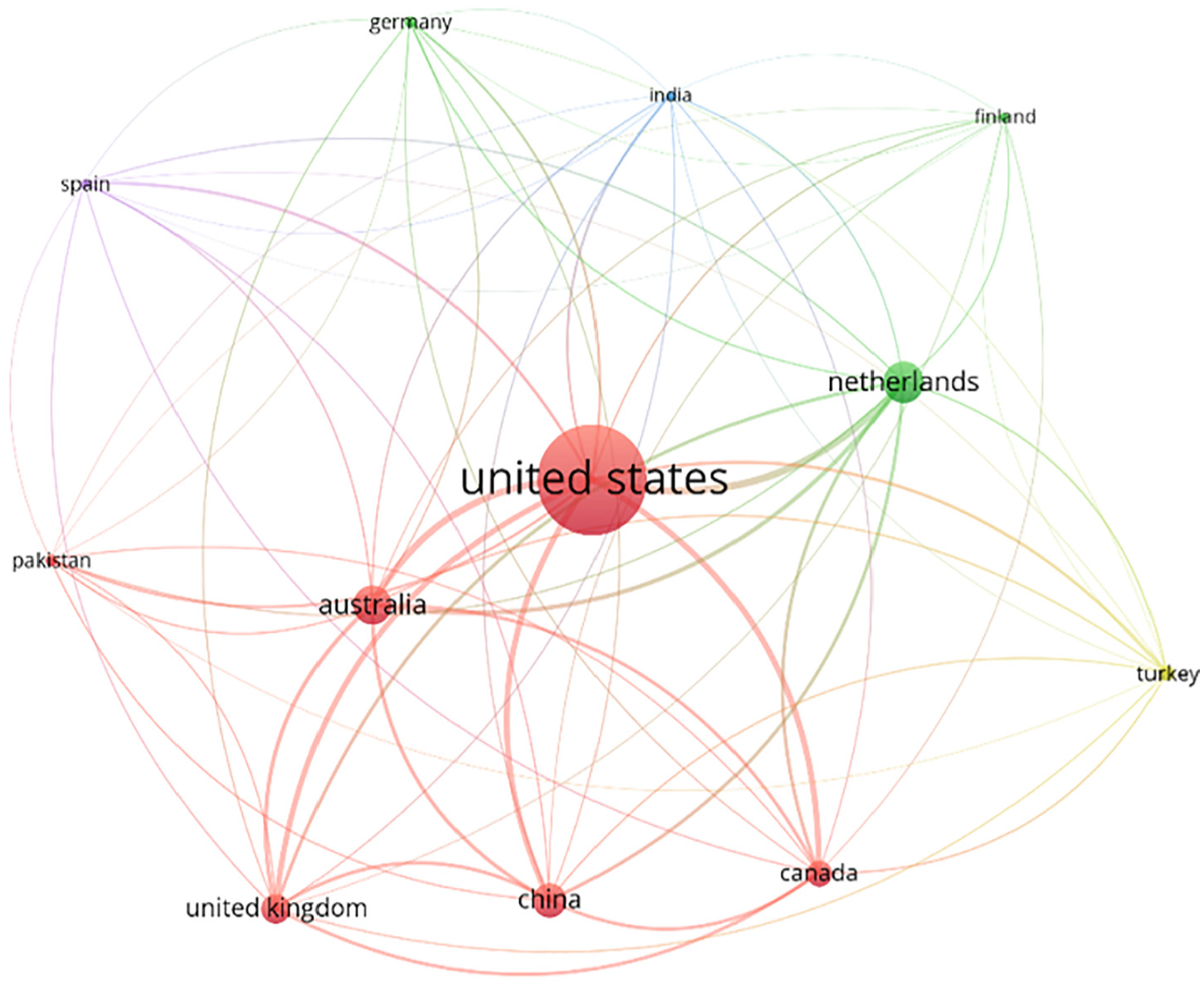
VOSviewer visualization of country collaboration network based on 100 most-cited publications.
Productive Authors and Co-citation Networks
The third question attempts to find the most productive authors and co-citation networks in the 100 most-cited publications on servant leadership. Table 3 shows the top five authors with the most contributions in the 100 most-cited publications on servant leadership. A total of 222 authors contributed in these 100 most-cited publications. We use the Publish or Perish software to set the minimum number of documents per author to the threshold of four, that is, each author has published at least four articles to identify the top five authors. Only five of the 222 authors were selected. Table 3 lists these top five authors and sorts by the number of publications. It shows that van Dierendonck, with a total of nine articles and1,458 total citations, is the most influential author in the field of servant leadership research.
Productive Authors.
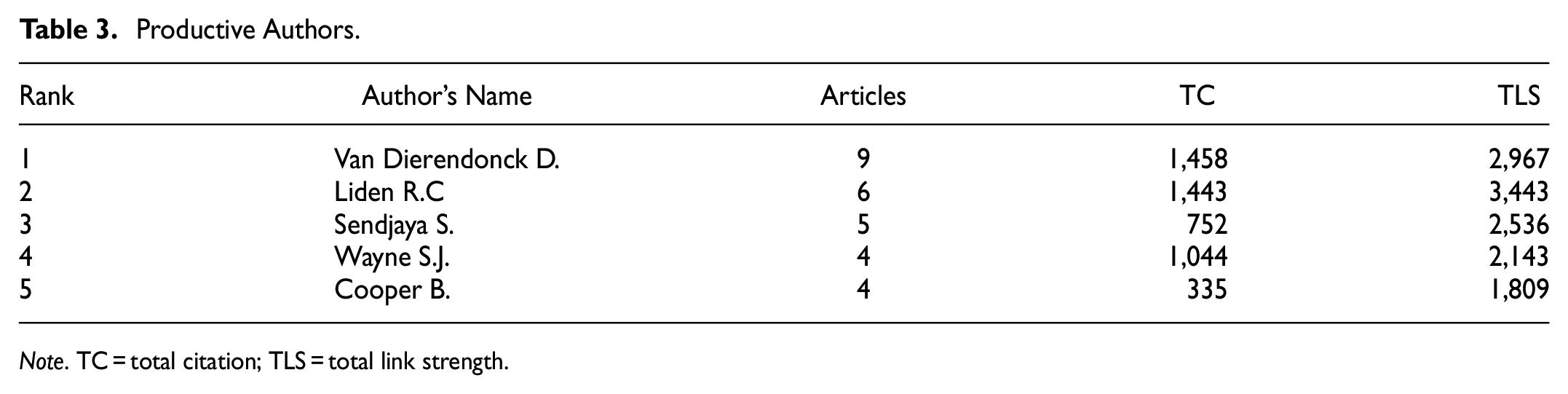
Note. TC = total citation; TLS = total link strength.
In second place is Liden, with six articles and1,443 total citations. Notably, Liden has the highest total link strength, which indicates that he works more with other scholars. Among the other three authors, although Wayne has a lower number of publications than Sendjaya, the author still has1,044 total citations, which is higher than Sendjaya’s total citations. On the one hand, Wayne’s article (e.g., Liden et al., 2014) appears in the top-tier management journal (Eva et al., 2019). Wayne developed and tested the multidimensional measurement of servant leadership in a multilevel framework, which is the first publication using the Ehrhart’s (2004) measure (Eva et al., 2019). In view of the complexity of multilevel analysis, bootstrapping is not yet performed in multilevel analysis (Eva et al., 2019). Meanwhile, the article which Wayne participated in uses Monte Carlo technology to simulate intervening variables under investigation to model the mediation effect (see Liden et al., 2014), which provides an important reference for future multilevel analysis research of servant leadership. The above-mentioned two aspects may be the reason why his article is cited more.
As shown in Figure 5, with the setting of full counting method and a minimum number of 50 citations per author, out of the6,539 authors, 109 meet the threshold, and 27 authors have been selected. The 100 most-cited publications are divided into three different colored clusters. We can observe that in the red cluster, Liden and Wayne are the most representative authors, and their work is closely related. The main direction of their work is related to the development of servant leadership scales and the investigation into the influencing factors of servant leadership. Their scholarly work contributes to other researchers conducting empirical research on servant leadership in different fields.

VOSviewer visualization of author co-citation based on 100 most-cited publications.
The blue cluster has only two scholars, Bakker and van Dierendonck. The node distance between the two scholars is not close as Bakker’s (2011) work focuses more on engagement and van Dierendonck’s work focuses on servant leadership. The reason Bakker and van Dierendonck are in the same cluster could be due to the nature of their research interest, that is, servant leadership behavior is likely to influence employee engagement (van Dierendonck, 2011). Interestingly, van Dierendonck is closely related to the scholars in both the red and green clusters, mainly because van Dierendonck is the most influential scholar in this field. However, his total link strength is lower than Liden’s, which indicates that Liden cooperates more with other researchers.
The conceptual development of servant leadership is reflected in the green cluster. The concept of servant leadership was first proposed by Greenleaf (1977) and then Graham (1991) laid the theoretical foundation of servant leadership. Building on Greenleaf’s (1977) and Graham’s (1991) scholarly work, other leadership scholars (Avolio & Gardner, 2005; Bass, 2000; Graham, 1991; Luthans & Avolio, 2003; Patterson, 2003; Russell, 2001; Russell & Gregory Stone, 2002; Spears, 1995; Winston, 2003) have further studied and refined the concept of servant leadership.
Keywords
The fourth research question focused on the top keywords in the 100 most-cited publications on servant leadership. This was done by using the co-occurrence of author keywords in the VOSviewer software. With two minimum numbers of occurrences of a keyword, out of the 253 keywords, 37 met the threshold. Figure 6 shows the author’s keywords were divided into nine clusters. The most significant keywords in these clusters were servant leadership, leadership, psychological empowerment, engagement, transformational leadership, ethical leadership, altruism, and measurement development. Such a large number of clusters show that academic interest in servant leadership research is very diverse. Nevertheless, such diversity has reflected that the servant leadership research field still lacks coherence and clarity (Eva et al., 2019).
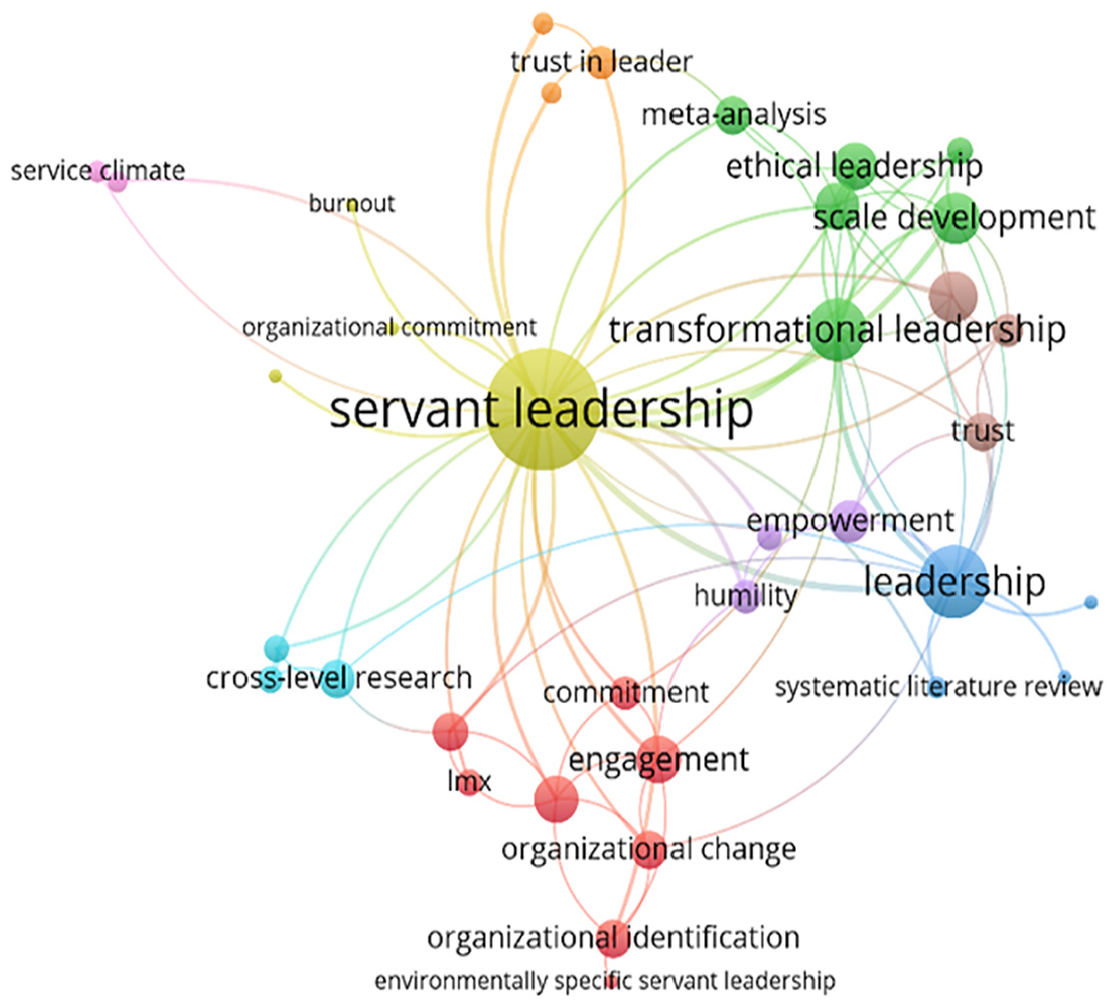
VOSviewer visualization of keyword co-occurrence based on 100 most-cited publications.
Figure 6 shows servant leadership is the core of all the keywords and all studies are centered on servant leadership (see the yellow cluster). Scholars have conducted numerous studies on servant leadership in different contexts (Jang & Kandampully, 2018; Parris & Peachey, 2013), different levels (Bavik et al., 2017; Harju et al., 2018; Liden et al., 2008; Ling et al., 2016; Walumbwa et al., 2010; Yang et al., 2017), and different influencing factors (Babakus et al., 2011; Miao et al., 2014; Verdorfer, 2016).
The red cluster mainly focuses on the field of organizational behavior, which reflects the link between servant leadership and employees’ positive behavior, and the impact on the leader-member relationship. It also shows that servant leaders demonstrate motivation to serve others, which motivates employees to perform their job roles more and engage in proactive behaviors (Kim & Kim, 2013). This is because the more servant leaders interact with their employees, the stronger the relationship between servant leaders and outcomes (Eva et al., 2019). Thus, while organizations actively seek changes, the analysis reflects a need to call for more research on the relationship between servant leadership and employees’ positive behavior.
The green cluster mainly puzzled around two domains of research. First, studies that distinguished between servant leadership and other types of leadership, including transformational leadership (van Dierendonck et al., 2014), ethical leadership (Hoch et al., 2018), and authentic leadership (Lemoine et al., 2019). Second, studies related to refining servant leadership concepts and scales (Liden et al., 2015; Sendjaya et al., 2019; van Dierendonck & Nuijten, 2011).
The blue cluster shows the importance of leadership research in organizational management. It also shows cross-level research on servant leadership. One of the main reasons for the existence of cross-level research is some single-level analysis of the hierarchically structured data may affect the reliability of research findings (Bovaird, 2007; Byrne, 2006, 2013), hence researchers conduct cross-level research in order to improve the methodological flaw. Besides, the purple cluster represented studies related to the characteristics of servant leadership, and the pink, brown, and orange clusters represented studies on different influencing factors of servant leadership.
The Most Active Journals and Characteristics
The final question is to explore the most active journals and their characteristics of the 100 most-cited articles on servant leadership. We analyzed the source information from Scopus to identify the journals of 100 most-cited articles on servant leadership. Fifty-two journals were found, 16 out of which were found to publish two or more articles. However, as some journals had the same number of publications, these 16 journals were ranked according to the total number of citations as shown in Table 4.
Most Active Journals.

Note. TP = total publication; TC = total citation; CPP = citation per publication; SNIP = Source Normalized Impact per Paper measures actual citations received relative to citations expected for the serial’s subject field; SJR = SCImago Journal Rank measures weighted citations received by the serial.
Table 4 shows that the top three journals are Leadership and Organization Development Journal (publications = 15), Leadership Quarterly (publications = 7), and Journal of Applied Psychology (publications = 4). All journals were ranked in Q1 except two journals, which were ranked in Q2 (Journal of Organizational Change Management and Nonprofit Management & Leadership). The results indicated that the 100 most-cited publications in the servant leadership field are largely in Q1 or higher-ranked journals. It is worth noting that the journal with the highest total citations (Leadership and Organization Development Journal) is not the most influential journal in the business, management, and accounting fields (percentile = 83, extracted from CiteScore rank of 2020 Scopus). The highest citations of this journal may come from having the largest number of publications (publications = 15). These publications have a broad range of topics related to public and private sectors, as well as leadership articles with interdisciplinary and cross-disciplinary approaches.
SNIP measures the average citation per paper in a given journal as a fraction of the citation potential of that journal in the specific subject field (Waltman et al., 2013). Table 4 shows that the SNIP scores of these top Q1 journals are all above 1.0. The higher the SNIP scores, the greater the influence of the journal (Moosa & Shareefa, 2020). Therefore, Journal of Management (SNIP = 5.756), Leadership Quarterly (SNIP = 4.326), Journal of Applied Psychology (SNIP = 4.185), and Tourism Management (SNIP = 4.163) are the top journals in the servant leadership research field.
Meanwhile, two Q2 journals (Nonprofit Management & Leadership and Journal of Organizational Change Management) have appeared in the top 16, ranked at the 13th and 15th positions based on the total citation. These two journals are mainly associated with servant leadership in non-profit organizations. The four articles in these two publications also show that the research on servant leadership in non-profit organizations may be scarce. Further, the citations could be limited from the scholars who researched on servant leadership in non-profit organizations. Nonetheless, these two journals were highly cited from top scholars in servant leadership (De Sousa & van Dierendonck, 2014; Kool & van Dierendonck, 2012) and a number of researchers. Therefore, the total citations of these two journals are relatively high, although they are not in the category of Q1 journals.
Conclusion
This study focuses on the 100 most-cited publications in the field of servant leadership with bibliometric analysis. This study contributes to a better understanding of the research trends, citation patterns, countries and collaborations, authors and co-citation networks, the top keywords, and the most active sources of 100 most-cited research publications on servant leadership. This study extends and complements previous systematic review of servant leadership literature using bibliometric analysis. This study has several important implications.
Implications
This study has its knowledge implications. By analyzing the most-cited publications and identifying key authors, countries, and journals, this current study provides a synthesis of the existing research on servant leadership. Specifically, the publication number of each country revealed a serious imbalance within the servant leadership knowledge base. Servant leadership studies should take into account the influences of its respective key behaviors in different boundary conditions and contexts. Considering this, future research could focus on the extension of knowledge production of servant leadership theory by examining the antecedents and consequences of servant leadership effectiveness in various research settings. Besides, scholars from the dominant countries should collaborate more internationally with researchers from the non-dominant countries to help them raise the research enthusiasm and thus begin to conduct more research, which may gradually narrow this imbalance. Besides, there should be more research on servant leadership in non-profit organizations of different cultural and contexts (Parris & Peachey, 2012; Schwarz et al., 2016) as this will promote the comprehensive understanding of servant leadership to a certain extent. Therefore, more research on servant leadership in non-profit organizations is necessary in the future, which can help researchers to understand servant leadership theory comprehensively and provide effective references for research on servant leadership in non-profit organizations.
This study has its research implications by identifying potential research gaps and areas for further investigation. By examining the distribution of publications across countries, collaborations among authors, and the top keywords in servant leadership research, researchers can identify underexplored areas and topics that require more attention. For instance, the identification of the top keywords informed that the exact meaning of servant leadership has not been established, which means the establishment of an effective theoretical rationale to explain the impact of servant leadership on organizational outcomes remains doubtful. Thus, the current findings urge the scholars and researchers to conceptualize servant leadership in more robust and comprehensive ways to promote more rigorous studies with higher reliability and validity.
While our study may not directly provide operational solutions or interventions, it serves as a valuable resource for researchers and practitioners to understand the key concepts, trends, and patterns in servant leadership research. This understanding can inform the development of practical applications and interventions in organizations and industries, promoting improved productivity and performance. This is the practical implication of the study.
Bibliometric analysis provides a systematic and objective approach to analyzing large volumes of scholarly literature. By employing this method, this current study demonstrates the usefulness of bibliometric analysis in understanding research trends, identifying influential authors and journals, and mapping the intellectual structure of a research field. This methodological implication can inspire researchers in organizational behavior and leadership to utilize bibliometric analysis in their own studies. In essence, the bibliometric analysis has implied a dire need to conduct a more complex and rigorous research design to understand the influences of servant leadership on organizational outcomes. For instances, using experimental designs to establish causality and prevent endogeneity such as video manipulation or pen and paper manipulation to the servant leader, using substitute methods to measure servant leadership such as field experiments, mixed methods design, eye-tracking or latent profile analysis, as well as measure each variable across multiple time points and multiple raters in the design (Eva et al., 2019).
Limitations and Future Studies
It is important to recognize that bibliometric analysis has inherent limitations. It primarily relies on the availability and accuracy of the data in the selected databases, and thus may not capture all relevant publications in the field. For instance, Scopus is a better choice for review research in management and education (Hallinger & Kovačević, 2019), a relatively single database still has its boundedness. There are other articles that probably received a higher number of citations but were not included in this study. Thus, this study may not be able to discuss other research areas of servant leadership that are not covered in the Scopus database. To address this limitation, future bibliometric studies could use multiple databases for sample article selection. Future studies could extend the bibliometric analysis with network analysis in presenting a more comprehensive bibliometric structure and the intellectual structure of the servant leadership studies. Additionally, bibliometric analysis provides quantitative insights but may not capture the qualitative aspects of the research. Future studies could consider complementing bibliometric analysis with other research methods to provide a more comprehensive understanding of servant leadership in organizational behavior and leadership.
Besides, the selection of the “100 most-cited publications” has its limitations. Firstly, this study assumes that the number of citations reflects the importance and impact of a publication. While citation counts are commonly used as a proxy for influence, they are not without limitations, such as self-citations, disciplinary biases, and variations in citation practices across fields. Secondly, focusing on the most-cited publications may neglect other valuable contributions that have not received as many citations but are still relevant and insightful. Therefore, the current study provides insights based on this specific selection criterion but does not cover the entire landscape of servant leadership research. In relation to this concern, this study suggests future studies could explore alternative criteria or methodologies for identifying and analyzing literature, including a broader range of publications, or using different citation metrics. These potential future studies can provide a more comprehensive understanding of the field of servant leadership. Based on the three assumptions made by the current study: assumption of citation impact, publication quality, and representation, future studies could consider alternative assumptions or approaches to gain a more comprehensive understanding of servant leadership research.
In addition, this study analyzed the 100 most-cited publications on servant leadership with the publication time from 1991 to May 2021. These publications may indicate the trends in servant leadership research over time. The new publications after May 2021 could be high-quality and significant for servant leadership research but have not been included in these 100 most-cited publications.
In conclusion, the current study contributes to deriving novel ideas for further investigation in the servant leadership studies by offering the researchers and practitioners a comprehensive overview, identifying knowledge gaps, and suggesting potential research directions. The findings and insights obtained from the bibliometric analysis can guide future empirical studies that delve deeper into specific practical applications, interventions, and problem-solving approaches related to servant leadership. While this study may not have an immediate operational role, it plays a crucial part in informing future research and providing a knowledge foundation that can ultimately lead to practical implications and improvements in industry and organizational practices.
Footnotes
Declaration of Conflicting Interests
The author(s) declared no potential conflicts of interest with respect to the research, authorship, and/or publication of this article.
Funding
The author(s) received no financial support for the research, authorship, and/or publication of this article.
Ethics Statement
Ethics statement is not applicable in this bibliometric study.
