




Abstract
Innovation is a significant method of ensuring excellence and competitiveness for contemporary organizations. Therefore, employees are highly motivated to involve in innovative behavior which comprises developing novel and beneficial ideas, sharing ideas of your own or other people to colleagues, and putting those ideas into practice. This bibliometric analysis aims to have a deeper understanding and an advanced knowledge about “innovative behavior” both theoretical and recent research developments using the Scopus database. The study was carried out to see the patterns in publication between 1961 and 2019; authors, journals, countries, academic discipline, research institutes/universities, and various keywords relevant to “innovative behavior” were used as search words. After thorough consideration and the use of multiple checkpoints to remove irrelevant studies, 931 research papers were reviewed. In the analysis of authors’ keywords “innovation” was the most frequently occurred among other keywords. The data has shown a stronger link between “innovative behavior” and “innovation” with 34 occurrences. We noticed that “innovative behavior” has the highest occurrence with 264 times with 37 links and 235 total link strength in which the innovative behavior links with some variables such as leadership, organizational commitment, knowledge sharing, entrepreneurship, psychological empowerment, organizational culture, work engagement, innovative climate, and employee behavior. These are the major concepts that occurred within “innovative behavior” research. Along with future guidelines and study limitations, certain variables with infrequent occurrences are also discussed.
Introduction
Innovative work behavior is defined as individuals’ intentional behaviors to generate and execute innovative and beneficial ideas that are designed to benefit the person, team, or institution (Bos-Nehles et al., 2017). The concept states that IWB is more than just creativity, however, creativity is an important element of IWB, particularly at the start, to develop fresh and valuable ideas (Scott & Bruce, 1994). Moreover, innovative work behavior covers more than just creativity; it also highlights the phases of idea publicity and idea implementation. As a result, innovative work behavior is designed to provide innovative outcomes that benefit the person, team, or company. The modification and renewal of products, services, methods, and techniques, as well as the evolution of new production technologies and management systems, are all examples of innovative outputs (Crossan & Apaydin, 2010; Tidd & Bessant, 2020).
A composite determined multifaceted behavior where employees intentionally generate, introduce, and apply innovative ideas through critical thinking, identifying existing and future problems, looking for new opportunities and solutions, recognizing performance gaps, and seeking out new methods and techniques to boost organizational performance from inside and outside to create value, gain a competitive edge, and maintaining sustainability (AlEssa & Durugbo, 2021).
To ensure the sustainability and success of an organization in challenging and dynamic environments, management must seek out novel approaches to their enterprises. Employees’ innovative work behavior is the complicated behavior that produces, promotes, and implements innovative ideas. Therefore, innovative work behavior provides skills for maintaining competitive advantage and organizational stability (AlEssa & Durugbo, 2021).
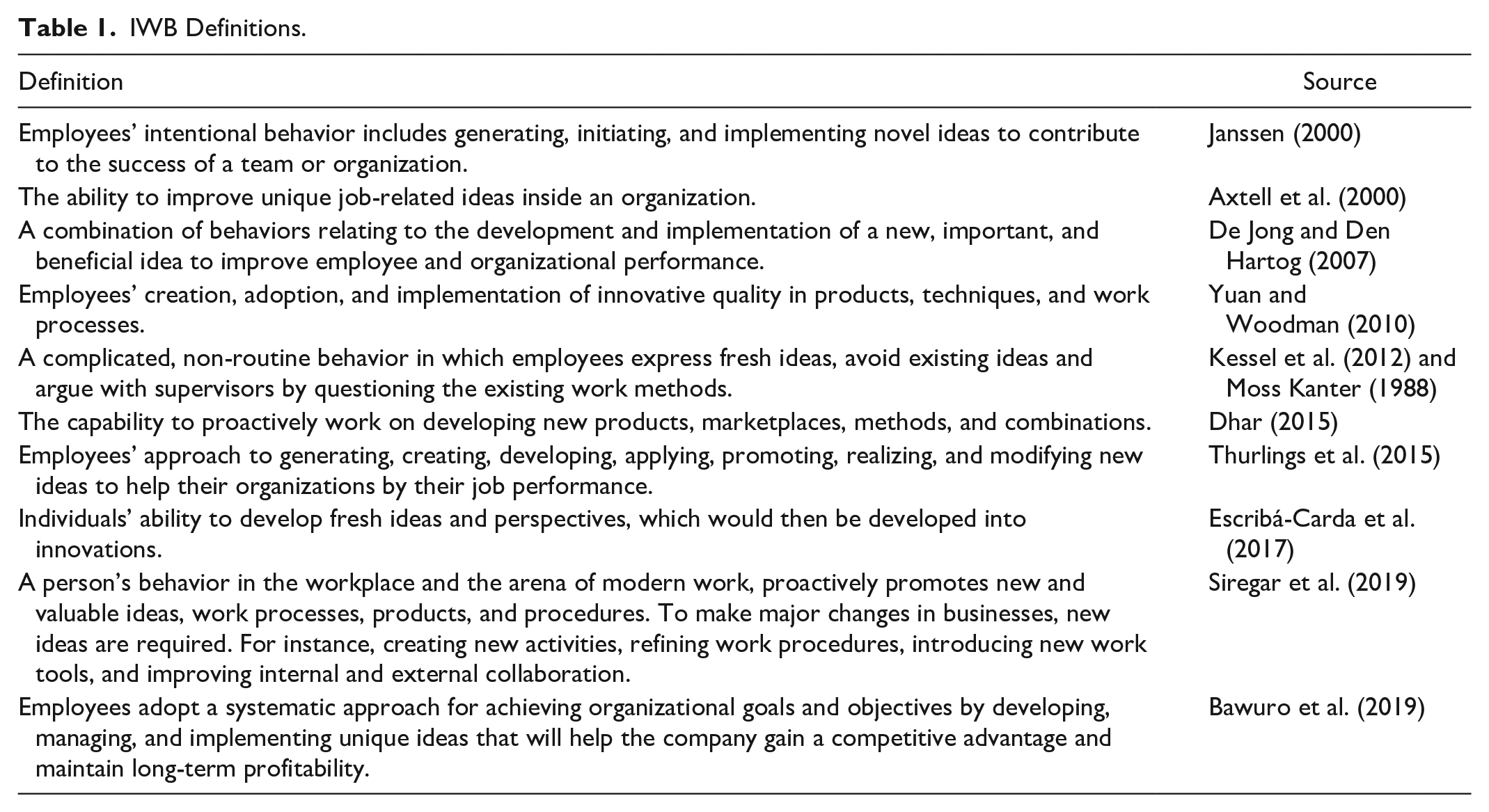
Table 1 provides some important IWB definitions.
IWB Definitions.
At the workplace, some people participate willingly and actively in the invention, development, and implementation of fresh ideas for personal success, community productivity, or organizational success. This phenomenon is described in the literature as innovative behavior (Monteiro et al., 2016).
Innovative behavior is characterized as a multidimensional construct “the intentional generation, promotion, and realization of new ideas within a work role, workgroup, or organization to benefit role performance, a group, or an organization” (Cingöz & Akdoğan, 2011). The multifaceted elements of the construct for creative actions come from identifying novel and valuable ideas, encouraging them, and implementing them (Scott & Bruce, 1994).
It has been generally recognized and executed in different organizations since the implementation of the concept of innovation (Axtell et al., 2000; Quintane et al., 2011). Innovation has become an important factor in service companies’ success and growth as the world is evolving rapidly (Campo et al., 2014; Rodgers, 2007). The innovative behavior of employees is considered as a key element in organizational innovation amongst various stages of innovation (Janssen et al., 2004). In service industries, it is important for business growth and is studied by several researchers (Calantone et al., 2002; Yuan & Woodman, 2010).
Innovation was identified as a significant strategy for businesses in the new global economy to stay competitive. The key predictor for organizational-wide innovation is the innovative work behavior of employees. Innovative work behavior refers to the development of functional goods, processes, or services that emerge from the discovery of problems to the generation of ideas (Al-Omari et al., 2019).
Companies and managers are becoming concerned with the importance of innovation and innovative work behavior. Employees’ innovative work behavior is essential for organizational innovation. The type of innovation might vary depending on the situation, such as innovation in workplace practices, techniques, or the working environment, but it is important to remember that innovation cannot occur without employees’ innovative work behavior (Akmal & Mehmood, 2020).
The key driving forces of innovation in the industry are employees (Li & Zheng, 2014). Innovative behavior is therefore very important for employees and can be characterized as an act of creating, encouraging, and enforcing innovative thinking in the organization for personal and organizational success (Chatchawan et al. 2017; De Jong & Den Hartog, 2010; Li & Zheng, 2014). Innovative behavior makes it possible to use innovative ways of thinking to respond rapidly and effectively to changes in consumer demand. Influence on innovative behavior of employees can be split mainly into two forms such as internal and external features (Li & Zheng, 2014; Lukes & Stephan, 2017; Smith et al., 2008). Internal factors are innovative personal characteristics and the desire to engage in innovation and external factors such as team climate (technology, values, finances, and so on) and management support (Chatchawan et al. 2017; Monteiro et al., 2016; Smith et al., 2008).
In past studies, researchers examined the factors of innovative work behavior. The majority of previous studies examined the factors of innovative work behavior at the organizational level. For example, (a) the impact of perceived organizational support, (b) workforce spirituality, and (c) person-organization fit on innovative work behavior has been studied previously, and it was discovered that such elements had a positive effect on innovative work behavior (Afsar & Badir, 2017). Multiple studies have been conducted to investigate the impact of an individual’s intrinsic motivation on employees’ innovative work behavior. A prior study in Thailand, for instance, found that intrinsic motivation was also a predictive variable for innovative work behavior (Afsar et al., 2016). Others examined factors such as (i) organizational culture, (ii) corporate social responsibilities, (iii) innovation trust, (iv) relational leadership, and (v) transformational leadership (Akram et al., 2016; Bysted, 2013; Choi et al., 2016; Kim et al., 2018; Taghipour & Dezfuli, 2013).
In the hospitality literature employees’ innovative behavior has been shown to improve; (a) financial performance (Grissemann et al., 2013), (b) future sales and firm value (Nicolau & Santa-María, 2013), (c) quality standards (Rogerson, 2013), (d) productivity and competitiveness (Pivčević & Garbin Praničević, 2012), and (e) performance (Mattsson & Orfila-Sintes, 2014). However, the unique nature of service employees’ role in facilitating innovation has not been thoroughly investigated; past research on the subject has tended to ignore the thorough exploratory examination required to uncover the nature and factors of service employees’ driven innovation (Edghiem & Mouzughi, 2018).
According to the study of Javed et al. (2019); (i) leadership, (ii)workgroup, (iii)work atmosphere, (iv)individual variations, (v)job qualities, (vi)demands, (vii) personality, and (viii) values are all main antecedents of innovative work behavior at the organizational, workgroup, and individual levels, they are significantly correlated with innovative work behavior.
It has been observed after examining the literature of previous research related to determinants of innovative work behavior, only limited variables have been explored. This suggests that our knowledge of the variables that impact innovative work behavior is still inadequate. Thus, future researchers should investigate the determinants of innovative work behavior (Al-Omari et al., 2020).
The present coronavirus pandemic (COVID-19) has pushed the world into a serious socioeconomic and psychological crisis. It has badly hit the economy but it hardly hit the service sector, mostly the hospitality business (Khan et al., 2021).
COVID-19 fear has become a worldwide problem. People, businesses, communities, and economies all across the world have been affected. Most companies were unable to overcome the economic difficulties caused by COVID-19. Those who have survived have had to create and execute innovative business models (Khan et al., 2021). Shin and Kang (2020) suggested that by adopting technological innovations and risk-reduction methods, the hotel industry might regain its customers’ trust after the restrictions are lifted.
The hospitality industry is one of the industries that has been seriously damaged by the COVID-19 lockdowns around the world. Early practical and theoretical findings in the hospitality industry suggest that business model innovation may be a useful solution for recovery and successfully dealing with the COVID-19 disaster. Amazingly, some hospitality businesses have already initiated to effectively restructure their existing business models (Breier et al., 2021).
Therefore, to cope with the COVID-19 crisis, service organizations should play a significant role in implementing innovation policies that include boosting employees’ innovative behaviors to gain back the trust of their customers. Innovative behavior is influenced by elements including leadership, organizational policies, perceived organizational support, trust, organizational climate, and culture.
According to Vasanthapriyan (2018), most research studies have been found on organizational innovation and a few studies on employees’ innovative behavior, but our mapping study has shown that the importance of research on employees’ innovative work behavior has increased in the last few years. Employees are considered as a foundation of innovation, and most of the research on innovation has also discussed the importance of innovative work behavior of employees.
Bibliometric analysis is a very famous and thorough method for examining and analyzing vast amounts of scientific research data. It allows us to explore the evolutionary aspects of a certain subject while also providing insight into the emerging areas of that subject. However, its use in business research is still quite new and, in many areas, insufficient (Donthu, Kumar, Mukherjee, et al., 2021).
Most crucially, bibliometric analysis in business research has gained so much attention not because of the trend, but rather as a result of its usefulness in dealing with vast amounts of scientific research data and gaining higher research impact (Donthu, Kumar, Mukherjee, et al., 2021).
Researchers use bibliometric analysis for many reasons, including identifying developing trends in articles and journal ratings, collaboration practices, and research elements, as well as investigating the intellectual structure of a certain area in the existing literature (Donthu et al., 2020; Donthu, Kumar, Pattnaik, & Lim, 2021; Verma & Gustafsson, 2020). For bibliometric analysis, the data used is typically large (hundreds or thousands) and the type of data is objective (such as the number of citations and publications, occurrences of keywords and topics), but its interpretations frequently depend on both objective (e.g., performance evaluation) and subjective (such as thematic analysis) analyses defined through informed approaches and methodologies. Bibliometric analysis, in other words, is effective for understanding and mapping the cumulative scientific information and developmental aspects of well-established areas by rigorously making sense of vast volumes of unstructured data. As a result, well-conducted bibliometric studies can lay solid foundations for promoting a field in novel and valuable ways. It helps and encourages researchers to (1) gain an overall idea, (2) recognize gaps in knowledge, (3) obtain unique ideas for the research study, and (4) position their predicted results in the field (Donthu, Kumar, Mukherjee, et al., 2021).
The latest research study has explored the application of bibliometric analysis studies on innovation-related subjects, for instance, open innovation (Wang & Tang, 2013), Schumpeter-based innovation (Lazzarotti et al., 2011), innovation related to collaborative partnership (Lopes & Carvalho, 2012), national innovation structures (Teixeira, 2014), and bibliometric analysis social networks and analysis (Francisco, 2011).
Innovation is a topic that has been fairly studied. Though, very few bibliometric studies on the topic seem to be published. It can be seen in this context that more research is needed for the theme of innovative behavior. The ultimate purpose of the analysis is to examine innovative behavior and make a significant contribution in literature by demonstrating a wide range of statistical analyses and critically examining the trends and scope of the field of innovative behavior from 1961 to 2019 by conducting a bibliometric analysis using Scopus database.
Methodology
Nowadays, bibliometrics is one of the few genuinely interdisciplinary areas for study covering almost every area of science. The methodology in bibliometrics covers the statistical, social, natural, engineering, and even life sciences components. Analysis of the scientific result published, for instance by a researcher, an organization, or a country, a research team can be described as analysis. The scientific discipline may further be defined. The scientific findings may be given in various ways, for example, chapters in books, journal articles, newspaper contributions, books, etc. This strand of research can be named by counting publications. This gives details about quantity but makes no relative use or reports on scientific use or effect (Thanuskodi, 2010). The bibliometric analysis enables researchers to conduct a thorough examination of a variable from multiple perspectives, highlighting its evolution pattern (Fellnhofer, 2019).
Hence, for the current study, we have used bibliometric analysis to examine the importance of innovative behavior in literature. This method of analysis provides different ways of interpreting the variable under study; (a) develops our understanding of a specific area of research by providing insights into the area of research, the behavior of the variable, and its consistency; (b) this shows recent developments about the variable; and (c) it includes the variable’s interactions and networks. For this study, we employed the Scopus Database, which indexes the top journals with the most latest publications (Aghaei Chadegani et al., 2013). Scopus is Elsevier’s database and is known to be the chief abstract and reference database of academic papers reviewed by experts. Scopus has provided its website with tools to support research needs in the science, engineering, medical, social sciences, and arts and humanities fields with simple easy, and full-scale resources. As of November 2012, Scopus has more than 20,500 titles in its archives, representing more than 5,000 foreign publishers, which means 49 million documents since 1823. Annual changes are made to approximately 2 million new documents per year (Santos et al., 2015). Scopus is one of the most comprehensive databases in terms of global and regional coverage of (a)journals, (b) books, and (c) conferences, and it includes a wide range of articles. Scopus has a user-friendly interface and supports a variety of software applications for obtaining information for bibliometric analysis such as authors, topics, abstracts, year of publication, universities/institutions, citations, and countries (Sikandar et al., 2021).
Search Strategy
This research aimed to examine research developments in “innovative behavior.” In the main search of this bibliometric study, research articles comprising the keyword “innovative behavior” in their titles and abstracts were used. For this reason, data were collected at different time spots during October and November 2020 using the Elsevier Scopus database. The main query string used for the first step of our search is as follows; TITLE-ABS (“innovative behavior”). The first step has shown 1,425 publications and when we examine our results, we found that the oldest research paper on “innovative behavior” was published in 1961, while 185 research papers were published in 2019. In the second step, our search was limited till 2019 so we found 964 publications. The query string used for second step of our search is as follows; TITLE-ABS (“innovative behavior”) AND (LIMIT-TO (SRCTYPE, “j”)) AND (LIMIT-TO (DOCTYPE, “ar”)) AND (EXCLUDE (PUBYEAR, 2020)). In step three, 33 research articles were eliminated from the main search string, because these 33 documents were either review articles, conceptual papers, or meta-analysis papers. The objective of the current study was to only include empirical studies in the search string, hence review articles were removed based on their lack of any new empirical contributions to the academic literature. Moreover, review papers usually have higher citations, so the list of top articles included in our study may be populated only with them. Therefore, the focus of this bibliometric study is only on empirical studies contributing to the literature. We followed Ayub et al. (2021), Khudzari et al. (2018), and Sheeraz et al. (2021) and excluded review articles from the analysis. So, In the final step 931 publications were included. The process of data collection of this bibliometric study is shown in Figure 1 while, in Supplemental Appendix A, all search strings are provided.

Process of data collection.
Bibliometric Maps
To generate and visualize bibliometric maps, we exported authors’ information, affiliated country data, and authors’ keywords information from 931 publications to VOSviewer (version 1.6.13), a software tool usually used for the development and visualization of bibliometric maps. When dealing with small and large datasets, the VOSviewer is particularly used; it shows data maps and different analytical analyses (Khudzari et al., 2018; Kokol et al., 2018; Llanos-Herrera & Merigo, 2019; Shah et al., 2019). Similarly, Van Eck and Waltman (2013) claimed that VOSviewer provides additional methods of mapping for the development of useful maps, networks, and data based on scientific principles. In this bibliometric study, VOSviewer maps consist of items to be examined, that is, affiliated countries and authors’ keywords. The author’s keywords provide information from the researchers’ point of view on research trends and have proven to be relevant in tracking the field’s growth. There may be a link between a pair of items or variables, and the strength of each link is shown as a positive number. Suppose that if the link between items has the highest number, it indicates that they have a stronger relationship. In addition, the VOSviewer map does not show analysis of two variables at a time, for example, countries and authors keywords.
Similarly, in co-authorship analysis, the strength of the link among countries indicates the number of co-authored research papers with affiliations in more than one country. We involved all 82 affiliated countries to the 931 publications in the co-authorship network analysis. For further examination, these affiliated countries have been divided into five continents and one region; America, Africa, Asia, Antarctica, Europe, and Oceania. The total strength of the link shows the total strength of a country’s co-authorship links with other countries. We have also shown visually the publication’s network of the countries using VOSviewer.
Moreover, in the study of co-occurrence, the strength of links among keywords shows how many publications in which the two keywords appear together. The study of the co-occurrence of keywords of authors involved 44 keywords from 931 publications. Congeneric phrases and synonymic terms were manually evaluated before importing the data of authors’ keywords to the VOSviewer. For instance, innovations and innovativeness were all known to be innovation and re-labeled as innovation. Also, the terms such as; (a) innovative behaviors, (b) innovative behavior, or (c) innovative behavior as well as (d) innovative work behavior or (e)innovative work behavior have all been re-labeled as innovative behavior. For all the words that were used interchangeably in the research papers, the same methodology was used. It should also be noticed that we have a small English alphabet “n” which refers to the “number of occurrences.”
Results of the Study
Publications Analysis
Results of our study have shown that 931 research papers on innovative behavior were written between 1961 and 2019 (Figure 2). There are only 143 of these 931 publications available with open access. While analyzing our findings, we found that the oldest research paper was published in 1961. The number of publications reached 50 in 2013 and 2018, the papers crossed the 100-plus barrier. A gradual rise in publications had arisen in literature by the beginning of the 21st century. After 2012, 61.43% of the papers have been published. We assume that the huge growth in the number of researches is the result of the rise in linkages and higher education academic institutions in some countries for instance Pakistan, and the global increase in publications (Makri, 2018; Researchtrends, 2019). From these results of the study, it can be concluded that the growth of publications will continue to rise dramatically in the coming years.

Year-wise publications (1961–2019).
Subject Areas in Innovative Behavior Research
This bibliometric study was conducted on all subject areas, so no restriction policy has been applied while analyzing the subject areas of innovative behavior. It aims to provide an overview of the areas in which publishing is the most influential on a subject. This study is helping to foster new research in various fields of knowledge with immense growth potential in the fields of Agricultural and Biological Sciences, Environmental Science, Psychology, Computer Science, and Engineering (shown in Figure 3). There are 533 documents with the most international publications in this field, and it is noted that the concentration on publications on “innovative behavior” is higher in the areas of Business, Management, and Accounting. There are 269 publications in the field of Social Sciences, followed by 136 publications in the area of Economics, Econometrics, and Finance.

Areas of knowledge.
Language of the Research Articles
Innovative behavior research is multilingual since we have found papers in multiple languages. Our findings indicate that the publications used in this research have been written in 15 languages. Almost 96.02% of the articles were published in English, followed by 1.07% in Chinese and Spanish, and 0.75% in German, while fewer than five articles were published in 11 languages which includes French, Italian, and Persian. We also find that the five most productive journals mentioned in Table 2 were published in English, and their scope is much wider than that of other language journals such as Psychologie du Travail et des Organizations. Although the data collected is based on title, abstract, and keywords, we included all papers published in any language.
Top 5 Journals on “Innovative Behavior.”.

Top Journals
Our study shows that five famous publishers maintain the top 5 most prolific journals (Table 2). The best five most-cited journals were; (1) International Journal of Innovation Management with 19 publications, (2) Research Policy with 16 publications, (3) Sustainability Switzerland with 14 publications, (4) European Journal of Innovation Management with 12 publications, and also (5) Journal of Product Innovation Management with 12 publications. “World Scientific” is the publisher of the top 1 journal whereas “Elsevier” and “Multidisciplinary Digital Publishing Institute (MDPI)” are second and third, respectively. Our review results showed that “Research Policy” had the highest number of citations (874) and also had a maximum citation of 214 times for one of its publications.
The 2019 citation score report showed that our research had two journals citing scores of 9 and more. “Research Policy” had the highest cite score of 10.4 and “International Journal of Innovation Management” had the lowest cite score 2.7. We have also explored that our top-ranked journal “International Journal of Innovation Management” had 19 publications but its cited score (2.7) is comparatively less than our third top-ranked journal “Sustainability Switzerland” which had 14 publications and (3.2) cite score, it indicates that our top 1 journal is not commonly cited. In Supplemental Table S2, we have assembled a list of the best eight cited journals with at least 10 publications on “innovative behavior.”
Top Countries, Best Institutions, and Global Linkages
Figure 4 presents the top 10 countries contributing to the field of “innovative behavior.” From 1961 to 2019, about 27.92% of the research articles were contributed by USA and China, this data shows that these two countries are promoting research on the “innovative behavior” topic. These 10 countries (in Figure 4) have produced 76.26 % of the total publications on “innovative behavior” research. However, out of a total of 86 countries, 57 countries have fewer than 10 publications. One explanation is perhaps that most of these 10 top research countries belong to the advanced academic world, which has already established a research culture. If we further examine our data wisely by continent and regions, there are five countries from Europe, three from Asia, one from America, and one from the region of Oceania. No country comes from Africa. Asia constitutes 60% of the world’s population (World Population Review, 2019), and in Asia and the world, China is the most populous country; it secured the second position in our data list. Africa is also the second-highest continent, consisting of 17% of the population of the world, but no country from Africa was in our data list of top 10. However, the area of Oceania is just 0.55% of the world’s population, but Australia was eighth.

Top 10 countries in “Innovative behavior” research.
In addition, Figure 4 highlights country contributions and research affiliation with authors from other countries. While the United States of America has the largest number of research papers, Taiwan has more single-country publications. In the same way, China, the United Kingdom, and Spain have intra-country partnerships comprising more than 60% joint research ventures. Similarly, Germany, Italy, the Netherlands, and Australia have researchers from other countries with more than 50% of their publications. Along with Figure 4, we have also assembled the list of the top 25 institutions that generate the highest “innovative behavior” publications (Supplemental Table S3).
Ten universities are among the top institutions that contribute the most to this field shown in Figure 4. This study shows that university faculty members, research associates, and students generate much of the research output. Finally, among these 10 academic institutions, 5 are listed in the top 150 best universities based on the 2020 QS world university ranking as shown in Figure 4 (World University Rankings, Times Higher Education, 2020): the University of Pennsylvania (ranked 11th), the University of Birmingham (ranked 112th), the Technical University of Berlin (ranked 149th), Maastricht University (ranked 127th), and National Taiwan University (ranked 120th). The findings indicate that research on “innovative behavior” has gained recognition from researchers at the world’s leading universities.
Figure 5 illustrates the categorization of countries by their regions. The VOSviewer has assigned colors to countries based on how often they are networking. In addition, the closer the two countries are to each other, the stronger their link is, as shown in Figure 5. Furthermore, the stronger the link between the two countries, the thicker the line. If we interpret the data by continent, Europe (30 countries) is in the first place, followed by Asia (27 countries), America (12 countries), Africa (11 countries), and the Oceania region (2 countries). Hence, Europe is at the top with the maximum number of countries. Co-authorship analysis has shown that the UK has maximum affiliations with 36 countries and 104 co-authorships. While Australia has 31 affiliations and 70 co-authorships; the USA has 29 affiliations and 82 co-authorships; China has 29 affiliations and 67 co-authorships; the Netherlands has 29 affiliations and 60 co-authorships; Italy has 27 affiliations and 52 co-authorships; France has 27 affiliations and 56 co-authorships, and Canada has 26 affiliations and 53 co-authorships. This study is useful for researchers to establish research opportunities collaborations with different countries. In addition, according to Thelwall and Sud (2016), more writers in an article can increase the citation of the research papers. These findings also indicate that in cooperation with other countries, new countries are publishing research articles; this will pave the way for understanding the cultural trends of these countries in that specific research field.

Screenshot of the bibliometric map showing co-affiliation of countries (network visualization mode).
Leading Authors
The 10 most productive authors of our data have affiliation with nine countries shown in (Table 3). The total number of authors of these 931 articles is 455 whereas one article author is undefined. We set the threshold of five in the VOSviewer when we uploaded the data, which revealed seven authors who had five or more articles. Hirsch said that the h-index above 40 indicates an excellent researcher (Quoted by Ball, 2005); thus, no author has an h-index over 40 (see Table 3). However, the number of articles, citations, and h-index of these authors is very high, but we only collected data for innovative behavior publications.
Top 10 Authors in the Field of “Innovative Behavior.”.

We further examined our data and find out that Battistelli and Carmeli are low in publications but their citations are quite high. Our top 10 authors published 5.9% of the total papers on innovative behavior studies. The first research papers of these writers were written from 2006 to 2016, of which five authors served as the first authors in their articles, four co-authors and only one was the last author. The affiliation of authors with their respective institutions has shown that research has been carried out on innovative behavior in areas related to business, management, and psychology. Carlo Odoardi from Italy is the top author of this study, since 2013 has published eight research articles containing 105 citations and 6 h-index. Francesco Montani from Monaco is the second top author of this study, he has published seven research papers since 2013 with 106 citations and 6 h-index. Adalgisa Battistelli, Abraham Carmeli, and Karin Sanders are the third top authors of our study, they have six publications with five h-index but different citation scores (details in Table 3). It has also been noticed that our third top author, Karin Sanders, and fourth top author, Alexander Newman, are both affiliated with Australia. It has also been noted that the research paper published in 2006 (Table 3) referred to the same publication (Carmeli, Meitar & Weisberg, 2006) written by Abraham Carmeli, our fourth prolific author. In Table 2 the authors of the most-cited research articles are usually not shown in Table 3. Only in both tables will their names be shown if they have been published prolifically.
Top 1 author’s publications record in Scopus database.

Top second author’s publications record in Scopus database.

Analysis of Authors Keywords
The results of the authors’ keywords have shown that 21% of the research papers have no keywords. We also determined five as the minimum number of keyword occurrences when uploading the information to VOSviewer (Van Eck & Waltman, 2013). Therefore, after searching synonyms for the 2,386 keywords, the database found 58 keywords. There are 272 links between these 58 keywords, although the total link strength is 543. Next, we re-labeled the identical/similar terms including phrases, and generated a map of 44 keywords of authors in VOSviewer, just as we set the threshold to 5 as a minimum number of appearances or occurrences in the previous stage. There are 180 links between these 44 keywords, while the total relation strength reaches 516.
The findings of the analysis indicate that the phrase “innovative behavior” has n = 264 and 235 total link strength to the other keywords (Figure 6). “Innovation” is the most frequently encountered keyword with n = 229 and 177 total link strength to other keywords followed by “Transformational Management” with n = 28 and 55 total link strength to other keywords. We noticed that “innovative behavior” has the highest occurrence with 264 times with third cluster, 37 links, and 235 total link strength in which the innovative behavior links with some keywords such as “leadership,” “organizational commitment,” “knowledge sharing,” “entrepreneurship,” “psychological empowerment,” “organizational culture,” “work engagement,” “innovative climate,” and “employee behavior.” The data has shown a stronger link between “innovative behavior” and “innovation” with 34 occurrences.

Screenshot of the bibliometric map representing authors’ keywords co-occurrences (n = 5) in overlay visualization mode.
Also, we have observed that some terms such as “employee innovative behavior,” “innovative behaviors,” and “innovative work behavior” were used to refer “innovative behavior.” The overlay visualization mode, which is displayed in different colors, is shown in Figure 6. The overlay visualization mode indicates the keywords’ average year of publication. Yellow color, for example, represents the variables with the average publication year 2018, while the purple color represents the average publication year 2010 variables. In addition, the variables with rare occurrences are also shown by this color scheme. For instance, job autonomy (n = 5), trust (n = 5), transactional leadership (n = 5), self-efficacy (n = 7), psychological capital (n = 9), and all other remaining been shown with yellow color. The overlay visualization mode often recognizes variables with years of publication that have fewer occurrences of “Innovative Behavior” studies. Though, more research is required to examine the impact of “Innovative Behavior” on such variables; service innovation (n = 1), innovation management (n = 1), idea generation (n = 2), proactivity (n = 3), SMEs (n = 3), knowledge management (n = 5), entrepreneurship (n = 7), and leadership (n = 10).
Conclusion, Limitations, and Future Research
We examined the “innovative behavior” research indexed in the Scopus database by mapping authors, keywords, and countries. This research, on the other hand, shows that innovative behavior is critical for organizations around the world. In addition, the interest of researchers in the subject has increased in recent years. In addition, social science researchers, administrators/managers, and psychologists publish much of the research in the field. While developed countries dominate the field both in the number of publications and in the number of active authors, developing countries have also begun to contribute. We also presented the pattern of publications with well-known and neglected keywords. We tried to understand past research patterns and keywords, but found no consistent pattern except that “innovative behavior” research is heading more toward “employee innovative behavior” and “innovative work behavior.” Since the information world is growing, it could be possible that some key terms currently dominating the field will be replaced in the future with more influential keywords.
Results of the study show that “innovative behavior” has the highest occurrence with 264 times with 37 links and 235 total link strength in which the innovative behavior links with some variables such as leadership, organizational commitment, knowledge sharing, entrepreneurship, psychological empowerment, organizational culture, work engagement, innovative climate, and employee behavior. These are the major concepts that occurred within “innovative behavior” research.
Analysis of authors shows that Carlo Odoardi from Italy is the top author of this study, since 2013 has published eight research articles containing 105 citations and 6 h-index. Francesco Montani from Monaco is the second top author of this study, he has published seven research papers since 2013 with 106 citations and 6 h-index. Co-authorship analysis has shown that the UK has maximum affiliations with 36 countries and 104 co-authorships. This study is useful for researchers to establish research opportunities collaborations with different countries.
Our co-occurrence analysis of the author’s keywords covered just 79% of the publications due to incomplete author’s keyword information from some papers. Our review is therefore limited to the keywords of these authors. Also, there is no systematic search string in the Scopus database, and we have not attempted to explore whether “innovative behavior” has been more investigated as an independent variable or as a mediator/moderator. While keywords for mediator and moderator appeared in the database, we are firmly convinced that these occurrences do not involve the full range of 931 publications. The explanation may be that in their titles, abstracts, and keywords, studies rarely use the words moderator or mediator. Reading each article one by one is the best solution to this problem. Therefore, we suggest that future researchers also discuss this aspect.
Another factor not addressed in this analysis is the nature of the research papers added in our analysis such as qualitative, quantitative, or mixed research. The findings of the database indicate limited results for quantitative and qualitative studies, but this is not checked again and could be discussed by future researchers. Valderrama-Zurián et al. (2015) argued that the publications are duplicated in the Scopus database. We did, however, systematically search the electronic identifier (EID) of the articles and could not find any replication of the articles. This issue can also be addressed manually or systematically by future researchers. Lastly, for future research to compare data outputs from different databases, it is recommended to use Scopus and the Web of Sciences. More systematic research would be useful in performing bibliometric analysis using various data sources.
Supplemental Material
sj-docx-1-sgo-10.1177_21582440221109589 – Supplemental material for A Bibliometric Study on Innovative Behavior Literature (1961–2019)
Supplemental material, sj-docx-1-sgo-10.1177_21582440221109589 for A Bibliometric Study on Innovative Behavior Literature (1961–2019) by Sidra Salam and Aslan Amat Senin in SAGE Open
Footnotes
Acknowledgements
The authors of this bibliometric study did not obtain any grant from any source. Sidra Salam would like to thank Professor Aslan for his constant guidance, encouragement, comments, and care. The authors also appreciate the facilitation of bibliometric analysis workshops by Azman Hashim International Business School, UTM.
Declaration of Conflicting Interests
The author(s) declared no potential conflicts of interest with respect to the research, authorship, and/or publication of this article.
Funding
The author(s) received no financial support for the research, authorship, and/or publication of this article.

Supplemental Material
Supplemental material for this article is available online.
References
Supplementary Material
Please find the following supplemental material available below.
For Open Access articles published under a Creative Commons License, all supplemental material carries the same license as the article it is associated with.
For non-Open Access articles published, all supplemental material carries a non-exclusive license, and permission requests for re-use of supplemental material or any part of supplemental material shall be sent directly to the copyright owner as specified in the copyright notice associated with the article.
