




Abstract
Taking the motivation of the knowledge aggregation of age-friendly design resources as the starting point, this paper compares the development history of age-friendly design for interactive interfaces, understands the research status, hotspots, and development trend of age-friendly design for interactive interfaces from 2003 to 2022 worldwide, and summarizes and analyses them. This paper explores five aspects of aging-friendly design in the field of interactive interface design extracted from the Web of Science core collection database, including keyword co-occurrence analysis of global research literature, country/region information analysis, fundamental research areas, major research institutions, and future research directions. It explores the design methods, design trends, and design laws of aging-friendly design for interactive interfaces from a multidisciplinary perspective. The results show that: (a) Smart Home, Ambient Assisted Living (AAL), User Experience, Internet of Things (IoT), etc., are the hot topics at the forefront of interface aging design. (b) USA is the world’s leading research site for interface aging design and works closely with China, where the population aging is more serious. (c) The main research areas of interface aging are computer science and engineering ethics. (d) Udice French Research Universities, the primary publishing institution, is worth attention. (e) This review proposes three research hotspots as important development directions for interactive interface aging design, including “smart home product interaction interface aging design will become a hot topic,”“fusion of multi-source data assisted interface aging design,” and “interdisciplinary interface aging design.”
Introduction
Interaction interface design for aging is to update and iterate the interface by proposing a systematic design approach (including visual, cognitive, and mobility perspectives) so that the final product can reduce the perceived limitations of the graphical interface, help the elderly reduce some psychological barriers in the process of using intelligent products, and obtain a pleasant experience for users (H. Liu, Wang, Liu, et al., 2022; L. Zhu & Lv, 2023), improve the comfort of the interface used by the elderly, and improve the elderly’s comfort with the use of the interactive interface.
Interaction interface is mainly divided into two types: complex interface interaction and weak interface interaction. The soft interface includes text, color, graphics, controls, structure, navigation, and other aspects. The architecture of the interaction interface mainly includes functional modules, logical configurations, and interactive forms. Since the natural aging process makes the elderly prone to physical and memory weakness (Jia & Tung, 2022; Zhu & Hou, 2022), interactive interfaces based on smart technologies are fully functional and colorful. Yet they do not match the cognitive characteristics of older persons, which will undoubtedly increase their difficulty in operation and thus loss of self-confidence, and even lead to the social isolation of the elderly with physical and mental impairments (Syeda et al., 2019). At the same time, it is necessary to consider the aging interface design for the elderly and disabled (Miura et al., 2016). Understanding older users and design strategies are essential for the age-appropriate design process. Dong and Dong (2022) developed a design tool based on resources and empowerment models for older adults to help apply knowledge to practice. They organized a design workshop to evaluate the toolkit, showing that it positively influenced the understanding and response of participating designers to aging and helped designers to make design references on interactive interface fitness for aging.
Compared with previous research, this paper will explore the meaning of interface age-friendly design, related theories, and the usability and ease of use of research applications and practices.
Significance of Aging Design of Interactive Interface
With the acceleration of aging in most countries, society is facing huge pressure to provide for the elderly (Comincioli et al., 2021). The world is gradually entering an aging society, and developed countries led by the USA are taking the lead in entering an aging society. The report World Population Prospects 2022, released by the United Nations on July 11, World Population Day, the proportion of people aged 65 and above in the world is expected to increase from 10% in 2022 to 16% in 2050, and 80% of countries, and regions in the world will enter the aging society stage this year (Data from the World Health Organization). With the continuous development and improvement of computer science and artificial intelligence technology, product design is gradually moving from information technology to intelligence, and the way of Human-Machine Interaction is gradually developing from traditional single-modal interaction to multi-modal interaction. The demand for goods and services for the elderly is growing daily as a result of the rise in the number of older people and the advancement of science and technology. We should address the diverse requirements of the elderly while easing their physical and emotional stress in order to let them better enjoy the comfortable life brought about by scientific and technical advancements. Create a friendly world for the elderly (Chang et al., 2018), by various innovative elderly products and software have started to flood the market, and the booming elderly innovative product industry has strongly promoted the rapid spread and popularization of age-friendly design of interaction interfaces in the world. Internet usage services are becoming increasingly indispensable in people’s lives (Dombrovskaia & Vilches, 2021). More elderly people are starting to accept and learn to use the interactive interface, but how to operate the interface smoothly can increase the frustration and anxiety of elderly users.
For the sake of solving such matter, many scholars and researchers put forward interactive interface designs suitable for elderly users; as early as 2001, Zajicek (2001) conducted research on the interaction design of information product interfaces for the elderly user group, and the experimental results show that the interface structure, icon, symbol, color, and image elements have an important influence on the interface interaction design of elderly users’ products. Some early scholars have studied interaction design in terms of theory, methods, principles, and user experience, and with the development of the times, gradually learning from psychology (Datu et al., 2022), behavioral science (Bilynets & Cvelbar, 2022), brain science (Choksi et al.,2021), cognitive science (Ross, 2019), intelligent technologies s (Putro & Rosmansyah, 2018), and other multidisciplinary perspectives to intersect this (Laparra-Hernández et al., 2021).
From a socioeconomic perspective, older adults are often labeled as “causing social problems” due to their physical decline. However, when seniors are viewed as a resource and economic engine, they may help with a variety of issues and contribute to society. Similarly, the needs of the elderly are becoming more marketable and are driving the emergence of a “silver economy” (Marcucci et al., 2021). As a result, developed countries in Europe, the USA, and Japan have begun to focus on designing an aging society from a social welfare perspective (S. F. Liu, Wang, Lin, et al., 2022).
Research on Aging Theory of Interactive Interface
From a theoretical research perspective, based on the literature of the past 20 years, some design suggestions are proposed. For example, As early as 2004, Becker (2004) put forward the theory that dynamic pages will interfere with reading and reduce search efficiency when the elderly search for information online. When older adults search for health information online, too much ancillary content is detrimental to finding the correct information while hindering information search (Kules & Xie, 2011).
In 2020, C. M. Wang et al. (2020) proposed a tangible interface interactive device to help elderly people achieve active aging. The device combines human-computer interaction technology and the elderly’s life experience to provide three functions: nostalgia, leisure, and entertainment. Martins et al. (2020) studied the interaction mode of elderly users and redesigned the interfaces of three types of products, and proposed three guiding principles for reference. The results show that elderly users will have more accurate touch operations and higher interaction speed from adaptive methods. In addition, the interface design of senior products also needs to invest in a more technological sense that matches the cognitive experience of senior users (2019), that is, scenario-based interface. Scenario-based interfaces for elderly products can reduce the learning cost of elderly users, add emotional value to elderly products, and make elderly users enjoy the fun of modern technological products, for example, smart home products can assess the hearing level of older adults based on their repeated volume adjustments (W. Liu & Wang, 2021) and automatically adjust the appropriate volume. Shahal et al. (2021) compared three methods for adapting touch button size: no adaptation and adaptation with visible and invisible feedback.
Research on Practice and Application of Interactive Interface Adaptability to Aging
When conducting research with older adults, they are limited by interaction endpoints due to physical issues, such as visual, auditory, and cognitive limitations (Piening et al., 2021; J. Zhu et al., 2021). We can understand the user interface interaction activities of older adults in three aspects: operational (Essuman et al., 2020; Park et al., 2021), cognitive (Feinkohl, 2022; F. Wu et al., 2022), and perceptual empirical research (Gualtieri et al., 2021).
Interface Manipulation Aspects
One of the key strategies for enhancing how well the elderly’s interface functions is the concept of the ergonomic method used to construct an ergonomic decision assessment system (Chao et al., 2021; Sarbat & Tasan, 2021). If interface operation issues can be effectively addressed, Embarak et al. (2020) conducted a systematic literature review (SLR) method to collect and review research to understand the different user interaction devices used by elderly people to promote social connections, provide more user-friendly social media applications, and help elderly users gradually accept new ways of online communication with family and friends, with a positive impact. Chia-Chen and Kuo-Chen (2016) found through research that the error rate is lower when the drawing direction is from bottom to top, and the average drawing speed is higher when the drawing direction is from top to bottom. This discovery provides a valuable reference for the design of products or interactive interfaces used by elderly users, which has an impact on product design and computer human-machine interface design. Further research is needed to determine whether these findings can be extended to more complex motor and cognitive abilities (Yu, Ouyang, Wang, 2022).USA scholars Sharma and Wong (2020) conducted experimental research and design based on some new design assumptions, developed a graphical interface, and verified it through literature and survey. After testing, they were successfully applied to the smart home laboratory of Iowa State University.
Interface Cognitive Aspects
Research on page layout related to aging of interactive interfaces, Z. Wu et al. (2021) based on the analysis results of the corresponding Relational model between the elderly’s perception characteristics and the news APP interface layout, summarized that: (a) graphical layout will reduce the retrieval time of elderly users compared with plain text layout; (b) Placing images on the right side of the page can improve browsing time for elderly people more than placing them on the left side. Through quantitative experimental analysis, it was found that unreasonable interface layout can increase the difficulty of operation for elderly people (Qi & Jing, 2022). Font size has a significant effect on the perusal effect of older users, and in the printed text, the font size of older people should be chosen 20% larger than the smallest comfortable font size (Goodman-Deane et al., 2016). In addition to the symbolic analysis of the limiting surface, in order to help the elderly live independently, smart homes based on touch technology are becoming more and more popular. Yi and Feng (2021) investigated and analyzed the research methods of the elderly’s daily life and behavior at home through research interviews to understand the main needs of the elderly in life, as well as their cognitive and behavioral characteristics. Combining Service design and Interaction design, they proposed four service function modules for the elderly at home. This provides a new way of thinking for elderly people at home to design and provide intelligent service system products.
Interface Perceptual Aspects
Z. C. Wang and Chen (2022)studied the design strategy of voice user interface for elderly smart home products, in order to improve the comfort of elderly users when operating smart home products. After analyzing the experimental results, it is proposed that the feedback mode of the voice user interface for smart home products should be adjusted adaptively based on environmental conditions and the location and status of elderly users. Voice interaction is more suitable for helping elderly people who live alone to better handle daily tasks (Gao et al., 2021). Taiwan scholars Tsai (2020) proposed a structural usability model to determine the relationship between user interface design and the usability of game systems, including software systems and individual hardware devices. Through experiments, it has been proven that using the iFit executable system will improve the efficiency of the elderly user interface, enable users to better interact with the system, and enhance the usability of the entire system, including the device and the system itself. Ambient assisted living relies on intelligent devices and, more importantly, considers human behavior to achieve human-machine interaction (D’Orazio, 2021) truly.
Stavrotheodoros et al. (2022) proposed a hybrid pairing method, which can effectively use rule-based and statistical matches: (a) propose environmental assisted living services according to the role, status, and demand background of elderly users. (b) Identify and solve problems by automatically selecting one or more combinations to find the most suitable basic service set for elderly users. Starting from the characteristics of sense and perception of the elderly, Mei and Men (2019) analyzed the relationship between the visual effects, interaction effects, and experience effects produced by different layouts and color arrangements of shopping websites and systematically sorted out the design principles of the elderly’s shopping websites, such as color matching and font size, and completed a complete set of advanced shopping website interface design (Chen et al., 2019).
From the above-mentioned studies related to interaction interface aging, it can be found that the current literature related to interface aging design research is mainly based on design theory and design practice, but the comprehensive compendium of research status and research hotspots of related articles in this field globally is still not comprehensive, and there is no data visualization study about interface aging design. Therefore, the purpose of this research is to summaries the present situation of research, and research environment of interface-adaptive design based on bibliometrics, organize and enrich the research dynamics and hot research directions of interactive interface-adaptive design, and visualize the information, to better grasp the frontier of related fields and promote the development direction of interface-adaptive design with crucial practical significance. This research’s purpose is to provide the latest summary of empirical research on the determinants associated with each type of skill, as well as to provide worthwhile insights into future research areas in the hope of expanding the understanding of the field of interface-adaptive design research.
By extricating the history of interaction design development and providing an overview and analysis of 20 years of global research on age-appropriate design for interaction interfaces, we clarify the current state of development and trends. It also answers the following five explore questions:
(i) What is the development trend of age-appropriate design for interfaces?
(ii) What are the trends in age-friendly design for interfaces? Which countries are of more interest in age-friendly design for interfaces? What are the research levels and research hotspots in these countries?
(iii) Which institutions have a relatively high number of publications on age-friendly design?
(iv) What is the current status of research work in the field of age-friendly design for interaction interfaces?
(v) What is the future research prospect and outlook of the design for the aging of interaction interfaces?
Methods
Source of Survey Data
Through the core collection of Science Citation Index Expanded (SCI Expanded) on the Web of Science platform, Document retrieval and dynamic tracking of research frontiers are carried out. Bibliometric analysis is carried out from the number and annual analysis of published papers, future development trends, hot spots, etc. The starting time is set as August 2003 to August 2022, a total of 20 years, and the document language is set as English, The subject word is set to “elderly” or ”senior” or ”aged people” and ”interface” or ”interactive interface design” for retrieval, and ”OR” is used as the merging logic. The literature type is limited to research papers, research reviews, and conference papers. Retrieved 2,309 articles published in 88 countries/regions from the above screening criteria, and exported “fully recorded and cited references” as the basic data for the study.
Data Analysis Tools
The visualization of Similarities (VOS) viewer (version 1.6.18) knowledge map drawing tool developed by the Science and Technology Research Center of Leiden University in the Netherlands is adopted (Chen et al., 2019), developed by researchers at the Center for Science and Technology Studies (CWTS) at Leiden University in the Netherlands, was used to construct research literature keywords for clustering relationships and visualizing knowledge aggregation. VOS viewer is based on the principle of co-citation and co-citation of literature. The combined use of VOS viewer software and BIBLIOMETRC (bibliometric analysis platform), statistical and visual analysis of significant technologies, popular fields, keyword frequencies, and clustering mapping (Krayz Allah et al., 2021), to sort out and summarize the current status and the hotspot of global research development about interactive interface fitness from 2003 to 2022. These will provide researchers with the opportunity to describe, analyze, and locate relevant prior research and identify trends in scientific knowledge.
Knowledge Graph
Knowledge map has attracted the attention of academia and industry due to its powerful knowledge display and theoretical system (Lin et al., 2021; T. Wu et al., 2018). The core technology logic of a knowledge graph comprises three major components: “data input-data processing-knowledge graph generation.” The data input process includes “structured data, semi-structured data, and unstructured data”; the data construction process includes “information extraction, knowledge fusion, and knowledge processing”; the generation process of the knowledge graph system is the result of the iterative process of the whole technical architecture. The generation of the knowledge mapping system results from the iterative and continuous updating and accumulation of the entire technical architecture. Data input is mining data sources, data construction is the application of the underlying model algorithm, and knowledge mapping generation is the presentation of data processing results, as shown in Figure 1.
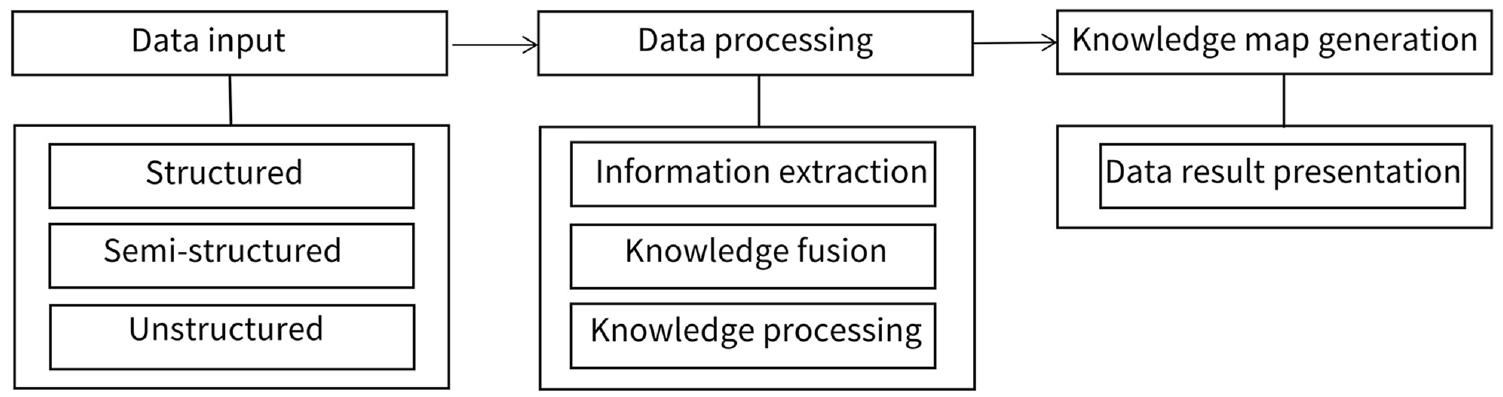
Three major links of “data input—data processing—knowledge map generation.”
In the data input stage, after extracting semi-structured data from the article resource library, this study entered the data construction stage and extracted information from the SCI Expanded on the Web of Science platform (Saha et al., 2020). The articles filtered according to restrictions were classified and analyzed, and converted into a reference summary. In the generation link of the Knowledge graph system, Information visualization is visualized by means of thermograph, keyword co occurrence, etc., to complete a complete logic of the Knowledge graph.
Co-occurrence Analysis
As smart technology advances and the interface aging research system is constantly updated, terms such as household experience, rehabilitation, and quality of life reflect hot topics in the field (Zhang et al., 2022). The method of co-occurrence word analysis has a wide range of research objects, including words, indexing words, classification numbers, and other meaningful fields included in literature and literature description in the text. Co-occurrence analysis is needed to select representative articles from a large amount of literature, categorize the literature, and identify research hotspots and directions. Many clustering algorithms can be visualized by computer programs or related software to show the relationship between keywords in a graphical way, which is convenient for researchers to analyze and utilize the clustering results, such as strategy diagrams, topic networks, and keyword overlap visualization methods.
Results
Keyword Co-occurrence Analysis
The 779 keywords appearing in the retrieved titles and abstracts were set to appear most times greater than 10, and the output graph contained 91 keywords with six classes of clustering visualization mapping. The interactive interface adaptive aging design keyword hotspot visualization as shown in Figure 2, with six clustering partitions, and the weight of the relevant literature determines the size of the circles; the more significant the ring, the higher the keyword hotspot and the greater the weight (R. Li et al., 2022). The relationship between processes is not shown for partially overlapping contents. The group to which the project belongs determines the color of the project, and there is not a single existence between keywords; there is an inevitable crossover. Technology development has allowed design applications to broaden the boundaries and integrate more engineering techniques.

Cluster analysis diagram of interaction interface aging research.
The top 20 co-occurring keywords in the field of interactive interface design for aging were obtained from the keyword co-occurrence analysis (Table 1). High-frequency keywords for the aging design of interactive interfaces are mainly Smart Home, AAL, User Experience, IoT, Virtual Reality, etc. It can be seen that in the field of aging design of the interface, the research content mainly applied to Smart Home and environment assisted living has become mature, which is an important research content of aging design of interface (Li et al., 2023). Environmentally assisted living technology is to connect various different devices and forms a kind of home intelligent technology network platform with scalability with the help of information coming from a large number of sensors, analyses the user’s state and environment using mobile communication technology (Hu et al., 2021), and monitors the user’s physical condition in real time, develop cognitive ability, provide automatic emergency call for help, and help the user perform various basic daily life activities, aiming to improve. It strives to enhance the senior population’s quality of life, provide them with assistance in their daily lives, and help them enjoy the intelligent life offered by technology. Other terms like user experience, rehabilitation, and quality of life have also become hot topics in this sector as a result of the advancement of intelligent technology and the ongoing updating of the interface aging research system.
Keywords of Aging Design for Interactive Interface.

The time distribution of research hotspots on interactive interface aging (Figure 3), the closer the color of the label is to yellow the more it is the emerging frontier in the knowledge field. In terms of color differentiation, there are three main periods: (a) Before 2013, Ambient intelligence, and telemedicine were the main research objects, and interface aging was mainly applied in the medical field. (b). The 4 years from 2014 to 2017 were the rapid development of interface aging design research, with the hot keywords biomechanic, and multimodal interaction in 2014. In 2014, using the keywords biomechanic, multimodal interaction, and the aging-friendly design of the interface started to explore the aging-friendly design of various interaction methods, including visual and haptic, etc. In 2015 to 2017, using the keywords augmented reality, brain-computer interface, EEG, and other technologies began to become important ways of interface age-friendly design research. The advancement and development of human-computer interaction technology, which is crucial to advancing technology, are inextricably linked to research on interaction design. Non-invasive brain-robot interaction (BRI) technology uses electroencephalography (EEG), based brain-computer interface (BCI) as an additional communication channel for robot control via brain waves and expects this technology to provide daily assistance to the elderly (Ko et al., 2022; Sun & Jin, 2021). (c) After 2018, research on interface age-friendly design covers a wider range of fields and gradually explores them on a large scale. Researchers have started to explore interface age-appropriate design in depth from various disciplinary perspectives, including Ergonomics and Cognitive psychology, which have become the latest trends in the field.

The time distribution map of research hotspots on aging interactive interfaces.
Information Analysis of Sending Country
In the VOS viewer, according to the principle of threshold setting (Saha et al., 2020), literature nodes and edges with certain importance or relevance can be selected to avoid overly complex graphics while maintaining a reasonable expression of the network structure. A smaller threshold for the number of nodes can generate a more concise network graph, while a larger threshold can contain more node information. Based on the research needs and concerns, according to the principle of appropriate threshold, Set the parameter thresholds to 25, 5, and 56, respectively. As shown in Figure 4, it is a visual representation of the parameter threshold output after setting. The larger the circle in the figure, the more documents the country sends in this field, and the greater the weight. The output visualization shows that the USA, China, Japan, and Germany have the most extensive research literature on interface adaptive design, which is helpful in tracking the research trends in this field accurately.
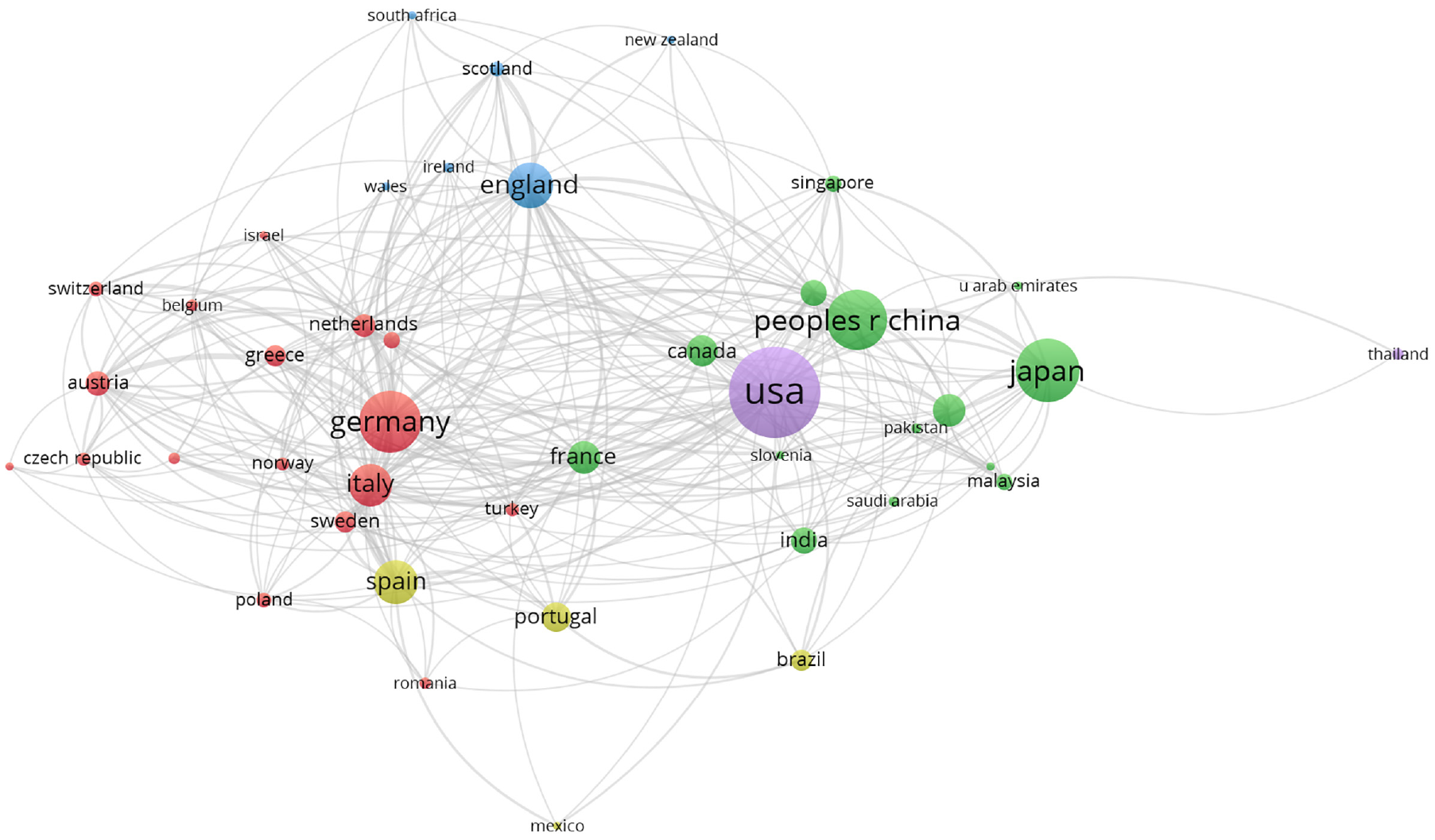
Co-occurrence analysis of interaction interface aging design cooperation countries.
The data of the top ten countries in terms of the number of publications after the literature search (Table 2), among which the USA (369), accounting for 16.08%, and China (316), accounting for 13.77%, the number of publications is significantly higher than other countries with specific influence. The other three countries in the top five were Japan (222), Germany (213), and the UK (177). Regarding the number of citations, the USA has been cited 7,545 times, and this data reveals that the USA still dominates and leads in the field of age-appropriate design for interactive interfaces. A visual chart of information on the partnership of each country visually reflects the disciplinary connection between countries/regions, as shown in Figure 5. A thicker line indicates closer cooperation between the two countries. The USA, which has a consistently high number of publications in the graph, has the most frequent partnership with China, followed by Germany and the UK. China has been seriously aging since 2014, and the aging population (60+ years old) accounts for almost 1/4 of the global aging population and is one of the countries with the largest elderly population in the world. The design about aging-appropriate design now tends to be at the forefront of aging-appropriate research in the world. China has started to emerge from 2014 about interactive interface aging, especially in 2014 to 2022 for a total of eight. In particular, 253 articles were published in 8 years from 2014 to 2022, accounting for 82.04% of the 20 years, which is in line with the phenomenon that the world is gradually entering an aging society, and the developed countries led by the USA are the first to enter the aging society as proposed in the introduction of the article.
Top 10 Countries in Global for Old People Design of Interactive Interface Research from 2003 to 2022.


2003 to 2022 research cooperation on aging adaptability of interactive interface in countries / regions.
Main Issuing Agency
Between 2003 and 2022, a total of 191 research institutions in 88 countries/regions worldwide published articles on the age-appropriate design of interfaces. The top 10 institutions that published related articles during the 20 years are listed in the search (Table 3), and the most published institution is Udice French Research Universities (31). The two U.S. institutions are the University of California System (23) and Florida State University (18), with 41 articles, 1,436 citations, and an H-Index (mixed quantified index) of 14, this high figure indicates that there is relatively close cooperation and high recognition between USA research institutions and other institutions and that researchers in design.
Main Research Institutions in The Field of Interface Aging Design from 2003 to 2022.

Key Research Areas
After analysis by VOS viewer, the main research fields of interactive interface design for aging were ranked (Table 4), and the number and percentage of articles published in the top 20 fields were listed, which can be roughly divided into four categories: computer science, machine technology, health care, and human-computer interaction. Among them, computer science accounts for 42.61%, and the fields involved include information coding, computer graphics and vision, programming, and human-computer interaction. Computer graphics and vision is an essential branch of interface design for aging, mainly for studying digital visual content involving synthesizing and manipulating image data. With the help of the characteristics of computer science, the contradiction between elderly users and interface interaction can be alleviated by focusing on the characteristics of users themselves from the perspective of graphics and vision.
Top 20 Research Fields of Global Interactive Interface Aging Design from 2003 to 2022.

Discussion
Faced with the rapidly growing elderly population, society needs to accelerate the pace of adapting to aging design, improve the user experience of elderly products based on the needs of elderly users, and reduce the physical and mental burden of the elderly population. In analyzing and summarizing articles on interface aging design over the past 20 years, the following five conclusions are summarized:
First, The Development Trend of Interface Aging Design
The high-frequency interactive interface aging-friendly design keywords focus on technology and application- related hotspots such as Smart Home, AAL, User Experience, Internet of Things, and Virtual Reality. In the field of interface age-appropriate design, the research contents mainly applied to Smart Home and AAL have matured. From 2018 to date, researchers have started to study interface age-appropriate design from multiple disciplinary perspectives, including Ergonomics, Cognitive psychology, etc. This change provides a more accurate, this change provides a more precise method for interface aging design and promotes comprehensive research on interface aging design.
Second, Countries are Worth Paying Attention to in Terms of Interface Aging Design as well as Their Research Levels and Hotspots
According to the data, the number of literature related to the United States has long ranked first, with more literature related to developed countries overall. This is closely related to the social background of low birth rates and low mortality rates in developed countries. Apart from USA and China, the higher quantity of publications are Japan, Germany, UK, and USA literature except for the high number of US (7,545) citations, which also reflects the rapid scientific and technological progress and literature of American society and institutions are highly recognized and need to be valued by scholars interested in this field. With global aging, research on interface aging will be further internationalized, as more countries are seeking international collaboration.
Third, the Number of Publications on Interface Aging Design is Relatively Concentrated Among Institutions
The publications on interface aging design are primarily dispersed in the United States and France, according to the institutions with the most publications, demonstrating that these two nations’ institutions dominate the field of interface aging design research. Of course, English, as a common language, also has a certain influence. The volume of institutional publications is influenced by the design profession, institution, country, and region, and the research goals vary according to the criteria specified in different countries. From the perspective of full and long-term development, the distribution points of analysis on age-appropriate interface design are still changing in various design fields, countries, or regions.
Fourth, Current Research Status in the Field of Aging Friendly Design for Interactive Interfaces
From the analysis results, it can be seen that Computer Science, Engineering, Robotics, etc. are key areas of focus for aging adaptation. Regarding the related research fields, Computer Science, Engineering, and Robotics are the key focus areas of age-appropriate design. Among them, the number of literature in the field of Computer Science remains high. Therefore, people who first get involved in interface design for aging are bound to explore it from the field of Computer Science, followed by research in the field of Engineering. Most of the research on interface design for aging is focused on the hot issues related to design in the technical field. In addition, design for aging interfaces is expanding, beginning to involve the humanities, natural sciences, social sciences, humanities, and the arts.
Fifth, Future Research Prospects and Prospects for Aging Friendly Design of Interactive Interfaces
The Aging Design of the Smart Home Product Interface Will Become a Hot-spot
With the global aging population rising year by year, the health of the elderly has become an issue of immediate public concern. In particular, the elderly need assistive equipment to help them solve their daily life problems. In recent years, with the driving development of intelligent technology and automatic technology, intelligent society has become the development trend of the new century. Under this background, smart home has also developed rapidly. The smart home is the embodiment of the IoT, taking residence as the platform to use the intelligent home gateway as the core of home control, integrating home living equipment through networked, integrated intelligent control and management, and building efficient residential facilities and family scheduled management systems. The use of a smart home will improve elderly people’s quality of life by making it more individualized, comfortable, convenient, and humane in the context of their everyday lives. It is also an innovative senior living model, opening a new market in the global “smart aging” industry and providing new opportunities for the “silver hair economy.” It will offer new opportunities for the “silver hair economy.”
At present, the interface of existing smart home products is poorly adapted to the elderly, mainly because the use of smart products is unfamiliar to the elderly, and the sensory experience is poor (Jin et al., 2021). For the interface, voice and other single, smart home interaction mode have become a bottleneck that hinders the comfortable experience of this unique group of elderly users, based on the natural interaction characteristics of multimodal elderly users in their daily lives. We make full use of the multimodal features to based on the natural interaction characteristics of multimodal elderly users in their everyday life, where we capitalize the full use of the multimodal aspects to design an age-friendly smart home information interaction interface.
A smart home experiment conducted by Yu, Ouyang, Wang, et al. (2022) shows that middle-aged and elderly users tend to slide in the horizontal direction when using the interface. The effect of trajectory display with color gradient is better, and the recognition of middle-aged and elderly users can be improved when the button size is 5 mm or above. The experiment produced recommendations for product designers and engineers that the middle-aged and older groups should acquire priority in design and development, thereby extending the user base. These findings support enhancing the usability of the elderly-friendly smart home interface.
Multi-Source Data Integration is Required for Interface Aging Research
Interface aging design not only starts from visual perspectives such as graphics and colors but also requires the integration of multi-source data to form a more scientific reference system, including ergonomics, universal design principles, multimodal human-computer interaction, Kinect sensors, eye trackers, etc. M-health is also known as Mobile Health, which means that medical-related services are provided through mobile devices. The potential benefits of integrating M-health services and applications with senior smart homes are to collect more data related to the elderly for interface age-appropriate design (Karageorgos et al., 2018; Pan & Dong, 2022). To increase the usefulness of the product, a product designer should have a comprehensive understanding of the demands of the elderly, adhere to general design principles, and be skilled at designing appropriate characters for reading device interface information.
An experiment on three groups of subjects with average ages of 21.0 years (youth group), 38.5 years (middle-aged group), and 61.5 years (elderly group) respectively shows that the elderly group is not sensitive to 6-point fonts, and its sensitivity to 9-point fonts is similar to that of the other two groups, so 9-point fonts and above are the most suitable size for the elderly (Luo et al., 2017). By gathering eye data, eye tracking technology shows the spatial position and transfer process of users’ attention on the screen. Currently, it is the approach of interface evaluation that is most frequently employed, giving more unbiased and trustworthy data support for interface effect evaluation. Hou and Hu (2022) proposed that in a visual search task, older adults gazed at the text area before the pictogram when the icon size was greater than 72 × 72 PX (1.38° × 1.38°).
Interdisciplinary Interface Aging Design
Interface aging design is gradually moving from theory to practice, becoming a class of complex scientific problems that are beyond the capability of a single discipline, and more interdisciplinary research from other fields or technologies, and multidisciplinary research will also advance the breakthrough of growth points and innovations in interface aging design and improve the scientific and normative aspects of interface aging design (Oviedo-García, 2016). Hsiao et al. (2017) presented a study on the design of user interfaces based on natural interaction to improve the usage intention of the elderly. The experiment retrieves deep information about the motion of the elderly through the Kinect sensor, relying on morphology to identify hand features from the depth values obtained from the sensor. Each design element of the interactive interface was decomposed and implemented using an Interpretative Structural Model (ISM), and solutions to the goals and directions of the design problem were proposed. Kunaratana-angkul et al. combined medicine to develop for the elderly. An application autonomously measured the low vision status of the test subjects through a smart laboratory device. A literature review and survey of various eye diseases (e.g., macular degeneration, conjunctivitis, glaucoma, etc.) suffering from were conducted in the study to develop interface mechanisms as a simulation tool to measure visual ability and eye conditions in older adults. In to better comprehend the requirements and usability of elderly adults, a prototype was created using a combination of experiences and interviews.
Conclusion
Technologies that focus on the elderly or enrich the lives of the ageing population have become new productive forces. The depth and breadth with which technology will continue to give more attention to the aging industry is a question that the whole society needs to explore together. From the literature search in the Web of Science database, it can be found that there is a certain foundation of research on the design of interactive interfaces for aging in social and behavioral sciences, but there is less research on the design of social and emotional integration of older people. This literature review analyses the design of interactive interfaces for ageing and presents some concluding remarks.
(a) The global epidemic environment has changed the life of the elderly and promoted the development of interactive products for the elderly. The hot topics about interface ageing design have gradually expanded from exploring human and machine interaction to multi-dimensional improvement combining human, machine, and environment, for example, Smart Home, AAL, User Experience, IoT, etc. have become the new research hotspots. (b) Against the background of the global aging trend, it has become a trend for multi-country co-operation to explore the interaction interface ageing design, of which the USA is the global leader in the field. Among them, the USA is the main research site of global interface design for ageing, and has close cooperation with China, where population aging is more serious. (c) Interface design for aging is mainly classified into four categories: computer science, machine technology, healthcare, and human-computer interaction, which provide more experimental researches and data to support the practice from different perspectives. Although physics and chemistry also have fewer publications on interface ageing design, they should not be ignored. Multi-disciplinary cooperation will also be a trend. (d) Udice French Research Universities, as a representative of the publishing organizations on ageing design of interactive interfaces, has proposed more new research methods, standard formulas, and design specifications, which are worth referring to. (e) From the perspective of future development, this article proposes three research hotspots as important development directions for aging friendly design of interactive interfaces.
Deep thinking, before designing elderly products, designers should first consider the cognitive functions (visual perception, memory, emotions) and possible changes in physical conditions (chronic diseases, joints, muscles) of the elderly population, understand their information processing and operation methods and characteristics, and fundamentally explore and design the interaction interface of elderly products to improve the operational efficiency of elderly users. In the design process, researchers and designers not only need to pay attention to the common issues arising from aging but also maintain sensitivity to social and cultural differences. By studying the prior knowledge of the elderly, they can address the issues of inclusivity and exclusivity in design. After completing the design goals, in order to better adapt the interface to aging, it is not only necessary to solve a certain interactive operation problem but also to focus on the consequences of differences in skill levels among elderly users as a long-term task.
Limitations and Future Directions
The results of this study are based on the Web of Science database and therefore have limitations in some areas. First, the study relied on a single Web of Science research database. It may have yet to query other important articles or conferences related to interactive interface adaptive aging design, so later studies will need to include more information about the literature in research databases. Second, this review uses English as the first language, which may result in more literature from English-related countries. Finally, due to the limitation of searching keywords, some relevant articles may need to be included and continue to be updated later.
Footnotes
Acknowledgements
Specially thanks to Zhenyu Li for her support in this article.
Declaration of Conflicting Interests
The author(s) declared no potential conflicts of interest with respect to the research, authorship, and/or publication of this article.
Funding
The author(s) disclosed receipt of the following financial support for the research, authorship, and/or publication of this article: This study was supported by the National Key Research and Development Program (2017YFD0601104), and part of it was supported by supported by the 2020 Jiangsu Postgraduate “International Smart Health Furniture Design and Engineering” project (202006), and supported by 2022 Jiangsu Province Ecological Health Home Furnishing Industry-University-Research International Cooperation Joint Support for laboratory project (202206). This work was also supported by Qing Lan Project.
Ethical Approval
This article does not involve animals and human studies.

Data Availability Statement
The data that support the findings of this study are available on request from the corresponding author Chengmin Zhou, upon reasonable request.