




Abstract
This study adopts bibliometric analysis to examine the development of teacher agency studies from 1995 to 2023. A total of 346 publications were retrieved from the Social Science Citation Index and Arts & Humanities Citation Index and analyzed using VOSviewer software. The results indicate that research on teacher agency has undergone three distinct periods and continues to show an upward trend. Key scholars and highly cited publications are identified, along with the most prolific areas of research. The analysis categorizes the topics on teacher agency research into an emergent framework consisting of individual, micro-, meso-, exo-, and macro-level dimensions. Additionally, the temporal analysis reveals that increasingly varied contexts have enriched the discourse on teacher agency, with topics being influenced by broader social contexts.
Introduction
Global educational reform and new development in educational systems bring new expectations and challenges to teachers, who play a crucial role in ensuring high-quality and equitable education (Hattie & Yates, 2013). As a result, teachers are increasingly expected to engage in continuous professional learning, collaborate with colleagues and exercise their professional agency (Leijen et al., 2024). In this context, teacher agency, which has generally been defined as “the socioculturally mediated capacity to act” (Ahearn, 2001, p. 112), has garnered significant attention due to its critical role in promoting both professional development and school development (Toom et al., 2015). This attention has grown particularly since Fullan (1993) underscored the importance of integrating moral purpose with change agentry in continuous teacher development. Priestley et al. (2015b) further argue that supporting teacher agency at the individual, cultural, and structural levels is essential for preserving the value of education and making improvements in education.
Research on teacher agency from various perspectives has provided useful insights into the dynamic and complex nature of teacher agency (e.g., Kayi-Aydar, 2015; Lasky, 2005; Priestley et al., 2015a). For example, Kayi-Aydar (2015) examined agency through the lens of positioning perspective, revealing its dynamic and discursive features. The research sheds light on teachers’ behaviours (Biesta et al., 2015) and helps us understand transformation in education (Priestley et al., 2015b). The interplay between agency and factors such as self-efficacy (Bandura, 2006), beliefs (Biesta et al., 2015), identity (Kayi-Aydar, 2015; Lasky, 2005; Tao & Gao, 2017), and emotion (Benesch, 2018; E. R. Miller & Gkonou, 2018) helps predict teachers’ reactions to policies (Priestley et al., 2012), understand their emotion labour and burnout (Nápoles et al., 2023; Nazari & Karimpour, 2022). Additionally, teacher agency also provides insights into policy implementation in the context of curriculum reforms (Le et al., 2021) and contributes to social justice (Pantić, 2015, 2017; Pantić et al., 2019). These insightful research enlightens our understanding of teacher agency as a critical capacity that enables teachers to mediate perceived constraints with sociocultural affordances to facilitate professional practice and development.
Given its significance, research interest in teacher agency has surged over the past three decades. Scholars have focused on individual factors influencing teacher agency (Biesta et al., 2015; Huang & Yip, 2021) and its enactment within educational change (Dubiner et al., 2018; Hiver & Whitehead, 2018; Priestley et al., 2012, 2016). The contextualized nature of teacher agency has further encouraged exploration of the constraints and affordances within different educational settings (Chen, 2022; Jeon et al., 2022a), addressing the growing call for teachers to act as active agents in curriculum change (Priestley et al., 2012).
The expanding body of research on teacher agency has created a demand for comprehensive literature reviews that offer a solid foundation for knowledge accumulation and further research. Some scholars have made initial efforts in this area. For instance, Chisholm et al. (2019) conducted a scoping review on teacher agency in English language arts (ELA) teaching, analyzing 21 articles to clarify where, how and why teacher agency is enacted. Li and Ruppar (2021) examined 9 empirical studies on teacher agency in inclusive education and special education, while A. L. Miller et al. (2022) summarized teachers’ agentic actions in 11 empirical articles. Although these reviews provide valuable insights, their limited scope and the number of articles reviewed make it challenging for researchers to gain a comprehensive understanding of teacher agency, such as the research impact and trends of publications. Therefore, there is an urgent need for a more comprehensive review to synthesize published studies on teacher agency with a large number of articles and broader, more varied scopes, providing a solid literature base for further research. The present study adopts a bibliometric approach and explore the intellectual structure of teacher agency from 1995 to 2023. Specifically, this study aims to address the following four research questions:
What are the publication trends of studies on teacher agency from 1995 to 2023?
Who are the most highly cited authors and what are the most frequently referenced publications?
Which countries/regions are the most productive in publications on teacher agency and how have they changed over time?
What are the most frequently explored topics on teacher agency and how have these topics changed over time?
Bibliometric Analysis
The term “bibliometrics” was first created by Pritchard (1969) to replace “statistical bibliography,” defining it as “the application of mathematics and statistical methods to books and other media of communication” (p. 2). Bibliometric methods, also known as bibliometric analysis (Wallin, 2005) include citation analysis, co-citation analysis, bibliographic coupling, co-author analysis, and co-word analysis. These methods provide valuable insights into specific disciplines by analyzing data such as citations, author affiliations, and keywords (Koseoglu et al., 2016).
While bibliometric analysis has a long history in library and information science, it has recently gained attention from scholars in the social sciences (Sun & Lan, 2021, 2023). It has been widely used to reveal overall trajectories, assess the current status of specific topics, and predict future trends (Perianes-Rodriguez et al., 2016). Bibliometric analysis has been successfully applied across various fields, including marketing (Perianes-Rodriguez et al., 2016), environment (Sarkodie & Strezov, 2019), finance (Khan et al., 2022), and language education (Xue & Yu, 2023). For example, Xue and Yu (2023) utilized bibliometric analysis to uncover the role of ambiguity tolerance in language education. They visualized the most frequently used keywords, and identified the most cited authors, journals and countries, providing valuable insights into past research focuses and future directions.
To our knowledge, bibliometric analysis has not yet been applied to the investigation of teacher agency. In this study, we employ this approach to visualize bibliometric networks, providing credible recommendations and directions for future research. Specifically, we employ VOSviewer software, version 1.6.20, to provide a rigorous synthesis of the research impact and trends in teacher agency studies. This is achieved by visualizing citation networks, co-authorship networks, reference networks, and keyword networks.
Methodology
Data Preparation
To ensure methodological rigour and disciplinary alignment in mapping teacher agency scholarship, this study exclusively utilized the Social Sciences Citation Index (SSCI) and Arts & Humanities Citation Index (A&HCI) through Web of Science. The reasons are threefold. First, SSCI and A&HCI prioritize journal quality through rigorous editorial selection and impact-factor requirements, thereby excluding predatory or low-impact publications. Second, they offer disciplinary precision by indexing core journals in teacher education that align with our social sciences and humanities focus. Third, these databases provide standardized citation data essential for reliable co-citation analysis and bibliometric compatibility. Furthermore, our approach also follows established bibliometric practices in educational research (Sun & Lan, 2021; Xue & Yu, 2023), ensuring analytical validity and replicability.
The retrieval was conducted on January 1st 2024, utilizing an advanced search strategy with the following terms: TS= (“teacher * agency” OR “teacher * relational agency” OR “teacher * epistemic agency” OR “teacher * professional agency” OR “teacher’s agency” OR “teaching agency” OR “pedagogical agency” OR “teacher * proactive agency” OR “agentic * teachers *”). The search covered the period from January 1, 1995, to December 31, 2023, to provide a comprehensive review of the literature, as 1995 marks the year of the first SSCI publication in the Web of Science (WoS). In total, 563 publications were retrieved.
Next, all keywords, and references of the retrieved publications were downloaded from WoS in text format. To ensure the relevance of the selected articles, the 563 publications were screened in EndNote, a reference management software. This selection process, which was based on co-citation, bibliometric coupling and the frequency of “agency” in each article, resulted in the exclusion of 217 publications. Following this screening, 346 publications were re-downloaded from WoS in text format and input into VOSviewer to produce visualized maps.
Data Analysis
After data cleaning, our final dataset contained bibliographic information from 346 publications. In our analysis, all maps are created using the clustering technique (van Eck & Waltman, 2010), with full counting selected to reflect the relevance and significance of each word (Perianes-Rodriguez et al., 2016). While the standard practice in VOSviewer is to use default settings (Van Eck & Waltman, 2010), we adjusted these settings to generate interpretable network visualizations, as some nodes might otherwise be obscured. The analysis was conducted as follows:
To answer RQ1, we utilized the Analyze function in WoS to generate Figure 1, which illustrates publication trends.

Quantitative distributions of publication trend.
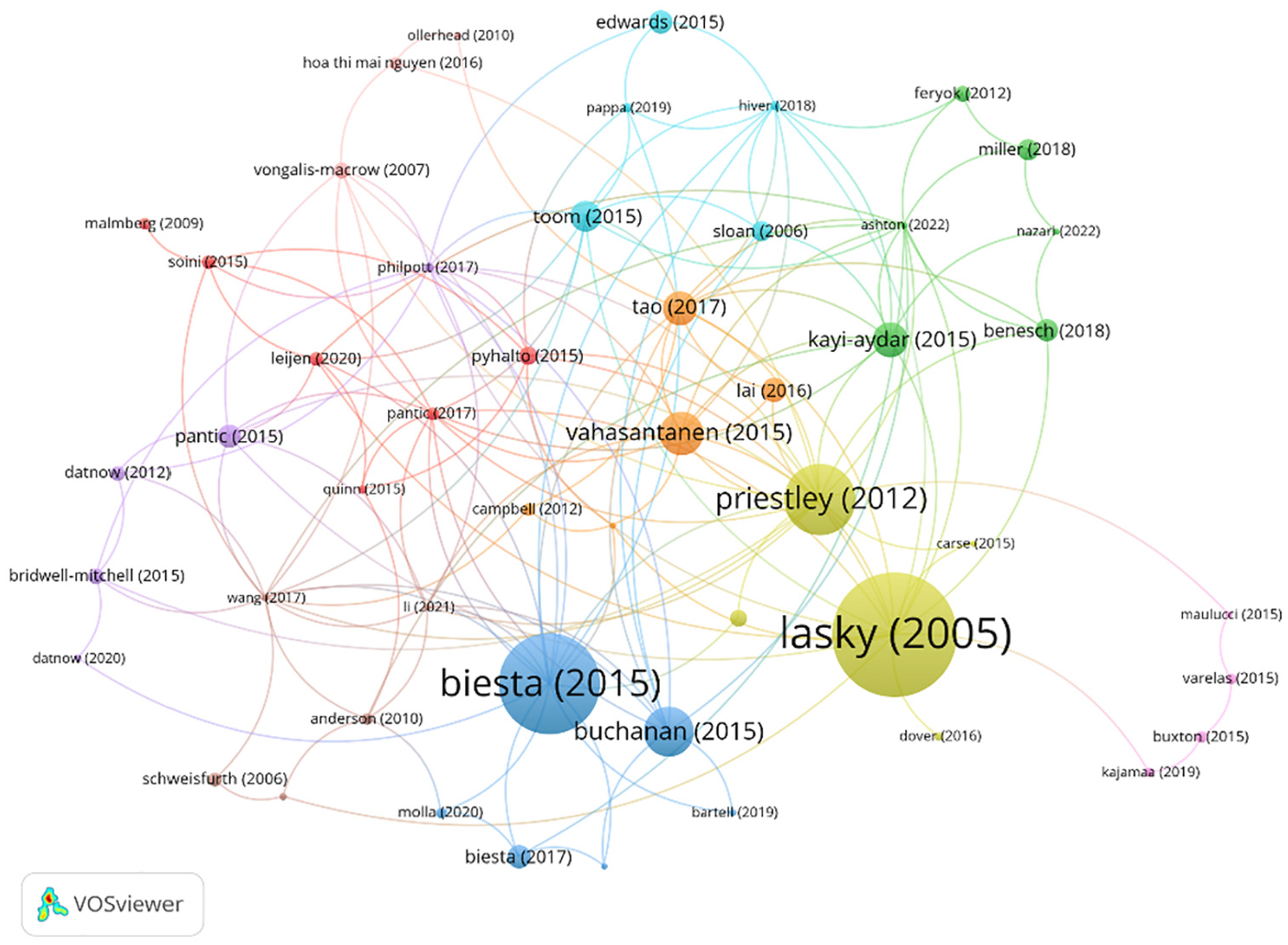
To answer RQ2, we analyzed reference data from WoS, using the Citation of Authors and Documents functions in VOSviewer. To visualize the most highly cited authors, we set a minimum threshold of documents of 2 publications and 10 citations per author, resulting in the visualization of 50 authors in Figure 2. For the most highly referenced publications, we set a minimum citation threshold of 24, identifying 50 key publications in Figure 3.

Mapping of the most highly cited authors.
Mapping of the most highly referenced publications.
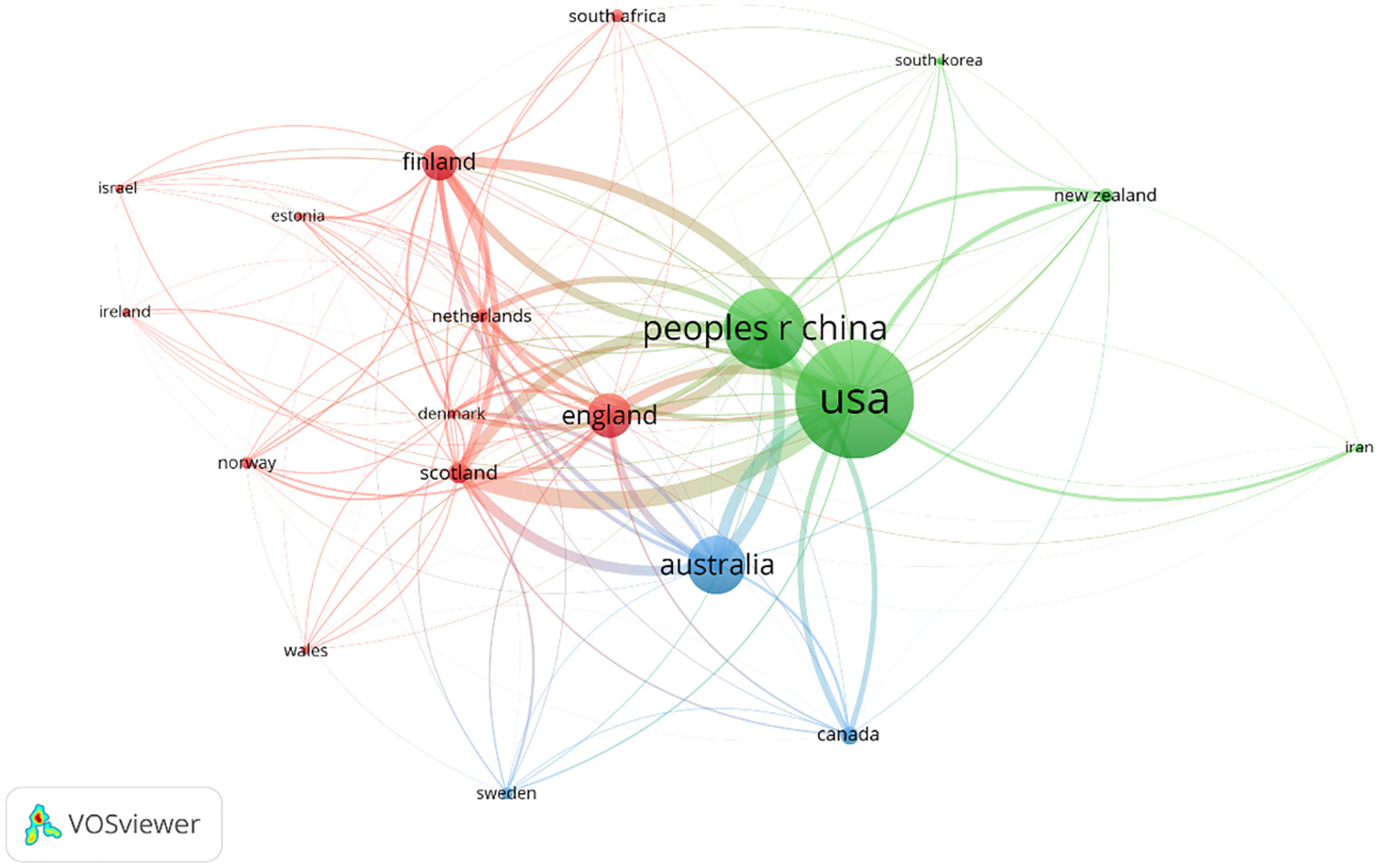
To answer RQ3, we visualized the number of publications from various countries/regions using the Citation of Countries function in VOSviewer. We set a minimum publication threshold of five per country/region to ensure the visibility in the visualization. As a result, 19 countries with 5 or more publications on teacher agency were presented in Figure 4. Figure 4 was then transformed into an overlay version (Figure 5) to clearly display the temporal distribution of publications by country/region (Van Eck & Waltman, 2014).
Mapping of the most productive countries/regions.

Mapping of the most productive countries/regions (Overlay).
To answer RQ4, we used the Co-occurrence function in VOSviewer to visualize keywords. Setting the co-occurrence threshold at 5, producing Figure 6, we initially generated 81 keywords. To eliminate redundancy, we merged similar terms, such as “schools,” and “school.” Additionally, search terms like “teacher agency,” “teachers’ agency,” and “professional agency” are removed due to their broad connections with other keywords, allowing for a more focused visualization. The final version of Figure 6 contains 69 keywords. We then transformed this into Figure 7, the overlay visualization, to display the temporal distribution of topics.

Mapping of keywords (Cluster).

Mapping of keywords (Overlay).
Results and Discussion
Publication Trend
The publication trend by year is illustrated in Figure 1, which presents the number of publications from 1995 to 2023. The data indicates a general upward trend in research on teacher agency, despite some fluctuations. This trend can be divided into three distinct periods: the stagnant period, the nascent period and the burgeoning period.
The stagnant period spanned from 1995 to 2004. During the initial decade, the field experienced a period of stagnation, with only one publication in 1995, marking the beginning of academic interest in teacher agency. This solitary publication laid the groundwork for future studies, although the field did not see further developments until the next decade (Hawthorne, 1995).
The second period is the nascent period, lasting from 2005 to 2014. The number of publications began to increase, albeit modestly. With a total of 19 publications, the annual count remained under 10. The peak in 2012 indicated a growing interest in the topic. Notable works during this period (Feryok, 2012; Lasky, 2005; Priestley et al., 2012; Sloan, 2006) contributed significantly to the theoretical and practical foundations of teacher agency. Lasky (2005)’s use of sociocultural approach and Feryok (2012)’s application of activity theory particularly illuminated the path for future research. Priestley et al. (2012) drew from three case studies from different disciplines, hospitality, life science, and technology to illustrate the significance of the ecological model.
The third period, spanning from 2015 to 2023, is the burgeoning period. This period witnessed a dramatic surge in publications on teacher agency, particularly in 2015 with a number of 21 works. The year 2015 is pivotal not only merely for the increased volume of publications, but also for the influential publications during this time. Notable works such as those by (Biesta et al., 2015; Edwards, 2015; Kayi-Aydar, 2015; Pantić, 2015; Toom et al., 2015; Vähäsantanen, 2015) laid solid foundations for studies on teacher agency. The comprehensive work by Priestley et al. (2015a) under the ecological perspective and the introduction of professional agency (Edwards, 2015; Toom et al., 2015; Vähäsantanen, 2015) contributed to the understanding of teacher agency. The distinction between agency and autonomy made by Priestley et al. (2015b) also stimulated discussions on teacher agency. The positioning theory, utilized by Kayi-Aydar (2015) further enriched the theoretical landscape.
Figure 1 shows that there was a sudden increase in 2019, which may be attributed to the educational and curriculum reforms around the globe (Fuller & Stevenson, 2018), including India (Brinkmann, 2019), China (Fu & Clarke, 2018, 2019), England (Harris & Graham, 2019), Norway (Halvorsen et al., 2019), Sweden (Insulander et al., 2019), and USA (Lockton & Fargason, 2019). Moreover, the development of technology used in the classroom also partly contributes to the large number of publications (Aagaard & Lund, 2019). The peak in 2021, with 61 publications, may be explained by the sudden breakout of COVID-19, which necessitated an increased capability in technology (Damsa et al., 2021) as teachers encountered great impediments in teaching practice (Xun et al., 2021). The sustained high level of publications in 2022 and 2023, with 55 and 54 respectively, indicated ongoing scholarly enthusiasm for teacher agency, suggesting that the field is in a developmental phase and poised to continue to prosper in the future.
Most Highly Cited Authors and Most Referenced Publications
Most Highly Cited Authors
Figure 2 visualizes the most highly cited authors in the field of teacher agency, revealing seven distinct clusters. Table 1 displays the top 10 most highly cited authors with their respective clusters.
Top 10 Most Highly Cited Authors.

Mark Priestley stands out as the most highly cited author, with an impressive 969 citations. He leads the red cluster, focusing on teacher agency in curriculum development (Priestley et al., 2012, 2015a, 2016). This cluster is the largest and most intensive one among the seven identified. The influence of this cluster is further bolstered by other prominent scholars within this group.
Notably, Gert Biesta and Sarah Robinson are jointly recognized as the second most cited authors, each with 607 times. They collaboratively delve into teacher agency through the lenses of teachers’ beliefs (Biesta et al., 2015) and teachers’ talk (Biesta et al., 2017). Their substantial influence, evidenced by the size of their nodes in the network, extends beyond the cluster, contributing to the broader field by establishing a well-rounded theoretical foundation for teacher agency (Priestley et al., 2015a).
The green cluster is dominated by a group of Finnish scholars, led by Kirsi Pyhältö. The author ranks as the third most highly cited author with 260 citations, leading research into professional agency (Pyhältö et al., 2015; Soini et al., 2015; Sullanmaa et al., 2024; Toom et al., 2015; Vähäsantanen et al., 2019, 2020). Other influential authors in this cluster include Katja Vähäsantanen, who ranks fourth with 239 citations, and Janne Pietarinen and Tiina Soini both with 128 citations. Their works provide insights into professional agency in various contexts, such as schools and universities, contributing to a deeper understanding of teacher learning and perceptions of professional agency (Pyhältö et al., 2014, 2015; Soini et al., 2015; Vähäsantanen, 2015).
Auli Toom, also from Finland, leads the blue cluster. She ranks sixth with 207 citations. This cluster focuses on the development of teacher agency and its role in professional development (Toom et al., 2015). For instance, Äli Leijen, along with Margus Pedaste and Liina Lepp, has explored how teacher agency can be promoted through reflection (Leijen et al., 2020) and teacher education course (Leijen et al., 2024). Moreover, some authors with a linguistic background in this group have begun collaborating with general education scholars to examine professional agency and professional development of language teachers. For instance, Xiaolei Ruan and Auli Toom investigated how EFL teacher agency fosters professional growth through the lens of self-discrepancy (Ruan & Toom, 2022; Ruan et al., 2020). This collaboration highlights the transdisciplinary potential and pervasive impact of teacher agency (E. R. Miller et al., 2018).
Meanwhile, researchers in language education have focused on teacher agency for some time. Hayriye Kayi-Aydar has been cited 175 times. She leads the yellow cluster of researchers with a linguistic focus, specifically on language teacher agency in the contexts of English as a Second Language (ESL) and English as a Foreign Language (EFL). Another notable figure in this cluster is Jian Tao, with 154 citations, whose work discusses the manifestation of Chinese EFL teacher agency in response to curriculum changes. Their research has elevated language teacher agency as a distinct subfield within the broad context of teacher agency, establishing a solid theoretical and practical foundation (Kayi-Aydar, 2015; Tao & Gao, 2021).
Nataša Pantić, with 175 citations, leads the orange cluster. She persistently investigates how social justice is achieved through teacher agency (Pantić, 2017; Pantić et al., 2019, 2022). Other scholars in this cluster continue to relate teacher agency to inclusive education and social justice (Mu et al., 2024; Y. Wang & Zhang, 2021), emphasizing the role of teachers as active agents in these areas (Pantić et al., 2022).
The purple and the cyan clusters do not feature any top-ten authors, indicating their comparatively low profile within this field. However, the authors in the purple cluster contribute to advancing the research on language teacher agency, particularly from a technological perspective in the digital age (Ashton, 2022; Chen, 2022; Jeon et al., 2022b) even though they have not yet reached a highly cited status. In the cyan cluster, the authors focus on teacher agency in primary schools across various contexts.
A particular strong connection exists between Guoping Fu and Anthony Clarke, as indicated by the thick line in Figure 2. This connection is unsurprising, given that they have collaboratively published six articles on teacher agency in science education in primary schools in China and Canada (Fu & Clarke, 2017, 2018, 2019, 2020, 2022, 2024).
In general, these highly cited authors identified come from diverse background, demonstrating a trend of shifting from general education to more specific areas such as science and language. They are highly cited for their contributions to both thematical and theoretical perspectives on teacher agency.
Most Frequently Referenced Publications
Figure 3 visualizes the 50 most highly referenced publications. The network map produces 10 major clusters, indicating 10 major areas of focus that have been receiving extensive attention within the field of teacher agency. Table 2 displays the top 10 most referenced publications with their respective clusters.
Top 10 Most Highly Referenced Publications.

Topping the list is the work of Lasky with 644 citations. He is the leader of the yellow cluster that focuses on the impact of educational changes on teacher agency. In his 2005 study, Lasky (2005) delved into teacher agency under school reform, defining it as “part of a complex dynamic; it shapes and is shaped by the structural and cultural features of society and school cultures” (p. 900).
This sociocultural perspective on teacher agency emphasizes the significance of social resources in relations to agency, expanding on Ahearn’s (2001) definition and influencing subsequent applications of activity theory (Feryok, 2012). Alongside Lasky’s work, Priestley et al. (2012)’s work with 345 citations, ranks third among these publications. It dissects teacher agency under curriculum making, explaining teachers’ response to curriculum policies through an ecological framework. Both studies shed light on how teacher agency is enacted amidst educational changes and contribute to the theoretical foundation of the field.
The second most highly referenced publication is by Biesta et al. with 510 citations. This work leads the blue cluster centring around the influence of various teacher-related factors on teacher agency. Biesta et al. (2015) significantly extend the ecological framework of teacher agency initiated by Emirbayer and Mische (1998), emphasizing the role of beliefs in understanding teacher agency. Buchanan (2015), with 233 citations, is another highly referenced publication, who explored teachers’ self-understandings of being agentive professionals within the educational reform.
Vähäsantanen’s publication in 2015 has 198 citations. This work ranks fifth and leads the orange cluster, focusing on educational change and teacher identity through an agency-centred approach. Two other publications in this cluster, Tao and Gao (2017) and Lai et al. (2016) also rank among the top 10. Their works have further strengthened the connection between teacher agency and professional identity negotiation, underscoring the significance of professional agency in teachers’ professional development.
Similarly focusing on the interplay between teacher agency and professional identity, Kayi-Aydars publication in the adjacent green cluster, which ranks sixth with 155 citations, extends the discussion to the language teaching field. Kayi-Aydar (2015), drawing on positioning theory, investigated how pre-service teachers’ positional identities shape their agency. Subsequent publications in the cluster (Ashton, 2022; Benesch, 2018; Feryok, 2012; E. R. Miller & Gkonou, 2018) further explore how language teachers exercise agency in line with their professional identity. These contributions have gradually established language teacher agency as a prominent research area within the broad field of teacher agency, reflecting the findings of highly cited authors.
The eighth most highly referenced publication is by Toom et al. This work has 132 citations, leading the cyan cluster and was an editorial written for a special issue in the journal Teacher and Teaching: theory and practice. As a summary of the themes, theoretical perspectives and methodologies used in the issue’s studies, it is not surprising that Toom et al. (2015) has been widely cited by other research on professional agency. The 10th most highly referenced publication by Pantić (2015), which leads the purple cluster also comes from this special issue. Pantić (2015) develops a theoretical model for studying teacher agency for social justice.
A close examination of our results reveals a notable convergence between the most highly cited authors and the most highly referenced publications. Authors like Priestley, Vähäsantanen, Toom, Kayi-Aydar, and Tao can be found in both lists, highlighting their significant contributions. However, some authors, like Lasky, who produced the most referenced publication, do not rank among the most cited, likely due to a limited number of publications in the database. Additionally, several publications come from a special issue that introduced various approaches to analyze teacher professional agency, laying a solid foundation for subsequent empirical studies. This aligns with the publication trend revealed in the previous section, which shows that from 2015 the research entered a period of rapid growth.
Most Productive Countries/Regions
Figure 4 visualizes the most productive countries/regions in the field of teacher agency, revealing three distinct clusters. Table 3 reports the top 10 contributors. The green cluster, the largest, is led by the United States with 89 publications, followed by China with 61, the second. New Zealand ranks eighth with 11 publications.
Top 10 Most Productive Countries/Regions.

The blue cluster contains three countries, Australia, Canada, and Sweden. Australia ranks the third most productive country with 44 publications, followed by Canada, which ranks seventh with 14 publications.
The red cluster consists of 11 countries/regions, mainly located in Europe. England ranks fourth with 34 publications. Finland ranks fifth with 27 publications. Scotland ranks sixth with 16 publications. The Netherlands and South Africa both rank ninth with 10 publications. It should be noted that England, Scotland and Wales are calculated separately rather than collectively as the UK. If combined, the UK would rank third with a total of 57 publications. Furthermore, the leading countries in the red cluster demonstrate strong connections with both the blue and green clusters, underscoring the significant impact of these leading countries (Table 4).
Diachronic Changes of Most Productive Countries/Regions.

To examine the temporal trends in publication output across countries/regions, the Overlay Visualisation of VOSviewer was utilized to track changes over time (Van Eck & Waltman, 2010). Figure 5 indicates that the countries/regions in deep colours, such as the United States, Scotland, Netherlands, and Canada, produced more publications before 2020, while Australia, Finland, and New Zealand have since emerged as dominant contributors. In contrast, the countries/regions in light colours, including China, Iran, Estonia, and Norway, have published more recently.
The above results show that, prior to 2020, research on teacher agency was largely dominated by scholars from developed Western countries/regions before 2020. This dominance reflects the established research infrastructures and academic traditions in these countries, which have long supported scholarly inquiry into educational policies and practices. The spread and adoption of influential educational policies also played a role. According to the World Education Reform Database established by Stanford Graduate School of Education (Bromley et al., 2024), countries like the Netherlands, the United Kingdom, and Canada, known for their leadership in education reform, created many educational policies that other countries emulated.
After 2020, some non-western countries/regions emerge, such as China, Iran, South Africa, and South Korea became significant contributors, reflecting growing global interest in teacher agency. Factors, such as increased investment in education and research (Okoye et al., 2022), international collaborations (T. Y. Wang et al., 2021), and the recognition of teacher agency in educational reforms (Furlong et al., 2021) have spurred this rise. For instance, China’s educational reforms and Iran’s focus on improving educational standards have driven related research (Wei & Chen, 2019; Yang & Clarke, 2018).
The growing trend of global participation enriches the field, expanding the scope of research and introducing diverse cultural and contextual perspectives on teacher agency.
Most Frequently Explored Topics and Their Temporal Evolution
Figure 6 displays the most frequent terms from the keywords, grouped into six clusters based on their semantic relatedness. Each colour represents a distinct cluster, highlighting different focuses on teacher agency. The size of nodes represents the frequency of a word, with larger nodes indicating more frequent occurrences. These six clusters encapsulate the key topics found in publications on teacher agency. Keywords with high frequencies in each cluster are introduced as follows. It is important to note that some keywords are not visible in Figure 6 due to the crowdedness in certain areas. For instance, “online teaching” and “technology” from the green cluster, located on the left side of the map, “preservice teachers” from the red cluster at the centre, and “language policy,” “bilingual education,” and “multilingual” from the blue cluster on the right are not easily observed.
The red cluster contains terms such as beliefs, self-efficacy, burnout, motivation, students, classroom, China, inclusive education and preservice teachers. These keywords reflect topics, subjects and contexts in studies on teacher agency. In terms of topics, the research represents the interplay between individual factors and teacher agency. For instance, the interplay between agency and self-efficacy (Bandura, 2006; Polatcan et al., 2023), and beliefs (Biesta et al., 2015) helps understand teachers’ burnout (Nápoles et al., 2023; Nazari & Karimpour, 2022) and their perspectives on student motivation (Glas, 2016; Glas et al., 2021). These topics have strong psychological foundations, as Pajares (1992) noted “… pleading for attention to teachers’ beliefs is itself an indication of the direction educational psychology has taken … Self-efficacy, for example, is a cornerstone of social cognitive theory” (p. 308). In addition to various topics, preservice teachers have frequently been been the focus of studies on teacher agency (Yang & Gong, 2023). Contexts such as Chinese cultural backgrounds (Fu & Clarke, 2018; Yang & Clarke, 2018) and inclusive education (Li & Ruppar, 2021; A. L. Miller et al., 2022) have also been widely explored. More specifically, the classroom serves a significant context where teacher agency makes great differences (Hiver & Whitehead, 2018; Ruan et al., 2020; Soini et al., 2015). These identified keywords reflect the interaction between psychological factors and contextual factors, aligning with the view of agency as an achievement emerging from iterative negotiations between person and context (Biesta et al., 2015). This cluster of studies spans a vast area and is interwoven with other clusters, suggesting their great influences across sub-areas.
The green cluster consists of terms like teacher education, teacher collaboration, community, COVID-19, challenges, online teaching, and technology. This group, on the one hand, underscores the significance of teacher agency in promoting teacher collaboration within communities (T. Y. Wang et al., 2021) and developing teacher agency during teacher education (Furlong et al., 2021; Leijen et al., 2024). On the other hand, it also highlights the critical role of teacher agency in the integration of technology and education, particularly during the COVID-19 pandemic. This period has boosted digitalization, presenting teachers with a multitude of challenges (Myyry et al., 2022). To navigate these challenges, teachers must be adept with innovative teaching technologies. Research by Jeon et al. (2022a) and Chen (2022) supports the notion that technology serves as a vital affordance, empowering teachers to exert agency in their practice, especially in online teaching settings. Their intersections reveal technology not merely as an exo-system factor, but as a transformative force redefining agency (Yang & Markauskaite, 2025).
The blue cluster is composed of professional development, education policy, language teacher agency, language policy, bilingual education, and multilingual. Obviously, research in this group manifests strong linguistic characteristics, focusing on language teacher agency in bilingual education and multilingual contexts for professional development (Chang et al., 2021; Dubiner et al., 2018; Mifsud & Vella, 2018). This focus has gradually grown into a sub-field of teacher agency (E. R. Miller et al., 2018). The prominence of language teacher agency aligns with findings in highly referenced publications and highly cited authors discussed in previous sections. While research on language teacher agency is consistent with broader teacher agency studies in terms of theoretical perspectives, novel frameworks that can better reflect characteristics of language teachers are expected.
Keywords in this cluster also suggest that educational and language policies may be the main drivers of language teacher agency (Kayi-Aydar, 2018; Liu et al., 2020; Ollerhead, 2010). As Tao (2022) notes, it is important to “recognize language teachers as reflexive and reflective agents and capitalize on the value of language teacher agency” to “confront shifting educational policies and curriculum reforms” (p. 839). Moreover, of noticeability is that the keyword “professional development” is located roughly at the centre of the map, distanced from other keywords. This positioning reflects that professional development has strong connections with other clusters, covering a wide range of studies (Carpendale et al., 2024; Nazari & De Costa, 2022).
The yellow cluster consists of keywords, such as teacher identity, professional identity, curriculum, context, beginning teachers, attrition, and narrative inquiry. Central to this group is the concept of teacher identity, which has complex relationships with teacher agency (Buchanan, 2015; Hiver & Whitehead, 2018). As Kayi-Aydar (2015) noted, “… identities have shaped teachers’ agency and self-reported classroom practice.” (p. 94), particularly in the context of curriculum reforms, where “teachers are increasingly required to act as agents of change” (Priestley et al., 2012, p. 191). In some areas, such as early childhood teachers, teacher attrition-teachers leave the profession and relinquish their teacher identity-has emerged as a significant issue (Dunn, 2018). Scholars are actively investigating the relationship between attrition and agency (Ciuciu, 2023). Beginning or novice teachers are particularly important subjects in these studies as they face numerous challenges that constrain their agency (Ashton, 2021). The above keywords effectively reflect the practical-evaluative and projective dimensions of agency, which emerge from the intersections of present contexts and future goals (Biesta et al., 2015). Narrative inquiry, a widely used qualitative method in education (Richards, 2009) offers holistic depictions of teachers’ past experiences.
The purple cluster includes keywords such as accountability, autonomy, leadership, education, reform, policy, educational change, and resistance, reflecting the practical-evaluative factors that shape teacher agency. The research in this group seeks to clarify the relationships between accountability, autonomy and teacher agency in the context of educational changes and reforms. Accountability, which stems from requirements in curriculum reforms or policies, is traditionally viewed as undermining teacher agency (Sloan, 2006). Therefore, in “an era of accountability,” it is crucial for teachers to maintain or develop their agency (Buchanan, 2015). School leaders can leverage professional agency to redefine accountability in their daily practices, emphasizing the pivotal role of leadership in shaping school accountability (Kim, 2024). Various leadership styles have been shown to affect teacher agency, teacher leadership (Bellibas et al., 2020), principal leadership (Hendawy Al-Mahdy et al., 2024), and distributed leadership (Hilal et al., 2024). Autonomy, often constrained by policy and accountability practices (Nguyen et al., 2022), is frequently discussed with agency (Eriksen et al., 2024; Nazari et al., 2023). Nevertheless, autonomy differs from agency, as Erss (2018) notes, “agency depends on the availability of resources, as opposed to autonomy which emphasizes foremost freedom from control” (p. 7). Increased accountability can threaten autonomy, prompting teachers to resist policies. Thus, resistance is viewed as one form of “negative” agency (Priestley et al., 2012), and resisting educational inequity plays a significant role in shaping teacher agency (Naraian, 2014).
Given the context-related features of agency (Kayi-Aydar, 2015), we closely examine Figure 6 and categorize the most explored topics into an emergent framework based on an adapted ecological system theory (Bronfenbrenner, 1979; Fan & Xie, 2025). This framework consists of five levels: individual, micro-, meso-, exo-, and macro- systems (Table 5). At the individual level, significant factors influencing teacher agency include beliefs, self-efficacy, teacher identity, autonomy, resistance, and burnout. The microsystem encompasses the immediate settings where teachers interact with other people, such as the students, classrooms, and online teaching environments, as these contexts involve “face-to-face” interactions (Bronfenbrenner, 1979, p. 7). At the mesosystem level, leadership, community, teacher collaboration, and teacher education create the environment for teacher engagement. The exosystem includes influences such as COVID-19, and technology, which affect “what happens in the person’s immediate environment” (Bronfenbrenner, 1979, p. 8). Finally, the macro level includes broader factors like reform, policy, accountability, and educational change, representing the overarching contexts that shape teacher agency. Our ecological framework effectively categorizes the contextual factors shaping teacher agency, thereby supporting the ecological model proposed by Biesta et al. (2015).
Co-occurrence of Terms From Keywords.

To further analyze the temporal trends of the most frequently explored topics, the Overlay Visualisation function of VOSviewer was utilized. Figure 7 is the overlay version of Figure 6, illustrating the evolving trends of certain topics over time. The diachronic changes of terms in Figure 7 are summarized in Table 6. VOSviewer automatically generated the timeline of topics, ranging from 2019 to 2022.
Diachronic Changes in Topics.

In 2019, studies on teacher agency focused on themes such as reform, policy, accountability, resistance, language policy, and bilingual education, largely driven by global educational reforms (Datnow, 2020). Examples include curriculum reform in China (Fu & Clarke, 2018, 2019; Wei & Chen, 2019), Sweden (Ryder et al., 2018), Scotland and Wales (Alkan & Priestley, 2019), the United States (Wessel-Powell et al., 2019), and England (Harris & Graham, 2019). Accountability measures often imposed by policymakers are viewed as hindrances to teacher agency (Buchanan, 2015).
In 2020, the focus shifted to teacher identity, curriculum, professional development, classroom and autonomy, with continued exploration of teachers’ responses to curriculum reforms (Barrett, 2020). As Buchanan (2015) noted, teachers “resist and negotiate in order to create a place for themselves” where they can exert their agency and autonomy (p. 700). Scholars sought to rebuild teachers’ professional roles (Connolly et al., 2018), and practices through professional development initiatives (Insulander et al., 2019), leading to notable changes in teacher identity (Huang, 2021).
In 2021, key topics included belief, self-efficacy, language teacher agency, burnout, attrition, and inclusive education, highlighting teachers’ psychological states (Glas et al., 2021; Huang & Yip, 2021). Among these, belief (Gao & Cui, 2024) and self-efficacy (Polatcan et al., 2023) emerged as crucial elements. In addition, the pandemic’s impact on resilience and burnout became significant (Nápoles et al., 2023; Xun et al., 2021), correlating with teacher attrition (Ciuciu, 2023; Huang, 2021).
By 2022, the focus turned to technology, COVID-19, teacher collaboration, online teaching, and engagement. The sudden shift from traditional teaching to online teaching imposed great challenges on teachers (Damsa et al., 2021). This surge in technology-integrated research reveals a theoretical tension that digital tools expand teachers’ agentic possibilities while simultaneously introducing new structural constraints, enriching the existing framework. Scholars investigated how teachers cope with encountered tensions (Louws et al., 2020), noting the benefits of collaboration, which fosters collective agency (Fu & Clarke, 2022). Teacher engagement has become increasingly critical in online teaching contexts (Zou et al., 2021), and technology emerged as a vital element of teacher agency in the digital age (Chen, 2022; Jeon et al., 2022a).
Overall, research on teacher agency has evolved in response to temporal and spatial contexts. In 2019, the focus was on how curriculum reform and policies shaped teachers’ work and lives. By 2020, the foci shifted to how teachers achieve professional development and classroom practices, followed by a deeper exploration of psychological factors in 2021. In 2022, influenced by COVID-19, scholars have recognized the significance of digital technology in achieving teacher agency, necessitating theoretical frameworks that better account for digital-material entanglement in teachers’ ecological systems. This trajectory illustrates how studies on teacher agency adapt to ongoing changes in education, reflecting developments in reform, the pandemic’s effects, and technological advancement.
Conclusion
This study utilized bibliometric analysis to trace the development of teacher agency research from 1995 to 2023. The findings offer valuable insights for researchers, especially those new to the field, guiding them towards key authors, seminal works, influential countries/regions, and the most explored topics relevant to their research interests.
First, the study shows that the research on teacher agency has progressed through three distinct phases: stagnant, nascent, and burgeoning. The most recent phase marks a period of rapid growth, underscoring the increasing recognition, and significance of teacher agency in the academic community. This upward trajectory suggests that teacher agency will continue to attract scholarly attention in the future.
Second, the current status in terms of the most highly cited authors and the most frequently referenced publications sketched out can help researchers pinpoint the influential authors and publications. The analysis of countries/regions productivity not only reveals the most prolific areas, but also uncovers the temporal change over time, indicating studies from more varied contexts are contributing to the research topic.
Third, the study identifies key topics frequently explored in teacher agency research, which have been categorized into an emergent framework comprising elements at the individual, micro-, meso-, exo-, and macro- levels. The temporal analysis of these topics further demonstrates the influence of social contexts on the study of teacher agency, with particular emphasis on events like the COVID-19 pandemic and the integration of new technologies.
The findings yield critical implications for multiple stakeholders. For school leaders and policymakers, the multi-level framework and the increasing geographic research diversification necessitate localized support systems that acknowledge agency as contextually mediated. Institutions should foster teacher agency by establishing professional learning communities where teachers collaboratively interpret external mandates through pedagogical expertise. For researchers, the shift from stagnation to growth in teacher agency bears threefold guidance for future inquiry. First, longitudinal research is needed to track how agency evolves across different career stages and institutional settings. Second, while digital technologies increasingly shape educational contexts, teacher agency in technology-integrated environments remains significantly under-theorized. Future studies should examine not only how digital tools influence agency, but also how teachers actively engage with technology to align with their values and goals. Third, geographical imbalances persist, which calls for expanded research in underrepresented regions, with a focus on how agency is shaped by distinct sociocultural and political contexts.
This study also acknowledges several methodological limitations. The exclusive reliance on SSCI and A&HCI indexed publications likely introduced selection bias by excluding relevant scholarship from broader databases like Scopus and Google Scholar. This may have skewed the geographical and epistemological scope of our findings. Meanwhile, the keyword-based search strategy based on predetermined terms like “teacher agency” may have narrowed the conceptual breadth. To address these limitations, future research should consider triangulating multiple databases and incorporating full-text analysis to enhance the comprehensiveness and robustness of bibliometric findings.
Footnotes

Author Contributions
Funding
The author(s) disclosed receipt of the following financial support for the research, authorship, and/or publication of this article: This work was supported by the Chinese National Social Science Foundation [Grant Number 23BYY151].
Declaration of Conflicting Interests
The author(s) declared no potential conflicts of interest with respect to the research, authorship, and/or publication of this article.
Data Availability Statement
Data available on request from the authors.