



Abstract
Under the heterogeneous situation of heterogeneity of farmland circulation entities, transaction costs are the key factors to optimize the selection of circulation contracts, and reducing transaction costs is an important realization path to promote farmland circulation in a reasonable and orderly manner and accelerate the process of agricultural modernization. Based on the survey data of 814 farming households in Henan Province, this study explores the transaction costs on contract selection based on the differential order governance. The results show that (a) in the transfer of farmland, farmers’ choice of contracts is restricted by their degree of association with the transaction entity, which is the result of differential order governance. (b) The influence of differential order governance on the selection of transfer contracts is constrained by the governance context. Farmers tend to choose formal written contracts in the context of weak ties governance but choose verbal or informal contracts under strong relationship governance. (c) The impact of transaction costs on the selection of farmland transfer contracts is constrained by the three-stage scenarios as before, during, and after the transaction. In different transaction stages, the higher the transaction costs are, the more likely farmers are to choose a formal written contract. The findings show the importance of the rules of human relations in the society of acquaintances in saving transaction costs. The importance of the formal system and informal institutions, such as trust and reputation, and avoiding one-size-fits-all suggestions should be involved in the formulation and implementation of farmland transfer policies.
Introduction
The Chinese economy has shifted from high-speed growth to medium-high-speed growth. In the context of promoting the coordinated development of agricultural modernization, industrialization, informatization, and urbanization, the value of land resources, one of the scarcest resources, has become increasingly prominent. In the early days of reform and opening up, the implementation of the household contract responsibility system made a great contribution to China’s agricultural development (Lin, 2013). However, with the development of nonagricultural industries and the flow of rural young and middle-aged laborers, the contradiction between the highly egalitarian institutional arrangement shown by this property rights structure and the development of the market economy has become increasingly prominent(Gao et al., 2019; Ma et al., 2013). Its inherent disadvantages, such as land fragmentation and insufficient resource allocation efficiency, are gradually becoming apparent. In March 2020, the Central Committee of the Communist Party of China and the State Council issued the “Opinions on Building a More Perfect Market-based Allocation System and Mechanism for Factors,” which proposed promoting the market-based reform of factors represented by land. In 2021, Document No. 1 of the CPC Central Committee stated that “Revitalization is a major task to realize the great rejuvenation of the Chinese nation, and the whole party and the whole society should be used to speed up the modernization of agriculture and rural areas… and improve the service system for the transfer of land management rights.” Promoting the transfer of farmland management rights in a rational and orderly manner is not only an important carrier for realizing agricultural modernization but also an important starting point for realizing the strategy of rural revitalization and the meaning of the topic of promoting rural construction (Deininger & Jin, 2006; J. Huang et al., 2020; Schulze & Zellweger, 2020). In 2021, the transfer area of household contracted farmland exceeded 37 million hectares. As an important carrier to connect the two parties, the contract is a commitment made by both parties (Kung & Bai, 2011; Y. Xu et al., 2018), which can promote the surplus of cooperation and help reduce transaction risks and realize benefits (Y. S. Cheng & Chung, 2018). With the acceleration of the process of farmland transfer in China, it is particularly necessary to study the selection of farmland transfer contracts for farmers and determine whether they can effectively perform the contracts (W. Cheng et al., 2019).
Farmland transfer and its contract options have long been the focus of academic research. Different contract arrangements correspond to different transaction costs (Peng et al., 2020). Williamson (2008) discussed the matching between “transaction, contract, and governance structure” by distinguishing the nature of the transaction and believed that asset specificity, uncertainty, and transaction frequency are the three dimensions of transaction costs (Shahzad et al., 2018). On the other hand, it constitutes an important factor affecting the choice of farmland transfer contracts. K. Y. Li’s (2009) research on farmers in Guangdong Province posits that in market transactions, the farmland transfer contract is not notarized, and the intervention of village cadres in farmland transfer greatly increases the uncertainty of farmers’ behavior in farmland transfer(Hu et al., 2021), which in turn increases transaction costs. Some scholars found that the transaction costs of farmers’ search for information, price negotiation and contract signing (Z. Chen, Zhuo, et al., 2021), supervision, and performance have a significant negative impact on the transfer of farmland. Studying farmland transfer and contract selection from the perspective of transaction costs is a recent academic effort (J. Xu, Huang, et al., 2021; Yang et al., 2021). As the risk of performance under a formal written contract is relatively small, entering into a written contract may be more conducive to the performance of the contract, but at the same time, there are certain negotiation, signing, and performance costs that can be saved by entering into an oral informal contract. However, the risk of contract performance may be greater for oral contracts than for written contracts. If there is a mechanism (such as a trust) that can effectively reduce the risk of contract performance when farmland transfers occur, farmers may be inclined to choose contracts with lower contract signing and contract performance costs. That is, they may choose an oral informal contract over a formal written contract.
Based on the perspectives of economics and law, the existing studies have paid attention to the composition and influencing factors of farmland transfer transaction costs and the inhibitory effect of transaction costs on farmland transfer (L. Chen, Chen, et al., 2021), which plays an important role in further research. However, in the underdeveloped areas of central and western China, there is still much room for the development of the role of rural social networks. Rural society is still structurally composed of acquaintances and social relations (Wang, 2019). Based on the perspective of rural sociology, there is a lack of quantitative research on the transaction costs associated with farmland transfer and their impact on contracts from the perspective of differential order governance. Under the premise of the heterogeneity of farmland transfer entities (relatives and friends, farmers in the village, farmers in other villages, large-scale management entities, etc.), few studies consider how to effectively reduce transaction costs through contract optimization selection and successive decisions, namely, contract matching governance, to better promote the rational and orderly transfer of farmland. Based on the above, the possible marginal contributions of this paper are: first, to investigate farmers in typical areas of Henan Province, a major agricultural province, and explore the impact of agricultural land circulation transaction costs on the contract choice of the two parties in the underdeveloped areas of central and western China, in order to make up for the lack of quantitative research in this field; Second, based on the heterogeneity of farmland circulation subjects, explore how contract optimization selection and contract governance can reduce transaction costs, so as to provide theoretical support for the government to formulate relevant farmland circulation policies according to different circulation entities. Then we will effectively promote the process of agricultural land circulation in our country and speed up the development of the market for the transfer of agricultural land.
Theoretical Basis and Research Hypotheses
The Connotation of “Differential Order Governance”
Different from the social relations presented under the “group pattern” shaped by the relatively independent individual communication methods in Western society, the concept of the “differential mode of association” has been put forward by Fei (2012): “Our pattern is not a bundle of clear firewood, but rather like the ripples pushed out in circles that occur when a stone is thrown on the water; each person is the center of the circle pushed out by his social influence, and what is pushed out by the ripples in the circle is connected. The circle used by each person at a certain time and place is not necessarily the same.” The conceptual image of the “differential mode of association” deconstructs the relationship between people in Chinese society, especially in the specific context of rural society. The trust relationship takes the individual as the center and gradually spreads to the outer circle in turn. The relationship of trust established by blood, geography, and business relationships between the self and others is divided into closeness and distance (C. Chen et al., 2020; Liu et al., 2019). On the one hand, the “differential mode of association” is embodied as an important moral paradigm, and on the other hand, it constitutes the way and patterns for allocating scarce social resources (including tangible resources, such as land and currency, and intangible resources, such as prestige, reputation, and rights). The ability to control and allocate various types of tangible and intangible resources determines the process of trust relationships between the parties or the families of parties and others as the center of the social relationship network. G. G. Huang (2010) described the social trust relationship network as having a strong correlation, acquaintance correlation, weak correlation, and no correlation in turn based on careful analysis. No correlations appeared in strangers. Weak correlations are formed with a general exchange and connections. Because of the existence of frequent communication and communication, it constitutes an acquaintance association. Based on blood and affinity, the relationship of strong association leads to the generation of strong associations.
The role of the legal concept in current China is becoming more perfect, but at the same time, the role of relationships cannot be ignored (L. Li, 2017). In the vast rural areas of China, village communities are still highlighted by the rules of an acquaintance society in a way. According to Fei Xiaotong’s differential mode of association and Huang Guangguo's specific situation of classifying the degrees of correlation (Fei, 2012), different correlation strengths require different governance paradigms to match (G. G. Huang, 2010), which is defined as “differential order governance” in the present study. Specifically, the fair rules presented in the specific situations of unrelated and weakly related ties must be realized by means of laws, regulations, policy texts, etc. The situation has strong market-oriented characteristics, and the degree of relationship between the two types of correlations is relatively weak. This situation reflects weak tie governance, so it is named “weak relationship governance.” In strong associations, the rules of demand derived from blood and kinship and the rules of human affection in acquaintance associations can give full play to the informal system. The relationship between these two kinds of associations is relatively strong and can be defined as “strong relationship governance” or “human relationship governance.” In this study, the connotation of “differential order governance” is reflected in two dimensions. First, in terms of structure, regardless of whether the farmland is transferred out or transferred in, the transferring farmer occupies a dominant central position in the governance network. The strength or controllability of the relationship between farmers and other subjects (relatives and friends, farmers in the same village, farmers outside the village, the main body of scale management, etc.) can be pushed out to form a peripheral layer. In addition, in terms of behavior, the central subject of the governance network (transferring farmers) tends to adopt informal but simple and efficient human interaction logic (strong relationship governance) within the acquaintance society (between relatives and friends and between farmers in the same village). However, the outer circles (farmers in other villages, large-scale management entities, etc.) with weak relationships and control scope tend to choose contracts with certain market-oriented characteristics (weak relationship governance) to strengthen their ability to control the farmland. Transferring farmers, as the center of the governance network, show such a differential social relationship pattern for the interactive games of different subjects in governance, and the differential order relationship pattern becomes increasingly thin depending on the strength of the relationship. It is not difficult to see that differential order governance is essentially relational governance (Kijima & Tabetando, 2020; Wang et al., 2019).
The large-scale business entities represented by enterprises generally do not know the farmers who are transferring their farmland, which is manifested as an unrelated relationship. Due to the lack of mutual trust, opportunistic behavior is easily induced. In the selection of transfer contracts, both parties are more inclined to write formal contracts, and the transfer rent is the highest among these four types of subjects. If a farmer transfers farmland to a farmer in another village, there may be a weak relationship (the transfer-out household and the transfer-in household from the other village belong to different natural villages). However, in most cases, they belong to the same administrative village, as the farmer survey conducted by the author confirms. Therefore, contact can be established by means of “closeness,” but there is still a lack of trust compared with the transfer within the natural village. Here, the two sides of transfer may be more likely to use a formal written contract to constrain the behavior of both parties, and the transfer rent is generally lower than that in the case of transfer involving large-scale business entities, such as enterprises. In contexts of no correlation and weak correlation, the two parties in the circulation have a general exchange relationship. In differential order governance, the paradigm of weak relationship governance should be implemented, and correspondingly, formal written contracts should be used to restrain the behavior of both parties. Different from contexts reflecting weak relationship governance, in contexts involving acquaintances and strong ties and under informal systems, such as blood, kinship, geography, reputation, and prestige, oral informal contracts are more likely to be adopted when farmland is transferred because both parties follow the rules of human relations. In differential order governance, it is more appropriate to adopt a strong relationship governance paradigm. When the transfer of farmland occurs within the same natural village, as a social community of acquaintances, villages present a high degree of trust in the context of acquaintances. Since informal systems, such as human relations, reputation, and prestige, have a strong binding force on villagers, oral informality is usually adopted when transferring farmland. By contrast, the rent for transfers within the village is generally higher than that for transfers between relatives and friends. Relatives and friends are related by blood and kinship and belong to the category of strong ties. The rent for the transfer of farmland is usually lower, and in many cases, it is free for relatives and friends to cultivate an individual’s farmland. Therefore, compared with transfers within the village, an oral informal contract is more likely to be adopted when farmland is transferred to relatives and friends, and the rent is lower (X. Li et al., 2021; Zhu et al., 2021).
Based on this,
Transaction Costs and the Selection of Farmland Transfer Contracts
Hart and Moore (1990) found that due to the objective existence of bounded rationality, opportunistic behavior and transaction costs greater than zero, no matter what kind of transaction is conducted in economic activities, the transaction contract is incomplete. Under the circumstance that the contract is incomplete, to ensure the effective execution of the transaction contract, that is, to ensure that the transaction can be carried out in accordance with the content of the contract, three kinds of costs are indispensable: foreseeing costs, contracting costs, and monitoring performance costs. The three together constitute transaction costs. The transaction costs generated differ according to the different contract methods, which is the main reason for the differences in the efficiency of institutional arrangements. The purpose of the contract between the two parties in the farmland transfer transaction is to obtain as much residual control and net income as possible, and the two parties to the transaction reach an agreement and conclude the contract through negotiation (H. Li & Zhang, 2021). Whether it is a written contract or an oral contract depends on the level of transaction fees. Because of this, the following inferences can be drawn. (a) Some farmland transfer contracts may not be concluded because the initial transaction cost is too high, which makes one or both parties think that the net income that can be obtained is too small. (b) The farmland transfer contract that has been realized has the characteristic of incompleteness, which makes the transaction cost continue to increase. Therefore, the parties to the transaction are more inclined to select contracts that can reduce their transaction costs as much as possible, for example, an oral contract with a lower signing cost. (c) When performing a farmland transfer contract, the initial contract terms may not be able to fully adapt to changes in the transaction environment and asset specificity. When possible, the two parties to the transaction may negotiate again and agree to change the contract form and the corresponding terms (C. Xu, Pu, et al., 2021; Han & Li, 2018; Jack & Suri, 2014; Van et al., 2013; Xia et al., 2021).
Based on this,
Based on the above theoretical analysis, this study selects differential order governance and transaction costs to reflect the impact on the choice of farmland transfer contracts. Since the differential order governance is characterized by strong ties, acquaintance ties, weak ties, and no ties and transaction costs externalized by contract signing and performance are closely related to trust, trust scores are also taken into account. In addition, since the head of household usually has decision-making power over the decision-making of the farm household, to improve the persuasiveness of the empirical results, this paper incorporates characteristics of the household head and the land into the analysis framework.
Materials and Methods
Data Sources
The data of this study come from the survey of farmers in Suiyang District and Yucheng County in Shangqiu City, Yanjin County in Xinxiang City, and Ruyang County in Luoyang City, Henan Province, organized by the research team in July and August 2019. This household survey involved a total of more than 850 farm households in 5 towns and 28 administrative villages, of which 814 were effective farmers. This survey focuses on the theme of farmland transfer, transfer contracts, and agricultural scale management. To ensure the quality of the survey, the main steps of the survey included the following:
First, according to the regional representation and the differences in local farmers' income level, soil and water conditions, geographical location, etc., the four counties and districts under the jurisdiction of the three cities in Henan Province were selected as the research sites, mainly because the economic development level and topography of these four counties and districts were similar. There are obvious differences, which are representative. Suiyang District and Yucheng County of Shangqiu City are located in eastern Henan and are mainly plains. They are the core areas of national high-standard basic farmland construction and the national commodity grain base. Yanjin County, Xinxiang City is located in the Yellow River Basin in the north of Henan Province, and the whole territory is on a plain. It belongs to the national high-quality wheat production base and the main production base of grain and cotton in China. Ruyang County, Luoyang City is located in western Henan, with a mountainous area of more than 900 km2, accounting for 70.2% of the total area.
Second, to ensure the randomness of sample selection, the research group randomly selected 1 to 2 townships (towns) in each of the above four counties and districts, and each township (town) selected 3 to 4 administrative villages. Each village randomly selected approximately 30 households for the household survey. Farmers who participated in this research were also selected randomly within each village. They were members of the family who played a direct role in the decision-making of farmland transfer, and all of them reached the age of 18. After the farmers confirmed the purpose of the survey and signed their consent, the survey was carried out. The investigation was conducted with the purpose of the investigation informed and consent was obtained. After the survey, respondents were informed about how the data collected might be used and each respondent received a gift valued at 25 Chinese Yuan. The survey was anonymous, and the data was only used for scientific research. The detailed information and privacy of the respondents were protected.
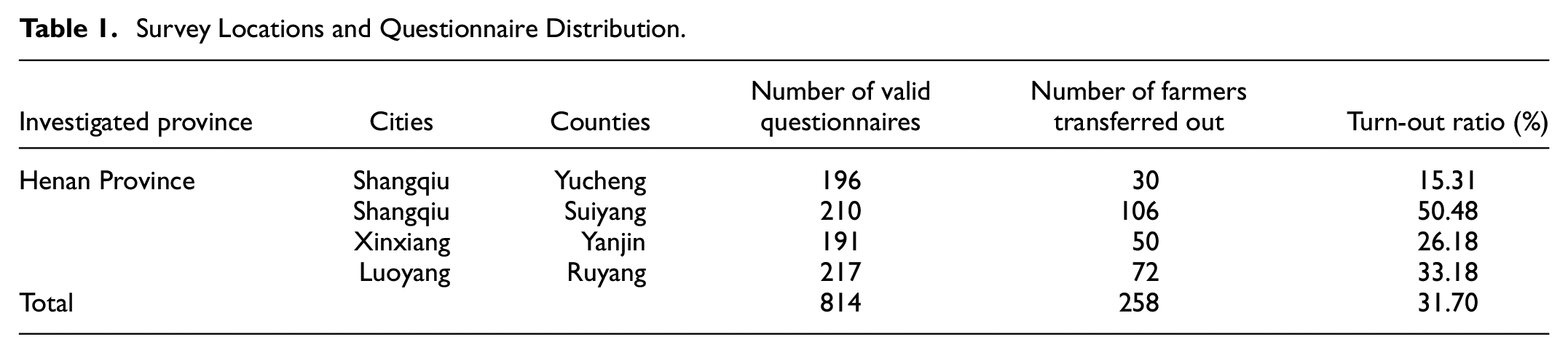
Three, to ensure the quality of the survey data, the participants who carried out this survey were all graduate students and senior undergraduates of our school. Before the formal survey, each person was systematically trained, including the content of the questionnaire and the exact meaning of each question. After processing the unsuitable samples, the final selected sample included 258 transfer-out households from 28 administrative villages. See Table 1 for details.
Survey Locations and Questionnaire Distribution.
Descriptive Evidence
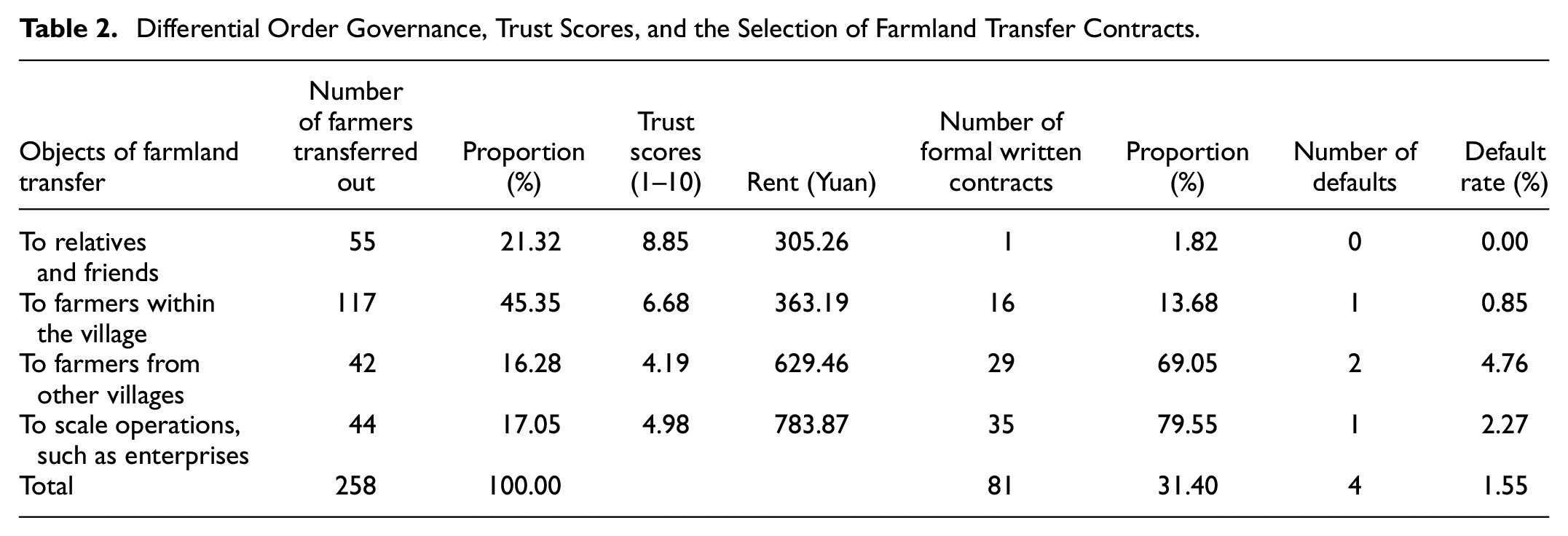
According to the previous analysis, differential order governance can be subdivided into weak relationship governance and strong relationship (human relationship) governance. The degree of trust varies according to the subject of the transfer. Generally, the degree of trust among relatives, friends, and farmers within the village is higher than that between farmers in different villages and enterprises. For the four types of the subject of transfer, the higher the trust scores between them are, the less likely a formal written contract will be adopted in the transfer of farmland.
Table 2 provides a statistical description of the transaction objects, trust scores, contract methods, and rental scale of farmland transfer. The current farmland transfer has largely shaped the feature of “differential order governance,” and farmers’ trust scores for different participants show a high consistency. In general, when farmland flows to farmers in other villages (weakly related) and large-scale business entities, such as enterprises (unrelated), the trust level is much lower than that associated with the flow to relatives and friends, and farmers within the village. The scores are 4.19 and 4.98, respectively, and the proportion of using formal written contracts is much higher than that between relatives, friends, and farmers in the village, which explains the characteristics of weak relationship governance. The transfer rent, which increases from 305.26 Yuan when farmland flows to relatives and friends to 783.87 Yuan when it flows to large-scale business entities, such as enterprises, also shows a gradual process of transition from humanization to marketization. The overall default rate of 1.55% indicates that regardless of whether oral informal contracts or formal written contracts are adopted in the survey area, contracts present good performance.
Differential Order Governance, Trust Scores, and the Selection of Farmland Transfer Contracts.
Model Construction
Structural equation models can handle both latent variables and their specific index values. Referring to the estimation of the structural equation model used by HengZhou & Chen (2013) to study the willingness of farmers to transfer farmland, this study selects primary data from household surveys of 814 households in four counties and districts in the three cities of Henan Province and uses a structural equation model to analyze differential order governance, transaction costs, household head and land characteristics, and trust scores. This paper conducts an empirical study on the influence of the choice of farmland transfer contract in four aspects. Structural equation models can handle multiple dependent variables simultaneously. They are suitable for multivariate analysis, which can estimate the factor structure and relationship between factors as well as the reliability and validity of the measurement variables at the same time. Measurement models describe the relationship between latent variables and indicators, while structural models describe the relationship between latent variables.
A measurement equation is usually written as follows:

The relationship between latent variables is usually described according to the following structural equation:

Among them, x is the exogenous observation variable, y is the endogenous observation variable,
Variable Selection
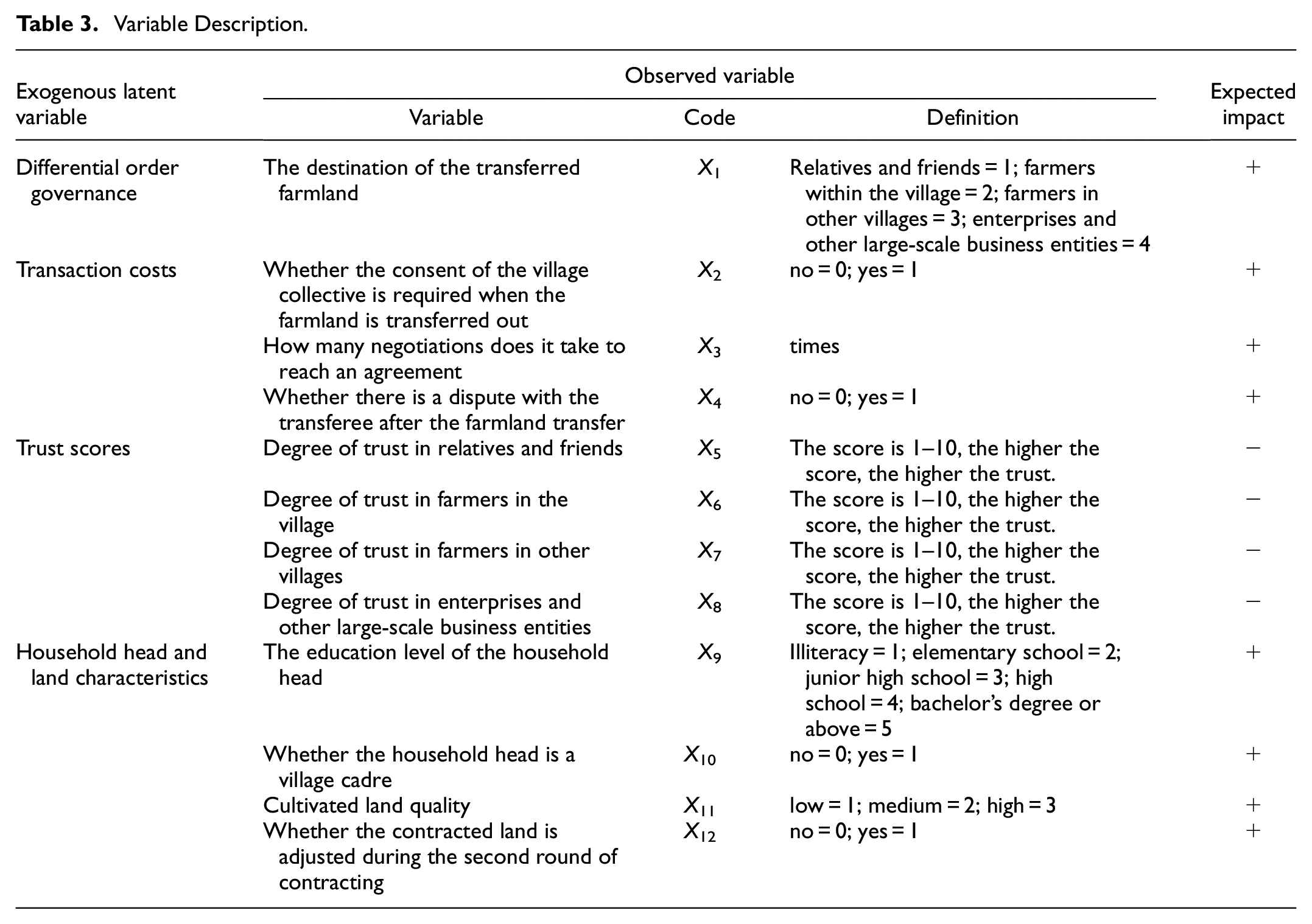
This study selects four aspects, differential order governance, transaction costs, household head, and land characteristics, and trust scores, to discuss the impact on the choice of farmland transfer contracts. Each aspect can be subdivided into several specific factors, described below.
Differential Order Governance
The differential order governance is mainly manifested by the indicator “the destination of the transferred farmland.” When a farmer transfers farmland to relatives and friends, farmer households in the village, farmer households in other villages, or enterprises and other large-scale business entities, there may be weak relationship governance and strong relationship governance methods. Correspondingly, the farmland transfer contract will take different forms, such as a formal written contract or an oral informal contract.
Transaction Costs
The transaction cost is reflected by three indicators: “whether the consent of the village collective is required when the farmland is transferred out,”“how many negotiations it takes to reach an agreement” and “whether there is a dispute with the transferee after the farmland transfer.”“Whether the consent of the village collective is required when the farmland is transferred out” reflects the intervention level of the village collective in the farmland transfer transaction before the transfer transaction. “How many negotiations it takes to reach an agreement” reflects the negotiation and signing costs in the transaction process. “Whether there is a dispute with the transferee after the farmland transfer” is the cost of monitoring the performance of the contract after the transaction is carried out. The above three indicators are intended to reflect the size of transaction costs in the three stages before, during, and after the transaction.
Trust scores
The trust scores are reflected in the “degree of trust in relatives and friends,”“degree of trust in farmers within the village,”“degree of trust in farmers in other villages,” and “degree of trust in enterprises and other large-scale business entities.” Each indicator is assigned a score of 1 to 10. Higher scores indicate higher levels of trust. If the two parties to the transaction have a high degree of trust, it is more likely that an oral informal contract will be adopted when farmland transfer occurs.
Household Head and Land Characteristics
Four indicators were selected, including “the education level of the household head,”“whether the household head is a village cadre,”“cultivated land quality” and “whether the contracted land has been adjusted during the second round of contracting” to reflect the characteristics of the household head and the land. As the decision maker of the family in rural society, the household head's education level and political and ideological consciousness have an important influence on the farmer's family. The higher the education level and political consciousness of the householder, the more likely the householder will adopt a formal written contract in the transfer of farmland. The quality of arable land is the most important component of resource endowment. When farmland transfer occurs and farmers think that their arable land is of good quality, they may be more inclined to choose a formal written contract than they would be if their land were of lower quality. If the contracted land is frequently adjusted during the second-round contract period, considering the stability of land rights, farmers may prefer to adopt a formal written contract to protect their land rights and interests when the farmland is transferred.
This study contains four exogenous latent variables, denoted by the symbol
Variable Description.
In this study, the endogenous latent variable is the choice of the farmland transfer contract, which is represented by
Results
Research Results
The Amos24.0 platform software for analyzing structural equation models is used to verify the structural model. After calculation, the fitting degree of the measurement model and the structural model is good. The measurement results of the structural model are estimated as shown in Table 4:
Structural Model Estimation.

Note.*, ** and *** indicate significance at the 10%, 5% and 1% levels, respectively.
On the basis of estimating the structural model, the influence direction and degree of exogenous latent variables (differential order governance, transaction costs, trust scores, household head, and land characteristics) on endogenous latent variables (the selection of farmland transfer contracts) were clarified. On this basis, it is necessary to further calculate the measurement model to obtain the influence direction and degree of the 12 exogenous observation variables on the 4 exogenous latent variables. Table 5 shows the estimation results of the measurement model.
Measurement Results of the Measurement Model.

, **, and *** indicate significance at the 10%, 5%, and 1% levels, respectively.
Analysis and Discussion
Analysis of Results
From Table 4, it can be seen that the exogenous latent variables, such as differential order governance, transaction costs, household head, and land characteristics, and trust scores selected in this study, have strong explanatory power on the impact of the endogenous latent variable on the selection of farmland transfer contracts. On the one hand, differential order governance and transaction costs have a positive and significant impact on the selection of farmland transfer contracts at the levels of 1% and 5%, respectively, which is consistent with the hypothesis of this study. On the other hand, the trust scores have a negative and significant impact on the selection of farmland transfer contracts at the level of 5%. This shows that the higher the degree of trust is, the more likely both parties will reject formal written contracts in the transfer of farmland. The influence of household head and land characteristics on endogenous latent variables is also significantly positive at the 5% level.
The measurement results of the measurement model in Table 5 show the influence of exogenous observable variables on exogenous latent variables. The details are given below.
(1) As an observable variable of differential order governance, the destination of farmland transferred out passes the significance test at the 1% level, indicating that it has a positive and significant impact on the selection of farmland transfer contracts. This shows that farmers face different governance methods when they transfer their farmland to subjects with different degrees of connection. When farmers transfer farmland to transaction entities with unrelated (large-scale business entities such as enterprises) and weak linkages (farmers in other villages), they are more inclined to weak relationship governance and more likely to conclude formal written contracts. In contrast, in the strong relationship governance situation involving farmers within the village and relatives and friends, the two parties to the farmland transfer transaction are more inclined to oral informal contracts.
(2) Among the observable variables that reflect transaction costs, “whether the consent of the village collective is required when the farmland is transferred out” and “how many negotiations will take to reach an agreement” both have obvious positive effects on the selection of transfer contracts at the 5% level. This shows that if the intervention of the village collective is strong before the farmland transfer transaction. The farmers prefer to adopt formal written contracts to protect their own land rights and interests. To complete the transaction, the number of negotiations between the two parties reflects the negotiation cost in the farmland transfer transaction. To reach a transaction, the more times the two parties negotiate, the higher the negotiation cost and the greater the possibility of choosing a formal written contract. The observable variable “whether there is a dispute with the transferee after the farmland transfer” represents the cost of monitoring the performance of the contract after the farmland transfer is completed. The measurement results show that this indicator has a positive impact on the choice of farmland transfer contracts. This result is consistent with the expected sign but not significant, which may be related to the low default rate of farmland transfer in the survey area.
(3) The four observable variables that reflect the trust scores and their influence directions are consistent with the expected symbols. The degree of trust in relatives and friends, the degree of trust in farmers in the village, and the degree of trust in enterprises and other large-scale business entities are all related to agricultural land transfer contracts. Choice showed a significant negative effect at the 5% level, which also showed that as trust increases, an oral informal contract becomes more likely when farmland is transferred, and as trust decreases, a formal written contract becomes the more likely choice.
(4) Among the four observable variables that describe the household head and land characteristics, “the education level of the household head,”“cultivated land quality,” and “whether the contracted land is adjusted during the second round of contracting” are significant at the levels of 10%, 5%, and 5%, respectively. These characteristics have a positive and significant impact on the choice of farmland transfer contracts, which confirms the research hypothesis.
Table 6 summarizes the results of these analyses and compares them with existing literature to reflect what is discussed in this article in a clearer way.
9 Differential Order Governance, Transaction Costs, Trust Scores, Household Head and Hand Characteristics and the Choices of Farmland Transfer Contracts.

Discussion
The essence of differential governance is a kind of relationship governance, for differential order governance, theoretical analysis shows that because the objects of farmland circulation involve different subjects, correspondingly, according to the degree of relationship between farmers and the objects of circulation and their close proximity, the general exchange principle in unrelated and weak correlation is more applicable to the formal system, and tends to be guaranteed by policies, regulations and other forms with market-oriented characteristics, which is manifested as “market governance,” and this situation is more inclined to be the same as written formal contracts. Longer contract terms are matched by higher contract rents. The rules of human affection and demand in strong association and acquaintance associations are mostly protected by informal systems, which are manifested as “human favor governance,” which tends to match verbal informal contracts, lower contract rents, and shorter contract terms.
The above results show that in line with the existing research, the traditional relationship of blood, geography, and karma in rural China constructs the differential pattern of social trust and its governance of peasant groups, and this trust pattern embedded in the social network of acquaintances seems to be difficult to transcend the category of family and acquaintance society, and it is this local trust and relationship network that causes the market transactions of land factors in rural areas to a large extent to show a tendency to personalize(C. Chen et al., 2020; Liu et al., 2019). However, when peasant households transfer their farmland to subjects outside the society of acquaintances, they often take on the characteristics of marketization.
Conclusions and Recommendations
Research Conclusions
On the one hand, the empirical results show that differential governance has a positive and significant impact on the choice of farmland circulation contracts at the 1% level, that is, farmers tend to choose written formal contracts in the context of market governance and verbal non-formal contracts in the context of non-market (human favor) governance. On the other hand, for transaction costs, the theoretical analysis suggests that when farmers are in the circulation of farmland, it may be more conducive to the performance of the contract to conclude a written contract than to conclude an oral contract. Because the risk of performance under a written formal contract is relatively small, but there are higher costs of negotiation, signing, and performance, oral contracts can save the cost of contracting compared with entering into a written formal contract, but the performance risk may be greater than that of a written contract. Empirical results show that transaction costs at the 5% level have a significant positive impact on the choice of farmland circulation contracts, i.e., the higher the transaction costs, the more likely farmers are to sign formal written contracts, while vice versa are verbal informal contracts.
Countermeasures and Suggestions
China's current policy focus tends to improve the construction of circulation service platforms and implement policies according to local conditions, so as to consolidate the foundation of land circulation and rationally and effectively innovate the form of agricultural land circulation, so as to promote the standardized and orderly circulation of land. But first of all, the rules of human interaction in an acquaintance society and in rural areas cannot be ignored. This kind of local interaction in the social context of rural acquaintances helps promote mutual trust among farmers with the same social background and in the same region. However, the urban-rural differentiated management mode and the interaction logic caused by the institutional structure led farmers to have low social trust outside the village. Secondly, because the choice of farmland transfer contract involves the comprehensive consideration of transaction costs, risk perception, social trust, and individual decision-making, local governments at all levels should take measures according to local conditions and give farmers full autonomy in contract selection. Otherwise, the transaction cost of farmland transfer will inevitably increase. Thirdly, when the government formulates and implements policies and rules related to the transfer of farmland, it should pay attention not only to the role of the formal system but also to the rationality of the existence of informal institutions such as prestige, reputation, and trust, in the social context of acquaintances.
Footnotes
Author Contributions
Y.W. and B.W. had the original idea for the study; Y.W. and H.W. were responsible for data collecting; L.Z. and Y.W. drafted the manuscript and the approved the final version. All authors have read and agreed to the published version of the manuscript.
Declaration of Conflicting Interests
The author(s) declared no potential conflicts of interest with respect to the research, authorship, and/or publication of this article.
Funding
The author(s) disclosed receipt of the following financial support for the research, authorship, and/or publication of this article: This research was funded by the National Social Science Foundation of China (21CJL012),Soft Science Research Plan Project of Henan Province of China (222400410113).
Ethical Approval
To ensure the randomness of sample selection, the research group randomly selected 1-2 townships (towns) in each of the above four counties and districts, and each township (town) selected 3-4 administrative villages. Each village randomly selected approximately 30 households for the household survey. Farmers who participated in this research were also selected randomly within each village. They were members of the family who played a direct role in the decision-making of farmland transfer, and all of them reached the age of 18. After the farmers confirmed the purpose of the survey and signed their consent, the survey was carried out. The investigation was conducted with the purpose of the investigation was informed and consent was obtained. After the survey, respondents were informed about how the data collected might be used and each respondent received a gift valued at 25 Chinese Yuan. The survey was anonymous, and the data was only used for scientific research. The detailed information and privacy of the respondents were protected.

Data Availability Statement
The data that support the findings of this study are available on request from the first author Yan Wang.