




Abstract
The dwindling international funding for HIV&AIDS, limited domestic resources and the growing need for HIV&AIDS services in low-income countries make the cost-minimization of HIV&AIDS services essential to address the shortage of funds. Previous HIV/AIDS studies have addressed the budget constraints using quantitative methods in economic evaluation. Transaction cost analysis in HIV&AIDS service implementation—guided by the Transaction cost economics (TCE) theory sources of costs—asset specificity, service measurability, and opportunism—have not been sufficiently analyzed in the literature, nor have qualitative approaches been applied. Guided by TCE theory, this study (1) characterized transaction complexity levels needed in HIV&AIDS prevention services to safeguard asset specificity and services measurability and avoid opportunism in Uganda, (2) compared the relative transaction costs across three modes of HIV&AIDS prevention services, and (3) assessed whether the HIV&AIDS prevention services mode with the least transactions costs matched the proposition of the transaction (TCE) theory to guide HIV&AIDS transactions design. Data was collected from October to December 2020 from three dominant HIV&AIDS prevention services modes in Rakai, Lira and Mukono in Uganda. These modes were: (1) “Public sector provision” mode, (2) Community-led HIV&AIDS Initiative—CHAI mode, and (3) Determined, Resilient, Empowered, AIDS-free, Mentored and Safe—DREAMS mode. These modes corresponded to respective TCE theory provision mode constructs: “Internal integration,”“Partnership,” and “Contracting out.” In each HIV& AIDS prevention services mode, the study conducted key informant interviews, a review of documents, and a focus group discussion. Transaction cost data were analyzed across the three modes based on TCE theory’s sources of transaction costs (aspect specify, service measurability and opportunism). Safeguarding asset specificity and services measurability in Uganda required transactions characterized by mixed-level complexity whilst avoiding opportunism required transactions characterized by high-level complexity. Based on these transaction characteristics requirements, the “partnership” (CHAI) was HIV&AIDS prevention service mode most matching the TCE theory for cost minimization in Uganda. The evidence further suggested that CHAI had the least complex transactions to safeguard asset specificity, deal with HIV&AIDS service measurability, avoid opportunism, and hence the lowest transaction cost levels. The “partnership” (CHAI) was the least costly in dealing with asset specificity, service measurability and opportunism in Uganda and was the most aligned with the proposition of the TCE theory. The findings imply that the TCE theory can be used to guide HIV&AIDS prevention services provision in Uganda.
Plain Language Summary
Purpose: The purpose of this paper was to use the analytical framework of the transaction cost economics theory to compare three modes HIV prevention services in Uganda. Methods: Data was collected from October to December 2020 from three dominant HIV&AIDS prevention services modes in Rakai, Lira, and Mukono in Uganda. These modes were: (1) “Public sector provision” mode, (2) Community-led HIV&AIDS Initiative—CHAI mode, and (3) Determined, Resilient, Empowered, AIDS-free, Mentored and Safe—DREAMS mode. Qualitative analysis was used to determine and compare levels of transactions costs across the three modes of HIV&AIDS services delivery conclusions: The “partnership” (CHAI) was the least costly in dealing with asset specificity, service measurability and opportunism in Uganda and was the most aligned with the proposition of the TCE theory. The findings imply that the TCE theory can be used to guide HIV&AIDS prevention services provision in Uganda.
Introduction
With the shrinking of international funding for HIV&AIDS, increasing needs for HIV&AIDS services and endemic shortage of domestic financing, policymakers with high HIV&AIDS burdens in low-income countries face the daunting challenge of identifying low-cost HIV&AIDS to reduce budgetary pressures. HIV, the virus that causes AIDS (acquired immunodeficiency syndrome), remains a global public health concern, especially in Sub-Saharan Africa (Amuche, 2017; Kharsany, 2016) because it is among the top five leading causes of mortality and morbidity among adults in the region (Ritchie & Roser, 2018). Sub-Saharan Africa is home to 54% of the global HIV&AIDS burden (UNAIDS, 2020). In Uganda, a one-time “global star” in controlling the HIV&AIDS epidemic (Parkhurst, 2012), the HIV&AIDS burden remains high, especially among certain subgroups showing increasing new HIV infections (Akatukwasa et al., 2019; Mafigiri et al., 2017; Santelli et al., 2015). In 2019, the country had the highest number (1,460,000) of people living with HIV&AIDS in East Africa at an adult prevalence rate of 6.2%. That year, UNAIDS statistical estimates put HIV prevalence in Uganda at 6.8% for women and 4.2% for men. In the same year, the data also indicated that 51,007 people were newly infected with HIV (5,364 children 0–14 years; 45,644 adults 15+ years, among them 26,606 were women 15+ years), with 23,000 AIDS-related deaths.
Moreover, the current need for HIV&AIDS services continues to outpace the country’s available resources (Ninsiima et al., 2020). The current National HIV&AIDS Strategic Plan (NSP) 2020/21 to 2024/25 indicates that Uganda will require a total of US$ 4.1 billion against total commitments of US$ 2.8 billion from traditional financial sources (government, international donors, and private sector) to realize the set goals of controlling the epidemic (UAC, 2020). The HIV&AIDS financing gap in the country continues to grow, from US$ 63 million in 2017, US$ 209 million in 2018, to US$ 259 million in 2019 (UAC, 2019). Besides, Uganda’s HIV&AIDS response heavily relies on external funding sources, with over 93% of the total national HIV&AIDS spending in 2018 coming from international funders (UAC, 2018). The financial liability of Uganda’s HIV&AIDS response to the Gross Domestic Product (GDP) would be 3%—if the government was to fully fund it (Kakaire et al., 2016). As a low-income country, Uganda’s amount of revenue generated from taxes to finance HIV&AIDS is already constrained, and any additional taxation may increase the risk of tax dampening. This burden notwithstanding, HIV&AIDS is no longer an emergency response in the perspective of international funders with evidence of declining funding toward the response (Schneider et al., 2016; UNAIDS, 2019). These emerging trends and patterns significantly threaten the sustainability of Uganda’s earlier successful response to the epidemic.
There is compelling evidence in the literature favoring the adoption of cost-reduction reforms as a key approach to sustaining HIV&AIDS responses in resource-limited settings (Grépin, 2012; Larson et al., 2011; Zeng et al., 2014). More literature argues that substantial reductions in the HIV&AIDS service packages may be necessary to meet budgetary constraints if HIV&AIDS service delivery costs remain high (Chang et al., 2016; Kakaire et al., 2016; Windisch et al., 2011). Kharsany and Karim (2016) examined the costs and efficiency of HIV&AIDS programs in low and middle-income countries to suggest cost-reduction strategies for HIV&AIDS services and found that HIV&AIDS programs can reduce costs by cutting input prices and adopting task shifting. The author also found that HIV&AIDS services integrated into other services were more likely to result in cost reduction. More empirical studies focused on efficiency gains in HIV&AIDS programing (Bautista-Arredondo et al., 2014; Kahn et al., 2017; Meulbroek et al., 2013; Shade et al., 2013; Zeng et al., 2012). They reported on opportunities for cost-cutting by integrating services and community-based interventions.
The above studies have largely concentrated on overall program outcomes and overall costs of HIV&AIDS services production (Chang et al., 2016; Mulogo et al., 2013; Oberth & Whiteside, 2016). They tell us little about transaction (governance) costs despite studies recognizing governance as a key factor influencing the overall costs of a program (Coggan et al., 2013; Rodrigues et al., 2012; Theodore et al., 2015). These studies argue that when these transactions are too high, the main product might not be delivered (Rodrigues et al., 2012; Theodore et al., 2015). The extent of transaction costs depends on the business context and can be minimized by organizing a production mode that best fits that context.
The theory that proposed governance structure as key to minimizing the cost of transactions in specific contexts was the TCE theory (Theodore et al., 2015; Williamson, 2010). TCE begins with the proposition that actors involved in exchanging the main product/service set up transactions to assist the delivery of that main product/service. These transactions consist of contracts, information sharing, negotiations, dispute settlements, monitoring, performance enforcement, and compliance-related transactions (Coggan et al., 2013; Shahab et al., 2018). The TCE theory further states modes of production in which actors are linked through these transactions. It distinguishes “internal integration” production/exchange by the main firm in which the actors are the main firm and the end users of product/service, contracting -out (marker-like) in which the actors are the main firm, the contracted firm and the end users of product/service. The other mode is a partnership (hybrid) in which the actors are partnering firms and the product/service’s end user. In what is known as the discriminating alignment hypothesis” (Williamson, 1993), the theory proposes that “Transactions that differ in their characteristics should be aligned with institutional arrangements that differ in their costs and competencies, to achieve transaction cost economizing result” (Williamson, 1998, p. 37). In other words, the theory proposes that the production/exchange mode that best suits actors’ interactions to deliver the main product needs to be identified to achieve the minimum transaction costs. The interactions consist of agreements on mechanisms and transactions to safeguard the product specificity (asset specificity), measure the product/service (service measurability), and prevent opportunism. Since modes would include agreements, mechanisms, and transactions with different levels of complexity to provide these safeguards, the mode of production with the least complexity in transactions is the most suitable.
In this perspective, Figure 1, as proposed by the TCE theory, shows that contracting out is more suitable in the context of a low level of transaction complexity to safeguard asset specificity, better service measurability and avoid opportunism. The Figure further shows that internal integration is the most appropriate in the opposite context. The partnership best suits the intermediate context. More details are provided below.

Economic alignment of transaction characteristics and institutional arrangements.
First, and perhaps the most important source of transaction costs is asset specificity—the degree to which a service requires a specific/specialized asset or technique that may not be put to an alternative once an organization invest in it. In the context of HIV&AIDS, these include specific human assets with specialized technical skills, experiences, and knowledge required to manage the socially sensitive and multidimensional HIV&AIDS services, specialized equipment, and site-specificity, including sensitivity key population targeted for high impact. Human asset specificity may include the sensitivity surrounding key populations (men who have sex with men, commercial sex workers, for example). Relatedly, HIV&AIDS services are primarily delivered at specific locations to address confidentiality and mitigate related stigma– thus, site-specificity. Adherence to specific international treatment protocols requires specific equipment, thus equipment specificity (Pant Pai et al., 2014). The higher the level of asset specificity, the more complexity of the transactions to safeguard it (Geyskens et al., 2006; Guinness, 2011; Gulbrandsen et al., 2017; Williamson, 2002) and hence higher transaction costs (see Figure 1).
Second, the source of transaction costs is opportunism—“self-seeking behavior with guile” (Rindfleisch et al., 2010). Opportunisms manifest majorly in calculated intentions to distort or provide misleading information (incomplete information) for selfish interests (Ping Ho et al., 2015). Opportunism is endemic in Uganda’s HIV&AIDS (Sekalala & Kirya, 2015). By its very nature, HIV&AIDS interventions heavily rely on interdependence and interactions between actors, amplifying opportunistic practices. The higher the level of opportunism, the more complex systems are needed to control it (Williamson, 2010). The higher the opportunism, the transaction costs (see Figure 1).
Third, the source is service measurability—which refers to the degree of ease with which actors can specify, assess, measure, and monitor the quality of services/activities. Crook et al. (2013), Brown et al. (2006), Brown and Potoski (2003), and Williamson (2017) characterize easy-to-measure services as those whose performance indicators are easily specifiable both quantitatively and qualitatively. If a service is difficult to measure, it attracts opportunism from actors, who may unscrupulously falsify information/data to “achieve” expected deliverables (Coggan et al., 2010). Measurability difficulty results in informational challenges when drawing agreements between actors or action plans (Williamson, 2008). In the case of HIV&AIDS, information asymmetry in planning, implementing and monitoring is present. The comprehensive and complex nature of HIV&AIDS interventions, characterized by multiple objectives and activities, makes it difficult to explicitly specify performance indicators (Mannell et al., 2014). An activity with high measurability difficulty (high measurability) requires more complex systems of information gathering, monitoring and controls (Rodrigues et al., 2012) and thus more transaction costs (Figure 1).
According to the TCE theory, contracting out is the most appropriate when a situation requires low complexity of safeguards and information search and contracts enforcement to preserve asset specificity, avoid opportunism and measure the service accurately. In other words, transactions can be switched to another use or between implementers without incurring high costs. In this case, bilateral dependence can help easily monitor, safeguard, and enforce contracts (Marinescu, 2012). As monitoring, safeguarded, and enforcement complexity increases to mixed levels (some less complex and others more complex), partnerships are preferred to minimize transaction costs. When the complexity of transactions is highest in all aspects, in-house (internal integration) production is the most appropriate (Williamson, 2010) to minimize transaction costs. In this case, contracting out cannot minimize transaction costs because of the associated difficulty in specifying performance indicators in the contract/agreement (Coggan et al., 2013) (Figure 1).
To know which intervention minimizes costs is an empirical question because a mode could be minimizing transaction costs about safeguarding specificity but not minimizing transaction cost about information search to ensure an accurate measure of services, for example. The TCEs theory posits that the interaction between asset specificity, measurability difficulty and opportunism results in serious transactional problems (Williamson, 2017) requiring an empirical investigation.
This paper adopted the TCE theory (1) to characterize transaction complexity levels needed in HIV&AIDS prevention services to safeguard asset specificity and services measurability and avoid opportunism in Uganda, (2) to compare the relative transaction costs across three HIV&AIDS prevention services modes, and (3) to assess whether HIV&AIDS prevention services mode with the least transactions costs matches the propositions of the transaction (TCE) theory to guide HIV & ADIS transactions design. The modes analyzed were (1) “Public sector multisectoral HIV&AIDS response ” mode, (2) Community-led HIV&AIDS Initiative—CHAI mode, and (3) Determined, Resilient, Empowered, AIDS-free, Mentored and Safe—DREAMS mode. The TCE theoretical framework analysis provided insights into choosing between alternative HIV& AIDS services modes using “real world” cases as in other studies (Coggan et al., 2013; Santato et al., 2018; Valentinov & Chatalova, 2014). The study viewed HIV & AIDS prevention services as the services exchanged between the public sector and HIV&AIDS services clients. The public sector was considered the main firm because the government is mainly responsible for coordinating HIV/AIDS services in any country and was considered the “internal integration” mode of HIV&AIDS prevention services. The public sector could then contract out its HIV&AIDS prevention services or enter into a partnership to provide them.
Initially applied in the “make-or-buy” decisions in the private sector—on whether to “produce services internally” or “contract out” service delivery, transaction cost analysis has gained prominence in various disciplines, including economics, organization, law, sociology, and behavioral and political sciences. For instance, Ilukor et al. (2015) applied transaction cost analysis to understand the governance challenges and the most appropriate institutional arrangements for delivering animal health services. The study used the TCE theory to determine the most suitable and cost-minimizing institutional arrangement in Uganda and Kenya. Theodore et al. (2015) applied TCEs to analyze the costs of in-clinic versus telehealth chronic care management, confirming the TCE framework’s important role in understanding key factors influencing variations in governance costs.
However, while transaction analysis has gained prominence over the past two decades, it is still in its infancy in the HIV&AIDS sub-sector, particularly in Uganda. A notable and perhaps ground-breaking paper in the literature that applied TCE theory to explore institutional arrangements for HIV&AIDS interventions was by Guinness (2011) in India. The study characterized the India scale of the HIV&AIDS context as one requiring internal integration to minimize transaction costs. However, The Indian government’s prevalent practice in HIV&AIDS services consisted of contracting out these services to non-governmental organizations (NGOs). The study sought to know how transaction costs in the mode of HIV&AIDS prevention services involving the government more directly would compare with transaction costs in an HI& AIDS service delivery mode where the government contracted out the HIV& AIDS services. Specifically, the first mode was run in State Y, where the Indian government was in charge of HIV service delivery, except that it used an agency to recruit NGOs which operated under government control. In the second mode, the government entirely contracted out HIV &AIDS prevention services to NGOs in State X. The study found that the mode of HIV& AIDS services in State Y resulted in the least transaction costs. Although there was a high level of uncertainty, asset specificity, endemic corruption and deficient information systems to weaken the contractual relationships in both states, the management agency in State Y enabled the development of a strong NGO network, greater transparency and control over corrupt practices than the contract model in State X ( Guinness, 2011). The study’s results were achieved using a standard document review methodology and semi-structured interviews in the TCE theory application focusing on contract design and negotiation, monitoring mechanisms, actions to ensure contract enforcement, and asset specificity. Because the cost-minimizing mode was one where the state ran the HIV&AIDS service more directly, the evidence supported the TCE prediction that internal integration is the most suitable in case of high-level opportunism and asset specificity.
While Guinness’s (2011) findings provide insights into applying TCE theory in the HIV &AIDS sector, the evidence is insufficient and not up to date with new funding developments in this sector. Therefore, this study adds and updates this literature by presenting the evidence in a low-income setting in sub-Saharan Africa and on all modes of production/exchange as predicted by the TCE theory. Guinness’s (2011) empirical study focused on two contracting versions and did not investigate partnerships or internal integration. The current evidence also appears at crucial times when there is an acute shortage of funding globally. This paper’s evidence reflects the adjustments that this state of affairs could trigger among actors. The next section discusses the methodology.
Methods
Design
The study used a qualitative approach to gather evidence in levels of transaction costs and compare the evidence across HIV&AIDS services modes. The approach is commonly applied in other studies of TCE (Guinness, 2011; Ilukor et al., 2015). It is the most appropriate because transactions safeguarding asset specificity/service measurability and avoiding opportunisms involve multiple actors. As has been noted in other studies quantifying transaction costs in these instances is difficult (Chintagunta et al., 2012; Masten et al., 1991). The study gathered the views of people involved in three modes of HIV&AIDS prevention service: Contracting-Out—the case of DREAMS; a Public-Non-Governmental Organization (NGO) partnership—the case of the CHAI; and internal Public Sector provision. The study also reviewed documents for additional evidence about how services were set up and how contracts, monitoring, and information systems were managed. The approach enabled researchers to have an overall sense of complexity levels of transactions to preserve asset specificity and service measurability and to avoid opportunism
Study Setting and Context
The study was conducted in three districts of Uganda, namely Rakai, Lira, and Mukono. These were purposively selected because they all had three HIV&AIDS prevention services modes of interest in this study. In addition, adult HIV prevalence in the three districts was higher than the national rate of 6.2% at the time of the study; with Rakai at 13.7%, Mukono at 7% (MOH, 2017), and Lira at 7.1% (Atekyereza, 2014). All three modes provided HIV& AIDs prevention services related to behavioral change communication, social support and protection, community outreach, social support to vulnerable populations, economic empowerment, and HIV education. This study did not consider the transaction costs for HIV&AIDS Treatment services.
Sample and Sampling Procedure
The study worked with the CHAI partnership program in Rakai, Lira and Mukono districts. The CHAI was a community-driven initiative designed and implemented in 30 districts as part of the larger Uganda AIDS Control Program. The World Bank funded CHAI to prevent HIV infections & HIV&AIDS prevalence and to mitigate its effects by enhancing community competence in HIV& AIDS prevention (UAC, 2007). The review of documents showed that the governance of the CHAI project took the form of a partnership between the Government of Uganda and NGOs. The government districts entered into a relational memorandum of understanding with CHAI to deliver services. From each of the three districts sampled, functional NGOs that had implemented CHAI were conveniently identified with the support of the District HIV&AIDS Focal Person.
The study also worked with the DREAMS, which represented contracting out HIV&AIDS prevention service mode. The mode was one of Uganda’s most extensive comprehensive HIV prevention programs, funded by PEPFAR. The DREAMS operated in 13 districts in Uganda and aimed to reduce rates of HIV transmission among highly vulnerable adolescents, girls, and young women, by addressing vulnerabilities of HIV infection among these populations. From each of the three districts sampled, functional NGOs that had implemented DREAMS projects were conveniently identified with the support of the DREAMS Project Coordinator.
Finally, the study worked with the public sector, representing the TCE theory’s internal integration mode. For the public sector, officials involved in HIV prevention services programing in Rakai, Lira and Mukono districts and at the national level were interviewed. Officials not in Rakai, Lira and Mukono districts were drawn from the national and sub-national districts. During sampling, inclusion criteria required that respondents had relevant contextual information about the phenomenon under investigation and were directly involved in HIV&AIDS policy and programing at national and district levels. The sample size and categories of respondents are summarized in Table 2. Since the study used in-depth interviews, the study used probing of key informants until a point of saturation, that is, no more new information.
Data Collection
Data were collected from October to December 2020 after the government relaxed the national lockdown guidelines to prevent the COVID-19 pandemic. Primary data was collected through key informant interviews (43; Table 1) and in nine focus group discussions (FGDs) (Table 2).
Characteristics of the Respondents Interviewed.
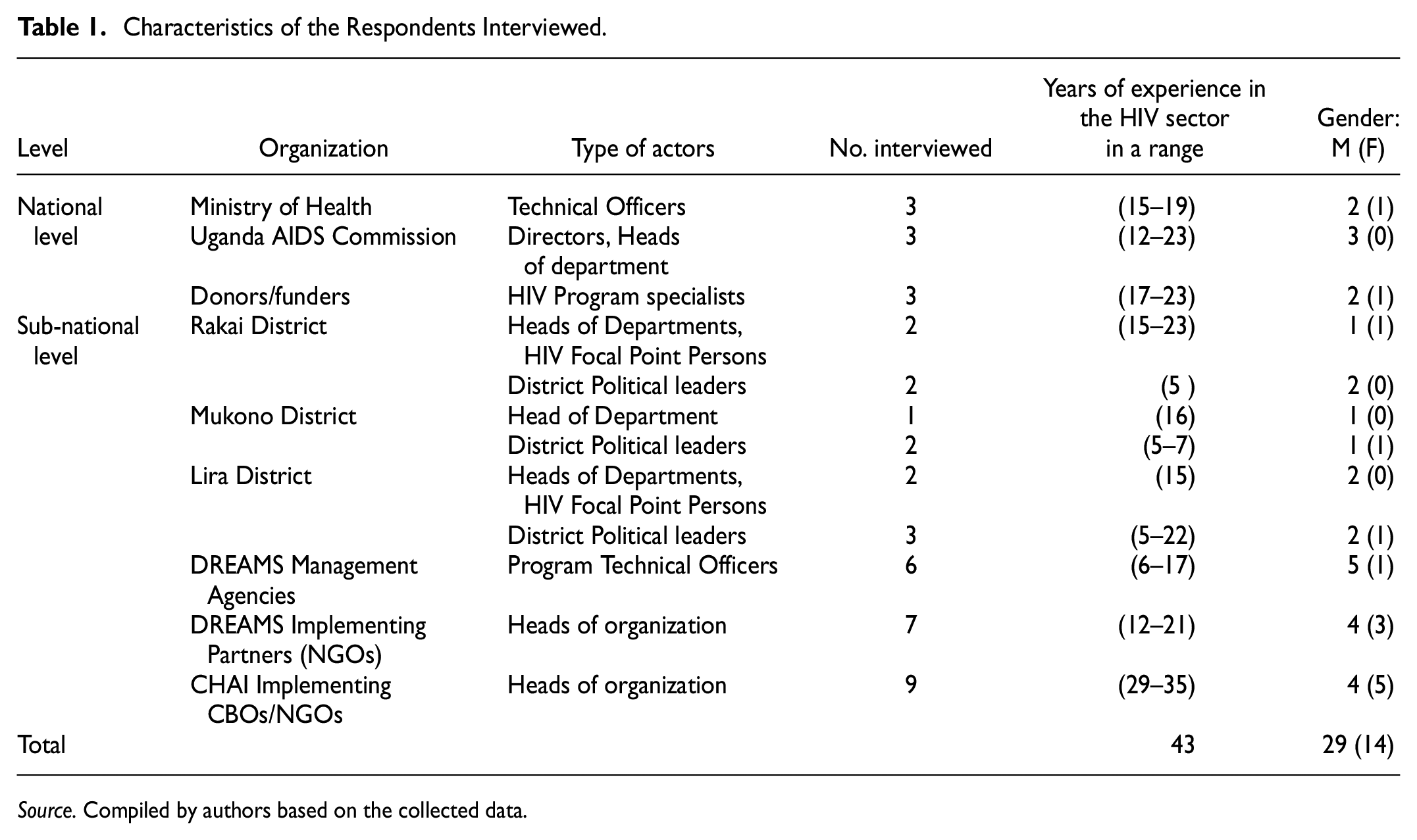
Source. Compiled by authors based on the collected data.
Summary and Characteristics of Study Participants for FGDs.

For interviews, an interview guide had questions designed for the different categories of participants at national and district levels to obtain information on the functioning and set-up of the different HIV&AIDS delivery modes. The guide was also used to ask questions related to the transactions between actors during service delivery. During the interview, follow-up probes were conducted with each participant to understand the phenomenon better. The interview was conducted face-to-face, but participants who were not available face-to-face were interviewed telephonically after explaining the study’s objectives and obtaining their consent.
One of the researchers contacted vital people to participate in Focus Group Discussions. These people were selected among leaders of District AIDS and DREAMS committees and people in HIV&AIDS forums. Targeting leaders for FGDs aimed at collecting views from the most knowledgeable participants yet not directly involved in HIV&AIDS prevention services delivery. The approach aimed at getting the opinions on the aspects of the study’s focus from the society’s viewpoint. The researcher had an assistant who took notes during the FGDs process, which also involved the use of audio recording for more reliable information.
Secondary data was collected through documentary review to augment data from key informant interviews and focus group discussions. The review of documents focused on the set-up of institutional structures, successes and challenges. Documents reviewed included current and previous National HIV and AIDS Strategic Plans; HIV&AIDS policy, Multi-Sectoral HIV and AIDS Mainstreaming guidelines, PEPFAR Country Operation Plans, DREAMS Strategy, the Community-Led HIV/AIDS Initiatives (CHAI) strategy, and other related HIV&AIDS guidelines. Others included District HIV and AIDS strategic plans, CHAI Proposals by Community Based Organizations, DREAMS operational guidelines and implementation plans.
Data Analysis
The analysis first characterized the level of transaction complexities that asset specificity, service measurability, and opportunism necessitate (low, mixed, and high). Transaction cost levels were then analyzed based on the complexities of each mode used to deal with each source. The study compared the overall transaction costs generated by all sources (Asset specificity, service measurability, and opportunism) across modes. The study examined whether the mode that achieves the least transaction costs was in line with the TCE theory prediction.
Data were transcribed and reviewed after each field interview, and themes and patterns were identified as we collected data. The researchers aligned the emerging themes with the three TCEs dimensions understudy. The analysis was based on the weak–strong continuum of Williamson (1998, p. 37) “natural order” of institutional arrangements—the TCE discriminating alignment hypothesis. According to the hypothesis, Transactions that differ in their characteristics should be aligned with institutional arrangements that differ in their costs and competencies to minimize transaction costs. The summary of findings for each case study was generated. The case-study summaries followed a similar format to compare cases (see Results). The summaries for each case were aligned to the TCE predictions and analyzed to account for the different institutional arrangements’ distinctive features (set-up) and their implications on the intensity of transaction costs.
The ethical clearances for this study were granted by the Higher Degrees Ethics Committee of a certain University, the Institutional Review Board (IRB) of an AIDS Organization, and the National Council of Science and Technology of certain country.
Results
This study characterized the transaction costs of HIV&AIDS services in Uganda as mixed asset-specific (specific and non-specific services), moderate to high service measurability difficulty, and a high degree of opportunism. Evidence characterized asset specificity transactions as the mixed level because of a great deal of HIV & AIDS awareness and skills in place that made safeguarding these skills less complex. However, skills requiring lab were high and required safeguarding complexities during HIV&AIDS prevention service implementation. Furthermore, HIV&AIDS services, such as information sharing, were easy to gather. However, other information, such as changes in risky behaviors and infection rate reduction, required more sophisticated measures to measure service measurability. Opportunism was the only source assessed as high because of its prevalence.
Levels of Transaction Costs Per Source and Per Mode of HIV&AIDS Prevention Services
Asset Specificity
All three HIV&AIDS service modes had transactions to preserve asset specificity for delivering HIV&AIDS services. The contracting-out mode had more complex transactions and, therefore, high costs. Table 3 summarizes the results.
Asset Specificity.

Source. Study data; whereby; 0 represents low TCs; x represents the average or mixed TCs; xx represents very high TCs.
As summarized in Table 3, direct and indirect transaction costs were considered at a mixed level in the public sector. The mixed level was due to some of the controls, such as the public civil service performance management system, authoritative flow of information and command already in place as part of the general government services. Key government safeguards included skills building in clinical monitoring, laboratory science, and management controls to enforce the performance of these skills. Typical evidence from the study participants is as follows:
“…we have in place dedicated personnel at the AIDS Control Programme in the Ministry of Health, at the Uganda AIDS Commission, and at the health facilities. All the HIV personnel under the government, whether paid by the government or development partners…. are managed by the public service performance management principles and procedures. Several trainings are conducted for the different cadres to improve their technical capacity. …” KII-37/43
The findings showed that HIV&AIDS activities were integrated into internal procedures and hierarchical communication flow. Respondents perceived that this approach was likely to moderate potential costs of information search, enforcement and recruiting HIV-specific sector staff because the HIV activities benefited from economies of scale of internal systems;
“In my opinion, the approach of utilising the available public performance management systems and existing resources such as staff has improved information flow and monitoring which could have been difficult and costly just the way the programmes that are managed outside the government system…” KII-33/43
Transactions to safeguard personnel with specific HIV were put in place by third parties such as grant donors leading to indirect transactions cost from the government perspective but were not also very high. Key informants indicated that almost all the staff within the AIDS Control Program in the Ministry of Health depended on donor grants. The typical view from the study participants is as follows:
“… salaries of over 95% of staff at the AIDS Control Programme are from PEPFAR and Global Fund. In fact, there was a time when PEPFAR stopped some programmes, and the staff were also stopped. The ones there now were recalled when the partnership between the ministry and PEPFAR was renewed…” KII-08/43
Briefly, asset specificity generated mixed levels of transaction complexity on the government’s part in direct and indirect transactions. Hence transaction costs generated by asset specification can be considered average, as Table 3 shows.
Table 3 shows that the contracting-out mode (DREAMS) had the highest direct transaction costs. DREAMS used extensive administrative controls, protracted management and supervision levels, and heavy investment in M&E protection with implementing partners to safeguard asset specificity. This was typical evidence related to this claim:
“We receive too many supervisors… from the management agency, from the ministry and from PEPFAR…” KII-36/43.
DREAMS transactions also involved information search, performance enforcement, high-level negotiations, investment in performance evaluation, monitoring and enforcement, whereby “hi-tech,” specialized monitoring and evaluation systems, particularly the Uganda DREAM-OVC tracking system—UDOTS were used. These transactions resulted in an M&E burden, mistrust in implementing partners implying high transaction costs to safeguard asset specificity (xx). Typical evidence of this effect is as follows:
“We have a robust, sophisticated system to track performance…a technical M&E management agency was contracted to track performance indicators of the different implementing NGOs…” KII-27/43
Unintended transactions of this mode that necessitated safeguarding included transactions needed to motivate personnel for long-term investment in HIV skills. Because the operating mode used short-term contracts, demotivation was prevalent among staff. These indirect transaction costs were at mixed level (x), though, because some staff would still be motivated to get their short-term contracts renewed. The typical evidence is cited below:
“We also see a big challenge as implementing partners avoided making key investments as the focus was on meeting short-term targets directed by the funder.” KII-34/43
The high-performance targets, high-quality expectations and strict time boundedness necessitated out-sourcing technically experienced NGOs to deliver the required targets within the required time. The typical evidence in this respect is as follows
“DREAMS is a robust programme, it is time-bound, the targets are too high….so management agencies sub-contracted NGOs with experts in HIV&AIDS programming to implement the activities within the expect projected time. to achieve this, the management agency set strict rules and expectations that have to be followed by implementing partners…” KII-32/43
Results in Table 3 further suggest that the Partnership CHAI had the lowest levels of transaction costs relative to the other two, both in terms of direct (0) and indirect (0) costs (Table 3). To safeguard asset specificity, the partnership needed no more training in skills and specialized equipment as these were part of the general government services in other non-HIV sectors. However, minimal transaction costs were expected, such as the costs of organizing volunteers. The government districts retained activities that required technical expertise. Delegating less complex transactions to the partner meant limited complexity of safeguarding assets. The findings revealed that no specialized investments in specific assets, such as skills and equipment, were made by implementing NGOs. Instead, the CHAI implementing groups primarily worked with community volunteers, who were at the same time beneficiaries;
“…at the design of this project, considerations were made to match the project’s activities with the competencies of the implementing groups…right from its initial design, the CHAI project was intended to be simple and suitable to the low technical competencies inherent in community-based organisations…” KII-14/43
“Activities requiring specialised skills and experience were ineligible for the NGOs’ implementation because they did not have the required competence. The districts utilised existing district resources, such as, the personnel to directly implement activities that required technical skills and specialised equipment.” KII-35/43
Indirect costs were not demonstrably observed in the current study. Potential indirect costs associated with the use of non-technical personnel were minimal because simple implementation transactions were matched to their community competencies;
“The implementing groups used basic reporting tools that were suitable to their capacity. The lower council politicians also provided oversight to ensure compliance, and the beneficiaries provided feedback on the services through monthly meetings and quarterly workshops…” KII-26/43
Briefly, asset specificity was the highest source of direct and indirect transaction costs for contracting out (DREAMS) (xx and x), second highest in the public sector (x, x) and lowest in the partnerships-CHAI (0, 0). See Table 3
Service Measurability
All three modes of HIV&AIDS delivery services had ways of measuring HIV&AIDS service. Transactions to safeguard accurate measurement of services were more complex in contracting out and lowest in Partnership (Table 4).
Service Measurability and Its Influence on Transaction Costs.

Source. Study data; whereby; 0 represents low costs; x represents average costs; xx represents.
As summarized in Table 4, the public sector had the second-highest transaction costs at the mixed level. HIV&AIDS services were evaluated based on M&E, spelled out services indicators. Transactions to preserve the measurement were complex in two ways. First, these service indicators were determined after a protracted consultation process at the national and district levels. The resulting M&E plan spelled out HIV&AIDS service indicators and targets by thematic area, which informed the evaluation guidelines. Second, there were key challenges associated with the measurement: the required data for measurement, difficulty in synchronizing the different databases from different sectors, and failure to align NGO work with the priorities of the M&E. Participants typically spelled out the challenges in this way:
“…because of the complexity in monitoring and evaluation of the HIV programmes in Uganda, every year, we procure consultants to compile the country’s multisectoral performance report. And… since we lack a centralised system that transmits data from different sources, the consultants conduct field visits to various stakeholders at central and district levels to capture this information. We know that this is a very expensive process but that is the only way to go about it…” KII-06/43
Often transactions around service measurability resulted in ripple effects, such as inequity in budget allocation when the government focused on specific measurement indicators, leaving other parties at the mercy of other sectors outside of the government. For example, focusing the budget on drugs and logistics left human resources-related transactions in the hand of third parties. The typical evidence is as follows:
“M&E systems for HIV are among the most neglected thematic areas….the government’s AIDS spending is primarily focused on drugs and other spending goes to human resources…this has left us under the mercy of donors, who each comes up with their own indicator definitions since it is their money…”KII-10/43
Table 4 results further show that contracting out (DREAMS) had the highest transaction costs to measure indicators. Respondents reported that DREAMS measurement indicators were multifaceted, with too many indicators and activities requiring complex transactions. The measurement process in DREAMS started with drawing plans and defining indicators, followed by conducting data Quality Assessments (DQA) monthly and producing a DQA protocol. This included joint field visits, quarterly measurement review meetings, and monthly spot checks. Key informants described the approach to performance measurement in DREAMS as too complex, costly and difficult to sustain in the context of the limited resource envelope in Uganda;
“…the DREAMS programme is organised around intensive M&E systems…we have teams that frequently carry out monitoring visits as routine as weekly, monthly and quarterly. DREAMS uses highly technical and sophisticated monitoring systems because of the multiple and complex indicators…” KII-22/43
Related indirect costs, such as opportunistic behavior, increased the possibility of the involved party taking advantage of frequent adjustments, renegotiations/revision of contracts and redefining indicators to sneak in opportunistic behavior. These were high because of many possible avenues that this could happen without being noticed due to complicated systems.
The result in Table 4 also shows that the Public-NGO Partnership, under CHAI, had the lowest levels of transaction costs. Interviews with key informants that participated in the CHAI programing revealed that the CHAI performance measurement was organized around easy-to-define and specify indicators and the use of simple data collection and reporting tools that were suitable for the low-level technical competencies of implementing groups CHAI, the communities defined their own community priorities/needs and indicators. Respondents reported that because of the simplicity of CHAI programing, there was no need for sophisticated performance measurement systems. Instead, different community structures, notably community leaders, beneficiaries and community members, were centrally positioned to monitor the measurement. In this study, indirect costs associated with service measurability were not demonstrably observed in CHAI. Respondents noted that this approach reduced the need for technical monitoring teams– who were actually fewer in numbers from the districts to offer routine supervision;
“CHAI activities were straightforward and easy to monitor. It was easy for the members of the community to meaningfully carry out monitoring since it was not so technical…” KII – 31/43
“Using simple and monitor-able indicators is one of the reasons we feel that the CHAI programme was one of the simplest and cheap HIV&AIDS programmes ever implemented in Uganda…” KII – 29/43
Opportunism
The three delivery modes had varying transaction levels generated by opportunistic circumstances in the study area. Transactions to prevent opportunistic behaviors were more complex in contracting out and lowest in (Table 5).
Opportunism and Its Influence on Transaction Costs.

Source. Study data; whereby; 0 represents low costs; x represents average costs; xx represents very high costs.
As summarized in Table 5, the public sector service provision had a mixed level of transactions to prevent optimism, but the highest transactions complexity in dealing with the side effects of its approach to deal with opportunism. The public sector used hierarchical directives and public service management systems to minimize the potential risks of opportunism. Several hierarchy-driven systems include issuing annual budget call circulars by the Ministry of Finance, creating costing codes in the mid-term expenditure framework, providing technical guidance by the Ministry of Health and Uganda AIDS Commission, and supporting supervision. Respondents perceived the hierarchical management system as an approach that moderated potential direct costs of administrative controls, negotiation and supervision;
“Each year, the ministry of finance issues a BCC (budget call circular) and the MTEF (mid-term expenditure framework) codes which every public entity is required to comply with when planning. And all the planned activities must be reported in the RBM (result-based monitoring) tool, also created by the ministry of finance. These are all web-based systems. This way, the government can monitor and deter opportunism in government entities with ease and less cost…” KII – 39/43
The findings linked indirect costs to the weak enforcement mechanisms, inadequate support supervision visits and insufficient control over non-government organizations that form part of the multi-sectoral actors;
“One of the greatest challenges is the inability of the government to monitor the activities of NGOs. You see…NGOs are big players in the response but the government has no system to monitor their contribution. These organisations don’t even report to government….” KII – 38/43
Table 5 also shows that contracting out (DREAMS) had the highest direct cost of dealing with opportunism. Dreams entailed complex performance management systems by putting in place strict control measures for mitigating any risks associated with opportunism. Complex safeguards such as random spot checks on a monthly and quarterly basis, recruitment of reputable NGOs to implement activities and use of complex performance tracking systems. Respondents observed that the extensive controls used in DREAMS as safeguards to moderate corruption-related risks resulted in high direct costs of information gathering, negotiations, monitoring and supervision. No evidence of indirect costs was reported in the study. “We conduct closer regular technical support during implementation as weekly, monthly and quarterly. Technical teams carry out support supervision. We also have robust systems that track the performance of all implementing partners. The monitoring visits are largely focused on addressing performance issues, especially meeting targets. We do all these to ensure fidelity to the programme and adherence to the quality standards of DREAMS implementation as required by the funder…” KII-21/43
The summary in Table 5 further shows that the Partnership (CHAI) resulted in the lowest level of transaction costs. CHAI took the informal form, largely relying on social capital regarding community social responsibility and collective action. Interviews with CHAI implementers and focus groups with the District AIDS coordination committee revealed that the community’s involvement in defining their own priorities resulted in the sense of common interest toward the project. Participants observed that common interest resulted in social cohesion, which was an important motivator for the community to monitor the project implementation closely; “We were motivated by the fact that the activities were generated by ourselves and they responded to our own needs. We knew that the project directly benefited us, so we monitored ourselves during implementation. It was unbecoming for a member to cheat because both the implementers and beneficiaries belonged to the same community and knew each…we routinely shared information with beneficiaries, community leaders and the district officers…” KII-28/43
Potential indirect costs associated with opportunism were not demonstrated in this study. This is because the indirect transaction costs associated with over-reliance on informal institutions were moderated through informal institutions such as community dialogs and social cohesion;
“Any dispute or governance challenge that came up was quickly addressed through community dialogues…so governance problems were solved disputes amicably…” KII 37/43
Transaction Cost Minimisation and Alignment
The findings above have shown that how an organization sets up transactions to deal with asset specificity, service measurability and opportunism results in different transaction costs, presenting an opportunity to compare levels of these transactions in each HIV&AIDS Prevention service mode and then compare relative transaction costs across the modes. The evidence in this study showed that the Partnership (CHAI) resulted in the least complex transactions situation in the face of mixed asset specificity level, moderate to a high level of services measurement difficulty and high level of opportunism. The mixed level of asset specificity and service measurability and a high level of opportunism in Uganda deviated slightly from the situation predicted by the theory, which only predicts partnership as the most appropriate in a situation of mixed level for all three sources of transaction costs. Since the partnership minimized the transaction costs and (closely) matched the theory prediction, the study concluded that it aligned with the TCE theory. The conclusion’s validity can be argued in that empirical evidence may not match every detail of the theoretical exposition. The study’s conclusion about the partnership alignment is based on the overwhelming match with mixed-level asset specificity and asset measurability. Furthermore, opportunism could have been at a mixed level in reality, but the evidence in Uganda could have deviated slightly.
In the following lines, the study analyzes factors contributing to CHAI’s lower transaction costs. The Chai became cost-minimizing because of the two actors in the partnership. The public sector cared for mixed-level transactions using already existing government services with no additional transactions. The partnership did not incur more transactions in a meaningful way but capitalized on existing transactions. The other part that accounted for transaction cost saving in CHAI was the approach of the other party (NGOs) in the partnership to deal with HIV&AIDS prevention services. CHAI programmers used NGOs to engage the community (beneficiaries) and define their priorities for HIV&AIDS control. This approach resulted in the community’s common interests and shared responsibility toward reducing the impact of the HIV&AIDS epidemic on individual, household and community levels. The beneficiaries’ freedom to choose and determine their priorities enabled the best utilization of existing resources and community competencies. Also, it contributed to a process of collective action in addressing a common community problem. As indicated in the previous sections, CHAI designers did not recruit experts to provide HIV&AIDS control services to the primary beneficiaries. They were rather based on voluntarism by the community members to deliver services. Through participating in the delivery of HIV control services, community members (including beneficiaries) developed an appreciation and understanding of the required assets in terms of skills, site of service delivery, and information required to deliver quality and sustainable services.
Furthermore, the community under the CHAI program of activities shared a common belief that activities were organized around acceptable norms and values through community involvement, facilitating positive adaptation. Positive adaptation reduced the need for regular supervision to enforce performance. Belonging to a similar environment with similar needs enabled each community member and beneficiary to present their concerns, suggest ideas for improvement and amicably agree on the trade-offs they were willing to accept for collective benefits. The evolved relational exchanges facilitated information sharing, strengthened unity among actors, and stirred the community toward attaining their common goal. Informal interactions and information flow effectively took place among actors since they were close. The relational interactions ensured that all actors’ views were considered during prioritization and built a sense of mutual trust among actors. Mutual trust grew from the support that the community members accorded each other. Different forms of trust emerged: collective trust and institutional trust. Collective trust was derived from community belonging, where NGO implementers were known to the community they served and shared the same norms and values. Institutional trust entailed the rules that existed, whereby the community members trusted the established safeguards governing the actions of actors. As a result of these processes, the informal rules and norms largely governed stakeholders’ actions, significantly moderating potential costs of information search, negotiations and performance enforcement. The approach avoided any complex transactions, hence the least cost in this mode.
Discussion
This study used the TCE theoretical framework to compare three dominant HIV& AIDS prevention services modes in Uganda: The public sector, contracting out (DREAMS) and Partnership (CHAI). The aim was to identify HIV&AIDS service mode with the lowest level of transaction costs and whether the latter aligned with the TCE prediction to recommend the theory as a transactions design guide. The analysis was conducted using a qualitative approach. The qualitative analysis becomes appealing in transaction costs analysis in HIV&AIDS because of the diversity of actors and transactions, some of which are difficult to quantify. The investigation of transaction costs was motivated by the recent decline in HIV &AIDS funding and the need to find alternative ways of saving on costs by minimizing transactions that bring about budgetary pressure.
The TCE theory’s sources of transaction costs, asset specificity, service measurability, and opportunism guided the analysis. The findings showed that CHAI transactions were the least complex and led to less cost in dealing with asset specificity, service measurability, and opportunism. CHAI first achieved the lowest costs by leveraging existing non-HIV-related transactions from the public partner that catered for complex transactions needed to deal with asset specificity, service measurability, and opportunism. Second, the simplicity of approach to deal with less specific HIV assets by relying on the community where the latter defined their own priorities and shared common interests and values. The CHAI aligned the delivery of services with the actors’ competencies, whereby the principal (the government/districts) retained services that required specialized skills and only engaged NGOs on services with non-specific skills. There was no need for NGOs to invest in specialized skills. This reduced the associated costs of safeguarding specialized skills. The community ownership model of CHAI service for non-highly-specialized services meant NGO could handle these via increased social and individual responsibility, community ownership and involvement, minimizing the need for sophisticated controls, contract enforcement, and opportunism monitoring.
In addition to its transactions being the least costly regarding asset specificity, service measurability, and opportunism, CHAI was the most closely aligned to the prediction of the TCE. The latter theory predicted that partnership minimizes transaction costs in a context of the mixed level of asset specificity, services measurability, and opportunism. The partnership minimized costs, and since the evidence characterized the context of Uganda as requiring mixed levels of transactions to deal with asset specificity and services measurability, the study took this as overwhelming evidence supporting that Partnership was the most aligned the TCE theory prediction with an implication that the late theory can guide transaction costs set up in the country to minimize costs. Comparably contracting out with DREAMS made asset specificity the highest source of transaction cost, and the public sector kept the intermediate space. For instance, in the DREAMS project, the requirement for highly competent organizations with specialized knowledge in HIV&AIDS service delivery blocked inexperienced organizations’ entry. Consequently, the search for highly competent implementing organizations that required intense due diligence to implement the DREAMS was a key factor in driving up transaction costs of negotiations and information search (details in the Result sections).
There have been many studies on managing programs to minimize costs whilst safeguarding the quality of services. These cost-outcome optimization studies have mainly adopted quantitative approaches. However, these approaches do not capture every information that leads to costs and focus on the overall minimization of cost without considering the minimization of transaction costs surrounding the production of the main product. The study covered this gap in the literature by applying a qualitative approach. The study also contributed to the literature that transaction costs analysis has had limited applications in the HIV& AIDS sectors, with many studies focusing on business animal other sectors. The only study closely related to this is a study by Guinness (2011) in India. Guinness (2011) notes that asset specificity, particularly skills and knowledge specificity in delivering HIV&AIDS services, is the response’s major source of transaction costs. Besides, asset specificity“lock-in” leads to costs of negotiations. While the study is closely related to this one, the evidence may not apply to the context of Uganda. Furthermore, the study did investigate all the TCE theory modes of production and focused only on versions of contracting out.
While the study contributes to this knowledge, particularly in the HIV& AIDS sector, some of its discussions about TCE theory have some precedents in the literature. For example, studies have reported that skills and knowledge specificity influence transaction costs to safeguard these skills (Coggan et al., 2013; Guinness, 2011; Williamson, 2010). Furthermore, Lorne and Sneh (2015) reported that because HIV&AIDS-specific skills and knowledge are non-transferable, implementers may act opportunistically, thus driving up monitoring costs. Regarding difficulties in service measurability, studies found that programmers engage in a multiplicity of monitoring methods and systems to track progress and collect information on the services (Kawonga et al., 2012; Ledikwe et al., 2014; Mpofu et al., 2014; Wiewel et al., 2015). In addition, Valdiserri et al. (2013) note that HIV&AIDS program implementers have difficulty defining and specifying behavioral change outcomes because behavioral change takes time to be realized, agreeing with other studies (Abimbola et al., 2015; Ashford & Biswas, 2010; Bech & Pedersen, 2005; Guinness, 2011; Holzscheiter et al., 2012; Khim & Annear, 2013) regarding the difficulties encountered in measuring HIV & AIDs services leading to information search and negotiation costs to obtain the required reports from actors. Regarding opportunism, Uganda’s HIV response has long been plagued by corruption (Bouchard et al., 2012; Kapiriri & Martin, 2006). For instance, in the current study, implementers manipulated data/information to “achieve” expected targets—in numbers set by the financiers. The presence of opportunism motivates programmers to establish intense management/administrative controls to safeguard potential risks and enforce performance, consequently increasing monitoring and enforcement transaction costs, as observed in DREAMS.
Regarding the appropriateness and alignment, there has s been mixed evidence and views in the literature regarding the suitability of the mode that minimizes costs. Most critics of TCE theory have mainly focused on its profit maximization assumption, modes of measurement of transaction costs and behavioral assumption (Lacity et al., 2011). One of the early critics of TCE was Demsetz (1993), who argued that the TCE assumption on profit maximization in searching for a cost-minimizing implementation arrangement ignores the realities of the real setting. Demsetz first questions the TCE assumption of shifting from the market (contracting out) form of governance to the hierarchy (internal) when the transaction costs of market governance are high. The rationale for internal integration is the cost of information search that principally determines the choice of a governance structure. The thinking is that hierarchy operates in an environment where information asymmetry is acquired at a high cost. The critic argues that internally integrating the services does not eliminate transaction costs because the organization still incurs the cost of information search. This criticism provides an opportunity for further research.
Study Limitations and Recommendations for Future Research
First, due to this study’s qualitative (explorative) nature as constructed by the TCE theory, the study did not compare actual costs quantitatively. The study analyzed the levels of complexity of transactions (and hence of transaction costs) needed to deal with asset specificity, service measurability and opportunism based on the view of participants and document reviews. Whilst it would have been better to attach actual costs to these comparisons, it was technically impossible given the multiple actors involved and the difficulty of transacting transactions such as negotiations in monetary terms. The authors refer to future research in the quantitative analysis of transaction costs. The longitudinal mixed-methods analysis combines TCE theory and other relevant quantitative theories to quantify the differences in absolute (direct) transaction costs and service quality would be a valuable addition to this literature.
Second, the study offered a partial analysis that examined costs. The study did not analyze output associated with transaction costs first because of the difficulties in quantitatively measuring these costs and second because cost-output analysis requires a focus on all the costs and not only. It was also difficult to determine the differences in healthcare quality, efficiency, value-for-money, and effectiveness associated with transaction cost levels across the three programs. The authors acknowledge these limitations.
Conclusion
This study was motivated by the declining funding commitment to HIV & AIDS services and the role transaction costs could play in reducing budgetary constraints. To this end, the TCE theory framework was used to analyze the transaction costs generated by the need to safeguard asset specificity, services measurability and optimism. The study found that CHAI had the least complex transactions and, thus, the lowest number of transactions. Already existing services catered for the high levels aspect of HIV in this mode of delivery, whilst the lowest was catered by the community ownership part of the partnership. The most costly was DREAMS because sophisticated controls caused the safeguard of asset specificity to generate higher transaction costs. The mode with the lowest costs also matched the propositions of the TCE theory implying the theoretical details can be used to guide HIV&AIDS services designs. The limitation of the papers and future research direction suggested.
Footnotes
Acknowledgements
I want to thank the Ministry of Health, PEPFAR Uganda DREAMS project, Uganda AIDS Commission, District Local Governments of Rakai, Lira and Mukono and all NGOs and individuals for their participation and honest responses.
Author’s Note
This paper differs from our papers entitled: “Institutional Arrangements for Providing HIV and AIDS Services in Uganda: A Transaction Cost Economics Analysis” in that this published paper focuses on characterizing the institutional arrangement in terms of TCE theory constructs of that characterizes transactions. The analysis was based on 4 proposed TCE governance instruments: administrative controls, adaptation, incentives and contract laws. The analysis sought to determine the institutions most aligned with these constructs and described by the TCE theory. This paper focuses on levels of transaction costs as arising from the sources of these costs according to the TCE theory.
Authors Contribution
SK conceptualized the manuscript, conducted data analysis and produced the first draft. JM conceptualized the manuscript, restructured and reviewed the various versions of the manuscript.
Declaration of Conflicting Interests
The author(s) declared no potential conflicts of interest with respect to the research, authorship, and/or publication of this article.
Funding
The author(s) disclosed receipt of the following financial support for the research, authorship, and/or publication of this article: This research was funded by the Health Economics and HIV/AIDS Research Division (HEARD) through a PhD scholarship at the University of Kwazulu Natal. At the time of this study, Sarah Khanakwa was a PhD student at the University of Kwazulu Natal, South Africa. The views and opinions in this article are solely the authors’ responsibility.
Patient Consent Statement
Not applicable to this study.
Consent to Publish
Not applicable to this study.

Data Availability
The data that support the findings of this study are included as supplementary materials in this submission.