




Abstract
This study investigated the role of social capital in the relationship between sports event volunteer management and volunteers’ attitude and behavior. Social capital was discovered to mediate the relationships of sports event volunteer management with volunteers’ satisfaction and work engagement. These relationships were empirically examined by conducting a survey of 303 volunteers from the 2016 Wuhan Open and 2016 Wuhan Marathon. The results revealed that sports event management practices, namely training and working conditions, significantly affected the volunteers’ social capital. The social capital of the sports event volunteers significantly affected their satisfaction and work engagement. The volunteers’ social capital promoted their satisfaction and engagement only if sports event volunteer management practices effectively enhanced their social capital. This study provides recommendations to help sports event organizers motivate volunteers.
Introduction
Volunteerism in China
Although volunteerism developed later in China than in Western countries, it has made great progress recently. In 2011, 9.5 million Chinese individuals participated as volunteers with a working time of 92.7 million hours (Yin & Xu, 2014). In the same year, 60 million Americans participated in formal volunteer organizations with a working time of 8.1 billion hours. However, volunteerism has recently gained greater attention in China (Yin & Xu, 2014). The comprehensive development of voluntary services in China began in the year 2008 (Wei, 2013), also known as the “first year of China’s voluntary service.” In the 2008 Olympic Games held in China, 70,000 individuals voluntarily participated. According to the statistical data provided in Yang (2018), by 2017, the total number of volunteers in China was 158 million, among whom 60.93 million were active volunteers. These volunteers participated in voluntary services through 1.31 million voluntary service organizations, with a total service time of 1.793 billion hours (Yang, 2018). In 2017, the State Council of China issued regulations regarding volunteer services; this indicated that voluntary services have risen to the level of central government work. In 2022 Beijing Winter Olympics, nearly 20,000 volunteers provide all kinds of service to in the Games with 1,000,000 applicants applying for volunteer position. This reflects Chinese has a high degree of enthusiasm for voluntary service.
In Western countries, the participation in voluntary service is guaranteed by its institutional environment, which is quiet different from China (Xia, 2018). For example, in the United States, many regulations related to volunteerism exist, including the Domestic Volunteer Service Act of 1973, National and Community Service Act of 1990, National and Community Service Trust Act of 1993, Volunteer Protection Act of 1997, and Citizen Service Act of 2002. Various institutions implement measures to comply with these regulations. For example, in the 2013 to 2014 school year of a Virginia high school, students were required to participate in community public services for a minimum of 60 hours to qualify for high school graduation. This requirement was increased to 80 hours in the 2017 to 2018 academic year (F. Wang, 2015). Therefore, in western countries, the participation in voluntary service arises from institutional pressure in a great extent.
In China, volunteerism reflects the real voluntary behavior of individuals because of the absence of mandatory volunteering requirements, which is different from that in western countries. Individuals participate in voluntary activities due to their willingness to solve social problems, such as those encountered during the COVID-19 pandemic, or to contribute to events, such as the 2008 Beijing Olympics. Volunteers mainly receive spiritual rewards or a participation certificate to prove their volunteering experience (Xia, 2018). Therefore, in China, voluntary service regulations are less binding for its expression is oriented and of principle (Xia, 2018). Under this regulatory and cultural background, the motivation of Chinese volunteers to participate in voluntary activities is considerably different from that of volunteers in Western countries.
Sports are the most common area for volunteering activity no matter in western countries or in China. More than a quarter of all volunteers in the United Kingdom, Australia, and other countries volunteer in sports-related activities (Storr et al., 2016); this proportion is similar to that observed in China. According to Sportcal, China currently holds the most international sports events globally (Z. Wang et al., 2019). Many volunteers participate in these Chinese sports events to provide all types of voluntary services. The 2019 Wuhan Marathon recruited over 7,000 volunteers to provide all types of voluntary services such as indicating the starting and ending points; protecting the environment; providing medical care and access to clothing; and assisting at beverage, drinking water, and food stations. The 2019 Wuhan military games recruited 250,000 volunteers, among whom 50,000 and 200,000 were event and city volunteers, respectively. Voluntary service regulations in China do not mandate individuals to be volunteer in these sports events. These Chinese volunteers participate in volunteerism because they have motivation outside the institutional pressure.
Volunteerism and Social Capital
Participation in sports volunteering can enhance individuals’ social capital (Storr et al., 2016). Thus, increased social capital can serve as one of the most crucial motivations for participating in voluntary services (Welty et al., 2013). The accumulation of social capital is particularly vital for Chinese sports event volunteers because social relations are essential motivations for Chinese individuals to volunteer in sports events (X. Wang, 2015). Studies conducted in China have reported a positive association of individuals’ social capital with their income return (Yao et al., 2013), health and well-being (Yip et al., 2007), success in the labor market (Knight & Yueh, 2008), and entrepreneurial survival (Batjargal, 2007). Therefore, Chinese culture substantially emphasizes the accumulation of social capital. Individuals’ social capital can be increased by bonding with others and developing a social network during a sports volunteering experience (Whittaker & Holland-Smith, 2016). Therefore, many studies on sports volunteering have focused on the acquisition and development of social capital (Engelberg et al., 2014). Although scholars have evaluated the contribution of volunteerism to the development of social capital among sports volunteers (Kay & Bradbury, 2009), they have not elucidated the mechanisms underlying the formation of social capital and investigated the effect of social capital on volunteers’ performance.
Effective management on volunteers can guarantee the service quality of sport events. However, the mechanism of how the management on volunteers influence volunteers attitude and behavior is not explored entirely. From the institutional perspective, sports event volunteering management refers to the various work involved in volunteering management within sports events including the recruitment, selection, orientation, training, support, performance management, and recognition of volunteers (Cuskelly et al., 2006). Many studies have investigated the management of sports event volunteers because sports event managers should be able to efficiently recruit, train, and retain volunteers to optimize the operation of the event (Doherty, 2009). Various management practices—such as training (Shaw, 2009), organizational support (Cuskelly & Hoye, 2013), and financial resources (Coates, 2014)—can improve the recruitment, work, and retention of volunteers (Khoo & Engelhron, 2011); these factors are crucial for enhancing the volunteers’ experience (Allen & Shaw, 2009). Studies examining the psychosocial process that can explicitly explain the relationships among management practices and volunteers’ motivation, job satisfaction, performance, and retention are warranted. A study based on the psychology model could comprehensively explain how sports event management affects volunteers’ psychological and behavioral reactions (Cho et al., 2020), thus further enhancing the understanding regarding volunteer management (Allen & Shaw, 2009).
Social capital can be used to explain how management on volunteers influence their attitude and behavior. Social capital refers to relationships with colleagues, acquaintances, and contacts that can provide opportunities for obtaining financial and human resources (Wagner et al., 2010). Because social capital can improve work-related performance, it is frequently described as a tactical asset (Luthans et al., 2004). Social capital can affect multiple work-related outcomes; thus, appropriate managerial actions are necessary to shape the social capital of individuals in organizations. Management practices such as providing training (Feinstein & Hammond, 2004) and appropriate work facilities (Zagenczyk et al., 2008) can help increase individuals’ social capital in an organization. Under the context of sports event volunteerism, volunteer management can help volunteers accumulate social capital, which, in turn, can improve their attitude and behavior related to volunteering. Hence, the present study investigated mechanisms through which sports event volunteer management can help volunteers acquire social capital and the effect of social capital on volunteers’ attitude and behavior regarding volunteerism. This study introduces social capital theory into the field of sports event volunteer management and demonstrates the psychosocial process through which volunteer management affects the attitude and behavior of volunteers.
Literature Review
Social Capital Theory
Social capital theory originates from the terms “social” and “capital,” in which “social” refers to the importance of positive human interactions based on relationships and “capital” refers to the influence and information that has value (Field, 2008; Pope, 2003). Several studies on sociology and the social sciences have regarded social capital as a concept with both theoretical and practical contributions (Adam & Roncevic, 2003; Field, 2017). Studies on social capital have emphasized the benefits of social networks (Field, 2017) including receiving help from friends, obtaining information from acquaintances, and gaining access to some valuable resources (Engelberg et al., 2014). Social capital is a valuable resource in terms of improving an individual’s job performance (Adam & Roncevic, 2003; Field, 2017).
The concept of social capital defined by Batjargal (2003) comprises three dimensions: structural, relational, and resource capital. Structural capital refers to the structure of the overall network of relationships (Granovetter, 1990). Relational capital refers to the extent to which economic actions are affected by the characteristics of an individual’s relationship with others (Granovetter, 1990). Resource capital is the degree to which a network possesses valuable resources (Lai et al., 1998).
Many management practices such as providing internal leadership training, individuals’ task assignment, tutoring, coaching, and in-time feedback can affect the formation of social capital among members in an organization (Carmeli et al., 2009; Galli & Gunte, 2012). Thus, the acting force of managers and leaders that is reflected in the improvement of social capital in organizations has been extensively discussed in the literature (Maak, 2007). Managers and leaders with more investment in social capital can establish and maintain more social capital (Baker & Dutton, 2006).
Social capital considerably affects job satisfaction (Tsounis et al., 2017) because it contributes to solving work-related problems with the help of others. With the resource support of social capital, individuals have greater ability to cope with work demands (Ommen et al., 2009), thus achieving favorable psychological well-being (Bakker & Demerouti, 2016), which, in turn, can increase their job satisfaction. Simultaneously, social capital can increase individuals’ work engagement because social support resources can promote motivational outcomes (Meng et al., 2018). Social capital in the workplace indicates the availability of practical and emotional social support that results in higher work engagement of employees arising from positive relationships with coworkers (Keyes, 2007).
Episodic Volunteerism
Episodic volunteerism, an independent type of volunteerism that differs from long-term volunteerism, has attracted increasing research attention (Macduff, 1990). Currently, a large proportion of volunteers engage in episodic volunteerism (Hyde et al., 2015), which is considered to be the wave of the future (Culp & Nolan, 2000). Episodic volunteerism is essential because numerous episodic volunteers are required in a short period of time during events such as during crisis situations to serve specific patient or community groups or community events (Hyde et al., 2014). Although episodic volunteerism has become a critical social phenomenon, research on this topic remains scant (Handy et al., 2006). The following three key aspects of episodic volunteerism should be evaluated (Merrill, 2006): its definition (Brudney, 2005), its characteristics (Cnaan & Handy, 2005), and the motivation and behavior of episodic volunteers (Wilson, 2012).
Social Capital From Volunteerism
Volunteerism may lead to the development of social capital (Darcy et al., 2014). Volunteerism could increase social connectedness (Kay & Bradbury, 2009), enhance bonding within a club, and collect bridging capital to several stakeholders in the organization (Darcy et al., 2014). Therefore, the development of social capital due to enhanced levels of active citizenship and prosocial behavior is a benefit of sports volunteerism for individuals and communities (Kay & Bradbury, 2009). In addition, personal skill development and social connectedness are the two types of social capital derived from sports volunteerism (Kay & Bradbury, 2009). Volunteers are able to meet new people and make social gains because of the event or festival (Nicholson & Pearce, 2001). Thus, an increase in social capital is a prominent advantage of volunteering (Wilson & Music, 1999). Volunteers can build trust, norms, and networks with experience in volunteerism. Sports volunteerism can help establish social capital and strengthen the structure of civic society (Putnam, 1995). Welty et al. (2015) reported that event volunteers obtain social capital by building relationships, learning, and working for social change. Scholars have discussed the formation of social capital for different genders (Downward et al., 2005), age groups, and classes (Bradford et al., 2016) from the perspective of sports event volunteering. One study indicated that social capital arising from volunteering was affected by the motivation and commitment of sports event volunteers (Hallmann et al., 2020). Although many studies have investigated social capital arising from volunteerism, the relationship between individuals’ social capital and volunteerism is still not fully understood (Harvey et al., 2007).
Sports Event Volunteer Management
From the institutional perspective, volunteer management includes the recruitment, selection, orientation, training, support, performance management, and recognition of organizational volunteers (Cuskelly et al., 2006). Studies on sports event volunteer management have evaluated strategies for efficiently managing volunteers and improving their experience and voluntary behaviors in terms of their decision to volunteer (Hallmann, 2015), time dedicated to volunteering (P. D. Taylor et al., 2012), continued volunteering and turnover (Kiefer, 2015), and satisfaction (Schlesinger et al., 2013). Several management practices facilitate the recruitment of volunteers including involving members who make decisions, delegating decision making and tasks, recognizing voluntary work, having an efficient recruitment strategy, and using electronic communication modes. In addition, some practices are critical to volunteer experience including planning and communication between volunteers and organizing committees (Kodama et al., 2013).
Training and working conditions are two essential factors affecting volunteer management. Training involves providing education and practice opportunities to individuals in accordance with the knowledge and skills they require. Training and development programs are widely used in volunteer management (T. Taylor & McGraw, 2006). Training and supervision can enhance volunteers’ experience to ensure the smooth running of volunteerism (Costa et al., 2006), thus effective pre-event training programs can be utilized to ensure volunteers’ satisfaction (Costa et al., 2006). Therefore, training is utilized in management of Olympic volunteers to improve their confidence in volunteering and help them understand their role in the games, thus effectively enhancing their performance (Kodama et al., 2013).
Working conditions, an essential aspect of organizational support (Cuskelly & Hoye, 2013), are another crucial factor affecting volunteer management. A sports club should provide appropriate working conditions to volunteers to meet their expectations and retain them in volunteering activities (Chelladurai, 2006). The working conditions controlled by sports event organizers—including transportation, food, accommodation, and workload—can affect the experience of volunteers (Doherty, 2003; Ralston et al., 2004). Thus, the effect of working conditions—including the provision of clothes, accommodation, and transport—should be investigated in the context of sports events (Wicker, 2017).
Satisfaction and Engagement of Sports Event Volunteers
Many studies on sports event volunteer management have focused on the satisfaction and engagement of sports event volunteers (Allen & Bartle, 2014; Cho et al., 2020; Nagel et al., 2019). The satisfaction of these volunteers is crucial because it affects their intention to continue their participation in voluntary services (Cho et al., 2020; Giannoulakis et al., 2015). Therefore, the satisfaction of sports event volunteers considerably affects their retention (Paull, 2000). Shaw (2009) examined the willingness of sports volunteers to participate and engage in additional voluntary activities and observed that the extra-role performance of volunteers was relevant to their engagement. Therefore, the exploration of sports volunteers’ engagement can not only help understand their affective experience but also identify strategies for improving their behavioral performance (Allen & Bartle, 2014). Effective management on volunteers can improve their satisfaction and behavior in sport event (Cho et al., 2020). Factors affecting sport volunteers’ satisfaction include personal networking, working atmosphere (Elstad, 1996), motivation (Lee et al., 2014), training (Costa et al., 2016), and organizational support (Won et al., 2021). Furthermore, factors affecting sport volunteers’ engagement include intrinsic motivation, work climate (Allen & Bartle, 2014), and organizational capacity (Philipp et al., 2018). Although studies have identified factors that affect sport volunteers’ satisfaction and engagement, the mechanisms through which these factors affect volunteers’ satisfaction and engagement remain unclear.
Conceptual Framework and Hypotheses Development
Conceptual Framework
On the basis of social capital theory, we proposed our conceptual framework (Figure 1). Social capital theory holds that the management practices of an organization can promote the formation of social capital for organizational members (Galli & Gunte, 2012). Social capital has three dimensions: structural, resource, and relational capital (Batjargal, 2003). The social capital of members in an organization can positively affect their job satisfaction (Tsounis et al., 2017) and work engagement (Meng et al., 2018). Management practices, including training (T. Taylor & McGraw, 2006) and working conditions (Cuskelly & Hoye, 2013), can positively affect the formation of sports event volunteers’ social capital (structural, resource, and relational capital). The social capital of volunteers can positively affect their satisfaction and work engagement. Therefore, the conceptual framework of this study describes how sports event volunteering management affects volunteers’ attitude and behavior through social capital.
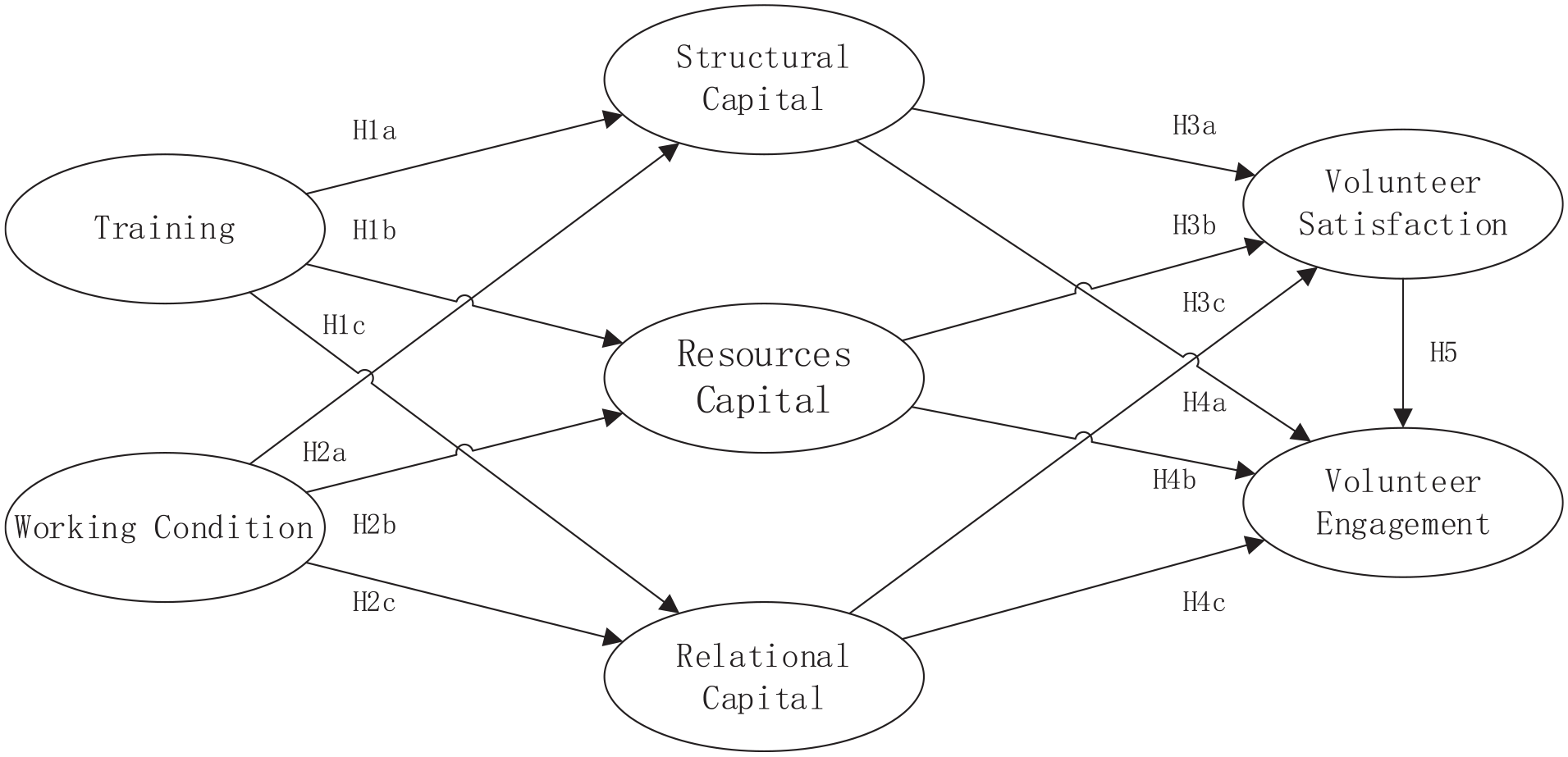
Conceptual framework with hypotheses.
Management and Social Capital of Sports Volunteers
Social capital is characterized by the concept of continual learning in an organization, group, or community (Sue et al., 1998). Social capital can facilitate learning interactions, which, in turn, can self-generate social capital (Sue et al., 1998). A learning community can help build networks, commitment, and shared values through shared language, shared experiences, trust, and self-development and foster the community’s identity; these elements can lead to the creation of social capital (Sue et al., 1998). Action learning can help participants construct and strengthen networks that can then become the basis of their social capital (D. W. Taylor et al., 2004). The development of identity and the knowledge resource of social capital can be achieved through interactions within learning programs, such as for the learning community of Australian family agricultural businesses detailed in one study (Sue, 2002). In a learning program, trainees can develop interpersonal skills, become familiar with each other, form shared values and trust, regard each other as credible sources of support and suggestions, and commit to provide support to members (Sue, 2002). All these factors help trainees in the learning program to obtain social capital. Participation in training is a crucial means of learning. Work-related training can improve employees’ social capital through three channels, namely economic reasons and positional effects, the development of abilities and cognitive or noncognitive skills, and peer effects (Feinstein & Hammond, 2004). Participation in training increases individuals’ contact with others who they would not otherwise meet or communicate with (Balatti et al., 2006). Hence, the contact creates opportunities for social networking with similar-minded and engaged individuals. For volunteers, training is usually conducted to enhance their understanding regarding the material they receive and increase their interest in volunteerism (Costa et al., 2006). Related training for sports event volunteers provides them with an opportunity to make new friends, improve their communication skills, increase their capabilities, and enhance their confidence and self-esteem. All these advantages can help them accumulate more social capital. Therefore, we proposed the following hypothesis.
H1: Training of sports event volunteers affects their social capital—structural capital (H1a), resource capital (H1b), and relational capital (H1c).
Working conditions can affect the formation of employees’ social capital. Open-office designs can promote communication among organizational members. The removal of physical barriers can enable the smooth exchange of work and communication (Oldham et al., 1995), thus leading to the creation of social capital among organizational members. Favorable physical working conditions can foster the development of social capital in organizations (Zagenczyk et al., 2008). Social interaction among individuals is vital to the formation of their social capital. The physical working conditions are a subset of social interactions in an established organization (Forgas, 1979). These conditions can affect the patter of communication and social interaction (Proshansky et al., 1970). Working conditions including propinquity, seating arrangement, size of office space, and flexibility can affect social experiences in the workplace (Forgas, 1979) and thus represent a subset of social rules, conventions, and expectations. These rules can decide the characteristics of social interaction under certain circumstances (Zagenczyk et al., 2008). Working conditions affect numerous factors such as behaviors, small-group interactions, friendship formation, participation, aggression, withdrawal, and helpfulness (Earle, 2003). The improvement of physical working conditions can contribute to work-related information exchange among employees, which is often referred to as job interdependence (Edvardsson & Gustavsson, 2003), leading to the creation of social capital in the workplace. With favorable working conditions, organizational members might develop a “collective mindset” or “team mental model,” which was reported to be highly related to cognitive social capital (Nahapiet & Ghoshal, 1998). Technical and social systems in the workplace can cause considerable discrepancies in employees’ work experiences (Zalesny & Farace, 1987). These discrepancies can affect their social interaction, thus leading to variation in work experiences (Zalesny & Farace, 1987), which are affected by working conditions. The physical working conditions of a workplace can either positively or negatively affect organizational behaviors including social behavior and interactions (Cameron & Caza, 2004). In sports event volunteerism, the provision of favorable working conditions can improve volunteers’ experiences, enhance their social interaction, and facilitate their communication and information exchange. All these factors can increase their social capital. Therefore, we proposed the following hypothesis.
H2: The working conditions of sports event volunteers affect their social capital—structural (H2a), resource (H2b), and relational (H2c) capital.
Sports Event Volunteers’ Social Capital, Attitude, and Behavior
Social capital in a workplace refers to cooperative relationships among members as well as actual and potential resources in the relationships between employees and their superiors (Meng et al., 2018). A high level of social capital in a workplace includes social support, mutual trust, and constructive cooperative relationships between members and their superiors (Meng et al., 2018). Job satisfaction is considered a positive personal perception of work or work-related experiences (Weiss, 2002). A study suggested that individuals’ social capital significantly and positively affects their job satisfaction (Ahmadi, 2012). The basic components of social capital—including the sense of trust, group solidarity, tolerance, and the sense of belonging—improve workplace interactions. These components have various functions; for example, they can help solve problems in a workplace and increase individuals’ interest in helping each other. Hence, a favorable attitude can improve employees’ job satisfaction (Tsounis et al., 2017). Because social capital helps individuals to cope with their work demands, it consequently increases their level of job satisfaction (Ommen et al., 2009). A high level of social capital can enhance an individual‘s ability to cope with their job demands and improve their mental health (Bakker & Demerouti, 2016). A study indicated that social capital is closely related to work comfort (Gitte et al., 2019). In addition, social capital is considered a job resource because it can help employees successfully accomplish work tasks, thus resulting in their well-being (Bakker & Demerouti, 2007) and satisfaction. Social resources—including social support from peers (Stansfeld & Candy 2006) and supervisors (Nieuwenhuijsen et al., 2010) and the quality of leadership (Nielsen & Daniels, 2012)—are closely related to employees’ social benefits. With higher social capital, sports event volunteers can obtain more resources and gain more social support from others and thus effectively meet their work demands. Therefore, higher social capital can lead to favorable volunteering-related experiences, thus leading to higher satisfaction with volunteerism. Hence, we proposed the following hypothesis.
H3: The social capital—structural (H3a), resource (H3b), and relational (H3c) capital—of sports event volunteers affects their satisfaction with volunteerism.
Work engagement can be described as a positive, fulfilling work-related state. It is characterized by vigor and dedication (Bakker & Demerouti, 2007), and is predicated by resources in the psychosocial work environment (Bakker & Demerouti, 2007). Job resources such as social support, influence at work, and managerial support, which are closely related to social capital, can boost motivational outcomes such as work engagement (Meng et al., 2018). Because social capital refers to resources present in relationships among organizational members (Coleman, 1988), social capital can be considered a collective resource that demonstrates itself in social networks, thus affecting opportunities for collaboration and social support (Kawachi & Berkman, 2001). Social capital is referred to as a job resource because the degree of social capital reveals the available emotional and practical social support (Thoits, 2011). Social capital may be related to positive mental states, such as work engagement, because high levels of social capital may increase employees’ engagement, thus leading to the development of positive relationships among coworkers and positive mental health (Keyes, 2007). Social capital in workplaces is associated with work engagement (Fujita et al., 2016; Stromgren et al., 2016). In a sports event, volunteers with higher social capital have more relational sources and gain more social support from others; this leads to the development of favorable psychological states and to positive volunteering experiences. These favorable psychological experiences encourage volunteers to engage in volunteerism more positively. Therefore, we proposed the following hypothesis.
H4: The social capital—structural (H3a), resource (H3b), and relational (H3c) capital—of sports event volunteers affect their engagement in volunteerism.
Sports Event Volunteers’ Satisfaction and Engagement
Studies have reported a positive relationship between individuals’ satisfaction and engagement (Biswas & Bhatnagar, 2013; Leary et al., 2013). Current work comfort can significantly affect employee engagement (Saradha & Patrick, 2011); therefore, work satisfaction can be considered a significant predictor of work engagement (Poloski & Hernaus, 2015). A favorable working environment includes work security, work comfort, low stress levels, good working hours, and management policies. If employees are satisfied with the working environment, they are positively engaged in their work. Moreover, if employees are satisfied with their relationships with others in the workplace and their career opportunities, they are positively engaged in their work. In sports event volunteerism, if volunteers are satisfied with their working conditions, relationships with others, and career development opportunities, they are satisfied with their experiences in volunteering and thus demonstrate greater engagement. Therefore, we proposed the following hypothesis.
H5: Sports event volunteers’ satisfaction affects their engagement in volunteerism.
Methods
Measurements
Existing studies have provided reliable scales for measuring relevant variables. Considering the specialty of the sports domain, we modified existing scales. We collected relevant scales from the literature, modified them through group discussion, and then selected the final scales. Because all the scales used in this study were selected from English-language papers, we employed translation and back-translation to ensure the accuracy of the scales in the Chinese version. Back translation is widely sued in social sciences, cross-cultural psychology, and health research (Behr, 2016). The procedure of back translation is as follow. We first use translator A to translate item from English scale into Chinese. Then we use translator B to translate the translated Chinese item back to English. If the expression of back translation has the same meaning as the original expression, we accept the translated Chinese item. If the expression of back translation is not the same as the original expression in meaning, we repeat the process again until the same meaning is reached (Harkness, 2003).
To adapt the scale to the context of Chinese culture, we organized a focus group interview of 10 individuals who had 2 years of volunteering experience. In the group interview, they were asked their views toward training, working conditions, social capital, satisfaction, and the work involved in volunteerism. On the basis of their feedback, we modified the scales and adapted them to the Chinese context.
This study examined the following seven variables for sports volunteers: training, working conditions, satisfaction, engagement, and social capital (structural, resource, and relational capital). The survey responses were analyzed using a 7-point Likert scale from 1 (strongly disagree) to 7 (strongly agree).
The scale used for training was based on the scale developed by Bulut and Culha (2010) that comprises three items: sufficient training, helpful training, and required training. The scale for working conditions was based on the scale developed by Tracy et al. (2006) that comprises the following three items: favorable working conditions, emphasis on volunteers, and adequate resource input. The scale for social capital was based on the scale developed by Fornoni et al. (2011) with three dimensions: structural capital, resource capital, and relational capital. The scale for structural capital contained three items, namely “making new friends,” “friends’ advice,” and “a social network of new friends.” The scale for resource capital contained two items, namely “sufficient resources provided by new friends” and “the willingness of new friends to help me.” The scale for relational capital contained three items, namely “sharing information,” “sharing experiences,” and “keeping in touch.” The scale for volunteer satisfaction was based on the scale developed by Rogalsky et al. (2016) and comprising two items, namely “experience satisfaction” and “role satisfaction.” The scale for sports volunteer engagement was based on the scale developed by Schaufeli et al. (2002) containing the following seven items: “feeling powerful,” “sticking to work,” “feeling energetic,” “working with encouragement,” “passionate,” “doing meaningful work,” and “working happily.”
Preinvestigation
Before the formal investigation, we chose 30 participants who had had sports volunteering experience in the recent 2 years to complete the questionnaire. In accordance with their feedback, we modified some questions in the questionnaire for better clarity. Subsequently, we developed the final questionnaire.
Data Collection and Sampling
We used a survey of volunteers who participated in the 2016 Wuhan Open and 2016 Wuhan Marathon. The Wuhan Open is one of the top three tennis competitions in China. It is one of the Premier five tournaments of the Women’s Tennis Association (WTA) together with Doha, Rome, Montreal, and Cincinnati and also one of the top 10 competitions of the WTA. The 2016 Wuhan Open recruited over 700 volunteers for sports services and trained them for volunteering services. The Wuhan Marathon is regarded as the most popular marathon in China. In the 2016 Wuhan Marathon, over 60,000 individuals applied for 20,000 runner positions. The match has been assigned the highest level of sports event personnel allocation standard. The event employed 26,800 security guards and 4,137 volunteers to provide relevant services. Appropriate training and full-scale support were provided to volunteers in the 2016 Wuhan Open and 2016 Wuhan Marathon. These two competitions are high-ranking, large-scale sports events, employing numerous volunteers, and requiring training and management of volunteers. Therefore, we included the volunteers of these two competitions as participants in this study.
The training provided to the volunteers could be categorized into general and professional training. General training includes the introduction of voluntary regulation, voluntary etiquette, and other items. The aim of general training is to cultivate volunteers’ awareness to obey voluntary regulations and exhibit elegance and charm during the sports event. Professional training includes the procedures of voluntary work, tasks of relevant voluntary positions, professional knowledge regarding relevant voluntary positions, operation of relevant equipment, and practical training in relevant positions. The aim of professional training is to ensure that volunteers have the professional skills for relevant voluntary positions.
We used the convenience sampling approach to collect data. The volunteers were asked to complete the questionnaire face-to-face at the game site of the 2016 Wuhan Marathon and 2016 Wuhan Open. They were asked to fill in the questionnaire on the basis of their own experience, feelings, and gains. The questionnaires were administered between April 9 and 11, 2016, to Wuhan Marathon volunteers and between September 27 and October 1, 2016, to Wuhan Open volunteers. We administered 310 questionnaires on the spot and collected all of them. We obtained 303 valid samples, and the valid sample collection rate was thus 97.74%, which met the requirement of having a valid sample collection rate of over 70%. In the survey, we sent small gifts to respondents to improve their acceptance; thus, we collected all 310 questionnaires, with a collection rate of 100%. The respondents’ descriptive statistics are listed in Table 1. Because the volunteers at the Wuhan Marathon and Wuhan Open events were mainly college students, their age and educational background were relatively similar.
Descriptive Statistics of Respondents.

Data Analysis
All descriptive data were analyzed using SPSS version 16.0. We identified missing outliers and examined the assumption of normality. Confirmatory factor analysis (CFA) and structural equation modeling (SEM) were performed using SPSS version 16.0 and AMOS version 18.0. We used the chi-square test, standardized root mean square residual (SRMR), goodness-of-fit index (GFI), adjusted GFI (AGFI), parsimony GFI (PGFI), Tacker–Lewis Index (TLI), comparative fit index (CFI), and root-mean-square error of approximation (RMSEA; Raykov et al., 1991). The acceptance criteria are as follow. The χ2/df should between 1 and 3 (Hayduk, 1987). The SRMR should be less than 0.05 (Joreskog & Sorbom, 1989). The GFI, AGFI, TLI, and CFI should be more than 0.9 (Bentler, 1990; Bentler & Bonett, 1980; Hu & Bentler, 1999; Specht, 1975). The PGFI should be more than 0.5 (Gotay et al., 2003). The RMSEA should be less than 0.08 (Chen et al., 2014).
We evaluated the psychometric properties of the scales during the initial assessment to determine the suitability of scale items. We performed CFA to determine the relationships between the scale items and seven latent constructs. On the basis of the results, the items exhibiting poor performance were eliminated. We reanalyzed the remaining items in the model. Second, we used the sample to examine the modified measurement model and the overall structural model. Finally, SEM was employed to examine the relationship of sports event volunteers’ training with their working conditions, social capital, and attitude and behavior. We were particularly interested in the volunteers’ satisfaction and work engagement because these variables affect the job performance of individuals (Biswas & Bhatnagar, 2013; Leary et al., 2013). Sports event volunteers’ training and working conditions can promote the formation of their social capital including structural, resource, and relational capital. The social capital of volunteers can affect their satisfaction and work engagement in volunteerism.
Results
Measurement Model
We performed CFA to examine data reliability and validity. The results revealed that the measurement model had favorable fit (χ2 = 374.641, χ2/df = 1.836, SRMR = 0.047, GFI = 0.903, AGFI = 0.869, PGFI = 0.668, TLI = 0.960, CFI = 0.968, and RMSEA = 0.053). As shown in Tables 2 and 3, each variable’s composite reliability (CR) ranged from .7321 to .9320, thus being higher than the threshold of .7 (Bagozzi & Yi, 1988). The average variance extracted (AVE) ranged from .5786 to .9070, thus being higher than the threshold of .50. These findings indicated that the variables had satisfactory reliability. The standardized factor loading of all the variables was higher than the threshold of .6 (Hair et al., 1998) and was significant at α = .01, indicating that the questionnaire had favorable convergent validity (Netemeyer et al., 1990). The square root values of all AVEs were higher than their line and row’s correlation coefficient, indicating that the questionnaire had favorable discriminant validity (Fornell & Larcker, 1981).
Questionnaire Items.

Coefficients of Correlation Between Latent Variables.

Note. Data on the diagonal are square roots (ave).
Structural Model
The goodness-of-fit statistics of the structural model were as follows: χ2 = 412.296, χ2/df = 2.146, SRMR = 0.046, GFI = 0.900, AGFI = 0.858, PGFI = 0.63, TLI = 0.945, CFI = 0.958, and RMSEA = 0.061. The results indicated that the structural model had good fit. Figure 2 shows the results of the path analysis of the structural model.

Results of the path analysis.
The structural model estimated path coefficients and verified the relationship between variables in the model. The normalized path coefficients of the hypothesis model are listed in Table 2. Volunteer training significantly affected the volunteers’ social capital, including structural capital (γ = .268, p < .01), resource capital (γ = .381, p < .01), and relational capital (γ = .249, p < .01). Working conditions significantly affected structural capital (γ = .471, p < .01), resource capital (γ = .537, p < .01), and relational capital (γ = .409, p < .01). The volunteer’s social capital partly affected their satisfaction. Structural capital (γ = .321, p < .01) and resource capital (γ = .413, p < .01) significantly affected the volunteers’ satisfaction, whereas relational capital (γ = −.025, p > .05) did not. The volunteer’s social capital partly affected their engagement. Resource capital (γ = .204, p < .01) and relational capital (γ = .324, p < .01) significantly affected the volunteers’ engagement, whereas structural capital (γ = .069, p > .05) did not. The volunteers’ satisfaction significantly affected their engagement (γ = .272, p < .01).
Discussion and Conclusion
Discussion
This study explored how sports event volunteer management practices affect volunteers’ satisfaction and work engagement in volunteerism. The function of volunteers’ social capital formed during volunteering is underlined in this study. The results of this study supported the presented hypotheses.
Sports volunteers’ management, attitude, and behavior
Sports volunteer management practices and organizational support can affect volunteers’ attitude and behavior (Cho et al., 2020; Wicker, 2017; Won et al., 2021). These management practices include decision making (Cuskelly & O’Brien, 2013), support from the organization (Cuskelly & Hope, 2013), financial resources (Coates et al., 2014), role models (Wicker & Frick, 2016), communication modes, the control of volunteers (Byers, 2013), rewards and recognition (Cho et al., 2020), training (T. Taylor & McGraw, 2006), and working conditions (Wicker, 2017). Management practices include a series of flowing activities including sports volunteers’ recruitment, selection, management, and retention (Cuskelly et al., 2006). In addition, work climate, as a conditions provided by the event, was found to be important factor to impact on volunteers’ attitude and behavior (Cho et al., 2020). Many management practices can affect sport volunteers’ attitude and behavior including the decision to volunteer (Koutrou & Downward, 2016), time dedicated to volunteerism (Koutrou & Downward, 2016), continued event volunteering (Hayton, 2016), and commitment and satisfaction (S. Kim et al., 2013). Consistent with the findings of previous studies (Cho et al., 2020), the results of this study indicated that sports event volunteer management practices could significantly enhance volunteers’ attitude and behavior. The same as Cho et al (2020), training and working conditions, as conditions provided by the event, can significantly affected the sports event volunteers’ satisfaction and work engagement in volunteerism. Different from the direct effect of organizational support on volunteers’ satisfaction and behavior (Won et al., 2021), the results also indicated that sports event volunteer management practices indirectly affected the volunteers’ attitude and behavior, which is also verified by Cho et al (2020). This effect may have been mediated by some intermediate factors such as social capital, which is a different mediating variable from previous study (Cho et al., 2020). Thus, favorable sports volunteer management practices cannot solely guarantee improvement in volunteers’ attitude and behavior. Only if intermediate factors, such as social capital, are significantly affected by sports volunteer management practices can these practices ultimately affect volunteers’ attitude and behavior.
Role of the social capital of volunteers in sports events
For individuals, the continual accumulation of social capital is one of the most vital motivations for volunteering for a sports event because these events provide an opportunity to meet new people and develop new social relationships (Nicholson & Pearce, 2001). Social capital is a crucial personal gain that volunteers can make from volunteering (Welty et al., 2013). Thus, social capital is an important outcome for individuals volunteering in sports events (Kay & Bradbury, 2009). Many studies have reported that individuals can gain social capital by volunteering in sports events (Hallmann et al., 2020; Storr & Spaaij, 2017). Volunteers’ social capital significantly affects their performance because it is connected with the volunteers’ ability to gain opportunities through their social network (Whittaker & Holland-Smith, 2016). In addition, social capital obtained by participants in sports events results in their positive attitude and behavior toward the event (Zhou & Kaplanidou, 2018). Moreover, continual volunteering will be reinforced by the development of social capital in sports event volunteerism (Peachey et al., 2011). Thus, during the management of sports events volunteers, the establishment of their social capital should be emphasized because it can affect their attitude and behavior (Kodama et al., 2013). In terms of training courses for sports event volunteers, managers should be aware of the importance of the social connections made by volunteers because they can affect volunteers’ future intention (Kodama et al., 2013). Consistent with the findings of previous studies, this study indicated that social capital is significant in sports event volunteerism. This research confirms that the social capital of sports event volunteers significantly affects their satisfaction and work engagement in volunteerism. This finding indicated that the acquisition of social capital is a crucial motivation of Chinese individuals to participate in sports events because the effects of social capital on volunteers’ satisfaction and engagement are relatively strong. In China, individuals’ participation in volunteering services arises from their internal motivation because of the absence of mandatory external regulations regarding volunteerism. Obtaining social capital from volunteerism is a crucial personal motivation of Chinese volunteers, and social capital considerably affects the satisfaction and work engagement of volunteers. Furthermore, this study demonstrated the effect of sport volunteer management practices on the volunteers’ social capital. The findings indicated that training could significantly affect sports event volunteers’ social capital; this result is in accordance with that obtained by Kodama et al. (2013). Moreover, working conditions, as a management tool, affected sports event volunteers’ social capital. Thus, sports event organizers could consider their volunteers management practices carefully to promote volunteers’ social capital, thus ensuring their satisfaction and work engagement with volunteering. Only if the motivation of participation is satisfied by the management practices of sports events will volunteers have favorable experiences and devote themselves fully to volunteering.
Theoretical Implications
Introduction of social capital theory to sports volunteer management research
This study introduces social capital theory to sports volunteer management research, extending the application scope of this theory. Social capital theory is widely applied in studies on organizational behavior, entrepreneurship management, sociology, and business strategy. The present study applied this theory in the context of sports event volunteer management, thus extending the theory’s application scope. Additionally, this study expands the research on sports event volunteer management by introducing a new theoretical perspective. Current studies on sports event volunteer management have introduced several theories such as motivation theory (Giannoulakis, 2015), commitment theory (Keunsu et al., 2013), organizational support theory (Aisbett & Hoye, 2015), and identity theory (M. Kim et al., 2010). The introduction of social capital theory to the research on sports event volunteer management provides a new theoretical perspective in this field.
Clarification of the function of social capital in sports volunteer research
The social capital of sports event volunteers was reported by a previous study (Kay & Bradbury, 2009). Individuals can increase their social capital by volunteering in sports events (Nicholson & Pearce, 2001). Although the social capital of volunteers plays a crucial role in sports events (Hallmann et al., 2020; Storr & Spaaij, 2017; Whittaker & Holland-Smith, 2016), the underlying mechanism has not been fully discussed. Our study examined the function of the social capital of volunteers in sports event volunteerism and determined that higher social capital of sports event volunteers results in superior attitude and behavior toward volunteering. Furthermore, this finding indicates the role of volunteers’ social capital in sports event volunteerism, demonstrating that sports event volunteers’ performance can be improved by increasing their social capital. The identification of the role of the volunteers’ social capital has further deepened research in this area and extended research on volunteers’ social capital.
Revelation of the mechanism through which sports event volunteer management practices affect volunteers’ attitude and behavior
Studies have indicated that the effective management of sports event volunteers can improve their performance (Cuskelly & Hope, 2013; Wicker, 2017; Wicker & Frick, 2016). Volunteer management practices—such as training (Cuskelly et al., 2006), organizational support (Cuskelly & Hope, 2013), working conditions (Doherty, 2003; Ralston et al., 2004), and communication (Kodama et al., 2013)—can improve their experiences and volunteering behavior. However, the mechanism through which sports event volunteer management practices affect the attitude and behavior of volunteers remains unclear. Our study evaluated the underlying mechanism and observed that sports event volunteer management practices affect volunteers’ attitude and behavior through social capital. This finding deepens the understanding of how sports event volunteer management practices affect volunteers.
Practical Implications
Provide effective training to volunteers
Sports event organizers should provide effective training to volunteers to facilitate their obtaining social capital. During training, opportunities should be provided to volunteers to meet as many new people as possible to build new relationships. Apart from working skills, social abilities such as communication, problem solving, analyzing, organizing, and coordinating should be involved in training to strengthen the volunteers’ capability to develop social relationships. Social resources with high quality should be introduced to training to enhance the quality of volunteers’ social capital. With enhanced social capital arising from favorable training, sports event volunteers can feel satisfied and engage in their volunteering more efficiently because of the fulfillment of their motivation for participation.
Provide favorable working conditions
Sports event organizers should provide favorable working conditions for volunteers to help them obtain social capital. Communication tools, such as a walkie-talkie, should be provided to ensure efficient communication among team members. Volunteers should be provided with places to conduct meetings and relevant facilities to enable them to conveniently negotiate among themselves. Satisfactory volunteer clothing should be provided to improve their confidence and instill a sense of pride, thus enabling better participation in social interaction. Moreover, satisfactory accommodation and transportation should be provided to enable them to talk regarding their volunteering experience proudly to others and enhance their interaction with other volunteers. With better working conditions, volunteers would be more willing to interact socially and communicate with others, thus helping them obtain social capital. With the social capital arising from favorable working conditions, volunteers feel satisfied and more effectively engage during sports events.
Help volunteers to obtain social capital from volunteering experiences
Sports event organizers should provide opportunities for volunteers to accumulate social capital. The social status of volunteers can be enhanced by advertising their positive social image to give them an advantageous position during social interactions. Social groups with many social resources should be introduced in the sports event to provide volunteers an opportunity to obtain high-quality social resources. Sports event organizers should provide more opportunities for volunteers to contact people within and outside of the sports event to help them build more relationships with other people. If their social capital increases due to volunteering, they will feel satisfied and volunteer positively.
Limitations and Future Research Directions
Although the research results provide potential theoretical and practical implications for the management of volunteers during sports events, this study has some limitations that should be addressed. First, the conclusions were drawn from an investigation of the volunteers in only two sports events in China; thus, the results of the study should be carefully generalized. Accordingly, future studies should apply the model to other types of sports events in different countries to make the findings more generalizable. Second, this study only examined the role of social capital in sports event volunteer management. Other psychosocial elements that may play a crucial role in sports event volunteer management were not examined in this study. Thus, future studies should investigate the function of other psychosocial factors, such as commitment and role identity.
Conclusion
This study explored how sports event volunteer management affects volunteers’ service performance in a sports event with emphasis on the role of social capital. Sports event volunteer management practices, namely training and working conditions, can significantly improve volunteers’ satisfaction and engagement, with social capital playing a mediating role in the effects. The social capital of sports event volunteers consist of three components: structural, resource, and relational capital; these components play different roles in the mediating process. The study examined the mechanism through which sports event volunteer management improves volunteers’ psychological and behavioral responses, thus expanding the understanding of sports event volunteer management.
Footnotes
Acknowledgements
The author would like to thank Wallace Academic Editing for English editing of the article.
Declaration of Conflicting Interests
The author(s) declared no potential conflicts of interest with respect to the research, authorship, and/or publication of this article.
Funding
The author(s) disclosed receipt of the following financial support for the research, authorship, and/or publication of this article: Philosophy and social science research project of Hubei Education Department (19Y099); National Natural Science Foundation of China (71872136); Ministry of Education in China Project of Humanities and Social Sciences (18YJC630109); Scientific research project of Hubei Education Department (B2021186); Youth Scientific Research Fund of Wuhan Sports University (2022S05); and Young and middle aged scientific research team of Wuhan Sports University in 2021 (21KT18).
