




Abstract
The purpose of this study was to examine the relationship between volunteer management and volunteers’ intention to continue participating, based on the environmental psychology model. Moreover, this study investigated the mediating role of volunteers’ job satisfaction in this relationship. Using a sample drawn from volunteers of a cultural event in Singapore, this research conducted confirmatory factor analysis and structural equation modeling analysis. The results showed a positive relationship between volunteer management and volunteers’ intention to continue volunteering, with a full mediating effect of job satisfaction on this relationship. Also, the highest attribution of positive management practices came from reward and recognition, followed by empowerment, schedule flexibility, orientation and training, and social interaction. The findings of this study provide a perspective on how volunteer management can position itself for volunteer retention.
Keywords
Introduction
Volunteers have become a core and indispensable component of event service delivery in a supplement to limited paid employees in organizations and play an important role in large-scale events (Flood et al., 2005). Researchers noted that volunteers could be considered as a form of capital for organizations as they can reduce and ease the budget on full-time employees (Pauline, 2011; Wu et al., 2016). Volunteers can serve as administrators to the program, cooperating or aiding individual or aid groups, or helping to mobilize various aspects of the community for social engagement (Brudney & Meijs, 2014). While volunteers can perform the same task that paid workers carry out, there are differences between volunteers and paid workers within an organization. For example, the relationship is more hierarchal, where paid staff tend to supervise more or engage in recruitment duties (Brudney & Meijs, 2014). In contrast, volunteers are more motivated by social interaction and the ability to have a hand in achieving a successful outcome for the organization, as opposed to paid workers having a salary compensation as part of their motivation (Alfes et al., 2017). Galindo-Kuhn and Guzley (2002) noted that volunteer work could share with similar characteristics with paid work when an individual devotes time performing a job to utilize one’s skills and creativity in exchange for satisfaction, psychic rewards in the forms of results or achievements, and recognition.
From a management perspective, one problem is that the highly volatile volunteer base reflected by a high turnover rate can make volunteer recruitment a challenge (Bidee et al., 2013). According to Wong et al. (2011), both a rapid growth rate and a high turnover rate were observed in the volunteer service management; thus, organizational efforts to keep volunteers in the industry are needed to maintain volunteers. That is, appropriate strategies should be designed and provided by organizations. For instance, volunteer management practices play an essential role in retaining the relationship between organizations and volunteers. Hager and Brudney (2004) found that two fifths of volunteers do not continue volunteering for organizations due to inappropriate volunteer management practices. That is, poor volunteer management practices may not only lead to weak and poor volunteer group relationships but also cause volunteers to stop volunteering (Connors, 2011). Conversely, appropriate management practices, such as training and orientation provided by the organization, lead to higher levels of volunteer satisfaction (Wisner et al., 2005).
It should be noted that the role of volunteer management in event settings is more essential (Kim & Cuskelly, 2017) as various events, from the Olympic Games to regional community festivals, are highly dependent on volunteers’ participation for their operations (Smith et al., 2014). For example, the 2020 Tokyo Olympic organizer plans to recruit 110,000 volunteers to secure the smooth operation for the quadrennial event (The Japan Times, 2018). A regional festival (e.g., Chingay Parade) recruited over 2,000 volunteers, which account for a large amount of personnel, to perform different roles and duties in the event (Chingay Parade Singapore, 2018). Moreover, it has been argued that the management of event volunteers is significantly different from other types of volunteers as the short-term events need more efforts to recruit episodic volunteers and offer adequate training in a relatively short period of time (Getz, 1991; Kim & Cuskelly, 2017). As such, to recruit and retain volunteers for future events, event organizers need to better understand the tenets of volunteer management in event settings.
Many previous studies highlighted the importance of internal factors (e.g., motivations) in volunteers’ behavior (Bang et al., 2012; Bang & Ross, 2009; Farrell et al., 1998; Hallmann & Harms, 2012; Li & Wu, 2018). However, not only this, but the impact of environmental factors should also be considered as it plays a critical role in understanding individuals’ behavioral responses (Mehrabian & Russell, 1974). That is, in the context of volunteerism, the influence of volunteers’ working environment needs to be investigated to understand volunteers’ future behavior (Cho et al., 2019). Therefore, grounded on the environmental psychology model (Mehrabian & Russell, 1974), this study aimed to examine the relationships among volunteer management, volunteers’ job satisfaction, and intention to continue volunteering. The findings of this study contribute to a deeper understanding of the importance of the volunteers’ work environment and management on the psychological process of continuing volunteering.
Literature Review
Environmental Psychology Model
Mehrabian and Russell (1974) developed the environmental psychology model to elaborate on the relationship between the environment and individuals’ behavior. In this model, there are three components: environmental stimuli, emotional responses, and behavioral responses. Specifically, the environmental psychology model shows the effects of environmental stimuli on individuals’ emotional reactions and, sequentially, on behavioral responses in the forms of approach and avoidance behavior (Figure 1). The links suggested in the environmental psychology model have been evidenced by several empirical studies in various contexts. For example, previous studies showed the influence of environmental stimuli on consumers’ pleasure and behaviors in the brick-and-mortar stores (Alakwe & Okpara, 2017; Groeppel-Klein & Baun, 2001; Tai & Fung, 1997), virtual stores (Diehl, 2001; Huang, 2003; Manganari et al., 2011), and restaurants (Chen et al., 2015; Jang & Namkung, 2009; Ryu & Jang, 2007). In addition, some scholars applied the environmental psychology model in the context of spectator sports to understand sport fans’ behavior (Chen et al., 2013; Cho et al., 2019; Uhrich & Koenigstorfer, 2009).

The environmental psychology model (Mehrabian & Russell, 1974).
Similarly, the environmental psychology model has been applied as the theoretical base to understand employees’ affective responses, productivity, motivation, and behavior in the organization (Bitner, 1992; Kaplan & Kaplan, 2009). Studies found that environmental stimuli enhance not only employees’ satisfaction but also their job performance (Bitner, 1992; Lee & Brand, 2005). Moreover, according to the service–profit chain (Heskett et al., 1994), employee satisfaction and employee retention are influenced by a set of work conditions. The service–profit chain was further used to conceptualize the volunteer–loyalty chain, which categorized relevant work conditions as a volunteer service delivery system (Wisner et al., 2005). According to the volunteer–loyalty chain, volunteers are regarded as service providers; therefore, the organization needs various management activities to offer better work conditions (Wisner et al., 2005).
The management activities operated in the volunteers’ service delivery process is coined volunteer management, which also refers to the establishment of required conditions for volunteers within an organization’s operating system (Wisner et al., 2005). In this study, we adopted the term volunteer management to explore how organizations deliver a specific set of work conditions to their volunteers. That is, this study used volunteer management as the primary influencer of the voluntary work environment, which can potentially elicit emotional responses of volunteers (i.e., volunteer job satisfaction), producing behavioral responses (i.e., intention to continue volunteering).
Volunteers and Episodic Volunteerism
There is a stark difference between paid work and volunteer work. As volunteers do not receive a salary for their labor, management has to rely heavier on the positive experiences of their volunteers to enhance their motivation (Alfes et al., 2017). Alfes et al.’s (2017) work highlighted how paid staff, on the other hand, have lesser autonomy and independence within the structure, as they have to adhere more to a structure’s policies and procedures. Volunteers benefit from higher levels of independence and flexibility within their roles, being less structured than those of paid work. Therefore, Alfes et al. (2017) mentioned this variation affecting the difference in the behavior between volunteers and paid workers. The manner in which paid and unpaid workers are selected for their duties differ as well. The hierarchy in which this operates for paid workers is supported by Wilson and Pimm (1996), where their research highlights paid workers being selected over their counterparts for a task, unlike a volunteer being picked for a task based on their suitability. Also, rewarding and supporting volunteers are noted to be an important factor in the job satisfaction of volunteers, influencing their intention to continue volunteering (Fallon & Rice, 2015).
Episodic volunteers engage in one-time or short-term volunteering duties, though it does not define the particular nature of work or the amount of time invested in their role (Cnaan & Handy, 2005). Episodic volunteers are deemed a critical resource for many organizations, and their common motives tying them to their volunteerism is mentioned as wanting to help others and to socialize, as well as to physically challenge themselves for sports-based events (Dunn et al., 2016). Hyde et al. (2016) found that novice episodic volunteers had a desire to continue volunteering because of their motives, social norms, and satisfaction. Episodic volunteering can thus be looked at to become a more sustained activity. It still ties into their sense of satisfaction and community as well as the intention to continue volunteering in the future.
Volunteer Management, Satisfaction, and Intention to Continue Volunteering
Successful volunteer management is to ensure good organization and management among volunteers, as well as recognize the potential in them and maximize the human capital found to achieve the goals of an organization (Sherr, 2008). There is a need to be able to manage volunteers in various settings based on their different organizations or programs, including the different characteristics of the volunteers themselves (Brudney & Meijs, 2014), as volunteer management can directly influence volunteers’ retention. According to Hager and Brudney (2004), there are multiple practices that are closely associated with volunteers’ retention and revolve around the enrichment of a volunteer’s experience. Specifically, various volunteer management practices, such as recognizing volunteers and providing them with greater training, help retain them, as they hinge on making the volunteers’ experience meaningful and worthwhile. On the other hand, resisting or being indifferent to organizational culture makes it more difficult to retain them (Hager and Brudney, 2004). McBey et al. (2017) also noted that work culture and perceived organizational support play critical roles in volunteers’ decision to continue being committed to their role. That is, to increase retention of volunteers, volunteer management needs to not just allocate funds for the improvement and recognition of their volunteers but also enable a positive climate to enrich the experiences of volunteers. Therefore, this study suggests the following hypothesis:
Identifying and communicating volunteers’ role in an event is important to ensure smooth organization operation flow (Clary & Snyder, 1999). In addition, to operate events well, organizations need to create a desirable environment to satisfy volunteers and to sustain a strong volunteer base (Flood et al., 2005). That is, volunteer management in organizations needs to consider volunteers’ satisfaction (Farrell et al., 1998; Wisner et al., 2005) as this allows organizers to direct their attention to the areas that require improvements to retain and recruit volunteers effectively. Satisfaction derived from volunteer work is attributed to volunteer management. According to Waikayi et al. (2012), a favorable work environment with supportive management can create a positive atmosphere among their volunteers and further increases their satisfaction. For example, leadership skills from management help cultivate a positive attitude with volunteers, making the interaction friendlier and possibly raise satisfaction. Similarly, Hager and Brudney (2004) highlighted how practices linking to the enrichment in volunteer experience are essential to retaining volunteers. It indicates that management practices providing professional development and training, and properly matching volunteers to a specific task can raise volunteer satisfaction, heightening a volunteer’s experience. Furthermore, management practices recognizing the contribution of their volunteers can increase their focus and interest, signaling volunteer management having a direct hand in volunteer satisfaction (Hager and Brudney, 2004). Thus, this study proposes the following hypothesis:
Understanding volunteers’ future behavioral intention is important to retain volunteers and reduce the time involved in recruitment and training volunteers who are new to the event (Hallmann & Harms, 2012; Kim et al., 2007; Pauline, 2011; Wu et al., 2016). Given that volunteerism can be viewed as a form of a job, Chacon et al. (2007) suggested that job satisfaction is an essential predictor of volunteers’ service duration. Wong et al. (2011) also noted that the sense of satisfaction gained from previous volunteering experiences could serve as a motive for future voluntary activities and contribute to the intention to participate in future voluntary work. Doherty (2009) further noted that volunteers’ satisfaction in their experience from giving back to the community and social engagement could influence volunteers’ continuance intention. That is, similar to satisfied employees, satisfied volunteers are more likely to continue volunteering with the organization and indicate a future intent to volunteer (Fairley et al., 2013).
In addition, Terry et al. (2013) noted that organization management and perceived volunteer benefits positively influence volunteers’ satisfaction, resulting in volunteer retention. The benefits that individuals achieve through a volunteer experience (e.g., improved physical health, life satisfaction, self-esteem, happiness, mental, and physical health) lead volunteers to feel satisfied, and volunteer management significantly affects their behavioral intention (Beirne & Lambin, 2013; Farrell et al., 1998; Wilder et al., 2009; Yeung et al., 2018). Also, promoting social connections and raising satisfaction can lead to a strong retention rate for episodic volunteers, as proper management can foster satisfaction levels (Hyde et al., 2016). It indicates positive experiences for volunteers in raising their satisfaction level affect their decision for continued volunteering. Based on the findings of previous studies, this study established the following hypotheses:
Method
Research Context: Chingay Parade
Chingay Parade is one of the largest street performance and float parades in Asia, annually held since 1973. Chingay Parade has become a uniquely Singaporean Lunar New Year event, capturing the essence of Singapore’s dynamic multicultural personality (Chingay Parade Singapore, 2018). In 2017, about 8,000 performers took part in the street parade, and over 80,000 spectators participated in this event (Lai, 2018). Due to a large number of performers and spectators, the role of volunteers is even more important in this large event. Chingay Parade 2018 recruited numerous volunteers for different roles and duties, such as crowd management, logistics, food and beverage, and media team. During the event, volunteers need to manage visitors in high volumes and work with people stemming from various ethnic and cultural backgrounds. They also ensure the smooth operation of multiple issues from the parade, indicating they may work under stressful conditions and pressure.
Data Collection
This study collected data at the Chingay Parade 2018. The targeted sample was volunteers participating in the Chingay Parade 2018. This study used two data collection methods: face-to-face mode and online mode. First, the onsite survey was distributed to volunteers 1 week prior to the Chingay Parade and the period of the event from February 23 to 24, 2018, via contingent and volunteers’ leaders. Consequently, 122 valid responses were collected in this phase. As a next step, online data collection was conducted by means of Google form survey. The survey link was sent to volunteers, who did not participate in the face-to-face survey, and 83 complete responses were collected in this phase. A total of 209 valid responses were collected for further analysis.
Survey Instrument
The study questionnaire includes three constructs: volunteer management, job satisfaction, and intention to continue volunteering. Items in the survey were slightly modified to fit the context of volunteerism. All these items were assessed on 7-point Likert-type scales, ranging from 1 = strongly disagree to 7 = strongly agree.
Volunteer management was measured using a 25-item scale adapted from Wisner et al.’s (2005) measurement scale. The 25 items were divided into five subscales with three items each for schedule flexibility and empowerment, four items for orientation and training, six items each for social interaction, and rewards and recognition. For example, each volunteer management subscale included questions such as: “The hours that I volunteer were able to fit into my schedule” (schedule flexibility); “The organization provided leadership opportunities for volunteers” (empowerment); “Volunteers received training prior to beginning work in this organization” (orientation & training); “Volunteers had the opportunity to interact with each other” (social interaction); and “I receive recognition for a job well done” (rewards and recognition).
Next, this study used a job satisfaction scale developed by Macdonald and Maclntyre (1997) to measure Chingay volunteers’ job satisfaction. The scale is a unidimensional construct, consisting of 10 items, such as “I receive recognition for a job well done”; “I feel close to the people doing the same voluntary work as me”; “I feel good about working at this organization”; “I feel secure about my assigned role”; “Overall, I believe voluntary work is good for my physical health”; and “All my talents and skills are used when performing the voluntary tasks.” One item was deleted, as the item is related to wages (e.g., My wages are good).
Intention to continue volunteering was measured using five items adapted from Stukas et al. (1999). The scale is unidimensional, and sample items include “I will work at the same event next year”; “I will volunteer somewhere else next semester”; and “I will be a volunteer 1 year from now.”
Data Analysis
Using SPSS 23.0 and EQS 6.3, this study conducted data analyses using the following steps: (a) data screening, (b) confirmatory factor analysis (CFA), and (c) structural equation modeling (SEM). First, for data screening, missing values were treated using maximum likelihood estimation with the Expectation-Maximization (E-M) algorithm. In addition, this study used Mahalanobis distance to detect multivariate outliers. This study employed values of z-scores (Hair et al., 2010) and Mardia’s (1985) multivariate kurtosis coefficients to identify the univariate normality and the multivariate normality of the data. Satorra-Bentler scaled chi-square test (S-B χ2) (Satorra & Bentler, 1994) and robust standard errors (Bentler & Dijkstra, 1985) were used as this study found nonnormality (Bentler, 2005). Based on the values of degree of freedom, null root mean square error of approximation (RMSEA), and alternative RMSEA, this study computed the power of the research model and minimum sample size using Preacher and Coffman’s (2006) web utility. The result showed that the minimum sample size was 200, and the achieved power was larger than .8 with our sample.
Next, CFA was performed using robust maximum likelihood estimation. This study examined RMSEA and standardized root mean squared residual (SRMR) for the absolute model fit and measured comparative fit index (CFI) and nonnormed fit index (NNFI) for the comparative model fit. This study also identified the reliability and validity of the measurement scale by measuring Rho, average variance extracted (AVE), and correlation values. Finally, this study examined the relationship between volunteer management, job satisfaction, and intention to continue volunteering through SEM analysis. Volunteers’ job satisfaction was considered a mediating factor between volunteer management and intention to continue volunteering. In the SEM analysis, this study tested model fit indices, and Monte Carlo simulation was used to examine the indirect effect (Preacher & Selig, 2012).
Results
Respondents’ Demographic Characteristics
By conducting the data screening process, this study deleted seven extreme outliers based on z-scores and Mahalanobis distance. Finally, 202 responses were utilized for data analysis. Out of 202 respondents, males comprised 55.5% (n = 112), and females were 44.5% (n = 90) of the sample. An open-ended question was used to ask the respondents’ age, and the average age was 28.38. Most respondents (n = 172, 85.2%) had volunteer experience. Specifically, 31.7% (n = 64) of respondents were less than 3 times, 26.2% (n = 53) were 3 to 5 times, and 30.7% (n = 62) were more than 5 times.
Measurement Model
This study conducted a CFA to verify factor structures of the three constructs: volunteer management, job satisfaction, and intention to continue volunteering. As Mardia’s standardized coefficient was 193.35, this study used Satorra and Bentler’s (S-B’s) method (Satorra & Bentler, 1994) and robust standard errors (Bentler & Dijkstra, 1985) to analyze multivariate nonnormally distributed data (Byrne, 2006). From the CFA results, the measurement model fit indices were acceptable: S-B χ2 (df) = 242.003 (146), comparative fit index (CFI) = 0.963, nonnormed fit index (NNFI) = 0.956, RMSEA = .057, and standardized root mean residual (SRMR) = 0.054 (90% confidence interval [CI]: [.044, .070]).
In addition, this study examined the reliability, convergent validity, and discriminant validity of the measurement model. First, Rho coefficient of the total measurement model was .975, and Rho coefficients of each factor were .944 for volunteer management, .965 for job satisfaction, and .943 for intention to continue volunteering, indicating good internal consistency (Table 1). Next, this study identified the AVE of three constructs to test convergent validity. The results showed the AVE values were .774 for volunteer management, .754 for job satisfaction, and .767 for intention to continue volunteering. That is, the AVEs of all constructs were larger than .5, indicating acceptable convergent validity. Last, this study compared the square root of AVEs and correlations of constructs to confirm discriminant validity. As a result, the interconstruct correlations are less than corresponding the square root of AVEs of each construct, indicating acceptable discriminant validity (Table 2).
Factor Loading (λ), Rho, and AVE of the Measurement Model.

Note. AVE = average variance extracted.
Correlations Among All Constructs.

Square root of average variance extracted.
Structural Model
In the structural model, this study tested the relationship among volunteer management, job satisfaction, and intention to continue volunteering. The results showed the model had acceptable fit: S-B χ2 (df) = 241.994 (146), CFI = 0.963, NNFI = 0.956, RMSEA = .057, and SRMR = 0.054 (90% CI: [.044, 0.070]). This study examined the z statistic to test the hypotheses (Figure 2).

Standardized and Unstandardized Coefficients of the Structural Model.
First, volunteer management positively affected intention to continue volunteering. The unstandardized path coefficient from volunteer management to intention to continue volunteering was significant (unstandardized β = .606, t = 3.45, p < .001), supporting H1. Second, volunteer management affected job satisfaction (β = .687, t = 6.56, p < .001). There is also a significant positive effect of volunteer management on job satisfaction, supporting H2. Third, job satisfaction significantly affects intention to continue volunteering (β = .620, t = 5.28, p < .001), supporting H3. The results of the indirect effects of the mediation model show volunteer management indirectly affects intention to continue volunteering (β = .426, t = 3.76, Monte Carlo confidence interval = [0.228, 0.576], p < .001), and the path coefficient from volunteer management to intention to continue volunteering was not significant (β = .180, t = 1.74, p < .001), indicating full mediation and supporting H4 (Table 3).
Results of Regression and Mediation Analyses in the Structural Model.

Note. IV = independent variable; DV = dependent variable; MV = mediating variable
Significant at an alpha = .001 level (two-tailed).
In addition, this study examined the relationships between each subfactor of volunteer management and intention to continue volunteering in the mediation model. The results showed orientation and training (β = .418, t = 3.86), social interaction (β = .404, t = 3.84), rewards and recognition (β = .476, t = 3.97), empowerment (β = .467, t = 3.95), and schedule flexibility (β = .319, t = 3.88) have a significant effect on intention to continue volunteering, indicating there are significant relationships between the five subfactors of nostalgia and the intention in the structural model (Table 4).
Results of Three-Path Relation in the Mediation Model.
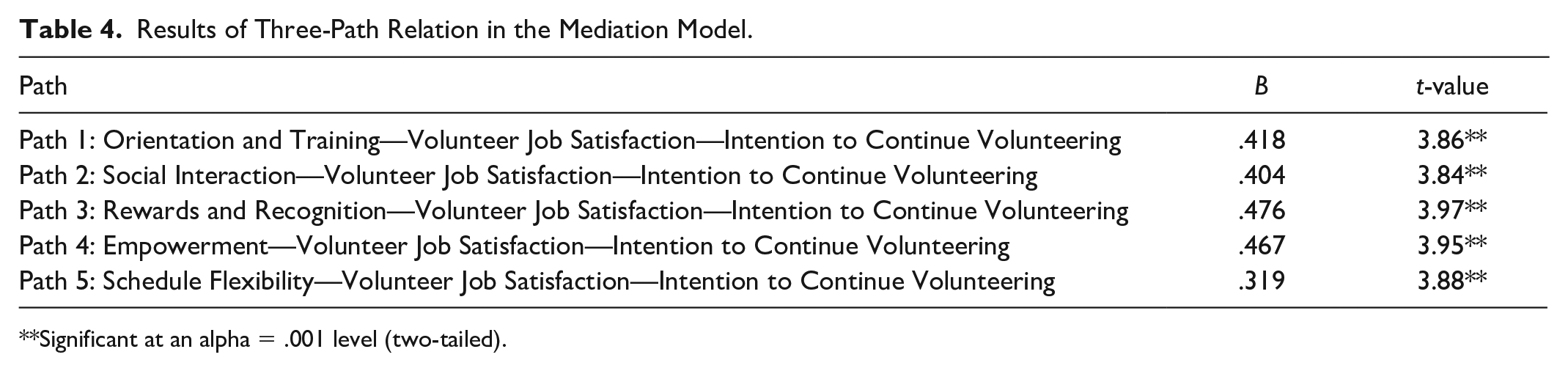
Significant at an alpha = .001 level (two-tailed).
Discussion
Episodic volunteers are less likely to volunteer for altruistic reasons and emphasized more social incentives to volunteer (e.g., they followed or were asked to by friends or family) compared with regular volunteers (Hustinx et al., 2008). In addition, episodic volunteers often make a larger commitment and spend more time in a short period for their tasks; as such, this intense role would be difficult to sustain (Holmes, 2014). However, episodic volunteers are passionate about their activities (Holmes, 2014) and play a critical role in large-scale events (Flood et al., 2005). Thus, given the importance of maintaining them, this study investigated the effect of volunteer management on episodic volunteers’ job satisfaction and continuance intention based on the environmental psychology model (Mehrabian & Russell, 1974).
First, a significant relationship was found between volunteer management and job satisfaction in this study. This result contradicted Al-Mutawa’s (2015) finding that there was no statistically significant relationship between training and support and volunteer satisfaction. However, the finding of this study was consistent with previous findings from Wisner et al. (2005) and Farrell et al. (1998), indicating volunteer management has a positive relationship with volunteers’ satisfaction. To understand the role of volunteer management in volunteers’ job satisfaction, more resources must be allocated to develop a holistic program for volunteers to improve retention. Specifically, the result showed the highest attribution of positive management practices came from reward and recognition, consistent with Fox and Wheeler’s (2002) findings. This may suggest more emphasis can be placed on this aspect in the development of volunteer management practices. This falls in line with the proposition that specific rewards that volunteers expect from volunteering are needed to ensure the continuation of volunteering behavior, and volunteering is a measurement of cost and reward (Bang & Ross, 2009).
In addition, all subfactors of volunteer management showed significant three-path mediation effects on intention to continue volunteering. The findings are consistent with previous studies, supporting that adequate amount and quality of social interaction have been shown to predict volunteer satisfaction (Costa et al., 2006; Fox & Wheeler, 2002). Furthermore, empowered employees tend to have more positive feelings about themselves and their jobs (Bowen & Lawler, 1995). Volunteer empowerment includes involving volunteers in the decision-making process and allowing them to be autonomic when carrying out their tasks. When autonomy needs are met, volunteers feel more satisfied with their roles and tasks (Boezeman & Ellemers, 2009). Orientation and training are also essential in providing the knowledge and skills required for volunteers to carry out their responsibilities (Heskett et al., 1997). Recently, Aisbett et al. (2015) found that orientation and training positively influence volunteers’ satisfaction. Specifically, training helps volunteers gain confidence in their skills and serves as a form of educational support (Pauline, 2011), while orientation could serve as a platform for volunteers to feel “welcomed” by the organization (Wisner et al., 2005). That is, orientation and training align volunteers to an organization’s mission and facilitate volunteers in helping the organization achieve its goals. In turn, volunteers feel accomplished (Wisner et al., 2005).
This study found a positive relationship between volunteers’ satisfaction and intention to continue volunteering. Satisfaction is defined as the fulfillment of participants’ expectations of a product and/or service (Oliver, 1997). People, as cognitive beings, compare their expectations with perceived performance and come to a conclusion on their satisfaction level with their experience (Wirtz & Bateson, 1999). Customer satisfaction has been researched as an indicator of customer loyalty and intention to repatronize (Cronin & Taylor, 1992; Patterson & Spreng, 1997). A clear connection among volunteers’ satisfaction, intention, and actual behavior has also been established (Millette & Gagné, 2008; Omoto & Snyder, 1995; Wisner et al., 2005). More recently, Terry et al. (2013) and Al-Mutawa (2015) also found that volunteers’ satisfaction is positively related to volunteers’ intention to remain. The significant influence of volunteer satisfaction on behavioral intention suggests volunteer organizations have to recognize factors that could enhance volunteer satisfaction by considering volunteer management. For example, organizations need to abandon a one-size-fits-all volunteer management style that may tamper with volunteers’ intention to return, donate, or recommend to others. That is, organizations need to consider volunteers’ personalities and preferences to moderate turnover rate and increase satisfaction.
This study confirmed the environmental psychology model, showing volunteer management positively affected volunteers’ intention to continue volunteering through job satisfaction. In other words, the successful application of the environmental psychology model to the context of volunteerism suggested a new perspective to explore volunteer retention, regarding volunteer management practice as a determining factor for volunteers’ continuance intention. The findings of this study showed four hypotheses were supported and provided a better understanding of the influence of the volunteers’ environment. Specifically, volunteer management directly affected intention to continue volunteering. However, when this study included job satisfaction in the structural model, the direct effect of volunteer management on intention was not significant, but the indirect effect of volunteer management on the intention though job satisfaction was significant. The finding was consistent with Hoye et al. (2008) argument that mediating factors are needed in the linkage between volunteer management practices and volunteer retention.
The results of this study are also linked to the basic concept underlying reinforcement theory (Skinner, 1953) that human behavior is regulated by reward and recognition. That is, multiple sources of contingencies (i.e., five subfactors of volunteer management) reinforce positive emotional responses, increasing the likelihood of behavioral change (i.e., intention to continue volunteering) in its members. As such, volunteer management needs to adopt the practice of reward and recognition to meet the satisfaction of volunteers. When volunteers are recognized for their efforts and are presented with a token of appreciation they expect, volunteers will not only feel satisfied but also motivated to continue volunteering. In addition, Heskett et al. (1994) noted that employees’ satisfaction and retention are influenced by a set of work conditions. Even though reward and recognition are the highest loading factors of volunteer management, there is a downside of overusing rewards for volunteers in the long run. When more rewards are used, the more they seem to be needed (Kelsey, 2011), an organization needs to know the limit of using rewards to prevent an adverse effect of positive reinforcement. Therefore, an organization should consider all other aspects when implementing a policy to retain volunteers because it could serve as the recyclable human resource to cut the cost of training new volunteers in the future.
Limitations and Future Research
This study had some limitations that could be reviewed and revised for future research. First, the targeted sample of this study was volunteers participating in a cultural event in Singapore. Therefore, the results may not be generalizable to all volunteers and organizations. Therefore, future research could consider to extend the sample and include volunteers from a variety of volunteer programs. This study should also be extended outside of Singapore, in other parts of the world, across a range of social changes and demography, such as age group. Second, this study applied the environmental psychology model and considered volunteer management as the main influencer of the voluntary work environment. Future studies need to measure personal factors influencing volunteers’ emotional and behavioral responses. Third, this study only measured one behavioral outcome (i.e., intention to continue volunteering), based on the environmental psychology model (Mehrabian & Russell, 1974). Future research needs to consider other psychological outcomes (e.g., subjective well-being, meaning in life, and quality of life) of volunteerism, further explaining the underlying mental process of volunteers and extending the environmental psychology model.
Footnotes
Declaration of Conflicting Interests
The author(s) declared no potential conflicts of interest with respect to the research, authorship, and/or publication of this article.
Funding
The author(s) received no financial support for the research, authorship, and/or publication of this article.
