




Abstract
The 2019 Military World Games was the largest special sports event in the history of Military Sports Events. Volunteers as a soft infrastructure play a critical role in the success of the Military World Games. However, few systematic studies have been conducted on volunteer motivation of Military World Games. Drawing on the social identity theory, a theoretical model has been developed, which includes a new theme-related motivation of love of military based on the version of VMS-ISE scale. Through investigating 2,114 respondents, results show that motivations of expression of values, patriotism and city involvement, interpersonal contacts, personal growth, love of sport, and love of military have positively impact on volunteer satisfaction. Especially, volunteers with the deep passion of military sport would highly increase volunteer satisfaction. Follow-up analyses may contribute a deeper understanding and practical guidance of organizers to recruit and manage volunteers in special sport events with the certain theme.
Introduction
The importance of volunteering in the sustainability of sports events has been highlighted (Costa et al., 2006; Cuskelly & Boag, 2001; Xing et al., 2018). In previous sports events, a tremendous number of volunteers have been recruited and played a critical role in them (Alexander et al., 2015). How to keep the strong sense of volunteers’ involvement and loyalty has long been a question of great interest. To date, extensive studies have been conducted (Bang et al., 2009; Dickson et al., 2014; Twynam et al., 2002), which has shown that motivation impact volunteers’ satisfaction in different degrees under the different contexts of sports events (Dickson et al., 2013; Kim et al., 2018) and volunteers’ satisfaction is imperative to develop effective volunteers’ involvement and loyalty (Bang et al., 2008; Kim et al., 2018).
However, previous studies have been mainly carried out in the context of general sports events (Bang & Ross, 2009; Dickson et al., 2015). Few studies have focused on the special sports events. Special sports events refer to the special events with the certain theme related to different kinds of sports, such as Military World Games with the typical theme of military sports, International Tennis Federation with the typical theme of tennis sports (Getz, 1997; Goldblatt, 2002). Previous studies have identified that in different contexts of special sports events, motivations vary correspondingly (Bang et al., 2009), and specified research of motivations in sports events have been called for further exploration (Giannoulakis et al., 2007). In addition, unlike continuous volunteers, volunteers in special sporting events are considered episodic volunteers, and understanding the motivation of episodic volunteers is necessary for volunteer management in special sports events (Farrell et al., 1998; Kim, 2018). Through exploring the influential factors of volunteers’ motivation in the context of special sports events, it would help enhance the effective recruitment and management of volunteers for special sports events and better satisfy volunteers’ special needs with their specified motivations (Alexander et al., 2015; Bang et al., 2019; Schlesinger & Gubler, 2016).
The 2019 Military World Games is an episodic special sports event with a typical military sports theme. According to the social identity theory, individuals are more easily to develop a common bond and navigate positive behaviors to a special social group when they have special emotion with some specific fields and classify themselves to the specific group (Tajfel, 1987). Based on the correlation, this paper intends to investigate whether volunteers who generate a sense of identity with the special group with military sports would be more likely to navigate positive satisfaction and loyalty to the special event of the 2019 Military World Games, with identification of other five potential motivations of expression of values, patriotism and city involvement, interpersonal contacts, personal growth, and extrinsic rewards using the modified version of VMS-ISE scale by structural equation modeling (Bang et al., 2008). This study is expected to make a contribution to a deeper understanding of the correlation between volunteers’ special motivations, satisfaction, and loyalty in the context of special sports events as well as given the theoretical and practical implication for developing and applying volunteerism in special sports events.
Literature Review
Volunteers’ Motivations
Volunteers’ motivation is the psychological tendency or internal drive to stimulate or sustain opportunities, commitment and involvement in volunteerism (Clary et al., 1998; Pearce, 1983). Different factors have been found to be related to volunteers’ motivations under the context of sports events, such as altruistic, egoistic, protective motives, solidary, patriotism, interpersonal contacts, social, personal growth, extrinsic rewards, and so on (Khoo & Engelhorn, 2007, 2011).
Different theories have been used in previous research on motivations (Cunningham, 2013) and the typical theories are incentives approach, functional theory, self-determination theory, social identity theory, leisure activity perspective, and so on (Kim et al., 2019; Lai et al., 2013; Warner et al., 2011). According to incentives approach, Knoke and Prensky (1984) have initially hypothesized three motivations, including normative incentives (purposive incentives, i.e., charitable and altruistic motivation, such as caring and helping others), affective incentives (solidary incentives, i.e., social benefits gained from group relationships, such as prestige, respect, friendship) and utilitarian incentives (material incentives, i.e., indirect benefits gained from volunteering, such as knowledge, skills). Hereafter, several studies have applied these theories into sports events (Khoo & Engelhorn, 2011; Monga, 2006). Functional theory has initially used by Clary et al. (1998). Furthermore, several studies have used social identity theory (Bang & Ross, 2009; Werbner & MacClancy, 1997). Based on the theory of self-determination (SD), core motivations of autonomy and control have been identified (Deci & Ryan, 1985). Parker has claimed the motivation of having a leisure experience from the angle of leisure activity perspective (Parker, 1997).
Based on theory frameworks, motivation models have been identified. Cnaan and Goldberg-Glen (1991) have identified two primary dimensions of altruistic motivation and egoistic motivation and proposed the model of Motivation to Volunteer Scale (MVS). Model of Volunteer Functions Inventory (VFI) has first proposed by Clary et al. (1998) which includes the motivations of values, understanding, social, career, protective, and enhancement. The Motivation to Volunteer (MTV) model has been developed by Monga (2006), who analyzes the motivations of altruistic, solidary, egoistic, and instrumentalist. The evidence reviewed here has suggested a pertinent role for motivations of volunteers in general contexts of events. However, the previous studies mainly focus on general contexts but not on special events. The Special Event Volunteer Motivation Scale (SEVMS) model has been published and initially proposed by Farrell et al., which hypothesizes specialized motivations in the context of special events: purposive, solidary, external traditions and commitments. Several further studies have supported this model in different contexts of special events (Farrell et al., 1998; Grammatikopoulos et al., 2006).
To investigate the impact of motivations in the context of sports events, several models have been identified. Bang and Chelladurai have examined the model of Volunteer Motivations Scale for International Sporting Events (VMSISE) in the context of the 2002 FIFA World Cup. In the model of VMSISE, 6 motivations and 21 items have been proposed: expression of values; patriotism; interpersonal contacts; personal growth; career orientation; extrinsic rewards (Bang & Chelladurai, 2003). Giannoulakis et al. (2007) have conducted the research under the context of Olympic Games and identified the model of Olympic Volunteer Motivation Scale (OVMS). Bang and Ross have initially examined the impact of love of sport and demonstrated that volunteers have higher satisfaction due to the love of sports. In their seminal study, the model of Volunteer Motivations Scale for International Sporting Events (VMS-ISE) has been proposed (Bang & Ross, 2009). Based on the model of VMS-ISE, several empirical studies have applied this model to different contexts of sports events and the model has been highly supported (Hallmann & Harms, 2012; Schlesinger & Gubler, 2016; VanSickle et al., 2015). Moreover, motivations have been validated in several contexts of special sports events (Khoo & Engelhorn, 2007). Williams et al. (1995) have provided evidence that socialization and interaction were the primary motivations under the context of ski events. Elstad has illustrated that meeting new friends was the primary motivation at the 1994 Winter Olympics. The image of prestige has been identified in the context of special sports events by Elstad (1996) and Farrell et al. (1998).
Volunteers’ Motivation, Satisfaction, and Loyalty
Numerous studies have examined the correlation between motivation and satisfaction (Jones & Burns, 1973; Warner et al., 2011). Results have shown that motivations have a positive effect on satisfaction (Bang et al., 2019; Finkelstein, 2008; Galindo-Kuhn & Guzley, 2001). Pearce has proposed that satisfaction is highly affected by the motivations of intrinsic, social, and service (Pearce, 1983). Gagné and Deci (2005) have identified that the degree of being autonomous or controlled could deeply influence the volunteers’ satisfaction. It is also conclusively been shown that motivations highly influence satisfaction under the context of sports events (Farrell et al., 1998; Reeser et al., 2005). Farrell et al. (1998) have illustrated that volunteers’ motivations of purposive, solidary, external traditions, commitments highly influence volunteers’ satisfaction, and the success of sports events. Reeser et al. (2005) have investigated that volunteers’ motivations of altruism, value, extrinsic, intrinsic factors have a strong positive correlation to volunteers’ satisfaction though investigating the 2002 Winter Olympic and Paralympic Games. Based on the above, hypothesis 1 (H1) was proposed that volunteers’ motivations are positively related to satisfaction at the 2019 Military World Games.
And studies have shown that satisfaction is a critical influential factor of loyalty to future events (Ahn, 2018; Finkelstein, 2008; Galindo-Kuhn & Guzley, 2001). The impact degree has also been assessed in several studies (Chang et al., 2009; Pauline, 2011). Clary et al. (1998) have found that the higher the satisfaction, the stronger the loyalty to future events. Wu et al. (2019) have found that highly satisfied volunteers show a higher willingness to continue service. Oh (2019) has noted that volunteer satisfaction has a direct and positive effect on loyalty. Based on the above, hypothesis 2 (H2) has been proposed that volunteers’ satisfaction is positively related to loyalty at the 2019 Military World Games.
The evidence reviewed seems to suggest a pertinent role for motivation on satisfaction and loyalty. However, there remain several aspects of motivation under the context of special sports events need to explore, and the research could be deeper and specified (Reeser et al., 2005; Wang & Yu, 2015).
Social Identity Theory
Social identity refers to individuals’ self-concept on whether they attach to the membership in a social group (or groups) deriving from knowledge of membership and the value or emotional significance (Tajfel, 1978). Social identity theory which has been first proposed in the early 1970s, mainly illustrates the cognitive processes and the motivational assumption for people to set up a positive social identity (Jenkins, 1996).
Social identity theory is a typical intergroup theory which emphasizes the role of social identity in explaining group behaviors (Brown, 2000). Tajfel (1970) and Tajfel et al. (1971) have created a minimal-group paradigm, enabling the experimenter to observe the group’s operation mode in a deeper way. Individuals identify their environment and establish social identity through social-categorization, social comparison, and positive distinctiveness (Tajfel & Turner, 1979). When individuals recognizes that he (or she) belongs to a specific social group in a particular environment, he (or she) would tend to exert the special emotion and value to the group and navigate behaviors through social interactions. In addition, individuals’ identification with a particular social group has an impact on motivation, and this impact could determine the degree of future behavior of a given object (Prayag & Grivel, 2018) When individuals perceive special sporting events as a social environment that satisfies some of their motivations, these motivations would further influence individuals’ evaluations of satisfaction and loyalty to special sporting event participation (Kaplanidou & Gibson, 2010).
Research has shown that social identity and organizational behaviors are highly correlated. When social identity with the group has been strongly established, they tend to create in-group preference, out-group bias, and participate in collective behaviors (Tajfel, 1978). And high levels of organizational identification have highly correlated with positive organizational involvement, work-related behaviors, and greater job performance (Knippenberg & Schie, 2000).
Existing research has mainly explored the volunteerism in general contexts (Clary et al., 1992; Cnaan & Goldberg-Glen, 1991). A few studies have explored volunteering at special sports events, especially focusing on the correlation on motivation with certain themes. This study tries to (1) identify the correlation between motivation, satisfaction, and loyalty to extend the previous research on the volunteerism in sports events and rich the outcomes of special sports events; (2) examine whether and to what extent the motivations, especially the new-designed theme-related motivation of love of military, would impact on satisfaction and loyalty under the context of special sports events with the certain theme of military, in order to promote the manager and organizers to deeper understand how to match expectations and how to be well performed of volunteers.
Materials and Methods
Research Context and Sample
The present study sampled the special sports event of the 2019 Military World Games for cross-sectional survey design. Case is carefully selected based on its relevance to the practical or theoretical issue under study and the principle of its unique characteristics (Denscombe, 2007). The 10-day Military World Games held in Wuhan, China is a typical special sports event with the distinct military character. There were 27 major events and 329 minor events. Five of the events were uniquely set up in the Military World Game, including aeronautical pentathlon, naval pentathlon, orienteering, military pentathlon, and parachuting. In addition to that, it had drawn the great attention of more than 9,308 soldiers from 109 countries all over the world. Thus far, the 2019 Military World Games was the largest sports event in the history of the World Military Games, with the largest number of participants.
According to the statistics number of Organizing Committee for the 2019 Military World Games, volunteers worked in 13 service categories, including transportation, international liaison, competition organization, media operations, venue services, and so on, before and during the Games to help guide, interpret, maintain order, manage facilities, provide safe transportation, and so on. Volunteers were mainly from college students and famous volunteer groups. Because of the particularity of the event related to military sports, a part of volunteers was recruited from military colleges.
For this study, the questionnaires were sent to the volunteers on-line by a professional survey app (sojump). Two thousand three hundred volunteers from the registration database have been selected using convenience sampling method after obtaining their permission. Of the total 2,300 anonymous questionnaires, 2,187 were returned which the response rate was 95.1%. Seventy three invalid questionnaires with incomplete data were excluded, and 2,114 questionnaires were effective, which the effective rate was 96.7%. In the final analysis, a total of 2,114 questionnaires were included, in which 52.3% were female and 47.7% were male.
The original questionnaire was translated into Chinese by four bilingual scholars who had more than 5 years of experience in translation and cross-cultural identification in order to ensure scale consistency between two translated versions. The face validity of multiple-item scales was evaluated by 15 academic experts and sports event’s organizers. The pilot study was conducted on 30 volunteers using a convenience sample. Based on the pre-test, the questionnaire has been revised and ambiguities have been clarified.
Instrumentation
The questionnaire was designed to measure volunteers’ demographic characteristics, motivation, satisfaction, and loyalty. Multi-measurement items were constructed based on literature reviews on the previous research and models related to volunteers’ motivation, satisfaction, and loyalty in sports events and special events.
The demographic survey was designed eight items to learn the demographic situation and respondent profile of volunteers, including gender, age, current city, volunteer registration category, education, volunteering frequency, volunteering frequency for sports events, and volunteering experience of military.
Motivation survey was conducted based on the VMS-ISE scale developed by Bang and Ross, which contains six motivations: expression of values, patriotism, personal growth, career orientation, extrinsic rewards, and love of sport. According to the social identity theory, this study adapted VMS-ISE with minor modification according to the research context of a special sports event, the 2019 Military World Games (Bang & Chelladurai, 2003; Bang & Ross, 2009). Among them, the assumption of five motivations (expression of values, patriotism, personal growth, extrinsic rewards, and love of sport) was retained. In view of the particularity of the 2019 Military World Games, love of military was added into the VMS-ISE scale as a supplementary factor of motivation. Love of military is supposed to be an important motivation for volunteers involving in military sports events. According to the social identity theory, individuals who have identity and self-concept with an organization through cognitive classification could develop positive emotional attachment and deep commitment to work. Because of love of military, volunteers who have special feelings and bond with the military are more likely to make an emotional attachment to the activities related to the military and emotionally and behaviorally involved into the military events (Kim et al., 2018). So, in this study under the special context of military sports, the factor of love of military has been included. Beyond that, given that the 2019 Military World Games is a city-based event which held in city Wuhan, volunteers taking part in the 2019 Military World Games was closely link to the host country and city (Bang & Chelladurai, 2003; Matsuoka & Chelladurai, 2001). Therefore, city involvement has been incorporated into patriotism to measure volunteers motivation. Based on what has been mentioned, seven motivations in this study have been maintained: expression of values, patriotism and city involvement, interpersonal contacts, personal growth, extrinsic rewards, love of sport, and love of military. Each factor has three items.
Satisfaction scale utilized the questionnaires in this research by Finkelstein (2008) and Galindo-Kuhn & Guzley (2001). Three items were designed to check whether their expected goals have been achieved, including “I am satisfied to be a volunteer at the 2019 Military World Games,” “I am satisfied to take part in the 2019 Military World Games,” “I am satisfied with the volunteer experience compared to my expectations.” Loyalty survey was measured by a three-item scale based on the questionnaires by Zeithaml et al. and Sunghyup, including “I will continue to take part in other events as a volunteer,” “I will attend other sports events as the volunteer” and “I will recommend other people to attend sports events as the volunteer” (Hyun, 2010; Zeithaml et al., 1996).
All survey questions were utilized a 5-point Likert scale from 1 (strongly disagree) to 5 (strongly agree). The respondents rated each question according to the degree how much they agreed with.
Preliminary Analysis
Exploratory Factor Analysis and Confirmatory Factor Analysis (CFA) was used to investigate variable relationships and uncover clusters of responses by factor analysis (Hair et al., 1998; Kline, 1998). Exploratory Factor Analysis (EFA) was utilized to extract the essential structure and synthesize the variables with intricate relationships into a few core factors (Denscombe, 2007). The multiple-item scales in this study have been minor modified with a new-designed motivation of love of military and two slightly-changed factors based on the previous prior theory and empirical evidence according to the target event of the 2019 Military World Games. To measure and identify the corresponding relationship and the meaningfulness of latent variables and their indicators of constructed scale, principal component analysis (PCA) with varimax rotation has been used in this study. Results showed that the load factors in the confirmatory factor analysis were less than 0.4.
Confirmatory Factor Analysis (CFA) was to test whether the relationship between a factor and the corresponding measure conforms to the theoretical relationship designed by the researcher. To test the factor structure of motivation, satisfaction and loyalty in this study, CFA was utilized by SPSS software (version 26). The factor structure of motivation, satisfaction and loyalty, especially the seven factors of expression of values, patriotism and city involvement, interpersonal contacts, personal growth, extrinsic rewards, love of sport, and love of military were confirmed (see Table 1).
The Results of Measurement Model Validation.
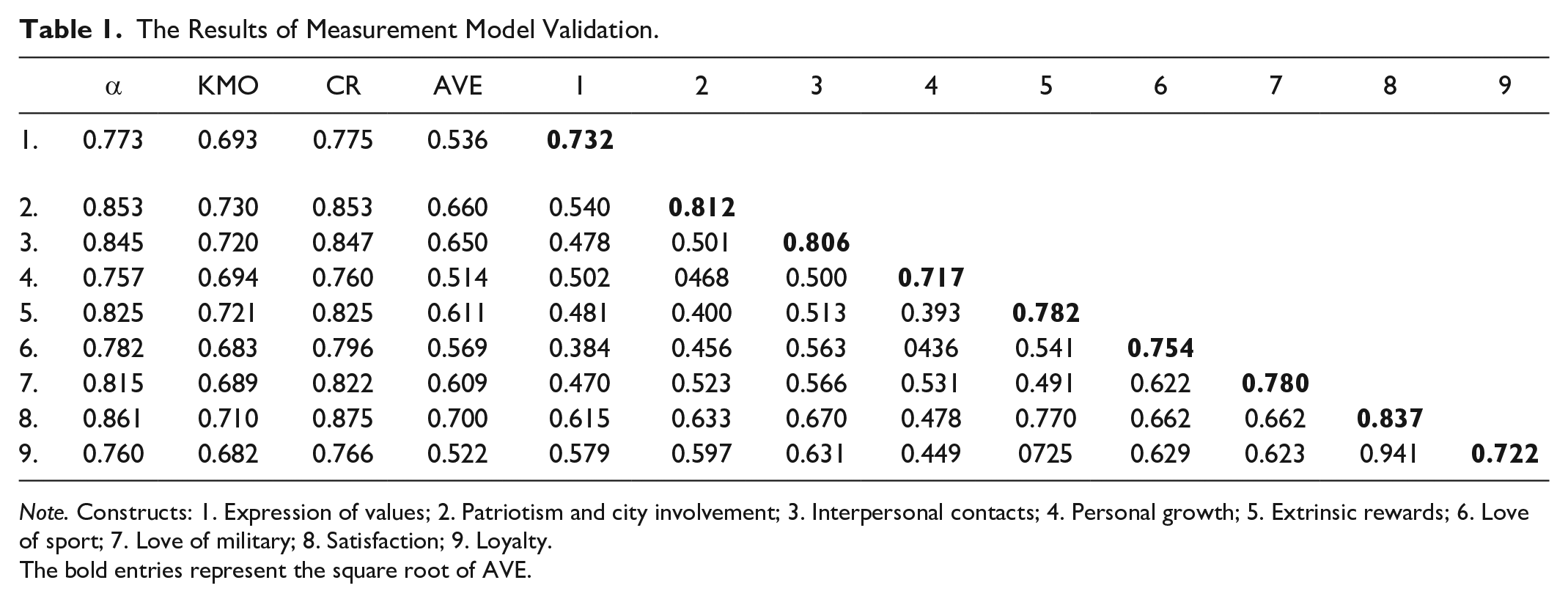
Note. Constructs: 1. Expression of values; 2. Patriotism and city involvement; 3. Interpersonal contacts; 4. Personal growth; 5. Extrinsic rewards; 6. Love of sport; 7. Love of military; 8. Satisfaction; 9. Loyalty.
The bold entries represent the square root of AVE.
Data Analysis
Demographic situation and respondent profile of volunteers were performed by SPSS software (version 26) including means, frequencies and percentages. The factor structure was checked by EFA and CFA by SPSS software (version 26). Reliability of the scale was conducted by SPSS software (version 26) to check Cronbach’s alpha. After assessing the factor structure of each measurement model, the research hypothesis and the structural model were examined by structural equation modeling (SEM) through testing assessment of normality, convergent and discriminant validity of the measurement model and model fit. Research hypotheses of the structural model were predicted by multiple regression analysis by AMOS (version 24) (Anderson & Gerbing, 1992).
Results
Volunteer Respondents’ Profile
Demographic characteristics of volunteer respondents were identified by basic descriptive and frequency statistics. Of the 2,114 respondents, female respondents are 52.3% and male respondents are 47.7%. Fifty four percent of respondents are between 19 and 29 years old and 27% of respondents were between 30 and 49 years old. Respondents with a bachelor degree and master degree accounted for over 90% (93.1%). Almost most of the volunteer respondents (96.1%) came from the host city Wuhan. More than half of volunteer respondents (51%) have the volunteer experience between 1 and 5 times and 38% of respondents have the volunteer experience between 6 and 10 times. Almost all of the volunteer respondents did not have the volunteer experience for military sports experience.
Reliability and Validity Test of Data
Reliability was conducted by SPSS software (version 26) to check Cronbach’s alpha. Cronbach’s alpha values for all factors were .935 that was beyond the recommended value 0.8 (Nunnally & Bernstein, 1994). It indicated good internal consistency of the whole scale. Each latent variable with the observed variables was analyzed respectively. Cronbach’s alpha values of each latent variable were .810, .853, .844, .758, .825, .783, .816, .861, .759 (see Table 1), which all beyond the standard value of .60 (Hyun, 2010). The reliability of the questionnaire conformed to the requirements of research analysis.
Validity test was to determine whether the designed items were reasonable and could effectively reflect the research objectives of researchers. The higher the validity, the higher the fit between the measured results and the observed subjects. The test of KMO and Barlett by SPSS software (version 26) was conducted. The analysis results showed that KMO value was 0.924. It is greater than the standard value of 0.6. The significance of Barlett sphericity test was 0.000, which was under the standard value of 0.05. The results showed that the survey data had strong reliability and high validity.
The convergent validity and discriminant validity were identified through CFA to identify construct validity and internal consistency estimates. As above introduced, the model included four parts and each part had been divided into several factors (Bang & Chelladurai, 2009). A total of 21 volunteer motivation items, three volunteer satisfaction items and three volunteer loyalty items (see Table 2) were assessed in the measurement model. The factor loadings have confirmed the factors.
The Results of the Convergent Validity and Discriminant Validity.

Note. *represents the significance (p) of the t-value.
p < .05. **p < .01. ***p < .001.
The convergent validity was calculated by factor loadings (λ), t-value, the average variance extracted (AVE), and composite reliability (CR) to represent various dimensions in each subscale using SPSS software (version 26). CR is a measure of internal consistency in scale items (Netemeyer, 2003). As Table 2 shows, the standardized factor loadings (λ) were all significant and beyond the recommended value 0.50 (Anderson & Gerbing, 1988). As Table 1 shows, the results of AVE were 0.536, 0.660, 0.650, 0.514, 0.611, 0.569, 0.609, 0.700, 0.522, which all exceeded the recommended value 0.5 (Bagozzi, 1981). CR for these factors are 0.775, 0.853, 0.847, 0.825, 0.757, 0.796, 0.822, 0.875, 0.766, which were all exceed the recommended value 0.7 by Nunnally and Bernstein (1994).
The discriminant validity was used to distinguish the measurement model from other constructs by empirical standards to avoid ambiguity in the research findings. The discriminant validity was calculated through testing AVE square root with the correlation value. If the AVE square root was beyond the relative value, the discriminant validity was good. As Table 1 shows, the AVE square root of each factor was greater than the relative value.
The Model Fit
The overall model fit was assessed by testing chi-square (χ2), df, goodness-of-fit index (GFI), adjusted goodness-of-fit index (AGFI), normed fit index (NFI), comparative fit index (CFI), root mean square error of approximation (RMSEA), and standardized root mean square residual (SRMR). Before testing the model fit, normality test was conducted to determine whether the population obeys a normal distribution based on the observed data. Through the test of normality assessment by AMOS, Skewness, and kurtosis statistics were all below an absolute value of 1.0 and 3.0 and denoted a normal distribution.
From Table 3 shown, the result of χ2/df (=0.908) was below the recommended value 3.0 (Hayduck, 1987). GFI (=0.917) was higher than the recommended value 0.9 (Bagozzi & Yi, 1988). AGFI (=0.894) was higher than the recommended value 0.8 (Scott, 1994). NFI (=0.916) met the recommended criteria of 0.9 (Bentler & Bonett, 1980). CFI (=0.924) was higher than the minimum cut-off of 0.9 and RMSEA (=0.029) was well below the minimum cut-off of 0.08 (Bagozzi & Yi, 1988). SRMR (=0.035) was below the minimum cut-off of 0.08 (Bagozzi & Yi, 1988). The results (see Table 3) have shown that the fit indices represented an accepted model fit.
The Results of Fit Indices of the Model.
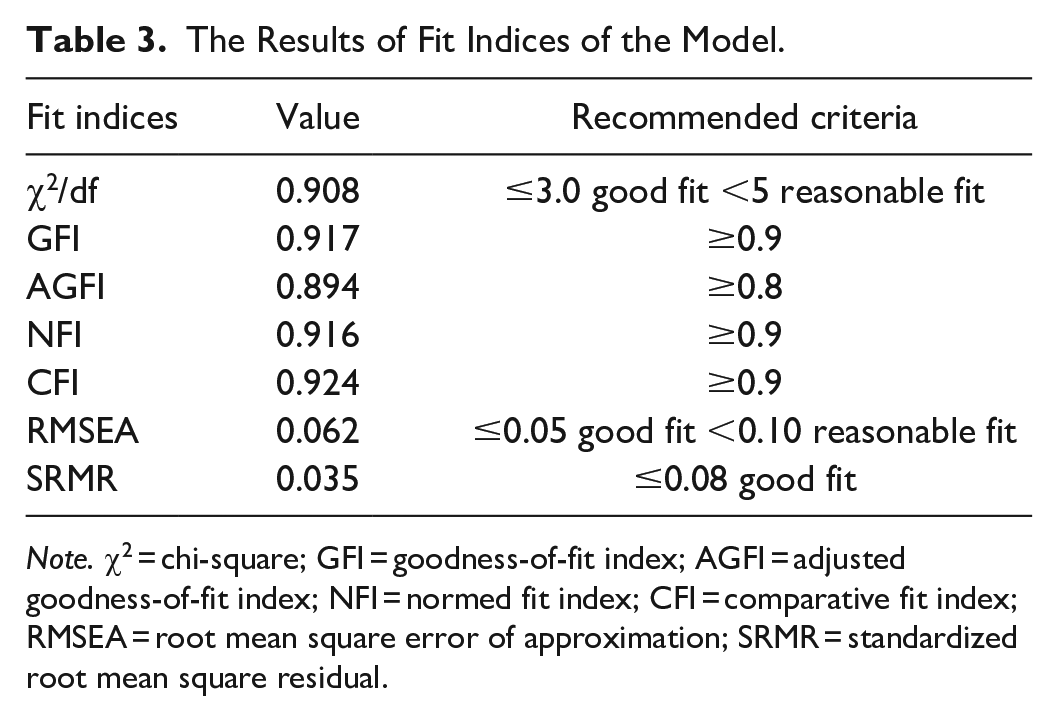
Note. χ2 = chi-square; GFI = goodness-of-fit index; AGFI = adjusted goodness-of-fit index; NFI = normed fit index; CFI = comparative fit index; RMSEA = root mean square error of approximation; SRMR = standardized root mean square residual.
Multiple Regressions
To predict the linear dependence, standardized regression weights, unstandardized regression weights, and path significances have been used by using Analysis of Moment Structures (AMOS) (Al-Sada et al., 2017; Tajfel et al., 1971). As shown in Table 4, hypotheses on the relationship between motivation and satisfaction (H1) have been partly supported. Motivation of expression of values (β = .141, p < .001), motivation of patriotism and city involvement (β = .202, p < .001), motivation of interpersonal contacts (β = .161, p < .001), motivation of personal growth (β = .418, p < .001), motivation of love of sport (β =0.145, p < .001), motivation of love of military (β = .141, p < .001) had a positive effect on the satisfaction. Motivation of extrinsic rewards to satisfaction (β = −.071, p < .001) did not have positive effect on the satisfaction. Satisfaction to loyalty (H2) (β = .941, p < .001) has been highly identified. The estimates of squared multiple correlations of a structural model of satisfaction (R2 = 0.789) were higher than the recommended value 0.67, which was well explained by the direct effect of motivation. The estimates of squared multiple correlations of the measurement model were all higher than the recommended value 0.36.
The Results of Multiple Regression of Structural Model.
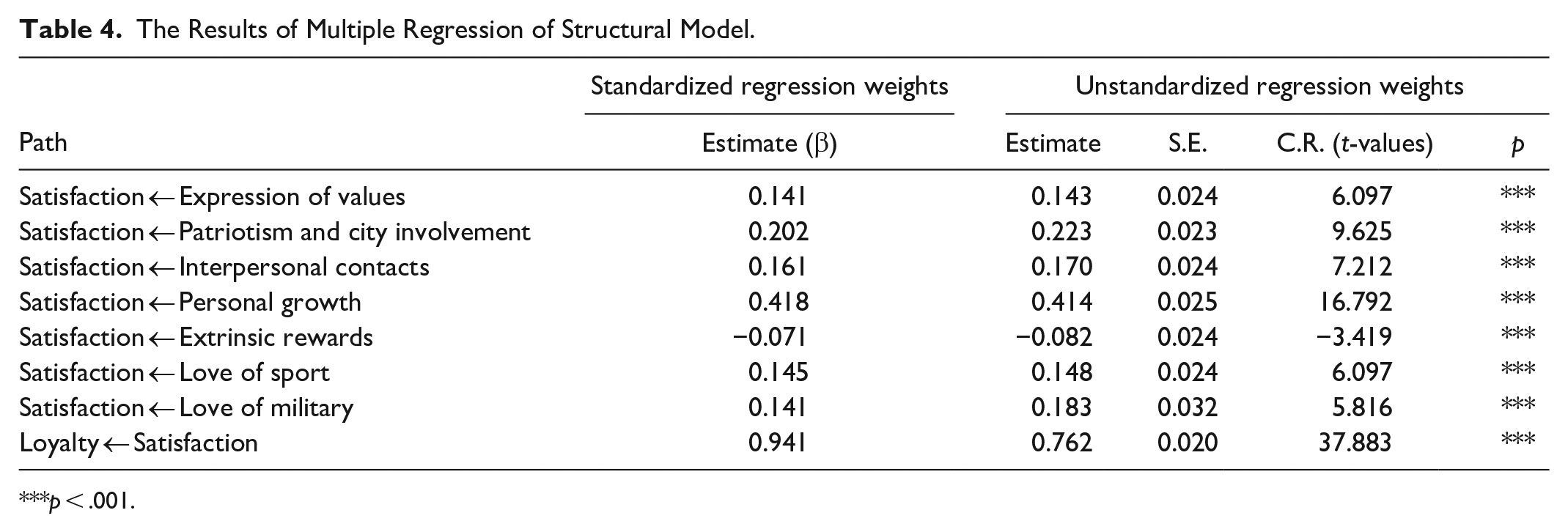
p < .001.
Discussion
With the segmentation study of volunteering under the context of special sports event of the 2019 Military World Games, the paper has identified the relationship between volunteers’ motivation, satisfaction and loyalty. This study has examined whether volunteers’ specialized theme-related motivations, that is, love of sport and love of military, could affect volunteers’ satisfaction in the context of special sports events, with identification of other five potential motivations of expression of values, patriotism and city involvement, interpersonal contacts, personal growth, and extrinsic rewards.
Results show that volunteers’ satisfaction and six motivations (expression of values, patriotism and city involvement, interpersonal contacts, personal growth, love of sport, and love of military) have positive links at the 2019 Military World Games. And volunteers’ satisfaction has a significant impact on loyalty. Based on the investigation, it might contribute to the studies on volunteering and afford implications to understand how to match the expectation and how to be well performed of volunteers for managers and organizers.
Among them, motivations of love of sport and love of military, which are closely related to the specialization of the theme of military sports, has been identified in this study. The results have shown that volunteers who have more passion for sport and military would bring more probability to be involved in volunteering and higher satisfaction. Based on the social identity theory, volunteers who have a special enthusiasm for some specific fields would be more easily to develop a common bond and shared interest to the related activities and more easily be satisfied and involved in the related organization (Costa et al., 2006; Green & Chalip, 1998). More specifically, volunteers who have specific incentives and highly motivated by love of sport and military would have a more common bond and shared interest with the activities related to military sports and more easily be satisfied and involved in the special sports events with military sports. And thus, motivations of love of sport and love of military has been proposed to be the vital factors influencing volunteers’ satisfaction to further events. The environment highlighting the mutual connection to sport and military would be attracted volunteers to interact with people who shared similar interest and commitment.
Moreover, in terms of other volunteers’ motivations, some previous research findings have been supported in this study. Altruistic factors, including expression of values and patriotism and city involvement, are the pivotal motivations. If volunteers are motivated by normative or purposive incentives, they are keen to express concerns about altruism (Clary et al., 1998; Farrell et al., 1998; Monga, 2006). Volunteers who have the strong motivation of expression of values are more inclined to help the event successful, to do something worthwhile as well as feel the importance to take part in the events through volunteering. They want to express pride of the country and city, to help the country and city to raise the prestige and to play a role in hosting sports events. Satisfaction is high among those volunteers with higher motivation of expression of values, patriotism and city involvement, while the experience of those who are felt valued, respected and satisfied may have increased loyalty (Oh, 2019; Wu et al., 2019). Therefore, organizers could highlight the importance of volunteers’ contribution to the events to cater to their motivations of expression of values and patriotism and city involvement.
The motivation of interpersonal contacts and personal development, which relate to career orientation and instrumentalist, is consistent with results of previous studies (Bang & Ross, 2009; Clary et al., 1998; Schlesinger & Gubler, 2016). Interpersonally motivated volunteers are more willing to interact with others, develop relationships with others, and work with different people to develop social competence or be more cohesive in society (Costa et al., 2006). It is likely that volunteers who are positively motivated to form social relationships and engage in social interactions will have a more positive impact on involvement and satisfaction in activities. Those volunteers who want to gain experience, develop abilities and improve their career development, especially for college students, might gain more chances, and qualification related to career development and job orientation. The benefits related to ability improvement, experience obtain, resume and work enrichment, and social connections are more attracted volunteers to take part in and be involved in the events.
However, the impact of extrinsic rewards on satisfaction is just the opposite: this dimension is not found to have a positive effect on satisfaction. Volunteers who have the motivations of extrinsic rewards or requirements preferred to obtain symbolic rewards such as respect or praise, or material rewards such as free food, uniforms, or souvenir. The motivation of extrinsic rewards or requirements typically belongs to the instrumentalist factor. Previous studies have already examined based on material or utilitarian incentives approach (Knoke & Prensky, 1984; Monga, 2006). But the motivation to be given services for exchanging for material and symbolic rewards could not be identified effectively on involvement, satisfaction, and loyalty under the context of the 2019 Military World Games.
From the motivation survey, it has been identified a clearer understanding of the correlation between differentiated motivations and satisfaction in special sports events. From the results, organizers could be better learn about the motivations of potential recruiters who are more focus on expression of values, patriotism and city involvement, interpersonal contacts, personal development, love of sport, and love of military, which are illustrated in this study. The emphasis of these opportunities or benefits may help volunteer’s better exploitation of enthusiasm and organizers’ recruitment. Furthermore, the results have shown that volunteers who have higher satisfaction would exert higher loyalty which would be the more possibility to be re-volunteer for any other events in the future and to recommend to friends to be a volunteer. Based on that, organizers could retain volunteers and encourage the existing volunteers to recommend potential volunteers by increasing their trust and greater satisfaction.
Conclusions
This study has shown that under the special sports event of the 2019 Military World Games, motivations of love of sport and love of military which are closely related to the special theme of military sports emerge as reliable predictors of volunteers’ satisfaction. The findings reported here shed new light on the influencing motivations under the context of special sport event.
From the theoretical standpoint, the results lend support to the general hypothesis and are consistent with the previous study that volunteers’ motivations of expression of values, patriotism and city involvement, interpersonal contacts, and personal growth have a positive impact on satisfaction. Moreover, this study has broadened the literature on volunteerism in sports events, especially in special sports events by showing that the specialized motivations which are closely connected with the event theme would positively influence volunteers’ satisfaction and thus may have an impact on volunteer loyalty, based on the social identity theory. The insights gained from this study may be of assistance to promote sustainability of volunteering in special sports events.
From the practical standpoint, the results generate useful implications to enhance volunteers’ sustainability, including recruitment and management in sports events, especially in special sports events. Specifically, the climate that more cater to volunteer’s motivation would encourage them to be deeply involved in sports events and to be continually volunteering. The current data highlights the importance of providing the environment to inspire volunteer’s active involvement in their task-based, interest-based, and social-based motivations. The findings of this study also suggest that recruiting volunteers who have the deep passion to the special theme of sports events may increase the possibility of satisfaction and loyalty (Kerwin et al., 2015). For example, in the 2019 Military World Games, organizers have recruited numerous volunteers from military colleges who may be easier to be involved and satisfied with the opportunities and tasks related to military sports.
As discussed above, the existing volunteers as the vital and potential human resources for further special sports events should be paid more attention for organizers and managers to deeper understate the special characteristics and priority. Targeted and effective recruitment and management would help to establish higher satisfaction and persistence of volunteering. For example, organizers could pay more attention to recruit volunteers who have special enthusiasm with the typical theme of special events in the longer term. Target groups for recruitment could be designed respectively and specifically according to the typical theme and characteristics of events. Moreover, a well-organized orientation program might evoke volunteers to be more likely to gain higher satisfaction and loyalty.
Research Limitations and Future Research Directions
The generalizability of these results, which is subject to certain limitations, provides avenues for future research. One of the limitations in this study which could have affected the measurements, was the tested sample. This study chose 2,114 volunteers from the 2019 Military World Games. Although the internal consistency fell above an acceptable level, the relatively small sample size used in the study cannot be a general adaption to the whole situation. Given this, research similar to this one should be carried out in a broader population of volunteers. Large randomized tests could provide more definitive evidence. Furthermore, the modified VMS-ISE model has been identified at the 2019 Military World Games, but whether it will be validated in other special and theme-based sports events should be repeatedly tested through more samples. Moreover, because of the limitation of investigating countries and regions, more various countries and regions could be selected and retested to increase the validity and reliability of studies. Notwithstanding these limitations, the study has offered some insight into the sustainability of the development of volunteerism under the context of special sports event. This would be a fruitful area for further work.
Footnotes
Author Contributions
Conceptualization, Tao Ye, Wei Chen; methodology, Tao Ye, Wei Chen; software, Wei Chen; validation, Wei Chen; formal analysis, Tao Ye, Xiaoyu Cheng, Wei Chen, and Yanyan Li; investigation, Wei Chen; resources, Wei Chen; data curation, Tao Ye, Wei Chen and Yanyan Li; writing—original draft preparation, Tao Ye and Wei Chen; writing—review and editing, Tao Ye, Xiaoyu Cheng, Wei Chen, and Yanyan Li; supervision, Tao Ye, Xiaoyu Cheng and Yanyan Li; project administration, Tao Ye, Xiaoyu Cheng and Yanyan Li; funding acquisition, Tao Ye, Xiaoyu Cheng, Wei Chen, and Yanyan Li. All authors have read and agreed to the published version of the manuscript.
Declaration of Conflicting Interests
The author(s) declared no potential conflicts of interest with respect to the research, authorship, and/or publication of this article.
Funding
The author(s) received no financial support for the research, authorship, and/or publication of this article.
