




Abstract
Extensive research has explored the positive relationship between internet communication technologies (ICTs) usage and life satisfaction. However, whether increased prosocial behaviors, specifically volunteering, mediate this relationship remains under-investigated, especially considering the moderating effect of the sense of social security (SSS). This study uses data from the 2021 Chinese Social Survey, encompassing 3,440 individuals. Path analyses are employed to analyze the proposed moderated mediation model. ICTs usage types are information-seeking (news browsing and learning), socially-oriented (chatting/making friends and business), and recreational activities. Results indicate that all forms of ICTs usage are positively associated with life satisfaction. Nevertheless, the mediating role of volunteering is only significant for ICTs usage related to news browsing (indirect effect = 0.09, SE = 0.02) and business (indirect effect = 0.06, SE = 0.02). Moreover, SSS moderates the mediation effect of volunteering in the relationship between news browsing and enhanced life satisfaction, where the mediation effect diminishes as SSS levels increase. This study reveals the role of prosocial behaviors in promoting life satisfaction after ICTs usage, endorsing cognition or financial resources, and urges for a greater chance of volunteering, especially among individuals with a relatively lower level of social security sense.
Introduction
The rapid advancement of information and communication technologies (ICTs) has led to profound societal transformations, enabling unprecedented efficiency in communication, collaboration, and information inquisition (Roztocki et al., 2019). Amid this digital revolution, despite a few scholars worried about the detrimental effects of reliance on ICTs (Ihm & Hsieh, 2015; Yang et al., 2021), a sizable of studies suggested that ICTs adoption contributes to enhanced life satisfaction (Schemer et al., 2021; Schmuck, 2020), with scholars attributing this relationship to mechanisms such as engagement in new activities, altered time use patterns, changed social communications, and varied access to information (Castellacci & Tveito, 2018; Király et al., 2020). These pathways indicated changes in personal or instrumental dimensions of mental well-being, however, less attention has been developed to examining how ICTs might foster life satisfaction through prosocial behaviors, such as volunteering, which embody intentional, collective acts of social participation. This oversight is particularly notable in China, where the internet penetration rate has surged to 78.6%, with over 1.108 billion active users as of 2024 (China Internet Network Information Center, 2025). The Chinese digital landscape, characterized by platforms like WeChat and TikTok, not only facilitates individual behavioral changes but also institutionalizes opportunities for prosocial engagement. For instance, apps such as Tencent Charity integrate volunteering initiatives into daily digital interactions, enabling users to participate in community-driven charitable activities. Despite this infrastructural shift, research on ICTs’ mental health benefits remains disproportionately focused on individual-level mediators (Latif et al., 2021; Yue et al., 2022) while neglecting the potential mediating role of prosocial behaviors.
Volunteering Activities as a Potential Mediator
Volunteering refers to offering time and skills to help others without expecting financial compensation, typically involving community service, charitable work, and participation in nonprofit organizations (Wilson, 2000). Taking changes in volunteering as a mediator offers a novel lens to understand the dynamics of life satisfaction changes following digital engagement. Drawing on the Conservation of Resources (COR) theory (Hobfoll, 1989), individuals leverage ICTs as a critical mechanism for acquiring and protecting resources necessary to navigate environmental demands (Allen, 2025; Allen & Mueller, 2013). ICTs provide access to informational resources (e.g., awareness of volunteer opportunities), social resources (e.g., connections to NGOs or online communities), and psychological resources (e.g., self-efficacy from digital skill mastery), which collectively empower individuals to engage in volunteering. Volunteering, in turn, serves as a mediator that amplifies these resources. By investing ICT-derived assets into prosocial acts, individuals gain social and psychological capital, fostering a feedback loop that sustains engagement. This process enhances life satisfaction through dual pathways: hedonic well-being, characterized by immediate emotional gratification, and social belonging (Andersen et al., 2021; Hui et al., 2020; Midlarsky, 1991), and eudaimonic well-being, rooted in meaning-making, self-realization, and alignment with core values (Ryan & Deci, 2001). Thus, ICTs act as catalysts for resource-driven prosocial behavior, bridging digital engagement to holistic well-being by mediating altered volunteering activities.
Notably, the relationship between ICTs usage and volunteering engagement might be moderated by individuals’ sense of social security (SSS), defined as their perceived stability, trust in societal institutions, and confidence in reciprocal support systems (Ge & He, 2023). As noted by the Protection Motivation Theory (PMT), a sense of social security shapes individuals’ willingness to convert resources derived from ICTs into prosocial behavior by influencing their risk-reward calculus (Marikyan & Papagiannidis, 2023; Rogers, 1975). Those with higher social security are more likely to invest resources such as time and skills into volunteering, trusting that societal structures will reciprocate or protect against losses. Thus, ICTs’ role in fostering volunteering, and therefore life satisfaction, is contingent on social security, which acts as a gatekeeper determining whether digital resources translate into prosocial action or remain underutilized due to perceived risks.
Therefore, we synthesized the Conservation of Resources theory, the Hedonic and Eudaimonic Well-being Model, and the Protection Motivation Theory to explain the potential mediation role of volunteering in the relationship between ICTs usage and life satisfaction, see Figure 1. Moreover, this moderated mediation effect might be distinct across different ICT usages, due to differences in their inherent resource-acquisition potential and alignment with prosocial motivations. Previous studies have categorized ICTs usage behaviors into three types: information-seeking, social orientation, and recreation (Ibáñez-Sánchez et al., 2022; Lee & Cho, 2020). Information-seeking ICT usage provides informational resources that enable volunteering, but only when individuals perceive sufficient social security to act on acquired knowledge (Bekkers, 2005; Boulianne, 2020), socially oriented-usage leverages social resources such as networks and peer norms to mobilize collective action. However, high social security individuals might confidently collaborate with online networks to organize charity events, whereas low social security users may avoid such engagement due to fearing exploitation or mismanagement (Gil de Zúñiga et al., 2017). Meanwhile, recreational usage primarily offers psychological resources with weak intrinsic ties to volunteering, during which the moderating role of SSS is minimal unless platforms explicitly bridge leisure and prosocial acts (Meier & Johnson, 2022). Thus, it is reasonable for this study to assume further that ICTs’ capacity to foster volunteering and, therefore, life satisfaction depends not only on whom it is used by but also on how technology is used.
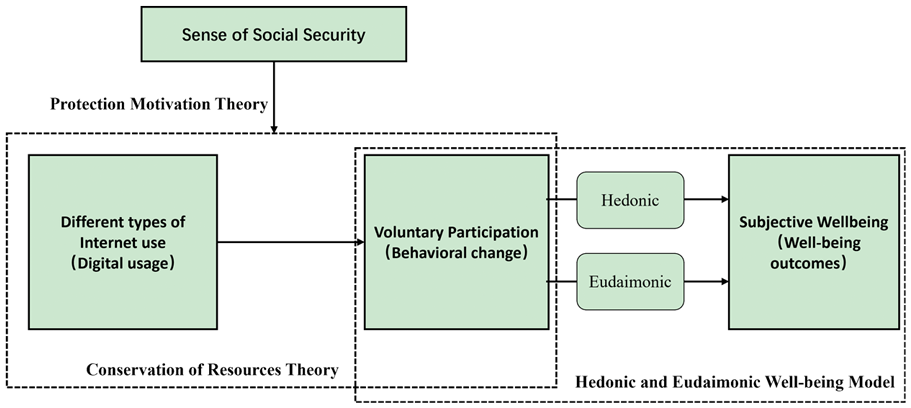
Hypothesized model.
Aims and Hypotheses
Considering China’s rapid digital transformation marked by prevalent ICTs adoption and escalating concerns over mental health as a pressing public health issue, this study explores the mechanism lining different ICTs usage patterns to life satisfaction, specifically considering the mediating role of volunteering and the moderating influence of perceived social security in shaping these relationships. Three hypotheses are proposed as below:
First, drawing on a synthesized theoretical framework integrating Conservation of Resources theory and the Hedonic-Eudaimonic Well-Being Model, we hypothesize that volunteering mediates the relationship between ICTs usage and life satisfaction. Specifically, we posit that greater adoption of ICTs may enhance life satisfaction by fostering increased participation in volunteering activities. Formally stated:
H1: Higher levels of ICTs adoption are positively associated with increased volunteering participation, thereby contributing to enhanced life satisfaction.
Second, we propose that the mediating role of volunteering in this relationship is moderated by individuals’ sense of social security. Regarding the Protection Motivation Theory (Marikyan & Papagiannidis, 2023; Rogers, 1975), we hypothesize that individuals with higher SSS are more likely to leverage ICT-derived resources to volunteer, amplifying improvements in life satisfaction. Formally:
H2: The mediating effect of volunteering on the relationship between ICTs usage and life satisfaction is moderated by SSS, such that the indirect effect is stronger among individuals with higher SSS.
Third, we hypothesize that the mediation-moderation mechanism may vary across distinct types of ICT usage. Building on prior research (Bekkers, 2005; Gil de Zúñiga et al., 2017; Meier & Johnson, 2022), we anticipate that the mediating role of volunteering will differ between ICTs used for information-seeking, social interaction, and recreational purposes. Specifically:
H3: The indirect effect of ICT usage on life satisfaction through volunteering is stronger for information-seeking and socially oriented ICT usage compared to recreational ICT usage.
Material and Methods
Data Sources and Sample Selection
Data in this study were obtained from the 2021 Chinese Social Survey (CSS), which is a large-scale cross-sectional survey with national representation designed to explore sociodemographic details, as well as the work and living conditions, along with social engagement, of individuals aged 18 to 69 years. Using a multistage, stratified, probability-to-size proportional cluster sampling method, this survey recruited a total of 10,283 individuals across 604 villages/communities and 151 counties/districts from 31 provinces/autonomous regions in China (Chen & Cheng, 2022). Detailed information regarding sampling strategies, ethnic approval, and other procedures could be seen elsewhere (Li & He, 2022). From an initial pool of 10,283 respondents recruited through this rigorous protocol, we excluded participants who are non-internet users (with the question “Do you regularly use the Internet?,”n = 3,372), and with missing values on main variables including life satisfaction, volunteering activities, and sense of social security (n = 3,471). As a result, this study includes 3,440 respondents.
Measures
Statistical Strategies
Descriptive analyses were conducted for all variables in this study. Mean score and standard deviation were reported for continuous variables, whereas the frequency and proportion of items were estimated for categorical variables. Multivariate regressions were employed to examine the associations of different ICTs usage, sense of social security, and volunteering with life satisfaction. To rigorously test our hypothesized cascade effects—where Internet use influences well-being through voluntary participation while the sense of security moderates these pathways—we conducted path analysis (a special case of structural equation modeling without latent variables). This approach overcomes the critical limitations of sequential regression models by simultaneously estimating all direct/indirect relationships in a single covariance structure (Kline, 2023), thereby properly handling correlated mediators and avoiding inflated Type I errors from stepwise testing (Hayes, 2017). Path analyses were then conducted to investigate the hypothesized mediation and moderation effects. Direct, indirect, and total effects of mediation models were reported, with bias-corrected bootstrap confidence intervals (CI) calculated using the bootstrap approach to estimate the 95% CI of the standardized indirect effects. All analyses were performed using STATA 17.0.
Results
Descriptive Analysis
Among 3,440 respondents in the sample, the average age was 41.430 years old (SD = 13.879), with party members comprising 11.5% of the participants. In 2021, the majority of residents used the Internet for activities such as browsing news, learning, chatting, doing business, and recreation more than many times a week. Moreover, 13.3% of total respondents reported participating in volunteer activities, with an average sense of social security level of 3.134 (SD=0.484). The respondents’ life satisfaction was relatively high (Mean = 7.433, SD = 2.059). Descriptive statistics are presented in Table 1.
Descriptive Statistics of Variables (N = 3,440).

Multivariate Regression Analysis
Table 2 displays the results of five regression models. Across all models, volunteering and the sense of social security demonstrated significant positive associations with individuals’ life satisfaction. With regard to ICTs usage, browsing news (beta = .132, p < .001), learning (beta = .138, p < .001), chatting (beta = .072, p < .001), business (beta = .069, p < .001) or playing (beta = .073, p < .01) are all positively associated with better life satisfaction, indicating that a higher level of ICTs usage often linked with better mental health outcomes, despite of its purposes in information-seeking, socially-oriented of just for recreation.
Multivariate Linear Regression Models Predicting Life Satisfaction.

Note. For each of the variable, standard errors in parentheses.
p< .01, ***p< .001.
Testing for Moderated Mediation
Building on the theoretical framework and prior studies, it was hypothesized that a sense of social security (SSS) moderates the mediating role of volunteering in the relationship between ICTs usage and life satisfaction outcomes. Five types of ICTs usage were examined as independent variables, respectively. Table 3 presents each model’s Akaike Information Criterion (AIC) and Bayesian Information Criterion (BIC) values. Overall, the model fit indices indicated that all models demonstrated acceptable levels of fit.
Model Fit Indices.

More detailed, as shown in Table 4, increased volunteering partially mediated the relationships of browsing new and business with life satisfaction. However, this mediation effect was not significant for ICTs usage like learning, chatting, and playing. Specifically, more frequent news browsing is associated with increased volunteering (beta = .85, p = .001), which is then linked with greater life satisfaction (beta = .42, p < .001). Similarly, using ICTs for business is associated with increased volunteering (beta = .35, p = .034) then enhanced life satisfaction (beta = .44, p < .001).
Regressions of SSS Moderate the Mediation Process.

p < .05, **p< .01, ***p< .001.
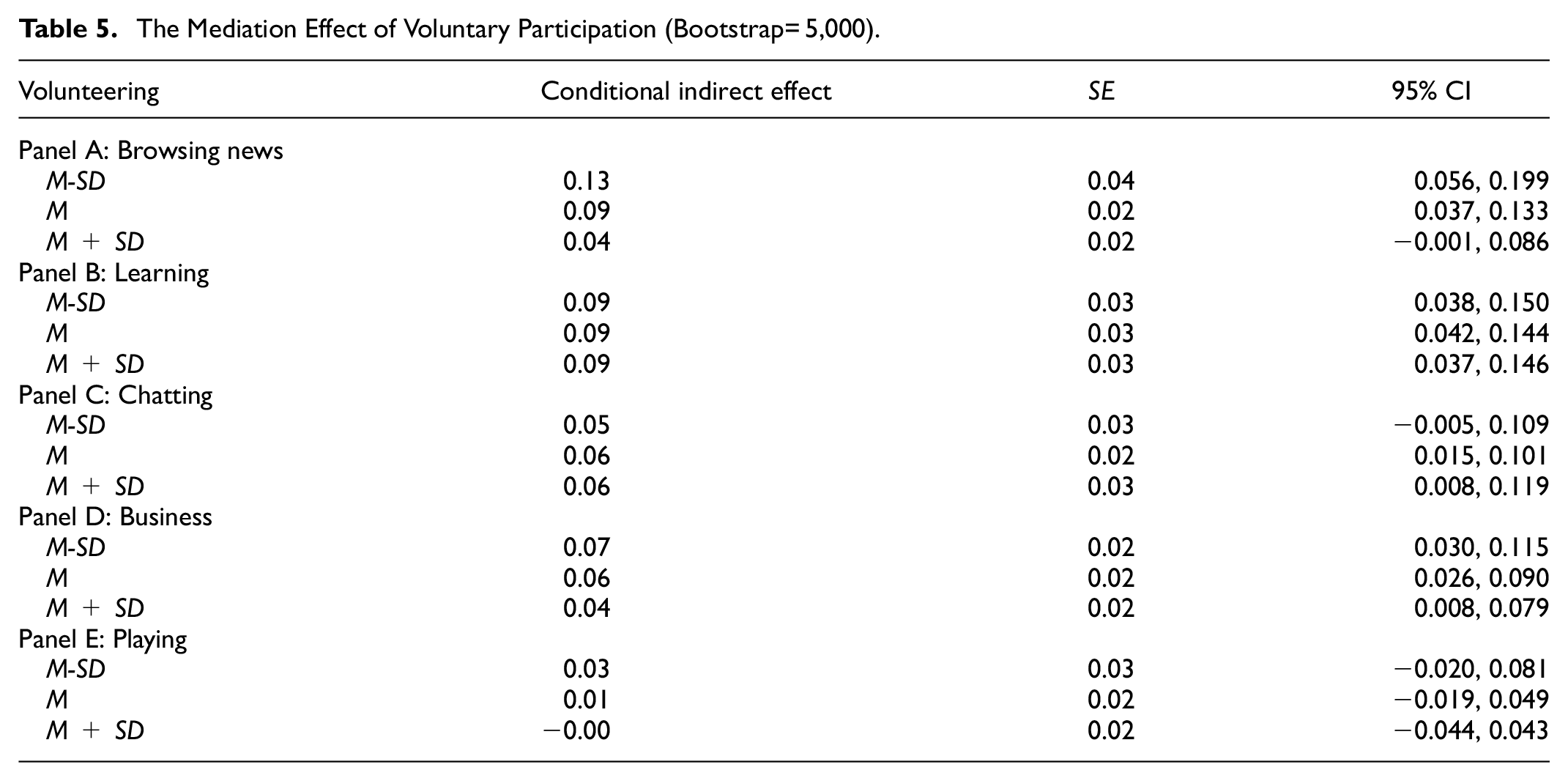
However, the moderation of SSS on volunteering’s mediation was only significant for browsing news. For individuals whose SSS was at an average level, the indirect effect of volunteering was about 0.09 (SE = 0.02), and for those with lower SSS, this mediation effect was 0.13 (SE = 0.04), by contrast, became non-significant for individuals with higher SSS (effect = 0.04, SE = 0.04; Table 5).
The Mediation Effect of Voluntary Participation (Bootstrap= 5,000).
Discussion
Using data from 3,440 individuals in the Chinese Social Survey, this study examines the mediating role of volunteering in the relationship between distinct types of ICTs usage and life satisfaction, while accounting for the moderating influence of sense of social security. Findings confirm positive associations between all forms of ICTs usage and higher life satisfaction. However, volunteering exhibits a significant mediating effect only for ICT activities involving browsing for news and business purposes. Crucially, SSS negatively moderated the association between browsing current affairs/political news and volunteering, indicating a stronger indirect pathway to life satisfaction among individuals with lower SSS. These results illuminate the complex interplay between digital engagement, prosocial behavior, and life satisfaction. Several findings warrant further discussion.
First, while corroborating established positive links between ICTs usage and life satisfaction (Islam & Samak, 2024; Jing et al., 2023), this study identifies volunteering as a partial explanatory mechanism. This aligns with the Conservation of Resources (COR) theory (Hobfoll, 1989, 1998), suggesting ICTs function as catalysts for resource-driven prosocial behavior, thereby bridging digital engagement to enhanced life satisfaction. Moreover, despite prior research primarily emphasizing the frequency or density of ICTs usage, this study focuses on the diversity of ICTs usage. It suggests mediation via volunteering proved significant exclusively for browsing news and business activities, contrasting with non-significant effects for learning, chatting, making friends, and recreation. This divergence might stem from the resource specificity inherent to each ICTs usage type. More detailed, news browsing furnishes cognitive resources (e.g., awareness, knowledge) that facilitate volunteering participation (Hobfoll, 1998), while business-oriented use enhances economic efficacy and provides financial resources, lowering barriers to volunteering (Hobfoll, 1998). Conversely, learning-focused ICTs typically reserves resources for personal skill development without embedding users in social networks conducive to volunteering; chatting often yields transient connections and weak-tie resources, insufficient to sustain the commitment and trust required for formal volunteering; and recreational ICTs usage primarily stimulates hedonic gratification, which rarely translates into altruistic motivation. This finding is consistent with what Tencent Foundation, a pioneering online charitable platform in China, has observed. It employs multifaceted strategies such as community building, information dissemination, and corporate collaboration to encourage the public’s engagement, and found that users viewing program details or participating in the “XiaoFeiJuan” initiative (e.g., triggering a 0.1RMB enterprise donation per 10 RMB purchase) showed a 37% higher donation rate compared to counterparts with exclusively recreational behaviors, and over 10% of these positive users subsequently volunteered in person (IAVE, 2023; Tencent, 2020). Thus, while ICTs hold the potential to foster life satisfaction via prosocial behavior, this pathway is highly contingent on the nature of ICTs usage; henceforth, programs aligned with the COR theory that could amplify the prosocial benefits by teaching users to consciously cultivate cognitive and economic resources through specific ICTs usage might be critical.
Moreover, this study finds a counterintuitive pattern describing the indirect effect of browsing on life satisfaction (via volunteering) diminished as SSS increased. This contrasts with non-significant moderation effects for other ICTs activities (learning, chatting, business, recreation), whose purposes and resource gains are either self-contained or exhibit less direct motivational pathways to volunteering. Browsing news as an exploratory and low-commitment activity uniquely depends on a motivational push to convert cognitive resources into prosocial action. More specifically, high SSS individuals experience reduced motivational pressure to transform passive browsing into active volunteering, as their existing safety diminishes perceived risks of inaction, while browsing satisfies curiosity or entertainment needs without necessitating reciprocal community engagement (Hallmann et al., 2018; Malinen & Mankkinen, 2018). By contrast, low SSS individuals facing heightened perceived risks of isolation often take browsing as a critical gateway to seek support networks, and their insecurity motivates resource investment in volunteering to cultivate belonging and reciprocal aid, therefore facilitating the volunteering pathway. This finding underscores a fundamental theoretical insight that SSS moderates mediation pathways only where ICTs usage involves exploratory resource acquisition requiring conversion into prosocial behavior. Consequently, disaggregating ICTs usage and integrating psychosocial moderators like SSS is imperative for understanding digital well-being outcomes.
This study provides several theoretical contributions to understanding the psychological impacts of ICTs usage. In general, we advance a novel integrative framework combining COR theory, the Hedonic and Eudaimonic Well-being framework, and the Protection Motivation Theory. This synthesis provides a more comprehensive mechanism explaining how ICTs usage translates into life satisfaction. More specifically, we identify a nuanced mechanism between ICTs usage and subjective well-being with a disaggregating ICTs usage and resource specificity perspective. We challenge the notion of ICTs usage as a monolithic construct and demonstrate that the mediating mechanism of volunteering is critically contingent on the specific type of ICTs usage and the nature of the resources it provides. Also, we reveal the conditional nature of PMT’s application within the digital-prosocial domain and suggest SSS moderate the mediating effect of volunteering only for exploratory, low-commitment ICTs usages like browsing news. These contributions shift the theoretical focus from whether ICTs affect well-being to under what specific conditions, through which resource pathways, and for whom digital engagement fosters life satisfaction via prosocial behaviors.
This study also sheds light on activities and practices to effectively leverage ICTs for fostering volunteering and life satisfaction. First, we urge for digital literacy interventions and platform reconfiguration programs aligning with the resource-specific pathways identified through our mediation analysis. More detailed, for ICTs environment such as news and business platforms of rich resources, it might be critical to embed contextually relevant volunteering cues within news aggregation services or e-commerce interfaces, and develop targeted curricula training users to identify credible volunteering opportunities, thereby further accelerating the rate of ICTs usage to volunteerism conversion. For ICT platforms emphasizing recreation or other social-oriented functions, it might be helpful to redirect recommendation systems from passive entertainment toward prosocial resource-activating content, and replace the generic social sharing prompts with structed calls to action to stimulate latent prosocial motivation through behavioral nudges. Second, tailoring outreach by users’ sense of social security might be critical, to ensure low-SSS populations encounter low-barrier, crisis-responsive volunteering gateways on news/community sites to address security-seeking motivations, while high-SSS groups receive prompts connecting civic duty to their security. Perhaps, encourage users of low SSS to identify security-enhancing volunteering and trigger duty-based messaging for high SSS users might be useful for tailoring prosocial engagement by sense of social security. In general, our framework and findings underscore the necessity of disaggregating ICTs usage and integrating user psychosocial context (e.g., SSS) for accurate theoretical modeling of digital mental health effects.
However, several limitations should be acknowledged. First of all, while cross-sectional studies like ours can provide valuable insights into mediating processes (MacKinnon, 2008), they cannot establish causality. Hence, it is imperative that future research utilizes longitudinal designs in order to procure more comprehensive assessments of both the immediate and enduring impacts of ICTs usage and volunteering on subjective well-being. Moreover, this study only examined the mediating effect of volunteering and the moderating effect of SSS in the relationship between ICTs usage and subjective well-being. As a result, future study is required to test other possible moderators and mediators that may contribute to a more comprehensive understanding of the relationship between ICTs usage and well-being.
Conclusion
Based on data from a sample of 3,440 Chinese adults, this study is among the pioneering efforts to investigate both the mediating role of volunteering and the moderating influence of perceived social security in the link between different ICTs usage and life satisfaction. The results demonstrate that increased involvement in volunteering acts as a positive mediator in the relationship between ICTs usage for browsing news and business with individuals’ well-being. Meanwhile, this mediation effect is moderate by SSS for ICTs targeting browsing news. These findings contribute novel perspectives to understanding how distinct patterns of ICTs usage relate to life satisfaction and highlight the importance of integrating both behavioral patterns and contextual perceptions in the study of digital well-being.
In conclusion, existing research underscores the intricate relationships between ICTs usage, volunteering, and life satisfaction, suggesting that social security moderates these interactions, whose findings shed light on the life satisfaction promotion in the digital era.
Footnotes
Acknowledgements
We acknowledge the Chinese Academy of Social Sciences for providing high-quality, nationally representative data.

Ethical Considerations
Data for this study was obtained from the Chinese Social Survey (CSS) 2021 conducted by Chinese Academy of Social Sciences (CASS). As this study uses de-identified data, additional ethical approval was waived.
Consent to Participate
This study uses data from the Chinese Social Survey (CSS). All respondents provided written informed consent before the survey started.
Author Contributions
Xiaorui Huang: Funding acquisition, Project administration, Writing – original draft, Writing – review & editing, Conceptualization. Yujia Hou: Methodology, Data Analysis, Writing – review & editing. Mingqi Fu: Data Analysis, Writing – review & editing, Conceptualization. All authors have read and approved the manuscript.
Funding
The authors disclosed receipt of the following financial support for the research, authorship, and/or publication of this article: This study was supported by Huaqiao University’s Academic Project Supported by the Fundamental Research Funds for the Central Universities(25SKGC-QT03).
Declaration of Conflicting Interests
The authors declared no potential conflicts of interest with respect to the research, authorship, and/or publication of this article.
Data Availability Statement
Data will be made available on request.