



Abstract
Research into language learning demotivation has tended to focus on the identification of discrete factors resulting in demotivation. In this article, we report an investigation into the interrelationship among factors eventually leading to demotivation using a sequential exploratory mixed-methods design. In Study 1, 13 participants were interviewed about their demotivation experiences and what factors, they perceived, had led to demotivation over a period of 12 months. We then used these results to formulate a demotivation model. In Study 2, we tested the generalizability of this model on a larger sample (N = 2044). Using structural equation modeling, our results showed that the model fit the data, and most of its paths were statistically significant. This model showed that having a fixed mindset had one direct and two indirect paths to demotivation. The two indirect paths were through lowering the learner’s ideal L2 self and through feeling disappointed by setbacks. We discuss the implication of our findings for language learning and teaching.
Demotivation is a gloomy topic to which many classroom teachers readily, and cheerlessly, relate. Along with teaching strategies, teachers are also expected to devise and implement various motivational strategies to keep reluctant learners motivated over time (Dörnyei, 2001a). In many contexts, it would be very rare to find a class of highly and consistently motivated learners—a situation that would certainly be the envy of fellow teachers.
Another worrying concern is that research has repeatedly shown that learner motivation tends to decrease over time. For example, in a study by R. C. Gardner et al. (2004), the researchers documented a decline in a number of motivational variables over a period of 1 year. The variables that were most susceptible to this declining trend were those directly related to what was happening within the learning situation, such as daily motivational intensity and evaluation of the teacher and the course. Similar results were obtained in other contexts as well (e.g., Al-Hoorie, 2019; Inbar et al., 2001; Williams et al., 2002). This declining motivation adds a further burden on teachers.
Attempts to remedy this situation and help learners recover from demotivation have led to the emergence of a relatively new area of research called remotivation (Carpenter et al., 2009; Falout, 2012). Remotivation refers to the process of recovery from demotivation as facilitated by positive internal or external factors. The primary aim of remotivation research, therefore, is to understand factors contributing to motivational decline and to investigate the effectiveness of different coping strategies in preventing this trend or reversing it. This line of research has recommended a number of remotivational strategies, mostly related to what learners can do to self-regulate their learning such as improving study skills and competing with friends for fun (for a review, see Kikuchi, 2015).
Because remotivation is still an under-researched area, the goal of this study was to shed light on what factors learners perceive as contributing to demotivation and subsequent remotivation, and how these factors are interrelated. We first interviewed a group of learners to formulate a demotivation model and then tested the generalizability of this model on a larger group of participants.
From Demotivation to Remotivation
Demotivation refers to the gradual loss of motivation over a relatively long period of time (e.g., over the course of weeks, months, or semesters, as opposed to within a single lesson). Originally, demotivation was attributed primarily to external factors that lower motivation (Dörnyei, 2001b) such as the classroom atmosphere and the teaching method, though subsequent demotivation research has highlighted the importance of internal factors as well (Kikuchi, 2015), such as self-confidence and negative attitudes. Considering that individuals vary in how they perceive and react to demotivators, Kikuchi (2015) also called for research exploring demotivational mechanisms to better understand how individual learners process demotivating factors and why learners may react differently to the same factors.
Nakata (2006) proposed three stages describing the feeling of discouragement that students may go through. The first stage is the initial demotivation that the learner may experience as a result of negative experiences, such as poor grades or an ineffective teaching approach. This initial demotivation can be passing, and the learner may recover from it after some time. However, if this demotivation is not addressed, the learner may transition to amotivation, which refers to a lack of motivation, passivity, and a feeling of purposelessness (Ryan & Deci, 2017). If this amotivation status also remains unaddressed, the learner may descend into learned helplessness (see below).
Reversing this trajectory and regaining interest in learning is remotivation. Remotivating learners requires more than listing a number of creative remotivational strategies, however. It would be more effective to tap into the source of demotivation and address it. Furthermore, rather than identifying discrete demotivation factors, it is also essential to recognize the subjective interconnections among these factors as perceived by the learner (Kim & Kim, 2013) as well as the adaptive and maladaptive coping strategies (Falout, 2012) that learners utilize to deal with their demotivation (see also Al-Hoorie, 2017). In other words, it is crucial to uncover the subjective reality of the demotivation process. In the next sections, we, therefore, review major factors associated with demotivation before presenting our study, which attempts to draw connections among them.
Language Learning Mindset
One potential internal factor is the learner’s implicit theories (i.e., mindsets) about their own abilities (Dweck, 1999). In this context, a mindset refers to whether one believes that qualities such as intelligence and talent are fixed or changeable traits. Mindsets have been shown to shape individuals’ thoughts, behaviors, and feelings, and consequently make them think, feel and act differently in identical situations (Dweck & Molden, 2005). Learners with a growth mindset believe that their ability is malleable, and so failures and setbacks are construed as an integral part of the learning process. In contrast, learners with a fixed mindset consider their ability as inborn, and therefore failure constitutes a threat to their confidence and self-esteem (Lou & Noels, 2019; Yeager et al., 2019). Research has also shown that individuals can hold distinct mindsets in relation to different areas (Dweck, 1999). For example, one may have a fixed mindset in relation to intelligence, but a growth mindset in relation to personality, social relationships, and sports.
Although it was initially suggested that language beliefs may be a fixed system of knowledge formed at an early age and thus cannot be easily changed (Peacock, 2001; Wenden, 1998), recent research has demonstrated that language beliefs are dynamic and can change under certain contingencies (Yeager et al., 2016). For example, after experiencing success or failure, directing praise or criticism to intelligence, personality, talent, or a God-given ability can promote a fixed mindset. In contrast, when feedback is specific, constructive, and genuine, and when it is directed to effort, strategies and skills, a growth mindset can be cultivated. Teachers’ own mindsets, therefore, play a key role in creating and developing different mindsets through how teachers interpret mistakes and failures during the learning process (e.g., Cimpian et al., 2007; Rattan et al., 2012, 2015).
Most initial research into mindsets was conducted in lab settings. Interventions conducted outside lab settings provided mixed results. A meta-analysis of such field interventions showed that changing mindsets led only to a minor improvement in academic achievement (Sisk et al., 2018) or none at all (Foliano et al., 2019). Nevertheless, mindset interventions seem particularly helpful to learners who are academically at risk and who come from a low socioeconomic background. Furthermore, a recent, nationally representative intervention involving secondary school students in the United States showed that the mindset intervention was effective when peer norms aligned with the messages of the intervention (Yeager et al., 2019).
Within language learning, Mercer (2011) similarly argued that possessing a fixed language learning mindset (LLM) leads the learner to avoid challenges and to set lower goals, thus risking becoming demotivated over time (see also Lou & Noels, 2017, 2019). Along the same lines, research by Lou and Noels (2020) additionally showed that migrants with a growth LLM reported less anxiety, more language use, and higher proficiency, even after controlling baseline proficiency.
Ideal L2 Self
Another potential factor has to do with the strength of the learner’s ideal L2 self (Dörnyei, 2005, 2009). The ideal L2 self represents an ideal end-state that the learner wishes to reach. The ideal L2 self is assumed to derive its motivational effect from the discrepancy between current and ideal self-states. The ideal L2 self has been studied extensively during the past two decades, though most research has examined correlation with other self-report measures rather than more meaningful language learning outcomes (see Al-Hoorie, 2018, for a meta-analysis).
Although the ideal L2 self has shown a strong association with self-reported intended effort, correlation with other, more tangible learning outcomes was not as strong (e.g., Hiver & Al-Hoorie, 2020a; Lamb, 2012; Moskovsky et al., 2016). The standard instrument used to measure the ideal L2 self primarily focuses on “imagination” and whether the learner can imagine him/herself learning the language successfully at some point in the future, rather than the discrepancy between actual states and ideal self-guides. This measurement focus led some researchers to suggest relabeling this instrument as the imagined self (Al-Hoorie, 2018).
Nevertheless, Dörnyei et al. (2016, p. 22) have argued that future self-guides have evolved into a specific form of vision, conceptualized as the vivid mental image of successfully achieving the desired goal. Without such a future-directed end goal, it is likely that the learner will be prone to demotivation over time (Kikuchi, 2019). It has also been argued that such future-directed vision is essential for directed motivational currents (Muir, 2020) or sustained flow (Ibrahim & Al-Hoorie, 2019), though close examination shows that vision and goal are not clearly distinct constructs (Al-Hoorie & Al Shlowiy, 2020).
Learning Disappointments
Motivation and demotivation are not completely parallel constructs. Factors relevant to motivation may not be relevant to demotivation, and vice versa. For example, language learners may feel disappointed by their proficiency level, relative to the amount of time and effort they have put into learning. This disappointment may be demotivating, but lack of disappointment per se may not necessarily be a motivating factor. This is why demotivation factors need to be investigated in their own right, rather than treating them as the flip side of motivating factors.
Although the inevitable disappointments that take place in academic settings can be an important factor contributing to demotivation, little research has examined how language learners navigate these disappointments. Testing and evaluation are part and parcel of academic life, and the average learner is bound to encounter setbacks from time to time. For some learners, such setbacks are an indication that success and failure are governed by factors beyond one’s control, ultimately leading to disillusionment and learned helplessness (Abramson et al., 1978; Noels et al., 2000) and even impostorism (Clance & Imes, 1978; R. G. Gardner et al., 2019). Other learners, in contrast, exhibit learned resourcefulness (Akgun & Ciarrochi, 2003; Rosenbaum, 1989), which allows the learner to access a behavioral repertoire of emotional and cognitive reactions to ameliorate stressful situations and to sustain resilient functioning (Yun et al., 2018). Nevertheless, a 4-year longitudinal study reported that learned resourcefulness does not improve over time (Ceyhan & Ceyhan, 2011), thus making learners vulnerable to demotivation with increasing academic pressure.
The Present Study
Although these three factors; growth mindset, ideal L2 self, and resourcefulness toward academic disappointments; have been argued to play an important role in motivation and achievement, empirical results have not always shown strong support as reviewed above. One possible explanation for such findings is that a better understanding of these factors is needed. A second, though not mutually exclusive explanation, is the need to consider these factors in tandem. Motivational factors are commonly treated as discrete variables examined in isolation (Hiver & Al-Hoorie, 2020b; Hiver et al., 2020; Larsen-Freeman & Cameron, 2008), but integrative investigations can shed important light not captured when motivational factors are studied separately (Joe et al., 2017; Kikuchi, 2015; Yun et al., 2018).
In the present investigation, we, therefore, set out to understand demotivation through the lens of learners themselves. Our aim was to investigate how learners’ individual experiences were related to language learning demotivation and how their demotivation changed and interacted with their environments (Kim & Kim, 2013). To this end, in Study 1, we conducted a small-scale qualitative study of 13 participants who provided personal accounts of their demotivation. This study, therefore, allowed us to formulate a model of demotivational dynamics. Our three-part research question for Study 1 was:
Acknowledging the limitations of qualitative methodology, Study 2 involved a large-scale survey involving more than 2,000 learners. Study 2 allowed us, first, to test the generalizability of the model we obtained in Study 1 and, second, to quantify the relationships between the different variables in the model. This approach has been described as a sequential exploratory mixed methods design that generates and tests a model (e.g., Plano Clark & Creswell, 2008). More specifically, Study 2 used structural equation modeling (SEM) to answer the following research question:
In combination, thus, Studies 1 and 2 enabled us to propose a demotivation model and then test this model with a large sample of participants from the same population.
As Study 2 used SEM, we recognize that, ultimately, SEM is used to test causal relationships, and not just correlations. In our case, we extracted the directionality of the hypothesized causal relationships from the results of Study 1 and built a model representing the causal paths perceived by the participants. In Study 2, we then tested the generalizability of these perceptions. Our goal from this procedure was to identity the subjective reality underpinning demotivation.
Furthermore, researchers using SEM are expected to test competing models to avoid confirmation bias (e.g., see Hiver & Al-Hoorie, 2020a). However, as only one model emerged from Study 1, it was the only model we tested. We, therefore, acknowledge that the possibility of other models to represent demotivation. We elaborate on this limitation later.
Study 1
Participants
Thirteen female Saudi language learners (aged 18–20) volunteered to participate in this study. They were studying English as part of a foundation year requirement in preparation for their majors, attending classes 20 hours a week. These learners were recruited from a larger group of learners who responded to a public call for participants who had experienced demotivation and who were willing to discuss their experiences candidly. The participants had studied English as a school subject for at least 8 years, though they rated themselves as having low competence. Generally, there is little opportunity for learners to practice their English outside of the language class in this context.
Data Collection
Three semi-structured interviews were conducted with each participant over the course of 12 months. To explore the factors and conditions that explained variation in learners’ demotivation and remotivation, the participants were asked to share their beliefs, thoughts, feeling, explanations, attributions, and dreams about their English learning experience as a long journey involving a combination of halts, obstacles, challenges, boredom, enjoyment, rewards, and discovery. In each of the three interviews, conducted a few months apart, the participants were encouraged to reflect on and articulate their demotivational processes, elaborate on the factors perceived to have caused their demotivation, and the interaction among different motivational factors. The interviews were conducted in Arabic, the participant s’ native language.
Data Analysis
The interviews were recorded, translated into English, and transcribed. The accuracy of the translation was then checked by a native speaker of Arabic who is fluent in English. The scripts were then read carefully to explore diverse accounts, find frequent patterns, identify differences among these patterns, and extract common demotivation-related themes using NVivo 9. Following the principles of applied thematic analysis (Guest et al., 2012), initial codes were inductively identified. The emerging codes were grouped into themes, and then these themes were classified into higher level conceptual themes. As an illustration, responses related to what made the participants feel vulnerable or resilient were grouped under vulnerability and resilience themes, and then these themes were linked via higher order themes (e.g., dealing with failure). This approach facilitated drawing a meaningful and coherent picture of the patterns emerging from the data.
To understand the interconnections among themes, the themes were analyzed following a process coding approach (Saldaña, 2016). Process coding is an analytical strategy that permits the researcher to uncover a sequence of events leading to an outcome as perceived by interviewees. Special attention was paid to how the different demotivating factors related to and interacted with each other, and common themes were grouped until final codes clearly emerged from the data. Using particular instances in the qualitative data, a bigger map of possible relationships between variables was developed. Finally, for the purpose of respondent validation, the resulting demotivation model was presented to the participants, who confirmed that it reflected their demotivation dynamics (for more details, see Albalawi, 2018).
Results
Language learning mindsets
The qualitative analysis revealed that demotivation occurred when internal or external factors broke some of the constituents of the learner’s expectations about the learning process and its outcomes. However, the diverse ways by which learners perceived different internal and external factors seemed to a large extent a function of the LLM held by each learner. Different LLMs had demotivational or remotivational power. In other words, the way they perceived factors such as the teacher’s role, their language learning ability, and their effort had an important impact on their motivation, demotivation, and remotivation processes.
A major finding of this study was that it was not only merely the identification of the demotivating factors that mattered but also the way these factors were perceived by individual language learners. A recurring finding in the qualitative analysis was that learners did not perceive demotivating events similarly across the board even in seemingly identical situations. Instead, the learner’s LLM, as fixed or malleable, shaped how one perceived these demotivators.
The ability to learn a second language was perceived by language learners possessing a fixed mindset as being limited and naturally gifted, while growth mindset learners believed that this ability could be increased through effort and practice. Therefore, when language learners attributed their own or others’ past failures and successes to “ability,” their motivation to learn the language was influenced differently according to whether they believed that this ability was fixed or not.
Those learners who believed that their language learning ability was fixed also emphasized that having a natural ability, or a knack, was essential for success. They consequently reported avoiding challenges and potentially embarrassing situations to look confident and save face if the task seemed difficult. They also felt threatened by the successful experiences of others and questioned their own ability when they encountered high achievers. They additionally devalued hard work and effort, perceiving them as fruitless. All these factors apparently made them more sensitive to demotivating factors. Consider the following learner who emphasized the power of a natural language learning ability:
Not everyone can learn a second language. Some people are talented; they have something special that helps them to learn languages fast; they are naturally gifted. They pass the language courses easily without studying hard. I wish I was one of them. Unfortunately, I feel that without having that natural ability, studying English is like wasting my time. I would rather spend my time studying something I am good at. (ID101)
Contrary to these learners, other interviewees made statements that indicated their tendency to endorse a growth mindset. These learners believed that the ability to learn a second language could be enhanced through effort and hard work. When they failed, these learners blamed their lack of effort or “carelessness.” In fact, all interviewees who reported having successful language learning experiences valued hard work and effort and believed in the malleability of ability. They reported being more determined, autonomous, resilient, and more committed to overcoming learning challenges. They embraced challenges and felt inspired by others’ successful experiences. According to one of these learners,
Everyone can learn a second language. It just needs time, patience, and effort. If I fail, I mainly blame myself for being careless and not trying harder using different strategies to increase my language ability. Learning English is like learning how to drive and cook. You start weak but the more you practice, the stronger you become. (ID102)
Ideal L2 self
Interestingly, the qualitative analysis also revealed that LLMs seemed to influence the construction of an ideal L2 self. The data also showed that the remotivational power of the ideal L2 self might be obstructed by the demotivational power of a fixed LLM. Learners with a fixed LLM reported that they did not possess a strong sense of an ideal L2 self. They specifically attributed this weak ideal L2 self to their belief in the unchangeability of language learning ability. In fact, several interviewees used the expression “I can’t imagine myself” as a successful learner. This pattern sometimes emerged in the context of using the language fluently, while in other times, it emerged after failures and setbacks. Some learners reported “lowering their expectations” of the type of learner they would like to be. As two learners explained,
I always imagine myself when I am older, speaking English fluently with foreigners, or working in a career where everybody speaks only English. I even imagine myself studying abroad. These are all dreams. I wish I can achieve all these dreams. However, I realized that it is not easy to learn English. Every time I fail in the English test, I lower my expectations because I lose hope and feel that I am helpless to change my situation. I feel like I do not have the ability to be the person I always imagine myself to be. It feels like if you really are a good person who would like to help poor people, but you do not have the money to help them. (ID104)
During my first years of English learning, I knew that I would learn the alphabet, vocabulary, grammar and the basic expressions in English. . . however, when it comes to speaking and pronunciation, peoples’ abilities vary. I always knew that there was nothing I could do to improve it. . . I could only imagine passing the course but never imagined myself being a fluent speaker of English. (ID105)
These learners could not create a vision of themselves speaking English fluently in the future, attributing it to their belief in the immutability of their language learning ability. As a result, their motivation to develop their language skills decreased over time as they put in less and less effort. In other words, the learners with a fixed mindset reported failure to create a clear and vivid image of an ideal L2 self, consequently demotivating them.
Disappointment
Disappointment appeared to be a major factor contributing to demotivation. Learners with a fixed mindset expressed a lot of disappointment about their low (particularly oral) proficiency level and their failure to improve it, despite studying the language for several years at school. When they did not achieve the oral proficiency level they expected, they became helpless, blamed their own ability, and quit trying even when they were encouraged to do so by people around them. A commonly invoked reason for this disappointment is the ineffective teaching approaches used in their learning contexts. The following two examples illustrate this point: When I started learning English. . . I was shocked. . . disappointed. . . confused. . . it was different from what I expected. . . I expected to be able to speak as well as my cousins did. . . of course I was learning but not what I expected. . . it was all about grammar, books, exams and memorization. . . (ID106)
When I was a child, my dream was to speak English fluently as well as my father did. However, after trying hard and failing to make a conversation several times in different situations, I started to feel disappointed about the outcome of learning English at school. I gradually felt helpless and felt that I would never be able to achieve my goals. The situation now is worse than before. I hate being in an English class or listening to someone speaking English and try to escape the English class whenever I can. Even when my father told me that there was a good private English institution that he was willing to afford if I would like to enroll in an intensive English course, I refused because I felt that I would definitely fail to improve my English and waste his money. (ID109)
When they found that the educational system was memorization- and exam-oriented, these learners just gave up and did not try to put in extra effort to remedy their language deficiencies. It seems that the fixed mindset of these learners had led them to expect quick proficiency gains without experiencing setbacks in the process. This expectation, first, led to being disappointed when their proficiency did not develop as fast as they had hoped and, second, led them to lower their expectations and goals. In combination, these factors apparently contributed to their demotivation.
In contrast to these demotivated accounts, learners with a growth mindset actually perceived their slow progress as a reassuring sign of a normal developmental trajectory. They believed that all proficient speakers of English must have been beginners at one point and experienced similar difficulties in their language learning journey. Therefore, they did not feel disappointed or lower their expectations. As one learner stated,
I know that I am not a fluent speaker of English. I also know that I will not achieve fluency soon. I consider myself a beginner who can only make simple sentences, not a conversation. However, when I listen to the Saudi teacher who speaks English fluently or encounter other Saudi girls who are fluent speakers of English, I imagine them when they were beginners like me and how they remained committed to learning English until they achieved their goal. Being a beginner who speaks broken English is the first step of a long learning journey that will definitely lead to achieving fluency one day. (ID102)
Coping with failure
The data showed that even when language learners encountered setbacks and failure and perceived certain factors as being potential demotivators, the ensuing diverse responses were to a large extent the function of coping mechanisms they used to respond to demotivation. The LLM seemed to be the major factor that significantly influenced the learner’s responses to potential demotivators and their diverse applications and choice of adaptive (e.g., autonomous learning, increasing effort, or seeking for help and guidance) or maladaptive (e.g., denial, escaping, or cheating) coping mechanisms.
Learners who had a growth LLM perceived setbacks, failures, and mistakes as an opportunity for growth and a valuable source for learning and development. They demonstrated more resilience by applying adaptive strategies that helped them to remain motivated or to remotivate themselves. Examples of their statements included:
When learning English, I wish if I make a mistake every day, so I learn something new every day. (ID105)
My motivation and my concentration increase when the grammar lesson becomes more complicated or the vocabulary gets more difficult, but I feel bored when the teachers repeat information that I already know. (ID100)
In contrast, learners who had a fixed LLM perceived setbacks as more threatening than challenging and consequently were more likely to withdraw from stressful academic situations. They, therefore, remained demotivated for extended periods as they applied maladaptive coping strategies in the hope of reducing the negative emotional impact of demotivation, rather than changing their learning strategies to facilitate recovery. Examples of their statements included:
I felt that I was wasting my time. I stopped attending the English classes because I felt helpless. I could not see the point of attending the English class if I could not understand anything. (ID109)
Gradually, English class became like a 45-minute break where I ate, drank and secretly chatted with my friends. I even escaped the English class whenever I could. (ID105)
I became neglectful and did not touch the book if I had an English test. I stopped feeling anxious or worried before the English test. (ID107)
I used to say, “I’ll be fine.” Although I felt that I would never succeed in learning English, I never hated English. I always told myself that failing English did not mean that I am a failure because I was good at other subjects. (ID107)
Mindset change leading to remotivation
The data showed, curiously, that the LLM might change over time and that the mindset gradual change can influence the language learner’s motivational level. In cases where learners recovered from demotivation, some fixed-mindset learners gradually adopted a growth LLM for various reasons including: (a) encountering high achievers or hardworking learners, (b) observing their own growth and progress after trying new strategies and skills, and (c) experiencing the positive outcome of hard work. The LLM turned out to be key to success in recovery from demotivation in our data.
Indeed, growth LLM was key to success in every recovery case in our data. All demotivated learners who successfully bounced back and rebuilt their motivation after experiencing demotivation have associated recovery with changing their maladaptive beliefs about the malleability of their language learning ability. Consider the following example of a participant who held a fixed LLM before she encountered a proficient classmate who spoke English fluently. Contrary to others who questioned their own ability when encountering high achievers, this learner explained how her discussion with that successful classmate gradually changed her perception of her own language learning ability, and thereby remotivated her. Encountering a proficient learner at the same learning setting inspired her and changed her fixed LLM from “I lacked the ability” into a growth mindset characterized by the statement “It was too hard; I needed too much time and effort.” Even though, at that point, this learner still thought that language learning was “too hard,” this new perception represented a major shift from a complete lack of ability (impossible endeavor) to too much time and effort required (but still at least possible). This perception was triggered by the recognition that that proficient classmate achieved her goal through sustained effort rather than an innate language ability or a natural talent:
I have always thought of majoring in English but thought that I lacked the ability and talent. I even believed that you cannot learn a second language if you are not smart and talented enough. However, I met a friend in high school who had better grades in English than I did. She told me that she never travelled abroad, she attended state schools, and she studied English hard. I decided to buy a book to learn English in one week. I admired her and had a strong desire to be like her, but it was too hard; I needed too much time and effort. Now, I believe that the harder I work and the longer hours I spend, the better English learner I will be. (ID110)
This and other similar examples in our data indicated that LLMs can change over time. Thus, it seems possible for learners to modify their fixed LLM, to generate a growth mindset that facilitates recovery from demotivation, and to consciously reflect on this process. If the newly generated growth mindset is enhanced and maintained, long-term goals may be achieved.
Discussion
Study 1 involved interviewing a group of language learners about the factors that they perceived as contributing to their demotivation. The analysis revealed three factors as well as their interrelationships. As shown in Figure 1, it seems that the primary factor contributing to demotivation is the learner’s LLM. A fixed LLM seems to have both direct and indirect effects on demotivation. One indirect effect appears to be through lowering one’s ideal L2 self, and the other through causing disappointment about low (particularly oral) proficiency. Both holding a fixed LLM and being disappointed about proficiency seem to have further led to a lower ideal L2 self and thereby demotivated the learners. These findings, in turn, might help explain recent results showing a weak effect of mindset training interventions on academic achievement (e.g., Sisk et al., 2018). Our results suggest that the relationship between a fixed mindset and low academic achievement is not direct but partly mediated by demotivation, indicating that the impact might not be noticeable in the short term. Instead, the effect might be incremental and cumulative over a more extended period of time.
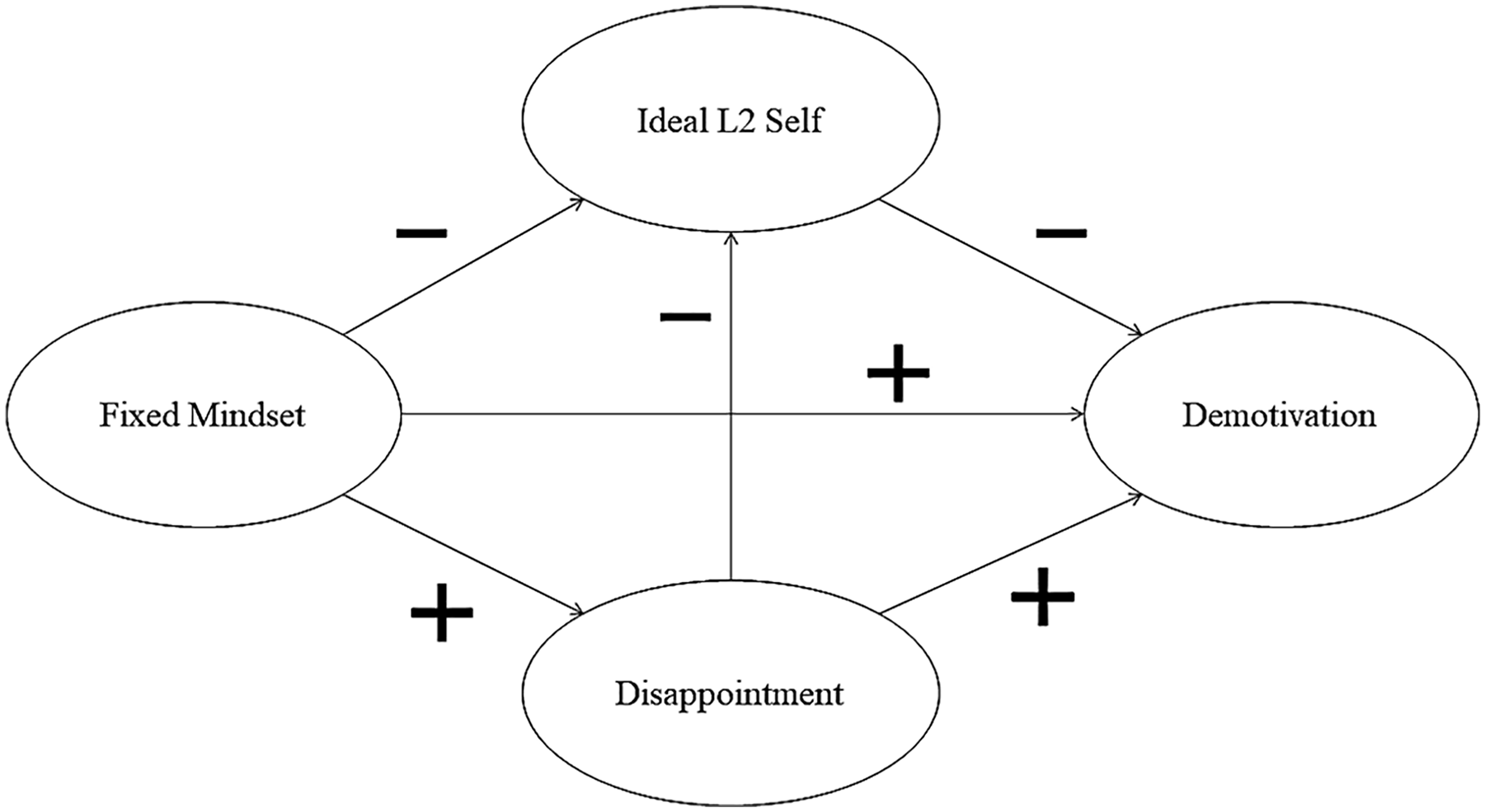
The hypothesized model emerging from Study 1.
Since Study 1 adopted a qualitative design, we were able to formulate the model shown in Figure 1 based on the learners’ perceptions. At the same time, the small sample of Study 1 allows neither confident inference to a larger population nor does it allow estimation of the magnitude of the relationships between these variables. Study 2 attempted to address these limitations by administering a survey to a larger sample and then testing the hypothesized model through SEM.
Study 2
Participants
A total of 2,044 participants (aged 18–24) volunteered to take part in this study. The participants (almost 90% female) were studying at the foundation year at a major Saudi university. The university in question accepts students from all over the country, thus its students represent different backgrounds. Around 53% of the participants were aiming for science-related majors whereas 46% opted for an arts-related major. Only 12% started learning English as early as Grade 1 or earlier, 52% from Grade 4, and 36% from intermediate school (Grade 7). Their proficiency self-ratings ranged from beginner (18%), elementary (21%), lower intermediate (22%), intermediate (28%), to upper intermediate (11%). The participants had diverse backgrounds, rural and urban, and graduated from different types of schools including public, private, and international.
Instrument
This study used four questionnaire scales, all adopting a 6-point Likert-type response format (Albalawi, 2018; see Appendix). Two scales were adapted from existing scales. The first was the LLM (Dweck, 1999), where a higher score indicated stronger endorsement of a fixed mindset. The second scale was the Ideal L2 Self (Taguchi et al., 2009), where a higher score indicated a stronger ideal L2 self. Two further scales were constructed based on the qualitative analysis in Study 1: L2 Disappointment and L2 Demotivation. To design two reliable scales, we adapted original statements and quotes that the participating students used to report symptoms of their disappointment and demotivation. In both scales, a higher score indicated higher levels of demotivation and of disappointment about oral proficiency. These scales were first piloted on a sample of 60 learners to verify comprehensibility. All scales were administered in Arabic to avoid language interference. (See “Results” section for reliability and validity of these scales.)
Data Analysis
SEM was used to test the hypothesized model (Figure 1) emerging from Study 1. The first step was examining the measurement model. After the scree plot showed that there were indeed four factors underlying the data, we conducted a confirmatory factor analysis with weighted least square mean and variance adjusted (WLSMV) estimation method using Mplus 7 (Muthén & Muthén, 1998–2012). We used WLSMV because it is suitable for ordinal data, makes no distributional assumptions about observed variables, and is less biased and more accurate than robust maximum likelihood (MLR) especially with large samples (Li, 2016). The measurement model part of the analysis also involved examining construct reliability and validity. The second step was the structural model, testing the fit of the model and estimating the structural paths. Missing data were handled using the default Mplus function, which estimates the model under missing data theory using all available data, and no paths were dropped due to nonsignificance.
Results
The measurement model showed adequate fit, χ2(48) = 165.717, p < .001, comparative fit index (CFI) = .994, Tucker-Lewis index (TLI) = .992, root mean square error of approximation (RMSEA) = .037, 90% CI [0.031, 0.043]. All standardized factor loadings were significant, and most were over .70, with the lowest being .68 (see Table 1). Most residuals were within ±2.0, with the smallest being −2.26. As Table 2 shows, the construct reliabilities were all above .70 while all average variance extracted values were over .50. The square roots of the average variance extracted values (shown in the diagonal of Table 2) were also larger than their respective inter-construct correlations, indicating adequate discriminant validity (see Hiver & Al-Hoorie, 2020a, for details on SEM considerations).
Standardized and Unstandardized Factor Loadings, Standard Errors, and z Ratios of Scales in the Measurement Model.

Note. All coefficients are significant at the p < .001 level.
Reliability, Validity, and Inter-Construct Correlations for the Scales of the Measurement Model.

Note. Values in the diagonal are the square roots of their respective AVE. CR = construct reliability; AVE = average variance extracted.
We then conducted the structural model. The results are presented in Figure 2 and Tables 3 and 4. Although having a fixed mindset had a direct effect on L2 Demotivation (β = .23), it also had an indirect effect of β = .25. In combination, having fixed mindset had a total effect of β = .48 on L2 Demotivation. In other words, learners with a fixed mindset may lower their Ideal L2 Selves, which subsequently leads to L2 Demotivation. Similarly, learners who endorse a fixed mindset might perceive their low oral proficiency with higher levels of disappointment, resulting in further L2 Demotivation. An interesting finding in the results is that L2 Disappointment did not significantly predict the Ideal L2 Self, suggesting that the effect of L2 Disappointment is not mediated by lowering the Ideal L2 Self.

Results of the structural model.
Standardized and Unstandardized Structural Coefficients, Standard Errors, and z Ratios for the Structural Model.
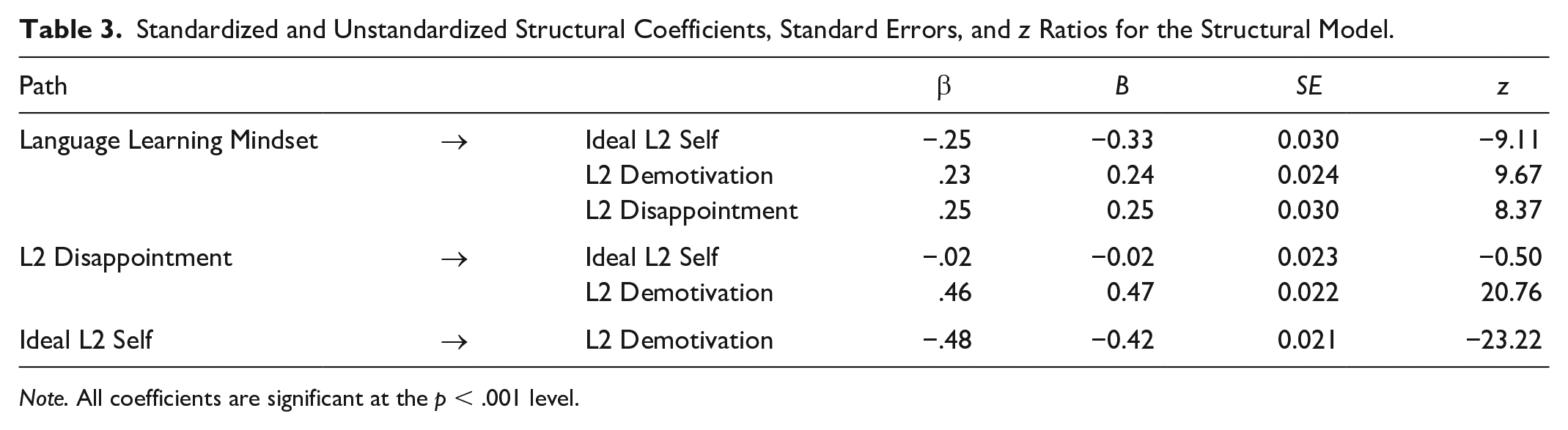
Note. All coefficients are significant at the p < .001 level.
Total, Direct, and Indirect Effects From Language Learning Mindset to L2 Demotivation.

Note. Mindset = Language Learning Mindset; Ideal = Ideal L2 Self; Demotivation = L2 Demotivation; Disappointment = L2 Disappointment.
p < .001.
Discussion
In this study, we conducted a large-scale quantitative study to test the demotivation model emerging from Study 1. Our results showed that the model was generalizable and showed adequate statistical fit. The model also estimated the strength of the associations among the variables, showing that having a fixed mindset, a weak ideal L2 self and feeling disappointed about one’s proficiency contributes to demotivation. The results additionally showed that having a fixed mindset contributed both directly and indirectly to demotivation. At the same time, our results did not provide support to a demotivation path of language learning disappointments through lowering the learner’s ideal L2 self. This finding supports the view that what matters is how the learner perceives setbacks and their competence to overcome them (e.g., Bandura, 1997; Dweck & Molden, 2005; Lou & Noels, 2019). Those who view lower oral proficiency as revealing their inherent deficiencies will feel disappointed and then demotivated. In contrast, those who see these same setbacks as a normal part of the learning process are unlikely to feel as disappointed.
General Discussion
In this article, our ultimate aim was to rethink language learning demotivation by exploring its complexity and the interrelationship among factors leading to it. Most research into language demotivation to date has focused on discrete demotivators and on equipping learners with strategies, or tricks, to overcome these demotivators. However, remotivating learners requires more than a list of strategies that might address the “symptoms” of demotivation. It requires identifying the root of this demotivation.
In response to recent calls (e.g., Kikuchi, 2015) to expand the focus of demotivation research, to take into account learners’ unique histories and backgrounds, and to investigate why learners react differently to seemingly the same demotivators, this article attempted to uncover the subjective reality of language learners who had experienced demotivation and remotivation. Our results revealed that demotivation experiences, perceptions, and explanations are highly individual, personalized, and unique. Crucially, LLM appeared to be the root cause of demotivation—at least among the other factors emerging from this investigation.
We conducted two studies. In Study 1, we interviewed a group of learners who recounted their experiences with demotivation and the factors they perceived as contributing to it. We analyzed the factors that made them behave and react differently and then proposed a model that explains the variation in their demotivational, motivational, and remotivational trajectories. However, the design of Study 1 did not permit generalizing this model or estimating the strength of the associations among its variables. To address these limitations, Study 2 tested the model on a larger sample. The results from Study 2 supported the model overall and most of its hypothesized paths.
The qualitative and quantitative results complemented each other by establishing a clear empirical link between LLMs and demotivation. The results revealed five paths leading to demotivation, as follows:
Believing that one’s language learning ability is fixed and inborn makes the learner susceptible to demotivation.
Belief in a fixed language learning ability also weakens one’s ideal L2 self.
Having a weak ideal L2 self can set off demotivation.
Belief in a fixed language learning ability also magnifies the impact of inevitable language-related disappointments.
Experiencing language disappointments (e.g., related to low oral proficient or teaching method) can contribute to demotivation.
In contrast, our results did not support the path involving language disappointments lowering the ideal L2 self and then bringing about disappointment. This suggests that feeling disappointed per se does not have as strong of an impact on the ideal L2 self as does having a fixed mindset.
Contributing to the recent developing interest among language learning researchers in LLM (e.g., Lou & Noels, 2017, 2019, 2020), our findings suggest that LLM plays a significant role within demotivation and remotivation. Possessing a fixed LLM leads to avoiding challenges and setting lower goals, thus risking becoming demotivated over time (Mercer, 2011). LLM seems to influence demotivation by guiding learners’ interpretations and shaping their responses to perceived demotivators. A fixed LLM can, therefore, cast a shadow on the language learning experience, resilience, and motivation, standing out as the key to failure in coping with and overcoming demotivation.
In other words, LLM may explain to a large extent why some learners remain demotivated for extended periods or even develop learned helplessness. Conversely, LLM may help explain why other learners use personal resources and effective coping strategies to positively adapt to potentially stressful demotivators or successfully recover from demotivation. Although Akgun and Ciarrochi (2003) and Yun et al. (2018) found that learned resourcefulness is essential for overcoming academic stress, sustaining resilient functioning and improving academic performance, Ceyhan and Ceyhan (2011) reported that learned resourcefulness does not improve over time. However, our results suggest that a fixed LLM can change over time and, when it does, learners’ resilience and resourcefulness may improve.
Our results additionally shed light on the adaptive and maladaptive coping strategies that learners used to deal with demotivation. LLM seems to have been a major influence on the selection of these strategies. LLM constituted a primary factor facilitating recovery from demotivation and helping previously demotivated students with different motivational needs to overcome setbacks and rebuild their motivation. Recognizing the subjective interconnections among the factors leading to demotivation and tapping into the source of demotivation (Kim & Kim, 2013) was vital for remotivating language learners.
It has been argued that a future-directed end goal is essential for motivation (Dörnyei, 2009; Kikuchi, 2019). Our results suggest that a fixed LLM can prevent the construction of an ideal L2 self. A weak ideal L2 self can consequently demotivate the language learner. Even if a positive ideal L2 self is successfully created, a fixed LLM could obstruct its motivational power due to the learner’s core belief that their future-directed end goal cannot be achieved without having the natural God-given ability. Although little research has addressed how learners construct their ideal L2 selves in the first place, our results suggest that LLM is a key factor facilitating or preventing the construction of an ideal L2 self.
Our results may also help explain why learners with a growth LLM in Lou and Noels (2020) reported less anxiety, more language use, and higher perceived proficiency, even after controlling baseline proficiency. Low oral proficiency, on its own, is not necessarily viewed as a demotivating factor. Disappointment about low oral proficiency, in our study, only demotivated learners who held a fixed LLM, while growth mindset language learners were satisfied with the slow progress they made in the classroom and perceived it as a natural part of the learning process, and thereby remained motivated. It is worth noting here that the L2 disappointment-related results add further evidence that motivation and demotivation are not completely parallel constructs. Our results suggest that demotivational factors need to be investigated in their own right, rather than treating them as the flip side of motivational factors. Although L2 disappointment appeared in our study as a factor that could lead to L2 demotivation, there was no evidence that lack of disappointment per se may be a motivating factor.
Finally, our results highlighted the potential for LLM to change. This supports the malleability of mindsets across time due to interaction with contextual factors (Mercer, 2011; Yeager et al., 2016). A growth LLM was associated with remotivation and recovery from demotivation. In contrast, learners with a fixed mindset remained demotivated, drawing from maladaptive coping strategies such as escaping from learning opportunities, not putting in the effort needed, and assuring themselves that they were better at other subjects.
Pedagogical Implications
As explained above, one possible explanation as to why mindset training interventions might have a weak effect on academic achievement (e.g., Sisk et al., 2018) is that the effect on mindsets is not direct but partly mediated by demotivation and how learners react to and cope with academic setbacks. Therefore, any effect of mindset change may not be noticeable in the short term.
One implication of our findings is for teachers to understand that children are not born holding a particular mindset, but instead several internal and external factors can promote the emergence and prevalence of particular mindsets over time. Feedback is considered the primary factor promoting different mindsets. That is, different kinds of praise and criticism can directly shape, create, and change learners’ mindsets. Therefore, we suggest promoting a growth LLM by (a) creating a growth learning environment that allows for making mistakes and embracing failures as a natural part of the learning journey; (b) discussing language learning beliefs with learners and stressing the superiority of effort as the key to success in language learning; (c) appreciating and rewarding the learner’s continuous effort to create an environment where hard work and gradual growth are valued; (d) selecting tasks, materials, and feedback tools that include positive implicit messages emphasizing the importance of effort; (e) praising the process (i.e., effort or strategy) rather than praising natural language learning ability; and (f) highlighting the importance of making mistakes and failures in improvement, growth, and learning new things. Thus, setbacks should be seen as representing situational difficulties and not inherent personal limitations, which will hopefully “prompt redoubling of efforts rather than provoking self-discouraging doubts about one’s coping capabilities” (Bandura, 1997, p. 288).
Another implication is addressing teachers’ own mindsets. As reviewed above, learners can implicitly detect even subtle linguistic messages (e.g., Cimpian et al., 2007). Language teachers’ beliefs about the nature of language learning and their students’ potential to master a new language can significantly influence their teaching strategies, their own motivation, and their feedback and reaction to their students’ failures or weaknesses. Dealing with demotivated learners should, therefore, be part of teacher training because of the possible long-term ramifications demotivation can have on learners. LLM, its impact on motivation and resilience, and ways to promote a growth LLM should be included in language teachers’ pre- and in-service training programs. These programs should introduce both a theoretical background on LLM and practical tips and strategies to deal with fixed mindsets and to promote growth mindsets.
Limitations and Future Directions
One limitation of our study was the sample. Our sample consisted of Saudi young adults (mostly female) studying foundation-year English at one university. Nevertheless, we have little reason to expect the results to be considerably different with male language learners, in other contexts, or when learning languages other than English (Dörnyei & Al-Hoorie, 2017). We encourage future research into diverse samples to ascertain the applicability of our results to them. Another limitation is that we did not compare our SEM model to other competing models. We acknowledge that there may be other models that could fit the data as well as or better than our model. However, we adopted this model because it was the one that clearly emerged from the qualitative data in Study 1. The direction of causality was based on the learners’ narratives in Study 1, while Study 2 aimed to quantify these perceived interrelationships.
Research into LLM is still very much in its initial phases, and we do not claim that the model we obtained is comprehensive or the final word in this matter. The findings have generated new questions that are beyond the scope of this study, and the potential for future studies in this emerging field seems considerable. For instance, future research should attempt to examine a larger network of factors and how they interact with each other in a dynamic fashion. Furthermore, the role of LLMs in remotivation needs to be further investigated, with attention directed toward a more fine-tuned understanding of the mechanisms involved in remotivation. There is also a need for intervention research to examine the extent to which language learners can be remotivated through promoting a growth LLM. This requires longitudinal and experimental research to examine the effectiveness of different strategies for changing LLM and for maintaining this change for longer periods. More research is also needed to examine the factors that contribute to the formation of different LLMs and the role of the teachers and parents in promoting and shaping these LLMs. Finally, exploring language teachers,’ not just learners,’ mindsets may open doors to better understanding teachers’ (de)motivation and their responses to demotivated learners.
Footnotes
Appendix
Questionnaire items were used in this study (Albalawi, 2018).
Acknowledgements
We would like to thank Zoltán Dörnyei for his support and thoughtful feedback on the design and analysis of this study.
Declaration of Conflicting Interests
The author(s) declared no potential conflicts of interest with respect to the research, authorship, and/or publication of this article.
Funding
The author(s) received no financial support for the research, authorship, and/or publication of this article.
Ethical Statement
Institutional ethical approval was obtained prior to data collection.
