



Abstract
Conducting a survey research on demotivating factors in business English majors can enrich the theoretical research findings on demotivation and meanwhile help to explore effective methods to enhance the students’ learning motivation. This study explores the construct of demotivating factors in business English majors in a Chinese university, the dynamic patterns of those demotivating factors, and the contextual characteristics of the dynamic patterns. Data from 335 business English undergraduates collected through various methods, including a questionnaire and follow-up in-depth group interviews with the participants, were quantitatively and qualitatively analyzed. A demotivation test battery of business English majors was developed, in which a sorting item was used to determine whether a business English major had experienced obvious demotivation. It was found that demotivation was prevalent among the participants, and that five factors in the demotivating system (i.e., teachers, aptitudes, learning materials, learning strategies and environments) were responsible for the demotivation, in which the construct of the five demotivating factors was a fractal. The significance of these five factors varied across different years of the participants’ study, among which aptitudes and learning strategies did not result in statistically significant dynamics among the participants across different years, whereas teachers, learning materials, and environments did. Further, it was determined that these dynamics were related to the changes in the students’ learning psychological peculiarities and their specific learning contexts across different years. These findings have implications for business English teaching in China but may be extended to business English teaching in other countries.
Keywords
Introduction
Demotivation is a common phenomenon in foreign language learning (FLL; Hosseinpour & Tabrizi, 2016, p. 98; Tabatabaei & Molavi, 2012, p. 186; Wu et al., 2020, p. 3). In the past few decades, it has become an important object of study in educational psychology (Kang, 2019, p. 21). Looking into demotivation and its factors can enhance learners’ motivation, improve their persistence, and reduce course dropout and class failure rates. Falout (2005, p. 280) even claims that one demotivating factor can eliminate the positive effects of 10 motivating factors.
With the introduction of the dynamic systems perspective (Larsen-Freeman & Cameron, 2008) into FLL studies, research on demotivation has overcome various disadvantages brought about by the simple, linear and static mode of traditional studies (Xu et al., 2017, p. 5). Exploring demotivation in the framework of dynamic systems (De Bot, 2015; Larsen-Freeman, 2012, p. 205, 2015, p. 16) helps to reveal the changes in demotivating systems and their contextually dependent characteristics in FLL diachronic case studies.
In recent years, researching demotivation in FLL has become more popular. However, studies of this subject from the dynamic systems perspective are scarce (Dörnyei, 2014; Li & Qian, 2018, p. 44), and therefore little is known about the dynamic changes and their contextually dependent characteristics of demotivating systems in the field of FLL. In addition, studies on demotivation based on investigations into learners in a particular course of study (e.g., Dörnyei, 2001a; Q. Gao et al., 2014; Sakai & Kikuchi, 2009; Song & Kim, 2017) far outnumber those focused on demotivation in task executions (e.g., Eddy-U, 2015; Jahedizadeh et al., 2016; Karaca & Inan, 2020; Wu et al., 2020), and those focused on demotivation in students in a specific college major are rare (e.g., Q. Gao et al., 2014; Hassaskhah et al., 2015). Moreover, in terms of the 4-year undergraduate time window, there is little work conducted on demotivating factors in students on a time scale of one academic year.
In China, the study of demotivating factors in business English majors has considerable significance because business English education has been expanding at an unprecedented speed (Shi & Cheng, 2019, p. 65). However, there is a lack of empirical research on demotivating factors in business English undergraduates in China. Therefore, very little is known about the various demotivating factors in business English undergraduates, and investigations into the contextual characteristics of dynamic changes of demotivating factors are scarce. To fill this gap, this study attempts to explore, from the perspective of dynamic systems, the demotivating factors in Chinese business English undergraduates and their dynamic patterns based on a time scale of one academic year, as well as the contextual characteristics of the dynamic patterns.
Literature Review
Dynamic systems theory (Larsen-Freeman, 2012) suggests that students’ demotivation in FLL constitutes a complex dynamic system, which consists of multiple subsystems. Moreover, both the complex dynamic system of demotivation in FLL and its subsystems are in constant dynamic change, driven by interactions between individual students and external contextual factors.
Karaca and Inan (2020, p. 2) define demotivation as “a gradual process in which certain internal and external factors impede learner’s willingness, enthusiasm, and intention not only to set learning goals and to invest subsequent time, energy, and effort to achieve these goals but also to sustain commitment throughout the process, resulting in the hindrance of learning performance.” Demotivation in FLL is a complex, multiple-dimensional and dynamic construct (Rashidi et al., 2014). This construct consists of many demotivating factors, which, in this study, refer to both internal and external factors that temporarily or continuously weaken students’ motivation when they are learning business English.
The study of demotivation/demotivating factors has gone through an increasingly deepening process in FLL research. Early research on demotivation in FLL originated from the study of various negative behaviors or phenomena in students or teachers exhibited in the classroom (e.g., Chambers, 1993; Gorham & Christophel, 1992). Later, by using the method of content analysis, Dörnyei (2001a) found that there were nine kinds of demotivating factors among secondary school students learning either English or German as a foreign language (FL). In his study, demotivation was defined as “specific external forces that reduce or diminish the motivational basis of a behavioral intention or an ongoing action” (Dörnyei, 2001a, p. 143). This definition was expanded by many researchers to include both internal and external forces as possible demotivating factors which reduce or diminish the motivation to study a foreign language (e.g., Arai, 2004; Dörnyei, 2001b, 2005, p. 90; Falout et al., 2009; Hosseinpour & Tabrizi, 2016, p. 97; Sakai & Kikuchi, 2009, p. 58). These studies have clarified the conceptual content of demotivation in FLL, laying the foundation for the research on the dynamic systems of demotivation in FLL.
In recent years, there has been a considerable increase in the study of demotivation related to FLL. The contents of such studies include different types of demotivating factors in various contexts (e.g., Hosseinpour & Tabrizi, 2016; Husniyah, 2019; Kikuchi, 2009; J. Liu, 2022; Sakai & Kikuchi, 2009; Tang, 2012; Trang & Baldauf, 2007; Yuan & Hu, 2022; Zhou et al., 2023), differences of demotivating factors between FL learners of different proficiency levels (e.g., Hosseinpour & Tabrizi, 2016; Tabatabaei & Molavi, 2012), relations between demotivating factors or demotivation and such variables as self-construal, students’ learning process, learning behavior, FL proficiency, learning effect, and burnout (e.g., Falout et al., 2009; Jahedizadeh et al., 2016; Qiu, 2024), the decline and reconstruction of motivation (e.g., Albalawi & Al-Hoorie, 2021; Falout et al. (2009); Kim et al., 2018; Song & Kim, 2017; Su, 2015; S. Wang & Littlewood, 2021; Wu et al., 2020), and the construction of a demotivational test battery (e.g., Karaca & Inan, 2020; Sakai & Kikuchi, 2009). A recent review article on demotivation in FLL by L. Gao and Liu (2022) provides a valuable addition to the literature on this subject. These studies generally identified various demotivating factors as statically internal and external forces influencing FLL, but they paid little attention to the fact that demotivating factors could change with time and context. Furthermore, there is a lack of systematic research summarizing and characterizing the structure of demotivating factors across different contexts due to various learning tasks.
Since the dynamic systems theory was applied to this field of study, dynamics of demotivating factors have gradually gained FLL researchers’ attention. However, due to various methodological problems, studies using this perspective are rare in comparison with those conducted using a static perspective. Song and Kim (2017), for example, drew on this perspective but ended up looking into the dynamic changes in South Korean high school students’ English learning motivation from their kindergarten days to their senior high school days using retrospective drawing supplemented with feedback from interviews. They described various motivating and demotivating factors influencing the dynamic changes of motivation by content analysis of such variables as FLL environment, attribution, social and parental influence, FL and its culture, necessity of EFL, etc. As their studies aimed to identify major demotivating factors and remotivating factors from the dynamic change of students’ learning motivation, studies focused on the dynamic change of demotivating factors are lacking.
Kikuchi (2015) conducted a year-long study of five first-year university students in Japan, using questionnaires, interviews, and reflective essays from the perspective of dynamic systems theory. The study examined the dynamic changes in the student’s English learning motivation across eight dimensions (i.e., criterion measures, ideal L2 self, ought-to-L2 self, attitudes to learning English, instrumentality-promotion, instrumentality-prevention, cultural interest, attitudes to L2 community) at seven different time points, and provided a comprehensive analysis of the demotivators and motivators affecting the dynamic changes in learning motivation. Although motivational factors themselves have independent patterns of change (Dörnyei, 2014, p. 81), Kikuchi’s study did not analyze the reasons for the dynamic changes in individual motivational factors because the interviews and reflective essays did not specifically target the characteristics of these dynamic changes.
Hassaskhah et al. (2015) studied the demotivating factors in 308 Iranian English majors from the perspective of complex dynamic systems theory, and identified three demotivating constructs (factors) which are institution-related, significant others-related and self-related. They analyzed the changes of mean scores of demotivating constructs between the group consisting of freshmen and sophomores and the group consisting of juniors and seniors, and concluded that the demotivation of English majors was a complex dynamic system. However, they did not conduct any follow-up interviews in pursuit of the underlying causes of the dynamic changes of demotivating constructs. Thus, they did not adequately explain why two of the three demotivating constructs had significant differences of dynamic changes between the two groups. Moreover, their questionnaire was lacking in questions about the contents of some courses within the English-major curriculum, therefore, the dynamic changes of demotivating constructs they discovered could not be analyzed from an overall perspective of curriculum development for the English-major program.
In China, studies of the dynamics of demotivating factors in FLL are scarce. Q. Gao et al. (2014) investigated factors for motivational decline in English majors by questionnaires and interviews. Through factor analysis, six factors in the decline of learning motivation were identified, that is, learning aptitudes, teachers and their teaching, extracurricular activities, teaching facilities, courses and textbooks, and evaluation schemes. The differences of the mean scores of demotivating factors among different grades were analyzed. However, the interviews only focused on the causes of the decline of learning motivation and did not pay attention to the causes leading to the dynamic changes. Li and Qian (2018) used semi-structured interviews to survey the demotivation of 15 non-English majors over 4 years. They analyzed the dynamic changes in students’ demotivation in English learning and found that the demotivation in freshmen and seniors was stronger than that in sophomores and juniors. They also analyzed the influencing factors of the dynamic change of demotivational trajectory from the perspective of activity theory. In summary, currently, little is known about the dynamic patterns of change and the reasons for the dynamic changes of demotivating factors in FLL.
Furthermore, except for a few studies (e.g., Dörnyei, 2001a; Q. Gao et al., 2014; Su, 2015), there was a lack of attention to the extent of universality of demotivation in FLL. Most studies regarded demotivation in FLL as a phenomenon common to all students. This made the reliability of the identified demotivating factors questionable, which remains a problem worthy of rigorous research.
The studies mentioned above are milestones in the literature on demotivation/demotivating factors research though they all have limitations. Studies of the dynamic changes of demotivating factors at a macro level of a whole program for a particular major in FLL are far from adequate and the patterns of and the reasons for the dynamic changes of demotivating factors are still unknown. For such studies, most questionnaires used were lacking in questions about the learning contents of various courses within the curriculum of a particular major. It is worth noting that studies of demotivating factors in business English undergraduates have, up till now, not been conducted in China. This is the main reason why this study was embarked on to investigate the demotivating factors in business English majors in China from the perspective of dynamic systems theory. To achieve this research objective, three research questions (RQs) were set, around which this study centers.
The first RQ is: Do all the participants experience demotivation, short-term or long-term, in learning business English?
RQ2 is: What are the main contributing factors of the demotivation experienced by the participants?
RQ3 is: What are the dynamic changes of demotivating factor intensity in the participants across different years of their undergraduate study and why?
Method
Participants
A group of 404 business English majors aged 18 to 24, representing all students of four grades in an ordinary university of average quality in the southeast of mainland China, participated in the study. They were all native speakers of Chinese from 24 different provinces or autonomous regions in China. The majority of the participants were female (349 vs. 55 male students), which reflects a typical imbalanced female/male proportion of students in departments of Business English in Chinese universities. Their basic learning modes are described briefly as follows: freshmen favored or were accustomed to teacher-centered learning; sophomores were very much like freshmen, whereas juniors showed a significant preference for autonomous learning and seniors were almost all autonomous learners. A possible reason was that as the learning environment and their own learning needs changed, college students studying business English also gradually changed their learning methods. They were studied all at one point in time (cross-sectional design).
Background
The faculty of the Department of Business English at this university was composed of 30 teachers (1 foreign teacher and 29 Chinese teachers), 10 of whom were male and 20 female. Three of them were PhDs, 25 had a master’s degree and 2 had a bachelor’s degree. There were 3 professors, 8 associate professors and 19 lecturers (equivalent to assistant professors). Seventeen teachers majored in foreign linguistics and applied linguistics, 3 in foreign literature, 4 in translation studies, and 6 in other specializations. None of them had majored in business English. Their average teaching age was 12.7 years. They chose to teach courses they liked from the curriculum and usually taught them repeatedly for many years. Their basic teaching principle was imparting knowledge and skills to students and equipping them for professional challenges in the future.
In terms of teaching materials for business English majors, the university was in full compliance with the national regulations on the selection of textbooks, which required that business English textbooks could only be chosen from one of the following categories: nationally recognized excellent textbooks, books listed on the 11th Five-Year Plan of Ministry of Education, the 21st-Century textbooks, core books recommended by the Ministry of Education, or books published in the last 5 years. Such textbooks contained materials of more theoretical value than practical significance, most of which were excerpts or articles from US or UK business textbooks or journals, and therefore they contained too many new words and proved too difficult for business English majors. Besides, many views on business culture presented in those articles did not fit in with the Chinese context.
As for the scheme of business English teaching, it was stipulated that the courses directly related to the discipline or those containing the core contents of business English must be completed during the first and second years and that in the third and fourth years, students must take courses heavily oriented toward the practical aspect of business English. Meanwhile, students were required to take courses under the rubric of liberal arts and participate, particularly from the first to the fourth years, in a variety of extracurricular activities conducive to the enhancement of practical and research skills for business English, such as entering competitions and taking examinations for certificates awarded by national professional associations. They must also participate in public service activities, such as fund-raising for the poor, distributing leaflets warning against drug abuse, or planting trees in neighborhoods near the campus.
Procedure
To explore the most important demotivating factors for business English undergraduates, a 46-item demotivation questionnaire was designed, for which the following steps were taken:
In the initial stage, several methods were employed to include a broad range of professional and practical elements regarding business English in the questionnaire. First, to increase the validity of the representation of students in seeking sources of demotivation, two students were selected from each of the three groups whose academic performances fell into three categories, that is, good, medium and poor in each of the four grades, so that altogether 24 participants (volunteers) were asked about their perceptions of sources of demotivation in business English learning. Second, to increase the validity of the representation of teachers, two young teachers, two middle-aged teachers and two senior teachers, who had been teaching business English, were interviewed, their answers being recorded with their permission. The researcher asked the same question to the teachers and the students, that is, “Please list as many demotivating sources as possible regarding business English learning.” The student participants wrote their answers to this question in Chinese so that they would not feel nervous when expressing themselves. A total of four student interviews were conducted. The method involved selecting six student volunteers from each grade for group interviews, each lasting approximately 30 min. Additionally, six interviews with teacher volunteers were conducted, in which each teacher was interviewed for about 10 min. Both the student and teacher interviews took place in the author’s office.
Next, all their answers were thematically analyzed, coded and categorized (Brown, 2001) after all possible demotivating sources were extracted and coded through a meticulous reading and rereading of each answer from the students and of the transcripts of recorded answers from the teachers. A further examination was conducted to delete seemingly different but the same demotivating sources as those described by other participants in different wording and re-categorize related codes into different groups.
Based on the above data, a questionnaire containing 65 items was developed in accordance with the questionnaire design method formulated by Dörnyei and Csizer (2012), and by drawing on the questionnaires of Q. Gao et al. (2014), Hassaskhah et al. (2015), and Sakai and Kikuchi (2009). Afterward, five of the senior student participants volunteered to attend a semi-structured group interview to help the researcher expand the database and clarify possible misunderstandings and ambiguities, thereby enhancing the accuracy and validity of the inquiry to address the research problems effectively. The specific procedure was as follows: First, each volunteer read a questionnaire containing 65 questions on their own. Then, each person provided feedback on revisions to the questionnaire items based on their understanding. Finally, the group discussed the feedback and selected the best suggestions for revision. The 1-hr group interview also revealed a few other demotivating sources not mentioned in the previous phase of the survey. Likewise, two of the six previously interviewed business English teachers were asked to make additions and revisions in the transcripts of their answers recorded by the researcher. Finally, all the collected items were examined, edited, and organized to enhance comprehensibility and validity before a semi-final version of the questionnaire was worked out, containing 46 question items in which seven constructs were expected to exist.
For the pilot phase, 69 student volunteers from two senior classes of business English were asked to fill out the questionnaire, and 5 of them submitted inaccurately completed questionnaire sheets which were hence counted as invalid and excluded. The Cronbach’s α coefficient for the reliability of the questionnaire was estimated at .87. The participants in the pilot phase were not included in the final phase of the study.
The core content of the questionnaire (see Appendix 1) consisted of 45 items regarding demotivating sources and one sorting item intended to find out whether the respondents had experienced obvious demotivation in learning business English. To keep the students attentive when filling out the questionnaire, the researcher designed the options of items 4, 8, 9, 13, 20, 25, 33, 40, 43 and 45 in reverse order and the students were told beforehand that there were the reverse design options in the questionnaire. Below each item, there were five possible Likert scale options from which respondents could choose: from “strongly disagree” to “strongly agree,” each being assigned 1 to 5 points, respectively. A higher score indicated a greater impact.
Data Collection and Analysis
To avoid affecting the normal teaching routines, the main survey was conducted in the last 2 weeks of the autumn semester in which all teaching stopped so that students could review their lessons for examinations. To ensure that all the contents of the questionnaire were correctly understood, the researcher gave all the students detailed explanations and clear guidance in Chinese. It was emphasized that the questionnaire was to be used for research only that their answers would not affect their examination results, and that all data abstracted from this survey would be treated as confidential. 102 freshmen, 95 sophomores, 120 juniors and 18 seniors filled out the questionnaires, 6 of which were found invalid. Of the 329 respondents who submitted valid questionnaires, 46 were male, 277 female and 6 unknown. According to the sorting item, the 329 valid questionnaires were classified by “with” or “without” obvious demotivation, and 245 questionnaires were found “with” obvious demotivation, which went through SPSS 21 statistical software for factor analyses and descriptive and referential statistical processing. Then, the means of demotivating factors across different grades were drawn by OriginPro9.1 software.
After the statistics were analyzed, semi-structured group interviews based on Lynch (1996, p. 132) were conducted to look into the causes of the dynamic changes of the demotivating factors. The third-year participants were asked to brainstorm and list all reasons they could think of which might lead to dynamic changes of the demotivating factors over 3 years. The questions (see Appendix 3) in the interviews centered around the dynamic changes of the demotivating factors. Eleven student volunteers from the juniors participated in the interview and 6 of them were interviewed in the first group while the other five were interviewed in the second group. They all had experienced 2.5 years of business English learning, so their explanations of the dynamic changes of demotivating factors were more informative or illuminating than those from the freshmen or the sophomores. To elicit more intuitive responses from the students to the dynamic changes of demotivating factors, a line chart of yearly changes of demotivating factor intensity was given to each student who participated in the interview. Mandarin, the student’s mother tongue, was used for the interview to facilitate accurate understanding and communication about the subject matter.
A total of 125-min recordings were transcribed using more than 4,300 Chinese characters. In accordance with the coding method developed by Mukminin et al. (2013), the transcript was perused repeatedly and the reasons for the dynamic change of each demotivating factor were identified and highlighted. Here are some data from students explaining demotivating factors as related to textbooks, teachers, and the environment.
Group 1 Student 1 (S1) says: “When I entered this university as a business English major, I didn’t quite understand the meaning of this major and was faced with textbooks that seemed as if they were written in a language that was totally unfamiliar to me. By the time I was in my third year, I came to understand the purpose and requirements of this major and became psychologically ready for such textbooks. I no longer rejected them. I knew I had to work hard to understand them. So I think the impact of the learning materials was not significant anymore.”
Group 2 S2 states: “During our sophomore and junior years, we compared different teachers. Some teachers were quite boring when teaching business-related subjects, which made it hard for me to stay interested. Some teachers lacked experience in business-related fields and sometimes seemed to be unsure of themselves.”
Group 2 S3 claims: “In my freshman year, I just wanted to have fun; I wanted at least one year to enjoy myself. As a result, in my sophomore year, I found it hard to adapt to the changes, and by my junior year, I realized that I could no longer afford to waste my time and had to get down to business.”
Next, a list containing every significant statement relevant to the dynamic change of each demotivating factor was produced. Next came the phase of creating clusters of meaning through organizing, and grouping the significant statements into themes (i.e., the five demotivating factors), during which overlapping and redundant data were removed or condensed. Finally, the reasons came under scrutiny and analysis in theoretical light before a conclusion was reached.
Results and Discussion
The Extent of the Universality of Demotivation
RQ1 is about whether all the business English undergraduates under study experience short-term or long-term unwillingness to learn business English.
A sorting item was used to yield results that answer RQ1, that is, “Have you had any temporary or long-term thoughts or behaviors showing that you don’t want or are unwilling to learn business English at this university?” There were 245 positive answers and 84 negative answers (245/329 = 74.5%), which shows that about three-fourths of the students had demotivational thoughts or behaviors. This might suggest that demotivation is universal among Chinese business English undergraduates. On the one hand, this seems consistent with the findings of Q. Gao et al. (2014) and Su (2015) on the universality of demotivation in foreign language majors, though their statistics showed higher percentages of demotivation, that is, 94.65% (Q. Gao et al., 2014) and 90% (Su, 2015). This result also suggests that studies like the present one are significant for research focused on demotivation in business English majors. The percentage of demotivation found in this study was lower than those in their investigations probably because business English in China was a relatively new major promising better employment prospects compared to the normal major of English language and literature.
On the other hand, the 74.5% of demotivation in business English majors obviously showed that not all students experienced demotivational forces, which was different from Hassaskhah et al.’s (2015) conclusion that “all students experience a decrease in motivation in learning since no learning situation is perfectly appropriate” (p. 560). One possible reason for some students showing no obvious demotivation was that they were interested in business English having a greater potentiality for better jobs or they had a relatively high level of proficiency in English. From this, it can be inferred that in FLL, due to various reasons, some students may not have significant demotivational experiences. Therefore, in future research on demotivation in FLL, to enhance the validity of such studies, it is necessary to screen students to find participants who have experienced demotivation.
Major Demotivating Factors in Business English Majors
RQ2 is about the main contributing factors of the demotivation experienced by the participants. After performing descriptive statistics on the data from 245 students, it was found that there were no missing values or outliers. Using a varimax method, a principal component analysis (PCA) of the items to examine the factorial structure was performed on 245 valid answer sheets to the questionnaire which gave a “yes” to having had obvious demotivational experience. Five factors were obtained after deleting the 16 items either with a crossing load or with a load less than 0.4 (Stevens, 2002, p. 395), which were Q2, Q3, Q4, Q8, Q9, Q11, Q15, Q17, Q18, Q25, Q31, Q32, Q33, Q34, Q35, and Q36. The Kaiser-Meyer-Olkin value was 0.816, which is well above the acceptable limit of 0.5 (Field, 2009). Bartlett’s test of sphericity (p < .001, sig. = .000) indicated that correlations between items were large enough for PCA. The total explanation rate of variance of the five factors was 49.42%, and the factor load of all items ranged from 0.430 to 0.771.
According to dynamic systems theory, demotivation in FLL is divided into internal and external demotivational systems. Based on the factor classification by L. Gao and Liu (2022), we developed an analysis framework for demotivating factors including language aptitudes, learning strategies, teachers, learning materials, and environments. The confirmatory factor analysis results for the data from the 245 students showed that CMIN/DF = 1.721 < 3, GFI = 0.843 > 0.8, CFI = 0.851 > 0.8, and RMSEA = 0.056 < 0.08. This indicates that our model is a good fit. Furthermore, all factor loadings were above 0.4, suggesting good convergent validity of the factors. The Cronbach’s α coefficient for the reliability of the questionnaire for the five demotivating factors was estimated at .87.
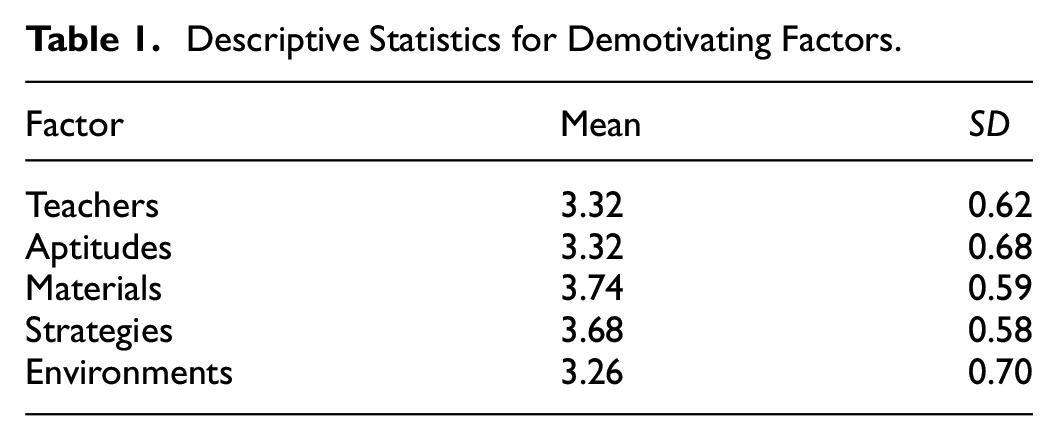
Five major factors in the demotivational system of business English undergraduates were identified in the 4-year time window. According to the contents of the factors, they were labeled teachers (24-23-22-19-20-21-26-16), language aptitudes (45-13-10-46-43-44-12), learning materials (30-29-27-28-14), learning strategies (38-39-37-42-40-41) and environments (7-6-5). Their α values/eigenvalues were 0.82/5.93, 0.80/3.24, 0.79/2.05, 0.71/1.63, and 0.61/1.48, respectively (see Appendix 2). From the perspective of the dynamic systems theory, the demotivational system of business English undergraduates could consist of two subsystems, one consisting of “teachers”“learning materials” and “environments,” which belonged to the external system of demotivating factors, and the other, consisting of “language aptitudes” and “learning strategies,” which belonged to the internal system of demotivating factors. The means and standard deviations of the five demotivating factors are shown in Table 1.
Descriptive Statistics for Demotivating Factors.
Within the external system of demotivating factors, the teacher factor mainly included teachers’ business English knowledge and skills, teaching methods, attitudes, and styles. Some teachers had no business experience at all, and most teachers taught business English knowledge merely according to their textbooks. Obviously, in terms of expertise, Chinese business English teachers were generally far from sufficient (Guo & Li, 2015; L. F. Wang & Ge, 2016). The reason might be that they mainly came from academic backgrounds in English linguistics, English literature, or translation studies. Therefore, C. J. Liu (2018, p. 15) advocates running teacher training programs equipping EFL teachers with knowledge and skills of international business. In addition, regarding teaching methods, business English teachers should be trained to use case-study and task-based teaching methods, and to shift from traditional teacher-centered to interactive and collaborative teaching approaches.
The learning materials within the external system in this study were all in English, which, to the majority of the students, was difficult due to too much terminology and theoretical stuff but too few case analyses. Although the kinds of business English textbooks in China are increasing, there is still a lack of quality textbooks suitable for students of non-key universities (Bian, 2018, p. 68). One of the reasons was that there was no evaluation index system for teaching materials, hence a lack of theorizing about the content selection and design for business English textbooks. Some textbooks were weak in terms of coherence and pertinence of contents and skills and enhancement of intercultural awareness. In addition, the proportion of learner autonomy and practical ability training in textbooks was not balanced and the number of auxiliary learning materials was also insufficient (Zou, 2017, p. 117). Therefore, the choice of contents and the level of difficulty of the selected textbooks often failed to suit students’ needs and aptitudes.
The environmental factor in the external system mainly included university surroundings, classroom atmosphere and peers. It was found that this factor influenced the students’ motivation systems differently from that of their high school. After entering the university, they regarded their academic performance as less important than that in their high schools. For example, during the group interview, a student said, “There is a big difference between the learning psychology in a high school and that in a university. High schoolers’ goals were one and the same: go to university, hence fierce competition against each other. But now they prefer to relax and pursue different ways of living to enjoy themselves for at least a while. Their goals become far less clear and consequently their motivations to learn decline considerably.” Many other interviewees expressed feelings and observations to the same effect.
In the internal system of demotivating factors, the language aptitude factor mainly consisted of English foundation, listening comprehension, memory, imitation, frustration, and self-confidence in business English learning. As the English foundation of students in non-key universities was weaker than that of students in key universities, most students in this study had difficulties and frustrations when learning business English. Besides, lack of training in teaching methodology or their inability to identify students’ gaps in their knowledge about English and business led to many business English teachers failing to provide multi-level scaffolding to students, which often resulted in students’ language aptitude becoming an important demotivating factor.
Another internal demotivating factor in this study, learning strategies, included capacity for autonomous learning, awareness of academic requirements for a degree in business English, and their strategies of preparation for examinations to obtain professional certificates. Most business English teachers reported in the interviews that they adhered to the teacher-centered approach, focused on imparting knowledge and skills only, and that they hardly explained or encouraged students to practice different types of learning strategies in their daily teaching.
Drawing on the studies of demotivating factors by researchers reviewed in the previous section of Literature Review, a discussion of another construct characteristic of demotivating factors in EFL learners is presented as follows.
Four Levels of Demotivating Factors
In this study, the five demotivating factors of business English learners could be classified into four levels: self-related, important other-related, learning materials/contents-related, and environment-related, respectively represented by SRF, IORF, LMRF, and ERF to be explained below. Through summarizing the constructs of demotivating factors by researchers reviewed, it was found that the four-level structure of demotivating factors among college English learners was repeatedly reproduced from such time windows as tasks, courses and majors in the research by other scholars. For example, in the time window of tasks, Eddy-U (2015) found six demotivating factors of university students in task-situated willingness to communicate, which resulted from SRF: lack of personal vision, lack of confidence, and ineffective skills for L2 learning; IORF: bad groupmates; LMRF: disinterest (e.g., due to boring topics or activity types); and ERF: bad classroom atmosphere. Karaca and Inan (2020) developed a demotivating factor scale of L2 writing tasks for Turkish undergraduates, in which five factors were identified, resulting from SRF: self-perceived writing competence, attitudinal aspects, and writing methods; IORF: teacher practices; LMRF: writing materials; and ERF: teaching/learning context.
In the time window of courses, Hosseinpour and Tabrizi (2016) investigated the demotivating factors among non-English majors at an Islamic Azad University and obtained seven factors attributable to SRF: reduced self-confidence, lack of purpose, and negative attitude; IORF: teachers, teaching styles, and teaching methods; and ERF: class characteristics, inadequate facilities. J. Liu (2022) explored the demotivating factors in an English major course for 3 months, which was conducted online due to the COVID-19 lockdown and found five factors attributable to SRF: lack of learning strategies; IORF: teachers, problematic teaching methods, and peer influences; ERF: learning environment, and technical problems with facilities.
In the time window of majors, Q. Gao et al. (2014) studied the demotivating factors among English majors for 3 years and found six factors arising from SRF: learning aptitudes; IORF: teachers and their teaching; LMRF: courses and textbooks; ERF: extracurricular activities, teaching facilities, and evaluation schemes. Hassaskhah et al. (2015) investigated the demotivating factors among Iranian undergraduates majoring in English for 4 years and identified many factors in three salient demotivating constructs, that is, SRF: students’ perception of their own ability, improvement and scores; IORF: teachers, classmates, and friends; LMRF: coursebooks; ERF: school facilities, school policy making, curriculum planning and education quality, social and financial issues, and family.
Due to differences in specific contents of English learning, a certain level of demotivating factors varied across different studies. Overall, this four-level structure remained unchanged in three different time windows. Therefore, from the perspective of dynamic systems (Larsen-Freeman, 2012, p. 205, 2015, p. 12; Mandelbrot, 1982, p. 18, quoted in de Bot, 2012, p. 143), the four-level structure of demotivating factors among EFL undergraduates may be a fractal pattern.
In addition, L. Gao and Liu (2022, p. 3), in their literature review on demotivation in FLL, found that, after carefully analyzing the results of each study on demotivating factors, although there were some variations in their findings, the classification of demotivating factors showed similarities. Generally, demotivating factors can be categorized into four types: learner-related factors, teacher-related factors, curriculum-related factors, and environment-related factors. This classification is almost identical to the one concluded in this study, except for some differences in expression. This confirms that the structure of demotivating factors in FLL is fractal in nature.
The research finding has significant implications for both the theory and practice of tackling demotivation in FLL. Theoretically, it transforms the chaotic combination of demotivating factors into a structured fractal, advancing the understanding of these factors. Practically, it can contribute to a more comprehensive exploration of effective methods for addressing FLL motivation problems among college students.
Dynamic Changes of Demotivating Factor Intensity Across Different Grades
RQ3 is concerned with the dynamic changes of demotivating factor intensity in the participants across different years of business English learning as well as with the causes underlying the dynamic changes. Analyses of the data from the questionnaire survey and interviews yielded results pointing to some facts and factors helpful in answering this research question.
Dynamic Patterns of Demotivating Factors
Of the 18 seniors in this study, only 11 reported in their answers to the questionnaire having experienced obvious demotivation, hence failing to meet the requirements of parameter statistics. Therefore, changes of demotivating factor intensity across different grades were compared and analyzed only among freshmen, sophomores and juniors, numbering 73, 74, and 87 respectively. With time as the horizontal (x) axis and the intensity of demotivating factors as the vertical (y) axis, the means of demotivating factors across the three grades were drawn by OriginPro9.1 software (see Figure 1).

Line chart of yearly change of demotivating factor intensity.
As shown in Figure 1, the five demotivating factors all changed dynamically over the 3 years. Among them, the demotivational intensity of teacher factor was increasing throughout, which was consistent with the finding of Q. Gao et al. (2014, p. 53). The intensities of learning materials and strategies were gradually decreasing over the 3 years. At the same time, the intensities of language aptitudes and environments first increased and then decreased later. These findings showed that there were diversely dynamic changes in the diachronic direction among the five demotivating factors in the 3 years.
To reveal the dynamic difference of demotivating factors over the 3 years, the means of the five demotivating factors were analyzed using one-way analysis of variance (see Table 2). The results showed that there was no significant difference in language aptitudes (F(2, 231) = 1.69, p = .187, Partial η2 = 0.014) and learning strategies (F(2, 231) = 2.65, p = .073, Partial η2 = 0.022) across the 3 years. The result of language aptitudes was similar to the finding of Hassaskhah et al. (2015, p. 565), who found that there was no significant change in the demotivating factors related to themselves (e.g., low self-confidence, low self-esteem, or/and lack of success) between the higher and lower grades. According to Carroll (1962), FL aptitude generally refers to a learner’s relatively stable tendency of specialized ability in learning a second language. It includes phonetic coding ability, grammatical sensitivity, inductive language learning ability and associative memory. It also refers to a relatively stable, even inborn and rarely changed, individual difference factor (Ellis, 1994).
Differences of Intensity of Demotivating Factors Among Different Grades.

p < .05. **p < .01.
In her discussion of learning strategies, which Wen (2001, p. 105) defined as the measures taken by learners for effective learning, which could be external or internal activities, she believed that learning strategies could be divided into management and language learning strategies. The former is related to the management of language learning process, whereas the latter is directly related to language learning materials. Management strategies involve the formulation of goals, the selection of strategies, the arrangement of time, the evaluation and adjustment of the strategies, and the control and adjustment of emotions. Language learning strategies include formal practice strategy, functional practice strategy and mother-tongue dependent strategy. Her study also found that the management strategies of college students tended to be mature when they graduated from senior high schools and that there was no significant change during their college years (ibid, p. 107). Therefore, when facing new learning contents and environments, students’ adaptation to learning strategies may involve the improvement of language learning strategies rather than that of management strategies.
However, teachers (F(2, 231) = 6.98, p = .001, Partial η2 = 0.057), learning materials (F(2, 231) = 3.61, p = .029, Partial η2 = 0.030) and environments (F(2, 231) = 8.79, p = .000, Partial η2 = 0.071) among the three external demotivating factors were significantly different across different grades, indicating that there were significantly dynamic changes in the external demotivating factors of teachers, learning materials and environments in their own diachronic intensities.
The above analyses showed that there were diversely dynamic changes in the intensities of the five factors of the internal and external demotivation systems and that each factor had its own dynamic pattern in the 3-year time window. Different from the internal demotivating factors, the external demotivating factors had significant dynamic differences over the 3 years.
Contextual Traits of Demotivating Factors With Significant Difference
After the three external demotivating factors with significant differences were tested with Post Hoc, it was found that, in the teacher factor, freshmen were significantly different from sophomores (t(145) = 2.68, p = .008, d = 0.439) and juniors (t(158) = 3.64, p = .000, d = 0.574). However, there was no significant difference between sophomores and juniors (t(159) = 0.82, p = .411, d = 0.130). Through coding and discussing the reasons for the dynamics of the demotivating factors based on data from the group interviews, it was found that the main reasons might be as follows:
First, most freshmen were compliant (apparently influenced by Confucianism-emphasized principle of obedience), hence afraid to mention teachers as a factor affecting their interest in learning. They tended to attribute demotivation to their own problem. Second, most freshmen were happy finally waving goodbye to their suffocating high school study and they were eager to enjoy a period of relaxation, hence much less motivated to study. In their second year, however, they began to study seriously, and their requirements for teachers were higher than before. Third, freshmen had less experience in comparing college teachers than sophomores and juniors who grew more mature and better able to evaluate teachers’ quality more objectively. As their textbooks became more theory-oriented and higher in level of difficulty, sophomores and juniors expected greater competency from teachers.
It follows that the demotivating factor arising from teachers gradually increases with the development of students’ conscientiousness and their academic needs. Therefore, business English teachers should constantly enhance their professional quality, thereby minimizing their responsibility for demotivation in teacher-student interactions and gratifying students’ needs for continuous development (L. F. Wang & Ge, 2016, p. 16).
Concerning learning materials, the greatest negative impact was on freshmen while the smallest was on juniors over the 3 years. There was a significant difference in negative impact between freshmen and juniors (t(158) = 2.40, p = .017, d = 0.389) as well as between sophomores and juniors (t(159) = 2.25, p = .026, d = 0.362), whereas no significant difference was found between freshmen and sophomores (t(145) = 0.09, p = .931, d = 0.017). Through coding and discussing the reasons for the dynamics of the demotivating factors arising from learning materials based on data from the group interviews, four possible reasons were identified as follows:
The first had to do with the change of instructional language. In high schools, Chinese was often used in the EFL classroom, whereas university courses in business English for freshmen and sophomores were taught almost completely in English. Therefore, freshmen in particular had difficulty understanding the contents of the courses. Second, the textbooks were all in English for freshmen and sophomores and there were too many new words, whereas many of the business English textbooks for juniors were in Chinese and some in Chinese and English. Third, the amount of difficulty with listening and reading comprehension decreased as the student’s level of English increased in their third year.
Finally, in terms of extracurricular learning materials, most freshmen felt at a loss to choose from the learning materials and after they did make a choice, they felt that learning materials were an extra heavy burden. Entering the third year, most juniors had clear learning objectives and could properly choose learning materials. Thus, the juniors felt a much lighter learning burden than the freshmen did. It is argued that the business English learning materials were not at the right level of difficulty for the students fresh out of high school, which were too difficult for freshmen and even sophomores. In addition, the level of difficulty in the textbooks over different grades lacked a gradual increase.
In sum, there was a mismatch between the complex dynamic development of business English students’ knowledge and skills and the level of difficulty of the learning materials for listening and reading.
Among the environmental factors, there was no significant difference between freshmen and sophomores (t(145) = 0.98, p = .329, d = 0.158), but there was significant difference between freshmen and juniors (t(158) = 3.01, p = .003, d = 0.489) and between sophomores and juniors (t(159) = 3.95, p = .000, d = 0.629). Through coding and discussing the possible reasons for the dynamics of the demotivating factors related mainly to the environment based on data abstracted from the group interview materials, the first reason was found to be like that discussed in the section above: as freshmen, many of them felt relieved that they had finally entered a university and could now enjoy themselves for a while. Meanwhile, they found the surroundings too unfamiliar to make them comfortable.
Second, most of the sophomores felt that their second year was a period of confusion for them. They were not able to learn by themselves and often blamed the learning environment for this inability. Even though some students did want to study, they were often required by the university to participate in extracurricular activities. Therefore, they felt that the environmental factor had a strong negative impact on their learning. It was true that during their first and second years, many freshmen and sophomores were often literally forced to take part in a variety of activities organized by the department or university. By contrast, most extracurricular activities were not compulsory for juniors or seniors. Tang (2012, p. 73) drew a similar conclusion, that is, many university students experienced demotivation in English learning because they couldn’t strike a balance between English learning and extracurricular activities.
Third, there were few examinations for certificates related to English or business in their first and second years but in their third year, juniors had to sit examinations for a variety of certificates to be more competitive on the job market after graduation. Therefore, most students set their own learning tasks or goals during their third year, becoming increasingly realistic and concerned about their employment prospects, hence a much less feeling about the negative impact of the environment.
Fourth, students became more mature after entering their third year in terms of self-discipline and meta-cognitive strategy. No matter how the environments changed, most juniors were able to make some, if not all, adaptations beneficial to their academic performance, hence a much-reduced negative impact from the environment. What’s more, juniors tried their best to create a better learning environment for themselves. They were more likely to learn how to self-regulate their affective states through engagement in intrinsically motivating activities (Falout et al., 2009, p. 411).
In summary, interactions between the psychological characteristics of students across the 3 years and the grade-related external elements form a complex dynamic system, which generated a significantly dynamic influence on demotivating factors in the freshmen, sophomores and juniors.
In the external system of demotivating factors, the dynamic changes of demotivating factors arising from teachers, learning materials, and environments depended on the internal and external diachronic contextual changes in the 3-year time window.
The five demotivating factors were produced through the interaction between various elements in specific learning contexts. Therefore, the five demotivating factors all had internally and externally context-dependent traits (Larsen-Freeman, 2015, p. 16). This contextual dependence was not only manifested in the interaction between internal and external demotivating factors (e.g., aptitudes and teachers) but also in the dynamic changes of external demotivating factors. Owing to changes in students’ learning psychology, learning needs and other internal factors, along with changes in external factors related to teachers, learning materials, job-related examinations, and extracurricular activities, the intensities of students’ external demotivating factors correspondingly produced significant dynamic changes over the 3 years.
The findings that the demotivating factors of business English undergraduates were subject to dynamic change added evidence to the dynamism of the demotivation system. Such dynamism was reflected not only in demotivation as a whole (e.g., Hassaskhah et al., 2015; Li & Qian, 2018), but also in specific demotivating factors, each having their own dynamic patterns, which proved the trait that the elements (demotivating factors) of a dynamic system change independently over time. (Dörnyei, 2014, p. 81). However, there was no significant dynamic change in the system of internal demotivating factors of business English majors across the 3 years, indicating that internal demotivating factors were more stable than external demotivating factors.
In addition to addressing the three research questions proposed and obtaining corresponding results, this study makes the following three contributions:
Uniqueness in research data collection: The study collected data on demotivation in Chinese business English majors using methods different from the majority of previous studies. To avoid issues such as cultural differences and content suitability inherent in existing questionnaires, this research did not directly adopt others’ questionnaires about demotivation. Instead, it designed its own questionnaire by collecting sources of demotivation specific to business English majors in China, incorporating one item to distinguish between subjects with and without significant demotivation experiences, thereby eliminating some invalid data.
Revelation of the fractal nature of demotivating factors: Through inductive and theoretical analyses, this study arrived at a new conclusion about the structure of demotivating factors—namely, that it is fractal in nature. Unlike previous structures, which typically consist of 3 to 8 unordered demotivating factors, this study reveals that demotivating factors have a fractal property, consisting of four layers: self-related factors, important others-related factors, learning materials/contents-related factors, and environment-related factors. This contributes to a new understanding of the structure of demotivating factors in FLL.
New research questions and insights into the dynamics of demotivating factors: Unlike previous research that examined the overall dynamics of motivating and demotivating factors in FLL, this study, from the perspective of dynamic systems theory, reveals the dynamic change patterns and properties of five independent demotivating factors in business English majors. This fills a gap in the research on the dynamic changes of demotivating factors and deepens the understanding of their dynamics.
Conclusion
Quantitative and qualitative analyses of major demotivating factors among Chinese business English undergraduates over 4 years revealed that demotivation was prevalent among the majority of the participants, at about 75%, and that five factors in the demotivating system (i.e., teachers, aptitudes, learning materials, learning strategies and environments) were responsible for the demotivation, in which the construct of the five demotivating factors was a fractal, pointing in particular to dynamic responsibility on the part of teachers, materials and environments in respect to their 1-year-time-scale dynamics over the first 3 years of college study.
In addition, by investigating the dynamism of demotivational systems at five-factor levels, this study uncovered multiple patterns of context-dependent demotivating factor changes across the 3 years, and concluded that the dynamic changes of demotivating factors resulted from learners’ complex internal and external contextual changes. Specifically, the significance of the five demotivating factors varied across grades, among which aptitudes and learning strategies (within the internal system of demotivating factors) did not result in statistically significant dynamics among the participants across different years, whereas teachers, learning materials and environments of the external system of demotivating factors did.
These findings have implications for business English teachers in China. First, English textbooks chosen for their students must be at the right level of difficulty. Second, more time should be spent on explaining different learning strategies and communicating with freshmen to help them master the learning strategies most suitable to themselves. Third, teachers should guide their students, especially freshmen, in adapting themselves to college life and setting their learning and life goals.
For writers and editors of business English textbooks, this study suggests that they aim at producing “learner-friendly materials” (Sultan, 2013). In particular, they should strive to compile various learning materials suitable for business English undergraduates in non-key universities based on their level of English proficiency and learning capacity.
In terms of administrators and policymakers of non-key universities offering business English programs, it is crucial that they create “learner-friendly environments” (Bahari, 2019) and that they send their business English teachers to training centers for enhancement of their professional knowledge and skills helpful to make them “double-qualified teachers.” Equally important for the administrators is reviewing the cultivating program in business English as a whole to improve its efficacy by, for example, modifying the requirements freshmen and sophomores must meet in participating in extracurricular activities.
As for the limitations of this case study, it must, first, be pointed out that the participants came from a non-key university in China only. This, to some degree, affects the application of the research findings. Therefore, it is suggested that samples include business English undergraduates from more non-key universities or non-key and key universities in China. Second, the cumulative variance of factors is not large. The demotivational system of business English undergraduates is composed of many subsystems of demotivating factors. The larger the cumulative variance of the subsystems, the stronger the explanatory power of the demotivational systems will be. Research in the future can enhance the validity of explanations based on the cumulative variance of factors by including more factors. Third, the interaction between demotivating factors was not investigated. In the demotivational system, the factors do not exist independently, but interact with each other and affect the changes of learners’ demotivational systems. In the future, using structural equation modeling to construct a system of demotivation in FLL will enhance the research on the causal relationships between various factors. Finally, this study has concluded through methods such as inductive and theoretical analyses that demotivating factors in FLL possess a fractal nature. This new theoretical perspective needs to be continuously verified and, if so, applied by more researchers on this subject in the future. Despite these limitations, this study still provides valuable insights into demotivating factors in college students majoring in business English.
Footnotes
Appendix 1
Appendix 2
Appendix 3
Acknowledgements
I’d like thank to all the students and teachers who agreed to be part of this study for their sincere cooperation.

Ethical Approval
Since there is no such committee as the Ethics Committee in the university where the author conducted this study, the author does not have an official ethical approval, but informed consent was obtained from every participant in this study.
Consent Details
The author of this article is fully aware of the importance of publication ethics and research integrity. Therefore, in all stages of questionnaire design, survey, and interviews, all students and teachers involved were fully informed of the academic purpose of this research, as well as the content and methods of the survey and interviews. Their participation in this research is entirely voluntary, that is, all the students and teachers involved are voluntary participants. Besides, all materials and research results from this survey will be used for academic purposes only, and the author of this article ensures the anonymity of all participating students and teachers. Therefore, participating in this research will not affect their academic performance or work at the university, nor will it impact their future lives in any negative way whatsoever.
Firstly, the author of this article informed all the participants of the purpose, survey content, and methods of the study. The students and teachers voluntarily participated in the research with a clear understanding of the study. Secondly, the author coordinated with the voluntary students and teachers to determine the time and location for the survey and interviews convenient to the participants. Finally, the author analyzed the collected data and written materials for academic and publication purposes strictly following the ethical principle of anonymity.
The potential negative impact of this survey research on students and teachers is that it did take up a portion of their free time. However, the study also offers some benefits to them. First, the participating students and teachers can gain knowledge about motivation and demotivation in business English learning and about some concepts in educational psychology. Second, they can learn some knowledge and skills related to academic research, which will benefit the students’ future academic development and enrich the teachers’ empirical research experience. Third, if this study is published, it can help all teachers and students interested in business English teaching and learning to acquire relevant knowledge and methods for reducing demotivating factors. Therefore, the potential benefits of the research to society and the study participants outweigh the risk of harm to the participants.
The author of this article adheres to the principle of fully respecting the participants in the survey and the academic principles of objectivity and authenticity. The informed consent from the study participants was obtained by the following steps:
First, the students and teachers likely to participate in this study were fully informed of the purpose, survey content, and methods of the research.
Second, they were told that their participation in this research was completely voluntary if they did choose to participate.
Third, they had the right to withdraw from the study at any time for any reason.
Fourth, the participants were asked to provide truthful responses to the research questions.
Fifth, they were informed that the research materials and results would be used for academic purposes only and would not affect their academic performance or work.
Sixth, the questionnaires are anonymous, and prior consent was obtained from the participants for any interview recordings.
Finally, it was made clear to the participating students and teachers that they would remain anonymous in any academic publications.
Funding
The author disclosed receipt of the following financial support for the research, authorship, and/or publication of this article: The author disclosed receipt of the following financial support for the research, authorship, and/or publication of this article: This work was funded by Talent Fund Project of Tongling University in 2021 for “A study on the ecological affordances and their effective transformation of English online learning motivation of college students in newly established universities” [grant number 2021tlxyrc01].
Declaration of Conflicting Interests
The author declared no potential conflicts of interest with respect to the research, authorship, and/or publication of this article.
Data Availability Statement
The data of this study are available from the corresponding author upon request.