




Abstract
The cognitive process of social categorization and perceived outgroup threat leads to the perception of the world as divided into intergroup conflict relations between enemy and friend groups—termed “friend–enemy divided thinking.” This study proposes the concept of friend–enemy divided thinking from the perspective of intergroup conflict and examines how this concept affects (1) political attitudes toward international relations and (2) conspiracy beliefs, which are closely related to intergroup conflict. A survey was conducted in Japan (N = 735). The results showed that the stronger the friend–enemy divided thinking is, the stronger the conspiracy beliefs are. People with stronger friend–enemy divided thinking felt threatened by national defense and immigration and supported negative policies against international relations. Both conspiracy beliefs and negative political attitudes toward national defense and immigration in international relations were interpreted to be associated with the perception of a hostile intergroup conflict that is heightened by friend–enemy divided thinking.
Plain Language Summary
The study aims to examine how this concept affects political attitudes toward international relations and conspiracy beliefs in Japan. The researchers conducted a survey of 735 participants and found that people with stronger friend-enemy divided thinking tend to have stronger conspiracy beliefs and feel threatened by national defense and immigration, supporting negative policies against international relations. The study suggests that both conspiracy beliefs and negative political attitudes in international relations are associated with the perception of a hostile intergroup conflict that is heightened by friend-enemy divided thinking. The implications of this study are important for understanding the role of intergroup conflict in shaping political attitudes and conspiracy beliefs.
Introduction
Friend–Enemy Divided Thinking from the Perspective of Intergroup Conflict
Several different groups exist globally, and these groups often come into conflict with each other, which is known as intergroup conflict. The dimensions of intergroup conflict are diverse and can take the form of wars, inter-state conflicts, ethnic conflicts, racism, intra-organizational sectionalism, and conservative-liberal partisan conflicts.
In intergroup conflicts, the people involved divide themselves into a friend group (the ingroup) and an enemy group (the outgroup) and recognize the state of conflict between the two groups (Brown & Gaertner, 2001; Tajfel & Turner, 1979; Tropp, 2012). The process of dividing and recognizing friends and foes is a core psychological process that occurs within the various intergroup conflicts mentioned above. In the process of dividing and recognizing friends and foes, intergroup conflict is maintained and escalated by attacking the members of the hostile outgroup.
In contrast, the group-level cognition of “enemy group vs. friend group” may be a process that generates psychological and behavioral responses under intergroup conflict. Not only does the actual intergroup conflict situation give rise to the cognition of “enemy group vs. friend group,” but further, the cognition of “enemy group vs. friend group” may lead to the perception of a conflict. In other words, it is the “perceived division” that may lead to conflict. This could be an important psychological process in a “polarized society.” Essentially, even when there is no division in reality, but the “division” is subjectively recognized, negative attitudes, emotions, and behaviors toward the members of the assumed hostile outgroup may arise. Thus, the thought of division between friend and foe may “make smoke without fire.” These psychological processes are common thinking styles in various contexts, such as destructive conflicts between ethnic groups (Bar-Tal, 2011) and partisan polarization in the political arena (Iyengar et al., 2019), and understanding these psychological processes is highly relevant to the society.
This study defined this process as “friend–enemy divided thinking”—the tendency of people to divide and perceive the world as an intergroup conflict between enemy and friend groups through the cognitive processes of social categorization and perceived outgroup threat. This study examined the relationship between friend–enemy divided thinking and psychological and social variables related to intergroup conflict.
Social Psychological Process Supporting Friend–Enemy Divided Thinking
Based on a theoretical standpoint of intergroup conflict, we consider two stages of friend–enemy divided thinking: (1) The process of social categorization leading to the division of the world into ingroups and outgroups. (2) The perception of the latter as a threat and the ensuing intergroup relations as hostile conflict. Consequently, such thinking leads to a perception of the world as being divided into “friend groups vs. enemy groups,” ultimately resulting in the escalation of intergroup conflict.
(1) Social categorization: The first stage of friend-enemy divided thinking involves the process of social categorization. Social psychology research on intergroup relations reveals that based on various criteria, such as ethnicity, nationality, gender, occupation, or more generally, on social cues such as similarity and proximity, individuals tend to categorize others and groups into ingroups and outgroups (Kawakami et al., 2017; Tajfel et al., 1971). In interpersonal cognition, to conserve cognitive resources, people often make simplistic perceptions of social categorization rather than deliberate judgments (Taylor & Fiske, 1978). Thus, the process of social categorization is automatic and fast (Martin & Macrae, 2007).
The theoretical background for social categorization derives from social identity theory (Tajfel & Turner, 1979) and its derivation, self-categorization theory (Turner et al., 1987). According to the latter, social categorization occurs in a process of meta-contrast, in which outstanding and perceptual characteristics are often the basis (Fiske, 1998; Fiske et al., 2018). When the meta-contrast ratio is high, with small within-group differences and large between-group differences, specific social categories are psychologically activated, and ingroup and outgroup are differentiated (Oakes, 1987). The criteria used to divide individuals into social categories, such as race, nationality, gender, occupation, and physical characteristics, depend on their situational salience (Kurzban et al., 2001; Peters, 1987).
As a result of social categorization, individuals perceived as outgroup members are often labeled with negative stereotypes (Fiske, 2015; Yzerbyt, 2016) and are treated as uncooperative in comparison to ingroup members (Balliet et al., 2014; Brewer, 1979). As a consequence of social categorization, individuals can be excessively divided into ingroups and outgroups, leading to misinterpretation of interindividual relationships as negative intergroup relationships. Therefore, the beginning of the psychological process of intergroup conflict is marked by social categorization that separates outgroups from ingroups.
(2) Perceived outgroup threat: The first stage of social categorization only distinguishes between ingroups and outgroups. However, it is essential to perceive the outgroup as a threat for a hostile relationship to be established. The second stage is perceived outgroup threat, which refers to the phenomenon of viewing the outgroup as hostile. Numerous social psychology studies have demonstrated that intergroup relations are often adversarial. For example, according to the interindividual-intergroup discontinuity effect, intergroup relations are likely to be more competitive than interindividual relationships (Insko et al., 1990; Wildschut & Insko, 2007). One crucial reason for this is that the outgroup is perceived as a threat.
Intergroup threat theory is an important social psychology theory that underlies perceived outgroup threat (Stephan et al., 2015). The theory conceptualizes threat in terms of two dimensions: symbolic and realistic threat, which operate at both the individual and group levels. Importantly, both dimensions of threats are antecedents of outgroup aggression. Perceptions of both realistic and symbolic threat are highly correlated (Stephan et al., 2015), and perceived outgroup threat is closely related to outgroup aggression (Riek et al., 2006). At the neural and physiological levels, outgroups are also perceived as threats and associated with prejudice, discrimination, and conflict (Amodio & Berg, 2021). Perceived outgroup threat is also associated with attributing hostility from the outgroup to the ingroup (Hunter et al., 1991; Pettigrew, 1979). The motivated social cognition (Kay & Eibach, 2012), which finds excessive hostility from outgroups, functions in these psychological processes. These findings indicate that being perceived as an outgroup in intergroup rather than interindividual relationships is more likely to be associated with negative attitudes and behaviors.
Against the theoretical background of social identity theory and intergroup threat theory, the friend-enemy divided thinking is a way of thinking that (1) detects ingroups/outgroups by social categorization even when there are no intergroup relations and (2) recognizes the intergroup conflict of enemy versus friend groups by perceiving the outgroups as threatening. Friend–enemy divided thinking may lead to negatively biased attitudes and behaviors similar to intergroup cognitive bias by causing motivated cognition to find intergroup conflict states even in the absence of intergroup relationships.
The Current Study
This study focused on individual differences in friend–enemy divided thinking. People with this thinking may perceive hostile intergroup conflicts even when intergroup relations do not exist, which may lead to negative attitudes and behaviors that arise under intergroup conflicts. In other words, friend–enemy divided thinking is a way of thinking that “creates the smoke of intergroup conflict even when there is no fire.” Individual differences in friend–enemy divided thinking and its relationship to variables related to the intergroup conflict need to be clarified. Thus, the current study focuses on two important outcome variables related to intergroup conflict: (1) political attitudes toward international relations and (2) conspiracy beliefs. Further, we examine the relationship between these two dimensions and friend–enemy divided thinking.
Outcome Variable (1): Political Attitudes Toward International Relations
Political attitudes toward international relations are examined. Friend–enemy divided thinking may promote more aggressive or aversive attitudes toward outgroups by making overly hostile attributions to them (Hunter et al., 1991; Pettigrew, 1979). When these cognitive approaches are considered at the national or ethnic level, they can lead to aggressive or avoidant political attitudes toward foreigners and foreign countries. Much of the research on intergroup conflict in social psychology has used intergroup relations at the national and ethnic levels as a specific setting for examination (cf. Bar-tal, 2011). National defense and immigration are topics on political attitudes toward international relations with respect to intergroup relations at the international or interethnic level.
This study measures perceived threat and policy issue attitudes toward national defense and immigration and examines the relationship between friend–enemy divided thinking and these variables. For national defense, those with a strong friend–enemy divided thinking were more likely to perceive threats to national defense from foreign countries and to support policies to strengthen their own national defense. For immigration, those with a strong friend–enemy divided thinking were more likely to perceive threats from foreign immigrants coming to their country and to support policies that avoid or exclude immigrants.
Hypothesis 1: There is a positive relationship between friend–enemy divided thinking and the feeling of threat regarding national defense and immigration, as well as an aggressive or avoidant attitude toward policy issues.
Outcome Variable (2): Conspiracy Beliefs
A conspiracy theory is defined as “attempts to explain the ultimate causes of significant social and political events and circumstances with claims of secret plots by two or more powerful actors” (Douglas et al., 2019). The belief in a specific conspiracy theory is termed a conspiracy belief. In the past, conspiracy theories have been used to explain various social events, such as the assassination of President Kennedy and the 9/11 attacks. Belief in conspiracy theories has been closely linked to prejudice, genocide, and denial of medical care. In 2021, Trump supporters in the US who believed that the presidential election was fraudulent attacked the Capitol Building. This indicates that conspiracy theories and beliefs have an impact that cannot be ignored in contemporary society. Thus, understanding the social psychological processes that give rise to conspiracy beliefs is an urgent issue.
In conspiracy theories, there is an underlying belief that a malevolent group is plotting to harm society (Douglas et al., 2019). Conspiracy theories expound that some malicious groups (outgroups) deceive and harm the general society (ingroups). Conspiracy beliefs are strongly related to intergroup cognition. From this perspective, research on intergroup conspiracy theories has also begun in recent years (Cichocka et al., 2016; Van Prooijen & Song, 2021). Right-wing attitudes and perceived intergroup threats are strongly associated with conspiracy beliefs (Imhoff & Bruder, 2014; Krüppel et al., 2021). Regarding this psychological tendency to find “malevolent groups,” it is hypothesized that conspiracy beliefs will be stronger in people who have a strong friend–enemy divided thinking.
This study examines conspiracy theory topics related to COVID-19, an important present-day issue, as well as conspiracy theory topics related to politics that were prevalent on the Internet at the time of the survey. These topics ranged from those related to the political left and right, to those that were less political. By covering multifaceted conspiracy theory topics, this study examines the effects of friend–enemy divided thinking on general conspiracy beliefs beyond specific conspiracy theory topics.
Hypothesis 2: There is a positive relationship between friend–enemy divided thinking and conspiracy beliefs.
Methods
Overview
The survey was conducted from January 15 to 21, 2021, using a Japanese Internet survey company. The participants were Japanese. The study was approved by the Institutional Review Board. After obtaining informed consent, participants were asked to answer questionnaires. The survey was divided into two parts and conducted within a week because it contained more questions than those used in this study. In total, 1,383 participants responded to the survey, including those who responded only to the first part of the survey. Age and gender were equally distributed. Responses from 735 participants who answered both surveys and completed all four instructional manipulation check items (e.g., please select “disagree” for this item) were analyzed. A power analysis indicated that the sample size had 98.35% statistical power to detect a slight effect size of r = .15. There were 351 (47.8%) male and 384 (52.2%) female participants. The mean age was 46.51 years (SD = 13.75). The educational level of participants was 48% university, 22% high school, 22% technical college/ junior college/ vocational school/ special training school, 6% graduate school, and 1% junior high school.
Analyzed Items
The relationships between the following variables were analyzed, and the questions were asked in Japanese and then translated into English for this paper.
Friend–Enemy Divided Thinking (Main Variable)
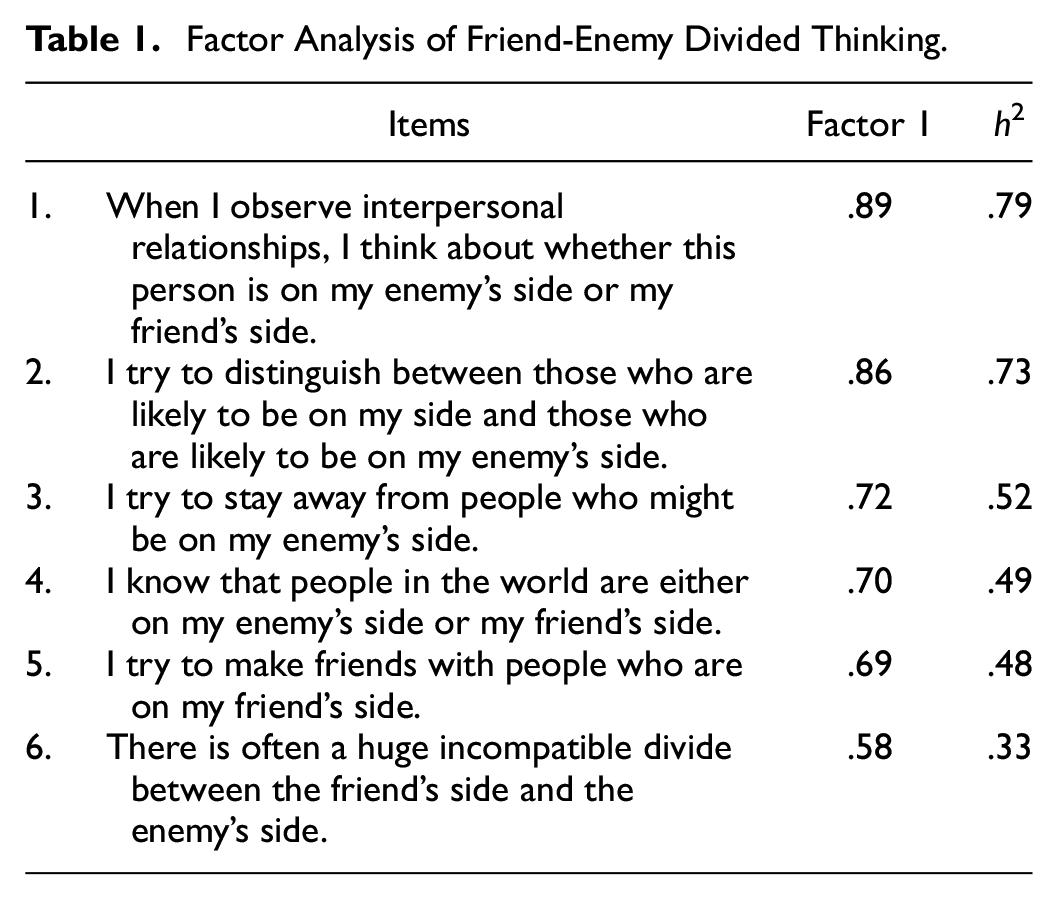
Friend–enemy divided thinking was measured using six items that were originally developed by the authors (Table 1). All items were rated on a 7-point Likert scale ranging from 1 (do not agree at all) to 7 (strongly agree).
Factor Analysis of Friend-Enemy Divided Thinking.
Political Attitudes Toward International Relations (Outcome Variable 1)
Threats and policy issue attitudes regarding national defense and immigration were measured.
The following three items were used as threats to national defense: “I am worried that other countries will attack Japan militarily,”“Japan is currently under threat of attack from other countries,” and “Japan is currently under threat of terrorism or war” (α = .88, ω = .88). The following three items were used as threats regarding immigration: “I feel threatened by the increase in the number of foreign residents in my area,”“I feel threatened by the continued increase in the number of foreign residents in Japan,” and “If I were to work in the same workplace as a foreign national, I am not sure if I would be able to get along with them” (α = .84, ω = .86). All these items were originally developed. The items were rated on a 7-point Likert scale ranging from 1 (disagree at all) to 7 (strongly agree). The average value of the two variables was used as the average threat to international relations.
The following four items were selected as the policy issue attitudes regarding national defense and immigration: “Strengthen the number of personnel, equipment, and budget of the Self-Defense Forces” (strengthening of the Self-Defense Forces), “Revise the Constitution and have a National Defense Force (NDF)” (having the NDF by revising the constitution), “Promote the acceptance of immigrants from abroad” (acceptance of immigrants), and “Allow permanent foreign residents to vote in local governments” (local suffrage for permanent foreign residents). The items were rated on a 7-point scale ranging from 1 (totally unsupportive) to 7 (very supportive). The items were based on the items used in the survey by Jou and Endo (2016). The average value of these variables was used as the average negative attitude toward international policy issues.
Conspiracy Beliefs (Outcome Variable 2)
The items were originally developed based on the conspiracy theories found on the Internet in Japan. Five conspiracy theories about COVID-19 and three on other political topics were identified and prepared (Table 2). All items were rated on a 7-point Likert scale ranging from 1 (disagree at all) to 7 (strongly agree).
Descriptive Statistics and Factor Analysis for Each Topic of Conspiracy Beliefs.

Political Ideology (Control Variables)
Considering the possibility that the influence of liberal and conservative ideologies is asymmetrical, this study distinctly indexed liberal ideology and conservative ideology rather than the one-dimensional liberal–conservative political ideology.
First, the participants were asked to indicate which side of the spectrum they fell on for all three categories: “progressive–conservative,”“left–right,” and “liberal–conservative.” These three categories were chosen based on Japan’s current state, where people’s conception of political ideology is gradually changing (Jou & Endo, 2016). Participants were asked to choose between “1. progressive/left/liberal,” and “11. conservative/right/conservative,” or “12. don’t know.” Responses of those who answered “don’t know” were considered as missing values, and the mean value of the items excluding those who answered “don’t know” was calculated.
Using this value, the strengths of liberal ideology and conservative ideology were indexed based on the distance from the midpoint, 6, as follows: For conservative ideology, the conservative score was “0” when the ideology score was below 6 and “raw score minus 6” when the score was above 6; that is, the degree of conservative ideology was defined as the distance between the midpoint (6) and the increasing degree of conservatism. Liberal ideology score was calculated in the same way, but in the reverse direction: “0” was used when the score was 6 or more and “6 minus raw score” was used when the score was less than 6; that is, the distance between the midpoint (6) and the increasing degree of liberalism was defined as the intensity of liberal ideology. Answers of “don’t know” for all three items were judged as not having any ideology and “0” was used for both conservative and liberal ideologies.
Gender, Age, Educational Level, the Big Five, and Critical Thinking (Control Variables)
Gender and age were controlled as other individual difference variables. Educational level was analyzed as a continuous variable, with junior high school = 1, high school = 2, technical college, junior college, vocational school, and special training school = 3, university = 4, and graduate school = 5. This study also measured the Big Five, which is the most prevalent personality measure of psychological individual difference traits, using the Ten Item Personality Measure—Japanese version (Oshio et al., 2012). For critical thinking, an extracted version of Hirayama and Kusumi’s (2004) measurement scale was used. The control variables also aimed to show the basic relationship between friend–enemy divided thinking and gender, age, educational level, and the Big Five.
Results
Factor Analysis of Friend–Enemy Divided Thinking
A factor analysis was conducted to confirm whether the friend–enemy divided thinking investigated in this study is a single-factor measure. The results of the parallel analysis suggested a single-factor structure. One sample eigenvalue (3.765) was greater than the parallel eigenvalue (1.139), and the next-highest sample eigenvalue (0.865) was below the second parallel eigenvalue (1.074). The results of the factor analysis (Promax rotation, maximum likelihood method) that extracted single factors are shown in Table 1. All six items were positively correlated (rs = .36 and −.78, ps < .001). The reliability coefficients were α = .88, and ω = .88.
Factor Analysis of Conspiracy Beliefs
Next, a factor analysis was then conducted to determine the eight conspiracy belief items’ factor structure (Table 2). The results of the parallel analysis suggested a single-factor structure. One sample eigenvalue (3.555) was greater than the parallel eigenvalue (1.174), and the next-highest sample eigenvalue (1.074) was below the second parallel eigenvalue (1.109). Thus, it was concluded that the conspiracy beliefs consisted of one factor. Additionally, all eight items were positively correlated (rs = .16 and −.57, ps < .001). The reliability coefficients were α = .81, ω = .82. Although this study included conspiracy theories from the ideological right and left, the factors were not dichotomized on the left–right axis, and a positive correlation was confirmed throughout. People who believe in one conspiracy theory tend to believe in the other, and there exists a general tendency to believe in any conspiracy theories (Imhoff & Bruder, 2014). Henceforth, when describing the “average conspiracy belief,” the average score of these eight items is referred to. Additionally, the mean of each item is listed in Table 2 for multiple regression analysis.
Descriptive Statistics and Correlations for Each Variable
Table 3 shows the means, standard deviations, and correlations for each variable. Examining the correlations with friend–enemy divided thinking, this study found a positive correlation with conservative ideology (r = .11, p = .003), a negative association with extraversion (r = −.08, p = .03), a positive correlation with agreeableness (r = .13, p < .001), and a positive correlation with neuroticism (r = .18, p < .001). Additionally, friend–enemy divided thinking was positively related to conspiracy beliefs and political attitudes toward international relations, which were placed as outcome variables (rs > .19, ps < .01). The mean and standard deviation of each variable and the correlation coefficient between all variables are shown in Table S1 in Supplementary Material.
Mean and Standard Deviation of Each Variable and Correlation Coefficient Between Variables.

Note. N = 735.
p < .01. *p < .05. +p < .10.
Outcome Variable (1): Effects of Friend–Enemy Divided Thinking on Political Attitudes Toward International Relations
First, to examine the relationship between political attitudes toward international relations in general and friend–enemy divided thinking, a multiple regression analysis was conducted using average threat regarding international relations and average negative international policy attitudes as dependent variables (Table 4). As in the case of conspiracy beliefs as the dependent variable, friend–enemy divided thinking was significantly positively associated with both average threats regarding international relations (β = .23, p < .001) and average negative international policy issue attitudes (β = .16, p < .001).
Results of Multiple Regression Analysis with Average International Threat and Average Negative International Policy Issue Attitudes as the Dependent Variable.

Note. N = 735.
p < .01. *p < .05. +p < .10.
The relationship between the topics of national defense and immigration was investigated in detail. The topics of national defense and immigration were considered political attitudes toward international relations. A multivariate multiple regression analysis was conducted with the following variables as independent variables: friend–enemy divided thinking, political ideology, gender, age, educational level, and the Big Five; and six items related to threat perception and policy issue attitude regarding national defense and immigration were considered as dependent variables. The results confirmed a significant effect of the model as a whole (Pillai’s Trace = .45, F (66, 4,338) = 5.30, R2 = .38, p < .001). A significant positive effect of friend–enemy divided thinking was also found (β = .23, p < .001).
Next, a multiple regression analysis was conducted for each dependent variable (Table 5). Significance tests were conducted using the Bonferroni method, with p < .0083 (5% significance level divided by 6, the number of dependent variables). The results showed that friend–enemy divided thinking was positively related to threats regarding national defense (β = −.15) and immigration (β = −.25). As for the effect of friend–enemy divided thinking on policy attitudes, significant negative relations were found for the acceptance of immigrants (β = −.19) and local suffrage for permanent foreign residents (β = −.12). In contrast, a positive association was found for strengthening of the Self-Defense Forces (β = .07) and forming the NDF by revising the constitution (β = .07), but the coefficient was not significant at the p < .0083 significance level. The results of each multiple regression analysis with 95% confidence intervals are provided in Supplemental Tables S2 to S7.
Results of Multiple Regression Analysis with Political Attitude Toward International Relations as the Dependent Variable.

Note. N = 735.
Based on the Bonferroni method, an asterisk (*) is placed next to coefficients with p < .0083 (a significance level 5% divided by 6).
The results show that friend–enemy divided thinking was associated with threat and an exclusionary policy attitude toward immigration. It was also strongly related to the threat regarding national defense, but it was not significantly related to attitudes toward national defense as a policy issue.
Regarding the attitude toward national defense, the association of political ideology was stronger than that of the other variables. Particularly, regarding the strengthening of the Self-Defense Forces and forming the NDF by revising the constitution, liberal ideology was negatively associated (β = −.21 and −.20, respectively) and conservative ideology was positively associated (β = .25 and .28, respectively).
Outcome Variable (2): Effect of Friend–Enemy Divided Thinking on Belief in Conspiracy Theories
A multiple regression analysis (maximum likelihood estimation) was conducted with friend–enemy divided thinking, political ideology, gender, age, educational level, and the Big Five as the independent variables and average conspiracy beliefs as the dependent variable (Table 6). The analysis confirmed a significant positive effect of friend–enemy divided thinking on average conspiracy beliefs (β = .25, p < .001), which had a greater association than any of the other variables included to control. This study found no greater association of average conspiracy beliefs with political ideology, gender, age, educational level, or the Big Five (βs < .10).
Results of Multiple Regression Analysis with Average Conspiracy Belief as the Dependent Variable.

Note. N = 735.
p < .01. *p < .05. +p < .10.
Next, whether the results were similar for each of the eight topics of conspiracy beliefs was examined. A multivariate multiple regression analysis was conducted with each of the items of the conspiracy beliefs as the dependent variable. The results confirmed a significant effect for the model (Pillai’s Trace = .34, F (88, 5,784) = 2.96, R2 = .30, p < .001). Friend–enemy divided thinking was the most influential variable (β = .25, p < .001). Next, multiple regression analyses were conducted for each dependent variable. The Bonferroni method was performed to test for significance, and it showed that p < .00625; 5% significance level divided by 8, the number of dependent variables; Table 7). The results showed that friend–enemy divided thinking had higher coefficients than any other variables (βs = .11 and −23, ps < .001). Thus, friend–enemy divided thinking had a clear association with conspiracy beliefs of all topics. Supporting information on the results of each multiple regression analysis (with 95% confidence intervals) is provided in Supplemental Tables S8 to S14.
Results of Multiple Regression Analysis with each 8 Topic of Conspiracy Belief as the Dependent Variable.

Note. N = 735.
Based on the Bonferroni method, an asterisk (*) is placed next to coefficients with p < .00625 (a significance level 5% divided by 8).
For some topics, the effects of political ideology were also found. However, the strength of the association of political ideology with conspiracy beliefs was lesser than the strength of the association of friend–enemy divided thinking. No consistent associations were found for gender, age, or the Big Five, and those for which associations were observed had low regression coefficients.
Discussion
This study proposed “friend–enemy divided thinking” as a way of thinking that separates enemy groups from friend groups and examined how individual differences in this thinking style are related to conspiracy beliefs and political attitudes toward international relations.
Friend–Enemy Divided Thinking
The concept of friend–enemy divided thinking by focusing on the two-step process of social categorization and perceived outgroup threat was theoretically derived. Each of these two stages is a psychological process that has been repeatedly demonstrated in previous research. This study treated this psychological process as an individual difference variable, friend–enemy divided thinking, and examined its relationship with variables related to intergroup conflict. The results demonstrated that there was a clear association between conspiracy beliefs that malevolent outgroups are intent on harming society and political attitudes toward foreign countries in international contexts. This suggests that friend–enemy divided thinking is a useful concept for understanding social and political situations related to intergroup conflict. This study assumed a two-stage process of social categorization and outgroup threat perception as the psychological process of intergroup conflict behind friend–enemy divided thinking but did not examine the relevance of this two-stage process itself. In the future, it will be necessary to examine internal psychological processes, such as motivated cognition, in friend–enemy divided thinking.
Regarding the measurement of friend–enemy divided thinking, this study found that it consisted of a single factor and could be measured with reliability. Friend–enemy divided thinking was not associated with gender, age, or educational level. In contrast, friend–enemy divided thinking was positively correlated with neuroticism and agreeableness. This finding may be related to the so-called paranoid personality (Shi et al., 2018). The belief that ingroups are victims may give rise to friend–enemy divided thinking. Additionally, agreeableness is thought to be related to the tendency of group favoritism, especially toward allied groups, in terms of emphasizing the cooperativeness of others and groups. In the future, it will be necessary to examine personality traits and situational factors that produce friend–enemy divided thinking.
Friend–Enemy Divided Thinking Leading to Negative Political Attitudes in International Relations
This study predicted that the friend–enemy divide would also increase exclusionary and aggressive political attitudes toward international relations, such as national defense and immigration. As predicted, the stronger the friend–enemy divide, the stronger the perceived threat to national defense and immigration, and the greater the opposition to immigration and local suffrage for permanent foreign residents. However, the results were not significant for the policy issue of national defense when controlling for other variables.
Additionally, political ideology was found to be more strongly related to policy issue attitudes and threat perceptions regarding national defense. This is consistent with the finding that people at both ends of the political-ideological spectrum place a high value on the issues of national defense and war (Krochik & Jost, 2011). National defense and war are policy issues that are closely related to the perception of one’s own left–right ideology.
Friend–Enemy Divided Thinking Causing Conspiracy Beliefs
Friend–enemy divided thinking was clearly associated with conspiracy beliefs. In the multiple regression analysis using the mean of the eight conspiracy theory items as the dependent variable, there was a significant positive association between friend–enemy divided thinking. This association was found even after controlling for gender, age, educational level, political ideology, and the Big Five. The strength of the association was greater than that of any of the control variables.
The results of the analyses, with each of the eight conspiracy theory topics regarding COVID-19 and politics as dependent variables, also showed a significant positive relationship with friend–enemy divided thinking. It had a greater effect than any of the control variables. Friend–enemy divided thinking may have a more important influence on conspiracy beliefs than gender, age, personality traits, political ideology, or critical thinking, as with deliberative judgment.
These results indicate that friend–enemy divided thinking is an important psychological variable that explains conspiracy beliefs. People with high levels of friend–enemy divided thinking are likely to yield to conspiracy beliefs by believing in the presence of hostile groups that are plotting against them.
Limitations and Future Directions
This study revealed that friend–enemy divided thinking is related to conspiracy beliefs and political attitudes regarding international relations. Additionally, various other aspects may be related. In the future, it will be necessary to examine the possibility of more diverse outcome variables.
It is difficult to clearly show causality. In this study, cross-sectional survey data showed that friend–enemy divided thinking was associated with conspiracy beliefs and political attitudes about national defense and immigration. Although the results of the regression analysis were significant, it will be necessary to conduct more in-depth investigations of causality, such as cross-lagged models in longitudinal surveys.
Additionally, the antecedents of friend–enemy divided thinking were not fully understood. Although it was found that gender, age, and educational level were not related and that neuroticism and agreeableness in the Big Five were related to friend–enemy divided thinking, it will be necessary to confirm the details in the future and to approach the question of how the friend–enemy divide is formed developmentally and how it can be reduced through intervention.
The findings were derived from a sample of Japanese participants; thus, it is crucial to verify if comparable results can be replicated in other cultural and demographic contexts. To ascertain the generalizability of the results, the study should be replicated in different countries.
In intergroup conflicts, conflict is generated and escalated by separating enemy and friend groups in the process of social categorization. By focusing on individual differences in the cognitive tendency to discriminate between enemy/friend groups, this study shows that excessive detection of “intergroup conflict” is associated with a belief in conspiracy theories and aggressive or exclusionary political attitudes toward foreign countries. These findings may be useful for analyzing political attitudes and ideologies. Thus, more multifaceted studies are needed.
Supplemental Material
sj-pdf-1-sgo-10.1177_21582440241249166 – Supplemental material for Friend–Enemy Divided Thinking from the Perspective of Intergroup Conflict: Relationship with International Attitudes and Conspiracy Beliefs
Supplemental material, sj-pdf-1-sgo-10.1177_21582440241249166 for Friend–Enemy Divided Thinking from the Perspective of Intergroup Conflict: Relationship with International Attitudes and Conspiracy Beliefs by Kengo Nawata, Makoto Fujimura and Toru Oga in SAGE Open
Footnotes
Acknowledgements
The authors would like to thank Dr. Takeru Miyajima for collaboration on the early stages of this work.
Declaration of Conflicting Interests
The authors declared no potential conflicts of interest with respect to the research, authorship, and/or publication of this article.
Funding
The authors disclosed receipt of the following financial support for the research, authorship, and/or publication of this article: This work was supported by the Cultural Variation Cluster in the Kyushu University Institute for Asian and Oceanian Studies and JSPS KAKENHI (grant numbers 20K03324).

Supplemental Material
Supplemental material for this article is available online.
Data Availability Statement
The data that support the findings of this study are available from the corresponding author upon reasonable request.
References
Supplementary Material
Please find the following supplemental material available below.
For Open Access articles published under a Creative Commons License, all supplemental material carries the same license as the article it is associated with.
For non-Open Access articles published, all supplemental material carries a non-exclusive license, and permission requests for re-use of supplemental material or any part of supplemental material shall be sent directly to the copyright owner as specified in the copyright notice associated with the article.
