




Abstract
Compromise is largely based on being able to come to a common perspective while sacrificing marginal values that would otherwise deny a reconciliation of disparate ideas. Due to the absence of an established intergroup compromise measure in the extant political or social psychology literature, we attempted to develop and psychometrically examine such a scale within the political psychology domain. Across two studies, we found construct and predictive validity for three scales that predict individuals’ propensity to compromise in a political context. In Study 2, we found evidence of model invariance between Democrats and Republicans, suggesting that our measures of compromise, political animus, and distrust are assessing these constructs equally for both major parties.
Keywords
Compromise is a negotiation process wherein individuals or groups share goals, exchange ideas, make concessions and tradeoffs, and eventually arrive at a mutually tolerable outcome (Bellamy, Kornprobst, & Reh, 2012; Schocken & Hummel, 1994; Turner, Brown, & Tajfel, 1979). In American political negotiations, leaders of the Democratic Party and Republican Party, the two political groups that represent values on opposing ends of the ideological spectrum in the United States, must be willing to compromise to reach decisions that move the country forward. Democrats and Republicans must be willing to accept something undesirable from each other (e.g., in immigration reform, Republicans must be willing to accept a path to legalization and Democrats must accept increased border security), while also conceding something personally desirable that the other party is unwilling to accept (e.g., Democrats personally desire a path to citizenship for undocumented immigrants but may have to concede that provision if Republicans are unwilling to accept it). Compromise between Democrats and Republicans is something that is desperately needed for America to address national and international challenges.
Currently, there is extensive literature on intergroup forgiveness, intergroup emotions, cooperation and leadership, social identity, and intergroup relations, but there exists no established measure of intergroup compromise in a political context (Bellamy et al., 2012). The current political climate, which has routinely been referred to as defining deviancy down, highlights the largely absent study of intergroup compromise in political psychology research.
In this article, we will discuss the psychometric development and initial experimental application of an instrument designed to assess individuals’ propensity to compromise in a political context: the Intergroup Compromise Inventory (ICI). We begin by discussing the increasingly polarized political atmosphere in the United States and the importance of gaining a greater understanding of intergroup compromise in this political climate.
The Great Polarized Society
If Americans want to know why their elected officials can’t compromise, . . . perhaps they ought to look in the mirror.
In 1964, Philip Converse argued that ideological polarization was over in American politics and that most citizens were centrists in their values and voting records. Support for this argument is found in data collected as a part of the National Election Studies (NES) project, which reveals an increase in independents and decrease in Democrats and Republicans in the 1960s (Bartels, 2000). This trend ended, however, following Southern Realignment and the emergence of various culture wars in the 1970s.
Once the issue of race and civil rights legislation entered the forefront of political discourse in the mid-20th century, the previous environment of overlapping political ideologies began to evaporate (Hare & Poole, 2013). President Harry Truman’s integration of Blacks into the military following World War II contributed to the 1948 election being one in which several Southern states favored the third-party Segregationist candidate, Strom Thurmond. These states refused to vote Democratic for the first time in decades (after giving Democrats between 80.6% and 93.6% of the electoral vote in the 1944 election). In 1968, the Southern states once again voted for a third-party Segregationist candidate, George Wallace. This shift, in effect, completed the realignment of the South. Since 1972, following the Civil Rights achievements of Democratic Presidents Kennedy and Johnson in the 1960s, the southern United States has predominantly voted for Republicans. These emergent moral divisions among voters increased following the Roe v. Wade decision in 1973.
Abortion rights, like race, contributed to a broad political realignment, and in this case, the trend was stronger outside the Southern states (Abramowitz & Saunders, 2008). Consider that from 1972 to 2004, the correlation between Liberal-Conservative partisan ideology and Democratic-Republican Party identification increased from .24 to .56 in the South, whereas it increased from .37 to .66 in the North, Midwest, and Western United States (Abramowitz & Saunders, 2008). The influence this ideological realignment had on shifting the Republican Party further to the right was felt almost immediately, and the correlation between attitude polarization on abortion between members of the Democratic and Republican parties and party identification has continued to rise (–.03 from 1972 to 1980, .08 from 1984 to 1992, and .18 from 1996 to 2004; Abramowitz & Saunders, 2008).
There was increasing demand for political party fidelity on numerous issues, including (but not limited to) gay rights, school choice, the equal pay amendment, the death penalty, government aid to disadvantaged groups, and affirmative action. Increasing moral divisions over these issues marked the end of a period of ideological overlap (e.g., Liberal Republicans, Conservative Democrats, and ticket-splitting voters) and the beginning of the increasingly partisan atmosphere we have today. The percentage of politicians with overlapping ideologies in the House and Senate has fallen from about 60% in 1977 to approximately 0% since 2003. Indeed, even Philip Converse (2006) admitted that ideological polarization has returned to American politics.
Moral diversity is less popular than racial diversity (Haidt, Rosenberg, & Hom, 2003). The sharp ideological “purification” that has taken place in both the Democratic and Republican parties has left little room for negotiation among the most partisan citizens, and partisans are the most likely to vote in elections (Abramowitz & Saunders, 2008). This has led to a significant decrease in swing-districts (only 72 predicted in 2018 compared with 164 in 1998) across the United States (Blake, 2017). Partisans in America’s noncompetitive, highly polarized districts appear to prefer a candidate who will stand firm on his or her positions rather than compromise with the opposing party.
Gerrymandering is regularly blamed for this decrease in swing seats and concurrent increase in uncompromising elected officials over time. In reality, the voting public has done this to themselves. From 1997 to 2017, about 83% of the seats that went from toss-ups to reliable Democratic and reliable Republican shifted during the course of electoral campaigns, not during redistricting (Blake, 2017). Thus, a desire for compromise is more of a political-social issue that should be assessed at the level of the voters who elect such people as opposed to the level of the elected officials themselves. In what follows, we discuss our initial steps and analyses in our attempt to develop a measure of compromise in a political context.
Study 1
In Study 1, we attempted to develop a scale of intergroup compromise (49 items initially) that predicts individuals’ desire to compromise in a political context. We predicted a main effect indicating that independents/moderates have a higher degree of compromise than either Progressives or Conservatives. There were several measures in our nomological network, including Sense of Self (SOS; Flurry & Ickes, 2007), Ego Defensiveness (EGO; Ickes, Park, & Robinson, 2012), Teamwork (Peterson & Seligman, 2004), Conformity (Goldberg et al., 2006), and Judgment/Open-Mindedness. A rationale for the selection of each scale is provided in the “Measures” section. It was expected that individuals high in compromise would score lower in conformity and EGO, and higher in SOS, judgment, and teamwork.
Method
Participants
Participants were 152 female and 82 male undergraduate students enrolled in Psychology courses at a southern university (Mage = 20.41, range = 18-46 years). Participants were recruited using the SONA system, where they registered for one of three versions of the proposed study based on their self-identified political affiliation given in prescreening: Democratic (n = 104), Republican (n = 47), and independent/third party (n = 81). The ethnic breakdown was as follows: White 31.5%, Latino(a) 23.3%, Black 19.8%, Asian 16.4%, and bi/multiracial 9.1%. The grade level breakdown was as follows: freshman 36.8%, sophomore 29.9%, junior 21.2%, and senior 12.1%.
Procedure
Participants arrived in a large classroom at the scheduled time of the study session they registered for. All participants completed an informed consent form before receiving and initiating the experimental packet. Participants were debriefed following completion of the questionnaire materials.
Measures
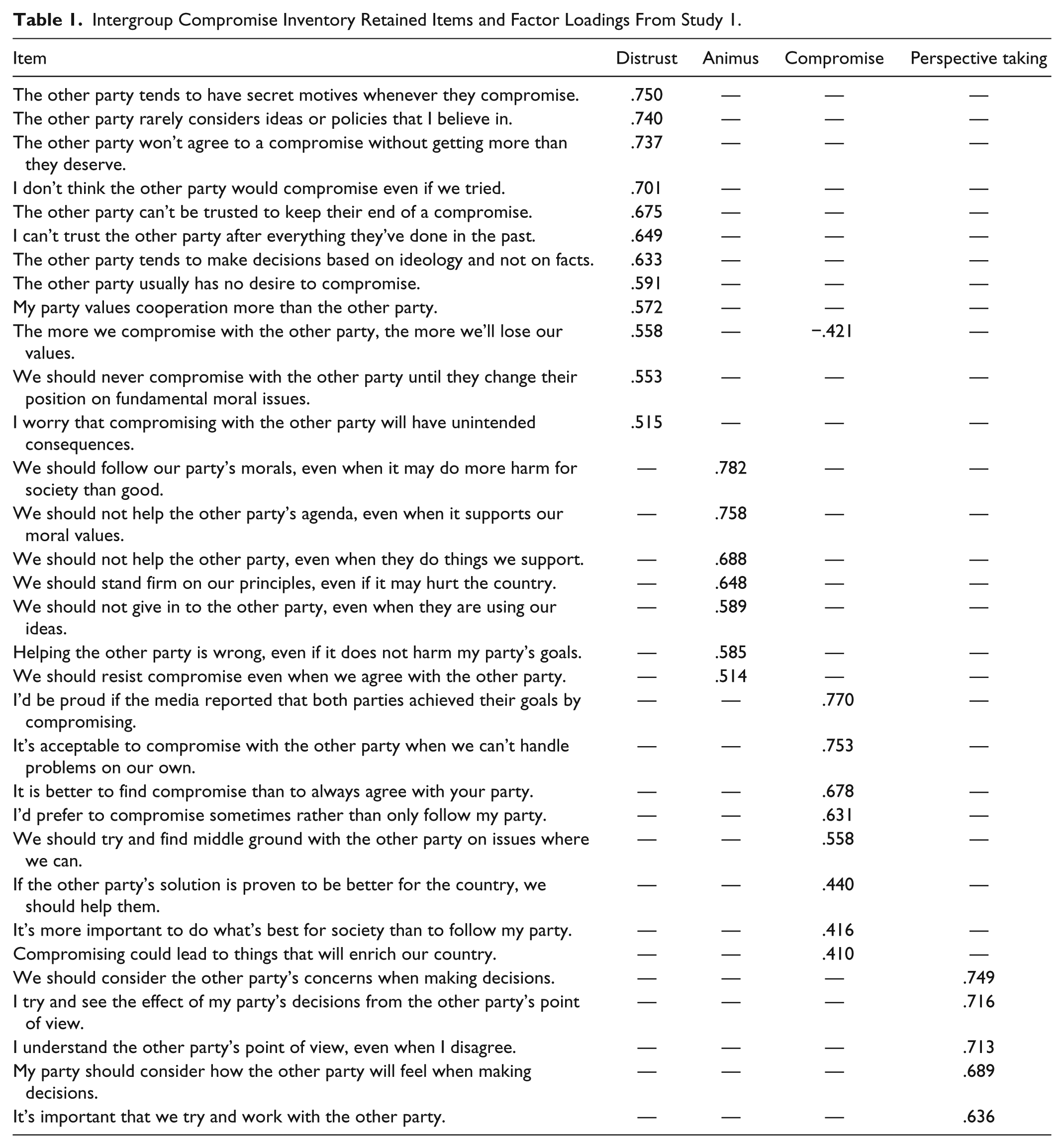
Below are the aforementioned self-report questionnaires included in the study for the purpose of content validity and criterion-related validity. See Table 1 for psychometric information.
Intergroup Compromise Inventory Retained Items and Factor Loadings From Study 1.
Sense of Self Scale (SOSS)
This scale measures individuals’ sense of identity, with higher scores indicating a weaker SOS (Flurry & Ickes, 2007). Individuals with a weaker SOS may be more likely to go along with their political party and therefore less willing to compromise. The 16 items on this measure were rated on a 5-point Likert-type scale (1 = completely disagree to 6 = completely agree). The SOSS displayed adequate reliability in the current sample (α = .77).
Ego-Defensiveness Scale (EGO)
The Ego-Defensiveness Scale was developed by William Ickes and Anna Park (Ickes et al., 2012). It assesses ego defensiveness by identifying the extent to which the respondents are unwilling and/or unable to accept criticism or correction from others. The 10 items on this measure were rated on a 6-point Likert-type scale (1 = completely disagree to 6 = completely agree). The EGO displayed adequate reliability in the current sample (α = .77).
Conformity
The Conformity Scale is a measure of individuals’ needs and concerns about being liked by others (Goldberg et al., 2006). Those who score higher on this measure may be less inclined to go against the group (their political party) and compromise. The 10 items on this measure were rated on a 6-point Likert-type scale (1 = completely disagree to 6 = completely agree). The EGO displayed adequate reliability in the current sample (α = .77).
Teamwork
The Teamwork scale measures individuals’ desire to work well with a group as opposed to working alone. High scorers may be more willing to compromise and achieve results that are acceptable to both sides (Peterson & Seligman, 2004). The 10 items on this measure were rated on a 6-point Likert-type scale (1 = completely disagree to 6 = completely agree). The Teamwork scale displayed adequate reliability in the current sample (α = .77).
Judgment
The Judgment scale is a measure of individuals’ propensity to think critically and make sound decisions (Goldberg et al., 2006). The 10 items on this measure were rated on a 6-point Likert-type scale (1 = completely disagree to 6 = completely agree). The Judgment scale displayed adequate reliability in the current sample (α = .77).
Proposal
This variable is a modification of the distribution strategy matrices used by Tajfel in intergroup differentiation research (Turner et al., 1979). Individuals with the lowest scores would essentially be willing to receive less if it meant there would be a greater difference in outcomes between their group and the outgroup (relative favoritism). Individuals with higher scores indicate a greater willingness to compromise (joint profit). Proposal was expected to be a criterion for the hypothesized factors (see below):
While debating how to improve America’s economic recovery, each major party (Democratic and Republican) presents 15 policies for a final bill. Of the 30 total proposals, how many would you accept from each side?

The measure was scaled from 1 to 6, with 10 to 1 indicating “1” and 15 to 15 indicating a “6.” Of course, this criterion had to demonstrate its validity in the context of political groups (Cureton, 1950). Its applicability was verified in an ANOVA testing differences across political parties, F(2, 222) = 6.17, p = .002. As expected, independents had higher proposal scores (M = 4.47, SE = 0.18) than Democrats (M = 3.66, SE = 0.16) or Republicans (M = 3.72, SE = 0.11).
We began by analyzing the ICI items with a data reduction approach using principal components analysis. We proceeded to assess the eigenvalues and scree plot to determine the range of factors to test (with the expectation being two to four). We then conducted exploratory factor analyses on the ICI items using oblique two-factor through four-factor solutions and promax rotation (retaining factor loadings of .4 or greater). That was followed by estimates of scale reliability (rho, ρ) for each of the emerging factors in the pattern matrix. We then used confirmatory factor analysis (CFA) to examine the fit of the final factor model to the sample data. The maximum likelihood mean adjusted estimator was used due to the possibility of item nonnormality across political affiliation (Osman et al., 2010). Finally, we assessed the construct, criterion-related, and incremental validity of the remaining subscales using the aforementioned measures in our nomological network.
Results
Exploratory factor analysis (EFA)
We conducted a series of EFAs on the 49 ICI items. The Kaiser–Meyer–Olkin (KMO) measure of sampling adequacy was acceptable (.809) for the initial solution. The scree plot for the initial solution indicated the possibility of four factors.
We then conducted a factor analysis using the principal components extraction method, requested four factors with a Promax rotation (Hendrickson & White, 1964), and set .4 as our cutoff for factor scores (Stevens, 1996). This analysis resulted in three factors of nine or more items and a fourth factor with only five items. Many items failed to load on a factor (by falling below a .35 factor loading) and we began to inspect their content and discard them.
Item analysis
Over the course of nine EFAs, we tested how well items that failed to load on a factor predicted outcomes for the Proposal and other variables in our nomological network. The following items were eliminated due to their inability to predict the proposal variable: “It’s not necessary that the other party understand our reasons when making a decision.” “Being firm in your beliefs is more important than finding middle-ground.” “It is acceptable to compromise on issues that don’t matter to us and won’t hurt us.” “Protecting our values is more important than helping any particular group in society.” “I’d be uncomfortable if the mass media criticized my party for not compromising.” “I trust that the other party won’t change their mind once both sides have agreed on something.” “Preserving our morals is more important than helping any particular group in society.” “We should coerce the other party into going along with us.” “I would support policies by my party that failed to consider the concerns of the other party.” “We should coerce the other party into going along with us.” “People in the other party should be allowed to express their concerns.” “I would support policies by my party that took the perspective of the other party into account.” “I would support policies that protect the values the other party cares about.” “The other party has the best interests of the country at heart as much as we do.” “I trust the other party to make good decisions despite our differences.” “If we help the other party, our lives will change for the worse.”
Of the initial 49 items, 32 were retained to form four stable factors (see Table 1). Two behavioral factors emerged that resembled the hypothesized two-factor structure of Compromise (k = 8) and Animus (k = 7), but our content analysis of the four-factor structure revealed there were two affect-related factors of Perspective Taking (k = 5) and Distrust (k = 12). To put it another way, two dimensions of Compromise emerged with two factors in each. Estimates of internal consistency (and 95% confidence intervals [CIs]) were acceptable for each subscale: Compromise (α = .816; 95% CI = [.78, .85]), Animus (α = .8; 95% CI = [.75, .83]), Perspective Taking (α = .816; 95% CI = [.75, .84]), and Distrust (α = .874; 95% CI = [.85, .9]).
Cross-validation
FACTOR
To check whether or not four factors were appropriate, we saved the 32 items in an ASCII.dat file and transferred them to FACTOR to test the four-factor model with an alternative factor analytic program (Lorenzo-Seva & Ferrando, 2006). Using Parallel Analysis, which is considered one of the better factor extraction methods (Horn, 1965), the program advised us to retain the four obtained dimensions and indicated that the common explained variance among them was 60.74%. FACTOR also provided justification for the removal of Items 25, 41, and 43, as they were tested in separate factor analytic models.
CFA
After cross-validating the EFA factor structure in a different program, we computed a CFA in AMOS to examine the fit of the four-factor ICI model to the sample data. All of the items were constrained to load on their factor, and the factors were allowed to be correlated. We used criteria from previous research (Osman et al., 2011) as criteria to evaluate model fit: comparative fit index (CFI) and Tucker–Lewis index (TLI) ≥ .9, and root mean square error of approximation (RMSEA) of .08 or less (Bentler, 1990; Browne & Cudeck, 1993; Tucker & Lewis, 1973).
The RMSEA was .074 (90% CI = [.068, .08]), but the CFI was .783, and the TLI was .75. The chi-square was significant, χ2(458, N = 234) = 1044.89, p < .001, but this was expected given the large sample size (Osman et al., 2011). Each of the factor score weights was greater for the predicted factor than for any other.
Interpreting scores
To confirm the assumed unidimensionality of the subscales, and thereby permitting them to be computed individually as opposed to a total scale score of 32 summed items, the reliability coefficient of each scale was estimated using McDonald’s coefficient-ω (McDonald, 1970, 1999). The following input was used to conduct the analyses: <headers> ‘PI Exploratory Factor Analyses’; <data> vars=32; format=‘(33f1.0)’; matrix=raw; file=‘D:/SCMFQ234.DAT’; <analyis> matrix=corr; method=pfa; trans=promax; number=4; secord; nsec=1; <output> all; <end>
If coefficient omega is greater for a set of scales than Cronbach’s alpha, which ignores error and may underestimate reliability (Cortina, 1993), then it suggests that those scales can be computed independently. For distrust and perspective taking, coefficient omega was identical to Cronbach’s alpha. However, coefficient omega was larger than Cronbach’s alpha for compromise (ω = .803) and animus (ω = .81). The coefficient omega estimates indicated that the items for each subscale are strongly related to their hypothesized factor, and thus the scales could be interpreted as follows: (a) Respondents who score high in Compromise see it as something that is more rewarding than loyalty to their party, (b) those who score high in Perspective Taking have a greater willingness to see things from the perspective of the opposing party, (c) those who score high in Distrust believe that the opposing party does not value compromise as much and cannot be taken at their word, and (d) respondents with high scores in Animus have an aversion to working with the outgroup to such an extent that they would reject their own ideas if people in the opposing party supported them. The items for each scale were then summed and mean-centered for validity analyses.
Criterion-related validity
We proceeded to assess the construct validity of the four computed scales (Cronbach & Meehl, 1955). Table 2 displays descriptive statistics and a correlation matrix with the variables included for validity analyses. After mean-centering each of the scales (i.e., ICI, Conformity, EGO, SOSS, Teamwork, Judgment), we conducted a series of hierarchical regression analyses to determine if the ICI scales (a) predicted the Proposal criterion and (b) if they explained significant additional variance in the model. Conformity, EGO, SOSS, Teamwork, and Judgment were entered in the first block and the ICI scales were entered in the second block. The results indicated that Animus, b = .05, SE = 0.02, t(206) = 2.01, p = .046, sr2 = 1.54%, Compromise, b = .07, SE = 0.02, t(206) = 3.66, p < .001, sr2 = 5.11%, and Distrust, b = –.047, SE = 0.01, t(206) = −4.28, p < .001, sr2 = 7.02%, were significant in a model predicting Proposal outcomes, F(9, 212) = 5.42, p < .001, R2 = 18.7%, and that the ICI scales explained significant additional variance, ΔF(4, 212) = 11.84, p < .001, ΔR2 = 18.2%. Perspective Taking was not a significant predictor.
Bivariate Correlations, Descriptive Statistics, and Psychometric Properties of All Measured Variables.

Note. PT = perspective taking; EGO = ego defensiveness; SOSS = Sense of Self Scale.
p < .05. **p < .01.
Political orientation
We then conducted a series of univariate analyses using respondents’ political orientation as a test of criterion-related validity for the ICI scales. Conceptually speaking, independents/moderates should score higher in Compromise and Perspective Taking, and lower in Animus and Distrust than Progressives/Democrats or Conservatives/Republicans.
A univariate ANOVA found higher Compromise scores for independents (M = 40.17, SE = 0.83) than for Progressives (M = 37.81, SE = 0.59) or Conservatives (M = 36.85, SE = 0.88), F(2, 201) = 4.21, p = .02,
Discussion
The goal of Study 1 was to develop and evaluate a measure of intergroup compromise within a political context. The findings of this initial investigation indicated that the ICI was a potentially useful measure of compromise, and distinct from other constructs. The correlation matrix demonstrated that the ICI was not redundant with other related constructs, as none of the estimates between the ICI and the other measures even reached ≥ .3 (see Cohen, 1992). Thus, although other scales could potentially be rewritten and modified for the assessment of political compromise (i.e., the Conflict Mode Instrument by Thomas & Kilmann, 1974), the ICI was developed for that sole purpose.
Based on the results of the CFA in AMOS and the Parallel Analysis (Horn, 1965), it appears there are only three robust factors as Perspective Taking was not particularly valid when tested for criterion-related validity or incremental validity. Thus, testing of the ICI in Study 2 did not include the Perspective-Taking subscale.
Study 2
An interparty negotiation experiment was conducted to investigate whether the ICI predicts Democrats’ and Republicans’ willingness to compromise in a negotiation setting (Willis, 2017) The experiment found that when dyads were incentivized to compromise, Republicans’ animus scores predicted greater differences in negotiation outcomes, with Republicans having higher scores. In addition, Democrats’ animus scores predicted lower joint outcomes. Overall, dyads that consisted of a Republican with higher scores on the compromise scale had marginally higher joint outcomes. In the following section, we discuss the psychometric results from this experiment.
Method
Participants
One hundred ninety-five undergraduate students, ages 18 to 57 years (Mage = 21.85, SD = 6.43), participated in this experiment. Participants in psychology courses enrolled in either the Democratic (n = 111) or Republican (n = 84) version of this experiment based on their response to a political affiliation item included in the psychology department’s SONA prescreening survey (Sona Systems; Fidler, 1997). Democratic participants were 47 male and 64 female students, and Republicans were 40 males and 43 females. The ethnic composition for Republicans was as follows: 40 White, 13 Asian, 12 Black, 11 Hispanic, and eight mixed. The ethnic composition for Democrats was as follows: 35 Black, 26 Asian, 21 Hispanic, 20 White, and seven mixed.
Psychometric analyses
Using FACTOR, we conducted a factor analysis on the remaining 26 ICI items (Lorenzo-Seva & Ferrando, 2006). 1 Once again, the KMO and Bartlett’s Test of multivariate normality were at acceptable levels (KMO = .86; χ2 = 2126.70, df = 325, p < .001). The program verified that three dimensions should be retained and indicated that the common explained variance among them was 50.67%. In addition, a Schmid and Leiman (1957) second-Order factor analysis found no evidence of a superordinate factor (G). All loadings on the hypothesized higher order factor G were simply those from the Animus scale, with no changes observed on the Distrust or Compromise scales, or the interfactor correlations. The composite reliability (rho, ρ) estimates for each scale were as follows: Distrust (ρ = .91), Compromise (ρ = .86), and Animus (ρ = .87). See Table 3 for item loadings.
Intergroup Compromise Inventory Loadings From FACTOR Parallel Analysis.

Using AMOS, we conducted a CFA to determine the degree to which the three-factor ICI model fit the sample data, and to verify that the factor score weights for each item were more predictive of its latent factor than for the other two factors. Using the minimum likelihood estimator, all items were constrained to their factor, and the latent (unobserved) factors were allowed to be correlated. Criteria from Osman et al. (2011) were used for evaluations of model fit: CFI and TLI > .9, and RMSEA of .08 or less.
We began by assessing the degree to which the data met psychometric assumptions. None of the univariate kurtosis values exceeded 7 (values ranged between –.92 and 6.92), indicating that the univariate data were normatively distributed. Moreover, a scale-level Probability-Plot (P-P) to check homoscedasticity revealed no significant curve, indicating that the residuals were approximately normally distributed around a mean of zero (see Figure 1). Mahalanobis distance indicated that 21 cases were potential influential outliers (Mahalanobis d2 range = 38.99, 87.05 for those 21 cases) based on their distance from the multidimensional centroid. However, the studentized deleted residuals for the computed scales indicated that there were no distance multivariate outliers, as all values were below 3 (Studentized Deleted Residual range = −2.41-2.36). In addition, there were no leverage multivariate outliers as no cases exceeded a leverage value of .5. Finally, multicollinearity was not an issue, as the tolerance (≥.61) and variance inflation factor (≤1.63) values meet their assumptions.
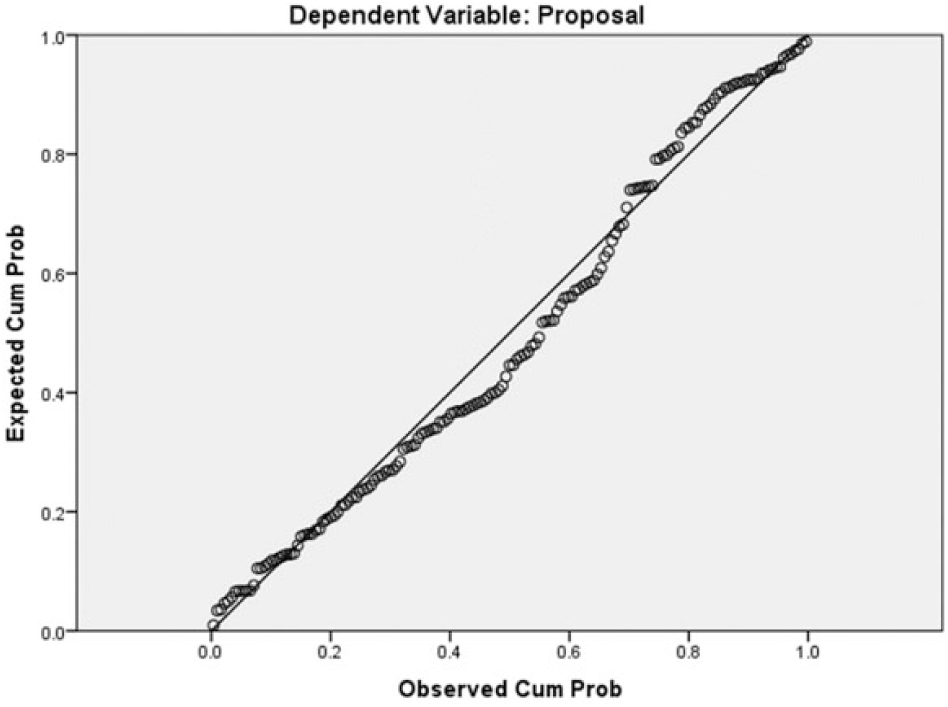
Normal P-P plot of regression standardized residual.
Figure 2 displays the standardized estimates for each item in relation to its latent variable. Fit statistics for the hypothesized model indicated inadequate fit: χ2(296) = 638.26, p < .001. At the same time, incremental fit statistics indicated slightly more satisfactory fit: CFI = .82, TLI = .81, RMSEA = .08 (PCLOSE < .001; 90% CI = [.07, .09), and Akaike information criterion (AIC) = 74.83. The discrepancy could be due to the sample size, as large samples tend to inflate the chi-statistic. Thus, we assessed the normed chi-square, which attempts to correct for sample size by comparing the ratio of the chi-statistic and degrees of freedom (with preferred values between 2 and 5), and found adequate fit for the hypothesized model χ2/296 = 2.16. Each item’s factor score weight was greater in magnitude for its predicted factor than for the other two. In addition, none of the latent variable intercorrelations exceeded desirable levels (i.e., r of .7).

Path diagram of ICI standardized estimates from CFA in AMOS.
Criterion-related validity
As we did in Study 1, we used respondents’ political affiliation as criterion-related validity for the ICI. On a conceptual level, one would expect independents to score higher on the compromise factor and lower on the distrust and animus factors than partisans from either major party. As expected, a univariate ANOVA found higher Compromise scores for independents (M = 40.87, SE = 0.68) than for Democrats (M = 39.93, SE = 0.96) or Republicans (M = 37.76, SE = 0.88), F(2, 169) = 3.98, p = .02,
Multiple-group invariance analyses
Finally, we ran a multigroup structural equation analysis to determine if the model was invariant between Democrats and Republicans. A chi-square difference test found invariance between the models (χ2 = 32.99; critical value of 35.17 needed for significance), indicating that the ICI functions similarly for those on the left and right sides of the political spectrum.
General Discussion
Political psychology remains a growing field in the science of psychology. Being an area in which more research will be conducted, one of the tasks to be undertaken is the development of measures pertinent to the area, and compromise is core to the political process. The importance of studying intergroup compromise in a political context is increasingly apparent considering the political polarization in the United States, which continues to hinder America’s ability to create long-term solutions for vital national issues. However, as stated by Bellamy et al. (2012), there currently exists no standard measure of intergroup compromise in the political psychology literature. Thus, the goal of these two studies was to develop and evaluate a measure of intergroup compromise within a political context.
Across two studies, we found evidence for three psychometrically strong scales assessing compromise in a political context. In Study 1, we found that the ICI scales predicted a political criterion variable, whereas other related constructs such as conformity and teamwork did not. In Study 2, we found evidence for the ICI’s psychometric invariance between Democrats and Republicans, and demonstrated its predictive validity in a political negotiation experiment (see Willis, 2017) Furthermore, in both studies, it was found that independents were more willing to compromise than respondents who identified as Democrats or Republicans.
Despite the overall psychometric validity demonstrated for the ICI, there are a few noteworthy limitations. First, we used an undergraduate population to examine the factor loadings and dimensions of the ICI items. Although our participants are among the voting-age population, it is difficult to determine the degree to which they have political beliefs that they are (un)willing to compromise on. Future studies should obtain samples of likely voters to assess the generalizability of the measure among individuals who vote often in midterm and presidential elections. Second, the ICI needs to be tested in other regions of the country (perhaps by utilizing MTurk) to determine the influence of other cultural and socioeconomic factors on individuals’ amenability to compromise. Third, the invariance analysis was limited to Democrats and Republicans. Future multisample analyses should include a robust proportion of independents, Libertarians, and other demographic variables.
An additional limitation for the ICI is the narrow applicable scope of the instrument. As discussed in Willis (2017), the ICI was predictive of outcomes in a Democrat versus Republican negotiation experiment among politically self-identified respondents Thus, the cross-sectional nature of the investigations thus far restricts the ICI to being an assessment of someone’s likelihood of compromise based on his or her current political affiliation. Given that independents scored higher on compromise in each investigation, a future longitudinal study could investigate the degree to which someone changing his or her political affiliation from Republican or Democrat at Time 1 to independent at Time 2 is associated with an increased amenability to compromise.
Additional political experiments need to be conducted to further establish the ICI’s criterion-related validity. One potential real-world contribution of the ICI would be discerning the political leanings of undecided voters during election seasons. For instance, a campaign may consider offering a more unifying message if the ICI is administered to focus groups and it is determined that the remaining 5% to 10% of undecided voters in a contested race are truly nonpartisan. To that end, the ICI would benefit from the adoption of more contemporary data analytic strategies in future investigations. For instance, the Mokken scaling procedure could be utilized to ensure that participants’ responses are not affected by the order of the items within each scale (Sijtsma & Molenaar, 2002). In addition, researchers may employ receiver operating characteristic (ROC) curves to establish cutoff scores for identifying the undecided voters who are truly nonpartisan.
Taken together, our findings suggest that the ICI may be a strong and promising measure of individuals’ openness to compromise in a political context. Indeed, it is one of the first to focus solely on individuals’ orientation toward obstructionism and compromise in a political context.
Footnotes
Acknowledgements
We would like to thank Shannon Scielzo (University of Texas Southwestern Medical Center) and William Ickes (University of Texas at Arlington) for their support in the early stages of this project.
Declaration of Conflicting Interests
The author(s) declared no potential conflicts of interest with respect to the research, authorship, and/or publication of this article.
Funding
The author(s) received no financial support for the research, authorship, and/or publication of this article.