




Abstract
This review aims to present a systematic review of empirical research on leadership and firm performance (FP) in order to synthesize the fragmented knowledge and propose a unifying framework for future research. To achieve this purpose, this research adopts systematic literature review methodology. A total of 60 empirical papers published during the period 2002 to 2021 was retrieved through exhaustive manual searches of online databases. A matrix table was developed to extract and organize information from the retrieved articles. The findings revealed four main key themes. First, the topic of leadership and FP has been mostly quantitatively examined in many countries and industries. Second, different leadership approaches have been found to ameliorate FP and transformational leadership remains the most commonly used approach. Third, innovation, learning, and culture were the most common mediators of the leadership-FP relationship. Fourth, support for innovation, competitive intensity, firm size, leaders’ trust, and justice orientation have been found to moderate the effect of leadership on FP.
Introduction
The emergence of globalization and industrial 4.0 has resulted in tough competition and economic turbulence in business environment. In response to these challenges, organizations have no other option but to accelerate firm performance (FP) in order to sustain their competitive advantage. In the extant literature, leadership has been recognized as one of the most critical factors that drives FP (Garg et al., 2003; Mintzberg, 1973). Drawing on dynamic capabilities theory (Teece et al., 1997), previous researchers have characterized leadership as a dynamic capability and acknowledged the importance of leaders in managing resources and outcomes in organizations (Iqbal & Ahmad, 2021; Overstreet et al., 2013; Pavlou & El Sawy, 2011; Zahari et al., 2022). Rajagopalan and Spreitzer (1997) stressed that leaders play a vital role in formulating and executing corporate strategies that enable firms to enhance their performance and remain responsive in the market. Recent studies on FP have found that leadership really matters to FP (Ali & Tang, 2016; Jing et al., 2019; Para-González et al., 2018; D. Wang et al., 2015; Zhang, Bao, et al., 2021).
Leadership has been defined as the process of influence and facilitation between leaders and their followers toward mutual goals (Northouse, 2018; Yukl, 2013). Earlier studies have highlighted the role of leadership in enabling organizations to maintain daily operation and achieve superior performance (Fiedler, 1996; Mintzberg, 1973). For example, Rajagopalan and Spreitzer (1997) highlighted the role of leaders in formulating and executing strategies that enable organizations to strengthen their FP and responsiveness. Findings from recent studies revealed that leadership really matters to FP in different contexts (Gürlek & Çemberci, 2020; Jing et al., 2019; Para-González et al., 2018; Rehman & Iqbal, 2020; Saeidi et al., 2021) such as Pakistan, Turkey, Malaysia, etc. In this regard, leaders dynamically integrate existing resources and transform their firms to achieve higher FP and adapt to the contemporary business setting.
Given the growing importance of leadership in organizations and its critical relationship with FP, a plethora of research has been conducted in this field. The earliest theory on leadership (frequently referred to as “trait theory”) assumed that successful leaders acquire innate personalities and attributes that differentiate them from non-leaders (Stogdill, 1948). Different from trait theories, behavioral theories concentrated on the behaviors and styles of leaders, for example, task-focused and relationship-focused (Blake & Mounton, 1968). Since trait and behavioral theories failed to recognize the critical role of situations and contexts in determining effective leaders, contingency theory was developed. This theory stressed that leaders need to be context sensitive and flexibly adopt an appropriate behavior requisite for each circumstance (Hersey & Blanchard, 1969). Burns (1978) developed transactional and transformational leadership. While the former is contractual process in which leaders provide rewards in exchange for employees’ performance, the latter is an influence process in which leaders catalyze greater motivation from followers by articulating an inspiring vision. Recently, scholars argued that transformational leadership is limited in its ability to explain how learning and creativity take place in organizations (Marion & Uhl-Bien, 2002). This limitation, combined with the increasingly complex nature of the current business environment, have given rise to the development of complexity leadership theory. It is defined as a combination of structures, activities, and processes that enable organizations to thrive in the turbulent and competitive environment (Clarke, 2013; Uhl-Bien et al., 2007).
However, research on leadership has produced inconclusive findings and biases due to replications of common topics and overreliance on quantitative methods alone (Yukl, 2013). Moreover, while previous findings showed that theories and research on leadership have evolved over the past decades, the question regarding what leadership approaches are most influential in augmenting FP remains unanswered. In practice, the identification of an appropriate leadership approach that can ameliorate FP are also essential for human resource department and the leaders themselves. Besides, previous researchers argued that studies on leadership-performance relationship produced many inclusive findings, which hindered our understanding of precisely how leadership fosters performance (Bartram & Casimir, 2007; Jing & Avery, 2008). To deal with the foregoing issue, scholars recommended that future studies identify potential mediators/moderators of the relationship between the two phenomena (Boerner et al., 2007; Yukl, 1999). The above-mentioned two issues represent important research gaps in the current literature.
To address these gaps, this paper aims to present a systematic review of empirical research on leadership and FP in order to synthesize the fragmented knowledge and propose a unifying framework for future research.
This review aims to answer the following questions:
RQ1. How was the relationship between leadership and FP empirically investigated in terms of context and methodology?
RQ2. What leadership approaches have been recognized as drivers of FP?
RQ3. Are there any mediators/moderators that play a role in the relationship between leadership and FP?
The remainder of this review is organized as follows. In the next section, we specify the methodology and describe the literature search process. We then present and discuss our findings. Finally, we provide concluding remarks, implications for theory and practice, limitations, and areas for future studies.
Methodology
The study aims to take stock of the existing literature on the connection between leadership and FP in systematic, transparent, reproducible, and scientific way. To achieve this aim, we followed guidelines for systematic literature review in the leadership and management disciplines (Elkhwesky et al., 2022; Frangieh and Yaacoub, 2017; Tranfield et al., 2003; Webster & Watson, 2002).
We followed the literature review process suggested by Vom Brocke et al. (2009) to perform a comprehensive and unbiased search for relevant empirical studies of leadership and FP. Recent reviews have demonstrated that guidelines from Vom Brocke et al. (2009) enable researchers to ensure the relevance, quality, and methodological rigor of their research (Dreyer et al., 2019; Manfredi Latilla et al., 2018).
In the first step, we define the scope of the review. The inclusion criteria include empirical studies on leadership and FP that were peer-reviewed and published in English during the period 2002 to 2021.
The second step is identification of keywords. Since there are different terminologies of FP in the literature, we asked for advice from five researchers that have experience in the fields of leadership and FP. Based on their suggestions, we formulated the following search string: (“leadership”) AND (“firm performance” OR “organizational performance” OR “business performance” OR “corporate performance” OR “financial performance”).
The third step is literature search. To conduct computerized searches for relevant publications, we relied on several large databases: Scopus, Emerald Insight, Science Direct, JSTOR, Taylor and Francis, and Google Scholar.
The initial search uncovered 293 potentially relevant publications. We then screened the title and abstract to remove duplicates, literature review articles, and articles that did not focus on leadership and FP as key subject areas or did not examine the relationship between leadership and FP. These exclusion criteria are developed in accordance with the research purposes and questions of this study. After this filtering, 105 articles remained. Next, the main body of the remaining publications were read and evaluated using similar inclusion and exclusion criteria defined earlier. The set of papers was reduced to 58 after the full text examination. Besides, to ensure that all potentially relevant publications are included in the review, we snowballed from the reference lists of the retrieved articles, which located 2 additional articles for a final set of 60 articles. Each filtering process was conducted independently by three researchers. In case of differences in the results, we cross-referenced and discussed untill agreement was reached.
In the last two steps, we developed a matrix table using guidelines from Garrard (2004). This table enables us to extract and organize information from 60 articles based on the following features: authors and publication year, region and sector, methodology employed, type of respondents, leadership approaches, FP indicators, and relationship between leadership and FP (Table 1). Based on the findings from the review, a unifying framework on the relationship between leadership and FP was proposed.
Literature Review Matrix Table.

Note. SMEs = small and medium-sized enterprises; SEM = structural equation modeling; CEO = chief executive officer; TF = transformational leadership; TA = transactional leadership; FP = firm performance; NI = non-financial indicators; FI = financial indicators; ROE = return on equity; ROI = return on investment; ROA = return on assets; ROS = return on sales.
Findings
This study aims to provide a review on how leadership and FP have been examined in the extant literature. The synthesis of the retrieved articles in this review revealed the following findings.
Descriptive Findings
The year-wise frequency of studies about the relationship between leadership and FP is presented in Figure 1. Two earlier publications were from Elenkov (2002) and Koene et al. (2002). While Elenkov (2002) examined the effect of transformational and transactional leadership behaviors on business objectives achievement of Russian firms, Koene et al. (2002) studied how leaders’ charismatic leadership and initiating structure behaviors affect financial performance of service organizations in the Netherlands. The topics of leadership and performance of firms garnered the greatest attention in 2020 (n = 12) and 2021 (n = 10), while only three articles were published during the 2016 to 2018 period. Of the 60 studies, 5 were published in 2019, of which one study was located in the Journal of Business Research. The upward trend in the figure illustrates that the impact of leadership on FP is an emerging issue and it is a right time to assess how far the field has come.
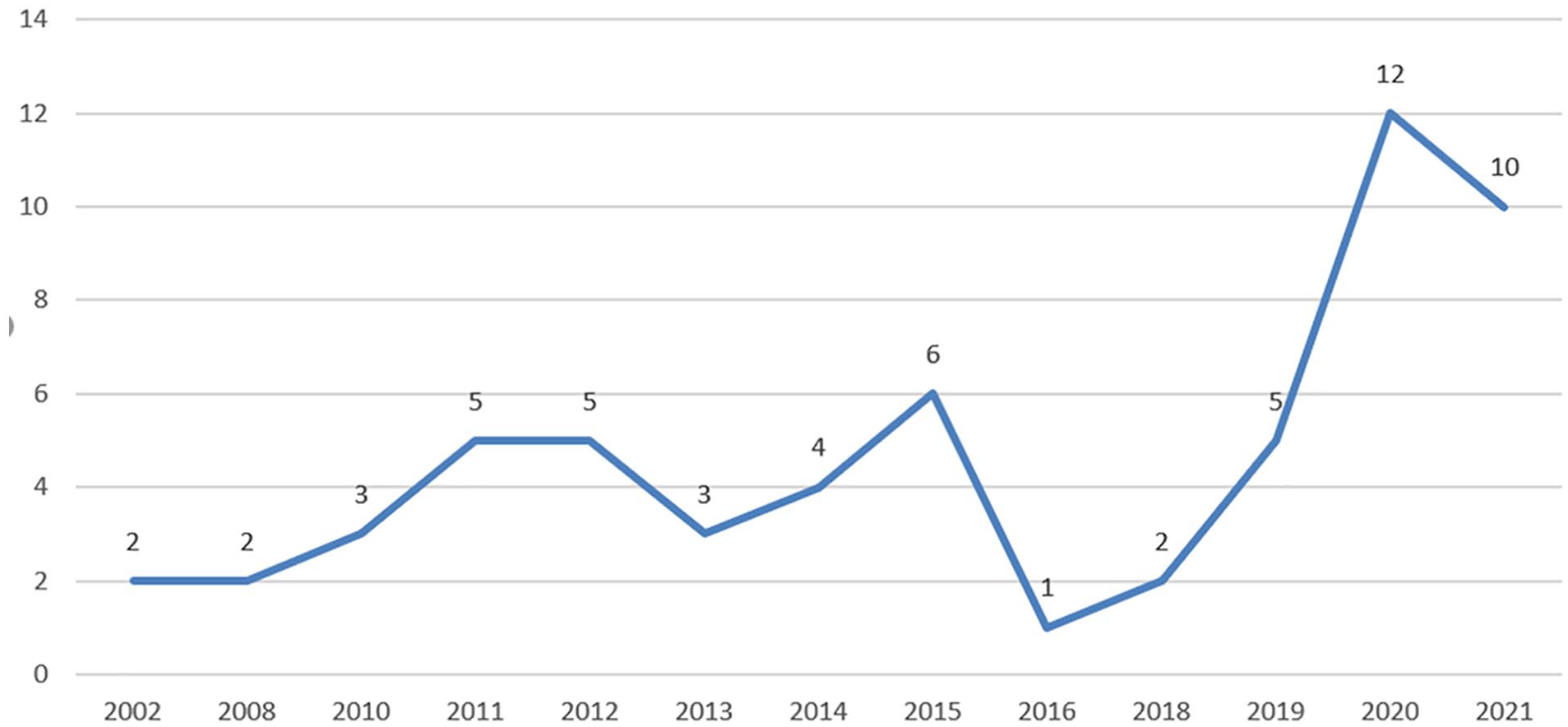
Year-wise publication of publication on leadership and firm performance.
Empirical studies on leadership-FP relationship have been conducted in 24 countries. Regarding country-wise distribution, approximately half of the studies were published from China (n = 14), Malaysia (n = 6), Turkey (n = 5), and the USA (n = 4). Multi-sector studies occupy a considerable portion (n = 17), followed by manufacturing (n = 6), service (n = 4), and banking (n = 4) industries. It is noticeable that research on new venture or small and medium-sized enterprises is scarce, with only one paper published in 2012 about technology start-up in the USA and one paper published in 2014 about new venture in China.
As for methodology adopted in the reviewed articles, quantitative approach accounted for 93% of the total studies (n = 56). Among 56 quantitative articles, structural equation modeling (n = 30), multiple regression (n = 10), and hierarchical regression (n = 7) were the most common data analysis techniques employed. Interviews were used in one qualitative study. There were three mix-method papers which employed both interviews and hierarchical linear models/regression analysis/PLS-SEM to study the effect of participative leadership, transformational leadership, and blue ocean leadership on FP (Jensen et al., 2020; Kim & Schachter, 2015; Loh & Yusof, 2020). The majority of the reviewed articles used chief executive officers and managers as key respondents (n = 35), while a smaller amount concentrated on employees (n = 14) or gathered information from both managers and employees (n = 11).
In examining the relationship between leadership and FP, most studies (n = 53) relied on interviews and surveys to gather subjective data on FP. There was one article that combined data from both perceived organizational performance and objective organizational performance for evaluating FP of banks in the Nederland (see Wilderom et al., 2012). Besides, financial indices were the focus of 15 studies, while non-financial measures were solely used in 10 studies. The rest (n = 35) attempted to provide a comprehensive picture of FP by employing both financial and non-financial measurement.
In total, 22 financial indicators and 38 non-financial indicators of FP were extracted from the reviewed articles. The most used financial indices were market share, return on assets, return on sales, and growth in sales. Some indices such as customer satisfaction, employee satisfaction, and reputation were frequently applied to evaluate non-financial FP. The non-financial indicators identified in the reviewed articles can be classified into five groups of consumer-oriented, organization-oriented, market-oriented, employee-oriented, and product-oriented.
The Effects of Different Leadership Approaches on FP
Leaders differ from one another in their leadership approaches, which results in varying influences on FP. Among 60 reviewed papers, 24 leadership approaches were found to positively affect FP. Of that, 30 articles focused on the impact of transformational leadership, and among those 21 articles, 15 examined multiple approaches to leadership. In particular, six articles focused on how transactional and transformational leadership drive performance (e.g., Elenkov, 2002; Ur Rehman et al., 2019; Yıldız et al., 2014), while eight articles compared the effects of three leadership styles (transactional, transformational, and laissez-faire) on FP (e.g., Abasilim et al., 2019; Anh & Nhàn, 2021; Mekhum, 2020; Saeidi et al., 2021; Sethibe, 2018). One paper by Min et al. (2011) studied the role of transformational leadership and paternalistic leadership on performance of private firms. This demonstrates that transformational leadership remains the most frequently used leadership approaches in the past 18 years (2002–2019). In addition, other leadership approaches were reported to have positive influence on FP such as servant leadership, charismatic leadership, participative leadership, etc. The findings on each leadership approach and its reported relationship with FP are presented as follows.
Transformational leadership
García-Morales et al. (2008) conducted a study in Europe and America about transformational leadership’s impact on FP in the pharmaceutical industry. They found that transformational leaders provide directions, rules, plans, and systems that enable the firms to increase organizational performance and respond to the market. García-Morales et al. (2012) extended their previous work by confirming the impacts of transformational leadership on FP, both directly and indirectly through organizational learning and innovation. Chan (2010) conducted a qualitative study on the influence of leadership expertise and experience on FP during three phases in Malaysia. This author found that all the leadership styles during three periods fit Burns’ (1978) definition of transformational leadership. C. Huang et al. (2011) examined dimensions of transformational leadership (intellectual stimulation, individual consideration, and charisma) and found a direct and positive relationship between the charisma of transformational leaders and FP. Samad (2012) also examined how dimensions of transformational leadership influence the performance of Malaysian logistics companies. However, the findings revealed that all dimensions of transformational leadership positively and directly affect employee satisfaction and customer satisfaction of those firms. Similar findings on the direct and positive impact of transformational leadership and FP have been found in recent studies (e.g., Chen et al., 2019; Kittikunchotiwut, 2020; Le & Le, 2021; Son et al., 2020; Zhang, Chen, et al., 2021).
Transactional and transformational leadership
Previous scholars found that (i) both transactional and transformational leadership have direct and positive influences on FP; and (ii) the impact of transformational leadership on FP was more significant than that of transactional leadership (e.g., Birasnav, 2014; Elenkov, 2002; Lee & Liu, 2008; Ur Rehman et al., 2019; Yıldız et al., 2014). A recent finding from Berraies and Bchini (2019) may be of more interest. Berraies and Bchini (2019) in their study in knowledge-intensive companies in Tunisia found that transformational leadership plays a significant role in enlarging the businesses’ financial performance, whereas transactional leadership style is not significantly associated with financial performance.
Transactional, transformational, and laissez-faire leadership
Studies of the effect of these three leadership approaches on FP reported mixed findings. In Zehir et al.’s (2012) study, they found significant, positive, and direct effects of transformational leadership and laissez-faire leadership on firm’s financial/nonfinancial FP. However, their findings showed that the relationship between transactional leadership and FP is not supported. Zumitzavan and Udchachone (2014) found that both transactional and transformational leadership have the direct and positive impacts on the hotels’ financial performance, while laissez-faire leadership exerts no influence. Similarly, Sethibe (2018) reported direct and positive influences of only transactional and transformational leadership on the firms’ non-financial performance in terms of customer satisfaction, productivity, and product/service innovation. Anh and Nhàn (2021) found that both transformational and transactional leadership have significant positive influences on FP, while laissez-faire leadership exhibited the adverse effects. Contrary to most research, Harsanto and Roelfsema (2015) found that only laissez-faire leadership has significant direct effect on the growth in sales of Indonesia firms. Surprisingly, their findings indicated an “Asian value” that transformational leaders in Asian have significantly less influence than those who practiced the laissez-faire style. In addition, transactional leadership is found to have negative influence on the firms’ performance, especially sales growth. Recent studies revealed contradictory results. Abasilim et al. (2019) reported a significant medium positive association between transformational leadership and FP, whereas transactional leadership had an insignificant small negative connection with FP. By contrast, Laissez-faire leadership was found to exert an insignificant small positive relationship with FP.
Other leadership approaches
Two papers from Peterson et al. (2012) and J. Huang et al. (2016) reported a positive and direct relationship between servant leadership and FP. Other two articles compared task-oriented, relation-oriented, and change-oriented leadership’s effects on FP. While Wan H. Wang et al. (2011) highlighted a significant, direct, and positive relationship between only task-focused leadership behaviors and firm performance; Özsahin et al. (2011) found that task-oriented and relation-oriented leadership indirectly impact FP through learning orientation. Charismatic leadership was found to have direct and positive effect on FP in Wilderom et al.’s (2012) and Koene et al.’s (2002) studies. Arslan and Staub (2013) examined the relationship between leadership, which was constructed based on the Theory X and Theory Y, and FP. The result showed that the styles of the leaders in Turkish firms could be illustrated by leadership X, leadership Y, and “indecisive group” - a small group of people who scored the same in both Theory X and Theory Y. In addition, the result only proved the influences of the leaders who have leadership Y on turnover rate and performance of firms. Zehir et al. (2011) explored the impact of supportive leadership, participative leadership, and transactional leadership on FP. Their findings demonstrated that these leadership approaches had direct and positive influences on FP. Kim and Schachter (2015) employed mixed method to study the connection between participative leadership and FP. The findings of quantitative data analysis revealed a direct and positive relationship between participative leadership and FP. The findings of qualitative data analysis demonstrated that the followers of participative leaders displayed proactiveness and honesty, which in turn helped the firm achieve its goals and enhance its performance. Charismatic leadership, spiritual leadership, ethical leadership, innovation leadership, entrepreneurial leadership, and leadership and people management were also found as drivers of FP in studies conducted by Y. Zhang and Wei (2021), Nguyen et al. (2021), Salehzadeh et al. (2015), D. Wang et al. (2015), Carmeli et al. (2010), S. Huang et al. (2014), and Alagaraja et al. (2015), respectively. Jing et al. (2019) investigated the connection between leadership paradigms (classical, transactional, visionary, and organic) and FP. They found that leadership indirectly affected FP through leader–follower trust, organizational climate, and vision communication/sharing. Recently, Rehman and Iqbal (2020) and Gürlek and Çemberci (2020) reported direct and positive relationship between knowledge-oriented leadership and FP, mediated by knowledge management and innovation. Loh and Yusof (2020) found that blue ocean leadership significantly and positively affected FP automotive vendors in Malaysia. Su et al. (2020) found that environmental leadership had a positive relationship with both environmental performance and financial performance aspects of agricultural products corporations in China.
Mediating Mechanism in the Relationship Between Leadership and FP
Mediating variables assist in explaining the relationship between leadership (independent variable) and FP (dependent variable). Among 60 studies, 35 studies examined how a variety of mediators, among which organizational learning, organizational innovation, and organizational culture were the most common, extend current understanding of the leadership-FP connection.
Organizational learning
It has been suggested that the presence of organizational learning contributes to an improvement in FP. García-Morales et al. (2008, 2012) tested this mediator and found that organizational learning mediated the connection between transformational leadership and FP. In particular, transformational leaders engaged and promoted organizational learning by eliminating the barriers that restricted learning processes. Based on this process, firms can improve organizational performance and expertise to respond to uncertainties and technological changes within the industries. According to Noruzy et al. (2013), transformational leaders stimulated organizational learning, which in turn fostered long-term performance and competitive advantage of manufacturing firms. Similar results were found in recent studies (e.g., Kittikunchotiwut, 2020; Para-González et al., 2018; Ur Rehman et al., 2019)
Organizational innovation
In their studies, García-Morales et al. (2008, 2012) found a positive mediating impact of organizational innovation on the relationship between transformational leadership and organizational performance. Transformational leaders were found to engage in the innovation diffusion and create a climate that fostered the creative ideas, which ultimately enabled their firms to handle challenges and achieve success. Similarly, Noruzy et al. (2013) contended that transformational leaders used inspirational motivation and intellectual stimulation to generate innovation. Then, firms with higher level of innovation could gain the capabilities needed to enhance performance and sustain competitiveness. In the same vein, the findings from studies of Overstreet et al. (2013), Zumitzavan and Udchachone (2014), and Para-González et al. (2018) revealed that the impact of leadership on FP was mediated by organizational innovation. Besides, S. Huang et al. (2014) examined the mediating effects of exploratory and exploitative innovation in the relationship between entrepreneurial leadership and the new ventures’ performance. They found that entrepreneurial leaders were critical drivers of the venture’s success and survival due to their abilities to generate both exploitative and exploratory innovation. Similarly, results from Berraies and Bchini’s (2019) study confirmed the mediating impact of both exploitative and exploratory innovations on the connection between transformational leadership and firm’s financial performance. Chen et al. (2019) presented an interesting finding. In their research, since the mediating effects of exploratory innovation on the relationship between transformational leadership and FP were inverted U-shaped, transformational leadership had negative and indirect influence on FP. In particular, firms that placed a strong emphasis on transformational leadership generated too much strategic shifts or exploratory innovation, which led these firms to huge danger of declined performance. In two recent studies of Rehman and Iqbal (2020) and Gürlek and Çemberci (2020), organizational innovation was found to mediate the relationship between knowledge-oriented leadership and FP in firms operating in Pakistan and Turkey.
Organizational culture
According to Zehir et al. (2011), organizational culture (competitive, bureaucratic, and community culture) mediated the relationships between leadership and FP. The findings from Ur Rehman et al.’s (2019) study also confirmed the mediating role of culture in the relationship between leadership and performance within Malaysian small and medium-sized enterprises. Leaders in these firms were found to exert their influence in developing an organizational culture, which in turn helped the firm become successful in the market.
Other mediators
In Carmeli et al.’s (2010) study, leaders enforced the interaction between functions and divisions within the firms to create a strategic fit that improved organizational adaptation capabilities and performance outcomes. Özsahin et al. (2011) found that learning orientation played a meditating role in the relationship between task-oriented leadership, relation-oriented leadership, and FP. Zehir et al. (2012) found that supervisory commitment mediated the relationship between leadership and performance of Turkish firms. Birasnav (2014) emphasized knowledge management as an essential factor that transformational leaders should focus on to improve FP. However, their findings showed that only knowledge application had significant impact on the relationship between the transformational leadership and FP. In other studies, while Kim and Schachter (2015) found that followership mediated the relationship between participative leadership and FP, J. Huang et al. (2016) highlighted a full mediating effect of service climate on the leadership-FP relationship within hospitality context. Recently, Para-González et al. (2018) explored the mediating role of high-performance human resources practices system on the relationship between transformational leadership and FP. Jing et al. (2019) studied how leadership paradigms affected FP through a variety of mediators including leader–follower trust, organizational climate, and vision communication/sharing. Findings from Su et al.’s (2020) study indicated that green innovation strategy and actions mediated the connection between environmental leadership and FP. Recently, Le and Le (2021) investigated and confirmed the mediating role of organizational change capability on the effect of transformational leadership on both operational and financial performance of Vietnamese firms. Nguyen et al. (2021) and Saeidi et al. (2021) found similar findings related to the meditating effect of corporate social responsibility on the relationship between ethical leadership and FP.
Moderating Mechanism in the Relationship Between Leadership and FP
Moderator variables affects the direction and/or extent of influence of the relationship between leadership (independent variable) and FP (dependent variable). Among 60 studies, 6 studies utilized moderators in their research, which provided insights into the boundary conditions in which leadership operated and influenced FP. Koene et al. (2002) found that store size moderated the relationship between charismatic leadership and financial performance of stores in the Netherlands. According to Min et al. (2011), the relationship between transformational leadership and FP was moderated by both emotional and cognitive trust to leaders. Leader justice orientation was found to positively moderate the relationships between ethical leadership and FP in D. Wang et al.’s (2015) study. In a study of 92 hotels in China, J. Huang et al. (2016) found that competitive intensity moderated how servant leadership indirectly affected FP through service climate. In other words, when competitive intensity was high, the indirect relationship between servant leadership and FP became stronger. This finding was in line with that of a recent study by Y. Zhang and Wei (2021), which highlighted the moderating role of competitive tension in the relationship between leadership and FP in pharmaceutical firms in Thailand. In particular, the positive influence of change leadership on FP was strengthened in the presence of perceived competitive tension.
Toward a Unifying Framework on the Relationship Between Leadership and FP
A review of previous research on leadership and FP revealed that most empirical studies on this topic have focused on how different leadership approaches influence FP (both financial and non-financial) and the mediating/moderating mechanisms that explain these connections. Figure 2 below presents an overarching view of these relationships.

Model of the relationship between leadership and firm performance.
Discussion and Areas for Future Research
This review aims to synthesize extant literature on leadership-FP relationship. The findings suggested that research on leadership and FP has been burgeoning in the past 20 years, with a plethora of quantitative articles conducted in various contexts. Among reviewed articles, transformational leadership approach was dominant in the studies related to FP. These findings confirmed Yukl’s (2013) argument that leadership research is being held back since scholars overly relied on quantitative method and a popular leadership approach in their studies. In response, this study provides some recommendations for future research into this area.
Research Design Advancement
Compared to quantitative methodology, qualitative and mixed-method approaches in leadership research enabled the researchers to explore leaders’ traits and competences or provide in-depth understanding of the effect of a certain leadership style. For example, Chan (2010) used qualitative approach to examine the effects of leadership expertise and experience on FP. The findings revealed that the behaviors of leaders found in the study fit Burns’ (1978) definition of transformational leadership. Moreover, Chan (2010) found that the success or failure of a firm ultimately depended on leaders’ traits and competencies. These findings have added to current understanding of the impact of leaders’ traits and competences on FP. Future studies are encouraged to quantitatively investigate the effects of leaders’ traits and competencies in comparison to leaders’ behaviors (transformational or complexity leadership) to provide better insights and build more useful theories. Similarly, Kim and Schachter’s (2015) mixed-method study helped further explain the impact of participative leadership on employees’ followership and performance of public organizations. In designing future studies on leadership and FP, researchers should combine quantitative and qualitative designs. Case studies and interviews can be used to refine the survey questionnaire or explore the influences of leadership on FP.
Examination of Understudied Leadership Approaches
Empirical studies reviewed in this study demonstrated that various leadership approaches ameliorated both financial and non-financial performance; therefore, there are possibilities that some uncovered leadership approaches have similar impact on FP. In the literature, complexity leadership has been found to share some similarities with transformational leadership and can be used in firms operating in volatile and globalized markets (Burchell, 2009). According to Marion and Uhl-Bien (2002), complexity leadership can remediate the restriction of transformational leadership in clearly explaining the processes through which firms adapt to the environment. Since the relationship between complexity leadership and FP is less examined in the literature, there are plenty of opportunities for future research on this topic.
Inclusion of Emerging Intervening and Boundary Variables
This review presents some factors that mediate/moderate the relationship between leadership and FP (e.g., organizational learning, organizational innovation, organizational culture, etc.) which can be used as a reference for future studies. However, in addition to these variables, we acknowledge the importance of other mediators/moderators that has not been empirically tested. Therefore, researchers should investigate emerging mediators/moderators and compare their incremental variance with the variables outlined in this study.
Conclusion
This paper aims to present a systematic review of the relationship between leadership and FP in order to synthesize the fragmented knowledge and propose a unifying framework for future research. The review revealed three main key themes related to the relationship between leadership and FP. First, the topic of leadership and FP has been mostly quantitatively examined in many countries and industries. Second, different leadership approaches have been found to ameliorate FP and transformational leadership remained the most used approach. Third, organizational innovation, organizational learning, and organizational culture were the most common factors that mediated the relationship between leadership and FP. Fourth, support for innovation, competitive intensity, firm size, trusts to leaders, and leader’s justice orientation have been found to moderate the effect of leadership on FP.
This review offers several implications to theory and practice. The findings provide an overall picture on how different leadership approaches affect FP, which contributes to the development of leadership and FP theory. Moreover, this study provides a framework consisting of different leadership approaches, mediators, moderators, and different indices of FP for empirical validation in future studies. For practicing managers, this study shows that FP can be enhanced through several different leadership approaches. The findings of this study can be used by leaders and human resources managers in identifying suitable leadership approaches that improves their FP in the current turbulent environment.
Finally, the scope of this systematic review focuses only on studies published in the English language. In the future, researchers are encouraged to cast a wider net and include publications in other languages. Besides, given the interest in investigating the relationship between leadership and FP and advancing knowledge in these fields, the current research just focused on scholarly and empirical articles. Future systematic reviews would benefit from exploring practical leadership perspectives and consultant views on leadership and FP retrieved from the vast amount of practitioner publications.
Footnotes
Declaration of Conflicting Interests
The author(s) declared no potential conflicts of interest with respect to the research, authorship, and/or publication of this article.
Funding
The author(s) disclosed receipt of the following financial support for the research, authorship, and/or publication of this article: This research is funded by Vietnam National Foundation for Science and Technology Development (NAFOSTED) under grant number NCUD.05-2019.70.
