




Abstract
This paper aims to comprehensively define village social capital, assess its multifaceted dimensions in relation to farmers’ entrepreneurial decision-making, and investigate the mediating role of rural development. The research sample consists of 14,133 farmers selected through a multi-stage proportional-to-size unequal probability sampling method. Data collection was carried out using questionnaires as part of the “Chinese Thousand Village Survey” project. Empirical analysis was conducted using binary logit and basic linear regression models, supplemented by probit models and other robustness testing methods. The findings indicate that village social capital exerts a significant and favorable influence on farmers’ entrepreneurial decision-making. Controlling for other variables, a unit increment in farmers’ village social network, village social participation, and village social trust is associated with a respective increase in farmers’ odds of entrepreneurial decision-making by 3.96, 5.42, and 16.28%. Village social trust emerges as the most influential factor. Additionally, rural harmony and rural economy partially mediate the relationship between village social capital and farmers’ entrepreneurial decision-making. This study contributes to a deeper understanding of the complex interplay between village social capital and farmers’ entrepreneurial decision-making, offering valuable guidance for farmers looking to leverage village social capital in their entrepreneurial endeavors. It lays a theoretical foundation for relevant entities to strengthen village social capital and cultivate a supportive environment for rural entrepreneurship. To our knowledge, this paper is among the earlier studies that investigate farmers’ entrepreneurial decision-making. Besides, the relationship between village social capital and rural development is rarely studied in the literature as two determinants of farmers’ entrepreneurial decision-making.
Keywords
Introduction
The prevailing economic changes and rising social challenges, especially in rural areas, has led to a growing consensus among researchers and policymakers. They recognized that the economic and social development of these regions hinges on the emergence of new businesses and startups, rather than the relocation or retention of pre-existing firms (Haltiwanger et al., 2013). In line with this trend, Bosworth and Bat Finke (2020) coined the term “commercial counterurbanization,” which is defined as the growth of rural economies stimulated by inward migration. They used this term to encapsulate the trend of farmers establishing their own enterprises within rural environments. While farmer entrepreneurship research has become an integral part of entrepreneurial studies, the factors that drive farmers’ decision-making processes in relation to entrepreneurship remains incipient (Rowe et al., 1999). Previous studies have identified that the economic and human capital accumulated by farmers while working in urban areas constitute the primary sources of entrepreneurial capital (Khoshmaram et al., 2020). Additionally, other research highlighted the significance of social capital as an intangible asset that exerts a pivotal influence on farmers’ entrepreneurial endeavors (Coleman, 1988). Scholars posited that social capital holds the potential to elucidate the workings of entrepreneurship and serve as a means to explore the underlying mechanisms that shape entrepreneurial activities (Kwon & Arenius, 2010). Consequently, the development of social capital, particularly in relation to entrepreneurship, is widely viewed as a crucial factor (Salamzadeh et al., 2022).
Although it is challenging that regardless of the theoretical interest in the link between social capital and farmer entrepreneurial activities (Ruef, 2010), few contributions have explicitly discussed the relationship between village social capital and farmers’ entrepreneurship decision-making. Some studies indicated that the family social capital, encompassing family duties, trust, and support, forms the basis for farmers’ entrepreneurial ideas (Evansluong & Pasillas, 2019). Family structure conditions, such as elite or handicapped families, strongly influence farmers’ decision-making in entrepreneurship (Yang et al., 2017). Other studies focused on urban social capital and suggested that social capital accumulated by farmers in urban living and working environments can facilitate entrepreneurial decision-making (Xu et al., 2017). However, an increasing amount of evidence showed that farmer entrepreneurship is deeply embedded in village society and profoundly influenced by the rural social environment (Bond & Graff, 2012; Muñoz & Kimmitt, 2019). Some empirical studies have examined the positive effect of the personal networks on entrepreneurial decision-making, and found associations between the strength, diversity, and centrality of network connections and farmers’ entrepreneurship (Williams et al., 2017). Nevertheless, these studies fail to fully explain the variations in entrepreneurial activities at the village level as they overlook the public goods attributes of social capital, such as social trust and participation (Coleman, 1988). Consequently, there exists a research gap regarding the understanding of the relationship between village social capital dimensions and farmers’ entrepreneurial decision-making.
Moreover, rural development is a result of the significant driving force of village social capital (Narayan & Pritchett, 1999), and some research argued that the rise of entrepreneurial decision-making is closely intimately connected to specific regional development contexts where entrepreneurial activities occur (Zahra, 2007). Therefore, rural development inevitably influences farmers’ entrepreneurial decision-making. However, existing research largely neglected the simultaneous consideration of social capital, entrepreneurship and location choice (Yu & Artz, 2019), and failed to explore the mediating mechanism between village social capital on farmers’ entrepreneurial decision-making.
Therefore, we provide exploratory analysis to fill above gap by achieving the following research objectives:
To study the definition of village social capital.
To highlight village social capital’s multifaceted dimensions in relation to farmers’ entrepreneurial decision-making.
To explore the mediating role of rural development.
To our knowledge, this paper is among the earlier studies that investigate farmers’ entrepreneurial decision-making. Specifically, the main contribution of this study is threefold. Firstly, we categorize social capital into family social capital, village social capital, and urban social capital, placing particular emphasis on the influence of village social capital on farmers’ entrepreneurial decision-making. This approach addresses the limitations of previous studies that only examined family or urban social capital. In specific terms, we adopt the perspective of “space of flows,” which refers to the space formed by elements such as capital flow, material flow, information flow, population flow, and technological flow (Castells, 1992). Chinese rural areas exemplify the characteristics of what Fei (2006) refers to as an “acquaintance society,” wherein different circle structures among individuals exist. Therefore, we categorize social capital into family, village, and urban social capital based on the spatial stratification characteristics of farmers’ social capital. Moreover, we refine the concept of village social capital by considering three dimensions: social network, social participation, and social trust. This addresses the oversight in previous studies that solely examined individual networks when studying social capital. Secondly, we identify the mechanism through which village social capital influences farmers’ entrepreneurial decision-making and elucidate the causal relationship between rural development and farmers’ entrepreneurial decision-making. This enhances the greater understanding of the complex interplay between village social capital, rural development, and farmers’ entrepreneurial decision-making, and further improves the theoretical analytical framework of farmers’ entrepreneurial decision-making. Thirdly, we provide guidance not only for farmers on to leverage village social capital for entrepreneurial decision-making but also for the government in formulating scientific and reasonable rural development policies. This contributes to the promotion of farmers’ entrepreneurial decision-making, thereby driving coordinated and sustainable economic, social, and ecological development in rural areas. Through these contributions, we extend the application scope of social capital theory and space of flows theory in the study of farmer entrepreneurial decision-making, enrich the theoretical understanding of the complex factors influencing farmers’ entrepreneurial decision-making in disciplines such as Rural Sociology, Political Economy of rural societies and Rural Governance, and provide new perspectives for addressing challenges such as the loss of village social capital and rural hollowing-out.
The paper is organized as follows. In section “Literature Review and Research Hypothesis,” we discuss village social capital and present the research hypotheses. In section “Research Design,” we present data sources and variable design, and develop binary logit model and basic linear regression model. Section “Empirical Results” is devoted to empirical analysis and presents the regression results. Finally, section “Conclusion and discussion” summarizes the findings and explores the implications, research limitations, and future research directions.
Literature Review and Research Hypothesis
Village Social Capital
The origin of the term social capital can be traced back to Bourdieu (1985), who defined it as “the sum of actual or potential resources associated with an enduring network of more or less mutual awareness and recognition.”Burt (1992) described social capital at the individual level as “a personal relationship that can generate economic capital.” In contrast, Coleman (1990) considered family kinship as the strongest form of social capital. In addition, Stern and Putnam (1993) defined social capital at the social level, as “the network of relationships that exist within and between social groups,” arguing that these networks generate pro-social norms of reciprocity, cooperation, and trust. Chiu et al. (2007) further defined social capital as three dimensions: structural (social interaction), relational (trust, reciprocal norms, and identity), and cognitive (shared language and shared vision). Despite the various definitions, Woolcock (1998) noted that social capital has common elements including foundational elements such as social interaction and connections, as well as cultural elements such as common purpose, reciprocal norms, trust, citizen participation, and learning. Building on these perspectives, Lin and Liu (2005) measured rural social capital using the dimensions of social network, trust, and public participation.
Another popular way to conceptualize social capital is through the lens of bridges and bonds. Woolcock (1998) categorized social capital into three types: bonding, bridging, and linking social capital. Bonding social capital primarily involves close relationships among homogeneous individuals such as family and friends. It is a resource embedded within internal network structures characterized by exclusivity, strong relationships, deep trust, and informal cooperation. Bridging social capital pertains to the horizontal trust and interconnection between different individuals, particularly the connection between farmers and other members of identity-based groups in the village. It is characterized by inclusiveness, weaker relationships, acquaintance trust, and more formal cooperation. Linking social capital means that individuals or organizations interacting across existing status and boundaries, obtaining diversified social resources from outside existing circles. It is characterized by cross-border, weak relationships, trust among strangers, and formal or institutionalized cooperation. Coleman (1990) further divided social capital into original social capital, which is provided by family and community in modern society, and new social capital, which people build up intentionally or unintentionally in their interaction activities based on new needs. Combining existing views, scholars divided farmers’ social capital into two categories: the original social capital formed in rural society before farmers entered urban areas, and new social capital reconstructed after farmers entered urban communities, with the boundary defined by the space of farmers’ flow.
Drawing from the Bourdieu’s field theory perspective, this paper focused on the differing “space of flows” of social capital cultivated by farmers. It employs a classification method that uses farmers’ space of flows as boundaries to further refine farmers’ social capital into three categories. These categories include “original” family social capital, which is formulated through blood relations and kinship in family spaces; “embedded” village social capital, which is formed through geographic proximity and organizational membership in village society; and “compensating” urban social capital, which is accumulated in urban living spaces due to career diversity and social integration. Within these categories, family social capital can be classified as “strong relationship-homogeneity” bonding social capital, characterized by strong bond between family members or close friends. Urban social capital exhibits the characteristics of “weak relationship-heterogeneity” linking social capital, manifested as “vertical” interactions among some scattered and low similarity groups in society. Village social capital is similar to “medium intensity and heterogeneity” bridging social capital, emphasizing looser horizontal ties with acquaintances and neighbors. Since the existing studies predominantly focused on family social capital and urban social capital (Dana et al., 2020; Xu et al., 2017), this paper specifically focuses on village social capital. Moreover, based on the three-dimensional structure of social capital, the village social network is attributed to the structural dimension of social capital, village social participation to the cognitive dimension of social capital, and village social trust to the relational dimension of social capital, and then construct the village social capital index and measure it. In summary, when defining village social capital, both the “content” and “structure” of social capital are taken into account. This approach helps to establish a bridge between relevant studies and explore the influence mechanisms of village social capital on farmers’ entrepreneurial decision-making, thereby further enriching existing research insights.
Research Hypothesis
Influence of Village Social Capital on Farmers’ Entrepreneurial Decision-Making
Zimmer and Aldrich (1987) introduced social structure theory into the study of entrepreneurial activities, arguing that social capital, which is an integral resource in the social structure, plays a crucial role in satisfying the entrepreneurial needs of its members. Village social capital, characterized by its evident closed and cohesive nature, is the main factor that both restricts and encourages farmers’ entrepreneurial behavior, thus influencing the decision-making process of farmers’ entrepreneurship (Huang & Mai, 2011). Farmers with substantial degree of social capital are more likely to generate new discoveries, promote the development of new opportunities, identify and integrate scarce resources (Uzzi, 1999). Village social capital can affect both farmers’ entrepreneurial motivation and behaviour (Batjargal & Liu 2004). Therefore, it is hypothesized:
Hypothesis 1: Farmers with rich village social capital tend to make entrepreneurial decisions.
China, as a typical guanxi society (Huang, Chen et al. 2021), is characterized by a social structure where interpersonal interactions are relationship-oriented and influenced by blood ties and geographical connections, leading to varying degrees of social relationships. In this context, personal connections and relationships are not only fundamental to social systems and power dynamics but also serve as crucial alternative mechanisms for information exchange and resource distribution (Li & Chen, 2012). Some studies showed that the initial social network in rural areas helps farmer entrepreneurs seek entrepreneurial support (e.g., financing and labor employment), reduce costs associated with engaging in non-agricultural activities, and efficiently integrate, absorb and utilize external resources to guarantee the smooth development of entrepreneurial activities (Jiang & Bian, 2007). Thus, we hypothesize:
Hypothesis 1a: Farmers with rich village social network tend to make entrepreneurial decisions.
Farmers’ social participation reflects the individual’s ability to access scarce resources in a village. The higher the degree of social participation is, the more conducive solving the dilemma of collective action is (Lin & Liu, 2005). Previous research has demonstrated that farmers’ political participation helps them obtain scarce government resources, improve their self-control ability, and stimulate and maintain entrepreneurial motivation (Bowen & De Clercq, 2008). By joining local economic or social organizations, farmers can gain valuable information and standardized training, which, in turn, can motivate successful business initiatives (Niu, 2004). Accordingly, we can propose the following hypothesis:
Hypothesis 1b: Farmers with high village social participation tend to make entrepreneurial decisions.
Trust is an important part of social capital (Welter, 2012). Individuals with high level of trust in others are more likely to accept differences between others and themselves, and are willing to interact with various types of people to access scarce information and recognize its value (Kirzner, 1973). Trust can significantly improve the communication scope, frequency and depth of members of social structures, thus stimulating cooperative behavior (Coleman, 1988). In the village acquaintance society, trust can help rural entrepreneurs obtain financial resources and emotional support, and provide a guarantee for successful entrepreneurship (Zhao et al., 2020). Hence, we propose the following hypothesis:
Hypothesis 1c: Farmers with high village social trust tend to make entrepreneurial decisions.
Mediating Effect of Rural Development
Rural harmony and rural economy are two fundamental dimensions of rural development (Liu, 2007). A harmonious rural environment fosters the growth of rural markets, which in turn nurtures agriculture and rural small enterprises. Furthermore, rural areas with strong social capital are more likely to achieve economic and social development (Zhao, 2003). A well-developed rural economy optimizes the entrepreneurial environment, increases entrepreneurial opportunities, reduces entrepreneurial costs, and promotes local entrepreneurship among farmers (Zhang, 2014). In light of these factors, we suggest that rural development serves as a vital bridge connecting village social capital and farmers’ entrepreneurial decision-making. It acts as a critical mediating mechanism through which village social capital influences farmers’ entrepreneurial decision-making.
Village social capital is a type of “soft capital” that can improve social efficiency and stimulate social vitality. It is a necessary social condition for achieving rural harmony (Jiang, 2005). Village social network is a collection of relationships between social actors that can connect different ethnic and interest groups to maintain social harmony and stability. Village social participation is an important approach to realize farmers’ subjective rights. The full spirit and behavior of social participation can integrate the whole village (Liu, 2013). The higher the degree of village social trust, the stronger the sense of security of its members, and the more conducive to enhancing village cohesion, promoting mutual recognition and harmonious coexistence (Zhao, 2010).
Within the realm of rural entrepreneurship, rural harmony serves as a pivotal social foundation. A positive village atmosphere greatly promotes the sustainable development of rural entrepreneurship (Wu, 2013). The characteristics of rural public institutions, such as hierarchy and quantity, are essential factors in establishing a harmonious environment in rural areas, and well-structured institutions effectively highlight local characteristics and provide entrepreneurial opportunities (Malmberg, 1997). Moreover, rural governance exerts an impact on farmers’ entrepreneurial decisions. Strong local governance helps eliminate barriers faced by farmers in terms of economic geography and other aspects, creating a favorable social environment for entrepreneurship and motivating farmers to pursue entrepreneurial endeavors (Stathopoulou, 2004).
Village social capital is also a non-market force that can enhance people’s welfare and economic growth. It enhances economic efficiency through coordinated actions and plays a positive role in the development of rural economy (Zhang, 2007). Rural economic activities are deeply embedded in deterministic and sustainable village social network (Liu, 2007), which facilitates information sharing, realize risk-sharing, and reduce opportunistic behaviors, thereby improving the economic and social status of farmers (Grootaert, 2010). Village social participation constructs close horizontal interaction networks, promoting the circulation of personal conduct information among farmers and enhancing interpersonal relationships. It reflects past successful cooperation and also fosters future collaborations (Hu, 2012). Village social trust in rural communities is the core of rural ethics and morality. It promotes individual economic cooperation, reduces transaction costs, and compensates for formal institutional deficiencies through social punishment of individuals or behaviors that undermine trust relationships, ultimately assisting the development of rural economies (Fukuyama, 1995).
Rural economy influences the abundance of resources, the scale of entrepreneurial activities, and the quantity and quality of entrepreneurial opportunities within the farmers’ entrepreneurship ecosystem (Cohen & Winn, 2007). Regions with high levels of rural economic development often benefit from the concentration of diverse factor resources, driven by their productivity advantages. Moreover, well-developed factor markets, along with concentrated and abundant information that spreads quickly, enable rural entrepreneurs to rapidly understand market supply gaps and discover market opportunities (Ye, 2018). The growth of the rural economy also attracts a substantial number of highly skilled individuals, leading to the accumulation of entrepreneurial opportunities through knowledge spillover and application expansion. Additionally, the higher income level in villages creates a large consumer market, which in turn offers a multitude of entrepreneurial opportunities for farmers (Acs, 2005).
Based on the above discussion, we propose the following five hypotheses:
Hypothesis 2: Rural development plays a mediating role between village social capital and farmers’ entrepreneurial decision-making.
Hypothesis 2a: Village social network, village social participation, and village social trust can improve rural development and have a positive effect on rural harmony.
Hypothesis 2b: Rural harmony plays a mediating role between village social capital and farmers’ entrepreneurial decision-making.
Hypothesis 2c: Village social network, village social participation, and village social trust can improve rural development and have a positive effect on rural economy.
Hypothesis 2d: Rural economy plays a mediating role between village social capital and farmers’ entrepreneurial decision-making.
Figure 1 shows the theoretical model of this study.

Theoretical model of this study.
Research Design
Data Sources
The data was collected from the “Chinese Thousand Village Survey” (CTVS) in 2016. The project took “Survey of Rural Entrepreneurship in China” as theme. It utilized the methods of fixed-point survey and homecoming survey. In the fixed-point survey, researchers adopted the multi-stage proportional-to-size unequal probability sampling method to obtain a representative sample. This means that each primary sampling unit was assigned a sampling probability proportional to the population size of the rural residents in that unit. This approach helped address issues related to sampling bias and sample size limitations that are often encountered when using random sampling methods for large populations. Moreover, it facilitated more effective and efficient data collection while reducing variance within and across groups (Rahman et al., 2022). To address potential spatial biases and selection biases and make survey data more representative, a series of seminars were conducted during the design and implementation of the sampling process. Scholars were invited to engage in thorough discussions and revisions of the questionnaire, ensuring its overall quality. Additionally, data collection was carried out across multiple departments and regions to ensure fullest possible coverage of as many rural areas in China. In the fixed-point survey, a team consisting of 302 students led by 30 teachers conducted surveys in 600 villages. These villages were situated in 60 towns across 30 counties, spanning 22 provinces of China. The homecoming survey team was completed by 1,886 college students who returned home during the summer. Each student conducted research in 1 to 2 villages. The survey team distributed over 30,000 questionnaires through household surveys, village surveys, and personal interviews. The survey respondents included town heads, village heads/party secretaries, village committee teams, and villagers (including entrepreneurs and non-entrepreneurs), covering nearly 10,000 farmer households in over 1,000 villages across the country. The data used in this study primarily came from villagers’ questionnaires. After excluding invalid questionnaires, a total of 14,133 valid questionnaires were obtained. Additionally, before initiating the survey, the researchers provided a detailed introduction to the research objectives to the survey participants, explained the anonymity and confidentiality of the survey, and obtained informed consent forms voluntarily signed by all participants.
The questionnaire consists of both scale and non-scale items. Since reliability and validity tests are only applicable to scale items (Li et al., 2015), we employed different methods to analyze these two types of items. Specifically, for scale items, we conducted statistical analysis by SPSS 27 software, encompassing a total of 14,133 questionnaires. We assessed the reliability of the questionnaire by calculating Cronbach’s alpha values (Straub et al., 2004), while evaluated its validity through the Kaiser-Meyer-Olkin (KMO) test and Bartlett’s Sphericity test (Hao et al., 2022). Notably, we assessed the reliability of the social trust dimensions of the survey questionnaire as well as the rural harmony dimension. However, since the rural harmony dimension consists of only 1 item, there are no internal consistency issues. Therefore, we further examined the overall reliability of the scale term. The results indicated that the Cronbach’s α for the dimension of social harmony is .731, while the overall Cronbach’s alpha for the entire scale is .775 (above the threshold of .7). The KMO = 0.701 (above the threshold of 0.7), and Bartlett’s Sphericity test demonstrated a χ2 value of 11,977.07 with p < .001. This suggests that the scale possesses good reliability and validity (Sijtsma, 2009; Kaiser & Rice, 1974). For non-scale items, we accounted for the appropriateness of the questionnaire content by accessing its content validity through the computation of Item-Content Validity Index (I-CVI) (Messick, 1990; Loevinger, 1957). According to the evaluation of 6 experts, the results showed that the I-CVI for each non-scale item in the questionnaire was 1.00, indicating good content validity (Lynn, 1986).
Variable Design
Dependent Variable: Farmers’ Entrepreneurial Decision-Making
Based on the results of the villagers’ questionnaire survey, the farmers who fill in the entrepreneur questionnaire are assigned a value of 1, while those who fill in the non-entrepreneur questionnaire are assigned a value of 0.
Independent Variable: Village Social Capital
Three primary indicators were established, namely, village social network, village social participation, and village social trust. Village social capital was quantified using six secondary indicators.
Human relations with kinship and geography play an important role in the social networks of rural areas in China (Fei, 2006). Emotional connections and maintenance are often achieved through certain expenditures. For example, when encountering someone’s wedding, funeral, relocation and other significant occasions, it is customary for villagers to give gifts or money. Individuals with a higher level of expenditure tend to have more solid social networks (Zhang et al., 2017). Hence, we selected “human contacts expenses” as a measure for village social network. Additionally, the widespread use of smartphones has expanded the social circles of farmers, and the number of contacts in their phone address book can effectively reflect the breadth of their social network (He & Yan, 2015). Therefore, we selected “local contacts” to measure village social network.
Regarding types of social participation at the village level, the identity of Party members, the experience of village cadres and the prestigiousness of spiritual leaders in the village are important factors affecting the acquisition of personal status and behavior patterns in the village. As a result, we selected “whether farmers are village elites” as a measure for village social participation (Liang et al., 2014). Rural economic or social organizations as crucial carriers of information in village society. Farmers’ participation in rural organizations and the breadth of their network within these organizations are critical aspects for measuring farmers’ social capital. Thus, we selected “whether farmer join in local organizations” to measure the participation of farmers’ social organizations (Zhang et al., 2016).
Social trust theory divides trust into special trust and general trust. Special trust refers to familial trust based on blood relationships among family members, while general trust pertains to the trust villagers place in non-relative villagers and village cadres (Zhai, 2004). Popularity serves as an important gauge of an individual’s communicative abilities within the village, and higher popularity levels indicate a greater degree of trust (Zang & Wang, 2017). In addition, the happiness satisfaction of the village residents reflects the villagers’ trust in the village’s grass-roots services. Therefore, we selected “popularity of farmers in the village” and “villagers’ happiness satisfaction” to measure village social trust.
Table 1 shows the measurement indexes and meanings of village social capital.
Measurement Indexes and Meanings of Village Social Capital.

Mediating Variable: Rural Development
Rural development consists of rural harmony and rural economy. Rural social harmony is an important indicator for assessing the degree of rural harmony construction. The CTVS evaluates rural harmony in terms of employment, housing, education, environment, health, community life, safety, work and family relations, as well as overall satisfaction with living conditions. The questionnaire responses are measured on a six-point Likert scale. Therefore, we used “the harmonious degree” as a measure of rural harmony. When assessing the rural economy, farmers’ income and consumption are commonly used indicators. Zhao et al. (2013) used per capita GDP and per capita net income of farmers to measure the level of rural economy. Yang and He (2019) considered per capita income and per capita consumption of farmers are commonly used indicators. In line with this, we specifically utilized “per capita net income” and “Per capita consumption level” to measure rural economy.
Table 2 shows the measurement indexes and meanings of rural development.
Measurement Indexes and Meanings of Rural Development.

The entropy method in MATLAB 9.11 is used to calculate the village social capital index and rural development index. The specific calculation steps were as follows.
(1) Construction of original index data matrix. Assuming that there are

(2) Standardized treatment of indicators. As the measurement units of each index is not unified, the indexes are need to be dimensionless.

(3) Calculate the index information entropy.

(4) Calculate the information entropy redundancy.

(5) Calculate the index weight.

Table 3 shows the weights of village social capital index and rural development index.
(6) Calculate the comprehensive index of each farmer’s village social capital and rural development.


Where
Weights of Village Social Capital Index and Rural Development Index.

Control Variables
Control Variables include the characteristic variables at the individual farmer level (e.g., gender, age, education level, and personal skills), family level (e.g., total number of families, proportion of male labor force in families, and entrepreneurial atmosphere in families), and town level (e.g., job mobility), which were used to control the variables’ heterogeneity.
Table 4 shows the variables and their measurement methods.
Variables and Their Measurement Methods.

Model Settings
As the dependent variable is a 0-1 dummy variable, the binary logit model is used for testing. The Equations 1 and 2 are the specific model.


In order to test the mediating effect of rural development, this paper constructs the following mediating effect models:


We first analyze

Where
Where
Empirical Results
Descriptive Statistics
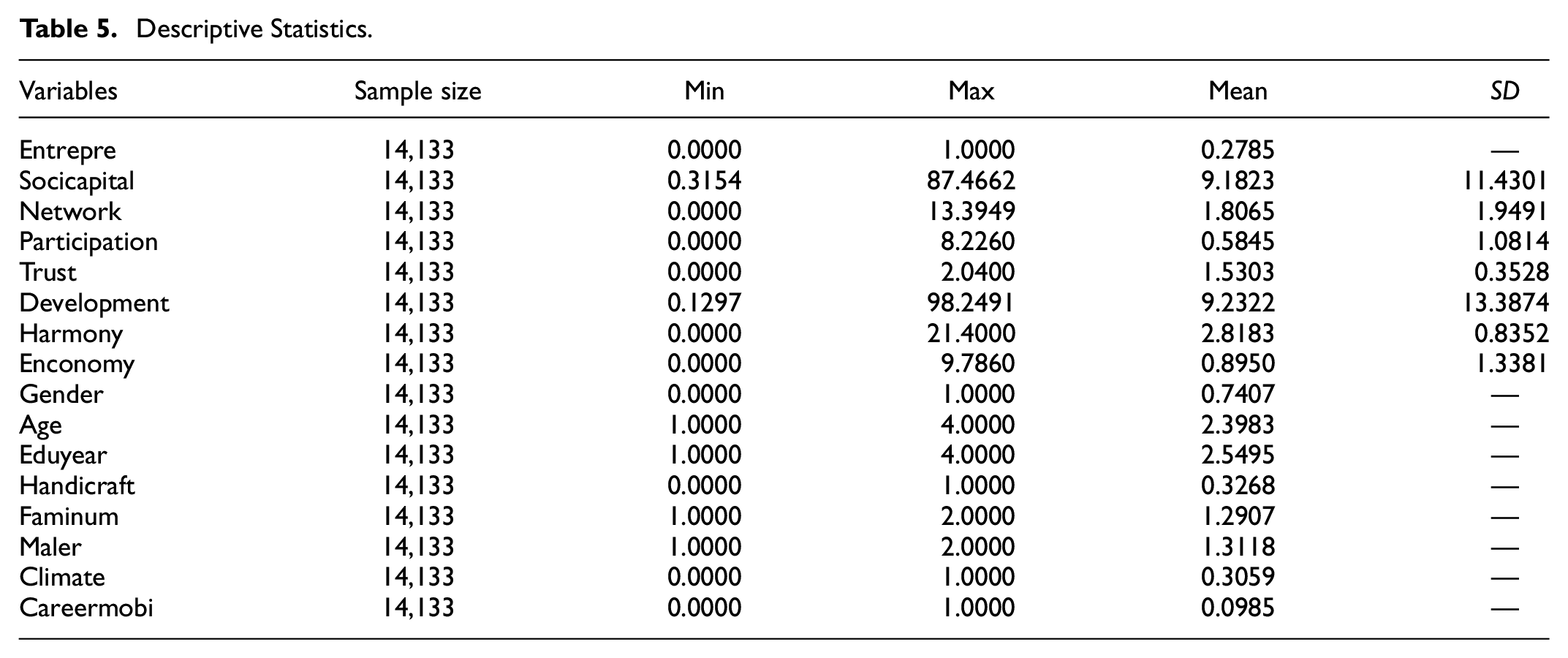
In order to avoid the influence of outliers, continuous variables are winsorized at the 1% level.
Table 5 shows the results of descriptive statistics for all variables.
Descriptive Statistics.
Regression Results of Village Social Capital and Farmers’ Entrepreneurial Decision-Making
The estimated parameter of the logit model represents the “log-odds ratio” of the event’s occurrence, rather than the marginal influence of the independent variable on the dependent variable, namely “odds ratio.” In the case of a continuous independent variable, the odds ratio reveals the multiplicative change in the occurrence rate caused by one unit increase in the independent variable. For dummy variables, the odds ratio reveals the multiplicative relationship between the occurrence rate of the concern group and the occurrence rate of the reference group. This paper reports both the log-odds ratio and the odds ratio.
In table 6, Model 1 analyses the overall relationship between village social capital and farmers’ entrepreneurial decision-making. The results indicate that village social capital has a positive and significant influence on farmers’ entrepreneurial decision-making (p < .01). Hypothesis 1 is supported. Furthermore, in column (2) of Model 1, the odds ratio for village social capital is 1.0060, which means while holding other conditions constant, a unit increase in farmers’ village social capital is associated with 0.60% higher odds of farmers’ entrepreneurial decision-making than before. In Modes 2, 3, and 4, village social network, village social participation and village social trust all have a significantly positive effect on farmers’ entrepreneurial decision-making (p < .01). Hypothesis 1a, 1b, and 1c are all supported. In terms of odds ratio, a unit increment in farmers’ village social network, village social participation, and village social trust is associated with a respective increase in farmers’ odds of entrepreneurial decision-making by 3.96, 5.42, and 16.28%. Notably, the odds ratio of village social trust is the most prominent.
Binary Logit Estimations of Farmers’ Entrepreneurial Decision-Making.

Note. Ps: Standard errors in parentheses.
p < .1. **p < .05. ***p < .01.
In terms of control variables, the direction of their coefficients is basically aligned with the existing research. Since the control variables are not the focus of our study, we only discuss the odds ratio of some control variables. The odds ratio of male farmers in making entrepreneurial decisions is 2.02 times that of female farmers. The odds ratio of farmers in making entrepreneurial decisions aged 31 to 45 and 46 to 60 is 139.76 and 136.23% higher than that of the reference group aged 30 and under, respectively. However, farmers over the age of 60 have a lower odds ratio in making entrepreneurial decisions than those aged 30 and under. The odds ratio of farmers with career mobility experience making entrepreneurial decisions is 1.15 times that of farmers without career mobility experience.
Table 6 shows the results of binary logit regression.
Mediating Effect of Rural Development Test
The test of the mediating effect of rural development is based on the method proposed by Baron and Kenny (1986). In table 7, Models 1, 3, 4, 5 and 9, 10,11 take rural development, rural harmony and rural economy as dependent variables, while Models 2, 6, 7, 8 and 12,13,14 take farmers’ entrepreneurial decision-making as dependent variable. Model 1 tests the direct effect of village social capital on rural development, and the results reveal that village social capital has a positive and significant effect on rural development (β = 0.2403, p < .01). The results of Model 2 demonstrate that rural development has a significant positive effect on farmers’ entrepreneurial decision-making (β = 0.0060, p < .01), while village social capital has a significant positive effect on farmers’ entrepreneurial decision-making (β =0.0043, p < .01). Hypothesis 2 is confirmed. The aforementioned analysis reveals that rural development plays a partial mediating role between village social capital and farmers’ entrepreneurial decision-making. This indicates that village social capital can indirectly affect farmers’ entrepreneurial decision-making through rural development.
The Results of Mediating Effect of Rural Development.

Note. Ps: Standard errors in parentheses.
p < .1. **p < .05. ***p < .01.
The results of Models 3, 4, and 5 demonstrate a significant positive effect between village social network (β = 0.0255, p < .01), village social participation (β = 0.0384, p < .01), village social trust (β = 0.7817, p < .01), and rural harmony. Hypothesis 2a is supported. The results of Models 6, 7, and 8 show a significant positive effect between rural harmony and farmers’ entrepreneurial decision-making (p < .01). Moreover, the model coefficients of village social network, village social participation and village social trust are significantly positive. These findings suggest that rural harmony plays a partial mediating role between village social capital and farmers’ entrepreneurial decision-making, thus Hypothesis 2b is supported.
The results of Models 9, 10 and 11 reveal a significant positive effect between village social network (β = 0.2045, p < .01), village social participation (β = 0.1968, p < .01), village social trust (β = 0.5897, p < .01) and rural economy. Hypothesis 2c is supported. The results of Models 12, 13, and 14 show that a significant positive effect between rural economy and farmers’ entrepreneurial decision-making (p < .01). Furthermore, the model coefficients of village social network, village social participation, and village social trust remain significantly positive. This indicates that the rural economy partially mediates between village social capital and farmers’ entrepreneurial decision-making. Thus, Hypothesis 2d is supported.
Table 7 shows the results of mediating effect of rural development.
We also adopt the bootstrap method to test the mediating effect of rural development. Specifically, for each model in table 7, a sample size of 10,000 is set, and the nonparametric percentile method is employed as the sampling approach for deviation correction. In table 8, the mediating effect of rural development between village social capital and farmers’ entrepreneurial decision-making is estimated at 0.0003, with a 95% confidence interval of [0.0002, 0.0004], excluding 0. It indicates that the presence of a partial mediating effect. Hypothesis 2 is once again supported. Similarly, mechanisms underlying the influence of village social capital on farmers’ entrepreneurial decision-making are mediated by rural harmony and rural economy, with a significant mediating effect. This verifies hypotheses 2a, 2b, 2c, and 2d.
Bootstrap Method for Testing Mediating Effect of Rural Development.

Note. Ps: Standard errors in parentheses.
Table 8 shows the results obtained from testing the mediating effect of rural development using bootstrap method.
Robustness Test
Considering the potential endogeneity issue of missing variables in the above models, this study conducted robustness tests from the perspectives of variable selection, sample selection, and method selection are subsequently tested.
Alternative Indicators of Village Social Capital
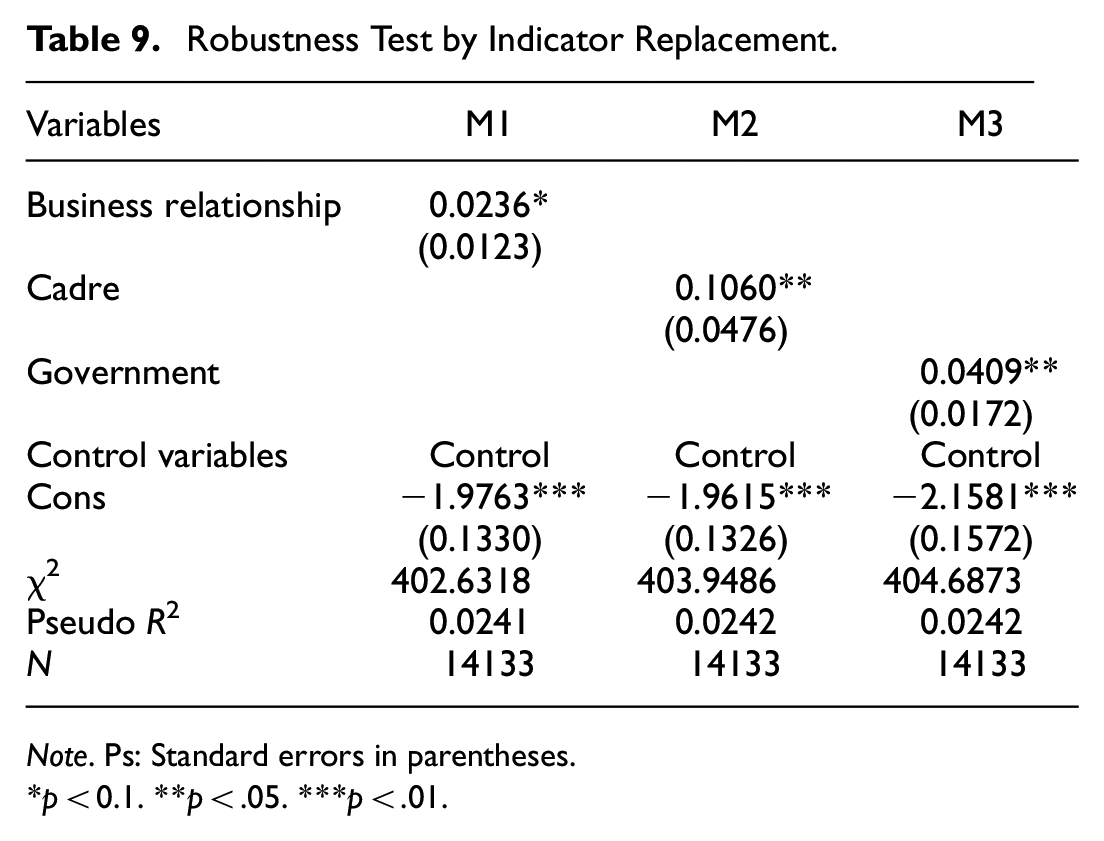
As the first robustness test, we employed the method of alternative indicators (Falk & Hagsten, 2023). In this test, we substituted the village social network with the business relationship variable, village social participation with village cadres, and village social trust with villagers’ satisfaction (Wang, 2011). The business relationship variable encompasses the number of acquaintances of farmers in rural cooperatives, rural commercial banks, credit cooperatives, and other banking and financial institutions. Village cadres are typically quantified by the number of farmers who have held cadre positions in the village. Villagers’ satisfaction is measured using the Likert 6-point scale.
The results, presented in Table 9, show that there are significant positive impact between farmers’ individual business relationship (β = 0.0236, p < .1), village cadre experience (β = 0.1060, p < .05), villagers’ satisfaction (β = 0.0409, p < .05), and farmers’ entrepreneurial decision-making. This further supports Hypotheses 1a, 1b, and 1c.
Robustness Test by Indicator Replacement.
Note. Ps: Standard errors in parentheses.
p < 0.1. **p < .05. ***p < .01.
Table 9 shows the results of robustness test by indicator replacement.
Sub-Sample Test
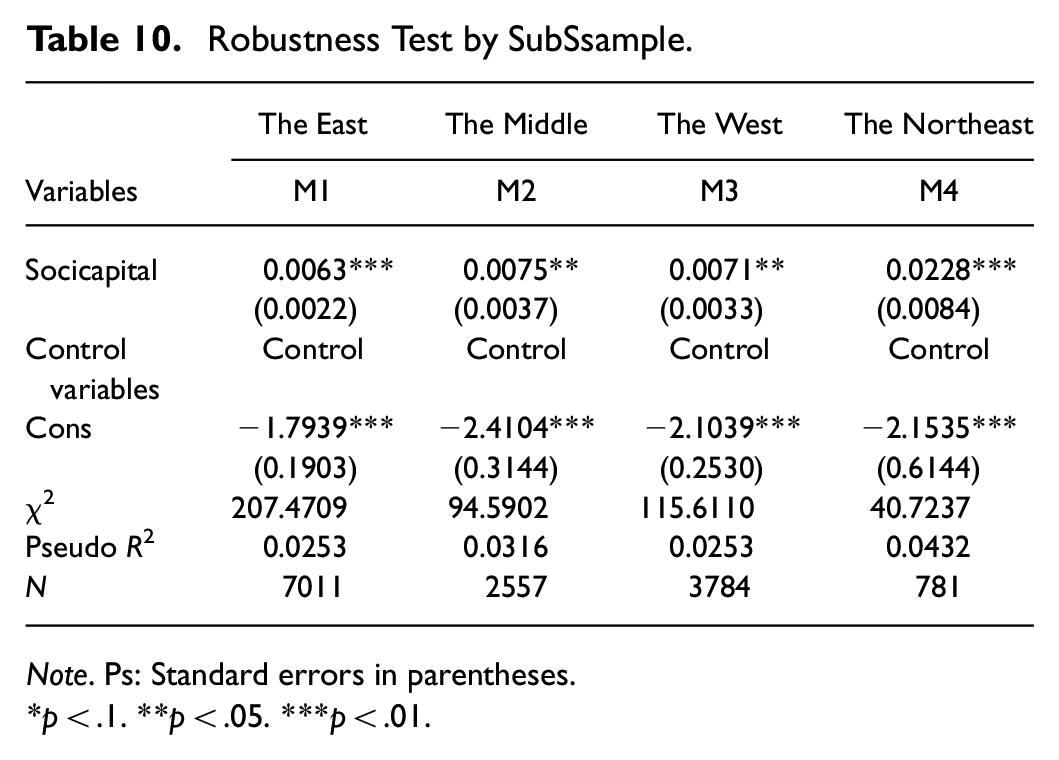
There may be differences in farmers’ entrepreneurial decisions in different regions. So, we divide the samples into the East, Central, West and Northeast, and test the robustness of the impact of regional village social capital on farmers’ entrepreneurial decision-making.
Table 10 reports the results for the eastern (β = 0.0063, p < .01), central (β = 0.0075, p < .05), western (β = 0.0071, p < .05), and northeastern (β = 0.0228, p < .01) regions. The findings indicate that there is a significant positive impact between the village social capital and farmers’ entrepreneurial decision-making. These results are consistent with the verification results of the full sample.
Robustness Test by SubSsample.
Note. Ps: Standard errors in parentheses.
p < .1. **p < .05. ***p < .01.
Table 10 shows the results of robustness test by sub-sample.
Probit Model Test
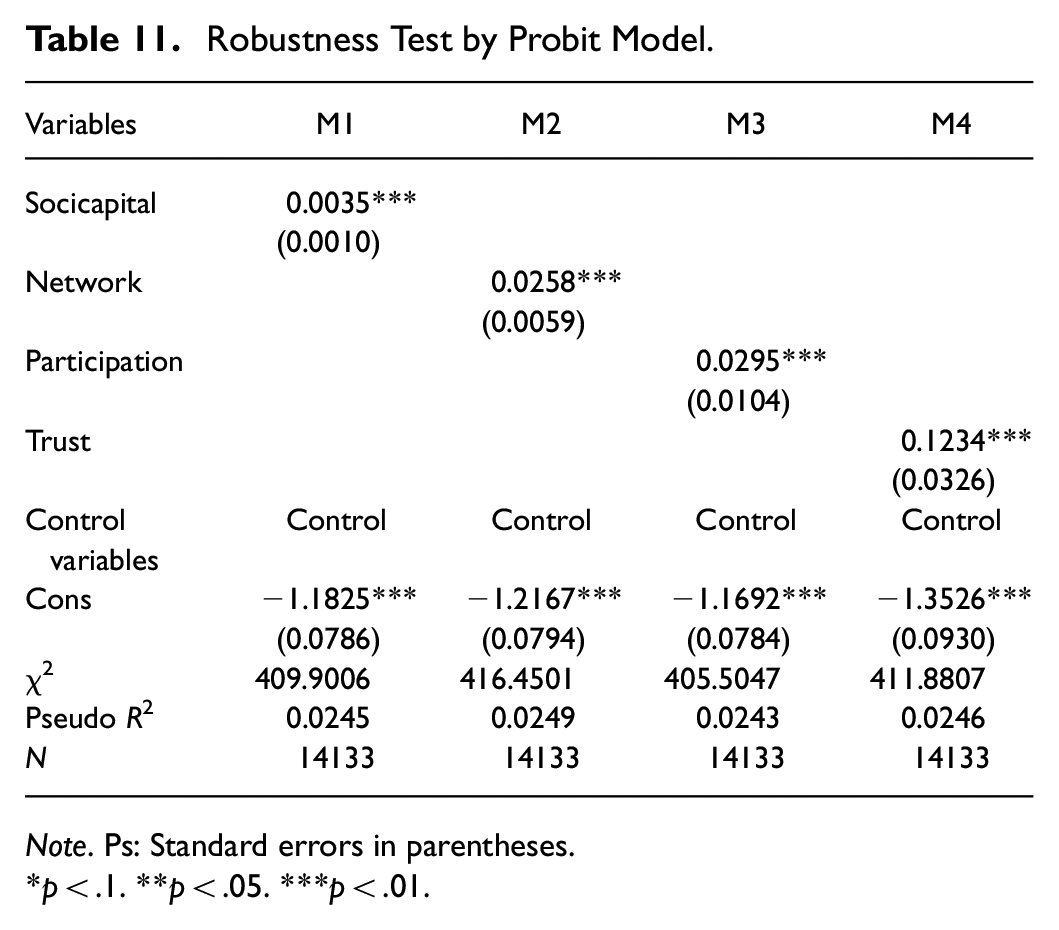
The dependent variables adopted in this test are dummy variables. For such problems, the logit or probit model can be employed for analysis. Therefore, we continue to use the probit model for the robustness test, and the results do not significantly differ from those obtained from the logit model test.
Table 11 shows the results of robustness test by probit model.
Robustness Test by Probit Model.
Note. Ps: Standard errors in parentheses.
p < .1. **p < .05. ***p < .01.
Conclusion and Discussion
Conclusion
This study investigates the influence of social capital at the village level on farmers’ entrepreneurial decision-making. It considers three dimensions of village social capital: village social network, village social participation, and village social trust. Moreover, it explores the mediating role of rural development, focusing on rural harmony and rural economy. While we contextualize village social capital, rural development, and farmers’ entrepreneurial decision-making in the unique Chinese environment, it is important to avoid excessive exceptionalism of these factors. We found the findings of this study to be applicable beyond China and can be generalized to other countries or regions. Specifically, some studies have observed similar mobility patterns among farmers in Mexico (Roberts, 1997), the United States, Gozo Island in Malta, Australia (King & Strachan, 1980), Indonesia (Graeme, 2001), and Thailand (Jirojwong et al., 2000) as that of Chinese farmers (Qi, 2013). Farmers who migrate generally consider their original village to be their permanent home and eventually return to it (Graeme, 2001). Most of those who return to their hometowns choose to start their own businesses and are influenced by local social capital, as evident in Pakistan, Indonesia, and Turkey (Ilahi, 1999; Kilic et al., 2009; McCormick & Wahba, 2003; Yaşlak et al., 2023). Moreover, Klagge and Klein-Hitpa (2010) conducted research indicating that regions and rural areas with more advanced development have a propensity to attract individuals back to their hometowns, stimulating entrepreneurship. Müller and Sternberg (2006) argued that educated and well-connected farmers who return to their hometowns play a role in filling the structural holes in the social network theory, they effectively bridge the outflow and inflow of capital, technology, and social relationships, thus positively impacting the development of their hometowns. Additionally, their entrepreneurial activities are also influenced. This phenomenon is observed in Poland, India, and China (Müller and Sternberg, 2006). Therefore, studies on farmers’ entrepreneurship or rural entrepreneurship suggested that the influence of social capital and rural development on farmers’ entrepreneurial decision-making is similar to that in China across numerous countries (el Olmo-García et al., 2023; Müller and Korsgaard, 2018). The key findings can be summarized as follows.
Village Social Capital Has a Significant Positive Effect on Farmers’ Entrepreneurial Decision-Making
The influence of village social capital is manifested in three dimensions: village social network, village social trust, and village social participation. Qian et al. (2022) argued that entrepreneurial decision-making in rural China is closely tied to social network embeddedness. Additionally, previous studies by Afandi et al. (2017) and Zhao et al. (2023) found that higher levels of trust contribute to promoting farmers’ entrepreneurial decision-making. Moreover, Vracheva and Stoyneva (2020) demonstrated that economic and political participation have positive effects on entrepreneurship. These findings are consistent with our research. But unlike previous studies that primarily focused on a single dimension of village social capital, this comprehensive study measured village social capital across three dimensions. Under the condition of p < .01, the odds ratios for village social network, village social trust and village social participation were found to be 1.0396, 1.0542, and 1.1628, respectively. The results revealed that, controlling for other variables, a unit increment in farmers’ village social network, village social participation, and village social trust is associated with a respective increase in farmers’ odds of entrepreneurial decision-making by 3.96%, 5.42, and 16.28%. Notably, village social trust emerged as a particularly influential factor in determining farmers’ entrepreneurial decision-making, highlighting its crucial role in facilitating the establishment of individual enterprises. This finding aligns with Putnam’s notion of social capital’s “rainmaker” effect (Putnam et al., 2000).
Rural Development Plays Mediating Role Between Village Social Capital and Farmers’ Entrepreneurial Decision-Making
The mediating role of rural development is evident in two aspects: rural harmony and rural economy. Existing studies investigating the connection between social capital and farmers’ entrepreneurial decision-making have mainly focused on individual factors like risk tolerance and psychological capital as mediating variables (Mahfud et al., 2020). Consequently, the role played by the village context, which generates social capital and facilitates farmer entrepreneurship, has received limited attention (Zhang et al., 2015). This study aims to fill this research gap by examining the mediating role of rural development, and found that the positive influence of village social capital on farmers’ entrepreneurial decision-making is partially mediated by rural development. This suggests that villages with rich social capital can strengthen the foundation for farmer entrepreneurship by enhancing the village’s economy and fostering a harmonious atmosphere. As a result, farmers’ entrepreneurial decision-making is likely to be enhanced.
Research Enlightenment
Cultivate Multi-Dimensional Village Social Capital and Further Stimulate Farmers’ Entrepreneurial Decision-Making
The scarcity of social capital significantly hinders the development of rural areas, particularly impeding farmers’ inherent entrepreneurial decision-making. Therefore, it is imperative to enhance the level of social capital within villages and solidify the social foundation that supports farmers’ entrepreneurship. This can be achieved through the implementation of the following three crucial approaches. Firstly, expanding farmers’ social networks is essential. By nurturing interpersonal relationships through customary interactions such as marriages and funerals, farmers can build and maintain networks that strengthen the depth of resources in the entrepreneurial social network. Additionally, leveraging modern information tools can help establish online and offline communication organizations and platforms, facilitating the effective identification of entrepreneurial-related information and expanding the reach of the village social network. Secondly, increasing public participation at the village level is necessary. As indicated by Galvão et al. (2020) and Korsgaard et al. (2015), public participation plays a crucial role in promoting entrepreneurial decision-making by establishing an entrepreneurial ecosystem and providing social resources. Thus, informal village organizations like neighborhood networks and e-commerce associations can be established to foster an entrepreneurial ecosystem. Furthermore, engaging in democratic deliberation and decision-making in village public affairs encourages meaningful participation, enabling farmers to access a broader range of social resources. Thirdly, strengthening the construction of village social trust is essential. Social trust not only helps address gaps in formal institutions, reducing transaction costs and entrepreneurial risks, but also facilitates the gathering of entrepreneurial information and acquisition of knowledge. Strengthening public dimensions of trust, such as moral trust and trustworthiness, enhances transparency in village affairs. This can help alleviate information asymmetry resulting from hierarchical systems, elevates the level of political trust within the village, and ultimately promotes farmers’ entrepreneurial decision-making.
Promote Rural Development and Continuously Optimize the Rural Entrepreneurial Environment
Currently, there is a noticeable scarcity of entrepreneurial activities initiated by farmers in rural areas. This challenge can be effectively addressed by fostering rural development. Firstly, enhancing the level of rural economic development is crucial. According to del Olmo-García (2023), village economic development creates entrepreneurial opportunities by expanding consumption, increasing investment, and improving infrastructure, thereby stimulating farmers’ entrepreneurial decision-making. Therefore, cultivating strong industrial support can be achieved through the development of unique industries such as rural tourism and agricultural product e-commerce Huang, Li,et al. (2021). This expansion increases channels for consumption and investment. Additionally, enhancing infrastructure construction, with a particular focus on education, healthcare, clean water, healthcare, and digital networks, can create entrepreneurial opportunities. Secondly, promoting rural harmonious development is important. As highlighted by Lang and Fink (2019), rural harmony influences farmers’ entrepreneurial decision-making in terms of institutional environment and social significance. Therefore, efforts should be made to strengthen cooperation, dialogue, and negotiation among stakeholders within the village, which can prevent and resolve major threats to life and property arising from disputes over village land management rights. This will ultimately promote harmonious relationships within the village. Furthermore, establishing a sound rural social governance mechanism that combines autonomy, rule of law, and moral governance can enhance rural harmony.
Research Limitation and Prospect
This study has several limitations. Firstly, the survey data in this study covers a wide spatial area in China, but lacks temporal continuity. Future research could employ longitudinal tracking and panel data methods to conduct dynamic studies with multiple time points to further test the reliability of the conclusions. Secondly, the focus of the study lies on examining the potential mediating role of rural development between social capital and farmers’ entrepreneurial decision-making. However, it is essential to acknowledge that rural development is an ongoing and evolving process. Future research can explore how various changes in the process of rural development, including the influence of infrastructure such as roads, Internet, and other hardware or software facilities, influence farmers’ entrepreneurial decision-making. This will contribute to a deeper understanding of the topic. Thirdly, while the study analyzes the influence of village social capital on farmers’ entrepreneurial decision-making, it does not further discuss the heterogeneity and interaction of the effects of family social capital, village social capital and urban social capital on farmers’ entrepreneurial decision-making. Future research could further explore this aspect to more comprehensively consider the clustering effects of social capital and rural areas on farmers’ entrepreneurial decision-making.
Footnotes
Declaration of Conflicting Interests
The author(s) declared no potential conflicts of interest with respect to the research, authorship, and/or publication of this article.
Funding
The author(s) disclosed receipt of the following financial support for the research, authorship, and/or publication of this article: Research achievements of Shandong Social Science Planning Project (Grant No.: 22CGLJ15)
Data Availability Statement
The data that support the findings of this study are available from Thousand Village Survey Data Platform. Restrictions apply to the availability of these data, which were used under license for this study. Data are available from the authors /  with the permission of Thousand Village Survey Data Platform.