




Abstract
The paper aims to study the happiness among youth by elaborating on the determinants of happiness among the youth in the Arab region. The paper relies on a probit model using novel and unique data at a micro-level extracted from the SAHWA Youth Survey (2016). The dependent variable in all of the models was derived from a question on self-satisfaction from the survey. We examined six models containing a diverse set of variables. The survey covers five main nations which are Lebanon, Egypt, Algeria, Morocco, and Tunisia. The paper studies the effect of the socio-economic, household, labor market, and value-based characteristics on happiness. The main findings show that being male and the age factor are associated negatively with the happiness of youth in the Arab region. In addition, education, income, democracy, and gender equality are factors associated positively with the happiness of youth in the Arab region. Furthermore, the results show that the Arab identity is associated negatively with happiness of youth in the Arab region. The paper suggests some policy implications to support policymakers in fostering policies that can promote happiness among the youth in the Arab region.
Plain Language Summary
The purpose of this paper is to examine the determinants that can impact the happiness among young people in the Arab region. The study uses data from the SAHWA Youth Survey (2016) and examines variables like age, education, income, and gender equality to study their impact on happiness. The survey covered five countries: Lebanon, Egypt, Algeria, Morocco, and Tunisia. The study found that being male and being old are factors associated negatively with happiness among young people in the Arab region. However, education, income, democracy, and gender equality are associated positively with happiness. The study also found that being identified as an Arab is associated negatively with happiness. The paper suggests recommendations for policymakers to support the well-being among young people in the Arab region. However, there exists some limitations in the study, the survey did not include the cultural differences among Arab youth across the region.
Introduction
The interest in studying the issue of happiness increases and shows an incremental demand for knowledge about the determinants of happiness in the Arab region. The Arab region witnessed a significant incident in 2011 which is the Arab Spring. The Arab Spring led to a political transformation that changed the Arab world. This leads to thinking about the state of happiness in the Arab region among the youth and what factors determine happiness among the Arab youth. The youth constitute an important significant segment of society in the Arab region and the paper can be an asset for policymakers to rethink the policies related to youth development and integration. The process of studying the determinants of happiness can be regarded as valuable scientific research (Norrish & Vella-Brodrick, 2008).
The concept of happiness is used to reflect the state of individualistic self-satisfaction. Although, the meaning of happiness can be used interchangeably with other concepts like subjective well-being and life satisfaction. In this paper, we follow Veenhoven (1984) definition, happiness is the individual judgment of the overall quality of one’s life. The concept of happiness is used to describe the state of an individual only (Veenhoven, 2011). To assess the issue of happiness, we need to examine multiple determinants of happiness that can range from socioeconomic determinants to value-based factors.
The paper’s main objective is to study the determinants of happiness amongst the youth in the Arab region using unique data at a micro-level extracted from the SAHWA youth survey (2016) that covers five main states. Among the five targeted countries in the study, some witnessed the Arab Spring uprisings in 2011 (Egypt and Tunisia). The dependent variable “Happiness” in the paper is derived from a question on self-satisfaction from the survey. We use the Probit model to generate results in the form of six models based on a distinguished set of explanatory variables. The paper is supported by a comprehensive set of explanatory variables that can be divided into four sets socio-economic, household, labor market, and value-based characteristics.
The rest of the paper is organized as follows, section two tackles the existing literature on the determinants of happiness and the importance of these papers in the context of happiness. Section three discusses the data, methodology, and model used in the study. Section four shows the results of the regressions at a benchmark level and a gender level. Section five discusses the results from section four and links them to the literature. The last section offers some concluding remarks followed by some policy implications and ideas for future research.
Determinants of Happiness
The present paper aims to understand the determinants of happiness among youth in the Arab region by taking into consideration the important incident that happened in 2011, the Arab Spring. We rely on the SAHWA youth survey (2016) which was conducted five years after the incident. The Arab region incident triggers the research toward determining the factors that affect happiness According to Devarajan and Ianchovichina (2018), corruption, unemployment, and disappointment at the level of public services are related to the increase in the level of unhappiness in the Arab region. This sort of unhappiness reveals that the social contract in the Arab region is wrecked. The literature showed that several determinants can impact happiness that can be socioeconomic, labor market, household, and value-based determinants. There exists a significant and negative impact on happiness when referring to some factors that were addressed in the Arab Spring uprisings; nepotism, unemployment, and deteriorating living standards where life satisfaction was descending and low in some Arab states (Arampatzi et al., 2018). The uprisings were the highest in the states that suffer from corruption. There exists a link between unhappiness and deteriorating living conditions in the Arab region.
Happiness can be impacted by multiple socioeconomic drivers as shown in several studies. The age variable is important to study since our paper focuses on youth. According to Siemers and Robson (2017), a significant positive relationship exists between happiness and young ages; youth links their happiness with their income level and success in the labor market. In addition, Olgiati et al. (2013) showed that there exists a U-shaped relationship between happiness and age. Whereas Bartram (2013) declined the existence of a linear relationship between age and happiness. In this paper, we examine the effect of age on happiness among Arab youth and whether there exists a U-shaped relationship between age and happiness.
In this paper, we study gender differences in the context of happiness. Several studies showed that females are happier than males in most countries around the world (Arrosa & Gandelman, 2016). While Bojanowska and Zalewska (2016) argued that both males and females are similar in linking happiness with other features of life like relationship relationships, health, and life fulfillment. The perceptions of females and males toward happiness can be different in the context of determinants and geographical location. To further investigate the issue, we study the determinants of happiness in each gender separately. In addition, we study the effect of marriage on happiness among Arab youth. Several papers showed that marriage imposes a positive impact on happiness and that married persons are happier than unmarried persons (Dush & Amato, 2005; Glenn & Weaver, 1979; Kim & Mckenry, 2002).
We study the effect of education on happiness among youth using two indicators whether youth are educated at the university level or high school level. The level of education plays a critical role in the context of determining the level of income and employment type. This imposes an effect on happiness among youth. According to Rahayu (2016), happiness can be influenced by the factor of education. This is in line with what Eren and Aşıcı (2017) claimed about happiness can be impacted by education through the employment factor and income. Furthermore, Clark and Oswald (1994) stated that unemployment negatively impacts happiness. To elaborate more on the issue of employment, we take into consideration the job type and benefits in our analysis regarding the effect of employment and other labor market conditions on happiness. Factors determined by education and employment like income and financial support can affect happiness among youth. Several papers showed that income is associated with rising levels of happiness (Evans et al., 2019; Mizobuchi, 2017; Powdthavee, 2010).
The Arab region is a main region for three main religions. In this context, we study the impact of religion on happiness. Devine et al. (2019) argued that many scholars show a positive relationship between happiness and religion. The authors referred to Bangladesh as a study area to study the influence of religion on happiness in Bangladesh. They assume that there exists a positive relationship between happiness and religion. In addition, they claimed that the importance of religion can be better evaluated while investigating other economic, political, or social elements. To further elaborate on the importance of religion, we study the joint effect of religion with other value-based determinants of happiness.
The family background of the youth like education and employment can be factors that impact happiness among youth. According to Gray et al. (2013), family factors and relationships impose a positive effect on youth happiness. Csikszentmihalyi and Hunter (2003) stated that family can impact the happiness of youth. In this paper, we examine the parents’ level of education and employment on the happiness among youth in the Arab region. There is a negative association between parental employment and youth happiness. The unemployment of parents impacts the well-being of their children (Baxter et al., 2012). Some studies show that the relationship between household background and happiness of youth is not significant (Powdthavee & Vernoit, 2013).
We examine the value-based determinants’ effect on happiness among youth in the Arab region. Several studies show that happiness can be influenced by value-based factors like democracy, justice, and gender equality. According to Inglehart (2009), there exists a strong effect of democracy on happiness. The Arab countries that witnessed the uprisings in 2011 called for democracy. In this context, we examine the impact of democracy on happiness. In addition, we examine the effect of gender equality on happiness among youth, especially at the level of females. According to Meisenberg and Woodley (2015), gender equality improved the living standards of females, however, it did not show a positive impact on happiness. We extend the analysis by examining more value-based factors that might impose an impact on happiness among youth like tradition and identity.
To conclude this section, the paper fosters the contribution of the previous studies by incorporating more determinants and joint effect variables on the issue of happiness. The Arab Spring impacted the socio-economic and value-based aspects of the Arab youth by impacting their living conditions. The following section discusses the data and methodology part by deeply elaborating on the variables we use based on the four segregations (socioeconomics, household, labor market, and value-based characteristics), the summary statistics, and lastly the model that we use for the study.
Data and Methodology
We employ novel data at a micro-level in this paper, which is mined from the SAHWA Youth Survey (2016). The survey includes five main countries in the MENA region; Algeria (2,036 observations), Egypt (1,970 observations), Lebanon (2,000 observations), Morocco (1,854 observations), and Tunisia (2,000 observations). In addition, the survey covers 9,860 observations of Arab youth whose ages range from 15 to 29 years old. The survey includes a total of six sections which are characteristics of the housing and housing amenities, employment and unemployment, education, culture and values, migration and internal mobility, and politics. Lastly, it is notable to state that the survey is conducted at the individual level by following a multi-stage probability sampling where youth respondents are selected randomly from the targeted households.
Variables
The dependent variable “Happiness” is defined as a dummy variable that takes the value of one if the respondent agrees mostly or strongly to the claim that he or she is satisfied with himself or herself, while zero if otherwise. We create the dependent variable happiness which is derived from the question in the SAHWA Youth Survey (2016) that asks the youth to indicate at what point they are satisfied with themselves.
The explanatory variables are divided into four main categories. The first category contains basic socio-economic characteristics. A binary variable is included to detect the gender of the respondent youth, that takes the value of one if the respondent is a male while zero if otherwise. The age of the participant is included through the variables age and age square; both are expressed in years. For education, we include two binary variables to determine the level of education of youth, whether the respondents are at a school-level education or university-level education. The school variable is a dummy variable that takes the value of one if the respondent acquired an education at a secondary level or below while zero if otherwise. The university variable is a dummy variable that takes the value of one if the participant acquired an education at a university level while zero if otherwise. In addition, the public is an added variable for the school type, which is a dummy variable that takes the value of one in case the school type is public while zero if otherwise. Another explanatory variable to investigate is the marital status. The variable married is a dummy variable that takes the value of one if the participant is married while zero if otherwise. We add a binary variable to check if the respondents are receiving financial support from their parents, this variable takes the value one if they are receiving financial support and zero if otherwise. We include a binary variable Religion Private Affair i to check if the respondents consider religion a private affair that should be separated from socio-economic life, this variable takes the value of one if the youth respondent agrees to the claim while zero if otherwise. Lastly, we add a binary variable urban residence that takes the value of one if the youth is residing in an urban region while zero if otherwise.
The second category of variables includes labor market characteristics. We include a dummy variable for employment employee that takes the value of one if the respondent youth is employed while zero if otherwise. We include two binary variables related to the type of the contract of the employee; Indefinite takes the value of one if the contract is indefinite while zero if otherwise, and fixed-term that takes the value of one if the contract is fixed while zero if otherwise. We add a binary variable for the job type; private which takes the value of one if the job type is private while zero if otherwise. To check whether the participant is enrolled within the social security system, We add a variable named NSSF to check whether is enrolled within the social security system which takes the value of one if the youth is registered with a social security system while zero if otherwise.
The third category of variables covers household characteristics. We include a set of variables to describe the education and employment of parents. Two categorical variables are used to describe the parents’ education level. The respondents choose their parents’ levels of education as follows, no education, primary, middle, secondary, or higher education. We assign two variables school and university to represent parents’ education. The School Father variable takes the value of one if the father’s education is at the secondary level or below, while zero if otherwise. The University Father variable takes the value of one if the father at the university level while zero if otherwise. The School Mother variable takes the value of one if the mother’s education is at the secondary level or below, while zero if otherwise. The University Mother variable takes the value of one if the mother’s education is at a university level while zero if otherwise. In addition, we include two categorical variables for the parents’ employment Employed Father and Employed Mother. Each variable takes the value of one if the father or mother is employed while zero if otherwise. The respondents choose the parents’ socio-professional category as follows, Employer, Tradesman, self-employed and artisan, Farmer, Professional and Senior Executive, Middle manager, Employee, Skilled laborer, Unskilled laborer, or Inactive.
The last category of variables in the paper includes value-based characteristics. We include three binary variables to study the confidence among the youth, No Confidence in the government that takes the value of one if the youth have no confidence in the government while zero if otherwise, No Confidence in the elections that takes the value of one if the respondents have no confidence in the elections while zero if otherwise, and the No Confidence in the legal system which takes the value of one if the youth have no confidence in this factor while zero if otherwise. We add a binary variable to examine the importance of tradition; Tradition Not Important to assess the modernity level of youth, the variable takes the value of one if tradition is regarded as non-important by the youth respondent while zero if otherwise. In addition, a dummy variable is added to check the perception of equality among genders which is Gender Equality. If the youth believes in gender equality in the labor market, education, politics, and family code, the youth is regarded as a Gender Equality Advocate. Henceforth, the variable takes the value of one if the youth is Gender Equality Advocate, while zero if otherwise. Three binary variables testify to the identity of the respondents. Global identity, this variable takes the value of one if the respondent youth regard himself or herself as citizen of the word while zero if otherwise. Regarding the National identity, this variable takes the value of one if the respondent youth define themselves as (Algerian, Egyptian, Tunisian, Moroccan, or Lebanese) while zero if otherwise. Arab identity, this variable takes the value of one if the respondent youth define themselves as an Arab and zero if otherwise. Finally, a set of variables are included within the value-based characteristics to study the joint effect of some variables on happiness, religion and global identity, religion and national identity, religion and Arab identity, and democracy and income.
Summary Statistics
Table 1 demonstrates the summary statistics for all the variables employed in this research. To begin with, around 87% of the respondents are satisfied with themselves overall. Among those who participate in the survey, 54% are males. In addition, Table 1 shows that 22 years old is the average age of the respondents. Among the participants, 23% of those who responded to the survey are married. In addition, the average income of the respondents stated in U.S. dollars is around 340.89 USD. Among the participants, 69% of them completed the secondary school level, whereas only 27% of the participants earned a university degree. Among the respondents, 84% of those who are in school are enrolled in a public school. Furthermore, 57% of the respondents receive financial support from their parents. Almost 69% of the respondents view religion as a private affair that should be separated from socio-economic life. Lastly, among the respondents to the survey, 61% of them live in an urban area.
Summary Statistics of Variables
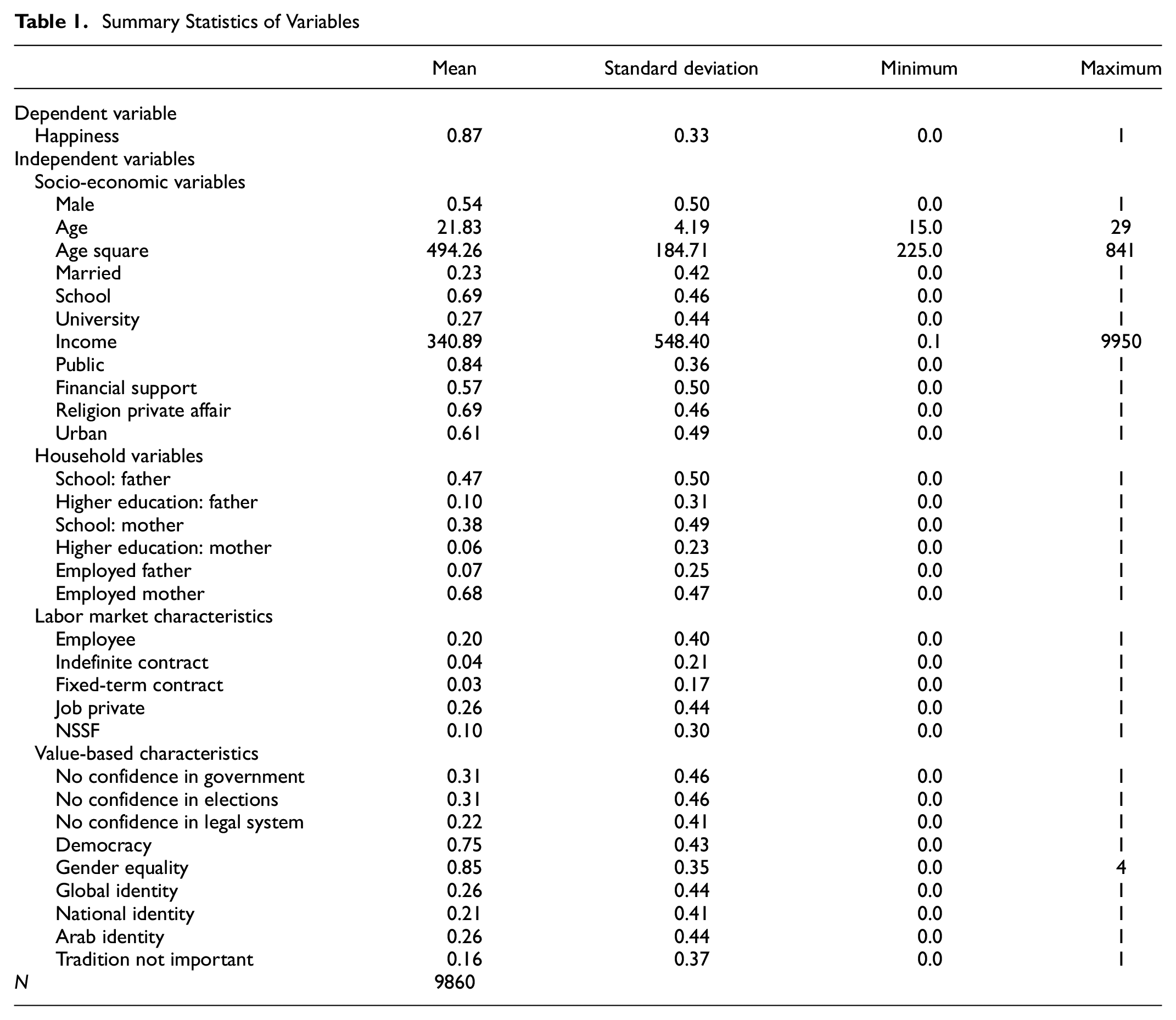
The household variables from Table 1 show that 47% of the respondents have their fathers acquired a secondary school level, while 38% of the respondents have mothers at a secondary school level. One-tenth of the respondents have fathers with a university degree, while 6% of the respondents have their mothers with a university degree. Amongst the respondents, 7% have employed fathers, while 68% have employed mothers. Regarding the labor market characteristics, Table 1 shows that only one-fifth of the respondents are employed. Almost 26% of the respondents have private jobs, 4% of the respondents have indefinite job contracts, 3% of the respondents have fixed job contracts, and 10% of the respondents are registered in the social security system.
By referring to the value-based variables, among the respondents, 75% of them believe in democracy. Also, 31% of the participants have no confidence in government, 31% have no confidence in elections, and 22% do not have confidence in the legal system. In addition, Table 1 shows that 26% of the respondents view themselves as citizens of the world, a similar percentage of respondents identify themselves as Arab citizens, and 21% of the respondents link themselves with their national identity. Amidst the participants, 16% of the youth believe that traditions are non-important. Lastly, 85% of the respondents are in favor of gender equality or gender equality advocates.
Empirical Model
The paper investigates the determinants of happiness among the youth in the Arab region by relying on four sets of variables (socioeconomics, household, labor market, and value-based). The dependent variable that is incorporated in the paper is binary, we rely on a probit model to conduct the regressions. Let

With the following probit rule:

Let
Results
The results from this section highlight the determinants that impact happiness among youth in the Arab region. The Arab Spring imposed several implications that affect the happiness among youth. The results are divided into two parts the first part at a benchmark level and the second part has been segregated by gender.
Happiness Among Youth: Benchmark Results
Table 2 shows the results of the six tested models in which a unique combination of variables exists in each model to deeply understand the determinants of happiness among the youth in the Arab region. To start with, the results of the socio-economic variables show several variables that have a significant impact on happiness. The results are significant and negatively associated with the happiness of the youth when the respondents are males. The age factor results are significant and negative for all six models, which is the older the youth get, the less happiness they have. However, the results for age square are significant and positive for males. If the respondent is married, then this factor exhibits a positive and significant impact on happiness among the youth. In addition, the results show that the education of youth regardless of the level of education imposes a significant and positive impact on happiness among youth. In addition, the results from Table 2 show that if the youth are enrolled or were enrolled in a public school, then the results are significant and associated negatively with happiness on youth. The income factor exhibits a positive and significant impact on happiness among youth in the six tested models. In addition, the results are significant for receiving financial support from parents and associated with the happiness among youth positively. Lastly, the results for separating religion from socioeconomic life and considering religion as a private affair are significant and show a positive impact on the happiness of youth in the Arab region.
Determinants of Happiness (Probit Model, Marginal Effects)

Note. Statistical significance: *10%, **5%, ***1%. Robust standard errors are reported in parentheses.
This section shows the results that are related to both household and labor market characteristics and their impact on happiness among the youth in the Arab region. The results of having an educated father at the secondary level are significant and show a positive impact on the happiness of youth. Similarly, the results of having an educated mother are significant and impact happiness among youth positively. Regarding the labor market characteristics, the results related to being employed while possessing a fixed-term contract are significant and associated positively with happiness.
Referring to the variables that are related to the value-based characteristics, some results show a significant impact on the happiness of youth in the Arab region. Three variables are included in the study to investigate the impact of the lack of confidence in certain political aspects on happiness. The variables related to the youth’s lack of confidence in government or elections exhibit a significant and positive impact on the happiness among the youth. Whereas, having no confidence in the legal system results are significant and show a negative impact on happiness. The results for democracy are significant and associated positively with the happiness among youth in the Arab region. After the Arab Spring uprisings, democracy aspires to be an important value for youth that can affect their happiness.
The results for gender equality are significant and associated positively with the happiness of youth in the Arab region. Regarding the identity variables, one can realize that if the youth define themselves as citizens of the world, then the results associated with this variable are significant and show a positive impact on the happiness of youth. On the contrary, if the youth define themselves as citizens of the countries where they belong, the results are significant and show a negative impact on the happiness of the youth. Similarly, the Arab identity results are significant and show a negative impact on the happiness of youth. The results for considering the tradition as a non-important aspect are significant and associated negatively with happiness among youth. By referring to the joint effects of some value-based characteristics we can notice that the results of the joint effect of religion and national identity are significant effect and impact happiness positively. While the joint effect of religion and Arab identity shows a significant effect on happiness and impact happiness negatively.
Results by Gender
Table 3 shows the results of regressions based on gender segregation. The results are discussed as follows, socio-economic, household, labor market, and value-based characteristics. To begin with the socio-economic factors, the results associated with age are significant in the case of males and show a negative influence on the happiness of males. The results for being married are significant in the case of females and impact the happiness of females positively, while the results for being married are insignificant in the case of males. Acquiring school degree results are significant and impact the happiness of both genders positively. Similarly, the results for being educated at a university level are significant and impact the happiness of both genders positively. The results for the income factor are significant in the case of males and the impact of their happiness positively. If the respondents are enrolled in a public school, the results are significant in the case of males and impact the happiness of males negatively. The results related to the income variable are significant in the case of males and show a positive impact on the happiness of males. It is notable that the financial support from parents’ results are significant and influence the happiness of both genders positively. The results are significant for the variable that considers religion a private affair in the case of males and impact the happiness of males positively. Lastly, the results regarding residing in an urban place are significant for females and exhibit a positive impact on the happiness of females.
Determinants of Happiness, Results by Gender (Probit Model, Marginal Effects)

Note. Statistical significance: *10%, **5%, ***1%. Robust standard errors are reported in parentheses.
This section analyzes and discusses both the household and the labor market characteristics based on gender. The results for having an educated father at a university level results are significant in the case of females and impact the happiness of females negatively while having an educated father at a university level results exhibit no significant impact on the males’ happiness. Table 3 shows that the results for having an educated mother at the school level are significant and impact the happiness of both males and females positively. While having an educated mother at a university degree level results are significant and impact the happiness of females positively but impact the happiness of males negatively. The results for an employed father are significant for females and affect the happiness of females positively. Table 3 shows that the results for being employed are significant in the case of males and exhibit a negative impact on the happiness of males. If the employment contract is indefinite, the results are significant for females and the impact on the happiness of females is positive. Similarly, if the employment contract is fixed or the type of job is private then the results are significant in the case of females and linked with happiness positively for females.
This part analyzes and discusses the results of the value-based characteristics based on both genders. The results for having no confidence in the government are significant in the case of females and demonstrate a positive impact on the happiness of females. Similarly, the results for having no confidence in the election are significant for females and show a positive impact on the happiness of females. The results for democracy are significant and show a positive effect on happiness for both males and females. Similarly, the results for gender equality between the two genders are significant and associate with happiness positively in both males and females. The results associated with being a citizen of the world are significant in the case of males and have a positive impact on the happiness of males. However, the outcomes for being a citizen of the Arab world are significant for males and affect the happiness of males negatively. In addition, the results for being a citizen of the nation (Lebanon, Algeria, Morocco, Tunisia, and Egypt) are significant and influence the happiness of both genders negatively. The results for the factor that states tradition as a non-important aspect are significant and demonstrate a negative influence on the happiness of the two genders.
Discussions
The results show the negative effect of being male on happiness are in line with evidence from Turkey that females are happier than males (Caner, 2015). These results can be related to the incident that have started the whole Arab Spring uprisings when a Tunisian young man ignited himself after having his goods confiscated by the police in Tunisia (Anderson, 2011). Our results show that the age factor imposes a negative impact on happiness. This can lead to assuming that being young and male are not associated positively with happiness, especially in the Arab region . However, the results from the age square show a significant and positive impact on happiness. This leads to thinking of the age factor in a way that happiness decreases with age up until a point, then the age variable starts to be associated positively with happiness. The results are in line with the results of Devine et al. (2019) that many tend to change their ambitions with age as the affiliation between age and happiness takes a shape of U relation. Furthermore, the results show a positive effect of marriage on happiness, and the results are in line with what Gove et al. (1983) argued that a good marriage is essential for happiness. In addition, married persons are happier than unmarried persons (Dush & Amato, 2005; Glenn & Weaver, 1979; Kim & Mckenry, 2002).
The results of education at school or university levels impose a significant and positive impact on happiness. This is in line with the results of Ross and Van Willigen (1997) showing that education practices a positive impact on happiness due to education’s key role in facilitating the ability to get a paid job and in increasing the ability to control one’s life. However, the results of the paper related to education at the secondary level or below contradict those of Silver et al. (2017) stating that education at the secondary level is linked negatively with happiness after the Arab Spring. Furthermore, our results show that income affects happiness positively and these results are in line with the results of Diener et al. (2013) as they show that when the increase in income leads to an increase in a person’s financial status and purchasing power; henceforth, an increase in income is linked to the increase in happiness. Another socioeconomic factor that shows a positive impact on happiness from the results is religion. This is compatible with other papers that have shown a positive relationship between happiness and religion (Ellison et al., 1989; Luttmer, 2005, Witter et al., 1985). The results from the household characteristics show that having educated parents influence happiness among youth positively. Parents have a critical role in determining the happiness of young people (Chui & Wong, 2016). According to the results of the labor market characteristics being employed with a fixed-term contract show a positive impact on happiness. This contradicts the results of Schumann and Kuchinke (2020) that fixed-term employment is associated with a reduction of individually reported happiness.
The results related to having no confidence in the legal system are in line with the findings of Bartolini et al. (2013), that confidence in institutions indicators are significant and positively associated with happiness, but the development of confidence in institutions through time displays a diminishing movement. Our results concerning the effect of democracy are in line with the (Dorn et al., 2007) results demonstrating that there exists a positive relationship between happiness and democracy. The gender equality variable shows a positive influence on happiness. People’s happiness is affected by the gender system and the enhanced gender systems improve the happiness of women (Mencarini & Sironi, 2012). Considering tradition as non-important aspect results are negative. This can lead us to think of tradition as an aspect that can be associated positively with the happiness of youth. The variable concerning Arab identity shows a negative impact on happiness. It is possible that Arab identity after the Arab Spring is weak and affects happiness negatively in the Arab region. Our results concerning the Arab identity are in line with the findings of Fakih and Ghazalian (2019), that Arab identity power was reduced by the impact of the post-Arab Spring changes at the cultural, political, and social levels.
Gender-Based
Table 3 shows that the results generated are not the same for all determinants. These results contradict Horwitz et al. (1996) that the happiness of the two genders is impacted similarly by the marriage. In addition, the results from Table 3 coincide with the results from Table 2. That is, being young and male are factors that can associate negatively with happiness. Until the males reach an older age, the results are positive from the age perspective, and this can be witnessed from the results of the age squared variable. Henceforth, the age for males follows a U-shape pattern and these results are in line with the results of Caner (2015) and Helliwell (2006).
Some results show a similar effect on happiness for both males and females like in the case of education which imposes a positive effect on happiness for both males and females. The results are in line with the papers that have indicated the positive role of education on the happiness of youth (Cuñado & de Gracia, 2012; Ross & Van Willigen, 1997). The results show that the happiness of the two genders is influenced by their parents. According to Headey et al. (2014), The happiness of mothers and the manners of fathers impact the happiness of their sons and daughters. The results indicate that there exists downward support from parents to their children. This is in line with the findings of (Fakih & Marrouch, 2014). In addition, the results show an enhancement at the level of females’ happiness due to employment factors, and the results are in line with the claim of Meisenberg and Woodley (2015) that the happiness of females seems to be bargained by the participation of females in the job market. While we can notice that males’ happiness is impacted negatively when the male respondent stated that they are employed.
The variable related to democracy shows a positive impact on the happiness of youth. The results are in line with the findings of Potts (2016), that democracy through the channel of choice can supply happiness. According to Table 3, the gender equality results show a positive effect on both genders. This is in line with the results of Mencarini and Sironi (2012), that the enhancement of gender equality enhanced the happiness of females, nevertheless depending on the situation where females reside and work. In addition, the results for gender equality are supported by the findings of Audette et al. (2019) that males in addition to females are also benefitting in terms of happiness when there is gender equality. Lastly, it is critical to mention the important role of females in the Arab Spring uprisings, which pushes toward advocating gender equality (Al-Ali, 2012).
Conclusion
This paper’s objective is to understand the drivers of happiness amongst the youth in the Arab region by using a unique and distinguished dataset of SAHWA Youth Survey (2016) that covers five main states in the Middle East and North Africa region, the states are Algeria, Egypt, Morocco, Lebanon, and Tunisia. In addition, we aim to building on the findings of previous papers that tackled the issue of happiness and its determinants by increasing the margin of the drivers that can influence happiness.
Drawing on the results and the previous studies, it is possible to claim that being a male is associated negatively with the happiness of youth. While other factors like age and being in a public school are associated negatively with the happiness of youth. The age factor is a notable and distinguished variable, as it is negative in all the regressions. In other words, the older the youth, the more responsible they become; however, the results are associated positively with happiness at a specific age (turning point). Being a non-traditionalist or regarding tradition as a non-important aspect is not associated with happiness positively for the youth, as the results for this variable were negatively associated with happiness. In addition, separating religion from socio-economic life shows a positive and significant effect on the happiness of youth. Education and happiness are linked positively regardless of the level of education. The income factor exhibits a positive impact on the happiness of youth since income is the main determinant of the financial situation of the youth. Democracy is associated positively with the happiness of youth. Also, the gender equality factor is associated with the happiness of youth positively. Drawing on the discussion section, it is possible to redefine the concept of happiness to include more aspects beyond its psychological meaning. We need also to highlight the role of religion as it can play a significant role alongside the identity of youth whether national or Arab.
Policymakers may need to pay close attention to the factors that are associated with the happiness of youth positively through collaborating with the administrations on setting goals that support the well-being of the youth. Fundamentally, one option can be achieved by recommending and implementing policies that advocate gender equality amongst the youth. Since the results for gender equality are associated positively with the happiness of youth based on the results of the paper. Another option that can be taken into consideration is working on policies that advocate democracy as the results of the paper show a positive impact on the happiness of youth. Moreover, it is recommended to work on policies that can lead to better employment conditions. Understanding the determinants of happiness among youth can prevent future uprisings that can affect the development in Arab region.
Lastly, for the sake of future research, we recommend investigating why traditions are important for youth since the findings of this paper show that if tradition is considered a non-important aspect, then results are associated negatively with the happiness of youth in the Arab region. Another suggestion for future research is to investigate why employment results are not significant and what can be done to make the employment factor associated positively with happiness among youth in the Arab region. As the latest suggestion can support the policymakers with ideas that can enhance the employment condition such that in the future employment can become positively linked to happiness. Finally, it would be interesting to do the study while using panel data.
Footnotes
Declaration of Conflicting Interests
The author(s) declared no potential conflicts of interest with respect to the research, authorship, and/or publication of this article.
Funding
The author(s) received no financial support for the research, authorship, and/or publication of this article.

Data Availability Statement
Data sharing not applicable to this article as no datasets were generated or analyzed during the current study.