



Abstract
This article analyzes the factors influencing travel behavior during the epidemic and explore the impact of safety perception on travel choices. The study first summarizes the theoretical basis of factors affecting travel mode choice and introduces the corresponding questionnaire design. One thousand two hundred twenty-eight valid questionnaire data were collected in December 2020, including 1,044 online and 184 interview questionnaires. Descriptive statistics, correspondence analysis, and multivariate logistic regression are then used to systematically analyze the influencing factors on travel behavior before and after the epidemic. Additionally, a random parameter binary logit model with mean heterogeneity is applied to explore factors related to travel safety perceptions during the epidemic. The results reveal significant differences in influencing factors between self-driving/taxi and other modes of transportation, such as electric vehicles/bicycles, subways, and buses. Marital status (married, 1.131) and household size (household size: 3, 1.782), education (senior high, −1.650) contribute significantly to the composition of the random parameter binary logit model. Based on the findings, it is recommended that theoretically, future research could further explore the relationship between demographic characteristics and safety perception in travel choices; practically, policymakers should tailor transportation policies for different demographic groups, particularly focusing on safety perceptions.
Keywords
Introduction
At the end of 2019, the outbreak of novel coronavirus pneumonia (hereinafter referred to as “COVID-19”; Li et al., 2022), as a serious public health security emergency, sounded the alarm for the healthy development of the community of human destiny. It has attracted the attention of scholars from all walks of life in many fields such as human infectious diseases, sociology, public management, and so on. The far-reaching development trend of the COVID-19 epidemic is undoubtedly a serious challenge for urban construction (Yu et al., 2022). As an important subsystem of the urban giant system, the stability and environmental adaptability of the urban transportation system are crucial to the sustainable development of the urban system and play an irreplaceable role in epidemic prevention.
According to the data released by the Ministry of Transport of the People’s Republic of China during the Spring Festival travel rush in 2020, the commercial passenger volume in the whole society decreased by 46.6% in the month before the Spring Festival travel rush compared with the same period of the previous year (Wang et al., 2021). The national trunk traffic volume decreased by 69% year-on-year, and the expressway traffic volume decreased by 70%. In terms of China’s civil aviation passenger transport market, by the end of June 2020, the number of passengers carried by the whole industry was only 150 million, with a seat rate of 68.6% (Wang et al., 2021). Compared with the same period in 2019, the number of flights decreased by 44%, the number of passengers decreased by 55%, the seat rate decreased by 15 percentage points, and the average ticket price decreased by 8.6%. In 2022, the pandemic broke out in mid and late March, significantly affecting the operation of express logistics and Airlines Airport. In March, the business volume of national express service enterprises decreased by 3.1% year-on-year, and the business revenue decreased by 4.2% year-on-year (Zhuang et al., 2020).
In recent years, the research results on travel modes under the influence of the epidemic have gradually increased. Li et al. (2022) explored the spatiotemporal and behavioral changes in taxi travel during the pandemic; Yu et al. (2022) revealed the extent of the pandemic’s impact on taxis and its spatial heterogeneity, finding that the cumulative number of cured COVID-19 cases, public transportation operations, and per capita transportation costs significantly influenced taxi productivity; Luan et al. (2021) investigated the impact of COVID-19 on residents’ travel mode choices and car purchase intentions using Random Utility Maximization (RUM), Random Regret Minimization (RRM), and Generalized Regret Minimization models; Shakibaei et al. (2021) studied the impact of the pandemic on travel behavior in Istanbul, Turkey, in three phases; Dianat et al. (2022) analyzed the effect of the pandemic on daily travel activities, finding that residents were more inclined to work from home; Borkowski et al. (2021) used a CATI survey to investigate the impact of the pandemic on residents’ travel, identifying occupation as a key factor influencing changes in travel time; Chen et al. (2021) employed a multivariate logistic regression model to investigate the main factors influencing residents’ travel choices during the pandemic, finding that various socio-economic factors, transportation supply, health issues, and travel purposes significantly affected travel mode selection; Das et al. (2021) found that travel time, vehicle crowding, and health safety features were closely related to travelers’ shift from public transportation to private cars; Loa et al. (2022) applied a two-stage ordered logit model to analyze the impact of COVID-19 on ride-hailing services, finding that perceptions of risk, the tendency to take preventive measures when leaving home, and socio-economic factors affected residents’ travel choices during the pandemic. In summary, although significant research has been conducted on the impact of the pandemic on residents’ travel behavior, the characteristics of travel mode choices and influencing factors remain unclear, particularly with few studies providing a detailed and comprehensive analysis of travel modes.
To analyze the travel behavior characteristics of travelers under the influence of the pandemic, this study constructs a logit model based on survey data to examine the travel characteristics and influencing factors of travelers before and after the outbreak of the pandemic. The research findings have important implications for traffic management and the improvement of transportation services during public health emergencies.
Literature Review
Travel Behavior and Influencing Factors Before and After the Epidemic
Researches on influencing factors of residents’ travel behavior choice have always been one of the priorities, especially in today’s environment with such a severe situation of public health and safety (Jiang et al., 2020). The research on the influencing factors of travel behavior before the epidemic were not limited to common influencing factors (Susilo & Liu, 2016), but more related to travel satisfaction (De Vos, 2018; De Vos et al., 2016; Humagain et al., 2021). De Vos (2018) studied whether respondents who prefer various travel modes preferences were the same as the actual travel mode and whether the same sample had higher travel satisfaction. The results showed that the preference travel mode and the actual travel mode accounted for about half of the total sample, and the influence of the preference travel mode on travel satisfaction was at least as important as the selected travel mode itself. Recent commuting travel satisfaction with hypothetical commuting satisfaction when using alternative modes was compared by Humagain et al. (2021). The results showed that when the alternative mode was automatic or bus, the satisfaction of active mode users will be reduced. In the past 2 years, due to the emergence of the epidemic, the research on travel mode selection has gradually returned to the basic factors. Jiang et al. (2020) investigated travel frequency and transport mode of 8,330 residents in all provinces of China during the pandemic. Results indicated that during the pandemic period, the travel frequency, and transportation mode of Chinese residents might be affected by demographic variables such as gender, age, urban and rural areas, and areas, as well as the situation of suspected confirmed cases in or near the place and may also be related to the severity of the pandemic in the province. In addition, both basic personal attribute characteristics such as gender, age, occupation, and influencing factors of travel mode selection from the perspective of behavior and psychology are important (Zhou et al., 2021). In general, research trend should focus on the influencing factors of residents’ choice of travel behavior in the context of pandemic prevention and control, as well as the corresponding countermeasures regarding how to generate an optimal transport scheme which can both reduce the effect of COVID-19 and recover economy (Gao et al., 2020). However, existing study lacks a comparative analysis of the factors influencing travel behavior before and after the pandemic, and has not systematically explored the reasons and impacts of the significant changes in travel patterns caused by the pandemic. Additionally, there is limited research on policy responses during and after the pandemic, particularly regarding how to optimize transportation modes, reduce the risk of virus transmission, and support economic recovery through policy adjustments.
Influence of Safety After Epidemic on Travel Behavior
During the COVID-19 pandemic, public transportation increases the risk of contact with others; Motorcycles, bicycles and other vehicles may reduce contact with others, but may also expose themselves to the external environment (Mishra et al., 2021); The travel safety of people has great risks. Baig et al. (2022) studied the changes in individual travel patterns and purposes before and after the outbreak of COVID-19 and their views on COVID-19. The results showed that the perceived COVID-19 threat will affect people’s attitudes and subjective norms about the willingness to use public transportation. A multi-standard route planning technique using data such as COVID-19 outbreak locations was proposed by Mishra et al. (2021). Shao et al. (2021) used the random forest algorithm to screen the basic risk factors, established a traffic risk prediction model, and compared the traffic risks before and after COVID-19. Jiang et al. (2020) investigated the travel frequency and mode of transportation in all provinces of China during the epidemic. The results showed that during the epidemic, people’s travel frequency and mode of transportation were closely related to the sample. Under the principle of safety, suitable travel routes for users were planned, while minimizing the time when users appeared in dangerous places or avoiding users appearing in dangerous places. The psychological changes caused by COVID-19 are important factors affecting the changes of personal travel modes. Individual travel modes before COVID-19 may focus on multiple factors, such as travel time, cost, etc. Under the influence of COVID-19, people’s travel modes may focus on a relatively single, such as the safety of travel. Magano et al. (2021) conducted a cross-sectional study using instruments to assess the impact of the COVID-19 pandemic on travel, anxiety, fear, risk perception, and stress to determine the psychological factors that lead to the impact of COVID-19 on travel. The results showed that under the influence of the perception of the epidemic, people’s views on the impact of travel have undergone adaptive changes, and the psychological effects of fear and anxiety caused by COVID-19 need to be resolved first. However, there are few current studies on post epidemic safety, and most of the existing studies focus on changes in people’s travel behavior and potential psychological changes, which cannot significantly reflect the people’s psychological changes after the epidemic to take safety as the primary consideration in choosing travel behavior. Especially in choosing travel modes, more attention is needed to how changes in safety priorities are reflected. In addition, although traffic risk prediction models were proposed during the pandemic, research on the evolution of safety measures and traffic risk management in the post-pandemic era is still insufficient.
Methodology of Influencing Factors of Travel Behavior
The analysis methods of influencing factors of travel behavior can be roughly divided into easy-to-explain statistical methods (Ding et al., 2017) and high-precision machine learning that can find heterogeneity and nonlinear relationships (Kim et al., 2021). The discrete choice model is widely used in transportation field. The framework of structural equation model and discrete choice model was used by Ding et al. (2017) to describe the relationship between travel mode choice, car ownership and travel distance. Multinomial logit model was used by Gim (2017) to analyze the changes in weekly travel time in the three travel modes and the choice of the most commonly used mode each year. A joint discrete continuous model was developed by Liu et al. (2022) to analyze the relationship between travel mode choice and travel distance. The most widely used machine learning model is random forest. Random forest was used by Kim et al. (2021) to evaluate the heterogeneity of the impact of the built environment on the travel mode choice of people of different ages. To evaluate the heterogeneity of the impact of the built environment on the travel mode choice of people of different ages. Deep learning was gradually applied to the analysis of travel behavior with the development of artificial intelligence (Lai et al., 2022). However, the interpretability of statistical models is difficult to ignore. Statistical models with random parameters (Wu et al., 2018) can reduce the accuracy gap with machine models. The current research has less exploration of heterogeneity in random parameters (Se et al., 2022), and it is difficult to find deep-seated influence relationships. Although traditional statistical methods such as discrete choice models are widely used, they struggle to capture complex nonlinear relationships. Additionally, there is limited research on the heterogeneity of random parameters, which is crucial for understanding differences between various groups.
In this article, the theory of planned behavior and the theory of utility maximization are used to conduct data surveys firstly. Secondly, the multivariate logistic regression model is used to compare and analyze the differences in the influencing factors of travel modes before and after the epidemic. Then, the random parameter binary logit model with mean heterogeneity is used to analyze the influencing factors of travel safety in the post-epidemic era. And the model can explore the heterogeneity of mean in random parameters. Finally, the corresponding policies are given to provide reference for dealing with public health emergencies.
Selection of Influencing Factors and Questionnaire Design of Traffic Travel Behavior Under Pandemic Situation
Selection of Influencing Factors
Psychological Analysis of Residents’ Travel Behavior
Residents’ travel psychology is the law of psychological activities and personality psychological characteristics of travelers in the process of travel (Ali et al., 2019). According to the theory of behavioral psychology, resident’s behavior choice is usually dominated by their psychological needs. Similarly, when we choose the mode of transportation, we are also affected by psychological activities (Garzia et al., 2021). Before traveling, we will list a psychological preference table in our brain, first consider the possibility of realizing all modes of transportation from the starting place to the destination, and then choose the most satisfactory mode by considering our own psychological characteristics, and then judging by the characteristics of transportation mode and objective environmental conditions.
Analysis on Influencing Factors of Travel Behavior Under the Background of Pandemic Situation
According to the theory of planned behavior and residents’ travel psychological analysis, the essence of seeking the analysis of the influencing factors of traffic travel mode under the pandemic is to investigate the influencing factors of travelers’ psychology. Starting from the traveler’s travel psychology, the influencing factors of traffic travel mode can be transformed into the commonness and individuality of travel psychology.
The commonness of residents’ travel psychology refers to the common psychological activity characteristics of travelers in the process of travel. Including: timeliness psychology; safety psychology; economic psychology; convenient, and comfortable psychology.
Residents’ travel personality psychology means that because each traveler has different interests, family background, own conditions, travel conditions, and travel ideas, it is bound to produce different travel needs. Travelers’ travel psychological personality is mainly affected by the following aspects, as shown in Figure 1.

Thought map of influencing factors of travel behavior under the background of pandemic situation.
Questionnaire Design
Based on the analysis above, a structured questionnaire was designed for this study to collect information on the factors influencing residents’ travel behavior. The questionnaire consists of three main sections. The first section gathers basic information about respondents, including age, gender, family situation, occupation, and travel needs. By collecting this data, we can understand the travel preferences and behavior characteristics of different groups.
The second section examines the changes in travel behavior before and after the pandemic, including details such as residents’ locations during the pandemic, primary transportation modes used, car ownership, and key factors influencing travel decisions. The transportation options covered include private cars, subways, taxis/Didi, buses, electric bikes/bicycles, walking, and shuttle buses. Analyzing the choice of these transportation modes will help explore the impact of the pandemic on travel patterns.
The third section contains qualitative questions, focusing on whether the pandemic has changed or will change people’s commuting habits. A Likert five-point scale was used for responses: 0: Very agree; 1: Relatively agree; 2: Neutral; 3: Relatively disagree; 4: Very disagree.
The data collection for this study began in December 2020, utilizing both online and interview methods to ensure the diversity and representativeness of the sample. This approach was chosen due to the challenges of conducting face-to-face surveys during the early stages of the pandemic. The combination of online and interview methods enabled us to cover respondents from different regions and demographics. The online survey was distributed via social media platforms such as QQ, WeChat, and Weibo, which have broad coverage and high user activity. A total of 1,100 online questionnaires were distributed, resulting in 1,044 valid responses and a response rate of 94.9%.
To complement the online data, interview surveys were conducted in densely populated locations like school cafeterias and shopping centers, allowing us to reach respondents who might not engage in online surveys. Respondents were incentivized with small gifts to encourage participation. A total of 184 interview questionnaires were distributed, all of which were returned, yielding a 100% response rate. In total, 1,228 valid responses were collected, with 1,044 from the online survey and 184 from the interview survey, ensuring that the data was diverse and representative.
Data Analysis of Influencing Factors of Travel Behavior Under the Background of Pandemic Situation
Concept of Multiple Logistic Regression Model
Multiple logistic regression model is also called multi classification logistic regression. In the fields of medical research and Social Sciences, there are many dependent variables, which can be divided into disordered pluralism and ordered pluralism (Yang-Nan et al., 2024). When the dependent variable is a multi-category variable, the multiple logistic regression model is used to analyze the relationship between the probability p of a selection scheme and the influencing factors (Gareen & Gatsonis, 2003).
In this article, by collecting the selection of transportation vehicles before and after the pandemic, the dependent variable data are disordered multi classification variables, so this model can be selected as the research model, and its model expression is:

where


where
Multiple Logistic Analysis (Before the Pandemic)
The significance in the simulation fitting information table (Table 1) is p = .000 < .05, and the significance value of Pearson Chi-square is .709 > .6, indicating that the model has statistical significance and passes the test.
Model Fitting Information.

SPSS24 software was used for parameter estimation and analysis. Self-drive or rental was used as the reference category, and the influence category items with significance >.1 and obvious error were eliminated. As most people have more than one means of transportation, they are basically combined means of transportation. The collection of public transportation is summarized as bus and metro, which are summarized as the same mode of transportation as bus and other transportation. The following main conclusions are drawn:
(1) Travel demand: According to the table analysis (Table 2), compared with the reference transportation mode, the travel demand of walking and other non-public transportation shows a negative correlation between commuting and leisure shopping, which indicates that the groups considering the above two travel needs prefer self-driving or renting. Obviously, choosing self-driving or renting is faster in time and freer in place than other modes of transportation. When the travel behavior is only public transport, the regression coefficient β = 1.203 > 0 for commuting and other travel needs, and β = 1.138 > 0 for non-commuting travel needs, indicating that the groups with demand for these two modes prefer public transport and other transportation modes other than self-driving or renting.
(2) Educational level: When the travel behavior is public transport only, the regression coefficients of different education levels are negative compared with self-driving or travel, that is, there is a negative correlation between all education levels, that is, there are more self-driving or rental groups at all levels of education than public transport only, and by observing the EXP (β) value, it can be found that with the gradual increase of education, the EXP (β) value also increases, This shows that people with higher education are more likely to choose such transportation modes as self-driving or renting.
(3) Before the pandemic, the main factors affecting travel: It can be seen from the parameter estimation table (Table 2) that when only public transportation is compared with the reference transportation mode, it can be found that the regression coefficient β of safety, convenience and comfort, only travel purpose, travel purpose and safety and convenience, and only time is negative. Obviously, the groups that pay more attention to the above influencing factors prefer self-driving or renting, and the regression coefficient β that travel purpose and time cost are the influencing factors of travel is .886, Groups considering time cost prefer public transport only. In real life, generally time cost-oriented traffic travelers will avoid more expensive modes of transportation, such as self-driving or renting, so as to choose less expensive modes of transportation, such as public transportation, especially other less expensive modes, resulting in different behavior.
Parameter Estimation.

Multiple Logistic Analysis (After Pandemic)
Principal Component Analysis
Through the multivariate logistic analysis of the main influencing factors and travel modes after the pandemic by SPSS24 software, it is found that although it is significant in the simulation fitting information table, Pearson is .005 in the goodness of fit table, which is far less than .5, so the goodness of fit is relatively poor and the model is not available.
Therefore, it is unreasonable to use multivariate logistics to analyze the influencing factors on the choice of transportation mode after the pandemic. Principal component analysis can be used to reduce the dimension. After screening the main factors, the cross-table analysis of each influencing factor on travel behavior can be carried out to summarize the results of each influencing factor. According to the test results of KMO and Bartlett, KMO is .711 > .5, and the significance is .000 < .05, so principal component analysis can be carried out.
Analysis: The Table 3 is the total variance explained. It mainly depends on the cumulative column in the initial eigenvalue. Generally, more than 90% cumulative factors are more important. It can be seen from the Table 3 that the composition is between 8 and 9, and has reached more than 90% in total; If, from the total column and percent variance analysis, there are three components greater than 1. Because there are many factors in this article, the main analysis is the degree of influence of the influencing factors on the three components, and then the principal components of the influencing factors are obtained.
Total Variance Interpretation.

As shown in Table 4, the scores of age and household size are higher in the factors of 1 and 2, and the scores of marriage and family ownership are higher in the factors of 1 and 2. Therefore, generally speaking, age, marital status, whether to own a car, current residence, education level, gender, family size, travel demand, and factors affecting travel mode are the main factors, and the rest are secondary factors.
Component Score Coefficient Matrix.

Result Analysis
The following is the distribution map of education, occupation, travel demand, and main influencing factors in each transportation mode.
Education Level
Result analysis: It can be seen from Figure 2 that the undergraduate group accounts for the largest proportion in the whole sample, and the proportion of junior middle school and below and master’s degree and above is relatively small. In terms of choosing transportation mode, before undergraduate (including undergraduate stage), the number of people choosing self-driving/taxi, bus and self-driving/taxi increases with the higher education. In terms of choosing other non-public transportation, the number of people in senior high school or technical secondary school, college and undergraduate shows a slow growth trend, with little increase. The proportion of people who choose only public transport in undergraduate stage is the largest in other education stages.

Distribution of education level in various transportation modes.
Travel Demand
Result analysis: as shown in Figure 3, the sample group whose travel demand is only commuting accounts for the largest proportion, and the number of people who choose self-driving/taxi accounts for the largest proportion no matter what demand is considered. The travel demand is only commuting, and the mode of transportation is public transportation and others, which also accounts for the largest proportion of other trips.

Distribution of travel demand in various transportation modes.
Main Influencing Factors
Result analysis: as shown in Figure 4, after the pandemic, the sample groups pay more attention to the safety factors in the travel characteristics, and the groups who pay more attention to the safety factors are more likely to choose the self-driving or rental transportation mode to reduce their exposure in public places. The groups who choose other non-public transportation also pay more attention to the safety issues, while those who choose public transportation and other travel modes pay more attention to the purpose and cost of re-entry, travel purpose and others.
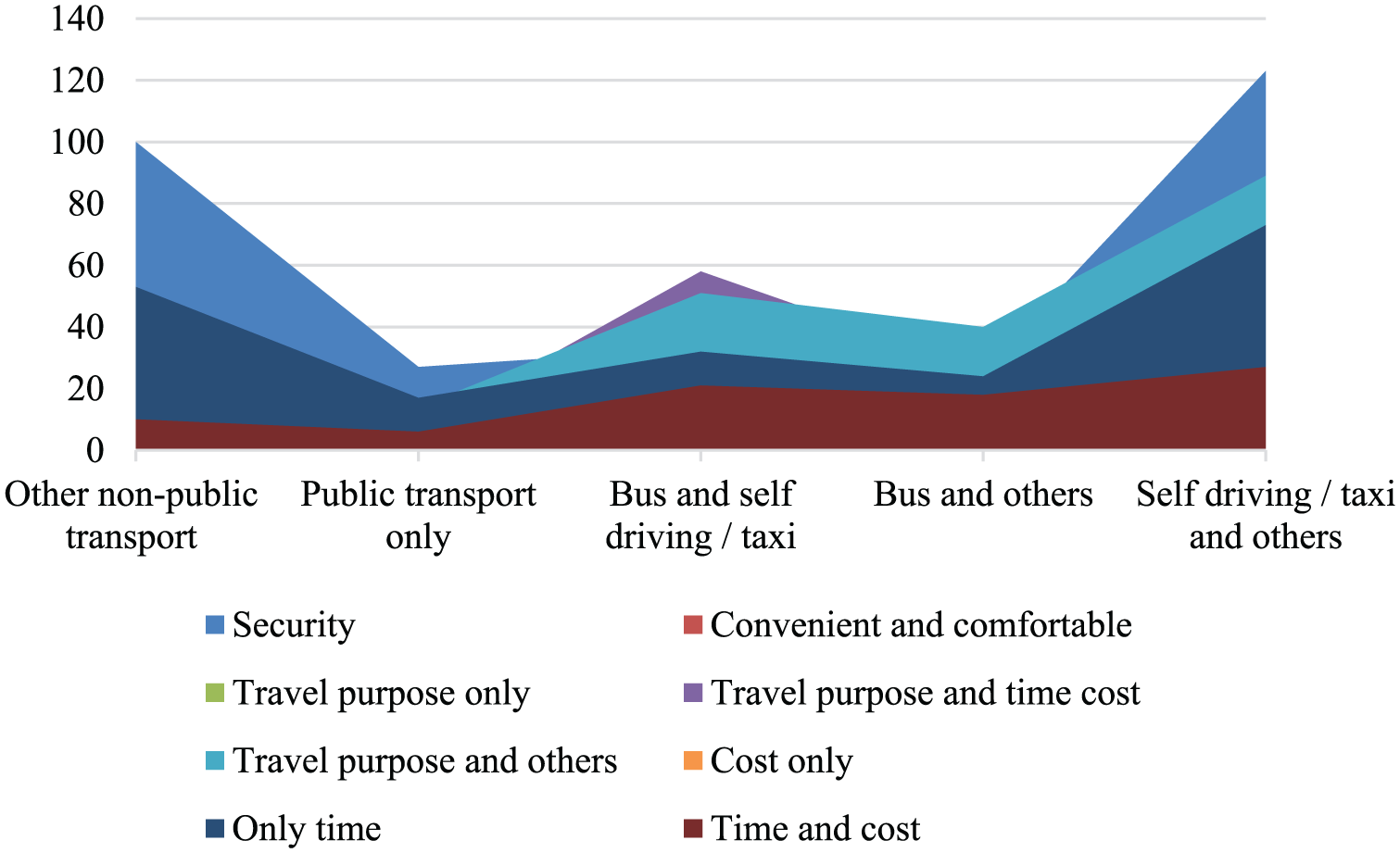
Distribution of travel characteristics in various travel behavior.
Analysis of the Impact of Safety Perception on Travel Behavior in the Post-Epidemic Era
This section discusses the conceptual framework of the safety-impacted travel behavior model in the post-epidemic era. Considering the unobservable heterogeneity and the main factors affecting travel behavior are safety and non-safety. The random parameter binary logit model with mean heterogeneity is used.
Random Parameter Binary Logit Model
Unlike traditional models that assume homogeneous preferences, the random parameter binary logit model (RPBL) model allows for random variations in individual preferences. Additionally, the RPBL model is flexible enough to relax the assumption of Independence of Irrelevant Alternatives (IIA), which is often applicable to real-world decision-making scenarios. Therefore, this article chooses the RPBL model to analyze the influencing factors of travel and capture individual heterogeneity in decision-making.
Safety is a main factor affecting people’s travel after the epidemic. Based on the mean heterogeneity random parameter model, a post-epidemic travel safety impact model was constructed to establish a model utility function (Yuan et al., 2018):

where
Assuming that the random error term obeys the generalized extreme value distribution, a general form of binary logit model is constructed (Anderson et al., 2018):

where

where
The mean heterogeneity random parameter model function is expressed as (Zhou et al., 2025):

where
Result Analysis
Based on the data collected in the third section of this article, we have modeled and analyzed the safety factors that impact travel behavior. The descriptive statistics of the significant variables in this section are presented in Table 5 below, where all variables are represented by dummy codes.
Model Parameter Estimation Results.

Table 5 presents descriptive statistics of the significant variables in the model, including marital status, gender, household size, region, educational background, and car ownership. These factors play a crucial role in shaping travel decisions, especially in the context of the pandemic, where travel safety has become a major consideration. Regarding marital status, married individuals tend to be more concerned about travel safety compared to unmarried individuals. This may be due to the sense of responsibility they have toward their family members, and as a result, they tend to be more cautious when choosing travel options. As for gender, males generally show higher concern for travel safety, likely due to traditional gender roles that associate males with protective responsibilities. Therefore, during the post-pandemic period, they are more inclined to choose safer travel options. Household size also significantly impacts travel safety concerns. Larger households, particularly those with two or three members, exhibit greater sensitivity to safety concerns compared to single-person households. This could be because families with more members, such as those with children or elderly people, are more cautious about the potential risks associated with travel. In terms of region, respondents from Eastern China are more likely to prioritize safety, likely because the region has stricter pandemic control measures and higher public health awareness. This results in these individuals placing greater emphasis on safety when making travel decisions. Educational background plays a more complex role. Higher education levels might lead individuals to perceive lower travel safety risks, assuming they can take adequate protective measures. However, this does not mean that they completely ignore safety; rather, their safety concerns are more rational and based on risk assessment. Regarding car ownership, individuals who own a car tend to be less concerned about travel safety. This may be because they feel they have more control over the travel process, reducing their reliance on public transportation and the associated safety risks.
The probability function of the binary logit model is closed, and the maximum likelihood estimation method can be used for parameter estimation. However, the probability function distribution of the mean heterogeneity stochastic parameter model is not unique, that is, the non-closed type, and the simulation-based maximum likelihood estimation method is needed. This article uses Halton sequence sampling for parameter estimation (Zhou et al., 2025).
The estimated results of the independent variables show that respondents are more dependent on safety than those who are not married in the post-epidemic era, indicating that the factors considered in the respondents’ decision-making will be greatly changed after experiencing major events in life (such as marriage) in Table 6. The results of the household size variables of the respondents also prove this conclusion from the side. Compared with the household size of one person, the household size of two and three people have increased the importance of safety, which shows that the respondents will first consider the safety of travel regardless of whether there is a next generation after marriage. In addition, male pay more attention to the safety of travel behavior than female.
Model Parameter Estimation Results.

Table 6 presents the parameter estimates of the random parameter binary logit model, showing the specific impacts of each factor on travel safety choices. Married individuals are more likely to choose safe travel options, with a coefficient of 1.131, indicating that marital status significantly influences the decision to prioritize safety. Married individuals are more focused on ensuring the safety of their family members, especially in the context of a pandemic. Regarding gender, males show more concern for travel safety, with a coefficient of .506. This suggests that males, possibly influenced by societal roles, are more likely to take on protective responsibilities, prioritizing safety in travel. Household size also plays a significant role, with two-person and three-person households showing greater safety concerns. The coefficients for these household sizes are .851 and 1.782, respectively, indicating that individuals in households with more members, particularly those with children or elderly people, are more likely to select travel options with higher safety guarantees. Educational background has varying effects on travel safety concerns. Individuals with a high school education and those with a bachelor’s degree exhibit different tendencies. The coefficient for individuals with a high school education is −1.650, suggesting that people with lower education levels are less concerned about safety and may prefer riskier travel options. In contrast, those with specialized or bachelor’s degrees show lower coefficients, indicating a more rational assessment of travel safety risks, although their concerns are still lower compared to other groups. The purpose of the trip also significantly influences safety concerns. Respondents whose primary considerations are travel time or cost tend to be less concerned with safety, with coefficients of −1.589 and −.739, respectively. This indicates that factors such as time and cost may outweigh safety concerns in their decision-making. Car owners tend to focus less on travel safety, with a coefficient of −1.076. This suggests that owning a private vehicle allows them to have greater control over the travel process, reducing their reliance on public transportation and decreasing their concerns about safety. Finally, the sensitivity to the pandemic also plays a key role in travel decisions. Those who are less sensitive to the pandemic tend to be less concerned about travel safety, with a coefficient of −.350. This reflects the direct impact of individual sensitivity to the pandemic on their travel safety choices, with more sensitive individuals being more likely to prioritize safety.
Policy Recommendations
Based on a survey of travelers’ willingness to travel after COVID-19 and a discussion of the relevant influencing factors, the PASS-travel is developed based on PASS approach (Zhang, 2020) for policy recommendations. PASS-travel is a framework embodying the four areas of P (Prepare/Protect), A (Avoid/Adjust), S (Shift/Share), and S (Substitute/Stop) and the corresponding three perspectives (government, transportation sectors, and travelers). PASS-travel aims to make transportation industry more adaptable to the conclusion of the COVID-19 pandemic. Specific policy recommendations based on the PASS-travel framework are enlisted in Table 7. It is worth mentioning that the code in square brackets is the policy focus.
Policy Recommendations Based on the PASS-Travel Approach.

Conclusions
This article takes the choice of travel behavior under the background of the pandemic as the research object, combined with the theory of planned behavior and the theory of utility maximization, adopts the method of multiple logistic regression model and random parameter binary logit model with mean heterogeneity, studies according to the collected survey data from various places, and systematically analyzes the influencing factors of traffic travel behavior under the background of the pandemic by using descriptive statistics, correspondence analysis, multiple logistics analysis and random parameter binary logit analysis with mean heterogeneity.
From the model level, this article adopts multiple Logistics analysis model, namely multiple logistic regression model. Through the descriptive statistics of the basic information of the samples, the Chi-square analysis was used to establish a contingency table and the correspondence analysis method was used to analyze the choice of transportation modes by various influencing factors before and after the pandemic. Then, the multiple logistics analysis was used to establish the influence model of transportation modes by various influencing factors before the pandemic. Finally, random parameter binary logit model with mean heterogeneity is used to analyze of influencing factors of choosing safe travel behavior in the post-epidemic era. Because after the outbreak of multiple logistic regression model fitting effect is not good, the travel behavior choice after the outbreak of the first independent variables, principal component analysis the main factors that influence the reduced-order filter, using Chi-square analysis and establish the map again, more clearly analyze the effect of various factors, the influence of each transportation mode after the outbreak. In terms of research methods, correspondence and multiple logistics analysis can well analyze the influence relationship between classification independent variables and classification dependent variables. Random parameter binary logit model with mean heterogeneity can explore heterogeneity of mean in random parameters.
In terms of structure and content, firstly, it focuses on the background of this research content, focuses on the analysis of pandemic background, safety and research methods of travel behavior. Secondly, it describes the concept of novel coronavirus, the overview of travel behavior and the analysis of the influencing factors of travel behavior. Next, select the influencing factors of travel behavior and reasonably design the questionnaire. Finally, the empirical data analysis is carried out.
This study contributes to the theoretical understanding of travel behavior during crises, particularly in the context of the pandemic. It integrates the Theory of Planned Behavior and the Theory of Utility Maximization to provide a comprehensive framework for analyzing the decision-making process of travelers. The research also enhances the current literature by examining how the pandemic influences travel choices and the safety considerations associated with them. From a practical perspective, the findings offer valuable insights for policymakers, transportation planners, and public health officials. Understanding the factors influencing travel behavior can guide the design of more effective transportation policies and interventions, especially in the post-pandemic era. The research suggests that providing clear safety guidelines and improving public trust in transportation systems will be crucial in encouraging the adoption of safe travel behaviors.
However, due to the difficulty and accuracy of information data collection and the level of the author, there are still many limitations in this paper. The first is that the factors affecting the travel behavior are not comprehensive enough, and there are corresponding objective environmental factors. For future research, it is suggested to incorporate built environment characteristics (e.g., residential area density, public transport accessibility) and regional pandemic prevention policies into the analysis framework to enrich the scope of influencing factors. Secondly, the questionnaire design is mostly non-scale problems, lack of reliability and validity analysis. Future studies may adopt mature standardized scales (such as safety perception scales) and conduct pre-surveys to test questionnaire reliability and validity, improving data credibility. Finally, the random parameter binary logit model with mean heterogeneity is further expanded to increase the accuracy of the model or explore the heterogeneity of mean in random parameters. It is recommended that subsequent research optimize the model’s parameter estimation methods (e.g., comparing different sampling techniques) and introduce more variable interaction terms to deeply excavate the sources of mean heterogeneity in random parameters.
Footnotes
Acknowledgements
This study, including the survey questionnaire, was approved by the Ethics Committees of Anking University, China and East China Jiaotong University, China.

Funding
The authors disclosed receipt of the following financial support for the research, authorship, and/or publication of this article: This work was supported by the National Nature Science Foundation of China under Grant numbers (52262048 and 52502418); Jiangxi Province Association for Science and Technology Youth Talent Support Program under Grant number (2023QT15); Humanities and Social Science Fund of Jiangxi Province under Grant number (JC24202).
Declaration of Conflicting Interests
The authors declared no potential conflicts of interest with respect to the research, authorship, and/or publication of this article.
Data Availability Statement
The data are available from the corresponding author on reasonable request.