




Abstract
Food-related issues have recently become one of the most salient and controversial issues and have received increasing media and scholarly attention. This study examines the distinct effects of trust and distrust on the public’s information behaviors, specifically in the context of two food-related issues including GM food and food additives. This study employs a cross-sectional survey with 1,089 Chinese citizens. This study demonstrates that trust and motivation positively predicted information transmission behaviors (i.e., information sharing and forwarding) and information acquisition behaviors (i.e., information attending and seeking). Distrust, on the other hand, predicted only information transmission behaviors. Motivation’s effects on information acquisition behaviors were moderated by trust. This study contributes to the field of health information by expanding STOPS’ applicability to food-related risk contexts, conducting research with culturally distinct populations different from those featured in prior research, and distinguishing the roles of trust and distrust in influencing information behaviors.
Plain Language Summary
Food-related issues have recently become one of the most salient and controversial issues and have received increasing media and scholarly attention. This study examines the distinct effects of trust and distrust on the public’s information behaviors, specifically in the context of two food-related issues including GM food and food additives. This study employs a survey with 1,089 Chinese citizens. This study found that trust and motivation increased in individuals’ information sharing, forwarding, attending, and seeking. Distrust, on the other hand, increased information sharing and forwarding. The study also found that as individuals have greater motivation to think about GM food and food additives issues, they are more likely to attend and seek information, and such relationships vary depending on their trust levels.
Engaging people in information behaviors is often difficult and costly since people pay minimal attention to socially-provided information and make little effort to communicate about such issues with others due to their limited personal resources, such as time or energy. Despite efforts to communicate accurate risk and health information, people’s miscommunication is still prevalent, creating unnecessary communication costs (Dijkstra et al., 2012; J. Kim, 2019). For communication researchers, investigating the factors that affect the public’s information behaviors is crucial.
Institutional trust and distrust are particularly important in contexts concerning the risks that are out of control or difficult for laypersons to understand. Due to the lack of scientific knowledge and literacy to process science-related information, institutional trust is necessary for laypersons to easily make decisions (Earle & Cvetkovich, 1995). Furthermore, one’s limited ability to cope with risks is associated with greater levels of perceived risks (Rimal & Real, 2003; Turner et al., 2006), which, in turn, lead to feelings of helplessness, anxiety, and dependence on institutions that are in charge of those risks (Ter Huurne & Gutteling, 2009). The influence of the public’s trust and distrust toward institutions still remains underexplored, as most prior studies focus on the trustworthiness of information sources rather than on people’s trust in institutions.
In addition, the effects of distrust on information behaviors have not been fully explored. Often, distrust is seen as the opposite end of trust, although many scholars (e.g., Cho, 2006; Dimoka, 2010; Lewicki et al., 1998) argue that distrust is a distinct construct from trust. If distrust plays a distinct role from trust in the public’s information behaviors, institutions must focus on eliminating distrust while making separate attempts to build up trust (Cho, 2006). Moreover, most prior studies on trust have been conducted in western countries, such as the U.S. or the Netherlands (e.g., Cvetkovich et al., 2002; Kuttschreuter, 2006; Sjöberg, 1998; Ter Huurne & Gutteling, 2009) except for few studies (Faour-Klingbeil et al., 2021; Huang et al., 2021). Scholars (Earle & Cvetkovich, 1995; Siegrist, 2000) have argued for the need to test the effects of trust with different populations, as they may differ depending on population-based characteristics.
The present study employs the situational theory of problem solving (STOPS)—a useful communication theory that can predict people’s various information behaviors (J.-N. Kim & Grunig, 2011)—to examine the effects of trust and distrust on information behaviors in the context of food-related issues in China. Food-related issues such as food additives and GM foods have recently become one of the most salient and controversial issues and have received increasing media and scholarly attention (Faour-Klingbeil et al., 2021; Huang et al., 2021; Wu et al., 2013). Such public communication has become more prevalent due to the emergence of various communication platforms such as the Internet and social media (Yoo et al., 2018). Specifically, China has witnessed new forms of information behaviors different from more traditional forms of information behavior such as passively receiving information provided by the media (Xu et al., 2015).
Literature Review
Situational Theory of Problem Solving
The situational theory of problem solving (STOPS) is a communication theory that explains when and why people become active in communicative behaviors (J.-N. Kim & Grunig, 2011). J.-N. Kim and Grunig (2011) explained that individuals become active in communicative behaviors when they are committed to solving a given problem. As an extension of the situational theory of publics (STP; Grunig, 1997), which predicts people’s information acquisition (i.e., information attending and information seeking), STOPS predicts diverse communicative behaviors for problem-solving including information selection (i.e., information permitting and forfending) and information transmission (i.e., information sharing and forwarding) (J.-N. Kim & Krishna, 2014). STOPS proposes antecedent variables that lead to communicative action.
Three perceptual variables—problem recognition, constraint recognition, and involvement recognition—are used to predict communicative behaviors. When people recognize a problem, they try to find a solution to resolve this given problem. Problem recognition is defined as “one’s perception that something is missing and that there is no immediately applicable solution to it” (J.-N. Kim & Grunig, 2011, p. 128). The actual connection of the self to the problem makes people active in a problematic situation. Involvement recognition refers to a “perceived connection between the self and the problem situation” (J.-N. Kim & Grunig, 2011, p. 130). Constraint recognition is defined as the moment when “people perceive that there are obstacles in a situation that limit their ability to do anything about the situation” (Grunig, 1997, p. 10).
Given an individual’s recognition of problems, actual connections, and obstacles, as described above, this theory predicts various information behaviors (communicative behaviors in STOPS). Among these, the present study focuses on information acquisition and transmission. According to STOPS, each information behavior can take an active or passive form. Information acquisition is comprised of an active form of information seeking—”the planned scanning of the environment for messages about a specified topic”—and a passive form of information attending—”the unplanned discovery of a message followed by continued processing of it” (J.-N. Kim & Grunig, 2011, p. 126). Information transmission is also composed of two forms: information forwarding as “planned, self-propelled information giving to others” and information sharing as “the sharing of information reactively only when someone requests one’s opinion, idea, or expertise about the problem” (J.-N. Kim & Grunig, 2011, p. 127). Despite the differences between distinct information behaviors, a review of information behavior research conducted by Fisher et al. (2005) found that only two out of the 70 examined theories included the concept of information transmission as an information behavior (J.-N. Kim & Grunig, 2011).
One of the core concepts in STOPS, situational motivation, referring to “the extent to which a person stops to think about, is curious about, or wants more understanding of a problem” (J.-N. Kim & Grunig, 2011, p. 132), is expected to mediate the effect of three perceptual variables on information behaviors. Kim and Grunig argued that situational motivation is a variable that sums up the relative effects of three perceptual variables and plays a mediating role in predicting individuals’ information behaviors; an argument that has been supported by empirical studies in various contexts (e.g., J.-N. Kim et al., 2011; J.-N. Kim & Ni, 2013). Given that situational motivation is an immediate predictor of individuals’ information behaviors, this study does not include the three perceptual variables, rather focusing on the relationships between situational motivation and information behaviors. Based on prior studies, the following hypothesis is posited:
H1. Situational motivation has a positive relationship with (a) information sharing, (b) information forwarding, (c) information attending, and (d) information seeking.
Trust
Defined as “the willingness of a party to be vulnerable to the actions of another party based on the expectation that the other will perform a particular action important to the trustor, irrespective of the ability to monitor or control that other party” (Mayer et al., 1995, p. 712), trust has been a core concept across various disciplines including sociology, political science, organizational theory, and psychology (e.g., Garment, 1991; Kramer, 1994; Putnam et al., 1994). Depending on the level of analysis, trust can be dispositional (e.g., trust in general people), interpersonal (e.g., trust in specific people), or institutional (e.g., trust in structures and industries) (McKnight & Chervany, 2001). The present study focuses on institutional trust (for a comprehensive review of different types of trust, refer to McKnight & Chervany, 2001). In addition, the kind of trust investigated in this study differs from source credibility, which refers to trust placed in particular individuals based on their traits (e.g., trust in a doctor’s expertise as a source of health information) (Earle & Cvetkovich, 1995).
Specifically, institutional trust refers to a phenomenon where “one believes, with feelings of relative security, that favorable conditions are in place that are conducive to situational success in a risky endeavor or aspect of one’s life” (McKnight & Chervany, 2001, p. 37). Originating in the field of sociology, the concept of institutional trust has focused on the social situations and/or structures that people perceive as protecting them from potential harm. For example, Zucker (1986) argued that institutional regulations—such as governmental enforcement and laws—are more effective than interpersonal relationships in enabling Americans to trust each other by assuring them that they are protected from other people’s potential threats.
Particularly in the context of risk, individuals rely on social institutions that manage and control risk because their personal resources (such as time and knowledge) are limited and thus unable to deal with every single risk (Earle & Cvetkovich, 1995; Siegrist, Cvetkovich, & Roth, 2000). Therefore, prior research has argued that the degree of trust people place in regulating agencies affects people’s reactions to risk (Ayyub et al., 2021; Kasperson et al., 1992; Siegrist, Cvetkovich, & Roth, 2000). Institutional trust refers to individuals’ willingness to rely on institutions that are tasked with managing risk and on the people who operate them, leading to individuals’ belief that these institutions will protect them from potential risks and harm (Siegrist, Cvetkovich, & Roth, 2000). Scholars have found that institutional trust is determined by a number of factors including the expertise, honesty, and perceived commitment of a given institution to mitigate a specific risk (Poortinga & Pidgeon, 2003; Ter Huurne & Gutteling, 2009).
Institutional trust has been identified as an important predictor of the public’s responses to risk. Most studies have shown that trust has a negative relationship with risk perception (Huurne & Gutteling, 2008; Kuttschreuter, 2006; Poortinga & Pidgeon, 2003; Siegrist, 2000, 2021) and that individuals’ lack of institutional trust can result in amplified levels of risk perceptions (Slovic, 1999) and negative feelings such as anxiety or worry (Griffin et al., 2008; Huurne & Gutteling, 2008; Ter Huurne & Gutteling, 2009). Laypersons generally do not possess enough knowledge concerning technology or risks (Gregory & Miller, 1998). Therefore, when they need to evaluate a specific risk, institutional trust is needed for individuals to deal with such complexity (Earle & Cvetkovich, 1995).
In terms of information behaviors, institutional trust has been found to have a negative relationship with informational needs, which have a positive relationship with information seeking (Griffin et al., 2008; Huurne & Gutteling, 2008; Kuttschreuter, 2006; Ter Huurne & Gutteling, 2009). This means that individuals are more likely to accept the lack of risk information when the institutions responsible for those risks are trustworthy. For example, through a survey conducted with 1,042 Dutch adults, Huurne and Gutteling (2008) found that information-seeking behavior is predicted by risk perception and informational needs. In turn, risk perception was predicted by trust in the context of industrial hazards. Risk perception, however, did not have any associations with informational needs. In another study with 466 Dutch adults, Ter Huurne and Gutteling (2009) showed that individuals with lower levels of institutional trust (both governmental and industrial trust) tended to feel a sense of information insufficiency regarding chemical risks. In the context of food safety, Kuttschreuter (2006) also conducted a survey with Dutch citizens and revealed that institutional trust plays a key role in determining risk perception and informational needs, which further affects information seeking.
In general, prior studies have found a negative relationship between trust and information seeking; however, other communicative behaviors remain unexplored. Although few studies, if any, have examined the effects of trust on different communicative behaviors, it is expected that trust has a negative relationship with information attending since it is a more passive form of information seeking. Similarly to the relationship between information seeking and trust, if an individual possesses lower levels of trust, he or she tends to feel a sense of lack of risk information and thus further attends to available circulated information. Trust is also expected to have a negative relationship with information sharing and forwarding. By its very definition, trust is the willingness to be vulnerable to another party (Mayer et al., 1995), and the level of trust indicates a person’s willingness to take the associated risks. An individual with a higher level of trust toward an institution would leave the transmission of information to other people in the institution, rather than communicating further information by himself or herself. Based on this assumption, the following hypothesis is posited:
H2. Trust has a negative relationship with (a) information sharing, (b) information forwarding, (c) information attending, and (d) information seeking.
Distrust
There have been numerous debates over the concept of distrust, focusing specifically on whether distrust is a distinct concept from trust or whether it is the opposite end of the same dimension (Lewicki et al., 1998). Traditionally, distrust has often been considered as the opposite end of trust within the same concept, equating distrust as lack of trust or low levels of trust (McKnight & Chervany, 2001; Omodei & McLennan, 2000; Schoorman et al., 2007; Ziegler & Lausen, 2005).
However, following the work of Kahneman and Tversky (1979)—who argued for the distinction between constructs with positive valence and negative valence—other scholars (Cho, 2006; Dimoka, 2010; Lewicki et al., 1998) have claimed that distrust is a separate concept from trust. For instance, Cho (2006, p. 26) stated that distrust is “qualitatively distinct phenomena from trust: Distrust is not just the absence of trust.” While trust reflects a trustor’s positive expectations that the trustee will behave on behalf of the trustor’s interests or welfare, distrust reflects a trustor’s negative expectations that the trustee will behave in harmful ways toward the trustor (Deutsch, 1958; Dimoka, 2010).
In the context of risk, distrust has been understood as developing and maintaining itself separately from trust (Slovic, 1993). Thus, such differences must be taken into consideration in the design of risk communication strategies. Cvetkovich et al. (2002) conducted experiments with American subjects and found that individuals with high levels of distrust on the nuclear power industry (compared to individuals with high levels of trust) viewed both positive and negative news regarding nuclear power plant management as more negative. The researchers also revealed that individuals with high levels of distrust found negative news (compared to positive news) more informative, while those with high levels of trust found both news types similarly informative. The study concluded that negative information related to (dis)trusted institutions intensifies the levels of (dis)trust among the public. Cvetkovich et al.’s (2002) study, however, used a continuum scale ranging from “−5: very great distrust” to “+5: very much trust” to measure trust and distrust, rather than using two different measures for respective constructs. In this study, trust is not regarded as the opposite end of distrust; thus, the relationships between distrust and information behaviors are not assumed to be on the opposite end of the spectrum from those between trust and information behaviors. Due to the lack of research concerning the relationships between distrust and information behaviors, the following is posed as a research question (RQ):
RQ1. What relationships does distrust have with (a) information sharing, (b) information forwarding, (c) information attending, and (d) information seeking?
Trust and Distrust as Moderators
The relationships between motivation and information behaviors have been empirically supported in various contexts (e.g., J.-N. Kim et al., 2011; J.-N. Kim & Grunig, 2011; J.-N. Kim & Ni, 2013). This study extends these prior studies by investigating how such effects of situational motivation are moderated by differences in individuals. In general, this study proposes that the influence of situational motivation on information behaviors will be affected by the levels of institutional trust and distrust. Individuals at equal levels of motivational status can be assumed to respond to risk information differently. For example, people with lower institutional trust would feel greater levels of risk perceptions and require more risk-related information since they do not trust institutions to protect them from given risks and would further become engaged in information behaviors to cope with those risks. People with higher institutional trust, on the other hand, would feel fewer levels of risk perceptions and require less risk-related information since they trust institutions to mitigate and protect them from any given risks. Consequently, they would take risks such as not getting involved in information behaviors that require resources. Despite the ample empirical evidence demonstrating the influence of situational motivation on information behaviors, the potential moderating effects of trust and distrust remain unclear. In addition, potential moderating effects may differ depending on the type (e.g., information acquisition, or transmission) and activeness (i.e., active or passive) of information behaviors. Due to the lack of research specific to these foci, the following research questions, instead of hypotheses, are posed:
RQ2. Trust negatively moderates the relationship between situational motivation and (a) information sharing, (b) information forwarding, (c) information attending, and (d) information seeking.
RQ3. Distrust positively moderates the relationship between situational motivation and (a) information sharing, (b) information forwarding, (c) information attending, and (d) information seeking.
Methods
Procedures and Sample
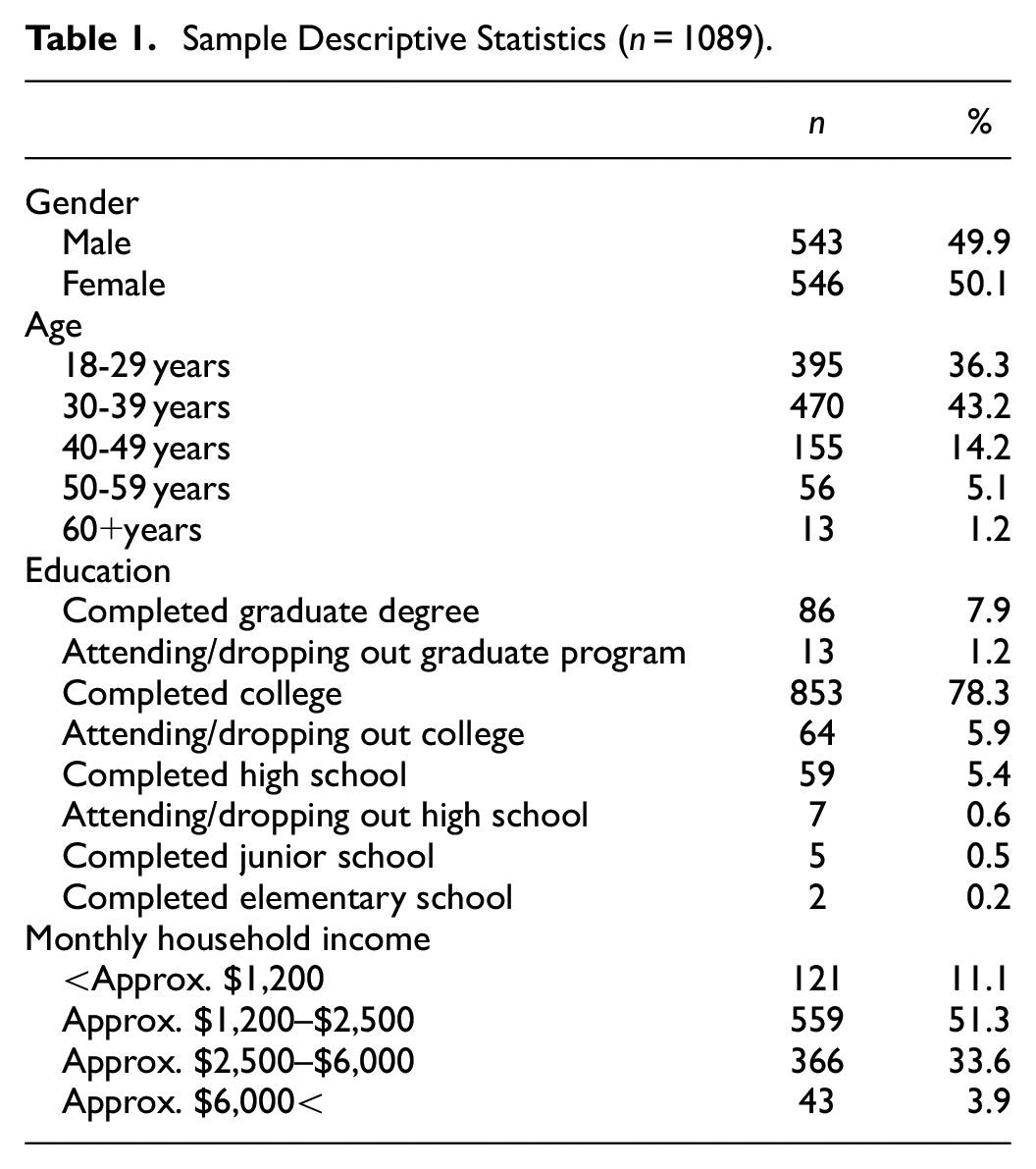
An online survey was conducted from January 20th to February 5th, 2018 through the SoJump online survey company. SoJump is one of the biggest online survey companies in China, featuring a nationwide sample pool of 2.6 million respondents, and it operates similarly to Mechanical Turk of Amazon.com (Yang et al., 2014). Respondents took approximately 15 min to complete the survey and received $1.50 worth of redeemable points once they completed the survey. To ensure response quality, SoJump added foil questions and manually checked a random sample of answers. This study received institutional review board approval from the corresponding author’s institution. A total of 1,089 Chinese citizens participated in the survey, and the participants’ characteristics are comparable to those of Chinese online users (China Internet Network Information Center, 2018). Sample descriptive statistics are presented in Table 1.
Sample Descriptive Statistics (n = 1089).
Measures
Respondents were asked to rate their level of agreement on a five-point Likert scale (1 = strongly disagree, 5 = strongly agree) to the presented statements. Responses to each item were averaged to form an index for respective measurement.
Trust and Distrust
Trust was measured with items adapted from a prior study (Kang & Park, 2017). Six questions were asked to measure respondents’ trust in the food industry (α = .78, M = 3.60, SD = 0.59). Sample items include “Sound principles seem to guide the food industry’s behavior,” and “The food industry can keep its promises to its publics.” To measure respondents’ distrust in the food industry (α = .87, M = 3.13, SD = 0.80), five questions, adapted from a prior study (Kang & Park, 2017), were asked. Sample items include “The food industry intentionally deceives the publics” and “The food industry does not care about acting ethically.”
Situational Motivation
Following a prior study (J.-N. Kim & Grunig, 2011), situational motivation for GM food (α = .52, M = 3.83, SD = 0.72) and food additives (α = .59, M = 3.84, SD = 0.71) was measured by two items regarding each respective issue: “I frequently think about this issue” and “I would like to better understand this issue.”
Information Behaviors
Based on a prior study (J.-N. Kim & Grunig, 2011), four types of information behaviors were assessed. Information forwarding for GM food (α = .71, M = 3.69, SD = 0.71) and food additives (α = .68, M = 3.76, SD = 0.72) was measured with three items each, including “If it is possible, I take time to explain this problem to friends or family members.” Information sharing for GM food (α = .65, M = 3.68, SD = 0.81) and food additives (α = .62, M = 3.69, SD = 0.79) was measured with three items each, including “I am willing to have conversation about this problem while not starting myself.” Information seeking for GM food (α = .80, M = 3.81, SD = 0.81) and food additives (α = .81, M = 3.72, SD = 0.84) was measured with three items each, including “I often search and read news or related blogs about this issue.” Information attending for GM food (α = .75, M = 4.04, SD = 0.64) and food additives (α = .74, M = 4.00, SD = 0.66) was measured with three items each, including “I pay attention to the problem when this issue appears on the TV or radio.”
Data Analysis Strategy
To test the study’s hypotheses, a series of hierarchical regression models were performed, with situational motivation, trust, and distrust as predictors and information behaviors including information forwarding, sharing, seeking, and attending as criterion variables. Specifically, age and gender were entered into the regression models as control variables. Then, three predictors (situational motivation, trust, and distrust) were added. Finally, the interaction terms between situational motivation and the other two predictors were entered into the models. Prior to analysis, all of the variables’ values were centered to prevent possible issues of multicollinearity, following Aiken and West (1991) .
Results
Confirmatory Factor Analysis
To examine the dimensional differences between trust and distrust, the entire 11 items for trust and distrust were submitted to a confirmative factor analysis (CFA) with a two-factor structure using AMOS 21. The results showed that this was appropriate for the model, based on Hu and Bentler’s (1999) criteria (χ2 = 283.19, p < .001, CFI = 0.95, RMSEA = 0.06, SRMR = 0.04). The dimensionality of the four information behaviors (information forwarding, sharing, seeking, and attending) were also examined using a CFA, with a structure of four factors specified. Based on the same criteria, the results demonstrated a very good fit for the GM data (χ2 = 192.20, p < .001, CFI = 0.97, RMSEA = 0.05, SRMR = 0.03) and food additive data (χ2 = 129.16, p < .001, CFI = 0.98, RMSEA = 0.04, SRMR = 0.02). Thus, the dimensionality of these constructs is deemed appropriate.
GM Food Results
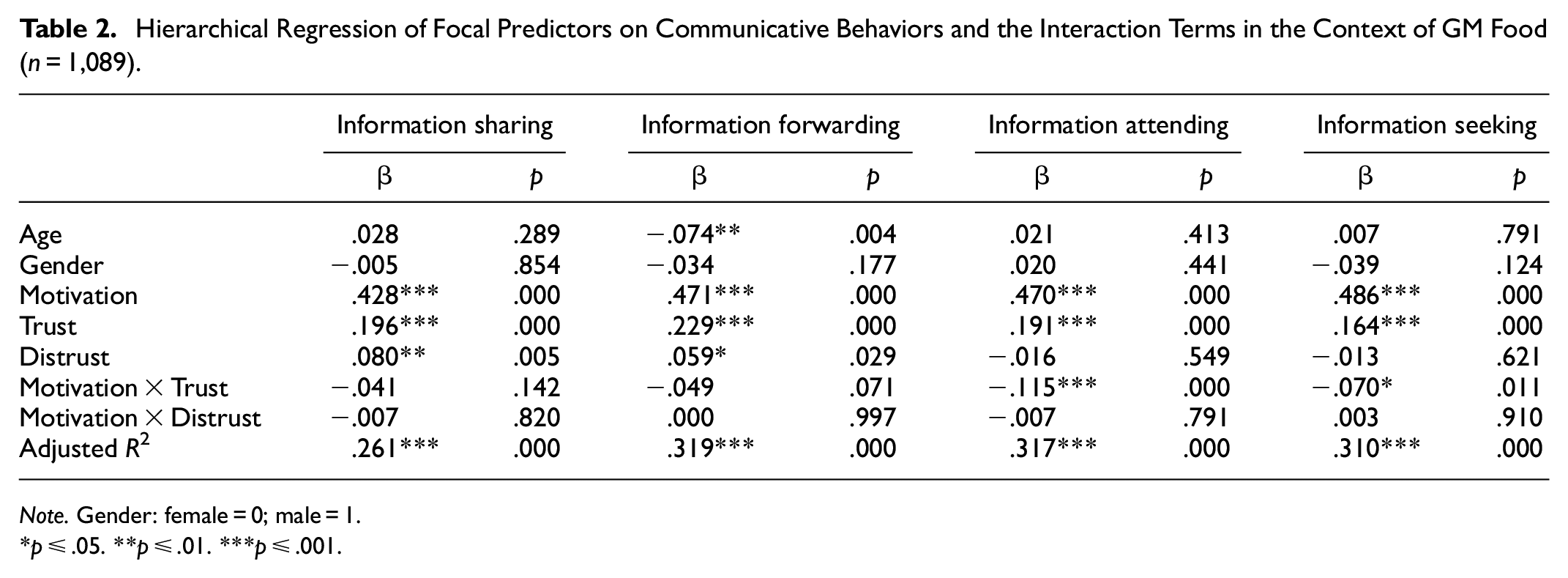
H1 posited positive relationships between situational motivation and information behaviors. The results, presented in Table 2, provide support for H1.
Hierarchical Regression of Focal Predictors on Communicative Behaviors and the Interaction Terms in the Context of GM Food (n = 1,089).
Note. Gender: female = 0; male = 1.
p ≤ .05. **p ≤ .01. ***p ≤ .001.
H2 posited that trust has negative relationships with information behaviors. As Table 2 presents, trust showed significant relationships with the four information behaviors. However, these relationships were positive, opposing the hypothesized direction. Thus, H2 is rejected.
RQ1 asked what kinds of relationships distrust has with four different information behaviors. As Table 2 presents, distrust showed positive relationships with information sharing and information forwarding. RQ2 asked how trust moderates the relationship between situational motivation and information behaviors. As Table 2 shows, trust negatively moderated situational motivation’s effects on information attending and seeking. RQ3 asked how distrust moderates the relationship between situational motivation and information behaviors. As Table 2 shows, distrust did not moderate any of the four relationships.
Food Additives Results
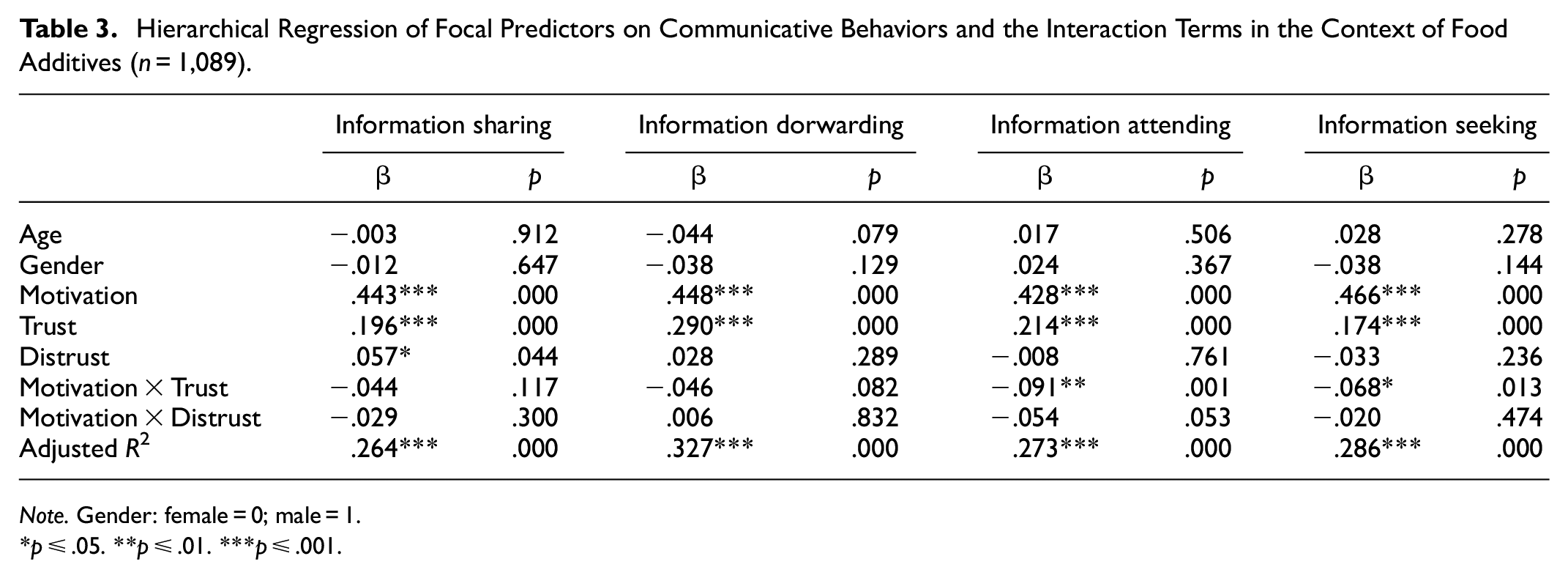
H1 predicted positive relationships between situational motivation and four information behaviors. As Table 3 shows, H1 is supported. H2 posited that trust has negative relationships with information sharing and information forwarding and negative relationships with information attending and information seeking. As is the case with GM food, trust had positive, rather than negative, relationships with all information behaviors. Therefore, H2 is rejected.
Hierarchical Regression of Focal Predictors on Communicative Behaviors and the Interaction Terms in the Context of Food Additives (n = 1,089).
Note. Gender: female = 0; male = 1.
p ≤ .05. **p ≤ .01. ***p ≤ .001.
RQ1 asked what kinds of relationships distrust has with information behaviors. As Table 3 shows, distrust had a positive relationship only with information sharing. RQ2 asked if trust has a moderating role in the relationship between situational motivation and information behaviors, while RQ3 asked if distrust has a moderating role in the relationship between situational motivation and information behaviors. As Table 3 shows, trust moderated the relationships between situational motivation and information attending and seeking. Distrust did not moderate the effects of situational motivation.
Discussion
Through a survey conducted with Chinese citizens, this study examines potential factors that may influence people’s information behaviors. The study’s results show that situational motivation and trust are strong predictors for information behaviors. Distrust predicted only information transmission behaviors including information sharing and forwarding. On the other hand, situational motivation was only moderated by trust in its influence on information acquisition behaviors including information attending and seeking. Distrust did not moderate the effects of situational motivation.
As previously demonstrated in STOPS (J.-N. Kim & Grunig, 2011), situational motivation was a strong predictor of various information behaviors, supporting prior studies (J.-N. Kim et al., 2011; J.-N. Kim & Ni, 2013). STOPS explains that one’s situational motivation to solve a problem driven by perceived levels of the problem, involvement, and constraints leads to information behaviors whether it is passive (information sharing, information attending) or active (information forwarding, information seeking). The present study contributes further evidence to support this model specifically in food-related contexts. Moreover, this study highlights the distinct functions of particular information behavior, which will be expanded in the discussion of distrust effects.
One of the study’s noteworthy findings is that trust positively predicted all information behaviors across the selected contexts (GM food and food additives), opposing the expectation to find negative relationships in between. Prior studies (Griffin et al., 2008; Huurne & Gutteling, 2008; Kuttschreuter, 2006; Ter Huurne & Gutteling, 2009) have shown that trust has negative relationships with information insufficiency and with further information-seeking behavior. These studies explained that individuals’ trust in institutions leads them to rely on these institutions, experience relief from risk-related concerns, and avoid the feeling of information insufficiency. This study, however, revealed the opposite. Considering that Kuttschreuter (2006) also employed a food safety context, such inconsistency does not seem to stem from topical differences. One possible explanation for this inconsistency is cultural difference. Whereas most prior studies were conducted in western countries (e.g., the Netherlands and the U.S.), the current study focused on Chinese citizens. Hofstede’s (1980) cultural dimensions theory categorizes China as a collectivistic culture where “people belong to in-groups or collectivities which are supposed to look after them in exchange for loyalty”; meanwhile, the theory contends that the United States and other western countries have individualistic cultures where “people are supposed to look after themselves and their immediate family only” (Ho, 1976; Hofstede & Bond, 1984, p. 419). In collectivistic cultures, people view their actions as important for collective goal attainment and they collaborate to achieve collective goals. In this sense, Chinese participants may have felt higher levels of social responsibility as institutional trust increased, causing them to try to help institutions with their information behaviors. Chinese participants may have interpreted the meaning of this study’s key terms—for example, trust, distrust, information behaviors, and food-related issues—differently. Hall (1980) argued that individuals decode meanings in texts based on their contexts. The Chinese government censors the media including the Internet, and this censorship may have affected survey participants’ interpretations of information behaviors. In addition, given the Chinese government’s robust regulation of the food industry, Chinese participants may have interpreted trust or distrust of the food industry differently than participants from Western countries. The exact reason for this study’s inconsistent finding is unclear, requiring future research across various cultural contexts.
Another of the study’s noteworthy findings is the revelation of the differential effects of trust and distrust on information behaviors. While trust positively predicted all information behaviors, distrust positively predicted information transmission behaviors including information sharing and forwarding. As the results in Tables 2 and 3 suggest, trust consistently had much larger absolute values in terms of the standardized regression coefficients than distrust across all information behaviors, and across two food-related issues. Therefore, we can safely conclude that trust is a more powerful factor in predicting information behaviors. Moreover, it should be noted that both trust’s and distrust’s effects on information transmission were positive, potentially implying that trust and distrust are separate constructs as argued in prior studies (Cho, 2006; Dimoka, 2010; Lewicki et al., 1998).
Interestingly, distrust did not predict information acquisition but did predict information transmission. Distrust refers to the expectation that an institution would act harmfully toward a trustee (Deutsch, 1958). Possibly, when people possess high distrust toward institutions, they may not rely on or make efforts to acquire available information, assuming that such information may have been produced by the responsible institutions. On the other hand, according to STOPS (J.-N. Kim & Grunig, 2011), information transmission is conducted to resolve a given issue. Thus, people may attempt to diffuse more information as they experience greater distrust in institutions.
In line with this, the current study revealed that only trust moderated the effects of situational motivation on information acquisition behaviors, including information attending and seeking, while distrust did not play any moderating roles. This means that situational motivation is less influenced by trust in affecting information transmission behaviors and more influenced by trust in affecting information acquisition behaviors. Considering that trust is positively associated with information sufficiency, trust is expected to affect information acquisition behaviors that are motivated by information insufficiency. More specifically, the study’s findings imply that even when people experience low levels of motivation to communicate, they might engage in information attending and seeking if their trust levels are high. However, trust’s moderation effect is attenuated when situational motivation increases, which might be the result of a ceiling effect.
This study makes unique contributions to the field of information behaviors by expanding STOPS’ applicability to food-related risk contexts, conducting research with culturally distinct populations different from those featured in prior research, and distinguishing the roles of trust and distrust in influencing information behaviors.
A few limitations must be acknowledged. The survey was conducted using an online panel that represents Chinese online users rather than the Chinese population or populations in other countries, limiting the results’ generalizability. Future studies should endeavor to collect more representative data. In addition, this study employed a cross-sectional study, which means that causal relationships between variables cannot be inferred from the findings herein. Future research that employs additional research designs to establish causal inferences among variables is therefore suggested.
This study provides practical implications for social institutions. The findings indicate that trust and distrust toward institutions are important predictors of the public’s information behaviors. In particular, trust was a strong predictor of various information behaviors. Various institutions—such as governments, non-profit organizations, and food industries—often attempt to communicate effectively with the public but fail due to the public’s indifference toward social issues. The current study highlights that public trust in a specific institution must be in place in order to foster effective communication. In line with this, the study’s findings imply that people who distrust food industries tend to become engaged in information sharing and forwarding while not paying attention to available information. Practitioners must attempt to eliminate public distrust in order to help people accept important information provided by institutions. The importance of institutional trust is further highlighted by this study’s finding that the public’s low situational motivation to become engaged in information behaviors can be attenuated by institutional trust, implying the importance of this kind of trust in communicating with the public.
Conclusion
Guided by STOPS, this study makes contributions to the field of health information by revealing the distinct roles of trust and distrust and by examining different types of information behaviors that are gaining greater importance as new communication technologies emerge. The study found that trust, distrust, and situational motivation predict information transmission, whereas trust and situational motivation predict information acquisition behaviors. It also showed that trust moderates the influence of situational motivation on information acquisition behaviors. In particular, the study was conducted in the context of food-related issues, which have recently garnered more media and scholarly attention. Moreover, the study’s setting in China differentiates it from prior studies conducted in Western countries. Its findings are expected to help various social institutions engage in more effective health communication.
Footnotes
Author’s note
This research was conducted while Jiaying Liu was at the Department of Communication Studies at the University of Georgia. She is now at the Department of Communication at the University of California Santa Barbara and may be contacted at
Declaration of Conflicting Interests
The author(s) declared no potential conflicts of interest with respect to the research, authorship, and/or publication of this article.
Funding
The author(s) disclosed receipt of the following financial support for the research, authorship, and/or publication of this article: This work was supported by the Young Scholar Foundation of China under Young Scholar Program of National Social Science Funds [grant number 19CXW019].

Data Availability Statement
The data that support the findings of this study are available from the corresponding author upon reasonable request.