




Abstract
This study focused on the role of Americans’ communication about COVID-19 vaccines, and its potential associations with two significant vaccine determinants. Two studies informed by the Situational Theory of Problem Solving (STOPS) were conducted. In the first, the researchers incorporated the intention to receive vaccination against the COVID-19 pandemic and vaccine-specific knowledge into STOPS to examine the associations among these three key variables. The second study introduced a new variable, trust in science/scientists, as a potential conceptual variable that functions together with vaccine knowledge to explain why Americans’ intentions to receive COVID-19 vaccines increased despite their imperfect knowledge about them. Two online surveys were distributed using Amazon Mechanical Turk (Study 1) and Qualtrics (Study 2). The first was administered from December 18 through 22 of 2020, and the second from December 18 through 29 of 2020. An enhanced level of communicative action with respect to COVID-19 vaccines decreased the accuracy of knowledge about the vaccines, which increased the intention to receive these vaccines (Study 1). A significant interaction was also found between COVID-19 vaccine knowledge and participants’ levels of trust in science/scientists on study participants’ future intention to receive COVID-19 vaccines (Study 2). Contrary to previous findings, Americans’ increased activeness in COVID-19 vaccine-specific communication was associated negatively with vaccine knowledge, which in turn, increased COVID-19 vaccination intentions. This negative association reflects the complex and unique nature of information environments with respect to COVID-19 vaccines. Trust in science/scientists served as a significant missing conceptual variable that shed light on the paradoxical finding.
Plain language summary
This study focused on the role of Americans’ communication about COVID-19 vaccines, and its potential associations with two significant vaccine determinants. Two studies informed by the Situational Theory of Problem Solving (STOPS) were conducted. In the first, the researchers incorporated the intention to receive vaccination against the COVID-19 pandemic and vaccine-specific knowledge into STOPS to examine the associations among these three key variables. The second study introduced a new variable, trust in science/scientists, as a potential conceptual variable that functions together with vaccine knowledge to explain why Americans’ intentions to receive COVID-19 vaccines increased despite their imperfect knowledge about them. An enhanced level of communicative action with respect to COVID-19 vaccines decreased the accuracy of knowledge about the vaccines, which increased the intention to receive these vaccines (Study 1). A significant interaction was also found between COVID-19 vaccine knowledge and participants’ levels of trust in science/scientists on study participants’ future intention to receive COVID-19 vaccines (Study 2).
Keywords
Introduction
The COVID-19 pandemic has been one of the greatest challenges in the history of public health in the United States (Gorman & Trotta, 2020). To respond to this crisis, the government and private sectors collaborated strategically to expedite research and development processes, as well as gain approval for vaccines intended for public use without compromising their safety and effectiveness (Corey et al., 2020; U.S. Department of Health and Human Services, 2020). Despite such endeavors, the actual vaccine uptake rate in the U.S. lagged behind expectations (Hopkins & Campo-Flores, 2021; Slaoui & Hepburn, 2020). Approximately 20% of Americans consistently expressed hesitancy or outright refusal to receive COVID-19 vaccines (Funk & Tyson, 2020; M. J. Jones, 2021). Further, researchers (Funk & Tyson, 2021; Khubchandani et al., 2021; Lin et al., 2021) have identified various factors, such as the reliance on novel vaccine technology platform and vaccine administration under Emergency Use Authorization (EUA), as the primary leading causes of public apprehension and negative sentiment toward the vaccines, which impeded the smooth progress in the public receiving vaccination.
The situation in making the decision to be vaccinated raised the following questions, which have been addressed to a limited extent in previous studies: What strategies that do potential vaccine recipients in the U.S. employ to manage confusion and uncertainty regarding COVID-19 vaccines? What factors motivate these individuals to engage in these strategies at varying levels? To what extent, if any, do people utilize these strategies to gain a better understanding and make informed judgments about COVID-19 vaccinations?
We conducted two studies shortly after the COVID-19 vaccines were approved and released to address these questions. The first study focused on the role of the public’s communicative action as a potential factor influencing vaccination intention. The Situational Theory of Problem Solving (STOPS, J.-N. Kim & Grunig, 2011) guides us to explain the conditions and process of motivated information behavior in a problematic situation. It has yet to be found that those citizens with epistemic motivation and communicative actions about COVID-19 would have greater knowledge and intention to receive the new vaccines. Thus, we integrated two vaccination determinants—vaccine knowledge and intention to receive COVID-19 vaccines—into the STOPS model to examine the associations among communicative behaviors, knowledge, and vaccination-related behavior during the pandemic’s outbreak.
Study 1’s findings were paradoxical, in that they indicated that (1) individuals who were more actively engaged in communicating about COVID-19 vaccines exhibited a higher level of ignorance about the vaccines, and (2) despite their lack of accurate knowledge, those who are communicating actively still choose to receive the vaccines. To resolve the puzzle, we conducted Study 2 to identify potential factors that lead the confused public to receive the new vaccines. In this regard, we specifically focused on trust in science/scientists, considering it as a missing conceptual variable that may be a suppressor of fear and an enhancer that increases vaccination on the part of the confused public. The central question we addressed in Study 2 was whether trust in science/scientists induce those confused members of the American public to take the risk of receiving the controversial COVID-19 vaccines. Our analysis revealed that trust in science/scientists helped explain the paradox revealed in Study 1.
Literature Review
Are Americans Ready to Receive COVID-19 Vaccines?
Despite the proven effectiveness and robustness of vaccines in controlling infectious diseases, the American public has expressed hesitance to receive vaccinations consistently throughout the history of vaccinations in the United States (Chotiner, 2020, Dubé et al., 2013, Palm et al., 2021). The public’s skepticism of, or even hostility toward, the COVID-19 vaccines was no exception. Numerous scientific reports and polls (Funk & Tyson, 2020, 2021; M. J. Jones, 2021; Malik et al., 2020; Reiter et al., 2020) conducted at different time points have consistently shown that a substantial proportion of these study respondents, ranging from 25% to 49%, have expressed their hesitance or even refusal to receive COVID-19 vaccines.
Previous studies (e.g., Reiter et al., 2020; Taylor et al., 2020) have focused on the unique characteristics associated only with COVID-19 vaccines to identify the leading cause of such phenomena in the recent COVID-19 vaccination context. The combination of global collaborations, new vaccine technology (mRNA), and the allocation of substantial resources has shortened the time required to complete all of the steps necessary to develop the vaccines significantly (Caldwell, 2021; Petri, 2020). As a result of these efforts, the commercialization of the first COVID-19 vaccines available in the U.S. took just less than a year, given that conventional vaccines typically take over a decade on average to be approved for public use. The U.S. government expedited the process while ensuring that all procedures were followed without compromising scientific rigor and integrity, thereby guaranteeing their safety and efficacy (Bridle & Sharif, 2020). However, the novel and unconventional approach used in the development of COVID-19 vaccines has generated public concerns and mistrust, and led to increased public resistance toward vaccine uptake (Graham, 2020).
Despite the prevalence of COVID-19 vaccine-specific concerns, few academic discussions have approached this problem from the potential vaccine recipients’ perspective. Given that the ultimate decision to be vaccinated is in the individual’s hands, it is imperative to promote a better understanding of ways in which they cope with the concerns related to the new vaccines and the outcomes of their problem-coping efforts in their ultimate acceptance of COVID-19 vaccines. We focused on the role of communication among the lay American public as a problem-solving mechanism to address COVID-19 vaccines-related issues. Individuals’ active engagement in communicative actions is deemed crucial in obtaining relevant health information, which contributes to reducing and/or managing uncertainty and making appropriate decisions during the outbreak of a public health crisis (Chon & Park, 2021; H. J. Kim & Hong, 2021). With this rationale, we continued to explain and predict communication behaviors and their outcomes during public health crises, based upon the STOPS framework.
The Situational Theory of Problem Solving (STOPS): Communication as an Instrument to Cope with COVID-19 Vaccine Issues
The Situational Theory of Problem Solving (STOPS; J.-N. Kim & Grunig, 2011) explains and predicts why and how people become active in communication behaviors during problem solving (Chon & Park, 2021). STOPS highlights communication as an instrumental and purposive behavior in which individuals engage to resolve problems and address the consequences attributable to the problems (J.-N. Kim & Grunig, 2011; J.-N. Kim & Krishna, 2014). Three key communicative actions—information acquisitions, selection, and transmission—within the STOPS framework, are referred to collectively as Communicative Actions in Problem-Solving (CAPS; J.-N. Kim & Grunig, 2011; Ni & Kim, 2009). CAPS encompasses the ways in which individuals, either individually or collectively, seek, choose, and share information in proactive or reactive ways during their problem-solving process (Grunig & Kim, 2017; J.-N. Kim et al., 2010; Y. Kim et al., 2016).
Information acquisition involves the ways in which individuals find information relevant to a specific problem with which they need to cope by seeking information (proactive and planned behavior to monitor the environment to obtain problem-specific information) and attending to information (reactive actions, such as gaining only the information available through unplanned discovery) (J.-N. Kim & Grunig, 2011; J.-N. Kim et al., 2010). Information selection leads people to manage and discriminate information by judging its value proactively to use only the information related to a given problem-solving task (Information forefending) and/or by accepting any information related to a problem-solving task reactively (Information permitting) (J.-N. Kim & Grunig, 2011; J.-N. Kim et al., 2013). In addition, problem-solvers engage in transmitting information actively without solicitation by the potential receivers (information forwarding) and/or giving information reactively in response to specific requests from others (information sharing) (Grunig & Kim, 2017; J.-N. Kim et al., 2010; Y. Kim et al., 2016).
Two antecedents predict the levels of activeness of CAPS’ three dimensions directly (Grunig & Kim, 2017; J.-N. Kim et al., 2010). The first is “situational motivation,” which refers to the “situational specific cognitive state and epistemic readiness to make problem-solving efforts” (J.-N. Kim & Grunig, 2011, p. 132). Three problem-specific perceptions—problem recognition, involvement recognition, and constraint recognition—influence the level of situational motivation. These perceptual variables determine the level of activeness in CAPS through the situational motivation (J.-N. Kim & Grunig, 2011; Krishna, 2018). According to STOPS, situational motivation increases when problem-solvers have high levels of problem and involvement recognition, and perceived low levels of constraint (J.-N. Kim & Krishna, 2014). The greater one’s situational motivation in problem-solving, the more active their communication in acquiring, selecting, and transmitting information (J.-N. Kim & Grunig, 2011).
The second antecedent in STOPS is the referent criterion, which is defined as any available and applicable existing knowledge, experience, and subjective judgmental system (i.e., attitudes, bias, goal, desire, and preference) that can assist individuals in problem solving (J.-N. Kim & Grunig, 2011; J.-N. Kim & Krishna, 2014). When individuals encounter a new problem, a referent criterion serves as a guideline or rule to approach and resolve the problem, by incorporating both factual/experiential aspects (e.g., situation-general knowledge and experience obtained from previous problem-solving) and affective or expectational aspects (e.g., wishful and willful thinking about the problem’s resolution, such as a goal or desire) (J.-N. Kim & Krishna, 2014; J.-N. Kim et al., 2010). As a direct antecedent of CAPS within STOPS, the problem-solver’s degree of communicative action varies depending on the presence of referent criterion. The stronger the presence of the referent criterion, the more active the problem solvers become in engaging in communicative actions for problem solving (J.-N. Kim & Grunig, 2011; J.-N. Kim et al., 2010).
Prior research (Chon & Park, 2021; Jiang et al., 2019; J.-N. Kim et al., 2010; Krishna, 2017, 2018) has applied STOPS in various public health crisis contexts, demonstrating its theoretical and practical utility. The COVID-19 vaccination has been the most urgent public health agenda in recent years. To combat the spread of the virus and mitigate its severe consequences, novel yet unknown vaccine technologies and expedited authorization processes were employed, making the vaccines available to the public in record time. However, the rapid development and approval process has also became major barrier to vaccine hesitancy (Lin et al., 2021). Considering the life-threatening nature of the situation faced by Americans, it is presumed that they are highly motivated to engage in communicative actions, including actively seeking and select relevant information to facilitate their inform-decision making regarding vaccination, as well as disseminating this information to support others in their decision-making processes. These problem solvers are also likely to be proactive in these communicative actions due to their lack of prior knowledge about the novel aspects of the new vaccines, along with their associated benefits and risks. They may also be eager to search for, select, and share the information in line with their pre-existing decision-making referents. Drawing upon the STOPS framework, we propose the following hypotheses that address the relations between the two direct antecedents and the active dimension of communication behavior.
H1: Americans’ situational motivation regarding COVID-19 vaccines is associated positively with their active communicative behavior regarding COVID-19 vaccines.
H2: Americans’ referent criterion regarding COVID-19 vaccines is associated positively with their active communicative behavior regarding COVID-19 vaccines.
Americans’ Communicative Behavior and Behavioral Considerations for Receiving COVID-19 Vaccines
Vaccination against COVID-19 is recognized widely as the most effective measure to prevent and mitigate the virus’s adverse impact (Palm et al., 2021). It has been acknowledged that behavioral manifestations play a crucial role in resolving problems, including those in health issues (Chon & Park, 2021; J.-N. Kim et al., 2010). Previous studies have integrated actual behavioral responses into STOPS and examined relations between its variables and actual behavior. Their findings showed that some of the key constructs in STOPS, such as situational motivation and CAPS, influence individuals’ intentions to engage in various in challenging contexts (Chon & Park, 2021; Jiang et al., 2019, J.-N. Kim et al., 2010; Krishna, 2017, 2018; Lim et al., 2016).
Building on the insights gained from previous research, we conceived of the potential associations between STOPS variables and the behavioral intention to receive COVID-19 vaccines. Specifically, we addressed the potential relations between two behavioral responses to issues surrounding COVID-19 vaccines: active dimensions of communicative behavior, and the behavioral intention to accept a COVID-19 vaccination. People’s information behaviors are known to result in various outcomes, including forming, maintaining, and changing attitudes, knowledge, and behavior (Anderson 1989). Significant associations between communicative action and behavioral intention related to public health concerns have also been demonstrated within STOPS framework (Chon & Park, 2021, J.-N. Kim et al., 2010; Krishna, 2018). These studies have demonstrated strong positive associations between two behavioral coping mechanisms in a wide array of problem-solving situations: the more active people are in communicative behavior in problem-solving, the more they perform behaviors that could be ultimate problem-solving strategies in response to numerous issues. Building on the previous findings, we propose the following hypothesis.
H3: Americans’ active communication behavior regarding COVID-19 vaccines is associated positively with their COVID-19 vaccination intention.
Communicative Actions—Vaccine Knowledge—Intention to Receive COVID-19 Vaccines
Vaccine knowledge, regardless of their accuracy, is a significant determinant of shaping individuals’ vaccination intentions and ultimate uptake (Choucair et al., 2021; Dubé et al., 2015, Zhang et al., 2010). In explorations of the relations within vaccination hesitancy, previous work (i.e., Krishna, 2018; Schulz & Hartung, 2021; Zheng et al., 2021) has highlighted the importance that holding essential accurate knowledge about vaccines (i.e., benefits and risks, vaccination policy, mechanisms of vaccination) in influential in guiding their informed decision about vaccinations.
There are two types of knowledge that individuals use when deciding whether to be vaccinated: existing scientific and vaccine-related knowledge and newly acquired knowledge specific to the vaccines (World Health Organization, 2020). Existing knowledge is akin to the referent criterion in STOPS. People may have already established and stored vaccine-related knowledge in their memories already, which can be accessed and retrieved for future reference when they encounter similar situations (J.-N. Kim et al., 2010). However, in the case of COVID-19 vaccines, we raise the question of how individuals acquire new knowledge about these vaccines, particularly knowledge that pertains to their unconventional nature, which differs substantially from that of existing vaccines and which the publics still understands poorly.
One potential answer lies in communication about the vaccine. Previous discussions (e.g., Rimal & Lapinski, 2009) have highlighted the role that health communication plays in acquiring necessary knowledge about health-related issues. Specifically, engaging actively in seeking, acquiring, and sharing information about health issues has been shown to make individuals be informed better about infectious diseases (i.e., H1N1), illnesses (i.e., cancers), and vaccines (i.e., HPV vaccines) (Beeker et al., 2000; Konotos et al., 2012; S. Y. Lee & Hawkins, 2016; Shieh et al., 2010; Shim et al., 2006).
Previous work allowed us to assume that active communicative behavior related to COVID-19 vaccines is associated with varying levels of vaccine-specific knowledge. Given that the novelty and uncertainties surrounding COVID-19 vaccines have heightened public concerns, individuals seek to gain a better understanding of these unknown aspects of new vaccines. The accuracy of their knowledge about the mechanisms, benefits, risks, and key policies of the vaccines are even more crucial in countering the worrisome misinformation landscape that surrounds them. In particular, despite benefits from the increasing pace with which vaccines have become available, the proliferation of false and inaccurate information increases the public’s skepticism and mistrust by attacking the new vaccines’ importance, safety, and effectiveness (Kata, 2010; Loomba et al., 2021; Stobbe & Fingerhut, 2021; Zimmerman et al., 2005). The repeated exposure to substantial amounts of vaccine-specific misinformation may contribute to individuals’ internalization of inaccurate vaccine knowledge and lead to a higher level of hesitancy and unwillingness to receive COVID-19 vaccines (Guidry et al., 2021; Lockyer et al., 2021; Muric et al., 2021)
Active communicative behavior is not merely about consuming information; it fulfills the public’s need for accurate knowledge (Figure 1). Motivated individuals seek and discern necessary information about the COVID-19 vaccines actively, and internalize this vaccine-specific information, as well as share it with others. This process would allow people to acquire sufficient and accurate knowledge, which serves as a valuable resource to cope with misinformation and its adverse consequences. Based on these discussions, we make the following predictions.
H4: Americans’ active communicative behavior regarding COVID-19 vaccines is associated positively with accuracy in COVID-19 vaccine-specific knowledge.
H5: Americans’ COVID-19 vaccine-specific knowledge is associated positively with their COVID-19 vaccination intention.
H6: Americans’ COVID-19 vaccine-specific knowledge mediates the associations between active communication behavior regarding COVID-19 vaccines and COVID 19 vaccination intention.

Research model (Study 1).
Study 1
Method
Data Collection
We distributed an online survey via Amazon Mechanical Turk (MTurk) from December 18 through 22, 2020. Those eligible for the survey were volunteers 18 to 80 years old living in the United States. In total, 687 people participated in the survey (male: 376, 54.7%; female: 305, 44.4%) and received $1.00 as compensation. At the beginning of the study, we provided the participants with written informed consent, and they agreed to participate in the study voluntarily. Table 1 shows the study participants’ key demographic characteristics.
Participants’ Characteristics.

Measures
Situational motivation was measured with four items (α = .85, M = 5.12, SD = 1.27), and the referent criterion was evaluated with five items (α = .90, M = 4.76, SD = 1.27) that were adopted and modified from previous work (J.-N. Kim & Grunig, 2011; Krishna, 2018). Twelve questionnaires adopted from previous works (J.-N. Kim & Grunig, 2011) measured the study participants’ levels of active CAPS (12 items, α = .93 M = 4.85, SD = 1.18).
COVID-19 vaccine-specific knowledge assessed the amount of accurate and comprehensive information that the participants held about COVID-19 vaccines, including their associated benefits and risks, policy, and vaccine mechanism. We used both factual information and common misconceptions about COVID-19 vaccines to create 13 true or false (T/F) statements adopted from previous studies (e.g., Krishna, 2017, 2018). Vaccine knowledge scores were computed as “0” = incorrect or “1” = correct, then summed to calculate final vaccine knowledge scores (M = 9.07, SD = 2.87, Min = 1, Max = 13).
COVID-19 vaccination intention was assessed with four items (α = .93, M = 5.14, SD = 1.46) adopted from previous studies (e.g., Chon & Park, 2021) that indicated the likelihood that respondents would receive a COVID-19 vaccines or recommend that others do so when available. Except for COVID-19 vaccine knowledge, all STOPS variables and COVID-19 vaccination intention were assessed with 7-point Likert scales that range from 1 = “strongly disagree” to 7 = “strongly agree.”Table 2 shows the details of the questionnaires associated with these key variables.
Items for the Key Tested Variables (Study 1).

Key demographics, including sex, age, education, race, and certain other characteristics that are relevant to the context of COVID-19 vaccinations (flu-shot vaccination Fall 2020 and political orientation) were entered into the regressions and mediation analysis as control variables to hold all of these potential variables that may explain any changes in the outcome variables constant.
Analysis
We performed a path analysis to test the hypothesized associations between :1) direct antecedents of active CAPS in STOPS (H1 and H2), 2) active CAPS and intention to receive COVID-19 vaccines (H3), 3) active CAPS and COVID-19-specific vaccine knowledge (H4), and 4) knowledge and intention to receive COVID-19 vaccines (H5). We used Hayes’ PROCESS macro (model 4) to perform a simple mediation analysis to test H6. Table 3 presents all key variables’ the zero-order correlations.
Zero-Order Correlations of Key Variables (N = 687).

p < .05, **p < .01 (two-tailed).
Results
The first two hypotheses predicted positive relations between situational motivation (H1) and the referent criterion (H2) each with active CAPS regarding COVID-19 vaccines. H1 was supported: The association between situational motivation and active CAPS was found to be significant and positive (β = 0.70, t = 27.41, p < .001). H2 was supported as well: The referent criterion was positively and significantly associated with active CAPS regarding COVID-19 vaccines (β = 0.72, t = 26.61, p < .001).
H3 predicted a positive association between Americans’ active CAPS and their COVID-19 vaccination intention, and the hypothesis was supported: The study participants’ active CAPS and intention to receive COVID-19 vaccines were associated significantly and positively (β = 0.47, t = 14.45, p < .001). H4 predicted positive associations between participants’ active CAPS and COVID-19 vaccine-specific knowledge. H4 was rejected: Contrary to the prediction, the more the respondents sought, forwarded, and forefended COVID-19 vaccine-related information actively, the lower their vaccine-specific knowledge was (β = −0.22, t = −6.02, p < .001).
H5 predicted a positive relation between participants’ COVID-19 vaccine-specific knowledge and their COVID-19 vaccination intention and was supported. The respondents expressed a greater intention to receive COVID-19 vaccines when they possessed more accurate knowledge about the vaccine (β = 0.12, t = 3.12, p = .002).
H6 predicted that COVID-19 vaccine-related knowledge mediates an association between active CAPS and the intention to receive the vaccines. H6 was supported, in that vaccine-specific knowledge mediated the association between the study participants’ active communicative behavior about COVID-19 vaccines and their intention to receive the vaccines significantly, at 95% CI (β = −0.07, SE = 0.01, 95% CI [−0.10, −0.04]). Figure 2 presents the results of testing the six hypotheses.
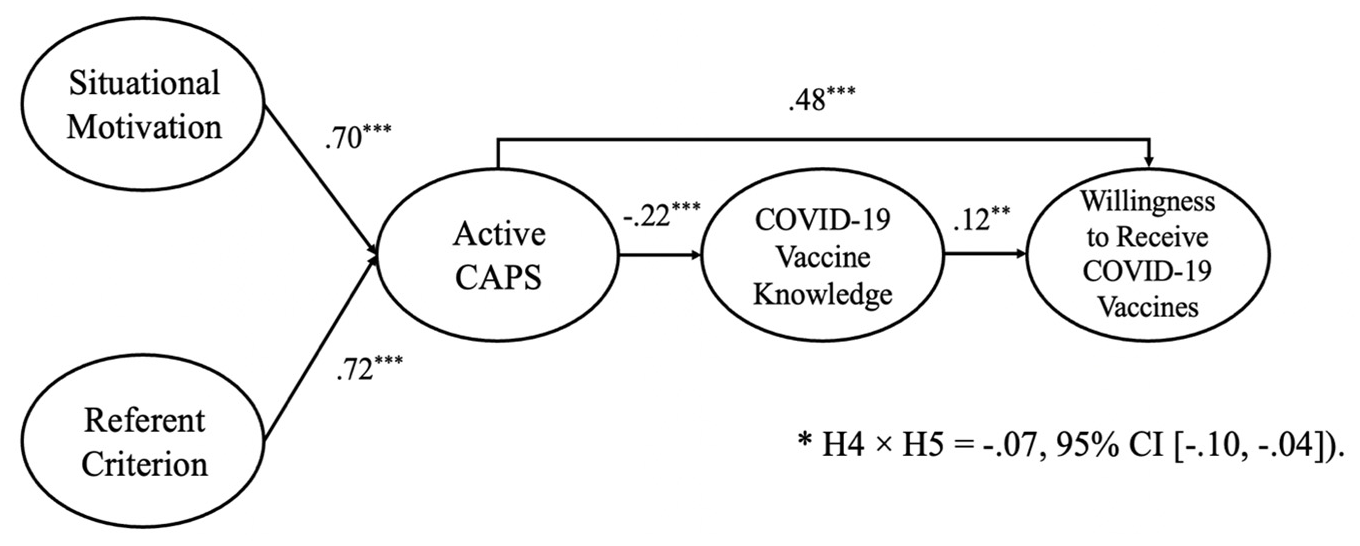
Results to test H1 through H6 (Study 1).
Study 2
Our counterintuitive mediation analysis outcome raises the following question: How does the public’s inaccurate knowledge about COVID-19 vaccines, which results from their active engagement in communicative actions, increased their intention to be vaccinated? To address this question and shed light on the underlying factor that validates our paradoxical finding, we conducted a follow-up study. Among numerous potential factors, we chose to examine the role of general trust in science/scientists, given that the increasing importance of science and the scientific community in relation to the novel scientific approaches used in the vaccines’ development.
Lay individuals have encountered various science-related issues that require them to make decisions with significant scientific implications. The scientific community plays a crucial role in educating the public and providing accessible scientific information, which improves their fundamental understanding of scientific processes thereby, and helps them make an informed decision that benefits society and individuals (Čavojová et al., 2023). However, the intricate nature of many emerging scientific advancements often presents challenges for lay individuals to fully understand the underlying principles and practical applications of these innovations fully (Hendriks et al., 2016).
To address the deficiency in specialist knowledge, researchers have highlighted the significance of general trust in science/scientists in guiding lay people’s understanding of new science and technologies’ nature and values (Brossard & Nisbet, 2007; Siegrist, 2000). It is acknowledged widely within the scientific community that lay people often have limited knowledge and understanding of scientific issues (Hmielowski et al., 2014). Science has become increasingly complex and inaccessible to individuals without specialized knowledge that only a few experts possess (Hendriks et al., 2016). In such contexts, lay people often rely on information and opinions presented by trusted social actors, such as scientific experts, to resolve doubts, form personal opinions, and determine their responses to science-related issues (Hendriks et al., 2016).
A growing body of scholarly discussions (i.e., Brossard & Nisbet, 2007; Hmielowski et al., 2014; Krause et al., 2019; C. J. Lee et al., 2005) has focused on the role of trust in science/scientists as a cognitive heuristic that lay people employ to process complex issues and determine their responses. The level of trust that the public places in science/scientists perform as cognitive shortcut to compensate for their inherent limitations in acquiring accurate knowledge about intricate issues like science (Lewicki & Brinsfield, 2011). In addition, the trust that the public has in science, its principles, and methodologies are pivotal in shaping public opinions and garnering their support for important scientific matters (Čavojová et al., 2023; Liu & Priest, 2009). Numerous empirical studies (i.e., Hmielowski et al., 2014; J.-N. Kim et al., 2011; Lang & Hallman, 2005; Liu & Priest, 2009; Motta, 2018) have provided substantial evidence of these phenomena. Collectively, these studies have shown that a strong sense of general trust in science/scientists is considered a prerequisite in promoting public awareness and judgment about the potential benefits and risks associated with new scientific advancements (Brossard & Nisbet, 2007; Resnik, 2011).
With respect to vaccines, researchers (e.g., Kerr et al., 2020; Sturgis et al., 2021; Thaker, 2021) have emphasized the crucial role that lay individuals’ heightened trust in technology, science, or experts in relevant fields, such as medicine, play in their confidence in, and acceptance of vaccines. Recent studies that have focused on the specific vaccination context (Casara et al., 2022; Jennings et al., 2021; Yuan et al., 2023) have also found patterns consistent with previous research, and demonstrated that a higher level of trust in scientists/science on lay individuals’ part is associated with an increased willingness to receive COVID-19 vaccines.
Building on previous discussions and empirical findings, we hypothesized that trust in science/scientists can provide insights into the paradoxical finding observed in the first study. Specifically, we propose the American public’s level of trust in science/scientists may mitigate the adverse influence of overall inaccuracies in vaccine knowledge when determining their willingness to receive COVID-19 vaccines.
H7: Americans’ vaccine knowledge and their trust in science/scientists in general will interact in their effects on vaccination intention against COVID-19.
Specifically, those with little vaccine knowledge, but strong trust in science/scientists are willing to receive COVID-19 vaccines to a degree comparable to those with vaccine knowledge, while those with low trust in science/scientists are least likely to be willing to receive COVID-19 vaccines.
Method
Data Collection
The eligible participants for the study (current U.S. residents over the age of 18) were recruited from December 18 through 29 of 2020 by using a panel provider (Qualtrics). A total of 525 participants (male: 261, 49.7%; female: 263, 50.1%) provided written informed consent and participated in the survey voluntarily. The participants who completed the survey received compensation from the panel provider. Table 1 also includes key demographics of the participants in Study 2
Measures
We administered 12 True or False (T/F) questions to assess the accuracy of the participants’ knowledge about vaccines in general as well as of COVID-19 vaccines (see Table 4). Each participant’s response to these questions was recorded as “0” for incorrect and “1” for correct. We calculated the vaccine knowledge score by summing the number of each participants’ correct answers. Based upon the midpoint (6) of the total knowledge score, we divided the participants into two groups: those with low accurate vaccine knowledge (N = 198, M = 3.43, SD = 0.08) and those with high vaccine knowledge accuracy (N = 327, M = 3.56, SD = 0.67).
Items for the Key Tested Variables (Study 2).

Five-items adopted from previous studies (S. H. Kim et al., 2013; Nisbet, 2005) and modified them to fit the study’s context were used to assess the level of general trust in science/scientists among our study participants. Each item was rated on a 5-point Likert scale that ranges from “1” = strongly disagree to “5” = strongly agree (α = .72, M = 3.70, SD = 0.75).
Analysis
We used Hayes’ PROCESS macro (model 1) to conduct a simple moderation analysis to test hypothesis 7. Control variables, including key demographic characteristics (sex, age, education, and race) and other variables (flu-shot vaccination Fall 2020 and political orientations), were entered into the mediation analysis.
Results
Proceeding to test H7, the main effects of vaccine knowledge and trust in science/scientists on the intention to receive COVID-19 vaccines were examined. Both variables showed significant main effects on the willingness to receive COVID-19 vaccines (vaccine knowledge: β = 1.06, t = 2.13, p = .03; general trust in science: β = 0.08, t = 9.88, p < .001), and indicated that holding more accurate knowledge about vaccines in general and having higher levels of trust in science/scientists both increase the public’s intentions to receive COVID-19 vaccines.
H7 predicted a significant interaction between the participants’ vaccine knowledge and trust in science/scientists on the intention to receive COVID-19 vaccines, and this hypothesis was supported (β = −0.26, t = −1.92, p = .05). As Figure 3 shows, the intention to receive COVID-19 vaccines increased on the part of individuals who demonstrated both low and high vaccine knowledge accuracy as their trust in science increased (low in vaccine knowledge: β = 0.80, t = 9.88, p < .001; high in vaccine knowledge: β = 0.55, t = 5.18, p < .001). Notably, the highest level of intention to receive COVID-19 vaccines was found among survey respondents who showed lower vaccine knowledge accuracy yet a higher level of trust in science (M = 4.17). COVID-19 vaccination intentions decreased among individuals who held lower levels of accurate knowledge as their trust in science decreased.

Interactions of vaccine knowledge and trust in science.
Discussion and Implications
We demonstrated several key findings. Firstly, increases in active communicative actions regarding COVID-19 vaccines led to less accurate of the vaccine-specific knowledge. Secondly, despite having less accurate vaccine knowledge, whose who engaged in more active communicative actions demonstrated greater intentions to receive COVID-19 vaccines. Thirdly, the general trust in science/scientists played a significant role in explaining the negative relations between communicative actions, vaccine knowledge, and vaccination intentions. We provide detailed discussions and implications of these findings below.
Communicative Actions in the Context of COVID-19 Vaccination
Our findings were consistent with STOPS, in that we observed an increased in COVID-19 vaccine-specific motivations and the referent criterion, which in turn, enhanced our participants’ active communicative actions. The application of STOPS to the COVID-19 vaccination context provided findings consistent with its theoretical propositions, and contributed to our understanding of individuals behaviors during the outbreak of public health crises. Building upon previous research (Chon & Park, 2021; H. J. Kim & Hong, 2021; J.-N. Kim et al., 2010; Krishna, 2018), the outcomes offered empirical evidence that demonstrated the public’s reliance on active communication behaviors to resolve specific vaccine-related problems amidst the global pandemic. While previous studies (i.e., Rimal & Lapinski, 2009) have well-addressed in the significance of information behaviors in decision-making in the health communication context, they have proposed or identified limited underlying factors that determine these communicative actions as coping mechanisms for the public’s problem-solving. By employing STOPS, we adopted a holistic perspective that elucidates how individuals communicate when health issues jeopardized public well-being, and under what circumstances they are motivated to engage in communication to resolve life-threatening health problems.
Direct Associations Between Communicative Action and Vaccine Knowledge and Intention to Receive COVID-19 Vaccines
Testing the direct association between individuals’ active communicative actions regarding COVID-19 vaccines and their intention to receive the vaccines showed positive results. As our study participants’ active communicative behaviors relevant to COVID-19 vaccines increased, their intention to be vaccinated against COVID-19 also increased also. The implications of these findings are twofold. First, in addition to communicative actions, STOPS shows its utility in predicting another behavioral response, intention to receive the vaccines, that individuals employ ultimately that affects the consequences of problem-solving during the spread of infectious diseases directly. Second, a practical implication was also derived. As stated above, information behaviors are essential components of public responses during public health crises’ outbreak (Chon & Park, 2021; Procopio & Procopio, 2007). However, through the findings of this study, the importance of individuals’ communicative behaviors was related to a somewhat more substantial and essential behavioral reaction to vaccination against the pandemic. The positive and significant association between the two responses demonstrates the necessity to increase the volume of reliable, accurate, and scientifically verified information that the public can access and rely on to take desirable actions in vaccination contexts.
A more notable finding was the negative association between the active CAPS and vaccine knowledge. Our finding showed that active communicative behaviors do not always produce desirable results in problem-solving. Instead, the public could be lured by scientifically unverified and/or inaccurate information and could select, modify, and share the processed information within their social networks. The following rationale may explain to what the unexpected findings may be attributed. As aforementioned, exerting great effort to increase the pace of the vaccines’ availability for public use provided a reason for increased public skepticism about their safety and effectiveness. This background offered conditions for the proliferation of false and faulty information about COVID-19 vaccines that conflicted directly with scientifically verified evidence from legitimate sources that supported the vaccines’ safety and efficacy (Stobbe & Fingerhut, 2021). Under these circumstances, highly motivated lay people who are searching for and learning about COVID-19 vaccines may encounter and become susceptible to pseudo-information, which prevents them from obtaining accurate knowledge about the vaccines (J.-N. Kim & Gil de Zúñiga, 2021).
Trust in Science and Scientists: A Missing Conceptual Piece of the Negative Linkages of Communicative Actions—Knowledge—Intention to Receive COVID-19 Vaccines
The trust in science/scientists was introduced as a missing conceptual variable that leads to making heuristic decisions about COVID-19 vaccinations. We investigated the way that trust in science/scientists influences individuals’ likelihood of being vaccinated against COVID-19 empirically, even when they hold inaccurate knowledge that interferes with their informed decision. Our approach to providing a rationale for the first study’s unexpected finding had theoretical implications. In addition to unraveling the unique associations among communicative actions, knowledge, and vaccination intentions, the second study integrated a significant concept in vaccination into the existing relations that we established under the theoretical guidance of STOPS.
Our findings provide important information for scientific communities about the public’s trust in science/scientists. Limited specialized knowledge and lack of direct experience with scientific topics make it difficult for the public to obtain a comprehensive understanding of scientific innovations. However, these innovations’ acceptance and use in society depend largely upon the lay public. In situations in which the public relies on incomplete knowledge to formulate their responses to new scientific information, the level of trust they have in science and the scientific community becomes crucial in fostering this social acceptance of science.
Strengthening public trust in science/scientists is of utmost importance, particularly in the COVID-19 pandemic, as the rapid development and administration of new vaccines has increased the public’s confusion (Fauci, 2021). In addition, the emergence of several variants of the virus has prolonged the exposure and necessitated constant updates in information and scientific evidence about the unknown aspects of vaccines, such as the duration of immunity and effectiveness against new variants. In such uncertain circumstances, the public’s reliance on information, knowledge, and interpretations that scientists provide becomes crucial in managing their concerns, fear, and uncertainty. This, in turn, helps people make informed judgements about the vaccines. Unfortunately, concerns have been reported about diminished public trust in science/scientists as the pandemic continues to have devastating consequences (Battiston et al., 2020; Schwarts, 2020). In a similar vein, our finding emphasized the need to strengthen public trust in science overall. This is vital to help individuals make constructive decisions about the pandemic and vaccinations.
Limitations and Future Research Suggestions
Firstly, despite the wide ranges of vaccination determinants, we limited our attention to vaccine knowledge and trust in science/scientists. We acknowledged that certain control variables, such as political orientation, may play a significant role in this specific vaccination context. Where discussions about the COVID-19 vaccines have become highly politicized, as previous work has addressed (D. R. Jones & McDermott, 2022; Ma, 2023; Pennycook et al., 2022). Given the prevalence of politicians and the CDC’s statements and partisan media coverage on vaccines, as well as partisan differences in response to vaccinations and the vaccines’ legitimacy, it is crucial for future research to explore the role of partisanship in conjunction with knowledge and trust to identify in-depth mechanisms of COVID-19 vaccination hesitancy. Additionally, it is important to understand how misinformation affects public knowledge about vaccines and trust in science/scientists. The dissemination of COVID-19 vaccine-related misinformation could decrease both knowledge accuracy and public trust significantly, and lead to further delays and refusal of be vaccinated. Future studies should continue to investigate these factors that were not explored deeply in our study to achieve a more comprehensive understanding within the STOPS framework.
Secondly, while MTurk is popular and useful for recruiting diverse and extensive samples, there are notable differences in the characteristics of MTurk users and non-MTurk users (MTurk users tend to be younger, overeducated, and more liberal compared to the general populations), which limited the ability to generalize our study’s findings to populations other than MTurk users (Berinsky et al., 2012; Chandler et al., 2013; Paolacci & Chandler, 2014; Shapiro et al., 2013). To address this limitation, we diversified our sample recruitment methods by using Qualtrics, a panel provider that enabled us to obtain samples that approximate the national probabilities of key demographics such as age, income, and race/ethnicity closely (Boas et al., 2020). However, it is important to note that our sample size, although estimated based upon a conventional rule of thumb informed by previous work (Kline, 1998) (i.e., the sample size should be 10 times the number of parameters in path models at least), was not sufficiently large to draw generalized conclusions. In future research, it is recommended that researchers consider larger sample sizes that provide representative data of the U.S. population using accurate estimation techniques that consider statistical constraints such as effect and population size.
Third, the study was cross-sectional, and assessed our study participants’ perceptions, motivations, cognitions, and behaviors in response to COVID-19 vaccines during a specific time-period. Our data collection took place at approximately the time when the first EUA was issued for the Pfizer-BioNTech vaccine, and the first vaccine doses were administered. We believed that the timing of our data collection reflected the public’s complex sentiments, thoughts, and opinions of these vaccines adequately, given that public attention to these vaccines and related concerns would have been at its highest. However, our study design has limitations in its ability to capture the diverse nature of COVID-19 vaccine problems and their effect on the public’s communicative behaviors. The specific concerns and circumstances related to these vaccines can vary, and result in differences in people’s perceptions, motivations, and thoughts. Depending upon the specific issues raised during different vaccination processes, individuals may engage in varying levels of communicative actions attributed to variations in STOPS’ antecedents. Future longitudinal studies could explore these dynamics in the public’s engagement in communication and their responses as they evolve over time.
Future research may also explore the relations between STOPS variables and other vaccination determinants, considering specific vaccination uptake situations. Active communicative behaviors could help people acquire knowledge and understanding about the novel aspects of COVID-19 vaccines. However, previous work (Krishna, 2018) has shown that the relation may be reversed in another vaccination context. Researchers could propose potential models within a STOPS framework and test and compare their predicted and explanatory power to propose a theoretical model that predicts the public’s communicative behaviors about vaccination problems.
Footnotes
Declaration of Conflicting Interests
The author(s) declared no potential conflicts of interest with respect to the research, authorship, and/or publication of this article.
Funding
The authors disclosed receipt of the following financial support for the research, authorship, and/or publication of this article: The publication of this article was funded by a start-up grant awarded to Narae Kim from the Donald W. Reynolds School of Journalism at the University of Nevada, Reno.
Ethical Approval
The study received approval from the Institutional Review Board (IRB) of the University of Oklahoma.

Data Availability Statement
The data of this study are not publicly available due to agreements with participants on data sharing but may be available from the corresponding author upon reasonable request.