



Abstract
Although the health belief model (HBM) has been widely applied in health behavior research, it cannot fully account for dietary supplement (DS) consumption. This study proposed a second-stage moderation model to empirically examine the mediating role of product knowledge and the moderating effects of trust and distrust in the HBM. Surveys were conducted both online and offline in first-tier Chinese cities; 768 effective samples were collected. Structural equation modeling was employed to test the hypotheses. The findings indicated that perceived susceptibility was a better predictor of attitude toward DS products. Second, perceived susceptibility’s effect on product attitude occurred through product knowledge. Third, trust in manufacturers positively affected product knowledge’s effect on product attitude. Based on these findings, to promote DS consumption, marketers can leverage consumers’ perceived susceptibility to illness, associate the benefits and efficacy of DSs with consumers’ health knowledge, and emphasize their production of high-quality DSs.
Introduction
Dietary supplements (DSs) are defined as products with dietary ingredients that people take to supplement their diets (US Food and Drug Administration, 2018). As a result of growing health consciousness, the consumption of DSs has gained popularity. For example, 76% of adults in the US consume DSs (CRN, 2017). In China, the DS market grew by 18.5% in 2019 and is forecast to be worth 330.7 billion yuan (US$51 billion) by 2021 (daxueconsulting, 2021). Hence, the topic of DSs has attracted considerable research attention. Since the marketplace for DSs is becoming increasingly global (Dwyer et al., 2018), many studies have focused on the safety, quality, and efficacy of DSs in various countries (da Justa Neves & Caldas, 2015; Dwyer et al., 2015; Maughan et al., 2018). Despite such work, there are still some gaps in DS-related research.
First, despite the widespread use of the health belief model (HBM) (Chung et al., 2012; Montanaro & Bryan, 2014; Trinh & Vo, 2016), constructs such as perceived susceptibility and severity mostly fail to predict attitudes toward DS consumption. The HBM posits that a person’s perceived susceptibility to negative health and the severity of that perception predict subsequent attitudes (Janz et al., 2002). Once consumers recognize health threats, their perceptions of the efficacy of using DSs can, to some extent, ease their concerns (Chung et al., 2012). Yet, studies have rarely reported perceived susceptibility and severity as significant factors affecting changes in attitude or behavior (Aiken et al., 1994; Chung et al., 2012; Garcia & Mann, 2003; Montanaro & Bryan, 2014; Wang & Li, 2015). If perceived susceptibility and severity inconsistently predict consumers’ attitudes or behaviors toward DSs, then the factors that mediate this relationship need to be determined.
Second, consumers still are doubtful regarding the safety and efficacy of DSs. Various events have aroused consumers’ suspicions, such as DS recalls in the US due to contamination (FDA, 2018); the detection of sibutramine-adulterated weight-loss products in the EU, the US, China, Australia, and India (Hachem et al., 2016); and the discovery of adulterated DSs in the Netherlands (Biesterbos et al., 2019). Along these lines, Polish consumers who were knowledgeable about DSs were found to exhibit low trust in DS-related advertising (Karbownik et al., 2019). In China, meanwhile, 60% of consumers were found to distrust so-called health food (China Consumer Association, 2016). Hence, when making purchase decisions about DSs, consumers typically face two concerns: whether manufacturers produce safe, efficacious DSs as advertised and whether they intentionally increase efficacy while ignoring safety (da Justa Neves & Caldas, 2015). Trust is defined as a positive expectation of positive behavior by another, and distrust is a positive expectation of negative behavior by another (Luhmann, 2017). They are two distinct constructs (Lewicki et al., 1998) that together affect consumers’ attitudes toward DSs; to our knowledge, however, no DS-related studies have simultaneously considered them. This is another research gap that needs to be filled.
To fill the abovementioned research gaps, this study aimed to improve the HBM by adding three relational constructs. Previous studies have found strong positive relationships between knowledge and attitudes toward products (Labrecque et al., 2006; Lau et al., 2013; Xin & Seo, 2020). Chung et al. (2012), moreover, suggested that people’s perceptions of health threats do not convert into positive attitudes toward DSs unless they have knowledge about the efficacy of DSs. Hence, the mediating role of product knowledge was tested in this study’s model. Additionally, since DSs are credence products whose relevant attribute information cannot be verified even after purchase and consumption (Grunert et al., 2004), trust should be incorporated to better account for consumers’ attitudes. While trust has been found to give knowledgeable consumers greater confidence in taking DSs (Niu, 2010), distrust increases perceived risk, causing consumers to adopt more cautious and skeptical attitudes toward DSs (Chung et al., 2012). As such, this study also considered the moderating effects of trust and distrust. Finally, to truly depict the current situation of DS consumption, this study presents a separate discussion regarding domestic and imported DSs.
Theory Development and Research Hypotheses
Perceived Susceptibility and Severity
Perceived susceptibility and severity are two widely used HBM constructs to predict health behavior (Chung et al., 2012; Garcia & Mann, 2003; Montanaro & Bryan, 2014; Mou et al., 2016; Shah et al., 1999; Wang & Li, 2015). Perceived susceptibility refers to individuals’ feelings of vulnerability to potential health problems. Perceived severity, meanwhile, is the extent to which individuals think health threats may negatively affect their lives (El-Toukhy, 2015). These two dimensions of threat appraisal are considered to have an additive effect on protection motivation and in turn influence behavioral intention (Shah et al., 1999). Mou et al. (2016), for example, developed and tested an extended HBM for consumer acceptance of online health information services based on 703 samples. The results indicated that both perceived susceptibility and severity had significant effects on behavior intention.
With an increase in consumers’ perceived susceptibility and perceived severity, health threats can influence their subsequent attitudes toward DSs (Beck, 1981; Janz et al., 2002). Hence, the following two hypotheses are proposed:
H1: Customers’ perceived susceptibility positively affects their attitudes toward using domestic DSs (H1a) or imported DSs (H1b).
H2: Customers’ perceived severity positively affects their attitudes toward using domestic DSs (H2a) or imported DSs (H2b).
Subjective Knowledge
Product knowledge, a part of consumer expertise, has long been recognized as an essential determinant of information-searching and decision-making behaviors (Brucks, 1985). Most previous studies have adopted a dichotomous objectivity–subjectivity perspective on product knowledge (Chung et al., 2012; Hadar & Sood, 2014; Lin & Filieri, 2015). Subjective knowledge refers to consumers’ beliefs regarding their knowledge of a specific product; objective knowledge refers to consumers’ actual knowledge (Brucks, 1985). Between the two, subjective knowledge has been found to be a stronger predictor because of the higher level of confidence required in decision-making (Hadar et al., 2013; Packard & Wooten, 2013).
Nutritional knowledge influences consumers’ acceptance of intention to purchase, and actual consumption of DSs (Labrecque et al., 2006; Royne et al., 2014; Tang et al., 2017). Without advice from professionals, DS consumers typically identify DS products based on their existing knowledge. Knowledge regarding the health attributes of functional foods and the health consequences of eating those foods increases the likelihood of consuming them or the willingness to recommend them to others (Landström, 2008). For example, Royne et al. (2014) surveyed DS store customers to identify their familiarity with advertising and their attitudes toward DSs; they found that knowledge played a key role in attitude formation. Deeper product knowledge is likely to result in a positive reaction to products with health benefits. Accordingly, the following is proposed:
H3: Customers’ product knowledge positively affects their attitudes toward using domestic DSs (H3a) or imported DSs (H3b).
The likelihood that individuals will seek information is influenced by their perceived health threats (Champion & Skinner, 2008). Those who perceive high susceptibility and high severity will take action to try to avoid health threats. However, if consumers lack knowledge of the ingredients, country of origin, and manufacturing processes of DSs, they will be unware of their efficacy (Fischler, 1988). Consumers with high perceptions of susceptibility or severity are inclined to gather product knowledge before consuming DSs. Accordingly, the following two hypotheses are proposed:
H4a: The more susceptibility consumers perceive, the more DS knowledge they will possess.
H4b: The more severity consumers perceive, the more DS knowledge they will possess.
Individuals facing multiple health threats exhibit positive attitudes toward taking DSs only if they have knowledge regarding product benefits or efficacy (Chung et al., 2012). Since a DS is categorized as neither food nor drugs, the relevant information remains ambiguous for most consumers (Mason & Scammon, 2011). Lacking relevant product knowledge, consumers cannot successfully align purchase options with their actual needs (Fain & Alexander, 2014). That is, if consumers receive information, they are likely to understand the content and be further convinced by the nutrient function claim (Liu et al., 2005). As such, product knowledge can act as a link between consumers’ perceived health threats (e.g., perceived susceptibility and severity) and their attitude toward DSs. One recent study investigated a similar mediating relationship (Ahadzadeh et al., 2018). Hence, the following are proposed:
H5: Product knowledge mediates the effect of perceived susceptibility on consumers’ attitudes toward domestic DSs (H5a) or imported DSs (H5b).
H6: Product knowledge mediates the effect of perceived severity on consumers’ attitudes toward domestic DSs (H6a) or imported DSs (H6b).
Trust and Distrust
Trust becomes more important when perceived risk is high (Lee & Turban, 2001); this is because trust overcomes defensiveness and uncertainty in the presence of unfamiliar information (Schein, 1985). Cases of malpractice, contaminants, or adulterants in the global DS market have been widely publicized (da Justa Neves & Caldas, 2015; Maughan et al., 2018). As such, trust plays an essential role in the DS market.
Although distrust has been regarded as the opposite of trust (Bergman et al., 2019), another theoretical perspective proposes that distrust is a distinct construct from trust (Lewicki et al., 1998; Vlaar et al., 2007). Trust is regarded as a positive expectation regarding another’s conduct. By contrast, distrust is a negative belief about another’s conduct that assumes they have ill intentions. For example, in the DS market, given the known cases of adulterated products, consumers may purchase DSs based on their trust in government regulations or in the quality control and reliability of manufacturers. However, if they doubt the authenticity of DS products, some consumers may refuse to take them.
Under high-risk shopping circumstances, product knowledge and trust can function together to reduce uncertainty. People tend to make trust-related assumptions regarding others based on what they know (McKnight et al., 1998). However, when knowledge is lacking, consumers assess the risks, and benefits of novel food products based on trust (Siegrist & Cvetkovich, 2000). Trust can cause consumers to accept claims about product quality and integrity (Daugbjerg et al., 2014). Hence, trust can reinforce the relationship between product knowledge and attitude toward DSs. This study therefore proposes the following hypothesis:
H7: Trust positively moderates the effect of product knowledge on attitudes toward domestic DSs (H7a) or imported DSs (H7b).
If consumers realize that manufacturers engage in unethical behaviors to take advantage of consumers’ perceived susceptibility and severity, they will not trust those manufacturers (Landström, 2008). Consumers with product knowledge can identify DS products based on labels or logos. However, when consumers recall discouraging experiences, distrust can result in negative expectations about the claimed benefits and produce less favorable attitudes toward DSs (Nuttavuthisit & Thøgersen, 2017). In such cases, distrust weakens the relationship between product knowledge and attitude toward DSs. Thus, the following hypothesis is proposed:
H8: Distrust negatively moderates the effect of knowledge regarding a DS product on the attitude toward domestic DSs (H8a) or imported DSs (H8b).
Based on the hypotheses, Figure 1 illustrates this study’s conceptual model, which is a second-stage moderation model (Edwards & Lambert, 2007). It aims to explain how perceived susceptibility and severity affect product knowledge and product attitude at different levels of trust and distrust. Figure 1 shows a combined domestic and imported DS model. Apart from the three joint constructs (i.e., perceived susceptibility, perceived severity, and product knowledge), DS1 and DS2 refer to domestic DS and imported DS, respectively.

Combined research model.
Method
Structural equation modeling (SEM) was used to analyze the data.
Questionnaire Development
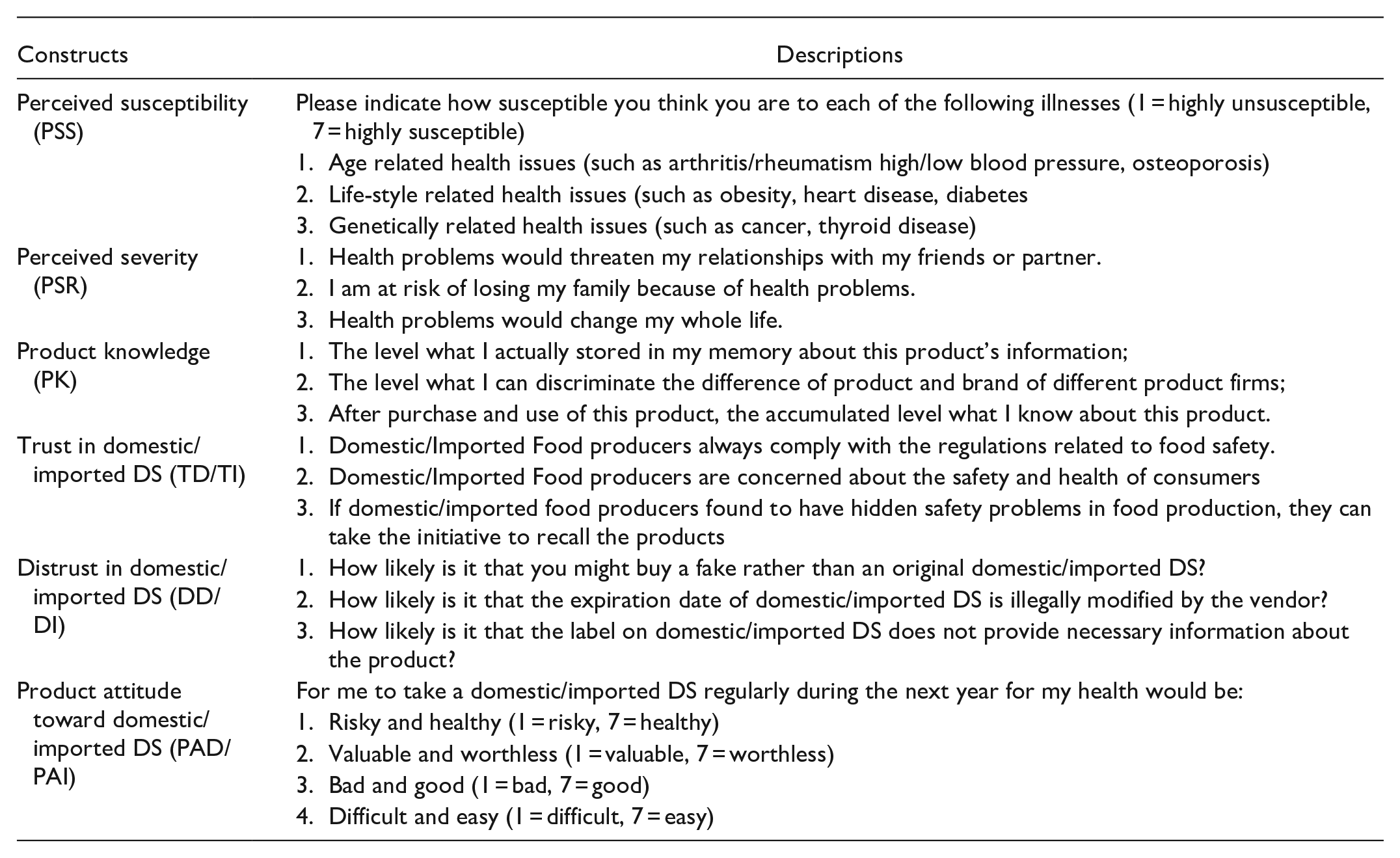
A six-section questionnaire was developed based on a review of the literature. At the beginning of the questionnaire, participants’ recent experiences are examined: “Have you bought or taken DSs over the last 6 months?” The second section consists of six constructs: perceived susceptibility, perceived severity, product knowledge, trust in domestic/imported DSs, distrust in domestic/imported DSs, and attitude toward domestic/imported DSs. The scales for perceived susceptibility, distrust in DSs, and product attitude were adapted from Chung et al. (2012). Perceived severity was measured using the method in Wang and Li (2015), trust in DSs was measured using the method in de Jonge et al. (2007), and product knowledge was measured based on Lin and Chen (2006) and Brucks (1985). The third section gathered demographic information. Measurement items in English were translated into Chinese. Thirty-five college students were randomly selected for a pilot test. Based on the reliability results and item analyses from the pilot test, some measurement items were deleted to enhance scale consistency (see Appendix A for the final questionnaire).
Sample
To target both online and offline consumers, data were collected from an Internet survey and from on-the-street interviews in first-tier Chinese cities, such as Shanghai, half of whose population regularly consumes DSs (daxueconsulting, 2016). A professional opinion pollster was used to conduct the Internet survey with randomly selected participants from their membership pool. Trained interviewers conducted on-the-street interviews to obtain a systematic sample of passersby at the exits of major shopping malls. Every tenth customer leaving the mall was invited to participate in the survey. The survey was conducted over a 3-month period, and a total of 803 interviews were conducted. Thirty-five responses were eliminated because they were inconsistent or too many data were missing, resulting in 768 effective samples for analysis.
Table 1 presents the descriptive statistics of the respondents. There were 356 men (46.4%) and 412 women (53.6%). Respondents over 25 years of age accounted for 88.6%; 36.2% had a bachelor’s degree or above. Finally, 74.7% of the respondents reported having bought or taken DSs in the past 6 months.
Socio-Demographic Characteristics of Sample.

Results
CFA
Confirmatory factor analysis (CFA) was used to test the model fit of nine factors. As indicated in Tables 2 and 3, all factor loadings (i.e., standardized coefficients) were above 0.6. The Cronbach’s α and composite ratio (CR) of the constructs all exceeded .7, and their average variance extracted (AVE) met the suggested level of .5. These results confirmed the convergent validity and internal consistency of the measurement scales (Fornell & Larcker, 1981; Hair et al., 2010). Furthermore, as shown in Table 3, discriminant validity was achieved because the interfactor correlations in corresponding rows and columns were less than the square roots of AVE on the main diagonal (Fornell & Larcker, 1981). Finally, the fit indices exhibited a good overall fit for both models since the chi-square–degrees of freedom ratio (χ2/df) was lower than 3; the values of the normed fit index (NFI), comparative fit index (CFI), goodness-of-fit index (GFI), adjusted goodness-of-fit index (AGFI), and Tucker–Lewis index (TLI) were all above .90; and the root-mean-square error of approximation (RMSEA) was below .08 (Hair et al., 2010): χ2/df = 2.033, NFI = .967, CFI = .988, GFI = .977, AGFI = .964, TLI = .984, and RMSEA = .037 in the domestic DS model and χ2/df = 1.708, NFI = .951, CFI = .979, GFI = .950, AGFI = .922, TLI = .972, and RMSEA = .035 in the imported DS model.
Confirmatory Factor Analysis for the Whole Model.

Factor Means, SD, Pearson Correlations, and Validities.

Note. n = 570; SD = standard deviations; AVE = average variance extracted; the square roots of AVE are located along the diagonal and the inter-construct correlations are shown in the lower left off-diagonal elements in the matrix.
p < .05. **p < .01.
Furthermore, Harman’s one-factor test (Harman, 1960) was used to check for common-method variance. The results of exploratory factor analysis indicated that no single latent factor could explain all variance, with the first factor constituting only 20.01% in the domestic DS model and 21.16% in the imported DS model. Hence, common-method bias was sufficiently controlled in both models.
Simultaneous Regression Paths
Direct effects
As indicated in Table 4, first, perceived susceptibility had a significant effect on attitude toward both domestic and imported DSs (β = .209, p < .001; β = .228, p < .001). This suggests that consumers who perceive high susceptibility to health problems are likely to exhibit positive attitudes toward DSs. Perceived severity showed no effect on attitude toward domestic DSs (β = .015, p > .05) but positively affected attitude toward imported DSs (β = .155, p < .001). This indicates that if individuals believe that illness can have serious consequences, they may demonstrate a positive attitude toward imported DSs compared to domestic DSs. These results support H1a, H1b, and H2b but not H2a. Subsequently, in the domestic model, perceptions of susceptibility and severity were positively associated with product knowledge (β = .299, p < .001; β = .093, p < .01). Similarly, in the imported DS model, product knowledge was positively affected by perceived susceptibility (β = .349, p < .001) and severity (β = .097, p < .01). These results suggest that people with higher perceptions of susceptibility and severity possess significantly greater DS product knowledge. Thus, the results supported H3a, H3b, H4a, and H4b. Finally, product knowledge was significantly related to product attitude in both models (β = .426, p < .001 in the domestic DS model; β = .238, p < .001 in the imported DS model). Individuals with high DS product knowledge are therefore likely to show positive attitudes toward DSs. Thus, H5 was wholly supported.
Hypotheses Tests of Direct Effects.

p < .05. **p < .01. ***p < .001.
Mediating effect of product knowledge
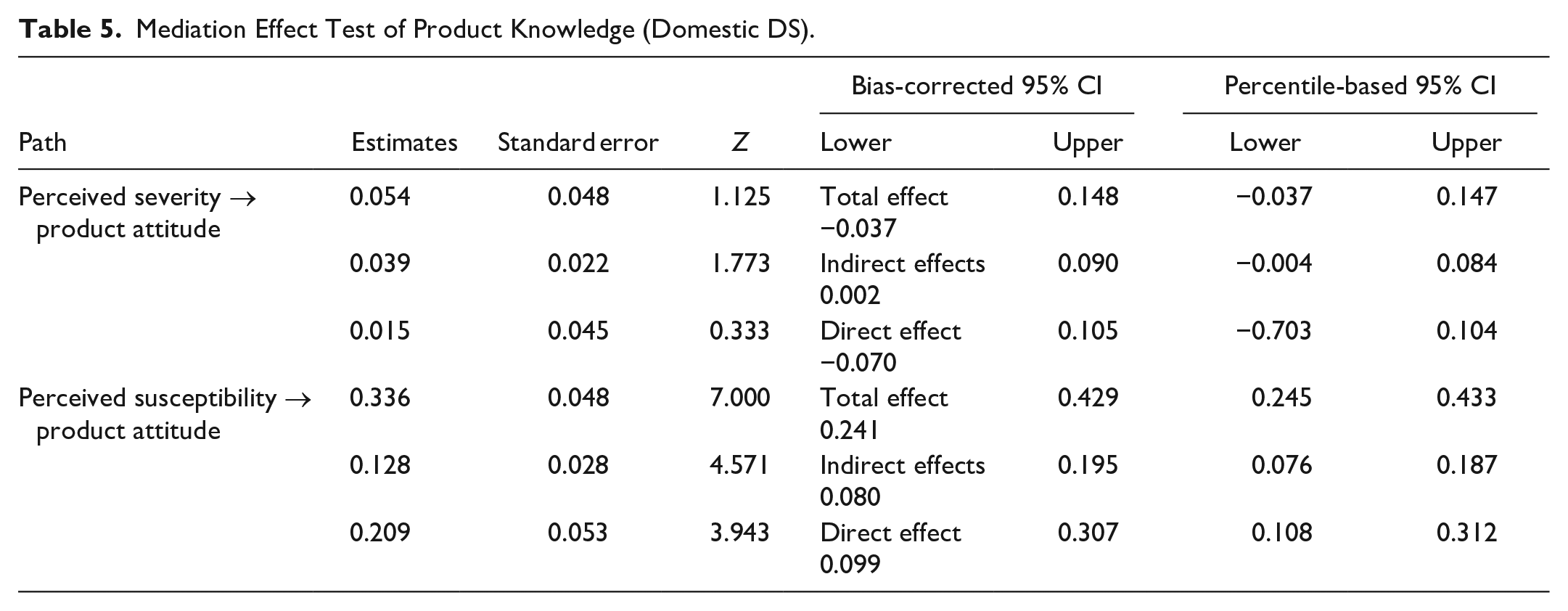
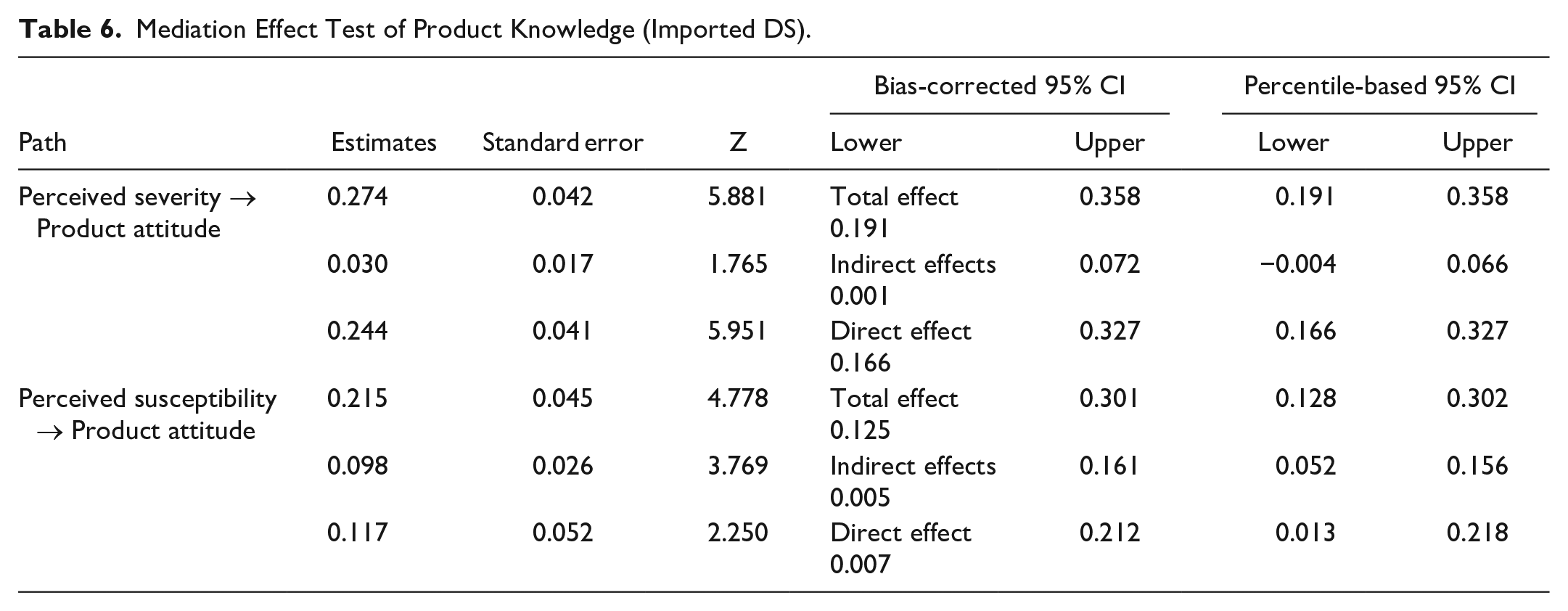
The bootstrapping method (MacKinnon, 2008) was used to test mediation effects. Tables 5 and 6 display the estimates for 2,000 bootstrapped samples with the 95% bias-corrected and percentile-based confidence intervals (CIs) (Hayes, 2009) for both models. The results of the mediation test are given below.
(1) Effects between perceived susceptibility and product attitude: In the domestic model, the indirect effect was statistically significant (estimate = 0.128) (95% bias-corrected CI [0.080, 0.195], 95% percentile-based CI [0.076, 0.187]). The corresponding direct effect was significant (estimate = 0.209; 95% bias-corrected CI [0.099, 0.307]; 95% percentile-based CI [0.108, 0.312]). In the imported DS model, a significant indirect effect was demonstrated (estimate = 0.098) (95% bias-corrected CI [0.005, 0.161], 95% percentile-based CI [0.052, 0.156]). The direct effect was statistically significant (estimate = 0.117) because the 95% bias-corrected CI [0.007, 0.212] and 95% percentile-based CI [0.013, 0.218] excluded zero. These results indicate that product knowledge partially mediated the positive relationship between perceived susceptibility and attitude toward domestic and imported DSs (Zhao et al., 2010). Thus, H5a and H5b are supported.
(2) Effects between perceived severity and product attitude: In the domestic model, the indirect relationship between perceived severity and product attitude through product knowledge was nearly nonsignificant (estimate = 0.039; 95% bias-corrected CI [0.002, 0.090]; 95% percentile-based CI [−0.004, 0.084]). A similar relationship was observed in the imported model (estimate = 0.030; 95% bias-corrected CI [0.001, 0.072]; 95% percentile-based CI [−0.004, 0.066]). In judging the different results between the percentile-based and bias-corrected methods, the percentile-based method generally exhibited superiority in determining the mediation effect (Preacher & Hayes, 2008). It can be concluded, therefore, that the mediated perceived severity–product knowledge–product attitude relationship is nonexistent (Zhao et al., 2010). Thus, H6a and H6b are not supported.
Mediation Effect Test of Product Knowledge (Domestic DS).
Mediation Effect Test of Product Knowledge (Imported DS).
Moderating effects of trust and distrust
To test the hypothesized moderating effects of trust and distrust, a subgroup approach was used to detect the moderating effects, as suggested by Hair et al. (2010) and Edwards and Lambert (2007). This method statistically analyzes the equality of parameters considered by the structural model. Initially, based on survey responses, participants were divided into two groups based on the following medians: low-trust and distrust groups (Group 1) and high-trust and distrust groups (Group 2). Subsequently, multigroup analysis was conducted, and chi-square differences were assessed with a degree of freedom of 1 when comparing restricted and unrestricted models.
Table 7 shows the moderating effects of trust and distrust in the relationship between product knowledge and product attitude. In the domestic and imported models, the parameter estimates for the high-trust and low-trust groups showed significant chi-square differences (domestic model: Δχ2[1] = 7.621, p < .01; imported model: Δχ2[1] = 17.358, p < .001). By contrast, the chi-square differences for the distrust subgroups in the domestic model (Δχ2[1] = .143, p > .05) and the imported model (Δχ2[1] = .009, p > .05) did not reach statistical significance. These results indicate that trust had a significant, positive moderating effect on the relationship between product knowledge and attitude toward domestic and imported DSs, but distrust exhibited no such moderating effect. Hence, the results support H7a and H7b but not H8a or H8b.
Hypotheses Tests of Moderating Effects of Trust/Distrust.

p < .05. **p < .01. ***p < .001.
Discussion
Perceived Severity and Susceptibility in Relation to DS Attitude
In both models, perceived susceptibility appeared to predict product attitude more accurately than perceived severity. This is consistent with previous studies (Gerend & Shepherd, 2012; Wang & Li, 2015). Taking DSs is mainly a preventative behavior. Consumers with serious health problems will typically favor professional medical treatment over DS consumption (Janz & Becker, 1984). Moreover, in this study, perceived severity predicted attitudes toward imported DSs better than attitudes toward domestic DSs. One possible explanation is that Chinese consumers tend to favor foreign products over domestic ones because of their low faith in the quality of domestic products (Bell, 2007; Liu et al., 2019; Xin & Seo, 2020).
Mediating Effect of Product Knowledge
Testing the mediating role of product knowledge revealed that participants who perceived high susceptibility had more product knowledge, which improved their attitude toward DSs. The findings also indicated that perceived severity’s effect on product attitude was not mediated by product knowledge. These two dimensions of risk perceptions exhibited different associations with knowledge, partially contradicting Chung et al. (2012). When people consider themselves vulnerable, or they are suffering as a result of inaction, they are more inclined to undertake self-management and health-seeking behaviors (Mou et al., 2016). Through information seeking, consumers initially find facts, gather them to form an information foundation, and synthetically develop their knowledge base, which eventually affects their attitudes (Ng et al., 2021; Todd, 2006).
This study, however, only confirmed the intervening role of product knowledge in the relationship between susceptibility and attitude. According to Nahl (2009), affective behavior initiates, maintains, and terminates cognitive behavior. At each stage, from information seeking to knowledge construction, if consumers lose their motivation to continue to the next search step or unexpectedly find some new, intriguing information, they are likely to stop or to switch their activity midstream (Gonzalez-Ibanez, 2013). Therefore, perceived severity, which qualifies as an affective appraisal process, is a stronger predictor of preventive strategy and behavioral intention than perceived susceptibility, which is a cognitive process (Shah et al., 1999). Individuals may turn to other types of medical treatment if they affectively relate the health threat to a serious consequence during their search for DS information (El-Toukhy, 2015). Hence, the mediating effect of product knowledge is nonsignificant for severity perception.
Moderators of Trust and Distrust
In the moderating effect tests in the domestic and imported DS models, trust was found to positively moderate the effect of product knowledge on product attitude. DS marketing often uses celebrity endorsements to increase advertising effectiveness and persuade consumers through perceived trustworthiness (Rollins & Bhutada, 2014). Trust, characterized by hope, faith, confidence, assurance, and initiative, is earned over time through open communication and through relationships (Hess & Bacigalupo, 2011). However, this type of trust could also limit individuals’ motivation to critically evaluate their acquired knowledge (Ireland & Webb, 2007). Hence, trust may reinforce consumers’ attitudes toward DSs, even though they are less familiar with DSs.
The results also showed that distrust did not moderate the relationship between product knowledge and product attitude, which is inconsistent with the background of Chinese society. Distrustful consumers tend to be skeptical about DS advertising. News about poor quality control in manufacturing and cases of fraud can further boost consumers’ wariness of DSs (Lin et al., 2018). Such concerns over DS manufacturers can negatively compound consumers’ product knowledge, reinforcing their cautious attitudes. A possible explanation for the nonsignificant moderating effect of distrust is that most of the sampled participants were regular DS consumers. Ultimately, the negative effect of distrust is stronger than the positive effect of trust on purchase intention (Ou & Sia, 2010). Consumers therefore overcome distrust, rooted in fear and skepticism (Lewicki et al., 1998), to consume DSs. After using DSs for a period of time, they are likely to engage in a knowledge-based assessment of manufacturers’ trustworthiness. This type of knowledge-based trust requires long-term, slowly developing cognitive processes (Robert et al., 2009), which might form stronger trust judgments about DS producers and create immunity to negative news about manufacturers. As such, distrust might not significantly influence product knowledge’s effect on product attitude among regular consumers.
Conclusion
Although the HBM has been widely applied in health behavior research, it cannot fully account for DS consumption. This study introduced product knowledge, trust, and distrust to enhance model explanation. Surveys were conducted online and offline in first-tier Chinese cities; 768 effective samples were collected. SEM was used to test the hypotheses. Perceived susceptibility was found to better predict attitudes toward DS consumption than perceived severity. Perceived susceptibility and severity could both result in high product knowledge, which in turn predicted product attitude. Moreover, product knowledge mediated the relationship between perceived susceptibility and product attitude. Finally, trust in DS manufacturers strengthened the relationship between product knowledge and product attitude while distrust did not have a moderating effect.
Managerial Implications
First, marketers can be conscious of consumers’ perceived susceptibility to illness to promote the need for DSs. If illness severity is adopted in the advertising strategy, cross-country cooperation regarding DS manufacturing is advised to highlight the high-quality features of domestic products.
Second, marketers should also stress the benefits and efficacy of DSs to reconstruct consumers’ attitudes toward DSs. In this study, the severity–attitude relationship was not mediated by product knowledge. Since severity is a weaker predictor of DS product attitude but a stronger predictor of treatment behavior, marketers should avoid this factor in their advertising strategies.
Third, manufacturers should always produce high-quality DSs as advertised and publicize their social responsibility efforts to the target market. As such, consumer trust can be built. Even when negative news arises, manufacturers’ goodwill image can reduce consumer’s concern.
Limitations and Future Research
This study has some limitations. Since product knowledge was not found to mediate severity and attitude, future studies should add other potential mediators to further complement the HBM model. In addition, most of the study participants had DS consumption experience. Non-DS consumers should therefore be addressed in future studies. Lastly, demographic factors such as age and cultural backgrounds can be strong predictors of DS consumption; these should be considered in future research.
Footnotes
Appendix A
| Constructs | Descriptions |
|---|---|
| Perceived susceptibility (PSS) | Please indicate how susceptible you think you are to each of the following illnesses (1 = highly unsusceptible, 7 = highly susceptible) |
| 1. Age related health issues (such as arthritis/rheumatism high/low blood pressure, osteoporosis) | |
| 2. Life-style related health issues (such as obesity, heart disease, diabetes | |
| 3. Genetically related health issues (such as cancer, thyroid disease) | |
| Perceived severity (PSR) | 1. Health problems would threaten my relationships with my friends or partner. |
| 2. I am at risk of losing my family because of health problems. | |
| 3. Health problems would change my whole life. | |
| Product knowledge (PK) | 1. The level what I actually stored in my memory about this product’s information; |
| 2. The level what I can discriminate the difference of product and brand of different product firms; | |
| 3. After purchase and use of this product, the accumulated level what I know about this product. | |
| Trust in domestic/imported DS (TD/TI) | 1. Domestic/Imported Food producers always comply with the regulations related to food safety. |
| 2. Domestic/Imported Food producers are concerned about the safety and health of consumers | |
| 3. If domestic/imported food producers found to have hidden safety problems in food production, they can take the initiative to recall the products | |
| Distrust in domestic/imported DS (DD/DI) | 1. How likely is it that you might buy a fake rather than an original domestic/imported DS? |
| 2. How likely is it that the expiration date of domestic/imported DS is illegally modified by the vendor? | |
| 3. How likely is it that the label on domestic/imported DS does not provide necessary information about the product? | |
| Product attitude toward domestic/imported DS (PAD/PAI) | For me to take a domestic/imported DS regularly during the next year for my health would be: |
| 1. Risky and healthy (1 = risky, 7 = healthy) | |
| 2. Valuable and worthless (1 = valuable, 7 = worthless) | |
| 3. Bad and good (1 = bad, 7 = good) | |
| 4. Difficult and easy (1 = difficult, 7 = easy) |
Declaration of Conflicting Interests
The author(s) declared no potential conflicts of interest with respect to the research, authorship, and/or publication of this article.
Funding
The author(s) disclosed receipt of the following financial support for the research, authorship, and/or publication of this article: This research is supported by Philosophy and Social Science Planning Project of Guangdong Province [grant numbers GD18CGL05], Science and Technology Planning Project of Guangdong Province [grant numbers 180917114960500] and STU Scientific Research Initiation Grant [grant numbers STF19019]. This manuscript was edited by Wallace Academic Editing and LetPub Editing.
