



Abstract
Considerable efforts have been made to depict the causal patterns of trust, risk perception, and risk acceptance. Yet, it remains far from clear whether the established models are over-simplistic and to what extent the observed associations are contingent upon risk contexts. Extending the theorizing based on the Causal Chain model, this study adopts a comparative approach to examining the role of trust in regulators in the case of post-Fukushima food imports in Hong Kong, Mainland China, and Taiwan. Consistent with the proposed integrative framework, all three samples exhibited indirect relationships between trust in regulators and behavioral intentions through two types of risk perception (affective and cognitive risk perceptions) and risk acceptance. Findings showed that risk acceptance was the most prominent mediator in explaining the extended model and supported the necessity of distinguishing risk acceptance and behavioral intention as two self-contained constructs working in sequence. Moreover, trust in regulators showed the strongest predictivity in behavioral intentions in the Mainland China sample, while risk perception played a more important role in explaining outcome variables in the Hong Kong and Taiwan samples. In addition to contributing to theory building by presenting the external validity of the integrative framework across different political and food regulatory systems, the study demonstrates practical implications for regulatory authorities and risk communicators.
Introduction
Unlike hazards or disasters which exist in an objective nature, risks are largely defined in line with the general public’s subjective perceptions, judgments, and decision-making. Faced with increasingly uncertain and imperceptible food safety risks, individuals tend to evaluate potential negative impacts on themselves and family members by assessing the trustworthiness of government regulators and expert agencies, based on which they are able to reduce cognitive complexities and plan future actions. In the past decade, trust has been extensively explored as one of the critical factors affecting the public assessment of technological and environmental risks. Considerable efforts have been made to uncover the associations between trust, risk perception, and acceptability (e.g., Bratanova et al., 2013; Chikaraishi et al., 2020; Kim & Koo, 2016; Nam-Speers et al., 2020; Ross et al., 2014). However, it remains far from clear whether the established models are over-simplistic and to what extent the observed associations are contingent upon risk contexts.
In testing the dynamic interactions between trust, risk perception, and risk acceptance, much attention has focused on the dimensions and functions of trust (Earle, 2010), while downplaying the potential variations of the latter two constructs. The emerging dual-process view of risk perception (Altarawneh et al., 2018; Finucane et al., 2000) has induced evidence suggesting that affect and cognition play different, if not mutually exclusive, roles in shaping how the public perceive risk events and accordingly, forming behavioral intention in terms of timing (Richardson et al., 2012) and strength (De Vocht et al., 2015). Put it another way, the general public do not only think, but also feel about risks (Slovic & Peters, 2006). Notwithstanding the concurred dual-process in perceiving risks, prior studies either make no distinction between the affective and cognitive components or merely lay stress on the function of a single component of risk perception (e.g., Finucane et al., 2000; Sobkow et al., 2016).
From regulators’ perspective, the ultimate goal of risk management and policy making is usually to improve the effectiveness in intervening and influencing the public’s behavioral intentions, such as intentions to get vaccination (Chen, 2015) and to consume genetically modified food (Lu et al., 2015). The bulk of previous research, however, has yet to conceptually distinguish risk acceptance from behavioral intention (Ross et al., 2014; Siegrist, 1999, 2000). Specifically, researchers tend to make presumptions that if individuals exhibit high levels of acceptability, they would simply behave accordingly (Ross et al., 2014). Nonetheless, risk acceptance has not reflected the motivational component implied in behavioral intention. There is thus an obviously missing link between the consensus model and behavioral intention to be addressed.
Moreover, prior studies tend to see risk context as a macro-level structure which isolates social and cognitive perspectives of risk perception and decision-making (Lee & Lemyre, 2009), thus failing to build a connection between personal and contextual factors in explaining individuals’ risk assessment. In addition, advances in trust studies have long made normative assumptions about Western societies and cultures. According to the annual global report on trust published by Edelman (2019), the majority of the public across the globe distrust all types of institutions ranging from governments and business organizations, to non-governmental organizations (NGOs) and media groups. 1 In contrast, Hong Kong and Mainland China are among the few societies that are excluded in this distruster list and even exhibit a significant increase in the Trust Index. Such sharp contrast highlights the significance of reexamining the effect of trust on risk judgment and decision-making against the high trust context as an essential supplement to extant literature.
The present study extends the recent theorizing based on the Causal Chain model (Bronfman et al., 2008; Earle, 2010), which situates the mediating role for risk perception in explaining the relationship between trust and risk acceptance. It builds on the existing research gaps in several ways. First, it adopts the dual-process view and examines the role of both affective and cognitive components in perceiving risks. This is important given the call for the integration of both dimensions of risk perception in risk analysis (Janssen et al., 2012). Second, it distinguishes risk acceptance from behavioral intention in order to address the obviously missing link between the consensus model and behavioral intention. This helps obtain a more veracious comprehension of trust’s role coupled with its dormant implications for efficient risk management. Third, the study pays closer attention to food hazards (post-Fukushima food imports) and employs a comparative approach to investigating the relationships across three Chinese societies with similar cultures but different political and food regulatory systems. By doing so, this study fulfills the important task of examining the external validity of the extended model.
Conceptualization
The Causal Chain Model
Developed to explain the role of trust in risk assessment, the Causal Chain model contends that trust in risk regulation serves as a strong prior attitude that shapes subsequent interpretation of messages and conversations around risk issues, thus creating variations in risk perception, and in turn, risk judgment (Earle, 2010; Eiser et al., 2002; Siegrist, 1999, 2000). That is, people’s level of trust in regulatory authorities determines the extent to which they perceive risks, and subsequently the acceptability of health or technological risks. The latest empirical work conducted by Bratanova et al. (2013) following a waterborne disease outbreak in Sweden supported the model that trust predicts risk perception and acceptability, and additionally, the effect of trust on risk acceptance is fully mediated by risk perception. It should be noted that the Associationist model is the competing framework to the Causal Chain model. Specifically, proponents of the associationist view argue that general judgments of acceptability, which are based on prior attitudes toward technologies or policies, may precede and substantially determine the public’s trust of regulatory institutions and their perceptions of risk issues (Frewer et al., 1998; Poortinga & Pidgeon, 2005). Hence, both trust and risk perception serve as the indicators or reflections of the general acceptability of a certain technology or policy.
The applicability of these two models is either knowledge-based or context-sensitive. On one hand, the essential contradiction can be largely dissolved when taking an individual’s available knowledge and accessible information into consideration (Earle, 2010). The Causal Chain model is better suited to the situation in which the public at large have a moderate to thorough knowledge of trustees but lack knowledge of the risk object. Trust, in this case, is more likely to take on the role of antecedent because people cannot assess risks by themselves and need to rely on regulatory authorities to navigate and make further decisions. If the public have knowledge of or a prior attitude toward a technology or policy, then the associationist view is more applicable because the heuristic cues of value similarity can be utilized to judge the trustworthiness of trustees. One the other hand, a thorough understanding of the risk context is critical for selecting an appropriate model in risks analysis. For the current concern, Bronfman et al. (2008) compared the applicability of two models against 30 types of hazards in Chile and revealed that the Associationist model offers more substantial insights into environmental hazards, while the Causal Chain model is more applicable for technological hazards.
The current work is developed upon the case of post-Fukushima food imports, which has sparked one of the largest public outcries in recent years that challenged both the institutional trust of public stakeholders and the risk management of government regulators across Hong Kong, Mainland China, and Taiwan. Food safety issues have been an ever-increasing concern in Chinese societies and weakened public trust toward regulatory authorities and official policies. Potential “side-effects” of nuclear-contaminated food could be devasting but are usually of high uncertainty for the general public to fully recognize and comprehend. Although citizens in these three societies are capable of using diverse channels and digital platforms to seek out risk messages and build connections with other public stakeholders, they have limited ways to evaluate the risk essentiality and need to rely on government regulators to monitor the risk surroundings. By providing scientific proof, dismissing rumors, and instructing authentic risk information, regulatory authorities are expected to inform the public of “what,” “when,” and “where” about the post-Fukushima food imports and specific guidelines on meaningful protection of self and others. This helps the public thoroughly understand potential harms, especially when the harmful consequences are sporadic and delayed (Slovic, 1987). Hence, people seek suggestions and support from regulatory authorities and scientific experts to form their intuitive judgments and assess the extent to which they are vulnerable to risks (Viklund, 2003).
Moreover, the public may form positive expectations of regulators’ behavior that helps to protect them from the vulnerability concerned (e.g., actions taken to monitor, alert, and recall unsafe food products imported from disaster-affected areas in Japan). This highlights the essential role of trust in risk assessment. Through evaluating the intention and competence of more familiar regulators, people have reduced the complexity of risk judgment and thereby facilitated the willingness to accept the risk (Earle, 2010). In addition, risks engendered by post-Fukushima food imports are closer to what Bronfman et al. (2008) addressed as technological risks (e.g., nuclear energy, gene technology, genetically modified food), to which the Causal Chain model is more applicable. Therefore, we consider trust in regulators as the antecedent of risk perception and acceptability of risk objects.
Affective and Cognitive Risk Perceptions
The psychometric approach to pondering risk perception is deeply rooted in the tradition of cognitive psychology and the technical orientation of risk analysis, particularly the considerable scholarship on risk judgment and decision-making (Fischhoff et al., 1978; Slovic et al., 1982). This line of inquiry assumes that risk is one’s subjective and socially constructed perception, the definition of which is influenced by the combination of social, psychological, cultural, and institutional factors. It classifies and quantifies risk perception in terms of multiple qualitative properties of the public’s expressed preference, such as dread, controllability, susceptibility, distribution, and benefits (Sjoberg, 2004). Early conceptualization thus equates perceiving risks with assessing the probability of potential hazards and vulnerabilities based on one’s logical, rational, and rule-based reasoning. As a recent example, Roh and Lee (2018) categorized risks in terms of the controllability and demonstrated that perceptions of intrinsic risks (i.e., risks arising from normal operation) and extrinsic risks (i.e., risks posed by uncontrollable accidents such as natural disaster) have distinct effects on risk acceptance of nuclear power generation.
The emergence of the dual-process theory (DPT) provides a new avenue to understand risk perception by recognizing affect as a significant evaluation mechanism (Epstein, 1994; Peters & Slovic, 1996). In general, the DPT approach to risk perception has outlined two categorically distinct modes of processing. The cognitive risk perception represents the analytic process which is slow, deliberate, sequential, and controlled with high cognitive effort and more involvement of consciousness (Epstein, 2014), while the affective risk perception denotes the heuristic process which is fast, intuitive, parallel, and automatic with low cognitive effort and less involvement of consciousness (Slovic & Peters, 2006). Unlike the cognitive risk perception driven by probability-based assessments, the affective risk perception represents an emotional reaction or response to the threat. A growing body of risk research demonstrates that negative affects such as fear, anger (Lerner et al., 2003), and psychological stress (Sobkow et al., 2016) are of crucial importance to how people perceive risks.
Prior studies revealed that affective and cognitive risk perceptions may have different yet inconclusive impacts on risk decision-making (Finucane et al., 2000; Sobkow et al., 2016). For instance, Loewenstein et al. (2001) asserted that emotional and cognitive risk assessments differ while the former often drives subsequent behaviors. In the case of cancer risk, health-protective motivations, such as the intention to quit smoking, are more likely to be predicted by affective risk perception than by cognitive risk perception (Janssen et al., 2012). However, cognitive perceptions show better predictability on behavioral intentions in food hazards (De Vocht et al., 2015). To extend the Causal Chain model, this study adopts the dual-process model of risk perception in an attempt to shed new light onto the underexplored complexity of the linkage between trust and behavioral outcomes.
Differentiating Behavioral Intention From Risk Acceptance
In response to food hazards, how to effectively influence the public’s behavioral intention has been a key concern of involved organizations, policymakers, and regulatory bodies. Behavioral intention, which refers to the readiness to perform certain types of action (Fishbein & Ajzen, 1975), proves to be a significant predictor for the ultimate health protection behavior (Richardson et al., 2012). The bulk of prior studies regarded behavioral intention as a conceptual synonym of risk acceptance. For instance, Siegrist (1999, 2000) gauged risk acceptance with items measuring the purchase intention of products adopting gene technology. Ross et al. (2014) examined risk acceptance by means of the willingness to use recycled water in various occasions. These efforts make presumptions that if the public have high levels of risk acceptance, they would simply behave accordingly. Nonetheless, the current study asserts that risk acceptance is not a rough equivalent to behavioral intention and in turn, behavioral intention is not a corollary of risk acceptance. Taking a cognitive processing approach, the theory of planned behavior (Ajzen, 1991) offers a succinct conceptualization of behavioral intention that distinguishes it from risk acceptance. In food safety crises, risk is mostly unfavorable and accepting risk indicates the willingness to endure the potential negative consequences. Since the place of origin has been clearly labeled on food items imported from Fukushima (e.g., milk powder, oatmeal), citizens in all three Chinese societies can detect potential risks involved in their consumer behavior and avoid such threats by adopting alternative products that are perceived to be safer and healthier. Risk acceptance in this regard reflects an individual’s informed risk-taking attitude toward consuming or promoting food imported from nuclear-contaminated areas after the subjective evaluation of the expected outcomes and experiences. Behavioral intention, however, captures the motivational component suggesting “how hard people are willing to try” and “how much effort they are planning to exert, in order to perform the behavior” (Ajzen, 1991, p.181). Such motivational factors that induce efforts to carry out certain behaviors are not always present in the concept of risk acceptance. In the specific area of health behavior change, both the Health Belief Model (HBM; Carpenter, 2010; Janz & Becker, 1984) and the Health Action Process Approach (HAPA; Schwarzer & Luszczynska, 2008) suggest that an individual tends to judge and balance the pros and cons of certain consequences of accepting recommended health-related behavior (i.e., perceived benefits/barriers in HBM; outcome expectancies in HAPA) before making decisions to adopt a precaution measure or alter risky behaviors. Put if differently, agreeing to endure the food safety risk may not necessarily reflect that one is motivated and thus, willing to exert efforts to consume or promote potentially contaminated food. Therefore, we treat risk acceptance and behavioral intention as two self-contained constructs working in sequence.
Moreover, measures applied to gage the behavioral intention differ greatly across disciplines. Crisis communication scholars, for example, employ word of mouth (WOM) to predict whether public stakeholders intend to say good or bad things about companies after a crisis has occurred (Coombs & Holladay, 2008). In marketing and consumer scholarship, the purchase intention has been underlined to examine the likelihood of purchase behavior after being exposed to various promotions and advertisements (Grewal et al., 1998). From the perspective of government regulators in the food safety incidents concerned, sustaining the purchase and positive WOM of questionable food after the crisis would be the ultimate goal of risk management. As thus, the integrative framework proposed in this study attempts to incorporate both the use intention and the WOM intention and examine the dynamic relationships between accepting risky consequences and these two concrete behavioral intentions.
The discussions above highlight a number of relationships that have been examined or untested in previous research. Figure 1 presents the study’s conceptual framework based on the extended Causal Chain model. The transition from the consensus model to the integrative framework proposed in this study adds both additional outcome variables (i.e., use and WOM behavioral intentions) and several more latent pathways to the whole model (e.g., from trust, affective and cognitive risk perceptions to behavioral intentions). As the integrative model presented in Figure 1 contains 15 direct and 14 indirect relationships, it would be inefficient to demonstrate individual hypotheses for all paths. Hence, a set of general research questions is posited to guide further analysis and discussion:
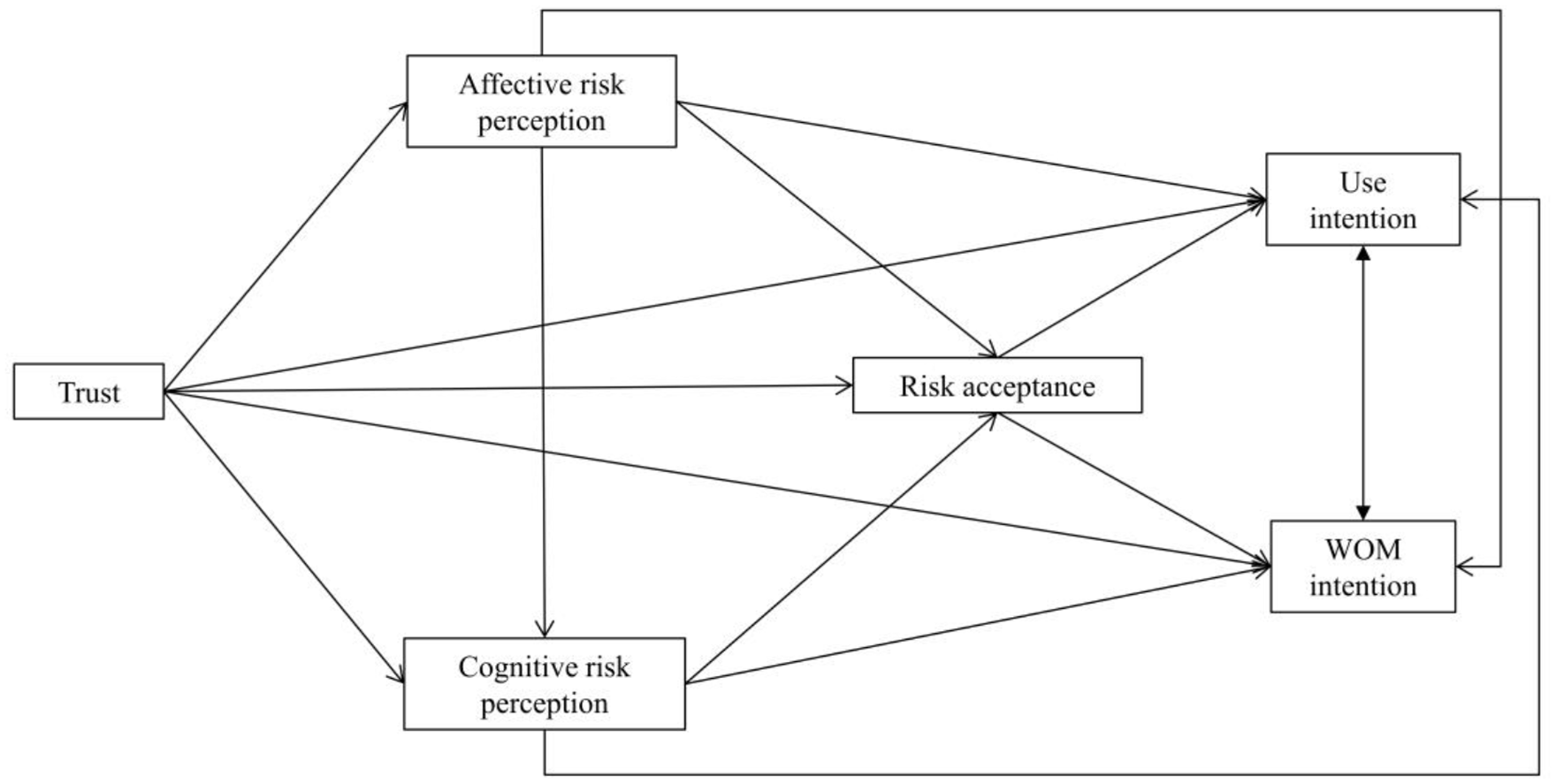
Proposed integrative framework.
Food Safety Regulatory Systems and Post-Fukushima Food Imports in Hong Kong, Mainland China, and Taiwan
With the common heritage from the collectivistic Confucian culture prioritizing holistic beliefs and in-group norms (Triandis, 2001), Hong Kong, Mainland China, and Taiwan have different political systems and are at different stages of regulating and restricting food products from Japan. Similar contextual variations can also be witnessed in how people from different Chinese societies perceive the involvement of regulatory interests in constructing food safety risk narratives. Nonetheless, how people perceive and reason about post-Fukushima food imports is contingent upon food safety regulatory systems and the development of risk events, which are briefly summarized as below.
Hong Kong
The Food and Health Environmental Hygiene Department (FEHD) regulates food and environmental hygiene in Hong Kong. The Center for Food Safety was established in 2006 to enforce regulators and liaise with the Mainland and overseas food authorities. Despite this new regulatory system, there has been criticism over the lack of planning for food safety problems (Chan & Chan, 2009). In Hong Kong, few social and political issues occurred in relation to post-Fukushima imports partly because the crisis response adopted by Hong Kong government turned out to be more timely, consistent, and active than its two counterparts. Immediately after 2011 Fukushima nuclear power plant incident, Hong Kong government issued an order to restrict certain food imports from Fukushima and other four prefectures in Japan to Hong Kong. Moreover, the government has been reviewing the risk management measures on food imports from disaster-affected areas in the light of the latest situation, taking into account the most recent surveillance results and experts’ views from international organizations, and implementing revised arrangement for import control on Japanese food. On the other hand, the abundant official information continuously updated on governments’ websites may have induced the public sense of regulatory gatekeeping to safeguard food safety and therefore, elicited a strong demonstration effect for a transparent dispute settlement.
Mainland China
The China Food and Drug Administration (FDA), which is overseen by the Chinese Communist Party, regulates food and drug safety in Mainland China. Although the FDA is now stepping up enforcement in response to the growing number of food safety scandals (Lyu, 2012), debates and controversies remain because of the state-market dichotomy, the lack of information transparency, and the complex and multi-level regulatory institutions. In Mainland China, the repertoire of post-Fukushima food imports can be characterized by a number of representative events spanning from 2011 to 2019, such as the panic-buy salt over nuclear threat in 2011 and “315” gala in 2017. In 2011, supermarkets in Beijing, Shanghai, and other parts of China ran out of salt after false rumor circulated that iodized salt can help ward off radiation poisoning, even though any fallout from a crippled Japanese nuclear power plant is unlikely to reach the country. Text messages on mobile phone were circulated about nuclear plumes spreading through East Asia and salt offered adequate protection for radiation sickness. In 2017, the CCTV “315” show, a mix of undercover reports and song-and-dance, highlighted Japanese brands including Muji, which was reported to sell food products (e.g., Calbee oatmeal) in China from an area of Tokyo where high levels of radiation were detected in 2015.
Taiwan
The Council of Agriculture, the Department of Health (DOH), and the National Laboratories of Foods and Drugs (NLFD) oversee food safety in Taiwan. Of the three, the NLFD has jurisdiction over food imports and exports. In response to recent scandals, policymakers have imposed a “green and red light system” to alert the public to food safety issues. Nevertheless, many Taiwanese remain pessimistic about the reforms (Chen, 2008). After the 2011 Fukushima nuclear disaster, the government led by Kuomintang (KMT) placed a ban on all products from Fukushima and its nearby areas. In 2016, the new government led by Democratic Progressive Party (DPP) proposed maintaining the ban for Fukushima products only, but to allow foodstuff in from the other prefectures if they passed inspection. DPP and KMT have since been mired in the partisan rancor centering around whether to lift the Japanese food ban or not, which have been intensively and continuously reported and commented in media coverage.
The above descriptions provide a general picture of the dynamics of the food safety regulatory systems and the evolution of risk events that shape what regulatory arrangements people are embedded in and how they perceive and respond to risks of post-Fukushima food imports. To examine the integrative model across three Chinese societies and inspect the contextual variations, we raised a research question:
Method
Sampling
Data were collected through an online survey conducted between August and September 2019 through the Dynata, an online panel platform that manages over 60 million registered panelists in 94 countries. The sampling database recruited respondents above the age of 18 from its proprietary pools of registered panelists and provided the web link of the questionnaire to them. Eligible respondents were briefed the research purpose and required to provide consent at the outset. A filter question was designed to verify if the respondent heard of the Fukushima Daiichi nuclear power plant accident caused by the 3.11 earthquake in Japan in 2011. Those unaware of the accident were assumed to be out of the risk context and thus removed from the sample. A total of 3,083 valid responses were obtained (Hong Kong: N = 1,030; Mainland China: N = 1,032; Taiwan: N = 1,021) and each respondent received panel reward points upon completing the questionnaire.
Dependent Variables
Use intention and word-of-month (WOM) intention
All main variables included in the integrative framework were measured by asking respondents to state their level of agreement with specific items on a seven-point scale ranging from 1 (strongly disagree) to 7 (strongly agree). Items of behavioral intentions were adapted from prior studies (Coombs & Holladay, 2008; Grewal et al., 1998). For use intention, respondents stated their level of agreement on whether they would: (1) purchase Fukushima-imported food, (2) consume Fukushima-imported food, (3) have their relatives consume Fukushima-imported food. Responses were averaged to form a scale. For WOM intention, respondents were asked if relatives or friends turned to them for advice, they would: (1) encourage them to consume Fukushima-imported food, (2) recommend Fukushima-imported food to them, (3) say positive things about Fukushima-imported food. Three items were averaged to form a scale.
Independent Variables and Mediators
Trust in regulatory authorities
It is worth noting that the post-Fukushima food imports in Mainland China involved food regulatory bodies at both national and local levels. Instead of presenting specific public sectors or business entities to respondents, we adopted “food safety regulators” as the target for trust assessment because of its frequency in both official and civil discourses across three societies.
Respondents were asked to state their level of agreement on items encompassed by three dimensions adapted from previous scholarship to measure the trust in regulatory authorities (Mayer et al., 1995). Trust in food safety regulators’ ability was measured by asking respondents the extent to which they agree with the statement that food safety regulators: (1) are capable of performing their job, (2) are known to be efficient at the things they try to do, (3) are equipped with technical skills that make people confident, (4) have sufficient knowledge about the work that needs done, (5) are well qualified for their job. In a similar vein, trust in food safety regulators’ benevolence was measured by the extent to which they agree with the statement that regulators: (1) are very concerned about people’s welfare, (2) are very concerned about what is important to people, (3) are very concerned about people’s needs and desires, (4) will go out of its way to help people, (5) would not knowingly do anything to hurt people. Trust in food safety regulators’ integrity was measured by the level of agreement with the statement that regulators: (1) try hard to be fair in dealing with others, (2) have a strong sense of justice, (3) act in line with reasonable principles, (4) stick to their promises, (5) keep their words and actions consistent. Items described above were averaged to form each dimension of trust. A final measure was obtained by averaging three dimensions to evaluate the overall level of trust in regulatory authorities.
Affective and cognitive risk perceptions
Items were adapted from Ferrer et al. (2016) and selected based on their applicability to the risk context of interest to our investigation. For affective risk perception, respondents stated their level of agreement with statements that (1) I am worried about, (2) I am fearful about, (3) I feel angry with, (4) I feel discontented with, (5) I feel nervous about the consequences that arise from consuming food imported from Fukushima. Items were averaged for a scale.
On a related note, cognitive risk perception was measured by asking respondents to rate their agreement with statements against the risk context of Fukushima-imported food: (1) “the likelihood that I will be affected at some point in the future is low,” (2) “compared to the average person, my odds of being affected is low,” (3) “I am confident that I can avoid the impact of such risks,” (4) “the risk has limited impact on my life.” These items were then reverse coded and averaged to form a scale.
Risk acceptance
For risk acceptance, respondents were asked to rate their level of agreement on three statements: (1) “I have high acceptance of potential risks engendered by food imported from Fukushima,” (2) “after careful deliberation, I think food imported from Fukushima does more good than harm,” (3) “I can accept the potential risks brought by the food imported from Fukushima.” Three items were averaged to form a scale.
Control Variables
Demographics including gender, age, education, and family economic status were set as covariates to control for potential extraneous effects. As to the gender, the distributions were 52%, 51%, and 50% female for Hong Kong, Mainland China, and Taiwan, respectively. Age was measured by asking respondents the year they were born in and then minus the number by 2019 because the survey was administered in this year (Hong Kong: M = 38.56, SD = 11.58; Mainland China: M = 35.34, SD = 9.80; Taiwan: M = 39.70, SD = 12.49). Education was measured by the highest education level ranging from primary school to postgraduates (Hong Kong: M = 3.83, SD = 0.74; Mainland China: M = 4.03, SD = 0.51; Taiwan: M = 3.95, SD = 0.66). Family economic status asked respondents to report the monthly household income. Responses were designed based on the population consensus of three Chinese societies and ranged from below average to very high (Hong Kong: M = 4.83, SD = 1.74, 5 = 40,000HKD–50,000HKD, equivalent to US$5,133–6,417; Mainland China: M = 3.29, SD = 1.25, 3 = 15,000RMB–25,000RMB, equivalent to US$2,138–3,563; Taiwan: M = 8.34, SD = 5.26, 8 = 80,000TWD–90,000TWD, equivalent to US$2,637–2,967). Descriptive statistics of main variables are summarized in Table 1.
Descriptive Statistics of Main Variables.

Note. AVE = average variance extracted; CA = Cronbach’s alpha; CR = composite reliability; SD = standard deviation.
Results
RQ1 focused on the paths linking trust in regulatory authorities with two types of behavioral intention. RQ2 examined the similarities and differences across the three samples. To test the extended model, path analysis based on structural equation modeling was employed to investigate the relationships. In specific, a partial correlation matrix was created for each sample by including all target variables while statistically controlling for demographics. The resulting matrices were then entered into path analyses with Mplus 7 software using the maximum likelihood estimation. The global quality of the structural model was evaluated using the following goodness-of-fit indices: comparative fit index (CFI), Tucker-Lewis index (TLI), the root mean-squared error of approximation (RMSEA), and standardized root mean-squared residual (SRMR). Cut-off criteria suggested by Hu and Bentler (1999) for a good fitting model were adopted, which include .95 or above for the CFI and TLI, .06 or lower for the RMSEA, and .08 or below for the SRMR.
Validity and Reliability
The measurement model was evaluated through internal consistency reliability, convergent validity, and discriminant validity. Internal consistency reliability suggests the degree to which an item loads on its purposed construct. It was assessed by Cronbach’s alpha and composite reliability (CR) with the .7 benchmark for moderate reliability. As exhibited in Table 1, all measurement scales exceeded this benchmark (Hong Kong: .85/.82; Mainland China: .90/.85; Taiwan: .91/.81), therefore ensuring the internal consistency. Convergent validity assesses the extent to which an item positively correlates with alternative items within the same construct. The average variance extracted (AVE), which is the grand mean of the squared loadings of indicators associated with the construct, is usually adopted to evaluate the convergent validity. All measures other than the ability dimension of trust in the Taiwan sample (AVE = .46) exceeded the suggested cutoff value of .5. Discriminant validity refers to the extent to which a construct differs from other constructs. It was assessed by means of the Fornell-Larcker principle that the square root of each construct’s AVE should be greater than its correlations with other measurement scales (Fornell & Larcker, 1981). The standard was met by each construct concerned in the integrative framework. Since all the above conditions were fulfilled, it can be concluded that the validity and reliability of the measurement model were satisfactory.
Testing Model Fit
Estimations of the three full models showed excellent fit for the Mainland China sample—CFI = 1.00; TLI = 1.00; REMEA = .001; SRMR = .01—but average fit for the Hong Kong—CFI = .98; TLI = .94; REMEA = .04; SRMR = .02—and Taiwan samples—CFI = .96; TLI = .94; REMEA = .07; SRMR = .04. By and large, the structures of the relationship in the three samples were supportive of the extended Causal Chain model.
To further refine the model, all non-significant paths (p > .10) were omitted and the models retested. Final models are shown in Figures 2 to 4 with the removed paths represented by dashed lines. Analyses based on the refined model showed excellent fit for the Mainland China sample again—CFI = 1.00; TLI = .99; REMEA = .01; SRMR = .02—while the fit for the Hong Kong—CFI = .99; TLI = .98; REMEA = .02; SRMR = .02—and Taiwan samples—CFI = .99; TLI = .95; REMEA = .04; SRMR = .02—obviously improved compared with the full model.
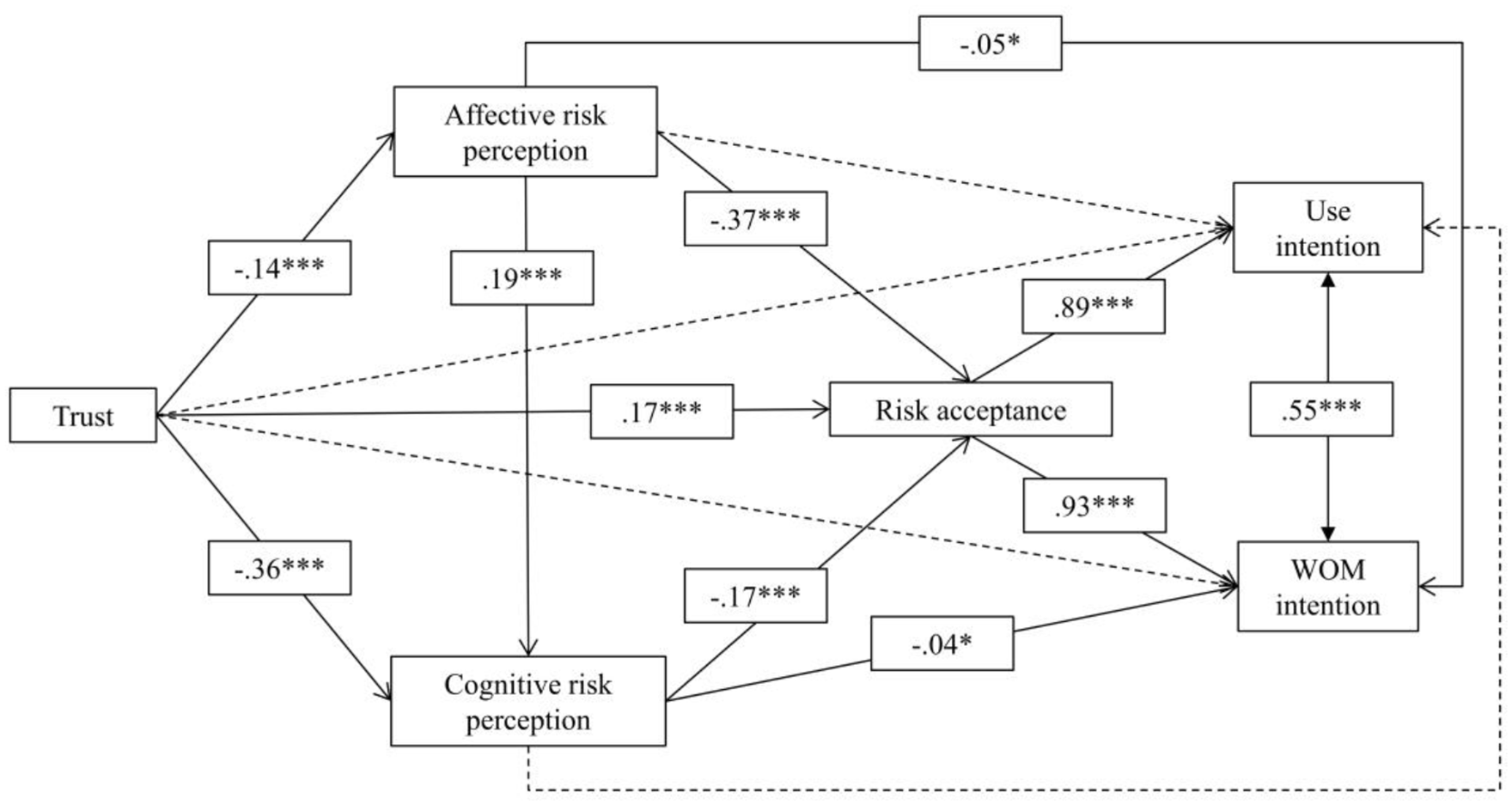
Final model based on Hong Kong sample. Betas are standardized coefficients.

Final model based on Mainland China sample. Betas are standardized coefficients.

Final model based on Taiwan sample. Betas are standardized coefficients.
Examining Direct Relationships
Examination of the direct effects along each layer of the model showed that trust in regulatory authorities was negatively related to affective risk perception (Hong Kong: β = −.14, p < .001; Mainland China: β = −.19, p < .001; Taiwan: β = −.17, p < .001) and cognitive risk perception (Hong Kong: β = −.36, p < .001; Mainland China: β = −.32, p < .001; Taiwan: β = −.30, p < .001), while positively associated with risk acceptance (Hong Kong: β = .17, p < .001; Mainland China: β = .11, p < .01; Taiwan: β = .22, p < .001). While the Hong Kong sample did not exhibit any relationships between trust and behavioral intentions, trust was positively related to both use intention (β = .05, p < .05) and WOM intention (β = .06, p < .01) for the Mainland China sample, while showed marginally significant relationship with WOM intention (β = .03, p < .10) for the Taiwan sample.
In all models, affective risk perception was positively related to cognitive risk perception (Hong Kong: β = .19, p < .001; Mainland China: β = .07, p < .10; Taiwan: β = .35, p < .001) while negatively related to risk acceptance (Hong Kong: β = −.37, p < .001; Mainland China: β = −.17, p < .001; Taiwan: β = −.45, p < .001). Cognitive risk perception was also negatively related to risk acceptance (Hong Kong: β = −.17, p < .001; Mainland China: β = −.40, p < .001; Taiwan: β = −.30, p < .001). While the China sample showed no significant relationship between risk perceptions and behavioral intentions, affective risk perception (β = −.05, p < .05) and cognitive risk perception (β = −.04, p < .05) were related to WOM intention for the Hong Kong sample, while cognitive risk perception was related to use intention (β = −.05, p < .01) for the Taiwan sample.
All models featured significant direct paths from risk acceptance to use intention (Hong Kong: β = .89, p < .001; Mainland China: β = .92, p < .001; Taiwan: β = .94, p < .001) and WOM intention (Hong Kong: β = .93, p < .001; Mainland China: β = .94, p < .001; Taiwan: β = .89, p < .001). Moreover, both behavioral intentions were positively related to each other with betas between .47 and .76.
Examining Indirect Relationships
Further analyses were conducted to examine the mediating relationships between trust and behavioral intentions. As expected, trust in regulatory authorities exhibited indirect effects on use intention (Hong Kong: β = .27, p < .001; Mainland China: β = .25, p < .001; Taiwan: β = .32, p < .001) and WOM intention (Hong Kong: β = .29, p < .001; Mainland China: β = .27, p < .001; Taiwan: β = .28, p < .001) across all three samples. These represent total indirect effects. Table 2 summarizes the specific and total indirect pathways from trust to behavioral intentions across samples.
Summary of Indirect Effects Comparisons Among the Three Samples.
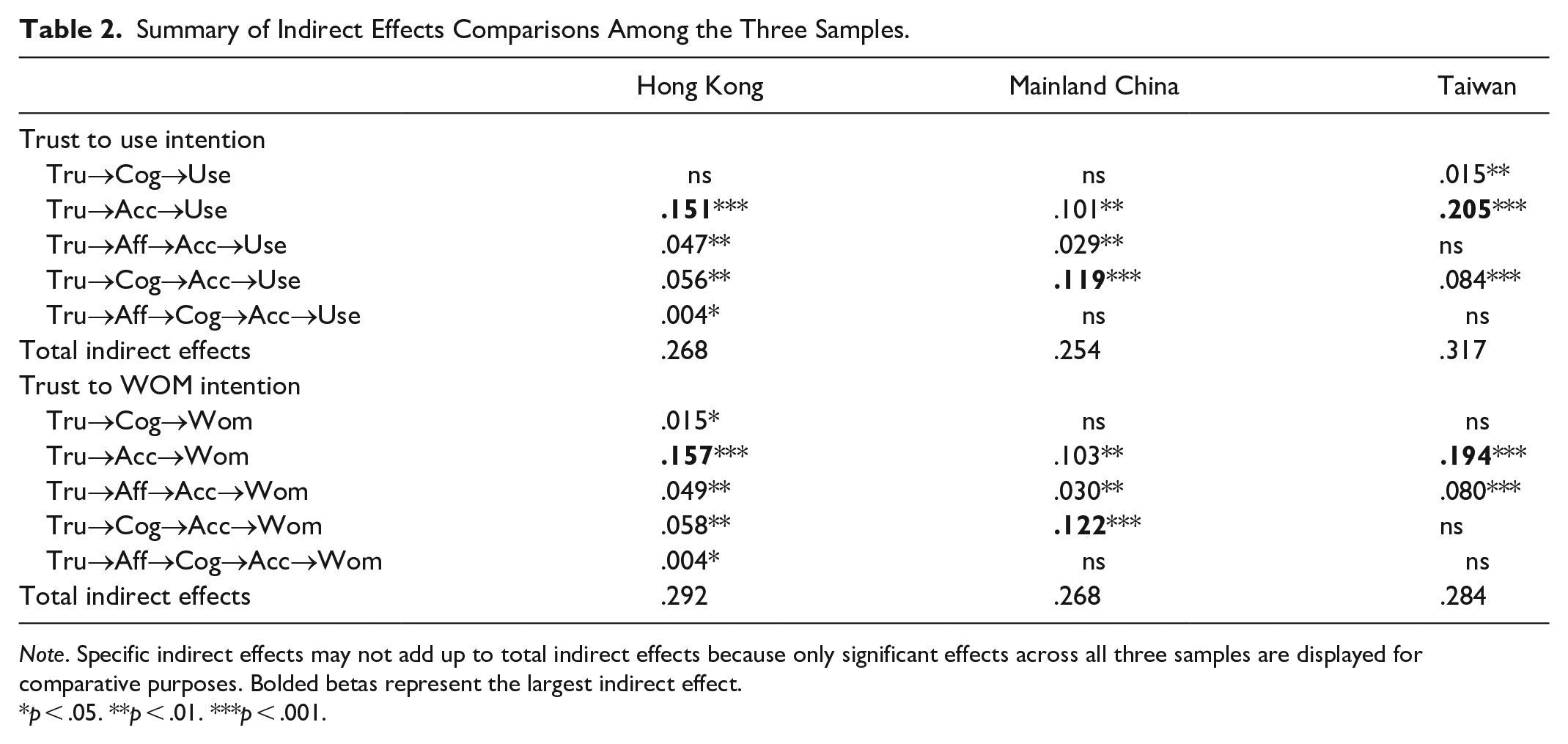
Note. Specific indirect effects may not add up to total indirect effects because only significant effects across all three samples are displayed for comparative purposes. Bolded betas represent the largest indirect effect.
p < .05. **p < .01. ***p < .001.
A closer inspection of specific indirect effects makes it possible to examine the relative strength of each path as a proportion of the total indirect effects. Similar pathways to behavioral intentions were observed across three samples. The trust/acceptance combinations all predicted use intention and WOM intention and accounted for much of the proportion of the total indirect effects. Several differences were captured among samples. The Mainland China sample showed a trust → cognitive risk perception → risk acceptance → use/WOM intention path that accounted for the largest proportion of the total indirect effects (Hong Kong: 20.90%/19.86%; Mainland China: 46.85%/45.52%; Taiwan: 26.50%/3.17%). 2 One plausible explanation would be that apart from several focal events drawing immediate public attention (e.g., the panic-buy salt over nuclear threat in 2011, the “315” gala in 2017), the post-Fukushima food imports were off the public agenda for most of the time since 2011. The discontinued public exposure coupled with government restrictions, either actual or perceived, on sensitive food safety scandals were likely to weaken respondents’ issue-specific familiarity and awareness. This lack of access to sufficient and transparent information may motivate them to perform probability-based assessments on the threats and hazards of imported foods in the light of readily available cues, especially those provided by recently occurring food safety crises in Mainland (e.g., contaminated milk powder scandal, McDonald’s rotten meat scandal, lead-contaminated drinking water incident) to further judge the risk acceptability and make decisions about consumption or WOM. The trust to acceptance path was more prominent for the Taiwan sample (Hong Kong: 56.34%/53.77%; Mainland China: 39.76%/38.43%; Taiwan: 64.67%/68.31%). 3 Unlike the situation in Mainland China, the highly politicized “nuclear food referendum” in Taiwan stirred up a huge social controversy as well as a long-lasting partisan battle between the KMT (blue camp) and the DPP (green camp) on the issue of post-Fukushima food imports. This ensured citizens’ continuous exposure to relevant information through either media platforms or interpersonal discussions. The variety of communication channels combined with a free press and a more vibrant online information environment can provide Taiwanese many navigating sources to form personal attitudes toward risk issues and cultivate a relatively stable risk acceptability only through which their perceived trustworthiness of regulatory authorities can influence their decisions to consume or promote food imported from disaster-affected areas.
Discussion
Grounded on the Causal Chain model, this study proposed an integrative framework examining the effects of trust in regulatory authorities on behavioral intentions across Hong Kong, Mainland China, and Taiwan. Risk perception and risk acceptance work as mediators. To extend the consensus model, we adopted the dual-process view of risk perception (De Vocht et al., 2015; Finucane et al., 2000; Richardson et al., 2012; Slovic & Peters, 2006) and examined the role of both cognitive and affective components in perceiving risks. This speaks to Janssen et al.’s (2012) call for differentiating two dimensions of risk perception (i.e., thinking vs. feeling) of health-related issues. Moreover, we moved beyond the existing boundary-blurring efforts (e.g., Ross et al., 2014; Siegrist, 2000) and conceptually distinguished risk acceptance from behavioral intention to address the absent link between the consensus model and behavioral intention. As contextual contingency and management localization may affect the role of trust in risk assessment, we also investigated the utility of the extended model and compared potential contextual differences across three societies that have different political and food regulatory systems.
Three sets of findings can be obtained across the samples. First, trust played a significant role in influencing two types of risk perception and risk acceptance, which confirms the Causal Chain model after specifying the dual-process view of risk perception. This has also strengthened the applicability of the Causal Chain model in deciphering risk assessment in technological hazards (Bronfman et al., 2008). Additionally, the relationship between trust and cognitive risk perception was uniformly higher than that between trust and affective risk perception. There is a significant gap between scientific consensus and public opinion regarding the safety of food imported from nuclear-contaminated areas in Japan. As nonscientific publics have limited ways to evaluate the potential threat, they need to rely on messages announced by government regulators to monitor the risk surroundings. Trust in regulators serves as a rational mechanism that reduces the cognitive complexity of risk assessment and provides necessary guiding principles for the effective self-protection. Therefore, it is necessary for regulatory authorities to enhance their credibility and execution so as to build a service-oriented image and to strengthen the public trust toward the risk management process. This provides a prerequisite for effective risk communication and is likely to benefit the formulation of meaningful food safety policies.
The second pattern of findings concerns the role of risk acceptance, which was the most important mediator in explaining the integrative framework. Among all specific indirect pathways, the trust → risk acceptance → use/WOM intention pathway consistently comprised a large proportion of the total effect sizes. In the current case, public stakeholders would rather form a rational community that makes judgment based on available knowledge and accessible information than show complete “blind trust” in regulators. Their intentions to either consume or promote food imported from disaster areas are largely subject to the extent to which they are willing to accept the potential threats. As thus, the remarkable gap between scientific experts and nonscientific publics cannot be filled by constantly improving the public trust in government regulators. Granted, the widespread anxiety expressed during the crisis was aggravated by the inaccurate and inconsistent instructional risk messages communicated to public stakeholders. Regulatory authorities are thus expected to establish a dialogic communication platform with nonexperts and ensure information openness and transparency such that the public skepticism can be eased in the two-way symmetric interaction. Social media platforms, which exhibit robust affordances in interactivity and instantaneity, could be used by organizational communicators to convey accurate risk messages, explain the risky states for public comprehension, and fully understand the real-time public opinion.
The third set of findings relate to the distinction between risk acceptance and behavioral intention. Specifically, two types of risk perception were significantly related to the public’s willingness to accept post-Fukushima food imports, while exhibited much less influence on their behavioral intentions. This contrast was starker for the Mainland China sample, wherein none of the four direct pathways from risk perception to behavioral intention showed significance. Unlike the findings of scholars that compared the differential contribution of affective and cognitive risk perceptions to behavioral intention (De Vocht et al., 2015; Richardson et al., 2012; Sobkow et al., 2016), the present study found that the relationships were rather indirect, such that how people perceive risks predicted risk acceptance, which in turn was related to various forms of behavioral intention. On one hand, such finding supports the necessity of distinguishing risk acceptance and behavioral intention as two self-contained constructs working in sequence. On the other hand, this indicates that the transition from “subjective tolerance” to “voluntary consumption/promotion” can take time and there is still a long way to go to restore the brand image of and rebuild public confidence in Japanese food products across three Chinese societies.
While the patterns of relationships among the concerned variables are generally supportive of the integrative framework and present external validity to the proposed model, several differences across samples should be addressed. First, despite the coherent explanatory power across samples, trust exerted the greatest impact on behavioral intentions in the Mainland China sample. This finding is understandable given the higher-ranked position of China in the recent annual report of trust barometer (Edelman, 2019). People tend to perceive regulatory authorities as closer to the central government, which earns much more public trust than the local government (Li, 2004). Another possible explanation is that in Mainland China, the stricter media censorship and surveillance against negative information about large-scale food safety scandals can limit the access to expertise knowledge and restrict individuals’ motivation to resort to issue-specific reasoning in risk assessment. This in turn diverts public efforts from openly discussing risk issues to relying on readily available heuristic cues such as the trustworthiness of regulators in evaluating potential threats and making further decisions.
Contextual factors may also explain the relative strength of risk perception in the Hong Kong and Taiwan samples. Government regulators in these two regions are directly responsible for food safety policies, and thus are evaluated primarily according to their performance in protecting the public from being affected by food products imported from nuclear-contaminated areas. Moreover, the watchdog role played by media organizations in Hong Kong and Taiwan is likely to hold regulators liable, such that their trustworthiness may be eroded due to negative coverage. This perhaps encourages individuals to leverage and mobilize more affective or cognitive resources to initiate analytic-based information processing than to simply take trust-oriented routes. However, it should be noted that scientific “truths” and public opinion of food and agricultural issues are largely influenced by media reports (Wilkes et al., 2000). By shifting attention toward or away from a certain issue, framing strategies have been utilized by political actors as a means to mobilize the public in order to change or maintain a health-related policy decision (Tosun & Schaub, 2017). As thus, how socio-scientific issues such as nuclear-contaminated food safety are politicized and how the politicization is making an effect on the established relationship between trust and risk management require further clarification.
Limitations and Further Research
There are several limitations of this study and suggestions for future research to be addressed. First, the analysis of cross-sectional data can neither reach causal conclusions nor exclude alternative pathways between trust in regulators and behavioral intentions. Indeed, the purpose of this study was to examine an extended trust model and the findings were mostly supportive. Nonetheless, most findings based on the Causal Chain model to date were obtained from cross-sectional samples, and therefore more substantive panel studies with multi-wave designs would be needed to thoroughly substantiate the numerous causal relationships positioned in the integrative framework. Second, while the external validity of the extended model was tested through analyzing cross-regional samples, the inaccessibility of a probability sampling strategy makes it difficult to generalize the findings to the wide variety of public stakeholders across three Chinese societies. Moreover, both the risk context and the research design focused on the single case of post-Fukushima food imports. Future studies may consider using a more systematic sampling frame to inspect the applicability of the integrative framework in other risk contexts. Third, this study measures only the intention to perform desirable behavioral intentions of critical importance to government regulators (i.e., use and WOM). Consequences of these acts are restricted to respondents, their immediate family members and close friends. However, other pertinent behaviors such as participating in an anti-nuclear movement may impact not only individuals’ state of lives, but also the functioning of community and society at large. The motivational component linking risk acceptance to behavioral intention is likely to vary with the anticipated consequences. For instance, the high level of risk acceptance may be sufficient to motivate intentions to purchase unsafe food, but insufficient to arouse intentions to sign a petition supporting post-Fukushima food imports. In addition, the rapid development of mobile communication and chaos on social media have underscored the importance of communicative behavioral intentions in risk and crisis management. Unraveling the specific mechanism that induces communicative behavioral intentions merits more scholarly attention.
Footnotes
Data Availability Statement
The data that support the findings of this study are available from the corresponding author, Xiao Wang, upon reasonable request.
Declaration of Conflicting Interests
The author(s) declared no potential conflicts of interest with respect to the research, authorship, and/or publication of this article.
Funding
The author(s) disclosed receipt of the following financial support for the research, authorship, and/or publication of this article: This work was supported by the General Research Fund from the Research Grants Council of the Hong Kong Special Administrative Region, China (Grant No. 14616617); and the GESIS (Leibniz Institute for the Social Sciences) Grant (Grant No. GG-2019-017).
Ethical Approval
Ethical approval was granted by the Survey and Behavioral Research Ethics Committee (SBREC) at the Chinese University of Hong Kong (No. SBRE-19-090).
